
植物生态学报 ›› 2011, Vol. 35 ›› Issue (5): 539-550.DOI: 10.3724/SP.J.1258.2011.00539 cstr: 32100.14.SP.J.1258.2011.00539
所属专题: 生物多样性
刘聪1,2, 项文化1,2,*( ), 田大伦1,2,3, 方晰1,2,3, 彭长辉1,4
收稿日期:2010-11-08
接受日期:2011-01-28
出版日期:2011-11-08
发布日期:2011-06-07
作者简介:* E-mail: xiangwh2005@163.com
LIU Cong1,2, XIANG Wen-Hua1,2,*(), TIAN Da-Lun1,2,3, FANG Xi1,2,3, PENG Chang-Hui1,4
Received:2010-11-08
Accepted:2011-01-28
Online:2011-11-08
Published:2011-06-07
摘要:
细根在森林生态系统C分配和养分循环过程中发挥着重要作用, 但对地下细根与植物多样性之间关系的研究相对较少。该研究选择中亚热带从单一树种的杉木(Cunninghamia lanceolata)人工林到多树种的常绿阔叶林(青冈(Cyclobalanopsis glauca)-石栎(Lithocarpus glaber)林)的不同植物多样性梯度, 用根钻法采集细根并测定其生物量, 用Win-RHIZO 2005C根系分析系统测定细根形态参数, 以验证以下3个假设: 1)植物种类丰富度高的林分其细根生产存在“地下超产”现象; 2)根系空间生态位的分离水平是否随着植物多样性增多而增大? 3)细根是否通过形态可塑性对林木竞争做出响应?结果显示: 从单一树种的杉木人工林到植物种类较复杂的青冈-石栎常绿阔叶林, 0-30 cm土层的林分细根总生物量和活细根生物量均呈增加的趋势, 即细根总生物量为杉木林(305.20 g·m-2) <马尾松(Pinus massoniana)林(374.25 g·m-2) <南酸枣(Choerospondias axillaris)林(537.42 g·m-2) <青冈林(579.33 g·m-2), 活细根生物量为杉木林(268.74 g·m-2) <马尾松林(299.15 g·m-2) <南酸枣林(457.32 g·m-2) <青冈林(508.47 g·m-2), 各森林类型之间的细根总生物量差异显著(p < 0.05), 但活细根生物量差异不显著。土壤垂直剖面上, 除杉木林细根生物量随土层变化不显著外, 其他森林类型的活细根生物量和总细根生物量均随土层变化显著, 表层细根生物量随树种多样性的升高呈减小趋势, 据此推测树种间的生态位分离水平逐渐增大。植物多样性的不同对林分的细根形态及空间分布格局影响不显著, 细根形态可塑性对生物量变化响应不明显。
刘聪, 项文化, 田大伦, 方晰, 彭长辉. 中亚热带森林植物多样性增加导致细根生物量“超产”. 植物生态学报, 2011, 35(5): 539-550. DOI: 10.3724/SP.J.1258.2011.00539
LIU Cong, XIANG Wen-Hua, TIAN Da-Lun, FANG Xi, PENG Chang-Hui. Overyielding of fine root biomass as increasing plant species richness in subtropical forests in central southern China. Chinese Journal of Plant Ecology, 2011, 35(5): 539-550. DOI: 10.3724/SP.J.1258.2011.00539
| 森林类型 Forest type | 优势树种 Dominant species | 林分密度 Stand density (stem·hm-2) | 林龄 Stand age (a) | 平均胸径Average DBH (cm) | 平均树高Average tree height (m) | 海拔Elevation (m) | 坡向Slope aspect | 坡度 Slope |
|---|---|---|---|---|---|---|---|---|
| CL | 杉木 Cunninghamia lanceolata | 625 | 51 | 23.54 (5-35) | 19.51 (4.5-27) | 223-258 | SE | 24° |
| PM | 马尾松 Pinus massoniana 石栎 Lithocarpus glaber | 1 975 | 47 | 9.33 (5-26) | 8.37 (4-15.4) | 220-262 | SW | 15° |
| CA | 南酸枣 Choerospondias axillaris 豹皮樟 Litsea coreana var. sinensis 四川山矾 Symplocos setchuensis 台湾冬青 Ilex formosana 千年桐 Aleurites montana | 1 075 | 58 | 12.68 (5-53.7) | 6.6 (2.5-12.5) | 245-321 | W | 35° |
| CG | 青冈 Cyclobalanopsis glauca 石栎 Lithocarpus glaber 马尾松 Pinus massomiana 南酸枣 Choerospondias axillaris | 1 474 | 58 | 11.91 (5-42) | 9.30 (1-26.1) | 225-254 | NW | 22° |
表1 调查林分的基本特征
Table 1 Stand characteristics of sampled forests
| 森林类型 Forest type | 优势树种 Dominant species | 林分密度 Stand density (stem·hm-2) | 林龄 Stand age (a) | 平均胸径Average DBH (cm) | 平均树高Average tree height (m) | 海拔Elevation (m) | 坡向Slope aspect | 坡度 Slope |
|---|---|---|---|---|---|---|---|---|
| CL | 杉木 Cunninghamia lanceolata | 625 | 51 | 23.54 (5-35) | 19.51 (4.5-27) | 223-258 | SE | 24° |
| PM | 马尾松 Pinus massoniana 石栎 Lithocarpus glaber | 1 975 | 47 | 9.33 (5-26) | 8.37 (4-15.4) | 220-262 | SW | 15° |
| CA | 南酸枣 Choerospondias axillaris 豹皮樟 Litsea coreana var. sinensis 四川山矾 Symplocos setchuensis 台湾冬青 Ilex formosana 千年桐 Aleurites montana | 1 075 | 58 | 12.68 (5-53.7) | 6.6 (2.5-12.5) | 245-321 | W | 35° |
| CG | 青冈 Cyclobalanopsis glauca 石栎 Lithocarpus glaber 马尾松 Pinus massomiana 南酸枣 Choerospondias axillaris | 1 474 | 58 | 11.91 (5-42) | 9.30 (1-26.1) | 225-254 | NW | 22° |
| 参数 Parameter | 变异来源 Source of variation | ||
|---|---|---|---|
| 森林类型 Forest type | 土壤层次 Soil layer | 森林类型×土壤层次 Forest type × Soil layer | |
| 活生物量 Live biomass (g·m-2) | 0.075 6 | 0.002 2** | 0.662 6 |
| 死生物量 Necromass (g·m-2) | 0.034 2* | 0.021 0* | 0.092 1 |
| 总生物量 Total biomass (g·m-2) | 0.043 9* | 0.000 7** | 0.672 1 |
| 活根死根比 Live biomass/necromass | 0.031 1* | 0.608 1 | 0.666 2 |
| 根长密度 Root length density (RLD) (m·m-3) | 0.073 7 | <0.000 1** | 0.022 9* |
| 比根长 Specific root length (SRL) (m·g-1) | 0.000 8** | 0.875 2 | 0.791 1 |
| 比表面积 Specific root area (SRA) (cm2·g-1) | 0.000 1** | 0.331 2 | 0.650 5 |
| 比根尖密度 Specific root tips density (SRT) (no·g-1) | 0.004 0** | 0.927 2 | 0.732 6 |
| 比分叉密度 Specific root forks density (SRF) (no·g-1) | 0.031 4* | 0.244 5 | 0.656 8 |
| 根面积指数 Root ares index (RAI) (m2·m-2) | 0.214 7 | <0.000 1** | 0.011 6* |
表2 森林类型和土壤层次对细根生物量及形态特征影响的方差分析
Table 2 Variance analysis of effects of forest type and soil layer on fine root biomass and morphology
| 参数 Parameter | 变异来源 Source of variation | ||
|---|---|---|---|
| 森林类型 Forest type | 土壤层次 Soil layer | 森林类型×土壤层次 Forest type × Soil layer | |
| 活生物量 Live biomass (g·m-2) | 0.075 6 | 0.002 2** | 0.662 6 |
| 死生物量 Necromass (g·m-2) | 0.034 2* | 0.021 0* | 0.092 1 |
| 总生物量 Total biomass (g·m-2) | 0.043 9* | 0.000 7** | 0.672 1 |
| 活根死根比 Live biomass/necromass | 0.031 1* | 0.608 1 | 0.666 2 |
| 根长密度 Root length density (RLD) (m·m-3) | 0.073 7 | <0.000 1** | 0.022 9* |
| 比根长 Specific root length (SRL) (m·g-1) | 0.000 8** | 0.875 2 | 0.791 1 |
| 比表面积 Specific root area (SRA) (cm2·g-1) | 0.000 1** | 0.331 2 | 0.650 5 |
| 比根尖密度 Specific root tips density (SRT) (no·g-1) | 0.004 0** | 0.927 2 | 0.732 6 |
| 比分叉密度 Specific root forks density (SRF) (no·g-1) | 0.031 4* | 0.244 5 | 0.656 8 |
| 根面积指数 Root ares index (RAI) (m2·m-2) | 0.214 7 | <0.000 1** | 0.011 6* |
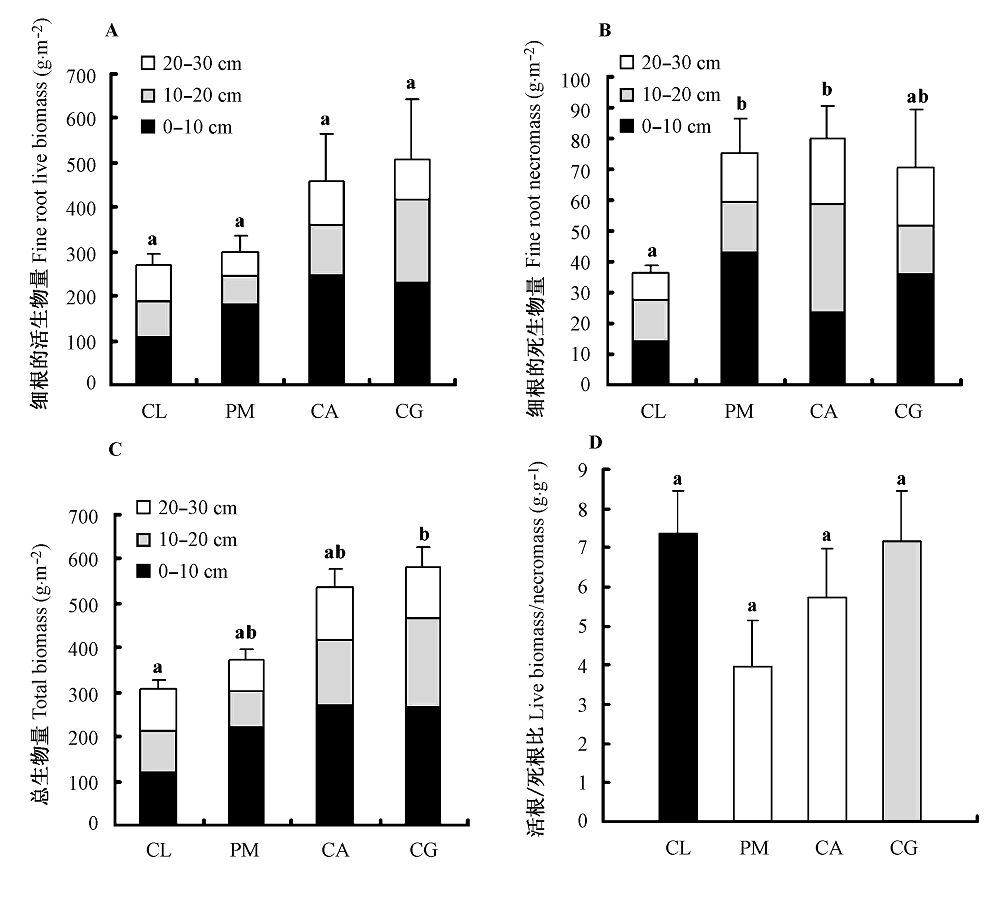
图1 不同土层4种森林类型细根的活生物量(A)、死生物量(B)、总生物量(C)和活根死根比(D) (平均值±标准误差, n = 9)。不同字母表示不同森林类型间在0-30 cm土壤层次差异显著(p < 0.05)。CA, 南酸枣林; CG, 青冈-石栎林; CL, 杉木林; PM, 马尾松-石栎林。
Fig. 1 Fine root live biomass (A), necromass (B), total biomass (C) and live biomass/necromass (D) at different soil layer of four forest types (mean ± SE, n = 9). Different letters represent signi?cant differences among different forest types for the 0-30 cm soil layer (p < 0.05). CA, Choerospondias axillaris forest; CG, Cyclobalanopsis glauca-Lithocarpus glaber forest; CL, Cunninghamia lanceolata forest; PM, Pinus massoniana-Lithocarpus glaber forest.
| 森林类型 Forest type | 土层 Soil layer (cm) | 活生物量 Live biomass (g·m-2) | 死生物量 Necromass (g·m-2) | 总生物量 Total biomass (g·m-2) | 活根死根比 Live biomass/necromass |
|---|---|---|---|---|---|
| CL | 0-10 | 106.14 (17.68)a NS | 14.10 (1.70)a NS | 120.24 (18.59)a NS | 7.92 (0.99)a NS |
| 10-20 | 81.11 (23.54)a | 13.47 (2.87)a | 94.58 (24.12)a | 8.77 (2.70)a | |
| 20-30 | 81.50 (10.34)a | 8.89 (1.81)a | 90.39 (10.21)a | 14.20 (4.80)a | |
| PM | 0-10 | 179.75 (32.60)a §** | 43.03 (8.73)b §** | 222.78 (40.11)ab §** | 4.50 (0.54)a NS |
| 10-20 | 65.30 (6.15)a | 16.29 (2.69)ab | 81.59 (7.12)a | 4.77 (0.84)a | |
| 20-30 | 54.11 (10.10)a | 15.77 (2.76)a | 69.87 (12.16)a | 3.94 (0.74)a | |
| CA | 0-10 | 246.23 (55.84)a § | 23.75 (5.88)ab NS | 269.98 (54.28)b § | 16.60 (5.63)a NS |
| 10-20 | 112.41 (58.94)a | 34.88 (9.43)b | 147.29 (63.03)a | 5.90 (2.83)a | |
| 20-30 | 98.67 (59.72)a | 21.48 (6.57)a | 120.16 (57.86)a | 13.02 (9.94)a | |
| CG | 0-10 | 229.70 (45.22)a § | 35.95 (9.57)ab § | 265.65 (48.32)b § | 11.21 (3.79)a NS |
| 10-20 | 186.76 (86.11)a | 15.66 (4.30)ab | 202.41 (85.45)a | 20.11 (7.51)a | |
| 20-30 | 92.01 (38.69)a | 19.26 (11.85)a | 111.27 (39.29)a | 22.01 (10.52)a |
表3 不同土层4种森林类型细根的活、死生物量及其比值(平均值(标准误差))
Table 3 Fine root live biomass, necromass and their ratio at different soil layer under four forest types (mean (SE))
| 森林类型 Forest type | 土层 Soil layer (cm) | 活生物量 Live biomass (g·m-2) | 死生物量 Necromass (g·m-2) | 总生物量 Total biomass (g·m-2) | 活根死根比 Live biomass/necromass |
|---|---|---|---|---|---|
| CL | 0-10 | 106.14 (17.68)a NS | 14.10 (1.70)a NS | 120.24 (18.59)a NS | 7.92 (0.99)a NS |
| 10-20 | 81.11 (23.54)a | 13.47 (2.87)a | 94.58 (24.12)a | 8.77 (2.70)a | |
| 20-30 | 81.50 (10.34)a | 8.89 (1.81)a | 90.39 (10.21)a | 14.20 (4.80)a | |
| PM | 0-10 | 179.75 (32.60)a §** | 43.03 (8.73)b §** | 222.78 (40.11)ab §** | 4.50 (0.54)a NS |
| 10-20 | 65.30 (6.15)a | 16.29 (2.69)ab | 81.59 (7.12)a | 4.77 (0.84)a | |
| 20-30 | 54.11 (10.10)a | 15.77 (2.76)a | 69.87 (12.16)a | 3.94 (0.74)a | |
| CA | 0-10 | 246.23 (55.84)a § | 23.75 (5.88)ab NS | 269.98 (54.28)b § | 16.60 (5.63)a NS |
| 10-20 | 112.41 (58.94)a | 34.88 (9.43)b | 147.29 (63.03)a | 5.90 (2.83)a | |
| 20-30 | 98.67 (59.72)a | 21.48 (6.57)a | 120.16 (57.86)a | 13.02 (9.94)a | |
| CG | 0-10 | 229.70 (45.22)a § | 35.95 (9.57)ab § | 265.65 (48.32)b § | 11.21 (3.79)a NS |
| 10-20 | 186.76 (86.11)a | 15.66 (4.30)ab | 202.41 (85.45)a | 20.11 (7.51)a | |
| 20-30 | 92.01 (38.69)a | 19.26 (11.85)a | 111.27 (39.29)a | 22.01 (10.52)a |
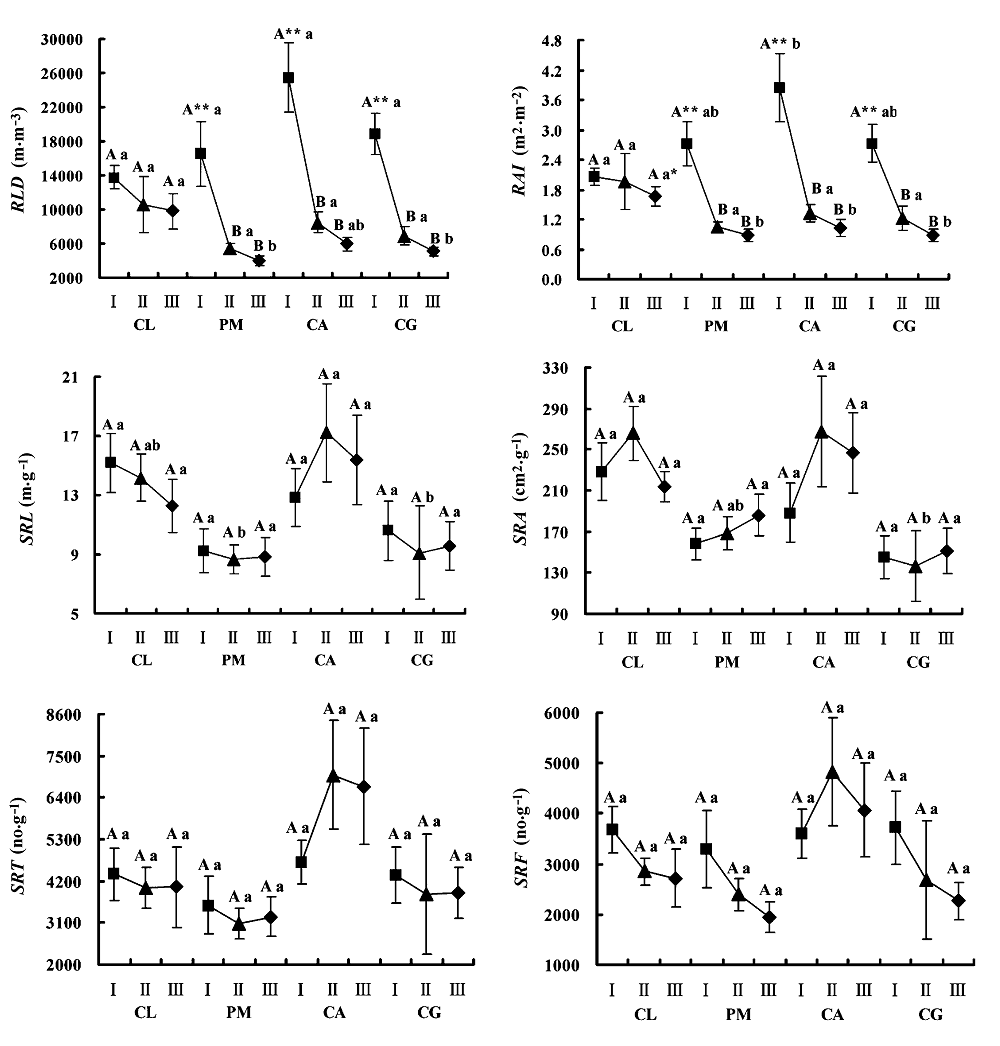
图2 不同森林类型各土层细根的形态参数比较。CA、CG、CL和PM见表1, RAI、RLD、SRA、SRF、SRL和SRT见表2。相同字母表示每种森林类型各土层间(大写字母)或不同森林同一土层间(小写字母)细根形态指标无显著差异。I、II和III分别表示0-10、10-20和20-30 cm土层。
Fig. 2 Comparison of fine root morphological parameters among different soil layers of different forest types. CA, CG, CL and PM see Table 1, RAI, RLD, SRA, SRF, SRL and SRT see Table 2. Values with same letter indicate no significant differences among the soil layers (capital letters) or forest type (small letters). *, p < 0.05; **, p < 0.01; I, 0-10 cm; II, 10-20 cm; III, 20-30 cm.
| [1] |
Bakker MR, George E, Turpault MP, Zhang JL, Zeller B (2004). Impact of Douglas-fir and Scots pine seedlings on plagioclase weathering under acidic conditions. Plant and Soil, 266, 247-259.
DOI URL |
| [2] |
Bauhus J, Khanna PK, Menden N (2000). Aboveground and belowground interactions in mixed plantations of Eucalyptus globulus and Acacia mearnsii. Canadian Journal of Forest Research, 30, 1886-1894.
DOI URL |
| [3] |
Bayala J, Teklehaimanot Z, Ouedrango SJ (2004). Fine root distribution of pruned trees and associated crops in a parkland system in Burkina Faso. Agroforestry Systems, 60, 13-26.
DOI URL |
| [4] | Caldwell MM, Pearcy RW (1994). Exploitation of Environmental Heterogeneity by Plants: Ecophysiological Processes Above- and Belowground. Academic Press, San Diego, USA. |
| [5] | Chen W (陈伟), Xue L (薛立) (2004). Root interactions: competition and facilitation. Acta Ecologica Sinica (生态学报), 24, 1243-1251. (in Chinese with English abstract) |
| [6] |
Craine JM (2006). Competition for nutrients and optimal root allocation. Plant and Soil, 285, 171-185.
DOI URL |
| [7] |
Cronan CS (2003). Belowground biomass, production, and carbon cycling in mature Norway spruce, Maine, U.S.A. Canadian Journal of Forest Research, 33, 339-350.
DOI URL |
| [8] |
Cuevas E, Brown S, Lugo AE (1991). Above- and below ground organic matter storage and production in a tropical pine plantation and a paired broadleaf secondary forest. Plant and Soil, 135, 257-268.
DOI URL |
| [9] |
Curt T, Prévosto B (2003). Rooting strategy of naturally regenerated beech in Silver birch and Scots pine woodlands. Plant and Soil, 255, 265-279.
DOI URL |
| [10] |
Erskine PD, Lamb D, Bristow M (2006). Tree species diversity and ecosystem function: Can tropical multi-species plantations generate greater productivity? Forest Ecology and Management, 233, 205-210.
DOI URL |
| [11] |
Ewel JJ, Mazzarino MJ (2008). Competition from below for light and nutrients shifts productivity among tropical species. Proceedings of the National Academy of Sciences of the United States of America, 105, 18836-18841.
DOI URL PMID |
| [12] |
Fransen B, de Kroon H, Berendse F (1998). Root morphological plasticity and nutrient acquisition of perennial grass species from habitats of different nutrient availability. Oecologia, 115, 351-358.
URL PMID |
| [13] |
Gamfeldt L, Hillebrand H, Jonsson PR (2008). Multiple functions increase the importance of biodiversity for overall ecosystem functioning. Ecology, 89, 1223-1231.
DOI URL PMID |
| [14] |
Grier CC, Vogt KA, Keyes MR, Edmonds RL (1981). Biomass distribution and above- and below-ground production in young and mature Abies amabilis zone ecosystems of the Washington Cascades. Canadian Journal of Forest Research, 11, 155-167.
DOI URL |
| [15] |
Guo DL, Mitchell RJ, Hendricks JJ (2004). Fine root branch orders respond differentially to carbon source-sink manipulations in a longleaf pine forest. Oecologia, 140, 450-457.
DOI URL PMID |
| [16] | Hector A (2001). Biodiversity and functioning of grassland ecosystems: multi-site comparison. In: Kinzig AP, Tilman D, Pacala SW eds. The Functional Consequences of Biodiversity: Empirical Progress and Theoretical Extensions. Princeton University Press, Princeton. 71-95. |
| [17] |
Hector A (2006). Overyielding and stable species coexistence. New Phytologist, 172, 1-3.
DOI URL PMID |
| [18] | Hendrick RL, Pregitzer KS (1996). Temporal and depth-related patterns of fine root dynamics in northern hardwood forests. Ecology, 84, 167-176. |
| [19] |
Hendriks CMA, Bianchi FJJA (1995). Root density and root biomass in pure and mixed forest stands of Douglas-fir and beech. Netherlands Journal of Agricultural Science, 43, 321-331.
DOI URL |
| [20] |
Hodge A (2004). The plastic plant: root responses to heterog- eneous supplies of nutrients. New Phytologist, 162, 9-24.
DOI URL |
| [21] |
Hooper DU, Chapin FS, Ewel JJ, Hector A, Inchausti P, Lavorel S, Lawton JH, Lodge DM, Loreau M, Naeem S, Schmid B, Setälä H, Symstad AJ, Vandermeer J, Wardle DA (2005). Effects of biodiversity on ecosystem functioning: a consensus of current knowledge. Ecological Monographs, 75, 3-35.
DOI URL |
| [22] |
Hooper DU, Dukes JS (2004). Overyielding among plant functional groups in a long-term experiment. Ecology Letters, 7, 95-105.
DOI URL |
| [23] |
Jackson RB, Canadell J, Ehleringer JR, Mooney HA, Sala OE, Schulze ED (1996). A global analysis of root distribution for terrestrial biomes. Oecologia, 108, 389-411.
URL PMID |
| [24] |
Jose S, Williams R, Zamora D (2006). Belowground ecological interactions in mixed-species forest plantations. Forest Ecology and Management, 233, 231-239.
DOI URL |
| [25] |
Légaré S, Bergeron Y, Paré D (2005). Effect of aspen (Populus tremuloides) as a companion species on the growth of black spruce (Picea mariana) in the southwestern boreal forest of Quebec. Forest Ecology and Management, 208, 211-222.
DOI URL |
| [26] |
Lehmann J (2003). Subsoil root activity in tree-based cropping systems. Plant and Soil, 255, 319-331.
DOI URL |
| [27] |
Lehmann J, Zech W (1998). Fine root turnover of irrigated hedgerow intercropping in Northern Kenya. Plant and Soil, 198, 19-31.
DOI URL |
| [28] | Leuschner C, Hertel D (2002). Fine root biomass of temperate forests in relation to soil acidity and fertility, climate, age and species. Progress in Botany, 64, 405-438. |
| [29] |
Leuschner C, Hertel D, Coners H, Büttner V (2001). Root competition between beech and oak: a hypothesis. Oecologia, 126, 276-284.
DOI URL PMID |
| [30] |
Leuschner C, Hertel D, Schmid I, Koch O, Muhs A, Hölscher D (2004). Stand fine root biomass and fine root morphology in old-growth beech forests as a function of precipitation and soil fertility. Plant and Soil, 258, 43-56.
DOI URL |
| [31] |
Leuschner C, Jungkunst HF, Fleck S (2009). Functional role of forest diversity: pros and cons of synthetic stands and across-site comparisons in established forests. Basic and Applied Ecology, 10, 1-9.
DOI URL |
| [32] | Liao LP (廖利平), Chen CY (陈楚莹), Zhang JW (张家武), Gao H (高洪) (1995). Turnover of fine roots in pure and mixed Cunninghamia lanceolata and Michelia macclurei forests. Chinese Journal of Applied Ecology (应用生态学报), 6, 7-10. (in Chinese with English abstract) |
| [33] | Liu J (刘佳), Xiang WH (项文化), Xu X (徐晓), Chen R (陈瑞), Tian DL (田大伦), Peng CH (彭长辉), Fang X (方晰) (2010). Analysis of architecture and functions of fine roots of five subtropical tree species in Huitong. Chinese Journal of Plant Ecology (植物生态学报), 34, 938-945. (in Chinese with English abstract ) |
| [34] |
Loreau M (1998). Biodiversity and ecosystem functioning: a mechanistic model. Proceedings of the National Academy of Sciences of the United States of America, 95, 5632-5636.
URL PMID |
| [35] | Mei L (梅莉), Wang ZQ (王政权), Han YZ (韩有志), Gu JC (谷加存), Wang XR (王向荣), Cheng YH (程云环), Zhang XJ (张秀娟) (2006). Distribution patterns of Fraxinus mandshurica root biomass, specific root length and root length density. Chinese Journal of Applied Ecology (应用生态学报), 17, 1-4. (in Chinese with English abstract) |
| [36] |
Meinen C, Hertel D, Leuschner C (2009). Biomass and morphology of fine roots in temperate broad-leaved forests differing in tree species diversity is there evidence of below-ground overyielding? Oecologia, 161, 99-111.
URL PMID |
| [37] | Morgan JL, Campbell JM, Malcolm DC (1992). Nitrogen relations of mixed-species stands on oligotrophic soils. In: Cannell MGR, Malcolm DC, Robertson PA eds. The Ecology of Mixed-species Stands of Trees. Blackwell, London. 65-85. |
| [38] |
Ostonen I, Lõhmus K, Helmisaari HS, Truu J, Meel S (2007). Fine root morphological adaptations in Scots pine, Norway spruce and silver birch along a latitudinal gradient in boreal forests. Tree Physiology, 27, 1627-1634.
URL PMID |
| [39] |
Pate JS, Bell TL (1999). Application of the ecosystem mimic concept to the species-rich Banksia Woodlands of Western Australia. Agroforestry Systems, 45, 303-341.
DOI URL |
| [40] |
Persson H, Ahlström K (2002). Fine root response to nitrogen supply in nitrogen manipulated Norway spruce catchment areas. Forest Ecology and Management, 168, 29-41.
DOI URL |
| [41] |
Persson H, von Fircks Y, Majdi H, Nilsson LO (1995). Root distribution in a Norway spruce (Picea abies (L.) Karst.) stand subjected to drought and ammonium-sulfate application. Plant and Soil, 168-169, 161-165.
DOI URL |
| [42] |
Pregitzer KS (2002). Fine roots of trees―a new perspective. New Phytologist, 154, 267-270.
DOI URL |
| [43] |
Pregitzer KS, Laskowski MJ, Burton AJ, Lessard VC, Zak DR (1998). Variation in sugar maple root respiration with root diameter and soil depth. Tree Physiology, 18, 665-670.
URL PMID |
| [44] |
Roscher C, Temperton VM, Scherer-Lorenzen M, Schmitz M, Schumacher J, Schmid B, Buchmann N, Weisser WW, Schulze ED (2005). Overyielding in experimental grassland communities: irrespective of species pool or spatial scale. Ecology Letters, 8, 419-429.
DOI URL |
| [45] |
Scherer-Lorenzen M, Schulze ED, Don A, Schumacher J, Weller E (2007). Exploring the functional significance of forest diversity: a new long-term experiment with temperate tree species (BIOTREE). Perspectives in Plant Ecology, Evolution and Systematics, 9, 53-70.
DOI URL |
| [46] | Schmid B, Joshi J, Schläpfer F (2001). Empirical evidence for biodiversity ecosystem functioning relationships. In: Kinzig AP, Pacala SW, Tilman D eds. The Functional Consequences of Biodiversity: Empirical Progress and Theoretical Extensions. Princeton University Press, Princeton. 120-150. |
| [47] |
Schmid I, Kazda M (2002). Root distribution of Norway spruce in monospecific and mixed stands on different soils. Forest Ecology and Management, 159, 37-47.
DOI URL |
| [48] | Wang ST (王树堂), Han SJ (韩士杰), Zhang JH (张军辉), Wang CG (王存国), Xu Y (徐媛), Li XF (李雪峰), Wang SQ (王树起) (2010). Woody plant fine root biomass and its spatial distribution in top soil of broad-leaved Korean pine forest in Changbai Mountain. Chinese Journal of Applied Ecology (应用生态学报), 21, 583-589. (in Chinese with English abstract) |
| [49] | Wen DZ (温达志), Wei P (魏平), Kong GH (孔国辉), Ye WH (叶万辉) (1999). Production and turnover rate of fine roots in two lower subtropical forest sites at Dinghushan. Acta Phytoecologica Sinica (植物生态学报), 23, 361-369. (in Chinese with English abstract) |
| [50] | Yang YS (杨玉盛), Chen GS (陈光水), Lin P (林鹏), Huang RZ (黄荣珍), Chen YX (陈银秀), He ZM (何宗明) (2003). Fine root distribution, seasonal pattern and production in a native forest and monoculture plantations in subtropical China. Acta Ecologica Sinica (生态学报), 29, 229-232. (in Chinese with English abstract) |
| [51] | Zhou Y (周毅), Deng XJ (邓学建), Mi XQ (米小其), Niu YD (牛艳东) (2007). Investigation of avifauna community construction and diversity of Dashanchong of Changsha in Hunan Province. Hunan Forestry Science & Technology (湖南林业科技), 34(2), 35-37. (in Chinese with English abstract) |
| [1] | 杨梅花, 张子嘉, 乔栋, 冯俊娜, 庞子杰, 钱龙, 刘志晖, 蔡娜娜, 胡中民, 杨国姣. 海南热带森林乔木群落调查和多样性数据集[J]. 植物生态学报, 2026, 50(预发表): 0-. |
| [2] | 马建辉, 童鑫, 张思榕, 毛子昆, 秦俊, 马克平. 菌根真菌生理生态功能研究进展及展望[J]. 植物生态学报, 2026, 50(3): 498-514. |
| [3] | 邹纪开, 吴佳怡, 谷云懿, 陈宝明. 不同形态氮添加与丛枝菌根真菌对外来入侵植物白花鬼针草竞争力的影响[J]. 植物生态学报, 2026, 50(3): 722-730. |
| [4] | 王梦雪, 胡明艳, 储诚进, 陈阳, 罗文启, 马子龙. 亚热带森林不同菌根真菌树种叶片和细根的碳氮磷化学计量特征[J]. 植物生态学报, 2026, 50(2): 334-343. |
| [5] | 张静, 陈洁, 李艳朋, 盘李军, 许涵, 李意德, 何海生. 南亚热带针阔混交人工林植物生物量比较及其影响因子分析[J]. 植物生态学报, 2026, 50(2): 400-416. |
| [6] | 李沁, 贺鹏程, 叶清. 华南国家植物园24种植物花与叶片功能性状变异[J]. 植物生态学报, 2026, 50(2): 474-488. |
| [7] | 侯霄帆, 马辰涵, 孙语倩, 高钰涵, 李品. 臭氧胁迫下叶片与细根凋落物分解的生态化学计量特征差异[J]. 植物生态学报, 2026, 50(2): 268-278. |
| [8] | 徐恩相, 周蕾, 章晓炜, 张国萍, 仲杜伟, 黄智, 刘派, 迟永刚. 基于不同生育阶段冠层光谱和碳通量的水稻产量估算[J]. 植物生态学报, 2026, 50(1): 82-93. |
| [9] | 梁天豪, 吴帆, 黄锦学, 景陈鸿, 傅贺菁, 杨智杰, 熊德成. 增温对中亚热带格氏栲天然林细根生长量及形态特征的影响[J]. 植物生态学报, 2026, 50(1): 94-106. |
| [10] | 朱瑞德, 杨俊薇, 刘宵含, 陈冰瑞, 池秀莲, 田地, 杨光, 程蒙, 戴亚峰, 王诗文. 霍山石斛设施和林下栽培模式中养分对植物-微生物关联的调控[J]. 植物生态学报, 2025, 49(9): 1434-1447. |
| [11] | 宋珊珊, 唐志尧. 河北塞罕坝草甸草原根际土壤真菌与植物地上生物量的关系[J]. 植物生态学报, 2025, 49(9): 1461-1471. |
| [12] | 邢强, 赵斌, 胡永红, 杨君, 秦俊, 刘何铭, 王红兵, 周鹏. 华东地区两种典型立体绿化植物根系性状特征及对新型土壤基质的响应[J]. 植物生态学报, 2025, 49(9): 1498-1514. |
| [13] | 张法伟, 李红琴, 祝景彬, 樊博, 周华坤, 李英年, 梁乃申. 氮添加和降水改变对高寒草甸生态系统地上与地下碳储的影响[J]. 植物生态学报, 2025, 49(9): 1399-1409. |
| [14] | 樊月玲, 蒋正德, 叶佳舒, 郑立臣, 陈欣. 2005-2015年下辽河平原农田长期观测样地主要农作物收获期性状和产量数据集[J]. 植物生态学报, 2025, 49(8): 1271-1282. |
| [15] | 刘新月, 王立平, 刘春和, 孙艳丽, 刘鹏, 田赟, 贾昕, 查天山, 钱多. 北京不同林龄人工林生物量空间格局及其影响因素[J]. 植物生态学报, 2025, 49(6): 939-951. |
| 阅读次数 | ||||||
|
全文 |
|
|||||
|
摘要 |
|
|||||
Copyright © 2026 版权所有 《植物生态学报》编辑部
地址: 北京香山南辛村20号, 邮编: 100093
Tel.: 010-62836134, 62836138; Fax: 010-82599431; E-mail: apes@ibcas.ac.cn, cjpe@ibcas.ac.cn
备案号: 京ICP备16067583号-19

