
植物生态学报 ›› 2025, Vol. 49 ›› Issue (9): 1399-1409.DOI: 10.17521/cjpe.2024.0243 cstr: 32100.14.cjpe.2024.0243
张法伟1,*( )(
)( ), 李红琴2, 祝景彬3, 樊博1, 周华坤1, 李英年1, 梁乃申4
收稿日期:2024-07-25
接受日期:2025-01-14
出版日期:2025-09-20
发布日期:2025-01-15
作者简介:*张法伟: ORCID: 0000-0003-0693-7956 E-mail: mywing963@126.com
基金资助:
ZHANG Fa-Wei1,*()(), LI Hong-Qin2, ZHU Jing-Bin3, FAN Bo1, ZHOU Hua-Kun1, LI Ying-Nian1, LIANG Nai-Shen4
Received:2024-07-25
Accepted:2025-01-14
Online:2025-09-20
Published:2025-01-15
Supported by:摘要: 高寒草甸生态系统具有重要的碳储功能但相对脆弱, 理解其对大气氮沉降和降水格局改变的响应是准确评估全球变化下系统碳收支的科学基础。基于2017年在青藏高原东北隅建立的高寒草甸氮添加(10 g·m-2·a-1)和降水改变(减雨50%和增雨50%)实验平台, 分析2022-2023年植被生物量和土壤有机碳含量(SOCC)及组分的变化, 探讨高寒草甸生态系统碳储对氮水改变的响应。结果表明氮添加和降水改变对群落地上生物量(AGB)无显著交互作用。群落AGB对氮水改变的响应具有显著的功能群依赖性, 氮添加处理显著提高莎草类和禾草类AGB。减雨50%处理显著降低群落AGB约27%, 但增雨50%处理无显著作用。除了莎草类, 其他功能群AGB在群落AGB中的占比无显著变化。0-40 cm地下生物量(BGB)和SOCC对氮水改变的响应微弱, 表现出土壤深度和年际的依赖性。氮添加和减雨50%处理分别降低和提高根冠比约31%和83%。氮添加处理仅显著提升土壤表层(0-10 cm)矿物结合态有机碳(MAOC)含量约31%。氮水改变下群落AGB的响应比(RR)主要受控于禾草类AGB。0-40 cm BGB的RR受土壤表层和深层(20-40 cm) BGB的影响。0-40 cm SOCC的RR由各层SOCC共同驱动。土壤表层BGB直接正向调控表层颗粒态有机碳(POC)含量并通过POC间接负向影响表层MAOC。群落AGB正向调控深层MAOC含量但负向影响深层POC含量。因此, 氮水改变的主效应而非交互效应影响了高寒草甸AGB, 但对BGB和SOCC的作用微弱。植被生物量对土壤有机碳组分含量的影响具有深度依赖性。
张法伟, 李红琴, 祝景彬, 樊博, 周华坤, 李英年, 梁乃申. 氮添加和降水改变对高寒草甸生态系统地上与地下碳储的影响. 植物生态学报, 2025, 49(9): 1399-1409. DOI: 10.17521/cjpe.2024.0243
ZHANG Fa-Wei, LI Hong-Qin, ZHU Jing-Bin, FAN Bo, ZHOU Hua-Kun, LI Ying-Nian, LIANG Nai-Shen. Response of aboveground and belowground carbon storage to nitrogen addition and precipitation change in an alpine meadow ecosystem. Chinese Journal of Plant Ecology, 2025, 49(9): 1399-1409. DOI: 10.17521/cjpe.2024.0243
| 变量 Variables | 地上 生物量 AGB | 地下 生物量 BGB | 根冠比 R/S | 土壤全氮含量 SNC | 土壤全磷 含量 SPC | 土壤碱解氮含量 SNaC | 土壤速效磷含量 SPaC | 土壤pH Soil pH | 土壤有机碳含量 SOCC | 颗粒态 有机碳 含量 POC content | 矿物结合态有机碳含量 MAOC content |
|---|---|---|---|---|---|---|---|---|---|---|---|
| 降水改变 Rain | 3.79* | 1.46 | 4.07* | 2.01 | 0.68 | 0.30 | 1.13 | 18.10*** | 4.10* | 0.16 | 0.33 |
| 氮添加 N | 0.57 | 0.44 | 11.03** | 1.32 | 0.95 | 7.25** | 0.15 | 0.10 | 1.30 | 1.49 | 5.73* |
| 土壤深度(功能群) SD (FG) | 86.55*** | 319.71*** | − | 660.93*** | 25.29*** | 176.22*** | 177.46*** | 638.30*** | 434.59*** | 119.47*** | 213.64*** |
| 年份 Y | 0.07 | 8.40** | 3.34 | 48.48*** | 1.16 | 114.86*** | 42.28*** | 5.00* | 38.82*** | − | − |
| Rain × N | 2.88 | 0.29 | 0.65 | 1.08 | 1.22 | 1.25 | 3.17* | 0.70 | 1.49 | 0.14 | 1.22 |
| Rain × SD (FG) | 1.16 | 0.36 | − | 0.33 | 0.50 | 0.05 | 2.53* | 9.80*** | 0.48 | 0.06 | 0.27 |
| Rain × Y | 0.07 | 1.21 | 0.18 | 0.97 | 0.34 | 0.07 | 1.00 | 5.00* | 2.63 | − | − |
| N × SD (FG) | 14.85*** | 0.59 | − | 1.04 | 3.97 | 6.40** | 0.55 | 25.80*** | 0.76 | 0.36 | 0.01 |
| N × Y | 0.07 | 0.55 | 0.42 | 5.64* | 0.70 | 3.75 | 4.89* | 2.40 | 14.58** | − | − |
| Y × SD (FG) | 0.02 | 2.76 | − | 9.08** | 6.98** | 39.03** | 18.27*** | 63.70*** | 22.76*** | − | − |
表1 降水改变、氮添加和功能群或土壤深度及年份对植被生物量、根冠比和土壤性状的混合效应模型的F值
Table 1 F values of linear mixed-effect models of plant biomass, root/shoot ratio (R/S), and soil properties to precipitation change (Rain), nitrogen addition (N), and functional groups (FG) or soil depths (SD)
| 变量 Variables | 地上 生物量 AGB | 地下 生物量 BGB | 根冠比 R/S | 土壤全氮含量 SNC | 土壤全磷 含量 SPC | 土壤碱解氮含量 SNaC | 土壤速效磷含量 SPaC | 土壤pH Soil pH | 土壤有机碳含量 SOCC | 颗粒态 有机碳 含量 POC content | 矿物结合态有机碳含量 MAOC content |
|---|---|---|---|---|---|---|---|---|---|---|---|
| 降水改变 Rain | 3.79* | 1.46 | 4.07* | 2.01 | 0.68 | 0.30 | 1.13 | 18.10*** | 4.10* | 0.16 | 0.33 |
| 氮添加 N | 0.57 | 0.44 | 11.03** | 1.32 | 0.95 | 7.25** | 0.15 | 0.10 | 1.30 | 1.49 | 5.73* |
| 土壤深度(功能群) SD (FG) | 86.55*** | 319.71*** | − | 660.93*** | 25.29*** | 176.22*** | 177.46*** | 638.30*** | 434.59*** | 119.47*** | 213.64*** |
| 年份 Y | 0.07 | 8.40** | 3.34 | 48.48*** | 1.16 | 114.86*** | 42.28*** | 5.00* | 38.82*** | − | − |
| Rain × N | 2.88 | 0.29 | 0.65 | 1.08 | 1.22 | 1.25 | 3.17* | 0.70 | 1.49 | 0.14 | 1.22 |
| Rain × SD (FG) | 1.16 | 0.36 | − | 0.33 | 0.50 | 0.05 | 2.53* | 9.80*** | 0.48 | 0.06 | 0.27 |
| Rain × Y | 0.07 | 1.21 | 0.18 | 0.97 | 0.34 | 0.07 | 1.00 | 5.00* | 2.63 | − | − |
| N × SD (FG) | 14.85*** | 0.59 | − | 1.04 | 3.97 | 6.40** | 0.55 | 25.80*** | 0.76 | 0.36 | 0.01 |
| N × Y | 0.07 | 0.55 | 0.42 | 5.64* | 0.70 | 3.75 | 4.89* | 2.40 | 14.58** | − | − |
| Y × SD (FG) | 0.02 | 2.76 | − | 9.08** | 6.98** | 39.03** | 18.27*** | 63.70*** | 22.76*** | − | − |

图1 地上生物量(A)、地下生物量(B)、土壤有机碳含量(C)和土壤有机碳组分含量(D)对氮水改变的响应(平均值±标准差)。
Fig. 1 Responses of aboveground biomass (A), belowground biomass (B), soil organic carbon content (C), and content of soil organic carbon fractions (D) to the changes in nitrogen and precipitation (mean ± SD). CK, control; CK+50%, increased precipitation; CK-50%, decreased precipitation; N, nitrogen addition; N+50%, nitrogen addition with increased precipitation; N-50%, nitrogen addition with decreased precipitation. MAOC, mineral-associated organic carbon; POC, particulate organic carbon.

图2 植被地上生物量、0-40 cm地下生物量、根冠比及0-40 cm土壤有机碳含量的氮水改变的响应比(平均值±标准差)。
Fig. 2 Response ratio of aboveground biomass (AGB), 0-40 cm belowground biomass (BGB), root/shoot ratio (R/S), and 0-40 cm soil organic carbon content (SOCC) to the changes in nitrogen and precipitation (mean ± SD). ***, **, and * are p < 0.001, p < 0.01, and p < 0.05, respectively. CK, control; CK+50%, increased precipitation; CK-50%, decreased precipitation; N, nitrogen addition; N+50%, nitrogen addition with increased precipitation; N-50%, nitrogen addition with decreased precipitation.
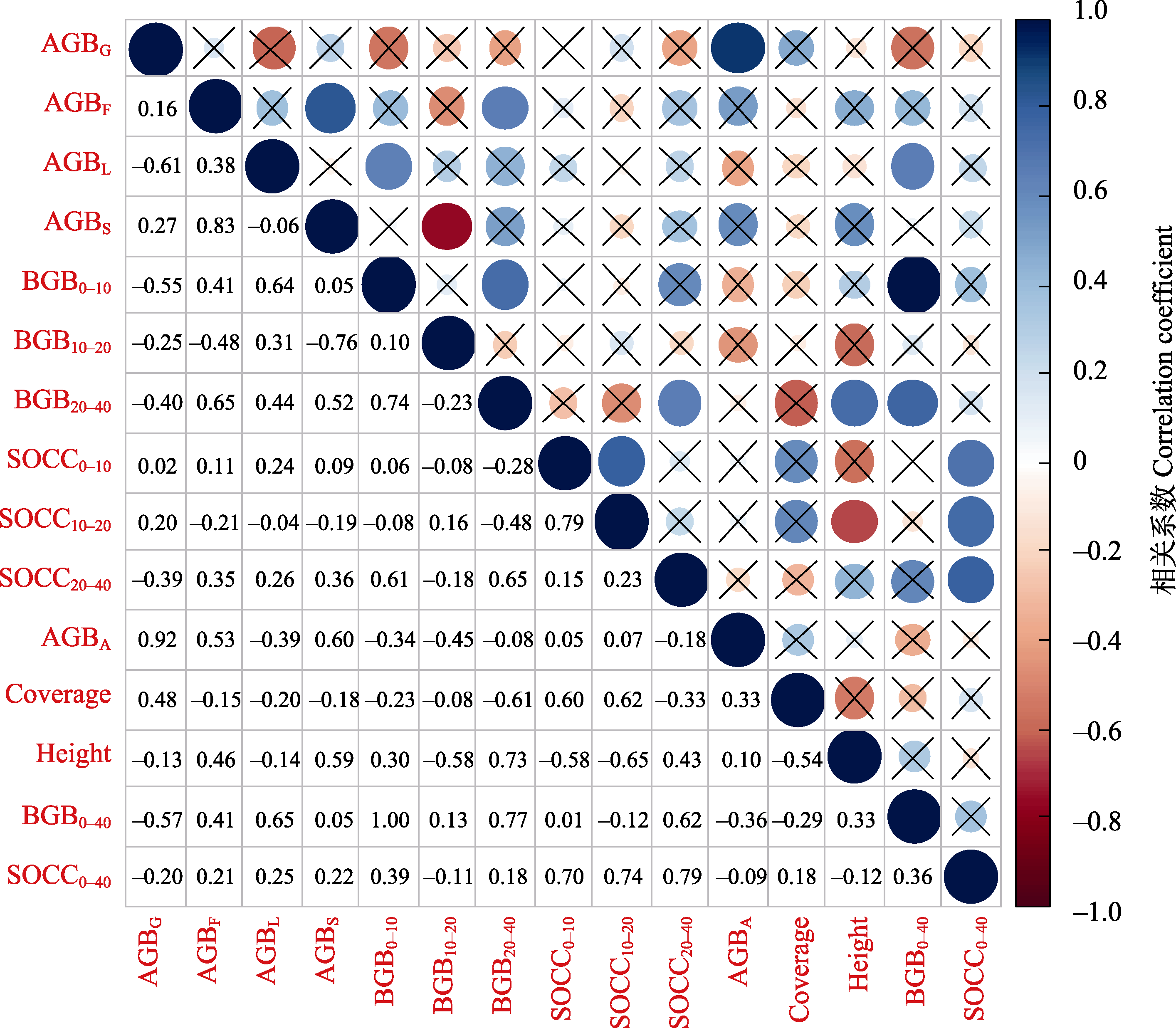
图3 地上生物量、地下生物量及土壤有机碳含量的响应比与主要因子响应比的Pearson相关性分析。图中数字为相关系数。×, p > 0.05. AGBG、AGBF、AGBL、AGBS、AGBA, 禾草类、杂类草、豆科类、莎草类和群落地上生物量; BGB0-10、BGB10-20、BGB20-40、BGB0-40, 0-10、10-20、20-40 cm土层和总地下生物量; Coverage, 群落盖度; Height, 群落最大高度; SOCC0-10、SOCC10-20、SOCC20-40、SOCC0-40, 0-10、10-20、20-40 cm土层和总土壤有机碳含量。
Fig. 3 Pearson correlations among the response ratio of aboveground biomass (AGB), belowground biomass (BGB), soil organic carbon content (SOCC), and key variables’ response ratio. The number is the correlation coefficient. ×, p > 0.05. AGBG, AGBF, AGBL, AGBS, and AGBA, AGB of graminoid, forb, legume, sedge and community; BGB0-10, BGB10-20, BGB20-40, and BGB0-40, BGB of 0-10 cm, 10-20 cm, 20-40 cm, and 0-40 cm soil; Coverage, vegetation coverage; Height, maximal height; SOCC0-10, SOCC10-20, SOCC20-40, and SOCC0-40, SOCC of 0-10 cm, 10-20 cm, 20-40 cm, and 0-40 cm soil.
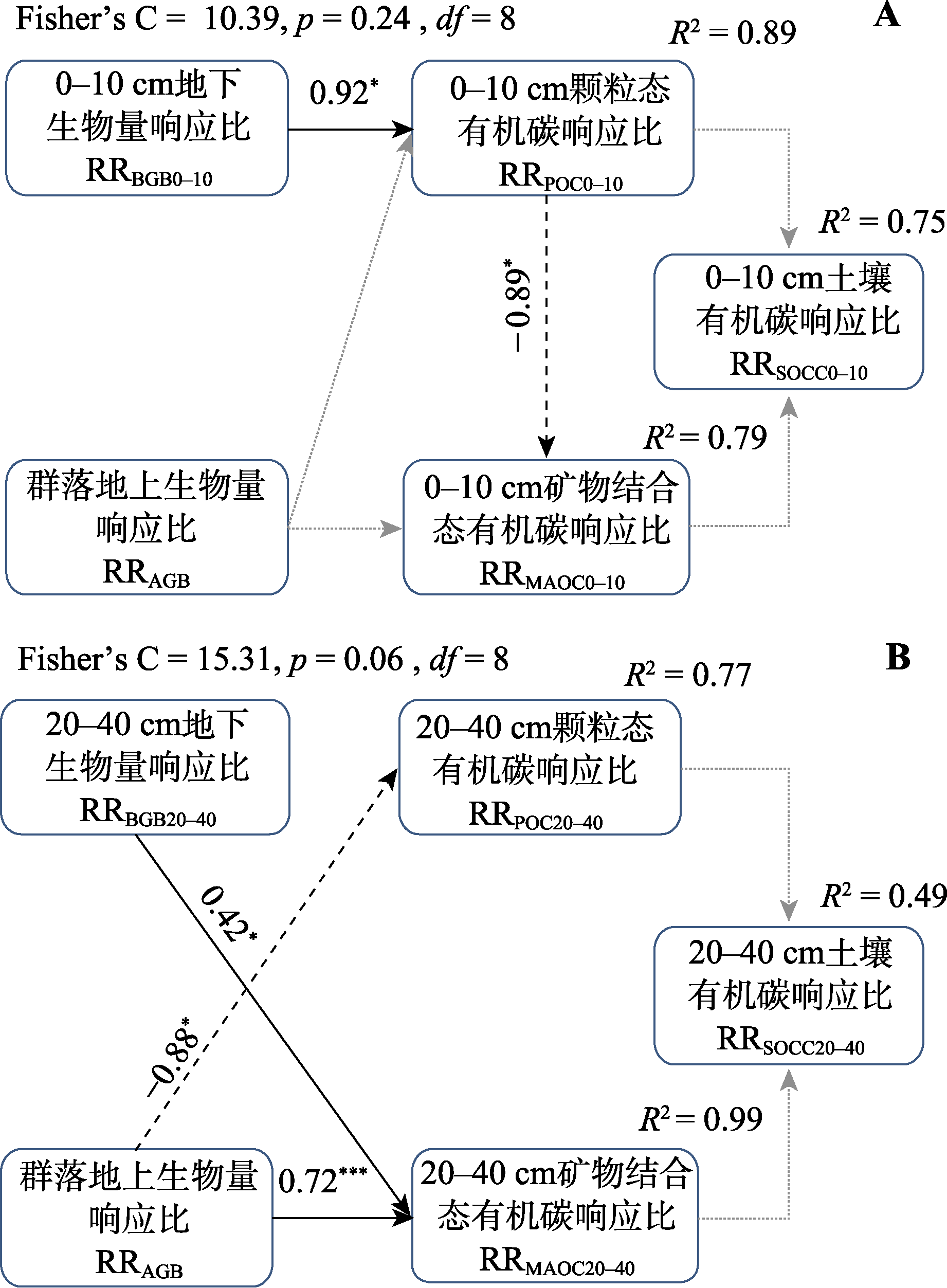
图4 0-10 cm (A)和20-40 cm (B)土层土壤有机碳及其组分含量响应比的结构方程模型。实线、短线和点线分别表示正效应、负效应和无显著效应。线段上的数字为标准作用系数。R2表示模型对响应变量的解释度。***和*表示p < 0.001和p < 0.05。
Fig. 4 Structural equation models for the response ratio (RR) of 0-10 cm and 20-40 cm soil organic carbon fractions and soil organic carbon content. Solid, dashed, and dotted lines showed positive, negative and insignificant relationships. The numbers that annotate the arrows were the standardized path coefficients. R2 suggested that explanatory power of the models to responses. *** and * are p < 0.001, and p < 0.05, respectively. AGB, aboveground biomass; BGB, belowground biomass; MAOC, mineral-associated organic carbon; POC, particulate organic carbon; SOCC, soil organic carbon content.
| [1] |
Bai YF, Cotrufo MF (2022). Grassland soil carbon sequestration: current understanding, challenges, and solutions. Science, 377, 603-608.
DOI PMID |
| [2] | Borer ET, Grace JB, Stanley Harpole W, MacDougall AS, Seabloom EW (2017). A decade of insights into grassland ecosystem responses to global environmental change. Nature Ecology & Evolution, 1, 118. DOI: 10.1038/s41559-017-0118. |
| [3] |
Bossio DA, Cook-Patton SC, Ellis PW, Fargione J, Sanderman J, Smith P, Wood S, Zomer RJ, von Unger M, Emmer IM, Griscom BW (2020). The role of soil carbon in natural climate solutions. Nature Sustainability, 3, 391-398.
DOI |
| [4] |
Chen LY, Fang K, Wei B, Qin S, Feng X, Hu T, Ji C, Yang Y (2021a). Soil carbon persistence governed by plant input and mineral protection at regional and global scales. Ecology Letters, 24, 1018-1028.
DOI URL |
| [5] |
Chen Y, Han MG, Yuan X, Hou YH, Qin WK, Zhou HK, Zhao XQ, Klein JA, Zhu B (2022). Warming has a minor effect on surface soil organic carbon in alpine meadow ecosystems on the Qinghai-Tibetan Plateau. Global Change Biology, 28, 1618-1629.
DOI URL |
| [6] |
Chen Y, Liu X, Hou YH, Zhou SR, Zhu B (2021b). Particulate organic carbon is more vulnerable to nitrogen addition than mineral-associated organic carbon in soil of an alpine meadow. Plant and Soil, 458, 93-103.
DOI |
| [7] |
Chen Y, Qin WK, Zhang QF, Wang XD, Feng JG, Han MG, Hou YH, Zhao HY, Zhang ZH, He JS, Torn MS, Zhu B (2024). Whole-soil warming leads to substantial soil carbon emission in an alpine grassland. Nature Communications, 15, 4489. DOI: 0.1038/s41467-024-48736-w.
PMID |
| [8] |
Cotrufo MF, Ranalli MG, Haddix ML, Six J, Lugato E (2019). Soil carbon storage informed by particulate and mineral-associated organic matter. Nature Geoscience, 12, 989-994.
DOI |
| [9] | Ding JZ, Chen LY, Ji C, Hugelius G, Li YN, Liu L, Qin SQ, Zhang BB, Yang GB, Li F, Fang K, Chen YL, Peng YF, Zhao X, He HL, et al. (2017). Decadal soil carbon accumulation across Tibetan permafrost regions. Nature Geoscience, 10, 420-424. |
| [10] |
Fang HJ, Cheng SL, Yu GR, Yang XM, Xu MJ, Wang YS, Li LS, Dang XS, Wang L, Li YN (2014). Nitrogen deposition impacts on the amount and stability of soil organic matter in an alpine meadow ecosystem depend on the form and rate of applied nitrogen. European Journal of Soil Science, 65, 510-519.
DOI URL |
| [11] |
Fontaine S, Barot S, Barré P, Bdioui N, Mary B, Rumpel C (2007). Stability of organic carbon in deep soil layers controlled by fresh carbon supply. Nature, 450, 277-280.
DOI |
| [12] |
Fu G, Shen ZX (2017). Response of alpine soils to nitrogen addition on the Tibetan Plateau: a meta-analysis. Applied Soil Ecology, 114, 99-104.
DOI URL |
| [13] | Han DR, Hu ZM, Wang XH, Wang T, Chen AP, Weng QH, Liang MQ, Zeng X, Cao RC, Di K, Luo DN, Zhang GR, Yang YH, He HL, Fan JW, Yu GR (2022). Shift in controlling factors of carbon stocks across biomes on the Qinghai-Tibetan Plateau. Environmental Research Letters, 17, 74016. DOI: 10.1088/1748-9326/ac78f5. |
| [14] |
He HL, Wang SQ, Zhang L, Wang JB, Ren XL, Zhou L, Piao SL, Yan H, Ju WM, Gu FX, Yu SY, Yang YH, Wang MM, Niu ZE, Ge R, et al. (2019). Altered trends in carbon uptake in China’s terrestrial ecosystems under the enhanced summer monsoon and warming hiatus. National Science Review, 6, 505-514.
DOI URL |
| [15] |
Hedges LV, Gurevitch J, Curtis PS (1999). The meta-analysis of response ratios in experimental ecology. Ecology, 80, 1150-1156.
DOI URL |
| [16] | Hu YL, Deng Q, Kätterer T, Olesen JE, Ying SC, Ochoa-Hueso R, Mueller CW, Weintraub MN, Chen J (2024). Depth-dependent responses of soil organic carbon under nitrogen deposition. Global Change Biology, 30, e17247. DOI: 10.1111/gcb.17247. |
| [17] | Huang M, Chen XP, Degen AA, Guo RY, Zhang T, Luo BY, Li HY, Zhao JX, Shang ZH (2023). Nitrogen addition stimulated soil respiration more so than carbon addition in alpine meadows. Environmental Research, 233, 116501. DOI: 10.1016/j.envres.2023.116501. |
| [18] |
Jia J, Cao ZJ, Liu CZ, Zhang ZH, Lin L, Wang YY, Haghipour N, Wacker L, Bao HY, Dittmar T, Simpson MJ, Yang H, Crowther TW, Eglinton TI, He JS, Feng XJ (2019). Climate warming alters subsoil but not topsoil carbon dynamics in alpine grassland. Global Change Biology, 25, 4383-4393.
DOI PMID |
| [19] |
Jiang CM, Yu GR, Li YN, Cao GM, Yang ZP, Sheng WP, Yu WT (2012). Nutrient resorption of coexistence species in alpine meadow of the Qinghai-Tibetan Plateau explains plant adaptation to nutrient-poor environment. Ecological Engineering, 44, 1-9.
DOI URL |
| [20] |
Knapp AK, Avolio ML, Beier C, Carroll CJW, Collins SL, Dukes JS, Fraser LH, Griffin-Nolan RJ, Hoover DL, Jentsch A, Loik ME, Phillips RP, Post AK, Sala OE, Slette IJ, et al. (2017). Pushing precipitation to the extremes in distributed experiments: recommendations for simulating wet and dry years. Global Change Biology, 23, 1774-1782.
DOI PMID |
| [21] |
Lefcheck JS (2016). piecewiseSEM: Piecewise structural equation modelling in R for ecology, evolution, and systematics. Methods in Ecology and Evolution, 7, 573-579.
DOI URL |
| [22] |
Leff JW, Jones SE, Prober SM, Barberán A, Borer ET, Firn JL, Harpole WS, Hobbie SE, Hofmockel KS, Knops JMH, McCulley RL, La Pierre K, Risch AC, Seabloom EW, Schütz M, et al. (2015). Consistent responses of soil microbial communities to elevated nutrient inputs in grasslands across the globe. Proceedings of the National Academy of Sciences of the United States of America, 112, 10967-10972.
DOI PMID |
| [23] |
Li HQ, Zhang FW, Li YN, Zhao XQ, Cao GM (2016). Thirty-year variations of above-ground net primary production and precipitation-use efficiency of an alpine meadow in the north-eastern Qinghai-Tibetan Plateau. Grass and Forage Science, 71, 208-218.
DOI URL |
| [24] |
Li HQ, Zhang FW, Yi LB (2023). Stoichiometric responses in topsoil and leaf of dominant species to precipitation change and nitrogen addition in an alpine meadow. Chinese Journal of Plant Ecology, 47, 922-931.
DOI URL |
|
[李红琴, 张法伟, 仪律北 (2023). 高寒草甸表层土壤和优势植物叶片的化学计量特征对降水改变和氮添加的响应. 植物生态学报, 47, 922-931.]
DOI |
|
| [25] |
Li JH, Cheng BH, Zhang R, Li WJ, Shi XM, Han YW, Ye LF, Ostle NJ, Bardgett RD (2021). Nitrogen and phosphorus additions accelerate decomposition of slow carbon pool and lower total soil organic carbon pool in alpine meadows. Land Degradation & Development, 32, 1761-1772.
DOI URL |
| [26] |
Li JH, Hou YL, Zhang SX, Li WJ, Xu DH, Knops JMH, Shi XM (2018). Fertilization with nitrogen and/or phosphorus lowers soil organic carbon sequestration in alpine meadows. Land Degradation & Development, 29, 1634-1641.
DOI URL |
| [27] |
Liang C, Schimel JP, Jastrow JD (2017). The importance of anabolism in microbial control over soil carbon storage. Nature Microbiology, 2, 17105. DOI: 10.1038/nmicrobiol.2017.105.
PMID |
| [28] |
Liebmann P, Wordell-Dietrich P, Kalbitz K, Mikutta R, Kalks F, Don A, Woche SK, Dsilva LR, Guggenberger G (2020). Relevance of aboveground litter for soil organic matter formation—A soil profile perspective. Biogeosciences, 17, 3099-3113.
DOI |
| [29] | Liu HY, Huang N, Zhao CM, Li JH (2023a). Responses of carbon cycling and soil organic carbon content to nitrogen addition in grasslands globally. Soil Biology & Biochemistry, 186, 109164. DOI: 10.1016/j.soilbio.2023.109164. |
| [30] |
Liu HY, Mi ZR, Lin L, Wang YH, Zhang ZH, Zhang FW, Wang H, Liu LL, Zhu B, Cao GM, Zhao XQ, Sanders NJ, Classen AT, Reich PB, He JS (2018). Shifting plant species composition in response to climate change stabilizes grassland primary production. Proceedings of the National Academy of Sciences of the United States of America, 115, 4051-4056.
DOI PMID |
| [31] | Liu JL, Zhan W, Huang XY, Tang D, Jin SF, Zhu D, Chen H (2023b). Nitrogen addition increases topsoil carbon stock in an alpine meadow of the Qinghai-Tibet Plateau. Science of the Total Environment, 888, 164071. DOI: 10.1016/j.scitotenv.2023.164071. |
| [32] |
Lu M, Zhou XH, Luo YQ, Yang YH, Fang CM, Chen JK, Li B (2011). Minor stimulation of soil carbon storage by nitrogen addition: a meta-analysis. Agriculture, Ecosystems & Environment, 140, 234-244.
DOI URL |
| [33] |
Luo RY, Fan JL, Wang WJ, Luo JF, Kuzyakov Y, He JS, Chu HY, Ding WX (2019). Nitrogen and phosphorus enrichment accelerates soil organic carbon loss in alpine grassland on the Qinghai-Tibetan Plateau. Science of the Total Environment, 650, 303-312.
DOI URL |
| [34] |
Mack MC, Schuur EAG, Bret-Harte MS, Shaver GR, Chapin FS (2004). Ecosystem carbon storage in arctic tundra reduced by long-term nutrient fertilization. Nature, 431, 440-443.
DOI |
| [35] |
Maes SL, Dietrich J, Midolo G, Schwieger S, Kummu M, Vandvik V, Aerts R, Althuizen IHJ, Biasi C, Björk RG, Böhner H, Carbognani M, Chiari G, Christiansen CT, Clemmensen KE, et al. (2024). Environmental drivers of increased ecosystem respiration in a warming tundra. Nature, 629, 105-113.
DOI |
| [36] |
Qin WK, Zhang QF, Ao GKL, Zhu B (2024). Responses and mechanisms of soil organic carbon dynamics to warming: a review. Chinese Journal of Plant Ecology, 48, 403-415.
DOI URL |
|
[秦文宽, 张秋芳, 敖古凯麟, 朱彪 (2024). 土壤有机碳动态对增温的响应及机制研究进展. 植物生态学报, 48, 403-415.]
DOI |
|
| [37] |
Reid JP, Adair EC, Hobbie SE, Reich PB (2012). Biodiversity, nitrogen deposition, and CO2 affect grassland soil carbon cycling but not storage. Ecosystems, 15, 580-590.
DOI URL |
| [38] |
Riggs CE, Hobbie SE (2016). Mechanisms driving the soil organic matter decomposition response to nitrogen enrichment in grassland soils. Soil Biology & Biochemistry, 99, 54-65.
DOI URL |
| [39] | Rocci KS, Lavallee JM, Stewart CE, Cotrufo MF (2021). Soil organic carbon response to global environmental change depends on its distribution between mineral-associated and particulate organic matter: a meta-analysis. Science of the Total Environment, 793, 148569. DOI: 10.1016/j.scitotenv.2021.148569. |
| [40] |
Sáez-Sandino T, Maestre FT, Berdugo M, Gallardo A, Plaza C, García-Palacios P, Guirado E, Zhou G, Mueller CW, Tedersoo L, Crowther TW, Delgado-Baquerizo M (2024). Increasing numbers of global change stressors reduce soil carbon worldwide. Nature Climate Change, 14, 740-745.
DOI |
| [41] |
Shen DY, Ye CL, Hu ZK, Chen XY, Guo H, Li JY, Du GZ, Adl S, Liu MQ (2018). Increased chemical stability but decreased physical protection of soil organic carbon in response to nutrient amendment in a Tibetan alpine meadow. Soil Biology & Biochemistry, 126, 11-21.
DOI URL |
| [42] | Smith MD, Wilkins KD, Holdrege MC, Wilfahrt P, Collins SL, Knapp AK, Sala OE, Dukes JS, Phillips RP, Yahdjian L, Gherardi LA, Ohlert T, Beier C, Fraser LH, Jentsch A, et al. (2024). Extreme drought impacts have been underestimated in grasslands and shrublands globally. Proceedings of the National Academy of Sciences of the United States of America, 121, e1985086176. DOI: 10.1073/pnas.2309881120. |
| [43] |
Sokol NW, Whalen ED, Jilling A, Kallenbach C, Pett-Ridge J, Georgiou K (2022). Global distribution, formation and fate of mineral-associated soil organic matter under a changing climate: a trait-based perspective. Functional Ecology, 36, 1411-1429.
DOI URL |
| [44] |
Spohn M, Bagchi S, Biederman LA, Borer ET, Bråthen KA, Bugalho MN, Caldeira MC, Catford JA, Collins SL, Eisenhauer N, Hagenah N, Haider S, Hautier Y, Knops JMH, Koerner SE, et al. (2023). The positive effect of plant diversity on soil carbon depends on climate. Nature Communications, 14, 6624. DOI: 10.1038/s41467-023-42340-0.
PMID |
| [45] | Sun J, Wang YX, Lee TM, Nie XW, Wang T, Liang EY, Wang YF, Zhang L, Wang J, Piao SL, Chen FH, Fu BJ (2024). Nature-based solutions can help restore degraded grasslands and increase carbon sequestration in the Tibetan Plateau. Communications Earth & Environment, 5, 154. DOI: 10.1038/s43247-024-01330-w. |
| [46] |
Terrer C, Phillips RP, Hungate BA, Rosende J, Pett-Ridge J, Craig ME, van Groenigen KJ, Keenan TF, Sulman BN, Stocker BD, Reich PB, Pellegrini AFA, Pendall E, Zhang H, Evans RD, et al. (2021). A trade-off between plant and soil carbon storage under elevated CO2. Nature, 591, 599-603.
DOI |
| [47] | Viechtbauer W (2010). Conducting meta-analyses in R with the meta for package. Journal of Statistical Software, 36, 1-48. |
| [48] | Wang C, Kuzyakov Y (2024). Soil organic matter priming: the pH effects. Global Change Biology, 30, e17349. DOI: 10.1111/gcb.17349. |
| [49] | Wang YF, Lv WW, Xue K, Wang SP, Zhang LR, Hu RH, Zeng H, Xu XL, Li YM, Jiang LL, Hao YB, Du JQ, Sun JP, Dorji T, Piao SL, et al. (2022). Grassland changes and adaptive management on the Qinghai-Tibetan Plateau. Nature Reviews Earth & Environment, 3, 668-683. |
| [50] |
Wang YH, Wang C, Ren F, Jing X, Ma WH, He JS, Jiang L (2023a). Asymmetric response of aboveground and belowground temporal stability to nitrogen and phosphorus addition in a Tibetan alpine grassland. Global Change Biology, 29, 7072-7084.
DOI URL |
| [51] | Wang YY, Xiao JF, Ma YM, Ding JZ, Chen XL, Ding ZY, Luo YQ (2023b). Persistent and enhanced carbon sequestration capacity of alpine grasslands on Earth’s Third Pole. Science Advances, 9, e6875. DOI: 10.1126/sciadv.ade6875. |
| [52] | Wei D, Qi YH, Ma YM, Wang XF, Ma WQ, Gao TG, Huang L, Zhao H, Zhang JX, Wang XD (2021). Plant uptake of CO2outpaces losses from permafrost and plant respiration on the Tibetan Plateau. Proceedings of the National Academy of Sciences of the United States of America, 118, e2015283118. DOI: 10.1073/pnas.2015283118. |
| [53] |
Wilcox KR, Shi Z, Gherardi LA, Lemoine NP, Koerner SE, Hoover DL, Bork E, Byrne KM, Cahill J, Collins SL, Evans S, Gilgen AK, Holub P, Jiang L, Knapp AK, et al. (2017). Asymmetric responses of primary productivity to precipitation extremes: a synthesis of grassland precipitation manipulation experiments. Global Change Biology, 23, 4376-4385.
DOI PMID |
| [54] |
Yang GJ, Stevens C, Zhang ZJ, Lü XT, Han XG (2023). Different nitrogen saturation thresholds for above-, below-, and total net primary productivity in a temperate steppe. Global Change Biology, 29, 4586-4594.
DOI URL |
| [55] |
Yang YH, Fang JY, Smith P, Tang YH, Chen AP, Ji CJ, Hu HF, Rao S, Tan K, He JS (2009). Changes in topsoil carbon stock in the Tibetan grasslands between the 1980s and 2004. Global Change Biology, 15, 2723-2729.
DOI URL |
| [56] |
Yang YH, Zhang DY, Wei B, Liu Y, Feng XW, Mao C, Xu WJ, He M, Wang L, Zheng ZH, Wang YY, Chen LY, Peng YF (2023). Nonlinear responses of community diversity, carbon and nitrogen cycles of grassland ecosystems to external nitrogen input. Chinese Journal of Plant Ecology, 47, 1-24.
DOI URL |
|
[杨元合, 张典业, 魏斌, 刘洋, 冯雪徽, 毛超, 徐玮婕, 贺美, 王璐, 郑志虎, 王媛媛, 陈蕾伊, 彭云峰 (2023). 草地群落多样性和生态系统碳氮循环对氮输入的非线性响应及其机制. 植物生态学报, 47, 1-24.]
DOI |
|
| [57] |
Ye CL, Chen DM, Hall SJ, Pan S, Yan XB, Bai TS, Guo H, Zhang Y, Bai YF, Hu SJ (2018). Reconciling multiple impacts of nitrogen enrichment on soil carbon: plant, microbial and geochemical controls. Ecology Letters, 21, 1162-1173.
DOI PMID |
| [58] | Yuan X, Qin WK, Xu H, Zhang ZH, Zhou HK, Zhu B (2020). Sensitivity of soil carbon dynamics to nitrogen and phosphorus enrichment in an alpine meadow. Soil Biology & Biochemistry, 150, 107984. DOI: 10.1016/j.soilbio.2020.107984. |
| [59] | Zhang GL, Yang F, Long H (2023). Save the life-sustaining mattic layer on the Qinghai-Tibetan Plateau. The Innovation, 4, 100418. DOI: 10.1016/j.xinn.2023.100418. |
| [1] | 李燚, 黄欢, 赵艳超, 陈立同. 养分添加对不同海拔高寒草甸群落多样性及组成的影响[J]. 植物生态学报, 2026, 50(预发表): 0-. |
| [2] | 张安宁, 肖亚宁, 赵霞, 张淼, 崔瀚文, 陈书燕, 安黎哲. 青藏高原灌木化与氮添加对土壤线虫及功能性状的交互作用[J]. 植物生态学报, 2026, 50(预发表): 0-. |
| [3] | 吴光进, 郭垚鑫, 任成杰, 王俊, 岳明, 赵发珠. 秦岭北麓不同植被类型土壤有机碳含量分布及其影响因素[J]. 植物生态学报, 2026, 50(预发表): 1-. |
| [4] | 何正嘉, 曾歆然, 王琳影, 薛昕宇, 苏钦泽, 李宇, 张寅杰, 吴辉煌, 陈成聪, 吴良泉, 魏安妮, 仇云鹏, 郭梨锦. 茶园丛枝菌根真菌群落和土壤有机碳对镁肥的响应[J]. 植物生态学报, 2026, 50(3): 700-709. |
| [5] | 李文竹, 栾军伟, 邸雅平, 王一, 聂秀青, 刘世荣. 模拟干旱对暖温带锐齿槲栎林菌根介导下土壤酶活性和土壤有机碳组分的影响[J]. 植物生态学报, 2026, 50(3): 660-673. |
| [6] | 张静, 陈洁, 李艳朋, 盘李军, 许涵, 李意德, 何海生. 南亚热带针阔混交人工林植物生物量比较及其影响因子分析[J]. 植物生态学报, 2026, 50(2): 400-416. |
| [7] | 徐恩相, 周蕾, 章晓炜, 张国萍, 仲杜伟, 黄智, 刘派, 迟永刚. 基于不同生育阶段冠层光谱和碳通量的水稻产量估算[J]. 植物生态学报, 2026, 50(1): 82-93. |
| [8] | 皮惠之, 张秋芳, 孙浩, 曾泉鑫, 彭园珍, 元晓春, 徐建国, 陈岳民. 微生物碳氮不平衡影响罗浮栲林土壤微生物氮利用效率对氮富集的响应[J]. 植物生态学报, 2026, 50(1): 34-44. |
| [9] | 冯梅, 欧阳胜男, 李迈和, 周晓倩, 铁烈华, 申卫军, 段洪浪. 前期氮添加对无梗花栎幼苗干旱响应中地上-地下碳氮分配动态的影响[J]. 植物生态学报, 2025, 49(9): 1527-1542. |
| [10] | 邢强, 赵斌, 胡永红, 杨君, 秦俊, 刘何铭, 王红兵, 周鹏. 华东地区两种典型立体绿化植物根系性状特征及对新型土壤基质的响应[J]. 植物生态学报, 2025, 49(9): 1498-1514. |
| [11] | 宋珊珊, 唐志尧. 河北塞罕坝草甸草原根际土壤真菌与植物地上生物量的关系[J]. 植物生态学报, 2025, 49(9): 1461-1471. |
| [12] | 朱瑞德, 杨俊薇, 刘宵含, 陈冰瑞, 池秀莲, 田地, 杨光, 程蒙, 戴亚峰, 王诗文. 霍山石斛设施和林下栽培模式中养分对植物-微生物关联的调控[J]. 植物生态学报, 2025, 49(9): 1434-1447. |
| [13] | 郑子仪, 陈江慧, 刘慧颖. 气候变暖提高青藏高原高寒草甸优势物种的根系分泌速率[J]. 植物生态学报, 2025, 49(9): 1363-1373. |
| [14] | 樊月玲, 蒋正德, 叶佳舒, 郑立臣, 陈欣. 2005-2015年下辽河平原农田长期观测样地主要农作物收获期性状和产量数据集[J]. 植物生态学报, 2025, 49(8): 1271-1282. |
| [15] | 范亚冉, 夏少攀, 于冰冰, 朱紫琪, 杨威, 范豫川, 刘晓雨, 张旭辉, 郑聚锋. 大气CO2浓度升高和增温对土壤有机碳库积累、分子组成和结构稳定性的影响[J]. 植物生态学报, 2025, 49(7): 1053-1069. |
| 阅读次数 | ||||||
|
全文 |
|
|||||
|
摘要 |
|
|||||
Copyright © 2026 版权所有 《植物生态学报》编辑部
地址: 北京香山南辛村20号, 邮编: 100093
Tel.: 010-62836134, 62836138; Fax: 010-82599431; E-mail: apes@ibcas.ac.cn, cjpe@ibcas.ac.cn
备案号: 京ICP备16067583号-19

