
植物生态学报 ›› 2026, Vol. 50 ›› Issue (1): 213-221.DOI: 10.17521/cjpe.2024.0472 cstr: 32100.14.cjpe.2024.0472
郑佳棋1, 宋金凤1, 桑英1,*( ), 孙慧珍1, 张伟志1, 张敏1, 全先奎2, 金光泽1
收稿日期:2024-12-27
接受日期:2025-04-16
出版日期:2026-01-20
发布日期:2026-02-14
通讯作者:
*桑英(ysang@nefu.edu.cn)基金资助:
ZHENG Jia-Qi1, SONG Jin-Feng1, SANG Ying1,*(), SUN Hui-Zhen1, ZHANG Wei-Zhi1, ZHANG Min1, QUAN Xian-Kui2, JIN Guang-Ze1
Received:2024-12-27
Accepted:2025-04-16
Online:2026-01-20
Published:2026-02-14
Contact:
*SANG Ying (ysang@nefu.edu.cn)Supported by:摘要:
根系吸水和叶片蒸腾协同作用以维持植物体内水分动态平衡。木质部水分的长距离运输主要依赖蒸腾拉力, 根压仅在夜间或蒸腾速率低时起作用。然而, 一些藤类和草本植物具有较大的根压, 在蒸腾拉力同时存在的情况下, 根压变化是否影响蒸腾及蒸腾对根压变化的响应速度和方式仍不清楚。该研究以水培富贵竹(Dracaena sanderiana)为研究对象, 设置低温(0 ℃)、高温(35 ℃)、盐(200 mmol·L-1 NaCl)、干旱(20% PEG 6000)、去须根和离体胁迫处理, 探讨以上胁迫因子对富贵竹根压和蒸腾的影响, 以及蒸腾对根压的响应。结果表明: (1)富贵竹根压较大, 非胁迫条件下可维持全天正压, 能够单独作用将水分驱动至茎干顶端, 而不需要蒸腾拉力作用; 富贵竹蒸腾速率最大值仅为0.37 mmol·m-2·s-1, 蒸腾耗水少可能是其可全天维持正根压的原因。(2)低温处理后根压和蒸腾速率均降低, 高温处理后两者均升高, 说明温度影响根系的生理活动和根压, 根压变化又迅速影响蒸腾。(3)盐、干旱、去须根和离体处理后, 根压均在一天内降到负值后逐渐回升至0附近, 而蒸腾速率和气孔导度均在处理后短时间内小幅降低, 次日降至处理前的18%-72%, 长时间(4-12天)处理后则均接近于0, 这说明水培富贵竹蒸腾对根压变化反馈迅速, 根压消失导致富贵竹失去水分向上运输的动力, 引起气孔关闭和蒸腾消失。综上所述, 水培富贵竹根压消失后蒸腾拉力并未维持之前的蒸腾速率, 说明富贵竹木质部水分运输具有根压驱动机制, 与大多数植物具有的以蒸腾拉力为主要驱动机制不同。该研究进一步揭示了富贵竹特殊的水分运输机制, 为富贵竹栽培的水分管理提供理论支撑与指导。
郑佳棋, 宋金凤, 桑英, 孙慧珍, 张伟志, 张敏, 全先奎, 金光泽. 不同胁迫因子下水培富贵竹蒸腾对根压的响应. 植物生态学报, 2026, 50(1): 213-221. DOI: 10.17521/cjpe.2024.0472
ZHENG Jia-Qi, SONG Jin-Feng, SANG Ying, SUN Hui-Zhen, ZHANG Wei-Zhi, ZHANG Min, QUAN Xian-Kui, JIN Guang-Ze. Response of transpiration to root pressure of hydroponic Dracaena sanderiana under different stress factors. Chinese Journal of Plant Ecology, 2026, 50(1): 213-221. DOI: 10.17521/cjpe.2024.0472
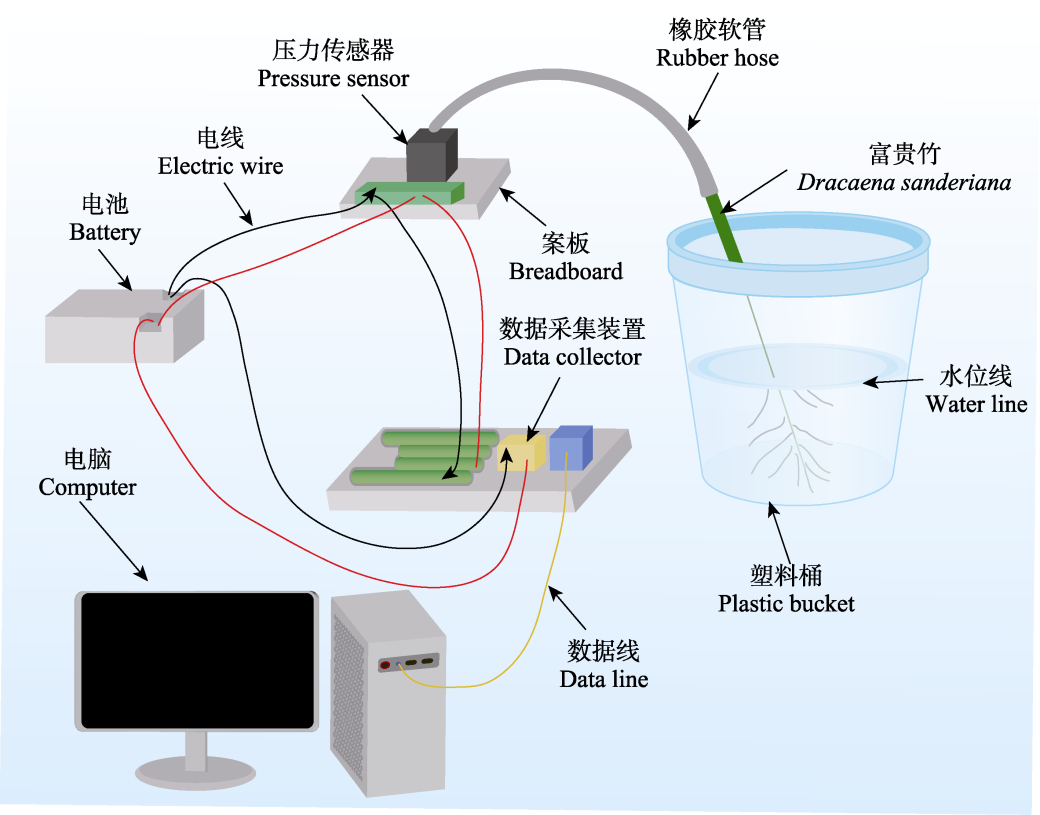
图1 根压测定装置。
Fig. 1 Apparatus for root pressure measurement.
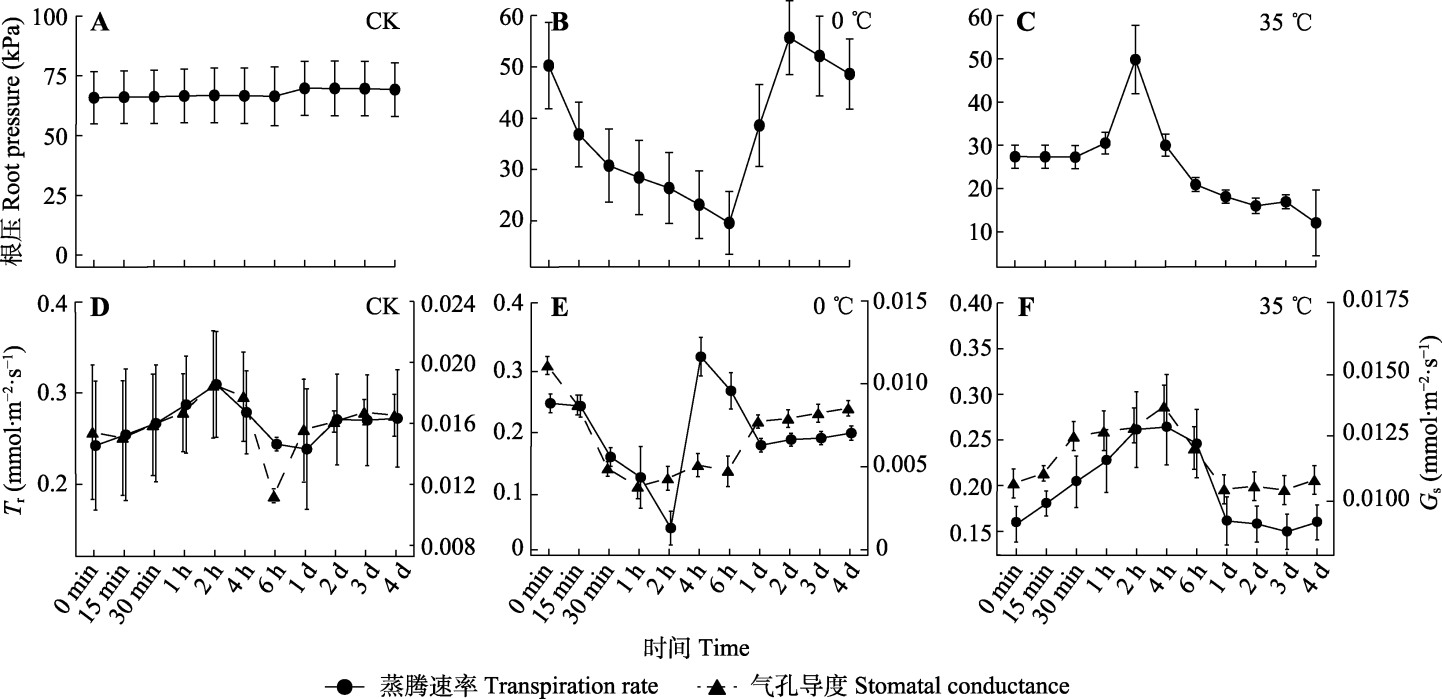
图2 对照、低温、高温对水培富贵竹根压、蒸腾速率(Tr)和气孔导度(Gs)的影响(平均值±标准误)。CK为对照, 0 min为处理前数值, 15 min-4 d为处理后相应时间结果。
Fig. 2 Effects of low and high temperature on root pressure, transpiration rate (Tr) and stomatal conductance (Gs) of hydroponic Dracaena sanderiana (mean ± SE). CK represents control, 0 min represents the value before treatment, and 15 min to 4 d represents the value of 15 minutes to 4 d after treatment.
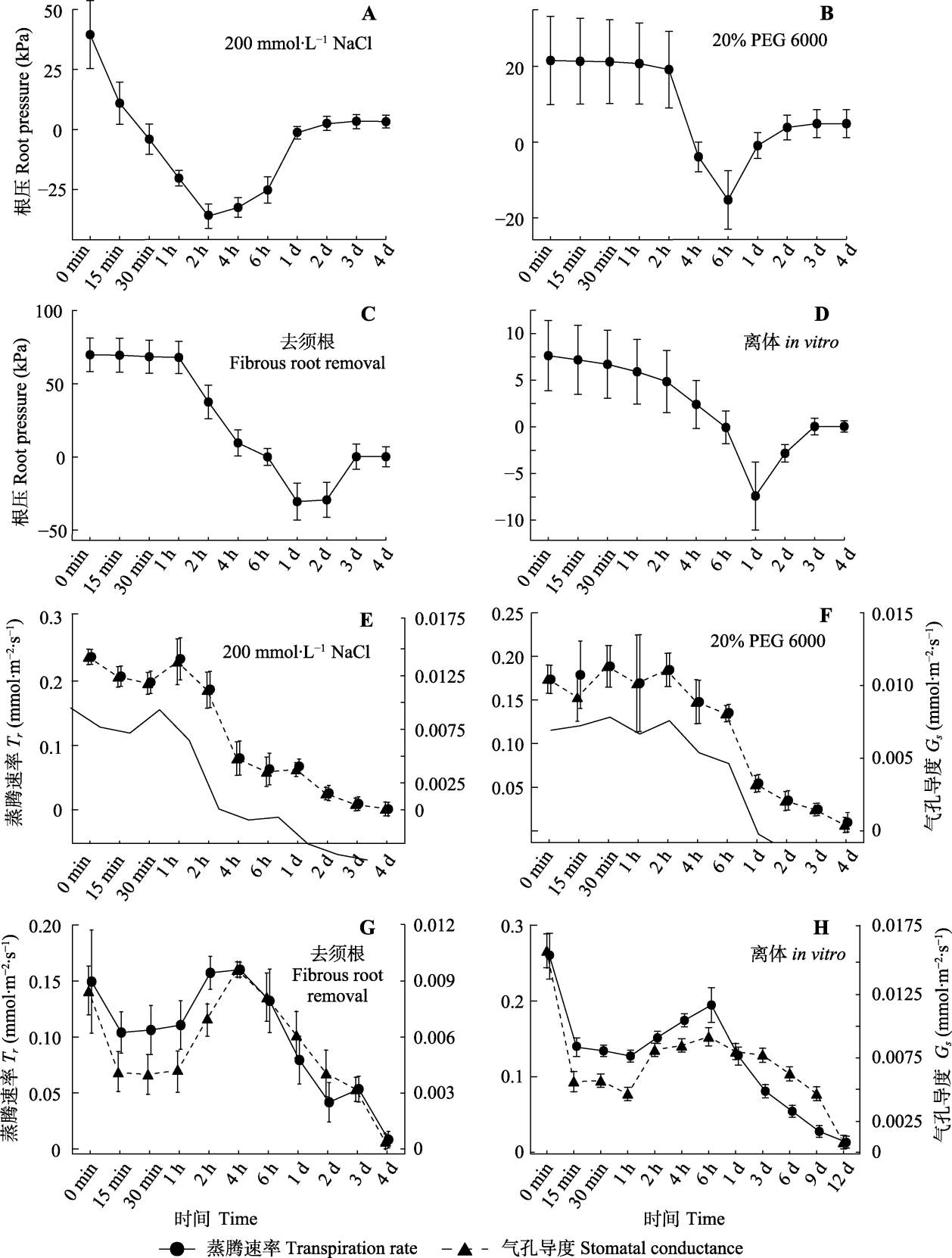
图3 盐、干旱、去须根和离体处理对水培富贵竹根压、蒸腾速率(Tr)和气孔导度(Gs)的影响(平均值±标准误)。0 min为处理前数值, 15 min-12 d为处理后相应时间结果。
Fig. 3 Effects of salt, drought, fibrous root removal and in vitro on root pressure, transpiration rate (Tr) and stomatal conductance (Gs) of hydroponic Dracaena sanderiana (mean ± SE). 0 min represents the value before treatment, and 15 min to 4 d represents the value of 15 minutes to 12 d after treatment.
| 胁迫条件 Stress condition | 短时间 short time treatment | 长时间 long time treatment |
|---|---|---|
| 0 ℃ | 0.464 | 0.173 |
| 35 ℃ | 0.883** | 0.516 |
| NaCl | 0.964** | 0.922** |
| PEG 6000 | 0.107 | -0.027 |
| 去须根 Fibrous root removal | 0.357 | 0.827* |
| 离体 in vitro | 0.180 | 0.855** |
表1 短时间和长时间胁迫条件下水培富贵竹根压与蒸腾速率的相关性
Table 1 Correlation coefficient between root pressure and transpiration rate of hydroponic Dracaena sanderiana under short- and long-time stress conditions
| 胁迫条件 Stress condition | 短时间 short time treatment | 长时间 long time treatment |
|---|---|---|
| 0 ℃ | 0.464 | 0.173 |
| 35 ℃ | 0.883** | 0.516 |
| NaCl | 0.964** | 0.922** |
| PEG 6000 | 0.107 | -0.027 |
| 去须根 Fibrous root removal | 0.357 | 0.827* |
| 离体 in vitro | 0.180 | 0.855** |
| [1] |
Andersen PC, Brodbeck BV (1989). Diurnal and temporal changes in the chemical profile of xylem exudate from Vitis rotundifolia. Physiologia Plantarum, 75, 63-70.
DOI URL |
| [2] |
Bai XF, Bu QM, Tan YQ, Zhu JJ, Liu LD (2012). Regulation of photosynthesis and water status of Atriplex triangularis under osmotic stress by NaCl. Chinese Bulletin of Botany, 47, 500-507.
DOI URL |
|
[柏新富, 卜庆梅, 谭永芹, 朱建军, 刘林德 (2012). NaCl对渗透胁迫下三角叶滨藜光合作用和水分状况的调节. 植物学报, 47, 500-507.]
DOI |
|
| [3] |
Barrios-Masias FH, Knipfer T, McElrone AJ (2015). Differential responses of grapevine rootstocks to water stress are associated with adjustments in fine root hydraulic physiology and suberization. Journal of Experimental Botany, 66, 6069-6078.
DOI PMID |
| [4] |
Berry JA, Beerling DJ, Franks PJ (2010). Stomata: key players in the earth system, past and present. Current Opinion in Plant Biology, 13, 232-239.
DOI URL |
| [5] |
Cao KF, Yang SJ, Zhang YJ, Brodribb TJ (2012). The maximum height of grasses is determined by roots. Ecology Letters, 15, 666-672.
DOI URL |
| [6] |
Clearwater MJ, Blattmann P, Luo Z, Lowe RG (2007). Control of scion vigour by kiwifruit rootstocks is correlated with spring root pressure phenology. Journal of Experimental Botany, 58, 1741-1751.
PMID |
| [7] |
Cobb AR, Choat B, Holbrook NM (2007). Dynamics of freeze-thaw embolism in Smilax rotundifolia (Smilacaceae). American Journal of Botany, 94, 640-649.
DOI URL |
| [8] |
Cochard H, Ewers FW, Tyree MT (1994). Water relations of a tropical vine-like bamboo (Rhipidocladum racemiflorum): root pressures, vulnerability to cavitation and seasonal changes in embolism. Journal of Experimental Botany, 45, 1085-1089.
DOI URL |
| [9] | Crafts AS (1949). Water in the Physiology of Plants. Chronica Botanica Company, Waltham, USA. |
| [10] | Dixon HH, Joly J (1894). On the ascent of sap. Proceedings of the Royal Society of London B, 57, 3-5. |
| [11] | Drobnitch ST, Wenz J, Gleason SM, Comas LH (2024). Searching for mechanisms driving root pressure in Zea mays—A transcriptomic approach. Journal of Plant Physiology, 296, 154209. DOI: 10.1016/j.jplph.2024.154209. |
| [12] | Edwards WRN, Jarvis PG (1982). Relations between water content, potential and permeability in stems of conifers. Plant, Cell & Environment, 5, 271-277. |
| [13] |
Ewers FW, Améglio T, Cochard H, Beaujard F, Martignac M, Vandame M, Bodet C, Cruiziat P (2001). Seasonal variation in xylem pressure of walnut trees: root and stem pressures. Tree Physiology, 21, 1123-1132.
DOI PMID |
| [14] |
Fisher JB, Ewers FW, López-Portillo J (1997). Survey of root pressure in tropical vines and woody species. International Journal of Plant Sciences, 158, 44-50.
DOI URL |
| [15] | Gao XY (2014). Effect of Saline-alkali Stress on Growth and Physiological Ecology of Rice in Different Concentrations. Master degree dissertation, Jilin Agricultural University, Changchun. |
| [高显颖 (2014). 不同浓度盐碱胁迫对水稻生长及生理生态特性影响. 硕士学位论文, 吉林农业大学, 长春.] | |
| [16] |
Grossenbacher KA (1938). Diurnal fluctuation in root pressure. Plant Physiology, 13, 669-676.
DOI PMID |
| [17] | Guo AJ (2004). Study on Characteristic of Carbon Fixation and Transpiration of 10 Interior Foliage Plants. Master degree dissertation, Northeast Forestry University, Harbin. |
| [郭阿君 (2004). 10种室内观叶植物固碳释氧、蒸腾、抑菌特性的研究. 硕士学位论文, 东北林业大学, 哈尔滨.] | |
| [18] | Guo JR, Wan XC (2017). Circadian rhythm of root pressure in intact poplar seedlings and the influencing factors. Scientia Silvae Sinicae, 53(10), 22-28. |
| [郭建荣, 万贤崇 (2017). 杨树苗木完整植株根压的昼夜节律及其影响因素. 林业科学, 53(10), 22-28.] | |
| [19] |
Holbrook NM, Ahrens ET, Burns MJ, Zwieniecki MA (2001). In vivo observation of cavitation and embolism repair using magnetic resonance imaging. Plant Physiology, 126, 27-31.
PMID |
| [20] |
Holmlund HI, Davis SD, Ewers FW, Aguirre NM, Sapes G, Sala A, Pittermann J (2020). Positive root pressure is critical for whole-plant desiccation recovery in two species of terrestrial resurrection ferns. Journal of Experimental Botany, 71, 1139-1150.
DOI URL |
| [21] | Huang YQ, Mo L, Zhao P, Zhang ZF, He CX (2008). Comparison of gas exchanges between in situ and abscised leaves of high arbor trees: a case study of Cyclobalanopsis glauca under three habitats. Acta Ecologica Sinica, 28, 4508-4516. |
| [黄玉清, 莫凌, 赵平, 张中峰, 何成新 (2008). 高大乔木原位与离体叶片气体交换特征的比较——以三种环境下的青冈栎(Cyclobalanopsis glauca)为例. 生态学报, 28, 4508-4516.] | |
| [22] | Jia TT (2017). Seven Kinds of Common Indoor Plants Carbon Oxygen Release, and Interpretation of the Water Absorption Ability of Study in Jilin Province. Master degree dissertation, Beihua University, Jilin City, Jilin. |
| [贾婷婷 (2017). 吉林省7种常见室内植物固碳释氧、释水吸热能力研究. 硕士学位论文, 北华大学, 吉林吉林市.] | |
| [23] |
Jin Y, Wang CK, Sang Y (2011). Contribution of stem water storage to daily transpiration of three temperate trees in northeastern China. Chinese Journal of Plant Ecology, 35, 1310-1317.
DOI URL |
|
[金鹰, 王传宽, 桑英 (2011). 三种温带树种树干储存水对蒸腾的贡献. 植物生态学报, 35, 1310-1317.]
DOI |
|
| [24] |
Knipfer T, Eustis A, Brodersen C, Walker AM, Mcelrone AJ (2015). Grapevine species from varied native habitats exhibit differences in embolism formation/repair associated with leaf gas exchange and root pressure. Plant, Cell & Environment, 38, 1503-1513.
DOI URL |
| [25] | Kramer PJ, Boyer JS (1995). Water Relations of Plants and Soils. Academic Press, San Diego, USA. |
| [26] |
Lawlor DW (2002). Limitation to photosynthesis in water-stressed leaves: stomata vs. metabolism and the role of ATP. Annals of Botany, 89, 871-885.
DOI URL |
| [27] |
Leonard OA (1944). Use of root pressures in determining injury to roots by cultivation. Plant Physiology, 19, 157-163.
DOI PMID |
| [28] |
Schenk HJ, Jansen S, Hölttä T (2021). Positive pressure in xylem and its role in hydraulic function. New Phytologist, 230, 27-45.
DOI PMID |
| [29] | Singh S (2016). Root pressure: getting to the root of pressure//Lüttge U, Cánovas FM, Matyssek R. Progress in Botany 77. Springer, Cham, Switzerland. |
| [30] |
Sperry JS, Holbrook NM, Zimmermann MH, Tyree MT (1987). Spring filling of xylem vessels in wild grapevine. Plant Physiology, 83, 414-417.
DOI PMID |
| [31] | Sun GY (2016). Plant Physiology. China Forestry Publishing Press, Beijing. |
| [孙广玉 (2016). 植物生理学. 中国林业出版社, 北京.] | |
| [32] | Sun HZ, Zhou XF, Zhao HX (2002). A researches on stem sap flow dynamics of Betula platyphylla. Acta Ecologica Sinica, 22, 1387-1391. |
| [孙慧珍, 周晓峰, 赵惠勋 (2002). 白桦树干液流的动态研究. 生态学报, 22, 1387-1391.] | |
| [33] | Taiz L, Zeiger E (2010). Plant Physiology. 5th ed. Sinauer Associates, Sunderland, USA. |
| [34] |
Tang Y, Wang CK (2011). A feasible method for measuring photosynthesis in vitro for major tree species in northeastern China. Chinese Journal of Plant Ecology, 35, 452-462.
DOI URL |
|
[唐艳, 王传宽 (2011). 东北主要树种光合作用可行的离体测定方法. 植物生态学报, 35, 452-462.]
DOI |
|
| [35] | Tian XL (2008). Physio-ecology Relationship Between Root Pressure and Bamboo Species Under Low Temperature Stressed. Master degree dissertation, Nanjing Forestry University, Nanjing. |
| [田新立 (2008). 竹类植物的根压与低温胁迫下竹子生理生态关系的研究. 硕士学位论文, 南京林业大学, 南京.] | |
| [36] |
Tyree MT, Sperry JS (1989). Vulnerability of xylem to cavitation and embolism. Annual Review of Plant Physiology and Plant Molecular Biology, 40, 19-36.
DOI URL |
| [37] | Wang HF (2015). Root Pressure and Influencing Factors of Woody Lianas in Xishuangbanna. Master degree dissertation, University of Chinese Academy of Sciences, Beijing. |
| [王华芳 (2015). 西双版纳热带雨林木质藤本的根压及影响因素. 硕士学位论文, 中国科学院大学, 北京.] | |
| [38] |
Wegner LH (2014). Root pressure and beyond: energetically uphill water transport into xylem vessels? Journal of Experimental Botany, 65, 381-393.
DOI PMID |
| [39] | Xu XL, Xu SH, Liang ZS, Dong JE, Jin MY, Liu F, Chen XL (2020). Photosynthetic physiological characteristics and its influencing factors of Polygonatum sibiricum Red. leaves in different positions. Journal of Northwest A&F University (Natural Science Edition), 48(2), 119-128. |
| [徐晓蓝, 徐世浩, 梁宗锁, 董娟娥, 金美艳, 刘峰, 陈喜良 (2020). 不同叶位黄精叶片的光合日变化及其影响因子. 西北农林科技大学学报(自然科学版), 48(2), 119-128.] | |
| [40] |
Yang SJ, Zhang YJ, Sun M, Goldstein G, Cao KF (2012). Recovery of diurnal depression of leaf hydraulic conductance in a subtropical woody bamboo species: embolism refilling by nocturnal root pressure. Tree Physiology, 32, 414-422.
DOI URL |
| [41] | Yao SJ, Du GY, Mou HM, Feng H, Bai JP, He JQ (2016). Applications of nuclear magnetic resonance in the study of soil-plant-atmosphere continuum. Chinese Journal of Applied Ecology, 27, 315-326. |
| [要世瑾, 杜光源, 牟红梅, 冯浩, 白江平, 何建强 (2016). 核磁共振技术在土壤-植物-大气连续体研究中的应用. 应用生态学报, 27, 315-326.] | |
| [42] | Yu XM (2024). Investigation of the Regulatory Mechanism of Vapor Pressure Deficit on Calcium Absorption and Distribution in Tomato. PhD dissertation, Northwest A&F University, Yangling, Shaanxi. |
| [于雪梅 (2024). 水汽压差对番茄钙吸收和分配的调控机理研究. 博士学位论文, 西北农林科技大学, 陕西杨凌.] | |
| [43] |
Zhang M, Sang Y, Song JF (2023). Root pressure of hydroponic Dracaena sanderiana and its determinants. Chinese Journal of Plant Ecology, 47, 1010-1019.
DOI URL |
|
[张敏, 桑英, 宋金凤 (2023). 水培富贵竹的根压及其影响因素. 植物生态学报, 47, 1010-1019.]
DOI |
|
| [44] | Zhang QY (2017). Response of Artificial Forest Under Drought Stress at Hillslope Scale in Semi-humid Loess Regions. PhD dissertation, Northwest A&F University, Yangling, Shaanxi. |
| [张庆印 (2017). 半湿润黄土区坡面刺槐林对干旱胁迫的生理响应. 博士学位论文, 西北农林科技大学, 陕西杨凌.] | |
| [45] | Zhang ZY, Guo W, Yang SJ (2022). Recent advances in research on root pressure of plants. Guihaia, 42, 714-727. |
| [张周颖, 郭雯, 杨石建 (2022). 植物根压研究进展. 广西植物, 42, 714-727.] | |
| [46] | Zhao YP (2024). Study on photosynthetic diurnal variation of Salix matsudana under salt stress. Journal of Anhui Agricultural Sciences, 52(4), 87-89. |
| [赵育鹏 (2024). 盐胁迫条件下竹柳光合作用日变化特征研究. 安徽农业科学, 52(4), 87-89.] | |
| [47] | Zheng CX (2013). Plant Physiology. 3rd ed. Science Press, Beijing. |
| [郑彩霞 (2013). 植物生理学. 3版. 科学出版社, 北京.] | |
| [48] | Zhou R, Xie JM, Zhang J, Zhang JF, Li F, Hu SL (2024). Effect of NaCl stress on the growth and physiological characteristics of broccoli. Journal of Gansu Agricultural University, 59(6), 117-127. |
| [周睿, 颉建明, 张婧, 张俊峰, 李凤, 胡世莲 (2024). NaCl胁迫对青花菜幼苗生长生理特性的影响. 甘肃农业大学学报, 59(6), 117-127.] |
| [1] | 郝雅昕, 金光泽, 刘志理. 生长季不同阶段和枝龄对常绿针叶树种枝性状的影响[J]. 植物生态学报, 2026, 50(2): 279-292. |
| [2] | 李港墩, 钱尼澎, 王林旭, 董淳超, 刘琪璟. 长白山红松和春榆径向生长季节动态对环境因子的响应[J]. 植物生态学报, 2025, 49(7): 1110-1118. |
| [3] | 张箫荻, 王晓霞, 章毓文, 侯靖雨, 石骁鹏, 和璐璐, 刘亚栋, 薛柳, 何宝华, 段劼. 北京山区三种林下灌木水力结构、叶片功能性状及其环境适应策略[J]. 植物生态学报, 2025, 49(7): 1128-1143. |
| [4] | 李思雨, 杨风亭, 王辉民, 戴晓琴, 孟盛旺. 杉木和木荷木质部形成季节动态及其对环境因子的响应[J]. 植物生态学报, 2025, 49(2): 295-307. |
| [5] | 贾慧琳, 倪隆康, 秦佳双, 廖苏慧, 谭羽, 何佳懿, 顾大形. 极端干旱后喀斯特树木水力功能恢复动态及其影响因素[J]. 植物生态学报, 2025, 49(12): 2004-2014. |
| [6] | 张乐, 焦亮, 薛儒鸿, 张鹏, 王旭鸽, 秦亚蓉, 后赛鹏, 马媛媛. 祁连山祁连圆柏年内径向生长对水热因素的响应[J]. 植物生态学报, 2025, 49(11): 1878-1889. |
| [7] | 童郁强, 吴梦鸽, 王玲, 赵实, 韩叙, 张彤, 刘静, 秦胜金, 董英豪, 魏亚伟, 周永斌. 基于液流径向变化的樟子松蒸腾耗水量估算及影响因素[J]. 植物生态学报, 2024, 48(9): 1118-1127. |
| [8] | 付照琦, 胡旭, 田沁瑞, 葛艳灵, 周红娟, 吴小云, 陈立欣. 晋西黄土区2种典型森林树种夜间液流特征及对环境因子的响应[J]. 植物生态学报, 2024, 48(9): 1128-1142. |
| [9] | 钱尼澎, 高浩鑫, 宋超杰, 董淳超, 刘琪璟. 长白山白桦径向生长季节动态及其对环境因子的响应[J]. 植物生态学报, 2024, 48(8): 1001-1010. |
| [10] | 马琳, 巢林, 何雨莎, 李忠国, 王爱华, 刘晟源, 胡宝清, 刘艳艳. 热带喀斯特季节性雨林12个树种木质部栓塞抗性与其解剖结构及相关性状间的关系[J]. 植物生态学报, 2024, 48(7): 888-902. |
| [11] | 张富崇, 于明含, 张建玲, 王平, 丁国栋, 何莹莹, 孙慧媛. 黑沙蒿应对降水变化的木质部与韧皮部协同响应机制[J]. 植物生态学报, 2024, 48(7): 903-914. |
| [12] | 常晨晖, 朱彪, 朱江玲, 吉成均, 杨万勤. 森林粗木质残体分解研究进展[J]. 植物生态学报, 2024, 48(5): 541-560. |
| [13] | 杨尚锦, 范云翔, 章毓文, 韩巧玲, 赵玥, 段劼, 邸楠, 席本野. 树木夜间液流组分划分方法对比——以毛白杨为例[J]. 植物生态学报, 2024, 48(4): 496-507. |
| [14] | 白雨鑫, 苑丹阳, 王兴昌, 刘玉龙, 王晓春. 东北地区3种桦木木质部导管特征对气候变化响应的趋同与差异[J]. 植物生态学报, 2023, 47(8): 1144-1158. |
| [15] | 蒋海港, 曾云鸿, 唐华欣, 刘伟, 李杰林, 何国华, 秦海燕, 王丽超, 姚银安. 三种藓类植物固碳耗水节律调节作用[J]. 植物生态学报, 2023, 47(7): 988-997. |
| 阅读次数 | ||||||
|
全文 |
|
|||||
|
摘要 |
|
|||||
Copyright © 2026 版权所有 《植物生态学报》编辑部
地址: 北京香山南辛村20号, 邮编: 100093
Tel.: 010-62836134, 62836138; Fax: 010-82599431; E-mail: apes@ibcas.ac.cn, cjpe@ibcas.ac.cn
备案号: 京ICP备16067583号-19

