
植物生态学报 ›› 2026, Vol. 50 ›› Issue (1): 222-236.DOI: 10.17521/cjpe.2025.0048 cstr: 32100.14.cjpe.2025.0048
• 研究论文 • 上一篇
李月琪1, 麻仲花1, 刘威帆1, 苏明1, 万猛虎1, 李清云1, 张丹1, 刘吉利2, 吴娜1,*( )
)
收稿日期:2025-02-10
接受日期:2025-03-21
出版日期:2026-01-20
发布日期:2026-02-14
通讯作者:
*吴娜(nawu2000@163.com)基金资助:
LI Yue-Qi1, MA Zhong-Hua1, LIU Wei-Fan1, SU Ming1, WAN Meng-Hu1, LI Qing-Yun1, ZHANG Dan1, LIU Ji-Li2, WU Na1,*()
Received:2025-02-10
Accepted:2025-03-21
Online:2026-01-20
Published:2026-02-14
Contact:
*WU Na (nawu2000@163.com)Supported by:摘要:
针对宁夏引黄灌区盐碱地面积不断扩大和种植玉米(Zea mays)产量降低等问题, 探讨垂直深旋耕配施有机肥对玉米叶片衰老特性及产量的影响, 可为该地区盐碱地玉米延衰增产提供理论依据。该研究于2021-2022年在宁夏平罗县开展裂区试验。设置常规耕作(TF, 翻耕深度25-30 cm)和垂直深旋耕(DT, 深度40-45 cm) 2种耕作方式为主区, 以0 kg·hm-2 (M0)、7 500 kg·hm-2 (M1)、15 000 kg·hm-2 (M2)和22 500 kg·hm-2 (M3) 4个有机肥用量水平为副区, 用于分析盐碱地玉米产量及叶片衰老特性。结果表明: (1) DT加M2处理, 玉米产量显著提高, 有机肥用量保持在14 505-16 710 kg·hm-2之间可实现产量最大化; 在该处理下, 玉米的叶面积指数(LAI)、相对叶绿素含量(SPAD)显著提升, 叶片衰老起始期推迟1.7-2.19 d。(2) DT配施有机肥较其他处理降低了土壤pH和电导率(EC), 增加了碱解氮(AN)、有效磷(AP)、速效钾(AK)和有机质(OM)的含量, 显著提高了超氧化物歧化酶(SOD)、过氧化物酶(POD)和过氧化氢酶(CAT)活性并降低了脯氨酸(Pro)和丙二醛(MDA)含量, 显著提升了可溶性糖(SS)含量。其中以M2处理最优, 与其相比, 过多的有机肥投入(M3)会使土壤pH和EC升高, 养分含量降低, SOD活性、POD活性、CAT活性、SS含量、Pro含量下降且增加MDA的含量, 抑制玉米生长和产量的持续提升。(3) Pearson相关性分析表明, 玉米产量与叶片的LAI、SPAD、SOD活性、POD活性、CAT活性、Pro含量、SS含量及土壤的AN、AK、OM含量呈显著或极显著正相关关系, 与MDA含量、EC呈显著或极显著负相关关系。(4)主成分分析表明, 垂直深旋耕配施有机肥处理下综合得分呈现M2 > M3 > M1 > M0的态势。该研究中垂直深旋耕配施15 000 kg·hm-2有机肥(M2)可有效改善盐碱地土壤环境, 推迟叶片衰老时间, 提高叶片抗氧化酶活性, 降低MDA的积累, 进而提高玉米产量。
李月琪, 麻仲花, 刘威帆, 苏明, 万猛虎, 李清云, 张丹, 刘吉利, 吴娜. 垂直深旋耕配施有机肥对盐碱地玉米叶片衰老特性及产量的影响. 植物生态学报, 2026, 50(1): 222-236. DOI: 10.17521/cjpe.2025.0048
LI Yue-Qi, MA Zhong-Hua, LIU Wei-Fan, SU Ming, WAN Meng-Hu, LI Qing-Yun, ZHANG Dan, LIU Ji-Li, WU Na. Effects of vertical deep rotary tillage with organic fertilizer on leaf senescence characteristics and yield of maize in saline soil. Chinese Journal of Plant Ecology, 2026, 50(1): 222-236. DOI: 10.17521/cjpe.2025.0048
| 年份 Year | 全盐含量 Total salt content (g·kg-1) | pH | 有机质含量 Organic matter content (g·kg-1) | 全氮含量 Total nitrogen content (g·kg-1) | 全磷含量 Total phosphorus (P) content (g·kg-1) | 碱解氮含量 Alkali-hydrolyzed nitrogen content (mg·kg-1) | 速效磷含量 Available P content (mg·kg-1) | 速效钾含量 Available potassium content (mg·kg-1) |
|---|---|---|---|---|---|---|---|---|
| 2021 | 2.76 | 8.68 | 14.20 | 0.77 | 0.58 | 30.29 | 22.00 | 214.27 |
| 2022 | 2.31 | 7.98 | 17.28 | 0.88 | 0.67 | 35.67 | 25.76 | 234.76 |
表1 宁夏引黄灌区盐碱地土壤基础肥力水平
Table 1 Basic fertility level of saline-alkaline soils in Yinhuang Irrigation District, Ningxia, China
| 年份 Year | 全盐含量 Total salt content (g·kg-1) | pH | 有机质含量 Organic matter content (g·kg-1) | 全氮含量 Total nitrogen content (g·kg-1) | 全磷含量 Total phosphorus (P) content (g·kg-1) | 碱解氮含量 Alkali-hydrolyzed nitrogen content (mg·kg-1) | 速效磷含量 Available P content (mg·kg-1) | 速效钾含量 Available potassium content (mg·kg-1) |
|---|---|---|---|---|---|---|---|---|
| 2021 | 2.76 | 8.68 | 14.20 | 0.77 | 0.58 | 30.29 | 22.00 | 214.27 |
| 2022 | 2.31 | 7.98 | 17.28 | 0.88 | 0.67 | 35.67 | 25.76 | 234.76 |
| 年份 Year | 耕作方式 Farming practices | 有机肥用量 Organic fertilizer application rate (M) | pH | EC | AN (mg·kg-1) | AP (mg·kg-1) | AK (mg·kg-1) | OM (mg·kg-1) |
|---|---|---|---|---|---|---|---|---|
| 2021 | TF | M0 | 8.91a | 0.30a | 35.09c | 16.15c | 213.97c | 16.82d |
| M1 | 8.91a | 0.28a | 39.76b | 18.97b | 256.34b | 18.46c | ||
| M2 | 8.44b | 0.15c | 44.43a | 22.20a | 350.19a | 24.37a | ||
| M3 | 8.49b | 0.18b | 42.56a | 19.29b | 257.45b | 23.09b | ||
| DT | M0 | 8.58b | 0.25a | 36.03c | 17.33a | 229.89c | 18.03b | |
| M1 | 8.83a | 0.19b | 43.49bc | 18.97a | 257.01b | 18.49b | ||
| M2 | 8.56b | 0.13c | 51.89a | 23.70a | 350.52a | 24.15a | ||
| M3 | 8.81a | 0.18b | 48.16ab | 21.24a | 270.60b | 23.41a | ||
| 2022 | TF | M0 | 8.56a | 0.79a | 42.81b | 19.96b | 196.97b | 14.00d |
| M1 | 8.40ab | 0.33b | 44.27b | 20.53b | 241.80ab | 15.80c | ||
| M2 | 7.59c | 0.23c | 50.89a | 25.78a | 337.92a | 19.36a | ||
| M3 | 7.64bc | 0.32b | 50.46a | 21.97b | 248.79ab | 17.74b | ||
| DT | M0 | 7.95a | 0.51a | 48.93c | 20.27c | 209.50b | 14.90c | |
| M1 | 7.82b | 0.43ab | 51.08bc | 23.04b | 246.94b | 16.39b | ||
| M2 | 7.71b | 0.25b | 54.64a | 26.48a | 342.14a | 20.62a | ||
| M3 | 7.82b | 0.31ab | 52.75ab | 24.18b | 250.85b | 20.07a | ||
| 方差分析 ANOVA | ||||||||
| 年份 Year (Y) | ** | ** | ** | ** | NS | ** | ||
| 耕作方式 Farming practices (F) | NS | * | ** | * | NS | ** | ||
| 有机肥施用量 OFA rate (M) | ** | ** | ** | ** | ** | ** | ||
| Y × F | NS | NS | NS | NS | NS | ** | ||
| Y × M | NS | ** | * | NS | NS | ** | ||
| F × M | ** | ** | NS | NS | NS | NS | ||
| Y × F × M | NS | ** | * | NS | NS | NS | ||
表2 垂直深旋耕配施有机肥对玉米根际土壤化学性质的影响
Table 2 Effects of vertical deep rotary tillage with organic fertilizers on inter-root soil chemical properties of maize
| 年份 Year | 耕作方式 Farming practices | 有机肥用量 Organic fertilizer application rate (M) | pH | EC | AN (mg·kg-1) | AP (mg·kg-1) | AK (mg·kg-1) | OM (mg·kg-1) |
|---|---|---|---|---|---|---|---|---|
| 2021 | TF | M0 | 8.91a | 0.30a | 35.09c | 16.15c | 213.97c | 16.82d |
| M1 | 8.91a | 0.28a | 39.76b | 18.97b | 256.34b | 18.46c | ||
| M2 | 8.44b | 0.15c | 44.43a | 22.20a | 350.19a | 24.37a | ||
| M3 | 8.49b | 0.18b | 42.56a | 19.29b | 257.45b | 23.09b | ||
| DT | M0 | 8.58b | 0.25a | 36.03c | 17.33a | 229.89c | 18.03b | |
| M1 | 8.83a | 0.19b | 43.49bc | 18.97a | 257.01b | 18.49b | ||
| M2 | 8.56b | 0.13c | 51.89a | 23.70a | 350.52a | 24.15a | ||
| M3 | 8.81a | 0.18b | 48.16ab | 21.24a | 270.60b | 23.41a | ||
| 2022 | TF | M0 | 8.56a | 0.79a | 42.81b | 19.96b | 196.97b | 14.00d |
| M1 | 8.40ab | 0.33b | 44.27b | 20.53b | 241.80ab | 15.80c | ||
| M2 | 7.59c | 0.23c | 50.89a | 25.78a | 337.92a | 19.36a | ||
| M3 | 7.64bc | 0.32b | 50.46a | 21.97b | 248.79ab | 17.74b | ||
| DT | M0 | 7.95a | 0.51a | 48.93c | 20.27c | 209.50b | 14.90c | |
| M1 | 7.82b | 0.43ab | 51.08bc | 23.04b | 246.94b | 16.39b | ||
| M2 | 7.71b | 0.25b | 54.64a | 26.48a | 342.14a | 20.62a | ||
| M3 | 7.82b | 0.31ab | 52.75ab | 24.18b | 250.85b | 20.07a | ||
| 方差分析 ANOVA | ||||||||
| 年份 Year (Y) | ** | ** | ** | ** | NS | ** | ||
| 耕作方式 Farming practices (F) | NS | * | ** | * | NS | ** | ||
| 有机肥施用量 OFA rate (M) | ** | ** | ** | ** | ** | ** | ||
| Y × F | NS | NS | NS | NS | NS | ** | ||
| Y × M | NS | ** | * | NS | NS | ** | ||
| F × M | ** | ** | NS | NS | NS | NS | ||
| Y × F × M | NS | ** | * | NS | NS | NS | ||
| 变异来源 Source of variation | 年份 Year (Y) | 耕作方式 Farming practices (F) | 有机肥施用量 Organic fertilizer application rate (M) | Y × F | Y × M | F × M | Y × F × M | |
|---|---|---|---|---|---|---|---|---|
| LAI | 0.20NS | 48.55** | 80.48** | 12.66** | 0.21NS | 2.59NS | 1.25NS | |
| SPAD | 4.01NS | 273** | 55.54** | 13.87** | 0.87NS | 0.97NS | 0.78NS | |
| SOD | 69 863** | 2 104** | 321** | 1 646** | 163** | 37.81** | 26.70** | |
| POD | 68 952** | 2 162** | 330** | 1 690** | 168** | 38.84** | 27.45** | |
| CAT | 9.84* | 959** | 2 053** | 0.01NS | 0.00NS | 8.63** | 0.00NS | |
| MDA | 44.67** | 28.93** | 26.76** | 0.02NS | 0.94NS | 1.75NS | 0.51NS | |
| Pro | 82.10** | 606** | 1 227** | 66.46** | 11.74** | 60.48** | 12.28** | |
| SS | 0.61NS | 46.42** | 38.43** | 10.40** | 0.65NS | 3.96* | 0.03NS | |
| 产量 Yield | 0.15NS | 82.53** | 59.13** | 0.22NS | 0.21NS | 3.58* | 0.34NS | |
表3 年份、耕作方式和有机肥施用量对玉米生理指标及产量的主体间效应分析
Table 3 Inter-subject effects of year, cultivation mode and organic fertilizer application on physiological indexes and yield of maize
| 变异来源 Source of variation | 年份 Year (Y) | 耕作方式 Farming practices (F) | 有机肥施用量 Organic fertilizer application rate (M) | Y × F | Y × M | F × M | Y × F × M | |
|---|---|---|---|---|---|---|---|---|
| LAI | 0.20NS | 48.55** | 80.48** | 12.66** | 0.21NS | 2.59NS | 1.25NS | |
| SPAD | 4.01NS | 273** | 55.54** | 13.87** | 0.87NS | 0.97NS | 0.78NS | |
| SOD | 69 863** | 2 104** | 321** | 1 646** | 163** | 37.81** | 26.70** | |
| POD | 68 952** | 2 162** | 330** | 1 690** | 168** | 38.84** | 27.45** | |
| CAT | 9.84* | 959** | 2 053** | 0.01NS | 0.00NS | 8.63** | 0.00NS | |
| MDA | 44.67** | 28.93** | 26.76** | 0.02NS | 0.94NS | 1.75NS | 0.51NS | |
| Pro | 82.10** | 606** | 1 227** | 66.46** | 11.74** | 60.48** | 12.28** | |
| SS | 0.61NS | 46.42** | 38.43** | 10.40** | 0.65NS | 3.96* | 0.03NS | |
| 产量 Yield | 0.15NS | 82.53** | 59.13** | 0.22NS | 0.21NS | 3.58* | 0.34NS | |
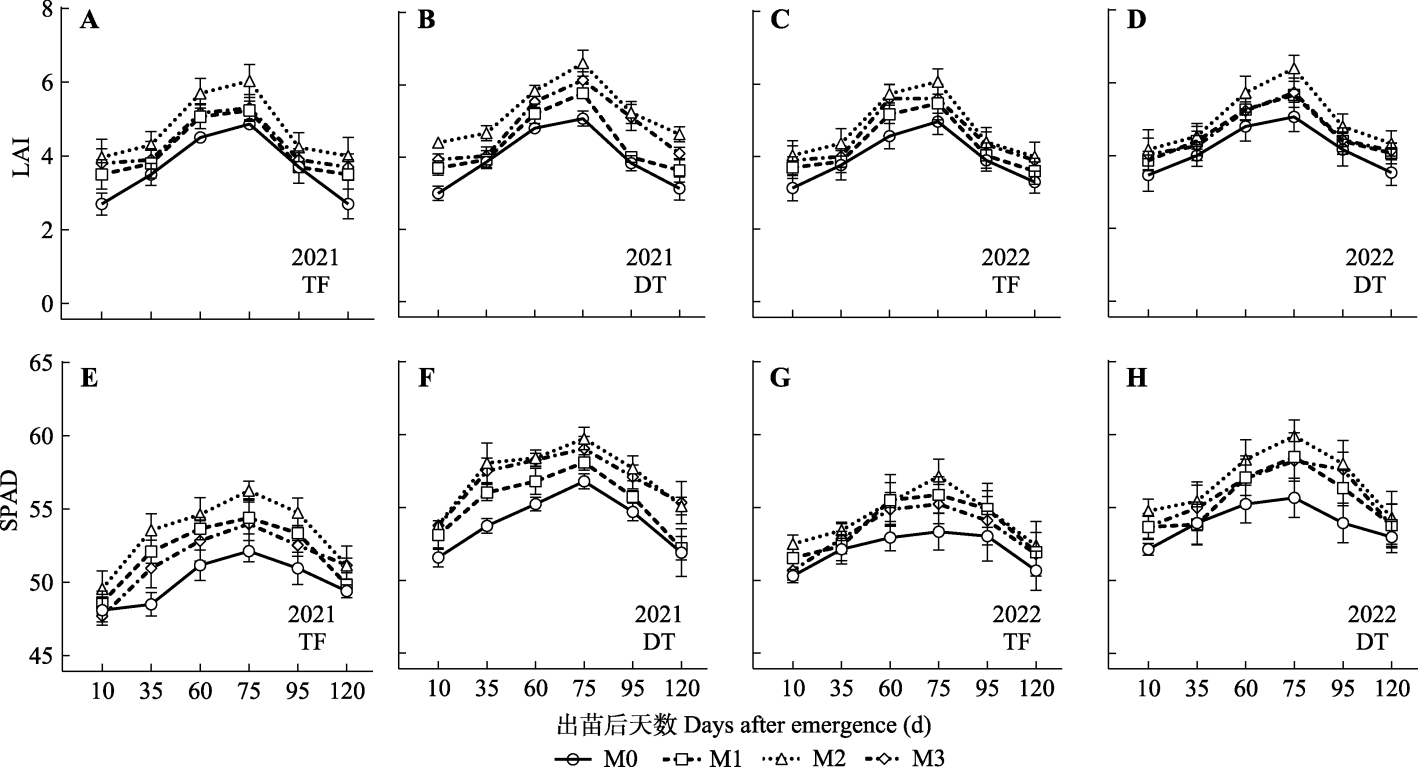
图1 垂直深旋耕配施有机肥对玉米叶面积指数(LAI)和相对叶绿素含量(SPAD)的影响(平均值±标准差)。DT, 垂直深旋耕; TF, 常规耕作方式。M0, 施有机肥0 kg·hm-2; M1, 施有机肥7 500 kg·hm-2; M2, 施有机肥15 000 kg·hm-2; M3, 施有机肥22 500 kg·hm-2。
Fig. 1 Effects of vertical deep rotary tillage with organic fertilizer on leaf area index (LAI) and relative chlorophyll content (SPAD) of maize (mean ± SD). DT, vertical deep rotary tillage; TF, conventional tillage. M0, 0 kg·hm-2 of organic fertilizer; M1, 7 500 kg·hm-2 of organic fertilizer; M2, 15 000 kg·hm-2 of organic fertilizer; M3, 22 500 kg·hm-2 of organic fertilizer.
| 年份 Year | 耕作方式 Farming practices | 处理 Treatment | 二次函数拟合 Quadratic function fitting | R2 | 衰老起始期 Onset of ageing (d) |
|---|---|---|---|---|---|
| 2021 | TF | M0 | Y = -0.000581X2 + 0.066X + 1.95 | 0.848 9* | 56.80 |
| M1 | Y = -0.000475X2 + 0.062X + 2.75 | 0.778 7* | 63.16 | ||
| M2 | Y = -0.000517X2 + 0.069X + 3.12 | 0.737 8* | 66.73 | ||
| M3 | Y = -0.000417X2 + 0.053X + 3.11 | 0.702 5* | 63.55 | ||
| DT | M0 | Y = -0.000578X2 + 0.070X + 2.20 | 0.878 2* | 60.55 | |
| M1 | Y = -0.000519X2 + 0.068X + 2.83 | 0.744 0* | 60.51 | ||
| M2 | Y = -0.000572X2 + 0.081X + 3.12 | 0.762 2* | 70.80 | ||
| M3 | Y = -0.000537X2 + 0.070X + 2.85 | 0.735 0* | 65.18 | ||
| 2022 | TF | M0 | Y = -0.000576X2 + 0.064X + 2.72 | 0.848 6* | 55.56 |
| M1 | Y = -0.000478X2 + 0.063X + 2.88 | 0.752 9* | 65.90 | ||
| M2 | Y = -0.000524X2 + 0.071X + 3.16 | 0.783 6* | 67.75 | ||
| M3 | Y = -0.000485X2 + 0.063X + 3.05 | 0.753 4* | 64.95 | ||
| DT | M0 | Y = -0.000432X2 + 0.051X + 2.82 | 0.876 7* | 59.03 | |
| M1 | Y = -0.000426X2 + 0.057X + 3.24 | 0.781 9* | 66.90 | ||
| M2 | Y = -0.000526X2 + 0.070X + 3.27 | 0.788 0* | 69.39 | ||
| M3 | Y = -0.000392X2 + 0.053X + 3.35 | 0.756 3* | 67.60 |
表4 垂直深旋耕配施有机肥对玉米衰老起始期的影响
Table 4 Effects of vertical deep rotary tillage combined with organic fertilizer on the initial aging period of maize
| 年份 Year | 耕作方式 Farming practices | 处理 Treatment | 二次函数拟合 Quadratic function fitting | R2 | 衰老起始期 Onset of ageing (d) |
|---|---|---|---|---|---|
| 2021 | TF | M0 | Y = -0.000581X2 + 0.066X + 1.95 | 0.848 9* | 56.80 |
| M1 | Y = -0.000475X2 + 0.062X + 2.75 | 0.778 7* | 63.16 | ||
| M2 | Y = -0.000517X2 + 0.069X + 3.12 | 0.737 8* | 66.73 | ||
| M3 | Y = -0.000417X2 + 0.053X + 3.11 | 0.702 5* | 63.55 | ||
| DT | M0 | Y = -0.000578X2 + 0.070X + 2.20 | 0.878 2* | 60.55 | |
| M1 | Y = -0.000519X2 + 0.068X + 2.83 | 0.744 0* | 60.51 | ||
| M2 | Y = -0.000572X2 + 0.081X + 3.12 | 0.762 2* | 70.80 | ||
| M3 | Y = -0.000537X2 + 0.070X + 2.85 | 0.735 0* | 65.18 | ||
| 2022 | TF | M0 | Y = -0.000576X2 + 0.064X + 2.72 | 0.848 6* | 55.56 |
| M1 | Y = -0.000478X2 + 0.063X + 2.88 | 0.752 9* | 65.90 | ||
| M2 | Y = -0.000524X2 + 0.071X + 3.16 | 0.783 6* | 67.75 | ||
| M3 | Y = -0.000485X2 + 0.063X + 3.05 | 0.753 4* | 64.95 | ||
| DT | M0 | Y = -0.000432X2 + 0.051X + 2.82 | 0.876 7* | 59.03 | |
| M1 | Y = -0.000426X2 + 0.057X + 3.24 | 0.781 9* | 66.90 | ||
| M2 | Y = -0.000526X2 + 0.070X + 3.27 | 0.788 0* | 69.39 | ||
| M3 | Y = -0.000392X2 + 0.053X + 3.35 | 0.756 3* | 67.60 |
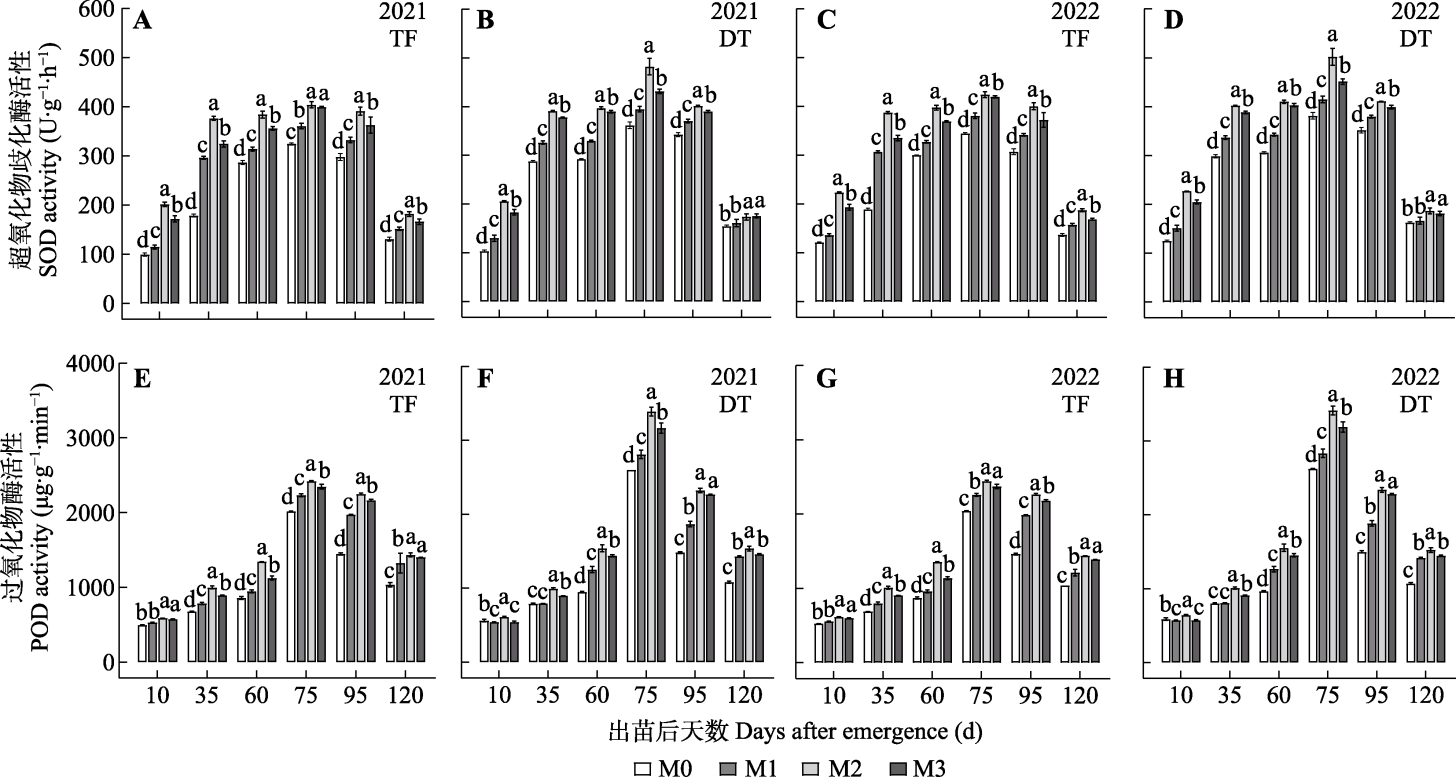
图2 垂直深旋耕配施有机肥对玉米叶片超氧化物歧化酶和过氧化物酶活性的影响(平均值±标准差)。DT, 垂直深旋耕; TF, 常规耕作方式。M0, 施有机肥0 kg·hm-2; M1, 施有机肥7 500 kg·hm-2; M2, 施有机肥15 000 kg·hm-2; M3, 施有机肥22 500 kg·hm-2。不同小写字母表示不同处理间差异显著(p < 0.05)。
Fig. 2 Effects of vertical deep rotary tillage with organic fertilizer on superoxide dismutase (SOD) and peroxidase (POD) activities of maize leaves (mean ± SD). DT, vertical deep rotary tillage; TF, conventional tillage. M0, 0 kg·hm-2 of organic fertilizer; M1, 7 500 kg·hm-2 of organic fertilizer; M2, 15 000 kg·hm-2 of organic fertilizer; M3, 22 500 kg·hm-2 of organic fertilizer. Different lowercase letters indicate significant differences among different treatments (p < 0.05).
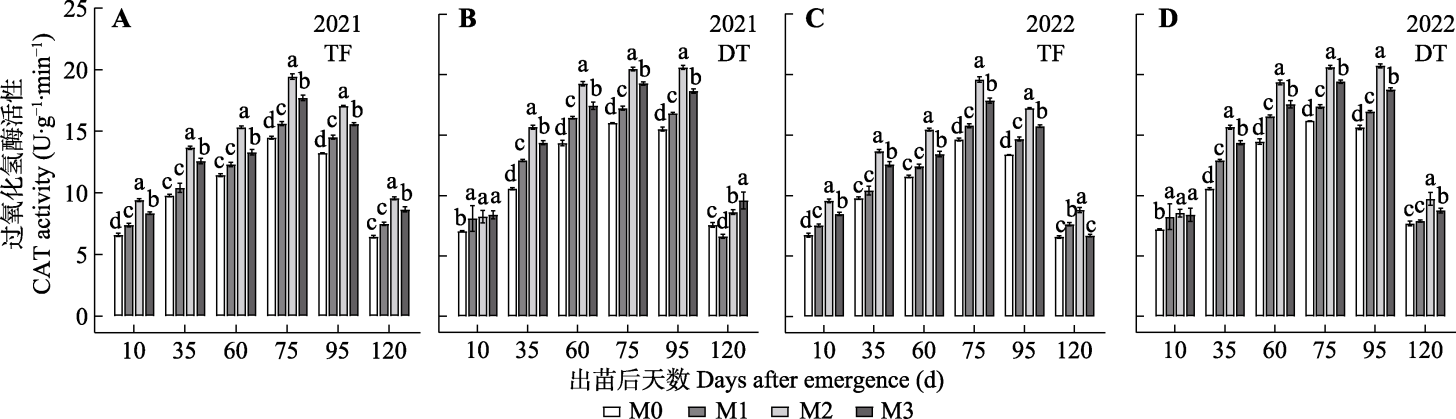
图3 垂直深旋耕配施有机肥对玉米叶片过氧化氢酶活性的影响(平均值±标准差)。DT, 垂直深旋耕; TF, 常规耕作方式。M0, 施有机肥0 kg·hm-2; M1, 施有机肥7 500 kg·hm-2; M2, 施有机肥15 000 kg·hm-2; M3, 施有机肥22 500 kg·hm-2。不同小写字母表示不同处理间差异显著(p < 0.05)。
Fig. 3 Effects of vertical deep rotary tillage with organic fertilizer on catalase (CAT) activity of maize leaves (mean ± SD). DT, vertical deep rotary tillage; TF, conventional tillage. M0, 0 kg·hm-2 of organic fertilizer; M1, 7 500 kg·hm-2 of organic fertilizer; M2, 15 000 kg·hm-2 of organic fertilizer; M3, 22 500 kg·hm-2 of organic fertilizer. Different lowercase letters indicate significant differences among different treatments (p < 0.05).
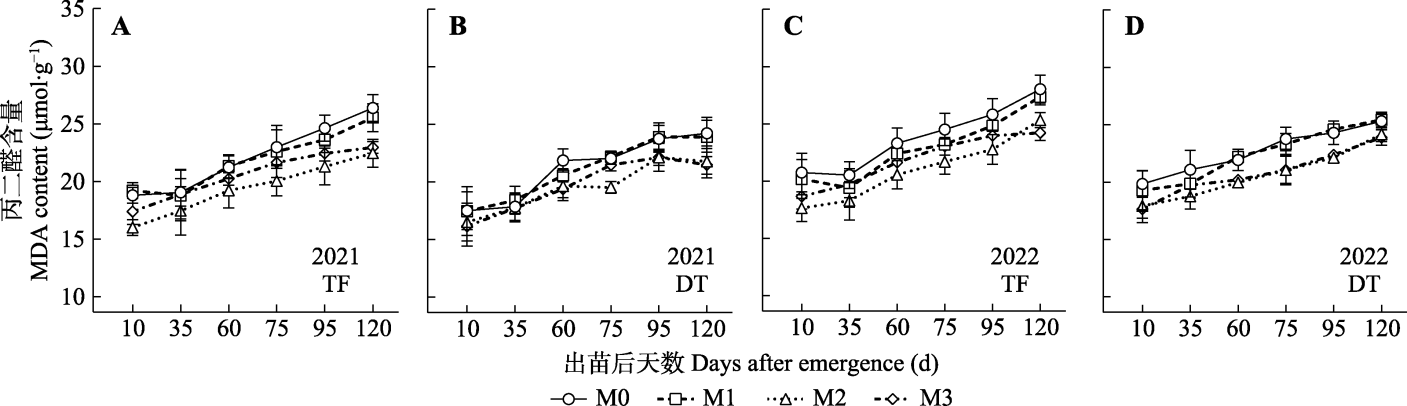
图4 垂直深旋耕配施有机肥对玉米叶片丙二醛含量的影响(平均值±标准差)。DT, 垂直深旋耕; TF, 常规耕作方式。M0, 施有机肥0 kg·hm-2; M1, 施有机肥7 500 kg·hm-2; M2, 施有机肥15 000 kg·hm-2; M3, 施有机肥22 500 kg·hm-2。
Fig. 4 Effect of vertical deep tillage combined with organic fertilizer application on malondialdehyde (MDA) content in maize leaves (mean ± SD). DT, vertical deep rotary tillage; TF, conventional tillage. M0, 0 kg·hm-2 of organic fertilizer; M1, 7 500 kg·hm-2 of organic fertilizer; M2, 15 000 kg·hm-2 of organic fertilizer; M3, 22 500 kg·hm-2 of organic fertilizer.
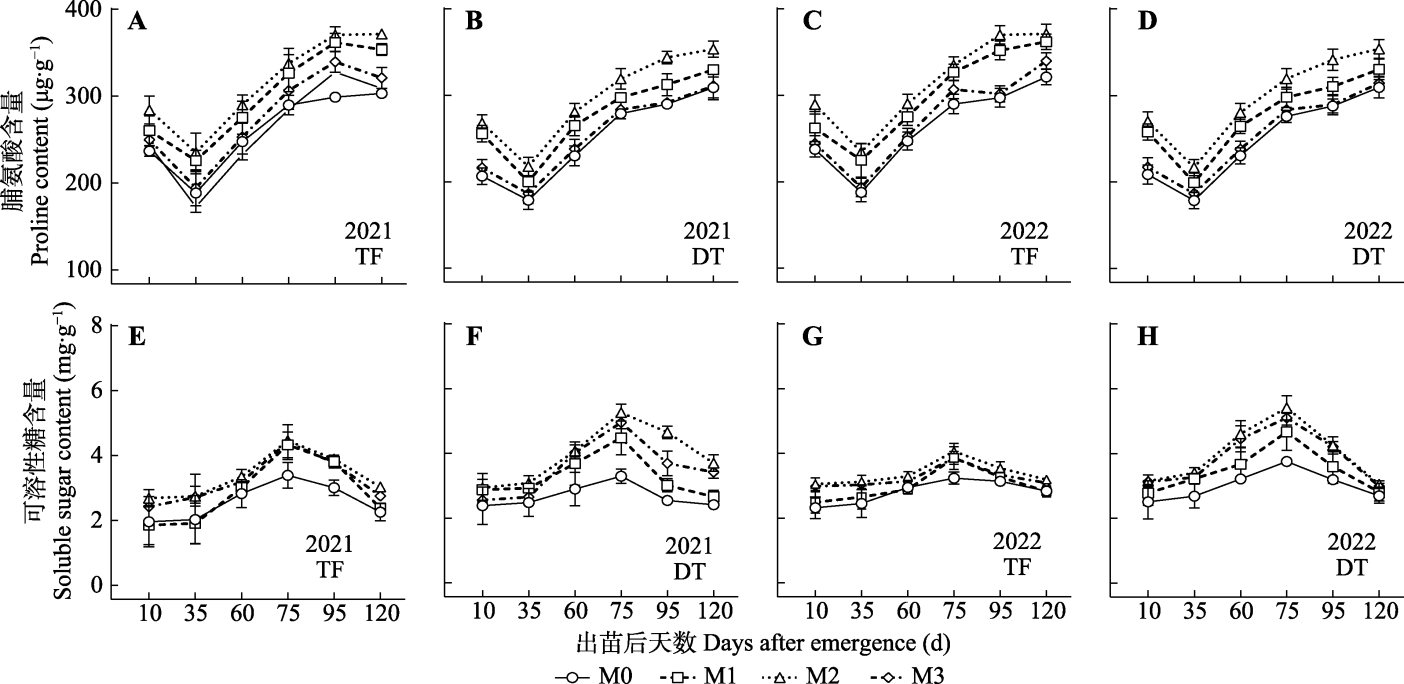
图5 垂直深旋耕配施有机肥对玉米叶片脯氨酸和可溶性糖含量的影响(平均值±标准差)。DT, 垂直深旋耕; TF, 常规耕作方式。M0, 施有机肥0 kg·hm-2; M1, 施有机肥7 500 kg·hm-2; M2, 施有机肥15 000 kg·hm-2; M3, 施有机肥22 500 kg·hm-2。
Fig. 5 Effects of vertical deep rotary tillage with organic fertilizer on proline and soluble sugars content of maize leaves (mean ± SD). DT, vertical deep rotary tillage; TF, conventional tillage. M0, 0 kg·hm-2 of organic fertilizer; M1, 7 500 kg·hm-2 of organic fertilizer; M2, 15 000 kg·hm-2 of organic fertilizer; M3, 22 500 kg·hm-2 of organic fertilizer.
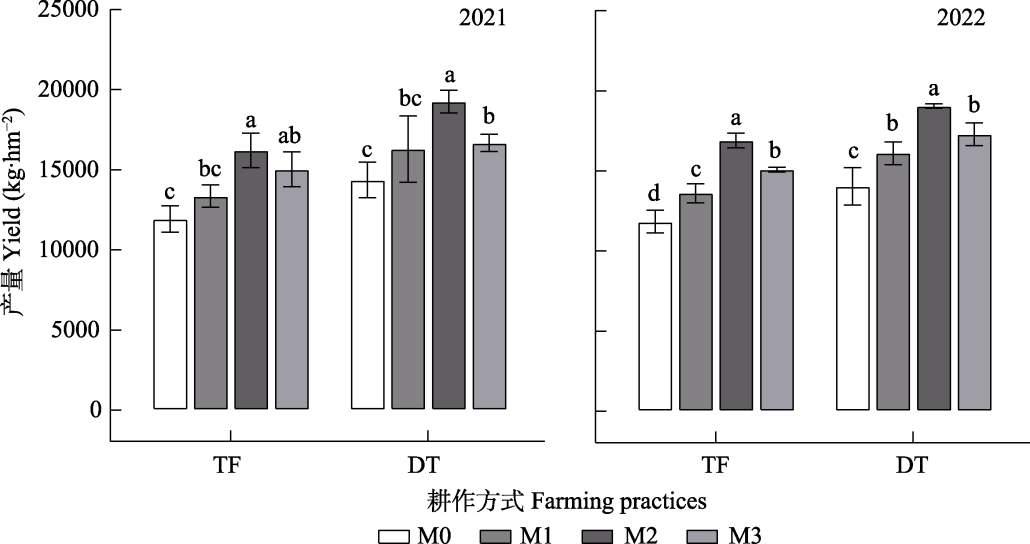
图6 垂直深旋耕配施有机肥对玉米产量的影响(平均值±标准差)。DT, 垂直深旋耕; TF, 常规耕作方式。M0, 施有机肥0 kg·hm-2; M1, 施有机肥7 500 kg·hm-2; M2, 施有机肥15 000 kg·hm-2; M3, 施有机肥22 500 kg·hm-2。不同小写字母表示不同处理间差异显著(p < 0.05)。
Fig. 6 Effects of vertical deep rotary tillage combined with organic fertilizer on maize yield (mean ± SD). DT, vertical deep rotary tillage; TF, conventional tillage. M0, 0 kg·hm-2 of organic fertilizer; M1, 7 500 kg·hm-2 of organic fertilizer; M2, 15 000 kg·hm-2 of organic fertilizer; M3, 22 500 kg·hm-2 of organic fertilizer. Different lowercase letters indicate significant differences among different treatments (p < 0.05).
| 年份 Year | 耕作方式 Farming practices | 二次函数拟合 Quadratic function fitting | R2 | 最佳有机肥施用量 Optimal organic fertilizer application rate (kg·hm-2) | 最高产量 Maximum production (kg·hm-2) |
|---|---|---|---|---|---|
| 2021 | TF | Y = -0.0000116X2 + 0.424X + 11655.45 | 0.860 6* | 18 276 | 15 530 |
| DT | Y = -0.0000202X2 + 0.586X + 14031.56 | 0.822 9* | 14 505 | 18 282 | |
| 2022 | TF | Y = -0.0000160X2 + 0.534X + 11507.11 | 0.843 7* | 16 688 | 15 963 |
| DT | Y = -0.0000171X2 + 0.553X + 13764.44 | 0.883 3* | 16 170 | 18 235 |
表5 不同耕作方式配施有机肥量与玉米产量的二次函数关系
Table 5 Quadratic relationship between the amount of organic fertilizer with different tillage practices and maize yield
| 年份 Year | 耕作方式 Farming practices | 二次函数拟合 Quadratic function fitting | R2 | 最佳有机肥施用量 Optimal organic fertilizer application rate (kg·hm-2) | 最高产量 Maximum production (kg·hm-2) |
|---|---|---|---|---|---|
| 2021 | TF | Y = -0.0000116X2 + 0.424X + 11655.45 | 0.860 6* | 18 276 | 15 530 |
| DT | Y = -0.0000202X2 + 0.586X + 14031.56 | 0.822 9* | 14 505 | 18 282 | |
| 2022 | TF | Y = -0.0000160X2 + 0.534X + 11507.11 | 0.843 7* | 16 688 | 15 963 |
| DT | Y = -0.0000171X2 + 0.553X + 13764.44 | 0.883 3* | 16 170 | 18 235 |
| 项目 Item | LAI | SPAD | SOD | POD | CAT | MDA | Pro | SS | 产量 Yield |
|---|---|---|---|---|---|---|---|---|---|
| pH | 0.01NS | 0.05 NS | -0.12 NS | -0.10NS | 0.09NS | 0.02NS | 0.26NS | 0.21NS | -0.01NS |
| EC | -0.88** | -0.87** | -0.94** | -0.91** | -0.93** | 0.56NS | -0.87** | -0.89** | -0.81** |
| AN | 0.81** | 0.91** | 0.85** | 0.87** | 0.88** | -0.62** | 0.67* | 0.87** | 0.65* |
| AP | 0.82** | 0.63* | 0.76** | 0.71** | 0.69* | -0.39NS | 0.54NS | 0.46NS | 0.44NS |
| AK | 0.88** | 0.79** | 0.95** | 0.90** | 0.87** | -0.50 NS | 0.90** | 0.74** | 0.83** |
| OM | 0.82** | 0.88** | 0.90** | 0.92** | 0.95** | -0.76** | 0.50NS | 0.76** | 0.65* |
| 产量 Yield | 0.81** | 0.72** | 0.85** | 0.83** | 0.80** | -0.49NS | 0.77** | 0.79** | 1.00** |
表6 垂直深旋耕配施有机肥土壤理化性质与玉米叶片生理指标的相关性分析
Table 6 Correlations between soil physicochemical properties and physiological variables of leaves of maize under vertical deep rotary tillage with organic fertilizers
| 项目 Item | LAI | SPAD | SOD | POD | CAT | MDA | Pro | SS | 产量 Yield |
|---|---|---|---|---|---|---|---|---|---|
| pH | 0.01NS | 0.05 NS | -0.12 NS | -0.10NS | 0.09NS | 0.02NS | 0.26NS | 0.21NS | -0.01NS |
| EC | -0.88** | -0.87** | -0.94** | -0.91** | -0.93** | 0.56NS | -0.87** | -0.89** | -0.81** |
| AN | 0.81** | 0.91** | 0.85** | 0.87** | 0.88** | -0.62** | 0.67* | 0.87** | 0.65* |
| AP | 0.82** | 0.63* | 0.76** | 0.71** | 0.69* | -0.39NS | 0.54NS | 0.46NS | 0.44NS |
| AK | 0.88** | 0.79** | 0.95** | 0.90** | 0.87** | -0.50 NS | 0.90** | 0.74** | 0.83** |
| OM | 0.82** | 0.88** | 0.90** | 0.92** | 0.95** | -0.76** | 0.50NS | 0.76** | 0.65* |
| 产量 Yield | 0.81** | 0.72** | 0.85** | 0.83** | 0.80** | -0.49NS | 0.77** | 0.79** | 1.00** |
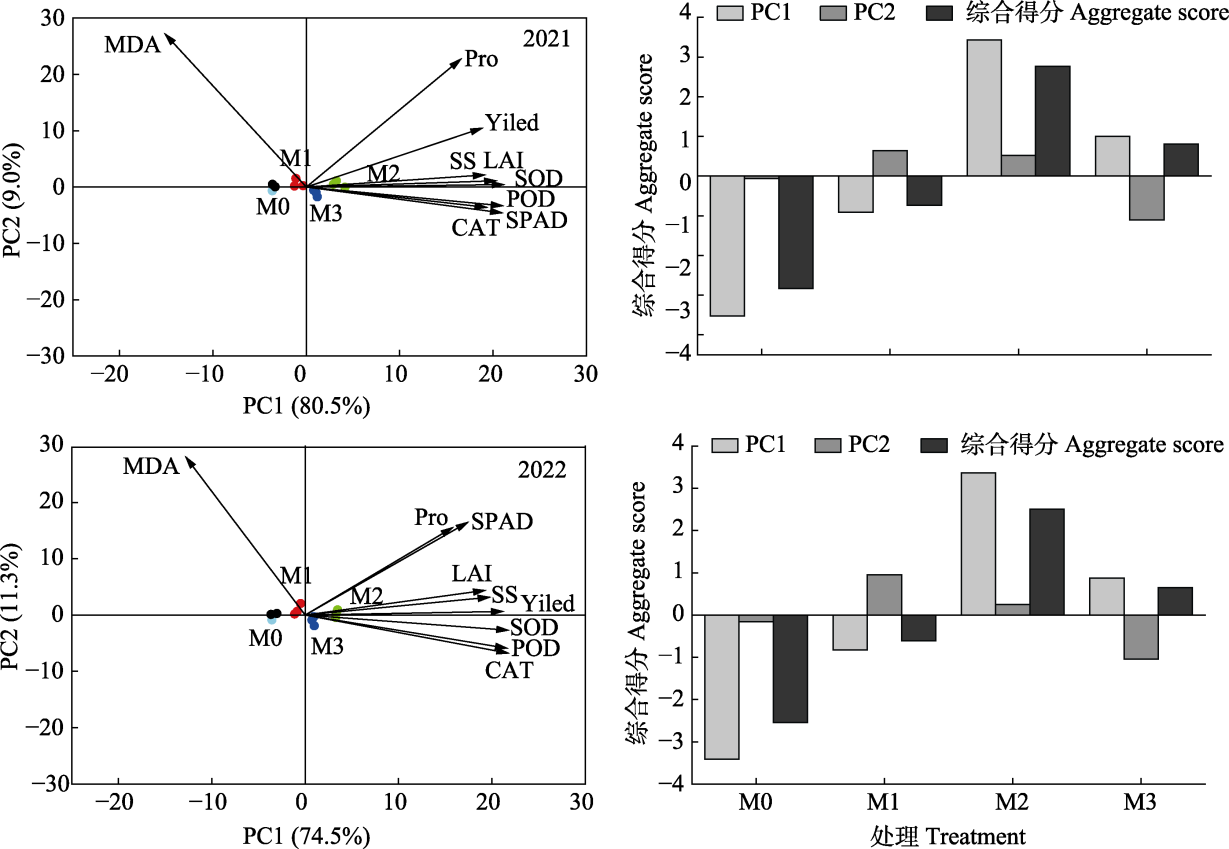
图7 垂直深旋耕配施有机肥对玉米产量与生理指标的综合评价分析。AK, 速效钾含量; AN, 碱解氮含量; AP, 有效磷含量; CAT, 过氧化氢酶活性; EC, 电导率; LAI, 叶面积指数; MDA, 丙二醛含量; OM, 有机质含量; POD, 过氧化物酶活性; Pro, 脯氨酸含量; SOD, 超氧化物歧化酶活性; SPAD, 相对叶绿素含量; SS, 可溶性糖含量。
Fig. 7 Comprehensive evaluation analysis of maize yield and physiological variables by vertical deep rotary tillage with organic fertilizer application. AK, quick-acting potassium content; AN, alkaline dissolved nitrogen content; AP, effective phosphorus content; CAT, catalase activity; EC, electrical conductivity; LAI, leaf area index; MDA, malondialdehyde content; OM, organic matter content; POD, peroxidase activity; Pro, proline content; SOD, superoxide dismutase activity; SPAD, relative chlorophyll content; SS, soluble sugar content.
| [1] | Bao SD (2000). Soil Agrochemical Analysis. 3rd ed. China Agricultural Publishing House, Beijing. |
| [鲍士旦 (2000). 土壤农化分析. 3版. 中国农业出版社, 北京.] | |
| [2] | Deng J (2024). Research on the role of fertilizers in sustainable soil use. Rural Scientific Experiment, (1), 48-50. |
| [邓炯 (2024). 肥料在土壤可持续利用中的作用研究. 农村科学实验, (1), 48-50.] | |
| [3] | Deng YS, Zhang M, Li W, Liu YJ, Peng SG, Tian F, Zhang ZW, Zhang C, Jiang ZM, Chen J, Su GX, Deng XH (2020). Effects of deep vertical rotary tillage on physicochemical properties of tobacco-planting soil and growth of flue-cured tobacco. Chinese Tobacco Science, 41(6), 30-36. |
| [邓永晟, 张敏, 李伟, 刘勇军, 彭曙光, 田峰, 张仲文, 章程, 江智敏, 陈金, 粟戈璇, 邓小华 (2020). 垂直深旋耕对植烟土壤理化性状和烤烟生长的影响. 中国烟草科学, 41(6), 30-36.] | |
| [4] | Du ML, Chen LL, Yang L, Yue LN, Liu XW, Jing JY (2025). Effects of mixed cropping of different varieties of silage maize on yield and quality. Acta Agrestia Sinica, 33, 273-282. |
|
[杜木林, 陈莉莉, 杨靓, 岳丽楠, 刘笑玮, 荆晶莹 (2025). 不同基因型青贮玉米混作对产量及品质的影响. 草地学报, 33, 273-282.]
DOI |
|
| [5] |
Jian TC, Kang JH, Wu HL, Liu GH, Gao D, Ma XY, Li X (2021). Antioxidative characteristics study of nitrogen in alleviating premature senescence of spring wheat at high temperature after anthesis. Journal of Agricultural Science and Technology, 23(7), 33-44.
DOI |
| [坚天才, 康建宏, 吴宏亮, 刘根红, 高娣, 马雪莹, 李鑫 (2021). 氮素缓解春小麦花后高温早衰的抗氧化特性研究. 中国农业科技导报, 23(7), 33-44.] | |
| [6] | Kuang EJ, Li ZX, Chi FQ, Zhang JM, Su QR, Zhu BG (2020). Effect of different plough and organic fertilizer on characteristics of soybean yield and soil nutrients. Soybean Science, 39(1), 108-115. |
| [匡恩俊, 李梓瑄, 迟凤琴, 张久明, 宿庆瑞, 朱宝国 (2020). 耕地方式与有机肥配施对大豆产量及土壤养分特征的影响. 大豆科学, 39(1), 108-115.] | |
| [7] | Li CH, Zhang Q, Feng YQ, Chen DP, Zhang YM, Wei QP (2016). Effects of organic fertilization within partial root on the growth and leaf physiological characteristics of apple trees. Agricultural Research in the Arid Areas, 34(3), 23-30. |
| [李翠红, 张强, 冯毓琴, 陈大鹏, 张永茂, 魏钦平 (2016). 分区施用有机肥对苹果树体生长和叶片生理特性的影响. 干旱地区农业研究, 34(3), 23-30.] | |
| [8] | Li GH, Liu PP, Zhao B, Dong ST, Liu P, Zhang JW, Tian CX, He ZJ (2017). Effects of water conditions and controlled release urea on yield and leaf senescence physiological characteristics in summer maize. Chinese Journal of Applied Ecology, 28, 571-580. |
|
[李广浩, 刘平平, 赵斌, 董树亭, 刘鹏, 张吉旺, 田翠霞, 何在菊 (2017). 不同水分条件下控释尿素对夏玉米产量和叶片衰老特性的影响. 应用生态学报, 28, 571-580.]
DOI |
|
| [9] | Li ZH, Guo YF, Ren GD, Zhang KW, Miu Y, Guo HW (2023). Advances in leaf senescence. Journal of Plant Physiology, 59, 1627-1656. |
| [李中海, 郭永峰, 任国栋, 张可伟, 缪颖, 郭红卫 (2023). 叶片衰老研究进展. 植物生理学报, 59, 1627-1656.] | |
| [10] | Liu H, Ma ZH, Liu WF, Wan MH, Ma FL, Wu N, Liu JL (2025). Effects of different tillage practices with organic fertilizers on rhizosphere soil microbial communities of maize in saline-alkali soils. Chinese Journal of Eco-Agriculture, 33(1), 25-39. |
| [刘昊, 麻仲花, 刘威帆, 万猛虎, 马风兰, 吴娜, 刘吉利 (2025). 不同耕作方式配施有机肥对盐碱地玉米根际土壤微生物群落的影响. 中国生态农业学报, 33(1), 25-39.] | |
| [11] | Liu HB, Liu GL, Cheng YF, Li HX, Yin CL, Ning TY, Liu P, Li G (2024). Effects of alternate tillage mode on soil water-salt distribution and winter wheat yield in saline-alkali soil. Agricultural Science & Technology and Equipment, (5), 54-57. |
| [刘鸿博, 刘国利, 程云飞, 李宏旭, 尹承龙, 宁堂原, 刘鹏, 李耕 (2024). 交替耕作模式对盐碱地土壤水盐分布及冬小麦产量的影响. 农业科技与装备, (5), 54-57.] | |
| [12] | Ma DL, Gao HX, Yu XF, Gao JL, Li B (2023). Effects of subsoiling tillage on stalk lodging resistant mechanical characteristic of maize varieties after physiological maturity. Agricultural Research in the Arid Areas, 41(1), 140-149. |
| [马达灵, 高慧霞, 于晓芳, 高聚林, 李博 (2023). 深松耕作对不同年代玉米品种生理成熟后的抗倒伏力学特性的影响. 干旱地区农业研究, 41(1), 140-149.] | |
| [13] | Ma ZH, Liu JL, Wu N, Yang YS, Hu YQ, Zhe YQ (2023). Effects of deep rotary tillage combined with organic fertilizer on bacterial community structure and function of maize rhizosphere soil in saline alkali land. Chinese Journal of Agrometeorology, 44, 479-491. |
| [麻仲花, 刘吉利, 吴娜, 杨永森, 胡永琪, 者永清 (2023). 深旋耕配施有机肥对盐碱地玉米根际土壤细菌群落结构及其功能的影响. 中国农业气象, 44, 479-491.] | |
| [14] | Qiu L, Zhao LS, Xie YD, Xiong HC, Gu JY, Bi XL, Liu LX, Guo HJ (2022). Advances in research on premature senescence in plants. Journal of Plant Genetic Resources, 23, 346-357. |
|
[仇琳, 赵林姝, 谢永盾, 熊宏春, 古佳玉, 毕秀丽, 刘录祥, 郭会君 (2022). 植物早衰研究进展. 植物遗传资源学报, 23, 346-357.]
DOI |
|
| [15] | Qu ZY, Hu M, Wang LP, Ding YH, Gao XY (2020). Effects of different improvement measures on hydrothermal carbon and sunflower yield in salinized soil. Transactions of the Chinese Society for Agricultural Machinery, 51, 268-275. |
| [屈忠义, 胡敏, 王丽萍, 丁艳宏, 高晓瑜 (2020). 不同改良措施对盐渍化土壤水热碳与葵花产量的影响. 农业机械学报, 51, 268-275.] | |
| [16] | Su M, Liu QJ, Hong ZQ, Li FG, Zhang ZZ, Zhou T, Ma JL, Wu HL, Kang JH (2024a). Effects of different nitrogen application rates on photosynthetic characteristics and yield formation of potato in semi-arid region of northwest China. Journal of Plant Nutrition and Fertilizers, 30, 1919-1933. |
| [苏明, 柳强娟, 洪自强, 李翻过, 张正珍, 周甜, 马纪龙, 吴宏亮, 康建宏 (2024a). 西北半干旱区不同施氮量对马铃薯光合特性及产量形成的影响. 植物营养与肥料学报, 30, 1919-1933.] | |
| [17] | Su M, Liu QJ, Zhang ZZ, Zhou T, Hong ZQ, Li FG, Kang JH, Wu HL (2024b). Effects of nitrogen application on antioxidant properties and yield of dryland potato leaves in the mountainous region of southern Ningxia. Chinese Journal of Ecological Agriculture, 32, 1341-1354. |
| [苏明, 柳强娟, 张正珍, 周甜, 洪自强, 李翻过, 康建宏, 吴宏亮 (2024b). 施氮量对宁夏南部山区旱地马铃薯叶片抗氧化特性及产量的影响. 中国生态农业学报, 32, 1341-1354.] | |
| [18] |
Su QR, Li WX, Chi FQ (2006). Effect of organic fertilizer application on soil salt content and the yield of rice. Chinese Agricultural Science Bulletin, 22, 299-301.
DOI |
| [宿庆瑞, 李卫孝, 迟凤琴 (2006). 有机肥对土壤盐分及水稻产量的影响. 中国农学通报, 22, 299-301.] | |
| [19] | Sun J (2013). Improvement of saline and waste land into good land. China Rural Science & Technology, (8), 28-29. |
| [孙洁 (2013). 盐碱地改良废弃土地变良田. 中国农村科技 (8), 28-29.] | |
| [20] | Sun Q, Hu JJ (2006). Research Techniques in Plant Physiology. Northwest A&F University Press, Xianyang, Shaanxi. |
| [孙群, 胡景江 (2006). 植物生理学研究技术. 西北农林科技大学出版社, 陕西咸阳.] | |
| [21] | Wang BL, Zhou CS, Hai Z, Lou YX, Liu XY, Zhen T, Liu P (2024). Effects of deep-pine tillage and mulching on soil physicochemical properties and maize yield in saline-alkaline land of West Liao He Soda. Jiangsu Agricultural Science, 52(19), 252-258. |
| [王本龙, 周春生, 海珍, 娄雨欣, 刘学瑶, 甄婷, 刘萍 (2024). 深松耕作与覆膜对西辽河苏打盐碱地土壤理化性质及玉米产量的影响. 江苏农业科学, 52(19), 252-258.] | |
| [22] | Wang CJ, Li FX, Wu X (2021). Effects of different organic materials on soil nutrient content and nitrogen availability in saline alkali land of Yinbei irrigation area. Modern Agricultural Science and Technology, (23), 141-142. |
| [王长军, 李凤霞, 吴霞 (2021). 不同有机物料对银北灌区盐碱地土壤养分含量及氮有效性的影响. 现代农业科技, (23), 141-142.] | |
| [23] | Wang D, Lyu YJ, Yao FY, Xu WH, Chen SM, Shao XW, Cao YJ, Wang YJ (2022). Leaf senescence characteristics post-anthesis at different positions of spring maize canopy under different cultivation models. Chinese Journal of Eco-Agriculture, 30, 1925-1937. |
| [王丹, 吕艳杰, 姚凡云, 徐文华, 陈帅民, 邵玺文, 曹玉军, 王永军 (2022). 不同栽培模式春玉米花粒期冠层不同部位叶片的衰老特性. 中国生态农业学报, 30, 1925-1937.] | |
| [24] |
Wang LP, Li P, Zhao LH, Fan ZL, Hu FL, Fan H, He W, Chai Q, Yin W (2025). Response of senescence characteristics for maize leaves under different plastic mulching and using patterns in oasis irrigation areas of northwestern China. Acta Agronomica Sinica, 51, 233-246.
DOI |
|
[王丽萍, 李盼, 赵连豪, 樊志龙, 胡发龙, 范虹, 何蔚, 柴强, 殷文 (2025). 西北绿洲灌区玉米叶片衰老特征对不同地膜覆盖利用方式的响应. 作物学报, 51, 233-246.]
DOI |
|
| [25] | Wang QM, Jing YP, Li YJ, Zhao J, Zhang YZ, Li XP, Li HC, Liu YJ, Bai YX (2020). Effect of different fertilizer regime on the improvement of saline-alkali soil in Hetao Irrigation District. Soil and Fertilizer Sciences in China, (5), 124-131. |
| [王庆蒙, 景宇鹏, 李跃进, 赵举, 张雅贞, 李秀萍, 李焕春, 刘宇杰, 白勇兴 (2020). 不同培肥措施对河套灌区盐碱地改良效果. 中国土壤与肥料, (5), 124-131.] | |
| [26] | Wang W, Li MY, Zhou R, Mo F, Khan A, Batool A, Zhang W, Lu JS, Zhu Y, Wang BZ, Yang YM, Wang J, Tao XP, Xiong YC (2023). Leaf senescence, nitrogen remobilization, and productivity of maize in two semiarid intercropping systems. European Journal of Agronomy, 150, 126943. DOI: 10.1016/J.EJA.2023.126943. |
| [27] | Wang XQ, Xu X, Li FX (2010). Possible effects of coal flue gas desulfurization on nitrogen metabolism of alfalfa and research progress. Agricultural Science Research, 31(4), 84-87. |
| [王学琴, 许兴, 李凤霞 (2010). 燃煤烟气脱硫物施用对苜蓿氮素代谢的可能影响及研究进展. 农业科学研究, 31(4), 84-87.] | |
| [28] | Wang Y, Zhao C, Fan ZL, Gou ZW, Hu FL, Yin W, Chai Q (2020). Characteristics of dry matter accumulation and yield formation of dense planting maize in different row spacings. Chinese Journal of Eco-Agriculture, 28, 652-661. |
| [王玉, 赵财, 樊志龙, 苟志文, 胡发龙, 殷文, 柴强 (2020). 行距及密度影响玉米密植潜力的干物质累积和产量构成机制. 中国生态农业学报, 28, 652-661.] | |
| [29] | Wang YX, Wang JH, Liu YT, Ren CM, Yang HY, Xu YY, Gao P, Zhao L, Hu JF (2018). Effects of different deep loosening years treatments on the layer structure and the yield of maize of saline alkali soil in semi-arid region of Heilongjiang Province. Heilongjiang Agricultural Sciences, (8), 15-18. |
| [王宇先, 王俊河, 刘玉涛, 任翠梅, 杨慧莹, 徐莹莹, 高盼, 赵蕾, 胡继芳 (2018). 不同深松年限处理对黑龙江省西部地区盐碱土耕层结构及玉米产量的影响. 黑龙江农业科学, (8), 15-18.] | |
| [30] |
Wu HY, Zhang YJ, Zhang WF, Wang KR, Li SK, Jiang CD (2019). Photosynthetic characteristics of senescent leaf induced by high planting density of maize at heading stage in the field. Acta Agronomica Sinica, 45, 248-255.
DOI URL |
|
[吴含玉, 张雅君, 张旺锋, 王克如, 李少昆, 姜闯道 (2019). 田间密植诱导抽穗期玉米叶片衰老时的光合作用机制. 作物学报, 45, 248-255.]
DOI |
|
| [31] | Xie GM, Liang M, Chen P, Zhang C, Fan MY, Wang CY, Zhao L (2024). The effects of tillage and the combined application of organic and inorganic fertilizers on the antioxidant enzyme activity and yield of maize leaves. Agronomy, 14, 968. DOI: 10.3390/agronomy14050968. |
| [32] | Xiong W, Jiang LX, Chi P, Wu Y, Geng D, Du CQ, Liu S, Liu Y, Yang YL, Pan C (2024). Application and effect of soil fertility enhancement measures in high standard farmland construction in Luotian County. Central South Agricultural Science and Technology, 45(11), 81-84. |
| [熊伟, 江路霞, 池鹏, 吴雨, 耿栋, 杜成全, 刘胜, 刘洋, 杨乙琳, 潘超 (2024). 罗田县高标准农田建设土壤地力提升措施的应用及效果. 中南农业科技, 45(11), 81-84.] | |
| [33] | Yang HL, Bie H (2024). Characteristics and application prospect of a new oil crop Cyperus esculentus. Seed Science & Technology, 42(17), 139-141. |
| [杨海龙, 别海 (2024). 新型油料作物油莎豆的特性及应用前景探析. 种子科技, 42(17), 139-141.] | |
| [34] | Yang QH, Zhang Q, Wang YX, He X, Yang PW, Zhao DZ, Ni M, Zhu HY (2019). Effects of deep ploughing on soil layer characteristics and maize yield on red soil sloping land. Southwest China Journal of Agricultural Sciences, 32, 2783-2789. |
| [杨群辉, 张庆, 王应学, 何翔, 杨佩文, 赵德柱, 倪明, 朱红业 (2019). 红壤坡地深松耕对土层特性和玉米产量的影响. 西南农业学报, 32, 2783-2789.] | |
| [35] | Yu F, Zhao S, Zhao Y, Wang Y, Fan YK, Meng QF (2022). Effects of long-term application of cattle manure on soil fertilityand corn yield of saline-sodic soil in western Songnen Plain. Agricultural Research in the Arid Areas, 40, 172-180. |
| [于菲, 赵硕, 赵影, 汪勇, 范益恺, 孟庆峰 (2022). 长期施用有机肥对松嫩平原西部盐碱土肥力和玉米产量的影响. 干旱地区农业研究, 40, 172-180.] | |
| [36] |
Yu HD, Chu ZY, Wang SY, Guo YQ, Ren BZ, Zhang JW (2023). Effects of different controlled nitrogen ratios on leaf senescence and grain filling characteristics of summer maize. Scientia Agricultura Sinica, 56, 3511-3529.
DOI |
|
[于浩东, 初振宇, 汪顺源, 郭艳青, 任佰朝, 张吉旺 (2023). 不同控释氮素比例对夏玉米叶片衰老和籽粒灌浆特性的影响. 中国农业科学, 56, 3511-3529.]
DOI |
|
| [37] | You ZY, Wang JG, Liu Y, Yan ZH, Zhang JL, Wan SB (2024). Interactive effect of N and Ca on the nitrogen metabolism enzyme activity, nitrogen utilization and calcium accumulation of peanut. Chinese Journal of Oil Crop Sciences, 46, 904-912. |
|
[尤召阳, 王建国, 刘颖, 闫振辉, 张佳蕾, 万书波 (2024). 氮钙互作对花生氮素利用及钙素积累的影响. 中国油料作物学报, 46, 904-912.]
DOI |
|
| [38] | Zhang B, Li JR, Guo LN, Zhu SJ, Fu FW (2024). Research progress on the effect of organic fertilizer application on soil microorganisms. Journal of Jilin Forestry Science and Technology, 53(6), 27-32. |
| [张波, 李江荣, 郭亮娜, 朱思洁, 付芳伟 (2024). 有机肥添加对土壤微生物的影响研究进展. 吉林林业科技, 53(6), 27-32.] | |
| [39] | Zhang JY, Du QZ, Liu X, Deng JH, Jiao Q, Gong L, Jiang XY (2021). The regulation of S-abscisic acid on corn growth and yield in saline-alkali soil. Agrochemicals, 60, 853-858. |
| [张建业, 杜庆志, 刘翔, 邓佳辉, 焦芹, 龚洛, 姜兴印 (2021). S-诱抗素对盐碱地玉米生长及产量的调控作用. 农药, 60, 853-858.] | |
| [40] | Zhang JZ (2007). Effect of Microbial Organic Fertilizer on Physicochemical Property of Saline Alkali Soil and Physiologic Reaction of Alfalfa. Master degree dissertation, Northeast Agricultural University, Harbin. |
| [张金柱 (2007). 生物有机肥对盐碱土理化性质及苜蓿生理反应影响的研究. 硕士学位论文, 东北农业大学, 哈尔滨.] | |
| [41] |
Zhang MW, Qiao JF, Song SS, Ma J, Zhang PP, Li C, Niu J, Guo HX (2022). Effect of drought stress on grain-filling and physiological properties of summer maize and the exogenous spermidine regulation. Journal of Nuclear Agricultural Sciences, 36, 2501-2509.
DOI |
|
[张美微, 乔江方, 宋韶帅, 马娟, 张盼盼, 李川, 牛军, 郭涵潇 (2022). 干旱对夏玉米籽粒充实和生理特性的影响及其外源亚精胺调控. 核农学报, 36, 2501-2509.]
DOI |
|
| [42] |
Zhang NX, Zhao C, Zhao LX, Cai LJ, Wang YF, Chai Q (2018). Water-saving potential for biennial mulched corn with same plastic film in oasis irrigation area. Acta Agronomica Sinica, 44, 876-885.
DOI URL |
|
[张乃旭, 赵财, 赵良霞, 蔡莉娟, 王一帆, 柴强 (2018). 绿洲灌区一膜覆两年玉米的节水潜力. 作物学报, 44, 876-885.]
DOI |
|
| [43] | Zhang X (2024). Agricultural environmental protection technology in the development of ecological agriculture. World Tropical Agriculture Information, (11), 21-22. |
| [张肖 (2024). 生态农业发展中的农业环保技术. 世界热带农业信息, (11), 21-22.] | |
| [44] | Zhao WX, Huang M, Li YJ, Wu JZ, Zhao KN, Zhang J, Li SJ, Wang HT, Huang XL, Li S, Li WN (2023). Effects of different tillage practices on physiological characteristics in flag leaves and grain yield of wheat during the summer fallow season in dryland of Western Henan. Agricultural Research in the Arid Areas, 41(5), 175-185. |
| [赵雯馨, 黄明, 李友军, 吴金芝, 赵凯男, 张军, 李淑靖, 汪洪涛, 黄修利, 李爽, 李文娜 (2023). 夏闲季不同耕作方式对豫西旱地小麦旗叶生理特性和产量的影响. 干旱地区农业研究, 41(5), 175-185.] |
| [1] | 徐恩相, 周蕾, 章晓炜, 张国萍, 仲杜伟, 黄智, 刘派, 迟永刚. 基于不同生育阶段冠层光谱和碳通量的水稻产量估算[J]. 植物生态学报, 2026, 50(1): 82-93. |
| [2] | 李少伟, 何永涛, 孙维, 戴尔阜. 2016-2020年拉萨河谷典型农田生态系统长期监测样地作物收获期性状和产量数据集[J]. 植物生态学报, 2025, 49(8): 1321-1328. |
| [3] | 樊月玲, 蒋正德, 叶佳舒, 郑立臣, 陈欣. 2005-2015年下辽河平原农田长期观测样地主要农作物收获期性状和产量数据集[J]. 植物生态学报, 2025, 49(8): 1271-1282. |
| [4] | 王立龙, 冯静, 苏娜, 刘新平, 潘成臣, 李玉强. 2005-2015年科尔沁沙地典型农田生态系统长期监测样地玉米收获期性状和产量数据集[J]. 植物生态学报, 2025, 49(8): 1293-1300. |
| [5] | 王志波, 刘文胜, 吴瑞俊, 王国梁. 2018-2023年黄土高原丘陵沟壑区川台地农田长期监测样地作物收获期性状和产量数据集[J]. 植物生态学报, 2025, 49(8): 1301-1311. |
| [6] | 王书伟, 林静慧, 周伟, 单军, 赵旭, 颜晓元. 2004-2020年太湖平原典型农田生态系统长期监测样地作物收获期性状和产量数据集[J]. 植物生态学报, 2025, 49(8): 1283-1292. |
| [7] | 王鹏, 李向义, 高艳菊, 热甫开提·沙比提, 曾凡江. 2005-2010年塔克拉玛干沙漠南缘绿洲农田长期监测样地棉花收获期性状和产量数据集[J]. 植物生态学报, 2025, 49(8): 1329-1338. |
| [8] | 朱喜, 何志斌, 杜明武, 赵丽雯, 吴丹丹. 2004-2010年河西走廊中段绿洲农田生态系统长期监测样地作物性状和产量数据集[J]. 植物生态学报, 2025, 49(8): 1312-1320. |
| [9] | 张斌, 张浩成, 乔天, 吕治兵, 许亚男, 李雪芹, 原向阳, 冯美臣, 张美俊. 接种丛枝菌根真菌对干旱胁迫燕麦非结构性碳水化合物及碳氮磷化学计量特征的影响[J]. 植物生态学报, 2025, 49(7): 1082-1095. |
| [10] | 严文秀, 赵诗晗, 郑春燕, 张萍, 沈海花, 常锦峰, 徐亢. 基于多物候指标的人工饲草长势监测及产量估测[J]. 植物生态学报, 2025, 49(7): 1096-1109. |
| [11] | 唐远翔, 熊仕臣, 朱洪锋, 张新生, 游成铭, 刘思凝, 谭波, 徐振锋. 长期氮添加对四川盆地西缘常绿阔叶林优势树种凋落叶产量及碳氮磷归还的影响[J]. 植物生态学报, 2025, 49(5): 720-731. |
| [12] | 程可心, 杜尧, 李凯航, 王浩臣, 杨艳, 金一, 何晓青. 玉米与叶际微生物组的互作遗传机制[J]. 植物生态学报, 2024, 48(2): 215-228. |
| [13] | 刘建新, 刘瑞瑞, 刘秀丽, 贾海燕, 卜婷, 李娜. 外源硫化氢对盐碱胁迫下裸燕麦光合碳代谢的调控[J]. 植物生态学报, 2023, 47(3): 374-388. |
| [14] | 熊淑萍, 曹文博, 曹锐, 张志勇, 付新露, 徐赛俊, 潘虎强, 王小纯, 马新明. 水平结构配置对冬小麦冠层垂直结构、微环境及产量的影响[J]. 植物生态学报, 2022, 46(2): 188-196. |
| [15] | 孙浩哲, 王襄平, 张树斌, 吴鹏, 杨蕾. 阔叶红松林不同演替阶段凋落物产量及其稳定性的影响因素[J]. 植物生态学报, 2021, 45(6): 594-605. |
| 阅读次数 | ||||||
|
全文 |
|
|||||
|
摘要 |
|
|||||
Copyright © 2026 版权所有 《植物生态学报》编辑部
地址: 北京香山南辛村20号, 邮编: 100093
Tel.: 010-62836134, 62836138; Fax: 010-82599431; E-mail: apes@ibcas.ac.cn, cjpe@ibcas.ac.cn
备案号: 京ICP备16067583号-19

