
植物生态学报 ›› 2026, Vol. 50 ›› Issue (1): 82-93.DOI: 10.17521/cjpe.2024.0186 cstr: 32100.14.cjpe.2024.0186
徐恩相1, 周蕾1,*( ), 章晓炜1, 张国萍2, 仲杜伟1, 黄智1, 刘派1, 迟永刚1
收稿日期:2024-06-03
接受日期:2025-01-14
出版日期:2026-01-20
发布日期:2026-02-14
通讯作者:
*周蕾(zhoulei@zjnu.cn)基金资助:
XU En-Xiang1, ZHOU Lei1,*(), ZHANG Xiao-Wei1, ZHANG Guo-Ping2, ZHONG Du-Wei1, HUANG Zhi1, LIU Pai1, CHI Yong-Gang1
Received:2024-06-03
Accepted:2025-01-14
Online:2026-01-20
Published:2026-02-14
Contact:
*ZHOU Lei (zhoulei@zjnu.cn)Supported by:摘要:
准确估算作物产量对于农业政策制定具有重要意义。植被冠层光谱和碳通量是监测作物生长状态的主要数据, 然而比较两者在预测产量方面精确度的研究较少。该研究以同步观测的植被冠层反射光谱和气体交换参数为基础数据, 探索各类参数预测水稻(Oryza sativa)籽粒产量和地上生物量的精确度。结果表明, 植被反射指数在估算水稻籽粒产量和地上生物量时的表现优于碳通量参数, 其中最优估算参数为植被近红外反射率; 营养生长阶段是水稻籽粒产量和地上生物量的最优估算阶段。研究结果可为基于遥感数据和地面通量数据的农田产量估算提供指导。
徐恩相, 周蕾, 章晓炜, 张国萍, 仲杜伟, 黄智, 刘派, 迟永刚. 基于不同生育阶段冠层光谱和碳通量的水稻产量估算. 植物生态学报, 2026, 50(1): 82-93. DOI: 10.17521/cjpe.2024.0186
XU En-Xiang, ZHOU Lei, ZHANG Xiao-Wei, ZHANG Guo-Ping, ZHONG Du-Wei, HUANG Zhi, LIU Pai, CHI Yong-Gang. Estimation of rice yield based on canopy reflectance spectra and carbon flux in diverse growth phases. Chinese Journal of Plant Ecology, 2026, 50(1): 82-93. DOI: 10.17521/cjpe.2024.0186
| 日期 Date | 年序日 DOY | 时期 Stage | 阶段 Phase |
|---|---|---|---|
| 07-10 | 191 | 移栽期 Transplanting | 营养生长 Vegetative |
| 07-17 | 198 | 分蘖期 Tillering | |
| 07-25 | 206 | 分蘖期 Tillering | |
| 08-06 | 218 | 拔节期 Jointing | |
| 08-12 | 224 | 拔节期 Jointing | |
| 08-20 | 232 | 孕穗期 Booting | 生殖生长 Reproductive |
| 08-26 | 238 | 孕穗期 Booting | |
| 09-08 | 251 | 抽穗期 Heading | |
| 09-18 | 261 | 扬花期 Flowering | |
| 09-26 | 269 | 乳熟期 Milk grain | 成熟 Ripening |
| 10-02 | 275 | 蜡熟期 Dough grain | |
| 10-15 | 288 | 蜡熟期 Dough grain | |
| 10-22 | 295 | 完熟期 Mature grain |
表1 2023年水稻测量日期
Table 1 Measurement dates of Oryza sativa in 2023
| 日期 Date | 年序日 DOY | 时期 Stage | 阶段 Phase |
|---|---|---|---|
| 07-10 | 191 | 移栽期 Transplanting | 营养生长 Vegetative |
| 07-17 | 198 | 分蘖期 Tillering | |
| 07-25 | 206 | 分蘖期 Tillering | |
| 08-06 | 218 | 拔节期 Jointing | |
| 08-12 | 224 | 拔节期 Jointing | |
| 08-20 | 232 | 孕穗期 Booting | 生殖生长 Reproductive |
| 08-26 | 238 | 孕穗期 Booting | |
| 09-08 | 251 | 抽穗期 Heading | |
| 09-18 | 261 | 扬花期 Flowering | |
| 09-26 | 269 | 乳熟期 Milk grain | 成熟 Ripening |
| 10-02 | 275 | 蜡熟期 Dough grain | |
| 10-15 | 288 | 蜡熟期 Dough grain | |
| 10-22 | 295 | 完熟期 Mature grain |
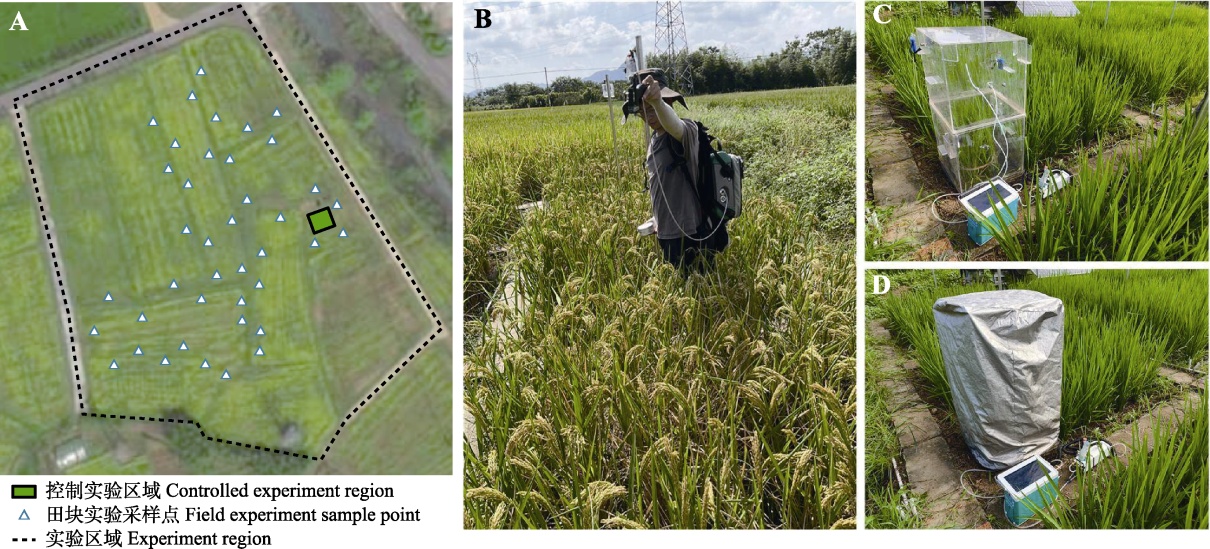
图1 控制实验区域和田块实验采样点(A)以及水稻冠层光谱(B)、净生态系统交换(C)和生态系统呼吸(D)的测量。
Fig. 1 Controlled experiment region and field experiment sampling points (A), and measurements of Oryza sativa canopy reflectance spectra (B), net ecosystem exchange (C) and ecosystem respiration (D).
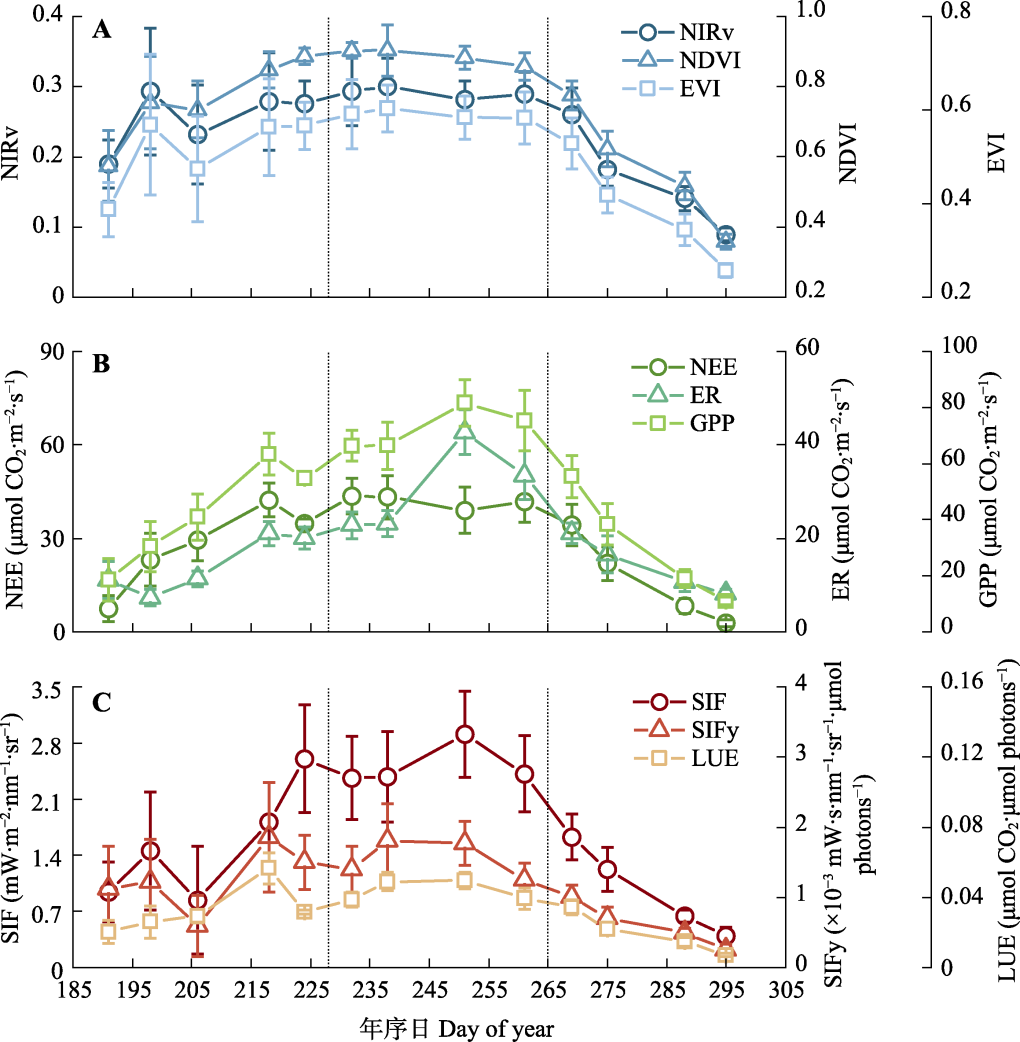
图2 日均反射指数(A)、碳通量参数(B)和植被生理参数(C)的季节变化(平均值±标准误, n = 9)。灰色虚线表示不同生长阶段。ER, 生态系统呼吸; EVI, 增强型植被指数; GPP, 总初级生产力; LUE, 光能利用率; NDVI, 归一化植被指数; NEE, 净生态系统碳交换; NIRv, 植被近红外反射率; SIF, 日光诱导叶绿素荧光; SIFy, 日光诱导叶绿素荧光产率。
Fig. 2 Seasonal variations in daily average reflectance index (A), carbon flux parameters (B) and vegetation physiological parameters (C) (mean ± SE, n = 9). Grey dashed lines indicate different growth phases. ER, ecosystem respiration; EVI, enhanced vegetation index; GPP, gross primary productivity; LUE, light use efficiency; NDVI, normalized difference vegetation index; NEE, net ecosystem exchange; NIRv, near-infrared reflectance of vegetation; SIF, solar-induced chlorophyll fluorescence; SIFy, solar-induced chlorophyll fluorescence yield.
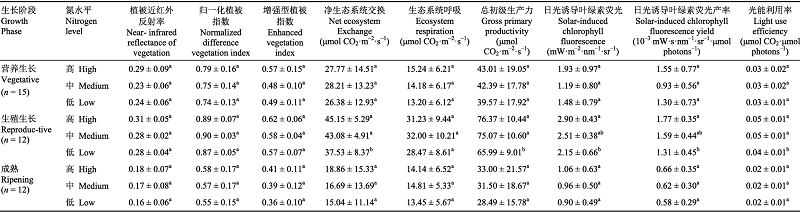 |
表2 不同氮水平下反射指数、碳通量参数和植被生理参数(平均值±标准误)
Table 2 Reflectance index, carbon flux parameters and vegetation physiological parameters at different nitrogen levels (mean ± SE)
| |
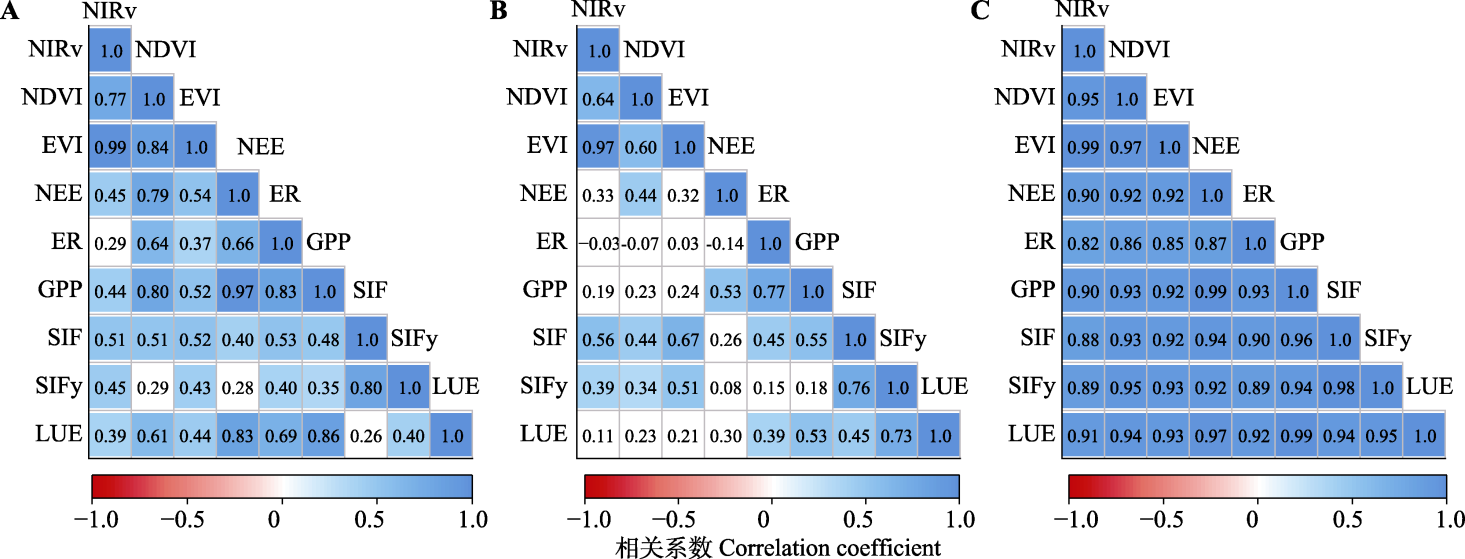
图3 各类参数在营养生长阶段(A), 生殖生长阶段(B)和成熟阶段(C)内的相关性。图中数字为Pearson相关系数, 白色表示未通过显著性检验(p > 0.05)。ER, 生态系统呼吸; EVI, 增强型植被指数; GPP, 总初级生产力; LUE, 光能利用率; NDVI, 归一化植被指数; NEE, 净生态系统碳交换; NIRv, 植被近红外反射率; SIF, 日光诱导叶绿素荧光; SIFy, 日光诱导叶绿素荧光产率。
Fig. 3 Correlations among various parameters within vegetative phase (A), reproductive phase (B) and ripening phase (C). The numbers in the figure are Pearson correlation coefficients, and the white background indicates the insignificant (p > 0.05) correlations. ER, ecosystem respiration; EVI, enhanced vegetation index; GPP, gross primary productivity; LUE, light use efficiency; NDVI, normalized difference vegetation index; NEE, net ecosystem exchange; NIRv, near-infrared reflectance of vegetation; SIF, solar-induced chlorophyll fluorescence; SIFy, solar-induced chlorophyll fluorescence yield.
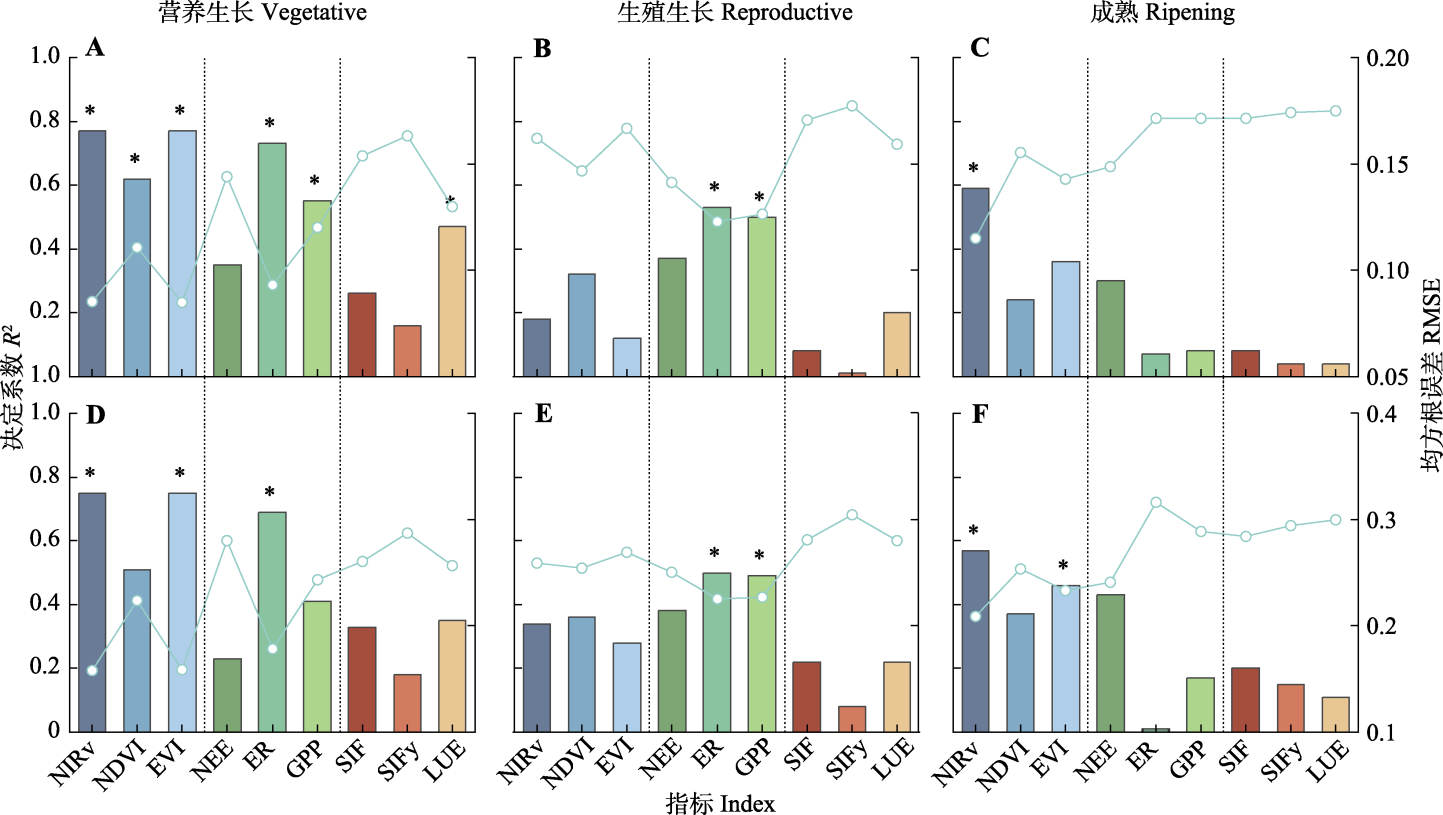
图4 籽粒产量(A-C)和地上生物量(D-F)与反射指数和碳通量参数以及植被生理参数在不同生育阶段内的决定系数(柱状图)和均方根误差(折线图)。*, 线性回归结果显著(p < 0.05)。ER, 生态系统呼吸; EVI, 增强型植被指数; GPP, 总初级生产力; LUE, 光能利用率; NDVI, 归一化植被指数; NEE, 净生态系统碳交换; NIRv, 植被近红外反射率; SIF, 日光诱导叶绿素荧光; SIFy, 日光诱导叶绿素荧光产率。
Fig. 4 Coefficient of determination (bar plot) and root mean square error (line chart) of grain yield (A-C) and aboveground biomass (D-F) with reflectance index, carbon flux parameters and vegetation physiological parameters at different growing phases. *, linear regressions that are significant (p < 0.05). ER, ecosystem respiration; EVI, enhanced vegetation index; GPP, gross primary productivity; LUE, light use efficiency; NDVI, normalized difference vegetation index; NEE, net ecosystem exchange; NIRv, near-infrared reflectance of vegetation; SIF, solar-induced chlorophyll fluorescence; SIFy, solar-induced chlorophyll fluorescence yield.
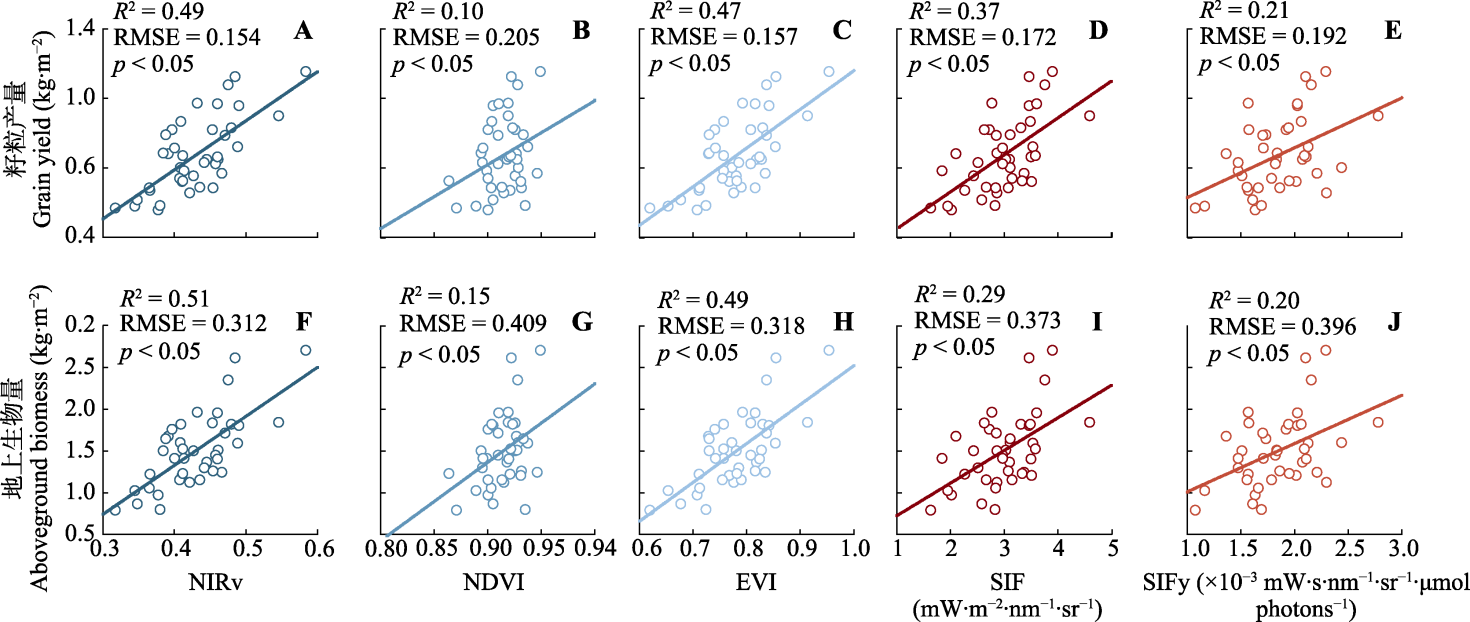
图5 基于田块实验反射指数和植被生理参数与籽粒产量(A-E)和地上生物量(F-J)的相关性。EVI, 增强型植被指数; NDVI, 归一化植被指数; NIRv, 植被近红外反射率; SIF, 日光诱导叶绿素荧光; SIFy, 日光诱导叶绿素荧光产率。R2, 决定系数; RMSE, 均方根误差。
Fig. 5 Correlations of reflectance index and vegetation physiological parameters with grain yield (A-E) and aboveground biomass (F-J) based on field experiment. EVI, enhanced vegetation index; NDVI, normalized difference vegetation index; NIRv, near-infrared reflectance of vegetation; SIF, solar-induced chlorophyll fluorescence; SIFy, solar-induced chlorophyll fluorescence yield. R2, coefficient of determination; RMSE, root mean square error.
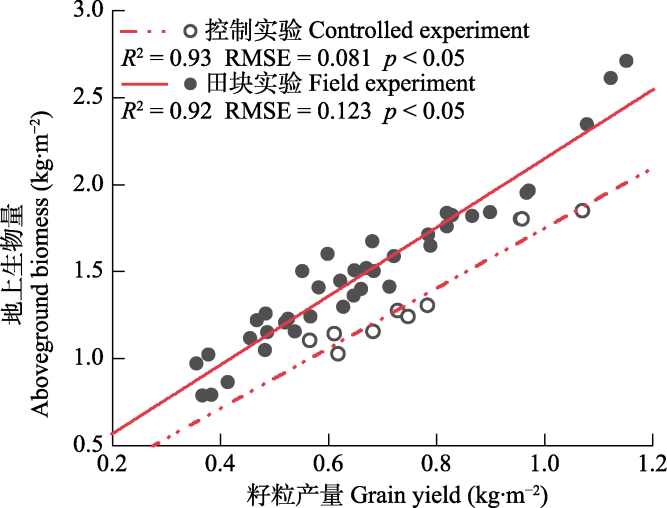
图6 基于控制实验和田块实验籽粒产量和地上生物量的相关性。
Fig. 6 Correlation between grain yield and aboveground biomass based on controlled experiment and field experiment.
| [1] | Alexandratos N, Bruinsma J (2012). World agriculture towards 2030/2050: the 2012 revision. ESA Working Papers 12-03, FAO, Rome. 154. |
| [2] | Badgley G, Field CB, Berry JA (2017). Canopy near-infrared reflectance and terrestrial photosynthesis. Science Advances, 3, e1602244. DOI: 10.1126/sciadv.1602244. |
| [3] | Baldocchi DD, Ryu Y, Dechant B, Eichelmann E, Hemes K, Ma SY, Sanchez CR, Shortt R, Szutu D, Valach A, Verfaillie J, Badgley G, Zeng YL, Berry JA (2020). Outgoing near-infrared radiation from vegetation scales with canopy photosynthesis across a spectrum of function, structure, physiological capacity, and weather. Journal of Geophysical Research: Biogeosciences, 125, e2019JG005534. DOI: 10.1029/2019JG005534. |
| [4] |
Bausch WC (1993). Soil background effects on reflectance-based crop coefficients for corn. Remote Sensing of Environment, 46, 213-222.
DOI URL |
| [5] |
Casanova D, Epema GF, Goudriaan J (1998). Monitoring rice reflectance at field level for estimating biomass and LAI. Field Crops Research, 55, 83-92.
DOI URL |
| [6] | Cen HY, Wan L, Zhu JP, Li YJ, Li XR, Zhu YM, Weng HY, Wu WK, Yin WX, Xu C, Bao YD, Feng L, Shou JY, He Y (2019). Dynamic monitoring of biomass of rice under different nitrogen treatments using a lightweight UAV with dual image-frame snapshot cameras. Plant Methods, 15, 32. DOI: 10.1186/s13007-019-0418-8. |
| [7] |
Chen RN, Liu XJ, Chen JD, Du SS, Liu LY (2022). Solar-induced chlorophyll fluorescence imperfectly tracks the temperature response of photosynthesis in winter wheat. Journal of Experimental Botany, 73, 7596-7610.
DOI URL |
| [8] |
Combe M, de Wit AJW, Vilà-Guerau de Arellano J, van der Molen MK, Magliulo V, Peters W (2017). Grain yield observations constrain cropland CO2 fluxes over Europe. Journal of Geophysical Research: Biogeosciences, 122, 3238-3259.
DOI URL |
| [9] |
Damm A, Erler A, Hillen W, Meroni M, Schaepman ME, Verhoef W, Rascher U (2011). Modeling the impact of spectral sensor configurations on the FLD retrieval accuracy of sun-induced chlorophyll fluorescence. Remote Sensing of Environment, 115, 1882-1892.
DOI URL |
| [10] | Dechant B, Ryu Y, Badgley G, Köhler P, Rascher U, Migliavacca M, Zhang YG, Tagliabue G, Guan KY, Rossini M, Goulas Y, Zeng YL, Frankenberg C, Berry JA (2022). NIRvP: a robust structural proxy for sun-induced chlorophyll fluorescence and photosynthesis across scales. Remote Sensing of Environment, 268, 112763. DOI: 10.1016/j.rse.2021.112763. |
| [11] |
Dhondt S, Wuyts N, Inzé D (2013). Cell to whole-plant phenotyping: the best is yet to come. Trends in Plant Science, 18, 428-439.
DOI PMID |
| [12] |
Eitel JUH, Magney TS, Vierling LA, Brown TT, Huggins DR (2014). LiDAR based biomass and crop nitrogen estimates for rapid, non-destructive assessment of wheat nitrogen status. Field Crops Research, 159, 21-32.
DOI URL |
| [13] |
Elsgaard L, Görres CM, Hoffmann CC, Blicher-Mathiesen G, Schelde K, Petersen SO (2012). Net ecosystem exchange of CO2 and carbon balance for eight temperate organic soils under agricultural management. Agriculture, Ecosystems & Environment, 162, 52-67.
DOI URL |
| [14] |
Falge E, Baldocchi D, Tenhunen J, Aubinet M, Bakwin P, Berbigier P, Bernhofer C, Burba G, Clement R, Davis KJ, Elbers JA, Goldstein AH, Grelle A, Granier A, Guðmundsson J, et al. (2002). Seasonality of ecosystem respiration and gross primary production as derived from FLUXNET measurements. Agricultural and Forest Meteorology, 113, 53-74.
DOI URL |
| [15] | FAO (2023). World Food and Agriculture—Statistical Yearbook 2023. FAO, Rome. |
| [16] | Fu YY, Huang JX, Shen YJ, Liu SM, Huang Y, Dong J, Han W, Ye T, Zhao WZ, Yuan WP (2021). A satellite-based method for national winter wheat yield estimating in China. Remote Sensing, 13, 4680. DOI: 10.3390/rs13224680. |
| [17] | Guan KY, Wu J, Kimball JS, Anderson MC, Frolking S, Li B, Hain CR, Lobell DB (2017). The shared and unique values of optical, fluorescence, thermal and microwave satellite data for estimating large-scale crop yields. Remote Sensing of Environment, 199, 333-349. |
| [18] |
Günther A, Huth V, Jurasinski G, Glatzel S (2015). The effect of biomass harvesting on greenhouse gas emissions from a rewetted temperate fen. Global Change Biology Bioenergy, 7, 1092-1106.
DOI URL |
| [19] |
Haboudane D, Miller JR, Pattey E, Zarco-Tejada PJ, Strachan IB (2004). Hyperspectral vegetation indices and novel algorithms for predicting green LAI of crop canopies: modeling and validation in the context of precision agriculture. Remote Sensing of Environment, 90, 337-352.
DOI URL |
| [20] | Han SY (2023). Growth Monitoring and Yield Prediction of Winter Wheat Based on Multi-platform Remote Sensing Data. PhD dissertation, Henan Agricultural University, Zhengzhou. |
| [韩少宇 (2023). 基于多平台遥感数据的冬小麦长势监测和产量预测. 博士学位论文, 河南农业大学, 郑州.] | |
| [21] |
Hay R, Gilbert RA (2001). Variation in the harvest index of tropical maize: evaluation of recent evidence from Mexico and Malawi. Annals of Applied Biology, 138, 103-109.
DOI URL |
| [22] | He MZ, Chen SY, Lian X, Wang XH, Peñuelas J, Piao SL (2022). Global spectrum of vegetation light-use efficiency. Geophysical Research Letters, 49, e2022GL099550. DOI: 10.1029/2022GL099550. |
| [23] | He MZ, Kimball JS, Maneta MP, Maxwell BD, Moreno A, Beguería S, Wu XC (2018). Regional crop gross primary productivity and yield estimation using fused landsat-MODIS data. Remote Sensing, 10, 372. DOI: 10.3390/rs10030372. |
| [24] | Hu JH (2020). Rice Yield Estimation Methods Based on Unmanned Aerial Vehicle (UAV) Imaging Hyperspectral Remote Sensing Data. Master degree dissertation, Zhejiang University, Hangzhou. |
| [胡景辉 (2020). 基于无人机成像高光谱遥感数据的水稻估产方法研究. 硕士学位论文, 浙江大学, 杭州.] | |
| [25] | Jia M, Colombo R, Rossini M, Celesti M, Zhu J, Cogliati S, Cheng T, Tian YC, Zhu Y, Cao WX, Yao X (2021). Estimation of leaf nitrogen content and photosynthetic nitrogen use efficiency in wheat using sun-induced chlorophyll fluorescence at the leaf and canopy scales. European Journal of Agronomy, 122, 126192. DOI: 10.1016/j.eja.2020.126192. |
| [26] |
Jin XL, Kumar L, Li ZH, Feng HK, Xu XG, Yang GJ, Wang JH (2018). A review of data assimilation of remote sensing and crop models. European Journal of Agronomy, 92, 141-152.
DOI URL |
| [27] | Johnson MD, Hsieh WW, Cannon AJ, Davidson A, Bédard F (2016). Crop yield forecasting on the Canadian Prairies by remotely sensed vegetation indices and machine learning methods. Agricultural and Forest Meteorology, 218, 74-84. |
| [28] | Kimm H, Guan KY, Jiang CY, Miao GF, Wu GH, Suyker AE, Ainsworth EA, Bernacchi CJ, Montes CM, Berry JA, Yang X, Frankenberg C, Chen M, Köhler P (2021). A physiological signal derived from sun-induced chlorophyll fluorescence quantifies crop physiological response to environmental stresses in the U.S. Corn Belt. Environmental Research Letters, 16, 124051. DOI: 10.1088/1748-9326/ac3b16. |
| [29] | Li LC (2023). Crop Growth and Yield Predictions and Uncertainty Analysis Under Climate Change. PhD dissertation, Northwest A&F University, Yangling, Shaanxi. |
| [李林超 (2023). 气候变化对作物生长和产量影响的模拟及不确定性研究. 博士学位论文, 西北农林科技大学, 陕西杨凌.] | |
| [30] | Liu LY, Zhang YJ, Wang JH, Zhao CJ (2006). Detecting photosynthesis fluorescence under natural sunlight based on fraunhofer line. Journal of Remote Sensing, 10, 130-137. |
| [刘良云, 张永江, 王纪华, 赵春江 (2006). 利用夫琅和费暗线探测自然光条件下的植被光合作用荧光研究. 遥感学报, 10, 130-137.] | |
| [31] | Liu XJ, Guanter L, Liu LY, Damm A, Malenovský Z, Rascher U, Peng DL, Du SS, Gastellu-Etchegorry JP (2019). Downscaling of solar-induced chlorophyll fluorescence from canopy level to photosystem level using a random forest model. Remote Sensing of Environment, 231, 110772. DOI: 10.1016/j.rse.2018.05.035. |
| [32] |
Liu XJ, Liu LY (2015). Improving chlorophyll fluorescence retrieval using reflectance reconstruction based on principal components analysis. IEEE Geoscience and Remote Sensing Letters, 12, 1645-1649.
DOI URL |
| [33] | Liu XJ, Liu ZQ, Liu LY, Lu XL, Chen JD, Du SS, Zou C (2021). Modelling the influence of incident radiation on the SIF-based GPP estimation for maize. Agricultural and Forest Meteorology, 307, 108522. DOI: 10.1016/j.agrformet.2021.108522. |
| [34] | Lobell DB, Hammer GL, McLean G, Messina C, Roberts MJ, Schlenker W (2013). The critical role of extreme heat for maize production in the United States. Nature Climate Change, 3, 497-501. |
| [35] |
Merrick T, Pau S, Detto M, Broadbent EN, Bohlman SA, Still CJ, Almeyda Zambrano AM (2021). Unveiling spatial and temporal heterogeneity of a tropical forest canopy using high-resolution NIRv, FCVI, and NIRvrad from UAS observations. Biogeosciences, 18, 6077-6091.
DOI |
| [36] | Nuarsa IW, Nishio F, Hongo C (2011). Rice yield estimation using landsat ETM+ data and field observation. Journal of Agricultural Science, 4, 45-56. |
| [37] | Peng B, Guan KY, Zhou W, Jiang CY, Frankenberg C, Sun Y, He LY, Köhler P (2020). Assessing the benefit of satellite-based Solar-Induced Chlorophyll Fluorescence in crop yield prediction. International Journal of Applied Earth Observation and Geoinformation, 90, 102126. DOI: 10.1016/j.jag.2020.102126. |
| [38] | Qiu RN, Li X, Han G, Xiao JF, Ma X, Gong W (2022). Monitoring drought impacts on crop productivity of the U.S. Midwest with solar-induced fluorescence: GOSIF outperforms GOME-2 SIF and MODIS NDVI, EVI, and NIRv. Agricultural and Forest Meteorology, 323, 109038. DOI: 10.1016/j.agrformet.2022.109038. |
| [39] |
Reeves MC, Zhao M, Running SW (2005). Usefulness and limits of MODIS GPP for estimating wheat yield. International Journal of Remote Sensing, 26, 1403-1421.
DOI URL |
| [40] | Shi YL, Wang ZH, Li SM, Li CY, Xiao PQ, Zhang P, Chang XG (2022). A method of estimation aboveground biomass of sparse tree-shrub using optical remote sensing. Scientia Silvae Sinicae, 58(2), 13-22. |
| [石永磊, 王志慧, 李世明, 李春意, 肖培青, 张攀, 常晓格 (2022). 基于光学遥感的稀疏乔灌木地上部分生物量反演方法. 林业科学, 58(2), 13-22.] | |
| [41] | Wan L, Cen HY, Zhu JP, Zhang JF, Zhu YM, Sun DW, Du XY, Zhai L, Weng HY, Li YJ, Li XR, Bao YD, Shou JY, He Y (2020). Grain yield prediction of rice using multi-temporal UAV-based RGB and multispectral images and model transfer—A case study of small farmlands in the South of China. Agricultural and Forest Meteorology, 291, 108096. DOI: 10.1016/j.agrformet.2020.108096. |
| [42] | Wang D (2017). Hyperspectral and Multispectral Remote Sensing Study on Yield Estimation of Rice. Master degree dissertation, Wuhan University, Wuhan. |
| [王娣 (2017). 高光谱与多光谱遥感水稻估产研究. 硕士学位论文, 武汉大学, 武汉.] | |
| [43] | Wang D, Chen J, Felton AJ, Xia LL, Zhang YF, Luo YQ, Cheng XL, Cao JJ (2021a). Post-fire co-stimulation of gross primary production and ecosystem respiration in a meadow grassland on the Tibetan Plateau. Agricultural and Forest Meteorology, 303, 108388. DOI: 10.1016/j.agrformet.2021.108388. |
| [44] | Wang SH, Zhang YG, Ju WM, Qiu B, Zhang ZY (2021b). Tracking the seasonal and inter-annual variations of global gross primary production during last four decades using satellite near-infrared reflectance data. Science of the Total Environment, 755, 142569. DOI: 10.1016/j.scitotenv.2020.142569. |
| [45] | Wang XB, Wang SQ, Li X, Chen B, Wang JB, Huang M, Rahman A (2020). Modelling rice yield with temperature optima of rice productivity derived from satellite NIRv in tropical monsoon area. Agricultural and Forest Meteorology, 294, 108135. DOI: 10.1016/j.agrformet.2020.108135. |
| [46] |
Wardlow BD, Egbert SL, Kastens JH (2007). Analysis of time-series MODIS 250 m vegetation index data for crop classification in the U.S. Central Great Plains. Remote Sensing of Environment, 108, 290-310.
DOI URL |
| [47] |
Weber VS, Araus JL, Cairns JE, Sanchez C, Melchinger AE, Orsini E (2012). Prediction of grain yield using reflectance spectra of canopy and leaves in maize plants grown under different water regimes. Field Crops Research, 128, 82-90.
DOI URL |
| [48] | Wu GH, Guan KY, Jiang CY, Kimm H, Miao GF, Bernacchi CJ, Moore CE, Ainsworth EA, Yang X, Berry JA, Frankenberg C, Chen M (2022a). Attributing differences of solar-induced chlorophyll fluorescence (SIF)-gross primary production (GPP) relationships between two C4 crops: corn and miscanthus. Agricultural and Forest Meteorology, 323, 109046. DOI: 10.1016/j.rse.2021.112565. |
| [49] | Wu LS, Zhang XK, Rossini M, Wu YF, Zhang ZY, Zhang YG (2022b). Physiological dynamics dominate the response of canopy far-red solar-induced fluorescence to herbicide treatment. Agricultural and Forest Meteorology, 323, 109063. DOI: 10.1016/j.agrformet.2022.109063. |
| [50] |
Wu LS, Zhang YG, Zhang ZY, Zhang XK, Wu YF (2022). Remote sensing of solar-induced chlorophyll fluorescence and its applications in terrestrial ecosystem monitoring. Chinese Journal of Plant Ecology, 46, 1167-1199.
DOI URL |
|
[吴霖升, 张永光, 章钊颖, 张小康, 吴云飞 (2022). 日光诱导叶绿素荧光遥感及其在陆地生态系统监测中的应用. 植物生态学报, 46, 1167-1199.]
DOI |
|
| [51] |
Xia JY, Niu SL, Wan SQ (2009). Response of ecosystem carbon exchange to warming and nitrogen addition during two hydrologically contrasting growing seasons in a temperate steppe. Global Change Biology, 15, 1544-1556.
DOI URL |
| [52] |
Xia JZ, Yuan WP, Lienert S, Joos F, Ciais P, Viovy N, Wang YP, Wang XF, Zhang HC, Chen Y, Tian XJ (2019). Global patterns in net primary production allocation regulated by environmental conditions and forest stand age: a model-data comparison. Journal of Geophysical Research: Biogeosciences, 124, 2039-2059.
DOI URL |
| [53] |
Yang KG, Ryu Y, Dechant B, Berry JA, Hwang Y, Jiang CY, Kang M, Kim J, Kimm H, Kornfeld A, Yang X (2018). Sun-induced chlorophyll fluorescence is more strongly related to absorbed light than to photosynthesis at half-hourly resolution in a rice paddy. Remote Sensing of Environment, 216, 658-673.
DOI URL |
| [54] | Yang Q, Liu LC, Zhou JX, Ghosh R, Peng B, Guan KY, Tang JY, Zhou W, Kumar V, Jin ZN (2023). A flexible and efficient knowledge-guided machine learning data assimilation (KGML-DA) framework for agroecosystem prediction in the US Midwest. Remote Sensing of Environment, 299, 113880. DOI: 10.1016/j.rse.2023.113880. |
| [55] |
Yang X, Tang JW, Mustard JF, Lee JE, Rossini M, Joiner J, Munger JW, Kornfeld A, Richardson AD (2015). Solar-induced chlorophyll fluorescence that correlates with canopy photosynthesis on diurnal and seasonal scales in a temperate deciduous forest. Geophysical Research Letters, 42, 2977-2987.
DOI URL |
| [56] | Yu YJ, Gong Y, Fang SH, Peng Y, Yang KL, Yuan NG, Wu XT, Zhu RS (2022). UAV remote sensing estimation of rice yield based on the analysis of spectral accumulation in multiple growth periods//High-Resolution Earth Observation Academic Alliance. Proceedings of the Eighth Annual Conference on High Resolution Earth Observation. Springer, Beijing. 330-345. |
| [于亚娇, 龚龑, 方圣辉, 彭漪, 杨凯丽, 袁宁鸽, 吴贤婷, 朱仁山 (2022). 基于多生育期光谱累积量分析的无人机遥感水稻估产//高分辨率对地观测学术联盟. 第八届高分辨率对地观测学术年会. 施普林格, 北京. 330-345.] | |
| [57] |
Yuan WP, Chen Y, Xia JZ, Dong WJ, Magliulo V, Moors E, Olesen JE, Zhang HC (2016). Estimating crop yield using a satellite-based light use efficiency model. Ecological Indicators, 60, 702-709.
DOI URL |
| [58] | Zhang BB (2023). Monitoring Potato Growth and Yield Estimation Using Unmanned Aerial Vehicle Remote Sensing Images. Master degree dissertation, Northeast Agricultural University, Harbin. |
| [张斌斌 (2023). 基于无人机遥感影像的马铃薯长势监测及产量估测研究. 硕士学位论文, 东北农业大学, 哈尔滨.] | |
| [59] |
Zhang JT, Tian HQ, Yang J, Pan SF (2018). Improving representation of crop growth and yield in the dynamic land ecosystem model and its application to China. Journal of Advances in Modeling Earth Systems, 10, 1680-1707.
DOI URL |
| [60] | Zhang ZY, Zhang XK, Porcar-Castell A, Chen JM, Ju WM, Wu LS, Wu YF, Zhang YG (2022). Sun-induced chlorophyll fluorescence is more strongly related to photosynthesis with hemispherical than nadir measurements: evidence from field observations and model simulations. Remote Sensing of Environment, 279, 113118. DOI: 10.1016/j.rse.2022.113118. |
| [61] | Zheng SL (2014). Theory and Technology of High Efficient Crop Production. Sichuan University Press, Chengdu. 280-286. |
| [郑顺林 (2014). 作物高效生产理论与技术. 四川大学出版社, 成都. 280-286.] | |
| [62] |
Zhou X, Zheng HB, Xu XQ, He JY, Ge XK, Yao X, Cheng T, Zhu Y, Cao WX, Tian YC (2017). Predicting grain yield in rice using multi-temporal vegetation indices from UAV-based multispectral and digital imagery. ISPRS Journal of Photogrammetry and Remote Sensing, 130, 246-255.
DOI URL |
| [63] | Zhu J, Yin YM, Lu JS, Warner TA, Xu XW, Lyu MY, Wang X, Guo CL, Cheng T, Zhu Y, Cao WX, Yao X, Zhang YG, Liu LY (2023). The relationship between wheat yield and sun-induced chlorophyll fluorescence from continuous measurements over the growing season. Remote Sensing of Environment, 298, 113791. DOI: 10.1016/j.rse.2023.113791. |
| [1] | 宋珊珊, 唐志尧. 河北塞罕坝草甸草原根际土壤真菌与植物地上生物量的关系[J]. 植物生态学报, 2025, 49(9): 1461-1471. |
| [2] | 张斌, 张浩成, 乔天, 吕治兵, 许亚男, 李雪芹, 原向阳, 冯美臣, 张美俊. 接种丛枝菌根真菌对干旱胁迫燕麦非结构性碳水化合物及碳氮磷化学计量特征的影响[J]. 植物生态学报, 2025, 49(7): 1082-1095. |
| [3] | 王贝贝, 吴苏, 王苗苗, 胡锦涛. 日光诱导叶绿素荧光不同组分在作物总初级生产力估算中的贡献比例: 多时间尺度分析[J]. 植物生态学报, 2025, 49(4): 562-572. |
| [4] | 刘柯言, 韩璐, 宋午椰, 张初蕊, 胡旭, 许行, 陈立欣. 基于日光诱导叶绿素荧光探测干旱对黄土高原植被光合稳定性的影响[J]. 植物生态学报, 2025, 49(3): 415-431. |
| [5] | 黄玲, 王榛, 马泽, 杨发林, 李岚, SEREKPAYEV Nurlan, NOGAYEV Adilbek, 侯扶江. 长期放牧和氮添加对黄土高原典型草原长芒草种群生长的影响[J]. 植物生态学报, 2024, 48(3): 317-330. |
| [6] | 袁鹤洋, 郝珉辉, 何怀江, 张春雨, 赵秀海. 长白山物种丰富度与物种组成对森林生产力的影响及其随演替的变化[J]. 植物生态学报, 2024, 48(12): 1602-1611. |
| [7] | 刘位会, 宋小艳, 才仁多杰, 丁路明, 王长庭. 退化程度对高寒草甸不同优势植物根系形态性状和生物量的影响[J]. 植物生态学报, 2024, 48(12): 1666-1682. |
| [8] | 赵艳超, 陈立同. 土壤养分对青藏高原高寒草地生物量响应增温的调节作用[J]. 植物生态学报, 2023, 47(8): 1071-1081. |
| [9] | 任培鑫, 李鹏, 彭长辉, 周晓路, 杨铭霞. 洞庭湖流域植被光合物候的时空变化及其对气候变化的响应[J]. 植物生态学报, 2023, 47(3): 319-330. |
| [10] | 郝晴, 黄昌. 森林地上生物量遥感估算研究综述[J]. 植物生态学报, 2023, 47(10): 1356-1374. |
| [11] | 董六文, 任正炜, 张蕊, 谢晨笛, 周小龙. 功能多样性比物种多样性更好解释氮添加对高寒草地生物量的影响[J]. 植物生态学报, 2022, 46(8): 871-881. |
| [12] | 陈丽, 田新民, 任正炜, 董六文, 谢晨笛, 周小龙. 养分添加对天山高寒草地植物多样性和地上生物量的影响[J]. 植物生态学报, 2022, 46(3): 280-289. |
| [13] | 黄侩侩, 胡刚, 庞庆玲, 张贝, 何业涌, 胡聪, 徐超昊, 张忠华. 放牧对中国亚热带喀斯特山地灌草丛物种组成与群落结构的影响[J]. 植物生态学报, 2022, 46(11): 1350-1363. |
| [14] | 薛金儒, 吕肖良. 黄土高原生态工程实施下基于日光诱导叶绿素荧光的植被恢复生产力效益评价[J]. 植物生态学报, 2022, 46(10): 1289-1304. |
| [15] | 吴霖升, 张永光, 章钊颖, 张小康, 吴云飞. 日光诱导叶绿素荧光遥感及其在陆地生态系统监测中的应用[J]. 植物生态学报, 2022, 46(10): 1167-1199. |
| 阅读次数 | ||||||
|
全文 |
|
|||||
|
摘要 |
|
|||||
Copyright © 2026 版权所有 《植物生态学报》编辑部
地址: 北京香山南辛村20号, 邮编: 100093
Tel.: 010-62836134, 62836138; Fax: 010-82599431; E-mail: apes@ibcas.ac.cn, cjpe@ibcas.ac.cn
备案号: 京ICP备16067583号-19

