
植物生态学报 ›› 2026, Vol. 50 ›› Issue (2): 306-317.DOI: 10.17521/cjpe.2025.0097 cstr: 32100.14.cjpe.2025.0097
于江珊1, 许浩2,3,4, 郭永忠2,3,4, 侯继华1,*( )
)
收稿日期:2025-03-19
接受日期:2025-05-13
出版日期:2026-02-28
发布日期:2026-04-01
通讯作者:
*侯继华 (houjihua@bjfu.edu.cn)基金资助:
YU Jiang-Shan1, XU Hao2,3,4, GUO Yong-Zhong2,3,4, HOU Ji-Hua1,*()
Received:2025-03-19
Accepted:2025-05-13
Online:2026-02-28
Published:2026-04-01
Contact:
*HOU Ji-Hua (houjihua@bjfu.edu.cn)Supported by:摘要:
油松(Pinus tabuliformis)为中国温带针叶林的建群种和关键物种, 具有较强的环境适应能力。研究油松当年生器官(新生器官)和多年生器官(≥1年生, 成熟器官)的叶、枝、根的化学计量特征及其相互关系, 对于深入理解植物种内变异和资源分配策略具有重要意义。该研究选取了中国9个地区的天然油松林, 测定了81株油松的当年生叶、多年生叶、当年生枝、多年生枝、吸收根和运输根的碳(C)、氮(N)和磷(P)含量。结果表明: (1)当年生器官的N和P含量高于多年生器官, 而多年生器官的C:N、C:P和N:P比值则高于当年生器官。不同年龄组之间, 各器官的化学计量特征表现出不同程度的种内变异, 且器官年龄是决定变异的主要因素。(2)标准主轴回归分析显示, 相较于当年生叶, 多年生叶的P含量更高; 相较于多年生枝和运输根, 当年生枝和吸收根的C、N、P含量更高。(3)油松吸收根的C、N、P含量显著高于当年生叶和当年生枝。(4)冗余分析表明, 影响当年生叶和多年生叶化学计量特征的主要环境因子分别为年平均气温和土壤P含量; 对当年生枝和多年生枝化学计量特征影响最大的环境因子分别为年降水量和土壤P含量; 而影响吸收根和运输根化学计量特征的主要环境因子分别为土壤含水率和土壤N含量。该研究揭示了油松不同年龄组叶、枝、根的资源分配策略及其环境适应性。该研究结果表明, 在研究常绿树种化学计量特征时, 应充分考虑各器官的年龄差异, 这对阐明其养分分配和环境适应策略至关重要。
于江珊, 许浩, 郭永忠, 侯继华. 器官年龄在油松叶、枝、根化学计量特征变异以及协调中的重要作用. 植物生态学报, 2026, 50(2): 306-317. DOI: 10.17521/cjpe.2025.0097
YU Jiang-Shan, XU Hao, GUO Yong-Zhong, HOU Ji-Hua. Important role of organ age in variation and coordination of stoichiometry in Pinus tabuliformis leaves, twigs and roots. Chinese Journal of Plant Ecology, 2026, 50(2): 306-317. DOI: 10.17521/cjpe.2025.0097
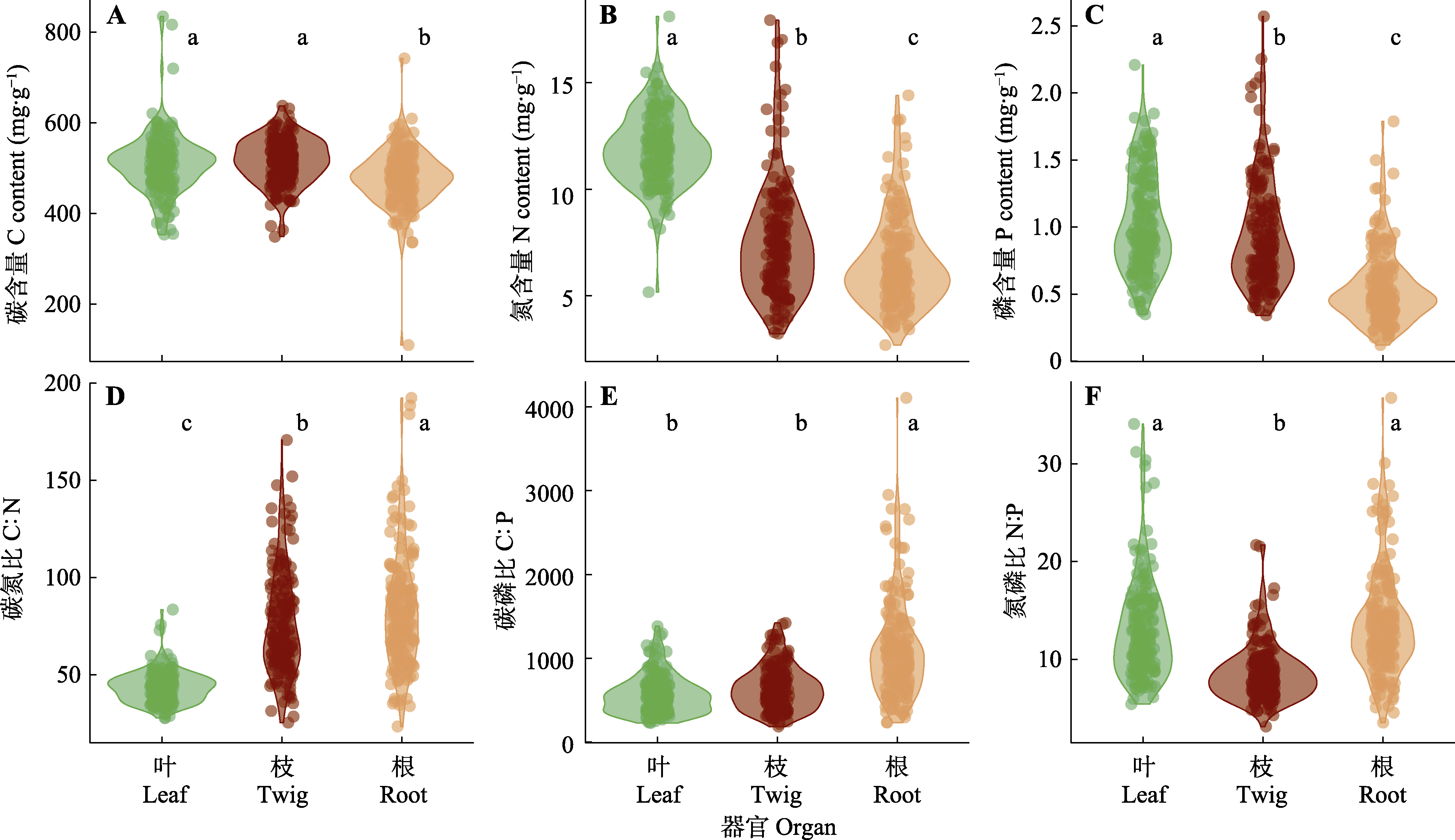
图1 9个天然油松林中, 油松叶、枝和根的碳(C)、氮(N)、磷(P)化学计量特征分布的小提琴图。不同小写字母表示不同器官间的显著差异(p < 0.05)。
Fig. 1 Violin plots showing the distribution of carbon (C), nitrogen (N), and phosphorus (P) stoichiometry in leaves, twigs and roots of P. tabuliformis across nine natural forests. Different lowercase letters indicate significant differences among organs (p < 0.05).
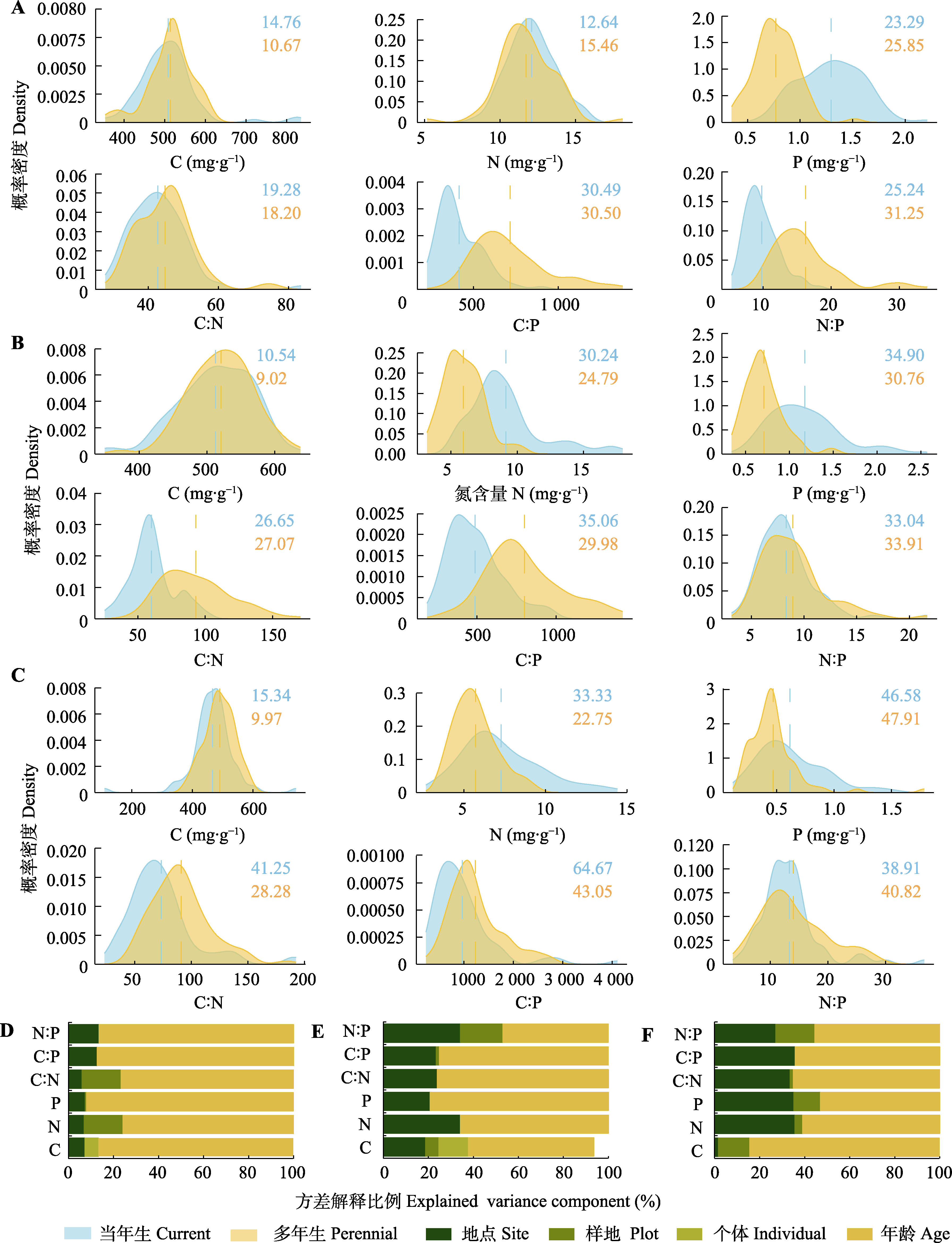
图2 油松当年生器官与多年生器官碳(C)、氮(N)、磷(P)化学计量特征的相对频率(A-C)以及利用嵌套线性混合模型对叶、枝和根进行的方差分解(D-F)。A和D为叶, B和E为枝, C和F为根。A-C中的垂直线表示每个年龄组的均值, 蓝色字体和黄色字体分别表示当年生和多年生器官的变异系数。D-F中的方差分解分为4个嵌套级别: 地点、样地、个体和器官年龄。C, 碳含量; N, 氮含量; P, 磷含量。
Fig. 2 Stoichiometric characteristics of the carbon (C), nitrogen (N) and phosphorus (P) in current-year and perennial organs of P. tabuliformis: Relative frequency (A-C) and variance partitioning using nested linear mixed models for leaves, branches, and roots (D-F). A and D represent leaves, B and E represent twigs, C and F represent roots. The vertical lines in A-C indicate the mean values for each age group, with blue and yellow font denoting the coefficient of variation for current-year and perennial organs, respectively. In D-F, the variance partitioning is divided into four nested levels: site, plot, individual, and organ age. C, carbon content; N, nitrogen content; P, phosphorus content.
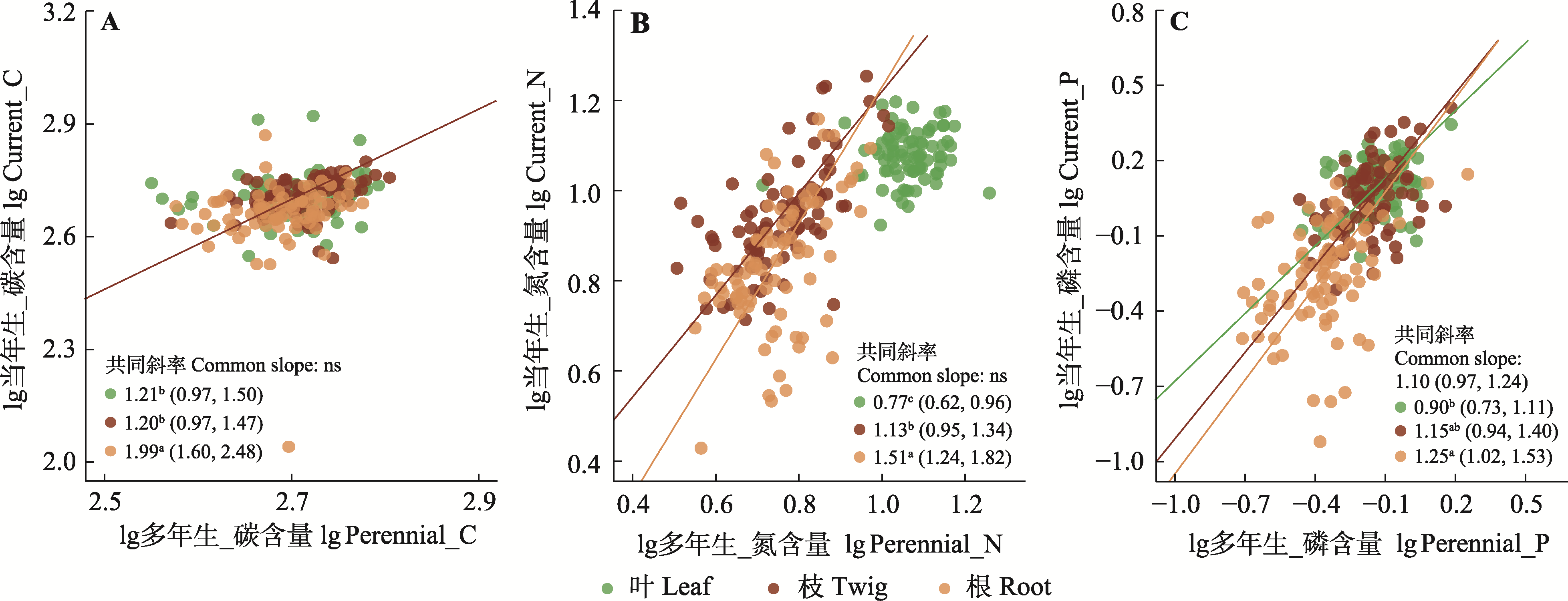
图3 油松当年生器官与多年生器官碳(C)、氮(N)、磷(P)含量的标准主轴回归分析。线条仅在关系显著时(p < 0.05)显示。图下方标注了各器官的异速生长斜率及其95%置信区间。不同小写字母表示不同器官间差异显著(p < 0.05); ns, 不存在共同斜率。
Fig. 3 Standardized major axis regression analysis of carbon, nitrogen, phosphorus content between current-year and perennial organs in P. tabuliformis. Regression lines are shown only when the relationship is significant (p < 0.05). The allometric slopes with 95% confidence intervals are indicated in the lower corner of each panel. Different lowercase letters represent significant difference among organs (p < 0.05); ns, no common slope.
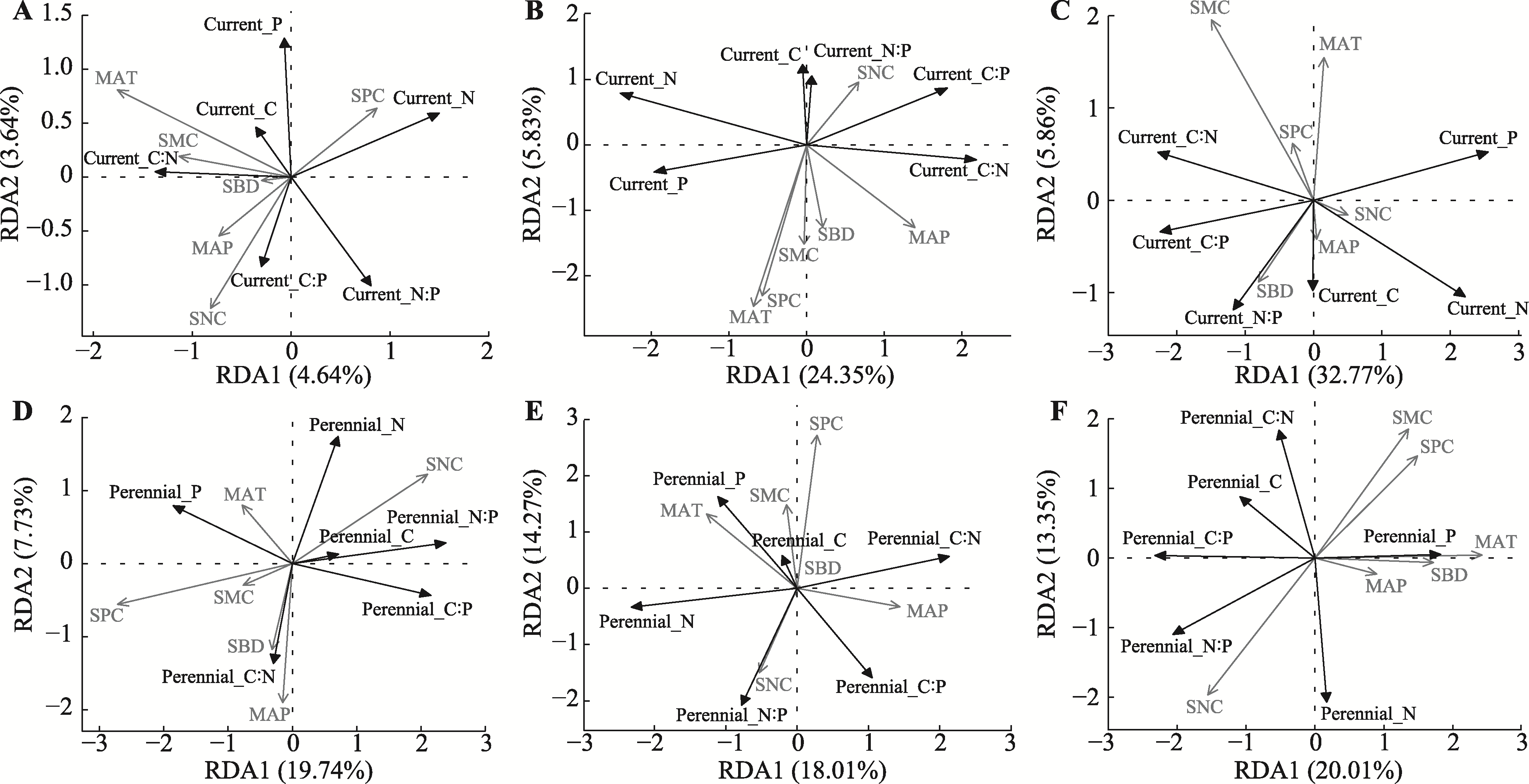
图4 油松叶、枝和根化学计量特征与环境因子的冗余分析(RDA)。A, 当年生叶。B, 当年生枝。C, 吸收根。D, 多年生叶。E, 多年生枝。F, 运输根。Current_C, 当年生器官碳含量; Current_N, 当年生器官氮含量; Current_P, 当年生器官磷含量; Current_C:N, 当年生器官碳氮比; Current_C:P, 当年生器官碳磷比; Current_N:P, 当年生器官氮磷比; Perennial_C, 多年生器官碳含量; Perennial_N, 多年生器官氮含量; Perennial_P, 多年生器官磷含量; Perennial_C:N, 多年生器官碳氮比; Perennial_C:P, 多年生器官碳磷比; Perennial_N:P, 多年生器官氮磷比; MAP, 年降水量; MAT, 年平均气温; SBD, 土壤密度; SMC, 土壤含水率; SNC, 土壤全氮含量; SPC, 土壤全磷含量。
Fig. 4 Redundancy analysis (RDA) of stoichiometry in leaves, twigs and roots of P. tabuliformis with environmental factors. A, Current-year leaves. B, Current-year twigs. C, absorptive roots. D, Perennial leaves. E, Perennial twigs. F, transport roots. Current_C, current-year organ carbon content; Current_N, current-year organ nitrogen content; Current_P, current-year organ phosphorus content; Current_C:N, carbon-to-nitrogen ratio of current-year organ; Current_C:P, carbon-to-phosphorus ratio of current-year organ; Current_N:P, nitrogen-to-phosphorus ratio of current-year organ; Perennial_C, perennial organ carbon content; Perennial_N, perennial organ nitrogen content; Perennial_P, perennial organ phosphorus content; Perennial_C:N, carbon-nitrogen ratio of perennial organ; Perennial_C:P, carbon-phosphorus ratio of perennial organ; Perennial_N:P, nitrogen-phosphorus ratio of perennial organ. MAP, mean annual precipitation; MAT, mean annual air temperature; SBD, soil bulk density; SMC, soil moisture content; SNC, soil total nitrogen content; SPC, soil total phosphorus content.
| 年龄组 Age group | 叶 Leaf | 枝 Twig | 根 Root | ||||||
|---|---|---|---|---|---|---|---|---|---|
| 环境因子 Environmental factor | 解释率 Contribution rate (%) | p | 环境因子 Environmental factor | 解释率 Contribution rate (%) | p | 环境因子 Environmental factor | 解释率 Contribution rate (%) | p | |
| 当年生 Current-year | SBD | 0.25 | 0.91 | SBD | 4.52 | 0.17 | SBD | 6.94 | 0.07 |
| SNC | 4.24 | 0.18 | SNC | 4.80 | 0.13 | SNC | 2.15 | 0.40 | |
| SPC | 2.66 | 0.34 | SPC | 14.60 | 0.002 | SPC | 2.15 | 0.43 | |
| SMC | 3.78 | 0.24 | SMC | 5.81 | 0.09 | SMC | 32.59 | <0.01 | |
| MAT | 10.50 | <0.05 | MAT | 17.20 | <0.01 | MAT | 7.72 | 0.04 | |
| MAP | 1.90 | 0.47 | MAP | 18.67 | <0.01 | MAP | 0.61 | 0.79 | |
| 多年生 Perennial | SBD | 5.23 | 0.11 | SBD | 0.02 | 0.99 | SBD | 16.46 | <0.01 |
| SNC | 34.03 | <0.01 | SNC | 13.17 | <0.01 | SNC | 34.20 | <0.01 | |
| SPC | 47.41 | <0.01 | SPC | 37.12 | <0.01 | SPC | 24.41 | <0.01 | |
| SMC | 4.07 | 0.20 | SMC | 10.72 | <0.01 | SMC | 28.47 | <0.01 | |
| MAT | 5.01 | 0.14 | MAT | 16.48 | <0.01 | MAT | 32.99 | <0.01 | |
| MAP | 11.53 | <0.01 | MAP | 12.03 | <0.01 | MAP | 4.52 | 0.16 | |
表1 环境因子对油松叶、枝和根化学计量特征的解释率
Table 1 Proportion of variance explained by environmental factors for the stoichiometry of leaf, twig and root of Pinus tabuliformis
| 年龄组 Age group | 叶 Leaf | 枝 Twig | 根 Root | ||||||
|---|---|---|---|---|---|---|---|---|---|
| 环境因子 Environmental factor | 解释率 Contribution rate (%) | p | 环境因子 Environmental factor | 解释率 Contribution rate (%) | p | 环境因子 Environmental factor | 解释率 Contribution rate (%) | p | |
| 当年生 Current-year | SBD | 0.25 | 0.91 | SBD | 4.52 | 0.17 | SBD | 6.94 | 0.07 |
| SNC | 4.24 | 0.18 | SNC | 4.80 | 0.13 | SNC | 2.15 | 0.40 | |
| SPC | 2.66 | 0.34 | SPC | 14.60 | 0.002 | SPC | 2.15 | 0.43 | |
| SMC | 3.78 | 0.24 | SMC | 5.81 | 0.09 | SMC | 32.59 | <0.01 | |
| MAT | 10.50 | <0.05 | MAT | 17.20 | <0.01 | MAT | 7.72 | 0.04 | |
| MAP | 1.90 | 0.47 | MAP | 18.67 | <0.01 | MAP | 0.61 | 0.79 | |
| 多年生 Perennial | SBD | 5.23 | 0.11 | SBD | 0.02 | 0.99 | SBD | 16.46 | <0.01 |
| SNC | 34.03 | <0.01 | SNC | 13.17 | <0.01 | SNC | 34.20 | <0.01 | |
| SPC | 47.41 | <0.01 | SPC | 37.12 | <0.01 | SPC | 24.41 | <0.01 | |
| SMC | 4.07 | 0.20 | SMC | 10.72 | <0.01 | SMC | 28.47 | <0.01 | |
| MAT | 5.01 | 0.14 | MAT | 16.48 | <0.01 | MAT | 32.99 | <0.01 | |
| MAP | 11.53 | <0.01 | MAP | 12.03 | <0.01 | MAP | 4.52 | 0.16 | |
| [1] |
Ågren GI (2004). The C:N:P stoichiometry of autotrophs—Theory and observations. Ecology Letters, 7, 185-191.
DOI URL |
| [2] | Bao SD (2000). Soil Agrochemical Analysis. China Agriculture Press, Beijing. |
| [鲍士旦 (2000). 土壤农化分析. 中国农业出版社, 北京.] | |
| [3] |
Chabot BF, Hicks DJ (1982). The ecology of leaf life spans. Annual Review of Ecology and Systematics, 13, 229-259.
DOI URL |
| [4] |
Chavana-Bryant C, Malhi Y, Wu J, Asner GP, Anastasiou A, Enquist BJ, Cosio Caravasi EG, Doughty CE, Saleska SR, Martin RE, Gerard FF (2017). Leaf aging of Amazonian canopy trees as revealed by spectral and physiochemical measurements. New Phytologist, 214, 1049-1063.
DOI PMID |
| [5] | Ding XX, Tang LY, Zhang BN, Ye LF, Xie JB, Wang ZY (2025). Adaptive strategies of twig functional traits in Robinia pseudoacacia along a precipitation gradient and their driving mechanisms. Journal of Zhejiang A&F University, 42, 503-512. |
| [丁新新, 汤璐瑶, 张博纳, 叶琳峰, 谢江波, 王忠媛 (2025). 刺槐小枝功能性状沿降水梯度的适应策略及其驱动机制. 浙江农林大学学报, 42, 503-512.] | |
| [6] |
Elser JJ, Fagan WF, Denno RF, Dobberfuhl DR, Folarin A, Huberty A, Interlandi S, Kilham SS, McCauley E, Schulz KL, Siemann EH, Sterner RW (2000). Nutritional constraints in terrestrial and freshwater food webs. Nature, 408, 578-580.
DOI |
| [7] |
Fajardo A, Piper FI (2011). Intraspecific trait variation and covariation in a widespread tree species (Nothofagus pumilio) in southern Chile. New Phytologist, 189, 259-271.
DOI PMID |
| [8] |
Fortunel C, Ruelle J, Beauchêne J, Fine PVA, Baraloto C (2014). Wood specific gravity and anatomy of branches and roots in 113 Amazonian rainforest tree species across environmental gradients. New Phytologist, 202, 79-94.
DOI PMID |
| [9] | Freschet GT, Pagès L, Iversen CM, Comas LH, Rewald B, Roumet C, Klimešová J, Zadworny M, Poorter H, Postma JA, Adams TS, Bagniewska-Zadworna A, Bengough AG, Blancaflor EB, Brunner I, et al. (2021). A starting guide to root ecology: strengthening ecological concepts and standardising root classification, sampling, processing and trait measurements. New Phytologist, 232, 973-1122. |
| [10] |
Hodge A (2004). The plastic plant: root responses to heterogeneous supplies of nutrients. New Phytologist, 162, 9-24.
DOI URL |
| [11] | Huang ZG, Yu WW, Luo HH, Li YF, Dai WS, Hu YY, Wu JS (2015). Photosynthetic characteristics and their relationships with leaf nitrogen content and nitrogen allocation in leaves at different leaf age. Scientia Silvae Sinicae, 51(2), 44-51. |
| [黄增冠, 喻卫武, 罗宏海, 李昱飞, 戴文圣, 胡渊渊, 吴家胜 (2015). 香榧不同叶龄叶片光合能力与氮含量及其分配关系的比较. 林业科学, 51(2), 44-51.] | |
| [12] | Kong DL, Wang JJ, Wu HF, Valverde-Barrantes OJ, Wang RL, Zeng H, Kardol P, Zhang HY, Feng YL (2019). Nonlinearity of root trait relationships and the root economics spectrum. Nature Communications, 10, 2203. DOI: 10.1038/s41467-019-10245-6. |
| [13] |
Kumordzi BB, Aubin I, Cardou F, Shipley B, Violle C, Johnstone J, Anand M, Arsenault A, Bell FW, Bergeron Y, Boulangeat I, Brousseau M, de Grandpré L, Delagrange S, Fenton NJ, et al. (2019). Geographic scale and disturbance influence intraspecific trait variability in leaves and roots of North American understorey plants. Functional Ecology, 33, 1771-1784.
DOI |
| [14] |
Kuusk V, Niinemets Ü, Valladares F (2018a). A major trade-off between structural and photosynthetic investments operative across plant and needle ages in three Mediterranean pines. Tree Physiology, 38, 543-557.
DOI URL |
| [15] |
Kuusk V, Niinemets Ü, Valladares F (2018b). Structural controls on photosynthetic capacity through juvenile-to-adult transition and needle ageing in Mediterranean pines. Functional Ecology, 32, 1479-1491.
DOI URL |
| [16] |
Li A, Guo DL, Wang ZQ, Liu HY (2010). Nitrogen and phosphorus allocation in leaves, twigs, and fine roots across 49 temperate, subtropical and tropical tree species: a hierarchical pattern. Functional Ecology, 24, 224-232.
DOI URL |
| [17] |
Li JL, Le XG, Chen XP, Reich PB, Niklas KJ, Li XQ, Wu PP, Zhou YJ, Zhong QL, Hu DD, Cheng DL (2024). Divergent intra- and interspecific root order variability identifies a two-dimensional root economics spectrum. Plant and Soil, 499, 473-490.
DOI |
| [18] | Liao HL (2018). Effects of Drought to Absorptive Root Traits and Growth of 4 Tree Species in Subtropical China. Master degree dissertation, Nanchang Institute of Technology, Nanchang. |
| [廖海玲 (2018). 干旱对亚热带4个树种苗木吸收根属性及生长的影响. 硕士学位论文, 南昌工程学院, 南昌.] | |
| [19] | Liu C, Jin GZ, Liu ZL (2021). Importance of organ age in driving intraspecific trait variation and coordination for three evergreen coniferous species. Ecological Indicators, 121, 107099. DOI: 10.1016/j.ecolind.2020.107099. |
| [20] |
Liu ZL, Hikosaka K, Li FR, Jin GZ (2020). Variations in leaf economics spectrum traits for an evergreen coniferous species: tree size dominates over environment factors. Functional Ecology, 34, 458-467.
DOI URL |
| [21] |
McCormack ML, Adams TS, Smithwick EAH, Eissenstat DM (2012). Predicting fine root lifespan from plant functional traits in temperate trees. New Phytologist, 195, 823-831.
DOI PMID |
| [22] |
McCormack ML, Dickie IA, Eissenstat DM, Fahey TJ, Fernandez CW, Guo DL, Helmisaari HS, Hobbie EA, Iversen CM, Jackson RB, Leppälammi-Kujansuu J, Norby RJ, Phillips RP, Pregitzer KS, Pritchard SG, et al. (2015). Redefining fine roots improves understanding of below-ground contributions to terrestrial biosphere processes. New Phytologist, 207, 505-518.
DOI PMID |
| [23] |
Mucha J, Zadworny M, Helmisaari HS, Nihlgård B, Repo T, Żytkowiak M, Małek S, Reich PB, Oleksyn J (2020). Fine root classification matters: nutrient levels in different functional categories, orders and diameters of roots in boreal Pinus sylvestris across a latitudinal gradient. Plant and Soil, 447, 507-520.
DOI |
| [24] |
Nambiar EKS, Fife DN (1987). Growth and nutrient retranslocation in needles of radiata pine in relation to nitrogen supply. Annals of Botany, 60, 147-156.
DOI URL |
| [25] |
Niinemets Ü (2016). Leaf age dependent changes in within-canopy variation in leaf functional traits: a meta-analysis. Journal of Plant Research, 129, 313-338.
DOI PMID |
| [26] |
Olofinboba MO, Kozlowski TT (1973). Accumulation and utilization of carbohydrate reserves in shoot growth of Pinusresinosa. Canadian Journal of Forest Research, 3, 346-353.
DOI URL |
| [27] |
Ono K, Nishi Y, Watanabe A, Terashima I (2001). Possible mechanisms of adaptive leaf senescence. Plant Biology, 3, 234-243.
DOI URL |
| [28] |
Paradis E, Schliep K (2019). Ape 5.0: an environment for modern phylogenetics and evolutionary analyses in R. Bioinformatics, 35, 526-528.
DOI PMID |
| [29] |
Pedrotti A, Pauletto EA, Crestana S, Holanda FSR, Cruvinel PE, Vaz CMP (2005). Evaluation of bulk density of Albaqualf soil under different tillage systems using the volumetric ring and computerized tomography methods. Soil and Tillage Research, 80, 115-123.
DOI URL |
| [30] |
Peñuelas J, Sardans J (2009). Elementary factors. Nature, 460, 803-804.
DOI |
| [31] |
Pregitzer KS, DeForest JL, Burton AJ, Allen MF, Ruess RW, Hendrick RL (2002). Fine root architecture of nine North American trees. Ecological Monographs, 72, 293-309.
DOI URL |
| [32] | Qian Y, Sun HG, Dong RX, Jiang JM (2018). Research progress of carbohydrates allocation in conifers. Scientia Silvae Sinicae, 54(1), 141-153. |
| [钱杨, 孙洪刚, 董汝湘, 姜景民 (2018). 针叶树碳水化合物分配研究进展. 林业科学, 54(1), 141-153.] | |
| [33] |
Reich PB, Oleksyn J (2004). Global patterns of plant leaf N and P in relation to temperature and latitude. Proceedings of the National Academy of Sciences of the United States of America, 101, 11001-11006.
DOI PMID |
| [34] |
Reich PB, Rich RL, Lu X, Wang YP, Oleksyn J (2014). Biogeographic variation in evergreen conifer needle longevity and impacts on boreal forest carbon cycle projections. Proceedings of the National Academy of Sciences of the United States of America, 111, 13703-13708.
DOI PMID |
| [35] | Robakowski P, Bielinis E (2017). Needle age dependence of photosynthesis along a light gradient within an Abies alba crown. Acta Physiologiae Plantarum, 39, 83. DOI: 10.1007/s11738-017-2376-y. |
| [36] |
Rüther E, Hertel D, Leuschner C (2024). Intraspecific variation in fine root morphology of European beech: a root order-based analysis of phenotypic root morphospace. Oecologia, 205, 121-133.
DOI PMID |
| [37] |
Sides CB, Enquist BJ, Ebersole JJ, Smith MN, Henderson AN, Sloat LL (2014). Revisiting Darwin’s hypothesis: Does greater intraspecific variability increase species’ ecological breadth. American Journal of Botany, 101, 56-62.
DOI URL |
| [38] |
Siefert A, Violle C, Chalmandrier L, Albert CH, Taudiere A, Fajardo A, Aarssen LW, Baraloto C, Carlucci MB, Cianciaruso MV, de L Dantas V, de Bello F, Duarte LDS, Fonseca CR, Freschet GT, et al. (2015). A global meta-analysis of the relative extent of intraspecific trait variation in plant communities. Ecology Letters, 18, 1406-1419.
DOI PMID |
| [39] | Sterner RW, Elser JJ (2002). Ecological Stoichiometry: the Biology of Elements from Molecules to Biosphere. Princenton University Press, Princenton. |
| [40] |
Tang DT, Peng GQ, Zhang S (2019). Age-related variations of needles and twigs in nutrient, nonstructural carbon and isotope composition along altitudinal gradients. Journal of Mountain Science, 16, 1546-1558.
DOI |
| [41] | Tian J, Yang XQ, Yuan WP, Lin SR, Han LS, Zheng Y, Xia XS, Liu LY, Wang M, Zheng W, Fan L, Yan K, Chen XZ (2024). A leaf age-dependent light use efficiency model for remote sensing the gross primary productivity seasonality over pantropical evergreen broadleaved forests. Global Change Biology, 30, e17454. DOI: 10.1111/gcb.17454. |
| [42] | Umaña MN, Swenson NG (2019). Does trait variation within broadly distributed species mirror patterns across species? A case study in Puerto Rico. Ecology, 100, e02745. DOI: 10.1002/ecy.2745. |
| [43] |
Valladares F, Sánchez-Gómez D, Zavala M (2006). Quantitative estimation of phenotypic plasticity: bridging the gap between the evolutionary concept and its ecological applications. Journal of Ecology, 94, 1103-1116.
DOI URL |
| [44] | Wang SQ, Li Y, Ju WM, Chen B, Chen JH, Croft H, Mickler RA, Yang FT (2020). Estimation of leaf photosynthetic capacity from leaf chlorophyll content and leaf age in a subtropical evergreen coniferous plantation. Journal of Geophysical Research: Biogeosciences, 125, e2019JG005020. DOI: 10.1029/2019JG005020. |
| [45] | Wang SY, Wang WN, Wang SZ, Yang LX, Gu JC (2021). Intraspecific variations of anatomical, morphological and chemical traits in leaves and absorptive roots along climate and soil gradients: a case study with Ginkgo biloba and Eucommia ulmoides. Plant and Soil, 469, 73-88. |
| [46] | Wang YJ, Jin GZ, Liu ZL (2024). Effects of tree size and organ age on variations in carbon, nitrogen, and phosphorus stoichiometry in Pinus koraiensis. Journal of Forestry Research, 35, 52. DOI: 10.1007/s11676-024-01705-x. |
| [47] | Wang YN, Gao GQ, Wang N, Wang ZQ, Gu JC (2019). Effects of morphology and stand structure on root biomass and length differed between absorptive and transport roots in temperate trees. Plant and Soil, 442, 355-367. |
| [48] |
Warton DI, Wright IJ, Falster DS, Westoby M (2006). Bivariate line-fitting methods for allometry. Biological Reviews, 81, 259-291.
DOI PMID |
| [49] |
Weemstra M, Mommer L, Visser EJW, van Ruijven J, Kuyper TW, Mohren GMJ, Sterck FJ (2016). Towards a multidimensional root trait framework: a tree root review. New Phytologist, 211, 1159-1169.
DOI PMID |
| [50] |
Weemstra M, Roumet C, Cruz-Maldonado N, Anthelme F, Stokes A, Freschet GT (2022). Environmental variation drives the decoupling of leaf and root traits within species along an elevation gradient. Annals of Botany, 130, 419-430.
DOI PMID |
| [51] |
Westerband AC, Funk JL, Barton KE (2021). Intraspecific trait variation in plants: a renewed focus on its role in ecological processes. Annals of Botany, 127, 397-410.
DOI PMID |
| [52] |
Yang Y, Russo SE (2024). Trade-offs in rooting strategy dimensions along an edaphic gradient in a grassland ecosystem. Functional Ecology, 38, 792-807.
DOI URL |
| [53] | Yao FY, Chen YH, Yan ZB, Li P, Han WX, Fang JY (2015). Biogeographic patterns of structural traits and C:N:P stoichiometry of tree twigs in China’s forests. PLoS ONE, 10, e0116391. DOI: 10.1371/journal.pone.0116391. |
| [54] |
Zadworny M, McCormack ML, Żytkowiak R, Karolewski P, Mucha J, Oleksyn J (2017). Patterns of structural and defense investments in fine roots of Scots pine (Pinus sylvestris L.) across a strong temperature and latitudinal gradient in Europe. Global Change Biology, 23, 1218-1231.
DOI PMID |
| [55] |
Zhang JH, He NP, Liu CC, Xu L, Yu Q, Yu GR (2018). Allocation strategies for nitrogen and phosphorus in forest plants. Oikos, 127, 1506-1514.
DOI URL |
| [56] | Zhang K, Hou JH, He NP (2017). Leaf functional trait distribution and controlling factors of Pinus tabuliformis. Acta Ecologica Sinica, 37, 736-749. |
| [张凯, 侯继华, 何念鹏 (2017). 油松叶功能性状分布特征及其控制因素. 生态学报, 37, 736-749.] | |
| [57] | Zhao X, Liu ZL, Jin GZ (2024). Effects of nitrogen addition and leaf age on needle traits and the relationships among traits in Pinus koraiensis. Environmental and Experimental Botany, 223, 105795. DOI: 10.1016/j.envexpbot.2024.105795. |
| [1] | 曹伊菲, 苏涛, 曹敏, 汪海燕, 杨洁. 新生代被子植物叶脉密度演化的驱动因素研究:气候适应与植食压力[J]. , 2027, 51(动植物互作): 0-. |
| [2] | 柯嘉雯, 程张浩, 高雪夷, 徐云剑, 王毅. 镉污染下的植物响应:从吸收、转运到应答与缓解机制[J]. 植物生态学报, 2026, 50(预发表): 1-. |
| [3] | 李佳泽, 贾德彬, 郝玉胜, 郝帅, 尚紫琴, 纪明宇. 内蒙大兴安岭地区落叶松生态系统氧同位素日变化及蒸散定量区分[J]. , 2026, 50(预发表): 0-. |
| [4] | 段建林, 孟晟, 陈仁利, 熊林峰, 卢春洋, 席念勋. 全球变化因子多样性对菌根植物性状的影响[J]. , 2026, 50(预发表): 0-. |
| [5] | 王子平, 毛子昆, 贺涵, 姜鹏程, 闫瑞环, 王绪高. 东北阔叶红松林不同演替阶段树种分布与空间关联格局[J]. 植物生态学报, 2026, 50(预发表): 1-. |
| [6] | 饶朝康, 唐亮. 不同潮位红树植物叶际微生物群落特征及其影响因素[J]. 植物生态学报, 2026, 50(预发表): 1-. |
| [7] | 张诚航, 卫星, 吴纯泽, 王裕尧, 李浩楠. 大气还原态氮干湿沉降下水曲柳和兴安落叶松菌根化苗木生长响应[J]. 植物生态学报, 2026, 50(3): 649-659. |
| [8] | 杨密, 鲁梦珍, 冯治洋, 袁旭东, 赵小祥, 刘峰, 田秋香. 亚热带森林土壤磷有效性与外生菌根优势度的关联分析[J]. 植物生态学报, 2026, 50(3): 639-648. |
| [9] | 李文竹, 栾军伟, 邸雅平, 王一, 聂秀青, 刘世荣. 模拟干旱对暖温带锐齿槲栎林菌根介导下土壤酶活性和土壤有机碳组分的影响[J]. 植物生态学报, 2026, 50(3): 660-673. |
| [10] | 刘润洪, 阳柳蓉, 梁慧婷, 申卫军. 丛枝菌根和外生菌根植物磷获取与利用策略研究进展与展望[J]. 植物生态学报, 2026, 50(3): 566-583. |
| [11] | 何堂庆, 王变变, 曹鑫鑫, 张康成, 汪晓东, 王浩, 白彤硕, 赵叶新, 张艺, 王益, 仇云鹏, 胡水金. 半干旱草地植物和丛枝菌根真菌群落对长期降水增加的响应[J]. 植物生态学报, 2026, 50(3): 674-684. |
| [12] | 江康威, 吕程, 王亚菲, 李宏, 张芷晴, 王雨, 张青青, 吐尔逊娜依•热依木. 放牧干扰下丛枝菌根真菌群落对土壤多功能性的影响[J]. 植物生态学报, 2026, 50(3): 685-699. |
| [13] | 段世龙, 余成瑾, 许心垚, 冯固, 谢贤安, 张林. 植物-丛枝菌根真菌-细菌连续体及其维持机制[J]. 植物生态学报, 2026, 50(3): 600-611. |
| [14] | 何正嘉, 曾歆然, 王琳影, 薛昕宇, 苏钦泽, 李宇, 张寅杰, 吴辉煌, 陈成聪, 吴良泉, 魏安妮, 仇云鹏, 郭梨锦. 茶园丛枝菌根真菌群落和土壤有机碳对镁肥的响应[J]. 植物生态学报, 2026, 50(3): 700-709. |
| [15] | 邹纪开, 吴佳怡, 谷云懿, 陈宝明. 不同形态氮添加与丛枝菌根真菌对外来入侵植物白花鬼针草竞争力的影响[J]. 植物生态学报, 2026, 50(3): 722-730. |
| 阅读次数 | ||||||
|
全文 |
|
|||||
|
摘要 |
|
|||||
Copyright © 2026 版权所有 《植物生态学报》编辑部
地址: 北京香山南辛村20号, 邮编: 100093
Tel.: 010-62836134, 62836138; Fax: 010-82599431; E-mail: apes@ibcas.ac.cn, cjpe@ibcas.ac.cn
备案号: 京ICP备16067583号-19

