
植物生态学报 ›› 2026, Vol. 50 ›› Issue (2): 244-255.DOI: 10.17521/cjpe.2025.0079 cstr: 32100.14.cjpe.2025.0079
汪子轩1,2,3, 邢爱军1,2, 陈子歆1,2,3, 沈海花1,2,3,*( ), 方精云1,4
收稿日期:2025-03-10
接受日期:2025-07-09
出版日期:2026-02-28
发布日期:2026-04-01
通讯作者:
*沈海花(shen.haihua@pku.edu.cn)基金资助:
WANG Zi-Xuan1,2,3, XING Ai-Jun1,2, CHEN Zi-Xin1,2,3, SHEN Hai-Hua1,2,3,*(), FANG Jing-Yun1,4
Received:2025-03-10
Accepted:2025-07-09
Online:2026-02-28
Published:2026-04-01
Contact:
*SHEN Hai-Hua (shen.haihua@pku.edu.cn)Supported by:摘要:
植物功能性状反映资源获取的权衡机制, 依据性状的组合可将植物划分为资源获取型和资源保守型。氮是植物生长的必需元素, 氮沉降的增加将通过改变生态系统氮循环, 进而对植物性状和资源获取策略产生影响。然而, 有关氮沉降与植物性状和策略的研究多集中于乔木层, 对林下植物群落, 尤其是北方森林中的研究较为匮乏。该研究依托兴安落叶松(Larix gmelinii)林13年的氮添加实验, 从物种和群落水平探讨氮添加对林下植物性状的影响, 并分析植物资源利用策略的变化。研究结果表明, 氮添加促进了获取型植物(如柴桦(Betula fruticosa)和小叶章(Deyeuxia angustifolia))的株高、比叶面积和相对盖度; 而抑制了保守型植物(如越橘(Vaccinium vitis-idaea))的株高、相对盖度和光合速率, 表明氮添加有利于获取型策略植物的生长。在群落水平上, 氮添加显著促进了群落平均性状中的叶氮含量、比叶面积和株高, 显著降低了叶磷含量, 这些群落平均性状的变化主要由种内变异引起。相反, 氮添加并没有显著改变大多数性状的功能分散度, 其变化主要与种间变异有关。更重要的是, 群落性状的变化表明, 氮添加促使北方森林林下植物群落的资源利用策略从保守型转变成获取型。综上所述, 该研究揭示了长期氮添加背景下北方森林林下植物群落资源利用策略的变化及其与植物群落组成和生长响应的关系。
汪子轩, 邢爱军, 陈子歆, 沈海花, 方精云. 长期氮添加对北方森林林下植物功能性状的影响. 植物生态学报, 2026, 50(2): 244-255. DOI: 10.17521/cjpe.2025.0079
WANG Zi-Xuan, XING Ai-Jun, CHEN Zi-Xin, SHEN Hai-Hua, FANG Jing-Yun. Effects of long-term nitrogen addition on understory plant functional traits in a boreal forest. Chinese Journal of Plant Ecology, 2026, 50(2): 244-255. DOI: 10.17521/cjpe.2025.0079
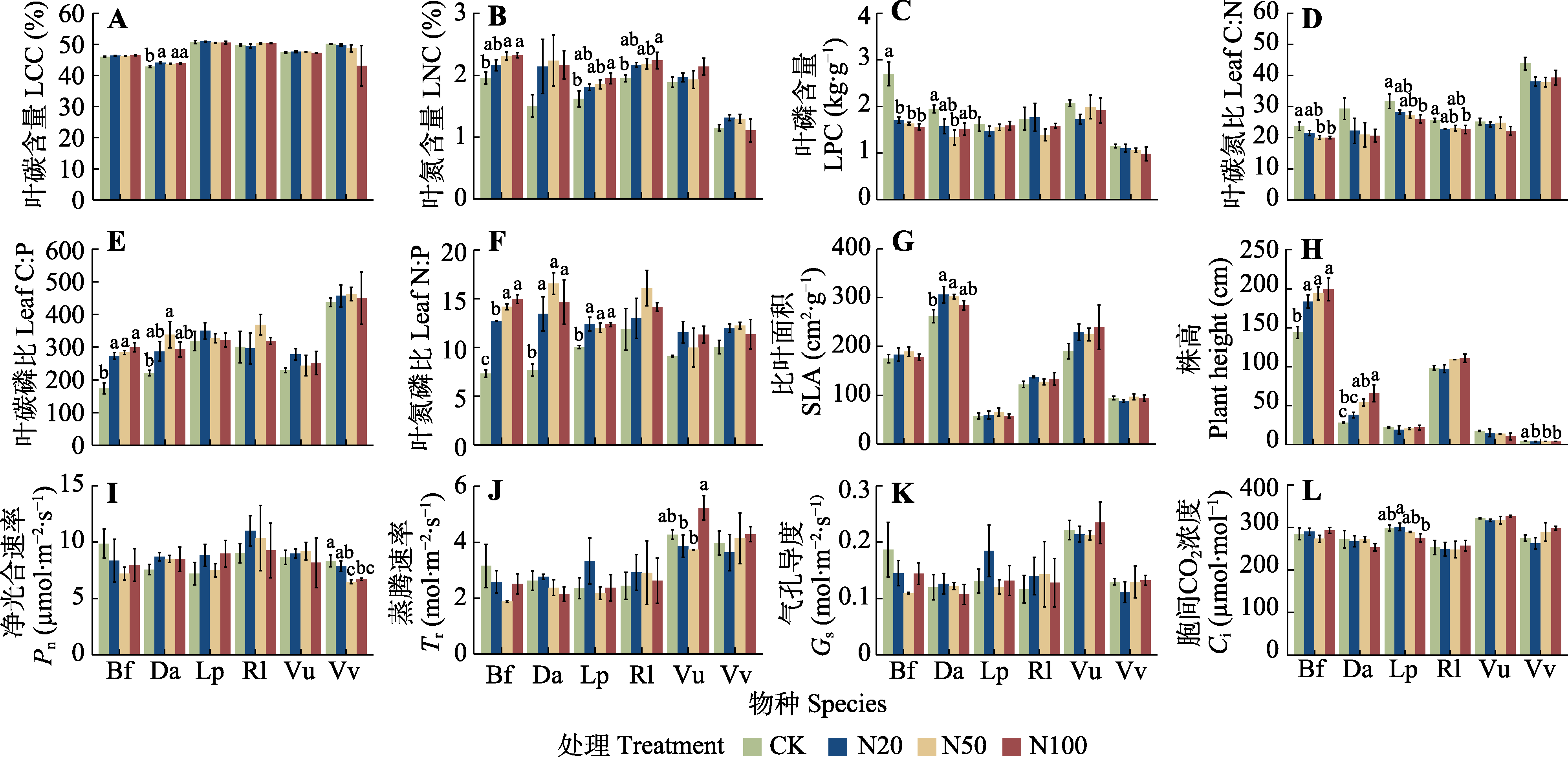
图1 不同氮添加处理下林下各物种的植物性状和叶片光合参数(平均值±标准误)。不同小写字母代表同一物种的性状在不同氮添加处理下差异显著(p < 0.05)。Bf, 柴桦; Da, 小叶章; Lp, 杜香; Rl, 高山杜鹃; Vu, 笃斯越橘; Vv, 越橘。CK, 对照; N20, 氮添加20 kg N·hm-2·a-1; N50, 氮添加50 kg N·hm-2·a-1; N100, 氮添加100 kg N·hm-2·a-1。
Fig. 1 Comparison of plant functional traits and leaf photosynthetic parameters among different understory species under different nitrogen addition levels (mean ± SE). Different lowercase letters indicate significant differences among different nitrogen addition levels under the same species (p < 0.05). Bf, Betula fruticosa; Da, Deyeuxia angustifolia; Lp, Ledum palustre; Rl, Rhododendron lapponicum; Vu, Vaccinium uliginosum; Vv, Vaccinium vitis-idaea. CK, no nitrogen addition; N20, nitrogen addition 20 kg N·hm-2·a-1; N50, nitrogen addition 50 kg N·hm-2·a-1; N100, nitrogen addition 100 kg N·hm-2·a-1. Ci, intercellular CO2 concentration; C:N, leaf carbon to nitrogen ratio; C:P, leaf carbon to phosphorus ratio; Gs, stomatal conductance; LCC, leaf carbon content; LNC, leaf nitrogen content; LPC, leaf phosphorus content; N:P, leaf nitrogen to phosphorus ratio; Pn, net photosynthetic rate; SLA, specific leaf area; Tr, transpiration rate.
| 物种 Species | 对照 CK | N20 | N50 | N100 |
|---|---|---|---|---|
| Bf | 30.32 ± 14.47a | 49.07 ± 9.85a | 56.28 ± 8.57a | 52.78 ± 8.84a |
| Da | 1.12 ± 0.40b | 6.91 ± 2.12b | 20.37 ± 5.09a | 39.52 ± 11.09a |
| Lp | 23.44 ± 13.46a | 18.39 ± 4.78a | 17.33 ± 2.77a | 3.64 ± 0.02a |
| Rl | 16.27 ± 10.35a | 7.34 ± 3.79a | 3.85 ± 2.24a | 6.07 ± 4.30a |
| Vu | 3.22 ± 2.20a | 4.92 ± 4.02a | 0.60 ± 0.00a | 0.97 ± 0.25a |
| Vv | 25.62 ± 1.00a | 13.38 ± 3.12b | 3.25 ± 1.15c | 0.85 ± 0.24c |
表1 不同氮添加处理下林下各物种相对盖度变化(%) (平均值±标准误)
Table 1 Comparison of relative cover (%) of different understory species under different nitrogen addition levels (mean ± SE)
| 物种 Species | 对照 CK | N20 | N50 | N100 |
|---|---|---|---|---|
| Bf | 30.32 ± 14.47a | 49.07 ± 9.85a | 56.28 ± 8.57a | 52.78 ± 8.84a |
| Da | 1.12 ± 0.40b | 6.91 ± 2.12b | 20.37 ± 5.09a | 39.52 ± 11.09a |
| Lp | 23.44 ± 13.46a | 18.39 ± 4.78a | 17.33 ± 2.77a | 3.64 ± 0.02a |
| Rl | 16.27 ± 10.35a | 7.34 ± 3.79a | 3.85 ± 2.24a | 6.07 ± 4.30a |
| Vu | 3.22 ± 2.20a | 4.92 ± 4.02a | 0.60 ± 0.00a | 0.97 ± 0.25a |
| Vv | 25.62 ± 1.00a | 13.38 ± 3.12b | 3.25 ± 1.15c | 0.85 ± 0.24c |
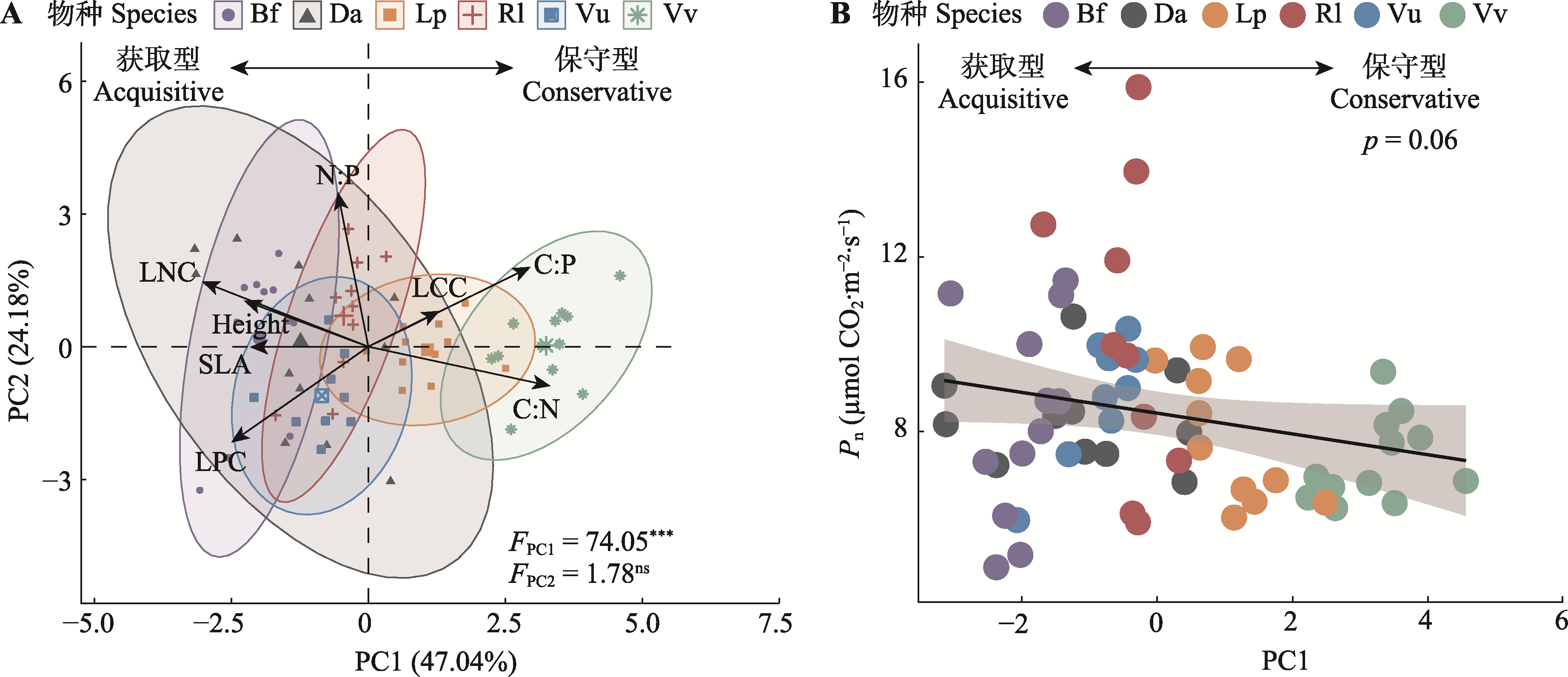
图2 不同氮添加处理下林下各物种主成分分析(PCA)结果(A)及第一主成分(PC1)得分和光合速率(Pn)之间关系(B)。FPC1和FPC2分别代表不同物种性状在PC1和第二主成分(PC2)得分的方差分析结果F值。***, p < 0.001; ns, p > 0.05。C:N, 叶碳氮比; C:P, 叶碳磷比; Height, 株高; LCC, 叶碳含量; LNC, 叶氮含量; LPC, 叶磷含量; N:P, 叶氮磷比; SLA, 比叶面积。Bf, 柴桦; Da, 小叶章; Lp, 杜香; Rl, 高山杜鹃; Vu, 笃斯越橘; Vv, 越橘。
Fig. 2 Principal component analysis (PCA) of plant functional traits among different understory species under different nitrogen addition levels (A) and the linear relationship between species principal component 1 (PC1) scores and net photosynthetic rates (Pn) (B). FPC1 and FPC2 represent the F-values obtained from ANOVA testing the differences of scores across different species on PC1 and PC2, respectively. ***, p < 0.001; ns, p > 0.05. C:N, leaf carbon to nitrogen ratio; C:P, leaf carbon to phosphorus ratio; Height, plant height; LCC, leaf carbon content; LNC, leaf nitrogen content; LPC, leaf phosphorus content; N:P, leaf nitrogen to phosphorus ratio; SLA, specific leaf area. Bf, Betula fruticosa; Da, Deyeuxia angustifolia; Lp, Ledum palustre; Rl, Rhododendron lapponicum; Vu, Vaccinium uliginosum; Vv, Vaccinium vitis-idaea.
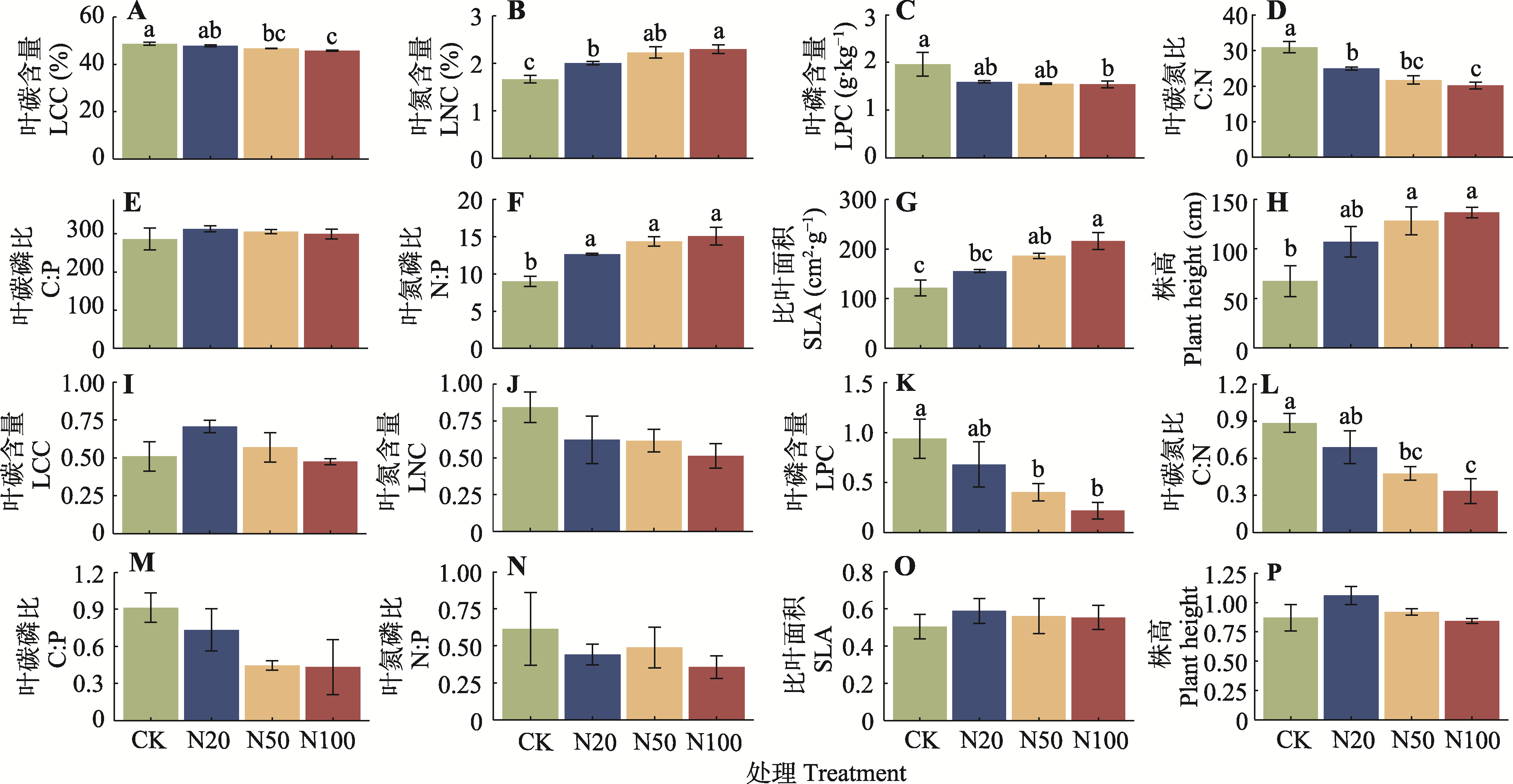
图3 不同氮添加处理下群落平均性状(CWM) (A-H)和性状功能分散度(FDis) (I-P) (平均值±标准误)。不同小写字母代表性状在不同氮添加处理下差异显著(p < 0.05)。CK, 对照; N20, 氮添加20 kg N·hm-2·a-1; N50, 氮添加50 kg N·hm-2·a-1; N100, 氮添加100 kg N·hm-2·a-1。
Fig. 3 Comparison of understory plant community-weighted trait means (CWM) (A-H) and functional dispersion index (FDis) (I-P) under different nitrogen addition levels (mean ± SE). Different lowercase letters indicate significant differences among nitrogen addition levels within the same species (p < 0.05). CK, no nitrogen addition; N20, nitrogen addition 20 kg N·hm-2·a-1; N50, nitrogen addition 50 kg N·hm-2·a-1; N100, nitrogen addition 100 kg N·hm-2·a-1. C:N, leaf carbon to nitrogen ratio; C:P, leaf carbon to phosphorus ratio; LCC, leaf carbon content; LNC, leaf nitrogen content; LPC, leaf phosphorus content; N:P, leaf nitrogen to phosphorus ratio; SLA, specific leaf area.
| 处理 Treatment | NPP (kg·m-2·a-1) |
|---|---|
| CK | 0.013 ± 0.004a |
| N20 | 0.024 ± 0.004a |
| N50 | 0.026 ± 0.003a |
| N100 | 0.031 ± 0.009a |
表2 不同氮添加处理下林下植物群落净初级生产力(NPP)的方差分析结果(平均值±标准误)
Table 2 ANOVA results of understory net primary productivity (NPP) under different nitrogen addition levels (mean ± SE)
| 处理 Treatment | NPP (kg·m-2·a-1) |
|---|---|
| CK | 0.013 ± 0.004a |
| N20 | 0.024 ± 0.004a |
| N50 | 0.026 ± 0.003a |
| N100 | 0.031 ± 0.009a |
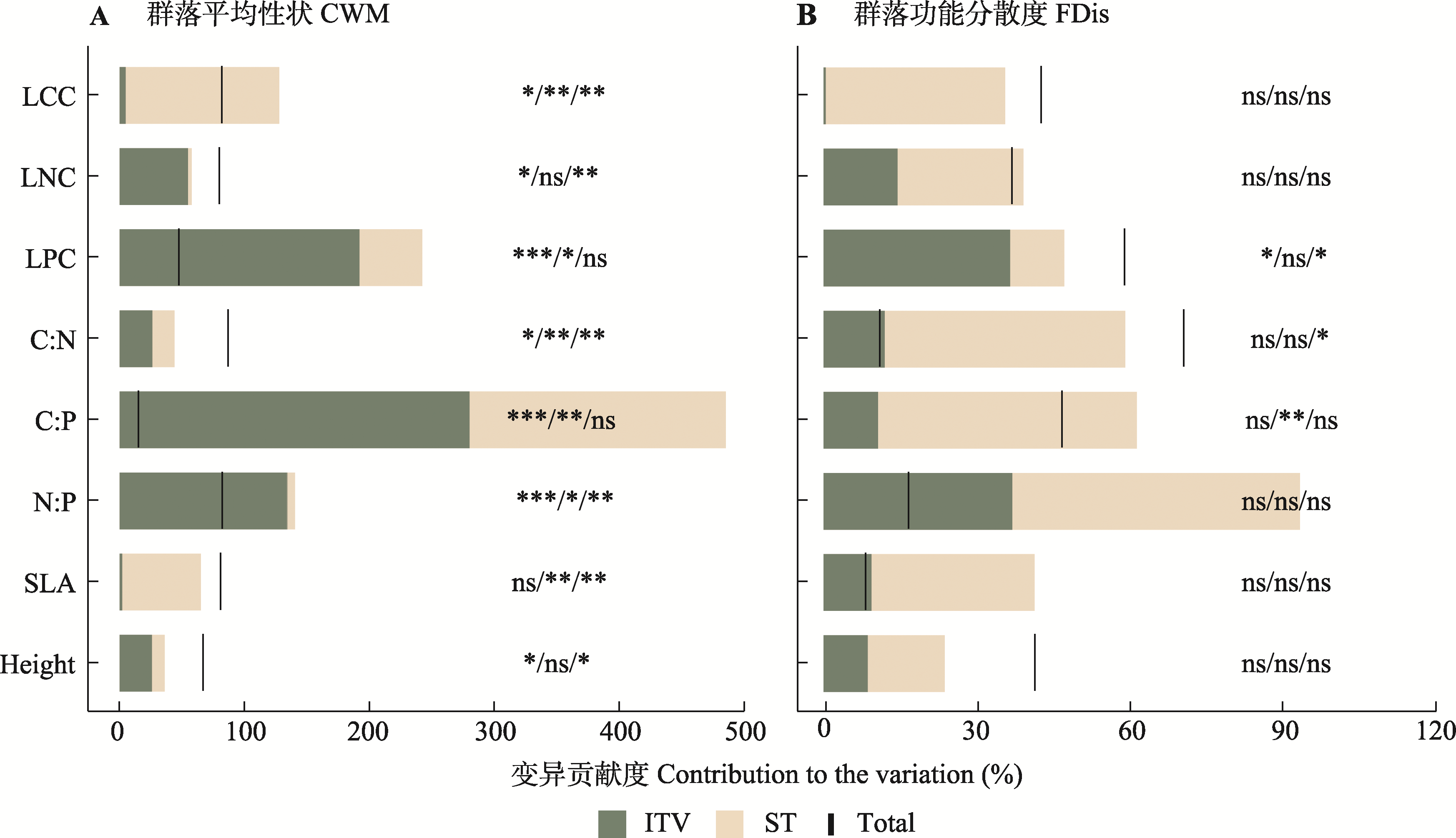
图4 种内变异(ITV)和种间变异(ST)对群落平均性状(CWM) (A)和性状功能分散度(FDis) (B)响应氮添加变化的贡献度。竖线代表性状总变化(Total, 包含ITV和ST及其交互效应)。图中−/−/−分别代表ITV/ST/Total的变化显著性: ns, p > 0.05; *, p < 0.05; **, p < 0.01; ***, p < 0.001。C:N, 叶碳氮比; C:P, 叶碳磷比; Height, 株高; LCC, 叶碳含量; LNC, 叶氮含量; LPC, 叶磷含量; N:P, 叶氮磷比; SLA, 比叶面积。
Fig. 4 Contribution of intraspecific trait variation (ITV) and species turnover (ST) to changes in community-weighted trait mean (CWM, A) and functional dispersion index (FDis, B) in response to nitrogen addition. The vertical bars represent total variation. The −/−/− symbols represent statistical significance of the ITV/ST/Total variation, respectively: ns, p > 0.05; *, p < 0.05; **, p < 0.01; ***, p < 0.001. C:N, leaf carbon to nitrogen ratio; C:P, leaf carbon to phosphorus ratio; Height, plant height; LCC, leaf carbon content; LNC, leaf nitrogen content; LPC, leaf phosphorus content; N:P, leaf nitrogen to phosphorus ratio; SLA, specific leaf area.
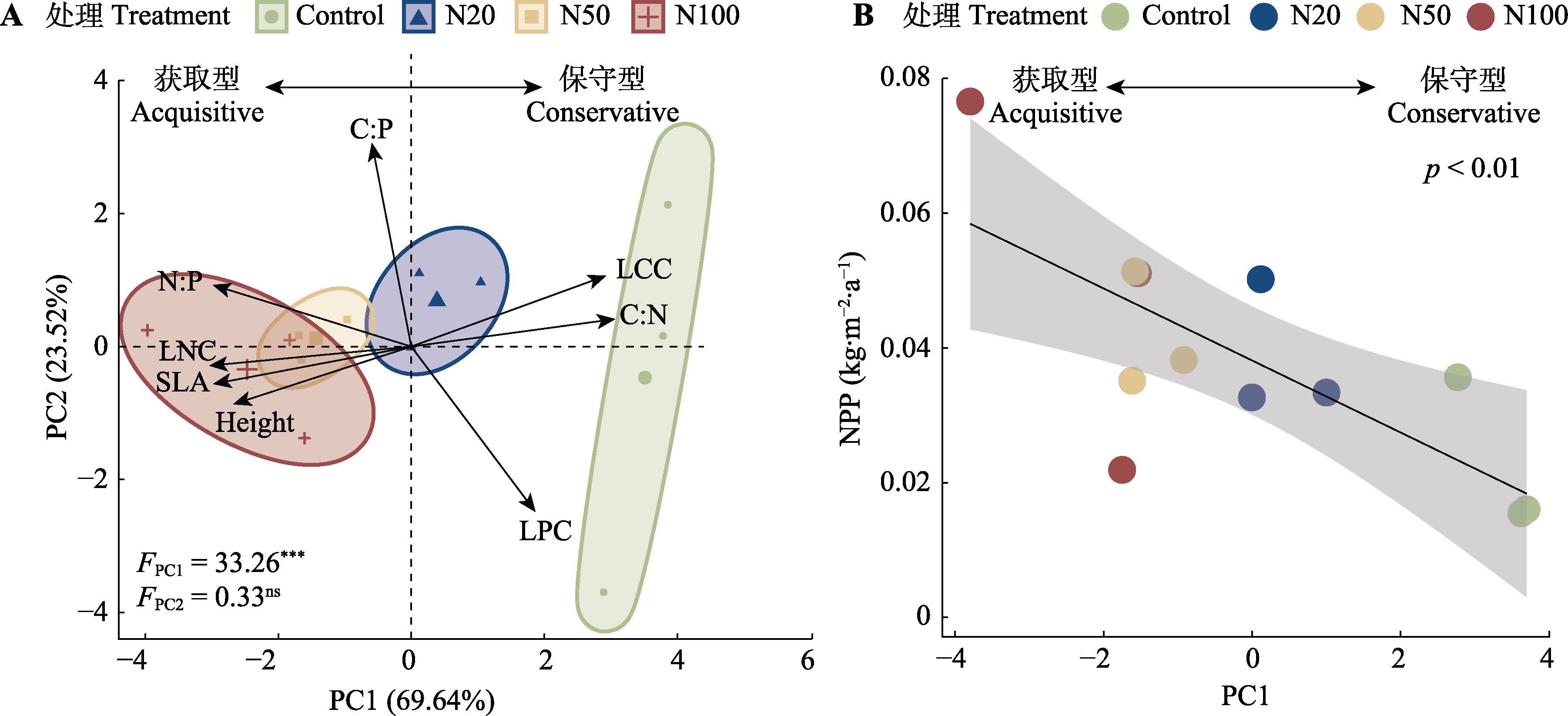
图5 不同氮添加处理下群落平均性状的主成分分析(PCA)结果(A)及第一主成分(PC1)得分和群落净初级生产力(NPP)的关系(B)。FPC1和FPC2分别代表不同氮添加处理下性状在PC1和第二主成分(PC2)得分的方差分析结果F值。***, p < 0.001; ns, p > 0.05。CK, 对照; N20, 氮添加20 kg N·hm-2·a-1; N50, 氮添加50 kg N·hm-2·a-1; N100, 氮添加100 kg N·hm-2·a-1。C:N, 叶碳氮比; C:P, 叶碳磷比; Height, 株高; LCC, 叶碳含量; LNC, 叶氮含量; LPC, 叶磷含量; N:P, 叶氮磷比; SLA, 比叶面积。
Fig. 5 Principal component analysis (PCA) of community-weighted trait mean (CWM) under different nitrogen addition levels (A) and the linear relationship between CWM principal component 1 (PC1) scores and understory community net primary productivity (NPP) (B). FPC1 and FPC2 represent the F-values obtained from ANOVA testing for differences in scores across nitrogen addition levels on PC1 and PC2, respectively. ns, p > 0.05; ***, p < 0.001. CK, no nitrogen addition; N20, nitrogen addition 20 kg N·hm-2·a-1; N50, nitrogen addition 50 kg N·hm-2·a-1; N100, nitrogen addition 100 kg N·hm-2·a-1. C:N, leaf carbon to nitrogen ratio; C:P, leaf carbon to phosphorus ratio; Height, plant height; LCC, leaf carbon content; LNC, leaf nitrogen content; LPC, leaf phosphorus content; N:P, leaf nitrogen to phosphorus ratio; SLA, specific leaf area.
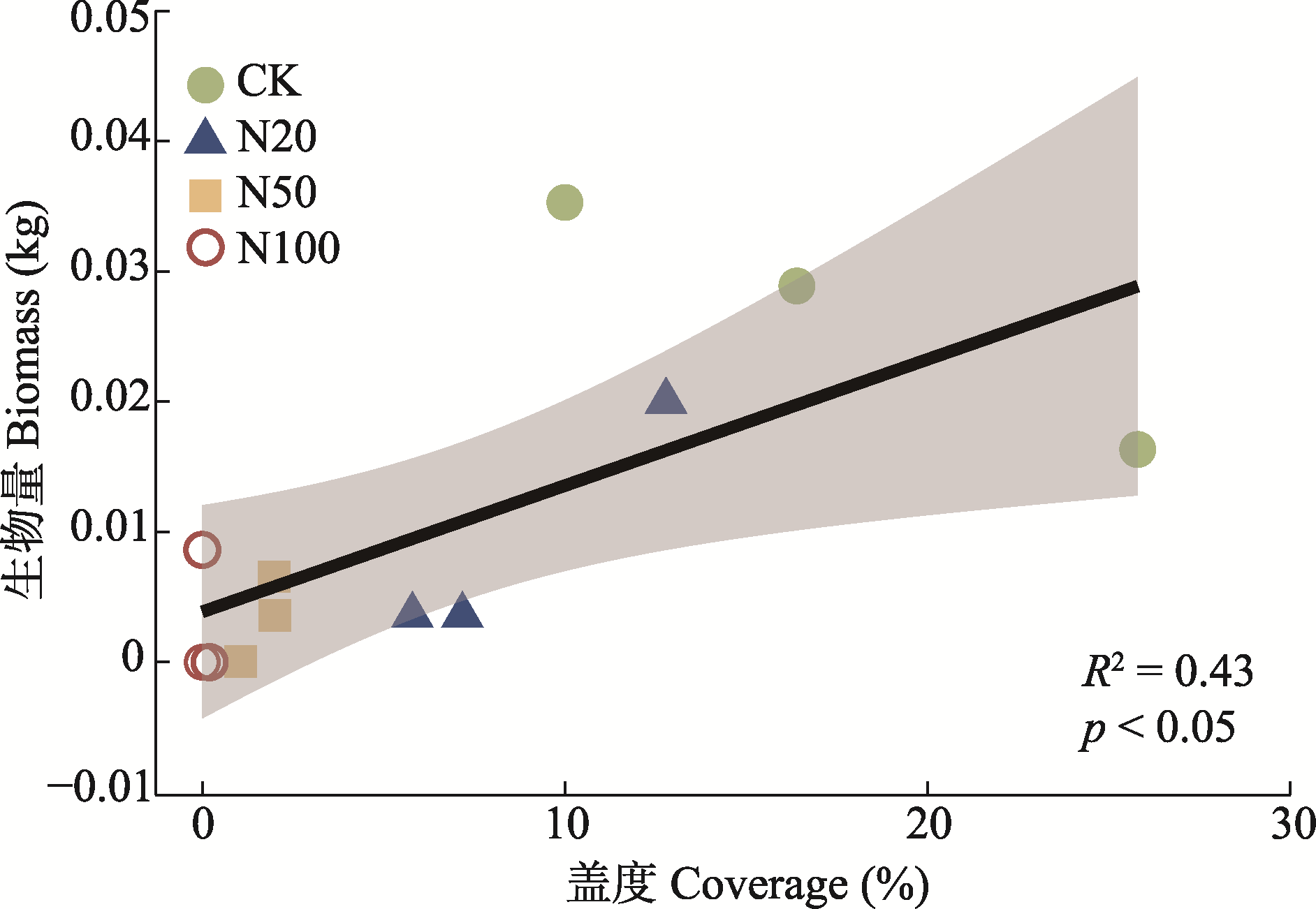
附录I 2023年越橘盖度与生物量的关系 CK, 对照; N20, 氮添加20 kg N·hm-2·a-1; N50, 氮添加50 kg N·hm-2·a-1; N100, 氮添加100 kg N·hm-2·a-1。
Supplement I Relationship between cover and biomass of Vaccinium vitis-idaea in 2023 CK, no nitrogen addition; N20, nitrogen addition 20 kg N·hm-2·a-1; N50, nitrogen addition 50 kg N·hm-2·a-1; N100, nitrogen addition 100 kg N·hm-2·a-1.
| 物种 Species | PC1 |
|---|---|
| Bf | -1.97 ± 0.15e |
| Da | -1.23 ± 0.36d |
| Lp | 1.07 ± 0.21b |
| Rl | -0.45 ± 0.16c |
| Vu | -0.84 ± 0.18cd |
| Vv | 3.22 ± 0.20a |
附录 II 物种主成分分析中不同物种性状在第一主成分(PC1)得分的方差分析结果
Supplement II ANOVA results of species principal component 1 (PC1) scores of different species
| 物种 Species | PC1 |
|---|---|
| Bf | -1.97 ± 0.15e |
| Da | -1.23 ± 0.36d |
| Lp | 1.07 ± 0.21b |
| Rl | -0.45 ± 0.16c |
| Vu | -0.84 ± 0.18cd |
| Vv | 3.22 ± 0.20a |
| 处理 Treatment | CWM PC1 |
|---|---|
| CK | 3.36 ± 0.30a |
| N20 | 0.37 ± 0.72b |
| N50 | -1.37 ± 0.32c |
| N100 | -2.36 ± 0.23c |
附录 III 群落性状主成分分析中不同氮添加下性状在第一主成分(PC1)得分的方差分析结果
Supplement III ANOVA results of community-weighted trait mean (CWM) principal component 1 (PC1) scores in different nitrogen addition levels
| 处理 Treatment | CWM PC1 |
|---|---|
| CK | 3.36 ± 0.30a |
| N20 | 0.37 ± 0.72b |
| N50 | -1.37 ± 0.32c |
| N100 | -2.36 ± 0.23c |
| [1] |
Cleveland CC, Townsend AR, Taylor P, Alvarez-Clare S, Bustamante MMC, Chuyong G, Dobrowski SZ, Grierson P, Harms KE, Houlton BZ, Marklein A, Parton W, Porder S, Reed SC, Sierra CA, et al. (2011). Relationships among net primary productivity, nutrients and climate in tropical rain forest: a pan-tropical analysis. Ecology Letters, 14, 939-947.
DOI PMID |
| [2] |
Du EZ, Zhou Z, Li P, Hu XY, Ma YC, Wang W, Zheng CY, Zhu JX, He JS, Fang JY (2013). NEECF: a project of nutrient enrichment experiments in China’s forests. Journal of Plant Ecology, 6, 428-435.
DOI URL |
| [3] |
Dyola N, Liang E, Peñuelas J, Camarero JJ, Sigdel SR, Aryal S, Lin W, Liu X, Liu Y, Xu X, Rossi S (2024). Linking leaf elemental traits to biomass across forest biomes in the Himalayas. Science China Earth Sciences, 67, 1518-1528.
DOI |
| [4] |
Eskelinen A, Harrison SP (2015). Resource colimitation governs plant community responses to altered precipitation. Proceedings of the National Academy of Sciences of the United States of America, 112, 13009-13014.
DOI PMID |
| [5] |
Gao WQ, Lei XD, Gao DL, Li YT (2021). Mass-ratio and complementarity effects simultaneously drive aboveground biomass in temperate Quercus forests through stand structure. Ecology and Evolution, 11, 16806-16816.
DOI URL |
| [6] |
Getman-Pickering ZL, Campbell A, Aflitto N, Grele A, Davis JK, Ugine TA (2020). LeafByte: a mobile application that measures leaf area and herbivory quickly and accurately. Methods in Ecology and Evolution, 11, 215-221.
DOI |
| [7] |
Gilliam FS, Hockenberry AW, Adams MB (2006). Effects of atmospheric nitrogen deposition on the herbaceous layer of a central Appalachian hardwood forest. The Journal of the Torrey Botanical Society, 133, 240-254.
DOI URL |
| [8] | Gilliam FS, Welch NT, Phillips AH, Billmyer JH, Peterjohn WT, Fowler ZK, Walter CA, Burnham MB, May JD, Adams MB (2016). Twenty-five-year response of the herbaceous layer of a temperate hardwood forest to elevated nitrogen deposition. Ecosphere, 7, e01250. DOI: 10.1002/ecs2.1250. |
| [9] |
Gundale MJ (2022). The impact of anthropogenic nitrogen deposition on global forests: negative impacts far exceed the carbon benefits. Global Change Biology, 28, 690-692.
DOI URL |
| [10] |
Hagh-Doust N, Mikryukov V, Anslan S, Bahram M, Puusepp R, Dulya O, Tedersoo L (2023). Effects of nitrogen deposition on carbon and nutrient cycling along a natural soil acidity gradient as revealed by metagenomics. New Phytologist, 238, 2607-2620.
DOI URL |
| [11] |
Hofmeister J, Hošek J, Modrý M, Roleček J (2009). The influence of light and nutrient availability on herb layer species richness in oak-dominated forests in central Bohemia. Plant Ecology, 205, 57-75.
DOI URL |
| [12] |
Hu MJ, Wan SQ (2019). Effects of fire and nitrogen addition on photosynthesis and growth of three dominant understory plant species in a temperate forest. Journal of Plant Ecology, 12, 759-768.
DOI |
| [13] | Jin YQ, Liu CG, Qian SS, Luo YQ, Zhou RW, Tang JW, Bao WK (2022). Large-scale patterns of understory biomass and its allocation across China’s forests. Science of the Total Environment, 804, 150169. DOI: 10.1016/j.scitotenv.2021.150169. |
| [14] |
Kichenin E, Wardle DA, Peltzer DA, Morse CW, Freschet GT (2013). Contrasting effects of plant inter- and intraspecific variation on community-level trait measures along an environmental gradient. Functional Ecology, 27, 1254-1261.
DOI URL |
| [15] | Kimball S, Funk JL, Spasojevic MJ, Suding KN, Parker S, Goulden ML (2016). Can functional traits predict plant community response to global change. Ecosphere, 7, e01602. DOI: 10.1002/ecs2.1602. |
| [16] |
La Pierre KJ, Smith MD (2015). Functional trait expression of grassland species shift with short- and long-term nutrient additions. Plant Ecology, 216, 307-318.
DOI URL |
| [17] |
Laliberté E, Legendre P (2010). A distance-based framework for measuring functional diversity from multiple traits. Ecology, 91, 299-305.
PMID |
| [18] |
Lavorel S, Grigulis K, McIntyre S, Williams NSG, Garden D, Dorrough J, Berman S, Quétier F, Thébault A, Bonis A (2008). Assessing functional diversity in the field-methodology matters! Functional Ecology, 22, 134-147.
DOI URL |
| [19] |
Lepš J, de Bello F, Šmilauer P, Doležal J (2011). Community trait response to environment: disentangling species turnover vs intraspecific trait variability effects. Ecography, 34, 856-863.
DOI URL |
| [20] |
Lin GG, Zeng DH, Mao R (2020). Traits and their plasticity determine responses of plant performance and community functional property to nitrogen enrichment in a boreal peatland. Plant and Soil, 449, 151-167.
DOI |
| [21] |
Liu H, Yin DY, He PC, Cadotte MW, Ye Q (2024a). Linking plant functional traits to biodiversity under environmental change. Biological Diversity, 1, 22-28.
DOI URL |
| [22] |
Liu JS, Li XF, Ma QH, Zhang X, Chen Y, Isbell F, Wang DL (2019). Nitrogen addition reduced ecosystem stability regardless of its impacts on plant diversity. Journal of Ecology, 107, 2427-2435.
DOI URL |
| [23] |
Liu L, Wen Z, Liu S, Zhang XY, Liu XJ (2024b). Decline in atmospheric nitrogen deposition in China between 2010 and 2020. Nature Geoscience, 17, 733-736.
DOI |
| [24] | Luo YK (2017). Functional Traits of Shrub Species in Eastern China. PhD dissertation, University of Chinese Academy of Sciences, Beijing. 85-87. |
| [罗永开 (2017). 中国东部地区灌木相关生长及功能性状的研究. 博士学位论文, 中国科学院大学, 北京. 85-87.] | |
| [25] |
Mao QG, Lu XK, Wang C, Zhou KJ, Mo JM (2017). Responses of understory plant physiological traits to a decade of nitrogen addition in a tropical reforested ecosystem. Forest Ecology and Management, 401, 65-74.
DOI URL |
| [26] |
Palmroth S, Holm Bach L, Nordin A, Palmqvist K (2014). Nitrogen-addition effects on leaf traits and photosynthetic carbon gain of boreal forest understory shrubs. Oecologia, 175, 457-470.
DOI PMID |
| [27] |
Pan S, Wang Y, Qiu YP, Chen DM, Zhang L, Ye CL, Guo H, Zhu WX, Chen AQ, Xu GH, Zhang Y, Bai YF, Hu SJ (2020). Nitrogen-induced acidification, not N-nutrient, dominates suppressive N effects on arbuscular mycorrhizal fungi. Global Change Biology, 26, 6568-6580.
DOI URL |
| [28] |
Peng JL, Ma FF, Tian DS, Quan Q, Chen C, Liao JQ, Zhou QP, Niu SL (2023). Plant C:N ratio predicts community composition changes under N addition in an alpine meadow. Journal of Ecology, 111, 589-600.
DOI URL |
| [29] |
Read QD, Moorhead LC, Swenson NG, Bailey JK, Sanders NJ (2014). Convergent effects of elevation on functional leaf traits within and among species. Functional Ecology, 28, 37-45.
DOI URL |
| [30] |
Reich PB (2014). The world-wide “fast-slow” plant economics spectrum: a traits manifesto. Journal of Ecology, 102, 275-301.
DOI URL |
| [31] |
Siefert A, Violle C, Chalmandrier L, Albert CH, Taudiere A, Fajardo A, Aarssen LW, Baraloto C, Carlucci MB, Cianciaruso MV, de L Dantas V, de Bello F, Duarte LDS, Fonseca CR, Freschet GT, et al. (2015). A global meta-analysis of the relative extent of intraspecific trait variation in plant communities. Ecology Letters, 18, 1406-1419.
DOI PMID |
| [32] |
Tian D, Du EZ, Jiang L, Ma SH, Zeng WJ, Zou AL, Feng CY, Xu LC, Xing AJ, Wang W, Zheng CY, Ji CJ, Shen HH, Fang JY (2018). Responses of forest ecosystems to increasing N deposition in China: a critical review. Environmental Pollution, 243, 75-86.
DOI PMID |
| [33] | Tian DS, Niu SL (2015). A global analysis of soil acidification caused by nitrogen addition. Environmental Research Letters, 10, 024019. DOI: 10.1088/1748-9326/10/2/024019. |
| [34] |
Walter CA, Raiff DT, Burnham MB, Gilliam FS, Adams MB, Peterjohn WT (2016). Nitrogen fertilization interacts with light to increase Rubus spp. cover in a temperate forest. Plant Ecology, 217, 421-430.
DOI URL |
| [35] |
Wang XY, Yan XB, Huang KL, Luo X, Zhang YY, Zhou LY, Yang F, Xu XH, Zhou XH, Niu KC, Guo H (2022). Nitrogen enrichment and warming shift community functional composition via distinct mechanisms: the role of intraspecific trait variability and species turnover. Functional Ecology, 36, 1230-1242.
DOI URL |
| [36] | Wei B, Zhang DY, Wang GQ, Liu Y, Li QL, Zheng ZH, Yang GB, Peng YF, Niu KC, Yang YH (2023). Experimental warming altered plant functional traits and their coordination in a permafrost ecosystem. New Phytologist, 240, 1802-1816. |
| [37] |
Wright IJ, Reich PB, Westoby M, Ackerly DD, Baruch Z, Bongers F, Cavender-Bares J, Chapin T, Cornelissen JHC, Diemer M, Flexas J, Garnier E, Groom PK, Gulias J, Hikosaka K, et al. (2004). The worldwide leaf economics spectrum. Nature, 428, 821-827.
DOI |
| [38] |
Xing AJ, Du EZ, Shen HH, Xu LC, de Vries W, Zhao MY, Liu XY, Fang JY (2022). Nonlinear responses of ecosystem carbon fluxes to nitrogen deposition in an old-growth boreal forest. Ecology Letters, 25, 77-88.
DOI URL |
| [39] |
Xing AJ, Xu LC, Shen HH, Du EZ, Liu XY, Fang JY (2019). Long term effect of nitrogen addition on understory community in a Chinese boreal forest. Science of the Total Environment, 646, 989-995.
DOI URL |
| [40] | Xu LC, Xing AJ, Du EZ, Shen HH, Yan ZB, Jiang L, Tian D, Hu HF, Fang JY (2021). Effects of nitrogen addition on leaf nutrient stoichiometry in an old-growth boreal forest. Ecosphere, 12, e03335. DOI: 10.1002/ecs2.3335. |
| [41] | Yang YT, Chen ZF, Xu BC, Ghanizadeh H, Li W, Ding CQ, Zhou RL, Wen ZM (2023). Contrasting patterns of community-weighted mean traits and functional diversity in driving grassland productivity changes under N and P addition. Frontiers in Plant Science, 14, 1145709. DOI: 10.3389/fpls.2023.1145709. |
| [42] | Yang YT, Chen ZF, Xu BC, Wei JQ, Zhu XX, Yao HB, Wen ZM (2022). Using trait-based methods to study the response of grassland to fertilization in the grassland in semiarid areas in the Loess Plateau of China. Plants, 11, 2045. DOI: 10.3390/plants11152045. |
| [43] |
Ye XM, Bu WS, Hu XF, Liu B, Liang K, Chen FS (2023). Species divergence in seedling leaf traits and tree growth response to nitrogen and phosphorus additions in an evergreen broadleaved forest of subtropical China. Journal of Forestry Research, 34, 137-150.
DOI |
| [44] | Zhao CT, Lin QH, Tian D, Ji CJ, Shen HH, Fan DY, Wang XP, Fang JY (2023). Nitrogen addition promotes conservative resource-use strategies via aggravating phosphorus limitation of evergreen trees in subtropical forest. Science of the Total Environment, 889, 164047. DOI: 10.1016/j.scitotenv.2023.164047. |
| [45] |
Zhou SX, Huang CD, Han BH, Xiao,YX, Tang JD, Xiang YB, Luo C (2017). Simulated nitrogen deposition significantly suppresses the decomposition of forest litter in a natural evergreen broad-leaved forest in the Rainy Area of Western China. Plant and Soil, 420, 135-145.
DOI |
| [1] | 邹纪开, 吴佳怡, 谷云懿, 陈宝明. 不同形态氮添加与丛枝菌根真菌对外来入侵植物白花鬼针草竞争力的影响[J]. 植物生态学报, 2026, 50(3): 722-730. |
| [2] | 张诚航, 卫星, 吴纯泽, 王裕尧, 李浩楠. 大气还原态氮干湿沉降下水曲柳和兴安落叶松菌根化苗木生长响应[J]. 植物生态学报, 2026, 50(3): 649-659. |
| [3] | 贾会丽, 王睿, 常玉良, 林茂, 栗国梁, 武帅楷, 苏原, 董宽虎, $\boxed{\hbox{王常慧}}$. 不同水平氮添加下晋北赖草叶片化学计量特征及其对光合的影响[J]. 植物生态学报, 2026, 50(2): 429-441. |
| [4] | 于江珊, 许浩, 郭永忠, 侯继华. 器官年龄在油松叶、枝、根化学计量特征变异以及协调中的重要作用[J]. 植物生态学报, 2026, 50(2): 306-317. |
| [5] | 贾紫璇, 方涛, 张舒欣, 刘一凡, 赵微, 王荣, 昌海超, 朱耀军, 罗芳丽, 郭允倩, 于飞海. 不同沼泽湿地芦苇地上-地下性状对水分变化的响应[J]. 植物生态学报, 2025, 49(9): 1448-1460. |
| [6] | 朱润铖, 蔡锡安, 黄娟. 植物防御相关挥发性有机物排放及对氮沉降的响应[J]. 植物生态学报, 2025, 49(5): 681-696. |
| [7] | 胡晓慧, 王兴昌, 董涵君, 刘玉龙, 苑丹阳, 柳荻, 王晓春. 东北温带针阔混交林32个树种非结构性碳水化合物的器官间变化与协同[J]. 植物生态学报, 2025, 49(3): 432-445. |
| [8] | 陆磊琴, 孙龙, 宋宇轩, 杨光, 蔡慧颖. 火后时间对大兴安岭越橘叶-枝-根非结构性碳水化合物的影响[J]. 植物生态学报, 2025, 49(12): 2105-2118. |
| [9] | 卞嘉琛, 王睿, 高阳阳, 梁雯君, 晋红, 张文轩, 张晓荣, 郝杰, $\boxed{\hbox{王常慧}}$, 董宽虎, 刁华杰. 不同水平氮添加对晋北赖草草地地上和地下净初级生产力的影响[J]. 植物生态学报, 2025, 49(12): 2043-2053. |
| [10] | 马煦晗, 黄菊莹, 余海龙, 韩翠, 李冰. 降水量变化及氮添加下荒漠草原土壤有机碳及其易分解组分研究[J]. 植物生态学报, 2024, 48(8): 1065-1077. |
| [11] | 秦嘉晨, 王欢, 朱江, 王扬, 田晨, 白永飞, 杨培志, 郑淑霞. 基于种内与种间性状变异的放牧过滤作用及其尺度效应[J]. 植物生态学报, 2024, 48(7): 858-871. |
| [12] | 俞庆水, 倪晓凤, 吉成均, 朱江玲, 唐志尧, 方精云. 10年氮磷添加对海南尖峰岭热带雨林优势植物叶片非结构性碳水化合物的影响[J]. 植物生态学报, 2024, 48(6): 690-700. |
| [13] | 张文瑾, 佘维维, 秦树高, 乔艳桂, 张宇清. 氮和水分添加对黑沙蒿群落优势植物叶片氮磷化学计量特征的影响[J]. 植物生态学报, 2024, 48(5): 590-600. |
| [14] | 赵常提, 夏青霖, 田地, 陈冰瑞, 朱瑞德, 刘宵含, 俞果, 吉成均. 长期氮添加对温带落叶阔叶林优势植物叶片次生代谢产物的影响[J]. 植物生态学报, 2024, 48(12): 1576-1588. |
| [15] | 马斌, 佘维维, 秦欢, 宣瑞智, 宋春阳, 袁新月, 苗春, 刘靓, 冯薇, 秦树高, 张宇清. 氮水添加对黑沙蒿种子功能性状的影响[J]. 植物生态学报, 2024, 48(12): 1637-1649. |
| 阅读次数 | ||||||
|
全文 |
|
|||||
|
摘要 |
|
|||||
Copyright © 2026 版权所有 《植物生态学报》编辑部
地址: 北京香山南辛村20号, 邮编: 100093
Tel.: 010-62836134, 62836138; Fax: 010-82599431; E-mail: apes@ibcas.ac.cn, cjpe@ibcas.ac.cn
备案号: 京ICP备16067583号-19

