
植物生态学报 ›› 2016, Vol. 40 ›› Issue (10): 1028-1036.DOI: 10.17521/cjpe.2016.0068 cstr: 32100.14.cjpe.2016.0068
所属专题: 全球变化与生态系统; 生态学研究的方法和技术; 青藏高原植物生态学:种群生态学
朱军涛*
出版日期:2016-10-10
发布日期:2016-11-02
基金资助:Jun-Tao ZHU*
Online:2016-10-10
Published:2016-11-02
摘要:
全球气候变暖对高寒和极地地区的植物物候产生强烈的影响。该研究主要关注增温条件下藏北高寒草甸不同功能型植物繁殖时间(生殖物候)的改变。实验采用开顶箱式增温方法, 对3个主要功能群浅根-早花、浅根-中花和深根-晚花植物的现蕾、开花、结实时间进行观测。研究结果表明: (1)增温导致了土壤水分胁迫, 显著推迟了浅根-早花植物高山嵩草(Kobresia pygmaea)的繁殖时间; (2)增温显著提前了浅根-中花植物钉柱委陵菜(Potentilla saundersiana)和深根晚花植物紫花针茅(Stipa purpurea)和矮羊茅(Festuca coelestis)的繁殖时间; (3)增温没有显著影响浅根-中花植物楔叶委陵菜(Potentilla cuneata)和深根-晚花植物无茎黄鹌菜(Youngia simulatrix)的繁殖时间; (4)增温缩短了3种类型植物的开花持续时间。这些结果显示增温改变了藏北高寒草甸群落中多数物种的繁殖时间, 这预示着在未来更热更干的生长季, 青藏高原高寒草甸系统的植物物候格局可能会被重塑。
朱军涛. 实验增温对藏北高寒草甸植物繁殖物候的影响. 植物生态学报, 2016, 40(10): 1028-1036. DOI: 10.17521/cjpe.2016.0068
Jun-Tao ZHU. Effects of experimental warming on plant reproductive phenology in Xizang alpine meadow. Chinese Journal of Plant Ecology, 2016, 40(10): 1028-1036. DOI: 10.17521/cjpe.2016.0068
| 处理 Treatment | 氮含量 N content (%) | 碳含量 C content (%) | 磷含量 P content (mg∙g-1) | C:N |
|---|---|---|---|---|
| 增温T4 Warming T4 | 0.22 ± 0.04 | 2.42 ± 0.52 | 0.75 ± 0.04 | 11.00 ± 0.32 |
| 增温T3 Warming T3 | 0.24 ± 0.06 | 2.31 ± 0.65 | 0.73 ± 0.05 | 9.63 ± 0.55 |
| 增温T2 Warming T2 | 0.21 ± 0.05 | 2.35 ± 0.74 | 0.74 ± 0.04 | 11.19 ± 0.74 |
| 增温T1 Warming T1 | 0.25 ± 0.07 | 2.40 ± 0.55 | 0.72 ± 0.03 | 9.60 ± 0.65 |
| 对照 Control | 0.25 ± 0.06 | 2.53 ± 0.61 | 0.75 ± 0.04 | 10.12 ± 0.44 |
表1 不同增温处理下土壤C、N、P 含量及C:N的差异(平均值±标准误差)
Table 1 Soil C, N, P contents and C:N for each treatments (mean ± SE)
| 处理 Treatment | 氮含量 N content (%) | 碳含量 C content (%) | 磷含量 P content (mg∙g-1) | C:N |
|---|---|---|---|---|
| 增温T4 Warming T4 | 0.22 ± 0.04 | 2.42 ± 0.52 | 0.75 ± 0.04 | 11.00 ± 0.32 |
| 增温T3 Warming T3 | 0.24 ± 0.06 | 2.31 ± 0.65 | 0.73 ± 0.05 | 9.63 ± 0.55 |
| 增温T2 Warming T2 | 0.21 ± 0.05 | 2.35 ± 0.74 | 0.74 ± 0.04 | 11.19 ± 0.74 |
| 增温T1 Warming T1 | 0.25 ± 0.07 | 2.40 ± 0.55 | 0.72 ± 0.03 | 9.60 ± 0.65 |
| 对照 Control | 0.25 ± 0.06 | 2.53 ± 0.61 | 0.75 ± 0.04 | 10.12 ± 0.44 |
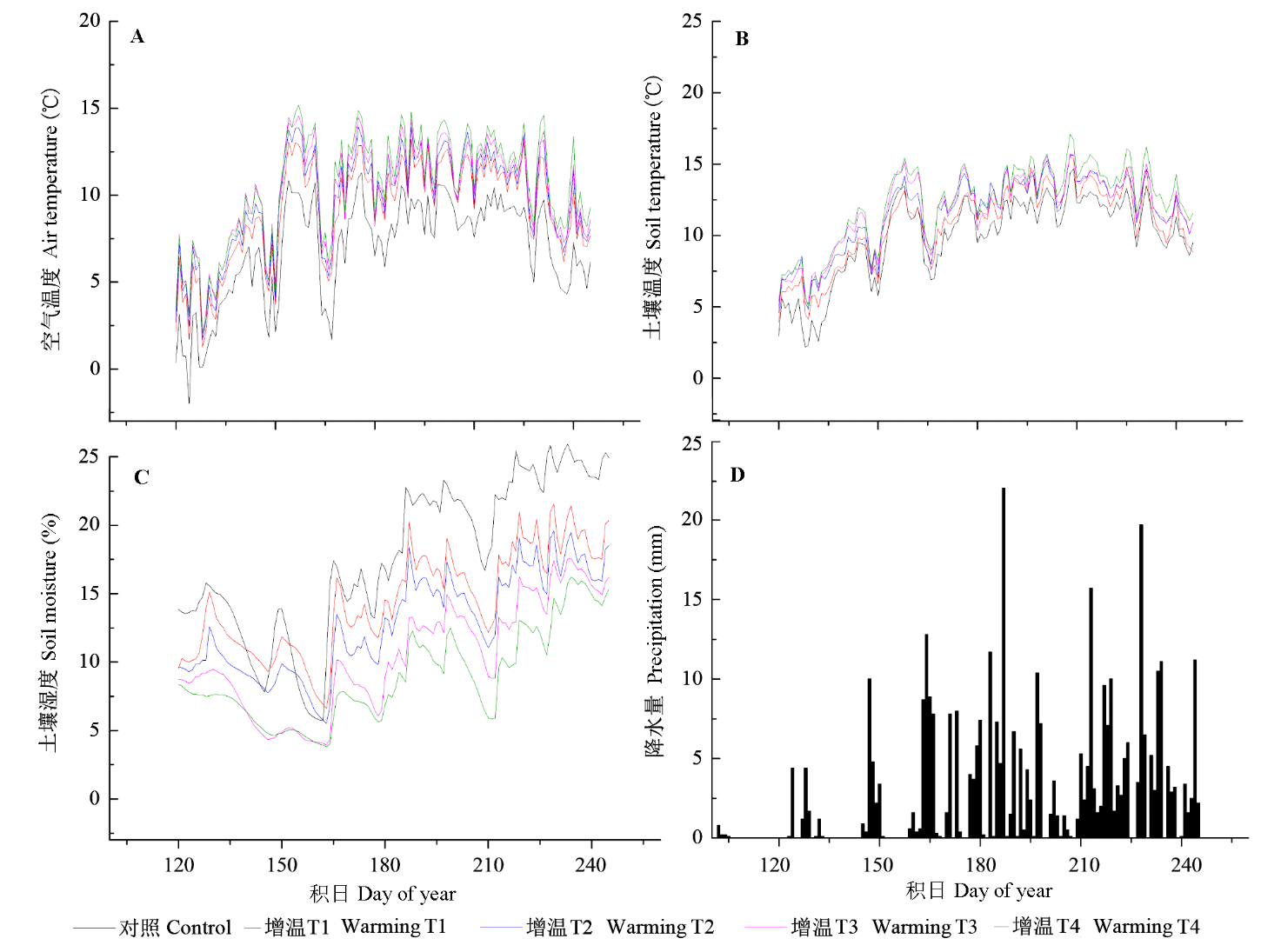
图1 植物生长季不同增温处理下平均气温(°C, A)、5 cm土壤温度(°C, B)、土壤湿度(%, C)及降水量(mm, D)。
Fig. 1 Mean air temperature (°C, A), soil temperature at 5 cm depth (°C, B), soil moisture (%, C) at 5 cm depth and precipitation (mm, D) during the growing seasons under different warming treatments.
| 处理 Treatment | 现蕾时间 Budding time | 开花时间 Flowering time | 结果时间 Fruiting time | 开花持续 Flowering duration | |||||||||||
|---|---|---|---|---|---|---|---|---|---|---|---|---|---|---|---|
| 自由度 Degree of freedom | F | p | 自由度 Degree of freedom | F | p | 自由度 Degree of freedom | F | p | 自由度 Degree of freedom | F | p | ||||
| 增温 Warming | 4 | 2.92 | 0.03 | 1.84 | 0.13 | 3 | 1.13 | 0.35 | 39.46 | 0.00 | |||||
| 物种 Species | 5 | 1 153.39 | 0.00 | 2 567.89 | 0.00 | 5 | 2 268.60 | 0.00 | 589.42 | 0.00 | |||||
| 增温×物种 Warming × species | 20 | 31.54 | 0.00 | 24.97 | 0.00 | 15 | 12.74 | 0.00 | 2.30 | 0.00 | |||||
表2 增温处理和植物种类对现蕾、开花和结果时间及开花持续时间的影响
Table 2 Results (F value) of two-way ANOVA on the effects of warming, plant species and their interactions on budding time, flowering time, fruiting time and flowering duration
| 处理 Treatment | 现蕾时间 Budding time | 开花时间 Flowering time | 结果时间 Fruiting time | 开花持续 Flowering duration | |||||||||||
|---|---|---|---|---|---|---|---|---|---|---|---|---|---|---|---|
| 自由度 Degree of freedom | F | p | 自由度 Degree of freedom | F | p | 自由度 Degree of freedom | F | p | 自由度 Degree of freedom | F | p | ||||
| 增温 Warming | 4 | 2.92 | 0.03 | 1.84 | 0.13 | 3 | 1.13 | 0.35 | 39.46 | 0.00 | |||||
| 物种 Species | 5 | 1 153.39 | 0.00 | 2 567.89 | 0.00 | 5 | 2 268.60 | 0.00 | 589.42 | 0.00 | |||||
| 增温×物种 Warming × species | 20 | 31.54 | 0.00 | 24.97 | 0.00 | 15 | 12.74 | 0.00 | 2.30 | 0.00 | |||||
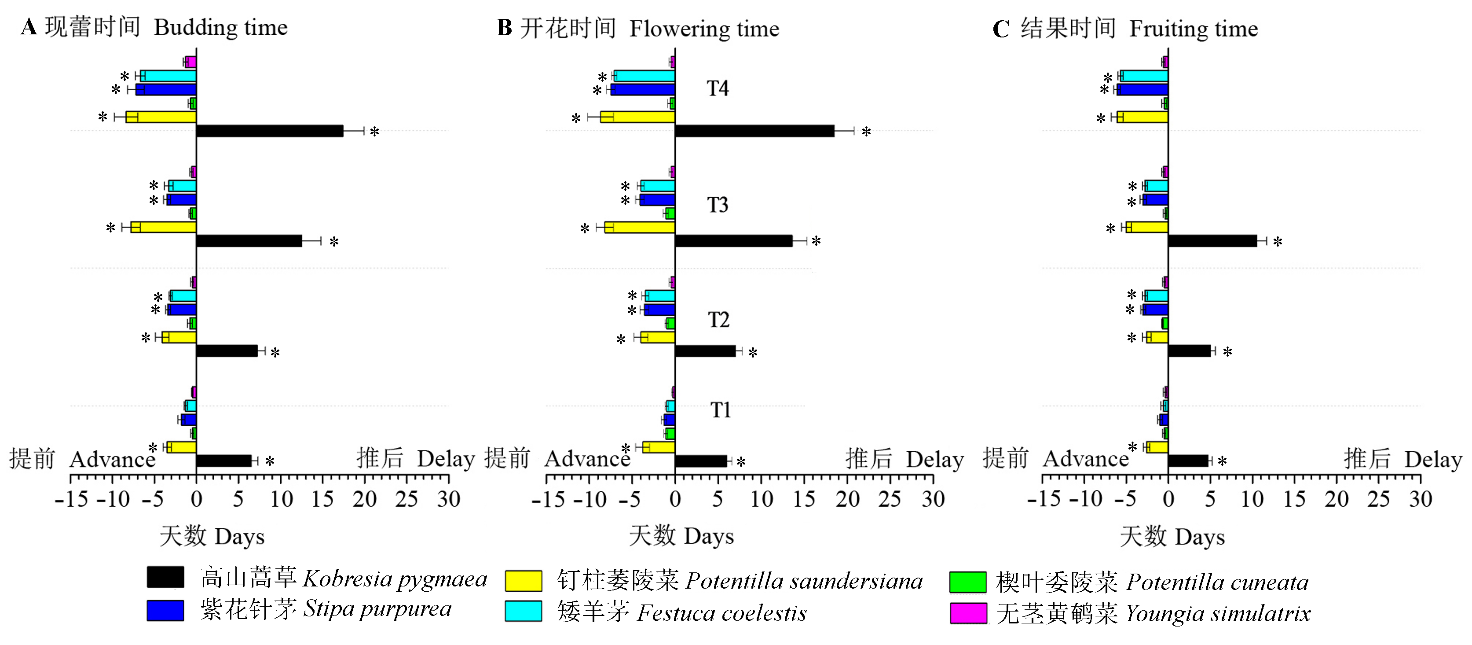
图2 增温处理对各物种的现蕾(A)、开花(B)和结果(C)时间的影响(平均值±标准误差)。图中正值代表与对照相比推后的天数, 负值代表与对照相比提前的天数; *代表增温处理与对照相比差异显著(p < 0.05)。
Fig. 2 Changes in the onset of budding, flowering and fruiting (in days) in four experimental treatments [i.e., T1, T2, T3, T4] compared with the control in 2014 (A, B, C) (mean ± SE). A positive value indicates later budding, flowering or fruiting than the control; a negative value indicates earlier budding, flowering or fruiting than the control. Data are mean ± SE for advanced or delayed phenology, respectively. “*” indicates significant difference between treatment and the control.
| 物种 Species | 增温T1 Warming T1 | 增温T2 Warming T2 | 增温T3 Warming T3 | 增温T4 Warming T4 |
|---|---|---|---|---|
| 高山嵩草 Kobresia pygmaea | 0 | 0 | 1 | 1 |
| 钉柱委陵菜 Potentilla saundersiana | 0 | 0 | 1 | 1 |
| 楔叶委陵菜 Potentilla cuneata | 0 | 1 | 1 | 1 |
| 紫花针茅 Stipa purpurea | 1 | 1 | 1 | 1 |
| 矮羊茅 Festuca coelestis | 0 | 0 | 0 | 1 |
| 无茎黄鹌菜 Youngia simulatrix | 0 | 1 | 1 | 1 |
表3 增温处理对各物种开花持续时间影响的F检验
Table 3 Results of Fisher test showing the differences of the flowering duration for each species among treatments (T1, T2, T3, T4)
| 物种 Species | 增温T1 Warming T1 | 增温T2 Warming T2 | 增温T3 Warming T3 | 增温T4 Warming T4 |
|---|---|---|---|---|
| 高山嵩草 Kobresia pygmaea | 0 | 0 | 1 | 1 |
| 钉柱委陵菜 Potentilla saundersiana | 0 | 0 | 1 | 1 |
| 楔叶委陵菜 Potentilla cuneata | 0 | 1 | 1 | 1 |
| 紫花针茅 Stipa purpurea | 1 | 1 | 1 | 1 |
| 矮羊茅 Festuca coelestis | 0 | 0 | 0 | 1 |
| 无茎黄鹌菜 Youngia simulatrix | 0 | 1 | 1 | 1 |
| [1] | Ashe XH (2013). Effects of Warming and Precipitation Regime on Plant Phenology and Productivity in an Alpine Meadow, Northwestern Sichuan, China. Master degree dissertation, Chengdu University of Technology, Chengdu.(in Chinese with English abstract)[阿舍小虎 (2013). 模拟增温与降水改变对川西北高寒草甸植物物候及初级生产力的影响. 硕士学位论文, 成都理工大学, 成都.] |
| [2] | Arft AM, Walker MD, Gurevitch J, Alatalo JM, Bret-Harte MS, Dale M (1999). Response patterns of tundra plant species to experimental warming: A meta-analysis of the international tundra experiment.Ecological Monographs, 69, 491-511. |
| [3] | Bjorkman AD, Elmendorf SC, Beamish AL, Vellend M, Henry GHR (2015). Contrasting effects of warming and increased snowfall on Arctic tundra plant phenology over the past two decades.Global Change Biology, 21, 4651-4661. |
| [4] | Chmielewski FM, Rötzer T (2001). Response of tree phenology to climate change across Europe.Agricultural and Forest Meteorology, 108, 101-112. |
| [5] | Cleland EE, Chiariello NR, Loarie SR, Mooney HA, Field CB (2006). Diverse responses of phenology to global changes in a grassland ecosystem.Proceedings of the National Academy of Sciences of the United States of America, 103, 13740. |
| [6] | Cook BI, Wolkovich EM, Parmesan C (2012). Divergent responses to spring and winter warming drive community level flowering trends.Proceedings of the National Academy of Sciences of the United States of America, 109, 9000-9005. |
| [7] | Dorji T, Totland Ø, Moe S, Hopping KA, Pan JB, Klein JA (2013). Plant functional traits mediate reproductive phenology and success in response to experimental warming and snow addition in Tibet.Global Change Biology, 19, 459-472. |
| [8] | Dunne JA, Harte J, Taylor KJ (2003). Subalpine meadow flowering phenology responses to climate change: Integrating experimental and gradient methods.Ecological Monographs, 73, 69-86. |
| [9] | Fitter AH, Fitter RSR (2002). Rapid changes in flowering time in British plants. Science, 296, 1689-1691. |
| [10] | Franks SJ, Sim S, Weis AE (2007). Rapid evolution of flowering time by an annual plant in response to a climate fluctuation.Proceedings of the National Academy of Sciences of the United States of America, 104, 1278-1282. |
| [11] | Goldman DA, Willson MF (1986). Sex allocation in functionally hermaphroditic plants: A review and critique.Botanical Review, 52, 157-194. |
| [12] | Gu S, Hui D, Bian A (1998). The contraction-expansion algorithm and its use in fitting nonlinear equations.International Journal of Biomathematics, 13, 426-434. |
| [13] | Hoffmann AA, Camac JS, Williams RJ, Papst W, Jarrad FC, Wahren C-H (2010). Phenological changes in six Australian subalpine plants in response to experimental warming and year-to-year variation.Journal of Ecology, 98, 927-937. |
| [14] | Hollister RD, Webber PJ, Bay C (2005). Plant response to temperature in northern Alaska: Implications for predicting vegetation change.Ecology, 86, 1562-1570. |
| [15] | IPCC (Intergovernmental Panel on Climate Change) (2007). Contribution of working group I to the fourth assessment report of the intergovernmental panel on climate change. In: Solomon S, Qin DH, Manning M, Marquis M, Chen ZL, Averyt K, Tignor M, Miller HL eds. Climate Change 2007: The Physical Science Basis. Cambridge University Press, Cambridge, UK. |
| [16] | Klein JA, Harte J, Zhao XQ (2008). Decline in medicinal and forage species with warming is mediated by plant traits on the Tibetan Plateau.Ecosystems, 11, 775-789. |
| [17] | Kliber A, Eckert CG (2004). Sequential decline in allocation among flowers within Inflorescences: Proximate mechanism and adaptive significance. Ecology, 85, 1675-1687. |
| [18] | Li YH, Han GD, Wang Z, Zhao ML, Wang ZW, Zhao HB (2014). Influences of warming and nitrogen addition on plant reproductive phenology in Inner Mongolia desert steppe.Chinese Journal of Ecology, 33, 849-856.(in Chinese with English abstract)[李元恒, 韩国栋, 王珍, 赵萌莉, 王正文, 赵鸿彬 (2014). 增温和氮素添加对内蒙古荒漠草原植物生殖物候的影响. 生态学杂志,33, 849-856.] |
| [19] | Piao SL, Fang JY, Zhou LM, Philippe C, Zhu B (2006). Variations in satellite-derived phenology in China’s temperate vegetation.Global Change Biology, 12, 672-685. |
| [20] | Porporato A, Laio F, Ridolfi L, Rodriguez-Iturbe I (2001). Plants in water-controlled ecosystems: Active role in hydrologic processes and response to water stress: III. Vegetation water stress.Advances in Water Resources, 24, 725-744. |
| [21] | Post ES, Pedersen C, Wilmers CC, Forchhammer MC (2008). Phenological sequences reveal aggregate life history response to climatic warming. Ecology, 89, 363-370. |
| [22] | Price MV, Waser NM (1998). Effects of experimental warming on plant reproductive phenology in a subalpine meadow.Ecology, 79, 1261-1271. |
| [23] | Richards FJ (1959). A flexible growth function for empirical use. Journal of Experimental Botany, 10, 290-301. |
| [24] | Rutishauser T, Stockli R, Harte J, Kueppers L (2012). Climate change: Flowering in the greenhouse.Nature, 485, 448-449. |
| [25] | Sherry RA, Zhou XH, Gu SL, Arnone JA, Schimel DS, Verburg PS, Wallace LL, Luo YQ (2007). Divergence of reproductive phenology under climate warming.Proceedings of the National Academy of Sciences of the United States of America, 104, 198-202. |
| [26] | Springate DA, Kover PX (2014). Plant responses to elevated temperatures: A field study on phenological sensitivity and fitness responses to simulated climate warming.Global Change Biology, 20, 456-465. |
| [27] | Visser ME, Both C (2005). Shifts in phenology due to global climate change: The need for a yardstick.Proceedings of the Royal Society Biological Sciences, 272, 2561-2569. |
| [28] | Wang SP, Meng FD, Duan JC, Wang YF, Cui XY, Piao SL, Niu HS, Xu GP, Luo CY, Zhang ZH, Zhu XX, Shen MG, Li YN, Du MY, Tang YH, Zhao XQ, Ciais PB, Kimball B, Peñuelas J, Janssens IA, Cui SJ, Zhao L, Zhang FW (2014). Asymmetric sensitivity of first flowering date to warming and cooling in alpine plants.Ecology, 95, 3387-3398. |
| [29] | Wolkovich EM, Cook BI, Allen JM, Crimmins TM, Betancourt JL, Travers SE, Pau S, Regetz J, Davies TJ, Kraft NJB, Ault TR, Bolmgren K, Mazer SJ, McCabe GJ, McGill BJ, Parmesan C, Salamin N, Schwartz MD, Cleland EE (2012). Warming experiments underpredict plant phenological responses to climate change. Nature, 485, 494-497. |
| [30] | Xia J, Wan S (2013). Independent effects of warming and nitrogen addition on plant phenology in the Inner Mongolian steppe.Annals of Botany, 111, 1207-1217. |
| [31] | Yu H, Luedeling E, Xu J (2010). Winter and spring warming result in delayed spring phenology on the Tibetan Plateau.Proceedings of the National Academy of Sciences of the United States of America, 107, 22151-22156. |
| [1] | 李燚, 黄欢, 赵艳超, 陈立同. 养分添加对不同海拔高寒草甸群落多样性及组成的影响[J]. 植物生态学报, 2026, 50(预发表): 0-. |
| [2] | 张安宁, 肖亚宁, 赵霞, 张淼, 崔瀚文, 陈书燕, 安黎哲. 青藏高原灌木化与氮添加对土壤线虫及功能性状的交互作用[J]. 植物生态学报, 2026, 50(预发表): 0-. |
| [3] | 郑子仪, 陈江慧, 刘慧颖. 气候变暖提高青藏高原高寒草甸优势物种的根系分泌速率[J]. 植物生态学报, 2025, 49(9): 1363-1373. |
| [4] | 张法伟, 李红琴, 祝景彬, 樊博, 周华坤, 李英年, 梁乃申. 氮添加和降水改变对高寒草甸生态系统地上与地下碳储的影响[J]. 植物生态学报, 2025, 49(9): 1399-1409. |
| [5] | 陈龙, 郭柯, 勾晓华, 赵秀海, 马泓若. 祁连圆柏林群落组成及特征[J]. 植物生态学报, 2025, 49(6): 852-864. |
| [6] | 王世松, 曲孝云, 董劭琼, 李佳鸿, 杨琦, 侯满福, 赵利清, 郭柯, 刘长成, 胥晓. 西藏札达典型荒漠植被类型及群落特征[J]. 植物生态学报, 2025, 49(5): 801-812. |
| [7] | 王娟, 张登山, 肖元明, 裴全帮, 王博, 樊博, 周国英. 长期围封后高寒草原植物根系分泌物特征与环境因子关系[J]. 植物生态学报, 2025, 49(4): 596-609. |
| [8] | 刘洋, 刘傲, 宋璇紫, 杨云, 安柏衡, 韩梦姣, 班玛才格尔, 米玛旺堆. 高原鼠兔干扰对高寒草甸主要植物生态位及种间联结的影响[J]. 植物生态学报, 2025, 49(12): 2054-2068. |
| [9] | 陈诚智, 高钰森, 罗力嘉, 王东. 川西高寒窄叶鲜卑花灌丛凋落枝和凋落叶生产与分解[J]. 植物生态学报, 2025, 49(10): 1733-1743. |
| [10] | 王麟, 李雪, 王愉, 王新, 胡小文, 杨梅, 朱剑霄. 不同配方种衣剂对高寒草地乡土草种种子生长与建植的影响[J]. 植物生态学报, 2025, 49(1): 118-128. |
| [11] | 徐嘉昕, 肖元明, 王小赟, 王雯莹, 马玉花, 李强峰, 周国英. 微生物菌肥与氮磷肥回补对退化高寒草甸土壤理化性质和酶活性的影响[J]. 植物生态学报, 2025, 49(1): 159-172. |
| [12] | 王雯莹, 肖元明, 王小赟, 徐嘉昕, 马玉花, 李强峰, 周国英. 多功能群物种配置模式下退化高寒草甸植物多样性与生态系统多功能性的关联[J]. 植物生态学报, 2025, 49(1): 103-117. |
| [13] | 张辉, 赵赟鹏, 刘晓琛, 郭增鹏, 胡国瑞, 冯彦皓, 马妙君. 高寒草甸退化过程中土壤种子库的变化及其在植物群落更新中的潜在作用[J]. 植物生态学报, 2025, 49(1): 74-82. |
| [14] | 马东峰, 贾存智, 王学朋, 赵鹏鹏, 胡小文. 甘南高寒退化草甸多物种组配的修复效果评估[J]. 植物生态学报, 2025, 49(1): 93-102. |
| [15] | 刘位会, 宋小艳, 才仁多杰, 丁路明, 王长庭. 退化程度对高寒草甸不同优势植物根系形态性状和生物量的影响[J]. 植物生态学报, 2024, 48(12): 1666-1682. |
| 阅读次数 | ||||||
|
全文 |
|
|||||
|
摘要 |
|
|||||
Copyright © 2026 版权所有 《植物生态学报》编辑部
地址: 北京香山南辛村20号, 邮编: 100093
Tel.: 010-62836134, 62836138; Fax: 010-82599431; E-mail: apes@ibcas.ac.cn, cjpe@ibcas.ac.cn
备案号: 京ICP备16067583号-19

