
植物生态学报 ›› 2022, Vol. 46 ›› Issue (8): 941-950.DOI: 10.17521/cjpe.2022.0017 cstr: 32100.14.cjpe.2022.0017
王姝文, 李文怀( ), 李艳龙, 严慧, 李永宏
收稿日期:2022-01-11
接受日期:2022-02-23
出版日期:2022-08-20
发布日期:2022-08-20
基金资助:
WANG Shu-Wen, LI Wen-Huai(), LI Yan-Long, YAN Hui, LI Yong-Hong
Received:2022-01-11
Accepted:2022-02-23
Online:2022-08-20
Published:2022-08-20
Supported by:摘要:
放牧家畜是调控草原植物多样性的重要因素, 探究不同家畜类型及其放牧行为下植物多样性的响应, 有助于全面理解草原植物多样性维持机制。该研究以内蒙古大学野外实验基地放牧控制实验为平台, 研究了中等放牧强度下不同家畜类型(牛、山羊、绵羊)及其选择性采食和聚集性放牧行为对植物α、β和γ多样性以及群落结构的影响。结果表明: (1)中等强度放牧牛、山羊和绵羊均在一定程度上提高了植物α、β和γ多样性。其中, 牛对植物多样性的提升作用最大且具有显著性。(2) 3种家畜放牧均显著改变了植物群落结构。绵羊的选择性采食导致下层优势物种糙隐子草(Cleistogenes squarrosa)的相对多度显著降低, 使其与牛或山羊放牧导致的群落结构变化趋势相反。(3) 3种家畜具有不同的牧草选择和放牧聚集行为。牛和山羊放牧使上层优势种羊草(Leymus chinensis)和大针茅(Stipa grandis)以及下层优势种糙隐子草地上生物量均显著降低, 而绵羊放牧仅使糙隐子草地上生物量显著降低。此外, 牛的采食空间聚集性显著低于山羊和绵羊。(4)植物多样性随上层或下层优势种地上生物量增加而显著降低或呈下降趋势, 表明放牧家畜能够通过抑制优势种生物量来提高植物多样性。(5)植物多样性随家畜采食空间聚集程度增加而显著降低或表现出下降趋势, 说明较低的放牧聚集性有利于植物多样性的维持。该研究表明, 内蒙古典型草原植物多样性保护和持续管理体系需要同时考虑放牧强度和家畜类型的影响。
王姝文, 李文怀, 李艳龙, 严慧, 李永宏. 放牧家畜类型对内蒙古典型草原植物多样性和群落结构的影响. 植物生态学报, 2022, 46(8): 941-950. DOI: 10.17521/cjpe.2022.0017
WANG Shu-Wen, LI Wen-Huai, LI Yan-Long, YAN Hui, LI Yong-Hong. Effects of different livestock types on plant diversity and community structure of a typical steppe in Nei Mongol, China. Chinese Journal of Plant Ecology, 2022, 46(8): 941-950. DOI: 10.17521/cjpe.2022.0017
| 家畜类型 Livestock type | 休息 Resting (m·s-1) | 采食 Feeding (m·s-1) | 游走 Wandering (m·s-1) |
|---|---|---|---|
| 牛 Cattle | 0-0.05 | 0.05-0.26 | >0.26 |
| 山羊 Goat | 0-0.03 | 0.03-0.16 | >0.16 |
| 绵羊 Sheep | 0-0.05 | 0.05-0.20 | >0.20 |
表1 根据速度阈值对内蒙古典型草原不同放牧家畜行为的划分
Table 1 Different livestock behaviors distinguished using their moving speed as thresholds in a typical steppe in Nei Mongol
| 家畜类型 Livestock type | 休息 Resting (m·s-1) | 采食 Feeding (m·s-1) | 游走 Wandering (m·s-1) |
|---|---|---|---|
| 牛 Cattle | 0-0.05 | 0.05-0.26 | >0.26 |
| 山羊 Goat | 0-0.03 | 0.03-0.16 | >0.16 |
| 绵羊 Sheep | 0-0.05 | 0.05-0.20 | >0.20 |
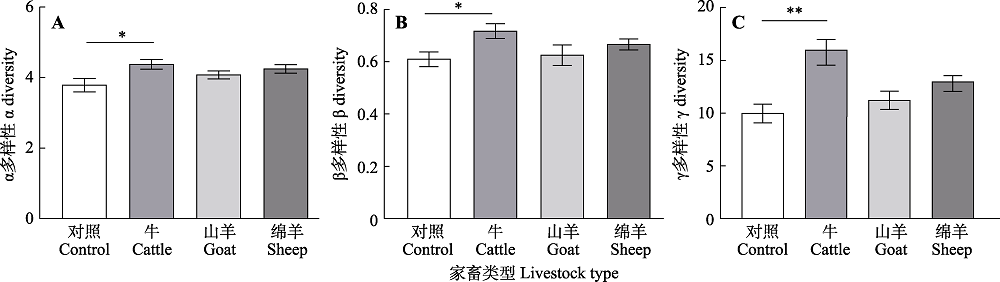
图1 不同家畜中等强度放牧下内蒙古典型草原植物多样性(平均值±标准误)。*, p < 0.05; **, p < 0.01。
Fig. 1 Plant species diversity under moderate grazing of different livestock species in a typical steppe in Nei Mongol (mean ± SE). *, p < 0.05; **, p < 0.01.
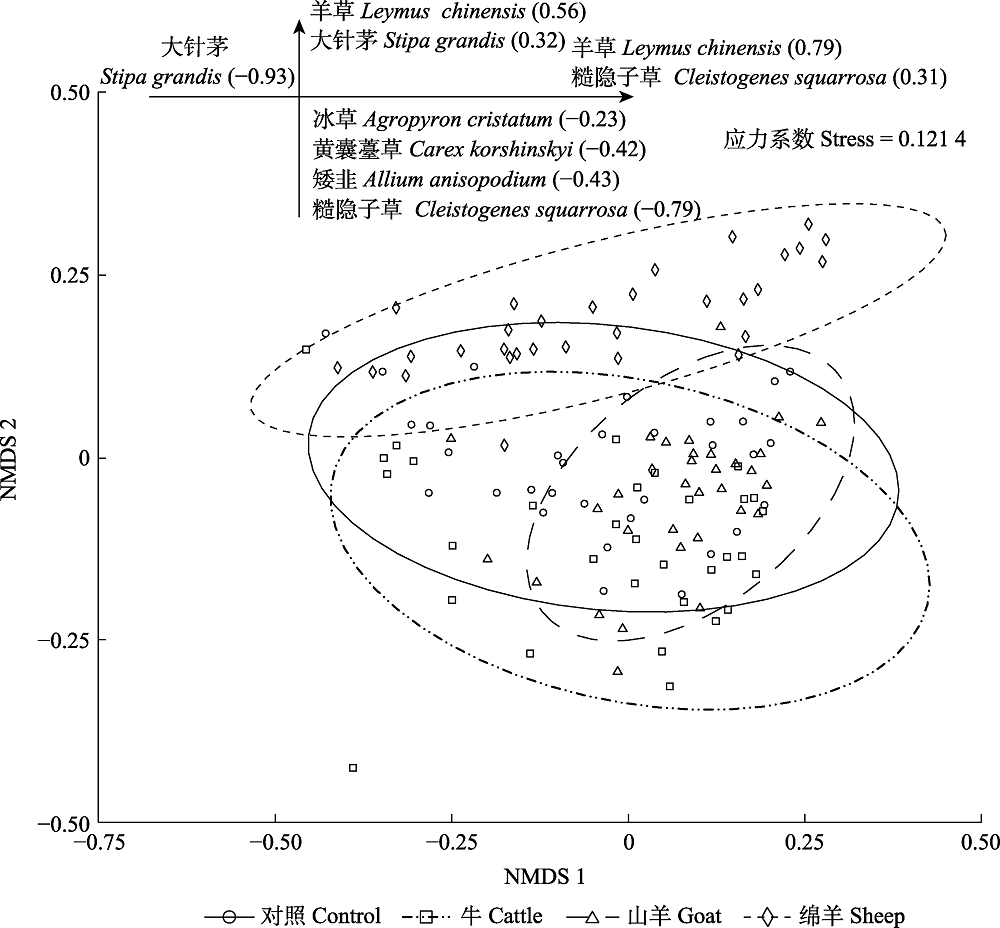
图2 不同家畜放牧下内蒙古典型草原植物群落组成非度量多维尺(NMDS)度排序, 椭圆置信区间为95%。图中所列植物相对多度与其在横轴和纵轴的数值显著相关(p < 0.05), 括号内的数字表示相关系数。
Fig. 2 Ordination of plant communities in a typical steppe in Nei Mongol under different livestock grazing treatments by non-metric multidimensional scaling (NMDS), with an elliptical confidence interval of 95%. The relative abundance of different species is significantly related to the axis 1 and axis 2 scores (p < 0.05). The numbers in parentheses indicate the correlation coefficients.
| 家畜类型 Livestock type | 上层优势种 Tall dominant species | 下层优势种 Short dominant species | 羊草 Leymus chinensis | 大针茅 Stipa grandis | 糙隐子草 Cleistogenes squarrosa | 黄囊薹草 Carex korshinskyi |
|---|---|---|---|---|---|---|
| 牛 Cattle | 1.148 | 0.713 | 1.113 | 1.253 | 0.918 | 1.673 |
| 山羊 Goat | 1.224 | 0.652 | 0.881 | 1.592 | 0.950 | 2.585 |
| 绵羊 Sheep | 0.277 | 3.029 | 1.072 | 0.576 | 3.583 | 3.309 |
表2 不同放牧家畜对内蒙古典型草原4个优势种的选择性采食指数
Table 2 Selective index of different livestock types to four dominant plant species in a typical steppe in Nei Mongol
| 家畜类型 Livestock type | 上层优势种 Tall dominant species | 下层优势种 Short dominant species | 羊草 Leymus chinensis | 大针茅 Stipa grandis | 糙隐子草 Cleistogenes squarrosa | 黄囊薹草 Carex korshinskyi |
|---|---|---|---|---|---|---|
| 牛 Cattle | 1.148 | 0.713 | 1.113 | 1.253 | 0.918 | 1.673 |
| 山羊 Goat | 1.224 | 0.652 | 0.881 | 1.592 | 0.950 | 2.585 |
| 绵羊 Sheep | 0.277 | 3.029 | 1.072 | 0.576 | 3.583 | 3.309 |
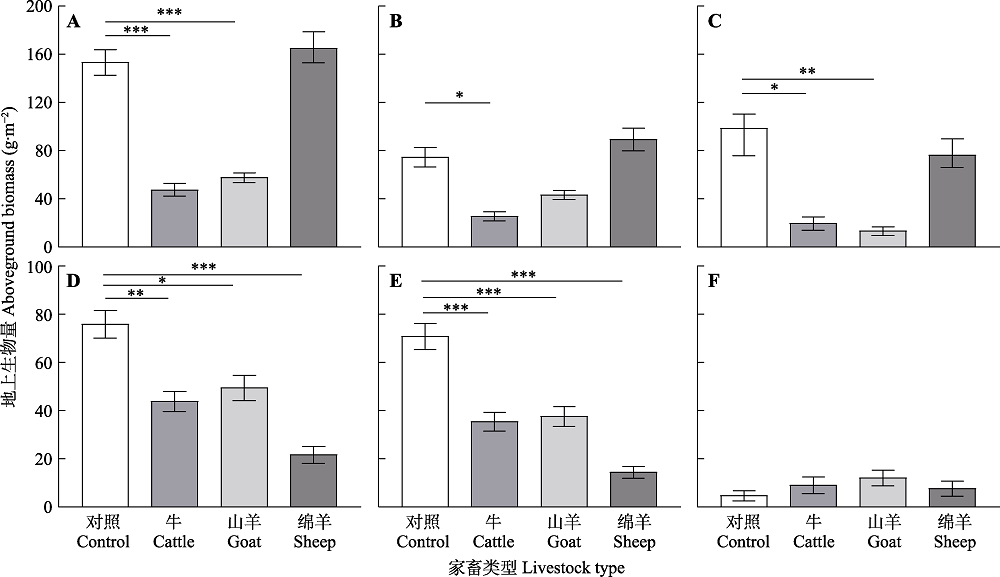
图3 不同家畜中等放牧强度下植物地上生物量(平均值±标准误)。A,上层优势种。B, 羊草。C, 大针茅。D, 下层优势种。E, 糙隐子草。F, 黄囊薹草。*, p < 0.05; **, p < 0.01; ***, p < 0.001。
Fig. 3 Plant aboveground biomass under the grazing of different livestock types at moderate intensity (mean ± SE). A, Tall dominant species. B, Leymus chinensis. C, Stipa grandis. D, Short dominant species. E, Cleistogenes squarrosa. F, Carex korshinskyi. *, p < 0.05; **, p < 0.01; ***, p < 0.001.
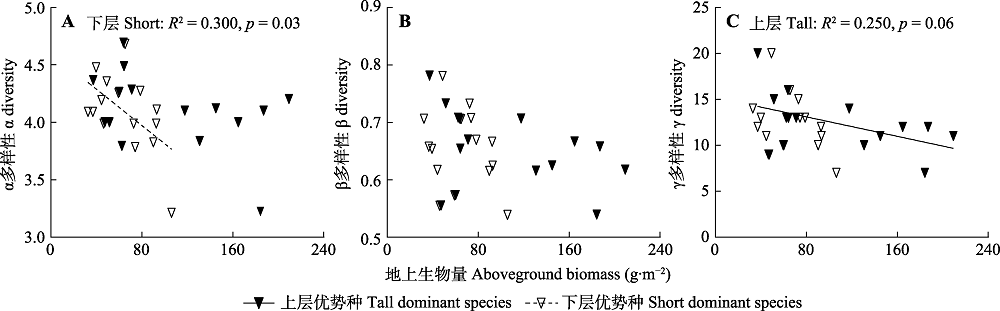
图4 不同家畜中等放牧强度下内蒙古典型草原上层和下层优势种地上生物量与植物多样性关系。
Fig. 4 Relationship between the aboveground biomass of tall and short dominant species in typical steppe in Nei Mongol and plant diversity under the grazing of different livestock types at moderate intensity.
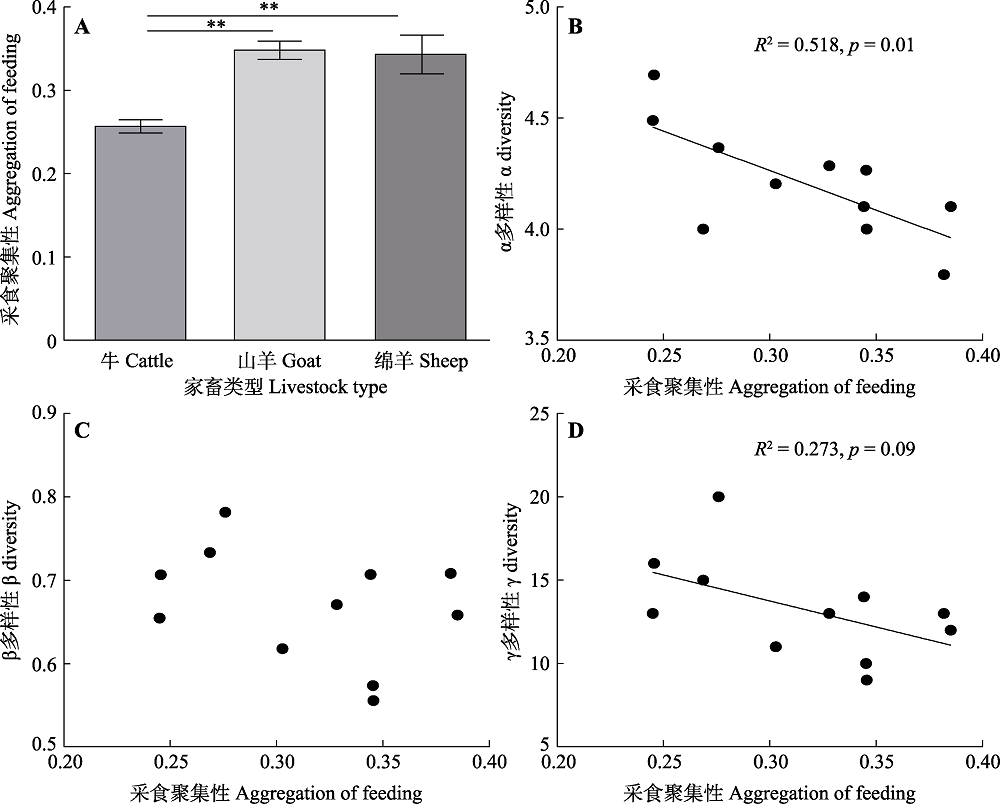
图5 家畜采食聚集性(平均值±标准误)及其与植物多样性关系。**, p < 0.01。
Fig. 5 Aggregation degrees of the feeding behavior of different livestock species (mean ± SE) and their relationships with plant diversity. **, p < 0.01.
| [1] |
Augustine DJ, Derner JD (2013). Assessing herbivore foraging behavior with GPS collars in a semiarid grassland. Sensors, 13, 3711-3723.
DOI PMID |
| [2] |
Bakker ES, Ritchie ME, Olff H, Milchunas DG, Knops JMH (2006). Herbivore impact on grassland plant diversity depends on habitat productivity and herbivore size. Ecology Letters, 9, 780-788.
PMID |
| [3] |
Borer ET, Seabloom EW, Gruner DS, Harpole WS, Hillebrand H, Lind EM, Adler PB, Alberti J, Anderson TM, Bakker JD, Biederman L, Blumenthal D, Brown CS, Brudvig LA, Buckley YM, et al. (2014). Herbivores and nutrients control grassland plant diversity via light limitation. Nature, 508, 517-520.
DOI URL |
| [4] |
Briske DD, Derner JD, Brown JR, Fuhlendorf SD, Teague WR, Havstad KM, Gillen RL, Ash AJ, Willms WD (2008). Rotational grazing on rangelands: reconciliation of perception and experimental evidence. Rangeland Ecology & Management, 61, 3-17.
DOI URL |
| [5] |
Clauss M, Steuer P, Müller DWH, Codron D, Hummel J (2013). Herbivory and body size: allometries of diet quality and gastrointestinal physiology, and implications for herbivore ecology and dinosaur gigantism. PLOS ONE, 8, e68714. DOI: 10.1371/journal.pone.0068714.
DOI URL |
| [6] |
Connell JH (1978). Diversity in tropical rain forests and coral reefs. Science, 199, 1302-1310.
DOI PMID |
| [7] |
Coughenour MB (1991). Spatial components of plant-herbivore interactions in pastoral, ranching, and native ungulate ecosystems. Journal of Range Management, 44, 530-542.
DOI URL |
| [8] |
Cuchillo-Hilario M, Wrage-Mönnig N, Isselstein J (2017). Behavioral patterns of (co-)grazing cattle and sheep on swards differing in plant diversity. Applied Animal Behaviour Science, 191, 17-23.
DOI URL |
| [9] |
Cuchillo-Hilario M, Wrage-Mönnig N, Isselstein J (2018). Forage selectivity by cattle and sheep co-grazing swards differing in plant species diversity. Grass and Forage Science, 73, 320-329.
DOI URL |
| [10] | Fang J (2013). The Interactions Between Foraging of Large Herbivore with Different Body Size and Songnen Grassland Vegetation Characteristics. PhD dissertation, Northeast Normal University, Changchun. 1-90. |
| [房健 (2013). 不同体尺大型草食动物采食对松嫩草地植被特征的响应及作用研究. 博士学位论文, 东北师范大学, 长春. 1-90.] | |
| [11] | Fang JY, Geng XQ, Zhao X, Shen HH, Hu HF (2018). How many areas of grasslands are there in China? Chinese Science Bulletin, 63, 1731-1739. |
| [方精云, 耿晓庆, 赵霞, 沈海花, 胡会峰 (2018). 我国草地面积有多大? 科学通报, 63, 1731-1739.] | |
| [12] |
Fisher JT, Anholt B, Volpe JP (2011). Body mass explains characteristic scales of habitat selection in terrestrial mammals. Ecology and Evolution, 1, 517-528.
DOI PMID |
| [13] |
Gao JJ, Carmel Y (2020). A global meta-analysis of grazing effects on plant richness. Agriculture, Ecosystems & Environment, 302, 107072. DOI: 10.1016/j.agee.2020.107072.
DOI URL |
| [14] |
González LA, Bishop-Hurley GJ, Handcock RN, Crossman C (2015). Behavioral classification of data from collars containing motion sensors in grazing cattle. Computers and Electronics in Agriculture, 110, 91-102.
DOI URL |
| [15] |
Grant SA, Suckling DE, Smith HK, Torvell L, Forbes TDA, Hodgson J (1985). Comparative studies of diet selection by sheep and cattle: the hill grasslands. Journal of Ecology, 73, 987-1004.
DOI URL |
| [16] | Griffith DA (1987). Spatial Autocorrelation. Association of American Geographers, Washington D.C. |
| [17] |
Hanley TA (1982). The nutritional basis for food selection by ungulates. Journal of Range Management, 35, 146-151.
DOI URL |
| [18] |
Herrero-Jáuregui C, Oesterheld M (2018). Effects of grazing intensity on plant richness and diversity: a meta-analysis. Oikos, 127, 757-766.
DOI URL |
| [19] | Hou LL (2020). Effects of Grazing on Livestock Foraging Behaviors. Master degree dissertation, Chinese Academy of Agricultural Sciences, Beijing. 1-52. |
| [侯路路 (2020). 放牧对家畜牧食行为的影响. 硕士学位论文, 中国农业科学院, 北京. 1-52.] | |
| [20] |
Illius AW, Gordon IJ (1987). The allometry of food intake in grazing ruminants. Journal of Animal Ecology, 56, 989-999.
DOI URL |
| [21] |
Kilgour RJ, Uetake K, Ishiwata T, Melville GJ (2012). The behaviour of beef cattle at pasture. Applied Animal Behaviour Science, 138, 12-17.
DOI URL |
| [22] | Koerner SE, Smith MD, Burkepile DE, Hanan NP, Avolio ML, Collins SL, Knapp AK, Lemoine NP, Forrestel EJ, Eby S, Thompson DI, Aguado-Santacruz GA, Anderson JP, Anderson TM, Angassa A, et al. (2018). Change in dominance determines herbivore effects on plant biodiversity. Nature Ecology & Evolution, 2, 1925-1932. |
| [23] |
Kraft NJB, Comita LS, Chase JM, Sanders NJ, Swenson NG, Crist TO, Stegen JC, Vellend M, Boyle B, Anderson MJ, Cornell HV, Davies KF, Freestone AL, Inouye BD, Harrison SP, Myers JA (2011). Disentangling the drivers of β diversity along latitudinal and elevational gradients. Science, 333, 1755-1758.
DOI PMID |
| [24] |
Laca EA, Sokolow S, Galli JR, Cangiano CA (2010). Allometry and spatial scales of foraging in mammalian herbivores. Ecology Letters, 13, 311-320.
DOI PMID |
| [25] | Li B (1997). The rangeland degradation in North China and its preventive strategy. Scientia Agricultura Sinica, 30(6), 1-9. |
| [李博 (1997). 中国北方草地退化及其防治对策. 中国农业科学, 30(6), 1-9.] | |
| [26] | Li J (2014). A Primary Study on Foraging Spatial Heterogeneity of Large Herbivore. Master degree dissertation, Northeast Normal University, Changchun. 1-60. |
| [李静 (2014). 大型草食动物釆食空间异质性的初步研究. 硕士学位论文, 东北师范大学, 长春. 1-60.] | |
| [27] |
Li WH, Bakker JD, Li YL, Zheng SX, Li FY (2021). Applying a high-precision tracking system to distinguish the spatiotemporal patterns of animal movement in grassland ecology. Biological Conservation, 255, 109016. DOI: 10.1016/j.biocon.2021.109016.
DOI URL |
| [28] |
Li WH, Hooper DU, Wu LJ, Bakker JD, Gianuca AT, Wu XB, Taube F, Wang CN, Bai YF (2021). Grazing regime alters plant community structure via patch-scale diversity in semiarid grasslands. Ecosphere, 12, e03547. DOI: 10.1002/ecs2.3547.
DOI |
| [29] |
Li WH, Zhan SX, Lan ZC, Wu XB, Bai YF (2015). Scale-dependent patterns and mechanisms of grazing- induced biodiversity loss: evidence from a field manipulation experiment in semiarid steppe. Landscape Ecology, 30, 1751-1765.
DOI URL |
| [30] | Li YL, Shi CJ, Cheng JW, Guo XD, Zhang TR, Li YH (2018). The daily intake and forage species selection of three types of grazing livestocks on a typical steppe in Inner Mongolia. Acta Agrestia Sinica, 26, 1091-1096. |
| [李艳龙, 石椿珺, 程建伟, 郭旭东, 张桐瑞, 李永宏 (2018). 内蒙古典型草原三种家畜采食量和食性选择的研究. 草地学报, 26, 1091-1096.] | |
| [31] |
Liu J, Feng C, Wang DL, Wang L, Wilsey BJ, Zhong ZW (2015). Impacts of grazing by different large herbivores in grassland depend on plant species diversity. Journal of Applied Ecology, 52, 1053-1062.
DOI URL |
| [32] |
Olff H, Ritchie ME (1998). Effects of herbivores on grassland plant diversity. Trends in Ecology & Evolution, 13, 261-265.
DOI URL |
| [33] |
Putfarken D, Dengler J, Lehmann S, Härdtle W (2008). Site use of grazing cattle and sheep in a large-scale pasture landscape: a GPS/GIS assessment. Applied Animal Behaviour Science, 111, 54-67.
DOI URL |
| [34] |
Ren HY, Han GD, Ohm M, Schönbach P, Gierus M, Taube F (2015). Do sheep grazing patterns affect ecosystem functioning in steppe grassland ecosystems in Inner Mongolia? Agriculture, Ecosystems & Environment, 213, 1-10.
DOI URL |
| [35] |
Rook AJ, Dumont B, Isselstein J, Osoro K, Wallisdevries MF, Parente G, Mills J (2004). Matching type of livestock to desired biodiversity outcomes in pastures-A review. Biological Conservation, 119, 137-150.
DOI URL |
| [36] | Suriguga (2020). Effects of Different Livestock Grazing on Plant Community Structure in the Typical Steppe of Inner Mongolia. Master degree dissertation, Inner Mongolia University, Hohhot. 1-47. |
| [苏日古嘎 (2020). 不同放牧家畜对内蒙古典型草原植物群落结构的影响. 硕士学位论文, 内蒙古大学, 呼和浩特. 1-47.] | |
| [37] |
Tilman D, Isbell F, Cowles JM (2014). Biodiversity and ecosystem functioning. Annual Review of Ecology, Evolution, and Systematics, 45, 471-493.
DOI URL |
| [38] |
Tonn B, Densing EM, Gabler J, Isselstein J (2019). Grazing-induced patchiness, not grazing intensity, drives plant diversity in European low-input pastures. Journal of Applied Ecology, 56, 1624-1636.
DOI URL |
| [39] | Vallentine JF (1990). Grazing Management. Academic Press, Pittsburgh, USA. |
| [40] |
Wan HW, Bai YF, Hooper DU, Schönbach P, Gierus M, Schiborra A, Taube F (2015). Selective grazing and seasonal precipitation play key roles in shaping plant community structure of semi-arid grasslands. Landscape Ecology, 30, 1767-1782.
DOI URL |
| [41] | Wang DL, Wang L (2011). Interactions between herbivores and plant diversity. Acta Agrestia Sinica, 19, 699-704. |
| [王德利, 王岭 (2011). 草食动物与草地植物多样性的互作关系研究进展. 草地学报, 19, 699-704.] | |
| [42] | Wang SP (2000). The dietary composition of fine wool sheep and plant diversity in Inner Mongolia steppe. Acta Ecologica Sinica, 20, 951-957. |
| [汪诗平 (2000). 不同放牧季节绵羊的食性及食物多样性与草地植物多样性间的关系. 生态学报, 20, 951-957.] | |
| [43] |
Whittaker RH (1960). Vegetation of the Siskiyou mountains, Oregon and California. Ecological Monographs, 30, 279-338.
DOI URL |
| [44] |
Yang J, Chu PF, Chen DM, Wang MJ, Bai YF (2014). Mechanisms underlying the impacts of grazing on plant α, β and γ diversity in a typical steppe of the Inner Mongolia grassland. Chinese Journal of Plant Ecology, 38, 188-200.
DOI |
|
[杨婧, 褚鹏飞, 陈迪马, 王明玖, 白永飞 (2014). 放牧对内蒙古典型草原α、β和γ多样性的影响机制. 植物生态学报, 38, 188-200.]
DOI |
|
| [45] |
Zhang RY, Tian DS, Chen HYH, Seabloom EW, Han GD, Wang SP, Yu GR, Li ZL, Niu SL (2022). Biodiversity alleviates the decrease of grassland multifunctionality under grazing disturbance: a global meta-analysis. Global Ecology and Biogeography, 31, 155-167.
DOI URL |
| [46] |
Zhang JH, Wang Z, Huang YM, Chen HY, Li ZY, Liang CZ (2021). Effects of grassland utilization on the functional traits of dominant plants in a temperate typical steppe. Chinese Journal of Plant Ecology, 45, 818-833.
DOI URL |
|
[张景慧, 王铮, 黄永梅, 陈慧颖, 李智勇, 梁存柱 (2021). 草地利用方式对温性典型草原优势种植物功能性状的影响. 植物生态学报, 45, 818-833.]
DOI |
|
| [47] |
Zhong ZW, Li XF, Wang DL (2021). Research progresses of plant-herbivore interactions. Chinese Journal of Plant Ecology, 45, 1036-1048.
DOI URL |
|
[钟志伟, 李晓菲, 王德利 (2021). 植物-植食性动物相互关系研究进展. 植物生态学报, 45, 1036-1048.]
DOI |
| [1] | 杨梅花, 张子嘉, 乔栋, 冯俊娜, 庞子杰, 钱龙, 刘志晖, 蔡娜娜, 胡中民, 杨国姣. 海南热带森林乔木群落调查和多样性数据集[J]. 植物生态学报, 2026, 50(预发表): 0-. |
| [2] | 何青, 袁旭东, 任博申, 冯治洋, 鲁梦珍, 林巧玲, 姜庆虎, 杨林森, 余辉亮, 姚辉, 杨敬元, 刘峰, 江明喜. 一年蓬(Erigeron annuus)入侵对亚高山泥炭湿地植物群落结构与多样性的影响[J]. 植物生态学报, 2026, 50(预发表): 0-. |
| [3] | 蔡榕榕, 沈历都, 刘雅各, 费雯丽, 戴冠华. 2005-2010年长白山阔叶红松林长期监测样地植物物种组成和群落特征数据集[J]. 植物生态学报, 2025, 49(8): 1236-1245. |
| [4] | 白帆, 王杨. 2007-2015年北京东灵山暖温带落叶阔叶林长期监测样地植物物种组成和群落特征数据集[J]. 植物生态学报, 2025, 49(8): 1229-1235. |
| [5] | 赵常明, 熊高明, 申国珍, 葛结林, 徐文婷, 徐凯, 武元帅, 谢宗强. 2010年神农架常绿落叶阔叶混交林和亚高山针叶林长期监测样地植物物种组成和群落特征数据集[J]. 植物生态学报, 2025, 49(8): 1215-1228. |
| [6] | 饶兴权, 蔡锡安, 林永标, 刘素萍. 2005-2015年鹤山马占相思林长期监测样地植物物种组成和群落特征数据集[J]. 植物生态学报, 2025, 49(8): 1246-1254. |
| [7] | 徐志雄, 杞金华, 杨国平, 鲁志云, 杨效东, 范泽鑫. 2005-2010年哀牢山中山湿性常绿阔叶林长期监测样地植物物种组成和群落特征数据集[J]. 植物生态学报, 2025, 49(8): 1191-1204. |
| [8] | 周志琼, 丁建林, 李晓明, 何其华. 2005-2010年西南山地人工林长期监测样地植物物种组成与群落特征数据集[J]. 植物生态学报, 2025, 49(8): 1255-1262. |
| [9] | 刘世忠, 张倩媚, 张德强, 刘菊秀, 褚国伟, 李跃林. 1999-2015年鼎湖山季风常绿阔叶林长期监测样地植物物种组成和群落特征数据集[J]. 植物生态学报, 2025, 49(8): 1205-1214. |
| [10] | 张坤, 伊丽晴, 刘占军, 张志杰, 王顼, 李明乐, 苗百岭, 张景慧, 李智勇, 董雷, 梁存柱. 毛刺锦鸡儿群落特征及分类[J]. 植物生态学报, 2025, 49(6): 888-896. |
| [11] | 韩鹏宾, 裴康迪, 何斌, 肖书礼, 唐勤. 中国云南铁杉林的群落组成及特征[J]. 植物生态学报, 2025, 49(6): 840-851. |
| [12] | 何斌, 韩鹏宾, 唐勤. 中国铁坚油杉林的群落类型及特征[J]. 植物生态学报, 2025, 49(6): 833-839. |
| [13] | 韩鹏宾, 何斌, 陆树刚, 唐勤. 中国柔毛油杉林的群落类型及特征[J]. 植物生态学报, 2025, 49(6): 825-832. |
| [14] | 杜燕, 刘鑫, 张瀚曰, 马少伟, 包维楷. 中国高山松群系的群落特征[J]. 植物生态学报, 2025, 49(6): 816-824. |
| [15] | 李冬梅, 孙龙, 韩宇, 胡同欣, 杨光, 蔡慧颖. 计划火烧对红松人工林生物多样性与生态系统多功能性关系的影响[J]. 植物生态学报, 2025, 49(3): 379-392. |
| 阅读次数 | ||||||
|
全文 |
|
|||||
|
摘要 |
|
|||||
Copyright © 2026 版权所有 《植物生态学报》编辑部
地址: 北京香山南辛村20号, 邮编: 100093
Tel.: 010-62836134, 62836138; Fax: 010-82599431; E-mail: apes@ibcas.ac.cn, cjpe@ibcas.ac.cn
备案号: 京ICP备16067583号-19

