
Chin J Plant Ecol ›› 2009, Vol. 33 ›› Issue (5): 833-841.DOI: 10.3773/j.issn.1005-264x.2009.05.001 cstr: 32100.14.j.issn.1005-264x.2009.05.001
• Research Articles • Next Articles
ZHANG Zhi-Dong1,2, ZANG Run-Guo2,*( )
)
Received:2008-07-23
Accepted:2009-04-09
Online:2009-07-23
Published:2009-09-30
Contact:
ZANG Run-Guo
ZHANG Zhi-Dong, ZANG Run-Guo. MODELLING THE SPATIAL DISTRIBUTION OF ABOVEGROUND BIOMASS BASED ON VEGETATION INDEX IN A TROPICAL FOREST IN BAWANG- LING, HAINAN ISLAND, SOUTH CHINA[J]. Chin J Plant Ecol, 2009, 33(5): 833-841.
| 植被指数 Vegetation indices | 缩写 Abbreviation | 公式 Formula |
|---|---|---|
| 归一化差异植被指数 Normalized difference vegetation index | NDVI | (NIR-R)/(NIR+R) |
| 短红外湿度植被指数 Moisture vegetation index using Landsat’s band 5 | MVI5 | (NIR-SWIR)/(NIR+SWIR) |
| 中红外湿度植被指数 Moisture vegetation index using Landsat’s band 7 | MVI7 | (NIR-MIR)/(NIR+MIR) |
| 比值植被指数 Ratio vegetation index | RVI | NIR/R |
Table 1 The vegetation index
| 植被指数 Vegetation indices | 缩写 Abbreviation | 公式 Formula |
|---|---|---|
| 归一化差异植被指数 Normalized difference vegetation index | NDVI | (NIR-R)/(NIR+R) |
| 短红外湿度植被指数 Moisture vegetation index using Landsat’s band 5 | MVI5 | (NIR-SWIR)/(NIR+SWIR) |
| 中红外湿度植被指数 Moisture vegetation index using Landsat’s band 7 | MVI7 | (NIR-MIR)/(NIR+MIR) |
| 比值植被指数 Ratio vegetation index | RVI | NIR/R |
| NDVI | RVI | MVI7 | MVI5 | |
|---|---|---|---|---|
| 顶极种生物量 Climax species biomass | 0.286* | 0.249* | 0.497** | 0.503** |
| 先锋种生物量 Pioneer species biomass | 0.194* | 0.214* | 0.109 | 0.117 |
| 总生物量 Total biomass | 0.284* | 0.246* | 0.511** | 0.505** |
Table 2 Correlations between aboveground biomass and vegetation index
| NDVI | RVI | MVI7 | MVI5 | |
|---|---|---|---|---|
| 顶极种生物量 Climax species biomass | 0.286* | 0.249* | 0.497** | 0.503** |
| 先锋种生物量 Pioneer species biomass | 0.194* | 0.214* | 0.109 | 0.117 |
| 总生物量 Total biomass | 0.284* | 0.246* | 0.511** | 0.505** |
| 模型 Model | R2 | F | p |
|---|---|---|---|
| 总生物量 Total biomass Ln(Y)=-53.186+11.325Ln(MVI7) | 0.761 | 42.407 | <0.000 1 |
| 顶极种生物量 Climax species biomass Ln(Y)= -40.766+9.509Ln(MVI5) | 0.753 | 40.579 | <0.000 1 |
| 先锋种生物量 Pioneer species biomass Ln(Y)= -36.072+7.674Ln(RVI) | 0.446 | 5.765 | 0.018 |
Table 3 Linear regression models using aboveground biomass as the dependent variables and vegetation indices as the independent variables
| 模型 Model | R2 | F | p |
|---|---|---|---|
| 总生物量 Total biomass Ln(Y)=-53.186+11.325Ln(MVI7) | 0.761 | 42.407 | <0.000 1 |
| 顶极种生物量 Climax species biomass Ln(Y)= -40.766+9.509Ln(MVI5) | 0.753 | 40.579 | <0.000 1 |
| 先锋种生物量 Pioneer species biomass Ln(Y)= -36.072+7.674Ln(RVI) | 0.446 | 5.765 | 0.018 |
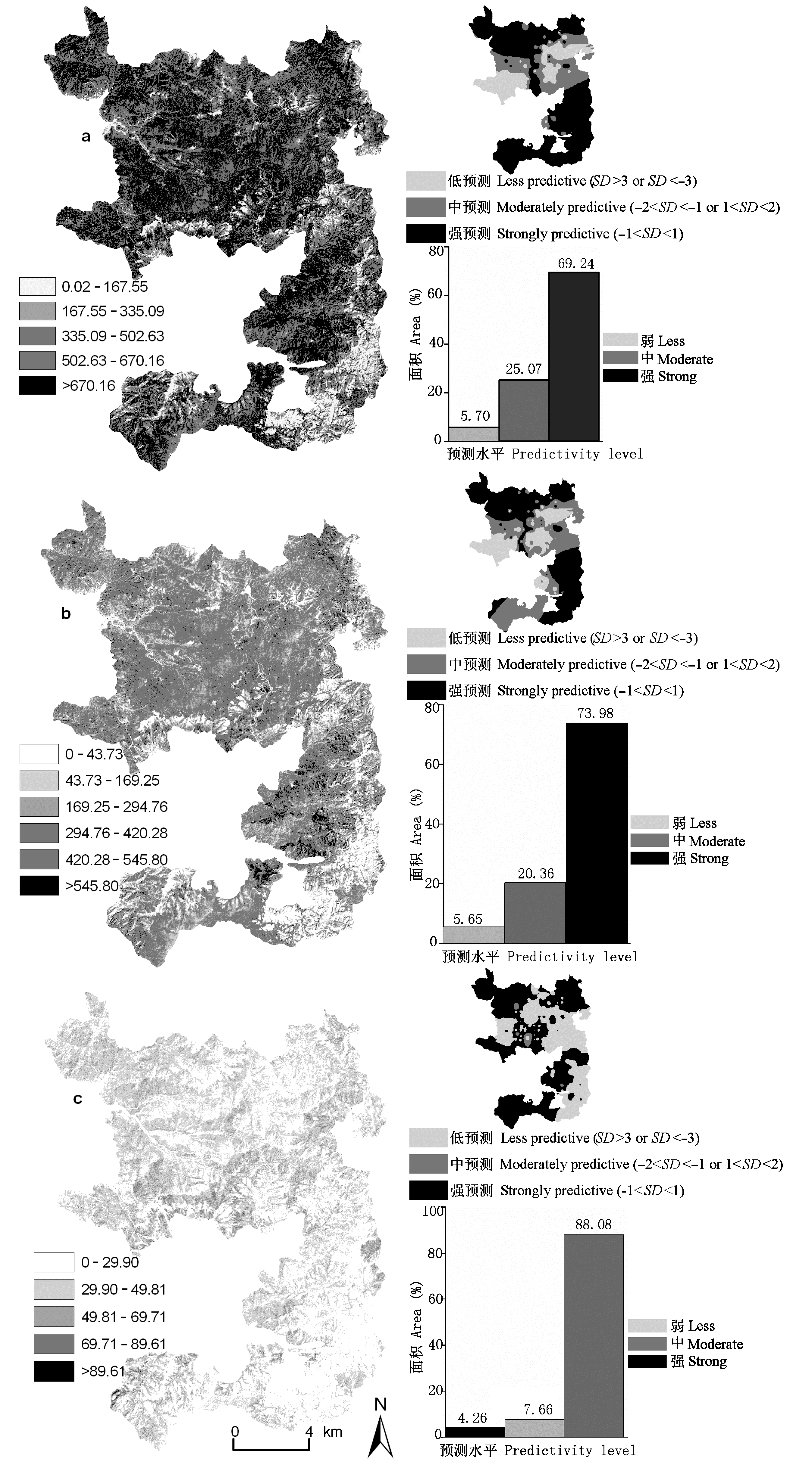
Fig. 1 Aboveground biomass (1 000 kg·hm-2) distribution and residual statistics maps of total species (a),climax (b) and pioneer species (c)
| [1] |
Boyd DS, Foody GM, Curran PJ (1999). The relationship between the biomass of Cameroonian tropical forests and radiation reflected in middle infrared wavelengths (3.0-5.0 μm). International Journal of Remote Sensing, 20, 1017-1023.
DOI URL |
| [2] |
Boyd DS, Foody GM, Curran PJ, Lucas RM, Honzák M (1996). An assessment of radiance in Landsat TM middle and thermal infrared wavebands for the detection of tropical forest regeneration. International Journal of Remote Sensing, 17, 249-261.
DOI URL |
| [3] |
Carlson T, Ripley D (1997). On the relation between NDVI, fractional vegetation cover, and leaf area index. Remote Sensing of Environment, 62, 241-252.
DOI URL |
| [4] |
Chave J, Condit R, Aguilar S, Hernandez A, Lao S, Perez R (2004). Error propogation and scaling for tropical forest biomass estimates. Philosophical Transactions of the Royal Society of London, Series B, 359, 409-420.
DOI URL PMID |
| [5] |
Chave J, Riéra B, Dubois MA (2001). Estimation of biomass in a neotropical forest of French Guiana: spatial and temporal variability. Journal of Tropical Ecology, 17, 79-96.
DOI URL |
| [6] |
Coomes DA, Grubb PJ (2003). Colonization, tolerance, competition and seed-size variation within functional groups. Trends in Ecology & Evolution, 18, 283-291.
DOI URL |
| [7] |
Dalling JW, Hubbell SP (2002). Seed size, growth rate and gap microsite conditions as determinants of recruitment success for pioneer species. Journal of Ecology, 90, 557-568.
DOI URL |
| [8] |
Dogan H, Dogan M (2006). A new approach to diversity indices―Modeling and mapping plant biodiversity of nallihan (A3-Ankara/Turkey) forest ecosystem in frame of geographic information systems. Biodiversity and Conservation, 15, 855-878.
DOI URL |
| [9] |
Dong J, Kaufmann RK, Myneni RB, Tucker CJ, Kauppi PE, Liski J, Buermann W, Alexeyev V, Hughes MK (2003). Remote sensing estimates of boreal and temperate forest woody biomass: carbon pools, sources, and sinks. Remote Sensing of Environment, 84, 393-410.
DOI URL |
| [10] | ESRI (2003). ARCGIS. Environmental Systems Research Institute, Inc., Redcands, California,USA. |
| [11] |
Foody GM, Boyd DS, Cutler MEJ (2003). Predictive relations of tropical forest biomass from Landsat TM data and their transferability between regions. Remote Sensing of Environment, 85, 463-474.
DOI URL |
| [12] |
Foody GM, Cutler ME, McMorrow J, Pelz D, Tangki H, Boyd DS, Douglas I (2001). Mapping the biomass of Bornean tropical rain forest from remotely sensed data. Global Ecology and Biogeography, 10, 379-387.
DOI URL |
| [13] |
Freitas SR, Mello MCS, Cruz CBM (2005). Relationships between forest structure and vegetation indices in Atlantic rainforest. Forest Ecology and Management, 218, 353-362.
DOI URL |
| [14] |
Gamon JA, Field CB, Goulden ML, Griffin KL, Hartley AE, Joel G, Penuelas J, Valentini R (1995). Relationships between NDVI, canopy structure, and photosynthesis in three Californian vegetation types. Ecological Applications, 5, 28-41.
DOI URL |
| [15] |
Garkoti SC (2008). Estimates of biomass and primary productivity in a high-altitude maple forest of the west central Himalayas. Ecological Research, 23, 41-49.
DOI URL |
| [16] |
Haripriya G (2000). Estimates of biomass in Indian forests. Biomass and Bioenergy, 19, 245-258.
DOI URL |
| [17] |
Houghton RA, Skole DL, Nobre CA, Hackler JL, Lawrence KT, Chomentowski WH (2000). Annual fluxes of carbon from deforestation and regrowth in the Brazilian Amazon. Nature, 403, 301-304.
DOI URL PMID |
| [18] | Jiang YX (蒋有绪), Wang BS (王伯荪), Zang RG (臧润国), Jin JH (金建华), Liao WB (廖文波) (2002). Biodiversity and Mechanism of Maintenance of the Tropical Forest in Hainan Island(海南岛热带林生物多样性及其形成机制). Science Press, Beijing, 219-324. (in Chinese) |
| [19] |
Kitayama K, Itow S (1999). Aboveground biomass and soil nutrient pools of a Scalesia pedunculata montane forest on Santa Cruz, Galápagos. Ecological Research, 14, 405-408.
DOI URL |
| [20] |
Köhler P, Ditzer T, Huth A (2000). Concepts for the aggregation of tropical tree species into functional types and application to Sabah’s lowland rain forest. Journal of Tropical Ecology, 16, 591-602.
DOI URL |
| [21] | Li YD (李意德) (1993). Comparative analysis for biomass measurement of tropical mountain rain forest in Hainan Island, China. Acta Ecologica Sinica (生态学报), 13, 313-320. (in Chinese with English abstract) |
| [22] | Li SY (李素英), Li XB (李晓兵), Ying G (莺歌), Fu N (符娜) (2007). Vegetation indexes-biomass models for typical semi-arid steppe—A case study for Xilinhot in Northern China. Journal of Plant Ecology (Chinese Version)(植物生态学报), 31, 23-31. (in Chinese with English abstract) |
| [23] |
Lu D, Mausel P, Brondizio E, Moran E (2004). Relationships between forest stand parameters and Landsat TM spectral responses in the Brazilian Amazon Basin. Forest Ecology and Management, 198, 149-167.
DOI URL |
| [24] | Lu Y (陆阳), Li MG (李鸣光), Huang YW (黄雅文), Chen ZH (陈章和), Hu YJ (胡玉佳) (1986). Vegetation of Bawangling gibbon natural reserve, in Hainan Island. Acta Phytoecologica et Geobotanica Sinica (植物生态学与地植物学学报), 10, 106-114. (in Chinese with English abstract) |
| [25] |
Phua MH, Saito H (2003). Estimation of biomass of a mountainous tropical forest using Landsat TM data. Canadian Journal of Remote Sensing, 29, 429-440.
DOI URL |
| [26] |
Saatchi SS, Houghton RA, Dos Santos Alvala RC, Soares JV, Yu Y (2007). Distribution of aboveground live biomass in the Amazon basin. Global Change Biology, 13, 816-837.
DOI URL |
| [27] | SPSS (2004). SPSS for windows, Version 13.0. Chicago. |
| [28] |
Swaine MD, Whitmore TC (1988). On the definition of ecological species groups in tropical forests. Vegetatio, 75, 81-86.
DOI URL |
| [29] |
Tan K, Piao S, Peng C, Fang J (2007). Satellite-based estimation of biomass carbon stocks for northeast China’s forests between 1982 and 1999. Forest Ecology and Management, 240, 114-121.
DOI URL |
| [30] |
Todd SW, Hoffer RM, Milchunas DG (1998). Biomass estimation on grazed and ungrazed rangelands using spectral indices. International Journal of Remote Sensing, 19, 427-438.
DOI URL |
| [31] |
Vanclay JK (1995). Growth models for tropical forests: a synthesis of models and methods. Forest Science, 41, 7-42.
DOI URL |
| [32] |
Verburg R, van Eijk-Bos C (2003). Effects of selective logging on tree diversity, composition and plant functional type patterns in a Bornean rain forest. Journal of Vegetation Science, 14, 99-110.
DOI URL |
| [33] | Wang ZX (王正兴), Liu C (刘闯), Huete AL (2003). From AVHRR-NDVI to MODIS-EVI: advances in vegetation index research. Acta Ecologica Sinica (生态学报), 23, 979-987. (in Chinese with English abstract) |
| [34] | Zang RG (臧润国), An SQ (安树青), Tao JP (陶建平), Jiang YX (蒋有绪), Wang BX (王伯荪) (2004). Biodiversity and Mechanism of Maintenance of the Tropical Forest in Hainan Island (海南岛热带林生物多样性维持机制). Science Press,Beijing, 1-169. (in Chinese) |
| [1] | feng yifan, zhu shiying, ZHOU Shu-Rong, jiang lele, chen long, wang miao, deng guofang, Liu Lan. The influence of soil microorganisms on the survival and growth traits of mycorrhized seedlings in tropical secondary forest restoration [J]. Chin J Plant Ecol, 2026, 50(预发表): 1-. |
| [2] | Yang Meihua, Zhang ZiJia, Qiao Dong, Feng Junna, Pang ZiJie, Qian Long, Liu Zhihui, Cai Nana, Hu Zhongmin, Yang Guojiao. A dataset of arbor community surveys and species diversity in Hainan tropical forests [J]. Chin J Plant Ecol, 2026, 50(预发表): 0-. |
| [3] | WANG Rong-Jun, WU Fu-Zhong, WU Qiu-Xia, ZHU Jing-Jing, NI Xiang-Yin. Differences in leaf nitrogen reabsorption efficiency among plants with different life forms [J]. Chin J Plant Ecol, 2026, 50(2): 344-351. |
| [4] | XU En-Xiang, ZHOU Lei, ZHANG Xiao-Wei, ZHANG Guo-Ping, ZHONG Du-Wei, HUANG Zhi, LIU Pai, CHI Yong-Gang. Estimation of rice yield based on canopy reflectance spectra and carbon flux in diverse growth phases [J]. Chin J Plant Ecol, 2026, 50(1): 82-93. |
| [5] | SONG Shan-Shan, TANG Zhi-Yao. Relationship between rhizosphere soil fungi and plant aboveground biomass in the meadow steppe of Saihanba, Hebei, China [J]. Chin J Plant Ecol, 2025, 49(9): 1461-1471. |
| [6] | DONG Jin-Long, DENG Yun, ZHANG Wen-Fu, YUAN Sheng-Dong, YAN Guang, CHEN Dian, GUO Xian-Ming, LIU Feng, LIN Lu-Xiang. Liana prevalence and its influencing factors in tropical forests of Xishuangbanna, Southwestern China [J]. Chin J Plant Ecol, 2025, 49(12): 1973-1990. |
| [7] | QIU Dan-Ni, PENG Qing-Qing, ZHANG Hui-Ling, WEN Hui-Hui, WU Fu-Zhong. Seasonal effects of typical canopy tree species on ant community dynamics in mid-subtropical evergreen broadleaf forests [J]. Chin J Plant Ecol, 2025, 49(11): 1805-1816. |
| [8] | LI Bei-Bei, ZHANG Ming-Jun, CHE Cun-Wei, LIU Ze-Chen, ZHONG Xiao-Fei, ZHANG Yuan-Yuan, ZHANG Yu. Water utilization strategy of Ziziphus jujuba under different sand cover thicknesses based on stable isotope tracing [J]. Chin J Plant Ecol, 2024, 48(9): 1202-1212. |
| [9] | RAN Jia-Xin, ZHANG Yu-Hui, WANG Yun, YANG Zhi-Jie, MAO Chao. Effects of warming and nitrogen and phosphorus addition on dissolved organic carbon biodegradability of litter in a subtropical forest [J]. Chin J Plant Ecol, 2024, 48(9): 1232-1242. |
| [10] | JIANG Kang-Wei, ZHANG Qing-Qing, WANG Ya-Fei, LI Hong, DING Yu, YANG Yong-Qiang, Tuerxunnayi REYIMU. Characteristics of plant functional groups and the relationships with soil environmental factors in middle part of northern slope of Tianshan Mountains under different grazing intensities [J]. Chin J Plant Ecol, 2024, 48(6): 701-718. |
| [11] | WU Ru-Ru, LIU Mei-Zhen, GU Xian, CHANG Xin-Yue, GUO Li-Yue, JIANG Gao-Ming, QI Ru-Yi. Prediction of suitable habitat distribution and potential impact of climate change on distribution patterns of Cupressus gigantea [J]. Chin J Plant Ecol, 2024, 48(4): 445-458. |
| [12] | HUANG Ling, WANG Zhen, MA Ze, YANG Fa-Lin, LI Lan, SEREKPAYEV Nurlan, NOGAYEV Adilbek, HOU Fu-Jiang. Effects of long-term grazing and nitrogen addition on the growth of Stipa bungeana population in typical steppe of Loess Plateau [J]. Chin J Plant Ecol, 2024, 48(3): 317-330. |
| [13] | YUAN He-Yang, HAO Min-Hui, HE Huai-Jiang, ZHANG Chun-Yu, ZHAO Xiu-Hai. Impact of species richness and composition on productivity and its changes with forest succession in Changbai Mountains, China [J]. Chin J Plant Ecol, 2024, 48(12): 1602-1611. |
| [14] | LIU Wei-Hui, SONG Xiao-Yan, CAIRENDUOJIE , DING Lu-Ming, WANG Chang-Ting. Effects of degradation degree on the root morphological traits and biomass of dominant plant species in alpine meadows [J]. Chin J Plant Ecol, 2024, 48(12): 1666-1682. |
| [15] | LU Xiao-Fei, QIN Zhang-Fen, WANG Bin, KUANG Yuan-Wen. Effects of nitrogen addition on phytolith-occluded carbon of understory plant-soil system in a subtropical evergreen broadleaf forest in south China [J]. Chin J Plant Ecol, 2024, 48(10): 1302-1311. |
| Viewed | ||||||
|
Full text |
|
|||||
|
Abstract |
|
|||||
Copyright © 2026 Chinese Journal of Plant Ecology
Tel: 010-62836134, 62836138, E-mail: apes@ibcas.ac.cn, cjpe@ibcas.ac.cn

