
Chin J Plant Ecol ›› 2025, Vol. 49 ›› Issue (9): 1399-1409.DOI: 10.17521/cjpe.2024.0243 cstr: 32100.14.cjpe.2024.0243
• Research Articles • Previous Articles Next Articles
ZHANG Fa-Wei1,*( )(
)( ), LI Hong-Qin2, ZHU Jing-Bin3, FAN Bo1, ZHOU Hua-Kun1, LI Ying-Nian1, LIANG Nai-Shen4
Received:2024-07-25
Accepted:2025-01-14
Online:2025-09-20
Published:2025-01-15
Supported by:ZHANG Fa-Wei, LI Hong-Qin, ZHU Jing-Bin, FAN Bo, ZHOU Hua-Kun, LI Ying-Nian, LIANG Nai-Shen. Response of aboveground and belowground carbon storage to nitrogen addition and precipitation change in an alpine meadow ecosystem[J]. Chin J Plant Ecol, 2025, 49(9): 1399-1409.
Add to citation manager EndNote|Ris|BibTeX
URL: https://www.plant-ecology.com/EN/10.17521/cjpe.2024.0243
| 变量 Variables | 地上 生物量 AGB | 地下 生物量 BGB | 根冠比 R/S | 土壤全氮含量 SNC | 土壤全磷 含量 SPC | 土壤碱解氮含量 SNaC | 土壤速效磷含量 SPaC | 土壤pH Soil pH | 土壤有机碳含量 SOCC | 颗粒态 有机碳 含量 POC content | 矿物结合态有机碳含量 MAOC content |
|---|---|---|---|---|---|---|---|---|---|---|---|
| 降水改变 Rain | 3.79* | 1.46 | 4.07* | 2.01 | 0.68 | 0.30 | 1.13 | 18.10*** | 4.10* | 0.16 | 0.33 |
| 氮添加 N | 0.57 | 0.44 | 11.03** | 1.32 | 0.95 | 7.25** | 0.15 | 0.10 | 1.30 | 1.49 | 5.73* |
| 土壤深度(功能群) SD (FG) | 86.55*** | 319.71*** | − | 660.93*** | 25.29*** | 176.22*** | 177.46*** | 638.30*** | 434.59*** | 119.47*** | 213.64*** |
| 年份 Y | 0.07 | 8.40** | 3.34 | 48.48*** | 1.16 | 114.86*** | 42.28*** | 5.00* | 38.82*** | − | − |
| Rain × N | 2.88 | 0.29 | 0.65 | 1.08 | 1.22 | 1.25 | 3.17* | 0.70 | 1.49 | 0.14 | 1.22 |
| Rain × SD (FG) | 1.16 | 0.36 | − | 0.33 | 0.50 | 0.05 | 2.53* | 9.80*** | 0.48 | 0.06 | 0.27 |
| Rain × Y | 0.07 | 1.21 | 0.18 | 0.97 | 0.34 | 0.07 | 1.00 | 5.00* | 2.63 | − | − |
| N × SD (FG) | 14.85*** | 0.59 | − | 1.04 | 3.97 | 6.40** | 0.55 | 25.80*** | 0.76 | 0.36 | 0.01 |
| N × Y | 0.07 | 0.55 | 0.42 | 5.64* | 0.70 | 3.75 | 4.89* | 2.40 | 14.58** | − | − |
| Y × SD (FG) | 0.02 | 2.76 | − | 9.08** | 6.98** | 39.03** | 18.27*** | 63.70*** | 22.76*** | − | − |
Table 1 F values of linear mixed-effect models of plant biomass, root/shoot ratio (R/S), and soil properties to precipitation change (Rain), nitrogen addition (N), and functional groups (FG) or soil depths (SD)
| 变量 Variables | 地上 生物量 AGB | 地下 生物量 BGB | 根冠比 R/S | 土壤全氮含量 SNC | 土壤全磷 含量 SPC | 土壤碱解氮含量 SNaC | 土壤速效磷含量 SPaC | 土壤pH Soil pH | 土壤有机碳含量 SOCC | 颗粒态 有机碳 含量 POC content | 矿物结合态有机碳含量 MAOC content |
|---|---|---|---|---|---|---|---|---|---|---|---|
| 降水改变 Rain | 3.79* | 1.46 | 4.07* | 2.01 | 0.68 | 0.30 | 1.13 | 18.10*** | 4.10* | 0.16 | 0.33 |
| 氮添加 N | 0.57 | 0.44 | 11.03** | 1.32 | 0.95 | 7.25** | 0.15 | 0.10 | 1.30 | 1.49 | 5.73* |
| 土壤深度(功能群) SD (FG) | 86.55*** | 319.71*** | − | 660.93*** | 25.29*** | 176.22*** | 177.46*** | 638.30*** | 434.59*** | 119.47*** | 213.64*** |
| 年份 Y | 0.07 | 8.40** | 3.34 | 48.48*** | 1.16 | 114.86*** | 42.28*** | 5.00* | 38.82*** | − | − |
| Rain × N | 2.88 | 0.29 | 0.65 | 1.08 | 1.22 | 1.25 | 3.17* | 0.70 | 1.49 | 0.14 | 1.22 |
| Rain × SD (FG) | 1.16 | 0.36 | − | 0.33 | 0.50 | 0.05 | 2.53* | 9.80*** | 0.48 | 0.06 | 0.27 |
| Rain × Y | 0.07 | 1.21 | 0.18 | 0.97 | 0.34 | 0.07 | 1.00 | 5.00* | 2.63 | − | − |
| N × SD (FG) | 14.85*** | 0.59 | − | 1.04 | 3.97 | 6.40** | 0.55 | 25.80*** | 0.76 | 0.36 | 0.01 |
| N × Y | 0.07 | 0.55 | 0.42 | 5.64* | 0.70 | 3.75 | 4.89* | 2.40 | 14.58** | − | − |
| Y × SD (FG) | 0.02 | 2.76 | − | 9.08** | 6.98** | 39.03** | 18.27*** | 63.70*** | 22.76*** | − | − |

Fig. 1 Responses of aboveground biomass (A), belowground biomass (B), soil organic carbon content (C), and content of soil organic carbon fractions (D) to the changes in nitrogen and precipitation (mean ± SD). CK, control; CK+50%, increased precipitation; CK-50%, decreased precipitation; N, nitrogen addition; N+50%, nitrogen addition with increased precipitation; N-50%, nitrogen addition with decreased precipitation. MAOC, mineral-associated organic carbon; POC, particulate organic carbon.

Fig. 2 Response ratio of aboveground biomass (AGB), 0-40 cm belowground biomass (BGB), root/shoot ratio (R/S), and 0-40 cm soil organic carbon content (SOCC) to the changes in nitrogen and precipitation (mean ± SD). ***, **, and * are p < 0.001, p < 0.01, and p < 0.05, respectively. CK, control; CK+50%, increased precipitation; CK-50%, decreased precipitation; N, nitrogen addition; N+50%, nitrogen addition with increased precipitation; N-50%, nitrogen addition with decreased precipitation.
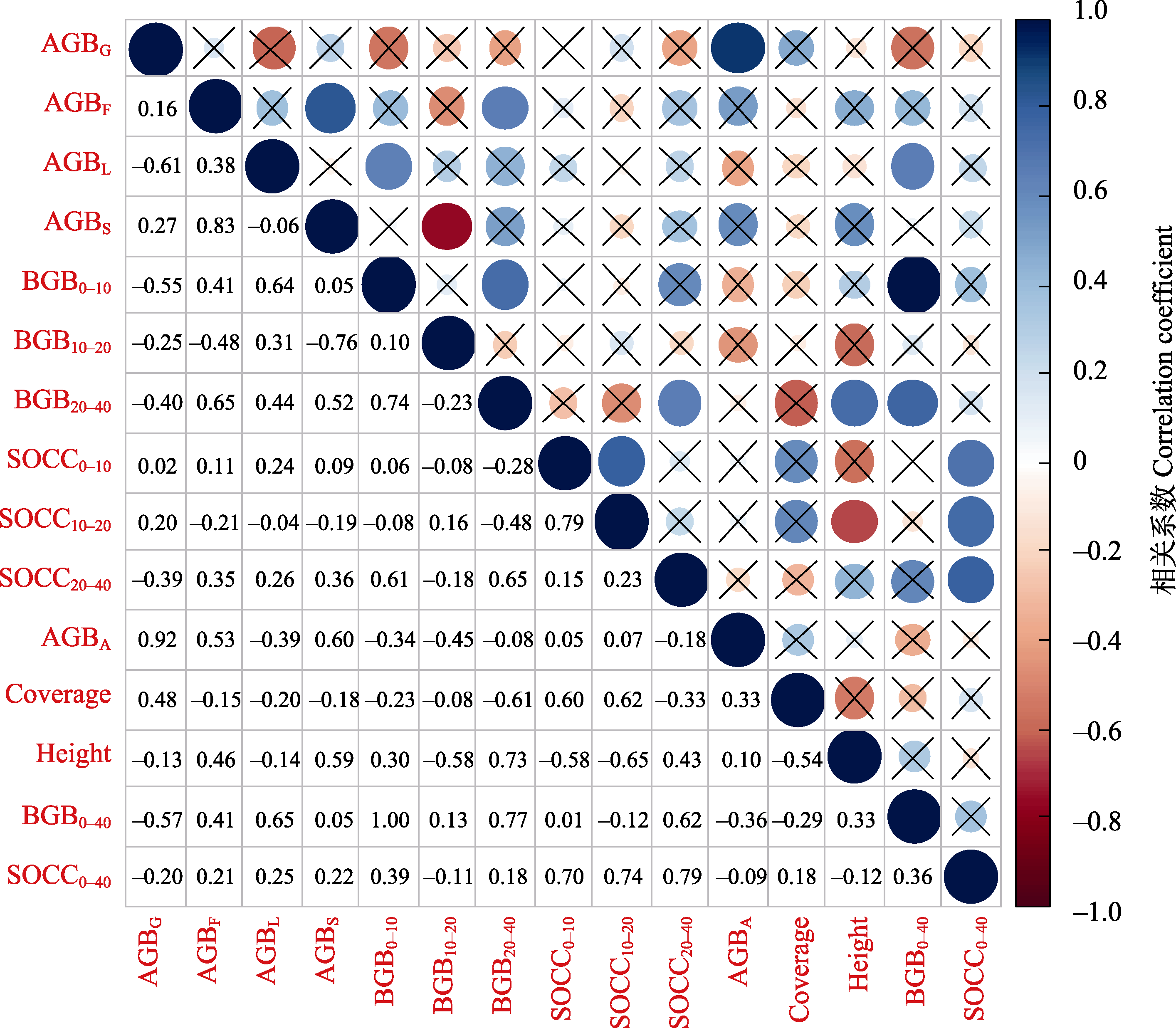
Fig. 3 Pearson correlations among the response ratio of aboveground biomass (AGB), belowground biomass (BGB), soil organic carbon content (SOCC), and key variables’ response ratio. The number is the correlation coefficient. ×, p > 0.05. AGBG, AGBF, AGBL, AGBS, and AGBA, AGB of graminoid, forb, legume, sedge and community; BGB0-10, BGB10-20, BGB20-40, and BGB0-40, BGB of 0-10 cm, 10-20 cm, 20-40 cm, and 0-40 cm soil; Coverage, vegetation coverage; Height, maximal height; SOCC0-10, SOCC10-20, SOCC20-40, and SOCC0-40, SOCC of 0-10 cm, 10-20 cm, 20-40 cm, and 0-40 cm soil.
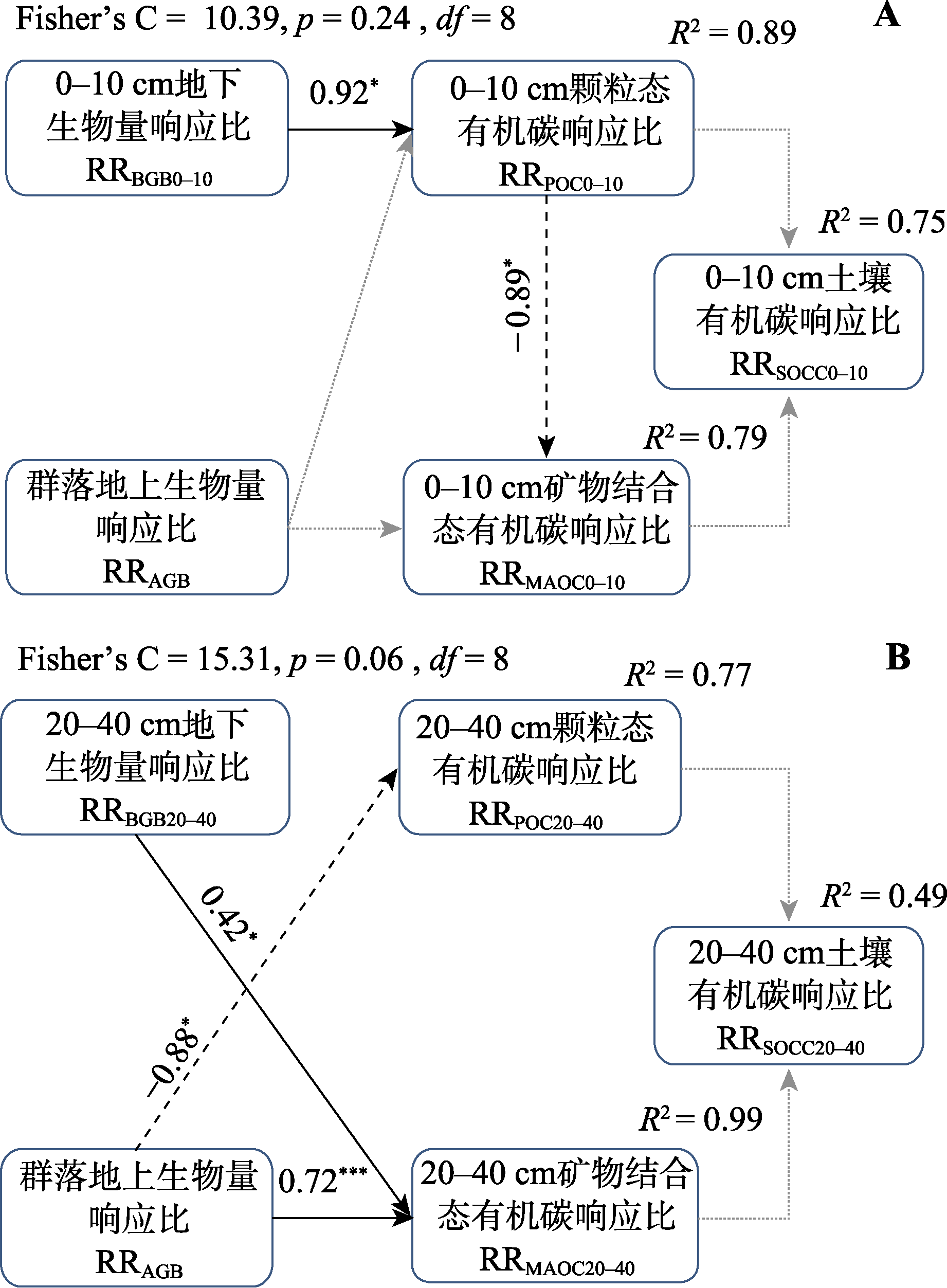
Fig. 4 Structural equation models for the response ratio (RR) of 0-10 cm and 20-40 cm soil organic carbon fractions and soil organic carbon content. Solid, dashed, and dotted lines showed positive, negative and insignificant relationships. The numbers that annotate the arrows were the standardized path coefficients. R2 suggested that explanatory power of the models to responses. *** and * are p < 0.001, and p < 0.05, respectively. AGB, aboveground biomass; BGB, belowground biomass; MAOC, mineral-associated organic carbon; POC, particulate organic carbon; SOCC, soil organic carbon content.
| [1] |
Bai YF, Cotrufo MF (2022). Grassland soil carbon sequestration: current understanding, challenges, and solutions. Science, 377, 603-608.
DOI PMID |
| [2] | Borer ET, Grace JB, Stanley Harpole W, MacDougall AS, Seabloom EW (2017). A decade of insights into grassland ecosystem responses to global environmental change. Nature Ecology & Evolution, 1, 118. DOI: 10.1038/s41559-017-0118. |
| [3] |
Bossio DA, Cook-Patton SC, Ellis PW, Fargione J, Sanderman J, Smith P, Wood S, Zomer RJ, von Unger M, Emmer IM, Griscom BW (2020). The role of soil carbon in natural climate solutions. Nature Sustainability, 3, 391-398.
DOI |
| [4] |
Chen LY, Fang K, Wei B, Qin S, Feng X, Hu T, Ji C, Yang Y (2021a). Soil carbon persistence governed by plant input and mineral protection at regional and global scales. Ecology Letters, 24, 1018-1028.
DOI URL |
| [5] |
Chen Y, Han MG, Yuan X, Hou YH, Qin WK, Zhou HK, Zhao XQ, Klein JA, Zhu B (2022). Warming has a minor effect on surface soil organic carbon in alpine meadow ecosystems on the Qinghai-Tibetan Plateau. Global Change Biology, 28, 1618-1629.
DOI URL |
| [6] |
Chen Y, Liu X, Hou YH, Zhou SR, Zhu B (2021b). Particulate organic carbon is more vulnerable to nitrogen addition than mineral-associated organic carbon in soil of an alpine meadow. Plant and Soil, 458, 93-103.
DOI |
| [7] |
Chen Y, Qin WK, Zhang QF, Wang XD, Feng JG, Han MG, Hou YH, Zhao HY, Zhang ZH, He JS, Torn MS, Zhu B (2024). Whole-soil warming leads to substantial soil carbon emission in an alpine grassland. Nature Communications, 15, 4489. DOI: 0.1038/s41467-024-48736-w.
PMID |
| [8] |
Cotrufo MF, Ranalli MG, Haddix ML, Six J, Lugato E (2019). Soil carbon storage informed by particulate and mineral-associated organic matter. Nature Geoscience, 12, 989-994.
DOI |
| [9] | Ding JZ, Chen LY, Ji C, Hugelius G, Li YN, Liu L, Qin SQ, Zhang BB, Yang GB, Li F, Fang K, Chen YL, Peng YF, Zhao X, He HL, et al. (2017). Decadal soil carbon accumulation across Tibetan permafrost regions. Nature Geoscience, 10, 420-424. |
| [10] |
Fang HJ, Cheng SL, Yu GR, Yang XM, Xu MJ, Wang YS, Li LS, Dang XS, Wang L, Li YN (2014). Nitrogen deposition impacts on the amount and stability of soil organic matter in an alpine meadow ecosystem depend on the form and rate of applied nitrogen. European Journal of Soil Science, 65, 510-519.
DOI URL |
| [11] |
Fontaine S, Barot S, Barré P, Bdioui N, Mary B, Rumpel C (2007). Stability of organic carbon in deep soil layers controlled by fresh carbon supply. Nature, 450, 277-280.
DOI |
| [12] |
Fu G, Shen ZX (2017). Response of alpine soils to nitrogen addition on the Tibetan Plateau: a meta-analysis. Applied Soil Ecology, 114, 99-104.
DOI URL |
| [13] | Han DR, Hu ZM, Wang XH, Wang T, Chen AP, Weng QH, Liang MQ, Zeng X, Cao RC, Di K, Luo DN, Zhang GR, Yang YH, He HL, Fan JW, Yu GR (2022). Shift in controlling factors of carbon stocks across biomes on the Qinghai-Tibetan Plateau. Environmental Research Letters, 17, 74016. DOI: 10.1088/1748-9326/ac78f5. |
| [14] |
He HL, Wang SQ, Zhang L, Wang JB, Ren XL, Zhou L, Piao SL, Yan H, Ju WM, Gu FX, Yu SY, Yang YH, Wang MM, Niu ZE, Ge R, et al. (2019). Altered trends in carbon uptake in China’s terrestrial ecosystems under the enhanced summer monsoon and warming hiatus. National Science Review, 6, 505-514.
DOI URL |
| [15] |
Hedges LV, Gurevitch J, Curtis PS (1999). The meta-analysis of response ratios in experimental ecology. Ecology, 80, 1150-1156.
DOI URL |
| [16] | Hu YL, Deng Q, Kätterer T, Olesen JE, Ying SC, Ochoa-Hueso R, Mueller CW, Weintraub MN, Chen J (2024). Depth-dependent responses of soil organic carbon under nitrogen deposition. Global Change Biology, 30, e17247. DOI: 10.1111/gcb.17247. |
| [17] | Huang M, Chen XP, Degen AA, Guo RY, Zhang T, Luo BY, Li HY, Zhao JX, Shang ZH (2023). Nitrogen addition stimulated soil respiration more so than carbon addition in alpine meadows. Environmental Research, 233, 116501. DOI: 10.1016/j.envres.2023.116501. |
| [18] |
Jia J, Cao ZJ, Liu CZ, Zhang ZH, Lin L, Wang YY, Haghipour N, Wacker L, Bao HY, Dittmar T, Simpson MJ, Yang H, Crowther TW, Eglinton TI, He JS, Feng XJ (2019). Climate warming alters subsoil but not topsoil carbon dynamics in alpine grassland. Global Change Biology, 25, 4383-4393.
DOI PMID |
| [19] |
Jiang CM, Yu GR, Li YN, Cao GM, Yang ZP, Sheng WP, Yu WT (2012). Nutrient resorption of coexistence species in alpine meadow of the Qinghai-Tibetan Plateau explains plant adaptation to nutrient-poor environment. Ecological Engineering, 44, 1-9.
DOI URL |
| [20] |
Knapp AK, Avolio ML, Beier C, Carroll CJW, Collins SL, Dukes JS, Fraser LH, Griffin-Nolan RJ, Hoover DL, Jentsch A, Loik ME, Phillips RP, Post AK, Sala OE, Slette IJ, et al. (2017). Pushing precipitation to the extremes in distributed experiments: recommendations for simulating wet and dry years. Global Change Biology, 23, 1774-1782.
DOI PMID |
| [21] |
Lefcheck JS (2016). piecewiseSEM: Piecewise structural equation modelling in R for ecology, evolution, and systematics. Methods in Ecology and Evolution, 7, 573-579.
DOI URL |
| [22] |
Leff JW, Jones SE, Prober SM, Barberán A, Borer ET, Firn JL, Harpole WS, Hobbie SE, Hofmockel KS, Knops JMH, McCulley RL, La Pierre K, Risch AC, Seabloom EW, Schütz M, et al. (2015). Consistent responses of soil microbial communities to elevated nutrient inputs in grasslands across the globe. Proceedings of the National Academy of Sciences of the United States of America, 112, 10967-10972.
DOI PMID |
| [23] |
Li HQ, Zhang FW, Li YN, Zhao XQ, Cao GM (2016). Thirty-year variations of above-ground net primary production and precipitation-use efficiency of an alpine meadow in the north-eastern Qinghai-Tibetan Plateau. Grass and Forage Science, 71, 208-218.
DOI URL |
| [24] |
Li HQ, Zhang FW, Yi LB (2023). Stoichiometric responses in topsoil and leaf of dominant species to precipitation change and nitrogen addition in an alpine meadow. Chinese Journal of Plant Ecology, 47, 922-931.
DOI URL |
|
[李红琴, 张法伟, 仪律北 (2023). 高寒草甸表层土壤和优势植物叶片的化学计量特征对降水改变和氮添加的响应. 植物生态学报, 47, 922-931.]
DOI |
|
| [25] |
Li JH, Cheng BH, Zhang R, Li WJ, Shi XM, Han YW, Ye LF, Ostle NJ, Bardgett RD (2021). Nitrogen and phosphorus additions accelerate decomposition of slow carbon pool and lower total soil organic carbon pool in alpine meadows. Land Degradation & Development, 32, 1761-1772.
DOI URL |
| [26] |
Li JH, Hou YL, Zhang SX, Li WJ, Xu DH, Knops JMH, Shi XM (2018). Fertilization with nitrogen and/or phosphorus lowers soil organic carbon sequestration in alpine meadows. Land Degradation & Development, 29, 1634-1641.
DOI URL |
| [27] |
Liang C, Schimel JP, Jastrow JD (2017). The importance of anabolism in microbial control over soil carbon storage. Nature Microbiology, 2, 17105. DOI: 10.1038/nmicrobiol.2017.105.
PMID |
| [28] |
Liebmann P, Wordell-Dietrich P, Kalbitz K, Mikutta R, Kalks F, Don A, Woche SK, Dsilva LR, Guggenberger G (2020). Relevance of aboveground litter for soil organic matter formation—A soil profile perspective. Biogeosciences, 17, 3099-3113.
DOI |
| [29] | Liu HY, Huang N, Zhao CM, Li JH (2023a). Responses of carbon cycling and soil organic carbon content to nitrogen addition in grasslands globally. Soil Biology & Biochemistry, 186, 109164. DOI: 10.1016/j.soilbio.2023.109164. |
| [30] |
Liu HY, Mi ZR, Lin L, Wang YH, Zhang ZH, Zhang FW, Wang H, Liu LL, Zhu B, Cao GM, Zhao XQ, Sanders NJ, Classen AT, Reich PB, He JS (2018). Shifting plant species composition in response to climate change stabilizes grassland primary production. Proceedings of the National Academy of Sciences of the United States of America, 115, 4051-4056.
DOI PMID |
| [31] | Liu JL, Zhan W, Huang XY, Tang D, Jin SF, Zhu D, Chen H (2023b). Nitrogen addition increases topsoil carbon stock in an alpine meadow of the Qinghai-Tibet Plateau. Science of the Total Environment, 888, 164071. DOI: 10.1016/j.scitotenv.2023.164071. |
| [32] |
Lu M, Zhou XH, Luo YQ, Yang YH, Fang CM, Chen JK, Li B (2011). Minor stimulation of soil carbon storage by nitrogen addition: a meta-analysis. Agriculture, Ecosystems & Environment, 140, 234-244.
DOI URL |
| [33] |
Luo RY, Fan JL, Wang WJ, Luo JF, Kuzyakov Y, He JS, Chu HY, Ding WX (2019). Nitrogen and phosphorus enrichment accelerates soil organic carbon loss in alpine grassland on the Qinghai-Tibetan Plateau. Science of the Total Environment, 650, 303-312.
DOI URL |
| [34] |
Mack MC, Schuur EAG, Bret-Harte MS, Shaver GR, Chapin FS (2004). Ecosystem carbon storage in arctic tundra reduced by long-term nutrient fertilization. Nature, 431, 440-443.
DOI |
| [35] |
Maes SL, Dietrich J, Midolo G, Schwieger S, Kummu M, Vandvik V, Aerts R, Althuizen IHJ, Biasi C, Björk RG, Böhner H, Carbognani M, Chiari G, Christiansen CT, Clemmensen KE, et al. (2024). Environmental drivers of increased ecosystem respiration in a warming tundra. Nature, 629, 105-113.
DOI |
| [36] |
Qin WK, Zhang QF, Ao GKL, Zhu B (2024). Responses and mechanisms of soil organic carbon dynamics to warming: a review. Chinese Journal of Plant Ecology, 48, 403-415.
DOI URL |
|
[秦文宽, 张秋芳, 敖古凯麟, 朱彪 (2024). 土壤有机碳动态对增温的响应及机制研究进展. 植物生态学报, 48, 403-415.]
DOI |
|
| [37] |
Reid JP, Adair EC, Hobbie SE, Reich PB (2012). Biodiversity, nitrogen deposition, and CO2 affect grassland soil carbon cycling but not storage. Ecosystems, 15, 580-590.
DOI URL |
| [38] |
Riggs CE, Hobbie SE (2016). Mechanisms driving the soil organic matter decomposition response to nitrogen enrichment in grassland soils. Soil Biology & Biochemistry, 99, 54-65.
DOI URL |
| [39] | Rocci KS, Lavallee JM, Stewart CE, Cotrufo MF (2021). Soil organic carbon response to global environmental change depends on its distribution between mineral-associated and particulate organic matter: a meta-analysis. Science of the Total Environment, 793, 148569. DOI: 10.1016/j.scitotenv.2021.148569. |
| [40] |
Sáez-Sandino T, Maestre FT, Berdugo M, Gallardo A, Plaza C, García-Palacios P, Guirado E, Zhou G, Mueller CW, Tedersoo L, Crowther TW, Delgado-Baquerizo M (2024). Increasing numbers of global change stressors reduce soil carbon worldwide. Nature Climate Change, 14, 740-745.
DOI |
| [41] |
Shen DY, Ye CL, Hu ZK, Chen XY, Guo H, Li JY, Du GZ, Adl S, Liu MQ (2018). Increased chemical stability but decreased physical protection of soil organic carbon in response to nutrient amendment in a Tibetan alpine meadow. Soil Biology & Biochemistry, 126, 11-21.
DOI URL |
| [42] | Smith MD, Wilkins KD, Holdrege MC, Wilfahrt P, Collins SL, Knapp AK, Sala OE, Dukes JS, Phillips RP, Yahdjian L, Gherardi LA, Ohlert T, Beier C, Fraser LH, Jentsch A, et al. (2024). Extreme drought impacts have been underestimated in grasslands and shrublands globally. Proceedings of the National Academy of Sciences of the United States of America, 121, e1985086176. DOI: 10.1073/pnas.2309881120. |
| [43] |
Sokol NW, Whalen ED, Jilling A, Kallenbach C, Pett-Ridge J, Georgiou K (2022). Global distribution, formation and fate of mineral-associated soil organic matter under a changing climate: a trait-based perspective. Functional Ecology, 36, 1411-1429.
DOI URL |
| [44] |
Spohn M, Bagchi S, Biederman LA, Borer ET, Bråthen KA, Bugalho MN, Caldeira MC, Catford JA, Collins SL, Eisenhauer N, Hagenah N, Haider S, Hautier Y, Knops JMH, Koerner SE, et al. (2023). The positive effect of plant diversity on soil carbon depends on climate. Nature Communications, 14, 6624. DOI: 10.1038/s41467-023-42340-0.
PMID |
| [45] | Sun J, Wang YX, Lee TM, Nie XW, Wang T, Liang EY, Wang YF, Zhang L, Wang J, Piao SL, Chen FH, Fu BJ (2024). Nature-based solutions can help restore degraded grasslands and increase carbon sequestration in the Tibetan Plateau. Communications Earth & Environment, 5, 154. DOI: 10.1038/s43247-024-01330-w. |
| [46] |
Terrer C, Phillips RP, Hungate BA, Rosende J, Pett-Ridge J, Craig ME, van Groenigen KJ, Keenan TF, Sulman BN, Stocker BD, Reich PB, Pellegrini AFA, Pendall E, Zhang H, Evans RD, et al. (2021). A trade-off between plant and soil carbon storage under elevated CO2. Nature, 591, 599-603.
DOI |
| [47] | Viechtbauer W (2010). Conducting meta-analyses in R with the meta for package. Journal of Statistical Software, 36, 1-48. |
| [48] | Wang C, Kuzyakov Y (2024). Soil organic matter priming: the pH effects. Global Change Biology, 30, e17349. DOI: 10.1111/gcb.17349. |
| [49] | Wang YF, Lv WW, Xue K, Wang SP, Zhang LR, Hu RH, Zeng H, Xu XL, Li YM, Jiang LL, Hao YB, Du JQ, Sun JP, Dorji T, Piao SL, et al. (2022). Grassland changes and adaptive management on the Qinghai-Tibetan Plateau. Nature Reviews Earth & Environment, 3, 668-683. |
| [50] |
Wang YH, Wang C, Ren F, Jing X, Ma WH, He JS, Jiang L (2023a). Asymmetric response of aboveground and belowground temporal stability to nitrogen and phosphorus addition in a Tibetan alpine grassland. Global Change Biology, 29, 7072-7084.
DOI URL |
| [51] | Wang YY, Xiao JF, Ma YM, Ding JZ, Chen XL, Ding ZY, Luo YQ (2023b). Persistent and enhanced carbon sequestration capacity of alpine grasslands on Earth’s Third Pole. Science Advances, 9, e6875. DOI: 10.1126/sciadv.ade6875. |
| [52] | Wei D, Qi YH, Ma YM, Wang XF, Ma WQ, Gao TG, Huang L, Zhao H, Zhang JX, Wang XD (2021). Plant uptake of CO2outpaces losses from permafrost and plant respiration on the Tibetan Plateau. Proceedings of the National Academy of Sciences of the United States of America, 118, e2015283118. DOI: 10.1073/pnas.2015283118. |
| [53] |
Wilcox KR, Shi Z, Gherardi LA, Lemoine NP, Koerner SE, Hoover DL, Bork E, Byrne KM, Cahill J, Collins SL, Evans S, Gilgen AK, Holub P, Jiang L, Knapp AK, et al. (2017). Asymmetric responses of primary productivity to precipitation extremes: a synthesis of grassland precipitation manipulation experiments. Global Change Biology, 23, 4376-4385.
DOI PMID |
| [54] |
Yang GJ, Stevens C, Zhang ZJ, Lü XT, Han XG (2023). Different nitrogen saturation thresholds for above-, below-, and total net primary productivity in a temperate steppe. Global Change Biology, 29, 4586-4594.
DOI URL |
| [55] |
Yang YH, Fang JY, Smith P, Tang YH, Chen AP, Ji CJ, Hu HF, Rao S, Tan K, He JS (2009). Changes in topsoil carbon stock in the Tibetan grasslands between the 1980s and 2004. Global Change Biology, 15, 2723-2729.
DOI URL |
| [56] |
Yang YH, Zhang DY, Wei B, Liu Y, Feng XW, Mao C, Xu WJ, He M, Wang L, Zheng ZH, Wang YY, Chen LY, Peng YF (2023). Nonlinear responses of community diversity, carbon and nitrogen cycles of grassland ecosystems to external nitrogen input. Chinese Journal of Plant Ecology, 47, 1-24.
DOI URL |
|
[杨元合, 张典业, 魏斌, 刘洋, 冯雪徽, 毛超, 徐玮婕, 贺美, 王璐, 郑志虎, 王媛媛, 陈蕾伊, 彭云峰 (2023). 草地群落多样性和生态系统碳氮循环对氮输入的非线性响应及其机制. 植物生态学报, 47, 1-24.]
DOI |
|
| [57] |
Ye CL, Chen DM, Hall SJ, Pan S, Yan XB, Bai TS, Guo H, Zhang Y, Bai YF, Hu SJ (2018). Reconciling multiple impacts of nitrogen enrichment on soil carbon: plant, microbial and geochemical controls. Ecology Letters, 21, 1162-1173.
DOI PMID |
| [58] | Yuan X, Qin WK, Xu H, Zhang ZH, Zhou HK, Zhu B (2020). Sensitivity of soil carbon dynamics to nitrogen and phosphorus enrichment in an alpine meadow. Soil Biology & Biochemistry, 150, 107984. DOI: 10.1016/j.soilbio.2020.107984. |
| [59] | Zhang GL, Yang F, Long H (2023). Save the life-sustaining mattic layer on the Qinghai-Tibetan Plateau. The Innovation, 4, 100418. DOI: 10.1016/j.xinn.2023.100418. |
| [1] | guangjin wu, 郭 垚鑫, Ren Chengjie, Wang Jun, YUE Ming, Zhao Fazhu. Distribution of soil organic carbon content and its influencing factors in different vegetation type on the northern foot of the Qinling Mountains [J]. Chin J Plant Ecol, 2026, 50(预发表): 1-. |
| [2] | ZHANG An-Ning, XIAO Ya-Ning, ZHAO Xia, ZHANG Miao, CUI Han Wen, Chen Shu-Yan, AN Li-Zhe. Interactions between shrub encroachment and nitrogen addition on nematode community and functional traits on Qinghai–Tibetan Plateau [J]. Chin J Plant Ecol, 2026, 50(预发表): 0-. |
| [3] | Li Yi, Huang Huan, Chao ZHAO Yan, CHEN Li-Tong. Effects of nutrient addition on community diversity and composition of alpine meadows across elevations [J]. Chin J Plant Ecol, 2026, 50(预发表): 0-. |
| [4] | HE Zheng-Jia, ZENG Xin-Ran, WANG Lin-Ying, XUE Xin-Yu, SU Qin-Ze, LI Yu, ZHANG Yin-Jie, WU Hui-Huang, CHEN Cheng-Cong, WU Liang-Quan, WEI An-Ni, QIU Yun-Peng, GUO Li-Jin. Response of arbuscular mycorrhizal fungal communities and soil organic carbon to magnesium fertilization in tea plantations [J]. Chin J Plant Ecol, 2026, 50(3): 700-709. |
| [5] | LI Wen-Zhu, LUAN Jun-Wei, DI Ya-Ping, WANG Yi, NIE Xiu-Qing, LIU Shi-Rong. Effects of manipulative drought on mycorrhiza-mediated soil enzyme activities and soil organic carbon fractions in a warm temperate Quercus aliena var. acuteserrata forest [J]. Chin J Plant Ecol, 2026, 50(3): 660-673. |
| [6] | ZHANG Jing, CHEN Jie, LI Yan-Peng, PAN Li-Jun, XU Han, LI Yi-De, HE Hai-Sheng. Comparison of plant biomass in conifer and broadleaf mixed artificial forests in south subtropical area and analyses of influential factors [J]. Chin J Plant Ecol, 2026, 50(2): 400-416. |
| [7] | PI Hui-Zhi, ZHANG Qiu-Fang, SUN Hao, ZENG Quan-Xin, PENG Yuan-Zhen, YUAN Xiao-Chun, XU Jian-Guo, CHEN Yue-Min. Microbial carbon-nitrogen imbalance affects the response of microbial nitrogen use efficiency to nitrogen enrichment in Castanopsis faberi forest soils [J]. Chin J Plant Ecol, 2026, 50(1): 34-44. |
| [8] | LIANG Tian-Hao, WU Fan, HUANG Jin-Xue, JING Chen-Hong, FU He-Jing, YANG Zhi-Jie, XIONG De-Cheng. Effects of soil warming on fine root growth and morphology of Castanopsis kawakamii in mid-subtropical forests [J]. Chin J Plant Ecol, 2026, 50(1): 94-106. |
| [9] | XU En-Xiang, ZHOU Lei, ZHANG Xiao-Wei, ZHANG Guo-Ping, ZHONG Du-Wei, HUANG Zhi, LIU Pai, CHI Yong-Gang. Estimation of rice yield based on canopy reflectance spectra and carbon flux in diverse growth phases [J]. Chin J Plant Ecol, 2026, 50(1): 82-93. |
| [10] | FENG Mei, OUYANG Sheng-Nan, Matthias SAURER, LI Mai-He, ZHOU Xiao-Qian, TIE Lie-Hua, SHEN Wei-Jun, DUAN Hong-Lang, Arthur GESSLER. Effects of previous nitrogen addition on aboveground and belowground carbon and nitrogen allocation dynamics in drought-exposed sessile oak seedlings [J]. Chin J Plant Ecol, 2025, 49(9): 1527-1542. |
| [11] | XING Qiang, ZHAO Bin, HU Yong-Hong, YANG Jun, QIN Jun, LIU He-Ming, WANG Hong-Bing, ZHOU Peng. Root trait variation in response to a novel soil substrate in two typical vertical greening plants from the East China [J]. Chin J Plant Ecol, 2025, 49(9): 1498-1514. |
| [12] | SONG Shan-Shan, TANG Zhi-Yao. Relationship between rhizosphere soil fungi and plant aboveground biomass in the meadow steppe of Saihanba, Hebei, China [J]. Chin J Plant Ecol, 2025, 49(9): 1461-1471. |
| [13] | ZHU Rui-De, YANG Jun-Wei, LIU Xiao-Han, CHEN Bing-Rui, CHI Xiu-Lian, TIAN Di, YANG Guang, CHENG Meng, DAI Ya-Feng, WANG Shi-Wen. Nutrient regulation of plant-microbial association in Dendrobium huoshanense facilities and understory cultivation patterns [J]. Chin J Plant Ecol, 2025, 49(9): 1434-1447. |
| [14] | ZHENG Zi-Yi, CHEN Jiang-Hui, LIU Hui-Ying. Climate warming increases root exudation rates of dominant species in alpine meadow on the Qingzang Plateau [J]. Chin J Plant Ecol, 2025, 49(9): 1363-1373. |
| [15] | FAN Yue-Ling, JIANG Zheng-De, YE Jia-Shu, ZHENG Li-Chen, CHEN Xin. Dataset on harvest traits and yield of major crops in long-term farmland observation plots in the Lower Liaohe Plain from 2005 to 2015 [J]. Chin J Plant Ecol, 2025, 49(8): 1271-1282. |
| Viewed | ||||||
|
Full text |
|
|||||
|
Abstract |
|
|||||
Copyright © 2026 Chinese Journal of Plant Ecology
Tel: 010-62836134, 62836138, E-mail: apes@ibcas.ac.cn, cjpe@ibcas.ac.cn

