
Chin J Plant Ecol ›› 2026, Vol. 50 ›› Issue (6): 1343-1356.DOI: 10.17521/cjpe.2025.0328 cstr: 32100.14.cjpe.2025.0328
• Research Articles • Previous Articles Next Articles
LI Yu-Kun1,2, ZHENG Zhou-Tao1,*( )(
)( ), CONG Nan1, ZHAO Guang1, ZHU Yi-Xuan1, ZHANG Yang-Jian1,2, SUN Xiao-Lin3, YAN Jun4
Received:2025-09-05
Accepted:2025-10-17
Online:2026-06-28
Published:2026-08-29
Contact:
ZHENG Zhou-Tao
Supported by:LI Yu-Kun, ZHENG Zhou-Tao, CONG Nan, ZHAO Guang, ZHU Yi-Xuan, ZHANG Yang-Jian, SUN Xiao-Lin, YAN Jun. Applicability assessment of global gross primary productivity products in alpine meadows of the Qingzang Plateau[J]. Chin J Plant Ecol, 2026, 50(6): 1343-1356.
Add to citation manager EndNote|Ris|BibTeX
URL: https://www.plant-ecology.com/EN/10.17521/cjpe.2025.0328
| 数据集名称 Dataset | 年份 Year | 时间分辨率 Temporal resolution | 空间分辨率 Spatial resolution | 模型类型 Model type | 参考文献 Reference |
|---|---|---|---|---|---|
| GPPGOSIF | 2000-2023 | 月 Monthly | 0.05° | 统计模型 Statistical model | Li & Xiao, |
| GPPNIRv | 1982-2018 | 月 Monthly | 0.05° | 统计模型 Statistical model | Wang et al., |
| GPPMODIS | 2000-2024 | 8 d | 500 m | 光能利用率模型 Light use efficiency model | Running et al., |
| GPPVPM | 2000-2019 | 月 Monthly | 0.05° | 光能利用率模型 Light use efficiency model | Zhang et al., |
| GPPGLASS | 1982-2018 | 8 d | 0.05° | 光能利用率模型 Light use efficiency model | Yuan et al., |
| GPPTL-LUE | 1992-2020 | 8 d | 0.05° | 光能利用率模型 Light use efficiency model | Bi et al., |
| GPPPML | 2002-2019 | 8 d | 0.05° | 过程模型 Process-based model | Zhang et al., |
| GPPBESS | 1982-2022 | 月 Monthly | 0.05° | 过程模型 Process-based model | Jiang & Ryu, |
Table 1 Information on gross primary productivity (GPP) products
| 数据集名称 Dataset | 年份 Year | 时间分辨率 Temporal resolution | 空间分辨率 Spatial resolution | 模型类型 Model type | 参考文献 Reference |
|---|---|---|---|---|---|
| GPPGOSIF | 2000-2023 | 月 Monthly | 0.05° | 统计模型 Statistical model | Li & Xiao, |
| GPPNIRv | 1982-2018 | 月 Monthly | 0.05° | 统计模型 Statistical model | Wang et al., |
| GPPMODIS | 2000-2024 | 8 d | 500 m | 光能利用率模型 Light use efficiency model | Running et al., |
| GPPVPM | 2000-2019 | 月 Monthly | 0.05° | 光能利用率模型 Light use efficiency model | Zhang et al., |
| GPPGLASS | 1982-2018 | 8 d | 0.05° | 光能利用率模型 Light use efficiency model | Yuan et al., |
| GPPTL-LUE | 1992-2020 | 8 d | 0.05° | 光能利用率模型 Light use efficiency model | Bi et al., |
| GPPPML | 2002-2019 | 8 d | 0.05° | 过程模型 Process-based model | Zhang et al., |
| GPPBESS | 1982-2022 | 月 Monthly | 0.05° | 过程模型 Process-based model | Jiang & Ryu, |
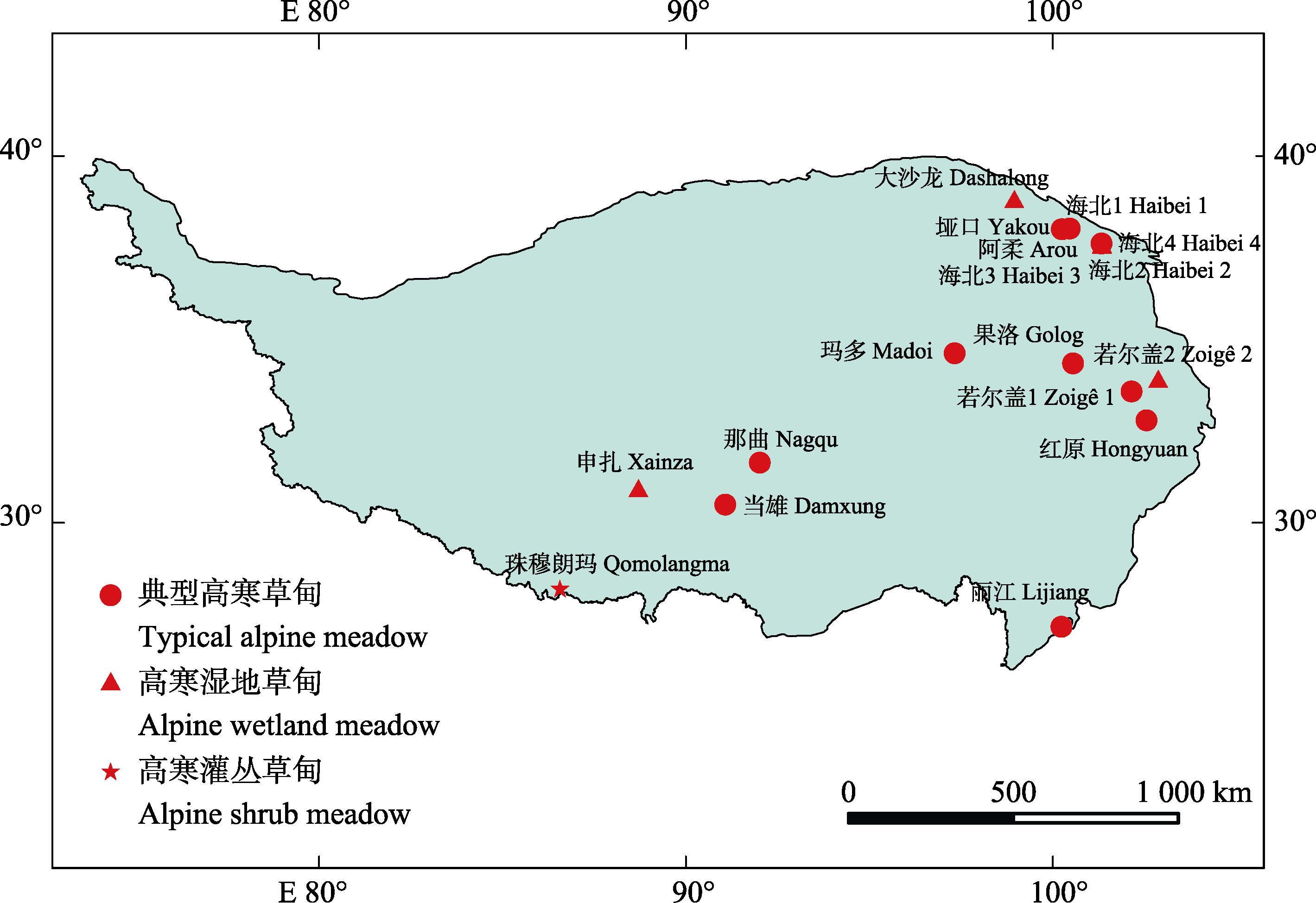
Fig. 1 Spatial distribution of eddy covariance flux stations in the Qingzang Plateau.
| 序号 Number | 站点名称 Station | 经度 Longitude | 纬度 Latitude | 观测时间 Observation period | 生态系统 Ecosystem | 优势物种 Dominant species | 气候区 Climate zone | 冻土类型 Permafrost type |
|---|---|---|---|---|---|---|---|---|
| 1 | 那曲 Nagqu | 92.01° E | 31.64° N | 2012-2018 | 典型高寒草甸 Typical alpine meadow | 高山嵩草 Kobresia pygmaea | 半干旱区 Semi-arid region | 季节冻土区 Seasonal frost zone |
| 2 | 当雄 Damxung | 91.07° E | 30.50° N | 2004-2010 | 典型高寒草甸 Typical alpine meadow | 丝颖针茅 Stipa capillacea | 半干旱区 Semi-arid region | 季节冻土区 Seasonal frost zone |
| 3 | 若尔盖1 Zoigê 1 | 102.14° E | 33.59° N | 2010 | 典型高寒草甸 Typical alpine meadow | 木里薹草 Carex muliensis | 半湿润区 Semi-humid region | 季节冻土区 Seasonal frost zone |
| 4 | 红原 Hongyuan | 102.55° E | 32.80° N | 2015-2018 | 典型高寒草甸 Typical alpine meadow | 发草 Deschampsia cespitosa | 半湿润区 Semi-humid region | 季节冻土区 Seasonal frost zone |
| 5 | 垭口 Yakou | 100.24° E | 38.01° N | 2015 | 典型高寒草甸 Typical alpine meadow | 西藏嵩草 Kobresia tibetica | 半湿润区 Semi-humid region | 多年冻土区 Permafrost zone |
| 6 | 玛多 Madoi | 97.32° E | 34.63° N | 2014 | 典型高寒草甸 Typical alpine meadow | 紫花针茅 Stipa purpurea | 半湿润区 Semi-humid region | 多年冻土区 Permafrost zone |
| 7 | 丽江 Lijiang | 100.23° E | 27.17° N | 2012-2015 | 典型高寒草甸 Typical alpine meadow | 青藏薹草 Carex moorcroftii | 半湿润区 Semi-humid region | 季节冻土区 Seasonal frost zone |
| 8 | 阿柔 Arou | 100.45° E | 38.03° N | 2015 | 典型高寒草甸 Typical alpine meadow | 紫花针茅 Stipa purpurea | 半湿润区 Semi-humid region | 季节冻土区 Seasonal frost zone |
| 9 | 果洛 Golog | 100.55° E | 34.35° N | 2008 | 典型高寒草甸 Typical alpine meadow | 垂穗披碱草 Elymus nutans | 半湿润区 Semi-humid region | 季节冻土区 Seasonal frost zone |
| 10 | 海北1 Haibei 1 | 101.32° E | 37.62° N | 2014-2016 | 典型高寒草甸 Typical alpine meadow | 矮生嵩草 Kobresia humilis | 半湿润区 Semi-humid region | 季节冻土区 Seasonal frost zone |
| 11 | 海北2 Haibei 2 | 101.33° E | 37.61° N | 2004-2009 | 高寒湿地草甸 Alpine wetland meadow | 西藏嵩草 Kobresia tibetica | 半湿润区 Semi-humid region | 季节冻土区 Seasonal frost zone |
| 12 | 海北3 Haibei 3 | 101.33° E | 37.58° N | 2004-2016 | 高寒湿地草甸 Alpine wetland meadow | 西藏嵩草 Kobresia tibetica | 半湿润区 Semi-humid region | 季节冻土区 Seasonal frost zone |
| 13 | 若尔盖2 Zoigê 2 | 102.87° E | 33.93° N | 2008-2009 | 高寒湿地草甸 Alpine wetland meadow | 异针茅 Stipa aliena | 半湿润区 Semi-humid region | 季节冻土区 Seasonal frost zone |
| 14 | 大沙龙 Dashalong | 98.94° E | 38.84° N | 2015 | 高寒湿地草甸 Alpine wetland meadow | 西藏嵩草 Kobresia tibetica | 半干旱区 Semi-arid region | 多年冻土区 Permafrost zone |
| 15 | 申扎 Xainza | 88.70° E | 30.95° N | 2016-2018 | 高寒湿地草甸 Alpine wetland meadow | 紫花针茅 Stipa purpurea | 半干旱区 Semi-arid region | 季节冻土区 Seasonal frost zone |
| 16 | 海北4 Haibei 4 | 101.33° E | 37.67° N | 2003-2020 | 高寒灌丛草甸 Alpine shrub meadow | 金露梅 Potentilla fruticosa | 半湿润区 Semi-humid region | 季节冻土区 Seasonal frost zone |
| 17 | 珠穆朗玛 Qomolangma | 86.56° E | 28.21° N | 2016 | 高寒灌丛草甸 Alpine shrub meadow | 金露梅 Potentilla fruticosa | 半干旱区 Semi-arid region | 多年冻土区 Permafrost zone |
Table 2 Information on the eddy covariance observation sites in the Qingzang Plateau
| 序号 Number | 站点名称 Station | 经度 Longitude | 纬度 Latitude | 观测时间 Observation period | 生态系统 Ecosystem | 优势物种 Dominant species | 气候区 Climate zone | 冻土类型 Permafrost type |
|---|---|---|---|---|---|---|---|---|
| 1 | 那曲 Nagqu | 92.01° E | 31.64° N | 2012-2018 | 典型高寒草甸 Typical alpine meadow | 高山嵩草 Kobresia pygmaea | 半干旱区 Semi-arid region | 季节冻土区 Seasonal frost zone |
| 2 | 当雄 Damxung | 91.07° E | 30.50° N | 2004-2010 | 典型高寒草甸 Typical alpine meadow | 丝颖针茅 Stipa capillacea | 半干旱区 Semi-arid region | 季节冻土区 Seasonal frost zone |
| 3 | 若尔盖1 Zoigê 1 | 102.14° E | 33.59° N | 2010 | 典型高寒草甸 Typical alpine meadow | 木里薹草 Carex muliensis | 半湿润区 Semi-humid region | 季节冻土区 Seasonal frost zone |
| 4 | 红原 Hongyuan | 102.55° E | 32.80° N | 2015-2018 | 典型高寒草甸 Typical alpine meadow | 发草 Deschampsia cespitosa | 半湿润区 Semi-humid region | 季节冻土区 Seasonal frost zone |
| 5 | 垭口 Yakou | 100.24° E | 38.01° N | 2015 | 典型高寒草甸 Typical alpine meadow | 西藏嵩草 Kobresia tibetica | 半湿润区 Semi-humid region | 多年冻土区 Permafrost zone |
| 6 | 玛多 Madoi | 97.32° E | 34.63° N | 2014 | 典型高寒草甸 Typical alpine meadow | 紫花针茅 Stipa purpurea | 半湿润区 Semi-humid region | 多年冻土区 Permafrost zone |
| 7 | 丽江 Lijiang | 100.23° E | 27.17° N | 2012-2015 | 典型高寒草甸 Typical alpine meadow | 青藏薹草 Carex moorcroftii | 半湿润区 Semi-humid region | 季节冻土区 Seasonal frost zone |
| 8 | 阿柔 Arou | 100.45° E | 38.03° N | 2015 | 典型高寒草甸 Typical alpine meadow | 紫花针茅 Stipa purpurea | 半湿润区 Semi-humid region | 季节冻土区 Seasonal frost zone |
| 9 | 果洛 Golog | 100.55° E | 34.35° N | 2008 | 典型高寒草甸 Typical alpine meadow | 垂穗披碱草 Elymus nutans | 半湿润区 Semi-humid region | 季节冻土区 Seasonal frost zone |
| 10 | 海北1 Haibei 1 | 101.32° E | 37.62° N | 2014-2016 | 典型高寒草甸 Typical alpine meadow | 矮生嵩草 Kobresia humilis | 半湿润区 Semi-humid region | 季节冻土区 Seasonal frost zone |
| 11 | 海北2 Haibei 2 | 101.33° E | 37.61° N | 2004-2009 | 高寒湿地草甸 Alpine wetland meadow | 西藏嵩草 Kobresia tibetica | 半湿润区 Semi-humid region | 季节冻土区 Seasonal frost zone |
| 12 | 海北3 Haibei 3 | 101.33° E | 37.58° N | 2004-2016 | 高寒湿地草甸 Alpine wetland meadow | 西藏嵩草 Kobresia tibetica | 半湿润区 Semi-humid region | 季节冻土区 Seasonal frost zone |
| 13 | 若尔盖2 Zoigê 2 | 102.87° E | 33.93° N | 2008-2009 | 高寒湿地草甸 Alpine wetland meadow | 异针茅 Stipa aliena | 半湿润区 Semi-humid region | 季节冻土区 Seasonal frost zone |
| 14 | 大沙龙 Dashalong | 98.94° E | 38.84° N | 2015 | 高寒湿地草甸 Alpine wetland meadow | 西藏嵩草 Kobresia tibetica | 半干旱区 Semi-arid region | 多年冻土区 Permafrost zone |
| 15 | 申扎 Xainza | 88.70° E | 30.95° N | 2016-2018 | 高寒湿地草甸 Alpine wetland meadow | 紫花针茅 Stipa purpurea | 半干旱区 Semi-arid region | 季节冻土区 Seasonal frost zone |
| 16 | 海北4 Haibei 4 | 101.33° E | 37.67° N | 2003-2020 | 高寒灌丛草甸 Alpine shrub meadow | 金露梅 Potentilla fruticosa | 半湿润区 Semi-humid region | 季节冻土区 Seasonal frost zone |
| 17 | 珠穆朗玛 Qomolangma | 86.56° E | 28.21° N | 2016 | 高寒灌丛草甸 Alpine shrub meadow | 金露梅 Potentilla fruticosa | 半干旱区 Semi-arid region | 多年冻土区 Permafrost zone |
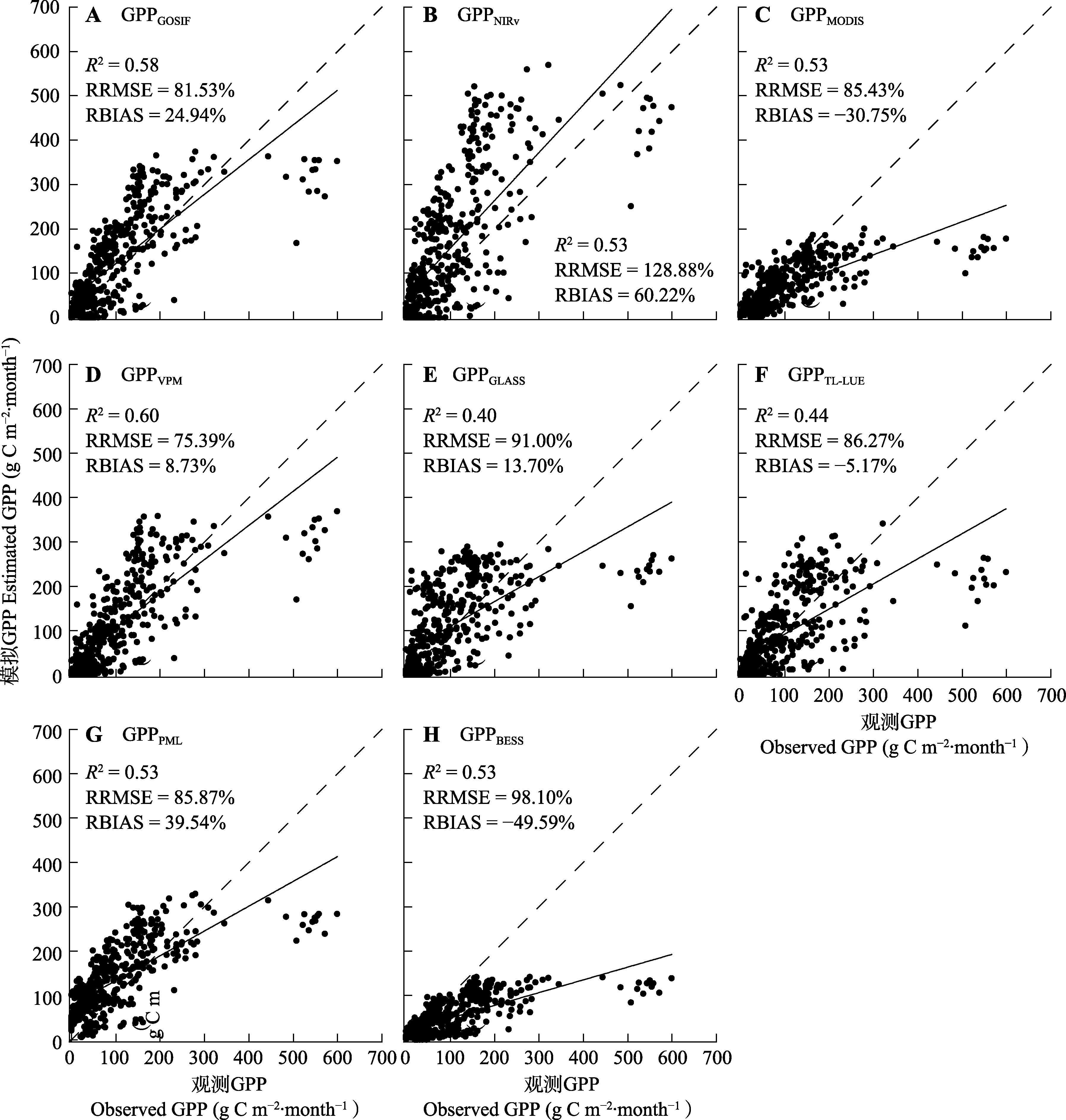
Fig. 2 Accuracy comparison of different gross primary productivity (GPP) products. Detailed information of the GPP products is provided in Table 1. RBIAS, relative bias; RRMSE, root relative mean square error.
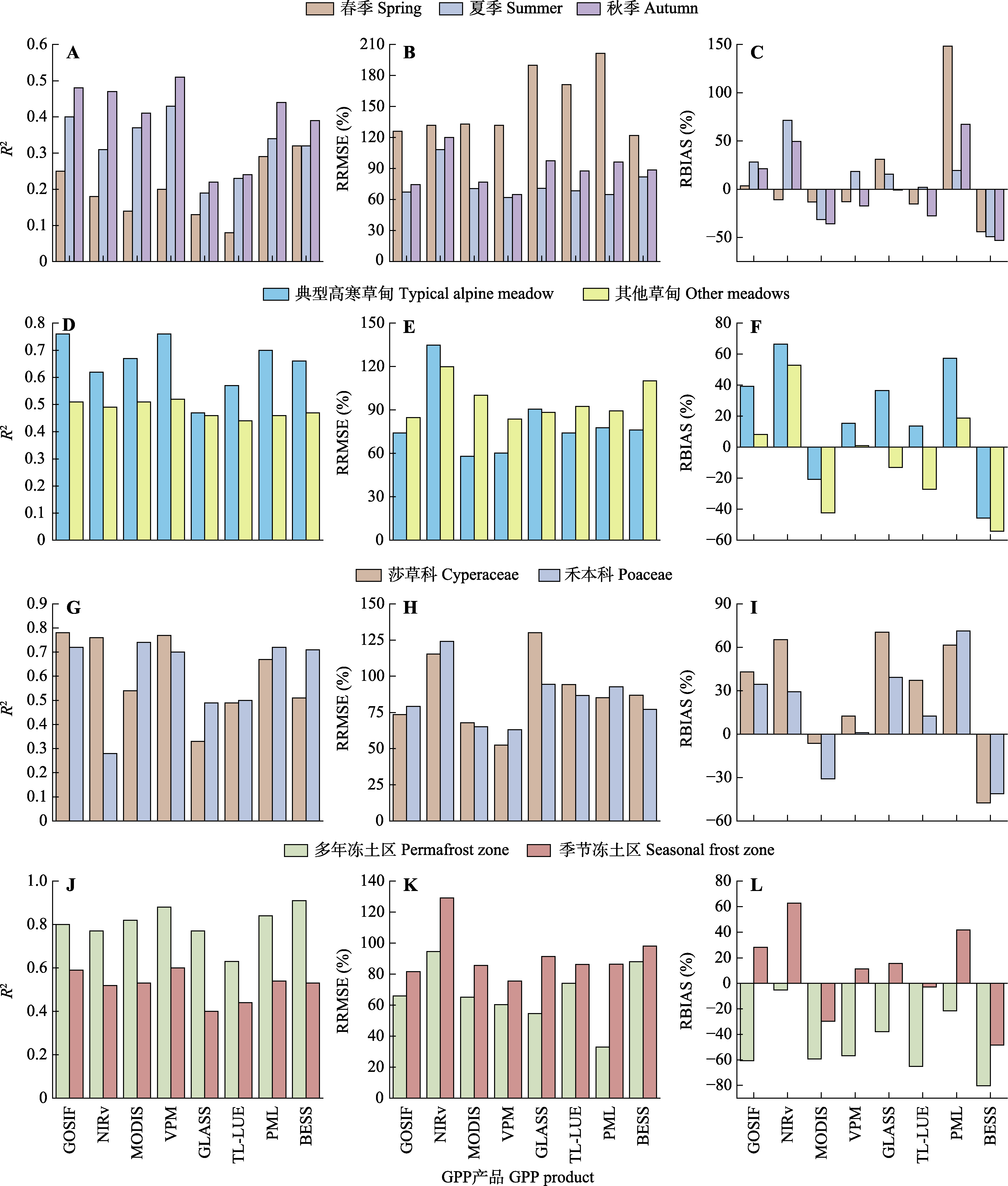
Fig. 3 Accuracy comparison of gross primary productivity (GPP) products. A-C, Comparison in different seasons. D-F, Comparison in different ecosystems. G-I, Comparison between sites dominated by Cyperaceae and Poaceae in typical alpine meadow. J-L, Comparison in different permafrost regions. Detailed information of the GPP products is provided in Table 1. RBIAS, relative bias; RRMSE, root relative mean square error.
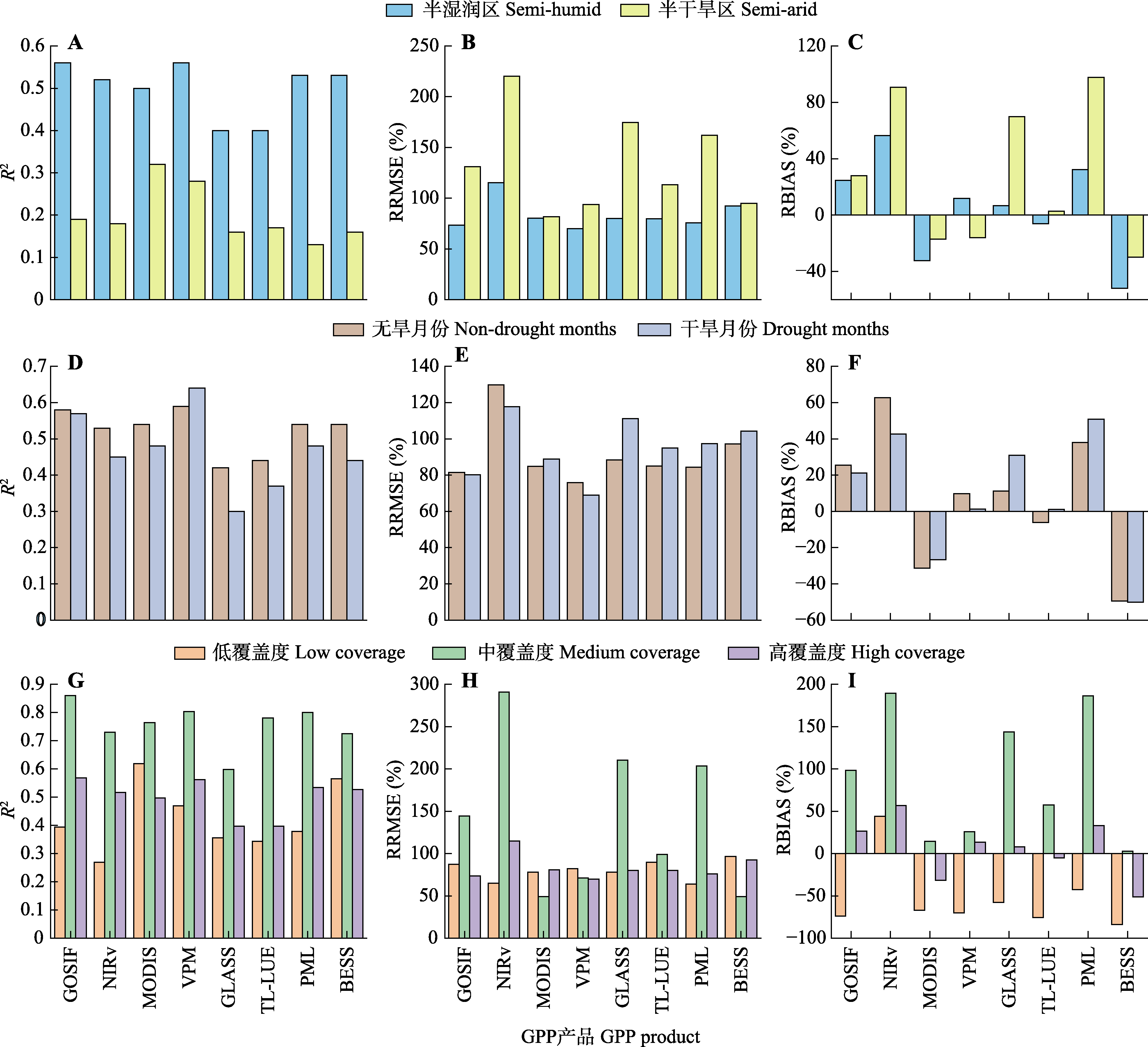
Fig. 4 Accuracy comparison of gross primary productivity (GPP) products. A-C, Comparison in different climate zones. D-F, Comparison in non-drought and drought months. G-I, Comparison under different fractional vegetation cover conditions. Detailed information of the GPP products is provided in Table 1. RBIAS, relative bias; RRMSE, root relative mean square error.
| [1] | Bai Y, Liang SL, Jia AL, Li SG (2023). Different satellite products revealing variable trends in global gross primary production. Journal of Geophysical Research: Biogeosciences, 128, e2022JG006918. DOI: 10.1029/2022JG006918. |
| [2] | Beer C, Reichstein M, Tomelleri E, Ciais P, Jung M, Carvalhais N, Rödenbeck C, Arain MA, Baldocchi D, Bonan GB, Bondeau A, Cescatti A, Lasslop G, Lindroth A, Lomas M, et al. (2010). Terrestrial gross carbon dioxide uptake: global distribution and covariation with climate. Science, 329, 834-838. |
| [3] | Bi WJ, He W, Zhou YL, Ju WM, Liu YB, Liu Y, Zhang XY, Wei XN, Cheng N (2022). A global 0.05° dataset for gross primary production of sunlit and shaded vegetation canopies from 1992 to 2020. Scientific Data, 9, 213. DOI: 10.1038/s41597-022-01309-2. |
| [4] | Chen JM (2021). Carbon neutrality: toward a sustainable future. The Innovation, 2, 100127. DOI: 10.1016/j.xinn.2021.100127. |
| [5] | Chen SY, Liu D, Zhang Y, Zheng RS, Wang T (2024a). Data-constrained modeling of terrestrial gross primary production over the Tibetan Plateau for 2003-2019. Agricultural and Forest Meteorology, 355, 110129. DOI: 10.1016/j.agrformet.2024.110129. |
| [6] | Chen WN, Wang S, Niu SL (2023). A dataset of carbon, water and heat fluxes of Zoige alpine meadow from 2015 to 2020. China Scientific Data, 8(2), 65-72. |
| [陈卫楠, 王松, 牛书丽 (2023). 2015-2020年若尔盖高寒草甸碳水热通量观测数据集. 中国科学数据, 8(2), 65-72.] | |
| [7] | Chen X, Chen TX, Liu SC, Chai YF, Guo RJ, Dai J, Wang SZ, Zhang LL, Wei XQ (2024b). Vegetation index-based models without meteorological constraints underestimate the impact of drought on gross primary productivity. Journal of Geophysical Research: Biogeosciences, 129, e2023JG007499. DOI: 10.1029/2023JG007499. |
| [8] |
Coops NC, Ferster CJ, Waring RH, Nightingale J (2009). Comparison of three models for predicting gross primary production across and within forested ecoregions in the contiguous United States. Remote Sensing of Environment, 113, 680-690.
DOI URL |
| [9] | Ding YX, Peng SZ (2020). Spatiotemporal trends and attribution of drought across China from 1901-2100. Sustainability, 12, 477. DOI: 10.3390/su12020477. |
| [10] |
Ding YX, Peng SZ (2021). Spatiotemporal change and attribution of potential evapotranspiration over China from 1901 to 2100. Theoretical and Applied Climatology, 145, 79-94.
DOI |
| [11] | Fang JY, Ke JH, Tang ZY, Chen AP (2001). Implications and estimations of four terrestrial productivity parameters. Acta Phytoecologica Sinica, 25, 414-419. |
| [方精云, 柯金虎, 唐志尧, 陈安平 (2001). 生物生产力的“4P”概念、估算及其相互关系. 植物生态学报, 25, 414-419.] | |
| [12] |
Gebrechorkos SH, Peng J, Dyer E, Miralles DG, Vicente-Serrano SM, Funk C, Beck HE, Asfaw DT, Singer MB, Dadson SJ (2023). Global high-resolution drought indices for 1981-2022. Earth System Science Data, 15, 5449-5466.
DOI URL |
| [13] | He L, Xie YW, Wang J, Zhang JJ, Si ML, Guo ZC, Ma CH, Bie Q, Li ZL, Ye JS (2023). Precipitation regimes primarily drive the carbon uptake in the Tibetan Plateau. Ecological Indicators, 154, 110694. DOI: 10.1016/j.ecolind.2023.110694. |
| [14] |
Jia K, Yang LQ, Liang SL, Xiao ZQ, Zhao X, Yao YJ, Zhang XT, Jiang B, Liu DY (2019). Long-term global land surface satellite (GLASS) fractional vegetation cover product derived from MODIS and AVHRR data. IEEE Journal of Selected Topics in Applied Earth Observations and Remote Sensing, 12, 508-518.
DOI URL |
| [15] |
Jia WX, Liu M, Wang DD, He HL, Shi PL, Li YN, Wang YF (2018). Uncertainty in simulating regional gross primary productivity from satellite-based models over northern China grassland. Ecological Indicators, 88, 134-143.
DOI URL |
| [16] |
Jiang CY, Ryu Y (2016). Multi-scale evaluation of global gross primary productivity and evapotranspiration products derived from Breathing Earth System Simulator (BESS). Remote Sensing of Environment, 186, 528-547.
DOI URL |
| [17] |
Jiang CY, Ryu Y, Fang HL, Myneni R, Claverie M, Zhu ZC (2017). Inconsistencies of interannual variability and trends in long-term satellite leaf area index products. Global Change Biology, 23, 4133-4146.
DOI PMID |
| [18] |
Jung M, Verstraete M, Gobron N, Reichstein M, Papale D, Bondeau A, Robustelli M, Pinty B (2008). Diagnostic assessment of European gross primary production. Global Change Biology, 14, 2349-2364.
DOI URL |
| [19] |
Lasslop G, Reichstein M, Papale D, Richardson AD, Arneth A, Barr A, Stoy P, Wohlfahrt G (2010). Separation of net ecosystem exchange into assimilation and respiration using a light response curve approach: critical issues and global evaluation. Global Change Biology, 16, 187-208.
DOI URL |
| [20] | Li RW, Zhang MY, Andreeva V, Pei WS, Zhou YQ, Misailov I, Basharin N (2023). Impact of climate warming on permafrost changes in the Qinghai-Tibet Plateau. Cold Regions Science and Technology, 205, 103692. DOI: 10.1016/j.coldregions.2022.103692. |
| [21] | Li WH, Zhao XQ, Zhang XZ, Shi PL, Wang XD, Zhao L (2013). Change mechanism in main ecosystems and its effect of carbon source/sink function on the Qinghai-Tibetan Plateau. Chinese Journal of Nature, 35(3), 172-178. |
| [李文华, 赵新全, 张宪洲, 石培礼, 王小丹, 赵亮 (2013). 青藏高原主要生态系统变化及其碳源/碳汇功能作用. 自然杂志, 35(3), 172-178.] | |
| [22] | Li X, Xiao JF (2019). Mapping photosynthesis solely from solar-induced chlorophyll fluorescence: a global, fine-resolution dataset of gross primary production derived from OCO-2. Remote Sensing, 11, 2563. DOI: 10.3390/rs11212563. |
| [23] |
Li XL, Gao J, Brierley G, Qiao YM, Zhang J, Yang YW (2013). Rangeland degradation on the Qinghai-Tibet Plateau: implications for rehabilitation. Land Degradation & Development, 24, 72-80.
DOI URL |
| [24] | Liao WJ, Jiao Y, Li SX, Hu ZM, Bai L (2024). Comparative analysis of gross primary productivity in the Qinghai-Tibet Plateau based on long-time series of remote sensing products. Chinese Journal of Ecology, 43, 1859-1869. |
| [廖玮杰, 焦悦, 李世禧, 胡中民, 白磊 (2024). 基于多种遥感产品的青藏高原长时间序列总初级生产力对比分析. 生态学杂志, 43, 1859-1869.] | |
| [25] | Ma JY, Yan XD, Dong WJ, Chou JM (2015). Gross primary production of global forest ecosystems has been overestimated. Scientific Reports, 5, 10820. DOI: 10.1038/srep10820. |
| [26] | Ma MN, Yuan WP (2017). Model differences in gross primary production on the Qinghai-Tibet Plateau. Remote Sensing Technology and Application, 32, 406-418. |
| [马敏娜, 袁文平 (2017). 青藏高原总初级生产力估算的模型差异. 遥感技术与应用, 32, 406-418.] | |
| [27] |
Nightingale JM, Coops NC, Waring RH, Hargrove WW (2007). Comparison of MODIS gross primary production estimates for forests across the U.S. A. with those generated by a simple process model, 3-PGS. Remote Sensing of Environment, 109, 500-509.
DOI URL |
| [28] | Niu FJ, Yin GA (2018). Map of the frozen soil in the Tibetan Plateau (2003). National Tibetan Plateau/Third Pole Environment Data Center. DOI: 10.11888/GlaciolGeocryo.tpe.00000048.file. |
| [牛富俊, 尹国安 (2018). 青藏高原多年冻土分布现状图件(2003). 国家青藏高原科学数据中心. DOI: 10.11888/GlaciolGeocryo.tpe.00000048.file.] | |
| [29] |
Niu FJ, Zheng H, Li AY (2020). The study of frost heave mechanism of high-speed railway foundation by field-monitored data and indoor verification experiment. Acta Geotechnica, 15, 581-593.
DOI |
| [30] | Pei YY, Dong JW, Zhang Y, Yang JL, Zhang YQ, Jiang CY, Xiao XM (2020). Performance of four state-of-the-art GPP products (VPM, MOD17, BESS and PML) for grasslands in drought years. Ecological Informatics, 56, 101052. DOI: 10.1016/j.ecoinf.2020.101052. |
| [31] | Peng SZ (2023). 1-km annual arid index dataset for China (1901-2024). National Tibetan Plateau/Third Pole Environment Data Center. DOI: 10.11888/Atmos.tpdc.300560. |
| [彭守璋 (2023). 中国1 km逐年干燥度数据集(1901-2024). 国家青藏高原科学数据中心. DOI: 10.11888/Atmos.tpdc.300560.] | |
| [32] |
Peng SZ, Ding YX, Liu WZ, Li Z (2019). 1 km monthly temperature and precipitation dataset for China from 1901 to 2017. Earth System Science Data, 11, 1931-1946.
DOI URL |
| [33] |
Peng SZ, Ding YX, Wen ZM, Chen YM, Cao Y, Ren JY (2017). Spatiotemporal change and trend analysis of potential evapotranspiration over the Loess Plateau of China during 2011-2100. Agricultural and Forest Meteorology, 233, 183-194.
DOI URL |
| [34] | Piao SL, Ciais P, Friedlingstein P, de Noblet-Ducoudré N, Cadule P, Viovy N, Wang T (2009). Spatiotemporal patterns of terrestrial carbon cycle during the 20th century. Global Biogeochemical Cycles, 23, GB4026. DOI: 10.1029/2008GB003339. |
| [35] |
Reichstein M, Falge E, Baldocchi D, Papale D, Aubinet M, Berbigier P, Bernhofer C, Buchmann N, Gilmanov T, Granier A, Grünwald T, Havránková K, Ilvesniemi H, Janous D, Knohl A, et al. (2005). On the separation of net ecosystem exchange into assimilation and ecosystem respiration: review and improved algorithm. Global Change Biology, 11, 1424-1439.
DOI URL |
| [36] |
Running SW, Nemani RR, Heinsch FA, Zhao MS, Reeves M, Hashimoto H (2004). A continuous satellite-derived measure of global terrestrial primary production. BioScience, 54, 547-560.
DOI URL |
| [37] |
See CR, Virkkala AM, Natali SM, Rogers BM, Mauritz M, Biasi C, Bokhorst S, Boike J, Bret-Harte MS, Celis G, Chae N, Christensen TR, Murner SJ, Dengel S, Dolman H, et al. (2024). Decadal increases in carbon uptake offset by respiratory losses across northern permafrost ecosystems. Nature Climate Change, 14, 853-862.
DOI |
| [38] | Sun T, Zhang XH, Cai YJ, Yang C, Gao ZR (2025). Response of gross primary productivity to flash droughts on the Qinghai-Tibetan Plateau. Ecological Modelling, 500, 110953. DOI: 10.1016/j.ecolmodel.2024.110953. |
| [39] | Tao JB, Mishra DR, Cotten DL, O’Connell J, Leclerc M, Nahrawi HB, Zhang GS, Pahari R (2018). A comparison between the MODIS product (MOD17A2) and a tide-robust empirical GPP model evaluated in a Georgia wetland. Remote Sensing, 10, 1831. DOI: 10.3390/rs10111831. |
| [40] | Tian YQ, Ouyang H, Xu XL, Song MH, Zhou CP (2008). Distribution characteristics of soil organic carbon storage and density on the Qinghai-Tibet Plateau. Acta Pedologica Sinica, 45, 933-942. |
| [田玉强, 欧阳华, 徐兴良, 宋明华, 周才平 (2008). 青藏高原土壤有机碳储量与密度分布. 土壤学报, 45, 933-942.] | |
| [41] | Wang GX, Cheng GD, Shen YP (2002). Soil organic carbon pool of grasslands on the Tibetan Plateau and its global implication. Journal of Glaciology and Geocryology, 24, 693-700. |
| [王根绪, 程国栋, 沈永平 (2002). 青藏高原草地土壤有机碳库及其全球意义. 冰川冻土, 24, 693-700.] | |
| [42] | Wang R, Bowling DR, Gamon JA, Smith KR, Yu R, Hmimina G, Ueyama M, Noormets A, Kolb TE, Richardson AD, Bourque CPA, Bracho R, Blanken PD, Black TA, Arain MA (2023a). Snow-corrected vegetation indices for improved gross primary productivity assessment in North American evergreen forests. Agricultural and Forest Meteorology, 340, 109600. DOI: 10.1016/j.agrformet.2023.109600. |
| [43] | Wang SH, Zhang YG, Ju WM, Qiu B, Zhang ZY (2021). Tracking the seasonal and inter-annual variations of global gross primary production during last four decades using satellite near-infrared reflectance data. Science of the Total Environment, 755, 142569. DOI: 10.1016/j.scitotenv.2020.142569. |
| [44] | Wang XF, Ma MG, Li X, Song Y, Tan JL, Huang GH, Yu WP (2012). Comparison of remote sensing based GPP models at an alpine meadow site. Journal of Remote Sensing, 16, 751-763. |
| [王旭峰, 马明国, 李新, 宋怡, 谭俊磊, 黄广辉, 于文凭 (2012). 遥感GPP模型在高寒草甸的应用比较. 遥感学报, 16, 751-763.] | |
| [45] |
Wang XF, Ma MG, Li X, Song Y, Tan JL, Huang GH, Zhang ZH, Zhao TB, Feng JM, Ma ZG, Wei W, Bai YF (2013). Validation of MODIS-GPP product at 10 flux sites in northern China. International Journal of Remote Sensing, 34, 587-599.
DOI URL |
| [46] | Wang YF, Lv WW, Xue K, Wang SP, Zhang LR, Hu RH, Zeng H, Xu XL, Li YM, Jiang LL, Hao YB, Du JQ, Sun JP, Dorji T, Piao SL, et al. (2022). Grassland changes and adaptive management on the Qinghai-Tibetan Plateau. Nature Reviews Earth & Environment, 3, 668-683. |
| [47] | Wang YY, Xiao JF, Ma YM, Ding JZ, Chen XL, Ding ZY, Luo YQ (2023b). Persistent and enhanced carbon sequestration capacity of alpine grasslands on Earth’s Third Pole. Science Advances, 9, eade6875. DOI: 10.1126/sciadv.ade6875. |
| [48] | Wei D (2021). A literature-based eddy covariance carbon exchange dataset on the Tibetan Plateau. National Tibetan Plateau/Third Pole Environment Data Center. DOI: 10.11888/Meteoro.tpdc.271211. |
| [魏达 (2021). 基于文献的青藏高原碳通量数据集. 国家青藏高原科学数据中心. DOI: 10.11888/Meteoro.tpdc.271211.] | |
| [49] | Wei D, Qi YH, Ma YM, Wang XF, Ma WQ, Gao TG, Huang L, Zhao H, Zhang JX, Wang XD (2021). Plant uptake of CO2 outpaces losses from permafrost and plant respiration on the Tibetan Plateau. Proceedings of the National Academy of Sciences of the United States of America, 118, e2015283118. DOI: 10.1073/pnas.2015283118. |
| [50] | Wu WX, Wang SQ, Xiao XM, Yu GR, Fu YL, Hao YB (2008). Modeling gross primary production of a temperate grassland ecosystem in Inner Mongolia, China, using MODIS imagery and climate data. Science in China Series D: Earth Sciences, 51, 1501-1512. |
| [51] |
Wylie BK, Fosnight EA, Gilmanov TG, Frank AB, Morgan JA, Haferkamp MR, Meyers TP (2007). Adaptive data-driven models for estimating carbon fluxes in the Northern Great Plains. Remote Sensing of Environment, 106, 399-413.
DOI URL |
| [52] |
Yang FH, Ichii K, White MA, Hashimoto H, Michaelis AR, Votava P, Zhu AX, Huete A, Running SW, Nemani RR (2007). Developing a continental-scale measure of gross primary production by combining MODIS and AmeriFlux data through Support Vector Machine approach. Remote Sensing of Environment, 110, 109-122.
DOI URL |
| [53] | Yu T, Sun R, Xiao ZQ, Zhang Q, Liu G, Cui TX, Wang JM (2018). Estimation of global vegetation productivity from global land surface satellite data. Remote Sensing, 10, 327. DOI: 10.3390/rs10020327. |
| [54] | Yu T, Zhang Q, Sun R (2021). Comparison of machine learning methods to up-scale gross primary production. Remote Sensing, 13, 2448. DOI: 10.3390/rs13132448. |
| [55] |
Yuan WP, Liu SG, Yu GR, Bonnefond JM, Chen JQ, Davis K, Desai AR, Goldstein AH, Gianelle D, Rossi F, Suyker AE, Verma SB (2010). Global estimates of evapotranspiration and gross primary production based on MODIS and global meteorology data. Remote Sensing of Environment, 114, 1416-1431.
DOI URL |
| [56] | Yuan WP, Liu SG, Zhou GS, Zhou GY, Tieszen LL, Baldocchi D, Bernhofer C, Gholz H, Goldstein AH, Goulden ML, Hollinger DY, Hu YM, Law BE, Stoy PC, Vesala T, et al. (2007). Deriving a light use efficiency model from eddy covariance flux data for predicting daily gross primary production across biomes. Agricultural and Forest Meteorology, 143, 189-207. |
| [57] | Zhang FW, Li HQ, Zhang LM, Li JX, Yang YS, Yu GR, Li YN (2023). A dataset of the observations of carbon, water and heat fluxes over an alpine shrubland in Haibei (2011-2020). China Scientific Data, 8(2), 132-142. |
| [张法伟, 李红琴, 张雷明, 李杰霞, 杨永胜, 于贵瑞, 李英年 (2023). 2011-2020年海北高寒灌丛碳水热通量观测数据集. 中国科学数据, 8(2), 132-142.] | |
| [58] | Zhang FW, Li HQ, Zhao L, Zhang LM, Chen Z, Zhu JB, Xu SX, Yang YS, Zhao XQ, Yu GR, Li YN (2021a). An observation dataset of carbon, water and heat fluxes in an alpine wetland in Haibei (2004-2009). China Scientific Data, 6(1), 46-55. |
| [张法伟, 李红琴, 赵亮, 张雷明, 陈智, 祝景彬, 徐世晓, 杨永胜, 赵新全, 于贵瑞, 李英年 (2021a). 2004-2009年海北高寒草地生态系统国家野外科学观测研究站高寒湿地碳水热通量观测数据集. 中国科学数据, 6(1), 46-55.] | |
| [59] | Zhang FW, Li HQ, Zhao L, Zhang LM, Chen Z, Zhu JB, Xu SX, Yang YS, Zhao XQ, Yu GR, Li YN (2021b). An observation dataset of carbon, water and heat fluxes over an alpine shrubland in Haibei (2003-2010). China Scientific Data, 6(1), 54-63. |
| [张法伟, 李红琴, 赵亮, 张雷明, 陈智, 祝景彬, 徐世晓, 杨永胜, 赵新全, 于贵瑞, 李英年 (2021b). 2003-2010年海北高寒灌丛碳水热通量观测数据集. 中国科学数据, 6(1), 54-63.] | |
| [60] | Zhang LX, Zhou DC, Fan JW, Guo Q, Chen SP, Wang RH, Li YZ (2019a). Contrasting the performance of eight satellite-based GPP models in water-limited and temperature-limited grassland ecosystems. Remote Sensing, 11, 1333. DOI: 10.3390/rs11111333. |
| [61] | Zhang T, Shan BX, Xu MJ, Zhao G, Zheng ZT, Tang YY, Chen N, Zhu JT, Cong N, Niu B, Zhang YJ (2024). Soil moisture alters the responses of alpine ecosystem productivity to environmental factors, especially VPD, on the Qinghai-Tibetan Plateau. Science of the Total Environment, 947, 174518. DOI: 10.1016/j.scitotenv.2024.174518. |
| [62] | Zhang Y, Xiao XM, Wu XC, Zhou S, Zhang GL, Qin YW, Dong JW (2017). A global moderate resolution dataset of gross primary production of vegetation for 2000-2016. Scientific Data, 4, 170165. DOI: 10.1038/sdata.2017.165. |
| [63] | Zhang YH, Ye AZ (2021). Would the obtainable gross primary productivity (GPP) products stand up? A critical assessment of 45 global GPP products. Science of the Total Environment, 783, 146965. DOI: 10.1016/j.scitotenv.2021.146965. |
| [64] |
Zhang YJ, Zhu YX, Li JX, Chen Y (2019b). Current status and future directions of the Tibetan Plateau ecosystem research. Science Bulletin, 64, 428-430.
DOI URL |
| [65] |
Zhang YQ, Kong DD, Gan R, Chiew FHS, McVicar TR, Zhang Q, Yang YT (2019c). Coupled estimation of 500 m and 8-day resolution global evapotranspiration and gross primary production in 2002-2017. Remote Sensing of Environment, 222, 165-182.
DOI URL |
| [66] | Zheng ZT (2022). Climate controls on the spatial variability of vegetation greenup rate across ecosystems in Northern Hemisphere. Plants, 11, 2971. DOI: 10.3390/plants11212971. |
| [67] | Zheng ZT, Cong N, Zhao G, Zhao B, Zhu YX, Zhang YJ, Zhu JT, Zhang T, Chen N, Gao J, Zhang Y, Sun YH (2024). Evident influence of water availability on the relationship between solar-induced chlorophyll fluorescence and gross primary productivity in the alpine grasslands of the Tibetan Plateau. International Journal of Applied Earth Observation and Geoinformation, 129, 103821. DOI: 10.1016/j.jag.2024.103821. |
| [68] | Zhu WQ, Xie ZY, Zhao CL, Zheng ZT, Qiao K, Peng DL, Fu YH (2024). Remote sensing of terrestrial gross primary productivity: a review of advances in theoretical foundation, key parameters and methods. GIScience & Remote Sensing, 61, 2318846. DOI: 10.1080/15481603.2024.2318846. |
| [1] | ZHANG An-Ning, XIAO Ya-Ning, ZHAO Xia, ZHANG Miao, CUI Han-Wen, CHEN Shu-Yan, AN Li-Zhe. Interactions between shrub encroachment and nitrogen addition on nematode community and functional traits on Qingzang Plateau [J]. Chin J Plant Ecol, 2026, 50(4): 859-869. |
| [2] | CHEN Long, GUO Ke, GOU Xiao-Hua, ZHAO Xiu-Hai, MA Hong-Ruo. Community components and characteristics of Juniperus przewalskii forests [J]. Chin J Plant Ecol, 2025, 49(6): 852-864. |
| [3] | WANG Shi-Song, QU Xiao-Yun, DONG Shao-Qiong, LI Jia-Hong, YANG Qi, HOU Man-Fu, ZHAO Li-Qing, GUO Ke, LIU Chang-Cheng, XU Xiao. Typical desert vegetation types and community characteristics in Zanda, Xizang, China [J]. Chin J Plant Ecol, 2025, 49(5): 801-812. |
| [4] | LI Lin, HUANG Jia-Fang, DING Zhong-Hao, GUO Ping-Ping, CAI Yuan-Bin, LI Shi-Hua, LI Yun-Qin, LUO Min. Impact of increased inundation height on the net ecosystem CO2 exchange in a Cyperus malaccensis tidal marsh [J]. Chin J Plant Ecol, 2025, 49(4): 526-539. |
| [5] | WANG Juan, ZHANG Deng-Shan, XIAO Yuan-Ming, PEI Quan-Bang, WANG Bo, FAN Bo, ZHOU Guo-Ying. Relationships between the characteristics of root exudate and environmental factors in the alpine steppe following long-term grazing exclusion [J]. Chin J Plant Ecol, 2025, 49(4): 596-609. |
| [6] | CHEN Cheng-Zhi, GAO Yu-Sen, LUO Li-Jia, WANG Dong. Twig and leaf litter production and decomposition in an alpine Sibiraea angustata shrubland of western Sichuan, China [J]. Chin J Plant Ecol, 2025, 49(10): 1733-1743. |
| [7] | WANG Lin, LI Xue, WANG Yu, WANG Xin, HU Xiao-Wen, YANG Mei, ZHU Jian-Xiao. Effects of different coating agents on seed growth and planting of native grasses in alpine grassland [J]. Chin J Plant Ecol, 2025, 49(1): 118-128. |
| [8] | WANG Wen-Ying, XIAO Yuan-Ming, WANG Xiao-Yun, XU Jia-Xin, MA Yu-Hua, LI Qiang-Feng, ZHOU Guo-Ying. Relationship between plant diversity and ecosystem multifunctionality in degraded alpine meadows under multifunctional group species combination models [J]. Chin J Plant Ecol, 2025, 49(1): 103-117. |
| [9] | ZHANG Hui, ZHAO Yun-Peng, LIU Xiao-Chen, GUO Zeng-Peng, HU Guo-Rui, FENG Yan-Hao, MA Miao-Jun. Dynamics of soil seed bank and its role in plant community regeneration during alpine meadow degradation [J]. Chin J Plant Ecol, 2025, 49(1): 74-82. |
| [10] | YANG Yu-Meng, LAI Quan, LIU Xin-Yi. Quantitative analysis of climate change and human activities on vegetation gross primary productivity in Nei Mongol, China [J]. Chin J Plant Ecol, 2024, 48(3): 306-316. |
| [11] | LI Yun-Yi, ZHENG Jin, YAN Xiao-Yan, LI Shuang, LUO Lin, TONG Jin, ZHAO Chun-Zhang. Effects of warming on phyllosphere and rhizosphere bacterial communities in Picea asperata and Fargesia nitida [J]. Chin J Plant Ecol, 2024, 48(12): 1692-1707. |
| [12] | ZHAO Yan-Chao, CHEN Li-Tong. Soil nutrients modulate response of aboveground biomass to warming in alpine grassland on the Qingzang Plateau [J]. Chin J Plant Ecol, 2023, 47(8): 1071-1081. |
| [13] | SHI Sheng-Bo, ZHOU Dang-Wei, LI Tian-Cai, DE Ke-Jia, GAO Xiu-Zhen, MA Jia-Lin, SUN Tao, WANG Fang-Lin. Responses of photosynthetic function of Kobresia pygmaea to simulated nocturnal low temperature on the Qingzang Plateau [J]. Chin J Plant Ecol, 2023, 47(3): 361-373. |
| [14] | SHI Sheng-Bo, SHI Rui, ZHOU Dang-Wei, ZHANG Wen. Effects of low temperature on photochemical and non-photochemical energy dissipation of Kobresia pygmaea leaves [J]. Chin J Plant Ecol, 2023, 47(10): 1441-1452. |
| [15] | ZHU Yu-Ying, ZHANG Hua-Min, DING Ming-Jun, YU Zi-Ping. Changes of vegetation greenness and its response to drought-wet variation on the Qingzang Plateau [J]. Chin J Plant Ecol, 2023, 47(1): 51-64. |
| Viewed | ||||||
|
Full text |
|
|||||
|
Abstract |
|
|||||
Copyright © 2026 Chinese Journal of Plant Ecology
Tel: 010-62836134, 62836138, E-mail: apes@ibcas.ac.cn, cjpe@ibcas.ac.cn

