
植物生态学报 ›› 2005, Vol. 29 ›› Issue (5): 781-784.DOI: 10.17521/cjpe.2005.0103 cstr: 32100.14.cjpe.2005.0103
杨树德1, 徐文忠1, 刘士锐2, 张统2, 麻密1,*( )
)
收稿日期:2004-05-26
接受日期:2005-06-17
出版日期:2005-05-26
发布日期:2005-08-30
基金资助:
YANG Shu-De1, XU Wen-Zhong1, LIU Shi-Rui2, ZHANG Tong2, MA Mi1,*()
Received:2004-05-26
Accepted:2005-06-17
Online:2005-05-26
Published:2005-08-30
About author:* E-mail: mami@ibcas.ac.cn摘要:
四氧化二氮/偏二甲肼(Unsymmetrical dimethyl-hybrazine, 简称UDMH)为常用的航天器双组元液体推进剂。偏二甲肼沸点低,具有“三致”毒性,可在使用过程中释放到环境中,对污染地的生物多样性和人类健康构成威胁,因此迫切需要清除环境中的偏二甲肼。该文采用细胞工程的技术手段,以芦苇幼苗的下胚轴为材料诱导愈伤组织,继而通过逐步提高筛选压力选育出可耐受偏二甲肼的变异细胞系,再诱导变异细胞系分化,为可治理含偏二甲肼的废水的人工湿地处理系统的构建提供理想的工程植物。结果表明:芦苇的愈伤组织在含有0.5 mg·L-1 2,4-D的MS培养基上生长良好;偏二甲肼对该愈伤组织生长的半致死剂量为16.3 mmol·L-1;在分别含有1.63、3.26和8.15 mmol·L-1偏二甲肼的筛选培养基上进行3~6次继代培养后,可得到较稳定的抗性细胞系,培养23 d后的相对生长量分别为对照的90.4%、84.3%和43.4%,培养43 d后的相对生长量分别为对照的95.6%、91.7%和46.8%;但是只有前两类抗性细胞系可在含0.1 g·L-1 KT、0.01 g·L-1 NAA和相应浓度的偏二甲肼的MS培养基中诱导分化;将绿色再生苗转移到不含激素但含偏二甲肼的培养基上强化根的生长,再经过35 d左右的适应性驯化,70%以上的再生苗可成功地转移至温室中培养,为日后人工湿地系统的构建奠定了基础。
杨树德, 徐文忠, 刘士锐, 张统, 麻密. 耐受偏二甲肼的芦苇变异株系的筛选. 植物生态学报, 2005, 29(5): 781-784. DOI: 10.17521/cjpe.2005.0103
YANG Shu-De, XU Wen-Zhong, LIU Shi-Rui, ZHANG Tong, MA Mi. SELECTION OF UDMH TOLERANT VARIANT LINES OF AN AQUATIC REED. Chinese Journal of Plant Ecology, 2005, 29(5): 781-784. DOI: 10.17521/cjpe.2005.0103
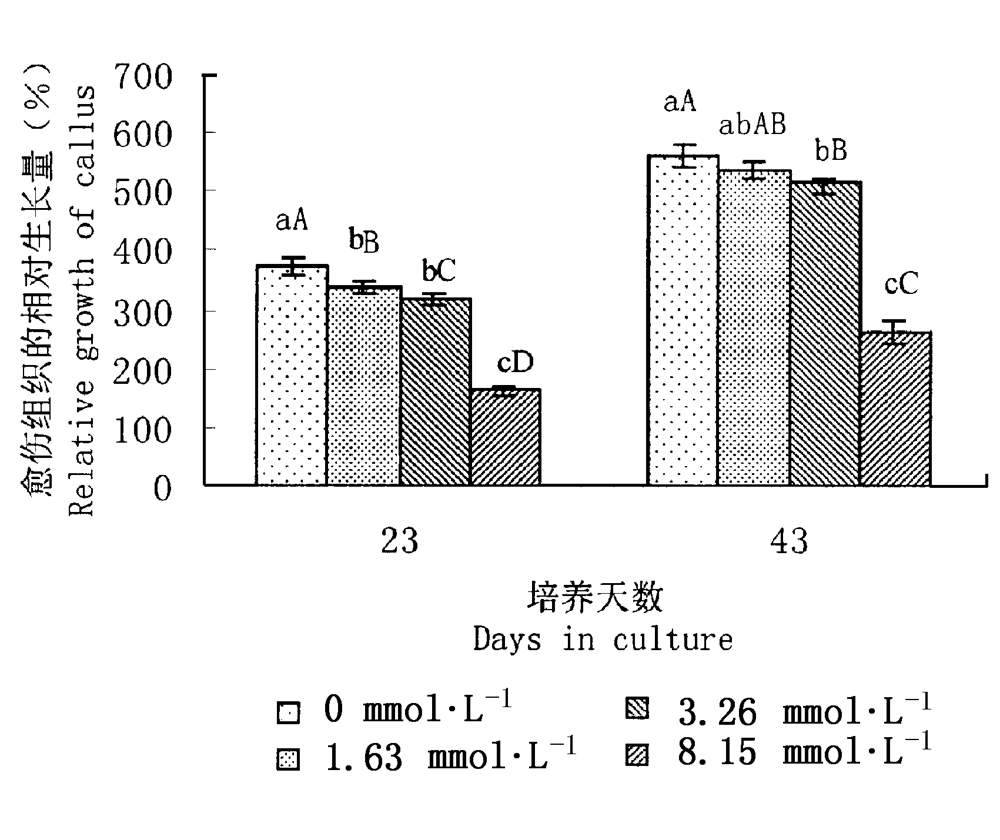
图1 培养23和43 d后愈伤组织在筛选培养基上的相对生长量 柱形图上方的误差棒代表正负标准方差(n=5),相同的大(小) 写字母表示不同处理间在同一培养时期内的值在1%(5%) 水平上不存在显著性差异
Fig.1 Relative growth of callus at the end of 23-day and 43-day subculture in screening medium respectively Vertical bars indicate the standard devirations (n=5). Within the same subculture interval, treatments marked with the same capital (small) letter are not significantly different at the level of 1% (5%)
| 偏二甲肼的浓度 Concentration of UDMH (mmol·L-1) | 再生频率 Regeneration rate (%) | 每块愈伤组织的 平均芽点发生数 Average number of shoots on a single callus |
|---|---|---|
| 0 | 88 | 9 |
| 1.63 | 55 | 4 |
| 3.26 | 42 | 3 |
| 8.15 | 0 | 0 |
表1 不同抗性愈伤组织的再生频率
Table 1 Regeneration rate of resistant callus
| 偏二甲肼的浓度 Concentration of UDMH (mmol·L-1) | 再生频率 Regeneration rate (%) | 每块愈伤组织的 平均芽点发生数 Average number of shoots on a single callus |
|---|---|---|
| 0 | 88 | 9 |
| 1.63 | 55 | 4 |
| 3.26 | 42 | 3 |
| 8.15 | 0 | 0 |
| [1] | Brix H (1989). The use of aquatic macrophytes in water pollution control. Journal of the Human Environment Research and Management, 18(2),100-107. |
| [2] | Ernst H, Rittinghausen S, Wahnschaffe U, Mohr U (1987). Induction of malignant peripheral nerve sheath tumors in European hamsters with 1,1-dimethylhydrazine (UDMH). Cancer Letter, 35,303-311. |
| [3] |
Frazier DE Jr, Tarr MJ, Olsen RG (1991). The in vitro and in vivo effects of 1,1-dimethylhydrazine (UDMH) on murine lymphocyte subsets and IA antigen expression. Immunopharmacol Immunotoxicol, 13,25-46.
DOI URL PMID |
| [4] | Gong BA(宫宝安), Xu XF(徐秀峰), Guo BD(郭保东), Zou DF(邹德峰), Cong PX(丛培学), Wang JG(王建国) (1994). Removal of UDMH from waste by catalytic oxidation. Journal of Yantai University (Natural Science and Engineering) (烟台大学学报(自然科学与工程版)), 3,43-46. (in Chinese with English abstract) |
| [5] | Lunn G, Sansone EB (1994). Oxidation of 1,1-dimethylhydrazine (UDMH) in aqueous solution with air and hydrogen peroxide. Chemosphere, 29,1577-1590. |
| [6] | Meng XH(孟晓红), Wu WE(吴婉娥), Fu CR(傅超然) (2000). Unsuynnetrical dimethyl-hybrazine pollution and evaluation of its control method. Yunnan Environmeatal Science (云南环境科学), 19,165-168. (in Chinese with English abstract) |
| [7] | Smith RH, Bhaskaran S, Schertz K (1983). Sorghum plant regeneration from aluminum selection media. Plant Cell Reproduction, 2,129-132. |
| [8] | Sun G, Gray KR, Biddlestone AJ, Cooper DJ (1999). Treatment of agricultural wastewater in a combined tidal flow-downflow reed bed system. Water Science and Technology, 40,139-145. |
| [9] | Ye ZH, Baker AJM, Wong MH, Willis AJ (1997). Zinc, lead and cadmium tolerance, uptake and accumulation by the common reed, Phragmites australis (Cav.) Trin. ex Steudel. Annals of Botany, 80,363-370. |
| [10] | Yue MX(岳茂兴), Peng RY(彭瑞云), Wang ZG(王正国), Wang DW(王德文), Yang ZH(杨志焕), Yang HM(杨鹤鸣), Xia YD(夏亚东), Gao YB(高亚兵), Cui XM(崔雪梅), Li JZ(李建忠), Li Y(李炎) (2004). Intoxication induced by unsymmetrical dimethylhydrazine: characteristics and mechanism of its acute and chronic injuries. Chinese Critieal Care Medicine (中国危重病急救医学), 16,740-742. (in Chinese with English abstract). |
| [11] | Zelnick SD, Mattie DR, Stepaniak PC (2003). Occupational exposure to hydrazines: treatment of acute central nervous system toxicity. Aviation Space Environmental Medcine, 74,1285-1291. |
| [12] | Zhang CL(张承烈), Chen GC(陈国仓) (1991). Study on gas exchange characteristics of Phragmites communis Trin. in different ecotypes of dry desert of the Hexi corridor. Acta Ecologica Sinica (生态学报), 11,250-254. (in Chinese with English abstract) |
| [13] | Zhang JD(张家得) (1993). Detection and Protection of Rocket Propellant Fuel and Prevention of Their Pollution (火箭推进剂的检测与防护及其污染治理措施). National University of Defense Technology Press, Changsha,779-803. (in Chinese) |
| [14] | Zhu HB(朱红兵), Zhang T(张统), Sha CL(沙聪亮), Li TD(李铁栋), Jiang Y(蒋义) (2003). Influence analysis of rocket fuels to the groundwater of launch base. Water and Wastewater Engineering (给水排水), 29,37-39.(in Chinese with English abstract). |
| [1] | 史欢欢, 雪穷, 于振林, 汪承焕. 密度、物种比例对盐沼植物种子萌发阶段种内、种间相互作用的影响[J]. 植物生态学报, 2023, 47(1): 77-87. |
| [2] | 郭瑞, 周际, 刘琪, 顾峰雪. 松嫩退化草地芦苇不同叶位叶片营养元素代谢特征[J]. 植物生态学报, 2018, 42(7): 734-740. |
| [3] | 李群, 赵成章, 赵连春, 王建良, 张伟涛, 姚文秀. 秦王川盐沼湿地芦苇比叶面积与叶片热耗散的关联性分析[J]. 植物生态学报, 2017, 41(9): 985-994. |
| [4] | 刘波, 吕宪国, 姜明, 张文广, 武海涛. 光照、水深交互作用对松嫩湿地芦苇种子萌发的影响[J]. 植物生态学报, 2015, 39(6): 616-620. |
| [5] | 陈清, 王义东, 郭长城, 王中良. 天津沼泽湿地芦苇叶片的碳稳定同位素比值分布特征及其环境影响因素[J]. 植物生态学报, 2015, 39(11): 1044-1052. |
| [6] | 胡楚琦, 刘金珂, 王天弘, 王文琳, 卢山, 周长芳. 三种盐胁迫对互花米草和芦苇光合作用的影响[J]. 植物生态学报, 2015, 39(1): 92-103. |
| [7] | 刘利丹, 介冬梅, 刘洪妍, 郭梅娥, 李楠楠. 东北地区芦苇植硅体的变化特征[J]. 植物生态学报, 2013, 37(9): 861-871. |
| [8] | 朱敏,张振华,于君宝,吴立新,韩广轩,杨利琼,邢庆会,谢宝华,毛培利,王光美. 氮沉降对黄河三角洲芦苇湿地土壤呼吸的影响[J]. 植物生态学报, 2013, 37(6): 517-529. |
| [9] | 杨利琼,韩广轩,于君宝,吴立新,朱敏,邢庆会,王光美,毛培利. 开垦对黄河三角洲湿地净生态系统CO2交换的影响[J]. 植物生态学报, 2013, 37(6): 503-516. |
| [10] | 贾庆宇, 周广胜, 周莉, 谢艳兵. 湿地芦苇植株氮素分布动态特征分析[J]. 植物生态学报, 2008, 32(4): 858-864. |
| [11] | 赵聪蛟, 邓自发, 周长芳, 关保华, 安树青, 陈琳, 陆霞梅. 氮水平和竞争对互花米草与芦苇叶特征的影响[J]. 植物生态学报, 2008, 32(2): 392-401. |
| [12] | 段晓男, 王效科, 欧阳志云, 苗鸿, 郭然. 乌梁素海野生芦苇群落生物量及影响因子分析[J]. 植物生态学报, 2004, 28(2): 246-251. |
| [13] | 张淑萍, 王仁卿, 张治国, 郭卫华, 刘建, 宋百敏. 黄河下游湿地芦苇形态变异研究[J]. 植物生态学报, 2003, 27(1): 78-85. |
| [14] | 郑学平, 张承烈, 陈国仓. 河西走廊芦苇的光合碳同化途径对生境条件的适应[J]. 植物生态学报, 1993, 17(1): 1-8. |
| [15] | 张承烈, 周瑞莲, 陈国仓. 芦苇耐脱水能力的生理生态学分析[J]. 植物生态学报, 1992, 16(4): 311-316. |
| 阅读次数 | ||||||
|
全文 |
|
|||||
|
摘要 |
|
|||||
Copyright © 2026 版权所有 《植物生态学报》编辑部
地址: 北京香山南辛村20号, 邮编: 100093
Tel.: 010-62836134, 62836138; Fax: 010-82599431; E-mail: apes@ibcas.ac.cn, cjpe@ibcas.ac.cn
备案号: 京ICP备16067583号-19

