
植物生态学报 ›› 2008, Vol. 32 ›› Issue (4): 743-750.DOI: 10.3773/j.issn.1005-264x.2008.04.002 cstr: 32100.14.j.issn.1005-264x.2008.04.002
张金菊1,3, 叶其刚1, 姚小洪1, 张胜菊1, 黄宏文1,2,*( )
)
收稿日期:2007-09-27
接受日期:2008-01-11
出版日期:2008-09-27
发布日期:2008-07-30
作者简介:*E-mail:huanghw@mail.scbg.ac.cn基金资助:
ZHANG Jin-Ju1,3, YE Qi-Gang1, YAO Xiao-Hong1, ZHANG Sheng-Ju1, HUANG Hong-Wen1,2,*()
Received:2007-09-27
Accepted:2008-01-11
Online:2008-09-27
Published:2008-07-30
摘要:
研究处于片断化生境中濒危植物的繁育系统、传粉过程及生殖成功状况, 可为评估物种的受胁迫程度及制订相应的保护和管理策略提供重要依据。通过野外观察和人工授粉实验等方法,对片断化生境中濒危植物黄梅秤锤树(Sinojackia huangmeiensis)的开花生物学和繁育系统进行了初步研究, 并探讨了影响其生殖成功的因素。黄梅秤锤树的总状花序上通常有两性花2~6朵, 单花花期约5~7 d, 单花花药不同步开裂使整朵花花粉活力持续时间延长。虽然花开放过程中柱头始终高于花药, 在单花水平上可在一定程度上避免同花自交的发生, 但由于花粉活力和柱头可授期之间有一定的重叠期, 在自然情况下, 由于外界媒介动物和风媒的作用, 不可避免地会产生同株同花和同株异花传粉。实验结果表明, 该种不存在无融合生殖现象, 繁育类型以异交为主, 部分自交亲和且需要传粉者。主要的传粉昆虫为黑带食蚜蝇(Epistrophe balteata)、中华蜜蜂 (Apis cerana) 和中华回条蜂(Habropoda sinensis)。黄梅秤锤树自然状态下的结实率较低(10.33%), 平均每果种子数较少(0.387个), 这主要与传粉昆虫少、花粉传递效率低, 以及柱头上自花及同株异花花粉的落置和自交亲和性低有关。但是单株较大的开花量保证了一定的果实和种子产量, 使居群能自然更新。部分自交亲和性可能为该物种适应生境片断化提供了一定的生殖保障及进化潜力。对该残存居群的保护, 应着眼于加强对传粉昆虫赖以生存的自然生态系统的恢复。
张金菊, 叶其刚, 姚小洪, 张胜菊, 黄宏文. 片断化生境中濒危植物黄梅秤锤树的开花生物学、繁育系统与生殖成功的因素. 植物生态学报, 2008, 32(4): 743-750. DOI: 10.3773/j.issn.1005-264x.2008.04.002
ZHANG Jin-Ju, YE Qi-Gang, YAO Xiao-Hong, ZHANG Sheng-Ju, HUANG Hong-Wen. PRELIMINARY STUDIES ON THE FLORAL BIOLOGY, BREEDING SYSTEM AND REPRODUCTIVE SUCCESS OF SINOJACKIA HUANGMEIENSIS, AN ENDANGERED PLANT IN A FRAGMENTED HABITAT IN HUBEI PROVINCE, CHINA. Chinese Journal of Plant Ecology, 2008, 32(4): 743-750. DOI: 10.3773/j.issn.1005-264x.2008.04.002
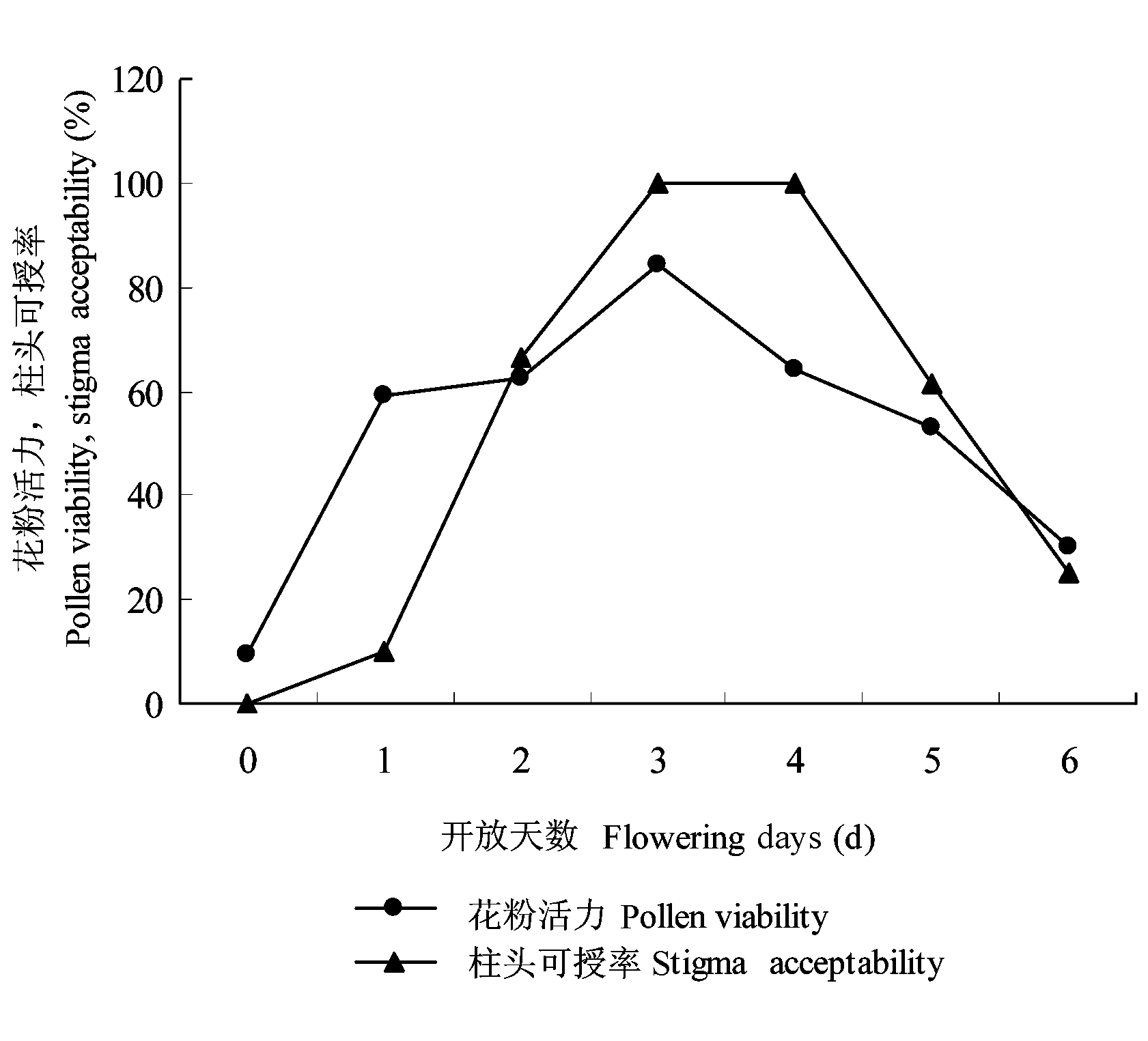
图1 黄梅秤锤树的花粉活力和柱头可授性
Fig. 1 Changes of the pollen viability and stigma acceptability of Sinojackia huangmeiensis
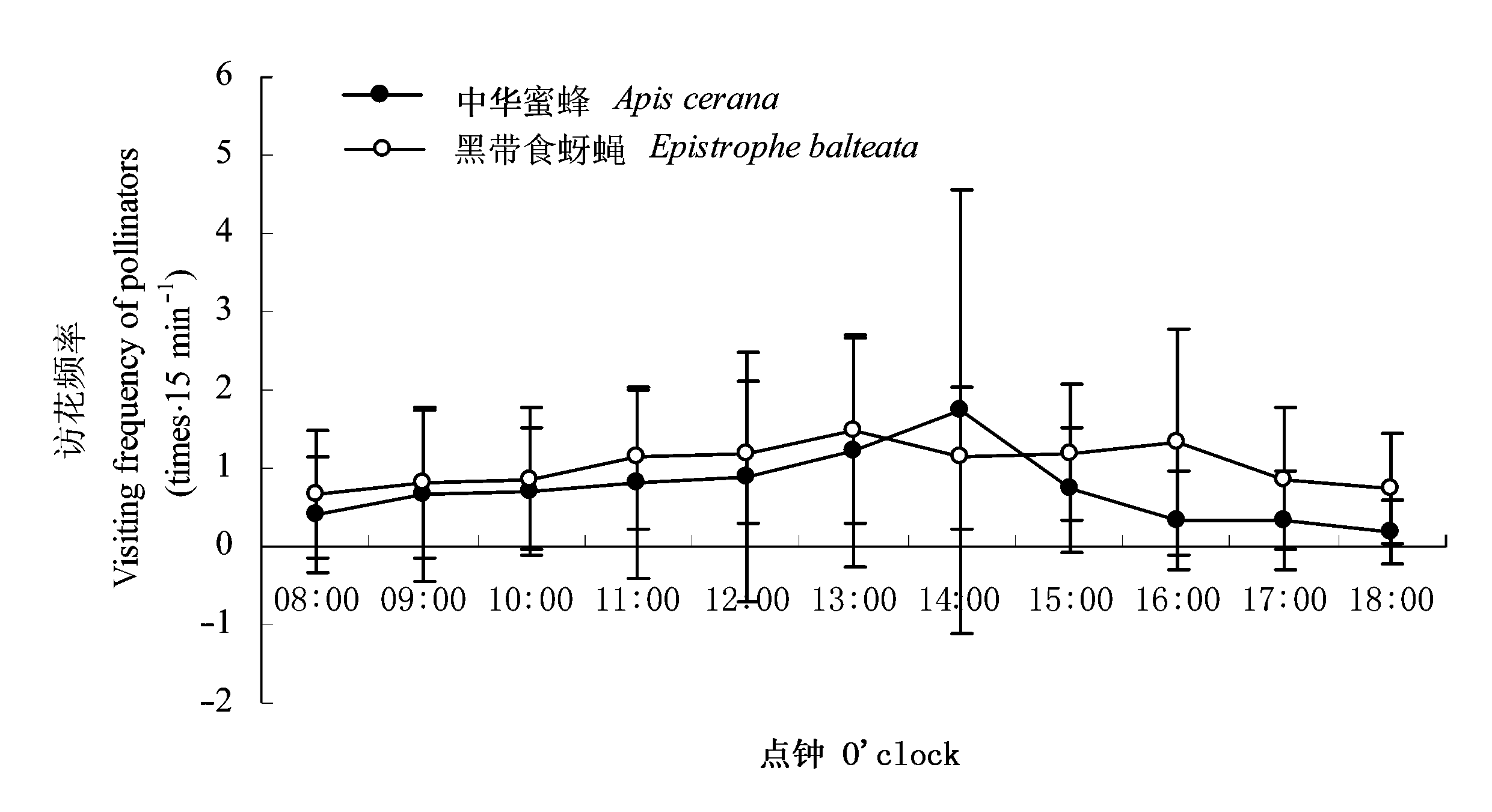
图2 黄梅秤锤树两种主要传粉昆虫中华蜜蜂(晴天)和黑带食蚜蝇(阴天)的访花频率
Fig. 2 The visiting frequency of two pollinators Apis cerana (on fine weather) and Epistrophe balteata (on cloudy weather) on flowers of Sinojackia huangmeiensis
| 处理 Treatments | 处理花数 No. of flowers | 结实数 No. of fruits | 结实率 Fruit set (%) | 每果种子数 Seed output per fruit |
|---|---|---|---|---|
| 自然对照 Open pollination | 300 | 31 | 10.33±7.88 | 0.387±0.089 |
| 不去雄,套袋,自花授粉 Isolated without emasculation, autogamy | 264 | 0 | 0 | 0 |
| 人工同株异花授粉 Manual geitonogamy | 252 | 20 | 7.94±5.65 | 0.500 ±0.114 |
| 人工异株授粉 Manual cross pollination | 297 | 220 | 74.07±8.25 | 0.732±0.033 |
| 去雄,套袋,不授粉 Emasculation, bagged, no pollination | 247 | 0 | 0 | 0 |
表1 不同授粉方式下黄梅秤锤树的结实率(平均值±标准偏差)
Table1 The fruit set and seed output per fruit of Sinojackia huangmeiensis under different treatments (mean±SD)
| 处理 Treatments | 处理花数 No. of flowers | 结实数 No. of fruits | 结实率 Fruit set (%) | 每果种子数 Seed output per fruit |
|---|---|---|---|---|
| 自然对照 Open pollination | 300 | 31 | 10.33±7.88 | 0.387±0.089 |
| 不去雄,套袋,自花授粉 Isolated without emasculation, autogamy | 264 | 0 | 0 | 0 |
| 人工同株异花授粉 Manual geitonogamy | 252 | 20 | 7.94±5.65 | 0.500 ±0.114 |
| 人工异株授粉 Manual cross pollination | 297 | 220 | 74.07±8.25 | 0.732±0.033 |
| 去雄,套袋,不授粉 Emasculation, bagged, no pollination | 247 | 0 | 0 | 0 |
| [1] | Aizen MA, Feinsinger P (1994a). Forest fragmentation, pollination, and plant reproduction in a Chaco dry forest, Argentina. Ecology, 75,330-351. |
| [2] | Aizen MA, Feinsinger P (1994b). Habitat fragmentation, native insect pollinator, and feral honeybees in Argentine “Chaco Serrano”. Ecological Applications, 4,378-392. |
| [3] | Allen-Wardell GP (1998). The potential consequences of pollinator declines on the conservation of biodiversity and stability of food crop yields. Conservation Biology, 12,8-17. |
| [4] | Anderson GJ, Bernardello G, Stuessy TF, Crawford D (2001). Breeding systems and pollination of selected plants endemic to the Juan Fernandez Islands. American Journal of Botany, 88,220-233. |
| [5] | Ashman TL, Knight TM, Steets JA, Amarasekare P, Burd M, Campbell DR, Dudash MR, Johnston MO, Mazer SJ, Mitchell RJ, Morgan MT, Wilson WG (2004). Pollen limitation of plant reproduction: ecological and evolutionary causes and consequences. Ecology, 85,2408-2421. |
| [6] |
Bernardello G, Aguilar R, Anderson GJ (2004). The reproductive biology of Sophora fernandeziana (Leguminosae), a vulnerable endemic species from Isla Robinson Crusoe . American Journal of Botany, 91,198-206.
DOI URL PMID |
| [7] | Bertin RI (1982). Floral biology, hummingbird pollination and fruit production of trumpet creeper (Campsis radicans, Bignoniaceae). American Journal of Botany, 69,122-134. |
| [8] | Chen T (陈涛), Zhang HD (张宏达) (1996). The geographical distribution of Styracaceae in Asia. Acta Scientiarum Naturalium Universitatis Sunyatseni (Natural Science Edition) (中山大学学报(自然科学版)), 35,97-103. (in Chinese with English abstract) |
| [9] | Chen XY (陈小勇) (2000). Effects of habitat fragmentation on genetic structure of plant populations and implication for the biodiversity conservation. Acta Ecologica Sinica (生态学报), 20,884-892. (in Chinese with English abstract) |
| [10] |
Cruden RW (1977). Pollen-ovule ratios: a conservative indicator of breeding systems in flowering plants. Evolution, 31,32-46.
DOI URL PMID |
| [11] | Dafni A (1992). Pollination Ecology: a Practical Approach. Oxford University Press, Oxford. |
| [12] | Demauro MM (1993). Relationship of breeding system to rarity in the lakeside Daisy ( Hymenoxys acaulis var glabra) . Conservation Biology, 7,542-550. |
| [13] | Frankham R, Ballou JD, Briscoe DA (2002). Introduction to Conservation Genetics. Cambridge University Press,Cambridge, UK. |
| [14] | Fritsch PW, Morton CM, Chen T, Meldrum C (2001). Phylogeny and biogeography of the Styracaceae. International Journal of Plant Sciences, 162 (Suppl. 6),95-116. |
| [15] | Fu LG (傅立国) (1992). China Plant Red Data Book: Rare and Endangered Plants (I) (中国植物红皮书:稀有濒危植物(第一册)). Science Press, Beijing. (in Chinese) |
| [16] | He T, Rao G, You R (2000). Reproductive biology of Ophiopogon xylorrhizus (Liliaceae s.l.): an endangered endemic of Yunnan, Southwest China . Australian Journal of Botany, 48,101-107. |
| [17] | Huang SQ (黄双全), Guo YH (郭友好), Pan MQ (潘明清), Chen JK (陈家宽) (1999). Floral syndrome and insect pollination of Liriodenron chinense. Acta Botanica Sinica (植物学报), 41,241-248. (in Chinese with English abstract) |
| [18] | Kearns CA, Inouye DW, Waser NM (1998). Endangered mutualisms: the conservation of plant-pollinator interactions. Annual Review of Ecology and Systematics, 29,83-112. |
| [19] |
Lamont BB, Klinkhamer PGL, Witkowski ETF (1993). Population fragmentation may reduce fertility to zero in Banksia goodii: a demonstration of the Allee effect . Oecologia, 94,446-450.
DOI URL PMID |
| [20] | Moody-Weis JM, Heywood JS (2001). Pollination limitation to reproductive success in the Missouri evening primrose, Oenothera macrocarpa (Onagraceae). American Journal of Botany, 88,1615-1622. |
| [21] | Rathcke BJ (2003). Floral longevity and reproductive assurance: seasonal patterns and an experiment test with Kalmia latifolia (Ericaceae). American Journal of Botany, 90,1328-1332. |
| [22] | SPSS (1999). Statistical Software Package, Version 10.0. SPSS Inc., Chicago. |
| [23] |
Weir BS, Cockerham CC (1984). Estimating F-statistics for the analysis of population structure . Evolution, 38,1358-1370.
DOI URL PMID |
| [24] | Yao XH (姚小洪), Ye QG (叶其刚), Kang M (康明), Huang HW (黄宏文) (2005). Geographic distribution and current status of the endangered genera Sinojackia and Changiostyrax. Biodiversity Science (生物多样性), 13,339-346. (in Chinese with English abstract) |
| [25] | Yao XH (姚小洪) (2006). Studies on Conservation Genetics of the Genera Sinojackia and Changiostyrax (秤锤树属与长果安息香属植物的保育遗传学研究). PhD dissertation, Wuhan Botanical Garden, Chinese Academy of Sciences. (in Chinese with English abstract) |
| [26] | Yao XH, Ye QG, Ge JW, Kang M, Huang HW (2007). A new species of Sinojackia (Styracaceae) from Hubei, Central China . Novon, 17,138-140. |
| [27] | Ye QG, Yao XH, Zhang SJ, Kang M, Huang HW (2006). Potential risk of hybridization in ex situ collections of two endangered species of Sinojackia Hu (Styracaceae). Journal of Integrative Plant Biology, 48,867-872. |
| [28] | Ye QG, Bunn E, Krauss SL, Dixon KW (2007). Reproductive success in a reintroduced population of a critically endangered shrub, Symonanthus bancroftii (Solanaceae). Australian Journal of Botany, 55,425-432. |
| [1] | 肖治术, 范宗骥, 于桂清, 范明亮. 油麻藤属(Mucuna)植物的传粉和种子传播研究进展: 现状与展望[J]. , 2027, 51(动植物互作): 0-. |
| [2] | 周鑫宇, 刘会良, 高贝, 卢妤婷, 陶玲庆, 文晓虎, 张岚, 张元明. 新疆特有濒危植物雪白睡莲繁殖生物学研究[J]. 植物生态学报, 2025, 49(10): 1643-1655. |
| [3] | 哈里布努尔, 古丽扎尔·阿不都克力木, 热依拉穆·麦麦提吐尔逊, 艾沙江·阿不都沙拉木. 黑果枸杞两种花型的花部综合征与传粉特性[J]. 植物生态学报, 2022, 46(9): 1050-1063. |
| [4] | 曾凯娜, 孙浩然, 申益春, 任明迅. 海南羊山湿地的传粉网络及其季节动态[J]. 植物生态学报, 2022, 46(7): 775-784. |
| [5] | 苏启陶, 杜志喧, 周兵, 廖永辉, 王呈呈, 肖宜安. 牯岭凤仙花及其传粉昆虫在中国的潜在分布区域分析[J]. 植物生态学报, 2022, 46(7): 785-796. |
| [6] | 张迪, 都业勤, 王磊, 陈鑫, 闫兴富, 唐占辉. 两种生境间大花百合不同性别表型开花及传粉特征的差异[J]. 植物生态学报, 2022, 46(5): 580-592. |
| [7] | 钟楠蝶, 王力, 肖杰, 王琼. 增温条件下花粉来源对红雉凤仙花生殖成功的影响[J]. 植物生态学报, 2022, 46(4): 416-427. |
| [8] | 阿依古丽•阿卜杜热伊木, 焦芳芳, 张爱勤. 异型花柱植物喀什补血草的传粉者功能群与花粉转移效率[J]. 植物生态学报, 2021, 45(1): 51-61. |
| [9] | 张亭, 王波, 苗白鸽, 彭艳琼. 榕树隐头花序挥发物组成及其传粉榕小蜂寄主识别行为[J]. 植物生态学报, 2017, 41(5): 549-558. |
| [10] | 黄艳波, 魏宇昆, 王琦, 肖月娥, 叶喜阳. 舌瓣鼠尾草退化杠杆雄蕊的相关花部特征及传粉机制[J]. 植物生态学报, 2015, 39(7): 753-761. |
| [11] | 吴云, 刘玉蓉, 彭瀚, 杨勇, 刘光立, 操国兴, 张强. 高山植物全缘叶绿绒蒿在不同海拔地区的传粉生态学研究[J]. 植物生态学报, 2015, 39(1): 1-13. |
| [12] | 田润炜,陆嘉惠,李学禹,余营,谢良碧,秦忠立. 光果甘草二体雄蕊的发育及其适应意义[J]. 植物生态学报, 2013, 37(7): 641-649. |
| [13] | 张勃, 孙杉, 方强恩, 白小明. 鼠尾草属不同物种的雄蕊杠杆机制对传粉者空间变异的进化响应[J]. 植物生态学报, 2012, 36(7): 681-689. |
| [14] | 戴攀峰, 谭敦炎. 雪莲的开花生物学特性及其生态适应意义[J]. 植物生态学报, 2011, 35(1): 56-65. |
| [15] | 曾建军, 肖宜安, 孙敏. 入侵植物剑叶金鸡菊的繁殖特征及其与入侵性之间的关系[J]. 植物生态学报, 2010, 34(8): 966-972. |
| 阅读次数 | ||||||
|
全文 |
|
|||||
|
摘要 |
|
|||||
Copyright © 2026 版权所有 《植物生态学报》编辑部
地址: 北京香山南辛村20号, 邮编: 100093
Tel.: 010-62836134, 62836138; Fax: 010-82599431; E-mail: apes@ibcas.ac.cn, cjpe@ibcas.ac.cn
备案号: 京ICP备16067583号-19

