
植物生态学报 ›› 2012, Vol. 36 ›› Issue (2): 117-125.DOI: 10.3724/SP.J.1258.2012.00117 cstr: 32100.14.SP.J.1258.2012.00117
张远东*( ), 刘彦春, 刘世荣, 张笑鹤
收稿日期:2011-06-02
接受日期:2011-12-10
出版日期:2012-06-02
发布日期:2012-02-22
作者简介:* E-mail: zyd@caf.ac.cn
ZHANG Yuan-Dong*(), LIU Yan-Chun, LIU Shi-Rong, ZHANG Xiao-He
Received:2011-06-02
Accepted:2011-12-10
Online:2012-06-02
Published:2012-02-22
摘要:
基于树木年轮学与标准地调查法, 研究了川西亚高山林区3种恢复森林类型生物量、蓄积量及生产力动态变化特征, 旨在尝试年轮学在森林生长过程反演中的运用, 并探索不同恢复模式下森林生物量和蓄积量的动态变化。结果表明, 不同恢复类型发育至20年以后, 均进入生长加速期, 平均胸径间差异逐渐显著, 人工云杉(Picea asperata)林胸径增长最快, 明显高于天然恢复的次生桦木(Betula spp.)林和次生针阔混交林。在恢复过程中, 次生针阔混交林一直保持最高的林分平均地上生物量与林分蓄积量, 其地上平均生物量一直显著高于人工云杉林(p < 0.05), 在20年以后显著高于次生桦木林(p < 0.05)。与人工云杉林相比, 次生桦木林在25年前具有相对较高的生物量, 而在25年之后则低于人工云杉林。在0-20年桦木林林分蓄积量略高于云杉林, 而20年以后, 云杉林蓄积量则超过桦木林。不同恢复类型的生产力大小对比显示, 30年之前, 次生针阔混交林>次生桦木林>人工云杉林, 30年之后, 针阔混交林生产力仍然最高, 而人工云杉林则超过次生桦木林。川西林区次生针阔混交林恢复模式在生物量和蓄积量积累方面均具有显著优势。
张远东, 刘彦春, 刘世荣, 张笑鹤. 基于年轮分析的不同恢复途径下森林乔木层生物量和蓄积量的动态变化. 植物生态学报, 2012, 36(2): 117-125. DOI: 10.3724/SP.J.1258.2012.00117
ZHANG Yuan-Dong, LIU Yan-Chun, LIU Shi-Rong, ZHANG Xiao-He. Dynamics of stand biomass and volume of the tree layer in forests with different restoration approaches based on tree-ring analysis. Chinese Journal of Plant Ecology, 2012, 36(2): 117-125. DOI: 10.3724/SP.J.1258.2012.00117
| 森林类型 Forest type | 海拔 Elevation (m) | 坡向 Slope aspect (°) | 坡度 Slope gradient (°) | 林分密度 Stand density (tree · hm-2) | 平均胸径 Mean DBH (cm) | 林龄 Stand age (a) | 样芯数 No. of cores |
|---|---|---|---|---|---|---|---|
| PSFI | 3 212 | NE 40 | 10 | 829.3 | 21.4 ± 6.2 | 43 | 47 |
| PSFII | 3 261 | NE 45 | 15 | 914.5 | 20.1 ± 5.7 | 44 | 49 |
| PSFIII | 3 252 | SE 70 | 10 | 964.7 | 19.7 ± 5.6 | 39 | 53 |
| SBFI | 3 214 | NW 40 | 26 | 3 021.5 | 9.3 ± 3.4 | 49 | 104 |
| SBFII | 3 238 | NW 25 | 20 | 3 086.1 | 11.2 ± 3.3 | 45 | 77 |
| SBFIII | 3 326 | NE 20 | 18 | 2 788.1 | 10.1 ± 4.5 | 50 | 94 |
| SMFI | 3 020 | NE 40 | 30 | 3 262.0 | 11.1 ± 3.4 | 36 | 93 |
| SMFII | 2 990 | NE 20 | 20 | 3 188.1 | 9.5 ± 3.4 | 35 | 124 |
| SMFIII | 3 345 | NE 15 | 20 | 3 032.7 | 11.7 ± 4.6 | 38 | 101 |
表1 川西亚高山地区调查样地的基本情况
Table 1 Basic information of sample plots of subalpine region in Western Sichuan
| 森林类型 Forest type | 海拔 Elevation (m) | 坡向 Slope aspect (°) | 坡度 Slope gradient (°) | 林分密度 Stand density (tree · hm-2) | 平均胸径 Mean DBH (cm) | 林龄 Stand age (a) | 样芯数 No. of cores |
|---|---|---|---|---|---|---|---|
| PSFI | 3 212 | NE 40 | 10 | 829.3 | 21.4 ± 6.2 | 43 | 47 |
| PSFII | 3 261 | NE 45 | 15 | 914.5 | 20.1 ± 5.7 | 44 | 49 |
| PSFIII | 3 252 | SE 70 | 10 | 964.7 | 19.7 ± 5.6 | 39 | 53 |
| SBFI | 3 214 | NW 40 | 26 | 3 021.5 | 9.3 ± 3.4 | 49 | 104 |
| SBFII | 3 238 | NW 25 | 20 | 3 086.1 | 11.2 ± 3.3 | 45 | 77 |
| SBFIII | 3 326 | NE 20 | 18 | 2 788.1 | 10.1 ± 4.5 | 50 | 94 |
| SMFI | 3 020 | NE 40 | 30 | 3 262.0 | 11.1 ± 3.4 | 36 | 93 |
| SMFII | 2 990 | NE 20 | 20 | 3 188.1 | 9.5 ± 3.4 | 35 | 124 |
| SMFIII | 3 345 | NE 15 | 20 | 3 032.7 | 11.7 ± 4.6 | 38 | 101 |
| 树种 Tree species | 地上部分器官 Aboveground organ | 异速生长模型 Allometric model | 决定系数 Determination coefficient | 文献来源 Origin of references | |
|---|---|---|---|---|---|
| 冷杉 Abies spp. | 干 Stem | W = 0.0139(D2H)1.0075 | R2 = 0.998 6 | Luo et al., 2002 | |
| 枝 Branch | W = 0.0014(D2H)1.0503 | R2 = 0.911 8 | |||
| 叶 Leaf | 胸径 DBH < 40 cm时, | W = 0.0003(D2H)1.2032 | R2 = 0.934 1 | ||
| 胸径 DBH > 40 cm时, | W = 11.5060ln(D2H) - 74.7330 | R2 = 0.753 9 | |||
| 云杉 Picea spp. | 干 Stem | W = 0.0405D2.5680 | R2 = 0.989 0 | Luo et al., 2002 | |
| 枝 Branch | W = 0.0037D2.7386 | R2 = 0.945 0 | |||
| 叶 Leaf | 胸径 DBH < 40 cm时, | W = 0.0014D2.9302 | R2 = 0.941 9 | ||
| 胸径 DBH > 40 cm时, | W = 29.5410lnD - 63.1500 | R2 = 0.757 4 | |||
| 桦木 Betula spp. | 干 Stem | W = 0.1411(D2H)0.7234 | R2 = 0.980 1 | Feng et al., 1999 | |
| 枝 Branch | W = 0.0072(D2H)1.0225 | R2 = 0.774 4 | |||
| 叶 Leaf | W = 0.0151(D2H)0.8085 | R2 = 0.828 1 | |||
| 树种 Tree species | 地上部分器官 Aboveground organ | 异速生长模型 Allometric model | 决定系数 Determination coefficient | 文献来源 Origin of references | |
| 槭树 Acer spp. | 干 Stem | W = 0.3274(D2H)0.7218 | R2 = 0.932 5 | Chen, 1983 | |
| 枝 Branch | W = 0.0135(D2H)0.7198 | R2 = 0.911 4 | |||
| 叶 Leaf | W = 0.0235(D2H)0.6929 | R2 = 0.891 7 | |||
| 杨木 Poplar spp. | 干 Stem | W = 0.0537(D2H)0.9270 | R2 = 0.987 0 | Zhu et al., 1988 | |
| 枝 Branch | W = 0.0125(D2H)0.9504 | R2 = 0.863 0 | |||
| 叶 Leaf | W = 0.0221(D2H)0.7583 | R2 = 0.786 0 | |||
| 其他阔叶树 Other broadleaf species | 干 Stem | W = 0.0097(D2H) + 5.8252 | R2 = 0.991 4 | Luo et al., 2002 | |
| 枝 Branch | W = 0.0510(D2H) + 3.5080 | R2 = 0.982 5 | |||
| 叶 Leaf | W = 0.0004(D2H) + 0.7563 | R2 = 0.933 3 | |||
附表I 川西亚高山次生林乔木地上生物量异速生长模型
Appendix I Allometric models for tree aboveground biomass in subalpine secondary forest in Western Sichuan
| 树种 Tree species | 地上部分器官 Aboveground organ | 异速生长模型 Allometric model | 决定系数 Determination coefficient | 文献来源 Origin of references | |
|---|---|---|---|---|---|
| 冷杉 Abies spp. | 干 Stem | W = 0.0139(D2H)1.0075 | R2 = 0.998 6 | Luo et al., 2002 | |
| 枝 Branch | W = 0.0014(D2H)1.0503 | R2 = 0.911 8 | |||
| 叶 Leaf | 胸径 DBH < 40 cm时, | W = 0.0003(D2H)1.2032 | R2 = 0.934 1 | ||
| 胸径 DBH > 40 cm时, | W = 11.5060ln(D2H) - 74.7330 | R2 = 0.753 9 | |||
| 云杉 Picea spp. | 干 Stem | W = 0.0405D2.5680 | R2 = 0.989 0 | Luo et al., 2002 | |
| 枝 Branch | W = 0.0037D2.7386 | R2 = 0.945 0 | |||
| 叶 Leaf | 胸径 DBH < 40 cm时, | W = 0.0014D2.9302 | R2 = 0.941 9 | ||
| 胸径 DBH > 40 cm时, | W = 29.5410lnD - 63.1500 | R2 = 0.757 4 | |||
| 桦木 Betula spp. | 干 Stem | W = 0.1411(D2H)0.7234 | R2 = 0.980 1 | Feng et al., 1999 | |
| 枝 Branch | W = 0.0072(D2H)1.0225 | R2 = 0.774 4 | |||
| 叶 Leaf | W = 0.0151(D2H)0.8085 | R2 = 0.828 1 | |||
| 树种 Tree species | 地上部分器官 Aboveground organ | 异速生长模型 Allometric model | 决定系数 Determination coefficient | 文献来源 Origin of references | |
| 槭树 Acer spp. | 干 Stem | W = 0.3274(D2H)0.7218 | R2 = 0.932 5 | Chen, 1983 | |
| 枝 Branch | W = 0.0135(D2H)0.7198 | R2 = 0.911 4 | |||
| 叶 Leaf | W = 0.0235(D2H)0.6929 | R2 = 0.891 7 | |||
| 杨木 Poplar spp. | 干 Stem | W = 0.0537(D2H)0.9270 | R2 = 0.987 0 | Zhu et al., 1988 | |
| 枝 Branch | W = 0.0125(D2H)0.9504 | R2 = 0.863 0 | |||
| 叶 Leaf | W = 0.0221(D2H)0.7583 | R2 = 0.786 0 | |||
| 其他阔叶树 Other broadleaf species | 干 Stem | W = 0.0097(D2H) + 5.8252 | R2 = 0.991 4 | Luo et al., 2002 | |
| 枝 Branch | W = 0.0510(D2H) + 3.5080 | R2 = 0.982 5 | |||
| 叶 Leaf | W = 0.0004(D2H) + 0.7563 | R2 = 0.933 3 | |||
| 树种 Tree species | 材积公式 Volume equation (m3) |
|---|---|
| 桦木 Betula spp. | $V = 0.00004894 \times {\left( {0.9839 \times D - 0.3303} \right)^{2.0173}} \times {\left( {\frac{{33.2727 - 1031.4484}}{{31.549 + D}}} \right)^{0.9388}}$ |
| 冷杉 Abies spp. | $V = 0.00006322 \times {\left( { - 0.1027 + 0.99576 \times D} \right)^{1.901}} \times {\left( {\frac{{45.79737 - 1837.226}}{{D + 38.40604}}} \right)^{0.963}}$ |
| 云杉 Picea spp. | $V = 0.00005679 \times {\left( {0.37388 + 0.9721 \times D} \right)^{1.852}} \times {\left( {\frac{D}{{1.129 + 0.0161 \times D}}} \right)^{1.0335}}$ |
| 杨树 Poplar spp. | $V = 0.00005275 \times {\left( { - 0.5162 + 1.0942 \times D} \right)^{1.94526}} \times {\left( {\frac{D}{{0.74623 + 0.0421 \times D}}} \right)^{0.93885}}$ |
| 槭树 Acer spp. | $V = 0.00005275 \times {\left( {0.49896 + 0.9661 \times D} \right)^{1.945}} \times {\left( {\frac{D}{{0.84118 + 0.0381}}} \right)^{0.93885}}$ |
附表II 川西主要树种一元立木材积表1)
Appendix II Table of one-way tree volume models of the main tree species in Western Sichuan1)
| 树种 Tree species | 材积公式 Volume equation (m3) |
|---|---|
| 桦木 Betula spp. | $V = 0.00004894 \times {\left( {0.9839 \times D - 0.3303} \right)^{2.0173}} \times {\left( {\frac{{33.2727 - 1031.4484}}{{31.549 + D}}} \right)^{0.9388}}$ |
| 冷杉 Abies spp. | $V = 0.00006322 \times {\left( { - 0.1027 + 0.99576 \times D} \right)^{1.901}} \times {\left( {\frac{{45.79737 - 1837.226}}{{D + 38.40604}}} \right)^{0.963}}$ |
| 云杉 Picea spp. | $V = 0.00005679 \times {\left( {0.37388 + 0.9721 \times D} \right)^{1.852}} \times {\left( {\frac{D}{{1.129 + 0.0161 \times D}}} \right)^{1.0335}}$ |
| 杨树 Poplar spp. | $V = 0.00005275 \times {\left( { - 0.5162 + 1.0942 \times D} \right)^{1.94526}} \times {\left( {\frac{D}{{0.74623 + 0.0421 \times D}}} \right)^{0.93885}}$ |
| 槭树 Acer spp. | $V = 0.00005275 \times {\left( {0.49896 + 0.9661 \times D} \right)^{1.945}} \times {\left( {\frac{D}{{0.84118 + 0.0381}}} \right)^{0.93885}}$ |
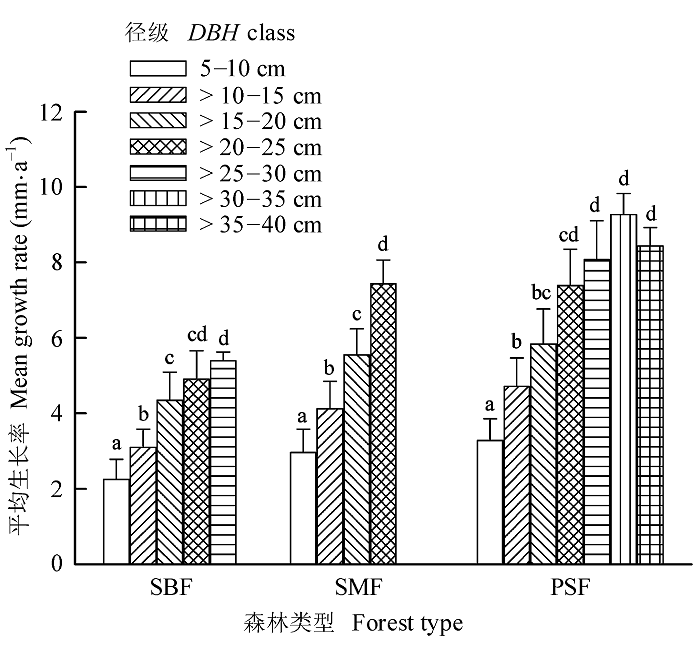
图1 三种恢复森林类型不同径级的年平均生长率(平均值±标准误差)。PSF, 人工云杉林; SBF, 次生桦木林; SMF, 次生针阔混交林。同一森林类型内标相同小写字母者表示径级间差异不显著(p > 0.05)。
Fig. 1 Annual mean growth rate of different DBH classes for three recovery forest types (mean ± SE). DBH, diameter at breast height. PSF, planted spruce (Picea asperata) forest; SBF, secondary birch (Betula spp.) forest; SMF, secondary coniferous and broad-leaved mixed forest. Values labelled by the same lowercase in each forest type are not significant different between diameter classes (p > 0.05).
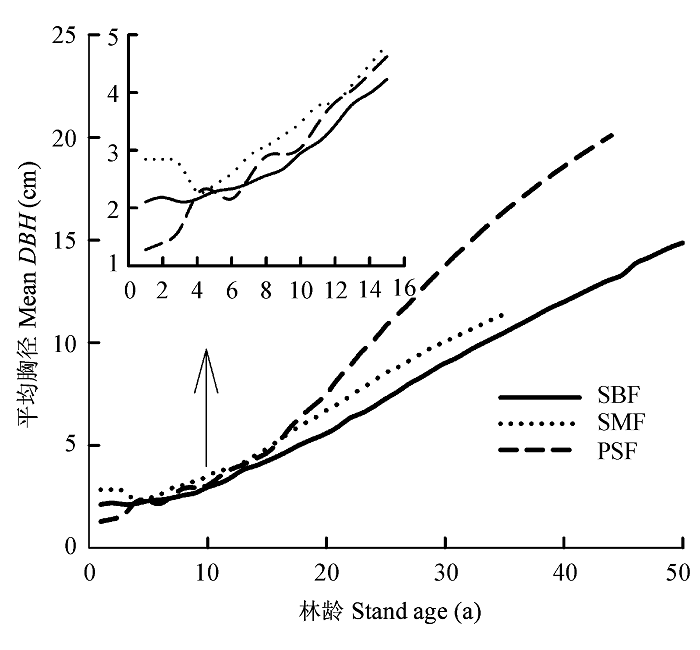
图2 三种恢复森林类型林分平均胸径随林龄的变化。PSF, 人工云杉林; SBF, 次生桦木林; SMF, 次生针阔混交林。小图为0-15年平均胸径的放大图。
Fig. 2 Changes of stand mean diameter at breast height (DBH) with stand age for three recovery forest types. PSF, planted spruce (Picea asperata) forest; SBF, secondary birch (Betula spp.) forest; SMF, secondary coniferous and broad- leaved mixed forest. DBH change among 1-15 years is enlarged in the new small chart.
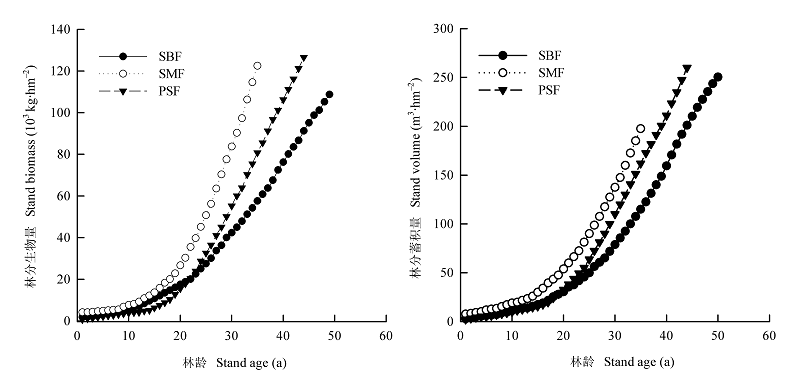
图3 三种恢复森林类型林分平均地上生物量与蓄积量的动态对比。 PSF, 人工云杉林; SBF, 次生桦木林; SMF, 次生针阔混交林。
Fig. 3 Dynamic comparisons of stand average aboveground biomass and volume among three recovery forest types. PSF, planted spruce (Picea asperata) forest; SBF, secondary birch (Betula spp.) forest; SMF, secondary coniferous and broad-leaved mixed forest.
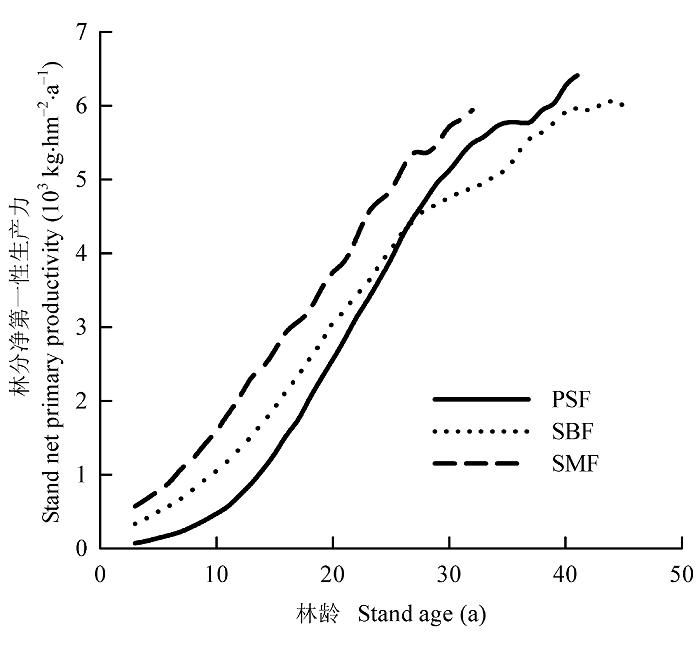
图4 三种恢复途径林分地上净第一性生产力的动态变化。PSF, 人工云杉林; SBF, 次生桦木林; SMF, 次生针阔混交林。数据是3种恢复林型净第一性生产力的5年滑动平均值。 为表达清晰, 原数据未在图中显示。
Fig. 4 Dynamic changes of aboveground net primary productivity for stands with three restoration approaches. PSF, planted spruce (Picea asperata) forest; SBF, secondary birch (Betula spp.) forest; SMF, secondary coniferous and broad-leaved mixed forest. The data is five-year moving average of net primary productivity for three recovery forest types. Original data is not displayed in the chart for clarity.
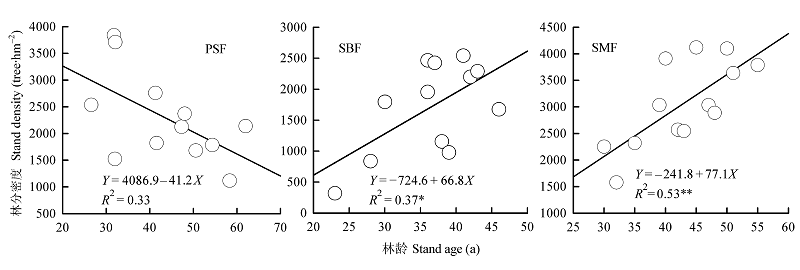
图5 三种恢复森林类型林分密度与林龄的关系。PSF, 人工云杉林; SBF, 次生桦木林; SMF, 次生针阔混交林。
Fig. 5 Relationships between stand density and stand age of three recovery forest types. PSF, planted spruce (Picea asperata) forest; SBF, secondary birch (Betula spp.) forest; SMF, secondary coniferous and broad-leaved mixed forest. *, p < 0.05; **, p < 0.01.
| [1] |
Achard F, Eva HD, Stibig HJ, Mayaux P, Gallego J, Richards T, Malingreau JP (2002). Determination of deforestation rates of the world’s humid tropical forests. Science, 297, 999-1002.
DOI URL PMID |
| [2] | Barr AG, Black TA, Hogg EH, Griffis TJ, Morgenstern K, Kljun N, Theede A, Nesic Z (2007). Climatic controls on the carbon and water balances of a boreal aspen forest, 1994-2003. Global Change Biology, 13, 561-576. |
| [3] | Biondi F (1999). Comparing tree-ring chronologies and repeated timber inventories as forest monitoring tools. Ecological Applications, 9, 216-227. |
| [4] | Brienen RJW, Zuidema PA (2006). The use of tree rings in tropical forest management: projecting timber yields of four Bolivian tree species. Forest Ecology and Management, 226, 256-267. |
| [5] |
Dixon RK, Solomon AM, Brown S, Houghton RA, Trexier MC, Wisniewski J (1994). Carbon pools and flux of global forest ecosystems. Science, 263, 185-190.
DOI URL PMID |
| [6] | Fang JY (方精云) (2000). Forest biomass carbon pool of middle and high latitudes in the north hemisphere is probably much smaller than present estimates. Acta Phytoecologica Sinica (植物生态学报), 24, 635-638. (in Chinese with English abstract) |
| [7] | Grissino-Mayer HD (2003). A manual and tutorial for the proper use of an increment borer. Tree-Ring Research, 59, 63-79. |
| [8] | Kljun N, Black TA, Griffis TJ, Barr AG, Gaumont-Guay D, Morgenstern K, McCaughey JH, Nesic Z (2006). Response of net ecosystem productivity of three boreal forest stands to drought. Ecosystems, 9, 1128-1144. |
| [9] | Lin B (林波), Liu Q (刘庆), Wu Y (吴彦), Pang XY (庞学勇), He H (何海) (2003). Effect of forest litters on soil physical and chemical properties in subalpine coniferous forests of western Sichuan. China Journal of Applied & Environ- mental Biology (应用与环境生物学报), 9, 346-351. (in Chinese with English abstract) |
| [10] | Liu YC (刘彦春), Zhang YD (张远东), Liu SR (刘世荣) (2010a). Aboveground biomass, ANPP and stem volume of birch stands in natural restoration process of subalpine secondary forest in western Sichuan. Acta Ecologica Sinica (生态学报), 30, 594-601. (in Chinese with English abstract) |
| [11] | Liu YC (刘彦春), Zhang YD (张远东), Liu SR (刘世荣), Zhang XH (张笑鹤) (2010b). Changes of tree layer aboveground biomass, ANPP to altitudinal gradient in the subalpine secondary mixed forest of western Sichuan, China. Acta Ecologica Sinica (生态学报), 30, 5810-5820. (in Chinese with English abstract) |
| [12] | Metsaranta JM, Lieffers VJ (2009). Using dendrochronology to obtain annual data for modelling stand development: a supplement to permanent sample plots. Forestry, 82, 163-173. |
| [13] | Myneni RB, Keeling CD, Tucker CJ, Asrar G, Nemani RR (1997). Increased plant growth in the northern high latitudes from 1981 to 1991. Nature, 386, 698-702. |
| [14] | Picket STA (1989). Space for time substitution as an alternative to long-term studies. In: Likens GE ed. Long-Term Studies in Ecology: Approaches and Alternatives. Springer, New York, 110-135. |
| [15] | Rozas V (2004). A dendroecological reconstruction of age structure and past management in an old-growth pollarded parkland in northern Spain. Forest Ecology and Management, 195, 205-219. |
| [16] | Shi LX (史立新), Wang JX (王金锡), Su YM (宿以明), Hou GW (侯广维) (1988). The early succession process of vegetation at cut-over area of dark coniferous forest in Miyaluo, West Sichuan. Acta Phytoecologica et Geobotanica Sinica (植物生态学与地植物学学报), 12, 306-313. (in Chinese with English abstract) |
| [17] | van Gemerden BS, Olff H, Parren MPE, Bongers F (2003). The pristine rain forest? Remnants of historical human impacts on current tree species composition and diversity. Journal of Biogeography, 30, 1381-1390. |
| [18] |
Woodwell GM, Whittaker RH, Reiners WA, Likens GE, Delwiche CC, Botkin DB (1978). The biota and the world carbon budget. Science, 199, 141-146.
DOI URL PMID |
| [19] | Worbes M, Klinge H, Revilla JD, Martius C (1992). On the dynamics, floristic subdivision and geographical distribution of várzea forests in Central Amazonia. Journal of Vegetation Science, 3, 553-564. |
| [20] | Xian JR (鲜骏仁), Zhang YB (张远彬), Wang KY (王开运), Hu TX (胡庭兴), Yang H (杨华) (2009). Carbon stock and its allocation in five forest ecosystems in the subalpine coniferous forest zone of western Sichuan Province, Southwest China. Chinese Journal of Plant Ecology (植物生态学报), 33, 283-290. (in Chinese with English abstract) |
| [21] | Zhang J, Ge Y, Chang J, Jiang B, Jiang H, Peng CH, Zhu JR, Yuan WG, Qi LZ, Yu SQ (2007). Carbon storage by ecolo- gical service forests in Zhejiang Province, subtropical China. Forest Ecology and Management, 245, 64-75. |
| [22] | Zhang YD (张远东), Liu SR (刘世荣), Zhao CM (赵常明) (2005a). Spatial pattern of subalpine forest restoration in West Sichuan. Chinese Journal of Applied Ecology (应用生态学报), 16, 1706-1710. (in Chinese with English abstract) |
| [23] | Zhang YD (张远东), Zhao CM (赵常明), Liu SR (刘世荣) (2005b). The influence factors of sub-alpine forest restoration in Miyaluo, West Sichuan. Scientia Silvae Sinicae (林业科学), 41, 189-193. (in Chinese with English abstract) |
| [24] | Zhao CM (赵常明), Chen QH (陈庆恒), Qiao YK (乔永康), Pan KW (潘开文) (2002). Dynamics of species diversity in the restoration process of artificial spruce conifer forest in the eastern edge of Qinghai-Tibetan Plateau. Acta Phytoecologica Sinica (植物生态学报), 26, 20-29. (in Chinese with English abstract) |
| [1] | 张静, 陈洁, 李艳朋, 盘李军, 许涵, 李意德, 何海生. 南亚热带针阔混交人工林植物生物量比较及其影响因子分析[J]. 植物生态学报, 2026, 50(2): 400-416. |
| [2] | 徐恩相, 周蕾, 章晓炜, 张国萍, 仲杜伟, 黄智, 刘派, 迟永刚. 基于不同生育阶段冠层光谱和碳通量的水稻产量估算[J]. 植物生态学报, 2026, 50(1): 82-93. |
| [3] | 朱瑞德, 杨俊薇, 刘宵含, 陈冰瑞, 池秀莲, 田地, 杨光, 程蒙, 戴亚峰, 王诗文. 霍山石斛设施和林下栽培模式中养分对植物-微生物关联的调控[J]. 植物生态学报, 2025, 49(9): 1434-1447. |
| [4] | 宋珊珊, 唐志尧. 河北塞罕坝草甸草原根际土壤真菌与植物地上生物量的关系[J]. 植物生态学报, 2025, 49(9): 1461-1471. |
| [5] | 邢强, 赵斌, 胡永红, 杨君, 秦俊, 刘何铭, 王红兵, 周鹏. 华东地区两种典型立体绿化植物根系性状特征及对新型土壤基质的响应[J]. 植物生态学报, 2025, 49(9): 1498-1514. |
| [6] | 张法伟, 李红琴, 祝景彬, 樊博, 周华坤, 李英年, 梁乃申. 氮添加和降水改变对高寒草甸生态系统地上与地下碳储的影响[J]. 植物生态学报, 2025, 49(9): 1399-1409. |
| [7] | 樊月玲, 蒋正德, 叶佳舒, 郑立臣, 陈欣. 2005-2015年下辽河平原农田长期观测样地主要农作物收获期性状和产量数据集[J]. 植物生态学报, 2025, 49(8): 1271-1282. |
| [8] | 刘新月, 王立平, 刘春和, 孙艳丽, 刘鹏, 田赟, 贾昕, 查天山, 钱多. 北京不同林龄人工林生物量空间格局及其影响因素[J]. 植物生态学报, 2025, 49(6): 939-951. |
| [9] | 马腾飞, 郝杰, 刁华杰, 宁亚楠, $\boxed{\hbox{王常慧}}$, 董宽虎. 晋北农牧交错带草地土壤无机氮含量的季节变化及其对放牧强度的响应[J]. 植物生态学报, 2025, 49(6): 965-974. |
| [10] | 陈文义, 王智勇, 周梦岩, 麻文俊, 王军辉, 罗志斌, 周婧. 幼龄楸树生物量分配规律与异速生长模型[J]. 植物生态学报, 2025, 49(2): 356-366. |
| [11] | 鲁浩斐, 戴岳, 安外尔·阿卜杜热伊木, 叶转兄. 不同地下水埋深条件下胡杨和多枝柽柳的径向生长对气候变化的响应[J]. 植物生态学报, 2025, 49(11): 1890-1906. |
| [12] | 郝毅晴, 刘伟, 杨阳, 安冰儿, 范冰, 李超, 崔久辉, 程延彬, 孙佳美, 潘庆民. 有机肥和无机肥对退化草原羊草种群密度和个体生物量的影响[J]. 植物生态学报, 2025, 49(1): 148-158. |
| [13] | 董云焘, 贾恒锋, 杨晶, 李佩轩, 方欧娅. 祁连山中部祁连圆柏林干扰历史重建[J]. 植物生态学报, 2024, 48(8): 967-976. |
| [14] | 张鹏, 焦亮, 薛儒鸿, 魏梦圆, 杜达石, 吴璇, 王旭鸽, 李倩. 干旱强度影响祁连山西段不同海拔青海云杉的生长恢复[J]. 植物生态学报, 2024, 48(8): 977-987. |
| [15] | 王燕, 张全智, 王传宽, 郭万桂, 蔺佳玮. 恢复方式对东北东部森林土壤碳氮磷计量特征的影响[J]. 植物生态学报, 2024, 48(7): 943-954. |
| 阅读次数 | ||||||
|
全文 |
|
|||||
|
摘要 |
|
|||||
Copyright © 2026 版权所有 《植物生态学报》编辑部
地址: 北京香山南辛村20号, 邮编: 100093
Tel.: 010-62836134, 62836138; Fax: 010-82599431; E-mail: apes@ibcas.ac.cn, cjpe@ibcas.ac.cn
备案号: 京ICP备16067583号-19

