
植物生态学报 ›› 2013, Vol. 37 ›› Issue (2): 104-110.DOI: 10.3724/SP.J.1258.2013.00011 cstr: 32100.14.SP.J.1258.2013.00011
王鑫厅1,2,*( ), 梁存柱1,**(), 王炜1
收稿日期:2012-10-08
接受日期:2012-11-21
出版日期:2013-10-08
发布日期:2013-01-31
作者简介:** (E-mail: bilcz@imu.edu.cn)基金资助:
WANG Xin-Ting1,2,*(), LIANG Cun-Zhu1,**(), WANG Wei1
Received:2012-10-08
Accepted:2012-11-21
Online:2013-10-08
Published:2013-01-31
摘要:
群落中的种群密度由于空间尺度的变化而存在着一定差异, 那么, 某一种群的密度随着空间尺度的变化会发生怎样的变化?抑或某一物种相对于另一物种而言, 随着空间尺度的变化其密度会怎样变化?这是与尺度有关的种群密度问题, 当属生态学的基本问题。该文提出这样的问题, 并把不同尺度下的种群密度称之为尺度密度(scale density)。O-Ring函数的实质是计算不同尺度下的种群密度。因此, 在研究实例中, 应用O-Ring函数计算了典型草原处于不同恢复阶段的羊草(Leymus chinensis)种群、米氏冰草(Agropyron michnoi)种群, 以及米氏冰草种群相对于羊草种群在不同尺度下的种群密度, 结果发现: 羊草和米氏冰草2个种群的尺度密度, 在小尺度范围内严重退化群落均高于恢复演替群落, 这一结果验证了“胁迫梯度假说”, 同时表明该结果是放牧胁迫下正相互作用所致; 通过比较羊草种群与米氏冰草相对于羊草的尺度密度发现, 在严重退化的群落中, 羊草与米氏冰草的种间关联为负联结, 这种负联结是由正相互作用引起的, 而在恢复8年和恢复21年群落中, 二者之间是正联结, 当为竞争所致。该实例说明分析种群密度随尺度变化的规律对于深入认识生态学问题可能会有很大帮助。
王鑫厅, 梁存柱, 王炜. 尺度与密度: 测定不同尺度下的种群密度. 植物生态学报, 2013, 37(2): 104-110. DOI: 10.3724/SP.J.1258.2013.00011
WANG Xin-Ting, LIANG Cun-Zhu, WANG Wei. Scale and density: measuring local neighborhood density at different spatial scales. Chinese Journal of Plant Ecology, 2013, 37(2): 104-110. DOI: 10.3724/SP.J.1258.2013.00011
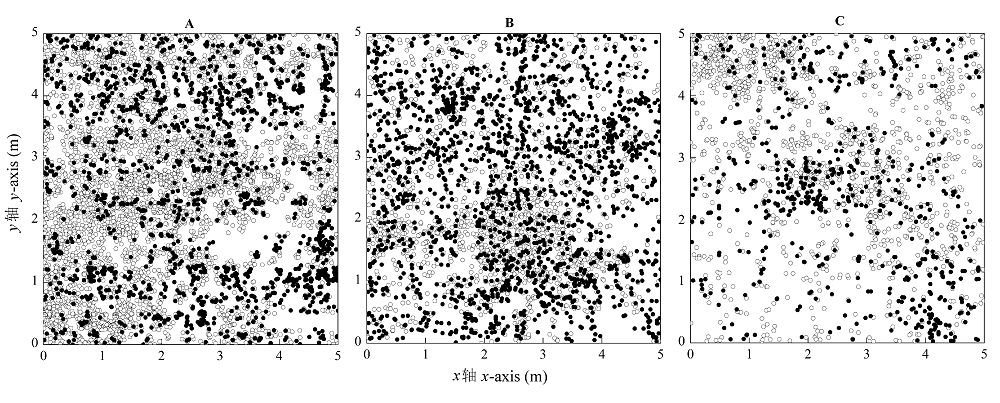
图1 不同恢复演替阶段羊草与米氏冰草种群的位点图。A, 严重退化群落。B, 恢复8年群落。C, 恢复21年群落。●, 羊草;○, 米氏冰草。
Fig. 1 Mapped points pattern of Leymus chinensis and Agropyron michnoi in different restoring succession stages. A, Seriously degraded community. B, 8-year-old restoring community. C, 21-year-old restoring community. ●, Leymus chinensis; ○, Agropyron michnoi.
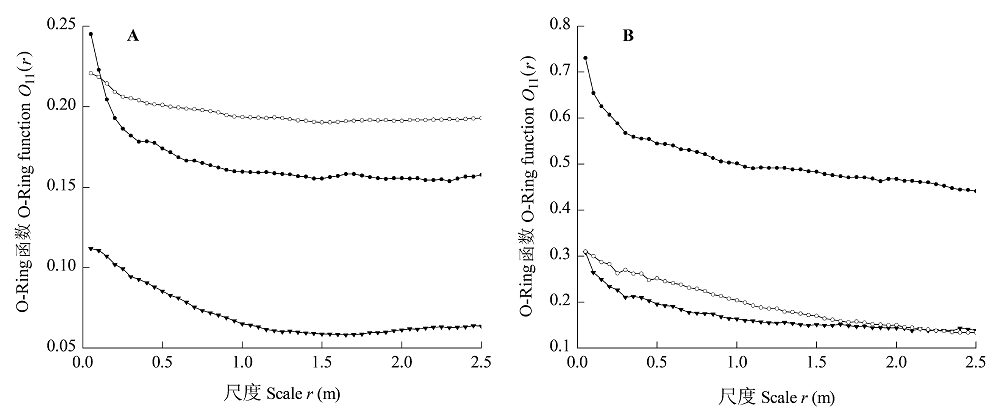
图2 不同恢复演替阶段羊草与米氏冰草种群的尺度密度。A, 羊草。B, 米氏冰草。 ●, 严重退化群落; ○, 恢复8年群落; ▼,恢复21年群落。
Fig. 2 Scale density of Leymus chinensis and Agropyron michnoi community in different restoring succession stages. A, Leymus chinensis. B, Agropyron michnoi. ●, seriously degraded community; ○, 8-year-old restoring community; ▼, 21-year-old restoring community.
| 种群 Population | 零恢复群落 0-year-old restoring community | 恢复8年群落 8-year-old restoring community | 恢复21年群落 21-year-old restoring community |
|---|---|---|---|
| 羊草 Leymus chinensis | 65.96 | 74.76 | 25.04 |
| 米氏冰草 Agropyron michnoi | 175.92 | 59.12 | 57.44 |
表1 不同恢复演替阶段的种群密度(株·m-2)
Table 1 Population density in different restoring succession stages (plants·m-2)
| 种群 Population | 零恢复群落 0-year-old restoring community | 恢复8年群落 8-year-old restoring community | 恢复21年群落 21-year-old restoring community |
|---|---|---|---|
| 羊草 Leymus chinensis | 65.96 | 74.76 | 25.04 |
| 米氏冰草 Agropyron michnoi | 175.92 | 59.12 | 57.44 |
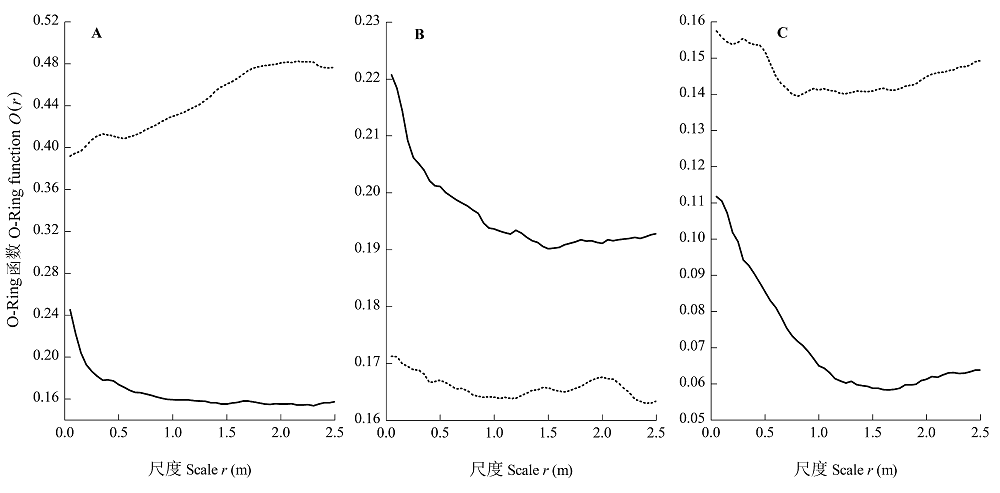
图3 不同恢复演替阶段羊草与米氏冰草相对于羊草的尺度密度。A, 严重退化群落。B, 恢复8年群落。C, 恢复21年群落。--,羊草; ????, 米氏冰草相对于羊草。
Fig. 3 Scale density of Leymus chinensis and Agropyron michnoi relative to Leymus chinensis in different restoring succession stages. A, Seriously degraded community. B, 8-year-old restoring community. C, 21-year-old restoring community. --, Leymus chinensis; ????, Agropyron michnoi relative to Leymus chinensis.
| [1] | Bertness MD, Callaway RM (1994). Positive interactions in communities. Trends in Ecology & Evolution, 9, 191-193. |
| [2] | Callaway RM (2007). Positive Interactions and Interdependence in Plant Communities. Springer, The Netherlands. |
| [3] | Callaway RM, Walker LR (1997). Competition and facilitation: a synthetic approach to interactions in plant communities. Ecology, 78, 1958-1965. |
| [4] | Galiano EF (1982). Pattern detection in plant populations through the analysis of plant-to-all-plants distances. Vegetatio, 49, 39-43. |
| [5] | Le Moine JM, Chen JQ (2003). Placing our hypotheses and results in time and space. Acta Phytoecologica Sinica (植物生态学报), 27, 1-10. |
| [6] | Ripley BD (1977). Modelling spatial patterns. Journal of the Royal Statistical Society, Series B, 39, 172-212. |
| [7] | Ripley BD (1981). Spatial Statistics. Wiley, New York. |
| [8] | Turkington R, Harper JL (1979). The growth, distribution and neighbour relationships of Trifolium repens in a permanent pasture. I. Ordination, pattern and contact. Journal of Ecology, 67, 201-218. |
| [9] | Wang MB, Wu YL (2004). English-Chinese Dictionary of Ecology. Science Press, Beijing. (in Chinese) |
| [ 王孟本, 毋月莲 (2004). 英汉生态学词典. 科学出版社, 北京.] | |
| [10] | Wang W, Liang CZ, Liu ZL, Hao DY (2000). Analysis of the plant individual behaviour during the degradation and restoring succession in steppe community. Acta Phytoecologica Sinica, 24, 268-274. (in Chinese with English abstract) |
| [ 王炜, 梁存柱, 刘钟龄, 郝敦元 (2000). 草原群落退化与恢复演替中的植物个体行为分析. 植物生态学报, 24, 268-274.] | |
| [11] | Wang W, Liu ZL, Hao DY, Liang CZ (1996a). Research on the restoring succession of the degenerated grassland in Inner Mongolia. I. Basic characteristics and driving force for restoration of the degenerated grassland. Acta Phytoecologica Sinica, 20, 449-459. (in Chinese with English abstract) |
| [ 王炜, 刘钟龄, 郝敦元, 梁存柱 (1996a). 内蒙古草原退化群落恢复演替的研究. I. 退化草原的基本特征与恢复演替动力. 植物生态学报, 20, 449-459.] | |
| [12] | Wang W, Liu ZL, Hao DY, Liang CZ (1996b). Research on the restoring succession of the degenerated grassland in Inner Mongolia. II. Analysis of the restoring processes. Acta Phytoecologica Sinica, 20, 460-471. (in Chinese with English abstract) |
| [ 王炜, 刘钟龄, 郝敦元, 梁存柱 (1996b). 内蒙古草原退化群落恢复演替的研究. II. 恢复演替时间进程的分析. 植物生态学报, 20, 460-471.] | |
| [13] | Wang XT, Hou YL, Liu F, Chang Y, Wang W, Liang CZ, Miao BL (2011). Point pattern analysis of dominant populations in a degraded community in Leymus chinensis + Stipa grandis steppe in Inner Mongolia, China. Chinese Journal of Plant Ecology, 35, 1281-1289. (in Chinese with English abstract) |
| [ 王鑫厅, 侯亚丽, 刘芳, 常英, 王炜, 梁存柱, 苗百岭 (2011). 羊草+大针茅草原退化群落优势种群空间点格局分析. 植物生态学报, 35, 1281-1289.] | |
| [14] | Wang XT, Wang W, Liu JH, Liang CZ, Zhang T (2006). A new method measuring plant population spatial patterns: photography orientation. Journal of Plant Ecology (Chinese Version), 30, 571-575. (in Chinese with English abstract) |
| [ 王鑫厅, 王炜, 刘佳慧, 梁存柱, 张韬 (2006). 植物种群空间分布格局测定的新方法: 摄影定位法. 植物生态学报, 30, 571-575.] | |
| [15] | Wiegand T, Gunatilleke S, Gunatilleke N (2007). Species associations in a heterogeneous Sri Lankan Dipterocarp forest. The American Naturalist, 170, 77-95. |
| [16] | Wiegand T, Moloney KA (2004). Rings, circles, and null-models for point pattern analysis in ecology. Oikos, 104, 209-229. |
| [17] | Yang C (2008). Ecology. 2nd edn. Higher Education Press, Beijing. (in Chinese) |
| [ 杨持 (2008). 生态学. 第二版. 高等教育出版社, 北京.] |
| [1] | 曹伊菲, 苏涛, 曹敏, 汪海燕, 杨洁. 新生代被子植物叶脉密度演化的驱动因素研究:气候适应与植食压力[J]. , 2027, 51(动植物互作): 0-. |
| [2] | 封逸凡, 朱时应, 周淑荣, 江乐乐, 陈隆, 王苗, 邓国芳, 刘兰. 热带次生林恢复中土壤微生物对菌根化树苗存活和生长性状的影响[J]. 植物生态学报, 2026, 50(预发表): 1-. |
| [3] | 郝雅昕, 金光泽, 刘志理. 生长季不同阶段和枝龄对常绿针叶树种枝性状的影响[J]. 植物生态学报, 2026, 50(2): 279-292. |
| [4] | 王德利. 生态学的基本原理[J]. 植物生态学报, 2026, 50(1): 24-33. |
| [5] | 张建华, 周晓阳, 段珊珊, 白佳妮, 徐龙超. 北京东灵山2种典型灌丛碳密度分配特征[J]. 植物生态学报, 2025, 49(10): 1721-1732. |
| [6] | 郝毅晴, 刘伟, 杨阳, 安冰儿, 范冰, 李超, 崔久辉, 程延彬, 孙佳美, 潘庆民. 有机肥和无机肥对退化草原羊草种群密度和个体生物量的影响[J]. 植物生态学报, 2025, 49(1): 148-158. |
| [7] | 马琳, 巢林, 何雨莎, 李忠国, 王爱华, 刘晟源, 胡宝清, 刘艳艳. 热带喀斯特季节性雨林12个树种木质部栓塞抗性与其解剖结构及相关性状间的关系[J]. 植物生态学报, 2024, 48(7): 888-902. |
| [8] | 秦嘉晨, 王欢, 朱江, 王扬, 田晨, 白永飞, 杨培志, 郑淑霞. 基于种内与种间性状变异的放牧过滤作用及其尺度效应[J]. 植物生态学报, 2024, 48(7): 858-871. |
| [9] | 王小林, 周维, 赵梅, 丁钰桐, 杨冬梅, 张吟霜, 尹梦琪, 庄悦, 彭国全. 雷竹和青皮竹导管结构的轴向变化[J]. 植物生态学报, 2024, 48(7): 915-929. |
| [10] | 文佳, 张新娜, 王娟, 赵秀海, 张春雨. 性状调节幼苗存活率对邻体竞争和环境的响应[J]. 植物生态学报, 2024, 48(6): 719-729. |
| [11] | 强亚琪, 张新娜, 王娟, 张春雨. 东北天然次生林同种和异种密度制约效应随生活史阶段变化规律[J]. 植物生态学报, 2024, 48(12): 1612-1622. |
| [12] | 赵榕江, 陈焘, 董丽佳, 郭辉, 马海鲲, 宋旭, 王明刚, 薛伟, 杨强. 植物-土壤反馈及其在生态学中的研究进展[J]. 植物生态学报, 2023, 47(10): 1333-1355. |
| [13] | 史欢欢, 雪穷, 于振林, 汪承焕. 密度、物种比例对盐沼植物种子萌发阶段种内、种间相互作用的影响[J]. 植物生态学报, 2023, 47(1): 77-87. |
| [14] | 张慧, 曾文静, 龚新桃, 马泽清. 亚热带典型树种根毛特征及其与共生真菌的关系[J]. 植物生态学报, 2023, 47(1): 88-100. |
| [15] | 冯继广, 张秋芳, 袁霞, 朱彪. 氮磷添加对土壤有机碳的影响: 进展与展望[J]. 植物生态学报, 2022, 46(8): 855-870. |
| 阅读次数 | ||||||
|
全文 |
|
|||||
|
摘要 |
|
|||||
Copyright © 2026 版权所有 《植物生态学报》编辑部
地址: 北京香山南辛村20号, 邮编: 100093
Tel.: 010-62836134, 62836138; Fax: 010-82599431; E-mail: apes@ibcas.ac.cn, cjpe@ibcas.ac.cn
备案号: 京ICP备16067583号-19

