
植物生态学报 ›› 2025, Vol. 49 ›› Issue (11): 1919-1933.DOI: 10.17521/cjpe.2024.0352 cstr: 32100.14.cjpe.2024.0352
田彤彤1, 尚博1,2,*( ), 徐彦森1,2, 袁相洋1,2, 刘硕3, 冯兆忠1,2
收稿日期:2024-10-10
接受日期:2025-01-10
出版日期:2025-11-20
发布日期:2025-11-20
通讯作者:
*尚博(shangbo@nuist.edu.cn)基金资助:
TIAN Tong-Tong1, SHANG Bo1,2,*(), XU Yan-Sen1,2, YUAN Xiang-Yang1,2, LIU Shuo3, FENG Zhao-Zhong1,2
Received:2024-10-10
Accepted:2025-01-10
Online:2025-11-20
Published:2025-11-20
Supported by:摘要: 臭氧(O3)污染和氮添加对植物光合作用的复合影响仍存在争议, 这可能与测定时期、时间及叶片位置等因素有关。该研究利用开顶式气室, 以杂交杨树(Populus euramericana cv. ‘74/76’)扦插苗为研究对象, 设置了两个O3浓度处理(NF: 环境大气; NF45: 环境大气+ 45 nmol·mol-1 O3), 并在每个O3处理下嵌套设置4个氮添加处理, 旨在探究杨树整个生长季中不同的时期、一天内不同时间及不同的叶片位置下光合参数对O3和氮添加的响应差异。结果表明, 在4个氮处理下, 与NF处理相比, NF45处理显著地降低了整个生长季光合速率(Pn)、气孔导度(gs)和叶绿素含量(SPAD), 分别降低了44.2%、18.2%和24.7%, 并且增加了胞间CO2浓度(Ci) 9.0%, 表明O3对杨树叶片Pn的降低主要是由非气孔因素限制的。比较生长季不同时期的结果发现, O3处理对杨树生长中后期Pn和SPAD的抑制作用显著强于前期。同时, 不同叶位光合参数对O3的响应也存在差异, NF45处理显著降低了下部叶片的Pn和SPAD, 而对最上部叶位的Pn和SPAD则有所增加, 表明植物在应对O3胁迫时表现出一定的补偿效应。一天内不同时间的测定结果表明, O3导致杨树叶片Pn降低的幅度不同, 但O3和时间对杨树叶片光合参数不存在统计学上显著的交互影响。氮添加下整个生长季杨树叶片的Pn和SPAD显著升高, Ci显著降低, 但gs没有显著的变化。氮添加对光合的促进作用在杨树的不同生长时期和不同叶位上无显著差异。此外, O3和氮添加对所有光合参数都未观察到显著的交互效应, 表明氮添加并没有缓解O3对杨树光合的负面影响。综上所述, 评估O3污染对森林生态系统碳固定能力影响时, 考虑植物叶片生长阶段和位置的异质性是十分必要的, 该研究也为在空气污染背景下优化人工林氮肥管理措施提供科学依据。
田彤彤, 尚博, 徐彦森, 袁相洋, 刘硕, 冯兆忠. 臭氧浓度升高和氮添加对杨树不同叶位和生长时期光合特性的影响. 植物生态学报, 2025, 49(11): 1919-1933. DOI: 10.17521/cjpe.2024.0352
TIAN Tong-Tong, SHANG Bo, XU Yan-Sen, YUAN Xiang-Yang, LIU Shuo, FENG Zhao-Zhong. Effects of elevated ozone concentration and nitrogen addition on the photosynthetic characteristics of poplar at different leaf positions and growth stages. Chinese Journal of Plant Ecology, 2025, 49(11): 1919-1933. DOI: 10.17521/cjpe.2024.0352
| 变量 Parameter | 净光合速率 Net photosynthetic rate | 气孔导度 Stomatal conductance | 胞间CO2浓度 Intercellular CO2 concentration | 叶绿素相对值 Relative chlorophyll content |
|---|---|---|---|---|
| 臭氧 O3 | <0.01 | <0.01 | <0.01 | <0.01 |
| 氮处理 Nitrogen (N) | <0.01 | 0.33 | <0.01 | <0.01 |
| 时期 Date | <0.01 | <0.01 | <0.01 | <0.01 |
| 臭氧×氮处理 O3 × N | 0.49 | 0.72 | 0.37 | 0.65 |
| 臭氧×时期 O3 × Date | <0.01 | 0.32 | <0.01 | <0.01 |
| 氮处理×时期 N × Date | 0.40 | 0.10 | 0.18 | 0.02 |
| 臭氧×氮处理×时期 O3 × N × Date | 0.70 | 0.63 | 0.90 | 0.02 |
表1 臭氧处理、氮添加和杨树不同生长时期以及交互作用对光合参数影响的重复测量方差分析结果
Table 1 RM-ANOVA results (p values) of the interaction between O3 treatment, nitrogen addition, different growth stages and their interaction on photosynthetic parameters of poplar
| 变量 Parameter | 净光合速率 Net photosynthetic rate | 气孔导度 Stomatal conductance | 胞间CO2浓度 Intercellular CO2 concentration | 叶绿素相对值 Relative chlorophyll content |
|---|---|---|---|---|
| 臭氧 O3 | <0.01 | <0.01 | <0.01 | <0.01 |
| 氮处理 Nitrogen (N) | <0.01 | 0.33 | <0.01 | <0.01 |
| 时期 Date | <0.01 | <0.01 | <0.01 | <0.01 |
| 臭氧×氮处理 O3 × N | 0.49 | 0.72 | 0.37 | 0.65 |
| 臭氧×时期 O3 × Date | <0.01 | 0.32 | <0.01 | <0.01 |
| 氮处理×时期 N × Date | 0.40 | 0.10 | 0.18 | 0.02 |
| 臭氧×氮处理×时期 O3 × N × Date | 0.70 | 0.63 | 0.90 | 0.02 |
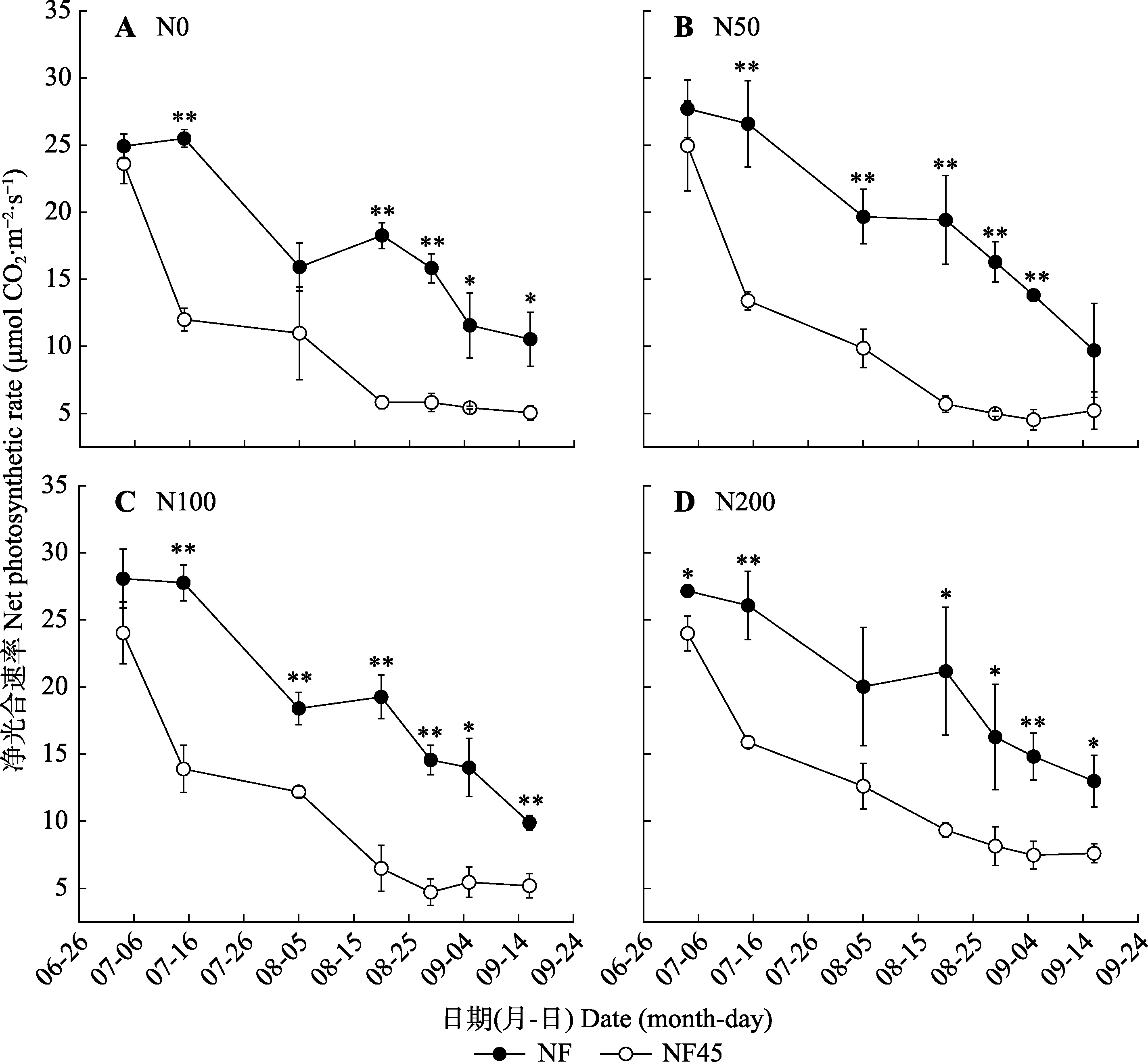
图1 不同臭氧和氮添加处理对杨树不同生长时期叶片光合速率(Pn)的影响(平均值±标准差)。NF表示环境大气, NF45表示环境大气+ 45 nmol·mol-1 O3; N0表示不添加氮, N50、N100和N200分别表示添加50、100和200 kg N·hm-2·a-1。*, p < 0.05; **, p < 0.01。
Fig. 1 Effects of different ozone and nitrogen (N) addition treatments on the leaf photosynthetic rate (Pn) of poplar at different growth stages (mean ± SD). NF, non-filtered ambient air; NF45, NF + 45 nmol·mol-1 O3. N0, no N added; N50, N0 + 50 kg N·hm-2·a-1; N100, N0 + 100 kg N·hm-2·a-1; N200, N0 + 200 kg N·hm-2·a-1. *, p < 0.05; **, p < 0.01.
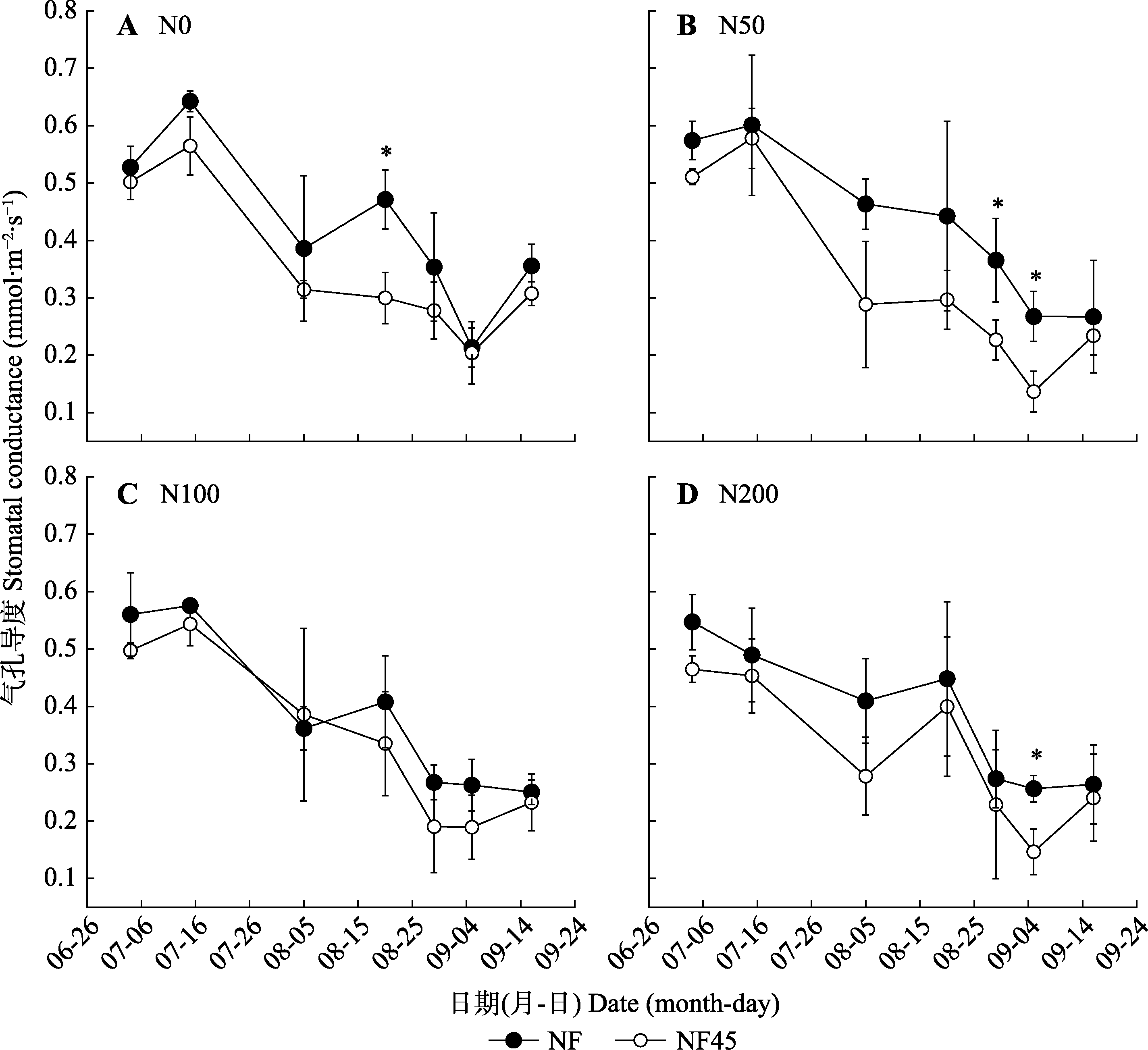
图2 不同臭氧和氮添加处理对杨树不同生长时期叶片气孔导度(gs)的影响(平均值±标准差)。NF表示环境大气, NF45表示环境大气+ 45 nmol·mol-1 O3; N0表示不添加氮, N50、N100和N200分别表示添加50、100和200 kg N·hm-2·a-1。*, p < 0.05; **, p < 0.01。
Fig. 2 Effects of different ozone and nitrogen (N) addition treatments on the stomatal conductance (gs) of poplar at different growth stages (mean ± SD). NF, non-filtered ambient air; NF45, NF + 45 nmol·mol-1 O3. N0, no N added; N50, N0 + 50 kg N·hm-2·a-1; N100, N0 + 100 kg N·hm-2·a-1; N200, N0 + 200 kg N·hm-2·a-1. *, p < 0.05; **, p < 0.01.
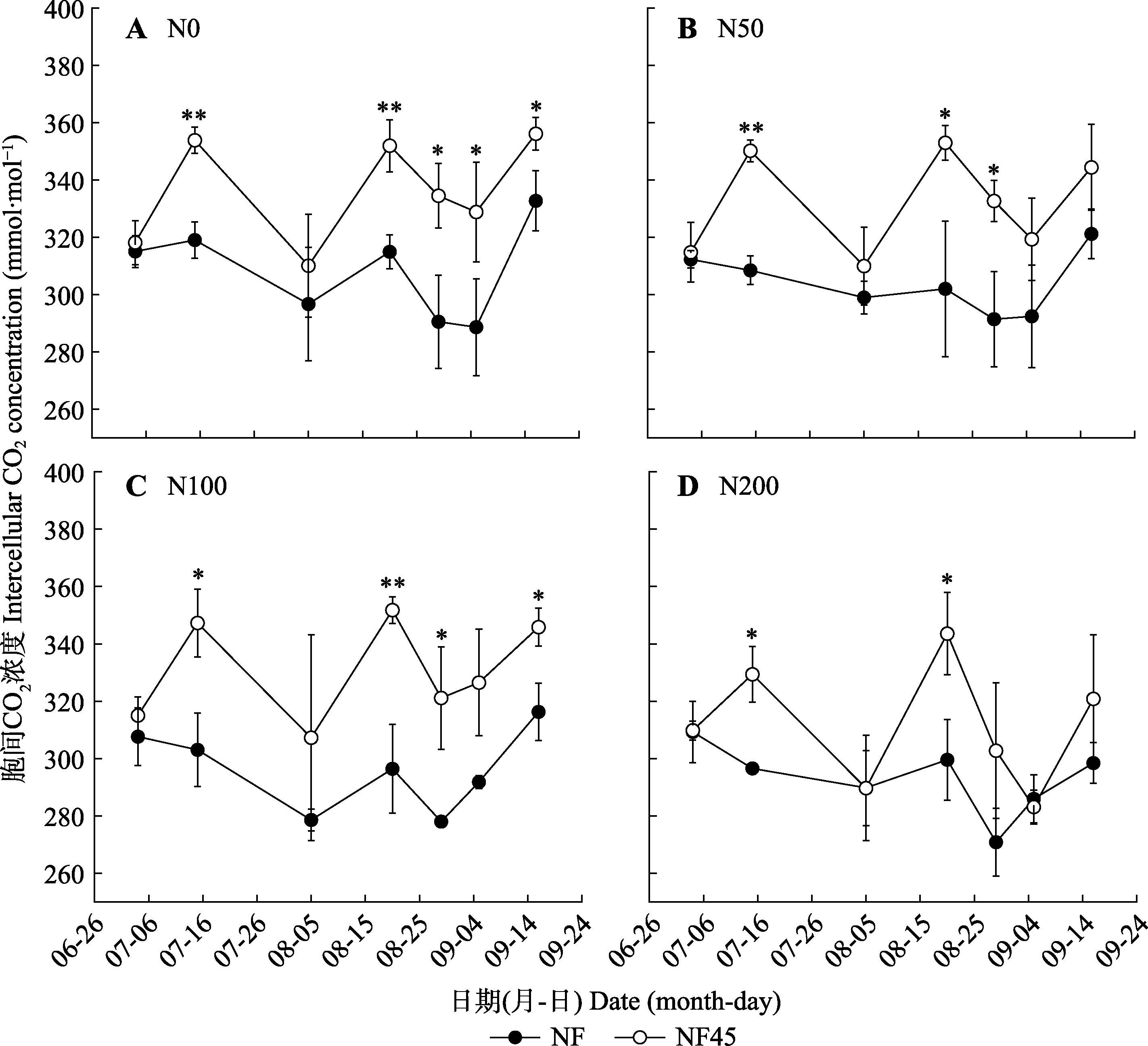
图3 不同臭氧和氮添加处理对杨树不同生长时期叶片胞间CO2浓度(Ci)的影响(平均值±标准差)。NF表示环境大气, NF45表示环境大气+ 45 nmol·mol-1 O3; N0表示不添加氮, N50、N100和N200分别表示添加50、100和200 kg N·hm-2·a-1。*, p < 0.05; **, p < 0.01。
Fig. 3 Effects of different ozone and nitrogen (N) addition treatments on the intercellular CO2 concentration (Ci) of poplar at different growth stages (mean ± SD). NF, non-filtered ambient air; NF45, NF + 45 nmol·mol-1 O3. N0, no N added; N50, N0 + 50 kg N·hm-2·a-1; N100, N0 + 100 kg N·hm-2·a-1; N200, N0 + 200 kg N·hm-2·a-1. *, p < 0.05; **, p < 0.01.
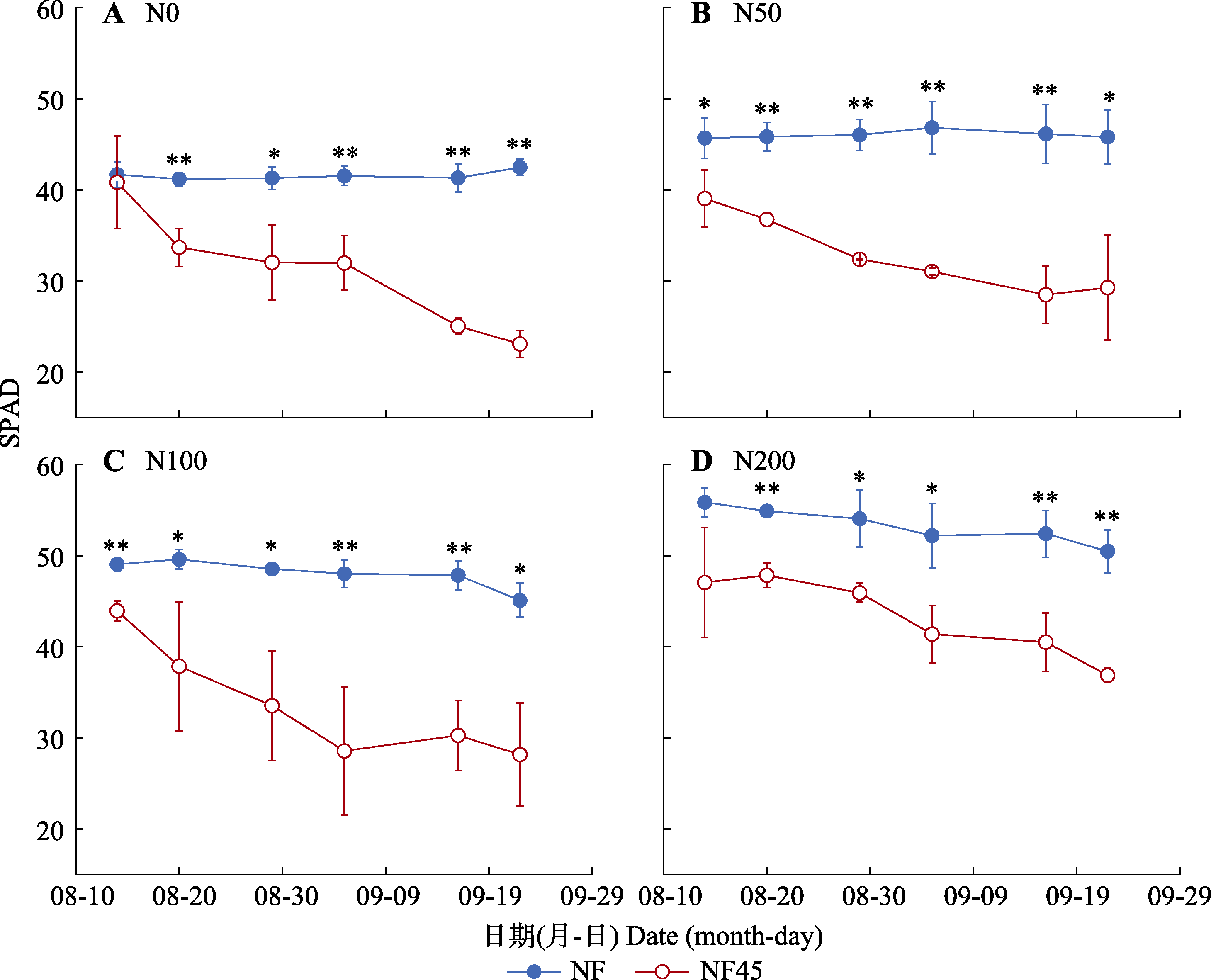
图4 不同臭氧和氮添加处理对杨树不同生长时期叶片叶绿素相对值(SPAD)的影响(平均值±标准差)。NF表示环境大气, NF45表示环境大气+ 45 nmol·mol-1 O3; N0表示不添加氮, N50、N100和N200分别表示添加50、100和200 kg N·hm-2·a-1。*, p < 0.05; **, p < 0.01。
Fig. 4 Effects of different ozone and nitrogen (N) addition treatments on the relative chlorophyll content (SPAD) of poplar at different growth stages (mean ± SD). NF, non-filtered ambient air; NF45, NF + 45 nmol·mol-1 O3. N0, no N added; N50, N0 + 50 kg N·hm-2·a-1; N100, N0 + 100 kg N·hm-2·a-1; N200, N0 + 200 kg N·hm-2·a-1. *, p < 0.05; **, p < 0.01.
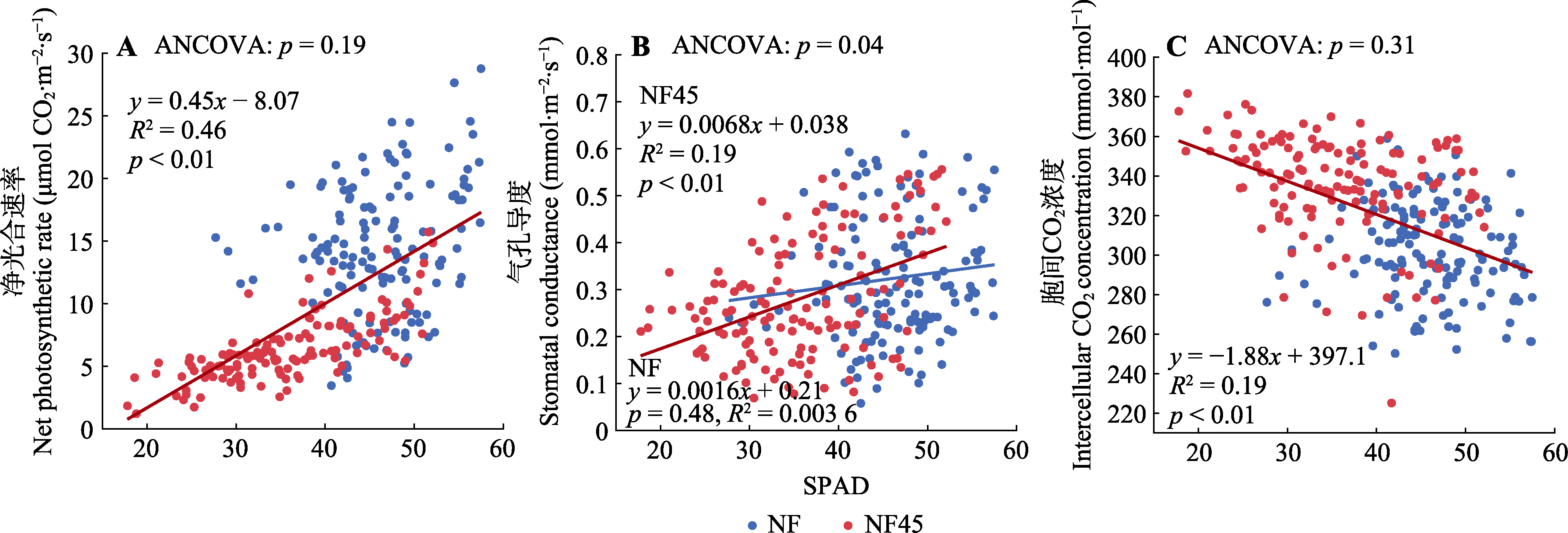
图5 整个生长季不同臭氧处理下杨树叶片相对叶绿素(SPAD)与光合速率(Pn)、气孔导度(gs)、胞间CO2浓度(Ci)的线性关系。NF表示环境大气, NF45表示环境大气+ 45 nmol·mol-1 O3。ANCOVA, 协方差分析。
Fig. 5 Linear relationship between relative chlorophyll content (SPAD) and photosynthetic rate (Pn), stomatal conductance (gs), and intercellular CO2 concentration (Ci) of poplar leaves under different ozone treatments throughout the growth season. NF, non-filtered ambient air; NF45, NF + 45 nmol·mol-1 O3. ANCOVA, analysis of covariance.
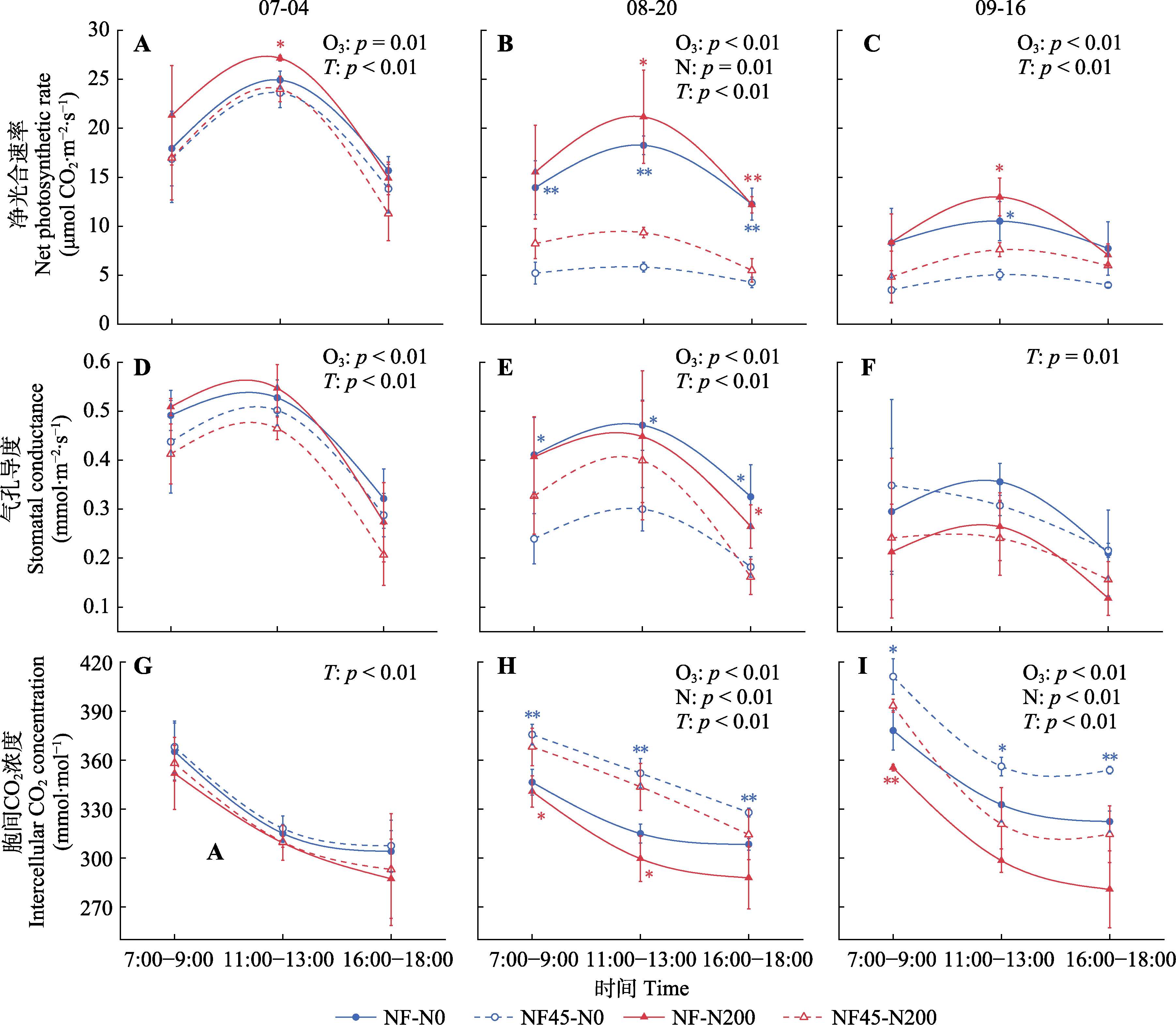
图6 不同臭氧(O3)和氮(N)添加处理对杨树叶片光合速率(Pn)、气孔导度(gs)、胞间CO2浓度(Ci)日变化(T)特征的影响(平均值±标准差)。NF表示环境大气, NF45表示环境大气+ 45 nmol·mol-1 O3; N0表示不添加氮, N200表示添加200 kg N·hm-2·a-1。蓝色*表示N0处理下两个O3处理下的差异显著; 红色*表示N200处理下两个O3处理下的差异显著; *, p < 0.05; **, p < 0.01。图中仅展示了统计学显著的p值。
Fig. 6 Effects of different ozone (O3) and nitrogen (N) addition treatments on the diurnal variation (T) of photosynthetic rate (Pn), stomatal conductance (gs), and intercellular CO2 concentration (Ci) in poplar leaves (mean ± SD). NF, non-filtered ambient air; NF45, NF + 45 nmol mol-1·O3. N0, no N added; N200, N0 + 200 kg N·hm-2·a-1. The blue asterisk indicated significant differences between the two O3 treatments under N0 treatment; The red asterisk indicated a significant difference between the two O3 treatments under N200 treatment. *, p < 0.05; **, p < 0.01. Only statistically significant p-values are shown.
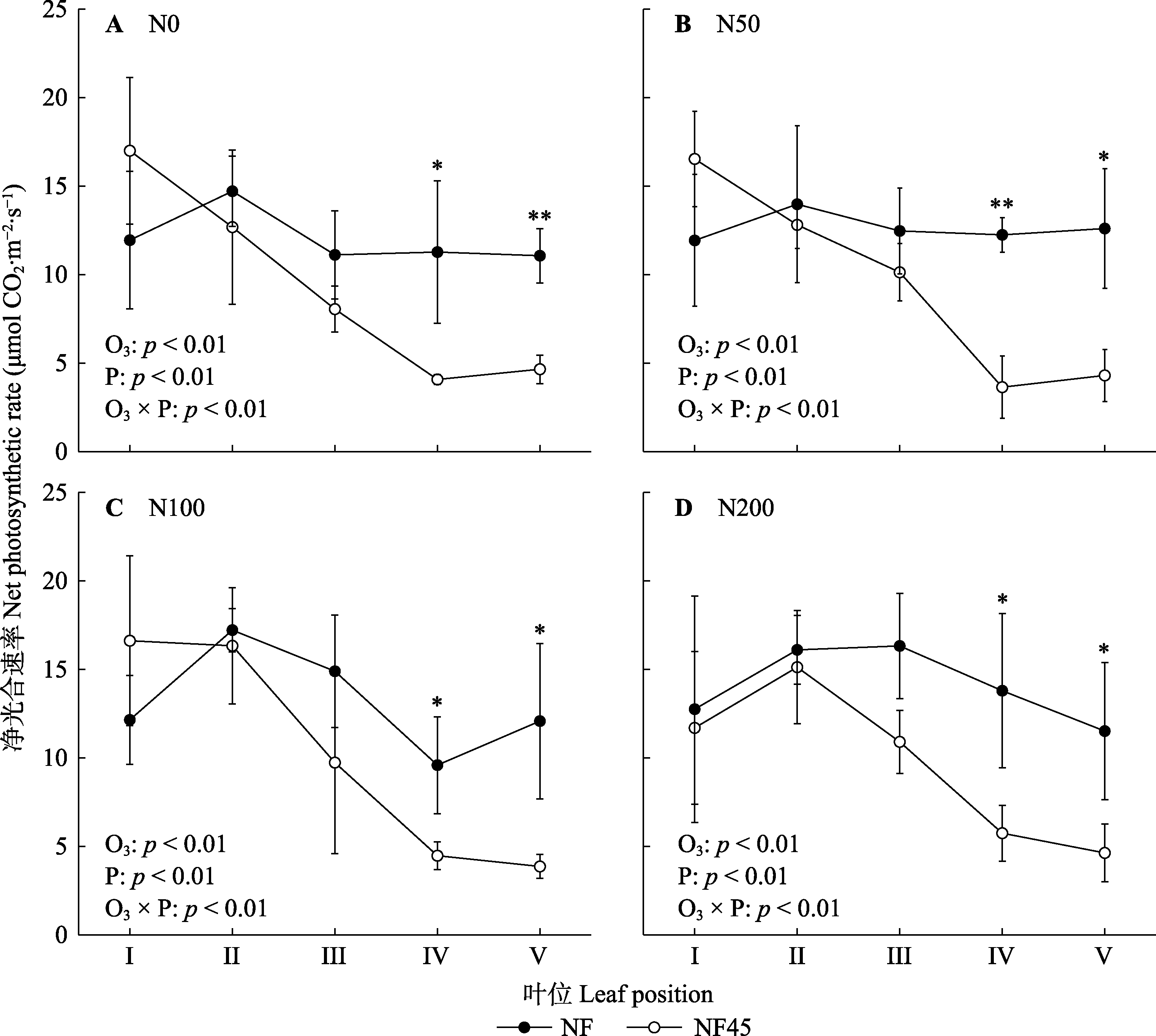
图7 不同臭氧(O3)和氮(N)添加处理对杨树不同叶位(P)光合速率(Pn)的影响(平均值±标准差)。NF表示环境大气, NF45表示环境大气+ 45 nmol·mol-1 O3; N0表示不添加氮, N50、N100和N200分别表示添加50、100和200 kg N·hm-2·a-1。*, p < 0.05; **, p < 0.01。I-V分别表示从上到下的1-5、6-10、11-15、16-20、21至底部的叶片。
Fig. 7 Effects of different ozone (O3) and nitrogen (N) addition treatments on the photosynthetic rate (Pn) at different leaf positions (P) of poplar (mean ± SD). NF, non-filtered ambient air; NF45, NF + 45 nmol·mol-1 O3. N0, no N added; N50, N0 + 50 kg N·hm-2·a-1; N100, N0 + 100 kg N·hm-2·a-1; N200, N0 + 200 kg N·hm-2·a-1. *, p < 0.05; **, p < 0.01. I-V is 1-5, 6-10, 11-15, 16-20, 21 to botton leaves form top to bottom, respectively.
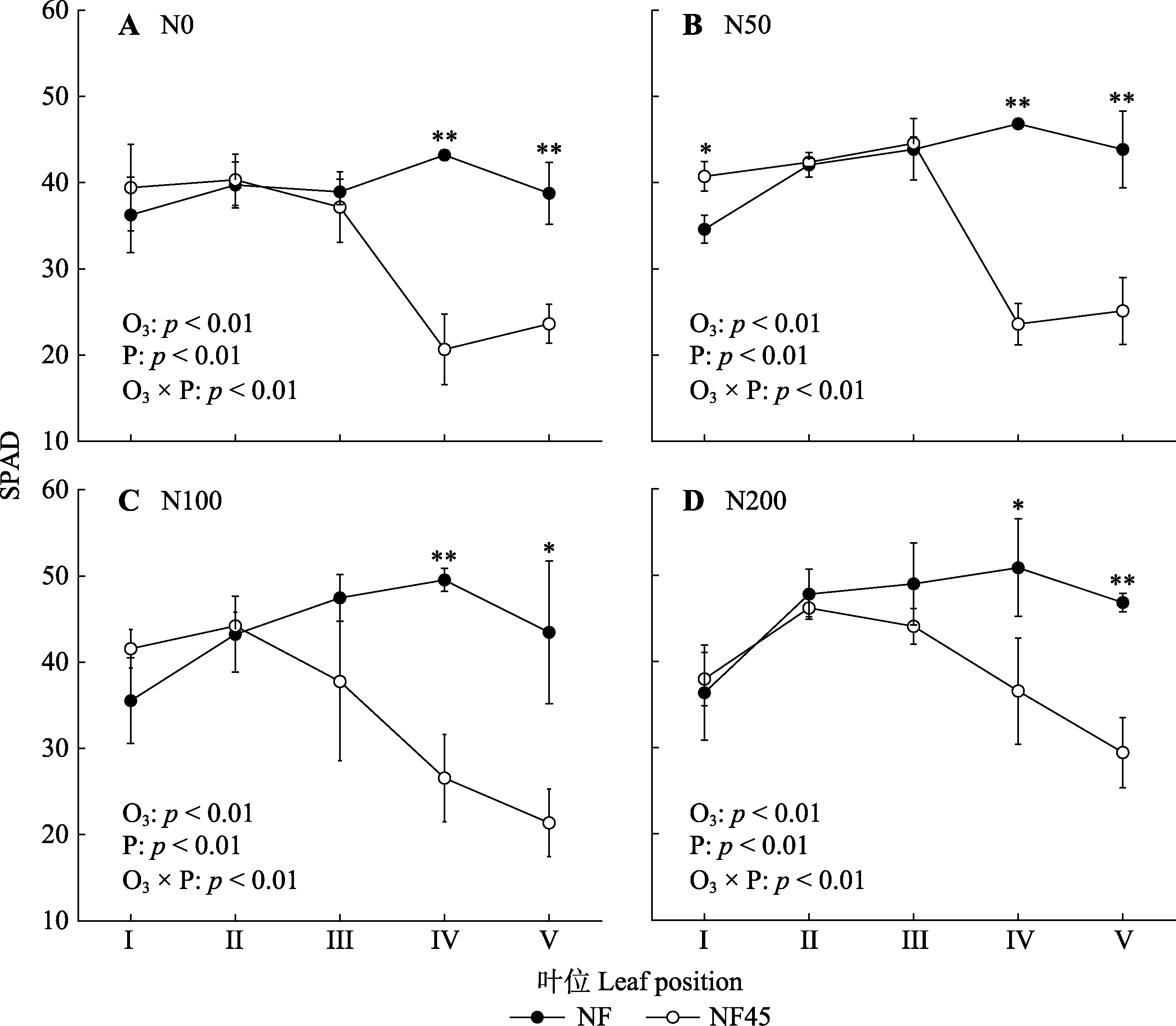
图8 不同臭氧(O3)和氮(N)添加处理对杨树不同叶位(P)叶绿素相对含量(SPAD)的影响(平均值±标准差)。NF表示环境大气, NF45表示环境大气+ 45 nmol·mol-1 O3; N0表示不添加氮, N50、N100和N200分别表示添加50、100和200 kg N·hm-2·a-1。*, p < 0.05; **, p < 0.01。I-V分别表示从上到下的1-5、6-10、11-15、16-20、21至底部的叶片。
Fig. 8 Effects of different ozone (O3) and nitrogen (N) addition treatments on the relative chlorophyll content (SPAD) at different leaf positions (P) of poplar (mean ± SD). NF, non-filtered ambient air; NF45, NF + 45 nmol·mol-1 O3. N0, no N added; N50, N0 + 50 kg N·hm-2·a-1; N100, N0 + 100 kg N·hm-2·a-1; N200, N0 + 200 kg N·hm-2·a-1. *, p < 0.05; **, p < 0.01. I-V is 1-5, 6-10, 11-15, 16-20, 21 to botton leaves form top to bottom, respectively.
| [1] | Agathokleous E, Feng ZZ, Oksanen E, Sicard P, Wang Q, Saitanis CJ, Araminiene V, Blande JD, Hayes F, Calatayud V, Domingos M, Veresoglou SD, Peñuelas J, Wardle DA, de Marco A, et al. (2020). Ozone affects plant, insect, and soil microbial communities: a threat to terrestrial ecosystems and biodiversity. Science Advances, 6, eabc1176. DOI: 10.1126/sciadv.abc1176. |
| [2] |
Ainsworth EA, Rogers A, Leakey ADB, Heady LE, Gibon Y, Stitt M, Schurr U (2007). Does elevated atmospheric [CO2] alter diurnal C uptake and the balance of C and N metabolites in growing and fully expanded soybean leaves? Journal of Experimental Botany, 58, 579-591.
DOI PMID |
| [3] |
Ainsworth EA, Yendrek CR, Sitch S, Collins WJ, Emberson LD (2012). The effects of tropospheric ozone on net primary productivity and implications for climate change. Annual Review of Plant Biology, 63, 637-661.
DOI PMID |
| [4] |
Andersen CP (2003). Source-sink balance and carbon allocation below ground in plants exposed to ozone. New Phytologist, 157, 213-228.
DOI PMID |
| [5] |
Azuchi F, Kinose Y, Matsumura T, Kanomata T, Uehara Y, Kobayashi A, Yamaguchi M, Izuta T (2014). Modeling stomatal conductance and ozone uptake of Fagus crenata grown under different nitrogen loads. Environmental Pollution, 184, 481-487.
DOI URL |
| [6] |
Bohler S, Sergeant K, Lefèvre I, Jolivet Y, Hoffmann L, Renaut J, Dizengremel P, Hausman JF (2010). Differential impact of chronic ozone exposure on expanding and fully expanded poplar leaves. Tree Physiology, 30, 1415-1432.
DOI PMID |
| [7] |
Desotgiu R, Pollastrini M, Cascio C, Gerosa G, Marzuoli R, Bussotti F (2012). Chlorophyll a fluorescence analysis along a vertical gradient of the crown in a poplar (Oxford clone) subjected to ozone and water stress. Tree Physiology, 32, 976-986.
DOI PMID |
| [8] | Feng ZZ, Li P, Yuan XY, Gao F, Jiang LJ, Dai LL (2018). Progress in ecological and environmental effects of ground- level O3 in China. Acta Ecologica Sinica, 38, 1530-1541. |
| [冯兆忠, 李品, 袁相洋, 高峰, 姜立军, 代碌碌 (2018). 我国地表臭氧生态环境效应研究进展. 生态学报, 38, 1530-1541.] | |
| [9] |
Feng ZZ, Pang J, Kobayashi K, Zhu JG, Ort DR (2011). Differential responses in two varieties of winter wheat to elevated ozone concentration under fully open-air field conditions. Global Change Biology, 17, 580-591.
DOI URL |
| [10] |
Feng ZZ, Shang B, Gao F, Calatayud V (2019a). Current ambient and elevated ozone effects on poplar: a global meta-analysis and response relationships. Science of the Total Environment, 654, 832-840.
DOI URL |
| [11] |
Feng ZZ, Shang B, Li ZZ, Calatayud V, Agathokleous E (2019b). Ozone will remain a threat for plants independently of nitrogen load. Functional Ecology, 33, 1854-1870.
DOI URL |
| [12] |
Feng ZZ, Wang L, Pleijel H, Zhu J, Kobayashi K (2016). Differential effects of ozone on photosynthesis of winter wheat among cultivars depend on antioxidative enzymes rather than stomatal conductance. Science of the Total Environment, 572, 404-411.
DOI URL |
| [13] |
Feng ZZ, Yuan XY, Li P, Shang B, Ping Q, Hu TJ, Liu S (2020). Progress in the effects of elevated ground-level ozone on terrestrial ecosystems. Chinese Journal of Plant Ecology, 44, 526-542.
DOI URL |
|
[冯兆忠, 袁相洋, 李品, 尚博, 平琴, 胡廷剑, 刘硕 (2020). 地表臭氧浓度升高对陆地生态系统影响的研究进展. 植物生态学报, 44, 526-542.]
DOI |
|
| [14] | Fu R, Shang B, Zhang GY, Feng ZZ (2021). Differential effects of ozone pollution on photosynthesis and growth of rice during two growth stages. Journal of Agro-Environment Science, 40, 2066-2075. |
| [付娆, 尚博, 张国友, 冯兆忠 (2021). 不同生育期臭氧熏蒸对水稻光合作用及生长的影响差异. 农业环境科学学报, 40, 2066-2075.] | |
| [15] |
Galloway JN, Townsend AR, Erisman JW, Bekunda M, Cai Z, Freney JR, Martinelli LA, Seitzinger SP, Sutton MA (2008). Transformation of the nitrogen cycle: recent trends, questions, and potential solutions. Science, 320, 889-892.
DOI PMID |
| [16] |
Gao F, Li P, Feng ZZ (2017). Interactive effects of ozone and drought stress on plants: a review. Chinese Journal of Plant Ecology, 41, 252-268.
DOI |
|
[高峰, 李品, 冯兆忠 (2017). 臭氧与干旱对植物复合影响的研究进展. 植物生态学报, 41, 252-268.]
DOI |
|
| [17] |
Hu EZ, Gao F, Xin Y, Jia HX, Li KH, Hu JJ, Feng ZZ (2015). Concentration- and flux-based ozone dose-response relationships for five poplar clones grown in North China. Environmental Pollution, 207, 21-30.
DOI PMID |
| [18] | Hu JW, Wang QC, Ma SJ (2020). Research advances in precision fertilization regime for plantation forests. World Forestry Research, 33, 37-42. |
| [胡建文, 王庆成, 马双娇 (2020). 人工林精准施肥研究进展. 世界林业研究, 33, 37-42.] | |
| [19] |
Johnson DW, Curtis PS (2001). Effects of forest management on soil C and N storage: meta analysis. Forest Ecology and Management, 140, 227-238.
DOI URL |
| [20] |
Kets K, Darbah JNT, Sober A, Riikonen J, Sober J, Karnosky DF (2010). Diurnal changes in photosynthetic parameters of Populus tremuloides, modulated by elevated concentrations of CO2 and/or O3 and daily climatic variation. Environmental Pollution, 158, 1000-1007.
DOI URL |
| [21] |
Kinose Y, Fukamachi Y, Okabe S, Hiroshima H, Watanabe M, Izuta T (2017). Photosynthetic responses to ozone of upper and lower canopy leaves of Fagus crenata Blume seedlings grown under different soil nutrient conditions. Environmental Pollution, 223, 213-222.
DOI URL |
| [22] |
LeBauer DS, Treseder KK (2008). Nitrogen limitation of net primary productivity in terrestrial ecosystems is globally distributed. Ecology, 89, 371-379.
DOI PMID |
| [23] |
Li CY, Korpelainen H (2015). Transcriptomic regulatory network underlying morphological and physiological acclimation to nitrogen starvation and excess in poplar roots and leaves. Tree Physiology, 35, 1279-1282.
DOI PMID |
| [24] |
Li K, Jacob DJ, Liao H, Shen L, Zhang Q, Bates KH (2019). Anthropogenic drivers of 2013-2017 trends in summer surface ozone in China. Proceedings of the National Academy of Sciences of the United States of America, 116, 422-427.
DOI PMID |
| [25] |
Li P, Feng ZZ, Catalayud V, Yuan XY, Xu YS, Paoletti E (2017). A meta-analysis on growth, physiological, and biochemical responses of woody species to ground-level ozone highlights the role of plant functional types. Plant, Cell & Environment, 40, 2369-2380.
DOI URL |
| [26] |
Li P, Zhou HM, Feng ZZ (2021). Ozone pollution, nitrogen addition, and drought stress interact to affect non- structural carbohydrates in the leaves and fine roots of poplar. Environmental Science, 42, 1004-1012.
DOI URL |
| [李品, 周慧敏, 冯兆忠 (2021). 臭氧污染、氮沉降和干旱胁迫交互作用对杨树叶和细根非结构性碳水化合物的影响. 环境科学, 42, 1004-1012.] | |
| [27] | Li SJ, Yuan XY, Feng ZZ, Du YD, Agathokleous E, Paoletti E (2022). Whole-plant compensatory responses of isoprene emission from hybrid poplar seedlings exposed to elevated ozone. Science of the Total Environment, 806, 150949. DOI: 10.1016/j.scitotenv.2021.150949. |
| [28] |
Liang XY, Zhang T, Lu XK, Ellsworth DS, BassiriRad H, You CM, Wang D, He PC, Deng Q, Liu H, Mo JM, Ye Q (2020). Global response patterns of plant photosynthesis to nitrogen addition: a meta-analysis. Global Change Biology, 26, 3585-3600.
DOI PMID |
| [29] |
Liu XJ, Zhang Y, Han WX, Tang AH, Shen JL, Cui ZL, Vitousek P, Erisman JW, Goulding K, Christie P, Fangmeier A, Zhang FS (2013). Enhanced nitrogen deposition over China. Nature, 494, 459-462.
DOI |
| [30] | Lu X, Hong JY, Zhang L, Cooper OR, Schultz MG, Xu XB, Wang T, Gao M, Zhao YH, Zhang YH (2018a). Severe surface ozone pollution in China: a global perspective. Environmental Science & Technology Letters, 5, 487-494. |
| [31] | Lu XK, Vitousek PM, Mao QG, Gilliam FS, Luo YQ, Zhou GY, Zou XM, Bai E, Scanlon TM, Hou EQ, Mo JM (2018b). Plant acclimation to long-term high nitrogen deposition in an N-rich tropical forest. Proceedings of the National Academy of Sciences of the United States of America, 115, 5187-5192. |
| [32] |
Mäenpää M, Riikonen J, Kontunen-Soppela S, Rousi M, Oksanen E (2011). Vertical profiles reveal impact of ozone and temperature on carbon assimilation of Betula pendula and Populus tremula. Tree Physiology, 31, 808-818.
DOI PMID |
| [33] | Maurer S, Matyssek R (1997). Nutrition and the ozone sensitivity of birch (Betula pendula). Trees, 12, 11-20. |
| [34] | Ning Z, Hou YK, Xu X (2024). Optimized strategies for nitrogen fertilizer application in Populus plantations in the context of climate change mitigation. Forest Policy and Economics, 159, 103139. DOI: 10.1016/j.forpol.2023.103139. |
| [35] |
Olsson P, Linder S, Giesler R, Högberg P (2005). Fertilization of boreal forest reduces both autotrophic and heterotrophic soil respiration. Global Change Biology, 11, 1745-1753.
DOI URL |
| [36] |
Pell EJ, Sinn JP, Johansen CV (1995). Nitrogen supply as a limiting factor determining the sensitivity of Populus tremuloides Michx. to ozone stress. New Phytologist, 130, 437-446.
DOI URL |
| [37] | Pukkala T (2017). Optimal nitrogen fertilization of boreal conifer forest. Forest Ecosystems, 4, 3. DOI: 10.1186/s40663-017-0090-2. |
| [38] |
Reay DS, Dentener F, Smith P, Grace J, Feely RA (2008). Global nitrogen deposition and carbon sinks. Nature Geoscience, 1, 430-437.
DOI |
| [39] |
Ren W, Tian HQ, Tao B, Chappelka A, Sun G, Lu CQ, Liu ML, Chen GS, Xu XF (2011). Impacts of tropospheric ozone and climate change on net primary productivity and net carbon exchange of China’s forest ecosystems. Global Ecology and Biogeography, 20, 391-406.
DOI URL |
| [40] | Shang B, Deng TT, Chen H, Xu YS, Feng ZZ (2024). Effects of elevated ozone on physiology, growth, yield and grain quality of rice (Oryza sativa L.): an ozone gradient experiment. Agriculture, Ecosystems & Environment, 363, 108858. DOI: 10.1016/j.agee.2023.108858. |
| [41] |
Shang B, Feng ZZ, Li P, Calatayud V (2018). Elevated ozone affects C, N and P ecological stoichiometry and nutrient resorption of two poplar clones. Environmental Pollution, 234, 136-144.
DOI PMID |
| [42] | Shang B, Feng ZZ, Li P, Yuan XY, Xu YS, Calatayud V (2017). Ozone exposure- and flux-based response relationships with photosynthesis, leaf morphology and biomass in two poplar clones. Science of the Total Environment, 603, 185-195. |
| [43] | Shang B, Xu YS, Peng JL, Agathokleous E, Feng ZZ (2021). High nitrogen addition decreases the ozone flux by reducing the maximum stomatal conductance in poplar saplings. Environmental Pollution, 272, 115979. DOI: 10.1016/j.envpol.2020.115979. |
| [44] |
Stevens CJ, Dise NB, Owen Mountford J, Gowing DJ (2004). Impact of nitrogen deposition on the species richness of grasslands. Science, 303, 1876-1879.
PMID |
| [45] |
Sugai T, Watanabe T, Kita K, Koike T (2019). Nitrogen loading increases the ozone sensitivity of larch seedlings with higher sensitivity to nitrogen loading. Science of the Total Environment, 663, 587-595.
DOI URL |
| [46] |
Sutton MA, Simpson D, Levy PE, Smith RI, Reis S, van Oijen M, de Vries W (2008). Uncertainties in the relationship between atmospheric nitrogen deposition and forest carbon sequestration. Global Change Biology, 14, 2057-2063.
DOI URL |
| [47] |
Vingarzan R (2004). A review of surface ozone background levels and trends. Atmospheric Environment, 38, 3431-3442.
DOI URL |
| [48] |
Wang JL, Liu G, Liu FX, Zhu JG (2019). Responses of antioxidant enzymes to chronic free-air ozone stress in rice (Oryza sativa L.) cultivars with different ozone-sensitivities. Bulletin of Environmental Contamination and Toxicology, 103, 428-434.
DOI |
| [49] |
Wang L, Pang J, Feng ZZ, Zhu JG, Kobayashi K (2015). Diurnal variation of apoplastic ascorbate in winter wheat leaves in relation to ozone detoxification. Environmental Pollution, 207, 413-419.
DOI PMID |
| [50] |
Wang Z, Ma L, Jia ZK, Wei HX, Duan J (2016). Interactive effects of irrigation and exponential fertilization on nutritional characteristics in Populus × euramericana cv. ‘74/76’ cuttings in an open-air nursery in Beijing, China. Journal of Forestry Research, 27, 569-582.
DOI URL |
| [51] |
Wittig VE, Ainsworth EA, Naidu SL, Karnosky DF, Long SP (2009). Quantifying the impact of current and future tropospheric ozone on tree biomass, growth, physiology and biochemistry: a quantitative meta-analysis. Global Change Biology, 15, 396-424.
DOI URL |
| [52] |
Wu F, Zhang HQ, Fang FR, Wu N, Zhang YX, Tang M (2017). Effects of nitrogen and exogenous Rhizophagus irregularis on the nutrient status, photosynthesis and leaf anatomy of Populus × canadensis ‘Neva’. Journal of Plant Growth Regulation, 36, 824-835.
DOI URL |
| [53] |
Xu YS, Feng ZZ, Kobayashi K (2021). Performances of a system for free-air ozone concentration elevation with poplar plantation under increased nitrogen deposition. Environmental Science and Pollution Research, 28, 58298-58309.
DOI |
| [54] |
Xu YS, Feng ZZ, Peng JL, Tarvainen L (2022). Elevated ozone decreases the activity of Rubisco in poplar but not its activation under fluctuating light. Tree Physiology, 42, 1762-1775.
DOI URL |
| [55] |
Xu YS, Feng ZZ, Shang B, Dai LL, Uddling J, Tarvainen L (2019). Mesophyll conductance limitation of photosynthesis in poplar under elevated ozone. Science of the Total Environment, 657, 136-145.
DOI URL |
| [56] |
Yamaguchi M, Watanabe M, Iwasaki M, Tabe C, Matsumura H, Kohno Y, Izuta T (2007). Growth and photosynthetic responses of Fagus crenata seedlings to O3 under different nitrogen loads. Trees, 21, 707-718.
DOI URL |
| [57] |
Yendrek CR, Leisner CP, Ainsworth EA (2013). Chronic ozone exacerbates the reduction in photosynthesis and acceleration of senescence caused by limited N availability in Nicotiana sylvestris. Global Change Biology, 19, 3155-3166.
DOI PMID |
| [58] | Zhang H, Tian TT, Shang B, Feng ZZ (2024). Effects of elevated ozone on the photosynthesis of different rice cultivars under different fertilization measures. Acta Ecologica Sinica, 44, 5583-5595. |
| [张涵, 田彤彤, 尚博, 冯兆忠 (2024). 不同施肥措施臭氧浓度升高对不同水稻品种光合特性的影响. 生态学报, 44, 5583-5595.] | |
| [59] | Zhang SR, Gao RF (2000). Ecophysiological characteristics of photosynthesis of hybrid poplar clones under light stress. Acta Phytoecologica Sinica, 24, 528-533. |
| [张守仁, 高荣孚 (2000). 光胁迫下杂种杨无性系光合生理生态特性的研究. 植物生态学报, 24, 528-533.] | |
| [60] |
Zhang WW, Feng ZZ, Wang XK, Niu JF (2012). Responses of native broadleaved woody species to elevated ozone in subtropical China. Environmental Pollution, 163, 149-157.
DOI URL |
| [61] |
Zhang WW, Feng ZZ, Wang XK, Niu JF (2014). Impacts of elevated ozone on growth and photosynthesis of Metasequoia glyptostroboides Hu et Cheng. Plant Science, 226, 182-188.
DOI URL |
| [1] | 李燚, 黄欢, 赵艳超, 陈立同. 养分添加对不同海拔高寒草甸群落多样性及组成的影响[J]. 植物生态学报, 2026, 50(预发表): 0-. |
| [2] | 张安宁, 肖亚宁, 赵霞, 张淼, 崔瀚文, 陈书燕, 安黎哲. 青藏高原灌木化与氮添加对土壤线虫及功能性状的交互作用[J]. 植物生态学报, 2026, 50(预发表): 0-. |
| [3] | 侯霄帆, 马辰涵, 孙语倩, 高钰涵, 李品. 臭氧胁迫下叶片与细根凋落物分解的生态化学计量特征差异[J]. 植物生态学报, 2026, 50(2): 268-278. |
| [4] | 皮惠之, 张秋芳, 孙浩, 曾泉鑫, 彭园珍, 元晓春, 徐建国, 陈岳民. 微生物碳氮不平衡影响罗浮栲林土壤微生物氮利用效率对氮富集的响应[J]. 植物生态学报, 2026, 50(1): 34-44. |
| [5] | 冯梅, 欧阳胜男, 李迈和, 周晓倩, 铁烈华, 申卫军, 段洪浪. 前期氮添加对无梗花栎幼苗干旱响应中地上-地下碳氮分配动态的影响[J]. 植物生态学报, 2025, 49(9): 1527-1542. |
| [6] | 张法伟, 李红琴, 祝景彬, 樊博, 周华坤, 李英年, 梁乃申. 氮添加和降水改变对高寒草甸生态系统地上与地下碳储的影响[J]. 植物生态学报, 2025, 49(9): 1399-1409. |
| [7] | 郝杰, 刁华杰, 苏原, 武帅楷, 高阳阳, 梁雯君, 牛慧敏, 杨倩雯, 常婕, 王袼, 许雯丽, 马腾飞, 董宽虎, $\boxed{\hbox{王常慧}}$. 降水调控农牧交错带盐渍化草地净初级生产力对氮添加及刈割的响应[J]. 植物生态学报, 2025, 49(5): 710-719. |
| [8] | 唐远翔, 熊仕臣, 朱洪锋, 张新生, 游成铭, 刘思凝, 谭波, 徐振锋. 长期氮添加对四川盆地西缘常绿阔叶林优势树种凋落叶产量及碳氮磷归还的影响[J]. 植物生态学报, 2025, 49(5): 720-731. |
| [9] | 闫小莉, 刘贵梅, 李小玉, 江宇翔, 全小强, 王燕茹, 曲鲁平, 汤行昊. 不同氮添加水平和铵硝态氮配比环境下木荷幼苗光合及叶绿素荧光特性[J]. 植物生态学报, 2025, 49(4): 624-637. |
| [10] | 冉佳鑫, 张宇辉, 王云, 杨智杰, 毛超. 增温和氮磷添加对亚热带森林凋落物溶解有机碳生物可降解性的影响[J]. 植物生态学报, 2024, 48(9): 1232-1242. |
| [11] | 全小强, 王燕茹, 李小玉, 梁海燕, 王立冬, 闫小莉. 氮添加和铵硝态氮配比对杉木幼苗光合特性及叶绿素荧光参数的影响[J]. 植物生态学报, 2024, 48(8): 1050-1064. |
| [12] | 杨尚锦, 范云翔, 章毓文, 韩巧玲, 赵玥, 段劼, 邸楠, 席本野. 树木夜间液流组分划分方法对比——以毛白杨为例[J]. 植物生态学报, 2024, 48(4): 496-507. |
| [13] | 黄玲, 王榛, 马泽, 杨发林, 李岚, SEREKPAYEV Nurlan, NOGAYEV Adilbek, 侯扶江. 长期放牧和氮添加对黄土高原典型草原长芒草种群生长的影响[J]. 植物生态学报, 2024, 48(3): 317-330. |
| [14] | 耿雪琪, 唐亚坤, 王丽娜, 邓旭, 张泽凌, 周莹. 氮添加增加中国陆生植物生物量并降低其氮利用效率[J]. 植物生态学报, 2024, 48(2): 147-157. |
| [15] | 颜辰亦, 龚吉蕊, 张斯琦, 张魏圆, 董学德, 胡宇霞, 杨贵森. 氮添加对内蒙古温带草原土壤活性有机碳的影响[J]. 植物生态学报, 2024, 48(2): 229-241. |
| 阅读次数 | ||||||
|
全文 |
|
|||||
|
摘要 |
|
|||||
Copyright © 2026 版权所有 《植物生态学报》编辑部
地址: 北京香山南辛村20号, 邮编: 100093
Tel.: 010-62836134, 62836138; Fax: 010-82599431; E-mail: apes@ibcas.ac.cn, cjpe@ibcas.ac.cn
备案号: 京ICP备16067583号-19

