
植物生态学报 ›› 2026, Vol. 50 ›› Issue (1): 94-106.DOI: 10.17521/cjpe.2024.0298 cstr: 32100.14.cjpe.2024.0298
梁天豪1,2,3, 吴帆1,2, 黄锦学1,2, 景陈鸿1,2,3, 傅贺菁1,2,3, 杨智杰1,2,3, 熊德成1,2,3,*( )
)
收稿日期:2024-09-04
接受日期:2025-01-27
出版日期:2026-01-20
发布日期:2026-02-13
通讯作者:
*熊德成(xdc104@163.com)基金资助:
LIANG Tian-Hao1,2,3, WU Fan1,2, HUANG Jin-Xue1,2, JING Chen-Hong1,2,3, FU He-Jing1,2,3, YANG Zhi-Jie1,2,3, XIONG De-Cheng1,2,3,*()
Received:2024-09-04
Accepted:2025-01-27
Online:2026-01-20
Published:2026-02-13
Contact:
*XIONG De-Cheng (xdc104@163.com)Supported by:摘要:
为了揭示气候变暖对我国亚热带地区常绿阔叶天然林细根生长量和形态特征的影响, 在福建三明森林生态系统国家野外科学观测研究站开展常绿阔叶天然林野外原位土壤增温实验, 采用内生长环法探究增温在雨季(5月)和旱季(11月)对常绿阔叶天然林吸收根(直径<1 mm)和运输根(直径1-2 mm)的生长量及形态特征的影响。结果表明: 与对照相比, 在雨季, 增温处理使得吸收根的生长量显著降低41.2%, 细根(直径0-2 mm)总生长量无显著变化, 吸收根和运输根的直径和长度均没有显著变化, 吸收根的比根长(SRL)和比根表面积(SRA)均显著降低53.2%和42.9%, 吸收根的组织密度(RTD)显著增加28.8%; 在旱季, 增温处理使得吸收根、运输根和细根总生长量均显著增加, 吸收根和运输根的长度分别显著增加38.5%和33.5%, 吸收根和运输根的直径、SRL、SRA和RTD均无显著变化。在未来气候变暖背景下, 中亚热带地区常绿阔叶天然林具有较强的适应能力。雨季, 细根表现出更高的可塑性, 主要是调整吸收根性状来降低增温对细根资源吸收和生长的影响; 旱季, 细根则采取相对保守的防御策略, 主要是增加吸收根和运输根的长度来拓展资源吸收空间。该研究为全球变暖情景下亚热带森林生态系统不同功能细根的生态适应机制及资源获取策略的研究提供了科学依据。
梁天豪, 吴帆, 黄锦学, 景陈鸿, 傅贺菁, 杨智杰, 熊德成. 增温对中亚热带格氏栲天然林细根生长量及形态特征的影响. 植物生态学报, 2026, 50(1): 94-106. DOI: 10.17521/cjpe.2024.0298
LIANG Tian-Hao, WU Fan, HUANG Jin-Xue, JING Chen-Hong, FU He-Jing, YANG Zhi-Jie, XIONG De-Cheng. Effects of soil warming on fine root growth and morphology of Castanopsis kawakamii in mid-subtropical forests. Chinese Journal of Plant Ecology, 2026, 50(1): 94-106. DOI: 10.17521/cjpe.2024.0298
| 林分 Stand | 海拔 Altitude (m) | 坡度 Slope (°) | 林分密度 Stand density (plant·hm-2) | 植物组成 Plant composition | 平均树高 Mean tree height (m) | 平均胸径 Mean diameter at breast height (cm) |
|---|---|---|---|---|---|---|
| 格氏栲天然林 Castanopsis kawakamii natural forest | 240 | 30 | 3 285 | 格氏栲、米槠、木荷、狗骨柴、百两金和毛冬青等 Castanopsis kawakamii, Castanopsis carlesii, Schima superba, Diplospora dubia, Ardisia crispa, Ilex pubescens, et al. | 35.1 | 57.7 |
表1 格氏栲天然林概况
Table 1 Stand characteristics of Castanopsis kawakamii natural forest
| 林分 Stand | 海拔 Altitude (m) | 坡度 Slope (°) | 林分密度 Stand density (plant·hm-2) | 植物组成 Plant composition | 平均树高 Mean tree height (m) | 平均胸径 Mean diameter at breast height (cm) |
|---|---|---|---|---|---|---|
| 格氏栲天然林 Castanopsis kawakamii natural forest | 240 | 30 | 3 285 | 格氏栲、米槠、木荷、狗骨柴、百两金和毛冬青等 Castanopsis kawakamii, Castanopsis carlesii, Schima superba, Diplospora dubia, Ardisia crispa, Ilex pubescens, et al. | 35.1 | 57.7 |
| 处理 Treatment | pH | 总碳含量 Total carbon content (g·kg-1) | 总氮含量 Total nitrogen content (g·kg-1) | 矿质氮含量 Mineral nitrogen content (mg·kg-1) | NH4+-N含量 NH4+-N content (mg·kg-1) | NO3--N含量 NO3--N content (mg·kg-1) |
|---|---|---|---|---|---|---|
| CK | 4.17 ± 0.04a | 24.55 ± 0.75a | 1.67 ± 0.06a | 8.13 ± 0.66a | 6.21 ± 0.37a | 1.92 ± 0.29a |
| W | 4.24 ± 0.04a | 23.23 ± 1.06a | 1.44 ± 0.08a | 5.20 ± 0.32b | 4.77 ± 0.28b | 0.43 ± 0.04b |
表2 增温对格氏栲天然林土壤基本理化性质的影响
Table 2 Effects of warming on soil physical and chemical properties in Castanopsis kawakamii natural forest
| 处理 Treatment | pH | 总碳含量 Total carbon content (g·kg-1) | 总氮含量 Total nitrogen content (g·kg-1) | 矿质氮含量 Mineral nitrogen content (mg·kg-1) | NH4+-N含量 NH4+-N content (mg·kg-1) | NO3--N含量 NO3--N content (mg·kg-1) |
|---|---|---|---|---|---|---|
| CK | 4.17 ± 0.04a | 24.55 ± 0.75a | 1.67 ± 0.06a | 8.13 ± 0.66a | 6.21 ± 0.37a | 1.92 ± 0.29a |
| W | 4.24 ± 0.04a | 23.23 ± 1.06a | 1.44 ± 0.08a | 5.20 ± 0.32b | 4.77 ± 0.28b | 0.43 ± 0.04b |
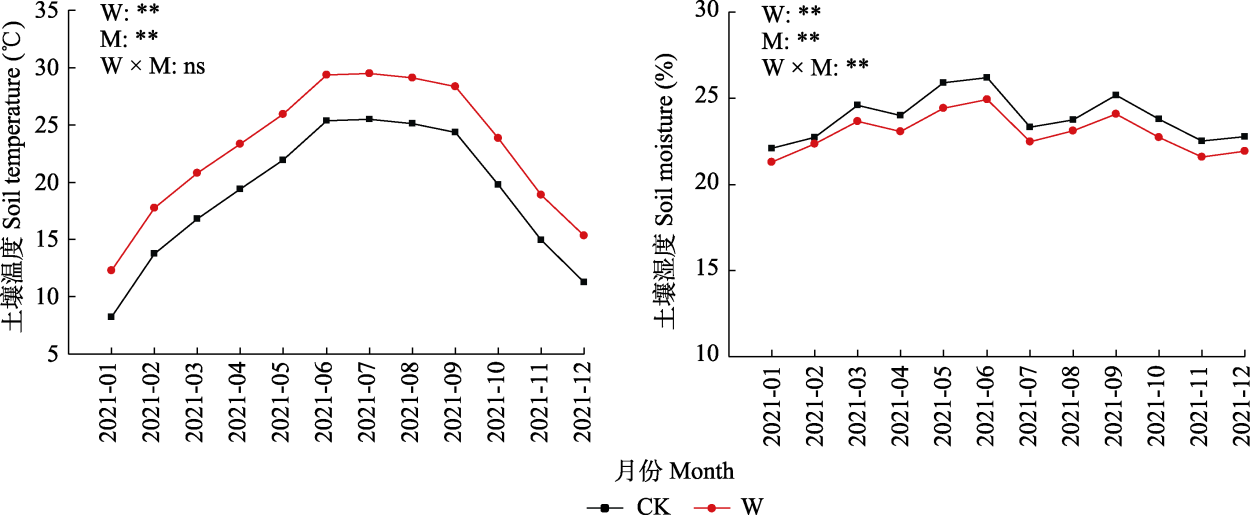
图1 增温对格氏栲天然林土壤温度和湿度的影响。CK, 对照; M, 月份; W, 增温。*, p < 0.05; **, p < 0.01; ns, p > 0.05。
Fig. 1 Effects of warming on soil temperature and moisture of Castanopsis kawakamii natural forest. CK, control treatment; M, month; W, warming treatment. *, p < 0.05; **, p < 0.01; ns, p > 0.05.
| 指标 Index | 细根径级 Diameter class of fine root (mm) | S | W | S × W | |||
|---|---|---|---|---|---|---|---|
| F | p | F | p | F | p | ||
| 生长量 Fine root growth (m2·g-1) | 0-1 | 76.517 | 0 | 39.665 | 0.003 | 31.196 | 0.001 |
| 1-2 | 69.950 | 0 | 16.255 | 0.016 | 9.759 | 0.014 | |
| 0-2 | 67.941 | 0.001 | 0 | 0 | 0 | 0 | |
| 根长 Root length (cm) | 0-1 | 0.506 | 0.497 | 5.248 | 0.084 | 5.481 | 0.047 |
| 1-2 | 21.536 | 0.002 | 0.166 | 0.694 | 29.072 | 0.001 | |
| 直径 Diameter (mm) | 0-1 | 8.198 | 0.021 | 3.699 | 0.127 | 0.006 | 0.940 |
| 1-2 | 3.045 | 0.119 | 0.008 | 0.935 | 0.607 | 0.458 | |
| 比根长 Specific root length (m·g-1) | 0-1 | 0.204 | 0.664 | 4.612 | 0.064 | 9.264 | 0.016 |
| 1-2 | 2.135 | 0.182 | 1.817 | 0.249 | 0.767 | 0.407 | |
| 比根表面积 Specific root surface area (cm2·g-1) | 0-1 | 2.146 | 0.181 | 5.143 | 0.053 | 12.546 | 0.008 |
| 1-2 | 0.008 | 0.933 | 3.062 | 0.155 | 0.396 | 0.547 | |
| 根组织密度 Root tissue density (g·cm-3) | 0-1 | 3.038 | 0.120 | 2.429 | 0.158 | 5.534 | 0.047 |
| 1-2 | 3.973 | 0.081 | 5.850 | 0.042 | 0.874 | 0.377 | |
表3 增温和季节对格氏栲天然林细根生长量和形态特征影响的线性混合模型分析
Table 3 Mixed linear model analysis on the effects of season and warming on the growth and morphological traits of fine roots in Castanopsis kawakamii natural forest
| 指标 Index | 细根径级 Diameter class of fine root (mm) | S | W | S × W | |||
|---|---|---|---|---|---|---|---|
| F | p | F | p | F | p | ||
| 生长量 Fine root growth (m2·g-1) | 0-1 | 76.517 | 0 | 39.665 | 0.003 | 31.196 | 0.001 |
| 1-2 | 69.950 | 0 | 16.255 | 0.016 | 9.759 | 0.014 | |
| 0-2 | 67.941 | 0.001 | 0 | 0 | 0 | 0 | |
| 根长 Root length (cm) | 0-1 | 0.506 | 0.497 | 5.248 | 0.084 | 5.481 | 0.047 |
| 1-2 | 21.536 | 0.002 | 0.166 | 0.694 | 29.072 | 0.001 | |
| 直径 Diameter (mm) | 0-1 | 8.198 | 0.021 | 3.699 | 0.127 | 0.006 | 0.940 |
| 1-2 | 3.045 | 0.119 | 0.008 | 0.935 | 0.607 | 0.458 | |
| 比根长 Specific root length (m·g-1) | 0-1 | 0.204 | 0.664 | 4.612 | 0.064 | 9.264 | 0.016 |
| 1-2 | 2.135 | 0.182 | 1.817 | 0.249 | 0.767 | 0.407 | |
| 比根表面积 Specific root surface area (cm2·g-1) | 0-1 | 2.146 | 0.181 | 5.143 | 0.053 | 12.546 | 0.008 |
| 1-2 | 0.008 | 0.933 | 3.062 | 0.155 | 0.396 | 0.547 | |
| 根组织密度 Root tissue density (g·cm-3) | 0-1 | 3.038 | 0.120 | 2.429 | 0.158 | 5.534 | 0.047 |
| 1-2 | 3.973 | 0.081 | 5.850 | 0.042 | 0.874 | 0.377 | |
| 指标 Index | 因子 Factor | 雨季 Rainy season | 旱季 Dry season | ||
|---|---|---|---|---|---|
| F | p | F | p | ||
| 细根生长量 Fine root growth (m2·g-1) | W | 0.111 | 0.756 | 37.335 | 0.004 |
| D | 0.089 | 0.774 | 17.911 | 0.003 | |
| W × D | 1.603 | 0.241 | 15.452 | 0.004 | |
| 根长 Root length (cm) | W | 6.106 | 0.039 | 28.365 | 0.001 |
| D | 38.293 | 0 | 3.088 | 0.117 | |
| W × D | 2.182 | 0.178 | 0.205 | 0.663 | |
| 直径 Diameter (mm) | W | 0.914 | 0.393 | 0.205 | 0.674 |
| D | 33.896 | 0 | 192.733 | 0 | |
| W × D | 0.081 | 0.783 | 0.922 | 0.365 | |
| 比根长 Specific root length (m·g-1) | W | 6.804 | 0.060 | 0.173 | 0.688 |
| D | 67.820 | 0 | 174.479 | 0 | |
| W × D | 12.455 | 0.008 | 2.801 | 0.133 | |
| 比根表面积 Specific root surface area (cm2·g-1) | W | 13.434 | 0.021 | 0.244 | 0.634 |
| D | 50.758 | 0 | 62.377 | 0 | |
| W × D | 7.886 | 0.023 | 1.816 | 0.215 | |
| 根组织密度 Root tissue density (g·cm-3) | W | 8.001 | 0.022 | 0.076 | 0.797 |
| D | 8.802 | 0.018 | 1.028 | 0.340 | |
| W × D | 0.042 | 0.843 | 0.926 | 0.364 | |
表4 增温和细根径级对格氏栲天然林不同季节细根生长量和形态特征影响的线性混合模型分析
Table 4 Mixed linear model analysis on the effects of warming and diameter class on the growth and morphological traits of fine roots in Castanopsis kawakamii natural forest
| 指标 Index | 因子 Factor | 雨季 Rainy season | 旱季 Dry season | ||
|---|---|---|---|---|---|
| F | p | F | p | ||
| 细根生长量 Fine root growth (m2·g-1) | W | 0.111 | 0.756 | 37.335 | 0.004 |
| D | 0.089 | 0.774 | 17.911 | 0.003 | |
| W × D | 1.603 | 0.241 | 15.452 | 0.004 | |
| 根长 Root length (cm) | W | 6.106 | 0.039 | 28.365 | 0.001 |
| D | 38.293 | 0 | 3.088 | 0.117 | |
| W × D | 2.182 | 0.178 | 0.205 | 0.663 | |
| 直径 Diameter (mm) | W | 0.914 | 0.393 | 0.205 | 0.674 |
| D | 33.896 | 0 | 192.733 | 0 | |
| W × D | 0.081 | 0.783 | 0.922 | 0.365 | |
| 比根长 Specific root length (m·g-1) | W | 6.804 | 0.060 | 0.173 | 0.688 |
| D | 67.820 | 0 | 174.479 | 0 | |
| W × D | 12.455 | 0.008 | 2.801 | 0.133 | |
| 比根表面积 Specific root surface area (cm2·g-1) | W | 13.434 | 0.021 | 0.244 | 0.634 |
| D | 50.758 | 0 | 62.377 | 0 | |
| W × D | 7.886 | 0.023 | 1.816 | 0.215 | |
| 根组织密度 Root tissue density (g·cm-3) | W | 8.001 | 0.022 | 0.076 | 0.797 |
| D | 8.802 | 0.018 | 1.028 | 0.340 | |
| W × D | 0.042 | 0.843 | 0.926 | 0.364 | |
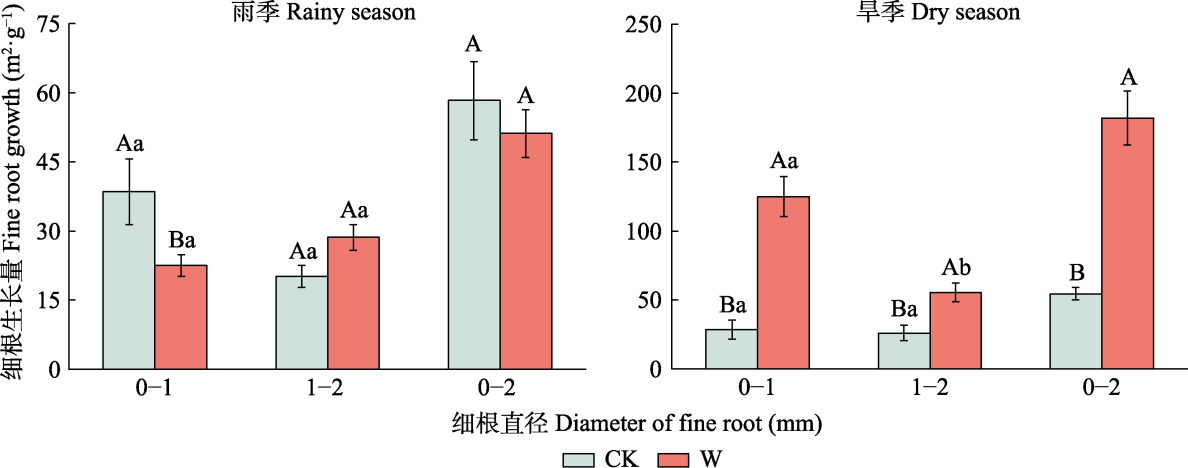
图2 增温对格氏栲天然林细根生长量的影响(平均值±标准误)。CK, 对照; W, 增温。不同大写字母表示同一径级不同处理间差异显著(p < 0.05), 不同小写字母表示同一处理不同径级间差异显著(p < 0.05)。
Fig. 2 Effect of warming on fine root growth of Castanopsis kawakamii natural forest (mean ± SE). CK, control treatment; W, warming treatment. Different uppercase letters indicate significant differences between treatments of the same diameter class (p < 0.05), and different lowercase letters indicate significant differences between diameter classes of the same treatment (p < 0.05).
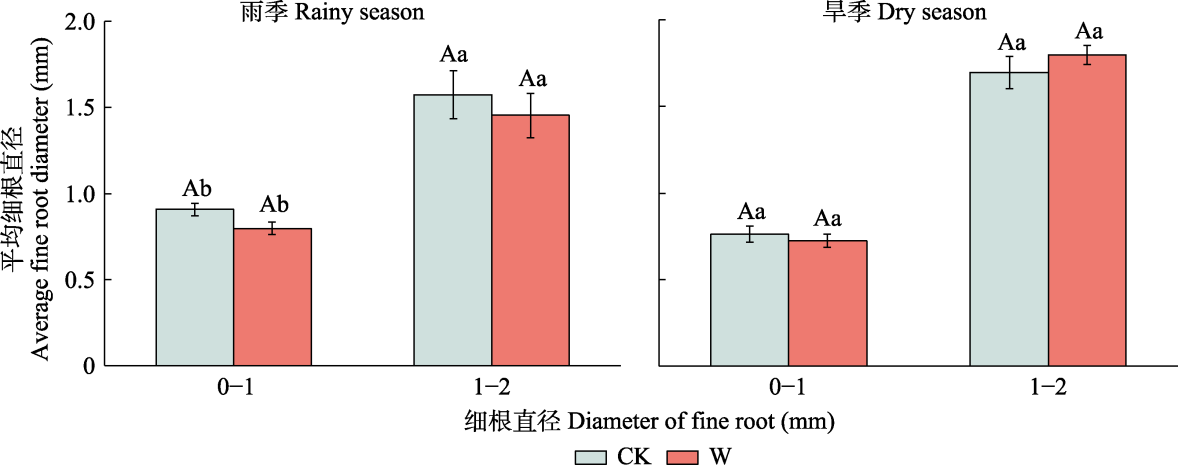
图3 增温对格氏栲天然林细根直径的影响(平均值±标准误)。CK, 对照; W, 增温。不同大写字母表示同一径级不同处理间差异显著(p < 0.05), 不同小写字母表示同一处理不同径级间差异显著(p < 0.05)。
Fig. 3 Effect of warming on fine root diameter of Castanopsis kawakamii natural forest (mean ± SE). CK, control treatment; W, warming treatment. Different uppercase letters indicate significant differences between treatments of the same diameter class (p < 0.05), and different lowercase letters indicate significant differences between diameter classes of the same treatment (p < 0.05).
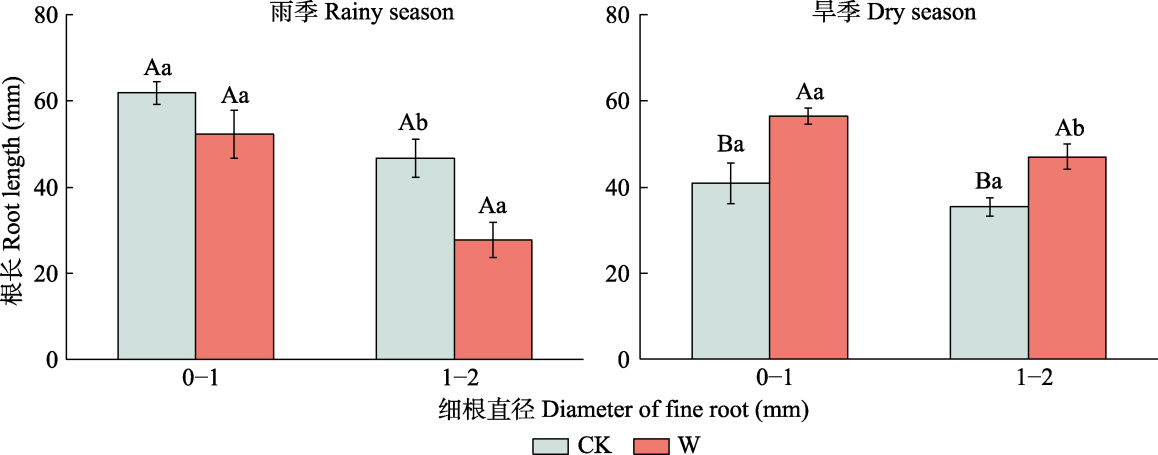
图4 增温对格氏栲天然林细根长度的影响(平均值±标准误)。CK, 对照; W, 增温。不同大写字母表示同一径级不同处理间差异显著(p < 0.05), 不同小写字母表示同一处理不同径级间差异显著(p < 0.05)。
Fig. 4 Effect of warming on fine root length of Castanopsis kawakamii natural forest (mean ± SE). CK, control treatment; W, warming treatment. Different uppercase letters indicate significant differences between treatments of the same diameter class (p < 0.05), and different lowercase letters indicate significant differences between diameter classes of the same treatment (p < 0.05).
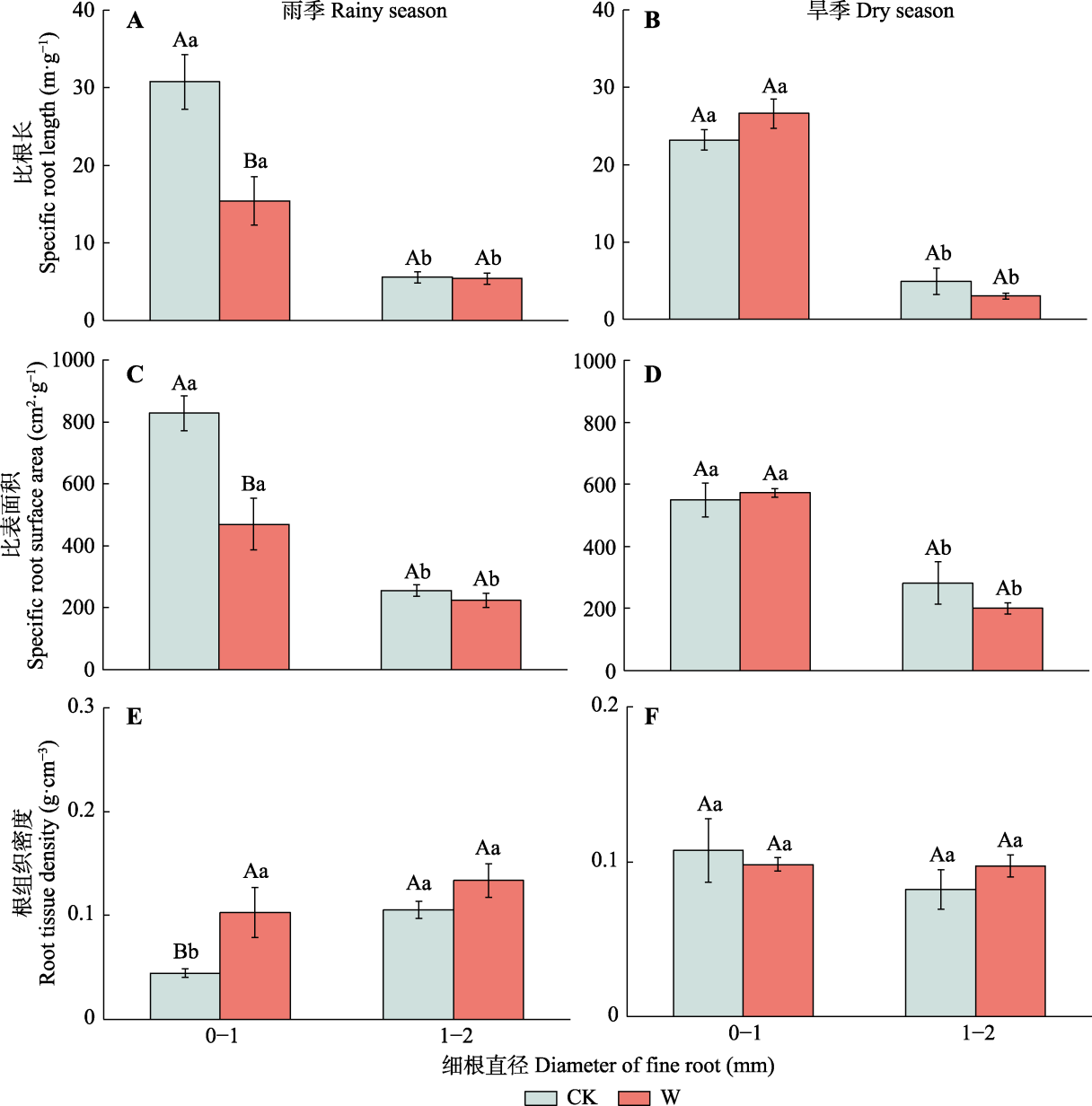
图5 增温对格氏栲天然林细根比根长、比根表面积和组织密度的影响(平均值±标准误)。CK, 对照; W, 增温。不同大写字母表示同一径级不同处理间差异显著(p < 0.05), 不同小写字母表示同一处理不同径级间差异显著(p < 0.05)。
Fig. 5 Effect of warming on specific root length, specific root surface area and root tissue density of Castanopsis kawakamii natural forest (mean ± SE). CK, control treatment; W, warming treatment. Different uppercase letters indicate significant differences between treatments of the same diameter class (p < 0.05), and different lowercase letters indicate significant differences between diameter classes of the same treatment (p < 0.05).
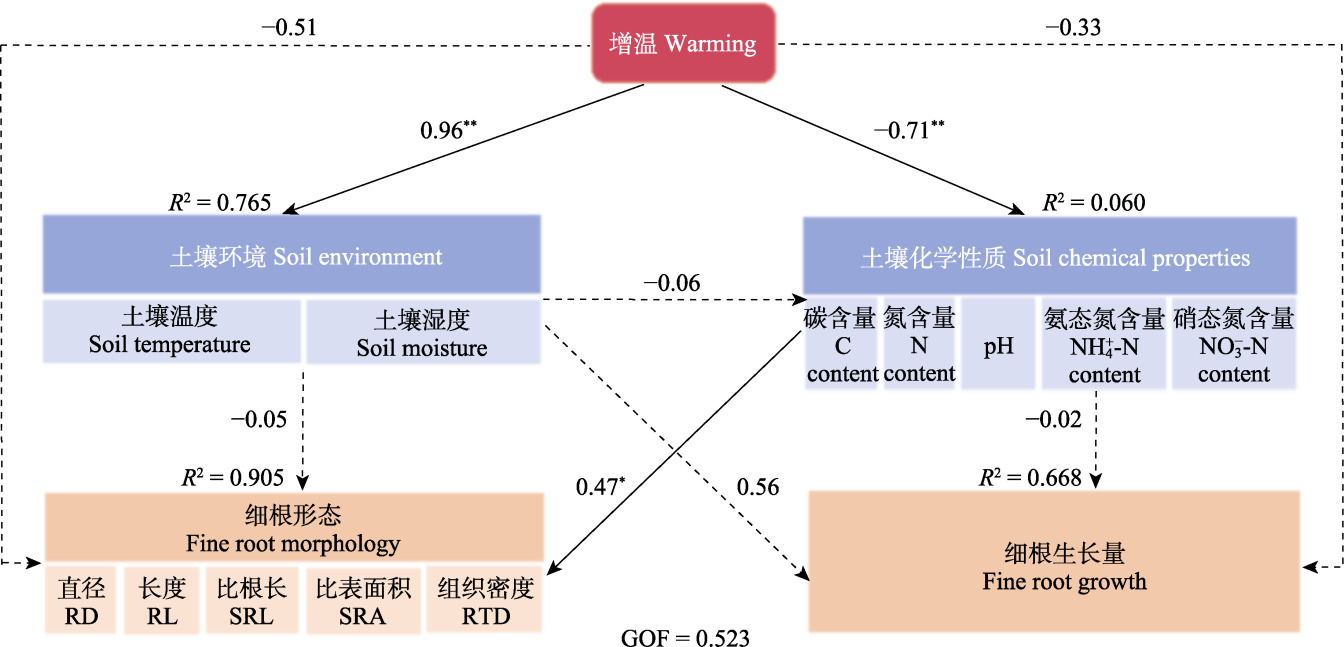
图6 偏最小二乘路径模型(PLS-PM)分析雨季增温对细根生长和形态可能的直接和间接影响途径。实线表示显著路径, 虚线表示不显著路径。箭头所列数字为标准化路径系数。*, p < 0.05; **, p < 0.01。GOF, 拟合优度。
Fig. 6 Partial least squares path modeling (PLS-PM) analysis of the possible direct and indirect pathways through which rainy season warming affected fine root growth and morphology. Solid lines indicate significant path, dash lines indicate insignificant path. Numbers listed by arrows are the standardized path coefficients. *, p < 0.05; **, p < 0.01. C, carbon; N, nitrogen; RD, root diameter; RL, root length; RTD, root tissue density; SRA, specific root area; SRL, specific root length. GOF, goodness of fit.
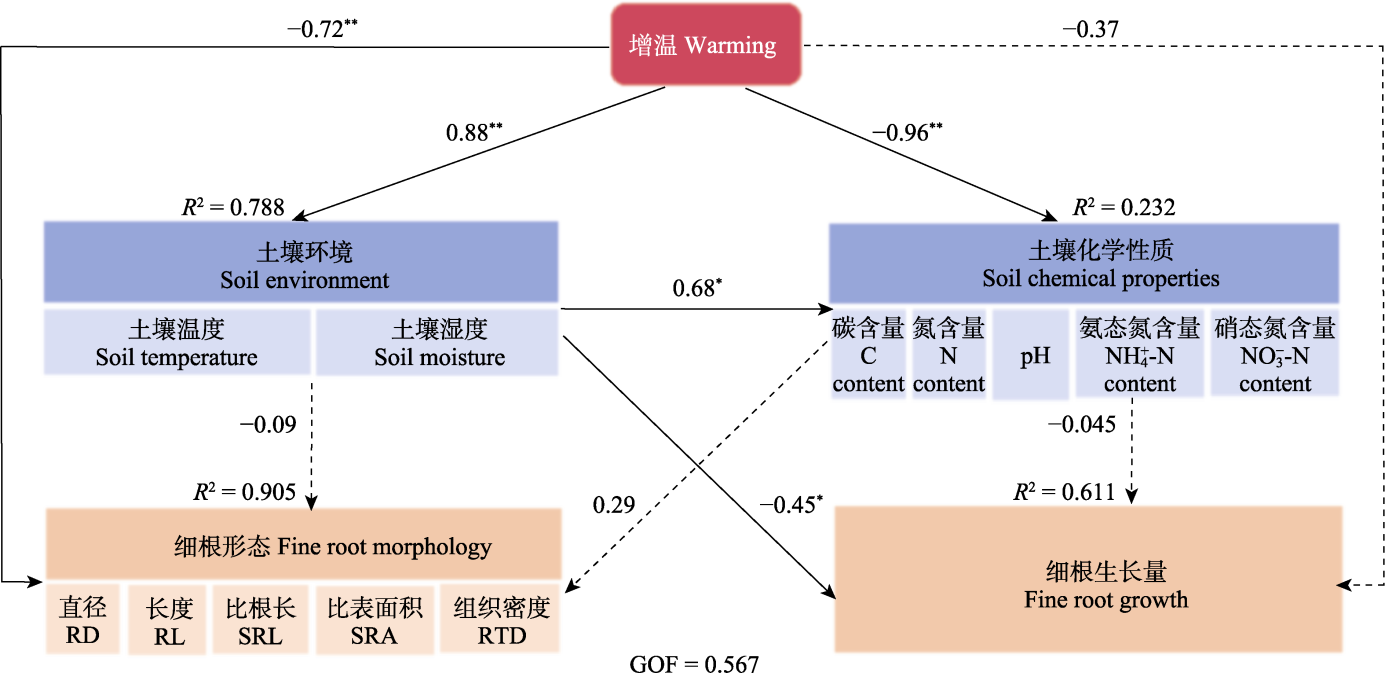
图7 偏最小二乘路径模型(PLS-PM)分析旱季增温对细根生长和形态可能的直接和间接影响途径。实线表示显著路径, 虚线表示不显著路径。箭头所列数字为标准化路径系数。*, p < 0.05; **, p < 0.01。GOF, 拟合优度。
Fig. 7 Partial least squares path modeling (PLS-PM) analysis of the possible direct and indirect pathways through which dry season warming affected fine root growth and morphology. Solid lines indicate significant path, dash lines indicate insignificant path. Numbers listed by arrows are the standardized path coefficients. *, p < 0.05; **, p < 0.01. C, carbon; N, nitrogen; RD, root diameter; RL, root length; RTD, root tissue density; SRA, specific root area; SRL, specific root length. GOF, goodness of fit.
| [1] | Adamczyk B, Sietiö OM, Straková P, Prommer J, Wild B, Hagner M, Pihlatie M, Fritze H, Richter A, Heinonsalo J (2019). Plant roots increase both decomposition and stable organic matter formation in boreal forest soil. Nature Communications, 10, 3982. DOI: 10.1038/s41467-019-11993-1. |
| [2] |
Addo-Danso SD, Prescott CE, Adu-Bredu S, Duah-Gyamfi A, Moore S, Guy RD, Forrester DI, Owusu-Afriyie K, Marshall PL, Malhi Y (2018). Fine-root exploitation strategies differ in tropical old growth and logged-over forests in Ghana. Biotropica, 50, 606-615.
DOI URL |
| [3] |
Bardgett RD, Mommer L, de Vries FT (2014). Going underground: root traits as drivers of ecosystem processes. Trends Ecology & Evolution, 29, 692-699.
DOI URL |
| [4] |
Brunner I, Herzog C, Dawes MA, Arend M, Sperisen C (2015). How tree roots respond to drought. Frontiers in Plant Science, 6, 547. DOI: 10.3389/fpls.2015.00547.
PMID |
| [5] |
Calleja-Cabrera J, Boter M, Oñate-Sánchez L, Pernas M (2020). Root growth adaptation to climate change in crops. Frontiers in Plant Science, 11, 544. DOI: 10.3389/fpls.2020.00544.
PMID |
| [6] | Carter KR, Wood TE, Reed SC, Schwartz EC, Reinsel MB, Yang X, Cavaleri MA (2020). Photosynthetic and respiratory acclimation of understory shrubs in response to in situ experimental warming of a wet tropical forest. Frontiers in Forests and Global Change, 3, 576320. DOI: 10.3389/ffgc.2020.576320. |
| [7] | Chen WY, Xiong DC, Shi SZ, Song TT, Cai YY, Guo RQ, Chen TT, Zheng X, Chen GS (2018). Effects of soil warming on fine root growth and morphology of Chinese fir (Cunninghamia lanceolata) seedlings. Acta Ecologica Sinica, 38, 5305-5314. |
| [陈望远, 熊德成, 史顺增, 宋涛涛, 蔡瑛莹, 郭润泉, 陈廷廷, 郑欣, 陈光水 (2018). 土壤增温对杉木幼苗细根生长量及形态特征的影响. 生态学报, 38, 5305-5314.] | |
| [8] |
Chenlemuge T, Hertel D, Dulamsuren C, Khishigjargal M, Leuschner C, Hauck M (2013). Extremely low fine root biomass in Larix sibirica forests at the southern drought limit of the boreal forest. Flora, 208, 488-496.
DOI URL |
| [9] |
Dallstream C, Milder L, Powers JS, Soper FM (2025). Strong scale-dependent relationships between fine-rootfunction and soil properties uncovered with spatially coupledsampling. New Phytologist, 246, 2506-2521.
DOI URL |
| [10] | Du XL, Huang JX, Xiong DC, Yang ZJ, Lin TC, Chen SD, Liu XF, Xu C, Yang YS (2024). Effects of air warming and soil warming on ecophysiological processes of leaves and fine roots of Cunninghamia lanceolata saplings. Forest Ecology and Management, 561, 121889. DOI: 10.1016/j.foreco.2024.121889. |
| [11] |
Feng JX, Xiong DC, Shi SZ, Xu CS, Zhong BY, Deng F, Chen YY, Chen GS, Yang YS (2017). Effects of soil warming on the ecophysiological properties of the fine roots of Chinese fir (Cunninghamia lanceolata) seedlings. Acta Ecologica Sinica, 37, 35-43.
DOI URL |
| [冯建新, 熊德成, 史顺增, 许辰森, 钟波元, 邓飞, 陈云玉, 陈光水, 杨玉盛 (2017). 土壤增温对杉木幼苗细根生理生态性质的影响. 生态学报, 37, 35-43.] | |
| [12] |
Fort F, Freschet GT (2020). Plant ecological indicator values as predictors of fine-root trait variations. Journal of Ecology, 108, 1565-1577.
DOI URL |
| [13] | Freschet GT, Roumet C, Comas LH, Weemstra M, Bengough AG, Rewald B, Bardgett RD, de Deyn GB, Johnson D, Klimešová J, Lukac M, McCormack ML, Meier IC, Pagès L, Poorter H, et al. (2021). Root traits as drivers of plant and ecosystem functioning: current understanding, pitfalls and future research needs. New Phytologist, 232, 1123-1158. |
| [14] | IPCC (Intergovernmental Panel on Climate Change) (2021). Climate Change 2021: the Physical Science Basis. Cambridge University Press, Cambridge, UK. |
| [15] | Jarvi MP, Burton AJ (2020). Root respiration and biomass responses to experimental soil warming vary with root functional traits and their responses to drought in five temperate tree species. Forest Ecology & Management, 546, 121316. DOI: 10.1007/s11104-020-04540-1. |
| [16] |
Jia LQ, Jiang Q, Sun J, Robinson D, Yang ZJ, Yao XD, Wang XH, Dai XL, Chen TT, Wu DM, Fan AL, Yang LM, Chen GS, Yang YS (2024). Contrasting depth-related fine root plastic responses to soil warming in a subtropical Chinese fir plantation. Journal of Ecology, 112, 1058-1073.
DOI URL |
| [17] |
Joslin JD, Wolfe MH, Hanson PJ (2001). Factors controlling the timing of root elongation intensity in a mature upland oak stand. Plant and Soil, 228, 201-212.
DOI |
| [18] |
Kwatcho Kengdo S, Peršoh D, Schindlbacher A, Heinzle J, Tian Y, Wanek W, Borken W (2022). Long-term soil warming alters fine root dynamics and morphology, and their ectomycorrhizal fungal community in a temperate forest soil. Global Change Biology, 28, 3441-3458.
DOI URL |
| [19] |
Lahti M, Aphalo PJ, Finér L, Ryyppö A, Lehto T, Mannerkoski H (2005). Effects of soil temperature on shoot and root growth and nutrient uptake of 5-year-old Norway spruce seedlings. Tree Physiology, 25, 115-122.
PMID |
| [20] |
Liese R, Leuschner C, Meier IC (2019). The effect of drought and season on root life span in temperate arbuscular mycorrhizal and ectomycorrhizal tree species. Journal of Ecology, 107, 2226-2239.
DOI URL |
| [21] |
Lozano YM, Aguilar-Trigueros CA, Flaig IC, Rillig MC (2020). Root trait responses to drought are more heterogeneous than leaf trait responses. Functional Ecology, 34, 2224-2235.
DOI URL |
| [22] |
Luke McCormack M, Dickie IA, Eissenstat DM, Fahey TJ, Fernandez CW, Guo DL, Helmisaari HS, Hobbie EA, Iversen CM, Jackson RB, Leppälammi-Kujansuu J, Norby RJ, Phillips RP, Pregitzer KS, Pritchard SG, et al. (2015). Redefining fine roots improves understanding of below-ground contributions to terrestrial biosphere processes. New Phytologist, 207, 505-518.
DOI PMID |
| [23] | Lv CH, Wang CK, Li YL, Zhou ZH (2023). Coordination among root exudation C, mycorrhizal colonization, and functional traits and their responses to drought in five temperate tree species. Forest Ecology and Management, 546, 121316. DOI: 10.1016/j.foreco.2023.121316. |
| [24] | Lv JH (2024). Differences in Functional Traits of Fine Roots of 16 Subtropical Tree Species in Response to Different Phosphorus Fertilizers. Master degree dissertation, Central South University of Forestry & Technology, Changsha. |
| [吕建华 (2024). 亚热带16种树种细根功能性状对不同磷肥的响应差异. 硕士学位论文, 中南林业科技大学, 长沙.] | |
| [25] |
Ma XX, Yan Y, Hong JT, Lu XY, Wang XD (2017). Impacts of warming on root biomass allocation in alpine steppe on the north Tibetan Plateau. Journal of Mountain Science, 14, 1615-1623.
DOI URL |
| [26] |
Malhotra A, Brice DJ, Childs J, Graham JD, Hobbie EA, Vander Stel H, Feron SC, Hanson PJ, Iversen CM (2020). Peatland warming strongly increases fine-root growth. Proceedings of the National Academy of Sciences of the United States of America, 117, 17627-17634.
DOI PMID |
| [27] | Miller BD, Carter KR, Reed SC, Wood TE, Cavaleri MA (2021). Only sun-lit leaves of the uppermost canopy exceed both air temperature and photosynthetic thermal optima in a wet tropical forest. Agricultural & Forest Meteorology, 301-302, 108347. DOI: 10.1016/j.agrformet. 2021.108347. |
| [28] |
Noh NJ, Crous KY, Li JQ, Choury Z, Barton CVM, Arndt SK, Reich PB, Tjoelker MG, Pendall E (2020). Does root respiration in Australian rainforest tree seedlings acclimate to experimental warming? Tree Physiology, 40, 1192-1204.
DOI PMID |
| [29] |
Parts K, Tedersoo L, Schindlbacher A, Sigurdsson BD, Leblans NIW, Oddsdóttir ES, Borken W, Ostonen I (2019). Acclimation of fine root systems to soil warming: comparison of an experimental setup and a natural soil temperature gradient. Ecosystems, 22, 457-472.
DOI |
| [30] | Qiu LJ (2018). Study on the Internal Cycle of Leaf Nutrients in Natural Forest and Plantation of Castanopsis kawakkamii. Master degree dissertation, Fujian Agriculture and Forestry University, Fuzhou. |
| [邱岭军 (2018). 格氏栲天然林与人工林叶片养分内循环研究. 硕士学位论文 福建农林大学, 福州.] | |
| [31] |
Roumet C, Birouste M, Picon-Cochard C, Ghestem M, Osman N, Vrignon-Brenas S, Cao KF, Stokes A (2016). Root structure-function relationships in 74 species: evidence of a root economics spectrum related to carbon economy. New Phytologist, 210, 815-826.
DOI PMID |
| [32] |
Souza RC, Solly EF, Dawes MA, Graf F, Hagedorn F, Egli S, Clement CR, Nagy L, Rixen C, Peter M (2017). Responses of soil extracellular enzyme activities to experimental warming and CO2 enrichment at the alpine treeline. Plant and Soil, 416, 527-537.
DOI URL |
| [33] |
Valverde-Barrantes OJ, Freschet GT, Roumet C, Blackwood CB (2017). A worldview of root traits: the influence of ancestry, growth form, climate and mycorrhizal association on the functional trait variation of fine-root tissues in seed plants. New Phytologist, 215, 1562-1573.
DOI PMID |
| [34] |
Wang JS, Defrenne C, Luke McCormack M, Yang L, Tian DS, Luo YQ, Hou EQ, Yan T, Li ZL, Bu WS, Chen Y, Niu SL (2021). Fine-root functional trait responses to experimental warming: a global meta-analysis. New Phytologist, 230, 1856-1867.
DOI PMID |
| [35] | Wen XC, Wang X, Ye MT, Liu H, He WC, Wang Y, Li TY, Zhao KJ, Hou GR, Chen G, Li XW, Fan C (2022). Response strategies of fine root morphology of Cupressus funebris to the different soil environment. Frontiers in Plant Science, 13, 1077090. DOI: 10.3389/fpls.2022.1077090. |
| [36] | Withington JM, Goebel M, Bułaj B, Oleksyn J, Reich PB, Eissenstat DM (2021). Remarkable similarity in timing of absorptive fine-root production across 11 diverse temperate tree species in a common garden. Frontiers in Plant Science, 11, 623722. DOI: 10.3389/fpls.2020.623722. |
| [37] |
Wu F, Wu C, Zhang YH, Yu H, Wei ZH, Zheng W, Liu XF, Chen SD, Yang ZJ, Xiong DC (2023). Effects of warming on growth, morphology and physiological metabolism characteristics of fine roots in a mature Cunninghamia lanceolata plantation in different seasons. Chinese Journal of Plant Ecology, 47, 856-866.
DOI URL |
|
[吴帆, 吴晨, 张宇辉, 余恒, 魏智华, 郑蔚, 刘小飞, 陈仕东, 杨智杰, 熊德成 (2023). 增温对成熟杉木人工林不同季节细根生长、形态及生理代谢特征的影响. 植物生态学报, 47, 856-866.]
DOI |
|
| [38] |
Wu YB, Zhang J, Deng YC, Wu J, Wang SP, Tang YH, Cui XY (2014). Effects of warming on root diameter, distribution, and longevity in an alpine meadow. Plant Ecology, 215, 1057-1066.
DOI URL |
| [39] |
Xiong DC, Yang ZJ, Chen GS, Liu XF, Lin WS, Huang JX, Bowles FP, Lin CF, Xie JS, Li YQ, Yang YS (2018). Interactive effects of warming and nitrogen addition on fine root dynamics of a young subtropical plantation. Soil Biology & Biochemistry, 123, 180-189.
DOI URL |
| [40] |
Yaffar D, Wood TE, Reed SC, Branoff BL, Cavaleri MA, Norby RJ (2021). Experimental warming and its legacy effects on root dynamics following two hurricane disturbances in a wet tropical forest. Global Change Biology, 27, 6423-6435.
DOI PMID |
| [41] | Zhao XX, Tian QX, Michelsen A, Lu MZ, Ren BS, Huang L, Zhao RD (2023). The effect of experimental warming on fine root functional traits of woody plants: data synthesis. Science of the Total Environment, 894, 165003. DOI: 10.1016/j.scitotenv.2023.165003. |
| [42] |
Zhou YM, Tang JW, Melillo JM, Butler S, Mohan JE (2011). Root standing crop and chemistry after six years of soil warming in a temperate forest. Tree Physiology, 31, 707-717.
DOI PMID |
| [1] | 封逸凡, 朱时应, 周淑荣, 江乐乐, 陈隆, 王苗, 邓国芳, 刘兰. 热带次生林恢复中土壤微生物对菌根化树苗存活和生长性状的影响[J]. 植物生态学报, 2026, 50(预发表): 1-. |
| [2] | 饶朝康, 唐亮. 不同潮位红树植物叶际微生物群落特征及其影响因素[J]. 植物生态学报, 2026, 50(预发表): 1-. |
| [3] | 林琳琳, 肖劲祥, 黄深深, 赵杨梅, 张德旭, 程毅康, 龙文兴. 磷添加对热带云雾林幼苗及幼树功能性状的影响[J]. , 2026, 50(预发表): 0-. |
| [4] | 段建林, 孟晟, 陈仁利, 熊林峰, 卢春洋, 席念勋. 全球变化因子多样性对菌根植物性状的影响[J]. , 2026, 50(预发表): 0-. |
| [5] | 张安宁, 肖亚宁, 赵霞, 张淼, 崔瀚文, 陈书燕, 安黎哲. 青藏高原灌木化与氮添加对土壤线虫及功能性状的交互作用[J]. 植物生态学报, 2026, 50(预发表): 0-. |
| [6] | 王爽, 陈雅轩, 陈艳梅, 王佳乐, 刘倩愿. 太行山典型区不同生境酸枣根系资源获取策略[J]. 植物生态学报, 2026, 50(2): 374-387. |
| [7] | 戴丽君, 向玲艺, 蹇陈, 王晓锋. 三峡回水扰动增强入库小流域河岸带典型草本植物功能性状的局域分化[J]. 植物生态学报, 2026, 50(2): 442-460. |
| [8] | 张静, 陈洁, 李艳朋, 盘李军, 许涵, 李意德, 何海生. 南亚热带针阔混交人工林植物生物量比较及其影响因子分析[J]. 植物生态学报, 2026, 50(2): 400-416. |
| [9] | 张永军, 李敬东, 安琦, 洪翎桂, 任正炜, 张蕊, 周小龙. 氮添加和增温对天山高寒草地群落性状的影响[J]. 植物生态学报, 2026, 50(2): 417-428. |
| [10] | 陈雅轩, 韩雨音, 陈艳梅, 刘倩愿. 华北不同林龄人工林植物功能性状与碳氮化学计量[J]. 植物生态学报, 2026, 50(2): 318-333. |
| [11] | 郑子仪, 陈江慧, 刘慧颖. 气候变暖提高青藏高原高寒草甸优势物种的根系分泌速率[J]. 植物生态学报, 2025, 49(9): 1363-1373. |
| [12] | 陈凯, 杨艳, 徐玲, 蒋忠华. 滇西南山地球花报春种子形态与萌发沿海拔梯度的变异[J]. 植物生态学报, 2025, 49(7): 1119-1127. |
| [13] | 崔冬晴, 田晨, 宋慧敏, 鲁小名, 萨其日, 徐国庆, 杨培志, 白永飞, 田建卿. 典型草原优势植物根际细菌群落多样性和功能群组成对长期放牧的响应机制[J]. 植物生态学报, 2025, 49(7): 1163-1176. |
| [14] | 张箫荻, 王晓霞, 章毓文, 侯靖雨, 石骁鹏, 和璐璐, 刘亚栋, 薛柳, 何宝华, 段劼. 北京山区三种林下灌木水力结构、叶片功能性状及其环境适应策略[J]. 植物生态学报, 2025, 49(7): 1128-1143. |
| [15] | 李梦琦, 苗灵凤, 李大东, 龙奕帆, 叶冰冰, 杨帆. 海南东寨港红树林植物细根功能性状对不同潮位沉积物养分变化的响应[J]. 植物生态学报, 2025, 49(4): 552-561. |
| 阅读次数 | ||||||
|
全文 |
|
|||||
|
摘要 |
|
|||||
Copyright © 2026 版权所有 《植物生态学报》编辑部
地址: 北京香山南辛村20号, 邮编: 100093
Tel.: 010-62836134, 62836138; Fax: 010-82599431; E-mail: apes@ibcas.ac.cn, cjpe@ibcas.ac.cn
备案号: 京ICP备16067583号-19

