
植物生态学报 ›› 2005, Vol. 29 ›› Issue (3): 429-435.DOI: 10.17521/cjpe.2005.0057 cstr: 32100.14.cjpe.2005.0057
刘会玉1( ), 林振山1, 张明阳2
收稿日期:2004-05-09
接受日期:2004-06-07
出版日期:2005-05-09
发布日期:2005-05-30
作者简介:E-mail: foozle@163.com
基金资助:
LIU Hui-Yu1(), LIN Zhen-Shan1, ZHANG Ming-Yang2
Received:2004-05-09
Accepted:2004-06-07
Online:2005-05-09
Published:2005-05-30
摘要:
栖息地毁坏是物种多样性减少的首要因素之一, 因此研究物种演化对栖息地毁坏的响应是非常必要的。而栖息地的毁坏又有瞬间毁坏和持续毁坏两种, 以往对栖息地毁坏的研究集中在瞬间毁坏上, 而该文则是通过N物种 竞争共存模型分析对比了物种演化对栖息地瞬间毁坏和持续毁坏的响应特征。研究发现 :不同性质的栖息地毁坏都会导致物种强弱关系的变化, 并非如通常所认为的强物种将免于遭受物种灭绝的威胁, 也不是强物种首先灭绝, 而是因集合种群结构的不同而异。在热带雨林群落, 瞬间毁坏下物种演化一般经历了强迫适应和恢复上升阶段, 而持续毁坏下物种得不到恢复, 只能持续衰退, 在较长一段时间内持续毁坏比瞬间毁坏更有利于物种的续存 ;而在温带森林群落, 瞬间毁坏下物种演化一般经历强迫适应, 恢复上升和准周期振荡, 最后平衡, 而持续毁坏下物种只能持续衰退, 出现了在栖息地持续毁坏率小于瞬间毁坏率时, 物种的栖息地占有率却小于瞬间毁坏时的占有率。
刘会玉, 林振山, 张明阳. 物种演化对人类活动作用下不同性质栖息地毁坏的响应. 植物生态学报, 2005, 29(3): 429-435. DOI: 10.17521/cjpe.2005.0057
LIU Hui-Yu, LIN Zhen-Shan, ZHANG Ming-Yang. SPECIES RESPONSES TO DIFFERENT TYPES OF HUMAN-CAUSEDHABITAT DEGRADATION. Chinese Journal of Plant Ecology, 2005, 29(3): 429-435. DOI: 10.17521/cjpe.2005.0057
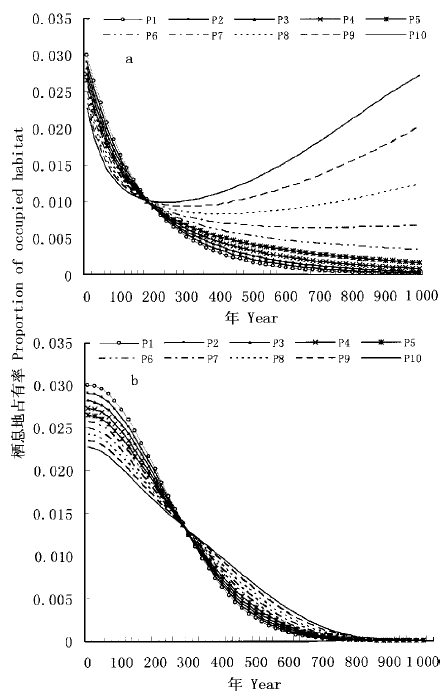
图1 栖息地瞬间毁坏 (D=0.3) 与持续毁坏 (b=0.001) 下物种 演化特征 (q=0.03, m=0.02) P1, P2, P3, P4, P5, P6, P7, P8, P9, P10分别为物种1, 物种2, 物种3, 物种4, 物种5, 物种6, 物种7, 物种8, 物种9, 物种10的栖息地占有率
Fig.1 The responses of N-species to instantaneous habitat destruction (a) and sustained habitat degradation (b) with q=0.03 and m=0.02 P1, P2, P3, P4, P5, P6, P7, P8, P9, P10 are the proportion of site occupied by species 1, 2, 3, 4, 5, 6, 7, 8, 9, 10 respectively
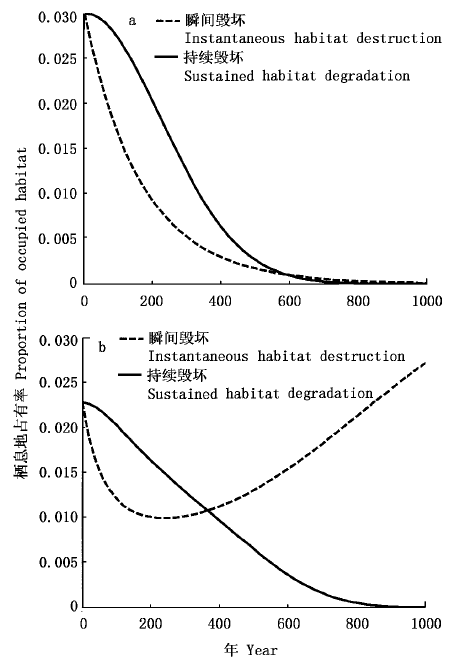
图2 物种1 (a) 和物种10 (b) 对千年时间尺度持续毁坏的响应与 瞬间毁坏模式下的比较 (q=0.03) 表1物种在瞬间毁坏 (D=0.3) 与持续毁坏 (b=0.001) 下的物种演化曲线的相交时间 (q=0.03)
Fig.2 Species 1 (a) and species 10 (b) response to sustained habitat degradation and instantaneous habitat destruction with q=0.03
| 物种1 Species 1 | 物种2 Species 2 | 物种3 Species 3 | 物种4 Species 4 | 物种5 Species 5 | 物种6 Species 6 | 物种7 Species 7 | 物种8 Species 8 | 物种9 Species 9 | 物种10 Species 10 | |
|---|---|---|---|---|---|---|---|---|---|---|
| t | 590 | 566 | 542 | 517 | 492 | 467 | 442 | 416 | 392 | 368 |
| D (t) | 0.59 | 0.566 | 0.542 | 0.517 | 0.492 | 0.467 | 0.442 | 0.416 | 0.392 | 0.368 |
表1 物种在瞬间毁坏(D= 0.3)与持续毁坏(b= 0.001)下的物种演化曲线的相交时间(q=0.03)
Table 1 The intersectant time of species evolutionary curves under the different habitat degradation with q=0.03
| 物种1 Species 1 | 物种2 Species 2 | 物种3 Species 3 | 物种4 Species 4 | 物种5 Species 5 | 物种6 Species 6 | 物种7 Species 7 | 物种8 Species 8 | 物种9 Species 9 | 物种10 Species 10 | |
|---|---|---|---|---|---|---|---|---|---|---|
| t | 590 | 566 | 542 | 517 | 492 | 467 | 442 | 416 | 392 | 368 |
| D (t) | 0.59 | 0.566 | 0.542 | 0.517 | 0.492 | 0.467 | 0.442 | 0.416 | 0.392 | 0.368 |
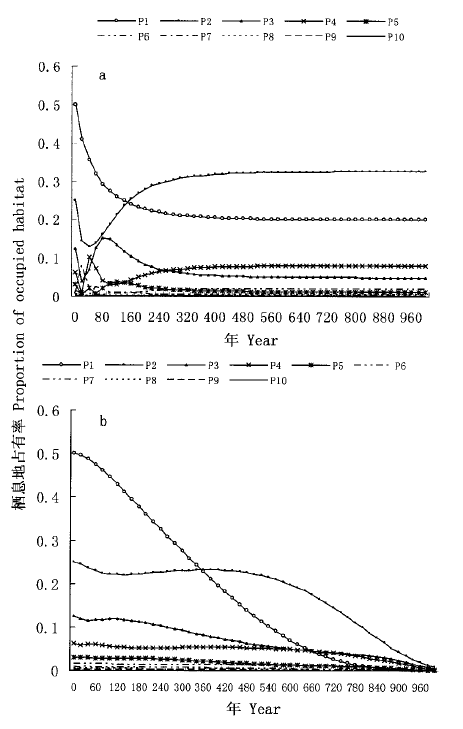
图3 Tilman模式下 (D=0.3) 与千年时间尺度 (b=0.001) 物种演化 的比较 (q=0.5, m=0.02) P1, P2, P3, P4, P5, P6, P7, P8, P9, P10:同图1
Fig.3 The responses of N-species to instantaneous habitat destruction (a) and sustained habitat degradation (b) with q=0.5 and m=0.02 See Fig.1
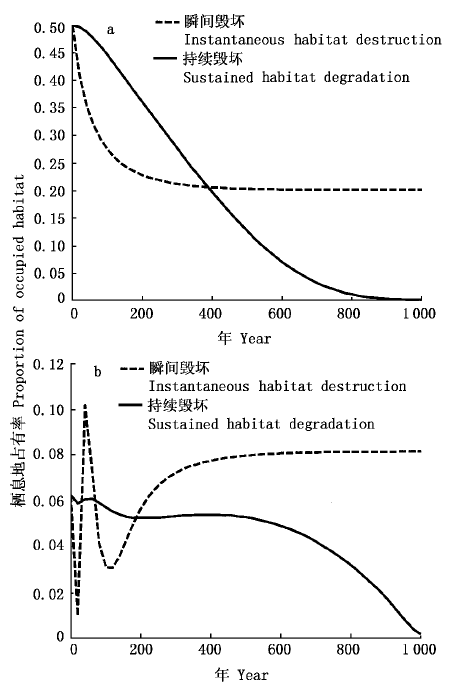
图4 物种1 (a) 和物种4 (b) 对千年时间尺度人类活动的响应 与TIlman模式下的比较 (q=0.5)
Fig.4 Speceis 1 (a) and species 4 (b) response to sustained habitat degradation and instantaneous habitat destruction with q=0.5
| 物种1 Species 1 | 物种2 Species 2 | 物种3 Species 3 | 物种4 Species 4 | 物种5 Species 5 | 物种6 Species 6 | 物种7 Species 7 | 物种8 Species 8 | 物种9 Species 9 | 物种10 Species 10 | |
|---|---|---|---|---|---|---|---|---|---|---|
| q=0.5 | 389 | 126 | 57 | 32 | 24 | 22 | 21 | 21 | 0 | 10 |
| D (t) | 0.389 | 0.126 | 0.057 | 0.032 | 0.024 | 0.022 | 0.021 | 0.021 | 0 | 0.010 |
表2 物种在瞬间毁坏 (D=0.3) 与持续毁坏 (b=0.01) 下的物种演化曲线首次相交时间 (q=0.5)
Table 2 The intersectant time of species evolutionary curves under the different habitat degradation with q=0.5
| 物种1 Species 1 | 物种2 Species 2 | 物种3 Species 3 | 物种4 Species 4 | 物种5 Species 5 | 物种6 Species 6 | 物种7 Species 7 | 物种8 Species 8 | 物种9 Species 9 | 物种10 Species 10 | |
|---|---|---|---|---|---|---|---|---|---|---|
| q=0.5 | 389 | 126 | 57 | 32 | 24 | 22 | 21 | 21 | 0 | 10 |
| D (t) | 0.389 | 0.126 | 0.057 | 0.032 | 0.024 | 0.022 | 0.021 | 0.021 | 0 | 0.010 |
| [1] | Bascompte J, Sole RV (1998). Effectsofhabitatdestructioninaprey-predatormetapopulation. JournalofTheoryBiology, 195,383-393. |
| [2] | Levins R (1969). Somedemographicandgeneticconsequencesofenvironmentalheterogeneityforbiologicalcontrol. BulletinoftheEntomologicalSocietyofAmerica, 15,237-240. |
| [3] | Lin ZS (2003). Simulatingunintendedeffectsrestoration. Ecologi calModeling, 164,169-175. |
| [4] | Lin ZS (林振山), Li L (2003). Theevolutioncharactersofthebestcompetitorofmetapopulation. ActaEcologicaSinica (生态学报), 23,1731-1736. (inChinesewithEnglishabstract). |
| [5] | Melin CJ, Bascompte J (2002). Foodwebstructureandhabitatloss. EcologyLetters, 5,37-46. |
| [6] | Nee S, May RM (1992). Dynamicsofmetaspecies:habitatde structionandcompetitivecoexistence. JournalofAnimalEcolo gy, 61,37-40. |
| [7] | Nee S, May RM, Hassell MP (1997). Twospeciesmetapopulationmodels.In:HanskiIA, GilpinMeds.MetapopulationBiology, Ecology, GeneticsandEvolution. AcademicPress, SanDiego. |
| [8] | Neuhauser C (1998). Habitatdestructionandcompetitivecoexis tenceinspatiallyexplicitmodelswithlocalinteractions. JournalofTheoryBiology, 193,445-463. |
| [9] |
Pimm SL, Raven P (2000). Extinctionbynumbers. Nature, 403,843-845.
PMID |
| [10] | Solé RV, Alonso D (2004). Habitatfragmentationandbiodiversitycollapseinneutralcommunities. EcologicalComplexity, 1,65-75. |
| [11] | Swihart RK, Feng ZL, Sladea NA, Mason DA, Gehring TM (2001). Effectsofhabitatdestructionandresourcesupplementa tioninapredator-preymetapopulationmodel. JournalofTheoryBiology, 210,287-303. |
| [12] |
Temple SA (1986). Theproblemofavianextinctions. Ornithology, 3,453-485.
DOI URL |
| [13] |
Tilman D, May RM, Lehman CL, Nowak MA (1994). Habitatde structionandtheextinctiondebt. Nature, 371,65-66.
DOI URL |
| [14] | Tilman D, Lehman CL, Yin C (1997). Habitatdestruction, dis persal, anddeterministicextinctionincompetitivecommunities. AmericanNaturalist, 149,407-435. |
| [15] | Wen YG (温远光), Yuan CA (元昌安), Li XX (李信贤), He TP (和太平), Lai JY (赖家业), Huang M (黄棉) (1998). Developmentofspeciesdiversityinvegetationrestorationprocessinmid-mountainregionofdamingshan, guangxi. ActaPhytoeco logicaSinica (植物生态学报), 22,33-40. (inChinesewithEnglishabstract). |
| [1] | 邹纪开, 吴佳怡, 谷云懿, 陈宝明. 不同形态氮添加与丛枝菌根真菌对外来入侵植物白花鬼针草竞争力的影响[J]. 植物生态学报, 2026, 50(3): 722-730. |
| [2] | 贾会丽, 王睿, 常玉良, 林茂, 栗国梁, 武帅楷, 苏原, 董宽虎, $\boxed{\hbox{王常慧}}$. 不同水平氮添加下晋北赖草叶片化学计量特征及其对光合的影响[J]. 植物生态学报, 2026, 50(2): 429-441. |
| [3] | 苏晨飞, 田慰, 张楠, 唐龙, 赵宇玮, 王耀. 光合响应模型与理论指导的神经网络融合的多因素光合速率预测模型[J]. 植物生态学报, 2026, 50(1): 173-187. |
| [4] | 宋垚彬, 董鸣, 于飞海, 叶学华, 刘建. 克隆植物生态学: 响应与效应[J]. 植物生态学报, 2025, 49(7): 999-1037. |
| [5] | 李港墩, 钱尼澎, 王林旭, 董淳超, 刘琪璟. 长白山红松和春榆径向生长季节动态对环境因子的响应[J]. 植物生态学报, 2025, 49(7): 1110-1118. |
| [6] | 卞嘉琛, 王睿, 高阳阳, 梁雯君, 晋红, 张文轩, 张晓荣, 郝杰, $\boxed{\hbox{王常慧}}$, 董宽虎, 刁华杰. 不同水平氮添加对晋北赖草草地地上和地下净初级生产力的影响[J]. 植物生态学报, 2025, 49(12): 2043-2053. |
| [7] | 张小雨, 贾国栋, 余新晓, 孙立博, 蒋涛. 不同退化程度小叶杨人工林冠层气孔导度特征及其环境响应[J]. 植物生态学报, 2024, 48(9): 1143-1156. |
| [8] | 李士杰, 王丽, 杜英军, 郑磊, 曾凡锁, 辛颖. 长白山天然水曲柳径向生长对气候的响应[J]. 植物生态学报, 2024, 48(8): 1011-1020. |
| [9] | 刘士玲, 杨保国, 郑路, 舒韦维, 闵惠琳, 张培, 李华, 杨坤, 周炳江, 田祖为. 广西红锥人工林径向生长的季节格局及其对气候因子的响应[J]. 植物生态学报, 2024, 48(8): 1021-1034. |
| [10] | 王丽丽, 宋晓彤, 谷际岐, 邵小明. 西藏尖叶对齿藓形态特征与环境变化的关系及响应策略[J]. 植物生态学报, 2024, 48(10): 1351-1360. |
| [11] | 刘聪聪, 何念鹏, 李颖, 张佳慧, 闫镤, 王若梦, 王瑞丽. 宏观生态学中的植物功能性状研究: 历史与发展趋势[J]. 植物生态学报, 2024, 48(1): 21-40. |
| [12] | 何敏, 许秋月, 夏允, 杨柳明, 范跃新, 杨玉盛. 植物磷获取机制及其对全球变化的响应[J]. 植物生态学报, 2023, 47(3): 291-305. |
| [13] | 夏璟钰, 张扬建, 郑周涛, 赵广, 赵然, 朱艺旋, 高洁, 沈若楠, 李文宇, 郑家禾, 张雨雪, 朱军涛, 孙建新. 青藏高原那曲高山嵩草草甸植物物候对增温的异步响应[J]. 植物生态学报, 2023, 47(2): 183-194. |
| [14] | 葛萍, 李昂, 王银柳, 姜良超, 牛国祥, 哈斯木其尔, 王彦兵, 薛建国, 赵威, 黄建辉. 草甸草原温室气体排放对氮添加量的非线性响应[J]. 植物生态学报, 2023, 47(11): 1483-1492. |
| [15] | 朱玉英, 张华敏, 丁明军, 余紫萍. 青藏高原植被绿度变化及其对干湿变化的响应[J]. 植物生态学报, 2023, 47(1): 51-64. |
| 阅读次数 | ||||||
|
全文 |
|
|||||
|
摘要 |
|
|||||
Copyright © 2026 版权所有 《植物生态学报》编辑部
地址: 北京香山南辛村20号, 邮编: 100093
Tel.: 010-62836134, 62836138; Fax: 010-82599431; E-mail: apes@ibcas.ac.cn, cjpe@ibcas.ac.cn
备案号: 京ICP备16067583号-19

