
植物生态学报 ›› 2022, Vol. 46 ›› Issue (7): 775-784.DOI: 10.17521/cjpe.2021.0281 cstr: 32100.14.cjpe.2021.0281
曾凯娜1,2, 孙浩然1,2, 申益春1, 任明迅1,2,*( )
)
收稿日期:2021-08-02
接受日期:2022-01-14
出版日期:2022-07-20
发布日期:2022-06-09
作者简介:* 任明迅:ORCID:0000-0002-4707-2656 (renmx@hainanu.edu.cn)基金资助:
ZENG Kai-Na1,2, SUN Hao-Ran1,2, SHEN Yi-Chun1, REN Ming-Xun1,2,*()
Received:2021-08-02
Accepted:2022-01-14
Online:2022-07-20
Published:2022-06-09
Supported by:摘要:
传粉网络是植物和传粉者之间形成的网状相互作用关系, 为理解群落物种多样性形成与维持机制提供了全新的视角。湿地是典型的群落交错区, 环境异质性与物种多样性都很高, 传粉网络可能比草地和森林等生态系统具有更复杂的结构。该研究针对海南岛海口市南郊的羊山湿地, 比较4个样地在旱季(5月)与雨季(8月)的传粉网络及其动态变化, 揭示湿地生态系统的传粉网络结构特征以及在干湿季的变化规律。结果表明, 羊山湿地传粉网络共有71种开花的植物, 131种传粉者, 传粉网络呈现低连接度、高嵌套度、中等网络特化程度的结构特征。在季节动态方面, 4个样地旱季的植物与传粉者种类高于雨季; 而传粉网络的连接度、嵌套度与网络特化程度没有明显的季节差异。白花鬼针草和水角等多个物种可同时在雨季和旱季开花, 使得植物-传粉者的种间关系虽然存在季节变化, 但传粉网络在旱季与雨季间的动态变化不大。总体而言, 羊山湿地物种多样性较高, 边缘效应较明显, 传粉网络结构较稳定。
曾凯娜, 孙浩然, 申益春, 任明迅. 海南羊山湿地的传粉网络及其季节动态. 植物生态学报, 2022, 46(7): 775-784. DOI: 10.17521/cjpe.2021.0281
ZENG Kai-Na, SUN Hao-Ran, SHEN Yi-Chun, REN Ming-Xun. Pollination network and seasonal dynamics of Yangshan Wetland in Hainan Island, China. Chinese Journal of Plant Ecology, 2022, 46(7): 775-784. DOI: 10.17521/cjpe.2021.0281
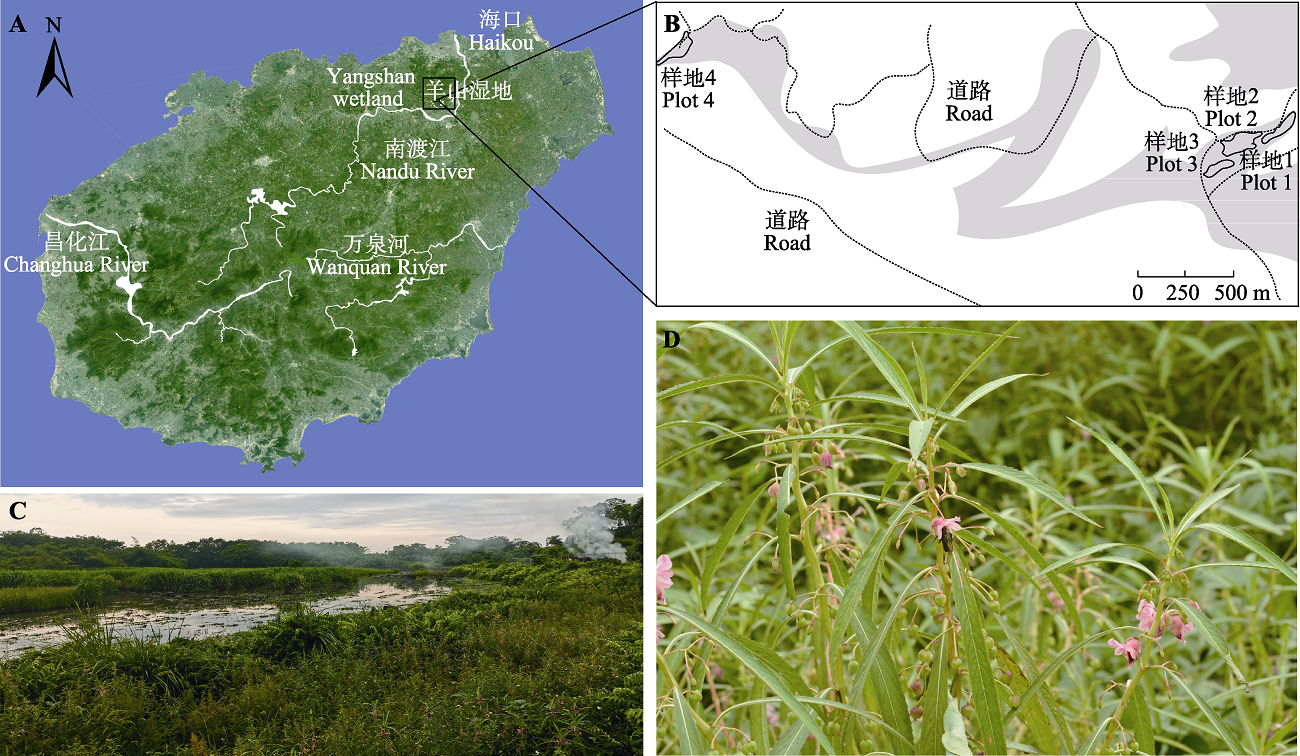
图1 海南羊山湿地的地理位置及景观。A, 羊山湿地在海南岛的位置。B, 研究样地示意图。C, 样地4的旱季景观。D, 羊山湿地常见挺水植物水角(中间植株有木蜂访花)。
Fig. 1 Study sites and landscapes of Yangshan Wetland in Hainan Island. A, Location of Yangshan wetland in Hainan Island. B, Four experimental plots. C, Landscape of Plot 4 in dry season. D, The most common emergent macrophytes plants Hydrocera triflora (a carpenter bee is visiting a flower on the middle plant).
| 传粉网络 Pollination network | 开花植物 Plants in blooming (P) | 传粉者Pollinator (A) | 网络尺寸 Network size (P × A) | 连接数量 Number of interaction (I) | 连接度 Connectance (I/(P × A)) | 嵌套度 Weighted nestedness | 网络特化 程度 H′2 |
|---|---|---|---|---|---|---|---|
| 旱季样地1 D1 | 10 | 19 | 190 | 37 | 0.19 | 5.73 | -0.33 |
| 旱季样地2 D2 | 14 | 21 | 294 | 49 | 0.17 | 4.78 | -0.28 |
| 旱季样地3 D3 | 19 | 29 | 551 | 73 | 0.13 | 5.70 | -0.22 |
| 旱季样地4 D4 | 22 | 45 | 990 | 84 | 0.08 | 11.71 | -0.37 |
| 旱季合计 Dry season total | 49 | 82 | 4 018 | 244 | 0.06 | 0.65 | 0.45 |
| 雨季样地1 R1 | 12 | 10 | 120 | 30 | 0.25 | 3.62 | -0.12 |
| 雨季样地2 R2 | 8 | 15 | 120 | 35 | 0.29 | 5.89 | -0.15 |
| 雨季样地3 R3 | 10 | 29 | 290 | 49 | 0.17 | 6.99 | -0.32 |
| 雨季样地4 R4 | 26 | 39 | 1 014 | 103 | 0.10 | 8.96 | -0.33 |
| 雨季合计 Rainy season total | 44 | 66 | 2 904 | 235 | 0.08 | 0.62 | 0.52 |
表1 海南羊山湿地不同季节的传粉网络参数
Table 1 Parameters of pollination network in different seasons of Yangshan Wetland in Hainan Island
| 传粉网络 Pollination network | 开花植物 Plants in blooming (P) | 传粉者Pollinator (A) | 网络尺寸 Network size (P × A) | 连接数量 Number of interaction (I) | 连接度 Connectance (I/(P × A)) | 嵌套度 Weighted nestedness | 网络特化 程度 H′2 |
|---|---|---|---|---|---|---|---|
| 旱季样地1 D1 | 10 | 19 | 190 | 37 | 0.19 | 5.73 | -0.33 |
| 旱季样地2 D2 | 14 | 21 | 294 | 49 | 0.17 | 4.78 | -0.28 |
| 旱季样地3 D3 | 19 | 29 | 551 | 73 | 0.13 | 5.70 | -0.22 |
| 旱季样地4 D4 | 22 | 45 | 990 | 84 | 0.08 | 11.71 | -0.37 |
| 旱季合计 Dry season total | 49 | 82 | 4 018 | 244 | 0.06 | 0.65 | 0.45 |
| 雨季样地1 R1 | 12 | 10 | 120 | 30 | 0.25 | 3.62 | -0.12 |
| 雨季样地2 R2 | 8 | 15 | 120 | 35 | 0.29 | 5.89 | -0.15 |
| 雨季样地3 R3 | 10 | 29 | 290 | 49 | 0.17 | 6.99 | -0.32 |
| 雨季样地4 R4 | 26 | 39 | 1 014 | 103 | 0.10 | 8.96 | -0.33 |
| 雨季合计 Rainy season total | 44 | 66 | 2 904 | 235 | 0.08 | 0.62 | 0.52 |
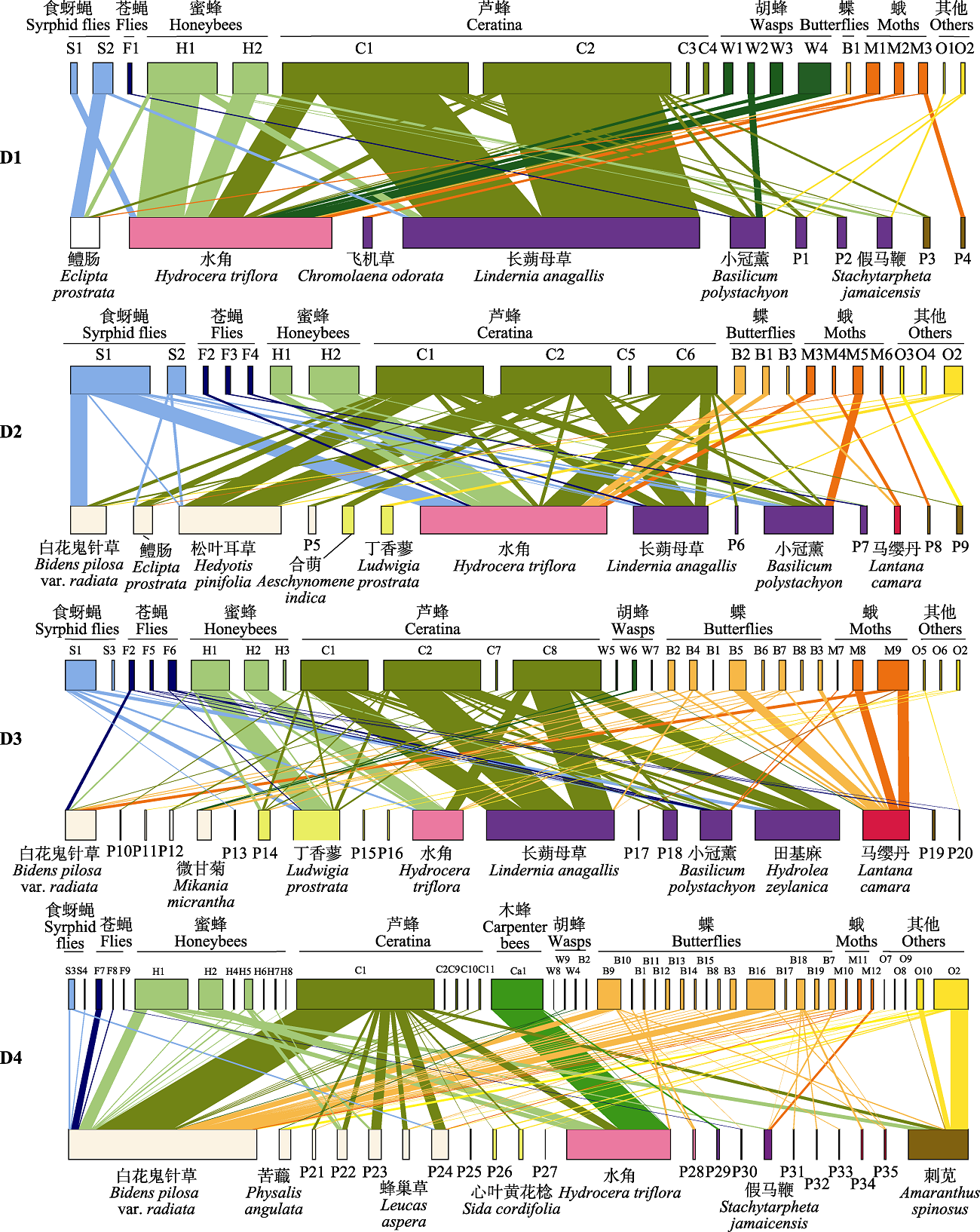
图2 海南羊山湿地4个旱季样地(D1-D4)传粉网络。在每个传粉网络中, 顶部代表传粉者, 底部代表植物。矩形大小代表相对多度, 上下矩形间的连接宽度代表关联强度。P1-P35等代号表示不同的植物(附录VI), 昆虫下面的代号代表该功能群中的不同物种。
Fig. 2 Pollination network in dry season of four plots (D1-D4) of Yangshan Wetland in Hainan Island. In each pollination network, the top and bottom represent pollinators and plants, respectively. The size indicates relative abundancy and the width of the link represents the correlation strength. P1-P35 are plants (Supplement VI) and codes under each pollinator functional group represent different species.
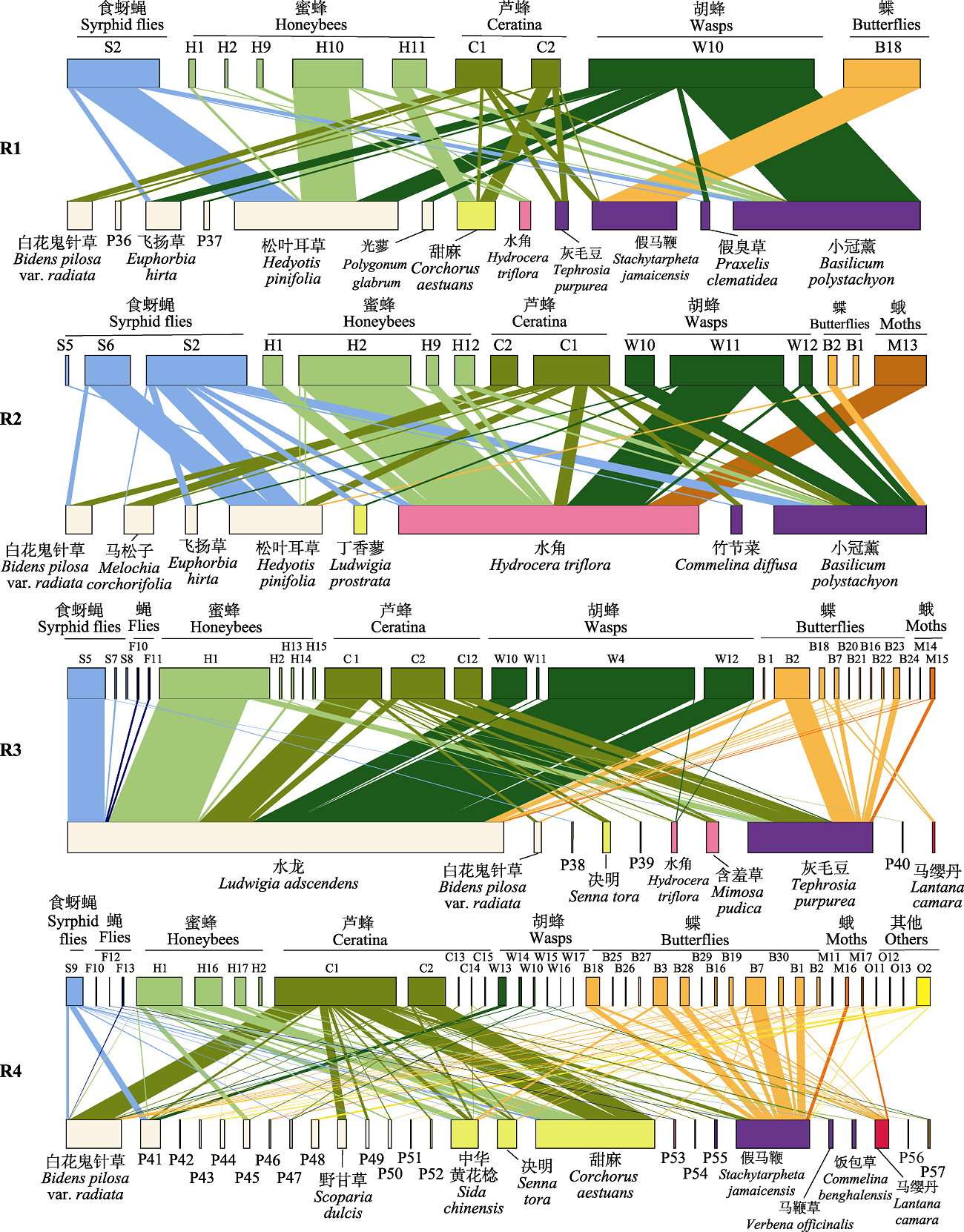
图3 海南羊山湿地4个雨季样地(R1-R4)传粉网络。在每个传粉网络中, 顶部代表传粉者、底部代表植物。矩形大小代表相对多度, 上下矩形间的连接宽度代表关联强度。P36-P57等代号表示不同的植物(附录VI), 昆虫下面的代号代表该功能群中的不同物种。
Fig. 3 Pollination network in rainy season of four plots (R1-R4) of Yangshan Wetland in Hainan Island. In each pollination network, the top and bottom represent pollinators and plants, respectively. The size indicates relative abundancy and the width of the link represents the correlation strength. P1-P35 are plants (Supplement VI) and codes under each pollinator functional group represent the different species.
| 植物 Plant | 传粉网络 Pollination network | 传粉者种类 Pollinator species | 物种强度 Species strength | 专一性 Standardized Kullback- Leibler distance (d′) |
|---|---|---|---|---|
| 白花鬼针草 Bidens pilosa var. radiata | 旱季 DZ | 40 | 12.484 0 | 0.551 0 |
| 雨季 RZ | 18 | 3.852 7 | 0.671 4 | |
| 水角 Hydrocera triflora | 旱季 DZ | 20 | 26.212 4 | 0.462 4 |
| 雨季 RZ | 12 | 6.977 5 | 0.455 6 | |
| 假马鞭 Stachytarpheta jamaicensis | 旱季 DZ | 7 | 2.266 9 | 0.477 4 |
| 雨季 RZ | 15 | 7.707 9 | 0.696 1 | |
| 马缨丹 Lantana camara | 旱季 DZ | 12 | 5.657 1 | 0.773 4 |
| 雨季 RZ | 10 | 5.248 1 | 0.646 1 | |
| 小冠薰 Basilicum polystachyon | 旱季 DZ | 17 | 7.241 9 | 0.317 5 |
| 雨季 RZ | 12 | 2.439 9 | 0.508 6 |
表2 海南羊山湿地常见植物的物种水平参数
Table 2 Species level parameters of common plants of the Yangshan Wetland in Hainan Island
| 植物 Plant | 传粉网络 Pollination network | 传粉者种类 Pollinator species | 物种强度 Species strength | 专一性 Standardized Kullback- Leibler distance (d′) |
|---|---|---|---|---|
| 白花鬼针草 Bidens pilosa var. radiata | 旱季 DZ | 40 | 12.484 0 | 0.551 0 |
| 雨季 RZ | 18 | 3.852 7 | 0.671 4 | |
| 水角 Hydrocera triflora | 旱季 DZ | 20 | 26.212 4 | 0.462 4 |
| 雨季 RZ | 12 | 6.977 5 | 0.455 6 | |
| 假马鞭 Stachytarpheta jamaicensis | 旱季 DZ | 7 | 2.266 9 | 0.477 4 |
| 雨季 RZ | 15 | 7.707 9 | 0.696 1 | |
| 马缨丹 Lantana camara | 旱季 DZ | 12 | 5.657 1 | 0.773 4 |
| 雨季 RZ | 10 | 5.248 1 | 0.646 1 | |
| 小冠薰 Basilicum polystachyon | 旱季 DZ | 17 | 7.241 9 | 0.317 5 |
| 雨季 RZ | 12 | 2.439 9 | 0.508 6 |
| [1] |
Aizen MA, Morales CL, Morales JM (2008). Invasive mutualists erode native pollination webs. PLOS Biology, 6, e31. DOI: 10.1371/journal.pbio.0060031.
DOI URL |
| [2] |
Asada T (2002). Vegetation gradients in relation to temporal fluctuation of environmental factors in Bekanbeushi peatland, Hokkaido, Japan. Ecological Research, 17, 505-518.
DOI URL |
| [3] |
Bascompte J, Jordano P (2007). Plant-animal mutualistic networks: the architecture of biodiversity. Annual Review of Ecology, Evolution, and Systematics, 38, 567-593.
DOI URL |
| [4] |
Bascompte J, Jordano P, Melián CJ, Olesen JM (2003). The nested assembly of plant-animal mutualistic networks. Proceedings of the National Academy of Sciences of the United States of America, 100, 9383-9387.
DOI PMID |
| [5] |
Bascompte J, Jordano P, Olesen JM (2006). Asymmetric coevolutionary networks facilitate biodiversity maintenance. Science, 312, 431-433.
PMID |
| [6] |
Bastolla U, Fortuna MA, Pascual-García A, Ferrera A, Luque B, Bascompte J (2009). The architecture of mutualistic networks minimizes competition and increases biodiversity. Nature, 458, 1018-1020.
DOI URL |
| [7] |
Blüthgen N, Menzel F, Blüthgen N (2006). Measuring specialization in species interaction networks. BMC Ecology, 6, 9. DOI: 10.1186/1472-6785-6-9.
DOI PMID |
| [8] |
Blüthgen N, Menzel F, Hovestadt T, Fiala B, Blüthgen N (2007). Specialization, constraints, and conflicting interests in mutualistic networks. Current Biology, 17, 341-346.
PMID |
| [9] | CaraDonna PJ, Burkle LA, Schwarz B, Resasco J, Knight TM, Benadi G, Blüthgen N, Dormann CF, Fang Q, Fründ J, Gauzens B, Kaiser-Bunbury CN, Winfree R, Vázquez DP (2021). Seeing through the static: the temporal dimension of plant-animal mutualistic interactions. Ecology Letters, 24, 149-161. |
| [10] |
Casanova M, Brock M (2000). How do depth, duration and frequency of flooding influence the establishment of wetland plant communities? Plant Ecology, 147, 237-250.
DOI URL |
| [11] |
Castro-Urgal R, Traveset A (2014). Differences in flower visitation networks between an oceanic and a continental island. Botanical Journal of the Linnean Society, 174, 478- 488.
DOI URL |
| [12] |
Cuartas-Hernández S, Medel R (2015). Topology of plant-flower-visitor networks in a tropical mountain forest: insights on the role of altitudinal and temporal variation. PLOS ONE, 10, e0141804. DOI: 10.1371/journal.pone.0141804.
DOI URL |
| [13] |
Dormann CF, Fründ J, Schaefer HM (2017). Identifying causes of patterns in ecological networks: opportunities and limitations. Annual Review of Ecology, Evolution, and Systematics, 48, 559-584.
DOI URL |
| [14] |
Dupont YL, Padrón B, Olesen JM, Petanidou T (2009). Spatio- temporal variation in the structure of pollination networks. Oikos, 118, 1261-1269.
DOI URL |
| [15] |
Fang Q, Huang SQ (2012). Progress in pollination networks: network structure and dynamics. Biodiversity Science, 20, 300-307.
DOI URL |
|
[方强, 黄双全 (2012). 传粉网络的研究进展: 网络的结构和动态. 生物多样性, 20, 300-307.]
DOI |
|
| [16] |
Fang Q, Huang SQ (2012). Relative stability of core groups in pollination networks in a biodiversity hotspot over four years. PLOS ONE, 7, e32663. DOI: 10.1371/journal.pone.0032663.
DOI URL |
| [17] |
Gómez JM, Perfectti F, Jordano P (2011). The functional consequences of mutualistic network architecture. PLOS ONE, 6, e16143. DOI: 10.1371/journal.pone.0016143.
DOI URL |
| [18] |
Haapalehto TO, Vasander H, Jauhiainen S, Tahvanainen T, Kotiaho JS (2011). The effects of peatland restoration on water-table depth, elemental concentrations, and vegetation: 10 years of changes. Restoration Ecology, 19, 587-598.
DOI URL |
| [19] |
Jones KN, Klemetti SM (2012). Managing marginal populations of the rare wetland plant Trollius laxus Salisbury (spreading globeflower): consideration of light levels, herbivory, and pollination. Northeastern Naturalist, 19, 267-278.
DOI URL |
| [20] | Kaiser-Bunbury CN, Muff S, Memmott J, Müller CB, Caflisch A (2010). The robustness of pollination networks to the loss of species and interactions: a quantitative approach incorporating pollinator behaviour. Ecology Letters, 13, 442-452. |
| [21] |
Lundgren R, Olesen JM (2005). The dense and highly connected world of greenland's plants and their pollinators. Arctic, Antarctic, and Alpine Research, 37, 514-520.
DOI URL |
| [22] |
Olesen JM, Bascompte J, Elberling H, Jordano P (2008). Temporal dynamics in a pollination network. Ecology, 89, 1573-1582.
PMID |
| [23] | Olesen JM, Jordano P (2002). Geographic patterns in plant- pollinator mutualistic networks. Ecology, 83, 2416-2424. |
| [24] |
Pawar S (2014). Why are plant-pollinator networks nested? Science, 345, 383. DOI: 10.1126/science.1256466.
DOI URL |
| [25] |
Ponisio LC, Gaiarsa MP, Kremen C (2017). Opportunistic attachment assembles plant-pollinator networks. Ecology Letters, 20, 1261-1272.
DOI PMID |
| [26] |
Saavedra S, Rohr RP, Fortuna MA, Selva N, Bascompte J (2016). Seasonal species interactions minimize the impact of species turnover on the likelihood of community persistence. Ecology, 97, 865-873.
PMID |
| [27] |
Santamaría S, Galeano J, Pastor JM, Méndez M (2016). Removing interactions, rather than species, casts doubt on the high robustness of pollination networks. Oikos, 125, 526-534.
DOI URL |
| [28] |
Schleuning M, Fründ J, Klein AM, Abrahamczyk S, Alarcón R, Albrecht M, Andersson GKS, Bazarian S, Böhning-Gaese K, Bommarco R, Dalsgaard B, Dehling DM, Gotlieb A, Hagen M, Hickler T, et al. (2012). Specialization of mutualistic interaction networks decreases toward tropical latitudes. Current Biology, 22, 1925-1931.
DOI PMID |
| [29] |
Souza CS, Maruyama PK, Aoki C, Sigrist MR, Raizer J, Gross CL, de Araujo AC (2018). Temporal variation in plant- pollinator networks from seasonal tropical environments: higher specialization when resources are scarce. Journal of Ecology, 106, 2409-2420.
DOI URL |
| [30] | State Forestry Administration of the People's Republic of China (2015). China Wetlands Resources Hainan Volume. China Forestry Publishing House, Beijing. |
| [中华人民共和国国家林业局 (2015). 中国湿地资源: 海南卷. 中国林业出版社, 北京.] | |
| [31] |
Tu YL, Wang LP, Wang XL, Wang LL, Duan YW (2019). Status of invasive plants on local pollination networks: a case study of Tagetes minuta in Tibet based on pollen grains from pollinators. Biodiversity Science, 27, 306-313.
DOI URL |
|
[土艳丽, 王力平, 王喜龙, 王林林, 段元文 (2019). 利用昆虫携带的花粉初探西藏入侵植物印加孔雀草在当地传粉网络中的地位. 生物多样性, 27, 306-313.]
DOI |
|
| [32] | Vasander H (1982). Plant biomass and production in virgin, drained and fertilized sites in a raised bog in southern Finland. Annales Botanici Fennici, 19, 103-125. |
| [33] |
Vázquez DP, Simberloff D (2002). Ecological specialization and susceptibility to disturbance: conjectures and refutations. The American Naturalist, 159, 606-623.
DOI PMID |
| [1] | 何青, 袁旭东, 任博申, 冯治洋, 鲁梦珍, 林巧玲, 姜庆虎, 杨林森, 余辉亮, 姚辉, 杨敬元, 刘峰, 江明喜. 一年蓬(Erigeron annuus)入侵对亚高山泥炭湿地植物群落结构与多样性的影响[J]. 植物生态学报, 2026, 50(预发表): 0-. |
| [2] | 赵掷艺, 黄伟权, 胡婧妍, 王义越, 虞梦婕, 吴玉环. 泥炭沼泽湿地植物残体分解及微生物作用机理研究进展[J]. , 2026, 50(预发表): 0-. |
| [3] | 周春菡, 熊智诚, 杨明新, 史海兰, 周亚星, 唐玉, 张静, 纪宝明, 代心灵. 黄河源园区高寒湿地菌根真菌群落特征及其影响因素[J]. 植物生态学报, 2026, 50(3): 625-638. |
| [4] | 张竟文, 李晶, 王汝苗, 王贺年, 崔丽娟. 不同纬度滨海湿地植物根系与土壤生态化学计量特征及内稳性分析[J]. 植物生态学报, 2026, 50(2): 461-473. |
| [5] | 贾紫璇, 方涛, 张舒欣, 刘一凡, 赵微, 王荣, 昌海超, 朱耀军, 罗芳丽, 郭允倩, 于飞海. 不同沼泽湿地芦苇地上-地下性状对水分变化的响应[J]. 植物生态学报, 2025, 49(9): 1448-1460. |
| [6] | 惠城阳, 章巧依, 刘腾腾, 刘维勇, 周丽娜, 金鑫杰, 张永华, 刘金亮. 温州大罗山主要植被类型及物种组成特征[J]. 植物生态学报, 2025, 49(6): 990-998. |
| [7] | 段俊丞, 王志勇, 高维聪, 张成凯, 高长宏, 刘晓彤, 李振今. 黄河三角洲湿地入侵物种互花米草时空演化与景观格局分析[J]. 植物生态学报, 2025, 49(6): 922-938. |
| [8] | 李琳, 黄佳芳, 丁中浩, 郭萍萍, 蔡芫镔, 李诗华, 李云琴, 罗敏. 淹水高度增加对短叶茳芏潮汐湿地净生态系统CO2交换量的影响[J]. 植物生态学报, 2025, 49(4): 526-539. |
| [9] | 刘盈麟, 李春明, 王昊, 武长路, 贺强. 长江口滨海湿地水鸟对底栖微藻群落的营养级联效应[J]. 植物生态学报, 2025, 49(3): 367-378. |
| [10] | 张旭东, 刘波, 张丹, 武海涛, 潘媛, 郑皓文, 李蕊, 严硕, 申敏琰, 赖明子. 湿地植物对土壤水分变化与凋落物覆盖的差异化响应[J]. 植物生态学报, 2025, 49(12): 2069-2079. |
| [11] | 郭欢敏, 沈小雪, 李瑞利. 深圳湾福田红树林自然保护区物种共存特征与物种分布概率[J]. 植物生态学报, 2025, 49(11): 1833-1843. |
| [12] | 郝毅晴, 刘伟, 杨阳, 安冰儿, 范冰, 李超, 崔久辉, 程延彬, 孙佳美, 潘庆民. 有机肥和无机肥对退化草原羊草种群密度和个体生物量的影响[J]. 植物生态学报, 2025, 49(1): 148-158. |
| [13] | 马东峰, 贾存智, 王学朋, 赵鹏鹏, 胡小文. 甘南高寒退化草甸多物种组配的修复效果评估[J]. 植物生态学报, 2025, 49(1): 93-102. |
| [14] | 王晓颖, 孙志高, 陈冰冰, 武慧慧, 张党玉. 闽江河口互花米草残体异位分解及磷养分释放特征[J]. 植物生态学报, 2024, 48(7): 844-857. |
| [15] | 牛一迪, 蔡体久. 大兴安岭北部次生林演替过程中物种多样性的变化及其影响因子[J]. 植物生态学报, 2024, 48(3): 349-363. |
| 阅读次数 | ||||||
|
全文 |
|
|||||
|
摘要 |
|
|||||
Copyright © 2026 版权所有 《植物生态学报》编辑部
地址: 北京香山南辛村20号, 邮编: 100093
Tel.: 010-62836134, 62836138; Fax: 010-82599431; E-mail: apes@ibcas.ac.cn, cjpe@ibcas.ac.cn
备案号: 京ICP备16067583号-19

