
Chin J Plant Ecol ›› 2025, Vol. 49 ›› Issue (11): 1957-1972.DOI: 10.17521/cjpe.2024.0316 cstr: 32100.14.cjpe.2024.0316
• Research Articles • Previous Articles
HU Jing1, LÜ Shi-Qi3, LI Bing1, MA Zhi-Bo2, FU Li-Yong2, YIN Jian-Zhang1, XIAO Jiu-Jin4, YAN Jia-Yuan1, HU Zong-Da1,*( )
)
Received:2024-09-20
Accepted:2025-01-09
Online:2025-11-20
Published:2025-11-20
Contact:
HU Zong-Da
Supported by:HU Jing, LÜ Shi-Qi, LI Bing, MA Zhi-Bo, FU Li-Yong, YIN Jian-Zhang, XIAO Jiu-Jin, YAN Jia-Yuan, HU Zong-Da. Characteristics of soil organic carbon fractions and carbon pool management index in four typical natural forests in temperature-transition zone[J]. Chin J Plant Ecol, 2025, 49(11): 1957-1972.
Add to citation manager EndNote|Ris|BibTeX
URL: https://www.plant-ecology.com/EN/10.17521/cjpe.2024.0316
| 林型 Forest type | 海拔 Mean altitude (m) | 坡度 Mean slop (°) | 平均郁闭度 Mean canopy density (%) | 平均林分密度 Mean stand density (stems·hm-2) | 平均胸径 Mean DBH (cm) | 乔木层平均树高 Tree layer mean tree height (m) |
|---|---|---|---|---|---|---|
| BP | 2 027 | 26 | 73.50 ± 1.38b | 2 637 ± 400a | 17.57 ± 1.21c | 15.88 ± 0.56b |
| PLB | 2 036 | 28 | 79.33 ± 2.34a | 1 554 ± 693b | 23.91 ± 2.76b | 16.39 ± 1.42b |
| PP | 2 157 | 28 | 76.00 ± 1.79ab | 1 166 ± 281b | 27.97 ± 2.00a | 21.48 ± 0.43a |
| LP | 1 974 | 25 | 75.83 ± 2.14b | 1 662 ± 279b | 25.88 ± 2.87ab | 18.61 ± 0.91b |
| CK | 2 017 | 33 | ‒ | ‒ | ‒ | ‒ |
| 林型 Forest type | 灌木层平均盖度 Shrub layer mean coverage (%) | 灌木层平均高度 Shrub layer mean height (m) | 草本平均盖度 Herbaceous mean coverage (%) | 草本平均高度 Herb layer mean height (cm) | 苔藓层平均盖度 Moss layer mean coverage (%) | 凋落物平均厚度 Litter mean thickness (cm) |
| BP | 13.03 ± 2.11b | 5.27 ± 0.99b | 41.65 ± 3.61a | 8.35 ± 0.56a | ‒ | 2.41 ± 0.94a |
| PLB | 22.62 ± 12.22a | 7.76 ± 1.63b | 31.80 ± 3.88b | 7.95 ± 2.29a | 7.78 ± 2.16b | 1.64 ± 0.25b |
| PP | 4.70 ± 4.14b | 11.97 ± 3.71a | 31.00 ± 3.28b | 7.27 ± 0.81a | 38.85 ± 7.88a | 1.74 ± 0.45ab |
| LP | 18.61 ± 2.24b | 7.73 ± 0.50b | 28.22 ± 2.72b | 6.91 ± 0.78a | 8.95 ± 7.35b | 1.86 ± 0.40ab |
| CK | ‒ | 1.00 ± 0.28 | 66.50 ± 13.98 | 4.60 ± 5.70 | ‒ | ‒ |
Table 1 Basic characteristics of the studied sample plots (mean ± SE)
| 林型 Forest type | 海拔 Mean altitude (m) | 坡度 Mean slop (°) | 平均郁闭度 Mean canopy density (%) | 平均林分密度 Mean stand density (stems·hm-2) | 平均胸径 Mean DBH (cm) | 乔木层平均树高 Tree layer mean tree height (m) |
|---|---|---|---|---|---|---|
| BP | 2 027 | 26 | 73.50 ± 1.38b | 2 637 ± 400a | 17.57 ± 1.21c | 15.88 ± 0.56b |
| PLB | 2 036 | 28 | 79.33 ± 2.34a | 1 554 ± 693b | 23.91 ± 2.76b | 16.39 ± 1.42b |
| PP | 2 157 | 28 | 76.00 ± 1.79ab | 1 166 ± 281b | 27.97 ± 2.00a | 21.48 ± 0.43a |
| LP | 1 974 | 25 | 75.83 ± 2.14b | 1 662 ± 279b | 25.88 ± 2.87ab | 18.61 ± 0.91b |
| CK | 2 017 | 33 | ‒ | ‒ | ‒ | ‒ |
| 林型 Forest type | 灌木层平均盖度 Shrub layer mean coverage (%) | 灌木层平均高度 Shrub layer mean height (m) | 草本平均盖度 Herbaceous mean coverage (%) | 草本平均高度 Herb layer mean height (cm) | 苔藓层平均盖度 Moss layer mean coverage (%) | 凋落物平均厚度 Litter mean thickness (cm) |
| BP | 13.03 ± 2.11b | 5.27 ± 0.99b | 41.65 ± 3.61a | 8.35 ± 0.56a | ‒ | 2.41 ± 0.94a |
| PLB | 22.62 ± 12.22a | 7.76 ± 1.63b | 31.80 ± 3.88b | 7.95 ± 2.29a | 7.78 ± 2.16b | 1.64 ± 0.25b |
| PP | 4.70 ± 4.14b | 11.97 ± 3.71a | 31.00 ± 3.28b | 7.27 ± 0.81a | 38.85 ± 7.88a | 1.74 ± 0.45ab |
| LP | 18.61 ± 2.24b | 7.73 ± 0.50b | 28.22 ± 2.72b | 6.91 ± 0.78a | 8.95 ± 7.35b | 1.86 ± 0.40ab |
| CK | ‒ | 1.00 ± 0.28 | 66.50 ± 13.98 | 4.60 ± 5.70 | ‒ | ‒ |
| 土壤理化性质 Soil physical-chemical property | BP | PLB | PP | LP | CK | Sig. (p) |
|---|---|---|---|---|---|---|
| 土壤容重 Soil bulk density (g·cm-3) | 1.13 ± 0.04a | 1.05 ± 0.08a | 0.98 ± 0.10a | 1.11 ± 0.04a | 1.14 ± 0.07ns | 0.434 |
| 含水量 Water content (%) | 20.32 ± 2.31b | 24.56 ± 3.07ab | 30.13 ± 3.22a | 21.45 ± 1.07b | 28.90 ± 2.36ns | 0.058 |
| pH | 6.49 ± 0.05a | 6.08 ± 0.07b | 6.44 ± 0.05a | 5.89 ± 0.09b | 5.80 ± 0.08** | <0.001 |
| 土壤有机碳含量 Soil organic carbon content (g·kg-1) | 52.12 ± 16.22ab | 53.08 ± 12.64ab | 65.31 ± 11.30a | 38.61 ± 15.75b | 37.48 ± 4.75*** | 0.032 |
| 可溶性有机碳含量 Dissolved organic carbon content (mg·kg-1) | 251.55 ± 23.68b | 264.18 ± 29.54b | 303.40 ± 22.77a | 259.92 ± 46.61b | 242.17 ± 20.60ns | 0.051 |
| 易氧化有机碳含量 Easily oxidizable organic carbon content (g·kg-1) | 7.80 ± 0.82b | 8.28 ± 0.39ab | 8.80 ± 0.84a | 5.83 ± 0.74c | 4.11 ± 1.94*** | <0.001 |
| 微生物生物量碳含量 Microbial biomass carbon content (mg·kg-1) | 729.79 ± 45.50a | 742.33 ± 65.93a | 808.69 ± 53.86a | 652.63 ± 62.90a | 569.45 ± 36.25* | 0.324 |
| 惰性有机碳含量 Recalcitrant organic carbon content (g·kg-1) | 32.73 ± 8.01b | 42.20 ± 10.18ab | 53.06 ± 9.31a | 35.33 ± 15.15b | 31.85 ± 11.05* | 0.021 |
| 活性有机碳含量 Active organic carbon content (g·kg-1) | 8.78 ± 0.36b | 9.28 ± 0.21ab | 9.92 ± 0.37a | 6.75 ± 0.37c | 4.93 ± 10.79*** | <0.001 |
Table 2 Selected physical-chemical properties of soil at different forest types (mean ± SE)
| 土壤理化性质 Soil physical-chemical property | BP | PLB | PP | LP | CK | Sig. (p) |
|---|---|---|---|---|---|---|
| 土壤容重 Soil bulk density (g·cm-3) | 1.13 ± 0.04a | 1.05 ± 0.08a | 0.98 ± 0.10a | 1.11 ± 0.04a | 1.14 ± 0.07ns | 0.434 |
| 含水量 Water content (%) | 20.32 ± 2.31b | 24.56 ± 3.07ab | 30.13 ± 3.22a | 21.45 ± 1.07b | 28.90 ± 2.36ns | 0.058 |
| pH | 6.49 ± 0.05a | 6.08 ± 0.07b | 6.44 ± 0.05a | 5.89 ± 0.09b | 5.80 ± 0.08** | <0.001 |
| 土壤有机碳含量 Soil organic carbon content (g·kg-1) | 52.12 ± 16.22ab | 53.08 ± 12.64ab | 65.31 ± 11.30a | 38.61 ± 15.75b | 37.48 ± 4.75*** | 0.032 |
| 可溶性有机碳含量 Dissolved organic carbon content (mg·kg-1) | 251.55 ± 23.68b | 264.18 ± 29.54b | 303.40 ± 22.77a | 259.92 ± 46.61b | 242.17 ± 20.60ns | 0.051 |
| 易氧化有机碳含量 Easily oxidizable organic carbon content (g·kg-1) | 7.80 ± 0.82b | 8.28 ± 0.39ab | 8.80 ± 0.84a | 5.83 ± 0.74c | 4.11 ± 1.94*** | <0.001 |
| 微生物生物量碳含量 Microbial biomass carbon content (mg·kg-1) | 729.79 ± 45.50a | 742.33 ± 65.93a | 808.69 ± 53.86a | 652.63 ± 62.90a | 569.45 ± 36.25* | 0.324 |
| 惰性有机碳含量 Recalcitrant organic carbon content (g·kg-1) | 32.73 ± 8.01b | 42.20 ± 10.18ab | 53.06 ± 9.31a | 35.33 ± 15.15b | 31.85 ± 11.05* | 0.021 |
| 活性有机碳含量 Active organic carbon content (g·kg-1) | 8.78 ± 0.36b | 9.28 ± 0.21ab | 9.92 ± 0.37a | 6.75 ± 0.37c | 4.93 ± 10.79*** | <0.001 |
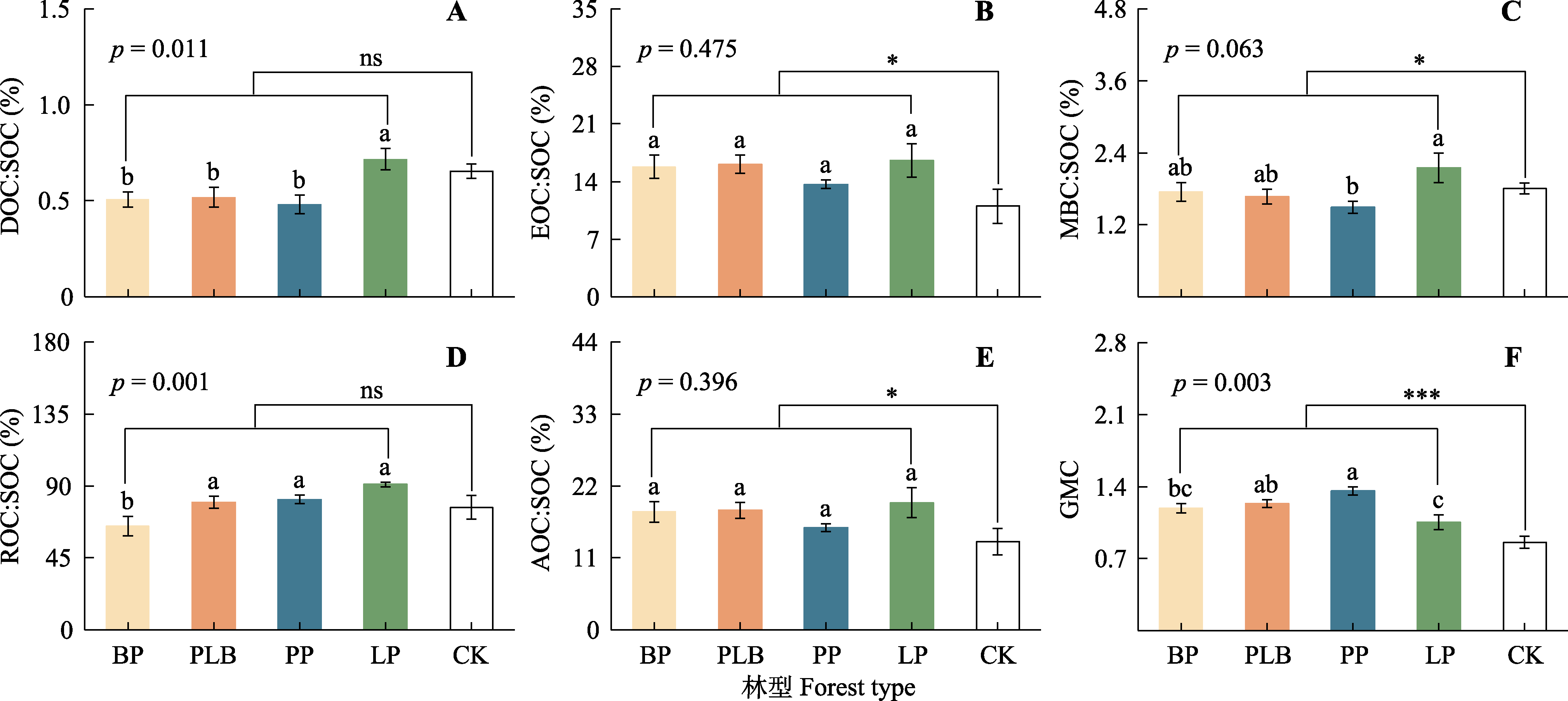
Fig. 1 Variation characteristics of the percent of soil C pool fractions in soil organic carbon content from the different forest types (mean ± SE). BP, Betula platyphylla forest; CK, scrub-grassland; LP, Larix gmelinii var. principis-rupprechtii forest; PLB, Picea wilsonii + Larix gmelinii var. principis-rupprechtii + B. platyphylla mixed conifer-broadleaf forest; PP, P. meyeri + P. wilsonii mixed conifer forest. AOC:SOC, ratio of active organic carbon contents to soil organic carbon contents; DOC:SOC, ratio of dissolved organic carbon contents to soil organic carbon contents; EOC:SOC, ratio of easily oxidizable organic carbon contents to soil organic carbon contents; GMC, geometric means of active organic carbon; MBC:SOC, ratio of microbial biomass carbon contents to soil organic carbon contents; ROC:SOC, ratio of recalcitrant organic carbon contents to soil organic carbon contents. Different lowercase letters indicate significant differences between different forest types in the figure (p < 0.05). ns imply no significant differences between natural forest types and CK in the figure (p > 0.05); p values refer to the significant differences in the percentages of each soil carbon pool component to total soil organic carbon among the four forest types, using one-way ANOVA testing at the 0.05 level; *, p < 0.05; ***, p < 0.001.
| 林型 Forest type | 稳态碳含量 Soil steady-state C content (CSS, g·kg-1) | 碳库活度 C pool active degree (CPA) | 碳库活度指数 C pool active indexes (CAI) | 碳库指数 C pool indexes (CPI) | 碳库管理指数 C pool management indexes (CPMI) |
|---|---|---|---|---|---|
| BP | 44.32 ± 6.36ab | 0.19 ± 0.02a | 1.49 ± 0.16a | 1.39 ± 0.18ab | 194.05 ± 7.14a |
| PLB | 44.81 ± 5.08ab | 0.19 ± 0.02a | 1.52 ± 0.12a | 1.42 ± 0.14ab | 207.01 ± 4.04a |
| PP | 56.50 ± 4.30a | 0.16 ± 0.01a | 1.25 ± 0.06a | 1.74 ± 0.12a | 213.64 ± 7.53a |
| LP | 32.78 ± 6.21b | 0.20 ± 0.03a | 1.59 ± 0.24a | 1.03 ± 0.17b | 146.71 ± 6.98b |
| CK | 33.37 ± 4.80** | 0.13 ± 0.03ns | 1.00 | 1.00 | 100.00 |
| Sig. (p) | 0.053 | 0.523 | 0.462 | 0.033 | <0.001 |
Table 3 Lability of soil organic carbon and carbon (C) pool management indexes in different forest types (mean ± SE)
| 林型 Forest type | 稳态碳含量 Soil steady-state C content (CSS, g·kg-1) | 碳库活度 C pool active degree (CPA) | 碳库活度指数 C pool active indexes (CAI) | 碳库指数 C pool indexes (CPI) | 碳库管理指数 C pool management indexes (CPMI) |
|---|---|---|---|---|---|
| BP | 44.32 ± 6.36ab | 0.19 ± 0.02a | 1.49 ± 0.16a | 1.39 ± 0.18ab | 194.05 ± 7.14a |
| PLB | 44.81 ± 5.08ab | 0.19 ± 0.02a | 1.52 ± 0.12a | 1.42 ± 0.14ab | 207.01 ± 4.04a |
| PP | 56.50 ± 4.30a | 0.16 ± 0.01a | 1.25 ± 0.06a | 1.74 ± 0.12a | 213.64 ± 7.53a |
| LP | 32.78 ± 6.21b | 0.20 ± 0.03a | 1.59 ± 0.24a | 1.03 ± 0.17b | 146.71 ± 6.98b |
| CK | 33.37 ± 4.80** | 0.13 ± 0.03ns | 1.00 | 1.00 | 100.00 |
| Sig. (p) | 0.053 | 0.523 | 0.462 | 0.033 | <0.001 |
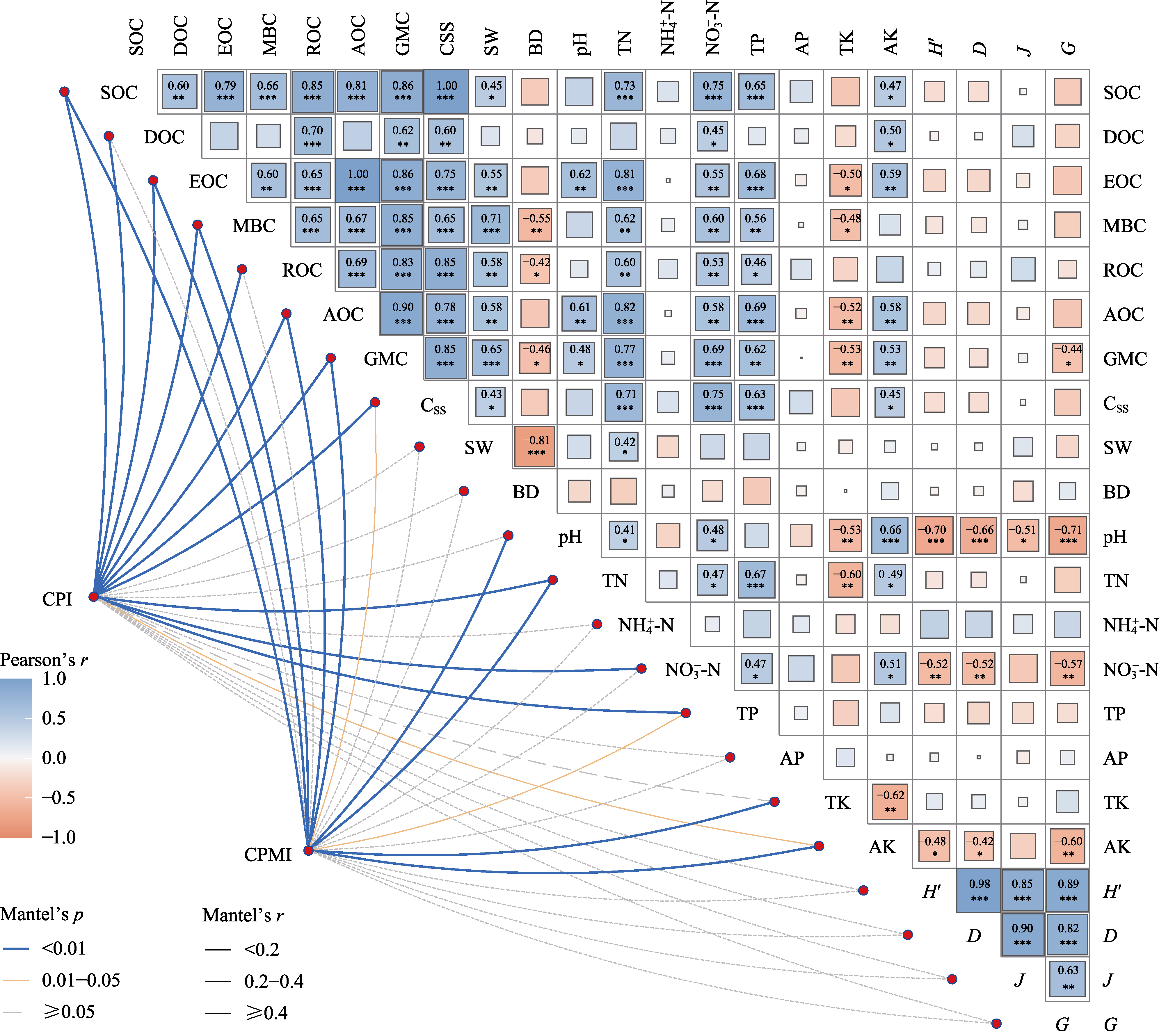
Fig. 2 Relationship between the carbon (C) pool management indexes and environmental variables under different forest types based on the Pearson correlation and mantel test analysis (n = 24). AK, available potassium content; AOC, active organic carbon content; AP, available phosphorus content; BD, soil bulk density; CSS, soil stable carbon content; CPI, carbon pool index; CPMI, carbon pool management index; D, Simpson index; DOC, dissolved organic carbon content; EOC, easily oxidizable organic carbon content; G, Gleason index; GMC, geometric mean value of active organic carbon content; H′, Shannon-Wiener index; J, Pielou evenness index; MBC, soil microbial biomass carbon content; NH4+-N, ammonium nitrogen content; NO3--N, nitrate nitrogen content; ROC, recalcitrant organic carbon content; SOC, soil organic carbon content; SW, soil water content; TK, total potassium content; TN, total nitrogen content; TP, total phosphorus content. Different colors indicate the corresponding types and Pearson correlation coefficients, and solid lines and dashed lines represent significant and insignificant correlations, respectively. *, p < 0.05; **, p < 0.01; ***, p < 0.001.
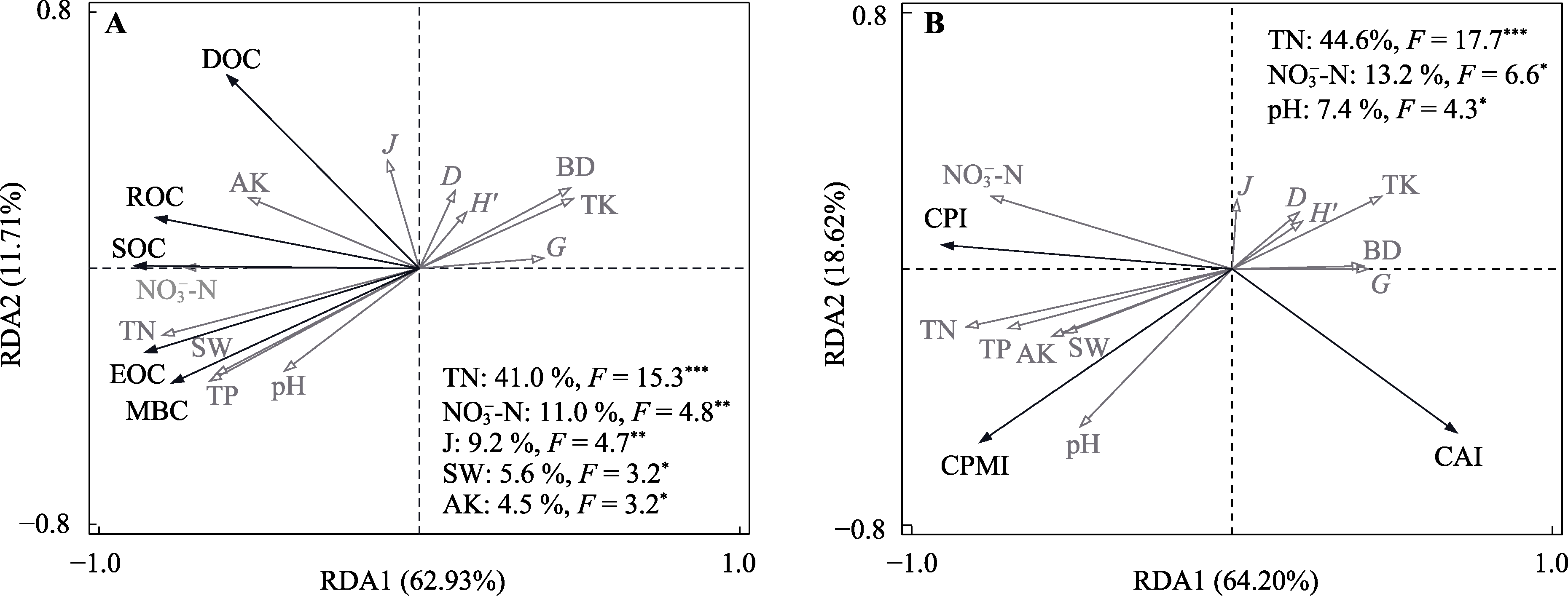
Fig. 3 Redundancy analysis (RDA) of soil carbon (C) pool fractions (A) and C pool management indexes (B) and soil environment factors. Index see Fig. 2. *, p < 0.05; **, p < 0.01; ***, p < 0.001.
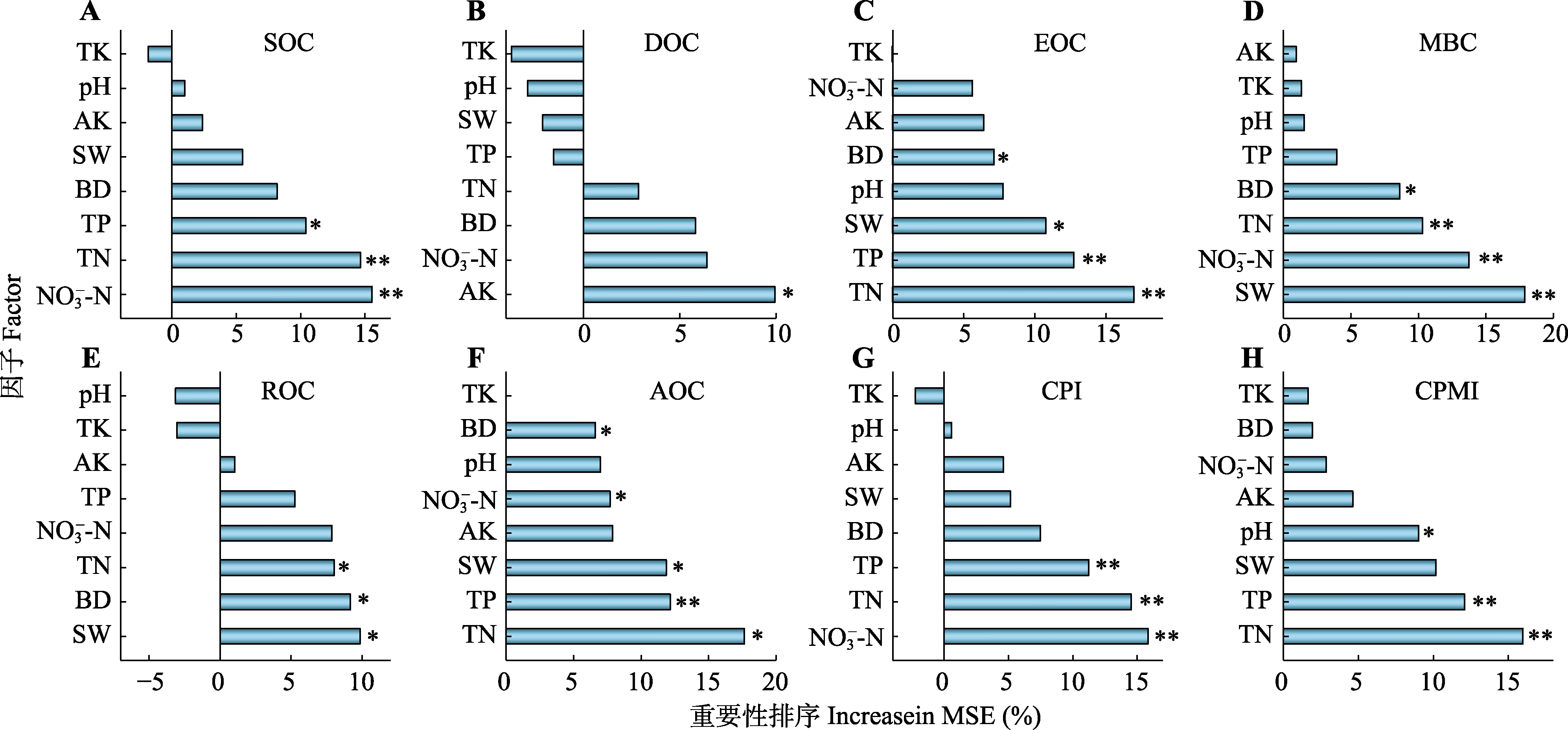
Fig. 4 Random forest analysis indicating the effects of soil environmental variables on the contents of soil organic carbon (C) and C pool fractions, and soil carbon pool management indexes. * and ** correspond to p < 0.05 and 0.01, respectively. Index see Fig. 2.
| [1] |
Ågren GI, Bosatta E, Magill AH (2001). Combining theory and experiment to understand effects of inorganic nitrogen on litter decomposition. Oecologia, 128, 94-98.
DOI PMID |
| [2] | Akinyede R, Taubert M, Schrumpf M, Trumbore S, Küsel K (2022). Dark CO2 fixation in temperate beech and pine forest soils. Soil Biology & Biochemistry, 165, 108526. DOI: 10.1016/j.soilbio.2021.108526. |
| [3] |
Anderson TH, Domsch KH (1989). Ratios of microbial biomass carbon to total organic carbon in arable soils. Soil Biology & Biochemistry, 21, 471-479.
DOI URL |
| [4] | Arias ME, Gonzalez-Perez JA, Gonzalez-Vila FJ, Ball AS (2005). Soil health—A new challenge for microbiologists and chemists. International Microbiology, 8, 13-21. |
| [5] | Augusto L, Boča A (2022). Tree functional traits, forest biomass, and tree species diversity interact with site properties to drive forest soil carbon. Nature Communications, 13, 1097. DOI: 10.1038/s41467-022-28748-0. |
| [6] |
Augusto L, De Schrijver A, Vesterdal L, Smolander A, Prescott C, Ranger J (2015). Influences of evergreen gymnosperm and deciduous angiosperm tree species on the functioning of temperate and boreal forests. Biological Reviews, 90, 444-466.
DOI URL |
| [7] |
Blair G, Lefroy RDB, Lisle L (1995). Soil carbon fractions based on their degree of oxidation, and the development of a carbon management index for agricultural systems. Australian Journal of Agricultural Research, 46, 1459-1466.
DOI URL |
| [8] |
Briones MJI, Ineson P (1996). Decomposition of Eucalyptus leaves in litter mixtures. Soil Biology & Biochemistry, 28, 1381-1388.
DOI URL |
| [9] | Cai H, Shu YG, Wang CM, Liao YH, Luo XL, Long H, Li XM (2023). Evolution characteristics of soil active organic carbon and carbon pool management index under vegetation restoration in karst area. Environmental Science, 44, 6880-6893. |
| [蔡华, 舒英格, 王昌敏, 廖远行, 罗秀龙, 龙慧, 李雪梅 (2023). 喀斯特地区植被恢复下土壤活性有机碳与碳库管理指数的演变特征. 环境科学, 44, 6880-6893.] | |
| [10] |
Chen LY, Fang K, Wei B, Qin SQ, Feng XH, Hu TY, Ji CJ, Yang YH (2021). Soil carbon persistence governed by plant input and mineral protection at regional and global scales. Ecology Letters, 24, 1018-1028.
DOI PMID |
| [11] |
Chen RR, Senbayram M, Blagodatsky S, Myachina O, Dittert K, Lin XG, Blagodatskaya E, Kuzyakov Y (2014). Soil C and N availability determine the priming effect: microbial N mining and stoichiometric decomposition theories. Global Change Biology, 20, 2356-2367.
DOI PMID |
| [12] | Chen ZD, Xu CX, An ZY, Wang YP, Sun DZ, Wang SM (2019). Research progress on fraction and analysis methods of soil carbon. Rock and Mineral Analysis, 38, 233-244. |
| [陈宗定, 许春雪, 安子怡, 王亚平, 孙德忠, 王苏明 (2019). 土壤碳赋存形态及分析方法研究进展. 岩矿测试, 38, 233-244.] | |
| [13] | Cheng ZC, Yang LB, Sui X, Zhang T, Wang WH, Yin WP, Li GF, Song FQ (2021). Soil microbial functional diversity responses to different revegetation types in Heilongjiang Zhongyangzhan black-billed capercaillie nature reserve. Research of Environmental Sciences, 34, 1177-1186. |
| [程智超, 杨立宾, 隋心, 张童, 王文浩, 尹伟平, 李国富, 宋福强 (2021). 黑龙江中央站黑嘴松鸡国家级自然保护区不同森林类型土壤微生物功能多样性分析. 环境科学研究, 34, 1177-1186.] | |
| [14] | de Deyn GB, Cornelissen JHC, Bardgett RD (2008). Plant functional traits and soil carbon sequestration in contrasting biomes. Ecology Letters, 11, 516-531. |
| [15] |
DeForest JL, Zak DR, Pregitzer KS, Burton AJ (2005). Atmospheric nitrate deposition and enhanced dissolved organic carbon leaching. Soil Science Society of America Journal, 69, 1233-1237.
DOI URL |
| [16] | Dong LB, Fan JW, Li JW, Zhang Y, Liu YL, Wu JZ, Li A, Shangguan ZP, Deng L (2022). Forests have a higher soil C sequestration benefit due to lower C mineralization efficiency: evidence from the central Loess Plateau case. Agriculture, Ecosystems & Environment, 339, 108144. DOI: 10.1016/j.agee.2022.108144. |
| [17] |
Fang XM, Wang QL, Zhou WM, Zhao W, Wei YW, Niu LJ, Dai LM (2014). Land use effects on soil organic carbon, microbial biomass and microbial activity in Changbai Mountains of Northeast China. Chinese Geographical Science, 24, 297-306.
DOI URL |
| [18] |
Fang XM, Yu DP, Zhou WM, Zhou L, Dai LM (2016). The effects of forest type on soil microbial activity in Changbai Mountain, Northeast China. Annals of Forest Science, 73, 473-482.
DOI URL |
| [19] | Gao DC, Shi WJ, Wang HM, Liu ZP, Jiang QO, Lv WJ, Wang SY, Zhang YL, Zhao CH, Hagedorn F (2024). Contrasting global patterns of soil microbial quotients of carbon, nitrogen, and phosphorus in terrestrial ecosystems. Catena, 243, 108145. DOI: 10.1016/j.catena.2024.108145. |
| [20] |
Gartzia-Bengoetxea N, González-Arias A, Merino A, Martínez de Arano I (2009). Soil organic matter in soil physical fractions in adjacent semi-natural and cultivated stands in temperate Atlantic forests. Soil Biology & Biochemistry, 41, 1674-1683.
DOI URL |
| [21] |
Gu X, Zhang SJ, Xiang WH, Li LD, Liu ZD, Sun WJ, Fang X (2016). Seasonal dynamics of active soil organic carbon in four subtropical forests in Southern China. Chinese Journal of Plant Ecology, 40, 1064-1076.
DOI |
|
[辜翔, 张仕吉, 项文化, 李雷达, 刘兆丹, 孙伟军, 方晰 (2016). 中亚热带4种森林类型土壤活性有机碳的季节动态特征. 植物生态学报, 40, 1064-1076.]
DOI |
|
| [22] |
Gunapala N, Scow KM (1998). Dynamics of soil microbial biomass and activity in conventional and organic farming systems. Soil Biology & Biochemistry, 30, 805-816.
DOI URL |
| [23] | Guo JH, Feng HL, McNie P, Liu QY, Xu X, Pan C, Yan K, Feng L, Adehanom Goitom E, Yu YC (2023). Species mixing improves soil properties and enzymatic activities in Chinese fir plantations: a meta-analysis. Catena, 220, 106723. DOI: 10.1016/j.catena.2022.106723. |
| [24] | Hao ZG, Zhao YF, Wang X, Wu JH, Jiang SL, Xiao JJ, Wang KC, Zhou XH, Liu HY, Li J, Sun YX (2021). Thresholds in aridity and soil carbon-to-nitrogen ratio govern the accumulation of soil microbial residues. Communications Earth & Environment, 2, 236. DOI: 10.1038/s43247-021-00306-4. |
| [25] |
Hättenschwiler S, Tiunov AV, Scheu S (2005). Biodiversity and litter decomposition in terrestrial ecosystems. Annual Review of Ecology, Evolution, and Systematics, 36, 191-218.
DOI URL |
| [26] | Huang Q, Wang BR, Shen JK, Xu FJ, Li N, Jia PH, Jia YJ, An SS, Amoah ID, Huang YM (2024). Shifts in C-degradation genes and microbial metabolic activity with vegetation types affected the surface soil organic carbon pool. Soil Biology & Biochemistry, 192, 109371. DOI: 10.1016/j.soilbio.2024.109371. |
| [27] |
Hynynen J, Repola J, Mielikäinen K (2011). The effects of species mixture on the growth and yield of mid-rotation mixed stands of Scots pine and silver birch. Forest Ecology and Management, 262, 1174-1183.
DOI URL |
| [28] |
Jackson RB, Lajtha K, Crow SE, Hugelius G, Kramer MG, Piñeiro G (2017). The ecology of soil carbon: pools, vulnerabilities, and biotic and abiotic controls. Annual Review of Ecology, Evolution, and Systematics, 48, 419-445.
DOI URL |
| [29] |
Jakšík O, Kodešová R, Kubiš A, Stehlíková I, Drábek O, Kapička A (2015). Soil aggregate stability within morphologically diverse areas. Catena, 127, 287-299.
DOI URL |
| [30] | Jia KD, Wang YQ, Gao Y, Zhou ZY (2024). Variability of soil organic carbon pool in different coniferous pure forests and mixed forests in Taiyue Mountain, Shanxi Province. Journal of Northeast Forestry University, 52(3), 112-118. |
| [贾匡迪, 王勇强, 高雨, 周志勇 (2024). 山西太岳山不同针叶纯林及混交林土壤有机碳库的变异性. 东北林业大学学报, 52(3), 112-118.] | |
| [31] |
Jiang PK, Xu QF (2006). Abundance and dynamics of soil labile carbon pools under different types of forest vegetation. Pedosphere, 16, 505-511.
DOI URL |
| [32] | Jílková V, Jandová K, Cajthaml T, Kukla J, Jansa J (2022). Differences in the flow of spruce-derived needle leachates and root exudates through a temperate coniferous forest mineral topsoil. Geoderma, 405, 115441. DOI: 10.1016/j.geoderma.2021.115441. |
| [33] |
Jones DL, Willett VB (2006). Experimental evaluation of methods to quantify dissolved organic nitrogen (DON) and dissolved organic carbon (DOC) in soil. Soil Biology & Biochemistry, 38, 991-999.
DOI URL |
| [34] | Kara O, Bolat I (2008). The effect of different land uses on soil microbial biomass carbon and nitrogen in Bartın province. Turkish Journal of Agriculture and Forestry, 32, 281-288. |
| [35] |
Knorr W, Prentice IC, House JI, Holland EA (2005). Long-term sensitivity of soil carbon turnover to warming. Nature, 433, 298-301.
DOI |
| [36] |
Kooch Y, Sanji R, Tabari M (2019). The effect of vegetation change in C and N contents in litter and soil organic fractions of a Northern Iran temperate forest. Catena, 178, 32-39.
DOI URL |
| [37] | Lange M, Eisenhauer N, Sierra CA, Bessler H, Engels C, Griffiths RI, Mellado-Vázquez PG, Malik AA, Roy J, Scheu S, Steinbeiss S, Thomson BC, Trumbore SE, Gleixner G (2015). Plant diversity increases soil microbial activity and soil carbon storage. Nature Communications, 6, 6707. DOI: 10.1038/ncomms7707. |
| [38] | Lee YJ, Lee HI, Lee CB, Lee KH, Kim RH, Ali A (2024). Abiotic and stand age-induced changes in tree diversity and size inequality regulate aboveground biomass and soil organic carbon stock in temperate forests of South Korea. Catena, 237, 107827. DOI: 10.1016/j.catena.2024.107827. |
| [39] | Li H, Chen Y, Lu Z, Wang FM, Lambers H, Zhang JF, Qin GM, Zhou JG, Wu JT, Zhang LL, Thapa P, Lu XK, Mo JM (2023). Nitrogen deposition in low-phosphorus tropical forests benefits soil C sequestration but not stabilization. Ecological Indicators, 146, 109761. DOI: 10.1016/j.ecolind.2022.109761. |
| [40] |
Li J, Wen YC, Li XH, Li YT, Yang XD, Lin ZA, Song ZZ, Cooper JM, Zhao BQ (2018). Soil labile organic carbon fractions and soil organic carbon stocks as affected by long-term organic and mineral fertilization regimes in the North China Plain. Soil and Tillage Research, 175, 281-290.
DOI URL |
| [41] | Li SY, Man XL, Wei H (2018). Dynamic characteristics of soil active organic carbon in Betula platyphalla forest and Larix gmelinii forest in Daxing’an Mountains. Journal of Northeast Forestry University, 46(12), 64-70. |
| [李书杨, 满秀玲, 魏红 (2018). 大兴安岭白桦林和兴安落叶松林土壤活性有机碳动态特征. 东北林业大学学报, 46(12), 64-70.] | |
| [42] | Li YN, Zhou XM, Zhang NL, Ma KP (2016). The research of mixed litter effects on litter decomposition in terrestrial ecosystems. Acta Ecologica Sinica, 36, 4977-4987. |
| [李宜浓, 周晓梅, 张乃莉, 马克平 (2016). 陆地生态系统混合凋落物分解研究进展. 生态学报, 36, 4977-4987.] | |
| [43] | Liang Q, Wang C, Zhang KX, Shi SW, Guo JX, Gao F, Liu J, Wang JX, Liu Y (2021). The influence of tree species on soil organic carbon stability under three temperate forests in the Baihua Mountain Reserve, China. Global Ecology and Conservation, 26, e01454. DOI: 10.1016/j.gecco.2021.e01454. |
| [44] |
Lin GG, McCormack ML, Ma CG, Guo DL (2017). Similar below-ground carbon cycling dynamics but contrasting modes of nitrogen cycling between arbuscular mycorrhizal and ectomycorrhizal forests. New Phytologist, 213, 1440-1451.
DOI PMID |
| [45] |
Liu MY, Li P, Liu MM, Wang J, Chang QR (2021). The trend of soil organic carbon fractions related to the successions of different vegetation types on the tableland of the Loess Plateau of China. Journal of Soils and Sediments, 21, 203-214.
DOI |
| [46] | Liu S, Wang CK (2010). Spatio-temporal patterns of soil microbial biomass carbon and nitrogen in five temperate forest ecosystems. Acta Ecologica Sinica, 30, 3135-3143. |
| [刘爽, 王传宽 (2010). 五种温带森林土壤微生物生物量碳氮的时空格局. 生态学报, 30, 3135-3143.] | |
| [47] | Mao XY, Shen YY, Chu JJ, Xu GP, Wang ZH, Cao Y, Chen YS, Zhang DN, Sun YJ, Huang KC (2025). Effects of simulated nitrogen deposition on soil organic carbon fractions and carbon pool management indicators in mid-subtropical Eucalyptus plantations. Environmental Science, 46, 1032-1045. |
| [毛馨月, 沈育伊, 褚俊智, 徐广平, 王紫卉, 曹杨, 陈运霜, 张德楠, 孙英杰, 黄科朝 (2025). 模拟氮沉降对中亚热带桉树人工林土壤有机碳组分及碳库管理指数的影响. 环境科学, 46, 1032-1045.] | |
| [48] | Mayer M, Prescott CE, Abaker WEA, Augusto L, Cécillon L, Ferreira GWD, James J, Jandl R, Katzensteiner K, Laclau JP, Laganière J, Nouvellon Y, Paré D, Stanturf JA, Vanguelova EI, Vesterdal L (2020). Tamm review: influence of forest management activities on soil organic carbon stocks: a knowledge synthesis. Forest Ecology and Management, 466, 118127. DOI: 10.1016/j.foreco.2020.118127. |
| [49] |
Pan YD, Birdsey RA, Fang JY, Houghton R, Kauppi PE, Kurz WA, Phillips OL, Shvidenko A, Lewis SL, Canadell JG, Ciais P, Jackson RB, Pacala SW, David McGuire A, Piao SL, Rautiainen A, Sitch S, Hayes D (2011). A large and persistent carbon sink in the world’s forests. Science, 333, 988-993.
DOI URL |
| [50] | Pang DB, Cui M, Liu YG, Wang GZ, Cao JH, Wang XR, Dan XQ, Zhou JX (2019). Responses of soil labile organic carbon fractions and stocks to different vegetation restoration strategies in degraded karst ecosystems of southwest China. Ecological Engineering, 138, 391-402. |
| [51] |
Prieto I, Stokes A, Roumet C (2016). Root functional parameters predict fine root decomposability at the community level. Journal of Ecology, 104, 725-733.
DOI URL |
| [52] |
Sheng H, Zhou P, Zhang YZ, Kuzyakov Y, Zhou Q, Ge TD, Wang CH (2015). Loss of labile organic carbon from subsoil due to land-use changes in subtropical China. Soil Biology & Biochemistry, 88, 148-157.
DOI URL |
| [53] | Shi JW, Song MY, Yang L, Zhao F, Wu JZ, Li JW, Yu ZJ, Li A, Shangguan ZP, Deng L (2023). Recalcitrant organic carbon plays a key role in soil carbon sequestration along a long-term vegetation succession on the Loess Plateau. Catena, 233, 107528. DOI: 107528.10.1016/j.catena.2023.107528. |
| [54] |
Skjemstad JO, Swift RS, McGowan JA (2006). Comparison of the particulate organic carbon and permanganate oxidation methods for estimating labile soil organic carbon. Soil Research, 44, 255-263.
DOI URL |
| [55] | Teng QM, Shen YY, Xu GP, Zhang ZF, Zhang DN, Zhou LW, Huang KC, Sun YJ, He W (2020). Characteristics of soil carbon pool management indices under different vegetation types in karst mountainous areas of North Guangxi. Chinese Journal of Ecology, 39, 422-433. |
| [滕秋梅, 沈育伊, 徐广平, 张中峰, 张德楠, 周龙武, 黄科朝, 孙英杰, 何文 (2020). 桂北喀斯特山区不同植被类型土壤碳库管理指数的变化特征. 生态学杂志, 39, 422-433.] | |
| [56] | Tian Q, Yang F, Wang ZH, Zhang QY (2024). Variation of soil organic carbon components and enzyme activities during the ecological restoration in a temperate forest. Ecological Engineering, 201, 107192. DOI: 10.1016/j.ecoleng.2024.107192. |
| [57] |
Vance ED, Brookes PC, Jenkinson DS (1987). An extraction method for measuring soil microbial biomass C. Soil Biology & Biochemistry, 19, 703-707.
DOI URL |
| [58] |
Vieira FCB, Bayer C, Zanatta JA, Dieckow J, Mielniczuk J, He ZL (2007). Carbon management index based on physical fractionation of soil organic matter in an Acrisol under long-term no-till cropping systems. Soil and Tillage Research, 96, 195-204.
DOI URL |
| [59] | Wang CY, He NP, Lyu YL (2016). Latitudinal patterns and factors affecting different soil organic carbon fractions in the eastern forests of China. Acta Ecologica Sinica, 36, 3176-3188. |
| [王春燕, 何念鹏, 吕瑜良 (2016). 中国东部森林土壤有机碳组分的纬度格局及其影响因子. 生态学报, 36, 3176-3188.] | |
| [60] | Wang D, Geng ZC, She D, He WX, Hou L (2015). Soil organic carbon storage and vertical distribution of carbon and nitrogen across different forest types in the Qinling Mountains. Acta Ecologica Sinica, 35, 5421-5429. |
| [王棣, 耿增超, 佘雕, 和文祥, 侯琳 (2015). 秦岭典型林分土壤有机碳储量及碳氮垂直分布. 生态学报, 35, 5421-5429.] | |
| [61] | Wang L, Liu QY, Guan QW, Shi JP, Peng TT, Zhu XC, Yang Y, Liu J (2023). Characteristics of soil organic carbon pools and their influencing factors under different stand types in the plain sandy area. Forest Research, 36(4), 72-81. |
| [王磊, 刘晴廙, 关庆伟, 史经攀, 彭婷婷, 朱相丞, 杨樾, 刘静 (2023). 平原沙土区不同林分类型下土壤有机碳库特征及其影响因子. 林业科学研究, 36(4), 72-81.] | |
| [62] | Wang LF, Zhou Y, Chen YM, Xu ZF, Zhang J, Liu Y, Joly FX (2022). Litter diversity accelerates labile carbon but slows recalcitrant carbon decomposition. Soil Biology & Biochemistry, 168, 108632. DOI: 10.1016/j.soilbio.2022.108632. |
| [63] | Wang X, Chen F, Liu JJ, Wang ZC, Zhang ZJ, Li XY, Zhang Q, Liu WC, Liu HY, Zeng J, Ren CJ, Yang GH, Zhong ZK, Han XH (2024). Linking the soil carbon pool management index to ecoenzymatic stoichiometry and organic carbon functional groups in abandoned land under climate change. Catena, 235, 107676. DOI: 10.1016/j.catena.2023.107676. |
| [64] |
Weil RR, Islam KR, Stine MA, Gruver JB, Samson-Liebig SE (2003). Estimating active carbon for soil quality assessment: a simplified method for laboratory and field use. American Journal of Alternative Agriculture, 18, 3-17.
DOI URL |
| [65] | Whalen ED, Lounsbury N, Geyer K, Anthony M, Morrison E, van Diepen LTA, Le Moine J, Nadelhoffer K, vanden Enden L, Simpson MJ, Frey SD (2021). Root control of fungal communities and soil carbon stocks in a temperate forest. Soil Biology & Biochemistry, 161, 108390. DOI: 10.1016/j.soilbio.2021.108390. |
| [66] | Wu XN, Fu DG, Duan CQ, Huang GN, Shang HY (2022). Distributions and influencing factors of soil organic carbon fractions under different vegetation restoration conditions in a subtropical mountainous area, SW China. Forests, 13, 629. DOI: 10.3390/f13040629. |
| [67] | Xiang HM, Luo XZ, Zhang LL, Hou EQ, Li J, Zhu QD, Wen DZ (2022). Forest succession accelerates soil carbon accumulation by increasing recalcitrant carbon stock in subtropical forest topsoils. Catena, 212, 106030. DOI: 10.1016/j.catena.2022.106030. |
| [68] |
Xiao WY, Chen HYH, Kumar P, Chen C, Guan QW (2019). Multiple interactions between tree composition and diversity and microbial diversity underly litter decomposition. Geoderma, 341, 161-171.
DOI URL |
| [69] | Xie BC, Zhang CX, Wang GD, Xie YG (2020). Global Convergence in correlations among soil properties. International Journal of Agricultural & Biological Engineering, 13, 108-116. |
| [70] | Xu HW, Qu Q, Lu BB, Zhang Y, Liu GB, Xue S (2020). Variation in soil organic carbon stability and driving factors after vegetation restoration in different vegetation zones on the Loess Plateau, China. Soil and Tillage Research, 204, 104727. DOI: 10.1016/j.still.2020.104727. |
| [71] | Xu JH, Sun Y, Gao L, Cui XY (2018). A review of the factors influencing soil organic carbon stability. Chinese Journal of Eco-Agriculture, 26, 222-230. |
| [徐嘉晖, 孙颖, 高雷, 崔晓阳 (2018). 土壤有机碳稳定性影响因素的研究进展. 中国生态农业学报, 26, 222-230.] | |
| [72] | Yan LJ, Li G, Wu JQ, Ma WW, Wang HY (2019). Effects of four typical vegetations on soil active organic carbon and soil carbon in Loess Plateau. Acta Ecologica Sinica, 39, 5546-5554. |
| [闫丽娟, 李广, 吴江琪, 马维伟, 王海燕 (2019). 黄土高原4种典型植被对土壤活性有机碳及土壤碳库的影响. 生态学报, 39, 5546-5554.] | |
| [73] |
Yang X, Wang D, Lan Y, Meng J, Jiang LL, Sun Q, Cao DY, Sun YY, Chen WF (2018). Labile organic carbon fractions and carbon pool management index in a 3-year field study with biochar amendment. Journal of Soils and Sediments, 18, 1569-1578.
DOI URL |
| [74] | Yao YW, Dai QH, Gao RX, Yi XS, Wang Y, Hu ZY (2023). Characteristics and factors influencing soil organic carbon composition by vegetation type in spoil heaps. Frontiers in Plant Science, 14, 1240217. DOI: 10.3389/fpls.2023.1240217. |
| [75] | Yu PJ, Li YX, Liu SW, Ding Z, Zhang AC, Tang XG (2022). The quantity and stability of soil organic carbon following vegetation degradation in a salt-affected region of Northeastern China. Catena, 211, 105984. DOI: 10.1016/j.catena.2021.105984. |
| [76] | Yuan Y, Zhao ZQ, Li XZ, Wang YY, Bai ZK (2018). Characteristics of labile organic carbon fractions in reclaimed mine soils: evidence from three reclaimed forests in the Pingshuo opencast coal mine, China. Science of the Total Environment, 613, 1196-1206. |
| [77] | Zarafshar M, Vincent G, Korboulewsky N, Bazot S (2024). The impact of stand composition and tree density on topsoil characteristics and soil microbial activities. Catena, 234, 107541. DOI: 10.1016/j.catena.2023.107541. |
| [78] | Zhang JS, Li SY, Sun XY, Zhou WZ, Zhao GY, Bai XT (2024). Characteristics of soil organic carbon and its components under different vegetation types in Shandong Province. Soils, 56, 350-357. |
| [张金硕, 李素艳, 孙向阳, 周文志, 赵冠宇, 白雪亭 (2024). 山东省不同植被类型土壤有机碳及其组分分布特征. 土壤, 56, 350-357.] | |
| [79] |
Zhang M, Zhang XK, Liang WJ, Jiang Y, Dai GH, Wang XG, Han SJ (2011). Distribution of soil organic carbon fractions along the altitudinal gradient in Changbai Mountain, China. Pedosphere, 21, 615-620.
DOI URL |
| [80] | Zhao XX, Tian QX, Michelsen A, Chen L, Yue PY, Feng ZY, Lin QL, Zhao RD, Liu F (2024). Fine roots and extramatrical mycelia regulate the composition of soil organic carbon and nitrogen in a subtropical montane forest. Forest Ecology and Management, 554, 121661. DOI: 10.1016/j.foreco.2023.121661. |
| [81] | Zhao Z, Liu YW, Ji FL, Liu XL, Jia ZK, Ma LY (2016). Mixed litter decomposition of Larix gmelinii var. principis-rupprechtii and Betula platyphylla. Journal of Central South University of Forestry & Technology, 36(12), 74-78. |
| [赵喆, 刘延文, 纪福利, 刘晓兰, 贾忠奎, 马履一 (2016). 华北落叶松—白桦凋落物混合分解研究. 中南林业科技大学学报, 36(12), 74-78.] | |
| [82] | Zhou GS, Wang YH, Jiang YL, Yang LM (2002). Conversion of terrestrial ecosystems and carbon cycling. Acta Phytoecologica Sinica, 26, 250-254. |
| [周广胜, 王玉辉, 蒋延玲, 杨利民 (2002). 陆地生态系统类型转变与碳循环. 植物生态学报, 26, 250-254.] | |
| [83] |
Zhou S, Lin JJ, Wang P, Zhu P, Zhu B (2023). Resistant soil organic carbon is more vulnerable to priming by root exudate fractions than relatively active soil organic carbon. Plant and Soil, 488, 71-82.
DOI |
| [84] |
Zou XM, Ruan HH, Fu Y, Yang XD, Sha LQ (2005). Estimating soil labile organic carbon and potential turnover rates using a sequential fumigation-incubation procedure. Soil Biology & Biochemistry, 37, 1923-1928.
DOI URL |
| [1] | guangjin wu, 郭 垚鑫, Ren Chengjie, Wang Jun, YUE Ming, Zhao Fazhu. Distribution of soil organic carbon content and its influencing factors in different vegetation type on the northern foot of the Qinling Mountains [J]. Chin J Plant Ecol, 2026, 50(预发表): 1-. |
| [2] | HE Zheng-Jia, ZENG Xin-Ran, WANG Lin-Ying, XUE Xin-Yu, SU Qin-Ze, LI Yu, ZHANG Yin-Jie, WU Hui-Huang, CHEN Cheng-Cong, WU Liang-Quan, WEI An-Ni, QIU Yun-Peng, GUO Li-Jin. Response of arbuscular mycorrhizal fungal communities and soil organic carbon to magnesium fertilization in tea plantations [J]. Chin J Plant Ecol, 2026, 50(3): 700-709. |
| [3] | LI Wen-Zhu, LUAN Jun-Wei, DI Ya-Ping, WANG Yi, NIE Xiu-Qing, LIU Shi-Rong. Effects of manipulative drought on mycorrhiza-mediated soil enzyme activities and soil organic carbon fractions in a warm temperate Quercus aliena var. acuteserrata forest [J]. Chin J Plant Ecol, 2026, 50(3): 660-673. |
| [4] | ZHANG Fa-Wei, LI Hong-Qin, ZHU Jing-Bin, FAN Bo, ZHOU Hua-Kun, LI Ying-Nian, LIANG Nai-Shen. Response of aboveground and belowground carbon storage to nitrogen addition and precipitation change in an alpine meadow ecosystem [J]. Chin J Plant Ecol, 2025, 49(9): 1399-1409. |
| [5] | FAN Ya-Ran, XIA Shao-Pan, YU Bing-Bing, ZHU Zi-Qi, YANG Wei, FAN Yu-Chuan, LIU Xiao-Yu, ZHANG Xu-Hui, ZHENG Ju-Feng. Effects of elevated atmospheric CO2 concentration and warming on stability of soil organic carbon pool accumulation, molecular composition and structure stability [J]. Chin J Plant Ecol, 2025, 49(7): 1053-1069. |
| [6] | QIU Zhi-Hao, ZHAO Ting-Ting, ZHANG Qing-Fen, LIU Jia-Yi, YUAN Xiao-Tong, YANG Feng-Jian. Physiological and biochemical properties of Rhododendron tomentosum under different forest types and its adaptability [J]. Chin J Plant Ecol, 2025, 49(7): 1144-1155. |
| [7] | HUANG Zhi-Jun, GAN Zi-Ying, ZHU Jia-Xin, QIU Qing-Yan, HU Ya-Lin. Impacts and mechanisms of carbon to nitrogen ratios of different organs of Cunninghamia lanceolata on soil priming effect [J]. Chin J Plant Ecol, 2025, 49(10): 1710-1720. |
| [8] | DU Shu-Hui, CHU Jian-Min, DUAN Jun-Guang, XUE Jian-Guo, XU Lei, XU Xiao-Qing, WANG Qi-Bing, HUANG Jian-Hui, ZHANG Qian. Influence of lignin phenols on soil organic carbon in degraded grassland in Nei Mongol, China [J]. Chin J Plant Ecol, 2025, 49(1): 30-41. |
| [9] | PENG Si-Rui, ZHANG Hui-Ling, SUN Zhao-Lin, ZHAO Xue-Chao, TIAN Peng, CHEN Di-Ma, WANG Qing-Kui, LIU Sheng-En. Effects of long-term litter removal on soil organic carbon and multiple components in subtropical Cunninghamia lanceolata forest [J]. Chin J Plant Ecol, 2024, 48(8): 1078-1088. |
| [10] | QIN Wen-Kuan, ZHANG Qiu-Fang, AO Gu-Kai-Lin, ZHU Biao. Responses and mechanisms of soil organic carbon dynamics to warming: a review [J]. Chin J Plant Ecol, 2024, 48(4): 403-415. |
| [11] | ZHANG Jia-Rui, DUAN Xiao-Yang, LAN Tian-Xiang, SURIGAOGE Surigaoge, LIU Lin, GUO Zhong-Yang, LÜ Hao-Ran, ZHANG Wei-Ping, LI Long. Advances in the role of plant diversity in soil organic carbon content and stability [J]. Chin J Plant Ecol, 2024, 48(11): 1393-1405. |
| [12] | ZHANG Yu, DU Ting, CHEN Yu-Lian, ZHU He-Meng, TAN Bo, YOU Cheng-Ming, ZHANG Li, XU Zhen-Feng, LI Han. Contribution of litter-derived carbon to soil organic carbon fractions and its response to freezing-thaw cycling in a subalpine forest [J]. Chin J Plant Ecol, 2024, 48(11): 1422-1433. |
| [13] | WANG Liang, ZHAO Xue-Chao, YANG Shao-Bo, WANG Qing-Kui. Priming effect of soil organic carbon decomposition induced by Cunninghamia lanceolate leaf litter and fine root and its response to nitrogen addition in subtropical forests [J]. Chin J Plant Ecol, 2024, 48(11): 1434-1444. |
| [14] | CHEN Ying-Jie, FANG Kai, QIN Shu-Qi, GUO Yan-Jun, YANG Yuan-He. Spatial patterns and determinants of soil organic carbon component contents and decomposition rate in temperate grasslands of Nei Mongol, China [J]. Chin J Plant Ecol, 2023, 47(9): 1245-1255. |
| [15] | ZHANG Ying, ZHANG Chang-Hong, WANG Qi-Tong, ZHU Xiao-Min, YIN Hua-Jun. Difference of soil carbon sequestration between rhizosphere and bulk soil in a mountain coniferous forest in southwestern China under nitrogen deposition [J]. Chin J Plant Ecol, 2023, 47(9): 1234-1244. |
| Viewed | ||||||
|
Full text |
|
|||||
|
Abstract |
|
|||||
Copyright © 2026 Chinese Journal of Plant Ecology
Tel: 010-62836134, 62836138, E-mail: apes@ibcas.ac.cn, cjpe@ibcas.ac.cn

