
Chin J Plant Ecol ›› 2025, Vol. 49 ›› Issue (11): 1944-1956.DOI: 10.17521/cjpe.2024.0217 cstr: 32100.14.cjpe.2024.0217
• Research Articles • Previous Articles Next Articles
ZHANG Xiao-Ting1, WANG Jun-Jie2,*( )
)
Received:2024-07-04
Accepted:2025-01-09
Online:2025-11-20
Published:2025-11-20
Contact:
WANG Jun-Jie
Supported by:ZHANG Xiao-Ting, WANG Jun-Jie. Chlorophyll fluorescence characteristics of mangrove plants under salt and copper treatments and their relationship with leaf structure and biochemical components[J]. Chin J Plant Ecol, 2025, 49(11): 1944-1956.
Add to citation manager EndNote|Ris|BibTeX
URL: https://www.plant-ecology.com/EN/10.17521/cjpe.2024.0217
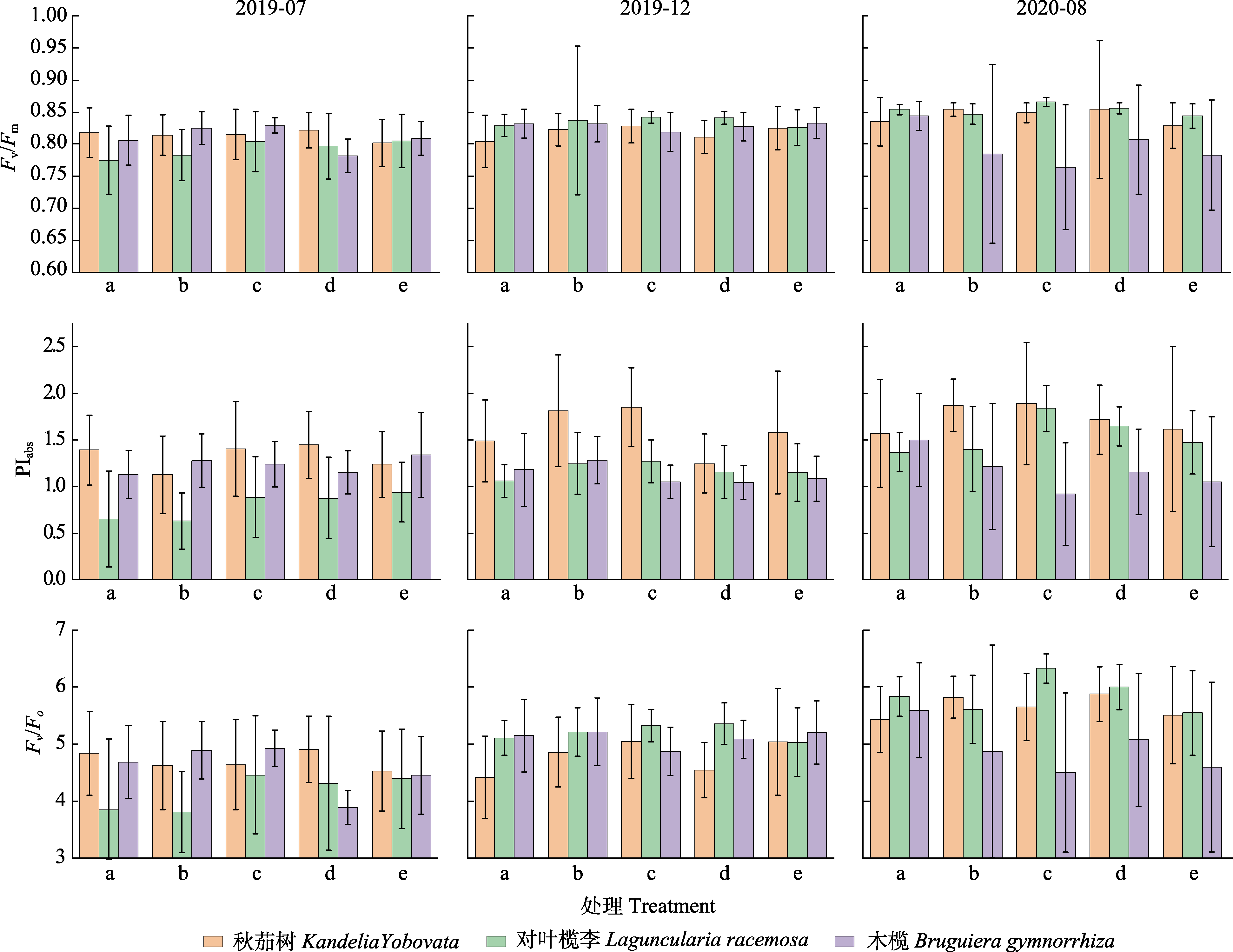
Fig. 1 Chlorophyll fluorescence parameters (mean ± SD) of three mangrove species under the combined treatment of different salinities and copper concentrations in three periods. a, salinity is 1/3 of the normal seawater salinity, and copper concentrations are 0, 50, 100, 200, and 400 mg·L-1 of copper sulfate solution; b, salinity is 2/3 of the normal seawater salinity, with the same copper concentrations as in a; c, salinity is the normal seawater salinity, with the same copper concentrations as in a; d, salinity is 4/3 of the normal seawater salinity, with the same copper concentrations as in a; e, salinity is 5/3 of the normal seawater salinity, with the same copper concentrations as in a. Fv/Fm, maximum quantum yield of PSII; PIabs, performance index; Fv/Fo, potential activity of PSII. The average chlorophyll fluorescence parameters of the three mangrove species under 25 combined treatments are shown in Supplement.
| 叶绿素荧光参数 Chlorophyll fluorescence parameter | Fv/Fm | PIabs | Fv/Fo | ||||||
|---|---|---|---|---|---|---|---|---|---|
| 2019-07 | 2019-12 | 2020-08 | 2019-07 | 2019-12 | 2020-08 | 2019-07 | 2019-12 | 2020-08 | |
| 秋茄树 Kandelia obovata | 0.423 | 1.083 | 1.208 | 1.074 | 2.422 | 1.184 | 0.488 | 1.675 | 0.646 |
| 对叶榄李 Laguncularia racemosa | 0.751 | 1.558 | 1.542 | 1.240 | 0.957 | 4.132** | 0.921 | 1.134 | 3.723 |
| 木榄 Bruguiera gymnorhiza | 4.420** | 0.368 | 0.974 | 0.855 | 1.071 | 1.484 | 6.910** | 0.708 | 0.846 |
Table 1 Analysis of variance of chlorophyll fluorescence parameters in different periods and species of mangrove plants under different salt treatments
| 叶绿素荧光参数 Chlorophyll fluorescence parameter | Fv/Fm | PIabs | Fv/Fo | ||||||
|---|---|---|---|---|---|---|---|---|---|
| 2019-07 | 2019-12 | 2020-08 | 2019-07 | 2019-12 | 2020-08 | 2019-07 | 2019-12 | 2020-08 | |
| 秋茄树 Kandelia obovata | 0.423 | 1.083 | 1.208 | 1.074 | 2.422 | 1.184 | 0.488 | 1.675 | 0.646 |
| 对叶榄李 Laguncularia racemosa | 0.751 | 1.558 | 1.542 | 1.240 | 0.957 | 4.132** | 0.921 | 1.134 | 3.723 |
| 木榄 Bruguiera gymnorhiza | 4.420** | 0.368 | 0.974 | 0.855 | 1.071 | 1.484 | 6.910** | 0.708 | 0.846 |
| 叶绿素荧光参数 Chlorophyll fluorescence parameter | Fv/Fm | PIabs | Fv/Fo | ||||||
|---|---|---|---|---|---|---|---|---|---|
| 2019-07 | 2019-12 | 2020-08 | 2019-07 | 2019-12 | 2020-08 | 2019-07 | 2019-12 | 2020-08 | |
| 秋茄树 Kandelia obovata | 1.409 | 0.967 | 0.416 | 1.200 | 0.469 | 0.577 | 1.275 | 0.840 | 0.231 |
| 对叶榄李 Laguncularia racemosa | 0.565 | 1.200 | 1.485 | 0.873 | 0.244 | 1.671 | 0.683 | 1.244 | 1.190 |
| 木榄 Bruguiera gymnorhiza | 1.213 | 1.526 | 1.461 | 0.921 | 0.305 | 0.353 | 1.010 | 0.366 | 0.291 |
Table 2 Analysis of variance of chlorophyll fluorescence parameters in different periods and species of mangrove plants under different copper treatments
| 叶绿素荧光参数 Chlorophyll fluorescence parameter | Fv/Fm | PIabs | Fv/Fo | ||||||
|---|---|---|---|---|---|---|---|---|---|
| 2019-07 | 2019-12 | 2020-08 | 2019-07 | 2019-12 | 2020-08 | 2019-07 | 2019-12 | 2020-08 | |
| 秋茄树 Kandelia obovata | 1.409 | 0.967 | 0.416 | 1.200 | 0.469 | 0.577 | 1.275 | 0.840 | 0.231 |
| 对叶榄李 Laguncularia racemosa | 0.565 | 1.200 | 1.485 | 0.873 | 0.244 | 1.671 | 0.683 | 1.244 | 1.190 |
| 木榄 Bruguiera gymnorhiza | 1.213 | 1.526 | 1.461 | 0.921 | 0.305 | 0.353 | 1.010 | 0.366 | 0.291 |
| 叶绿素荧光参数 Chlorophyll fluorescence parameter | Fv/Fm | PIabs | Fv/Fo | ||||||
|---|---|---|---|---|---|---|---|---|---|
| 2019-07 | 2019-12 | 2020-08 | 2019-7 | 2019-12 | 2020-08 | 2019-7 | 2019-12 | 2020-08 | |
| 秋茄树 Kandelia obovata | 1.393 | 1.398 | 1.020 | 1.759 | 0.853 | 0.824 | 1.734 | 0.876 | 1.585 |
| 对叶榄李 Laguncularia racemosa | 0.919 | 1.114 | 1.808 | 0.759 | 0.877 | 0.982 | 0.867 | 0.828 | 1.586 |
| 木榄 Bruguiera gymnorhiza | 0.562 | 0.821 | 1.376 | 0.696 | 1.295 | 0.947 | 0.517 | 0.802 | 1.239 |
Table 3 Analysis of variance of chlorophyll fluorescence parameters in different periods and species of mangrove plants under combined salt and copper treatments
| 叶绿素荧光参数 Chlorophyll fluorescence parameter | Fv/Fm | PIabs | Fv/Fo | ||||||
|---|---|---|---|---|---|---|---|---|---|
| 2019-07 | 2019-12 | 2020-08 | 2019-7 | 2019-12 | 2020-08 | 2019-7 | 2019-12 | 2020-08 | |
| 秋茄树 Kandelia obovata | 1.393 | 1.398 | 1.020 | 1.759 | 0.853 | 0.824 | 1.734 | 0.876 | 1.585 |
| 对叶榄李 Laguncularia racemosa | 0.919 | 1.114 | 1.808 | 0.759 | 0.877 | 0.982 | 0.867 | 0.828 | 1.586 |
| 木榄 Bruguiera gymnorhiza | 0.562 | 0.821 | 1.376 | 0.696 | 1.295 | 0.947 | 0.517 | 0.802 | 1.239 |
| 叶绿素荧光参数 Chlorophyll fluorescence parameter | F | p |
|---|---|---|
| Fv/Fm | 1.188 | 0.155 |
| PIabs | 1.314 | 0.054 |
| Fv/Fo | 2.218 | 0.000 |
Table 4 ANOVA of chlorophyll fluorescence parameters under the four-way interaction of period, species, salt treatment and copper (Cu) treatment
| 叶绿素荧光参数 Chlorophyll fluorescence parameter | F | p |
|---|---|---|
| Fv/Fm | 1.188 | 0.155 |
| PIabs | 1.314 | 0.054 |
| Fv/Fo | 2.218 | 0.000 |
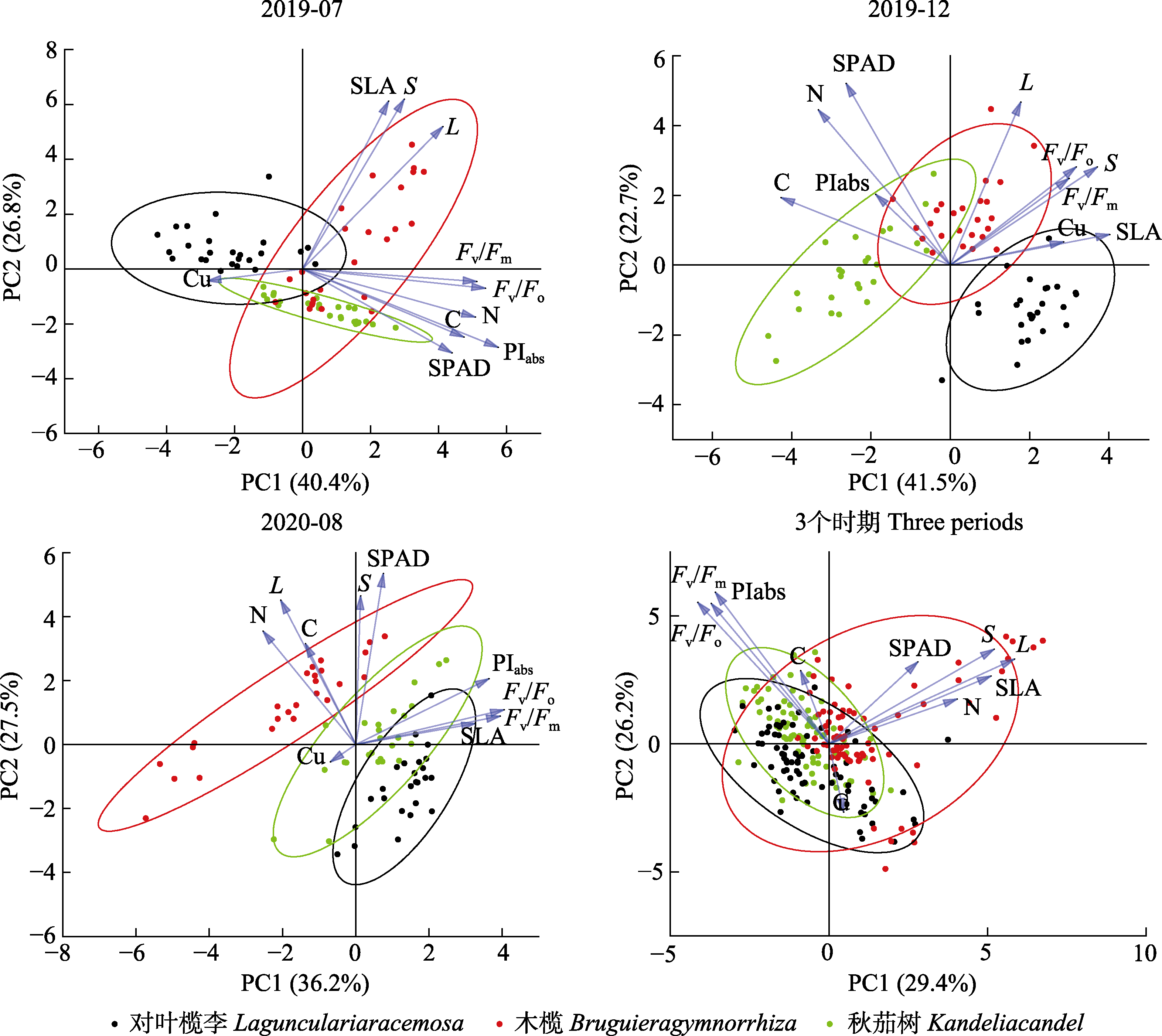
Fig. 2 Principal component (PC) analysis of leaf structure, biochemical components, and three chlorophyll fluorescence parameters in three mangrove species across three periods of salt and copper co-treatment. C, total carbon content; Cu, total copper content; Fv/Fm, maximum quantum yield of PSII; Fv/Fo, indicates the potential activity of PSII; L, leaf length; N, total nitrogen content; PIabs, performance index; S, leaf area; SLA, specific leaf area; SPAD, relative chlorophyll content.
| 叶绿素荧光参数 Chlorophyll fluorescence parameter | 固定效应 Fixed effect | 系数 Coefficient | 标准误 Standard error | t | p |
|---|---|---|---|---|---|
| Fv/Fm | 截距 Intercept | 0.906 | 0.099 | 9.145 | 0.000 |
| 叶长 Leaf length | 0.000 | 0.001 | 0.305 | 0.761 | |
| 叶面积 Leaf area | 0.000 | 0.000 | 1.517 | 0.132 | |
| 比叶面积 Specific leaf area | -0.000 | 0.001 | -0.118 | 0.906 | |
| 相对叶绿素含量 SPAD value | 0.002 | 0.001 | 2.348 | 0.020 | |
| 全铜含量 Total copper content | -0.001 | 0.001 | -1.521 | 0.131 | |
| 全碳含量 Total carbon content | -0.000 | 0.000 | -1.402 | 0.163 | |
| 全氮含量 Total nitrogen content | -0.006 | 0.002 | -2.707 | 0.008 | |
| PIabs | 截距 Intercept | -2.287 | 1.330 | -0.172 | 0.088 |
| 叶长 Leaf length | -0.001 | 0.016 | -0.063 | 0.950 | |
| 叶面积 Leaf area | 0.001 | 0.002 | 0.482 | 0.630 | |
| 比叶面积 Specific leaf area | 0.017 | 0.016 | 1.083 | 0.281 | |
| 相对叶绿素含量 SPAD value | 0.064 | 0.009 | 6.779 | 0.000 | |
| 全铜含量 Total copper content | -0.018 | 0.008 | -2.139 | 0.034 | |
| 全碳含量 Total carbon content | 0.001 | 0.002 | 0.324 | 0.747 | |
| 全氮含量 Total nitrogen content | -0.044 | 0.028 | -1.543 | 0.125 | |
| Fv/Fo | 截距 Intercept | 4.737 | 2.058 | 2.302 | 0.023 |
| 叶长 Leaf length | 0.010 | 0.025 | 0.396 | 0.693 | |
| 叶面积 Leaf area | 0.000 | 0.003 | 0.120 | 0.904 | |
| 比叶面积 Specific leaf area | 0.024 | 0.025 | 0.946 | 0.346 | |
| 相对叶绿素含量 SPAD value | 0.046 | 0.015 | 3.024 | 0.003 | |
| 全铜含量 Total copper content | -0.023 | 0.012 | -1.848 | 0.067 | |
| 全碳含量 Total carbon content | -0.002 | 0.004 | -0.648 | 0.518 | |
| 全氮含量 Total nitrogen content | -0.142 | 0.045 | -3.146 | 0.002 |
Table 5 Relationship between leaf structure, biochemical components, and three chlorophyll fluorescence parameters of Kandelia obovata under salt and copper treatments
| 叶绿素荧光参数 Chlorophyll fluorescence parameter | 固定效应 Fixed effect | 系数 Coefficient | 标准误 Standard error | t | p |
|---|---|---|---|---|---|
| Fv/Fm | 截距 Intercept | 0.906 | 0.099 | 9.145 | 0.000 |
| 叶长 Leaf length | 0.000 | 0.001 | 0.305 | 0.761 | |
| 叶面积 Leaf area | 0.000 | 0.000 | 1.517 | 0.132 | |
| 比叶面积 Specific leaf area | -0.000 | 0.001 | -0.118 | 0.906 | |
| 相对叶绿素含量 SPAD value | 0.002 | 0.001 | 2.348 | 0.020 | |
| 全铜含量 Total copper content | -0.001 | 0.001 | -1.521 | 0.131 | |
| 全碳含量 Total carbon content | -0.000 | 0.000 | -1.402 | 0.163 | |
| 全氮含量 Total nitrogen content | -0.006 | 0.002 | -2.707 | 0.008 | |
| PIabs | 截距 Intercept | -2.287 | 1.330 | -0.172 | 0.088 |
| 叶长 Leaf length | -0.001 | 0.016 | -0.063 | 0.950 | |
| 叶面积 Leaf area | 0.001 | 0.002 | 0.482 | 0.630 | |
| 比叶面积 Specific leaf area | 0.017 | 0.016 | 1.083 | 0.281 | |
| 相对叶绿素含量 SPAD value | 0.064 | 0.009 | 6.779 | 0.000 | |
| 全铜含量 Total copper content | -0.018 | 0.008 | -2.139 | 0.034 | |
| 全碳含量 Total carbon content | 0.001 | 0.002 | 0.324 | 0.747 | |
| 全氮含量 Total nitrogen content | -0.044 | 0.028 | -1.543 | 0.125 | |
| Fv/Fo | 截距 Intercept | 4.737 | 2.058 | 2.302 | 0.023 |
| 叶长 Leaf length | 0.010 | 0.025 | 0.396 | 0.693 | |
| 叶面积 Leaf area | 0.000 | 0.003 | 0.120 | 0.904 | |
| 比叶面积 Specific leaf area | 0.024 | 0.025 | 0.946 | 0.346 | |
| 相对叶绿素含量 SPAD value | 0.046 | 0.015 | 3.024 | 0.003 | |
| 全铜含量 Total copper content | -0.023 | 0.012 | -1.848 | 0.067 | |
| 全碳含量 Total carbon content | -0.002 | 0.004 | -0.648 | 0.518 | |
| 全氮含量 Total nitrogen content | -0.142 | 0.045 | -3.146 | 0.002 |
| 叶绿素荧光参数 Chlorophyll fluorescence parameter | 固定效应 Fixed effect | 系数 Coefficient | 标准误 Standard error | t | p |
|---|---|---|---|---|---|
| Fv/Fm | 截距 Intercept | 0.744 | 0.108 | 6.909 | 0.000 |
| 叶长 Leaf length | 0.001 | 0.001 | 1.643 | 0.103 | |
| 叶面积 Leaf area | 0.000 | 0.000 | 1.092 | 0.277 | |
| 比叶面积 Specific leaf area | -0.001 | 0.001 | -0.929 | 0.354 | |
| 相对叶绿素含量 SPAD value | 0.000 | 0.001 | 0.586 | 0.559 | |
| 全铜含量 Total copper content | -0.001 | 0.001 | -1.365 | 0.174 | |
| 全碳含量 Total carbon content | 0.000 | 0.000 | 0.152 | 0.879 | |
| 全氮含量 Total nitrogen content | 0.002 | 0.002 | 0.804 | 0.423 | |
| PIabs | 截距 Intercept | -0.998 | 1.134 | -0.880 | 0.380 |
| 叶长 Leaf length | 0.009 | 0.009 | 1.034 | 0.303 | |
| 叶面积 Leaf area | 0.002 | 0.001 | 1.371 | 0.173 | |
| 比叶面积 Specific leaf area | -0.009 | 0.006 | -1.551 | 0.123 | |
| 相对叶绿素含量 SPAD value | 0.035 | 0.008 | 4.184 | 0.000 | |
| 全铜含量 Total copper content | -0.013 | 0.008 | -1.668 | 0.098 | |
| 全碳含量 Total carbon content | 0.000 | 0.002 | 0.089 | 0.929 | |
| 全氮含量 Total nitrogen content | 0.020 | 0.026 | 0.070 | 0.443 | |
| Fv/Fo | 截距 Intercept | 1.384 | 2.511 | 0.551 | 0.582 |
| 叶长 Leaf length | 0.034 | 0.020 | 1.758 | 0.081 | |
| 叶面积 Leaf area | 0.004 | 0.003 | 1.636 | 0.104 | |
| 比叶面积 Specific leaf area | -0.024 | 0.013 | -1.803 | 0.074 | |
| 相对叶绿素含量 SPAD value | 0.021 | 0.019 | 1.112 | 0.268 | |
| 全铜含量 Total copper content | -0.017 | 0.018 | -0.954 | 0.342 | |
| 全碳含量 Total carbon content | 0.003 | 0.005 | 0.580 | 0.563 | |
| 全氮含量 Total nitrogen content | 0.071 | 0.058 | 1.234 | 0.219 |
Table 6 Relationship between leaf structure, biochemical components, and three chlorophyll fluorescence parameters of Laguncularia racemosa under salt and copper treatments
| 叶绿素荧光参数 Chlorophyll fluorescence parameter | 固定效应 Fixed effect | 系数 Coefficient | 标准误 Standard error | t | p |
|---|---|---|---|---|---|
| Fv/Fm | 截距 Intercept | 0.744 | 0.108 | 6.909 | 0.000 |
| 叶长 Leaf length | 0.001 | 0.001 | 1.643 | 0.103 | |
| 叶面积 Leaf area | 0.000 | 0.000 | 1.092 | 0.277 | |
| 比叶面积 Specific leaf area | -0.001 | 0.001 | -0.929 | 0.354 | |
| 相对叶绿素含量 SPAD value | 0.000 | 0.001 | 0.586 | 0.559 | |
| 全铜含量 Total copper content | -0.001 | 0.001 | -1.365 | 0.174 | |
| 全碳含量 Total carbon content | 0.000 | 0.000 | 0.152 | 0.879 | |
| 全氮含量 Total nitrogen content | 0.002 | 0.002 | 0.804 | 0.423 | |
| PIabs | 截距 Intercept | -0.998 | 1.134 | -0.880 | 0.380 |
| 叶长 Leaf length | 0.009 | 0.009 | 1.034 | 0.303 | |
| 叶面积 Leaf area | 0.002 | 0.001 | 1.371 | 0.173 | |
| 比叶面积 Specific leaf area | -0.009 | 0.006 | -1.551 | 0.123 | |
| 相对叶绿素含量 SPAD value | 0.035 | 0.008 | 4.184 | 0.000 | |
| 全铜含量 Total copper content | -0.013 | 0.008 | -1.668 | 0.098 | |
| 全碳含量 Total carbon content | 0.000 | 0.002 | 0.089 | 0.929 | |
| 全氮含量 Total nitrogen content | 0.020 | 0.026 | 0.070 | 0.443 | |
| Fv/Fo | 截距 Intercept | 1.384 | 2.511 | 0.551 | 0.582 |
| 叶长 Leaf length | 0.034 | 0.020 | 1.758 | 0.081 | |
| 叶面积 Leaf area | 0.004 | 0.003 | 1.636 | 0.104 | |
| 比叶面积 Specific leaf area | -0.024 | 0.013 | -1.803 | 0.074 | |
| 相对叶绿素含量 SPAD value | 0.021 | 0.019 | 1.112 | 0.268 | |
| 全铜含量 Total copper content | -0.017 | 0.018 | -0.954 | 0.342 | |
| 全碳含量 Total carbon content | 0.003 | 0.005 | 0.580 | 0.563 | |
| 全氮含量 Total nitrogen content | 0.071 | 0.058 | 1.234 | 0.219 |
| 叶绿素荧光参数 Chlorophyll fluorescence parameter | 固定效应 Fixed effect | 系数 Coefficient | 标准误 Standard error | t | p |
|---|---|---|---|---|---|
| Fv/Fm | 截距 Intercept | 0.313 | 0.161 | 1.936 | 0.054 |
| 叶长 Leaf length | -0.001 | 0.001 | -2.218 | 0.028 | |
| 叶面积 Leaf area | 0.001 | 0.000 | 4.320 | 0.000 | |
| 比叶面积 Specific leaf area | -0.001 | 0.001 | -0.918 | 0.360 | |
| 相对叶绿素含量 SPAD value | 0.004 | 0.001 | 7.067 | 0.000 | |
| 全铜含量 Total copper content | 0.002 | 0.001 | 1.567 | 0.119 | |
| 全碳含量 Total carbon content | 0.001 | 0.000 | 2.266 | 0.025 | |
| 全氮含量 Total nitrogen content | -0.008 | 0.002 | -3.286 | 0.001 | |
| PIabs | 截距 Intercept | -2.860 | 1.040 | -2.750 | 0.007 |
| 叶长 Leaf length | -0.005 | 0.004 | -1.319 | 0.189 | |
| 叶面积 Leaf area | 0.001 | 0.001 | 1.384 | 0.169 | |
| 比叶面积 Specific leaf area | 0.003 | 0.006 | 0.531 | 0.596 | |
| 相对叶绿素含量 SPAD value | 0.043 | 0.003 | 13.051 | 0.000 | |
| 全铜含量 Total copper content | -0.006 | 0.007 | -0.839 | 0.403 | |
| 全碳含量 Total carbon content | 0.004 | 0.002 | 1.712 | 0.089 | |
| 全氮含量 Total nitrogen content | -0.017 | 0.016 | -1.085 | 0.280 | |
| Fv/Fo | 截距 Intercept | -4.208 | 2.534 | -1.661 | 0.099 |
| 叶长 Leaf length | -0.022 | 0.010 | -2.126 | 0.035 | |
| 叶面积 Leaf area | 0.009 | 0.002 | 4.488 | 0.000 | |
| 比叶面积 Specific leaf area | -0.013 | 0.015 | -0.863 | 0.389 | |
| 相对叶绿素含量 SPAD value | 0.066 | 0.008 | 8.027 | 0.000 | |
| 全铜含量 Total copper content | 0.031 | 0.018 | 1.718 | 0.088 | |
| 全碳含量 Total carbon content | 0.011 | 0.005 | 2.247 | 0.026 | |
| 全氮含量 Total nitrogen content | -0.077 | 0.039 | -1.988 | 0.049 |
Table 7 Relationship between leaf structure, biochemical components, and three chlorophyll fluorescence parameters of Bruguiera gymnorhiza under salt and copper treatments
| 叶绿素荧光参数 Chlorophyll fluorescence parameter | 固定效应 Fixed effect | 系数 Coefficient | 标准误 Standard error | t | p |
|---|---|---|---|---|---|
| Fv/Fm | 截距 Intercept | 0.313 | 0.161 | 1.936 | 0.054 |
| 叶长 Leaf length | -0.001 | 0.001 | -2.218 | 0.028 | |
| 叶面积 Leaf area | 0.001 | 0.000 | 4.320 | 0.000 | |
| 比叶面积 Specific leaf area | -0.001 | 0.001 | -0.918 | 0.360 | |
| 相对叶绿素含量 SPAD value | 0.004 | 0.001 | 7.067 | 0.000 | |
| 全铜含量 Total copper content | 0.002 | 0.001 | 1.567 | 0.119 | |
| 全碳含量 Total carbon content | 0.001 | 0.000 | 2.266 | 0.025 | |
| 全氮含量 Total nitrogen content | -0.008 | 0.002 | -3.286 | 0.001 | |
| PIabs | 截距 Intercept | -2.860 | 1.040 | -2.750 | 0.007 |
| 叶长 Leaf length | -0.005 | 0.004 | -1.319 | 0.189 | |
| 叶面积 Leaf area | 0.001 | 0.001 | 1.384 | 0.169 | |
| 比叶面积 Specific leaf area | 0.003 | 0.006 | 0.531 | 0.596 | |
| 相对叶绿素含量 SPAD value | 0.043 | 0.003 | 13.051 | 0.000 | |
| 全铜含量 Total copper content | -0.006 | 0.007 | -0.839 | 0.403 | |
| 全碳含量 Total carbon content | 0.004 | 0.002 | 1.712 | 0.089 | |
| 全氮含量 Total nitrogen content | -0.017 | 0.016 | -1.085 | 0.280 | |
| Fv/Fo | 截距 Intercept | -4.208 | 2.534 | -1.661 | 0.099 |
| 叶长 Leaf length | -0.022 | 0.010 | -2.126 | 0.035 | |
| 叶面积 Leaf area | 0.009 | 0.002 | 4.488 | 0.000 | |
| 比叶面积 Specific leaf area | -0.013 | 0.015 | -0.863 | 0.389 | |
| 相对叶绿素含量 SPAD value | 0.066 | 0.008 | 8.027 | 0.000 | |
| 全铜含量 Total copper content | 0.031 | 0.018 | 1.718 | 0.088 | |
| 全碳含量 Total carbon content | 0.011 | 0.005 | 2.247 | 0.026 | |
| 全氮含量 Total nitrogen content | -0.077 | 0.039 | -1.988 | 0.049 |
| [1] | Alba C, Fahey C, Flory SL (2019). Global change stressors alter resources and shift plant interactions from facilitation to competition over time. Ecology, 100, e02859. DOI: 10.1002/ecy.2859. |
| [2] | An H, Shangguan ZP (2008). Specific leaf area, leaf nitrogen content, and photosynthetic acclimation of Trifolium repens L. seedlings grown at different irradiances and nitrogen concentrations. Photosynthetica, 46, 143-147. |
| [3] | Bai FL, Fan YH, Li L (2023). Influences of selenium and silicon on photosynthetic physiology and nutrient accumulation in wheat under salt stress. Jiangsu Agricultural Sciences, 51(3), 68-75. |
| [白凤麟, 樊雨荷, 李琳 (2023). 硒、硅对盐胁迫下小麦光合生理及养分累积的影响. 江苏农业科学, 51(3), 68-75.] | |
| [4] | Chen JH, Miao SY, Huang HF, Huang YZD, Feng J, Lai PY, Zhou JJ (2018). Comparative study on leaf structures of five mangrove species. Guihaia, 38, 655-664. |
| [陈健辉, 缪绅裕, 黄惠芳, 黄姚紫碟, 冯嘉, 赖培媛, 周建江 (2018). 五种红树植物叶片结构的比较研究. 广西植物, 38, 655-664.] | |
| [5] | EI-Beltagi HS, Sofy MR, Aldaej MI, Mohamed HI (2020). Silicon alleviates copper toxicity in flax plants by up-regulating antioxidant defense and secondary metabolites and decreasing oxidative damage. Sustainability, 12, 4732. DOI: 10.3390/su12114732. |
| [6] |
Fang FZ, Gui HY, Li ZJ, Zhang XF (2023). Physiological adaptation of six mangrove seedlings to different salinity. Bulletin of Botanical Research, 43, 881-889.
DOI |
|
[方发之, 桂慧颖, 黎肇家, 张晓凤 (2023). 6种红树幼苗对不同盐度的生理适应性. 植物研究, 43, 881-889.]
DOI |
|
| [7] | Feng LH, Xu YF, Chen WF, Liu JT, Wu CX, Hu HJ (2022). Growth and physiological response of Aegiceras corniculata to salinity stress. Hubei Agricultural Sciences, 61(22), 34-36. |
| [冯立辉, 徐扬帆, 陈文峰, 刘剑彤, 吴辰熙, 胡红娟 (2022). 盐胁迫对桐花树生长及生理的响应. 湖北农业科学, 61(22), 34-36.] | |
| [8] |
Filacek A, Zivcak M, Barboricova M, Misheva SP, Pereira EG, Yang XH, Brestic M (2022). Diversity of responses to nitrogen deficiency in distinct wheat genotypes reveals the role of alternative electron flows in photoprotection. Photosynthesis Research, 154, 259-276.
DOI PMID |
| [9] |
Fu YM, Li HY, Yu J, Liu H, Cao ZY, Manukovsky NS, Liu H (2017). Interaction effects of light intensity and nitrogen concentration on growth, photosynthetic characteristics and quality of lettuce (Lactuca sativa L. var.youmaicai). Scientia Horticulturae, 214, 51-57.
DOI URL |
| [10] | Giannakoula A, Therios I, Chatzissavvidis C (2021). Effect of lead and copper on photosynthetic apparatus in Citrus (Citrus aurantium L.) plants. The role of antioxidants in oxidative damage as a response to heavy metal stress. Plants, 10, 155. DOI: 10.3390/plants10010155. |
| [11] |
Hippler FWR, Petená G, Boaretto RM, Quaggio JA, Azevedo RA, Mattos-Jr D (2018). Mechanisms of copper stress alleviation in Citrus trees after metal uptake by leaves or roots. Environmental Science and Pollution Research, 25, 13134-13146.
DOI |
| [12] |
Hossain MS, Abdelrahman M, Tran CD, Nguyen KH, Chu HD, Watanabe Y, Hasanuzzaman M, Mohsin SM, Fujita M, Tran LP (2020). Insights into acetate-mediated copper homeostasis and antioxidant defense in lentil under excessive copper stress. Environmental Pollution, 258, 113544.
DOI URL |
| [13] | Huang DB, Peng LX, Zeng ZY, Huang XD, Luo Z, Shi MX (2017). Analysis on leaf growth characteristics and chlorophyll fluorescence of Carallia brachiata clones. Forestry and Environmental Science, 33(4), 19-24. |
| [黄东兵, 彭莉霞, 曾振宇, 黄小丹, 罗中, 石茗馨 (2017). 竹节树无性系叶片生长特性与叶绿素荧光. 林业与环境科学, 33(4), 19-24.] | |
| [14] | Jia WF, Wei XQ, Zhang QY, Li LY, Wang Y, Li JY, Wu L (2022). Effects of exogenous abscisic acid on stomatal and photosynthetic characteristics of Vaccinium spp. under UV-B stress. Jiangsu Agricultural Sciences, 50(7), 152-158. |
| [贾文飞, 魏晓琼, 张秋莹, 李林宇, 王颖, 李金英, 吴林 (2022). 盐碱处理对越橘光合特性及叶绿素荧光参数的影响. 江苏农业科学, 50 (7), 152-158.] | |
| [15] | Kong YS, Xu HY, Huang XH, Zhu F (2022). Relationship between leaf traits and photosynthetic efficiency of Ligustrum lucidum under Pb stress. Chinese Journal of Ecology, 41, 1881-1886. |
| [孔佑莎, 许洪扬, 黄鑫浩, 朱凡 (2022). Pb胁迫下大叶女贞叶片性状与光合效率的关系. 生态学杂志, 41, 1881-1886.] | |
| [16] | Li CZ, Sun YL, Liu HM, Xu QG (2021). The difference of seedling growth and photosynthetic performance of different rice varieties under cadmium stress. Journal of Hunan Agricultural University (Natural Sciences) , 47(2), 147-152. |
| [李陈贞, 孙亚莉, 刘红梅, 徐庆国 (2021). 镉胁迫下不同水稻品种幼苗生长及光合性能的差异. 湖南农业大学学报(自然科学版), 47(2), 147-152.] | |
| [17] | Li PM, Gao HY, Strasser RJ (2005). Application of the fast chlorophyll fluorescence induction dynamics analysis in photosynthesis study. Journal of Plant Physiology and Molecular Biology, 31, 559-566. |
| [18] | Li SD, Liu YJ, Wang ZS, Liu TH, Li XN, Zhang P (2023). Integrating chlorophyll a fluorescence and enzymatic profiling to reveal the wheat responses to nano-ZnO stress. Plants, 12, 3808. DOI: 10.3390/plants12223808. |
| [19] | Li YY, Lin P (2006). Anatomical characteristics of leaves in three mangrove species. Journal of Tropical and Subtropical Botany, 14, 301-306. |
| [李元跃, 林鹏 (2006). 三种红树植物叶片的比较解剖学研究. 热带亚热带植物学报, 14, 301-306.] | |
| [20] | Liang NS, Zeng Y, Li DX, Li ZJ, Lin JF, Duan TT, Li J (2024). Effects of salt stress on seed germination and seedling physiology of Avicennia marina. Journal of Guangdong Ocean University, 44(2), 62-68. |
| [梁耐思, 曾悦, 李党校, 黎政杰, 林佳峰, 段婷婷, 李进 (2024). 盐胁迫对白骨壤种子萌发及幼苗生理的影响. 广东海洋大学学报, 44(2), 62-68.] | |
| [21] | Liang S, Zhou RC, Dong SS, Shi SH (2008). Adaptation to salinity in mangroves: implication on the evolution of salt-tolerance. Chinese Science Bulletin, 53, 1708-1715. |
| [22] | Liu LN, Zhang WQ, Huang FF, Gan XH, Tang CB, Qiu PJ (2019). Effects of NaCl stress on the photosynthesis and cholorophyll fluorescence of Heritiera littoralis seedlings. Journal of Forest and Environment, 39, 601-607. |
| [刘莉娜, 张卫强, 黄芳芳, 甘先华, 唐成波, 丘鹏基 (2019). 盐胁迫对银叶树幼苗光合特性与叶绿素荧光参数的影响. 森林与环境学报, 39, 601-607.] | |
| [23] |
Pereira WE, de Siqueira DL, Martínez CA, Puiatti M (2000). Gas exchange and chlorophyll fluorescence in four Citrus rootstocks under aluminium stress. Journal of Plant Physiology, 157, 513-520.
DOI URL |
| [24] | Perez KLD, Ouimado MO, Maldia LS, Tinio CE, Hernandez JO, Combalicer MS (2021). Effects of copper on the leaf morpho-anatomy of Rhizophora Mucronata: implications for mangrove ecosystem restoration. Journal of Biological Diversity, 22, 2058-2065. |
| [25] | Sağlam A, Yetişsin F, Demiralay M, Terzi R (2016). Copper stress and responses in plants//Ahmad P. Plant Metal Interaction: Emerging Remediation Techniques. Elsevier, Amsterdam, The Netherlands. 21-40. |
| [26] |
Sari I, Din ZB (2012). Effects of salinity on the uptake of lead and cadmium by two mangrove species Rhizophora apiculate Bl. and Avicennia alba Bl. Chemistry and Ecology, 28, 365-374.
DOI URL |
| [27] | Shang CJ, Zhou Q, Nkoh JN, Liu J, Wang JJ, Hu ZL, Hussain Q (2024). Integrated physiological, biochemical, and transcriptomic analyses of Bruguiera gymnorhiza leaves under long-term copper stress: stomatal size, wax crystals and composition. Ecotoxicology and Environmental Safety, 281, 116609. DOI: 10.1016/j.ecoenv.2024.116609. |
| [28] |
Shangguan ZP, Shao MG, Dyckmans J (2000). Effects of nitrogen nutrition and water deficit on net photosynthetic rate and chlorophyll fluorescence in winter wheat. Journal of Plant Physiology, 156, 46-51.
DOI URL |
| [29] | Singh H, Kumar D, Soni V (2022). Performance of chlorophyll a fluorescence parameters in Lemna minor under heavy metal stress induced by various concentration of copper. Scientific Reports, 12, 10620. DOI: 10.1038/s41598-022-14985-2. |
| [30] | Strasser RJ, Tsimilli-Michael M, Srivastava a (2004). Analysis of the chlorophyll a fluorescence transient//Papageorgiou GC, Govindjee. Chlorophyll a Fluorescence: a Signature of Photosynthesis. Springer, Dordrecht, The Netherlands. 321-362. |
| [31] | Sun MX, Li SH, Gong QT, Xiao YS, Peng FT (2022). Leucine contributes to copper stress tolerance in peach (Prunus persica) seedlings by enhancing photosynthesis and the antioxidant defense system. Antioxidants, 11, 2455. DOI: 10.3390/antiox11122455. |
| [32] | Sun WJ, Jiang XH, Fu YY, Shen XJ, Gao Y, Wang XP (2021). The effects of salt stress on chlorophyll fluorescence of cotton seedling leaves. Journal of Irrigation and Drainage, 40(7), 23-28. |
| [孙文君, 江晓慧, 付媛媛, 申孝军, 高阳, 王兴鹏 (2021). 盐分胁迫对棉花幼苗叶片叶绿素荧光参数的影响. 灌溉排水学报, 40(7), 23-28.] | |
| [33] |
van Heerden PDR, Swanepoel JW, Krüger GHJ (2007). Modulation of photosynthesis by drought in two desert scrub species exhibiting C3-mode CO2 assimilation. Environmental and Experimental Botany, 61, 124-136.
DOI URL |
| [34] |
Wei LL, Hong HL, Bee MY, Wu YY, Ndayambaje P, Yan CL, Kao SJ, Chee PS, Wang YZ (2022). Different adaptive strategies of three mangrove species to nutrient enrichment. Plant Ecology, 223, 1093-1102.
DOI |
| [35] | Wei XW, Pan XY, Wang PF, Liu JX, Li JB, Wang Z (2023). Responses of chlorophyll fluorescence of alfalfa with various phosphorus utilization efficiencies to phosphorus deficiency. Journal of Plant Nutrition and Fertilizers, 29, 690-703. |
| [卫先伟, 潘新雅, 王鹏飞, 刘佳茜, 李军保, 王智 (2023). 不同磷效率紫花苜蓿叶绿素荧光参数对低磷胁迫的响应. 植物营养与肥料学报, 29, 690-703.] | |
| [36] |
Weih M, Rönnberg-Wästjung AC (2007). Shoot biomass growth is related to the vertical leaf nitrogen gradient in Salix canopies. Tree Physiology, 27, 1551-1559.
DOI URL |
| [37] | Wu CH, Wen Z, Zheng YF, Fu XX, Yuan ZM (2022). Evaluation of heat resistance of Rosa chinensis based on chlorophyll fluorescence parameter Fv/Fm. Journal of Anhui Agricultural Sciences, 50(23), 106-110. |
| [伍成厚, 温志, 郑育芬, 傅小霞, 袁志民 (2022). 基于叶绿素荧光参数Fv/Fm的月季耐热性评价. 安徽农业科学, 50(23), 106-110.] | |
| [38] | Wu ML, Chen LS, Wu JC, Fang ZL (2014). Relations of photosynthetic pigments and chlorophyll fluorescence of Aegiceras corniculatum with salinities in Zhangjiang Estuary. Journal of Applied Oceanography, 33, 326-330. |
| [吴敏兰, 陈立松, 吴锦城, 方志亮 (2014). 漳江口桐花树叶片光合色素含量和叶绿素荧光参数与盐度的关系. 应用海洋学学报, 33, 326-330.] | |
| [39] | Zhang GX, Deng CN (2012). Gas exchange and chlorophyll fluorescence of salinity-alkalinity stressed Phragmites australis seedlings. Journal of Food, Agriculture and Environment, 10, 880-884. |
| [40] | Zhang SR (1999). A discussion on chlorophyll fluorescence kinetics parameters and their significance. Chinese Bulletin of Botany, 34, 444-448. |
| [张守仁 (1999). 叶绿素荧光动力学参数的意义及讨论. 植物学通报, 34, 444-448.] | |
| [41] | Zhang XT, Wang JJ (2024). Response of leaf functional traits of mangrove plants to single and combined stress of salt and copper. Acta Ecologica Sinica, 44, 1284-1297. |
| [张晓婷, 王俊杰 (2024). 红树植物功能性状对盐和铜胁迫的响应. 生态学报, 44, 1284-1297.] | |
| [42] | Zhao H, Tang J, Zheng WJ (2016). Growth and physiological characteristics of Kandelia obovata seedlings under Cu2+ stress. Marine Sciences, 40(4), 65-72. |
| [赵胡, 唐俊, 郑文教 (2016). 重金属Cu2+胁迫对红树植物秋茄幼苗生长及某些生理特性的影响. 海洋科学, 40(4), 65-72.] | |
| [43] | Zheng CK, Liu XZ, Li WG, He YX, Zhang YX, Zhao TQ (2023). Effects of nitrogen on the growth and chlorophyll fluorescence of Stephanodiscus hantzschii. Journal of Hydroecology, 44(1), 131-138. |
| [郑传坤, 刘晓真, 李卫国, 贺玉晓, 张运兴, 赵同谦 (2023). 不同氮素对冠盘藻生长和光合荧光特性的影响. 水生态学杂志, 44(1), 131-138.] | |
| [44] | Zhong ZY, Hu L, Wang XL, Gao GQ, Fan HB, Sun L, Hu CY, Hu SM (2022). Effects of arsenic stress on PSII fluorescence parameters and light response of Lemna minor L. Journal of Nanchang Institute of Technology, 41(4), 23-28. |
| [钟智遥, 胡良, 王香莲, 高桂青, 樊后保, 孙珑, 胡晨阳, 胡盛明 (2022). 砷胁迫对青萍PSII荧光参数和光响应的影响. 南昌工程学院学报, 41(4), 23-28.] | |
| [45] | Zong JW, Huang XD, Jin YA, Yang YH (2023). Effect of Funneliformis mosseae on growth and leaf anatomical structure and chlorophyll fluorescence parameters of Xanthoceras sorbifolium under NaCl stress. Journal of Plant Resources and Environment, 32(2), 73-81. |
| [宗建伟, 黄小迪, 靳永安, 杨雨华 (2023). NaCl胁迫下摩西斗管囊霉对文冠果生长及叶片解剖结构和叶绿素荧光参数的影响. 植物资源与环境学报, 32(2), 73-81.] |
| [1] | Rao Chaokang, Tang Liang. Characteristics and Drivers of Mangrove Phyllosphere Microbial Communities across Different Tidal Elevations [J]. Chin J Plant Ecol, 2026, 50(预发表): 1-. |
| [2] | XI Nian-Xun. The impact of multiple global change factors on traits of mycorrhizal plants [J]. , 2026, 50(预发表): 0-. |
| [3] | HAO Huan-Huan, LI Dan, GUO Zi-Hua, ZHOU Ao, LI Yan-Jie, YANG Liang, ZHANG Ran, LU Ying-Shuai, ZHAO Xiang, CHEN Xiao-Peng. Effects of salt stress on secretion of amino acids and their derivatives in root of Elytrigia elongata [J]. Chin J Plant Ecol, 2026, 50(1): 202-212. |
| [4] | CUI Dong-Qing, TIAN Chen, SONG Hui-Min, LU Xiao-Ming, SA Qi-Ri, XU Guo-Qing, YANG Pei-Zhi, BAI Yong-Fei, TIAN Jian-Qing. Response mechanisms of rhizosphere bacterial community diversity and functional group composition of dominant plants in typical grasslands to long-term grazing [J]. Chin J Plant Ecol, 2025, 49(7): 1163-1176. |
| [5] | LI Meng-Qi, MIAO Ling-Feng, LI Da-Dong, LONG Yi-Fan, YE Bing-Bing, YANG Fan. Response of mangrove fine root functional traits to sediment nutrient changes at different tide levels in Dongzhaigang, Hainan, China [J]. Chin J Plant Ecol, 2025, 49(4): 552-561. |
| [6] | QIAO Pei-Yang, GU Xiao-Xuan, LIU Chang-Xin, CAO Ze-Yu, ZHANG Ting-Ting, LIN Chen, CHEN Qin-Chang, PENG Xiu-Fan, CHEN Fei-Fei, LI Hua-Liang, CHEN Wei, CHEN Lu-Zhen. Damage to the mangrove forests in Dongzhaigang of Hainan caused by super typhoon “Yagi” [J]. Chin J Plant Ecol, 2025, 49(4): 540-551. |
| [7] | GUO Huan-Min, SHEN Xiao-Xue, LI Rui-Li. Species co-occurrence and distribution probability in Futian Mangrove Nature Reserve of Shenzhen Bay [J]. Chin J Plant Ecol, 2025, 49(11): 1833-1843. |
| [8] | HU Die, JIANG Xin-Qi, DAI Zhi-Cong, CHEN Dai-Yi, ZHANG Yu, QI Shan-Shan, DU Dao-Lin. Arbuscular mycorrhizal fungi enhance the capacity of invasive Sphagneticola trilobata to tolerate herbicides [J]. Chin J Plant Ecol, 2024, 48(5): 651-659. |
| [9] | PAN Yuan-Fang, PAN Liang-Hao, QIU Si-Ting, QIU Guang-Long, SU Zhi-Nan, SHI Xiao-Fang, FAN Hang-Qing. Variations in tree height among mangroves and their environmental adaptive mechanisms in China’s coastal areas [J]. Chin J Plant Ecol, 2024, 48(4): 483-495. |
| [10] | FU Liang-Chen, DING Zong-Ju, TANG Mao, ZENG Hui, ZHU Biao. Rhizosphere effects of Betula platyphylla and Quercus mongolica and their seasonal dynamics in Dongling Mountain, Beijing [J]. Chin J Plant Ecol, 2024, 48(4): 508-522. |
| [11] | HU Chu-Ting, YANG Liu-Yi-Yi, SHI Shao-Lin, ZHOU Yan, CHEN Ting-Ting, ZHENG Bo-Han, YANG Yang, LU Xiao-Ling, WANG Chen-Ling, Ni Jian. Plant functional traits of typical artificial vegetation in Jinhua, Zhejiang, China [J]. Chin J Plant Ecol, 2024, 48(10): 1336-1350. |
| [12] | LI Xue, DONG Jie, HAN Guang-Xuan, ZHANG Qi-Qi, XIE Bao-Hua, LI Pei-Guang, ZHAO Ming-Liang, CHEN Ke-Long, SONG Wei-Min. Response of soil CO2 and CH4 emissions to changes in moisture and salinity at a typical coastal salt marsh of Yellow River Delta [J]. Chin J Plant Ecol, 2023, 47(3): 434-446. |
| [13] | SHI Huan-Huan, XUE Qiong, YU Zhen-Lin, WANG Cheng-Huan. Effects of density and species proportion on intraspecific and interspecific interactions between salt marsh plants during seed germination [J]. Chin J Plant Ecol, 2023, 47(1): 77-87. |
| [14] | WANG Jun-Qiang, LIU Bin, CHANG Feng, MA Zi-Jing, FAN Jia-Hui, HE Xiang-Ju, YOU Si-Xue, Aerziguli ABUDUREXITI, YANG Ying-Ke, SHEN Xin-Yan. Plant functional traits and ecological stoichiometric characteristics under water-salt gradient in the lakeshore zone of Bosten Lake [J]. Chin J Plant Ecol, 2022, 46(8): 961-970. |
| [15] | HAN Guang-Xuan, WANG Fa-Ming, MA Jun, XIAO Lei-Lei, CHU Xiao-Jing, ZHAO Ming-Liang. Blue carbon sink function, formation mechanism and sequestration potential of coastal salt marshes [J]. Chin J Plant Ecol, 2022, 46(4): 373-382. |
| Viewed | ||||||
|
Full text |
|
|||||
|
Abstract |
|
|||||
Copyright © 2026 Chinese Journal of Plant Ecology
Tel: 010-62836134, 62836138, E-mail: apes@ibcas.ac.cn, cjpe@ibcas.ac.cn

