
Chin J Plant Ecol ›› 2026, Vol. 50 ›› Issue (4): 870-882.DOI: 10.17521/cjpe.2025.0137 cstr: 32100.14.cjpe.2025.0137
• Research Articles • Previous Articles Next Articles
LI Yi1,3,*, HUANG Huan2,*, ZHAO Yan-Chao1, CHEN Li-Tong1,**( )(
)( )
)
Received:2025-04-14
Accepted:2025-10-17
Online:2026-04-20
Published:2026-06-25
Contact:
CHEN Li-Tong
About author:First author contact:*Contributed equally to this work
Supported by:LI Yi, HUANG Huan, ZHAO Yan-Chao, CHEN Li-Tong. Effects of nutrient addition on species diversity and composition of alpine meadows at different altitudes[J]. Chin J Plant Ecol, 2026, 50(4): 870-882.
Add to citation manager EndNote|Ris|BibTeX
URL: https://www.plant-ecology.com/EN/10.17521/cjpe.2025.0137
| 处理 Treatment | 自由度 df | 物种丰富度 Species richness | 香农威纳多样性指数 Shannon-Weiner index | 毗卢均匀度指数 Pielou evenness index | 反辛普森指数 Invsimpson index | ||||
|---|---|---|---|---|---|---|---|---|---|
| F | p | F | p | F | p | F | p | ||
| 氮添加 N | 1 | 2.089 | 0.150 | 2.402 | 0.123 | 1.360 | 0.245 | 1.482 | 0.225 |
| 磷添加 P | 1 | 24.506 | <0.001 | 9.291 | 0.003 | 3.163 | 0.077 | 6.211 | 0.014 |
| 海拔 E | 2 | 45.611 | <0.001 | 0.734 | 0.393 | 1.465 | 0.228 | 2.534 | 0.113 |
| 年际 Y | 3 | 3.578 | 0.060 | 7.338 | 0.008 | 13.822 | <0.001 | 6.557 | 0.011 |
| N × P | 1 | 0.010 | 0.921 | 1.645 | 0.202 | 2.429 | 0.121 | 0.001 | 0.980 |
| N × E | 2 | 1.049 | 0.307 | 10.891 | 0.001 | 10.678 | 0.001 | 6.906 | 0.009 |
| P × E | 2 | 23.048 | <0.001 | 21.883 | <0.001 | 13.700 | <0.001 | 13.238 | <0.001 |
| N × Y | 3 | 0.683 | 0.410 | 0.441 | 0.508 | 0.291 | 0.591 | 0.029 | 0.864 |
| P × Y | 3 | 1.000 | 0.319 | 1.129 | 0.290 | 0.602 | 0.439 | 1.108 | 0.294 |
| E × Y | 6 | 21.433 | <0.001 | 11.054 | 0.001 | 4.915 | 0.028 | 6.492 | 0.012 |
| N × P × E | 2 | 2.190 | 0.141 | 3.590 | 0.060 | 2.666 | 0.105 | 1.072 | 0.302 |
| N × P × Y | 3 | 4.822 | 0.030 | 3.483 | 0.064 | 1.798 | 0.182 | 0.686 | 0.409 |
| N × E × Y | 6 | 0.753 | 0.387 | 0.644 | 0.423 | 0.457 | 0.500 | 0 | 0.995 |
| P × E × Y | 6 | 6.619 | 0.011 | 4.422 | 0.037 | 2.265 | 0.134 | 3.202 | 0.076 |
| N × P × E × Y | 6 | 0.548 | 0.460 | 0.003 | 0.959 | 0.088 | 0.768 | 0.012 | 0.914 |
Table 1 Results of linear mixed model on the effects of nitrogen addition, phosphorus addition, elevation, year and their interactions on taxonomic α diversity
| 处理 Treatment | 自由度 df | 物种丰富度 Species richness | 香农威纳多样性指数 Shannon-Weiner index | 毗卢均匀度指数 Pielou evenness index | 反辛普森指数 Invsimpson index | ||||
|---|---|---|---|---|---|---|---|---|---|
| F | p | F | p | F | p | F | p | ||
| 氮添加 N | 1 | 2.089 | 0.150 | 2.402 | 0.123 | 1.360 | 0.245 | 1.482 | 0.225 |
| 磷添加 P | 1 | 24.506 | <0.001 | 9.291 | 0.003 | 3.163 | 0.077 | 6.211 | 0.014 |
| 海拔 E | 2 | 45.611 | <0.001 | 0.734 | 0.393 | 1.465 | 0.228 | 2.534 | 0.113 |
| 年际 Y | 3 | 3.578 | 0.060 | 7.338 | 0.008 | 13.822 | <0.001 | 6.557 | 0.011 |
| N × P | 1 | 0.010 | 0.921 | 1.645 | 0.202 | 2.429 | 0.121 | 0.001 | 0.980 |
| N × E | 2 | 1.049 | 0.307 | 10.891 | 0.001 | 10.678 | 0.001 | 6.906 | 0.009 |
| P × E | 2 | 23.048 | <0.001 | 21.883 | <0.001 | 13.700 | <0.001 | 13.238 | <0.001 |
| N × Y | 3 | 0.683 | 0.410 | 0.441 | 0.508 | 0.291 | 0.591 | 0.029 | 0.864 |
| P × Y | 3 | 1.000 | 0.319 | 1.129 | 0.290 | 0.602 | 0.439 | 1.108 | 0.294 |
| E × Y | 6 | 21.433 | <0.001 | 11.054 | 0.001 | 4.915 | 0.028 | 6.492 | 0.012 |
| N × P × E | 2 | 2.190 | 0.141 | 3.590 | 0.060 | 2.666 | 0.105 | 1.072 | 0.302 |
| N × P × Y | 3 | 4.822 | 0.030 | 3.483 | 0.064 | 1.798 | 0.182 | 0.686 | 0.409 |
| N × E × Y | 6 | 0.753 | 0.387 | 0.644 | 0.423 | 0.457 | 0.500 | 0 | 0.995 |
| P × E × Y | 6 | 6.619 | 0.011 | 4.422 | 0.037 | 2.265 | 0.134 | 3.202 | 0.076 |
| N × P × E × Y | 6 | 0.548 | 0.460 | 0.003 | 0.959 | 0.088 | 0.768 | 0.012 | 0.914 |
| 海拔 Elevation (m) | 处理 Treatment | 自由度 df | 物种丰富度 Species richness | 香农威纳多样性指数 Shannon-Weiner index | 毗卢均匀度指数 Pielou evenness index | 反辛普森指数 Invsimpson index | ||||
|---|---|---|---|---|---|---|---|---|---|---|
| F | p | F | p | F | p | F | p | |||
| 3 200 | 氮添加 N | 1 | 1.335 | 0.278 | 6.157 | 0.035 | 6.239 | 0.034 | 3.100 | 0.112 |
| 磷添加 P | 1 | 0.649 | 0.441 | 0.882 | 0.372 | 0.747 | 0.410 | 0.503 | 0.496 | |
| 年际 Y | 3 | 14.429 | <0.001 | 20.549 | <0.001 | 14.866 | <0.001 | 13.169 | <0.001 | |
| N × P | 1 | 0.148 | 0.709 | 0.157 | 0.701 | 0.419 | 0.534 | 0.841 | 0.383 | |
| N × Y | 3 | 0.814 | 0.372 | 1.075 | 0.305 | 0.968 | 0.330 | 0.012 | 0.915 | |
| P × Y | 3 | 2.890 | 0.096 | 1.737 | 0.194 | 0.942 | 0.337 | 1.076 | 0.305 | |
| N × P × Y | 3 | 1.748 | 0.193 | 2.723 | 0.106 | 2.024 | 0.162 | 0.819 | 0.370 | |
| 3 700 | N | 1 | 0.454 | 0.517 | 0.554 | 0.476 | 0.334 | 0.578 | 0.120 | 0.737 |
| P | 1 | 2.345 | 0.160 | 1.775 | 0.215 | 0.853 | 0.380 | 2.261 | 0.167 | |
| Y | 3 | 26.243 | <0.001 | 0.024 | 0.877 | 2.663 | 0.110 | 1.024 | 0.317 | |
| N × P | 1 | 3.605 | 0.090 | 1.749 | 0.219 | 0.436 | 0.526 | 4.686 | 0.059 | |
| N × Y | 3 | 2.203 | 0.145 | 0.044 | 0.834 | 0.056 | 0.814 | 0.006 | 0.938 | |
| P × Y | 3 | 2.496 | 0.121 | 3.276 | 0.077 | 2.050 | 0.159 | 2.010 | 0.163 | |
| N × P × Y | 3 | 0.057 | 0.812 | 0.051 | 0.822 | 0.167 | 0.684 | 0.434 | 0.514 | |
| 4 050 | N | 1 | 3.154 | 0.109 | 1.661 | 0.230 | 1.144 | 0.313 | 0.654 | 0.439 |
| P | 1 | 19.193 | 0.002 | 9.929 | 0.012 | 6.027 | 0.036 | 8.982 | 0.015 | |
| Y | 3 | 6.608 | 0.014 | 0.002 | 0.968 | 1.049 | 0.311 | 0.004 | 0.951 | |
| N × P | 1 | 5.061 | 0.051 | 5.523 | 0.043 | 4.868 | 0.055 | 4.311 | 0.068 | |
| N × Y | 3 | 0.280 | 0.600 | 0.007 | 0.936 | 0.027 | 0.871 | 0.016 | 0.900 | |
| P × Y | 3 | 3.805 | 0.057 | 2.569 | 0.116 | 1.190 | 0.281 | 2.340 | 0.133 | |
| N × P × Y | 3 | 5.531 | 0.023 | 3.721 | 0.060 | 1.933 | 0.171 | 1.769 | 0.190 | |
Table 2 Results of linear mixed model on the effects of nitrogen addition, phosphorus addition, year and their interactions on taxonomic alpha diversity at different elevations
| 海拔 Elevation (m) | 处理 Treatment | 自由度 df | 物种丰富度 Species richness | 香农威纳多样性指数 Shannon-Weiner index | 毗卢均匀度指数 Pielou evenness index | 反辛普森指数 Invsimpson index | ||||
|---|---|---|---|---|---|---|---|---|---|---|
| F | p | F | p | F | p | F | p | |||
| 3 200 | 氮添加 N | 1 | 1.335 | 0.278 | 6.157 | 0.035 | 6.239 | 0.034 | 3.100 | 0.112 |
| 磷添加 P | 1 | 0.649 | 0.441 | 0.882 | 0.372 | 0.747 | 0.410 | 0.503 | 0.496 | |
| 年际 Y | 3 | 14.429 | <0.001 | 20.549 | <0.001 | 14.866 | <0.001 | 13.169 | <0.001 | |
| N × P | 1 | 0.148 | 0.709 | 0.157 | 0.701 | 0.419 | 0.534 | 0.841 | 0.383 | |
| N × Y | 3 | 0.814 | 0.372 | 1.075 | 0.305 | 0.968 | 0.330 | 0.012 | 0.915 | |
| P × Y | 3 | 2.890 | 0.096 | 1.737 | 0.194 | 0.942 | 0.337 | 1.076 | 0.305 | |
| N × P × Y | 3 | 1.748 | 0.193 | 2.723 | 0.106 | 2.024 | 0.162 | 0.819 | 0.370 | |
| 3 700 | N | 1 | 0.454 | 0.517 | 0.554 | 0.476 | 0.334 | 0.578 | 0.120 | 0.737 |
| P | 1 | 2.345 | 0.160 | 1.775 | 0.215 | 0.853 | 0.380 | 2.261 | 0.167 | |
| Y | 3 | 26.243 | <0.001 | 0.024 | 0.877 | 2.663 | 0.110 | 1.024 | 0.317 | |
| N × P | 1 | 3.605 | 0.090 | 1.749 | 0.219 | 0.436 | 0.526 | 4.686 | 0.059 | |
| N × Y | 3 | 2.203 | 0.145 | 0.044 | 0.834 | 0.056 | 0.814 | 0.006 | 0.938 | |
| P × Y | 3 | 2.496 | 0.121 | 3.276 | 0.077 | 2.050 | 0.159 | 2.010 | 0.163 | |
| N × P × Y | 3 | 0.057 | 0.812 | 0.051 | 0.822 | 0.167 | 0.684 | 0.434 | 0.514 | |
| 4 050 | N | 1 | 3.154 | 0.109 | 1.661 | 0.230 | 1.144 | 0.313 | 0.654 | 0.439 |
| P | 1 | 19.193 | 0.002 | 9.929 | 0.012 | 6.027 | 0.036 | 8.982 | 0.015 | |
| Y | 3 | 6.608 | 0.014 | 0.002 | 0.968 | 1.049 | 0.311 | 0.004 | 0.951 | |
| N × P | 1 | 5.061 | 0.051 | 5.523 | 0.043 | 4.868 | 0.055 | 4.311 | 0.068 | |
| N × Y | 3 | 0.280 | 0.600 | 0.007 | 0.936 | 0.027 | 0.871 | 0.016 | 0.900 | |
| P × Y | 3 | 3.805 | 0.057 | 2.569 | 0.116 | 1.190 | 0.281 | 2.340 | 0.133 | |
| N × P × Y | 3 | 5.531 | 0.023 | 3.721 | 0.060 | 1.933 | 0.171 | 1.769 | 0.190 | |
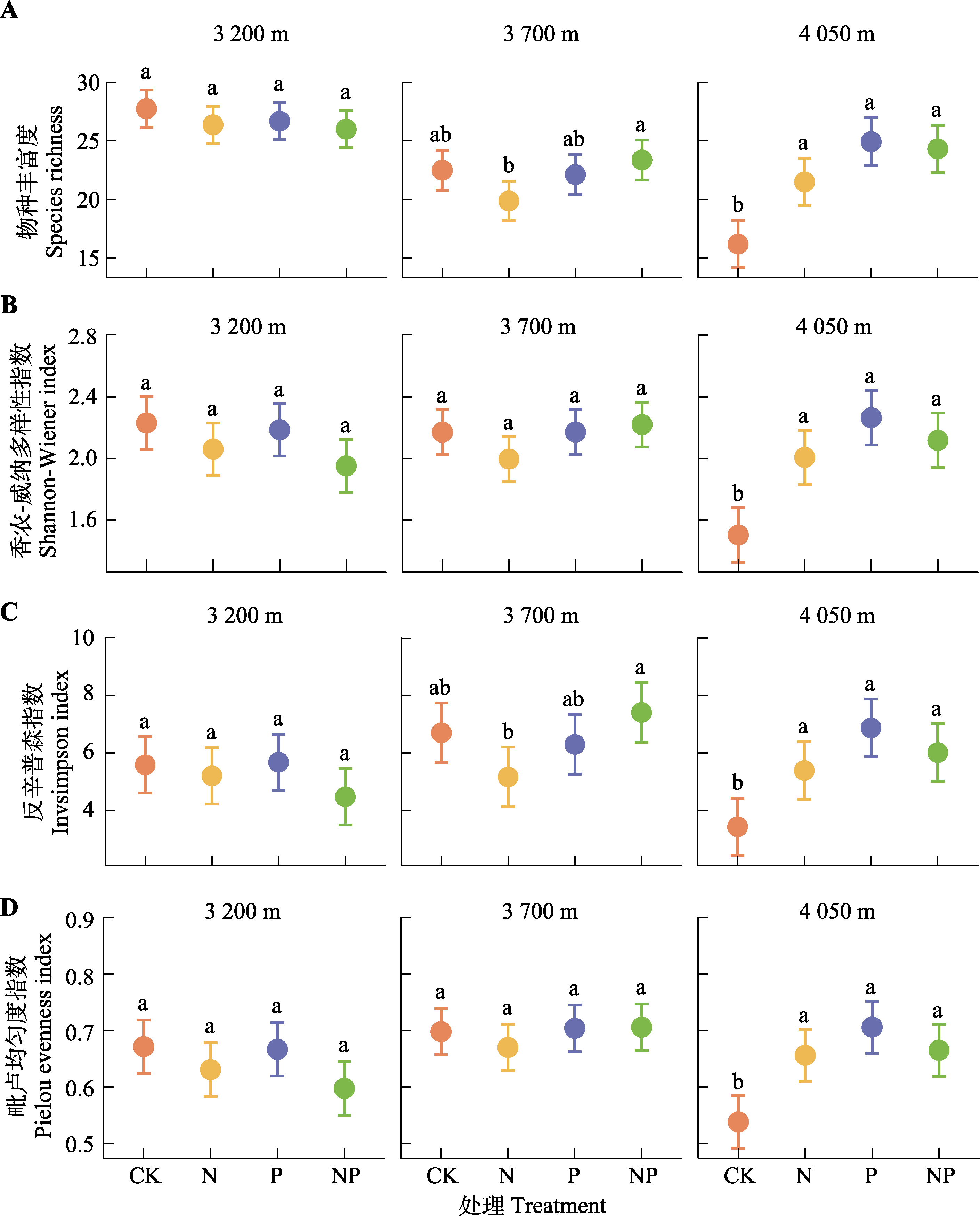
Fig. 1 Effects of no nutrient addition (CK), nitrogen addition (N), phosphorus addition (P), and combined nitrogen and phosphorus addition (NP) on the α diversity of plant communities at three altitudes from 2021 to 2024 (mean ± SE). Different lowercase letters indicate the significance of differences in the effects of the four nutrient treatments on α diversity indices (p < 0.05).
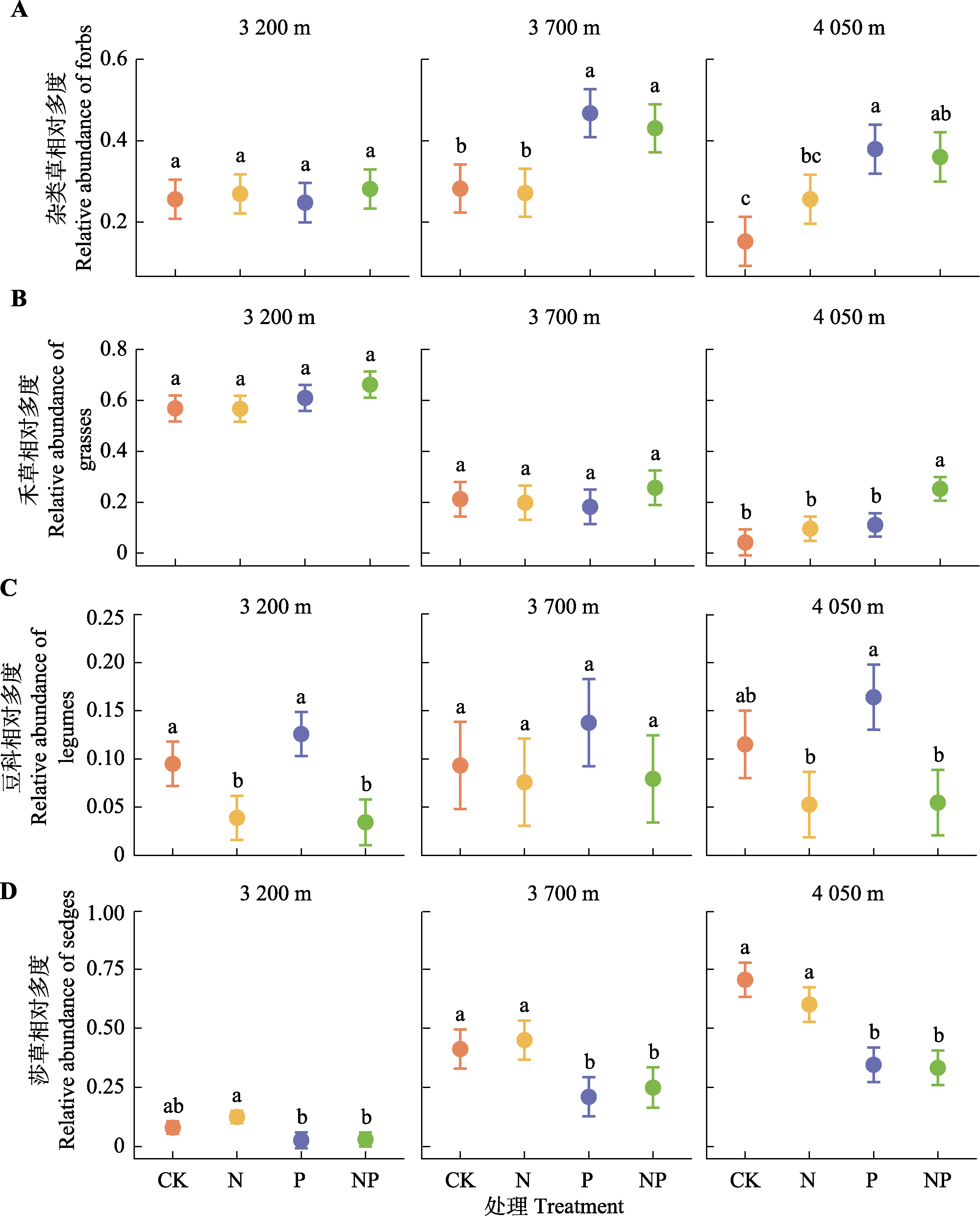
Fig. 2 Effects of no nutrient addition (CK), nitrogen addition (N), phosphorus addition (P), and combined nitrogen and phosphorus addition (NP) on the relative abundance of plant functional groups at three altitudes from 2021 to 2024 (mean ± SE). Different lowercase letters indicate the significance of differences in the effects of the four nutrient treatments on the relative abundance of plant functional groups (p < 0.05).
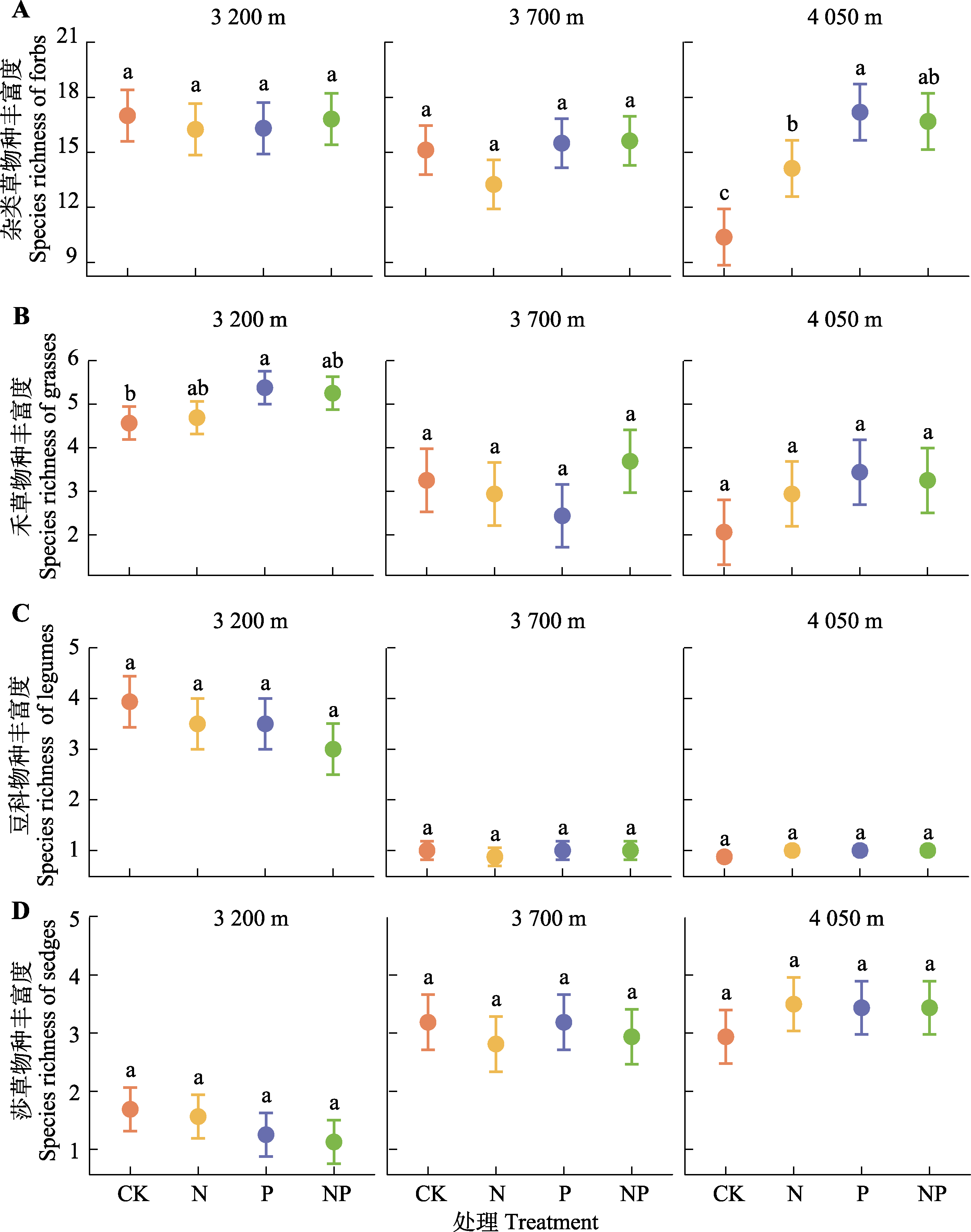
Fig. 3 Effects of no nutrient addition (CK), nitrogen addition (N), phosphorus addition (P), and combined nitrogen and phosphorus addition (NP) on species richness of plant functional groups at three altitudes from 2021 to 2024 (mean ± SE). Different lowercase letters indicate the significance of differences in the effects of the four nutrient treatments on species richness of plant functional groups (p < 0.05).
| 处理 Treatment | 自由度 df | Bray-Curtis相似性 Bray-Curtis similarity | Jaccard相似性 Jaccard similarity | ||||
|---|---|---|---|---|---|---|---|
| R2 | F | p | R2 | F | p | ||
| 氮添加 N | 1 | 0.01 | 3.61 | 0.001 | 0 | 1.48 | 0.166 |
| 磷添加 P | 1 | 0.03 | 14.02 | 0.001 | 0.01 | 7.84 | 0.001 |
| 年际 Y | 3 | 0.14 | 22.45 | 0.001 | 0.13 | 35.05 | 0.001 |
| 海拔 E | 2 | 0.24 | 58.13 | 0.001 | 0.54 | 213.51 | 0.001 |
| N × P | 1 | 0.01 | 2.81 | 0.004 | 0 | 1.50 | 0.174 |
| N × Y | 3 | 0.01 | 1.23 | 0.171 | 0 | 0.81 | 0.648 |
| P × Y | 3 | 0.02 | 2.66 | 0.001 | 0.01 | 1.34 | 0.160 |
| N × E | 2 | 0.01 | 2.09 | 0.002 | 0 | 1.42 | 0.154 |
| P × E | 2 | 0.03 | 6.16 | 0.001 | 0.01 | 2.73 | 0.007 |
| Y × E | 6 | 0.15 | 12.20 | 0.001 | 0.09 | 11.75 | 0.001 |
| N × P × Y | 3 | 0.01 | 0.80 | 0.796 | 0 | 0.87 | 0.559 |
| N × P × E | 2 | 0.01 | 1.72 | 0.017 | 0.01 | 2.14 | 0.023 |
| N × Y × E | 6 | 0.01 | 1.06 | 0.336 | 0.01 | 0.76 | 0.828 |
| P × Y × E | 6 | 0.03 | 2.10 | 0.001 | 0.01 | 1.04 | 0.378 |
| N × P × Y × E | 6 | 0.01 | 0.73 | 0.966 | 0 | 0.44 | 1.000 |
Table 3 Results of PERMANOVA on the effect of elevation, fertilizer, year and their interactions on community composition
| 处理 Treatment | 自由度 df | Bray-Curtis相似性 Bray-Curtis similarity | Jaccard相似性 Jaccard similarity | ||||
|---|---|---|---|---|---|---|---|
| R2 | F | p | R2 | F | p | ||
| 氮添加 N | 1 | 0.01 | 3.61 | 0.001 | 0 | 1.48 | 0.166 |
| 磷添加 P | 1 | 0.03 | 14.02 | 0.001 | 0.01 | 7.84 | 0.001 |
| 年际 Y | 3 | 0.14 | 22.45 | 0.001 | 0.13 | 35.05 | 0.001 |
| 海拔 E | 2 | 0.24 | 58.13 | 0.001 | 0.54 | 213.51 | 0.001 |
| N × P | 1 | 0.01 | 2.81 | 0.004 | 0 | 1.50 | 0.174 |
| N × Y | 3 | 0.01 | 1.23 | 0.171 | 0 | 0.81 | 0.648 |
| P × Y | 3 | 0.02 | 2.66 | 0.001 | 0.01 | 1.34 | 0.160 |
| N × E | 2 | 0.01 | 2.09 | 0.002 | 0 | 1.42 | 0.154 |
| P × E | 2 | 0.03 | 6.16 | 0.001 | 0.01 | 2.73 | 0.007 |
| Y × E | 6 | 0.15 | 12.20 | 0.001 | 0.09 | 11.75 | 0.001 |
| N × P × Y | 3 | 0.01 | 0.80 | 0.796 | 0 | 0.87 | 0.559 |
| N × P × E | 2 | 0.01 | 1.72 | 0.017 | 0.01 | 2.14 | 0.023 |
| N × Y × E | 6 | 0.01 | 1.06 | 0.336 | 0.01 | 0.76 | 0.828 |
| P × Y × E | 6 | 0.03 | 2.10 | 0.001 | 0.01 | 1.04 | 0.378 |
| N × P × Y × E | 6 | 0.01 | 0.73 | 0.966 | 0 | 0.44 | 1.000 |
| 海拔 Elevation (m) | 处理 Treatment | 自由度 df | Bray-Curtis相似性 Bray-Curtis similarity | Jaccard相似性 Jaccard similarity | ||||
|---|---|---|---|---|---|---|---|---|
| R2 | F | p | R2 | F | p | |||
| 3 200 | 氮添加 N | 1 | 0.02 | 2.71 | 0.031 | 0.01 | 1.73 | 0.125 |
| 磷添加 P | 1 | 0.10 | 14.73 | 0.001 | 0.01 | 1.81 | 0.096 | |
| 年际 Y | 3 | 0.44 | 21.74 | 0.001 | 0.53 | 21.95 | 0.001 | |
| N × P | 1 | 0.01 | 1.76 | 0.103 | 0.01 | 0.88 | 0.452 | |
| N × Y | 3 | 0.02 | 1.01 | 0.397 | 0.02 | 0.76 | 0.685 | |
| P × Y | 3 | 0.06 | 3.09 | 0.003 | 0.02 | 0.70 | 0.723 | |
| N × P × Y | 3 | 0.02 | 1.11 | 0.331 | 0.01 | 0.62 | 0.817 | |
| 3 700 | N | 1 | 0.01 | 1.65 | 0.081 | 0.01 | 0.85 | 0.565 |
| P | 1 | 0.06 | 7.23 | 0.001 | 0.03 | 3.46 | 0.002 | |
| Y | 3 | 0.38 | 14.58 | 0.001 | 0.44 | 16.21 | 0.001 | |
| N × P | 1 | 0.02 | 2.00 | 0.039 | 0.02 | 2.20 | 0.026 | |
| N × Y | 3 | 0.02 | 0.82 | 0.723 | 0.02 | 0.77 | 0.776 | |
| P × Y | 3 | 0.06 | 2.20 | 0.003 | 0.03 | 0.98 | 0.491 | |
| N × P × Y | 3 | 0.02 | 0.66 | 0.938 | 0.01 | 0.43 | 0.997 | |
| 4 050 | N | 1 | 0.03 | 3.40 | 0.002 | 0.01 | 1.92 | 0.070 |
| P | 1 | 0.06 | 6.18 | 0.001 | 0.05 | 7.10 | 0.001 | |
| Y | 3 | 0.34 | 12.42 | 0.001 | 0.49 | 21.75 | 0.001 | |
| N × P | 1 | 0.02 | 2.39 | 0.021 | 0.02 | 2.24 | 0.036 | |
| N × Y | 3 | 0.04 | 1.47 | 0.079 | 0.02 | 0.79 | 0.733 | |
| P × Y | 3 | 0.05 | 1.83 | 0.022 | 0.04 | 1.60 | 0.045 | |
| N × P × Y | 3 | 0.02 | 0.60 | 0.959 | 0.02 | 0.73 | 0.822 | |
Table 4 Results of PERMANOVA on the effect of fertilizer, year and their interactions on community composition of three elevation
| 海拔 Elevation (m) | 处理 Treatment | 自由度 df | Bray-Curtis相似性 Bray-Curtis similarity | Jaccard相似性 Jaccard similarity | ||||
|---|---|---|---|---|---|---|---|---|
| R2 | F | p | R2 | F | p | |||
| 3 200 | 氮添加 N | 1 | 0.02 | 2.71 | 0.031 | 0.01 | 1.73 | 0.125 |
| 磷添加 P | 1 | 0.10 | 14.73 | 0.001 | 0.01 | 1.81 | 0.096 | |
| 年际 Y | 3 | 0.44 | 21.74 | 0.001 | 0.53 | 21.95 | 0.001 | |
| N × P | 1 | 0.01 | 1.76 | 0.103 | 0.01 | 0.88 | 0.452 | |
| N × Y | 3 | 0.02 | 1.01 | 0.397 | 0.02 | 0.76 | 0.685 | |
| P × Y | 3 | 0.06 | 3.09 | 0.003 | 0.02 | 0.70 | 0.723 | |
| N × P × Y | 3 | 0.02 | 1.11 | 0.331 | 0.01 | 0.62 | 0.817 | |
| 3 700 | N | 1 | 0.01 | 1.65 | 0.081 | 0.01 | 0.85 | 0.565 |
| P | 1 | 0.06 | 7.23 | 0.001 | 0.03 | 3.46 | 0.002 | |
| Y | 3 | 0.38 | 14.58 | 0.001 | 0.44 | 16.21 | 0.001 | |
| N × P | 1 | 0.02 | 2.00 | 0.039 | 0.02 | 2.20 | 0.026 | |
| N × Y | 3 | 0.02 | 0.82 | 0.723 | 0.02 | 0.77 | 0.776 | |
| P × Y | 3 | 0.06 | 2.20 | 0.003 | 0.03 | 0.98 | 0.491 | |
| N × P × Y | 3 | 0.02 | 0.66 | 0.938 | 0.01 | 0.43 | 0.997 | |
| 4 050 | N | 1 | 0.03 | 3.40 | 0.002 | 0.01 | 1.92 | 0.070 |
| P | 1 | 0.06 | 6.18 | 0.001 | 0.05 | 7.10 | 0.001 | |
| Y | 3 | 0.34 | 12.42 | 0.001 | 0.49 | 21.75 | 0.001 | |
| N × P | 1 | 0.02 | 2.39 | 0.021 | 0.02 | 2.24 | 0.036 | |
| N × Y | 3 | 0.04 | 1.47 | 0.079 | 0.02 | 0.79 | 0.733 | |
| P × Y | 3 | 0.05 | 1.83 | 0.022 | 0.04 | 1.60 | 0.045 | |
| N × P × Y | 3 | 0.02 | 0.60 | 0.959 | 0.02 | 0.73 | 0.822 | |
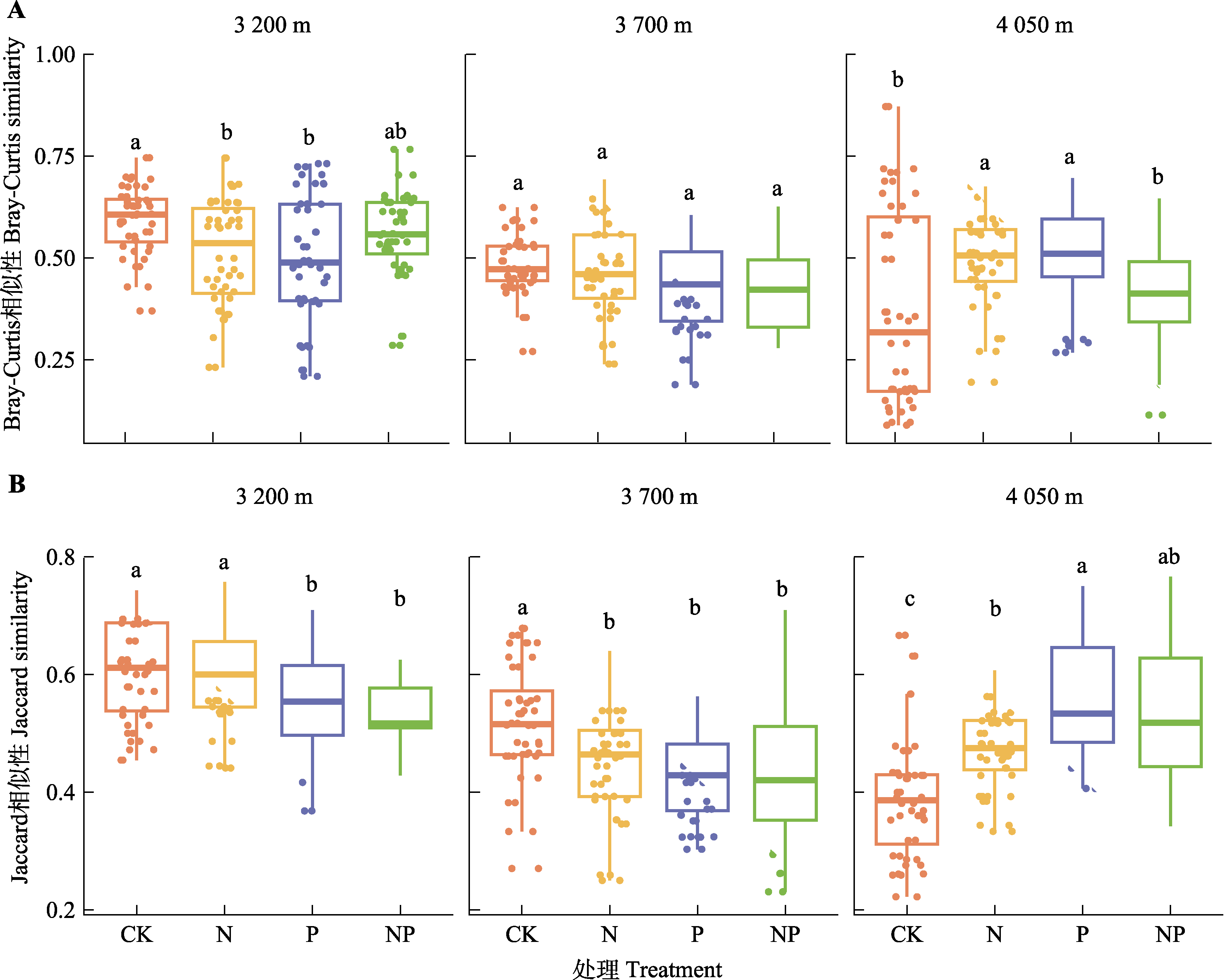
Fig. 4 Effects of no nutrient addition (CK), nitrogen addition (N), phosphorus addition (P), and combined nitrogen and phosphorus addition (NP) on β-diversity at three altitudes from 2021 to 2024 (mean ± SE). Different lowercase letters indicate the significance of differences in the effects of the four nutrient treatments on β-diversity of plant functional groups (p < 0.05).
| [1] |
Atkin OK (1996). Reassessing the nitrogen relations of Arctic plants: a mini-review. Plant, Cell & Environment, 19, 695-704.
DOI URL |
| [2] | Band N, Kadmon R, Mandel M, DeMalach N (2022). Assessing the roles of nitrogen, biomass, and niche dimensionality as drivers of species loss in grassland communities. Proceedings of the National Academy of Sciences of the United States of America, 119, e2112010119. DOI: 10.1073/pnas.2112010119. |
| [3] | Bookhagen B, Burbank DW (2010). Toward a complete Himalayan hydrological budget: spatiotemporal distribution of snowmelt and rainfall and their impact on river discharge. Journal of Geophysical Research: Earth Surface, 115, 2009JF001426. DOI: 10.1029/2009JF001426. |
| [4] |
Borer ET, Seabloom EW, Gruner DS, Harpole WS, Hillebrand H, Lind EM, Adler PB, Alberti J, Anderson TM, Bakker JD, Biederman L, Blumenthal D, Brown CS, Brudvig LA, Buckley YM, et al. (2014). Herbivores and nutrients control grassland plant diversity via light limitation. Nature, 508, 517-520.
DOI |
| [5] |
Chai X, Li YN, Duan C, Zhang T, Zong N, Shi PL, He YT, Zhang XZ (2018). CO2 flux dynamics and its limiting factors in the alpine shrub-meadow and steppe-meadow on the Qinghai-Xizang Plateau. Chinese Journal of Plant Ecology, 42, 6-19.
DOI URL |
|
[柴曦, 李英年, 段呈, 张涛, 宗宁, 石培礼, 何永涛, 张宪洲 (2018). 青藏高原高寒灌丛草甸和草原化草甸CO2通量动态及其限制因子. 植物生态学报, 42, 6-19.]
DOI |
|
| [6] |
Ceulemans T, Bodé S, Bollyn J, Harpole S, Coorevits K, Peeters G, van Acker K, Smolders E, Boeckx P, Honnay O (2017). Phosphorus resource partitioning shapes phosphorus acquisition and plant species abundance in grasslands. Nature Plants, 3, 16224. DOI: 10.1038/nplants.2016.224.
PMID |
| [7] | Christian K (2021). Alpine Plant Life. Springer Nature, Cham, Switzerland. |
| [8] | Chu CC, Wang Y, Wang ET (2021). Improving the utilization efficiency of nitrogen, phosphorus and potassium: current situation and future perspectives. Scientia Sinica (Vitae), 51, 1415-1423. |
| [储成才, 王毅, 王二涛 (2021). 植物氮磷钾养分高效利用研究现状与展望. 中国科学: 生命科学, 51, 1415-1423.] | |
| [9] |
Dong SK (2023). Revitalizing the grassland on the Qinghai-Tibetan Plateau. Grassland Research, 2, 241-250.
DOI URL |
| [10] |
Fang JY, Wang XP, Shen ZH, Tang ZY, He JS, Yu D, Jiang Y, Wang ZH, Zheng CY, Zhu JL, Guo ZD (2009). Methods and protocols for plant community inventory. Biodiversity Science, 17, 533-548.
DOI |
|
[方精云, 王襄平, 沈泽昊, 唐志尧, 贺金生, 于丹, 江源, 王志恒, 郑成洋, 朱江玲, 郭兆迪 (2009). 植物群落清查的主要内容、方法和技术规范. 生物多样性, 17, 533-548.]
DOI |
|
| [11] | Fu BJ, Ouyang ZY, Shi P, Fan J, Wang XD, Zheng H, Zhao WW, Wu F (2021). Current condition and protection strategies of Qinghai-Tibet Plateau ecological security barrier. Bulletin of Chinese Academy of Sciences, 36, 1298-1306. |
| [傅伯杰, 欧阳志云, 施鹏, 樊杰, 王小丹, 郑华, 赵文武, 吴飞 (2021). 青藏高原生态安全屏障状况与保护对策. 中国科学院院刊, 36, 1298-1306.] | |
| [12] | Fu BJ, Liu YX, Zhao WW, Feng XM, Liu SL, Miao CY, Wang XH, He CY, Li CJ, Ye AZ, Hu ZM, Liu ZF, Zhou DY (2024). Optimization for Qinghai-Xizang Plateau ecological security barrier system. Bulletin of Chinese Academy of Sciences, 39, 1882-1893. |
| [傅伯杰, 刘焱序, 赵文武, 冯晓明, 刘世梁, 缪驰远, 王旭辉, 何春阳, 李长嘉, 叶爱中, 胡中民, 刘志锋, 周丁扬 (2024). 青藏高原生态安全屏障体系优化. 中国科学院院刊, 39, 1882-1893.] | |
| [13] |
Ganjurjav H, Gornish E, Hu GZ, Wu JS, Wan YF, Li Y, Gao QZ, Lamb E (2020). Phenological changes offset the warming effects on biomass production in an alpine meadow on the Qinghai-Tibetan Plateau. Journal of Ecology, 109, 1014-1025.
DOI URL |
| [14] |
Harpole WS, Tilman D (2007). Grassland species loss resulting from reduced niche dimension. Nature, 446, 791-793.
DOI |
| [15] |
Hautier Y, Niklaus PA, Hector A (2009). Competition for light causes plant biodiversity loss after eutrophication. Science, 324, 636-638.
DOI PMID |
| [16] |
Harpole WS, Sullivan LL, Lind EM, Firn J, Adler PB, Borer ET, Chase J, Fay PA, Hautier Y, Hillebrand H, MacDougall AS, Seabloom EW, Williams R, Bakker JD, Cadotte MW, et al. (2016). Addition of multiple limiting resources reduces grassland diversity. Nature, 537, 93-96.
DOI |
| [17] |
Hong JT, Wang XD, Wu JB (2015). Effects of soil fertility on the N:P stoichiometry of herbaceous plants on a nutrient-limited alpine steppe on the northern Tibetan Plateau. Plant and Soil, 391, 179-194.
DOI URL |
| [18] | Hou XK, Kou D, Hirota M, Guo T, Lang T, Yang Y (2023). Altitudinal variations of the rate and temperature sensitivity of soil nitrogen mineralization on the Qinghai-Tibetan Plateau. Journal of Plant Ecology, 16, rtad005. DOI: 10.1093/jpe/rtad005. |
| [19] |
Hurlbert SH (1971). The nonconcept of species diversity: a critique and alternative parameters. Ecology, 52, 577-586.
DOI PMID |
| [20] |
Jin Y, Qian H (2022). V. PhyloMaker2: an updated and enlarged R package that can generate very large phylogenies for vascular plants. Plant Diversity, 44, 335-339.
DOI |
| [21] |
Jost L (2007). Partitioning diversity into independent alpha and beta components. Ecology, 88, 2427-2439.
DOI URL |
| [22] | Lei SL, Liao LR, Wang J, Zhang L, Ye ZC, Liu GB, Zhang C (2023). The diversity-Godron stability relationship of alpine grassland and its environmental drivers. Acta Prataculturae Sinica, 32(3), 1-12. |
|
[雷石龙, 廖李容, 王杰, 张路, 叶振城, 刘国彬, 张超 (2023). 高寒草地植物多样性与Godron群落稳定性关系及其环境驱动因素. 草业学报, 32(3), 1-12.]
DOI |
|
| [23] | Li Y, Lin L, Zhu WY, Zhang ZH, He JS (2017). Responses of leaf traits to nitrogen and phosphorus additions across common species in an alpine grassland on the Qinghai-Tibetan Plateau. Acta Scientiarum Naturalium Universitatis Pekinensis, 53, 535-544. |
| [李颖, 林笠, 朱文琰, 张振华, 贺金生 (2017). 青藏高原高寒草地常见植物叶属性对氮、磷添加的响应. 北京大学学报(自然科学版), 53, 535-544.] | |
| [24] |
Liu Y, He NP, Wen XF, Xu L, Sun XM, Yu GR, Liang LY, Schipper LA (2018). The optimum temperature of soil microbial respiration: patterns and controls. Soil Biology & Biochemistry, 121, 35-42.
DOI URL |
| [25] |
Liu WX, Liu LL, Yang X, Deng MF, Wang Z, Wang PD, Yang S, Li P, Peng ZY, Yang L, Jiang L (2021). Long-term nitrogen input alters plant and soil bacterial, but not fungal beta diversity in a semiarid grassland. Global Change Biology, 27, 3939-3950.
DOI URL |
| [26] |
McKinney ML, Lockwood JL (1999). Biotic homogenization: a few winners replacing many losers in the next mass extinction. Trends in Ecology & Evolution, 14, 450-453.
DOI URL |
| [27] | Oldroyd GED, Leyser O (2020). A plant’s diet, surviving in a variable nutrient environment. Science, 368, eaba0196. DOI: 10.1126/science.aba0196. |
| [28] | Peng Y, Yang JX, Seabloom EW, Leitch AR, Leitch IJ, Wang RZ, Wei CZ, Han XG (2024). Nutrient effects on plant diversity loss arise from nutrient identity and decreasing niche dimension. Ecology, 106, e4496. DOI: 10.1002/ecy.4496. |
| [29] | Peng Y, Yang JX, Seabloom EW, Sardans J, Peñuelas J, Zhang HY, Wei CZ, Han XG (2025). Multiple nutrient additions homogenize multidimensional plant stoichiometry in a meadow steppe. Global Change Biology, 31, e70123. DOI: 10.1111/gcb.70123. |
| [30] | Pepin N, Bradley RS, Diaz HF, Baraer M, Caceres EB, Forsythe N, Fowler H, Greenwood G, Hashmi MZ, Liu XD, Miller JR, Ning L, Ohmura A, Palazzi E, Rangwala I, et al. (2015). Elevation-dependent warming in mountain regions of the world. Nature Climate Change, 5, 424-430. |
| [31] | Qi ZY, Lv YX, Liu W, Sun JM, Wang J, Pan QM (2023). Mechanism for the restoration of degraded typical steppe by nitrogen and phosphorus co-addition. Chinese Journal of Applied Ecology, 34, 75-82. |
|
[戚智彦, 吕亚香, 刘伟, 孙佳美, 王璟, 潘庆民 (2023). 氮磷养分共同添加促进退化典型草原恢复的机制. 应用生态学报, 34, 75-82.]
DOI |
|
| [32] |
Qiu J (2008). China: the third pole. Nature, 454, 393-396.
DOI |
| [33] |
Ren F, Song WM, Chen LT, Mi ZR, Zhang ZH, Zhu WY, Zhou HK, Cao GM, He JS (2017). Phosphorus does not alleviate the negative effect of nitrogen enrichment on legume performance in an alpine grassland. Journal of Plant Ecology, 10, 822-830.
DOI |
| [34] |
Socolar JB, Gilroy JJ, Kunin WE, Edwards DP (2016). How should beta-diversity inform biodiversity conservation? Trends in Ecology & Evolution, 31, 67-80.
DOI URL |
| [35] | Stotz GC, Gianoli E, Cahill Jr JF (2019). Biotic homogenization within and across eight widely distributed grasslands following invasion by Bromus inermis. Ecology, 100, e02717. DOI: 10.1002/ecy.2717. |
| [36] |
Sundqvist MK, Giesler R, Graae BJ, Wallander H, Fogelberg E, Wardle DA (2011). Interactive effects of vegetation type and elevation on aboveground and belowground properties in a subarctic tundra. Oikos, 120, 128-142.
DOI URL |
| [37] | Tognetti PM, Prober SM, Báez S, Chaneton EJ, Firn J, Risch AC, Schuetz M, Simonsen AK, Yahdjian L, Borer ET, Seabloom EW, Arnillas CA, Bakker JD, Brown CS, Cadotte MW, et al. (2021). Negative effects of nitrogen override positive effects of phosphorus on grassland legumes worldwide. Proceedings of the National Academy of Sciences of the United States of America, 118, e2023718118. DOI: 10.1073/pnas.2023718118. |
| [38] | Wang DJ, Zhou HK, Yao BQ, Wang WY, Dong SK, Shang ZH, She YD, Ma L, Huang XT, Zhang ZH, Zhang Q, Zhao FY, Zuo J, Mao Z (2020). Effects of nutrient addition on degraded alpine grasslands of the Qinghai-Tibetan Plateau: a meta-analysis. Agriculture, Ecosystems & Environment, 301, 106970. DOI: 10.1016/j.agee.2020.106970. |
| [39] |
Wang L, Shi JJ, Dong QM, Yin YL, Wang XL, Yu Y, Zhang CP (2019). Effects of nitrogen and phosphorus addition on community diversity and biomass of alpine steppe. Acta Agrestia Sinica, 27, 1633-1642.
DOI |
|
[王玲, 施建军, 董全民, 尹亚丽, 王晓丽, 俞旸, 张春平 (2019). 氮、磷添加对高寒草原群落多样性和生物量的影响. 草地学报, 27, 1633-1642.]
DOI |
|
| [40] | Wilcots ME, Schroeder KM, Henning JA, Seabloom EW, Hobbie SE, Borer ET (2025). Alleviation of nutrient co-limitation increases grassland biomass production, but not carbon storage. Ecosystems, 28, 11. DOI: 10.1007/s10021-024-00956-3. |
| [41] |
Xu SB, Dai ZH, Guo PF, Fu XC, Liu SS, Zhou L, Tang WL, Feng TZ, Chen MJ, Zhan L, Wu TZ, Hu EQ, Jiang Y, Bo XC, Yu GC (2021). ggtreeExtra: compact visualization of richly annotated phylogenetic data. Molecular Biology and Evolution, 38, 4039-4042.
DOI PMID |
| [42] |
Yang XX, Ren F, Zhou HK, He JS (2014). Responses of plant community biomass to nitrogen and phosphorus additions in an alpine meadow on the Qinghai-Xizang Plateau. Chinese Journal of Plant Ecology, 38, 159-166.
DOI URL |
|
[杨晓霞, 任飞, 周华坤, 贺金生 (2014). 青藏高原高寒草甸植物群落生物量对氮、磷添加的响应. 植物生态学报, 38, 159-166.]
DOI |
|
| [43] | Zong N, Shi PL, Niu B, Jiang J, Song MH, Zhang XZ, He YT (2014). Effects of nitrogen and phosphorous fertilization on community structure and productivity of degraded alpine meadows in northern Tibet, China. Chinese Journal of Applied Ecology, 25, 3458-3468. |
| [宗宁, 石培礼, 牛犇, 蒋婧, 宋明华, 张宪洲, 何永涛 (2014). 氮磷配施对藏北退化高寒草甸群落结构和生产力的影响. 应用生态学报, 25, 3458-3468.] | |
| [44] | Zhao XQ, Zhou XM (1999). Ecological basis of alpine meadow ecosystem management in Tibet: Haibei alpine meadow ecosystem research station. AMBIO, 28, 642-647. |
| [赵新全, 周兴民 (1999). 青藏高原高寒草甸生态系统管理的生态学基础: 海北高寒草甸生态系统研究站. 人类环境杂志, 28, 642-647.] | |
| [45] | Zhang YL, Li BY, Zheng D (2002). A discussion on the boundary and area of the Tibetan Plateau in China. Geographical Research, 21, 1-8. |
| [张镱锂, 李炳元, 郑度 (2002). 论青藏高原范围与面积. 地理研究, 21, 1-8.] | |
| [46] | Zhou JJ, Liu YF, Wang JL, Wei W (2023). Effect of short-term nutrient addition on aboveground biomass, plant diversity, and functional traits of swampy alpine meadow in Tibet. Acta Prataculturae Sinica, 32(11), 17-29. |
|
[周娟娟, 刘云飞, 王敬龙, 魏巍 (2023). 短期养分添加对西藏沼泽化高寒草甸地上生物量、植物多样性和功能性状的影响. 草业学报, 32(11), 17-29.]
DOI |
| [1] | Chen Ya-Song, Lan Zhi-Chun, Wang Yin-Liu, Jiang Xin-Yi, NIU Guo-Xiang. Effects of Nitrogen and Phosphorus Inputs on the Interspecific Competition of Dominant Plants in Poyang Lake [J]. Chin J Plant Ecol, 2026, 50(预发表): 1-. |
| [2] | Xinya BU, Wang Xiuwei. Effects of different forms of nitrogen addition on leaf traits and growth of seedlings of four temperate tree species [J]. Chin J Plant Ecol, 2026, 50(5): 1092-1104. |
| [3] | LIN Lin-Lin, XIAO Jin-Xiang, HUANG Shen-Shen, ZHAO Yang-Mei, ZHANG De-Xu, CHENG Yi-Kang, LONG Wen-Xing. Effects of phosphorus addition on functional traits across seedlings and saplings in a tropical cloud forest [J]. Chin J Plant Ecol, 2026, 50(4): 917-928. |
| [4] | ZHANG An-Ning, XIAO Ya-Ning, ZHAO Xia, ZHANG Miao, CUI Han-Wen, CHEN Shu-Yan, AN Li-Zhe. Interactions between shrub encroachment and nitrogen addition on nematode community and functional traits on Qingzang Plateau [J]. Chin J Plant Ecol, 2026, 50(4): 859-869. |
| [5] | DAI Yun-Ze, YAO Liang-Jin, CHEN Miao, XU Xiao-Niu. Effects of nitrogen and phosphorus additions on the stability of soil aggregates and their carbon and nitrogen contents in evergreen broadleaf forests [J]. Chin J Plant Ecol, 2026, 50(1): 55-69. |
| [6] | PI Hui-Zhi, ZHANG Qiu-Fang, SUN Hao, ZENG Quan-Xin, PENG Yuan-Zhen, YUAN Xiao-Chun, XU Jian-Guo, CHEN Yue-Min. Microbial carbon-nitrogen imbalance affects the response of microbial nitrogen use efficiency to nitrogen enrichment in Castanopsis faberi forest soils [J]. Chin J Plant Ecol, 2026, 50(1): 34-44. |
| [7] | FENG Mei, OUYANG Sheng-Nan, Matthias SAURER, LI Mai-He, ZHOU Xiao-Qian, TIE Lie-Hua, SHEN Wei-Jun, DUAN Hong-Lang, Arthur GESSLER. Effects of previous nitrogen addition on aboveground and belowground carbon and nitrogen allocation dynamics in drought-exposed sessile oak seedlings [J]. Chin J Plant Ecol, 2025, 49(9): 1527-1542. |
| [8] | ZHANG Fa-Wei, LI Hong-Qin, ZHU Jing-Bin, FAN Bo, ZHOU Hua-Kun, LI Ying-Nian, LIANG Nai-Shen. Response of aboveground and belowground carbon storage to nitrogen addition and precipitation change in an alpine meadow ecosystem [J]. Chin J Plant Ecol, 2025, 49(9): 1399-1409. |
| [9] | HAO Jie, DIAO Hua-Jie, SU Yuan, WU Shuai-Kai, GAO Yang-Yang, LIANG Wen-Jun, NIU Hui-Min, YANG Qian-Wen, CHANG Jie, WANG Ge, XU Wen-Li, MA Teng-Fei, DONG Kuan-Hu, $\boxed{\hbox{WANG Chang-Hui}}$. Precipitation regulates the response of salinized grassland net primary productivity to nitrogen addition and mowing in the agro-pastoral zone [J]. Chin J Plant Ecol, 2025, 49(5): 710-719. |
| [10] | TANG Yuan-Xiang, XIONG Shi-Chen, ZHU Hong-Feng, ZHANG Xin-Sheng, YOU Cheng-Ming, LIU Si-Ning, TAN Bo, XU Zhen-Feng. Effects of long-term nitrogen addition on leaf litter production and carbon, nitrogen and phosphorus return of the dominant tree species in broadleaf evergreen forests on the western margin of Sichuan Basin [J]. Chin J Plant Ecol, 2025, 49(5): 720-731. |
| [11] | YAN Xiao-Li, LIU Gui-Mei, LI Xiao-Yu, JIANG Yu-Xiang, QUAN Xiao-Qiang, WANG Yan-Ru, QU Lu-Ping, TANG Xing-Hao. Photosynthetic characteristics and chlorophyll fluorescence parameters in Schima superba seedlings under different level of nitrogen addition and NH4+-N to NO3--N ratio [J]. Chin J Plant Ecol, 2025, 49(4): 624-637. |
| [12] | TIAN Tong-Tong, SHANG Bo, XU Yan-Sen, YUAN Xiang-Yang, LIU Shuo, FENG Zhao-Zhong. Effects of elevated ozone concentration and nitrogen addition on the photosynthetic characteristics of poplar at different leaf positions and growth stages [J]. Chin J Plant Ecol, 2025, 49(11): 1919-1933. |
| [13] | RAN Jia-Xin, ZHANG Yu-Hui, WANG Yun, YANG Zhi-Jie, MAO Chao. Effects of warming and nitrogen and phosphorus addition on dissolved organic carbon biodegradability of litter in a subtropical forest [J]. Chin J Plant Ecol, 2024, 48(9): 1232-1242. |
| [14] | QUAN Xiao-Qiang, WANG Yan-Ru, LI Xiao-Yu, LIANG Hai-Yan, WANG Li-Dong, YAN Xiao-Li. Effects of nitrogen addition level and NH4+-N to NO3--N ratio on photosynthetic characteristics and chlorophyll fluorescence parameters in Cunninghamia lanceolata seedling [J]. Chin J Plant Ecol, 2024, 48(8): 1050-1064. |
| [15] | HUANG Ling, WANG Zhen, MA Ze, YANG Fa-Lin, LI Lan, SEREKPAYEV Nurlan, NOGAYEV Adilbek, HOU Fu-Jiang. Effects of long-term grazing and nitrogen addition on the growth of Stipa bungeana population in typical steppe of Loess Plateau [J]. Chin J Plant Ecol, 2024, 48(3): 317-330. |
| Viewed | ||||||
|
Full text |
|
|||||
|
Abstract |
|
|||||
Copyright © 2026 Chinese Journal of Plant Ecology
Tel: 010-62836134, 62836138, E-mail: apes@ibcas.ac.cn, cjpe@ibcas.ac.cn

