
Chin J Plant Ecol ›› 2026, Vol. 50 ›› Issue (3): 552-565.DOI: 10.17521/cjpe.2025.0254 cstr: 32100.14.cjpe.2025.0254
• Reviews • Previous Articles Next Articles
FANG Di1,2, MA Ning1,2, LI Sheng-Gong1,2, ZHENG Jia-Jia1, CHU Yun-Xin1,2, YANG Jin-Chang3, YANG Zan-Ming4, ZHANG Long-Ning5, MENG Sheng-Wang1, GAO De-Cai1, DAI Xiao-Qin1, FU Xiao-Li1,2, WANG Hui-Min1,2, KOU Liang1,2,*( )
)
Received:2025-07-03
Accepted:2025-10-17
Online:2026-03-20
Published:2026-04-09
Contact:
KOU Liang
Supported by:FANG Di, MA Ning, LI Sheng-Gong, ZHENG Jia-Jia, CHU Yun-Xin, YANG Jin-Chang, YANG Zan-Ming, ZHANG Long-Ning, MENG Sheng-Wang, GAO De-Cai, DAI Xiao-Qin, FU Xiao-Li, WANG Hui-Min, KOU Liang. Regulatory role of mycorrhizal types in internal nutrient cycling of forest ecosystems[J]. Chin J Plant Ecol, 2026, 50(3): 552-565.
Add to citation manager EndNote|Ris|BibTeX
URL: https://www.plant-ecology.com/EN/10.17521/cjpe.2025.0254
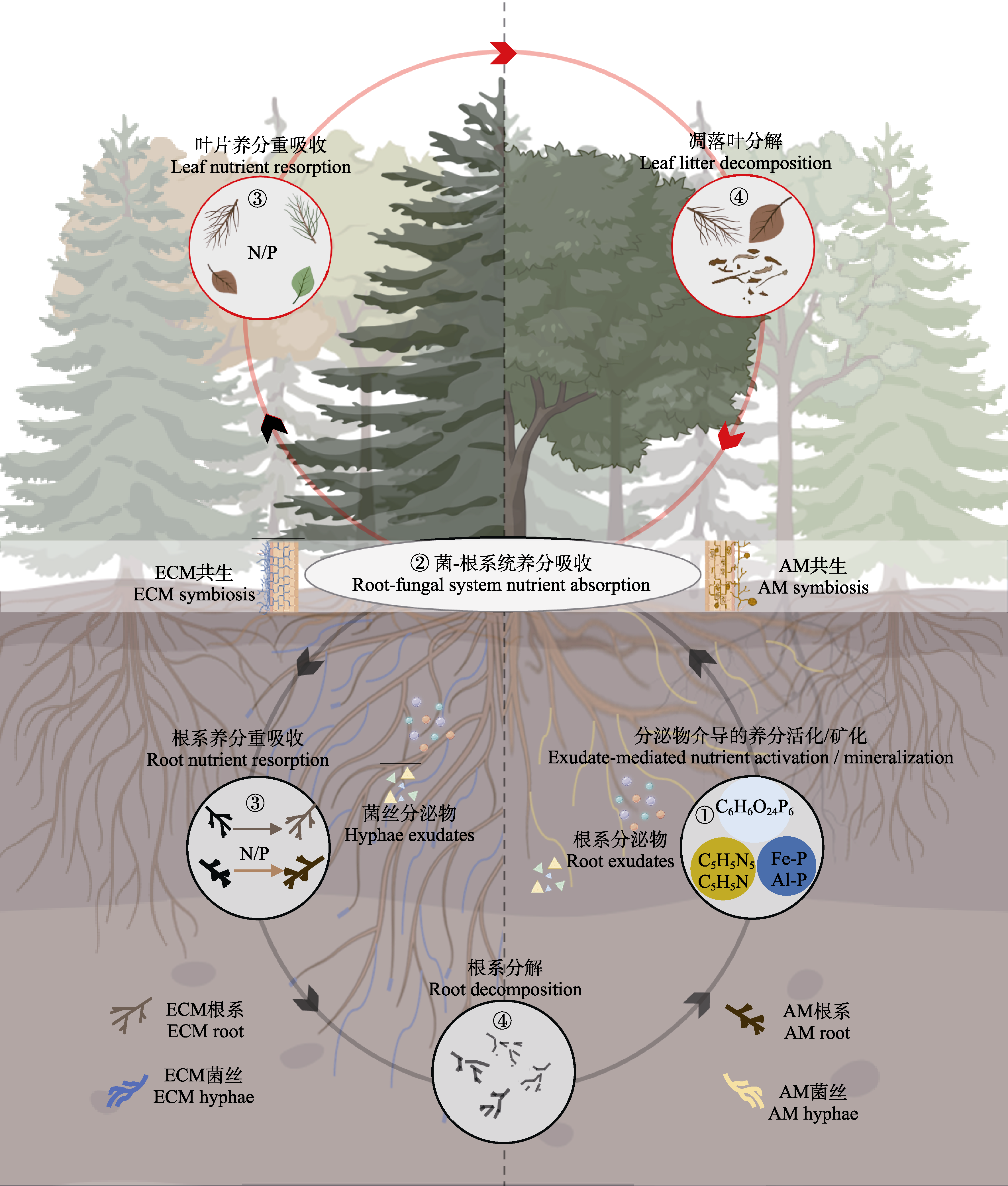
Fig. 1 Conceptual framework for the internal nutrient cycling of mycorrhizal plants in forest ecosystems (modified from Kou et al., 2025). Soil organic and inorganic nutrients are mineralized or activated into available forms through organic acids and extracellular enzymes secreted by roots and mycorrhizal hyphae (Process ①). These nutrients are then absorbed by the mycorrhizal-root system, with a portion transported to aboveground organs (e.g., leaves) to support plant growth and development, while the others are utilized in the metabolism of belowground roots and mycorrhizal fungi (Process ②). Some nutrients from senescent leaves and roots are reabsorbed and translocated to newly formed organs to minimize nutrient loss and enhance nutrient use efficiency (Process ③). Non-reabsorbed nutrients return to the soil as leaf or root litters and are gradually released to soil through decomposition (Process ④), contributing to the next round of internal nutrient cycling. AM, arbuscular mycorrhizae; ECM, ectomycorrhizae.
| [1] |
Aerts R (1997). Climate, leaf litter chemistry and leaf litter decomposition in terrestrial ecosystems: a triangular relationship. Oikos, 79, 439-449.
DOI URL |
| [2] |
Averill C, Bhatnagar JM, Dietze MC, Pearse WD, Kivlin SN (2019). Global imprint of mycorrhizal fungi on whole-plant nutrient economics. Proceedings of the National Academy of Sciences of the United States of America, 116, 23163-23168.
DOI PMID |
| [3] |
Averill C, Turner BL, Finzi AC (2014). Mycorrhiza-mediated competition between plants and decomposers drives soil carbon storage. Nature, 505, 543-545.
DOI |
| [4] |
Bahram M, Netherway T, Hildebrand F, Pritsch K, Drenkhan R, Loit K, Anslan S, Bork P, Tedersoo L (2020). Plant nutrient-acquisition strategies drive topsoil microbiome structure and function. New Phytologist, 227, 1189-1199.
DOI PMID |
| [5] | Bergmann J, Weigelt A, van der Plas F, Laughlin DC, Kuyper TW, Guerrero-Ramirez N, Valverde-Barrantes OJ, Bruelheide H, Freschet GT, Iversen CM, Kattge J, McCormack ML, Meier IC, Rillig MC, Roumet C, et al. (2020). The fungal collaboration gradient dominates the root economics space in plants. Science Advances, 6, eaba3756. DOI: 10.1126/sciadv.aba3756. |
| [6] |
Bradford MA, Berg B, Maynard DS, Wieder WR, Wood SA (2016). Understanding the dominant controls on litter decomposition. Journal of Ecology, 104, 229-238.
DOI URL |
| [7] |
Brant AN, Chen HYH (2015). Patterns and mechanisms of nutrient resorption in plants. Critical Reviews in Plant Sciences, 34, 471-486.
DOI URL |
| [8] |
Brundrett MC, Tedersoo L (2018). Evolutionary history of mycorrhizal symbioses and global host plant diversity. New Phytologist, 220, 1108-1115.
DOI PMID |
| [9] |
Brzostek ER, Greco A, Drake JE, Finzi AC (2013). Root carbon inputs to the rhizosphere stimulate extracellular enzyme activity and increase nitrogen availability in temperate forest soils. Biogeochemistry, 115, 65-76.
DOI URL |
| [10] |
Canarini A, Kaiser C, Merchant A, Richter A, Wanek W (2019). Root exudation of primary metabolites: mechanisms and their roles in plant responses to environmental stimuli. Frontiers in Plant Science, 10, 157. DOI: 10.3389/fpls.2019.00157.
PMID |
| [11] |
Chai YN, Schachtman DP (2022). Root exudates impact plant performance under abiotic stress. Trends in Plant Science, 27, 80-91.
DOI URL |
| [12] | Chapin III FS, Matson PA, Vitousek PM (2011a). Principles of Terrestrial Ecosystem Ecology. 2nd ed. Springer, New York. |
| [13] | Chapin III FS, Power ME, Cole JJ (2011b). Coupled biogeochemical cycles and Earth stewardship. Frontiers in Ecology and the Environment, 9, 3. DOI: 10.1890/1540-9295-9.1.3. |
| [14] | Chen H, Reed SC, Lü XT, Xiao KC, Wang KL, Li DJ (2021). Coexistence of multiple leaf nutrient resorption strategies in a single ecosystem. Science of the Total Environment, 772, 144951. DOI: 10.1016/j.scitotenv.2021.144951. |
| [15] |
Chen L, Cai YX, Lei HM, Qi XX, Lin JJ, Liao W, Huang ZX (2022). Comparison of soil nitrogen cycling between arbuscular mycorrhizal and ectomycorrhizal forests in a subtropical region. Chinese Journal of Ecology, 41, 218-226.
DOI |
| [陈亮, 蔡咏欣, 雷惠敏, 齐晓旭, 林俊均, 廖伟, 黄子玄 (2022). 亚热带丛枝菌根与外生菌根森林对土壤氮循环的影响. 生态学杂志, 41, 218-226.] | |
| [16] |
Chen WL, Koide RT, Adams TS, DeForest JL, Cheng L, Eissenstat DM (2016). Root morphology and mycorrhizal symbioses together shape nutrient foraging strategies of temperate trees. Proceedings of the National Academy of Sciences of the United States of America, 113, 8741-8746.
DOI PMID |
| [17] |
Cornwell WK, Cornelissen JHC, Amatangelo K, Dorrepaal E, Eviner VT, Godoy O, Hobbie SE, Hoorens B, Kurokawa H, Pérez-Harguindeguy N, Quested HM, Santiago LS, Wardle DA, Wright IJ, Aerts R, et al. (2008). Plant species traits are the predominant control on litter decomposition rates within biomes worldwide. Ecology Letters, 11, 1065-1071.
DOI PMID |
| [18] |
Dakora FD, Phillips DA (2002). Root exudates as mediators of mineral acquisition in low-nutrient environments. Plant Soil, 245, 35-47.
DOI |
| [19] | Deng MF, Hu SJ, Guo LL, Jiang L, Huang YY, Schmid B, Liu C, Chang PF, Li S, Liu XJ, Ma KP, Liu LL (2023). Tree mycorrhizal association types control biodiversity- productivity relationship in a subtropical forest. Science Advances, 9, eadd4468. DOI: 10.1126/sciadv.add4468. |
| [20] | Deng MF, Liu LL, Jiang L, Liu WX, Wang X, Li SP, Yang S, Wang B (2018). Ecosystem scale trade-off in nitrogen acquisition pathways. Nature Ecology & Evolution, 2, 1724-1734. |
| [21] |
Ding JX, Ge WJ, Liu Q, Wang QT, Kong DL, Yin HJ (2023). Temperature drives the coordination between above-ground nutrient conservation and below-ground nutrient acquisition in alpine coniferous forests. Functional Ecology, 37, 1674-1687.
DOI URL |
| [22] |
Dong LL, Mao ZJ, Sun T (2016). Condensed tannin effects on decomposition of very fine roots among temperate tree species. Soil Biology & Biochemistry, 103, 489-492.
DOI URL |
| [23] | Eagar AC, Mushinski RM, Horning AL, Smemo KA, Phillips RP, Blackwood CB (2022). Arbuscular mycorrhizal tree communities have greater soil fungal diversity and relative abundances of saprotrophs and pathogens than ectomycorrhizal tree communities. Applied and Environmental Microbiology, 88, e0178221. DOI: 10.1128/AEM.01782-21. |
| [24] | Fang YT, Mo JM, Gundersen P, Zhou GY, Li DJ (2004). Nitrogen transformations in forest soils and its responses to atmospheric nitrogen deposition: a review. Acta Ecologica Sinica, 24, 1523-1531. |
| [方运霆, 莫江明, Gundersen P, 周国逸, 李德军 (2004). 森林土壤氮素转换及其对氮沉降的响应. 生态学报, 24, 1523-1531.] | |
| [25] |
Fernandez CW, Langley JA, Chapman S, McCormack ML, Koide RT (2016). The decomposition of ectomycorrhizal fungal necromass. Soil Biology & Biochemistry, 93, 38-49.
DOI URL |
| [26] |
Freschet GT, Cornelissen JHC, van Logtestijn RSP, Aerts R (2010). Substantial nutrient resorption from leaves, stems and roots in a subarctic flora: What is the link with other resource economics traits? New Phytologist, 186, 879-889.
DOI PMID |
| [27] |
Freschet GT, Cornwell WK, Wardle DA, Elumeeva TG, Liu WD, Jackson BG, Onipchenko VG, Soudzilovskaia NA, Tao JP, Cornelissen JHC (2013). Linking litter decomposition of above-and below-ground organs to plant-soil feedbacks worldwide. Journal of Ecology, 101, 943-952.
DOI URL |
| [28] |
Fujii S, Takeda H (2010). Dominant effects of litter substrate quality on the difference between leaf and root decomposition process above- and belowground. Soil Biology & Biochemistry, 42, 2224-2230.
DOI URL |
| [29] | Gargallo-Garriga A, Preece C, Sardans J, Oravec M, Urban O, Peñuelas J (2018). Root exudate metabolomes change under drought and show limited capacity for recovery. Scientific Reports, 8, 12696. DOI: 10.1038/s41598-018-30150-0. |
| [30] |
Genre A, Lanfranco L, Perotto S, Bonfante P (2020). Unique and common traits in mycorrhizal symbioses. Nature Reviews Microbiology, 18, 649-660.
DOI |
| [31] |
Gill RA, Jackson RB (2000). Global patterns of root turnover for terrestrial ecosystems. New Phytologist, 147, 13-31.
DOI URL |
| [32] |
Gordon WS, Jackson RB (2000). Nutrient concentrations in fine roots. Ecology, 81, 275-280.
DOI URL |
| [33] | Guo LL, Deng MF, Li XF, Schmid B, Huang JS, Wu YT, Peng ZY, Yang L, Liu LL (2024). Evolutionary and ecological forces shape nutrient strategies of mycorrhizal woody plants. Ecology Letters, 27, e14330. DOI: 10.1111/ELE.14330. |
| [34] | Han MG, Sun LJ, Gan DY, Fu LC, Zhu B (2020). Root functional traits are key determinants of the rhizosphere effect on soil organic matter decomposition across 14 temperate hardwood species. Soil Biology & Biochemistry, 151, 108019. DOI: 10.1016/j.soilbio.2020.108019. |
| [35] |
Hedges JI (1992). Global biogeochemical cycles: progress and problems. Marine Chemistry, 39, 67-93.
DOI URL |
| [36] |
Högberg MN, Högberg P (2002). Extramatrical ectomycorrhizal mycelium contributes one-third of microbial biomass and produces, together with associated roots, half the dissolved organic carbon in a forest soil. New Phytologist, 154, 791-795.
DOI PMID |
| [37] |
Huang SZ, Sun XX, Zhang YD, Sun HL, Wang ZQ (2016). Nutrient retranslocation from the fine roots of Fraxinus mandshurica and Larix olgensis in northeastern China. Journal of Forestry Research, 27, 1305-1312.
DOI URL |
| [38] | Huang WL, van Bodegom PM, Declerck S, Heinonsalo J, Cosme M, Viskari T, Liski J, Soudzilovskaia NA (2022). Mycelium chemistry differs markedly between ectomycorrhizal and arbuscular mycorrhizal fungi. Communications Biology, 5, 398. DOI: 10.1038/s42003-022-03341-9. |
| [39] | IPCC (2021). Climate Change 2021: The Physical Science Basis. Cambridge University Press, Cambridge. |
| [40] |
Jacobs LM, Sulman BN, Brzostek ER, Feighery JJ, Phillips RP (2018). Interactions among decaying leaf litter, root litter and soil organic matter vary with mycorrhizal type. Journal of Ecology, 106, 502-513.
DOI URL |
| [41] | Jiang L, Kou L, Li SG (2019). Decomposition of leaf mixtures and absorptive-root mixtures synchronously changes with deposition of nitrogen and phosphorus. Soil Biology & Biochemistry, 138, 107602. DOI: 10.1013/j.soilbio.2019.107602. |
| [42] |
Jiang L, Wang HM, Li SG, Dai XQ, Meng SW, Fu XL, Yan H, Zheng JJ, Ma N, Kou L (2023). A ‘Get-Save-Return’ process continuum runs on phosphorus economy among subtropical tree species. Journal of Ecology, 111, 861-874.
DOI URL |
| [43] |
Jiang L, Wang HM, Li SG, Fu XL, Dai XQ, Yan H, Kou L (2021). Mycorrhizal and environmental controls over root trait-decomposition linkage of woody trees. New Phytologist, 229, 284-295.
DOI URL |
| [44] |
Jiang SJ, Liu YJ, Luo JJ, Qin MS, Johnson NC, Öpik M, Vasar M, Chai YX, Zhou XL, Mao L, Du GZ, An LZ, Feng HY (2018). Dynamics of arbuscular mycorrhizal fungal community structure and functioning along a nitrogen enrichment gradient in an alpine meadow ecosystem. New Phytologist, 220, 1222-1235.
DOI PMID |
| [45] | Jiang ST, Hu XX, Kang YL, Xie CY, An XR, Dong CX, Xu YC, Shen QR (2020). Arbuscular mycorrhizal fungal communities in the rhizospheric soil of litchi and mango orchards as affected by geographic distance, soil properties and manure input. Applied Soil Ecology, 152, 103593. DOI: 10.1016/j.apsoil.2020.103593. |
| [46] | Jiang Z, Thakur MP, Liu RQ, Zhou GY, Zhou LY, Fu YL, Zhang PP, He YH, Shao JJ, Gao J, Li N, Wang XX, Jia SX, Chen Y, Zhang CX, Zhou XH (2022). Soil P availability and mycorrhizal type determine root exudation in sub-tropical forests. Soil Biology & Biochemistry, 171, 108722. DOI: 10.1016/j.soilbio.2020.108722. |
| [47] |
Jones DL, Hodge A, Kuzyakov Y (2004). Plant and mycorrhizal regulation of rhizodeposition. New Phytologist, 163, 459-480.
DOI PMID |
| [48] |
Ju W, Huang ZQ, Fu YR, Wang T, Wang ZY, Yu ZP (2022). Relationships between tree functional traits and leaf nitrogen and phosphorus resorption efficiencies in subtropical young plantations. Chinese Journal of Applied Ecology, 33, 3229-3236.
DOI |
|
[鞠雯, 黄志群, 傅彦榕, 王涛, 王振宇, 余再鹏 (2022). 亚热带幼林树木功能性状与叶片氮磷重吸收率的关系. 应用生态学报, 33, 3229-3236.]
DOI |
|
| [49] | Kafle A, Cope KR, Raths R, Krishna YJ, Subramanian S, Bücking H, Garcia K (2019). Harnessing soil microbes to improve plant phosphate efficiency in cropping systems. Agronomy, 9, 127. DOI: 10.3390/agronomy9030127. |
| [50] |
Kaiser C, Kilburn MR, Clode PL, Fuchslueger L, Koranda M, Cliff JB, Solaiman ZM, Murphy DV (2015). Exploring the transfer of recent plant photosynthates to soil microbes: mycorrhizal pathway vs direct root exudation. New Phytologist, 205, 1537-1551.
DOI PMID |
| [51] |
Keller AB, Brzostek ER, Craig ME, Fisher JB, Phillips RP (2021). Root-derived inputs are major contributors to soil carbon in temperate forests, but vary by mycorrhizal type. Ecology Letters, 24, 626-635.
DOI PMID |
| [52] |
Keller AB, Phillips RP (2019). Leaf litter decay rates differ between mycorrhizal groups in temperate, but not tropical, forests. New Phytologist, 222, 556-564.
DOI PMID |
| [53] | Killingbeck KT (1986). The terminological jungle revisited: making a case for use of the term resorption. Oikos, 46, 263. DOI: 10.2307/3565477. |
| [54] |
Killingbeck KT (1996). Nutrients in senesced leaves: keys to the search for potential resorption and resorption proficiency. Ecology, 77, 1716-1727.
DOI URL |
| [55] |
Kobe RK, Lepczyk CA, Iyer M (2005). Resorption efficiency decreases with increasing green leaf nutrients in a global data set. Ecology, 86, 2780-2792.
DOI URL |
| [56] |
Kong DL, Wang JJ, Kardol P, Wu HF, Zeng H, Deng XB, Deng Y (2016). Economic strategies of plant absorptive roots vary with root diameter. Biogeosciences, 13, 415-424.
DOI URL |
| [57] |
Kou L, Ma N, Freschet GT, McCormack ML, Li SG (2025). Iterative effects: a new paradigm for root dynamics. Trends in Plant Science, 30, 941-952.
DOI URL |
| [58] |
Kou L, McCormack ML, Chen WW, Guo DL, Wang HM, Gao WL, Yang H, Li SG (2017). Nitrogen ion form and spatio-temporal variation in root distribution mediate nitrogen effects on lifespan of ectomycorrhizal roots. Plant and Soil, 411, 261-273.
DOI URL |
| [59] |
Kunkle JM, Walters MB, Kobe RK (2009). Senescence-related changes in nitrogen in fine roots: mass loss affects estimation. Tree Physiology, 29, 715-723.
DOI PMID |
| [60] |
Lambers H, Shane MW, Cramer MD, Pearse SJ, Veneklaas EJ (2006). Root structure and functioning for efficient acquisition of phosphorus: matching morphological and physiological traits. Annals of Botany, 98, 693-713.
DOI PMID |
| [61] |
Langley JA, Chapman SK, Hungate BA (2006). Ectomycorrhizal colonization slows root decomposition: the post-mortem fungal legacy. Ecology Letters, 9, 955-959.
PMID |
| [62] | Lang T, Ke XR, Wei J, Hussain M, Li MD, Gao CJ, Jiang MG, Wang YB, Fu YJ, Wu KH, Zhang WY, Tam NF, Zhou HC (2024). Dynamics of tannin variations in mangrove leaf litter decomposition and their effects on environmental nitrogen and microbial activity. Science of the Total Environment, 908, 168150. DOI: 10.1016/j.scitotenv.2023.168150. |
| [63] | Lei HM, Chen L, Wang H, Qi XX, Liu JQ, Ouyang S, Deng XW, Lei PF, Lin GG, Kuzyakov Y, Xiang WH (2022). Dominant mycorrhizal association of trees determines soil nitrogen availability in subtropical forests. Geoderma, 427, 116135. DOI: 10.1016/j.geoderma.2022.116135. |
| [64] | Li Y, Meng SW, Yang FT, Gao DC, Dai XQ, Kou L, Fu XL, Wang HM (2025). Nutrient resorption of plant leaves and its influencing factors: a review. Chinese Journal of Plant Ecology. DOI: 10.17521/cjpe.2025.0149. |
| [李一, 孟盛旺, 杨风亭, 高德才, 戴晓琴, 寇亮, 付晓莉, 王辉民 (2025). 植物叶片养分重吸收及其影响因素研究进展. 植物生态学报. DOI: 10.17521/cjpe.2025.0149.] | |
| [65] |
Liese R, Lübbe T, Albers NW, Meier IC (2018). The mycorrhizal type governs root exudation and nitrogen uptake of temperate tree species. Tree Physiology, 38, 83-95.
DOI PMID |
| [66] |
Lin GG, Guo DL, Li L, Ma CG, Zeng DH (2018). Contrasting effects of ectomycorrhizal and arbuscular mycorrhizal tropical tree species on soil nitrogen cycling: the potential mechanisms and corresponding adaptive strategies. Oikos, 127, 518-530.
DOI URL |
| [67] |
Lin GG, McCormack ML, Ma CG, Guo DL (2017). Similar below-ground carbon cycling dynamics but contrasting modes of nitrogen cycling between arbuscular mycorrhizal and ectomycorrhizal forests. New Phytologist, 213, 1440-1451.
DOI PMID |
| [68] | Ma N, Li SG, McCormack ML, Freschet GT, Ciais P, Wang HM, Niu SL, Reich PB, Zhang MM, Zhao RT, Zhao B, Gao DC, Gessler A, Huang YY, Gu JC, et al. (2025). Substantial forest soil carbon accrual from absorptive fine roots over decadal timescales. Nature Geoscience, 18, 1020-1026. |
| [69] |
McCormack ML, Guo DL, Iversen CM, Chen WL, Eissenstat DM, Fernandez CW, Li L, Ma CG, Ma ZQ, Poorter H, Reich PB, Zadworny M, Zanne A (2017). Building a better foundation: improving root-trait measurements to understand and model plant and ecosystem processes. New Phytologist, 215, 27-37.
DOI PMID |
| [70] |
Meier IC, Finzi AC, Phillips RP (2017). Root exudates increase N availability by stimulating microbial turnover of fast-cycling N pools. Soil Biology & Biochemistry, 106, 119-128.
DOI URL |
| [71] |
Midgley MG, Brzostek E, Phillips RP (2015). Decay rates of leaf litters from arbuscular mycorrhizal trees are more sensitive to soil effects than litters from ectomycorrhizal trees. Journal of Ecology, 103, 1454-1463.
DOI URL |
| [72] |
Ning QR, Li SZ, Jiang LC, Tao JJ, Chen HR, Liu C, Yang XY (2017). Characteristics and factors influencing foliar nutrient resorption in plants. Chinese Journal of Applied and Environmental Biology, 23, 811-817.
DOI URL |
| [宁秋蕊, 李守中, 姜良超, 陶晶晶, 陈涵睿, 刘聪, 杨贤宇 (2017). 植物叶片养分再吸收特征及其影响因子. 应用与环境生物学报, 23, 811-817.] | |
| [73] |
Paterson E, Sim A, Davidson J, Daniell TJ (2016). Arbuscular mycorrhizal hyphae promote priming of native soil organic matter mineralisation. Plant and Soil, 408, 243-254.
DOI URL |
| [74] |
Phillips RP, Brzostek E, Midgley MG (2013). The mycorrhizal-associated nutrient economy: a new framework for predicting carbon-nutrient couplings in temperate forests. New Phytologist, 199, 41-51.
DOI PMID |
| [75] |
Phillips RP, Fahey TJ (2006). Tree species and mycorrhizal associations influence the magnitude of rhizosphere effects. Ecology, 87, 1302-1313.
PMID |
| [76] | Qi XX, Chen L, Zhu JG, Li Z, Lei HM, Shen Q, Wu HL, Ouyang S, Zeng YL, Hu YT, Xiang WH (2022). Increase of soil phosphorus bioavailability with ectomycorrhizal tree dominance in subtropical secondary forests. Forest Ecology and Management, 521, 120435. DOI: 10.1016/j.foreco.2022.120435. |
| [77] | Ranoarisoa MP, Trap J, Pablo AL, Dezette D, Plassard C (2020). Micro-food web interactions involving bacteria, nematodes, and mycorrhiza enhance tree P nutrition in a high P-sorbing soil amended with phytate. Soil Biology & Biochemistry, 143, 107728. DOI: 10.1016/j.soilbio.2020.107728. |
| [78] |
Reich PB (2014). The world-wide ‘fast-slow’ plant economics spectrum: a traits manifesto. Journal of Ecology, 102, 275-301.
DOI URL |
| [79] |
Rosling A, Midgley MG, Cheeke T, Urbina H, Fransson P, Phillips RP (2016). Phosphorus cycling in deciduous forest soil differs between stands dominated by ecto- and arbuscular mycorrhizal trees. New Phytologist, 209, 1184-1195.
DOI PMID |
| [80] | Ross-Elliott TJ, Jensen KH, Haaning KS, Wager BM, Knoblauch J, Howell AH, Mullendore DL, Monteith AG, Paultre D, Yan DW, Otero S, Bourdon M, Sager R, Lee JY, Helariutta Y, et al. (2017). Phloem unloading in Arabidopsis roots is convective and regulated by the phloem-pole pericycle. eLife, 6, e24125. DOI: 10.7554/eLife.24125. |
| [81] |
Schlesinger WH (1977). Carbon balance in terrestrial detritus. Annual Review of Ecology and Systematics, 8, 51-81.
DOI URL |
| [82] |
See CR, Luke McCormack M, Hobbie SE, Flores-Moreno H, Silver WL, Kennedy PG (2019). Global patterns in fine root decomposition: climate, chemistry, mycorrhizal association and woodiness. Ecology Letters, 22, 946-953.
DOI PMID |
| [83] |
Seyfried GS, Dalling JW, Yang WH (2021). Mycorrhizal type effects on leaf litter decomposition depend on litter quality and environmental context. Biogeochemistry, 155, 21-38.
DOI |
| [84] |
Shane MW, Cramer MD, Funayama-Noguchi S, Cawthray GR, Millar AH, Day DA, Lambers H (2004). Developmental physiology of cluster-root carboxylate synthesis and exudation in harsh Hakea. expression of phosphoenolpyruvate carboxylase and the alternative oxidase. Plant Physiology, 135, 549-560.
DOI URL |
| [85] | Song LY, Gong JR, Li XB, Ding Y, Shi JY, Zhang ZH, Zhang WY, Li Y, Zhang SQ, Dong JJ (2022). Plant phosphorus demand stimulates rhizosphere phosphorus transition by root exudates and mycorrhizal fungi under different grazing intensities. Geoderma, 423, 115964. DOI: 10.1016/j.geoderma.2022.115964. |
| [86] | Soudzilovskaia NA, Vaessen S, van’t Zelfde M, Raes N (2017). Global patterns of mycorrhizal distribution and their environmental drivers//Tedersoo L. Biogeography of Mycorrhizal Symbiosis. Springer, Cham. 223-235. |
| [87] | Soudzilovskaia NA, van Bodegom PM, Terrer C, Zelfde MV, McCallum I, Luke McCormack M, Fisher JB, Brundrett MC, de Sá NC, Tedersoo L (2019). Global mycorrhizal plant distribution linked to terrestrial carbon stocks. Nature Communications, 10, 5077. DOI: 10./1038/s41467-019-13019-2. |
| [88] |
Sterkenburg E, Bahr A, Brandström Durling M, Clemmensen KE, Lindahl BD (2015). Changes in fungal communities along a boreal forest soil fertility gradient. New Phytologist, 207, 1145-1158.
DOI PMID |
| [89] |
Sun LJ, Kominami Y, Yoshimura K, Kitayama K (2017). Root-exudate flux variations among four co-existing canopy species in a temperate forest, Japan. Ecological Research, 32, 331-339.
DOI URL |
| [90] |
Sun T, Hobbie SE, Berg B, Zhang HG, Wang QK, Wang ZW, Hättenschwiler S (2018). Contrasting dynamics and trait controls in first-order root compared with leaf litter decomposition. Proceedings of the National Academy of Sciences of the United States of America, 115, 10392-10397.
DOI PMID |
| [91] |
Takami T, Ohnishi N, Kurita Y, Iwamura S, Ohnishi M, Kusaba M, Mimura T, Sakamoto W (2018). Organelle DNA degradation contributes to the efficient use of phosphate in seed plants. Nature Plants, 4, 1044-1055.
DOI PMID |
| [92] |
Taylor MK, Lankau RA, Wurzburger N (2016). Mycorrhizal associations of trees have different indirect effects on organic matter decomposition. Journal of Ecology, 104, 1576-1584.
DOI URL |
| [93] | Tedersoo L, Bahram M, Zobel M (2020). How mycorrhizal associations drive plant population and community biology. Science, 367, eaba1223. DOI: 10.1126/science.aba1223. |
| [94] |
Teste FP, Dixon KW, Lambers H, Zhou J, Veneklaas EJ (2020). The potential for phosphorus benefits through root placement in the rhizosphere of phosphorus-mobilising neighbours. Oecologia, 193, 843-855.
DOI PMID |
| [95] |
Tisserant E, Kohler A, Dozolme-Seddas P, Balestrini R, Benabdellah K, Colard A, Croll D, Da Silva C, Gomez SK, Koul R, Ferrol N, Fiorilli V, Formey D, Franken P, Helber N, et al. (2012). The transcriptome of the arbuscular mycorrhizal fungus Glomus intraradices (DAOM 197198) reveals functional tradeoffs in an obligate symbiont. New Phytologist, 193, 755-769.
DOI PMID |
| [96] |
Toljander JF, Lindahl BD, Paul LR, Elfstrand M, Finlay RD (2007). Influence of arbuscular mycorrhizal mycelial exudates on soil bacterial growth and community structure. FEMS Microbiology Ecology, 61, 295-304.
DOI PMID |
| [97] |
Veneklaas EJ (2022). Phosphorus resorption and tissue longevity of roots and leaves-importance for phosphorus use efficiency and ecosystem phosphorus cycles. Plant and Soil, 476, 627-637.
DOI |
| [98] |
Veneklaas EJ, Lambers H, Bragg J, Finnegan PM, Lovelock CE, Plaxton WC, Price CA, Scheible WR, Shane MW, White PJ, Raven JA (2012). Opportunities for improving phosphorus-use efficiency in crop plants. New Phytologist, 195, 306-320.
DOI PMID |
| [99] |
Vergutz L, Manzoni S, Porporato A, Novais RF, Jackson RB (2012). Global resorption efficiencies and concentrations of carbon and nutrients in leaves of terrestrial plants. Ecological Monographs, 82, 205-220.
DOI URL |
| [100] | Vitousek P (2004). Nutrient Cycling and Limitation: Hawaii as a Model System. Princeton University Press, Princeton. |
| [101] |
Vitousek PM, Porder S, Houlton BZ, Chadwick OA (2010). Terrestrial phosphorus limitation: mechanisms, implications, and nitrogen-phosphorus interactions. Ecological Applications, 20, 5-15.
PMID |
| [102] | Wang DN, Freschet GT, McCormack ML, Lambers H, Gu JC (2025). Nutrient resorption of leaves and roots coordinates with root nutrient-acquisition strategies in a temperate forest. New Phytologist, 246, 515-527. |
| [103] |
Wang P, Wang TY, Wu SH, Wen MX, Lu LM, Ke FZ, Wu QS (2019). Effect of arbuscular mycorrhizal fungi on rhizosphere organic acid content and microbial activity of trifoliate orange under different low P conditions. Archives of Agronomy and Soil Science, 65, 2029-2042.
DOI URL |
| [104] |
Weemstra M, Mommer L, Visser EJW, van Ruijven J, Kuyper TW, Mohren GMJ, Sterck FJ (2016). Towards a multidimensional root trait framework: a tree root review. New Phytologist, 211, 1159-1169.
DOI PMID |
| [105] |
Wen ZH, White PJ, Shen JB, Lambers H (2022). Linking root exudation to belowground economic traits for resource acquisition. New Phytologist, 233, 1620-1635.
DOI URL |
| [106] |
Wright IJ, Westoby M (2003). Nutrient concentration, resorption and lifespan: leaf traits of Australian sclerophyll species. Functional Ecology, 17, 10-19.
DOI URL |
| [107] |
Yan H, Freschet GT, Wang HM, Hogan JA, Li SG, Valverde-Barrantes OJ, Fu XL, Wang RL, Dai XQ, Jiang L, Meng SW, Yang FT, Zhang MM, Kou L (2022). Mycorrhizal symbiosis pathway and edaphic fertility frame root economics space among tree species. New Phytologist, 234, 1639-1653.
DOI PMID |
| [108] | Yang M, Lu MZ, Feng ZY, Yuan XD, Zhao XX, Tian QX, Liu F (2026). Correlation relationship between soil phosphorus availability and ectomycorrhizal tree dominance in a subtropical forest. Chinese Journal of Plant Ecology, 50, 639-648. |
| [杨密, 鲁梦珍, 冯志洋, 袁旭东, 赵小祥, 田秋香, 刘峰 (2026). 亚热带森林土壤磷有效性与外生菌根优势度的关联分析. 植物生态学报, 50, 639-648.] | |
| [109] |
Yang Y, Zhang XY, Hartley IP, Dungait JAJ, Wen XF, Li DD, Guo ZM, Quine TA (2022). Contrasting rhizosphere soil nutrient economy of plants associated with arbuscular mycorrhizal and ectomycorrhizal fungi in karst forests. Plant and Soil, 470, 81-93.
DOI |
| [110] |
Yin HJ, Wheeler E, Phillips RP (2014). Root-induced changes in nutrient cycling in forests depend on exudation rates. Soil Biology & Biochemistry, 78, 213-221.
DOI URL |
| [111] | Yu QS, Ma SH, Ni XF, Jiang L, Zhou Z, Zhu JL, Ji CJ, Tang ZY, Cheng XL, Fang JY (2023). A test of the mycorrhizal-associated nutrient economy framework in two types of tropical rainforests under nutrient enrichments. Forest Ecosystems, 10, 100083. DOI: 10.1016/j.fecs.2022.100083. |
| [112] | Yuan ZY, Chen HYH, Reich PB (2011). Global-scale latitudinal patterns of plant fine-root nitrogen and phosphorus. Nature Communications, 2, 344. DOI: 10.1038/ncomms1346. |
| [113] |
Zhang HY, Lü XT, Hartmann H, Keller A, Han XG, Trumbore S, Phillips RP (2018). Foliar nutrient resorption differs between arbuscular mycorrhizal and ectomycorrhizal trees at local and global scales. Global Ecology and Biogeography, 27, 875-885.
DOI URL |
| [114] | Zhang J, Ekblad A, Sigurdsson BD, Wallander H (2020a). The influence of soil warming on organic carbon sequestration of arbuscular mycorrhizal fungi in a sub-Arctic grassland. Soil Biology & Biochemistry, 147, 107826. DOI: 10.1016/j.soilbio.2020.107826. |
| [115] |
Zhang L, Fan JQ, Ding XD, He XH, Zhang FS, Feng G (2014). Hyphosphere interactions between an arbuscular mycorrhizal fungus and a phosphate solubilizing bacterium promote phytate mineralization in soil. Soil Biology & Biochemistry, 74, 177-183.
DOI URL |
| [116] | Zhang L, Peng Y, Zhou JC, George TS, Feng G (2020b). Addition of fructose to the maize hyphosphere increases phosphatase activity by changing bacterial community structure. Soil Biology & Biochemistry, 142, 107724. DOI: 10.1016/j.soilbio.2020.107724. |
| [117] |
Zhang L, Xu MG, Liu Y, Zhang FS, Hodge A, Feng G (2016). Carbon and phosphorus exchange may enable cooperation between an arbuscular mycorrhizal fungus and a phosphate-solubilizing bacterium. New Phytologist, 210, 1022-1032.
DOI PMID |
| [118] | Zhang MM, Liu S, Chen M, Chen J, Cao XW, Xu GX, Xing HS, Li FF, Shi ZM (2022). The below-ground carbon and nitrogen cycling patterns of different mycorrhizal forests on the eastern Qinghai-Tibetan Plateau. PeerJ, 10, e14028. DOI: 10.7717/peerj.14028. |
| [119] |
Zhao GS, Shi PL, Wu JS, Xiong DP, Zong N, Zhang XZ (2017). Foliar nutrient resorption patterns of four functional plants along a precipitation gradient on the Tibetan Changtang Plateau. Ecology and Evolution, 7, 7201-7212.
DOI PMID |
| [120] | Zhao R, Zhu Y, Mao ZJ, Gu WP, Zhang HG, Long FQ, Sun T (2023a). Predicting fine root decomposition from functional traits in 10 temperate tree species. Forests, 14, 372. DOI: 10.3390/f14020372. |
| [121] |
Zhao XX, Tian QX, Michelsen A, Lin QL, Zhao RD, Yuan XD, Chen L, Zuo J, Liu F (2023b). The effects of mycorrhizal associations on fine root decomposition in temperate and (sub)tropical forests. Plant and Soil, 487, 299-310.
DOI |
| [122] | Zheng JJ, Freschet GT, Tedersoo L, Li SG, Yan H, Jiang L, Wang HM, Ma N, Dai XQ, Fu XL, Kou L (2024). A trait-based root acquisition-defence-decomposition framework in angiosperm tree species. Nature Communications, 15, 5311. DOI: 10.1038/s41467-024-49666-3. |
| [1] | XI Nian-Xun. The impact of multiple global change factors on traits of mycorrhizal plants [J]. Chin J Plant Ecol, 2026, 50(4): 907-916. |
| [2] | WANG Fa-Yuan, ZHANG Xin, CHEN Bao-Dong. Interactions between soil microplastics and arbuscular mycorrhizal fungi [J]. Chin J Plant Ecol, 2026, 50(3): 612-624. |
| [3] | RAN Jia-Xin, HE Shu-Ting, LUO Su-Ping, WANG Yun, MAO Chao. Global patterns and drivers of soil gross nitrogen transformations of forest ecosystems [J]. Chin J Plant Ecol, 2026, 50(1): 45-54. |
| [4] | YANG Jia-Ting, PAN Ying-Ji, CHANG Chun-Ling, LIU Yan-Jie. Effects of native plant-soil microbe interaction on plant invasion [J]. Chin J Plant Ecol, 2024, 48(12): 1547-1560. |
| [5] | DU Zhong-Yu, WANG Jia, CHEN Guang-Cai. Response of soil seed banks to global change and human activity: current knowledge and advances [J]. Chin J Plant Ecol, 2024, 48(12): 1561-1575. |
| [6] | CHEN Bao-Dong, FU Wei, WU Song-Lin, ZHU Yong-Guan. Involvements of mycorrhizal fungi in terrestrial ecosystem carbon cycling [J]. Chin J Plant Ecol, 2024, 48(1): 1-20. |
| [7] | ZHANG Zhong-Yang, SONG Xi-Qiang, REN Ming-Xun, ZHANG Zhe. Ecological functions of vascular epiphytes in habitat construction [J]. Chin J Plant Ecol, 2023, 47(7): 895-911. |
| [8] | HE Min, XU Qiu-Yue, XIA Yun, YANG Liu-Ming, FAN Yue-Xin, YANG Yu-Sheng. Plant phosphorus acquisition mechanisms and their response to global climate changes [J]. Chin J Plant Ecol, 2023, 47(3): 291-305. |
| [9] | ZHANG Yao, CHEN Lan, WANG Jie-Ying, LI Yi, WANG Jun, GUO Yao-Xin, REN Cheng-Jie, BAI Hong-Ying, SUN Hao-Tian, ZHAO Fa-Zhu. Differences and influencing factors of microbial carbon use efficiency in forest rhizosphere soils at different altitudes in Taibai Mountain, China [J]. Chin J Plant Ecol, 2023, 47(2): 275-288. |
| [10] | WANG Jia-Tong, NIU Chun-Yue, HU Tian-Yu, LI Wen-Kai, LIU Ling-Li, GUO Qing-Hua, SU Yan-Jun. Three-dimensional radiative transfer modeling of forest: recent progress, applications, and future opportunities [J]. Chin J Plant Ecol, 2022, 46(10): 1200-1218. |
| [11] | QIN Wen-Chao, TAO Zhi-Bin, WANG Yong-Jian, LIU Yan-Jie, HUANG Wei. Research progress and prospect on the impacts of resource pulses on alien plant invasion [J]. Chin J Plant Ecol, 2021, 45(6): 573-582. |
| [12] | JING Xin, HE Jin-Sheng. Relationship between biodiversity, ecosystem multifunctionality and multiserviceability: literature overview and research advances [J]. Chin J Plant Ecol, 2021, 45(10): 1094-1111. |
| [13] | WANG Qing-Qing, GAO Yan, WANG Rong. Review on impacts of global change on food web structure [J]. Chin J Plant Ecol, 2021, 45(10): 1064-1074. |
| [14] | ZHANG Hong-Jin, WANG Wei. Responses of ecosystem multifunctionality to global change: progress, problem and prospect [J]. Chin J Plant Ecol, 2021, 45(10): 1112-1126. |
| [15] | XING Peng, LI Biao, HAN Yi-Xuan, GU Qiu-Jin, WAN Hong-Xiu. Responses of freshwater ecosystems to global change: research progress and outlook [J]. Chin J Plant Ecol, 2020, 44(5): 565-574. |
| Viewed | ||||||
|
Full text |
|
|||||
|
Abstract |
|
|||||
Copyright © 2026 Chinese Journal of Plant Ecology
Tel: 010-62836134, 62836138, E-mail: apes@ibcas.ac.cn, cjpe@ibcas.ac.cn

