
Chin J Plant Ecol ›› 2026, Vol. 50 ›› Issue (4): 987-1002.DOI: 10.17521/cjpe.2025.0421 cstr: 32100.14.cjpe.2025.0421
• Research Articles • Previous Articles Next Articles
RAO Chao-Kang1, TANG Liang1,2,*( )
)
Received:2025-11-27
Accepted:2026-02-25
Online:2026-04-20
Published:2026-06-25
Contact:
TANG Liang
Supported by:RAO Chao-Kang, TANG Liang. Characteristics and drivers of mangrove phyllosphere microbial communities across different tidal elevations[J]. Chin J Plant Ecol, 2026, 50(4): 987-1002.
Add to citation manager EndNote|Ris|BibTeX
URL: https://www.plant-ecology.com/EN/10.17521/cjpe.2025.0421
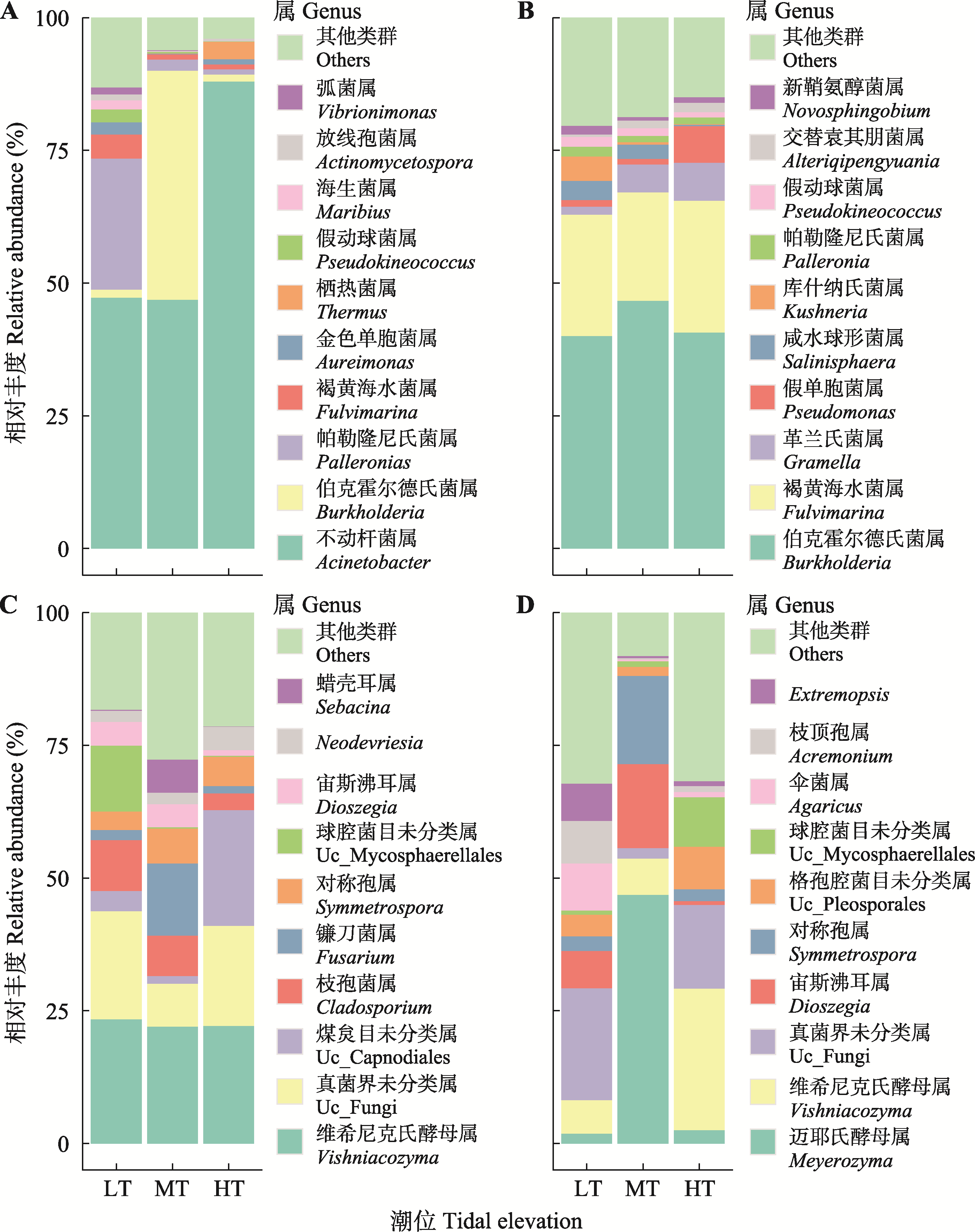
Fig. 1 Relative abundance of the top 10 dominant bacterial and fungal genera in epiphytic and endophytic communities across tidal elevations. A, B, Relative abundance of the top 10 dominant bacterial genera in epiphytic and endophytic communities, respectively. C, D, Relative abundance of the top 10 dominant fungal genera in epiphytic and endophytic communities, respectively. LT, low tidal elevation; MT, middle tidal elevation; HT, high tidal elevation. Uc, unclassified.
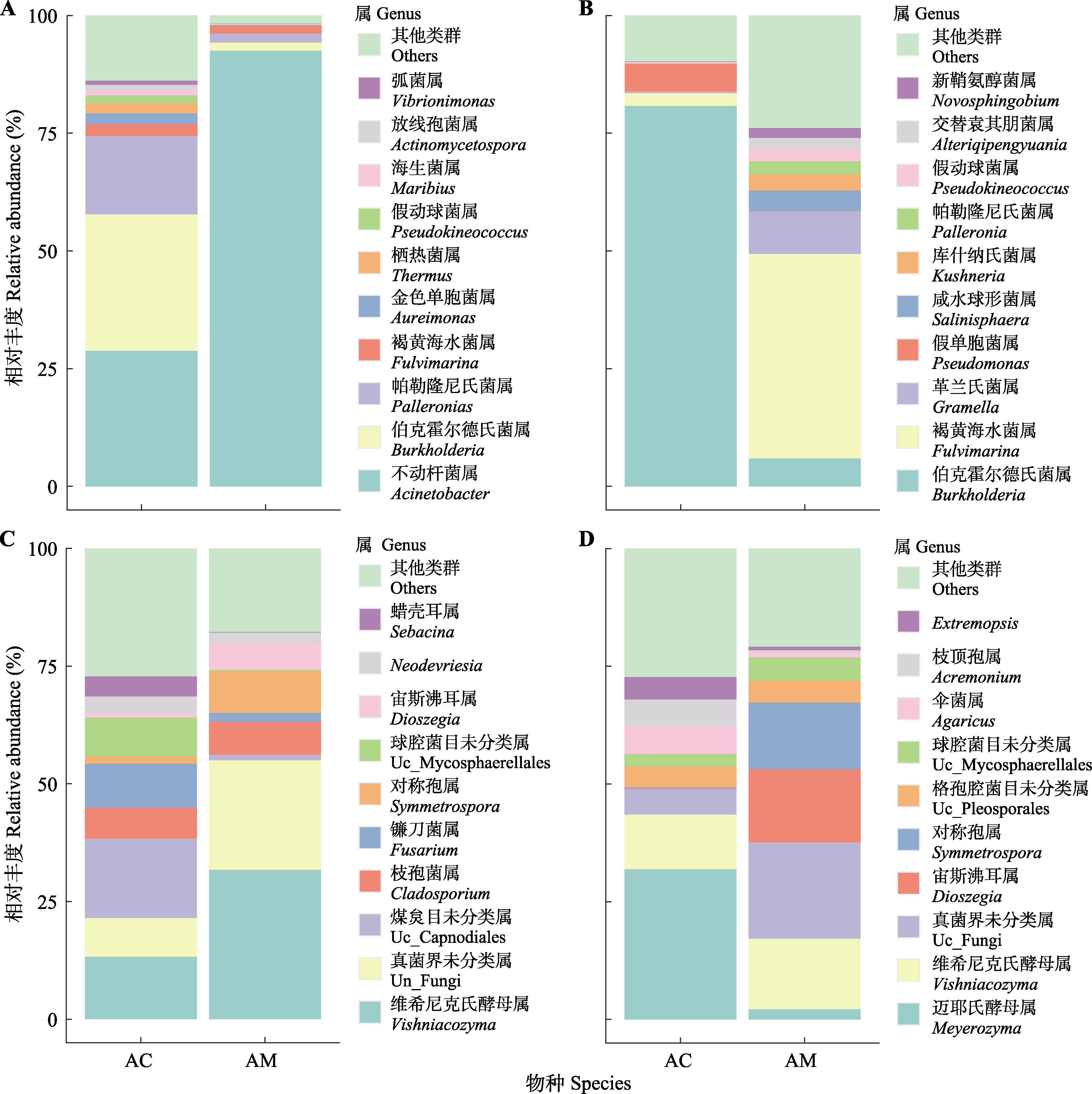
Fig. 2 Relative abundance of the top 10 dominant bacterial and fungal genera in epiphytic and endophytic communities across different plant hosts. A, B, Relative abundance of the top 10 dominant bacterial genera in epiphytic and endophytic communities, respectively. C, D, Relative abundance of the top 10 dominant fungal genera in epiphytic and endophytic communities, respectively. AC, Aegiceras corniculatum; AM, Avicennia marina. Uc, unclassified.
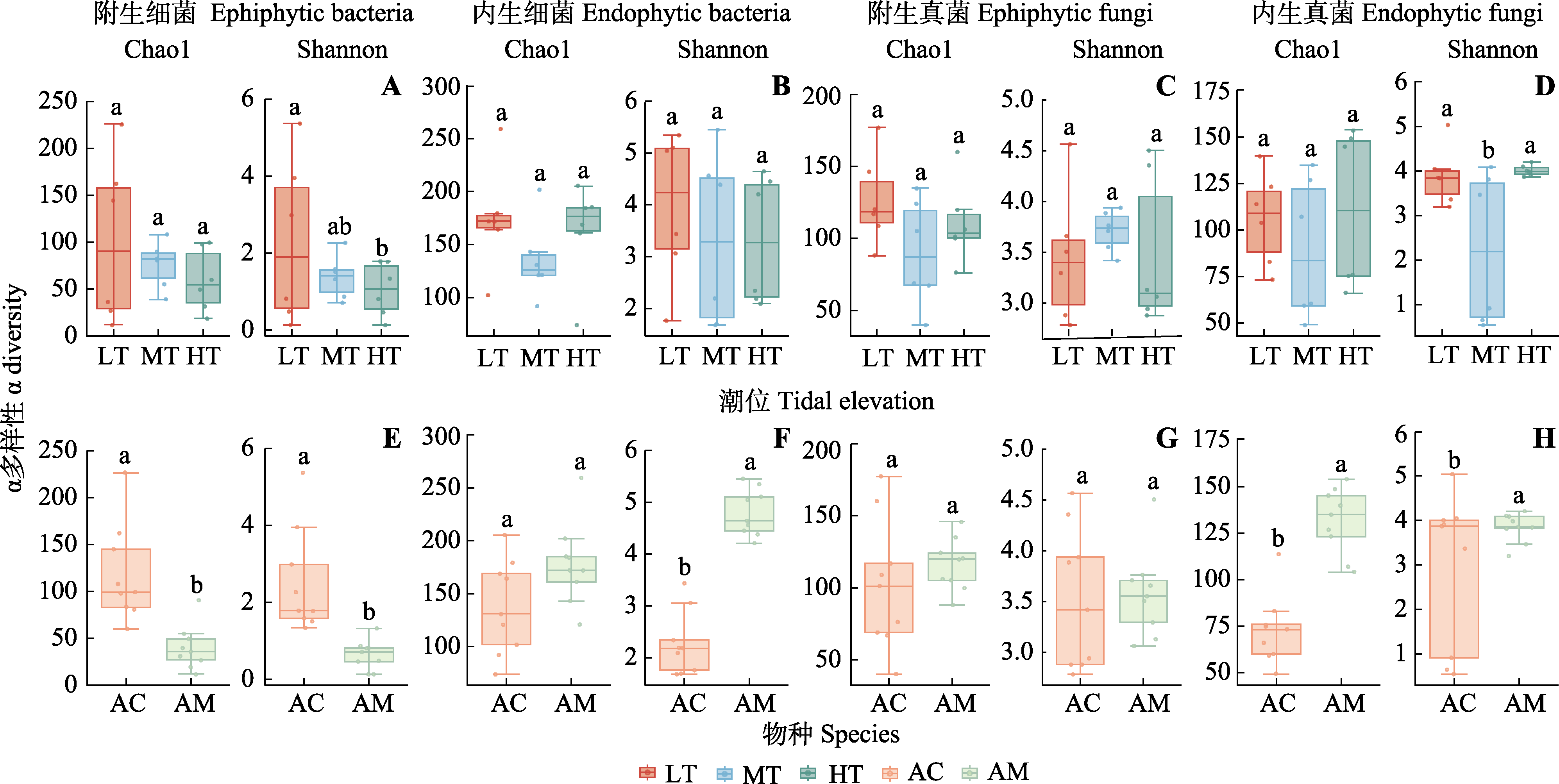
Fig. 3 Alpha diversity of mangrove phyllosphere microbial communities across tidal elevations and host plants. A-D, Chao1 richness index and Shannon-Wienner diversity index across the three tidal elevations for epiphytic bacteria, endophytic bacteria, epiphytic fungi, and endophytic fungi, respectively. E-H, The corresponding Chao1 and Shannon-Wienner indices between the two host species for the four microbial categories. LT, low tidal elevations; MT, middle tidal elevations; HT, high tidal elevations. AC, Aegiceras corniculatum; AM, Avicennia marina. Different lowercase letters above the box plots denote a statistically significant difference between groups (p < 0.05).
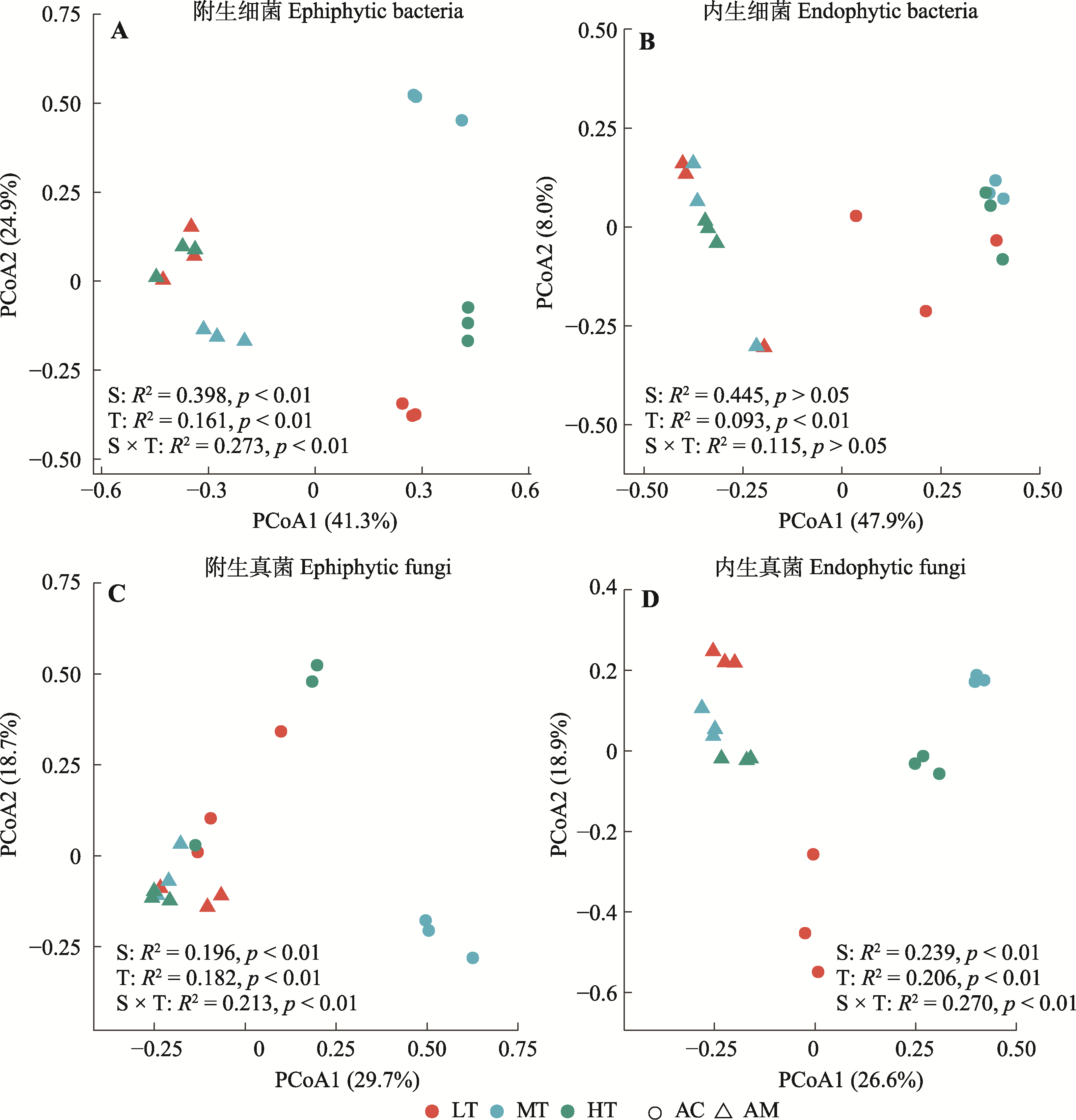
Fig. 4 Impact of tidal elevation and host species on phyllosphere microbial community structure. LT, low tidal elevations; MT, middle tidal elevations; HT, high tidal elevations. AC, Aegiceras corniculatum; AM, Avicennia marina. The analysis elucidates the effects of host species (S), tidal gradient (T), and their interactive effect (S × T) on the community structure. PCoA, principal coordinates analysis.
| 对照组 Control group | df | 细菌 Bacteria | 真菌 Fungi | ||||||
|---|---|---|---|---|---|---|---|---|---|
| 叶表 Epiphytic | 叶内 Endophytic | 叶表 Epiphytic | 叶内 Endophytic | ||||||
| R2 | p | R2 | p | R2 | p | R2 | p | ||
| Species = AC:Tidal | 2 | 0.800 | 0.007 | 0.420 | 0.012 | 0.622 | 0.012 | 0.635 | 0.007 |
| Species = AM:Tidal | 2 | 0.385 | 0.043 | 0.327 | 0.079 | 0.307 | 0.145 | 0.606 | 0.007 |
| Tidal = LT:Species | 5 | 0.725 | 0.100 | 0.485 | 0.100 | 0.327 | 0.100 | 0.579 | 0.100 |
| Tidal = MT:Species | 5 | 0.840 | 0.100 | 0.684 | 0.100 | 0.726 | 0.100 | 0.901 | 0.100 |
| Tidal = HT:Species | 5 | 0.836 | 0.100 | 0.674 | 0.100 | 0.416 | 0.100 | 0.497 | 0.100 |
Table 1 PERMANOVA results for mangrove phyllosphere microbial community structure under hierarchical partitioning of host species and tidal elevation
| 对照组 Control group | df | 细菌 Bacteria | 真菌 Fungi | ||||||
|---|---|---|---|---|---|---|---|---|---|
| 叶表 Epiphytic | 叶内 Endophytic | 叶表 Epiphytic | 叶内 Endophytic | ||||||
| R2 | p | R2 | p | R2 | p | R2 | p | ||
| Species = AC:Tidal | 2 | 0.800 | 0.007 | 0.420 | 0.012 | 0.622 | 0.012 | 0.635 | 0.007 |
| Species = AM:Tidal | 2 | 0.385 | 0.043 | 0.327 | 0.079 | 0.307 | 0.145 | 0.606 | 0.007 |
| Tidal = LT:Species | 5 | 0.725 | 0.100 | 0.485 | 0.100 | 0.327 | 0.100 | 0.579 | 0.100 |
| Tidal = MT:Species | 5 | 0.840 | 0.100 | 0.684 | 0.100 | 0.726 | 0.100 | 0.901 | 0.100 |
| Tidal = HT:Species | 5 | 0.836 | 0.100 | 0.674 | 0.100 | 0.416 | 0.100 | 0.497 | 0.100 |
| 物种 Species | 变量 Variable | 低潮位 LT | 中潮位 MT | 高潮位 HT |
|---|---|---|---|---|
| 蜡烛果 Aegiceras corniculatum | Sal | 19.000 ± 0.265a | 17.967 ± 0.473b | 16.033 ± 0.379c |
| Tem | 20.333 ± 1.197a | 20.253 ± 1.991a | 22.467 ± 0.092a | |
| Rh | 66.437 ± 10.096a | 71.273 ± 8.492a | 64.193 ± 0.705a | |
| pH | 6.877 ± 0.339a | 6.407 ± 0.360a | 6.063 ± 0.332a | |
| LWC | 0.317 ± 0.006a | 0.337 ± 0.006a | 0.377 ± 0.055a | |
| TK | 8.640 ± 0.553a | 8.037 ± 0.391a | 8.507 ± 1.308a | |
| TN | 17.887 ± 0.498a | 15.857 ± 0.552ab | 15.533 ± 1.296b | |
| TP | 2.673 ± 0.150a | 2.180 ± 0.070b | 2.307 ± 0.172b | |
| Ca | 2.963 ± 0.693a | 2.570 ± 0.104ab | 1.733 ± 0.155b | |
| Mg | 6.203 ± 0.938a | 6.413 ± 0.397a | 3.940 ± 0.295b | |
| 海榄雌 Avicennia marina | Sal | 19.500 ± 0.300a | 18.467 ± 0.777a | 15.200 ± 1.153b |
| Tem | 20.350 ± 1.225a | 20.737 ± 1.225a | 22.467 ± 0.092a | |
| Rh | 66.380 ± 10.192a | 68.940 ± 4.664a | 64.193 ± 0.705a | |
| pH | 6.707 ± 0.552a | 6.107 ± 0.199a | 5.860 ± 0.265a | |
| LWC | 0.407 ± 0.029a | 0.383 ± 0.012a | 0.390 ± 0.010a | |
| TK | 3.930 ± 0.352a | 3.890 ± 0.210a | 3.697 ± 0.338a | |
| TN | 9.200 ± 0.292a | 10.107 ± 0.301a | 9.173 ± 0.751a | |
| TP | 0.970 ± 0.101a | 1.093 ± 0.035a | 1.090 ± 0.110a | |
| Ca | 3.527 ± 0.235a | 3.553 ± 0.185a | 3.703 ± 0.454a | |
| Mg | 3.753 ± 0.662a | 4.917 ± 0.476a | 5.113 ± 0.870a |
Table 2 Environmental and leaf physicochemical factors of mangrove at different tidal levels (mean ± SD)
| 物种 Species | 变量 Variable | 低潮位 LT | 中潮位 MT | 高潮位 HT |
|---|---|---|---|---|
| 蜡烛果 Aegiceras corniculatum | Sal | 19.000 ± 0.265a | 17.967 ± 0.473b | 16.033 ± 0.379c |
| Tem | 20.333 ± 1.197a | 20.253 ± 1.991a | 22.467 ± 0.092a | |
| Rh | 66.437 ± 10.096a | 71.273 ± 8.492a | 64.193 ± 0.705a | |
| pH | 6.877 ± 0.339a | 6.407 ± 0.360a | 6.063 ± 0.332a | |
| LWC | 0.317 ± 0.006a | 0.337 ± 0.006a | 0.377 ± 0.055a | |
| TK | 8.640 ± 0.553a | 8.037 ± 0.391a | 8.507 ± 1.308a | |
| TN | 17.887 ± 0.498a | 15.857 ± 0.552ab | 15.533 ± 1.296b | |
| TP | 2.673 ± 0.150a | 2.180 ± 0.070b | 2.307 ± 0.172b | |
| Ca | 2.963 ± 0.693a | 2.570 ± 0.104ab | 1.733 ± 0.155b | |
| Mg | 6.203 ± 0.938a | 6.413 ± 0.397a | 3.940 ± 0.295b | |
| 海榄雌 Avicennia marina | Sal | 19.500 ± 0.300a | 18.467 ± 0.777a | 15.200 ± 1.153b |
| Tem | 20.350 ± 1.225a | 20.737 ± 1.225a | 22.467 ± 0.092a | |
| Rh | 66.380 ± 10.192a | 68.940 ± 4.664a | 64.193 ± 0.705a | |
| pH | 6.707 ± 0.552a | 6.107 ± 0.199a | 5.860 ± 0.265a | |
| LWC | 0.407 ± 0.029a | 0.383 ± 0.012a | 0.390 ± 0.010a | |
| TK | 3.930 ± 0.352a | 3.890 ± 0.210a | 3.697 ± 0.338a | |
| TN | 9.200 ± 0.292a | 10.107 ± 0.301a | 9.173 ± 0.751a | |
| TP | 0.970 ± 0.101a | 1.093 ± 0.035a | 1.090 ± 0.110a | |
| Ca | 3.527 ± 0.235a | 3.553 ± 0.185a | 3.703 ± 0.454a | |
| Mg | 3.753 ± 0.662a | 4.917 ± 0.476a | 5.113 ± 0.870a |
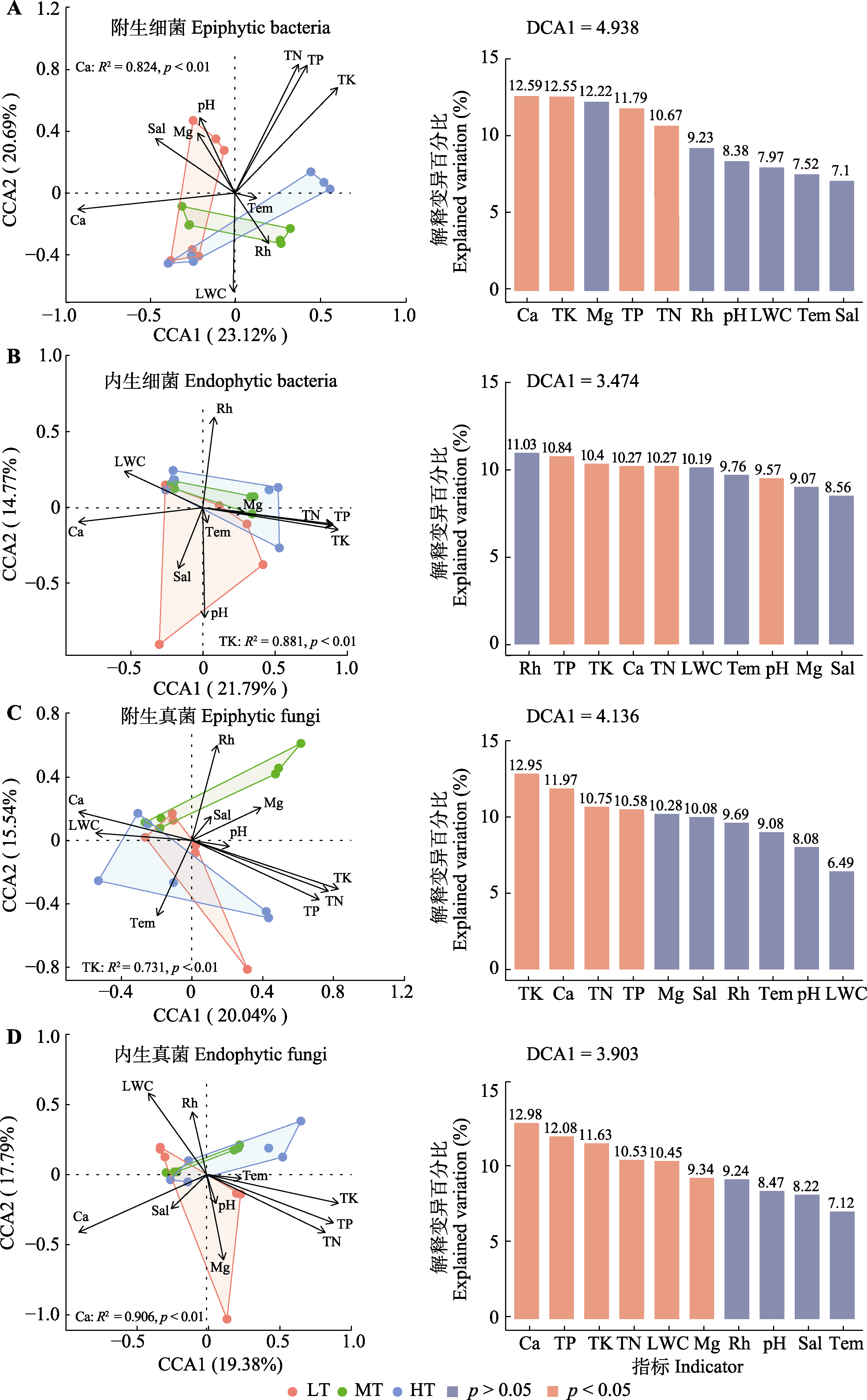
Fig. 5 Canonical correspondence analysis (CCA) and hierarchical partitioning analysis (HPA) of microbial community composition (at the ASV level) with environmental factors and leaf physical and chemical properties. LT, low tidal elevation; MT, middle tidal elevation; HT, high tidal elevation. DCA1, the gradient length value of the first axis of detrended correspondence analysis. Ca, leaf total calcium content; LWC, leaf water content; Mg, leaf total magnesium content; pH, acidity and alkalinity; Rh, relative humidity; Sal, salinity; Tem, air temperature; TK, leaf total potassium content; TN, leaf total nitrogen content; TP, leaf total phosphorus content.
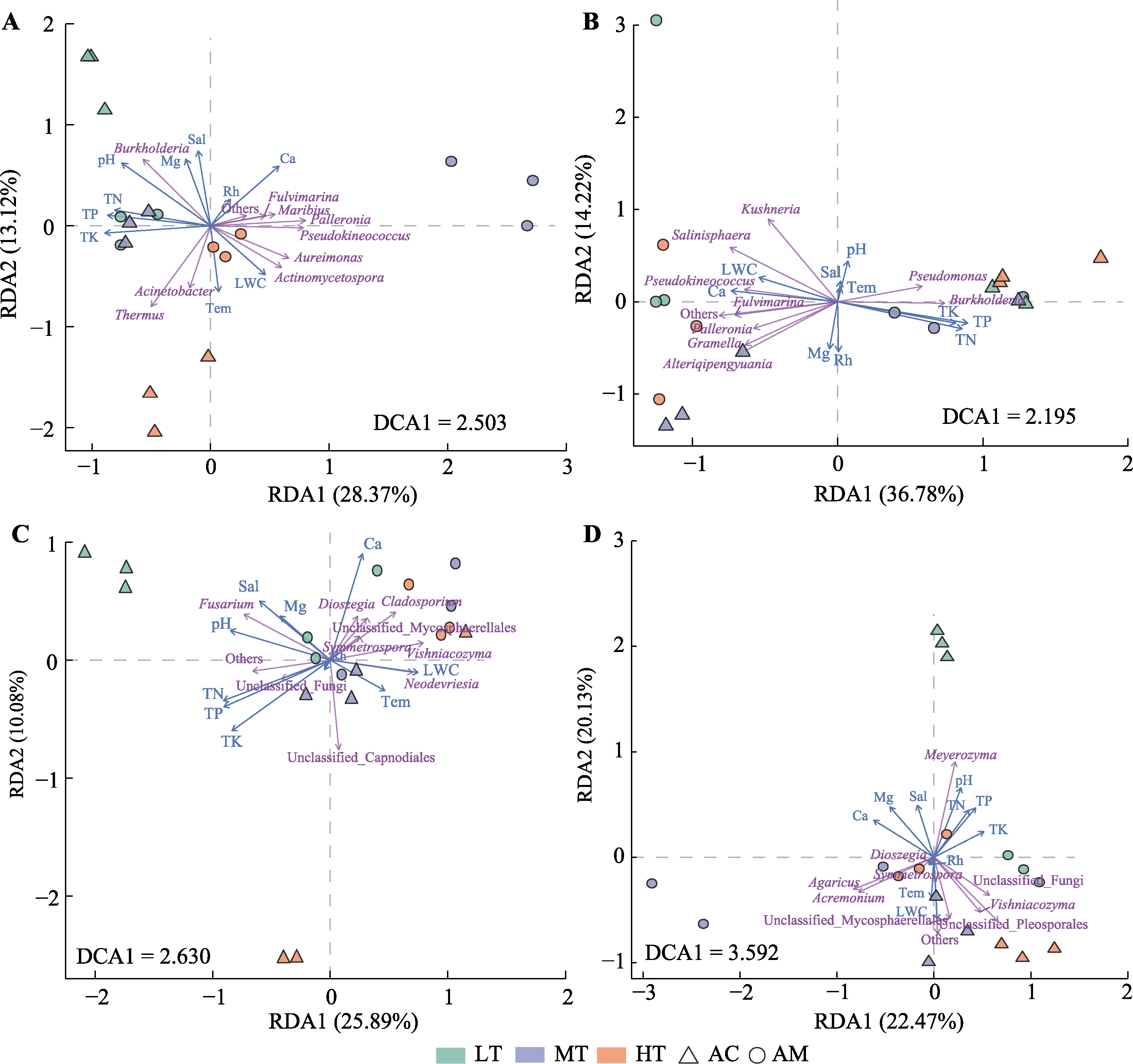
Fig. 6 Redundancy analysis (RDA) of the top 10 dominant genera of phyllosphere microorganisms with environmental indicators and leaf physicochemical indicators. A, B, Epiphytic bacteria and endophytic bacteria, respectively. C, D, Epiphytic fungi and endophytic fungi, respectively. LT, low tidal elevation; MT, middle tidal elevation; HT, high tidal elevation. AC, Aegiceras corniculatum; AM, Avicennia marina. DCA1, The gradient length value of the first axis of detrended correspondence analysis. Ca, leaf total calcium content; LWC, leaf water content; Mg, leaf total magnesium content; pH, acidity and alkalinity; Rh, relative humidity; Sal, salinity; Tem, air temperature; TK, leaf total potassium content; TN, leaf total nitrogen content; TP, leaf total phosphorus content.
| [1] |
Arfi Y, Buée M, Marchand C, Levasseur A, Record E (2012). Multiple markers pyrosequencing reveals highly diverse and host-specific fungal communities on the mangrove trees Avicennia marina and Rhizophora stylosa. FEMS Microbiology Ecology, 79, 433-444.
DOI URL |
| [2] |
Ball MC (1988). Salinity tolerance in the Mangroves Aegiceras corniculatum and Avicennia marina. I. Water use in relation to growth, carbon partitioning, and salt balance. Australian Journal of Plant Physiology, 15, 447-464.
DOI URL |
| [3] |
Beattie GA (2011). Water relations in the interaction of foliar bacterial pathogens with plants. Annual Review of Phytopathology, 49, 533-555.
DOI PMID |
| [4] | Chang CF, Huang SY, Lee CF (2021). Vishniacozyma changhuana sp. nov., and Vishniacozyma taiwanica sp. nov., two novel yeast species isolated from mangrove forests in Taiwan. International Journal of Systematic and Evolutionary Microbiology, 71, 004703. DOI: 10.1099/ijsem.0.004703. |
| [5] | Chi BJ, Guo ZJ, Wei MY, Song SW, Zhong YH, Liu JW, Zhang YC, Li J, Xu CQ, Zhu XY, Zheng HL (2024). Structural, developmental and functional analyses of leaf salt glands of mangrove recretohalophyte Aegiceras corniculatum. Tree Physiology, 44, tpad123. DOI: 10.1093/treephys/tpad123. |
| [6] | Chomnunti P, Hongsanan S, Aguirre-Hudson B, Tian Q, Peršoh D, Dhami MK, Alias AS, Xu JC, Liu XZ, Stadler M, Hyde KD (2014). The sooty moulds. Fungal Diversity, 66, 278. DOI: 10.1007/s13225-014-0278-5. |
| [7] | de Mandal S, Jeon J (2023). Phyllosphere microbiome in plant health and disease. Plants, 12, 3481. DOI: 10.3390/plants12193481. |
| [8] |
Dias ACF, Taketani RG, Andreote FD, Luvizotto DM, da Silva JL, dos Santos Nascimento R, de Melo IS (2012). Interspecific variation of the bacterial community structure in the phyllosphere of the three major plant components of mangrove forests. Brazilian Journal of Microbiology, 43, 653-660.
DOI PMID |
| [9] |
Doan HK, Ngassam VN, Gilmore SF, Tecon R, Parikh AN, Leveau JHJ (2020). Topography-driven shape, spread, and retention of leaf surface water impacts microbial dispersion and activity in the phyllosphere. Phytobiomes Journal, 4, 268-280.
DOI URL |
| [10] |
Gomes T, Pereira JA, Benhadi J, Lino-Neto T, Baptista P (2018). Endophytic and epiphytic phyllosphere fungal communities are shaped by different environmental factors in a Mediterranean ecosystem. Microbial Ecology, 76, 668-679.
DOI PMID |
| [11] |
Gong TY, Xin XF (2021). Phyllosphere microbiota: Community dynamics and its interaction with plant hosts. Journal of Integrative Plant Biology, 63, 297-304.
DOI |
| [12] | Grzyb T, Szulc J (2024). Deciphering molecular mechanisms and diversity of plant holobiont bacteria: microhabitats, community ecology, and nutrient acquisition. International Journal of Molecular Sciences, 25, 13601. DOI: 10.3390/ijms252413601. |
| [13] |
Guo Z, Wei MY, Zhong YH, Wu X, Chi BJ, Li J, Li H, Zhang LD, Wang XX, Zhu XY, Zheng HL (2023). Leaf sodium homeostasis controlled by salt gland is associated with salt tolerance in mangrove plant Avicennia marina. Tree Physiology, 43, 817-831.
DOI URL |
| [14] | Huang X, Xin K, Wang XP (2009). Brief description of mangrove community habitat characteristics in China. Tropical Forestry, 37(2), 10-12. |
| [黄星, 辛琨, 王薛平 (2009). 我国红树林群落生境特征研究简述. 热带林业, 37(2), 10-12.] | |
| [15] | Jacobs HM, O’Neal L, Lopatto E, Wozniak DJ, Bjarnsholt T, Parsek MR (2022). Mucoid Pseudomonas aeruginosa can produce calcium-gelled biofilms independent of the matrix components psl and CdrA. Journal of Bacteriology, 204, e00568. DOI: 10.1128/jb.00568-21. |
| [16] | Ji KP, Wei YQ, Lan GY (2024). Geographic location affects the bacterial community composition and diversity more than species identity for tropical tree species. Plants, 13, 1565. DOI: 10.3390/plants13111565. |
| [17] |
Kembel SW, O’Connor TK, Arnold HK, Hubbell SP, Wright SJ, Green JL (2014). Relationships between phyllosphere bacterial communities and plant functional traits in a neotropical forest. Proceedings of the National Academy of Sciences of the United States of America, 111, 13715-13720.
DOI PMID |
| [18] |
Kristensen E, Bouillon S, Dittmar T, Marchand C (2008). Organic carbon dynamics in mangrove ecosystems: a review. Aquatic Botany, 89, 201-219.
DOI URL |
| [19] | Laforest-Lapointe I, Messier C, Kembel SW (2016). Host species identity, site and time drive temperate tree phyllosphere bacterial community structure. Microbiome, 4, 27. DOI: 10.1186/s40168-016-0174-1. |
| [20] |
Lee SY, Primavera JH, Dahdouh-Guebas F, McKee K, Bosire JO, Cannicci S, Diele K, Fromard F, Koedam N, Marchand C, Mendelssohn I, Mukherjee N, Record S (2014). Ecological role and services of tropical mangrove ecosystems: a reassessment. Global Ecology and Biogeography, 23, 726-743.
DOI URL |
| [21] | Li J, Jin MK, Neilson R, Hu SL, Tang YJ, Zhang Z, Huang FY, Zhang J, Yang XR (2023). Plant identity shapes phyllosphere microbiome structure and abundance of genes involved in nutrient cycling. Science of the Total Environment, 865, 161245. DOI: 10.1016/j.scitotenv.2022.161245. |
| [22] | Li MM, Lv AP, Zhao ZY, Xian WD, Lian ZH, Ouyang YT, Ming H, Tan S, Jiao JY, Zhou EM, Liu L, Li WJ (2022). Description of five novel thermophilic species of the genus Thermus: Thermus hydrothermalis sp. nov., Thermus neutrinimicus sp. nov., Thermus thalpophilus sp. nov., Thermus albus sp. nov., and Thermus altitudinis sp. nov., isolated from hot spring sediments. Systematic and Applied Microbiology, 45, 126361. DOI: 10.1016/j.syapm.2022.126361. |
| [23] |
Li YY, Zheng J, Yan XY, Li S, Luo L, Tong J, Zhao CZ (2024). Effects of warming on phyllosphere and rhizosphere bacterial communities in Picea asperata and Fargesia nitida. Chinese Journal of Plant Ecology, 48, 1692-1707.
DOI URL |
|
[李昀奕, 郑矜, 严晓艳, 李霜, 罗林, 童晋, 赵春章 (2024). 云杉和华西箭竹叶际与根际细菌群落对增温的响应. 植物生态学报, 48, 1692-1707.]
DOI |
|
| [24] | Lin S, Lin HY (2018). Ecological research on the terrestrial flora resources in Hainan Dongzhaigang National Natural Reserves and its adjacent rural area. Chinese Journal of Tropical Crops, 39, 398-404. |
| [林生, 林惠宇 (2018). 海南东寨港国家级自然保护区及其周边陆域植物资源与植被调查研究. 热带作物学报, 39, 398-404.] | |
| [25] |
Lindow SE, Brandl MT (2003). Microbiology of the phyllosphere. Applied and Environmental Microbiology, 69, 1875-1883.
DOI URL |
| [26] | Long YF, Tian MJ, Ye BB, Li MQ, Li DD, Yang F (2025). Comparative study on the community characteristics and population dynamics of Bruguiera sexangula (Lour.) Poiret at different intertidal elevations in Dongzhaigang National Nature Reserve. Plant Science Journal, 43(1), 72-81. |
| [龙奕帆, 田梦洁, 叶冰冰, 李梦琦, 李大东, 杨帆 (2025). 东寨港自然保护区不同潮位下海莲群落特征及种群动态的比较研究. 植物科学学报, 43(1), 72-81.] | |
| [27] | Ma R, Wang ZL, Rui K (2025). Phyllosphere microbial community structure and diversity of Areca catechu with yellow leaf disease. Acta Microbiologica Sinica, 65, 3600-3614. |
| [马瑞, 王贞霖, 芮凯 (2025). 槟榔黄化病叶际微生物群落结构与多样性. 微生物学报, 65, 3600-3614.] | |
| [28] | Martin H, Rogers LA, Moushtaq L, Brindley AA, Forbes P, Quinton AR, Murphy ARJ, Hipperson H, Daniell TJ, Ndeh D, Amsbury S, Hitchcock A, Lidbury IDEA (2025). Metabolism of hemicelluloses by root-associated Bacteroidota species. The ISME Journal, 19, wraf022. DOI: 10.1093/ismejo/wraf022. |
| [29] |
Moitinho MA, Chiaramonte JB, Souza DT, Solano JH, Bononi L, Melo IS, Taketani RG (2019). Intraspecific variation on epiphytic bacterial community from Laguncularia racemosa phylloplane. Brazilian Journal of Microbiology, 50, 1041-1050.
DOI PMID |
| [30] |
Nagelkerken I, Blaber SJM, Bouillon S, Green P, Haywood M, Kirton LG, Meynecke JO, Pawlik J, Penrose HM, Sasekumar A, Somerfield PJ (2008). The habitat function of mangroves for terrestrial and marine fauna: a review. Aquatic Botany, 89, 155-185.
DOI URL |
| [31] | Nian LY, Xie Y, Zhang HZ, Wang MJ, Yuan B, Cheng SJ, Cao CJ (2023). Vishniacozyma victoriae: an endophytic antagonist yeast of kiwifruit with biocontrol effect to Botrytis cinerea. Food Chemistry, 411, 135442. DOI: 10.1016/j.foodchem.2023.135442. |
| [32] |
Noble AS, Abbaszadeh J, Lee CK (2025). Host selection is not a universal driver of phyllosphere community assembly among ecologically similar native New Zealand plant species. Microbiome, 13, 35. DOI: 10.1186/s40168-024-02000-x.
PMID |
| [33] |
Peng YX, Lee JH, Kim CY, Lee JY (2026). Halophyte-Derived Kushneria Strains enhance salt tolerance and rhizosphere dynamics in cabbage. Plant, Cell & Environment, 49, 531-549.
DOI URL |
| [34] | Pfaff MC, Nel R (2019). Intertidal zonation//Fath BD. Encyclopedia of Ecology. 2nd ed. Elsevier, Oxford. 97-107. |
| [35] | Qu X, Pan YQ, Wang PQ, Ran LL, Qin GF, Li QF, Kang P (2024). Response of phyllosphere and rhizosphere microbial communities to salt stress of Tamarix chinensis. Plants, 13, 1091. DOI: 10.3390/plants13081091. |
| [36] | Roberts MF (2005). Organic compatible solutes of halotolerant and halophilic microorganisms. Saline Systems, 1, 5. DOI: 10.1186/1746-1448-1-5. |
| [37] |
Santoyo G, Moreno-Hagelsieb G, del Carmen Orozco-Mosqueda M, Glick BR (2016). Plant growth-promoting bacterial endophytes. Microbiological Research, 183, 92-99.
DOI PMID |
| [38] |
Slade D, Radman M (2011). Oxidative stress resistance in Deinococcus radiodurans. Microbiology and Molecular Biology Reviews, 75, 133-191.
DOI PMID |
| [39] |
Sohrabi R, Paasch BC, Liber JA, He SY (2023). Phyllosphere microbiome. Annual Review of Plant Biology, 74, 539-568.
DOI URL |
| [40] | Sun Z, Zhang WX, Liu YT, Ding CJ, Zhu WX (2023). The changes of phyllosphere fungal communities among three different Populus spp. Microorganisms, 11, 2479. DOI: 10.3390/microorganisms11102479. |
| [41] | Thatoi H, Behera BC, Mishra RR, Dutta SK (2013). Biodiversity and biotechnological potential of microorganisms from mangrove ecosystems: a review. Annals of Microbiology, 63, 442. DOI: 10.1007/s13213-012-0442-7. |
| [42] |
Trivedi P, Leach JE, Tringe SG, Sa T, Singh BK (2020). Plant-microbiome interactions: from community assembly to plant health. Nature Reviews Microbiology, 18, 607-621.
DOI |
| [43] | Wang ZK, Wang JH, Yu X, Zhang HC, Liu J, Cao JW, Fang JS, Song ZF, Zhang L (2024). The metabolic characteristics and environmental adaptations of the intertidal bacterium Palleronia sp. LCG004. Frontiers in Microbiology, 15, 1469112. DOI: 10.3389/fmicb.2024.1469112. |
| [44] | Xu QW, Fu H, Zhu B, Hussain HA, Zhang KP, Tian XQ, Duan MC, Xie XY, Wang LC (2021). Potassium improves drought stress tolerance in plants by affecting root morphology, root exudates, and microbial diversity. Metabolites, 11, 131. DOI: 10.3390/metabo11030131. |
| [45] |
Yang XX, Yuan RW, Yang SY, Dai ZA, Di N, Yang HJ, He ZL, Wei M (2024). A salt-tolerant growth-promoting phyllosphere microbial combination from mangrove plants and its mechanism for promoting salt tolerance in rice. Microbiome, 12(1), 270. DOI:10.1186/s40168-024-0196 9-9.
DOI |
| [46] | Yao H, Sun X, He C, Li XC, Guo LD (2020). Host identity is more important in structuring bacterial epiphytes than endophytes in a tropical mangrove forest. FEMS Microbiology Ecology, 96, fiaa038. DOI: 10.1093/femsec/fiaa038. |
| [47] | Yao H, Sun X, He C, Maitra P, Li XC, Guo LD (2019). Phyllosphere epiphytic and endophytic fungal community and network structures differ in a tropical mangrove ecosystem. Microbiome, 7, 57. DOI: 10.1186/s40168-019-0671-0. |
| [48] | Ye Y, Lu CY, Hu HY, Tan FY (2004). Comparisons of tolerances to salt stress among three salt-secreting mangrove species. Acta Ecologica Sinica, 24, 2444-2450. |
| [叶勇, 卢昌义, 胡宏友, 谭凤仪 (2004). 三种泌盐红树植物对盐胁迫的耐受性比较. 生态学报, 24, 2444-2450.] | |
| [49] | Yousuf B, Sanadhya P, Keshri J, Jha B (2012). Comparative molecular analysis of chemolithoautotrophic bacterial diversity and community structure from coastal saline soils, Gujarat, India. BMC Microbiology, 12, 150. DOI: 10.1186/1471-2180-12-150. |
| [50] | Zhang KF, Zhong YJ, Sun LL, Liao H (2021). Plant-associated beneficial Burkholderia. Acta Microbiologica Sinica, 61, 2205-2218. |
| [张珂飞, 钟永嘉, 孙丽莉, 廖红 (2021). 植物有益伯克霍尔德氏菌的研究进展及其在农业中的应用. 微生物学报, 61, 2205-2218.] | |
| [51] | Zhang QM, Yu HB, Chen XS, Zheng DZ (1997). The relationship between mangrove zone on tidal flats and tidal levels. Acta Ecologica Sinica, 17, 258-265. |
| [张乔民, 于红兵, 陈欣树, 郑德璋 (1997). 红树林生长带与潮汐水位关系的研究. 生态学报, 17, 258-265.] | |
| [52] | Zheng DZ, Liao BW, Zheng SF, Xu DG, Han Z (1995). Mangrove plants’ adaptive ability to habitat and their horizontal distribution in Qinglan Harbour, Hainan Island. Forest Research, (1), 67-72. |
| [郑德璋, 廖宝文, 郑松发, 许达桂, 韩智 (1995). 海南岛清澜港红树树种适应生境能力与水平分布. 林业科学研究, (1), 67-72.] | |
| [53] |
Zheng Y, Sun XG, Xiong YY, Yuan GY, Ding GJ (2023). Effects of phyllospheric microorganisms on litter decomposition of Pinus massoniana. Chinese Journal of Plant Ecology, 47, 687-698.
DOI URL |
|
[郑炀, 孙学广, 熊洋阳, 袁贵云, 丁贵杰 (2023). 叶际微生物对马尾松凋落针叶分解的影响. 植物生态学报, 47, 687-698.]
DOI |
|
| [54] | Zhu CC, Lin YM, Wang ZH, Luo WQ, Zhang YH, Chu CJ (2023). Community assembly and network structure of epiphytic and endophytic phyllosphere fungi in a subtropical mangrove ecosystem. Frontiers in Microbiology, 14, 1147285. DOI: 10.3389/fmicb.2023.1147285. |
| [55] |
Zhu P, Wang YP, Shi TT, Zhang XL, Huang GQ, Gong J (2018). Intertidal zonation affects diversity and functional potentials of bacteria in surface sediments: a case study of the Golden Bay mangrove, China. Applied Soil Ecology, 130, 159-168.
DOI URL |
| Viewed | ||||||
|
Full text |
|
|||||
|
Abstract |
|
|||||
Copyright © 2026 Chinese Journal of Plant Ecology
Tel: 010-62836134, 62836138, E-mail: apes@ibcas.ac.cn, cjpe@ibcas.ac.cn

