
植物生态学报 ›› 2007, Vol. 31 ›› Issue (3): 505-512.DOI: 10.17521/cjpe.2007.0063 cstr: 32100.14.cjpe.2007.0063
彭长连1,2( ), 温学2, 林植芳2, 周厚诚3, 陈少薇2, 林桂珠2
收稿日期:2005-07-19
接受日期:2006-07-06
出版日期:2007-07-19
发布日期:2007-05-30
作者简介:E-mail: pengchl@scib.ac.cn
基金资助:
PENG Chang-Lian1,2(), WEN Xue2, LIN Zhi-Fang2, ZHOU Hou-Cheng3, CHEN Shao-Wei2, LIN Gui-Zhu2
Received:2005-07-19
Accepted:2006-07-06
Online:2007-07-19
Published:2007-05-30
摘要:
龙须菜(Gracilaria lemaneiformis)是红藻门江蓠属大型海藻,已从山东青岛引种到广东省南澳岛等地栽培多年。深入了解其光合作用与环境条件的关系,对龙须菜的合理栽培及其在环境生态中的生物学作用和扩大其开发利用价值,具有重要的理论和现实意义。该文利用人为配置的不同程度N、P污染海水处理龙须菜,研究其生理生态特性对海水氮磷富营养化的响应。结果表明: 处理6 d后,龙须菜叶绿素a及3种藻胆蛋白含量和总抗氧化能力在轻度P(P 0.2 mg·L-1)及重度N、P复合污染(P 10 mg·L-1,N 55 mg·L-1)情况下降低。叶绿素荧光参数的变化也表明上述处理对叶绿体PSⅡ造成不利影响,而在轻度N(N 0.9 mg·L-1)和轻度N、P复合污染(P 0.2 mg·L-1,N 0.9 mg·L-1)海水中上述参数则变化不大,表现出龙须菜对轻度N及轻度N、P复合污染的耐受性。该实验条件下,轻度污染处理后,藻体中不因环境N、P浓度升高而富集N、P。表明龙须菜可以作为轻度富营养化海水水体的净化藻类。
彭长连, 温学, 林植芳, 周厚诚, 陈少薇, 林桂珠. 龙须菜对海水氮磷富营养化的响应. 植物生态学报, 2007, 31(3): 505-512. DOI: 10.17521/cjpe.2007.0063
PENG Chang-Lian, WEN Xue, LIN Zhi-Fang, ZHOU Hou-Cheng, CHEN Shao-Wei, LIN Gui-Zhu. RESPONSE OF GRACILARIA LEMANEIFORMIS TO NITROGEN AND PHOSPHORUS EUTROPHIC SEAWATER. Chinese Journal of Plant Ecology, 2007, 31(3): 505-512. DOI: 10.17521/cjpe.2007.0063
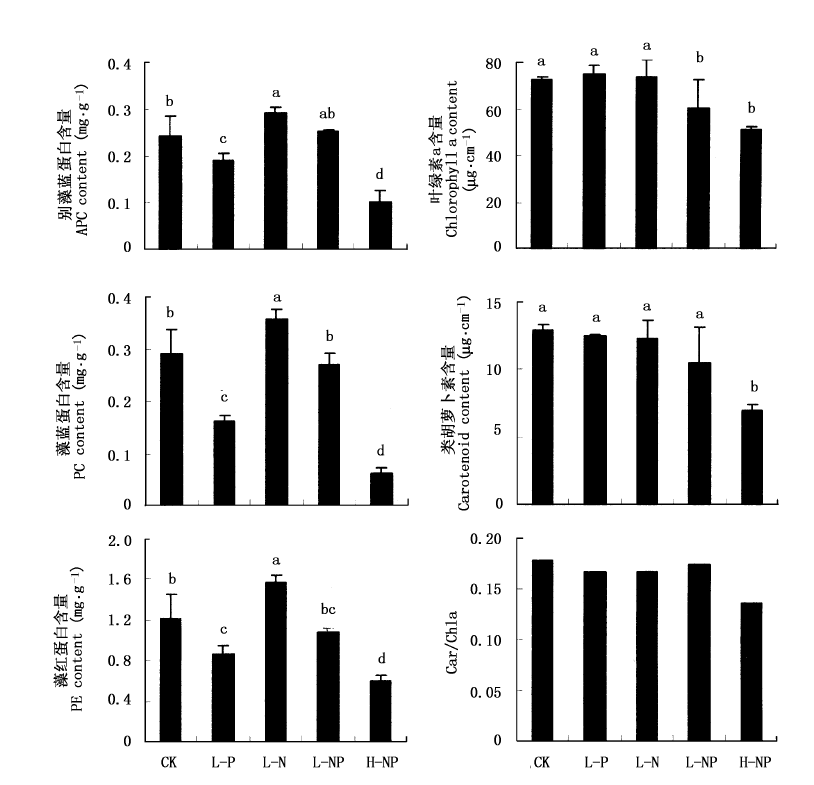
图1 不同N、P浓度处理6 d后藻胆蛋白、叶绿素a及类胡萝卜素含量的变化 CK为空白,即藻体生长的海水中未添加N、P元素;L-P为轻度P污染的海水,即海水中加入NaH2PO4,使P浓度为0.2 mg·L-1;L-N为轻度N污染的海水,加入NH4NO3,使N浓度为0.9 mg·L-1 ;L-NP为轻度N、P的复合污染, H-NP为重度N、P污染,N、P浓度分别为55和10 mg·L-1。实验重复3次, 相同字母的数字之间无显著差异(p=0.05), 带其它不同字母的数字之间的差异显著(p<0.05)
Fig.1 Changes in phycobiliproteins, contents of chlorophyll a and carotenoid in Gracilaria lemaneiformis after 6 days treatment in seawater with different concentrations of nitrogen and phosphorus CK (control), original seawater; L-P, less polluted seawater by 0.2 mg·L-1 of phosphorous (NaH2PO4); L-N, less polluted seawater by 0.9 mg·L-1 nitrogen (NH4NO3); L-NP, less polluted by nitrogen (0.9 mg·L-1)and phosphorus (0.2 mg·L-1) combination; H-NP, serious polluted seawater by 10 mg·L-1 nitrogen and 55 mg·L-1 phosphorus. The numbers sharing the same letters are not significantly different (p=0.05), and these with other different letters are significantly different (p<0.05)
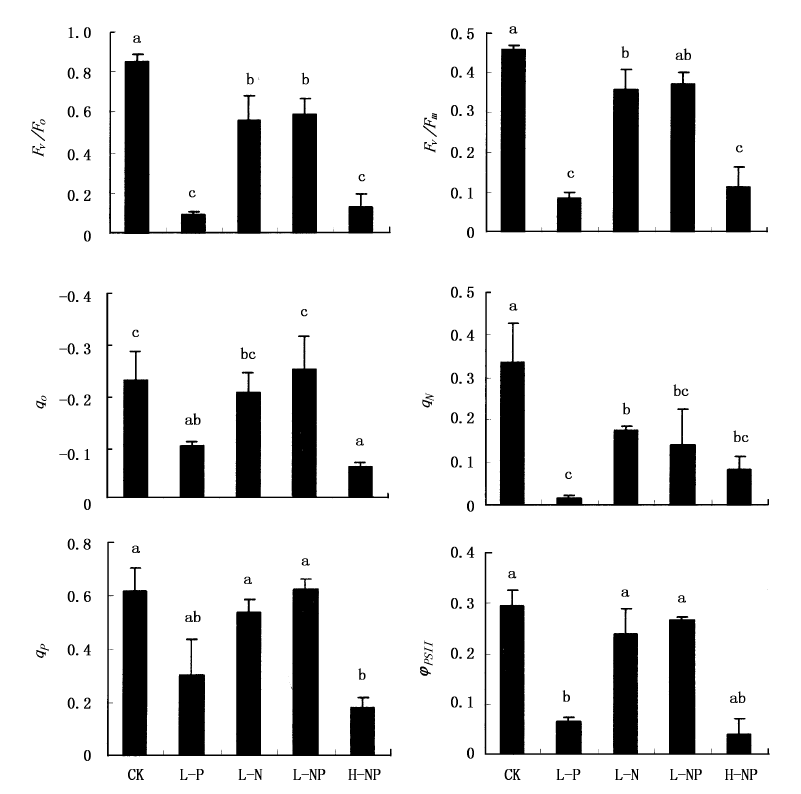
图2 不同N、P浓度处理6 d后叶绿素a荧光参数变化
Fig.2 Changes in chlorophyll a fluorescence parameters in Gracilaria lemaneiformis after 6 days treatment with different concentrations of nitrogen and phosphorus Fv/Fo:PSⅡ潜在活性 PSⅡ potential activity Fv/Fm: PSⅡ原初光化学效率 Maximum quantum yield of photosynthesis qo: 叶绿素荧光最小值的相对变化 Relative change of minimum chlorophll fluorescence qN: 非光化学猝灭系数 Non-photochemical quenching qP: 光化学猝灭系数 Photochemical quenching ΦPSⅡ: 光合作用的真实量子效率 Actual quantumn yield of photosynthesis CK、L-P、L-N、L-NP、H-NP: 见图1 See Fig. 1
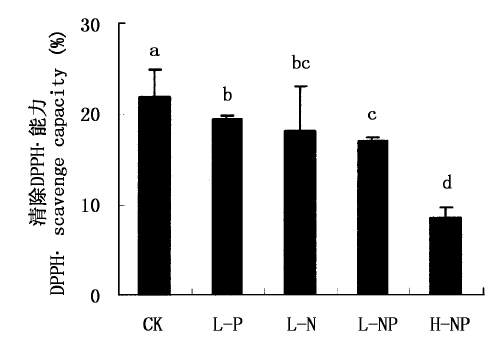
图3 不同N、P浓度处理时龙须菜藻体清除DPPH·能力的变化 CK、L-P、L-N、L-NP、H-NP:见图1
Fig.3 Changes in DPPH· scavenge capacity in Gracilaria lemaneiformis treated with different concentrations of nitrogen and phosphorous CK、L-P、L-N、L-NP、H-NP:See Fig. 1
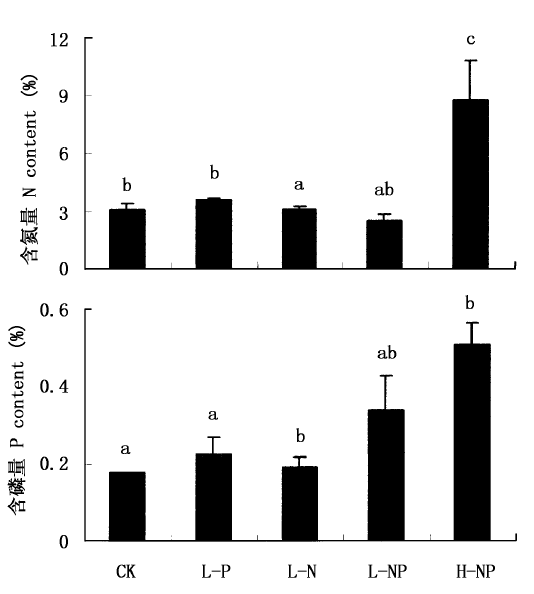
图4 不同N、P浓度处理时龙须菜藻体N、P含量的变化 CK、L-P、L-N、L-NP、H-NP:见图1
Fig.4 Changes of nitrogen or phosphorus content in Gracilaria lemaneiformis after treating with different concentrations of nitrogen and phosphorus CK、L-P、L-N、L-NP、H-NP:See Fig. 1
| [1] | Algarra P, Rüdiger W (1993). Acclimation processes in the light harvesting complex of the red alga Porphyridium purpureum (Bory) Drew et Ross, according to irradiance and nutrient availability. Plant, Cell and Environment, 16, 149-159. |
| [2] | Asada K, Takahashi M (1987). Production and scavenging of active oxygen in photosynthesis. In: Kyle DJ, Osmond CB, Arntzen CJ eds. Photoinhibition. Elsevier, Amsterdam, 227-287. |
| [3] |
Bird KT, Habig C, DeBusk T (1982). Nitrogen allocation and storage patterns in Gracilaria tikvahiae (Rhodophyta). Journal of Phycology, 18, 344-348.
DOI URL |
| [4] | Brand LE, Gottfried MD, Baylon CC, Romer NS (1991). Spatial and temporal distribution of phytoplankton in Biscayne Bay, Florida. Bulletin of Marine Science, 49, 599-613. |
| [5] |
Bronk DA, Glibert PM, Ward BB (1994). Nitrogen uptake, dissolved organic nitrogen release, and new production. Science, 265, 1843-1852.
DOI URL PMID |
| [6] |
Chapman ARO, Craigie JS (1977). Seasonal growth in Laminaria longicruris: relations with dissolved inorganic nutrients and internal reserves of nitrogen. Marine Biology, 40, 197-205.
DOI URL |
| [7] |
Chapman ARO, Markham JW, Lüning K (1978). Effects of nitrate concentration on the growth and physiology of Laminaria saccharina (Phaeophyta) in culture. Journal of Phycology, 14, 195-198.
DOI URL |
| [8] | Chen MZ (陈美珍), Zhang YY(张永雨), Yu J(余杰), Xie XB(谢雄彬)(2004). Studies on separation and scavenging activities on free radicals of phycobiliproteins from Gracilaria lemaneiformis. Food Science (食品科学), 25, 159-162. (in Chinese with English abstract) |
| [9] | Conkright ME, Levitus S, Boyer TP (1994). World Ocean Atlas 1994. Volume 1: Nutrient NOAA Atlas NESDIS 1. US Depterment of Commerce, Washington DC, 150. |
| [10] | de Casabianca ML, Marinho-Soriano E, Laugier T (1997). Growth of Gracilaria bursa-pastoris in a Mediterranean lagoon: Thau, France. Botanica Marina, 40, 29-37. |
| [11] | Dai QY(戴全裕), Jiang XC(蒋兴昌), Zhang H (张珩), Dai YL (戴玉兰) (1996). Purification wastwater from brewery and diet processing by Ipomoea aquatica. Acta Scientiae Circumstantiae (环境科学学报), 16, 249-251. (in Chinese with English abstract) |
| [12] |
Fong P, Foin TC, Zedler JB (1994). Assimilation model of lagoon algae based on nitrogen competition and internal storage. Ecological Monographs, 64, 225-247.
DOI URL |
| [13] |
Gantt E (1996). Pigment protein complexes and the concept of the photosynthetic unit: chlorophyll complexes and phycobilisomes. Photosynthesis Research, 48, 47-53.
DOI URL PMID |
| [14] |
Green BR, Durnford DG (1996). The chlorophyll-carotenoid proteins of oxygenic photosynthesis. Annual Review of Plant Physiology and Plant Molecular Biology, 47, 685-714.
DOI URL PMID |
| [15] | Ge Y(葛滢), Wang XY (王晓月), Chang J (常杰) (1999). Comparative studies on the purification ability of plants in different degree eutrophic water. Acta Scientiae Circumstantiae (环境科学学报), 19, 690-692. (in Chinese with English abstract) |
| [16] |
Glenn EP, Moore D, Akutagawa M, Himler A, Walsh T, Nelson SG (1999). Correlation between Gracilaria parvispora (Rhodo-phyta) biomass production and water quality factors on a tropical reef in Hawaii. Aquaculture, 178, 323-331.
DOI URL |
| [17] | Genty B, Briantais JM, Baker NR (1989). The relationship between the quantum yield of photosynthetic electron transport and quenching of chlorophyll fluorescence. Biochimica et Biophysica Acta, 990, 87-92. |
| [18] | Hanisak MD, Samuel MA (1983). The influence of major environmental factors on the growth of Gracilaria tikvahiae in culture. Journal of Phycology, 19(Suppl.), 6-10. |
| [19] |
Horton P, Ruban AV (1992). Regulation of photosystem Ⅱ. Photosynthesis Research, 34, 375-385.
DOI URL PMID |
| [20] | Howarth RW (1988). Nutrient limitation of net primary production in marine ecosystems. Annual Review of Ecology and Systematics, 19, 89-110. |
| [21] | Huang XH(黄晓航), Wen ZC(温宗存), Peng ZS (彭作圣), Wu CY (吴超元) (1998). Effect of transcient fertilization on growth and chemical content of Gracilaria lemaneiformis. Oceanologia et Limnologia Sinica (海洋与湖沼), 29, 570-574. (in Chinese with English abstract) |
| [22] |
Kursar TA, van der Meer JP, Alberte RS (1983). Light-harvesting system of the red alga Gracilaria tekvahiae. Ⅰ. Biochemical analysis of pigment mutations. Plant Physiology, 73, 353-360.
DOI URL PMID |
| [23] | Lapointe BE (1981). The effects of light and nitrogen on growth, pigment content, and biochemical composition of Gracilaria foliifera v. angustissima (Gigartinales, Rhodophyta). Journal of Phycology, 17, 90-95. |
| [24] | Lin ZF(林植芳), Li SS(李双顺), Zhang DL (张东林), Lin GZ (林桂珠), Li YB (李月标), Liu SX (刘淑娴), Chen MD (陈绵达) (1988). The changes of pigments, phenolics contents and activities of polyphenol oxidase and phenylalanine ammonia-lyase in pericarp of postharvest litchi fruit. Acta Botanica Sinica (植物学报), 30, 40-45. (in Chinese with English abstract) |
| [25] | Lobban CS, Harrison PJ (1994). Seaweed Ecology and Physiology. Cambridge University Press, Cambridge, 366. |
| [26] | Lüning K (1990). Seaweeds: Their Environment, Biogeography, and Ecophysiology. John Wiley and Sons, New York, 5. |
| [27] | Mizuta H, Shirakura Y, Yasui H (2002). Relationship between phycoerythrin and nitrogen content in Gloiopeltis furcata and Porphyra yezoensis. Algae, 17, 89-93. |
| [28] | Pedersen MF, Borum J (1996). Nutrient control of algal growth in estuarine waters. Nutrient limitation and the importance of nitrogen requirements and nitrogen storage among phytoplankton and species of macroalgae. Marine Ecology Progress Series, 142, 261-272. |
| [29] | Peng CL(彭长连), Chen SW (陈少薇), Lin ZF (林植芳), Lin GZ (林桂株) (2000). Detection of antioxidative capacity in plants by scavenging organic free radical DPPH. Progress in Biochemistry and Biophysics (生物化学与生物物理进展), 27, 658-661. (in Chinese with English abstract) |
| [30] | Peckol P, DeMeo-Anderson B, Rivers J, Valiela I, Maldonado M, Yates J (1994). Growth, nutrient uptake capacities and tissue constituents of the macroalgae Cladophora vagabunda and Gracilaria tikvahiae related to site-specific nitrogen loading rates. Marine Biology, 121, 175-185. |
| [31] | Rigler FH (1964). The phosphorus fraction and the turnover time of inorganic phosphorus in different type of lakes. Limnology and Oceanography, 9, 511-518. |
| [32] | Roháček K, Barták M (1999). Technique of the modulated chlorophyll fluorescence: basic concepts, useful parameters, and some applications. Photosynthetica, 37, 339-363. |
| [33] | Schramm W, Nienhuis PH (1996). Marine Benthic Vegetation: Recent Changes and the Effects of Eutrophication. Springer, Berlin, 470. |
| [34] | Tomoko S (2000). Effects of temperature, irradiance, salinity and inorganic nitrogen concentration on coral zooxanthellae in culture. Fisheries Science, 66, 1006-1013. |
| [35] | Vymazal J (1995). Algae and Element Cycling in Wetlands. Lewis Publishers, Boca Raton, Florida, 689. |
| [36] | Yang YF(杨宇峰), Fei XG(费修绠) (2003). Prospects for bioremediation of cultivation of large-sized seaweed in eutrophic maricunure areas. Journal of Ocean University of Qingdao (青岛海洋大学学报), 33, 53-57. (in Chinese with English abstract) |
| [37] | Wilson AJ, Critchley AT (1997). Studies on Gracilaria gracilis (Stackhouse) Steentoft, Irvine and Farnham and Gracilaria aculeata (Hering) Papenfuss from southern Africa. Ⅰ. The influence of temperature, irradiance, salinity and nitrogen-nutrition on growth. South African Journal of Botany, 63, 465-473. |
| [1] | 张安宁, 肖亚宁, 赵霞, 张淼, 崔瀚文, 陈书燕, 安黎哲. 青藏高原灌木化与氮添加对土壤线虫及功能性状的交互作用[J]. 植物生态学报, 2026, 50(预发表): 0-. |
| [2] | 陈欣蕊, 宋维峰, 王燚, 王浩, 孙诗瑶, 王彩江, 蔡世鹏, 任红, 何玉陶, 潘珉, 曹光秀, 严毅, 谢志勇, 王行. 滇池湖滨带典型挺水植物氮磷重吸收特征及其适应策略[J]. , 2026, 50(预发表): 0-. |
| [3] | 李燚, 黄欢, 赵艳超, 陈立同. 养分添加对不同海拔高寒草甸群落多样性及组成的影响[J]. 植物生态学报, 2026, 50(预发表): 0-. |
| [4] | 林琳琳, 肖劲祥, 黄深深, 赵杨梅, 张德旭, 程毅康, 龙文兴. 磷添加对热带云雾林幼苗及幼树功能性状的影响[J]. , 2026, 50(预发表): 0-. |
| [5] | 邹纪开, 吴佳怡, 谷云懿, 陈宝明. 不同形态氮添加与丛枝菌根真菌对外来入侵植物白花鬼针草竞争力的影响[J]. 植物生态学报, 2026, 50(3): 722-730. |
| [6] | 刘润洪, 阳柳蓉, 梁慧婷, 申卫军. 丛枝菌根和外生菌根植物磷获取与利用策略研究进展与展望[J]. 植物生态学报, 2026, 50(3): 566-583. |
| [7] | 杨密, 鲁梦珍, 冯治洋, 袁旭东, 赵小祥, 刘峰, 田秋香. 亚热带森林土壤磷有效性与外生菌根优势度的关联分析[J]. 植物生态学报, 2026, 50(3): 639-648. |
| [8] | 张诚航, 卫星, 吴纯泽, 王裕尧, 李浩楠. 大气还原态氮干湿沉降下水曲柳和兴安落叶松菌根化苗木生长响应[J]. 植物生态学报, 2026, 50(3): 649-659. |
| [9] | 魏莉, 王鹏森, 刘珊, 樊锐, 黄楠, 张建国, 其美拉姆, 苟扬, 刘沫含, 黄婷, 周冀琼. 丛枝菌根真菌对豆禾混播植物垂直生态位养分吸收的影响[J]. 植物生态学报, 2026, 50(3): 760-773. |
| [10] | 谭秋颜, 张清, 高程, 褚海燕, 杨腾. 外生菌根真菌: 高寒生态系统碳氮循环的关键驱动者[J]. 植物生态学报, 2026, 50(3): 584-599. |
| [11] | 陈淼, 陈健, 刘顺, 许格希, 冯秋红, 史作民. 外生菌根真菌对青藏高原东缘岷江冷杉和糙皮桦氮获取的贡献及其影响因素[J]. 植物生态学报, 2026, 50(3): 731-741. |
| [12] | 王蓉钧, 吴福忠, 吴秋霞, 朱晶晶, 倪祥银. 不同生活型植物叶片氮重吸收效率的差异[J]. 植物生态学报, 2026, 50(2): 344-351. |
| [13] | 贾会丽, 王睿, 常玉良, 林茂, 栗国梁, 武帅楷, 苏原, 董宽虎, $\boxed{\hbox{王常慧}}$. 不同水平氮添加下晋北赖草叶片化学计量特征及其对光合的影响[J]. 植物生态学报, 2026, 50(2): 429-441. |
| [14] | 陈雅轩, 韩雨音, 陈艳梅, 刘倩愿. 华北不同林龄人工林植物功能性状与碳氮化学计量[J]. 植物生态学报, 2026, 50(2): 318-333. |
| [15] | 汪子轩, 邢爱军, 陈子歆, 沈海花, 方精云. 长期氮添加对北方森林林下植物功能性状的影响[J]. 植物生态学报, 2026, 50(2): 244-255. |
| 阅读次数 | ||||||
|
全文 |
|
|||||
|
摘要 |
|
|||||
Copyright © 2026 版权所有 《植物生态学报》编辑部
地址: 北京香山南辛村20号, 邮编: 100093
Tel.: 010-62836134, 62836138; Fax: 010-82599431; E-mail: apes@ibcas.ac.cn, cjpe@ibcas.ac.cn
备案号: 京ICP备16067583号-19

