
植物生态学报 ›› 2007, Vol. 31 ›› Issue (4): 658-664.DOI: 10.17521/cjpe.2007.0085 cstr: 32100.14.cjpe.2007.0085
朱雅娟1,2, 阿拉腾宝1,3,4, 董鸣1, 黄振英1,*( )
)
收稿日期:2006-07-29
接受日期:2007-11-05
出版日期:2007-07-29
发布日期:2007-07-30
作者简介:* E-mail: zhenying@ibeas.ac.cn基金资助:
ZHU Ya-Juan1,2, ALATEN Bao1,3,4, DONG Ming1, HUANG Zhen-Yin1,*()
Received:2006-07-29
Accepted:2007-11-05
Online:2007-07-29
Published:2007-07-30
摘要:
羊柴(Hedysarum laeve)是豆科多年生半灌木,在自然条件下可以同时进行有性繁殖和克隆繁殖。该文在野外条件下研究了不同水平的水分和养分处理对羊柴种群的繁殖权衡的影响。结果表明,与对照相比,增加一定量的水分处理显著减少了花和荚果的生物量;显著增加了克隆分株枝的生物量,显著减少了分株根茎的生物量, 但没有影响其它部分的生物量。增加一定量的水分会抑制有性繁殖,改变生物量对克隆繁殖分株各部分的分配比例。与对照相比,增加一定量的养分能够促进有性繁殖,抑制克隆繁殖。
朱雅娟, 阿拉腾宝, 董鸣, 黄振英. 增加水分与养分对克隆植物羊柴自然种群繁殖权衡的影响. 植物生态学报, 2007, 31(4): 658-664. DOI: 10.17521/cjpe.2007.0085
ZHU Ya-Juan, ALATEN Bao, DONG Ming, HUANG Zhen-Yin. EFFECTS OF INCREASING WATER OR NUTRIENT SUPPLIES ON REPRODUCTION TRADE-OFFS IN THE NATURAL POPULATIONS OF CLONAL PLANT, HEDYSARUM LAEVE. Chinese Journal of Plant Ecology, 2007, 31(4): 658-664. DOI: 10.17521/cjpe.2007.0085
| 总生物量 Total biomass | 繁殖 Reproduction | 有性繁殖 Sexual reproduction | 花 Flower 荚果 Fruit |
| 克隆繁殖 Clonal reproduction | 叶 Leaf 枝 Shoot 根茎 Rhizome | ||
| 生长 Growtd | 叶 Leaf 枝 Shoot 根茎 Rhizome |
表1 实验中测定的生物量指标(g)
Table 1 The index of biomass measured in the experiments (g)
| 总生物量 Total biomass | 繁殖 Reproduction | 有性繁殖 Sexual reproduction | 花 Flower 荚果 Fruit |
| 克隆繁殖 Clonal reproduction | 叶 Leaf 枝 Shoot 根茎 Rhizome | ||
| 生长 Growtd | 叶 Leaf 枝 Shoot 根茎 Rhizome |
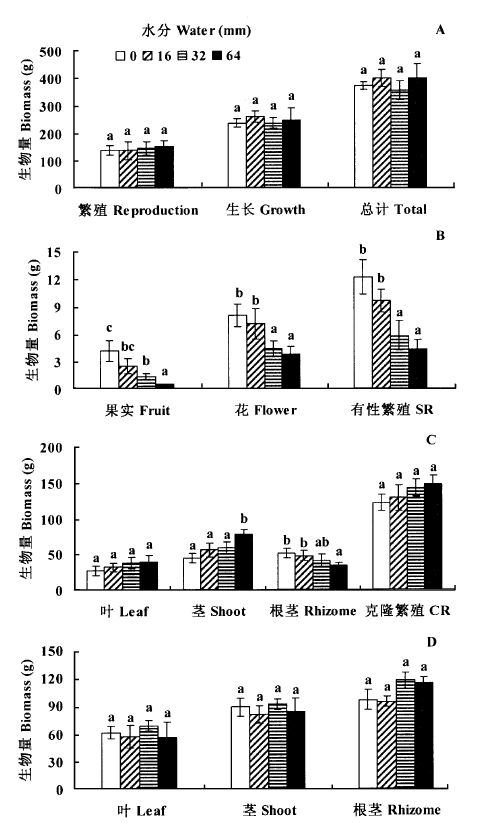
图1 增加水分对羊柴种群生物量的影响(平均值±标准误差)
Fig.1 Effects of increasing water supply on biomass (mean±SE) A: 繁殖、生长和总生物量Reproduction, growth and total biomass B: 有性繁殖Sexual reproduction (SR) C: 克隆繁殖Clonal reproduction (CR) D: 生长部分Growth traits of the Hedysarum laeve populations 根据Tukey's检验,各组之内由不同小写字母标记的值之间的差异是显著的(p<0.05)。在样方中,开花和结果的分株为有性繁殖分株,其枝、叶和根茎为生长部分的生物量,花和果实为有性繁殖部分的生物量;未开花的分株为克隆分株,其枝叶和根茎为克隆繁殖的生物量 In each group, bars sharing the same letters are not significantly different (p<0.05) according to Tukey's tests. The ramets with flower or fruit are considered as sexual ramets; their flower and fruit are the biomass of sexual reproduction, and their shoot, leaf and rhizome are the biomass of growth. The ramets without flower or fruit are considered as clonal ramets; their shoot, leaf and rhizome are the biomass of clonal reproduction在生物量的分配比例方面,和对照相比,增加水分对羊柴种群的繁殖,包括有性繁殖和克隆繁殖都产生了显著影响(p<0.05) (表2)。经过增加32和64 mm的水分处理之后,生物量对有性繁殖的分配比例显著减少 (p<0.05);对克隆繁殖的分配比例显著增加(p<0.05);对繁殖部分的总分配(包括有性和克隆繁殖)比例也显著增加 (p<0.05) (表2)。增加32和64 mm水分之后,生物量对花和荚果的分配比例显著减少(p<0.05) (图 2A)。增加水分之后,生物量对克隆分株的叶的分配比例没有显著差异;但是,与对照相比,增加32和64 mm的水分之后,生物量对克隆分株枝的分配显著增加(p<0.05);生物量对克隆分株根茎的分配显著减少(p<0.05) (图2B)。经过不同水平的水分处理之后,生物量对生长部分的叶、枝和根茎的分配比例没有显著差异 (图 2C)。
| 水分Water (mm) | 0 | 16 | 32 | 64 |
|---|---|---|---|---|
| 有性繁殖Sexual reproduction | 3.40±0.52b | 2.50±0.66b | 1.00±0.32a | 1.20±0.20a |
| 克隆繁殖Clonal reproduction | 32.8±1.44a | 33.5±3.66ab | 36.8±2.12b | 39±2.62b |
| 总繁殖Total reproduction | 34.6±1.87a | 31.75±6.14a | 40±2.11b | 39.8±2.89b |
表2 增加水分对羊柴种群繁殖生物量分配(%±SE)的影响
Table 2 Effects of increasing water supply on biomass allocation (%±SE) to reproduction of the Hedysarum laeve populations
| 水分Water (mm) | 0 | 16 | 32 | 64 |
|---|---|---|---|---|
| 有性繁殖Sexual reproduction | 3.40±0.52b | 2.50±0.66b | 1.00±0.32a | 1.20±0.20a |
| 克隆繁殖Clonal reproduction | 32.8±1.44a | 33.5±3.66ab | 36.8±2.12b | 39±2.62b |
| 总繁殖Total reproduction | 34.6±1.87a | 31.75±6.14a | 40±2.11b | 39.8±2.89b |
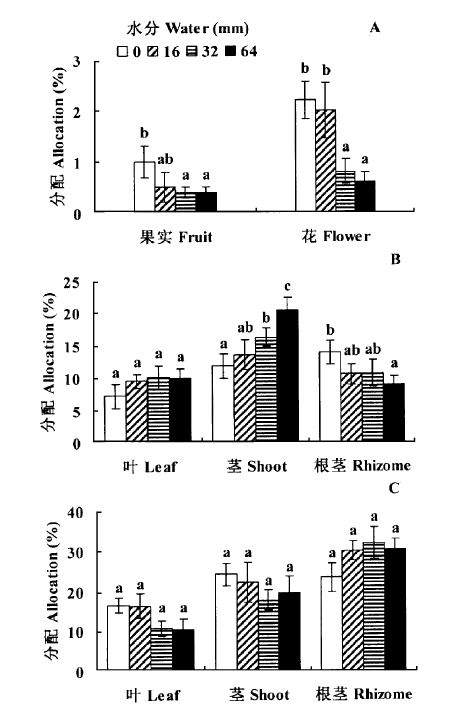
图2 增加水分对羊柴种群生物量分配的影响(平均值±标准误差)
Fig.2 Effects of increasing water supply on biomass allocation (mean±SE) A: 有性繁殖Sexual reproduction B: 克隆繁殖Clonal reproduction C: 生长部分Growth traits of the Hedysarum laeve populations 图注同图1 Notes see Fig. 1
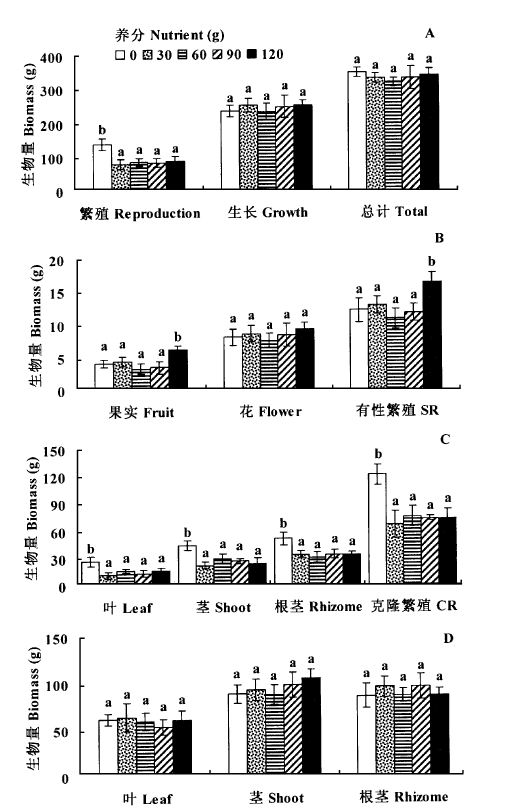
图3 增加养分对羊柴种群生物量的影响(平均值±标准误差)
Fig.3 Effects of increasing nutrient supply on the biomass (mean±SE) A: 繁殖、生长和总生物量Reproduction, growth and total biomass B: 有性繁殖Sexual reproduction (SR) C: 克隆繁殖Clonal reproduction (CR) D: 生长部分的生物量Growth of the Hedysarum laeve populations 图注同图1 Notes see Fig. 1
| 养分Nutrient (g) | 0 | 30 | 60 | 90 | 120 |
|---|---|---|---|---|---|
| 有性繁殖Sexual reproduction | 3.4±1.0a | 3.6±0.8a | 3.6±0.8a | 3.2±0.8a | 5.0±1.1b |
| 克隆繁殖Clonal reproduction | 32.8±2.9b | 28.8±2.6b | 27.4±3.2b | 26.6±2.6b | 21.2±1.5a |
| 总繁殖Total reproduction | 36.2±1.9b | 34.2±2.5b | 30.8±2.9b | 31.6±2.6b | 26.2±2.0a |
表3 增加养分对羊柴种群繁殖生物量分配(%±SE)的影响
Table 3 Effects of increasing nutrient supply on biomass allocation (%±SE) to reproduction of the Hedysarum laeve populations
| 养分Nutrient (g) | 0 | 30 | 60 | 90 | 120 |
|---|---|---|---|---|---|
| 有性繁殖Sexual reproduction | 3.4±1.0a | 3.6±0.8a | 3.6±0.8a | 3.2±0.8a | 5.0±1.1b |
| 克隆繁殖Clonal reproduction | 32.8±2.9b | 28.8±2.6b | 27.4±3.2b | 26.6±2.6b | 21.2±1.5a |
| 总繁殖Total reproduction | 36.2±1.9b | 34.2±2.5b | 30.8±2.9b | 31.6±2.6b | 26.2±2.0a |
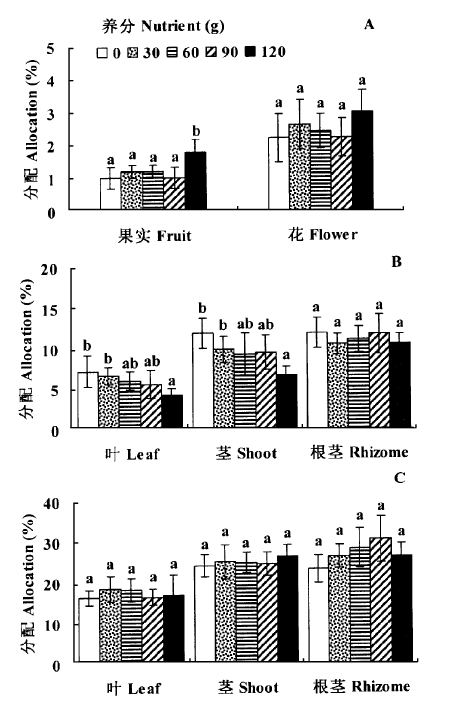
图4 增加养分对羊柴种群生物量分配的影响(平均值±标准误差)
Fig.4 Effects of increasing nutrient supply on biomass allocation (mean±SE) A: 有性繁殖Sexual reproduction B: 克隆繁殖Clonal reproduction C: 生长部分 Growth of the Hedysarum laeve populations 图注同图1 Notes see Fig. 1
| [1] |
Arizaga SA, Ezcurrra E (2002). Propagation mechanism in Agave macroacantha (Agavaceae), a tropical arid-land succulent rosette. American Journal of Botany, 89, 632-641.
DOI URL PMID |
| [2] |
Bates JD, Svejcar T, Miller RF, Angell RA (2006). The effects of precipitation timing on sagebrush steppe vegetation. Journal of Arid Environments, 64, 670-697.
DOI URL |
| [3] | Charpentier A, Stuefer JF (1999). Functional specialization of ramets in Scirpus maritimus: splitting the tasks of sexual reproduction, vegetative growth, and resource storage. Plant Ecology, 141, 129-136. |
| [4] | Chen YF (陈玉福), Dong M (董鸣) (2000). Genet characters of Hedysarum leave and the character of its ramet population in different habitats in Mu Us sandland. Acta Phytoecologica Sinica (植物生态学报), 24, 40-45. (in Chinese with English abstract) |
| [5] | Deng HY (邓红英) (2002). Plant functional types based on the response of dominant plants in Maowusu sand land to the change of simulated precipitation. Journal of Yunnan University (云南大学学报), 24, 75-80. (in Chinese with English abstract) |
| [6] | Ericsson O 1997. Clonal life histories and the evolution of seed recruitment. In: Kroon H, Groenendael J eds. The Ecology and Evolution of Clonal Plants. Backbuys Publishers, Leiden, 211-216. |
| [7] | Ge S (葛颂), Wang KQ (王可青), Dong M (董鸣) (1999). Genetic diversity and clonal structure in Hedysarum laeve in Mo Us sandland. Acta Botanica Sinica (植物学报), 41, 301-306. (in Chinese with English abstract) |
| [8] |
Gillespie IG, Michael ME, Loik E (2004). Pulse events in Great Basin Desert shrublands: physiological responses of Artemisia tridentata and Purshia tridentata seedlings to increased summer precipitation. Journal of Arid Environments, 59, 41-57.
DOI URL |
| [9] | He WM (何维明) (2002). Why does asexual generation in Sabina vulgaris population dominate in nature? Acta Phytoecologica Sinica (植物生态学报), 26, 235-238. (in Chinese with English abstract) |
| [10] |
Kleumen M, Fischer M, Schmid B (2001). Effects of intraspecific competition on size variation and reproductive allocation in a clonal plant. Oikos, 94, 515-524.
DOI URL |
| [11] |
Li RF, Zhang AS, Duan SS, Kang LF (2005). Patterns of reproductive allocation in Artemisia halodendron inhabiting two contrasting habitats. Acta Oecologia, 28, 57-64.
DOI URL |
| [12] | Liu FH (刘凤红), Liu J (刘建), Dong M (董鸣) (2004). Spatial pattern of sandy vegetation and two dominant clonal semi-shrubs in the Ordos Plateau. Acta Ecologica Sinica (生态学报), 24, 2374-2381. (in Chinese with English abstract) |
| [13] | Liu FH (刘凤红), Liu J (刘建), Dong M (董鸣) (2005). Response of biomass allocation to small-scale variation of vegetation coverage in dominant clonal semi-shrubs in the Mu Us Sandland. Acta Ecologica Sinica (生态学报), 24, 3415-3419. (in Chinese with English abstract) |
| [14] | Liu ZH (刘智慧), Zhang MZ (张明珍) (1999). The ultrastructure orientation of ATP enzyme viability in Hedysarum laeve root nodule. Journal of Sichuan University (Natural Science Edition) (四川大学学报(自然科学版)), 36, 747-751. (in Chinese with English abstract) |
| [15] | Ma YQ (马毓泉) (1989). Flora Intramongolica (内蒙古植物志). Tomus 3. Inner Mongolia People Press, Huhhot, 339. (in Chinese) |
| [16] |
Mendoza A, Franco M (1998). Sexual reproduction and clonal growth in Reinhardtia gracilis (Palmae), an understory tropical palm. American Journal of Botany, 85, 521-527.
URL PMID |
| [17] |
Ogle K, Reynolds JF (2004). Plant responses to precipitation in desert ecosystems: integrating functional types, pulses, thresholds, and delays. Oecologia, 141, 282-294.
DOI URL |
| [18] |
Perkins SR, Owens MK (2003). Growth and biomass allocation of shrub and grass seedlings in response to predicted changes in precipitation seasonality. Plant Ecology, 168, 107-120.
DOI URL |
| [19] |
Pino J, Sans FX, Masalles RM (2002). Size-dependent reproductive pattern and short-term reproductive cost in Rumex obtusifolius L. Acta Oecologica, 23, 321-328.
DOI URL |
| [20] |
Prati D, Schmid B (2000). Genetic differentiation of life-history traits within populations of the clonal plant Ranunculus reptans. Oikos, 90, 442-456.
DOI URL |
| [21] |
Reekie E (1998). An explanation for size-dependent reproductive allocation in Plantago major. Canadian Journal of Botany, 76, 43-50.
DOI URL |
| [22] | Roels B, Donders S, Werger M, Dong M (2001). Relation of wind-induced sand displacement to plant biomass and plant sand-binding capacity. Acta Botanica Sinica (植物学报), 43, 979-982. |
| [23] |
Ronsheim M, Bever J (2000). Genetic variation and evolutionary trade-offs for sexual and asexual reproductive modes in Allium vineale. American Journal of Botany, 87, 1769-1777.
URL PMID |
| [24] |
Sakai S (1995). Optimal resource allocation to vegetative and sexual reproduction of a plant growing in a spatially varying environment. Journal of Theory Biology, 175, 271-282.
DOI URL |
| [25] |
Sato T (2002). Size-dependent resource allocation among vegetative propagules and male and female functions in the forest herb Laportea bulbifera. Oikos, 96, 453-462.
DOI URL |
| [26] |
Schwinning S, Starr BI, Ehleringer JR (2003). Dominant cold desert plants do not partition warm season precipitation by event size. Oecologia, 136, 252-260.
DOI URL PMID |
| [27] |
Schwinning S, Starr BI, Ehleringer JR (2005). Summer and winter drought in a cold desert ecosystem (Colorado Plateau) part Ⅱ. effects on plant carbon assimilation and growth. Journal of Arid Environments, 61, 61-78.
DOI URL |
| [28] | Shen WS (沈渭寿) (1998). Distribution patterns of three main air-seedling plant populations in Mu Us sandy land. Journal of Desert Research (中国沙漠), 18, 372-378. (in Chinese with English abstract) |
| [29] | Sokal RR, Rohlf EJ (1995). Biometry. Freeman, San Francisco, CA. 887. |
| [30] |
Takada T, Nakajima H (1996). The optimal allocation for seed reproduction and vegetative reproduction in perennial plants: an application to the density-dependent transition matrix model. Journal of Theory Biology, 182, 179-191.
DOI URL |
| [31] |
Winkler E, Støcklin J (2002). Sexual and vegetative reproduction of Hieracium pilosella L. under competition and disturbance: a grid-based simulation model. Annals of Botany, 89, 525-536.
DOI URL PMID |
| [32] | Xiao S (肖洒), Wang G (王刚), Li L (李良) (2003). Adjustment of Artemisia ordosica and Hedysarum laeve's allometric pattern and individual size to the intra-specific competition in Mu us sandland. Journal of Desert Research (中国沙漠), 23, 67-72. (in Chinese with English abstract) |
| [33] | Zhang CY (张称意), Yang C (杨持), Dong M (董鸣) (2001). The clonal integration of photosynthates in the rhizomatous half shrub Hedysarum laeve. Acta Ecologica Sinica (生态学报), 21, 1986-1993. (in Chinese with English abstract) |
| [34] | Zhang CY (张称意), Yu FH (于飞海), Dong M (董鸣) (2002). Effects of sand burial on the survival, growth and biomass allocation in semi-shrub Hedysarum laeve seedlings. Acta Botanica Sinica (植物学报), 44, 337-343. |
| [35] | Zhang XS (张新时) (1994). Principles and optimal models for development of Maowusu Sandy Grassland. Acta Phytoecologica Sinica (植物生态学报). 18, 1-16. (in Chinese with English abstract) |
| [36] | Zhong ZC (钟章成) (1995). The reproductive strategy of plant population. Chinese Journal of Ecology (生态学杂志), 14, 37-42. (in Chinese with English abstract) |
| [1] | 陈欣蕊, 宋维峰, 王燚, 王浩, 孙诗瑶, 王彩江, 蔡世鹏, 任红, 何玉陶, 潘珉, 曹光秀, 严毅, 谢志勇, 王行. 滇池湖滨带典型挺水植物氮磷重吸收特征及其适应策略[J]. , 2026, 50(预发表): 0-. |
| [2] | 张贺凯, 谢伟, 陈保冬, 尹春英. 菌根真菌维持植物物种共存的作用及机制[J]. 植物生态学报, 2026, 50(3): 536-551. |
| [3] | 方迪, 马宁, 李胜功, 郑甲佳, 褚云馨, 杨锦昌, 杨赞明, 张龙宁, 孟盛旺, 高德才, 戴晓琴, 付晓莉, 王辉民, 寇亮. 菌根共生类型对森林养分内循环的调控作用[J]. 植物生态学报, 2026, 50(3): 552-565. |
| [4] | 秦斐斐, 唐朝辉, 司彤, 慈敦伟. 盐碱耐受型和敏感型花生生长发育及根际土壤特性对丛枝菌根真菌的响应[J]. 植物生态学报, 2026, 50(3): 742-759. |
| [5] | 段世龙, 余成瑾, 许心垚, 冯固, 谢贤安, 张林. 植物-丛枝菌根真菌-细菌连续体及其维持机制[J]. 植物生态学报, 2026, 50(3): 600-611. |
| [6] | 王蓉钧, 吴福忠, 吴秋霞, 朱晶晶, 倪祥银. 不同生活型植物叶片氮重吸收效率的差异[J]. 植物生态学报, 2026, 50(2): 344-351. |
| [7] | 张静, 陈洁, 李艳朋, 盘李军, 许涵, 李意德, 何海生. 南亚热带针阔混交人工林植物生物量比较及其影响因子分析[J]. 植物生态学报, 2026, 50(2): 400-416. |
| [8] | 叶学敏, 高伟, 唐星林, 陈伏生, 孙荣喜, 罗坤水. 氮磷添加对常绿阔叶林幼树叶片植食损伤的影响及调控机制[J]. 植物生态学报, 2026, 50(2): 256-267. |
| [9] | 郑佳棋, 宋金凤, 桑英, 孙慧珍, 张伟志, 张敏, 全先奎, 金光泽. 不同胁迫因子下水培富贵竹蒸腾对根压的响应[J]. 植物生态学报, 2026, 50(1): 213-221. |
| [10] | 贾紫璇, 方涛, 张舒欣, 刘一凡, 赵微, 王荣, 昌海超, 朱耀军, 罗芳丽, 郭允倩, 于飞海. 不同沼泽湿地芦苇地上-地下性状对水分变化的响应[J]. 植物生态学报, 2025, 49(9): 1448-1460. |
| [11] | 陈刚刚, 朱思洁, 郭亮娜, 付芳伟, 刘昱灼, 李江荣. 藏东南色季拉山高山树线乔灌地上-地下养分分配策略[J]. 植物生态学报, 2025, 49(9): 1515-1526. |
| [12] | 朱瑞德, 杨俊薇, 刘宵含, 陈冰瑞, 池秀莲, 田地, 杨光, 程蒙, 戴亚峰, 王诗文. 霍山石斛设施和林下栽培模式中养分对植物-微生物关联的调控[J]. 植物生态学报, 2025, 49(9): 1434-1447. |
| [13] | 张箫荻, 王晓霞, 章毓文, 侯靖雨, 石骁鹏, 和璐璐, 刘亚栋, 薛柳, 何宝华, 段劼. 北京山区三种林下灌木水力结构、叶片功能性状及其环境适应策略[J]. 植物生态学报, 2025, 49(7): 1128-1143. |
| [14] | 王世松, 曲孝云, 董劭琼, 李佳鸿, 杨琦, 侯满福, 赵利清, 郭柯, 刘长成, 胥晓. 西藏札达典型荒漠植被类型及群落特征[J]. 植物生态学报, 2025, 49(5): 801-812. |
| [15] | 韩菲, 王袼, 武帅楷, 林茂, 董宽虎, $\boxed{\hbox{王常慧}}$, 苏原. 极端降水对不同草原土壤总硝化及总氮矿化速率及其敏感性的影响[J]. 植物生态学报, 2025, 49(5): 697-709. |
| 阅读次数 | ||||||
|
全文 |
|
|||||
|
摘要 |
|
|||||
Copyright © 2026 版权所有 《植物生态学报》编辑部
地址: 北京香山南辛村20号, 邮编: 100093
Tel.: 010-62836134, 62836138; Fax: 010-82599431; E-mail: apes@ibcas.ac.cn, cjpe@ibcas.ac.cn
备案号: 京ICP备16067583号-19

