
植物生态学报 ›› 2008, Vol. 32 ›› Issue (5): 1031-1040.DOI: 10.3773/j.issn.1005-264x.2008.05.008 cstr: 32100.14.j.issn.1005-264x.2008.05.008
张新平1, 王襄平1, 朱彪1, 宗占江2, 彭长辉3, 方精云1,*( )
)
收稿日期:2008-01-25
接受日期:2008-04-15
出版日期:2008-01-25
发布日期:2008-09-30
作者简介:*(jyfang@urban.pku.edu.cn)基金资助:
ZHANG Xin-Ping1, WANG Xiang-Ping1, ZHU Biao1, ZONG Zhan-Jiang2, PENG Chang-Hui3, FANG Jing-Yun1,*()
Received:2008-01-25
Accepted:2008-04-15
Online:2008-01-25
Published:2008-09-30
摘要:
在中国东北长白山、帽儿山、凉水、根河的主要森林类型中设置27个样地, 连续3年(2004~2006年)观测森林凋落物的生产量, 以研究我国东北地区森林凋落物产量及其与环境因子的关系。结果表明, 不同森林类型凋落物年产量存在显著差异, 针阔叶混交林显著高于落叶针叶林和常绿针叶林, 落叶针叶林、常绿针叶林、落叶阔叶林和针阔叶混交林的年平均产量分别为2 337、2 472、3 130和4 146 kg·hm-2; 树叶、枝条、繁殖器官和其它组分占总凋落量的平均比例为71%、22%、6%和1%, 不同森林类型凋落物组分的比例差异较大。森林凋落物产量主要受温度限制, 降水、森林类型和群落结构无显著影响。不同组分凋落物量的影响因素不同: 树叶凋落量主要受温度和森林类型的影响; 枝条凋落量主要受降水和蓄积量的影响; 而繁殖器官凋落量则与树种的繁殖特性以及年降水有关。各组分占总凋落量的比例主要受降水影响, 树叶占凋落物比例随降水增加而下降, 枝条所占比例很小, 表现出与叶相反的变化趋势。
张新平, 王襄平, 朱彪, 宗占江, 彭长辉, 方精云. 我国东北主要森林类型的凋落物产量及其影响因素. 植物生态学报, 2008, 32(5): 1031-1040. DOI: 10.3773/j.issn.1005-264x.2008.05.008
ZHANG Xin-Ping, WANG Xiang-Ping, ZHU Biao, ZONG Zhan-Jiang, PENG Chang-Hui, FANG Jing-Yun. LITTER FALL PRODUCTION IN RELATION TO ENVIRONMENTAL FACTORS IN NORTHEAST CHINA’S FORESTS. Chinese Journal of Plant Ecology, 2008, 32(5): 1031-1040. DOI: 10.3773/j.issn.1005-264x.2008.05.008
| 地点 Site | 纬度 Latitude (N) | 经度 Longitude (E) | 海拔 Altitude (m) | 年均温 MAT (℃) | 年降水 MAP (mm) | 主要群落类型 Main community type | 样地数 No. plots |
|---|---|---|---|---|---|---|---|
| 长白山 Mt. Changbai | 42°03′~42°24′ | 128°04′~128°15′ | 650~1 940 | -3.7~2.9 | 600~1 340 | 岳桦林、常绿针叶林、针阔叶混交林、落叶针叶林 BE, EN, DNM, DN | 14 |
| 帽儿山 Mt. Mao’er | 45°16′~45°17′ | 127°34′~127°35′ | 300~420 | 1.9~2.5 | 724 | 落叶阔叶林、兴安落叶松林DB, LG | 7 |
| 凉水 Liangshui | 47°11′~47°12′ | 128°53′~128°54′ | 340~430 | 0.7~1.1 | 680 | 红松林、杨桦林 PK, BP | 4 |
| 根河 Genhe | 50°56′ | 121°30′~121°31′ | 810~840 | -4.8~-4.6 | 450~550 | 兴安落叶松林 LG | 2 |
表1 研究地点的地理位置、气候和植被概况
Table 1 General information on locations, climate, and vegetation types for the study sites
| 地点 Site | 纬度 Latitude (N) | 经度 Longitude (E) | 海拔 Altitude (m) | 年均温 MAT (℃) | 年降水 MAP (mm) | 主要群落类型 Main community type | 样地数 No. plots |
|---|---|---|---|---|---|---|---|
| 长白山 Mt. Changbai | 42°03′~42°24′ | 128°04′~128°15′ | 650~1 940 | -3.7~2.9 | 600~1 340 | 岳桦林、常绿针叶林、针阔叶混交林、落叶针叶林 BE, EN, DNM, DN | 14 |
| 帽儿山 Mt. Mao’er | 45°16′~45°17′ | 127°34′~127°35′ | 300~420 | 1.9~2.5 | 724 | 落叶阔叶林、兴安落叶松林DB, LG | 7 |
| 凉水 Liangshui | 47°11′~47°12′ | 128°53′~128°54′ | 340~430 | 0.7~1.1 | 680 | 红松林、杨桦林 PK, BP | 4 |
| 根河 Genhe | 50°56′ | 121°30′~121°31′ | 810~840 | -4.8~-4.6 | 450~550 | 兴安落叶松林 LG | 2 |
| 森林类型 Forest type | 群落类型 Community type | 主要树种 Major species | 样地数量 No. plots | 平均胸径 Mean DBH (cm) | 平均树高 Mean tree height (m) | 蓄积量 Volume (m3) | 立木密度 Density (/hm2) |
|---|---|---|---|---|---|---|---|
| 落叶阔叶林 DB | 平均值 Mean | 9 | 14.8 | 12.1 | 200.4 | 1 154 | |
| 岳桦林 BE | Betula ermanii(88%) | 3 | 14.2 | 9.2 | 110.6 | 1 393 | |
| 杨桦林 BP | B. platyphylla(27%) Populus davidiana(20%) | 3 | 14.6 | 14.5 | 264.3 | 1 207 | |
| 硬阔叶杂木林 DBM | Quercus mongolica(25%) Tilia amurensis(15%) | 3 | 15.7 | 12.6 | 226.2 | 863 | |
| 落叶针叶林 DN | 平均值 Mean | 7 | 21.6 | 17.5 | 305.7 | 694 | |
| 兴安落叶松林 LG | Larix gmelini(94%) | 5 | 16.6 | 14.6 | 244.5 | 820 | |
| 长白落叶松林 LO | L. olgensis(74%) | 2 | 34.1 | 24.7 | 458.7 | 380 | |
| 针阔叶混交林 DNM | 平均值 Mean | 6 | 25.5 | 16.6 | 573.1 | 617 | |
| 红松林 PK | Pinus koraiensis(40%) | 3 | 28.4 | 16.7 | 584.5 | 487 | |
| 红松阔叶林 PKDM | P. koraiensis(29%) T. amurensis(20%) | 3 | 22.5 | 16.5 | 561.6 | 747 | |
| 常绿针叶林 EN | 云冷杉林 PA | Picea jezoensis(38%) Abies nephrolepis (35%) | 5 | 19.3 | 14.2 | 518.8 | 1 352 |
表2 各森林类型的群落特征
Table 2 Community characteristics of all forest types
| 森林类型 Forest type | 群落类型 Community type | 主要树种 Major species | 样地数量 No. plots | 平均胸径 Mean DBH (cm) | 平均树高 Mean tree height (m) | 蓄积量 Volume (m3) | 立木密度 Density (/hm2) |
|---|---|---|---|---|---|---|---|
| 落叶阔叶林 DB | 平均值 Mean | 9 | 14.8 | 12.1 | 200.4 | 1 154 | |
| 岳桦林 BE | Betula ermanii(88%) | 3 | 14.2 | 9.2 | 110.6 | 1 393 | |
| 杨桦林 BP | B. platyphylla(27%) Populus davidiana(20%) | 3 | 14.6 | 14.5 | 264.3 | 1 207 | |
| 硬阔叶杂木林 DBM | Quercus mongolica(25%) Tilia amurensis(15%) | 3 | 15.7 | 12.6 | 226.2 | 863 | |
| 落叶针叶林 DN | 平均值 Mean | 7 | 21.6 | 17.5 | 305.7 | 694 | |
| 兴安落叶松林 LG | Larix gmelini(94%) | 5 | 16.6 | 14.6 | 244.5 | 820 | |
| 长白落叶松林 LO | L. olgensis(74%) | 2 | 34.1 | 24.7 | 458.7 | 380 | |
| 针阔叶混交林 DNM | 平均值 Mean | 6 | 25.5 | 16.6 | 573.1 | 617 | |
| 红松林 PK | Pinus koraiensis(40%) | 3 | 28.4 | 16.7 | 584.5 | 487 | |
| 红松阔叶林 PKDM | P. koraiensis(29%) T. amurensis(20%) | 3 | 22.5 | 16.5 | 561.6 | 747 | |
| 常绿针叶林 EN | 云冷杉林 PA | Picea jezoensis(38%) Abies nephrolepis (35%) | 5 | 19.3 | 14.2 | 518.8 | 1 352 |
| 森林类型 Forest type | 群落类型 Community type | 凋落物产量 Litter production | 平均 Average | 标准差 SD | 变异系数 CV (%) | ||
|---|---|---|---|---|---|---|---|
| 2004 | 2005 | 2006 | |||||
| 落叶阔叶林 DB | 平均值 Mean | 3 255 | 2 868 | 3 267 | 3 130ab | 227 | 7.2 |
| 岳桦林 BE | 1 332 | 2 302 | 2 293 | 1 976A | 557 | 28.2 | |
| 杨桦林 BP | 3 803 | 3 377 | 4 019 | 3 733AB | 327 | 8.8 | |
| 硬阔叶杂木林 DBM | 3 669 | 2 926 | 3 488 | 3 361AB | 387 | 11.5 | |
| 落叶针叶林 DN | 平均值 Mean | 2 803 | 2 095 | 2 113 | 2 337a | 404 | 17.3 |
| 兴安落叶松 LG | 3 018 | 2 363 | 2 130 | 2 504A | 460 | 18.4 | |
| 长白落叶松 LO | 2 266 | 1 560 | 2 086 | 1 971A | 367 | 18.6 | |
| 针阔叶混交林 DNM | 平均值 Mean | 4 312 | 4 066 | 4 060 | 4 146b | 144 | 3.5 |
| 红松林 PK | *** | 3 207 | 3 800 | 3 504AB | 420 | 12.0 | |
| 红松阔叶林 PKDM | 4 312 | 4 925 | 4 319 | 4 519B | 352 | 7.8 | |
| 常绿针叶林 EN | 云冷杉林 PA | 3 018 | 2 110 | 2 288 | 2 472aA | 481 | 19.5 |
表3 东北地区各森林类型凋落物年产量(kg·hm-2)
Table 3 Litter production for different forest types in Northeast China (kg·hm-2)
| 森林类型 Forest type | 群落类型 Community type | 凋落物产量 Litter production | 平均 Average | 标准差 SD | 变异系数 CV (%) | ||
|---|---|---|---|---|---|---|---|
| 2004 | 2005 | 2006 | |||||
| 落叶阔叶林 DB | 平均值 Mean | 3 255 | 2 868 | 3 267 | 3 130ab | 227 | 7.2 |
| 岳桦林 BE | 1 332 | 2 302 | 2 293 | 1 976A | 557 | 28.2 | |
| 杨桦林 BP | 3 803 | 3 377 | 4 019 | 3 733AB | 327 | 8.8 | |
| 硬阔叶杂木林 DBM | 3 669 | 2 926 | 3 488 | 3 361AB | 387 | 11.5 | |
| 落叶针叶林 DN | 平均值 Mean | 2 803 | 2 095 | 2 113 | 2 337a | 404 | 17.3 |
| 兴安落叶松 LG | 3 018 | 2 363 | 2 130 | 2 504A | 460 | 18.4 | |
| 长白落叶松 LO | 2 266 | 1 560 | 2 086 | 1 971A | 367 | 18.6 | |
| 针阔叶混交林 DNM | 平均值 Mean | 4 312 | 4 066 | 4 060 | 4 146b | 144 | 3.5 |
| 红松林 PK | *** | 3 207 | 3 800 | 3 504AB | 420 | 12.0 | |
| 红松阔叶林 PKDM | 4 312 | 4 925 | 4 319 | 4 519B | 352 | 7.8 | |
| 常绿针叶林 EN | 云冷杉林 PA | 3 018 | 2 110 | 2 288 | 2 472aA | 481 | 19.5 |
| 森林类型 Forest type | 群落类型 Community type | 组分 Component production (%) | |||||||||||
|---|---|---|---|---|---|---|---|---|---|---|---|---|---|
| 树叶 Leaf | 枝条 Branch | 繁殖器官 Fruit | 其它 Others | ||||||||||
| 落叶阔叶林 DB | 平均值 Mean | 2 549b(76) | 531a(18) | 122a(4) | 59(2) | ||||||||
| 岳桦林 BE | 1 545(66) | 551(26) | 177(7) | 19(1) | |||||||||
| 杨桦林 BP | 3 320(83) | 476(12) | 152(4) | 54(1) | |||||||||
| 硬阔叶杂木林 DBM | 2 781(80) | 565(15) | 37(2) | 103(3) | |||||||||
| 落叶针叶林 DN | 平均值 Mean | 1 428a(73) | 441a(22) | 74a(4) | 33(1) | ||||||||
| 兴安落叶松 LG | 1 589 (82) | 272(15) | 38(2) | 34(2) | |||||||||
| 长白落叶松 LO | 1 023(50) | 865(41) | 165(8) | 32(1) | |||||||||
| 针阔叶混交林 DNM | 平均值 Mean | 3 033b(74) | 679a(16) | 325b(8) | 83 (2) | ||||||||
| 红松林 PK | 2 897(76) | 444(12) | 350(9) | 110(3) | |||||||||
| 红松阔叶林 PKDM | 3 169(72) | 913(20) | 301(7) | 56(1) | |||||||||
| 常绿针叶林 EN | 云冷杉林 PA | 1 280a(54) | 764a(35) | 211ab(9) | 33(1) | ||||||||
表4 2006年各森林类型凋落组分产量(kg·hm-2)及其占总凋落量的比例(%)
Table 4 Productions of different litter components in 2006 (kg·hm-2) (Data in parenthesis are percentages)
| 森林类型 Forest type | 群落类型 Community type | 组分 Component production (%) | |||||||||||
|---|---|---|---|---|---|---|---|---|---|---|---|---|---|
| 树叶 Leaf | 枝条 Branch | 繁殖器官 Fruit | 其它 Others | ||||||||||
| 落叶阔叶林 DB | 平均值 Mean | 2 549b(76) | 531a(18) | 122a(4) | 59(2) | ||||||||
| 岳桦林 BE | 1 545(66) | 551(26) | 177(7) | 19(1) | |||||||||
| 杨桦林 BP | 3 320(83) | 476(12) | 152(4) | 54(1) | |||||||||
| 硬阔叶杂木林 DBM | 2 781(80) | 565(15) | 37(2) | 103(3) | |||||||||
| 落叶针叶林 DN | 平均值 Mean | 1 428a(73) | 441a(22) | 74a(4) | 33(1) | ||||||||
| 兴安落叶松 LG | 1 589 (82) | 272(15) | 38(2) | 34(2) | |||||||||
| 长白落叶松 LO | 1 023(50) | 865(41) | 165(8) | 32(1) | |||||||||
| 针阔叶混交林 DNM | 平均值 Mean | 3 033b(74) | 679a(16) | 325b(8) | 83 (2) | ||||||||
| 红松林 PK | 2 897(76) | 444(12) | 350(9) | 110(3) | |||||||||
| 红松阔叶林 PKDM | 3 169(72) | 913(20) | 301(7) | 56(1) | |||||||||
| 常绿针叶林 EN | 云冷杉林 PA | 1 280a(54) | 764a(35) | 211ab(9) | 33(1) | ||||||||
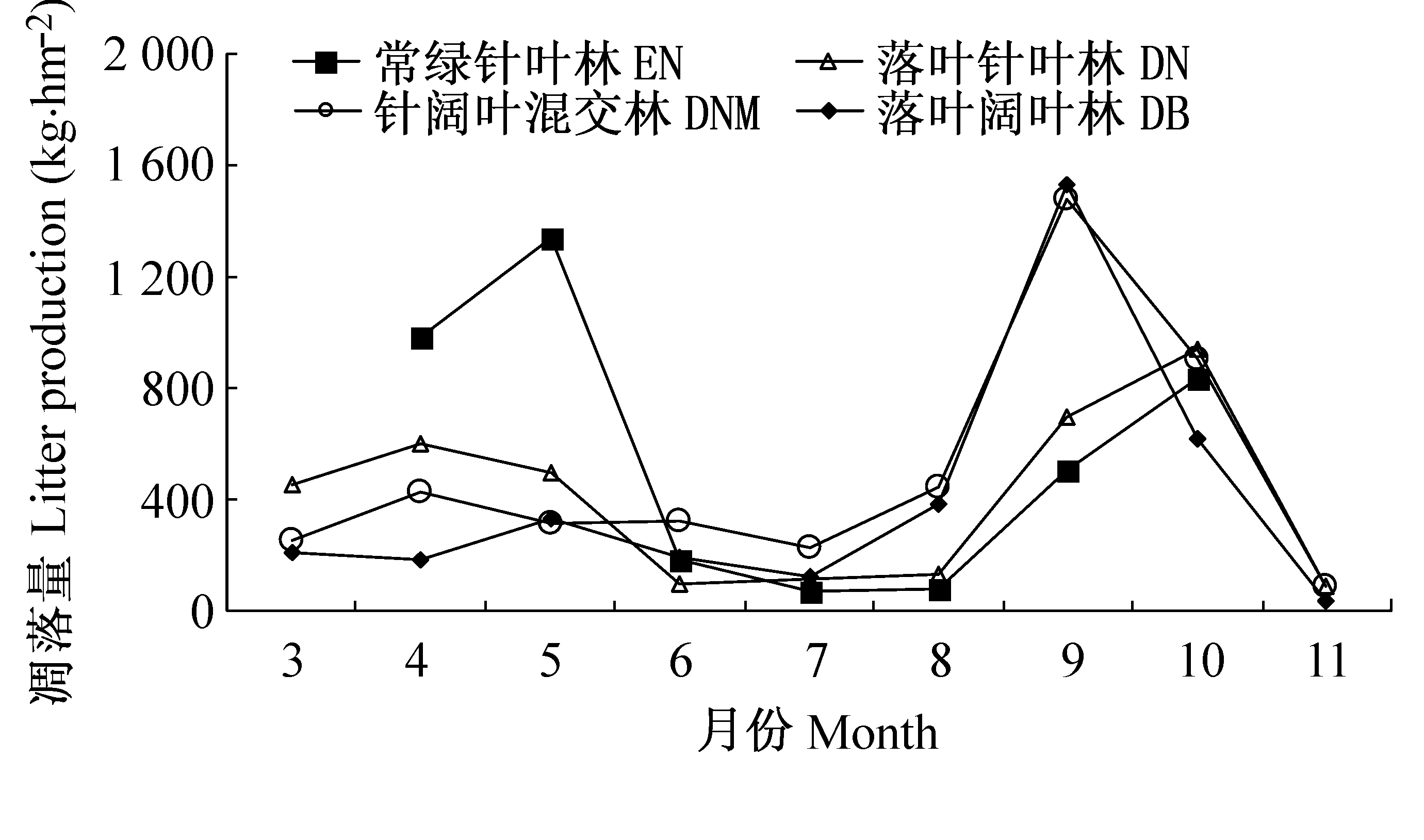
图1 东北地区4个森林类型凋落物季节动态 EN、DN、DNM、DB: 见表1 See Table 1
Fig. 1 Seasonal pattern of litter production for four forest types in Northeast China
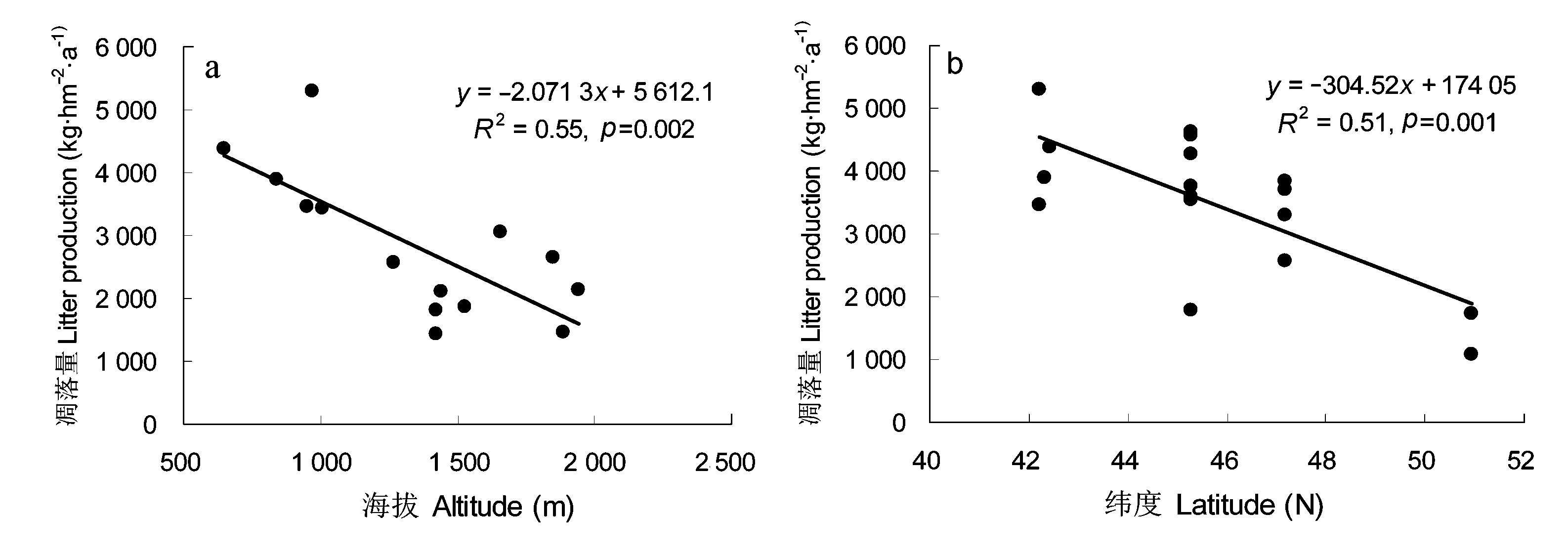
图2 凋落物产量随海拔、纬度的变化 a: 长白山海拔梯度上凋落物产量的变化 Litter production along the altitudinal gradient of Mt. Changbai b: 凋落物产量随纬度的变化, 图中为各研究地点海拔小于1 000 m的样地数据 Changes of litter production along the latitudinal gradients in NE China, data shown were from plots with a similar altitude (307-970 m)
Fig. 2 Changes of litter production with altitude and latitude
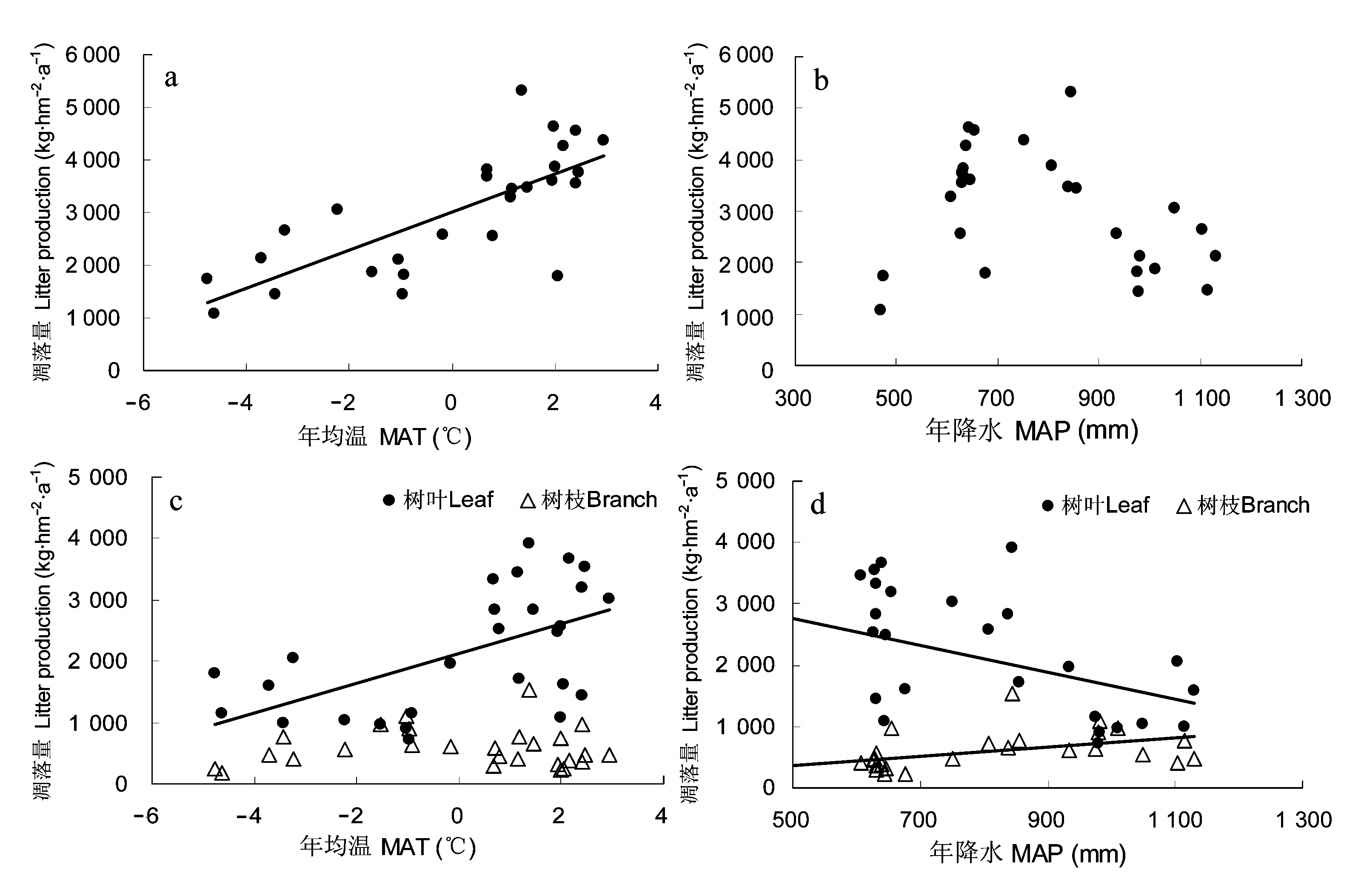
图3 凋落物产量和年均温、年降水的关系 a、b: 凋落物总量 Litter production c、d: 叶、枝凋落量 Production of leaf and branch litter 图中回归线在p<0.05水平显著 The regression lines were shown for relationships significant at p<0.05 MAT、MAP: 见表5 See Table 5
Fig. 3 Relationship between litter production and climatic indices
| 凋落物总量 Litter production | 组分 Component production | 百分比 Percentage | |||||
|---|---|---|---|---|---|---|---|
| 树叶 Leaf | 枝条 Branch | 繁殖器官 Fruit | 树叶 Leaf | 枝条 Branch | 繁殖器官 Fruit | ||
| 气候 Climate | |||||||
| 年均温 MAT | 0.75*** | 0.57** | 0.06 | 0.11 | 0.30 | -0.32 | -0.15 |
| 年降水 MAP | -0.30 | -0.44 * | 0.48* | 0.21 | -0.75*** | 0.68*** | 0.51** |
| 群落结构特征 Community structure | |||||||
| 平均胸径 Da | -0.08 | -0.03 | 0.26 | 0.49** | -0.31 | 0.18 | 0.50** |
| 平均树高 Ha | -0.03 | -0.02 | 0.27 | 0.22 | -0.24 | 0.19 | 0.22 |
| 立木密度 Density | -0.17 | -0.22 | 0.12 | -0.20 | -0.25 | 0.31 | -0.05 |
| 蓄积量 Volume | 0.26 | 0.14 | 0.55** | 0.65*** | -0.39* | 0.26 | 0.55** |
表5 凋落物产量和气候、群落结构指标的相关系数
Table 5 Correlation between litter production and climate, community structure
| 凋落物总量 Litter production | 组分 Component production | 百分比 Percentage | |||||
|---|---|---|---|---|---|---|---|
| 树叶 Leaf | 枝条 Branch | 繁殖器官 Fruit | 树叶 Leaf | 枝条 Branch | 繁殖器官 Fruit | ||
| 气候 Climate | |||||||
| 年均温 MAT | 0.75*** | 0.57** | 0.06 | 0.11 | 0.30 | -0.32 | -0.15 |
| 年降水 MAP | -0.30 | -0.44 * | 0.48* | 0.21 | -0.75*** | 0.68*** | 0.51** |
| 群落结构特征 Community structure | |||||||
| 平均胸径 Da | -0.08 | -0.03 | 0.26 | 0.49** | -0.31 | 0.18 | 0.50** |
| 平均树高 Ha | -0.03 | -0.02 | 0.27 | 0.22 | -0.24 | 0.19 | 0.22 |
| 立木密度 Density | -0.17 | -0.22 | 0.12 | -0.20 | -0.25 | 0.31 | -0.05 |
| 蓄积量 Volume | 0.26 | 0.14 | 0.55** | 0.65*** | -0.39* | 0.26 | 0.55** |
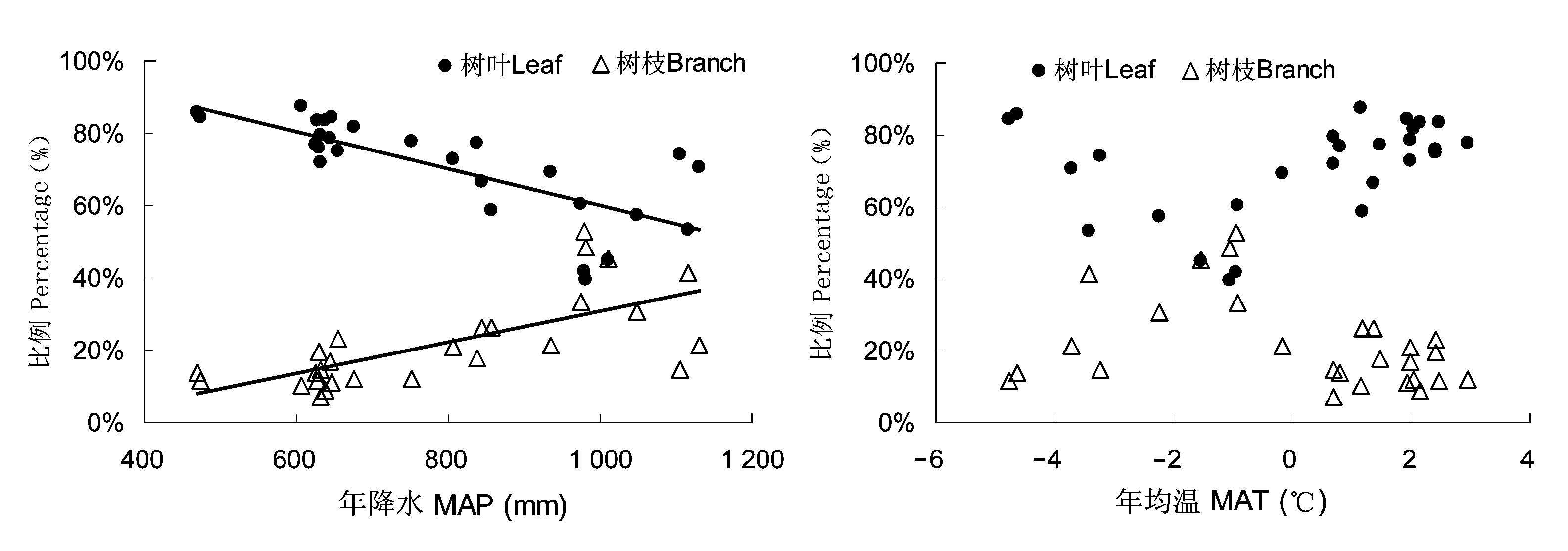
图4 树叶枝条比例和年均温、年降水的关系 图中回归线在p<0.05水平显著 The regression lines were shown for relationships significant at p<0.05 MAP、MAT: 见表5 See Table 5
Fig. 4 Relationship between climate indices and percentage of leaf and branch litter
| 变量 Variable | Df | Mean Sq | p | %SS | Df | Mean Sq | p | %SS |
|---|---|---|---|---|---|---|---|---|
| 凋落物总量 Litter production | 树叶 Leaf | |||||||
| 年均温 MAT | 1 | 18 994 353 | 0.000 | 56.17 | 1 | 8 420 356 | 0.000 | 32.55 |
| 年降水 MAP | 1 | 12 101 | 0.883 | 0.04 | 1 | 1 540 973 | 0.045 | 5.96 |
| 森林类型 Forest type | 3 | 568 994 | 0.395 | 5.05 | 3 | 2 908 711 | 0.001 | 33.73 |
| 群落类型 Community type | 4 | 613 267 | 0.374 | 7.25 | 4 | 303 022 | 0.471 | 4.68 |
| 蓄积量 Volume | 1 | 2 028 856 | 0.070 | 6.00 | 1 | 762 445 | 0.145 | 2.95 |
| 残差 Residuals | 16 | 538 843 | 25.49 | 16 | 325 606 | 20.14 | ||
| 枝条 Branch | 繁殖器官 Fruit | |||||||
| 年均温 MAT | 1 | 10 670 | 0.631 | 0.42 | 1 | 5 241 | 0.390 | 1.20 |
| 年降水 MAP | 1 | 758 214 | 0.001 | 29.66 | 1 | 32 402 | 0.043 | 7.41 |
| 森林类型 Forest type | 3 | 53 574 | 0.340 | 6.29 | 3 | 73 215 | 0.000 | 50.20 |
| 群落类型 Community type | 4 | 103 302 | 0.101 | 16.16 | 4 | 13 158 | 0.150 | 12.03 |
| 蓄积量 Volume | 1 | 501 654 | 0.004 | 19.62 | 1 | 20 203 | 0.102 | 4.62 |
| 残差 Residuals | 16 | 44 502 | 27.85 | 16 | 6 715 | 24.55 | ||
表6 气候、森林类型、群落结构指标对凋落物产量的影响
Table 6 Effects of climate, forest type and community structure on litter production
| 变量 Variable | Df | Mean Sq | p | %SS | Df | Mean Sq | p | %SS |
|---|---|---|---|---|---|---|---|---|
| 凋落物总量 Litter production | 树叶 Leaf | |||||||
| 年均温 MAT | 1 | 18 994 353 | 0.000 | 56.17 | 1 | 8 420 356 | 0.000 | 32.55 |
| 年降水 MAP | 1 | 12 101 | 0.883 | 0.04 | 1 | 1 540 973 | 0.045 | 5.96 |
| 森林类型 Forest type | 3 | 568 994 | 0.395 | 5.05 | 3 | 2 908 711 | 0.001 | 33.73 |
| 群落类型 Community type | 4 | 613 267 | 0.374 | 7.25 | 4 | 303 022 | 0.471 | 4.68 |
| 蓄积量 Volume | 1 | 2 028 856 | 0.070 | 6.00 | 1 | 762 445 | 0.145 | 2.95 |
| 残差 Residuals | 16 | 538 843 | 25.49 | 16 | 325 606 | 20.14 | ||
| 枝条 Branch | 繁殖器官 Fruit | |||||||
| 年均温 MAT | 1 | 10 670 | 0.631 | 0.42 | 1 | 5 241 | 0.390 | 1.20 |
| 年降水 MAP | 1 | 758 214 | 0.001 | 29.66 | 1 | 32 402 | 0.043 | 7.41 |
| 森林类型 Forest type | 3 | 53 574 | 0.340 | 6.29 | 3 | 73 215 | 0.000 | 50.20 |
| 群落类型 Community type | 4 | 103 302 | 0.101 | 16.16 | 4 | 13 158 | 0.150 | 12.03 |
| 蓄积量 Volume | 1 | 501 654 | 0.004 | 19.62 | 1 | 20 203 | 0.102 | 4.62 |
| 残差 Residuals | 16 | 44 502 | 27.85 | 16 | 6 715 | 24.55 | ||
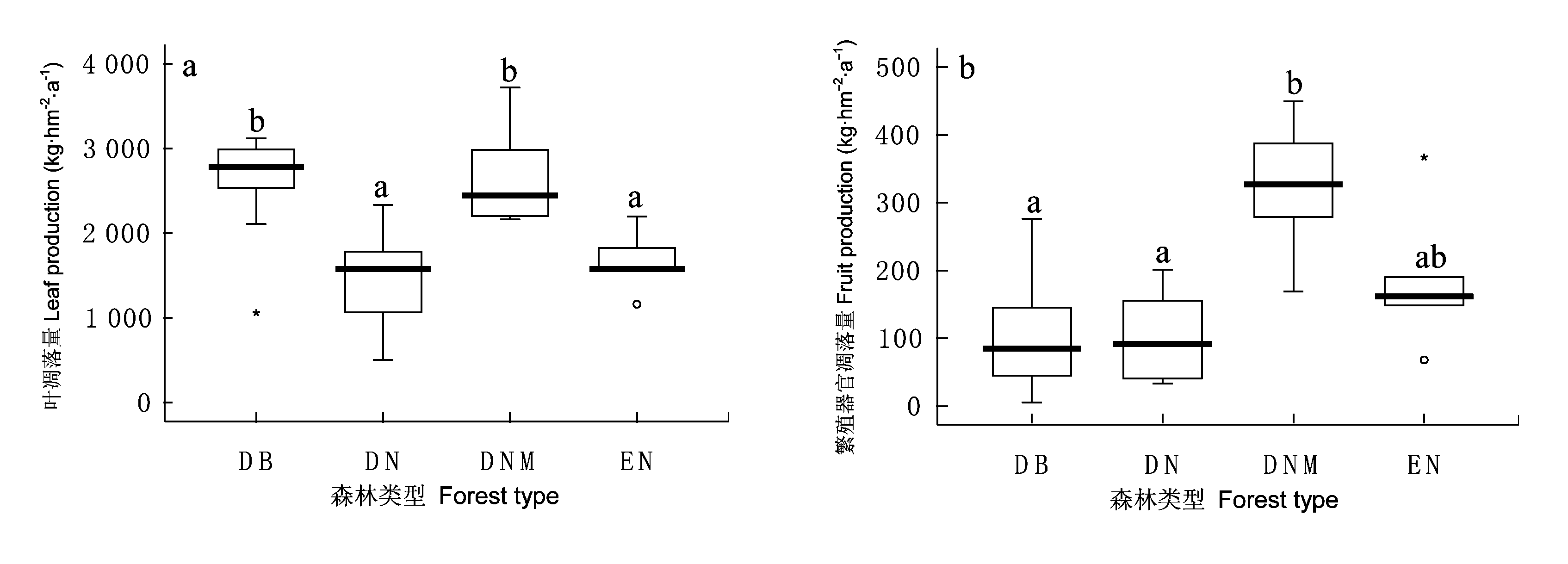
图5 不同森林类型凋落物产量的差异 a: 叶凋落量 Production of leaf litter b: 繁殖器官凋落量 Production of fruit litter 在分析之前已消除了气候指标(年均温和年降水)对凋落物产量的影响(详见研究方法), 上标字母相同者在p<0.05水平上无显著差异 Effects of climate indices on litter production have been removed before analysis. Forest types that shared the same superscript letter were not significantly different at 0.05 DB、DN、DNM、EN: 见表1 See Table 1
Fig. 5 Different litter production between forest types
| [1] | Bray JR, Gorham E (1964). Litter production in forests of the world. Advances in Ecological Research, 2,101-157. |
| [2] | Cheng BR (程伯容), Xu GS (许广山), Ding GF (丁桂芳) (1992). Litterfall and biological cycling intensity in coniferous forest and Korean pine-broad-leaved forest on the northern slope of Changbai Mountain. Research of Forest Ecological System (森林生态系统研究), 6,200-203. (in Chinese with English abstract) |
| [3] | China Climate Change Country Study Group (中国气候变化国别研究组) (2000). China Climate Change Country Study (中国气候变化国别研究). Tsinghua University Press,Beijing. (in Chinese) |
| [4] | Clark DA, Brown S, Kichlighter WK, Charmbers JQ, Thomlinson JR, Ni J, Holland EA (2001). Net primary production in tropical forests: an evaluation and synthesis of existing field data. Ecological Applications, 11,371-384. |
| [5] | Deborah L (2005). Regional-scale variation in litter production and seasonality in tropical dry forests of southern Mexico. Biotropica, 37,561-570. |
| [6] | Ding YH (丁一汇), Dai XS (戴晓苏) (1994). Temperature variation in China during the last 100 years. Meteorological Monthly (气象), 20(12),19-26. (in Chinese with English abstract) |
| [7] | Fang JY (方精云) (1992). Study on the geographic elements affecting temperature distribution in China. Acta Ecologica Sinica (生态学报), 12,97-104. (in Chinese with English abstract) |
| [8] |
Fang JY, Chen AP, Peng CH, Zhao SQ, Ci LJ (2001). Changes in forest biomass carbon storage in China between 1949 and 1998. Science, 292,2320-2322.
URL PMID |
| [9] | John T, Marcia JL (2002). Litterfall and forest floor dynamics in Eucalyptus pilularis forests. Austral Ecology, 27,192-199. |
| [10] | Li XF (李雪峰), Han SJ (韩士杰), Li YW (李玉文), Hou BZ (侯炳柱), Li XL (李雪莲) (2005). Litterfall in main forest ecosystems of Northeast China. Chinese Journal of Applied Ecology (应用生态学报), 16,783-788. (in Chinese with English abstract) |
| [11] | Lieth H (1975). Modeling the primary productivity of the world. In: Lieth H, Whittaker RH eds. Primary Productivity of the Biosphere. Springer-Verlag, New York, 239-259. |
| [12] | Likens GE, Bormann FH (1977). Biogeochemistry of a Forested Ecosystem. Springer-Verlag,Berlin,New York. |
| [13] | Lin B (林波), Liu Q (刘庆), Wu Y (吴彦), He H (何海) (2004). Advances in the studies of forest litter. Chinese Journal of Ecology (生态学杂志), 23(1),60-64. (in Chinese with English abstract) |
| [14] | Liu CJ, Carl JW, Björn B, Werner K, Gary ZW, Rongzhou M, Hannu I (2004). Variation in litterfall-climate relationships between coniferous and broadleaf forests in Eurasia. Global Ecology and Biogeography, 13,105-114. |
| [15] | Liu CZ (刘传照), Li JW (李景文), Pan GL (潘桂兰), Li CR (李传荣) (1993). Litter production and dynamics in broadleaved-Korean pine forests in Xiaoxingan Mountains. Chinese Journal of Ecology (生态学杂志), 12(6),29-33. (in Chinese with English abstract) |
| [16] | Liu SX (刘胜祥), Li WP (黎维平) (2007). Botany (植物学). Science Press,Beijing. (in Chinese) |
| [17] | Ma ZG (马志贵), Wang JX (王金锡) (1993). A study on the dynamics of forest litter in the habitat of giant panda. Acta Phytoecologica Sinica (植物生态学报), 17,155-163. (in Chinese with English abstract) |
| [18] | Odum EP (1971). Fundamentals of Ecology, 3rd edn. W. B. Saunders Co., Philadelphia and London. |
| [19] | Olena P, Nedret B (2007). Impact of deciduous tree species on litterfall quality, decomposition rates and nutrient circulation in pine stands. Forest Ecology and Management, 253,11-18. |
| [20] | Ren GY (任国玉), Guo J (郭军), Xu MZ (徐铭志), Chu ZY (初子莹), Zhang L (张莉), Zou XK (邹旭凯), Li QX (李庆祥), Liu XN (刘小宁) (2005). Climate changes of China’s mainland over the past half century. Acta Meteorologica Sinica (气象学报), 63,942-956. (in Chinese with English abstract) |
| [21] | Scherer-Lorenzen M, Bonilla JL, Potvin C (2007). Tree species richness affects litter production and decomposition rates in a tropical biodiversity experiment. Oikos, 116,2108-2124. |
| [22] | Tan K, Piao SL, Peng CH, Fang JY (2007). Satellite-based estimation of biomass carbon stocks for Northeast China’s forests between 1982 and 1999. Forest Ecology and Management, 240,114-121. |
| [23] | Thuille A, Schulze ED (2006). Carbon dynamics in successional and afforested spruce stands in Thuringia and the Alps. Global Change Biology, 12,325-342. |
| [24] | Wang FY (王凤友) (1989). Review on the study of forest litterfall. Advance in Ecology (生态学进展), 6(2),82-89. (in Chinese with English abstract) |
| [25] | Wang FY (王凤友), Wang YQ (王业蘧), Liu CZ (刘传照) (1991). Forest litter ecology in deciduous/Pinus koraiensis forest: (Ⅰ) Litterfall and its dynamics in the four community types. In: Zhou XF (周晓峰). ed. Long-Term Located Research on Forest Ecosystems (Volume 1) (森林生态系统定位研究第一集). Northeast Forestry University Press, Harbin, 228-237. (in Chinese with English abstract) |
| [26] | Wang JL (王建林), Tao L (陶澜), Lü ZW (吕振武) (1998). Study on the characteristic of litterfall of Picea likiangensis var. linzhiensis forest in Tibet. Acta Phytoecologica Sinica (植物生态学报), 22,566-570. (in Chinese with English abstract) |
| [27] | Wang XP, Tang ZY, Fang JY (2006). Climatic control on forests and tree species distribution in the forest region of Northeast China. Journal of Integrative Plant Biology, 48,778-789. |
| [28] | Wei J (魏晶), Wu G (吴钢), Deng HB (邓红兵) (2004). Researches on nutrient return of litterfall in the alpine tundra ecosystem of Changbai Mountains. Acta Ecologica Sinica (生态学报), 24,2213-2216. (in Chinese with English abstract) |
| [29] | Xu GS (许广山), Cheng BR (程伯容), Ding GF (丁桂芳) (1994). Accumulation and decomposition of litterfall in a Korean pine-broad-leaved forest stand. Research of Forest Ecological System (森林生态系统研究), 7,55-61. (in Chinese with English abstract) |
| [30] | Zhang DQ (张德强), Ye WH (叶万辉), Yu QF (余清发), Kong GH (孔国辉), Zhang YC (张佑倡) (2000). The litter-fall of representative forests of successional series in Dinghushan. Acta Ecologica Sinica (生态学报), 6,938-944. (in Chinese with English abstract) |
| [31] | Zheng Z (郑征), Li YR (李佑荣), Liu HM (刘宏茂), Feng ZL (冯志立), Gan JM (甘建民), Kong WJ (孔维静) (2005). Litterfall of tropical rain forests at different altitude, Xishuangbanna, Southwest China. Acta Phytoecologica Sinica (植物生态学报), 29,884-893. (in Chinese with English abstract) |
| [32] | Zhou GY, Guan LL, Wei XH, Zhang DQ, Zhang QM, Yan JH, Wen DZ, Liu JX, Liu SG, Huang ZL, Kong GH, Mo JM, Yu QF (2007). Litterfall production along successional and altitudinal gradients of subtropical monsoon evergreen broadleaved forests in Guangdong, China. Plant Ecology, 188,77-89. |
| [1] | 曹伊菲, 苏涛, 曹敏, 汪海燕, 杨洁. 新生代被子植物叶脉密度演化的驱动因素研究:气候适应与植食压力[J]. , 2027, 51(动植物互作): 0-. |
| [2] | 方迪, 马宁, 李胜功, 郑甲佳, 褚云馨, 杨锦昌, 杨赞明, 张龙宁, 孟盛旺, 高德才, 戴晓琴, 付晓莉, 王辉民, 寇亮. 菌根共生类型对森林养分内循环的调控作用[J]. 植物生态学报, 2026, 50(3): 552-565. |
| [3] | 冉佳鑫, 何舒婷, 罗素萍, 王云, 毛超. 森林土壤氮转化速率特征及其影响因素[J]. 植物生态学报, 2026, 50(1): 45-54. |
| [4] | 常鹏飞, 李平, 纳尔斯格, 王静, 王振华, 杨森, 贾舟, 杨璐, 刘玲莉, 邓美凤. 内蒙古温带草原不同草地类型土壤有机碳和无机碳储量对总碳储量的贡献及其驱动因素[J]. 植物生态学报, 2025, 49(9): 1374-1387. |
| [5] | 张琳, 袁伟影, 宋创业, 吴冬秀. 1998-2010年中国典型生态系统长期监测样地环境要素、物种丰富度和生物量动态数据集[J]. 植物生态学报, 2025, 49(8): 1182-1190. |
| [6] | 范亚冉, 夏少攀, 于冰冰, 朱紫琪, 杨威, 范豫川, 刘晓雨, 张旭辉, 郑聚锋. 大气CO2浓度升高和增温对土壤有机碳库积累、分子组成和结构稳定性的影响[J]. 植物生态学报, 2025, 49(7): 1053-1069. |
| [7] | 李港墩, 钱尼澎, 王林旭, 董淳超, 刘琪璟. 长白山红松和春榆径向生长季节动态对环境因子的响应[J]. 植物生态学报, 2025, 49(7): 1110-1118. |
| [8] | 刘碧颖, 陈子豪, 源思浩, 周婷. 植被志书研编中图表绘制的常见问题与技术参考[J]. 植物生态学报, 2025, 49(6): 911-921. |
| [9] | 乔沛阳, 顾肖璇, 刘昌鑫, 曹泽宇, 张婷婷, 林晨, 陈钦常, 彭修凡, 陈菲菲, 李华亮, 陈伟, 陈鹭真. 超强台风“摩羯”登陆点海南东寨港红树林受损状况研究[J]. 植物生态学报, 2025, 49(4): 540-551. |
| [10] | 周思琪, 艾灵, 倪祥银, 吴福忠, 吴秋霞, 朱晶晶, 张欣影. 全球植物凋落物纤维素分解速率的变化特征及其影响因子[J]. 植物生态学报, 2025, 49(3): 393-403. |
| [11] | 王堃莹, 邱贵福, 刘子赫, 孟君, 刘宇轩, 贾国栋. 气候变化对不同退化程度小叶杨林分生长和内在水分利用效率的调节[J]. 植物生态学报, 2025, 49(2): 343-355. |
| [12] | 黄美红, 牛梦秋, 杨鹏飞, 林洁, 廖周瑜, 陈建国, 向建英. 不同温度和埋藏深度对高山垫状植物山生福禄草种子出苗及幼苗生长的影响[J]. 植物生态学报, 2025, 49(12): 2092-2104. |
| [13] | 贺艺, 周静, 陈宸, 房庭舟, 苏剑, 高浩杰, 曹嘉浩, 杨飞宇, 范淇博, 朱乐瑶, 陈薏名, 杨飞, 王毅腾, 冯雷, 刘飞, 梁爽, 蒋明凯, 陈军, 赵云鹏, 陈伟乐, 赵颖, 黄建国. 浙江海岛濒危树种的保护与恢复[J]. 植物生态学报, 2025, 49(10): 1583-1599. |
| [14] | 董云焘, 贾恒锋, 杨晶, 李佩轩, 方欧娅. 祁连山中部祁连圆柏林干扰历史重建[J]. 植物生态学报, 2024, 48(8): 967-976. |
| [15] | 李士杰, 王丽, 杜英军, 郑磊, 曾凡锁, 辛颖. 长白山天然水曲柳径向生长对气候的响应[J]. 植物生态学报, 2024, 48(8): 1011-1020. |
| 阅读次数 | ||||||
|
全文 |
|
|||||
|
摘要 |
|
|||||
Copyright © 2026 版权所有 《植物生态学报》编辑部
地址: 北京香山南辛村20号, 邮编: 100093
Tel.: 010-62836134, 62836138; Fax: 010-82599431; E-mail: apes@ibcas.ac.cn, cjpe@ibcas.ac.cn
备案号: 京ICP备16067583号-19

