
植物生态学报 ›› 2008, Vol. 32 ›› Issue (6): 1386-1396.DOI: 10.3773/j.issn.1005-264x.2008.06.020 cstr: 32100.14.j.issn.1005-264x.2008.06.020
江志兵, 曾江宁, 陈全震( ), 廖一波, 寿鹿, 徐晓群, 刘晶晶, 黄逸君
收稿日期:2008-04-10
接受日期:2008-06-30
出版日期:2008-04-10
发布日期:2008-11-30
作者简介:*(chenqz6509@126.com)基金资助:
JIANG Zhi-Bing, ZENG Jiang-Ning, CHEN Quan-Zhen(), LIAO Yi-Bo, SHOU Lu, XU Xiao-Qun, LIU Jing-Jing, HUANG Yi-Jun
Received:2008-04-10
Accepted:2008-06-30
Online:2008-04-10
Published:2008-11-30
摘要:
近年来, 随着电厂在河口和港湾等生态脆弱区和敏感区的急剧增多, 电厂冷却系统热冲击和加氯对浮游生物造成的伤害已成为沿海地区非常严峻的生态安全问题。为探明冷却系统升温和加氯联合作用对亚热带海区浮游植物的影响程度, 针对滨海电厂的实际运作情况, 在室内对采自浙江省乐清湾海域的四季浮游植物进行了不同水平的热冲击和加氯胁迫, 并观察了这些浮游植物细胞数量在15 d内的动态变化。结果表明, 热冲击、加氯和季节均显著影响浮游植物细胞数量的恢复(p<0.001), 其中, 加氯的影响最大, 季节次之, 热冲击影响最小, 但热冲击增强了氯对浮游植物的毒性。自然水温越高、升温幅度越大, 细胞数量恢复越慢。春、秋、冬季自然水温较低时, 升温4~12 ℃后, 细胞数量仅需1~6 d即可恢复到对照组水平; 夏季自然水温较高, 升温4~8 ℃后, 细胞数量需4~9 d恢复到对照组水平, 但升温12 ℃后, 细胞数量在15 d内未能恢复到对照组水平。加氯浓度越高, 细胞数量恢复越慢。加氯1.0~1.8 mg·L-1后, 浮游植物生长虽受影响, 但大多能在15 d内恢复; 而加氯5.6 mg·L-1后, 其生长受到完全抑制, 细胞数量在15 d内未恢复到对照组水平。
江志兵, 曾江宁, 陈全震, 廖一波, 寿鹿, 徐晓群, 刘晶晶, 黄逸君. 热冲击和加氯后亚热带海区浮游植物细胞数量的动态变化. 植物生态学报, 2008, 32(6): 1386-1396. DOI: 10.3773/j.issn.1005-264x.2008.06.020
JIANG Zhi-Bing, ZENG Jiang-Ning, CHEN Quan-Zhen, LIAO Yi-Bo, SHOU Lu, XU Xiao-Qun, LIU Jing-Jing, HUANG Yi-Jun. DYNAMIC CHANGE OF PHYTOPLANKTON CELL DENSITY AFTER THERMAL SHOCK AND CHLORINATION IN A SUBTROPICAL BAY IN CHINA. Chinese Journal of Plant Ecology, 2008, 32(6): 1386-1396. DOI: 10.3773/j.issn.1005-264x.2008.06.020
| 季节 Seasons | 优势种 Dominant species | 占细胞总数的百分比 Percentages of total cell density (%) | ||||
|---|---|---|---|---|---|---|
| 春 Spring | 中肋骨条藻 Skeletonema costatum | 24 | ||||
| 夏 Summer | 中肋骨条藻 S. costatum | 87 | ||||
| 秋 Autumn | 中肋骨条藻 S. costatum | 42 | ||||
| 冬 Winter | 中肋骨条藻 S. costatum | 75 | ||||
表1 各季节浮游植物群落的优势种及其占细胞总数的百分比
Table 1 Dominant species of phytoplankton community and their percentages of total cell density in four seasons
| 季节 Seasons | 优势种 Dominant species | 占细胞总数的百分比 Percentages of total cell density (%) | ||||
|---|---|---|---|---|---|---|
| 春 Spring | 中肋骨条藻 Skeletonema costatum | 24 | ||||
| 夏 Summer | 中肋骨条藻 S. costatum | 87 | ||||
| 秋 Autumn | 中肋骨条藻 S. costatum | 42 | ||||
| 冬 Winter | 中肋骨条藻 S. costatum | 75 | ||||
| 水质参数 Quality parameters | 春 Spring | 夏 Summer | 秋 Autumn | 冬 Winter |
|---|---|---|---|---|
| 温度 Temperature (℃) | 20.0 | 28.0 | 22.0 | 10.0 |
| 盐度 Salinity | 25.5 | 20.3 | 27.5 | 21.5 |
| pH | 8.11 | 8.01 | 8.00 | 8.05 |
| 化学需氧量 Chemical oxygen demand (mg·L-1) | 1.62 | 1.20 | 0.92 | 1.48 |
| 氨氮 NH3(μmol·L-1) | 0.029 | 0.128 | 0.044 | 0.020 |
| 亚硝酸盐 NO2-(μmol·L-1) | 0.571 | 1.714 | 1.071 | 0.857 |
表2 实验用水水质状况
Table 2 Quality parameters of experimental seawater
| 水质参数 Quality parameters | 春 Spring | 夏 Summer | 秋 Autumn | 冬 Winter |
|---|---|---|---|---|
| 温度 Temperature (℃) | 20.0 | 28.0 | 22.0 | 10.0 |
| 盐度 Salinity | 25.5 | 20.3 | 27.5 | 21.5 |
| pH | 8.11 | 8.01 | 8.00 | 8.05 |
| 化学需氧量 Chemical oxygen demand (mg·L-1) | 1.62 | 1.20 | 0.92 | 1.48 |
| 氨氮 NH3(μmol·L-1) | 0.029 | 0.128 | 0.044 | 0.020 |
| 亚硝酸盐 NO2-(μmol·L-1) | 0.571 | 1.714 | 1.071 | 0.857 |
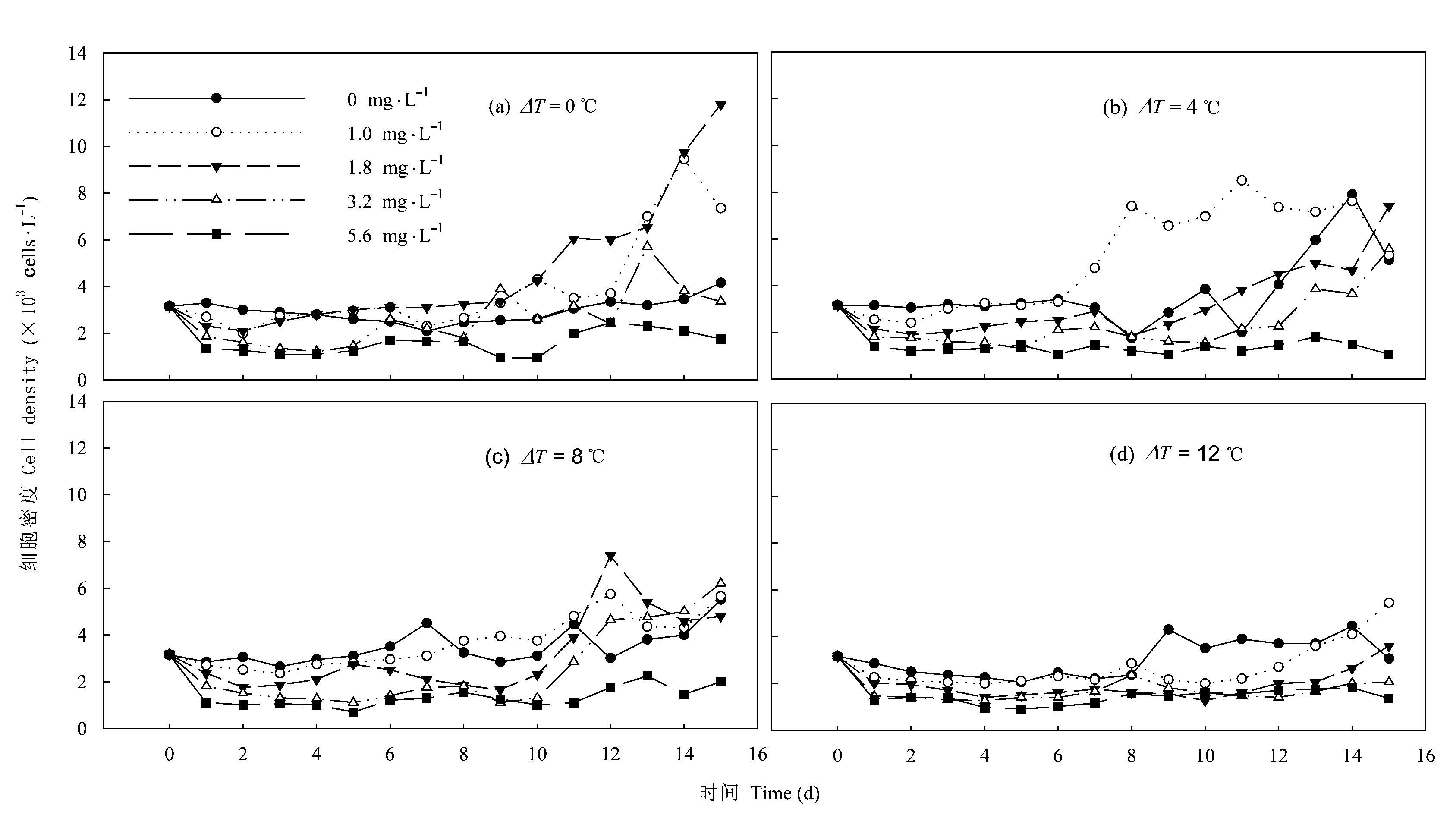
图1 春季浮游植物细胞密度的动态变化 ΔT: 同表3
Fig. 1 Dynamic changes of cell density of phytoplankton in spring See Table 3
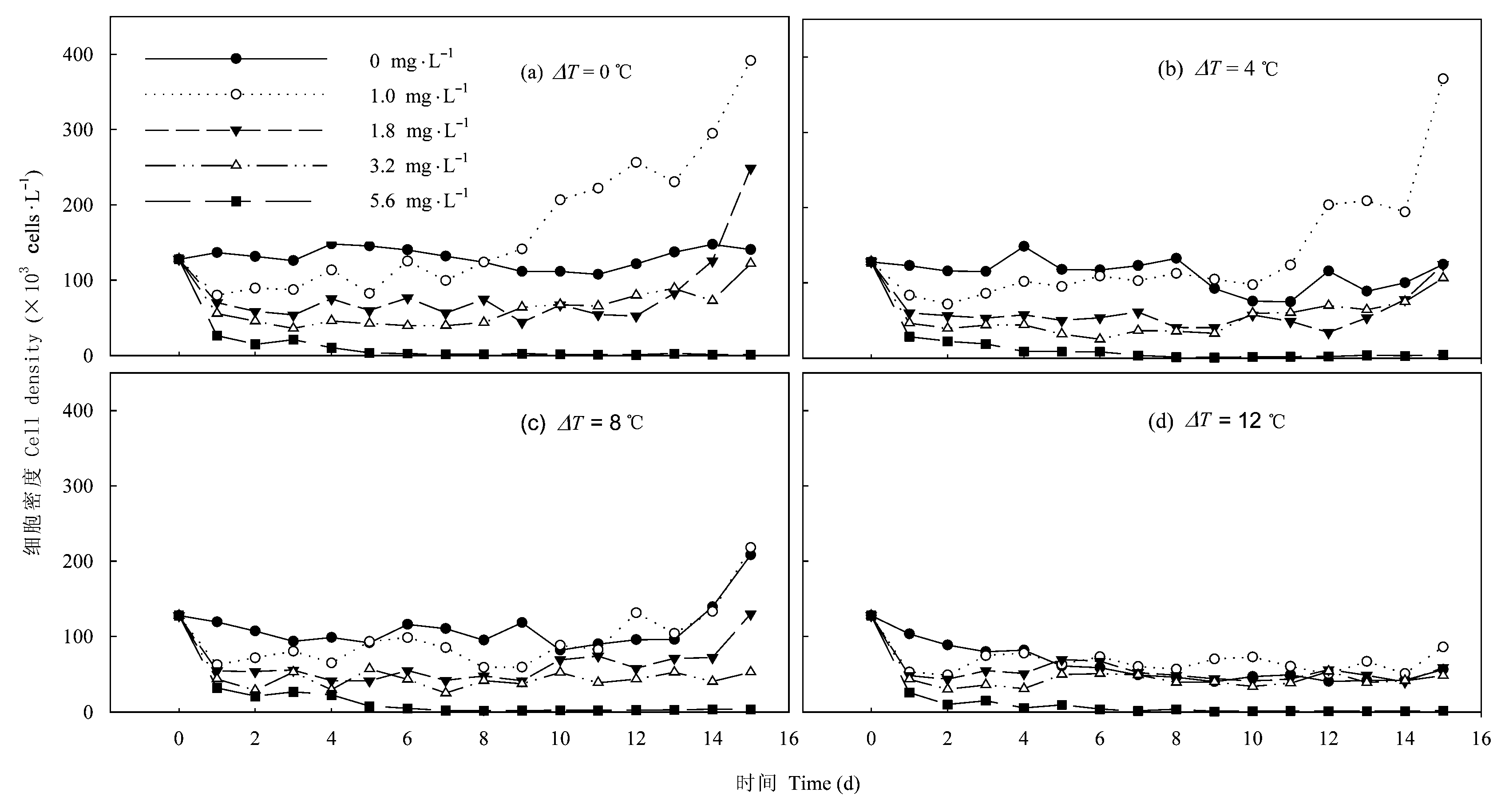
图2 夏季浮游植物细胞密度的动态变化 ΔT: 同表3 See Table 3
Fig. 2 Dynamic changes of cell density of phytoplankton in summer
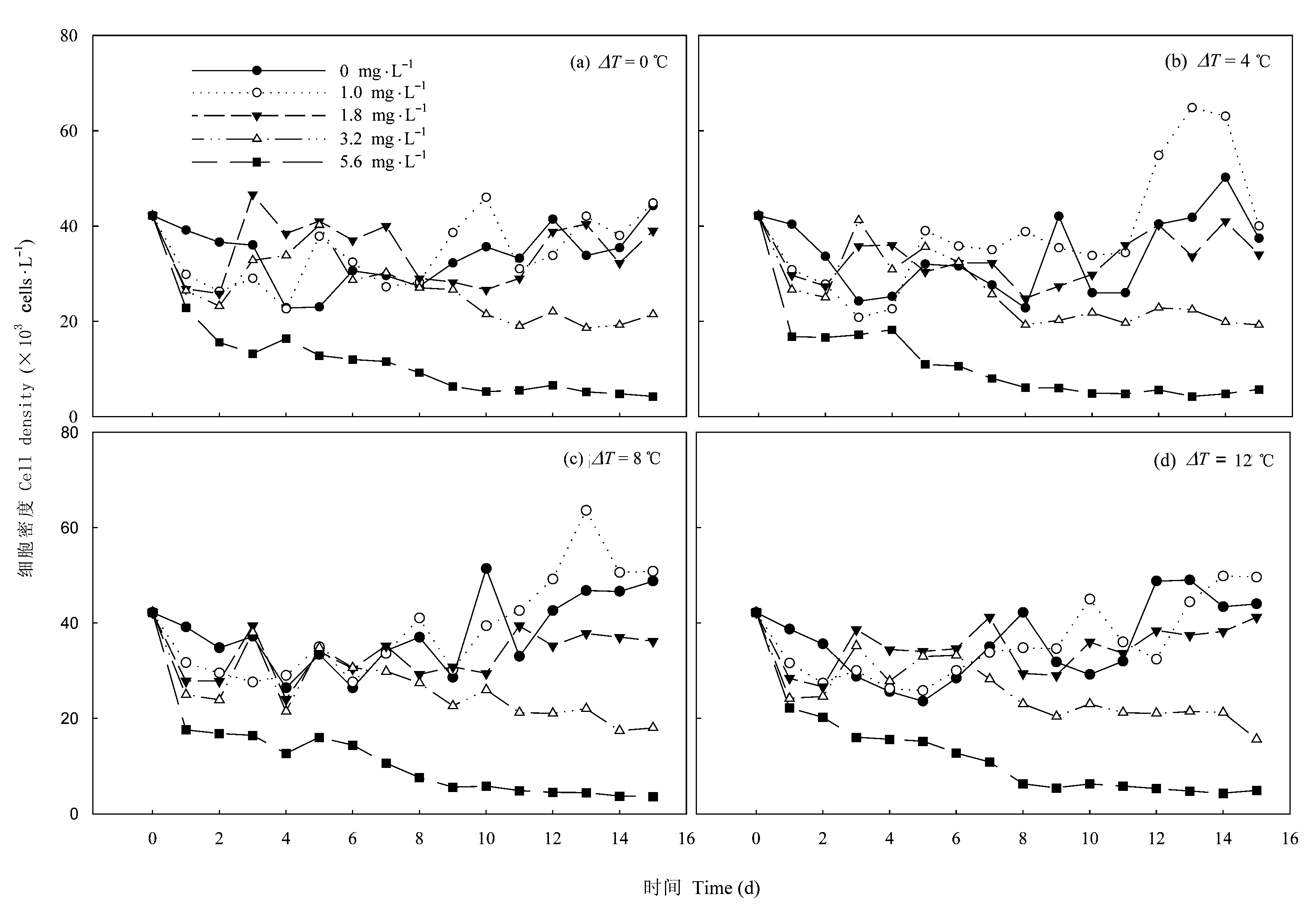
图3 秋季浮游植物细胞密度的动态变化 ΔT: 同表3
Fig. 3 Dynamic changes of cell density of phytoplankton in autumn See Table 3
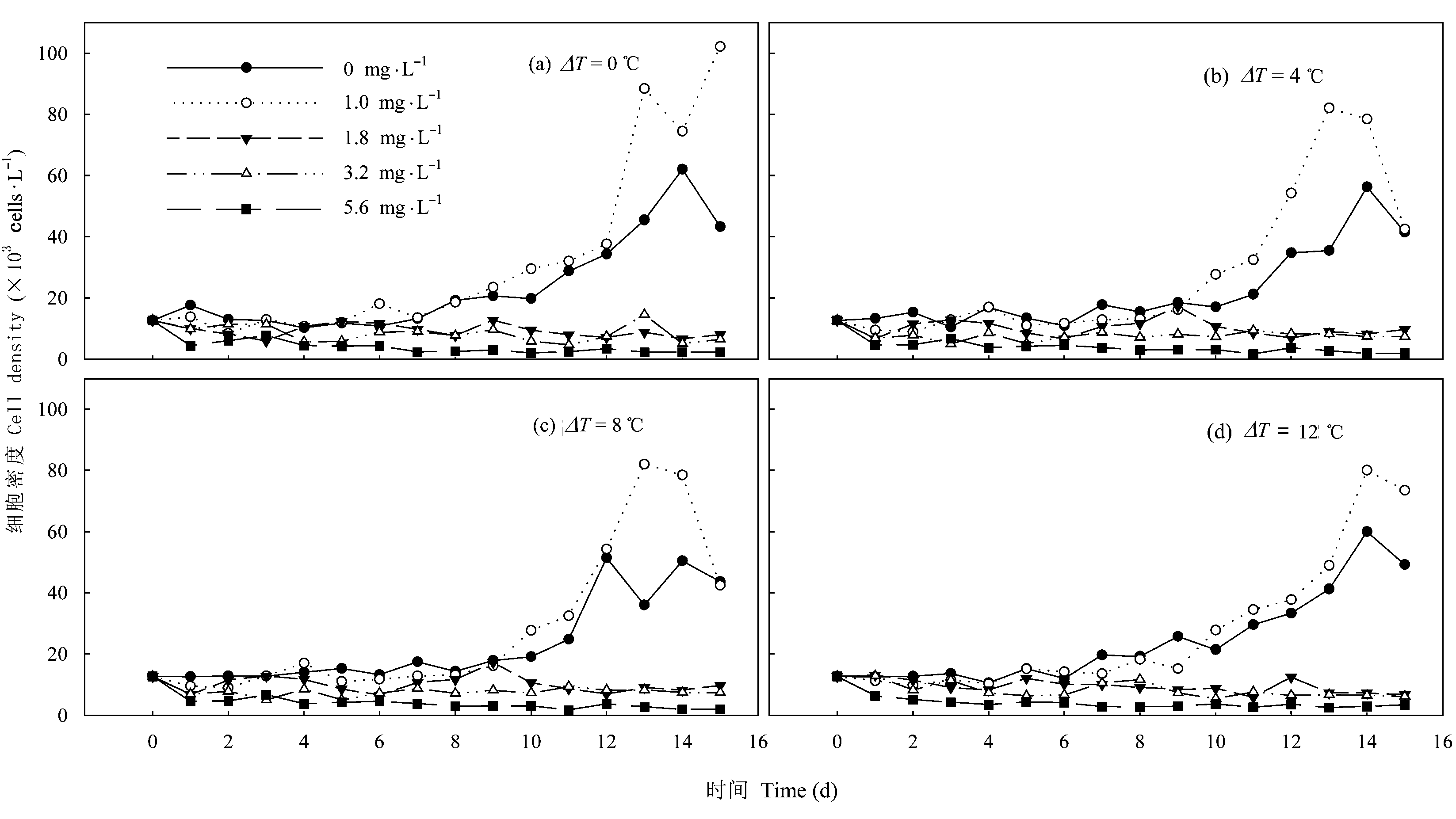
图4 冬季浮游植物细胞密度的动态变化 ΔT: 同表3
Fig. 4 Dynamic changes of cell density of phytoplankton in winter See Table 3
| CD (mg·L-1) | ΔT (℃) | 春 Spring | 夏 Summer | 秋 Autumn | 冬 Winter |
|---|---|---|---|---|---|
| 1.0 | 0 | 25 | 30 | 35 | 20 |
| 4 | 20 | 30 | 35 | 20 | |
| 8 | 20 | 25 | 30 | 15 | |
| 12 | 15 | 20 | 25 | 15 | |
| 1.8 | 0 | 75 | 180 | 150 | 60 |
| 4 | 60 | 150 | 120 | 45 | |
| 8 | 45 | 120 | 90 | 45 | |
| 12 | 45 | 120 | 60 | 30 | |
| 3.2 | 0 | 150 | 960 | 2 160 | 2 160 |
| 4 | 150 | 960 | 1 920 | 2 160 | |
| 8 | 120 | 720 | 1 480 | 1 720 | |
| 12 | 120 | 480 | 1 200 | 1 440 | |
| 5.6 | 0 | 1 440 | 2 400 | 11 520 | 8 640 |
| 4 | 1 440 | 1 920 | 10 080 | 7 200 | |
| 8 | 960 | 1 680 | 8 640 | 7 200 | |
| 12 | 960 | 1 440 | 7 200 | 5 760 |
表3 不同季节各组海水中余氯衰减至低于检测限所需的时间
Table 3 Decaying time (min) of residual chlorine of each test team in different seasons (residual chlorine decaying until below detection limit)
| CD (mg·L-1) | ΔT (℃) | 春 Spring | 夏 Summer | 秋 Autumn | 冬 Winter |
|---|---|---|---|---|---|
| 1.0 | 0 | 25 | 30 | 35 | 20 |
| 4 | 20 | 30 | 35 | 20 | |
| 8 | 20 | 25 | 30 | 15 | |
| 12 | 15 | 20 | 25 | 15 | |
| 1.8 | 0 | 75 | 180 | 150 | 60 |
| 4 | 60 | 150 | 120 | 45 | |
| 8 | 45 | 120 | 90 | 45 | |
| 12 | 45 | 120 | 60 | 30 | |
| 3.2 | 0 | 150 | 960 | 2 160 | 2 160 |
| 4 | 150 | 960 | 1 920 | 2 160 | |
| 8 | 120 | 720 | 1 480 | 1 720 | |
| 12 | 120 | 480 | 1 200 | 1 440 | |
| 5.6 | 0 | 1 440 | 2 400 | 11 520 | 8 640 |
| 4 | 1 440 | 1 920 | 10 080 | 7 200 | |
| 8 | 960 | 1 680 | 8 640 | 7 200 | |
| 12 | 960 | 1 440 | 7 200 | 5 760 |
| ΔT (℃) | 春 Spring | 夏 Summer | 秋 Autumn | 冬 Winter |
|---|---|---|---|---|
| 4 | 1 | 4 | 1 | 2 |
| 8 | 2 | 9 | 3 | 2 |
| 12 | 6 | - | 4 | 2 |
表4 不同ΔT下各季节浮游植物细胞数量恢复到对照组水平时所需的时间
Table 4 Days (d) for phytoplankton cell density recovering to the control levels at different ΔT in all the seasons
| ΔT (℃) | 春 Spring | 夏 Summer | 秋 Autumn | 冬 Winter |
|---|---|---|---|---|
| 4 | 1 | 4 | 1 | 2 |
| 8 | 2 | 9 | 3 | 2 |
| 12 | 6 | - | 4 | 2 |
| 因素Factors | df | F | p |
|---|---|---|---|
| ΔT | 3 | 9.24 | 0.000 |
| CD | 4 | 46.31 | 0.000 |
| 季节 Season | 3 | 14.46 | 0.000 |
表5 ΔT、CD和季节对浮游植物细胞数量恢复时间影响的方差分析结果
Table 5 ANOVA results of phytoplankton cell density recovery period determined by ΔT, CD and seasons
| 因素Factors | df | F | p |
|---|---|---|---|
| ΔT | 3 | 9.24 | 0.000 |
| CD | 4 | 46.31 | 0.000 |
| 季节 Season | 3 | 14.46 | 0.000 |
| CD (mg·L-1) | 春 Spring | 夏 Summer | 秋 Autumn | 冬 Winter |
|---|---|---|---|---|
| 1.0 | 4 | 8 | 4 | 3 |
| 1.8 | 4 | 15 | 3 | 4 |
| 3.2 | 6 | - | 4 | 9 |
| 5.6 | - | - | - | - |
表6 不同CD下各季节浮游植物细胞数量恢复到对照组水平时所需的时间
Table 6 Days (d) for phytoplankton cell density recovering to the control level at different CD in all the seasons
| CD (mg·L-1) | 春 Spring | 夏 Summer | 秋 Autumn | 冬 Winter |
|---|---|---|---|---|
| 1.0 | 4 | 8 | 4 | 3 |
| 1.8 | 4 | 15 | 3 | 4 |
| 3.2 | 6 | - | 4 | 9 |
| 5.6 | - | - | - | - |
| ΔT (℃) | CD (mg·L-1) | 春 Spring | 夏 Summer | 秋 Autumn | 冬 Winter |
|---|---|---|---|---|---|
| 4 | 1.0 | 4 | 8 | 5 | 4 |
| 1.8 | 7 | 15 | 4 | 10 | |
| 3.2 | 13 | - | 4 | - | |
| 5.6 | - | - | - | - | |
| 8 | 1.0 | 5 | 12 | 4 | 4 |
| 1.8 | 11 | - | 4 | - | |
| 3.2 | 12 | - | 5 | - | |
| 5.6 | - | - | - | - | |
| 12 | 1.0 | 8 | - | 3 | 5 |
| 1.8 | - | - | 4 | - | |
| 3.2 | - | - | 4 | - | |
| 5.6 | - | - | - |
表7 热冲击和加氯联合作用下各季节浮游植物细胞数量恢复到对照组水平时所需的时间
Table 7 Days (d) for phytoplankton cell density recovering to the control levels under the combined effect of thermal shock and chlorination in all the seasons
| ΔT (℃) | CD (mg·L-1) | 春 Spring | 夏 Summer | 秋 Autumn | 冬 Winter |
|---|---|---|---|---|---|
| 4 | 1.0 | 4 | 8 | 5 | 4 |
| 1.8 | 7 | 15 | 4 | 10 | |
| 3.2 | 13 | - | 4 | - | |
| 5.6 | - | - | - | - | |
| 8 | 1.0 | 5 | 12 | 4 | 4 |
| 1.8 | 11 | - | 4 | - | |
| 3.2 | 12 | - | 5 | - | |
| 5.6 | - | - | - | - | |
| 12 | 1.0 | 8 | - | 3 | 5 |
| 1.8 | - | - | 4 | - | |
| 3.2 | - | - | 4 | - | |
| 5.6 | - | - | - |
| [1] | Bamber RN (1995). The influence of rising background temperature on the effects of marine thermal effluents. Journal of Thermal Biology, 20,105-110. |
| [2] | Bamber RN, Seaby RMH (2004). The effects of power station entrainment passage on three species of marine planktonic crustacean, Acartia tonsa (Copepoda), Crangon crangon (Decapoda) and Homarus gammarus (Decapoda). Marine Environmental Research, 57,281-294. |
| [3] |
Behrenfeld MJ, O’Malley RT, Siegel DA, McClain CR, Sarmiento JL, Feldman GC, Milligan AJ, Falkowski PG, Letelier RM, Boss ES (2006). Climate-driven trends in contemporary ocean productivity. Nature, 444,752-755.
DOI URL PMID |
| [4] | China State Bureau of Technical Supervision (国家技术监督局) (1992). Standard of Marine Investigation (海洋调查规范). Standards Press of China,Beijing. (in Chinese) |
| [5] | Choi DH, Park JS, Hwang CY, Huh SH, Cho BC (2002). Effects of thermal effluents from a power station on bacteria and heterotrophic nanoflagellates in coastal waters. Marine Ecology Progress Series, 229,1-10. |
| [6] | Department of the Environment (1981). Methods for the Examination of Waters and Associated Materials: Chemical Disinfecting Agents in Water and Effluents and Chlorine Demand. HMSO, London. |
| [7] |
Doney SC (2006). Plankton in a warmer world. Nature, 444,695-696.
DOI URL PMID |
| [8] | Duffy JE, Stachowicz JJ (2006). Why biodiversity is important to oceanography: potential roles of genetic, species, and trophic diversity in pelagic ecosystem processes. Marine Ecology Progress Series, 311,179-189. |
| [9] | Goldman JC, Quinby HL (1979). Phytoplankton recovery after power plant entrainment. Journal of the Water Pollution Control Federation, 51,1811-1823. |
| [10] |
Hamilton DH, Flemer DA, Keefe CW, Mihursky JA (1970). Power plants: effects of chlorination on estuarine primary production. Science, 169,197-198.
URL PMID |
| [11] | Hirayama K, Hirano R (1970). Influence of high temperature and residual chlorine on marine phytoplankton. Marine Biology, 7,205-213. |
| [12] | Hoffmeyer MS, Biancalana F, Berasategui A (2005). Impact of a power plant cooling system on copepod and mesoplankton survival (Bahía Blanca estuary, Argentina). Iheringia, Série Zoologia, 95,311-318. |
| [13] |
Jiang ZB (江志兵), Zeng JN (曾江宁), Chen QZ (陈全震), Liao YB (廖一波), Xu XQ (徐晓群), Shou L (寿鹿), Liu JJ (刘晶晶), Gao AG (高爱根) (2008). Effects of residual heat and chlorine in cooling water from coastal power plant on Calanus sinicus. Chinese Journal of Applied Ecology(应用生态学报), 19,1401-1406. (in Chinese with English abstract)
URL PMID |
| [14] | Jewson DH (1992). Size reduction, reproductive strategy and the life cycle of a centric diatom. Philosophical Transactions: Biological Science, 336,191-213. |
| [15] | Langford TEL (1990). Ecological Effects of Thermal Discharges. Elsevier Applied Science Publishers,London. |
| [16] | Liu LF (刘兰芬), Hao H (郝红), Lu GS (鲁光四) (2004a). Experiment study on attenuation law of residual chlorine in cooling water discharged from thermal power plants. Journal of Hydraulic Engineering(水利学报), 5,94-98. (in Chinese with English abstract) |
| [17] | Liu LF (刘兰芬), Tan HW (谭红武), Zhang SJ (张士杰) (2004b). Method for assessing the impact of residual chlorine in cooling water on environment of thermal power plants. Journal of Hydraulic Engineering(水利学报), 6,98-103. (in Chinese with English abstract) |
| [18] | Mallin MA, Stone KL, Pamperl MA (1994). Phytoplankton community assessments of seven southeast U.S. cooling reservoirs. Water Research, 28,665-673. |
| [19] | Martínez-Arroyo A, Abundes S, González ME, Rosas I (2000). On the influence of hot-water discharges on phytoplankton communities from a coastal zone of the Gulf of Mexico. Water, Air, and Soil Pollution, 119,209-230. |
| [20] | Murthy PS, Venkatesan R, Nair KVK, Jahan SS, Peter DM, Ravindran M (2005). Evaluation of sodium hypochlorite for fouling control in plate heat exchangers for seawater application. International Biodeterioration and Biodegradation, 52,161-170. |
| [21] | Nebot E, Casanueva JF, Casanueva T, Fernández-Bastón MM, Sales D (2006). In situ experimental study for the optimization of chlorine dosage in seawater cooling systems. Applied Thermal Engineering, 26,1893-1900. |
| [22] | Poornima EH, Rajaduraia M, Rao TS, Anupkuman B, Rajamohan R, Narasimhan SV, Rao VNR, Venugopalan VP (2005). Impact of thermal discharge from a tropical coastal power plant on phytoplankton. Journal of Thermal Biology, 30,307-316. |
| [23] | Poornima EH, Rajadurai M, Rao VNR, Narasimhan SV, Venugopalan VP (2006). Use of coastal waters as condenser coolant in electric power plants: impaction on phytoplankton and primary productivity. Journal of Thermal Biology, 31,556-564. |
| [24] | Rajadurai M, Poornima EH, Narasimhanb SV, Rao VNR, Venugopalan VP (2005). Phytoplankton growth under temperature stress: laboratory studies using two diatoms from a tropical coastal power station site. Journal of Thermal Biology, 30,299-305. |
| [25] | Rajagopal S, Nair KVK, Azariah J, Velde GV, Jenner HA (1996). Chlorination and mussel control in the cooling conduits of a tropical coastal power station. Marine Environmental Research, 41,201-221. |
| [26] |
Rajagopal S, Velde GV, Gaag MV, Jenner HA (2003). How effective is intermittent chlorination to control adult mussel fouling in cooling water systems. Water Research, 37,329-338.
DOI URL PMID |
| [27] | Roberts JrMH (1977). Bioassay procedures for marine phytoplankton with special reference to chlorine. Chesapeake Science, 18,137-139. |
| [28] | Sanders JG, Ryther JH, Batchelder JH (1981). Effects of copper, chlorine, and thermal addition on the species composition of marine phytoplankton. Journal of Experimental Marine Biology and Ecology, 49,81-102. |
| [29] | Saravanane N, Satpathy KK, Nair KVK, Durairaj G (1998). Preliminary observations on the recovery of tropical phytoplankton after entrainment. Journal of Thermal Biology, 23,91-97. |
| [30] | Smith TM, Reynolds RW (2005). A global merged land-air-sea surface temperature reconstruction based on historic observations (1880―1997). Journal of Climate, 18,2021-2036. |
| [31] |
Taylor CJL (2006). The effects of biological fouling control at coastal and estuarine power stations. Marine Pollution Bulletin, 53,30-48.
DOI URL PMID |
| [32] | Wei GF (韦桂峰), Wang ZD (王肇鼎) (2001). Laboratory simulation of combined chlorine influencing phytoplankton growth: chlorophyll a and phytosynthesis. Journal of Tropical Oceanology (热带海洋学报), 20,47-53. (in Chinese with English abstract) |
| [33] | Werner D (1970). Productivity studies on diatom cultures. Helgoland Marine Reasearch, 20,97-103. |
| [34] |
Zargar S, Ghosh TK (2007). Thermal and biocidal (chlorine) effects on select freshwater plankton. Archives of Environmental Contamination Toxicology, 53,191-197.
DOI URL PMID |
| [35] | Zeng JN (曾江宁), Chen QZ (陈全震), Zheng P (郑平), Gao AG (高爱根), Liao YB (廖一波), Yang GM (杨关铭) (2005). Advance in effect of residual chlorine on hydrobios. Acta Ecologica Sinica(生态学报), 25,2717-2724. (in Chinese with English abstract) |
| [1] | 张静, 陈洁, 李艳朋, 盘李军, 许涵, 李意德, 何海生. 南亚热带针阔混交人工林植物生物量比较及其影响因子分析[J]. 植物生态学报, 2026, 50(2): 400-416. |
| [2] | 王尧, 王耀彬, 陈子彦, 伊如汉, 白永飞, 赵玉金, 金晶炜. 连续干旱对蒙古高原草地恢复力和抵抗力的影响[J]. 植物生态学报, 2025, 49(7): 1070-1081. |
| [3] | 乔沛阳, 顾肖璇, 刘昌鑫, 曹泽宇, 张婷婷, 林晨, 陈钦常, 彭修凡, 陈菲菲, 李华亮, 陈伟, 陈鹭真. 超强台风“摩羯”登陆点海南东寨港红树林受损状况研究[J]. 植物生态学报, 2025, 49(4): 540-551. |
| [4] | 贾慧琳, 倪隆康, 秦佳双, 廖苏慧, 谭羽, 何佳懿, 顾大形. 极端干旱后喀斯特树木水力功能恢复动态及其影响因素[J]. 植物生态学报, 2025, 49(12): 2004-2014. |
| [5] | 杜华栋, 王梦雨, 聂文杰, 孙浩, 车旭曦, 唐勋. 半干旱矿区塌陷地光伏电站建设对植物群落特征的影响[J]. 植物生态学报, 2025, 49(11): 1778-1790. |
| [6] | 夏敏菖, 李倩倩, 钱清清, 任淑君, 梁应冲, 陈亭颖, 李映佳, 牟宗敏, 陈穗云. 青霉菌灭活菌丝体对白车轴草和黑麦草生长及生理特性的影响[J]. 植物生态学报, 2025, 49(1): 189-198. |
| [7] | 王麟, 李雪, 王愉, 王新, 胡小文, 杨梅, 朱剑霄. 不同配方种衣剂对高寒草地乡土草种种子生长与建植的影响[J]. 植物生态学报, 2025, 49(1): 118-128. |
| [8] | 郝毅晴, 刘伟, 杨阳, 安冰儿, 范冰, 李超, 崔久辉, 程延彬, 孙佳美, 潘庆民. 有机肥和无机肥对退化草原羊草种群密度和个体生物量的影响[J]. 植物生态学报, 2025, 49(1): 148-158. |
| [9] | 王雯莹, 肖元明, 王小赟, 徐嘉昕, 马玉花, 李强峰, 周国英. 多功能群物种配置模式下退化高寒草甸植物多样性与生态系统多功能性的关联[J]. 植物生态学报, 2025, 49(1): 103-117. |
| [10] | 张辉, 赵赟鹏, 刘晓琛, 郭增鹏, 胡国瑞, 冯彦皓, 马妙君. 高寒草甸退化过程中土壤种子库的变化及其在植物群落更新中的潜在作用[J]. 植物生态学报, 2025, 49(1): 74-82. |
| [11] | 姚博, 陈云, 曹雯婕, 龚相文, 罗永清, 郑成卓, 王旭洋, 王正文, 李玉强. 呼伦贝尔退化沙地植被-土壤碳氮磷互馈关系及微生物驱动机制[J]. 植物生态学报, 2025, 49(1): 59-73. |
| [12] | 孙佳美, 安冰儿, 刘伟, 王璟, 潘庆民. 草原植物繁殖体调控技术: “蘖芽岛”的培育与移植[J]. 植物生态学报, 2025, 49(1): 129-137. |
| [13] | 房凯, 王迎新, 黄建辉, 段俊光, 张琦, 张倩, 甘红豪, 褚建民. 内蒙古典型草原不同退化阶段植被恢复的养分限制因子解析[J]. 植物生态学报, 2025, 49(1): 7-18. |
| [14] | 马东峰, 贾存智, 王学朋, 赵鹏鹏, 胡小文. 甘南高寒退化草甸多物种组配的修复效果评估[J]. 植物生态学报, 2025, 49(1): 93-102. |
| [15] | 王燕, 张全智, 王传宽, 郭万桂, 蔺佳玮. 恢复方式对东北东部森林土壤碳氮磷计量特征的影响[J]. 植物生态学报, 2024, 48(7): 943-954. |
| 阅读次数 | ||||||
|
全文 |
|
|||||
|
摘要 |
|
|||||
Copyright © 2026 版权所有 《植物生态学报》编辑部
地址: 北京香山南辛村20号, 邮编: 100093
Tel.: 010-62836134, 62836138; Fax: 010-82599431; E-mail: apes@ibcas.ac.cn, cjpe@ibcas.ac.cn
备案号: 京ICP备16067583号-19

