
植物生态学报 ›› 2010, Vol. 34 ›› Issue (10): 1155-1164.DOI: 10.3773/j.issn.1005-264x.2010.10.004 cstr: 32100.14.j.issn.1005-264x.2010.10.004
周双喜1,2, 吴冬秀1,*( ), 张琳1,2, 施慧秋1,2
收稿日期:2010-05-11
接受日期:2010-06-23
出版日期:2010-05-11
发布日期:2010-10-31
作者简介:* E-mail: wudx@ibcas.ac.cn
ZHOU Shuang-Xi1,2, WU Dong-Xiu1,*(), ZHANG Lin1,2, SHI Hui-Qiu1,2
Received:2010-05-11
Accepted:2010-06-23
Online:2010-05-11
Published:2010-10-31
摘要:
大针茅(Stipa grandis)是内蒙古草原的优势物种, 研究其幼苗在不同降雨格局下的响应特征, 可以为进一步研究降雨格局变化下内蒙古典型草原的响应特征提供科学依据。在中国科学院内蒙古草原生态系统定位研究站, 利用开顶式生长室进行控制试验模拟降雨格局变化, 研究了大针茅幼苗对总降雨量和降雨间隔时间变化的响应。结果表明: 1)总降雨量增加50%使大针茅幼苗生长季末的地上生物量平均增加23% (p < 0.05), 而降雨间隔时间由5天增长为15天使地上生物量平均增加48.8% (p < 0.001)。2)总降雨量对大针茅幼苗的地下生物量没有显著影响; 而在低降雨量条件下, 降雨间隔时间增长使地下生物量增加56.2% (p < 0.001), 在高降雨量条件下作用不显著。3)总降雨量和降雨间隔时间对根冠比的效应都依赖于对方水平的高低, 总降雨量增大只在较长降雨间隔条件下使根冠比发生改变(-28.4%, p < 0.05), 降雨间隔时间增长只在高降雨量条件下使根冠比发生改变(-28.8%, p < 0.05)。4)处理期间, 在处理时间分别为30天和45天时, 大针茅幼苗地上生物量、地下生物量和总生物量的差异都主要取决于总降雨量; 而在处理时间为75天时, 其差异则都主要取决于降雨间隔时间。该研究得到以下主要结论: 1)降雨间隔时间与总降雨量一样, 是影响大针茅幼苗生长的关键因素之一。2)总降雨量对大针茅幼苗生长的效应与降雨间隔时间的长短紧密相关。3)降雨格局对大针茅幼苗生长的影响机制随着幼苗的生长期不同而改变。
周双喜, 吴冬秀, 张琳, 施慧秋. 降雨格局变化对内蒙古典型草原优势种大针茅幼苗的影响. 植物生态学报, 2010, 34(10): 1155-1164. DOI: 10.3773/j.issn.1005-264x.2010.10.004
ZHOU Shuang-Xi, WU Dong-Xiu, ZHANG Lin, SHI Hui-Qiu. Effects of changing precipitation patterns on seedlings of Stipa grandis, a dominant plant of typical grassland of Inner Mongolia, China. Chinese Journal of Plant Ecology, 2010, 34(10): 1155-1164. DOI: 10.3773/j.issn.1005-264x.2010.10.004
| 月 Month | 月平均气温 Monthly mean air temperature (℃) | 月平均地温 Monthly mean ground temperature (℃) | 蒸发量 Evaporation (mm) |
|---|---|---|---|
| 7 | 19.8 | 25.4 | 283.2 |
| 8 | 18.5 | 22.6 | 295.2 |
| 9 | 11.3 | 13.5 | 202.9 |
表1 中国科学院内蒙古草原生态系统定位研究站2009年7-9月的平均气温、平均地温和月蒸发量
Table 1 Monthly mean air and ground temperature, and evaporation of July, August, and September of 2009 at Inner Mongolia Grassland Ecosystem Research Station of Chinese Academy of Sciences
| 月 Month | 月平均气温 Monthly mean air temperature (℃) | 月平均地温 Monthly mean ground temperature (℃) | 蒸发量 Evaporation (mm) |
|---|---|---|---|
| 7 | 19.8 | 25.4 | 283.2 |
| 8 | 18.5 | 22.6 | 295.2 |
| 9 | 11.3 | 13.5 | 202.9 |
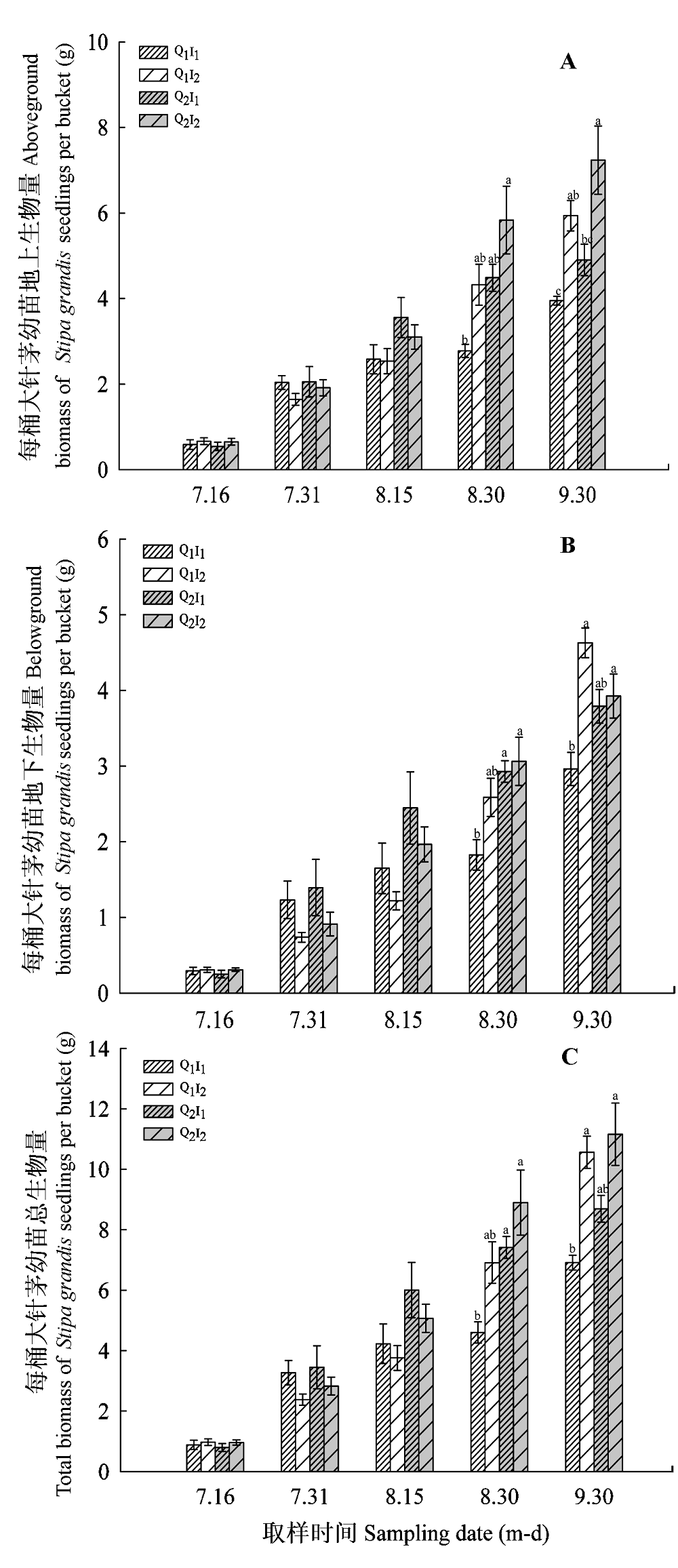
图1 不同降雨格局下大针茅幼苗地上生物量(A)、地下生物量(B)和总生物量(C)的变化(平均值±标准误差, n = 5)。 用单因素方差分析(Tukey post hoc)检验不同降雨格局之间的差异; 显著性差异(p < 0.05)用不同字母标记。I1, 降雨间隔时间为5天; I2, 降雨间隔时间为15天; Q1, 总降雨量150 mm; Q2, 总降雨量225 mm。
Fig. 1 Dynamics of aboveground biomass (A), belowground biomass (B), total biomass (C) of Stipa grandis seedlings in different precipitation patterns (mean ± SE, n = 5). Differences between each group were tested using One-way ANOVA with a Tukey post hoc test of significance; significant differences at p < 0.05 are indicated by different letters. I1, precipitation interval of 5 days; I2, precipitation interval of 15 days; Q1, precipitation quantity of 150 mm; Q2, precipitation quantity of 225 mm.
| 变量 Source of variation | 地上生物量Aboveground biomass | 地下生物量 Belowground biomass | 总生物量 Total biomass | 根冠比自然对数 ln (root / shoot ratio) | 根拓展生物量 Root proliferation biomass to unplanted half bucket area |
|---|---|---|---|---|---|
| 9.30 | |||||
| Q | 5.56* | 0.72 | 3.53 | 3.86 | 0.43 |
| I | 20.48*** | 14.70*** | 23.45*** | 3.46 | 6.46* |
| Q × I | 0.13 | 10.60*** | 0.88 | 6.42* | 8.54** |
| 8.30 | |||||
| Q | 10.56** | 11.04** | 12.21** | 0.65 | 2.36 |
| I | 8.52** | 3.54 | 7.61* | 4.16 | 0.06 |
| Q × I | 0.04 | 1.74 | 0.36 | 1.02 | 2.08 |
| 8.15 | |||||
| Q | 4.72* | 5.85* | 5.75* | 3.26 | 3.35 |
| I | 0.49 | 2.02 | 1.19 | 2.66 | 0.95 |
| Q × I | 0.34 | 0.01 | 0.13 | 1.05 | 0.09 |
| 7.31 | |||||
| Q | 0.40 | 0.51 | 0.50 | 0.31 | 0.02 |
| I | 1.40 | 4.18 | 2.88 | 5.85* | 0.01 |
| Q × I | 0.32 | 0.00 | 0.09 | 0.10 | 0.47 |
表2 总降雨量和降雨间隔时间对大针茅幼苗地上生物量、地下生物量、总生物量、根冠比和根拓展生物量影响的双因素方差分析结果(F值)
Table 2 Results (F-values) based on Two-way ANOVA of the effects of total precipitation quantity and precipitation interval on aboveground biomass, belowground biomass, total biomass, root/shoot ratio, and root proliferation biomass to the unplanted half bucket area of Stipa grandis seedlings
| 变量 Source of variation | 地上生物量Aboveground biomass | 地下生物量 Belowground biomass | 总生物量 Total biomass | 根冠比自然对数 ln (root / shoot ratio) | 根拓展生物量 Root proliferation biomass to unplanted half bucket area |
|---|---|---|---|---|---|
| 9.30 | |||||
| Q | 5.56* | 0.72 | 3.53 | 3.86 | 0.43 |
| I | 20.48*** | 14.70*** | 23.45*** | 3.46 | 6.46* |
| Q × I | 0.13 | 10.60*** | 0.88 | 6.42* | 8.54** |
| 8.30 | |||||
| Q | 10.56** | 11.04** | 12.21** | 0.65 | 2.36 |
| I | 8.52** | 3.54 | 7.61* | 4.16 | 0.06 |
| Q × I | 0.04 | 1.74 | 0.36 | 1.02 | 2.08 |
| 8.15 | |||||
| Q | 4.72* | 5.85* | 5.75* | 3.26 | 3.35 |
| I | 0.49 | 2.02 | 1.19 | 2.66 | 0.95 |
| Q × I | 0.34 | 0.01 | 0.13 | 1.05 | 0.09 |
| 7.31 | |||||
| Q | 0.40 | 0.51 | 0.50 | 0.31 | 0.02 |
| I | 1.40 | 4.18 | 2.88 | 5.85* | 0.01 |
| Q × I | 0.32 | 0.00 | 0.09 | 0.10 | 0.47 |
| 变量 Source of variation | 地上生物量Aboveground biomass | 地下生物量 Belowground biomass | 总生物量 Total biomass | 根冠比自然对数 ln (root / shoot ratio) | 根拓展生物量 Root proliferation biomass to the unplanted half bucket area |
|---|---|---|---|---|---|
| Q | 14.92*** | 12.48** | 17.19*** | 0.02 | 0.87 |
| I | 11.50** | 0.77 | 7.74* | 11.33*** | 1.11 |
| Q × I | 0.00 | 4.61* | 0.68 | 0.35 | 3.55 |
| T | 124.10*** | 135.16*** | 150.13*** | 9.54*** | 92.26*** |
| T × Q | 3.83* | 2.81* | 3.30* | 1.55 | 2.09 |
| T × I | 10.08*** | 6.40*** | 9.83*** | 0.94 | 4.81** |
| T × Q × I | 0.20 | 2.04 | 0.32 | 1.51 | 5.34** |
表3 取样时间、总降雨量、降雨间隔时间对大针茅幼苗地上生物量、地下生物量、总生物量、根冠比和根拓展生物量影响的重复测量的方差分析结果(F值):
Table 3 Results (F-values) based on repeated measures ANOVA of the effects of sampling time, total precipitation quantity and precipitation interval on aboveground biomass, belowground biomass, total biomass, root/shoot ratio, and root proliferation biomass to the unplanted half bucket area of Stipa grandis seedlings
| 变量 Source of variation | 地上生物量Aboveground biomass | 地下生物量 Belowground biomass | 总生物量 Total biomass | 根冠比自然对数 ln (root / shoot ratio) | 根拓展生物量 Root proliferation biomass to the unplanted half bucket area |
|---|---|---|---|---|---|
| Q | 14.92*** | 12.48** | 17.19*** | 0.02 | 0.87 |
| I | 11.50** | 0.77 | 7.74* | 11.33*** | 1.11 |
| Q × I | 0.00 | 4.61* | 0.68 | 0.35 | 3.55 |
| T | 124.10*** | 135.16*** | 150.13*** | 9.54*** | 92.26*** |
| T × Q | 3.83* | 2.81* | 3.30* | 1.55 | 2.09 |
| T × I | 10.08*** | 6.40*** | 9.83*** | 0.94 | 4.81** |
| T × Q × I | 0.20 | 2.04 | 0.32 | 1.51 | 5.34** |
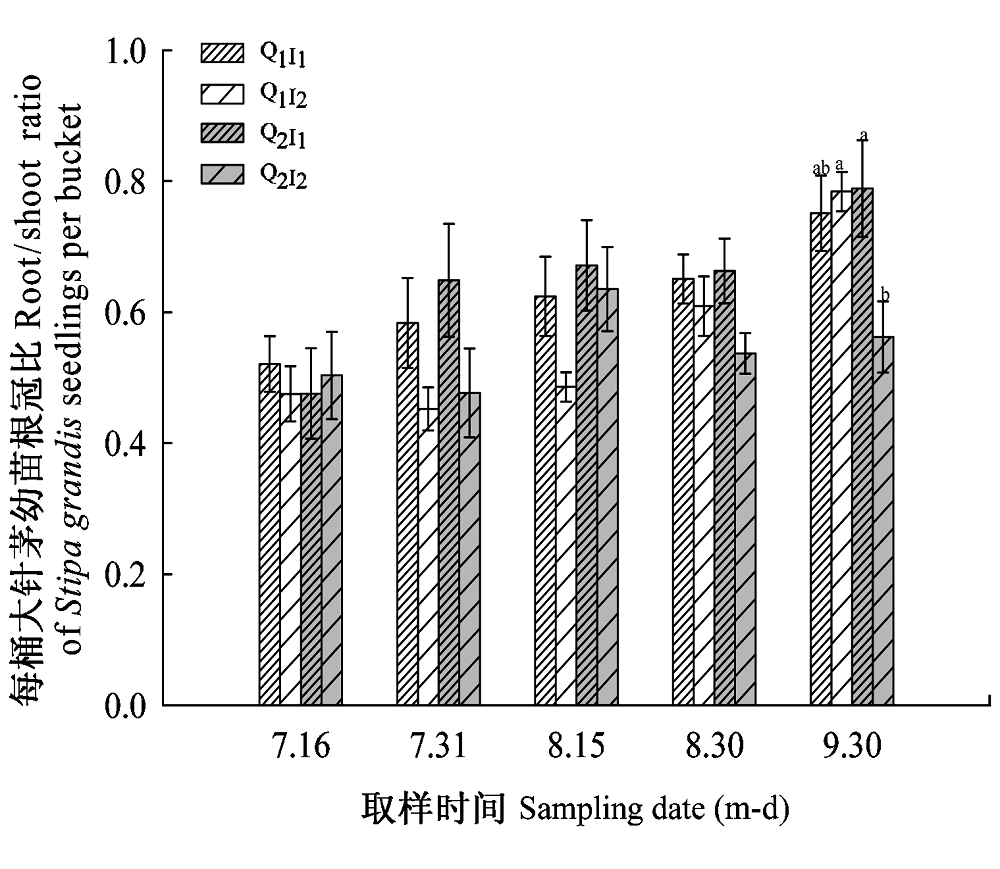
图2 不同降雨格局下大针茅幼苗根冠比的变化(平均值±标准误差, n = 5)。 图注同图1。
Fig. 2 Dynamics of root/shoot ratio of Stipa grandis seedlings in different precipitation patterns (mean ± SE, n = 5). Notes see Fig. 1.
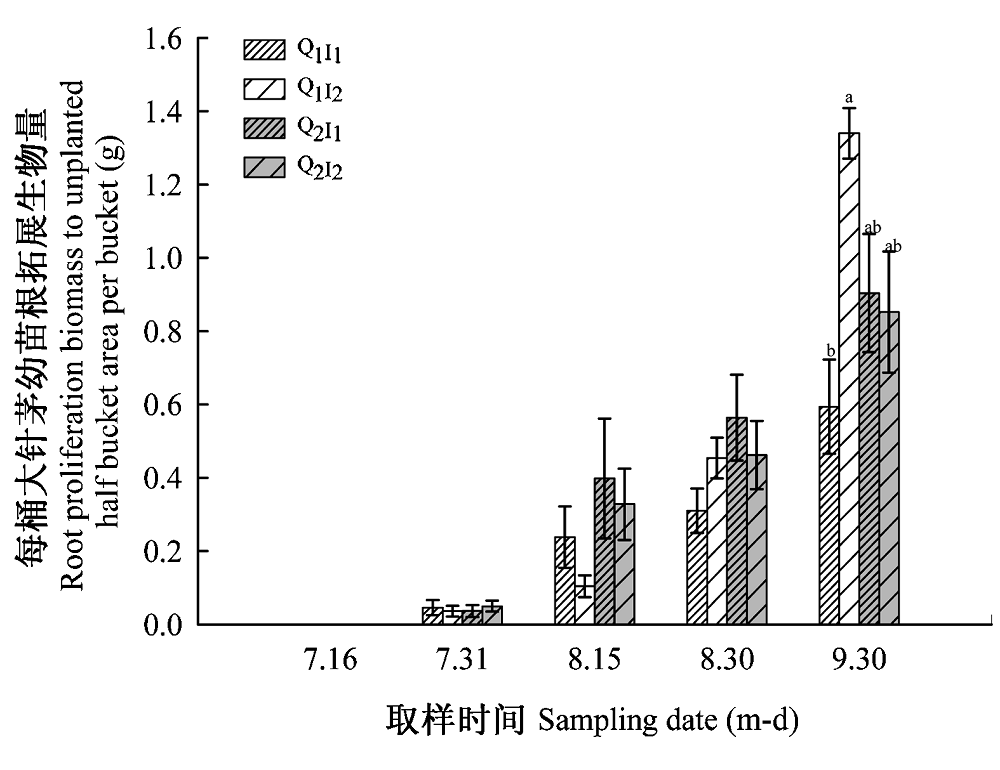
图3 不同降雨格局下大针茅幼苗根拓展生物量的变化(平均值±标准误差, n = 5)。 图注同图1。
Fig. 3 Dynamics of root proliferation biomass of Stipa grandis seedlings to the unplanted half bucket area in different precipitation patterns (mean ± SE, n = 5). Notes see Fig. 1.
| [1] |
Bai YF, Wu JG, Xing Q, Pan QM, Huang JH, Yang DL, Han XG (2008). Primary production and rain use efficiency across a precipitation gradient on the Mongolia plateau. Ecology, 89, 2140-2153.
URL PMID |
| [2] |
Chou WW, Silver WL, Jackson RD, Thompson AW, Allen- Diaz B (2008). The sensitivity of annual grassland carbon cycling to the quantity and timing of rainfall. Global Change Biology, 14, 1382-1394.
DOI URL |
| [3] | Commission Editorial of Inner Mongolia Flora (内蒙古植物志编写委员会) (1994). Flora Innermongolica (内蒙古植物志). Inner Mongolia People’s Press, Hohhot. 5, 195-205. (in Chinese) |
| [4] |
Dodd MB, Lauenroth WK, Welker JM (1998). Differential water resource use by herbaceous and woody plant life-forms in a shortgrass steppe community. Oecologia, 117, 504-512.
URL PMID |
| [5] |
Easterling DR, Meehl GA, Parmesan C, Changnon SA, Karl TR, Mearns LO (2000). Climate extremes: observations, modeling, and impacts. Science, 289, 2068-2074.
URL PMID |
| [6] |
Fay PA, Carlisle JD, Knapp AK, Blair JM, Collins SL (2000). Altering rainfall timing and quantity in a mesic grassland ecosystem: design and performance of rainfall manipulation shelters. Ecosystems, 3, 308-319.
DOI URL |
| [7] |
Fay PA, Carlisle JD, Knapp AK, Blair JM, Collins SL (2003). Productivity responses to altered rainfall patterns in a C4-dominated grassland. Oecologia, 137, 245-251.
DOI URL |
| [8] |
Fravolini A, Hultine KR, Brugnoli E, Gazal R, English NB, Williams DG (2005). Precipitation pulse use by an invasive woody legume: the role of soil texture and pulse size. Oecologia, 144, 618-627.
URL PMID |
| [9] |
Gordon HB, Whetton PH, Pittock AB, Fowler AM, Haylock MR (1992). Simulated changes in daily precipitation intensity due to the enhanced greenhouse effect-implications for extreme precipitation events. Climate Dynamics, 8, 83-102.
DOI URL |
| [10] |
Groisman PY, Karl TR, Easterling DR, Knight RW, Jamason PF, Hennessy KJ, Suppiah R, Page CM, Wibig J, Fortuniak K, Razuvaev VN, Douglas A, Forland E, Zhai PM (1999). Changes in the probability of heavy precipitation: important indicators of climatic change. Climate Change, 42, 243-283.
DOI URL |
| [11] |
Harper CW, Blair JM, Fay PA, Knapp AK, Carlisle JD (2005). Increased rainfall variability and reduced rainfall amount decreases soil CO2 flux in a grassland ecosystem. Global Change Biology, 11, 322-334.
DOI URL |
| [12] |
Heisler-White JL, Blair JM, Kelly EF, Harmoney K, Knapp AK (2009). Contingent productivity responses to more extreme rainfall regimes across a grassland biome. Global Change Biology, 15, 2894-2904.
DOI URL |
| [13] |
Heisler-White JL, Knapp AK, Kelly EF (2008). Increasing precipitation event size increases aboveground net primary productivity in a semi-arid grassland. Oecologia, 158, 129-140.
URL PMID |
| [14] | Houghton JT, Ding Y, Griggs DJ, Noguer M, van der Linden PJ, Dai X, Maskell K, Johnson CA (2001) Climate Change 2001: The Scientific Basis. Contribution of Working Group I to the Third Assessment Report of the Intergovernmental Panel on Climate Change. Cambridge University Press, Cambridge, UK. |
| [15] | IPCC (2007). Climate Change 2007: The Physical Science Basis. Contribution of Working Group I to the Fourth Assessment Report of the Intergovernmental Panel on Climate Change Cambridge University Press, Cambridge, UK. |
| [16] |
Jackson RB, Canadell J, Ehleringer JR, Mooney HA, Sala OE, Schulze ED (1996). A global analysis of root distributions for terrestrial biomes. Oecologia, 108, 389-411.
URL PMID |
| [17] |
Knapp AK, Briggs JM, Koelliker JK (2001). Frequency and extent of water limitation to primary production in a mesic temperate grassland. Ecosystems, 4, 19-28.
DOI URL |
| [18] |
Knapp AK, Fay PA, Blair JM, Collins SL, Smith MD, Carlisle JD, Harper CW, Danner BT, Lett MS, McCarron JK (2002). Rainfall variability, carbon cycling, and plant species diversity in a mesic grassland. Science, 298, 2202-2205.
DOI URL PMID |
| [19] |
Knapp AK, Smith MD (2001). Variation among biomes in temporal dynamics of aboveground primary production. Science, 291, 481-484.
URL PMID |
| [20] |
Lauenroth WK, Sala OE (1992). Long-term forage production of North American shortgrass steppe. Ecological Applications, 2, 397-403.
URL PMID |
| [21] |
Lundholm JT, Larson DW (2004). Experimental separation of resource quantity from temporal variability: seedling responses to water pulses. Oecologia, 141, 346-352.
URL PMID |
| [22] |
Maestre FT, Reynolds JF (2007). Amount or pattern? Grassland responses to the heterogeneity and availability of two key resources. Ecology, 88, 501-511.
URL PMID |
| [23] | Meehl GA, Arblaster JM, Tebaldi C (2005). Understanding future patterns of increased precipitation intensity in climate model simulations. Geophysical Research Letters, 32, L18719. |
| [24] |
Milchunas DG, Lauenroth WK (2001). Belowground primary production by carbon isotope decay and long term root biomass dynamics. Ecosystems, 4, 139-150.
DOI URL |
| [25] |
Mokany K, Raison RJ, Prokushkin AS (2006). Critical analysis of root: shoot ratios in terrestrial biomes. Global Change Biology, 12, 84-96.
DOI URL |
| [26] |
Nippert JB, Knapp AK, Briggs JM (2006). Intra-annual rainfall variability and grassland productivity: Can the past predict the future? Plant Ecology, 184, 65-74.
DOI URL |
| [27] |
Noy-Meir I (1973). Desert ecosystems: environment and producers. Annual Review of Ecology and Systematics, 4, 25-51.
DOI URL |
| [28] |
Novoplansky A, Goldberg D (2001). Interactions between neighbour environments and drought resistance. Journal of Arid Environments, 47, 11-32.
DOI URL |
| [29] |
Robertson TR, Bell CW, Zak JC, Tissue DT (2009). Precipitation timing and magnitude differentially affect aboveground annual net primary productivity in three perennial species in a Chihuahuan Desert grassland. New Phytologist, 181, 230-242.
DOI URL |
| [30] |
Sala OE, Lauenroth WK (1982). Small rain events: an ecological role in semi-arid regions. Oecologia, 53, 301-304.
URL PMID |
| [31] |
Sala OE, Lauenroth WK, Parton WJ (1992). Long-term soil-water dynamics in the shortgrass steppe. Ecology, 73, 1175-1181.
DOI URL |
| [32] |
Schenk HJ, Jackson RB (2002). The global biogeography of roots. Ecological Monographs, 72, 311-328.
DOI URL |
| [33] |
Sher AA, Goldberg DE, Novoplansky A (2004). The effect of mean and variance in resource supply on survival of annuals from Mediterranean and desert environments. Oecologia, 141, 353-362.
DOI URL |
| [34] |
Schwinning S, Sala OE (2004). Hierarchy of responses to resource pulses in arid and semi-arid ecosystems. Oecologia, 141, 211-220
DOI URL PMID |
| [35] |
Schwinning S, Sala OE, Loik ME, Ehleringer JR (2004). Thresholds, memory, and seasonality: understanding pulse dynamics in arid/semi-arid ecosystems. Oecologia, 141, 191-193.
DOI URL PMID |
| [36] |
Scurlock JMO, Hall DO (1998). The global carbon sink: a grassland perspective. Global Change Biology, 4, 229-233.
DOI URL |
| [37] |
Sponseller RA (2007). Precipitation pulses and soil CO2 flux in an Sonoran Desert ecosystem. Global Change Biology, 13, 426-436
DOI URL |
| [38] | Sun Y (孙颖), Ding YH (丁一汇) (2009). A projection of future changes in summer precipitation and monsoon in East Asia. Science in China (Series D) (中国科学D辑), 39, 1487-1504. (in Chinese) |
| [39] |
Swemmer AM, Knapp AK, Snyman HA (2007). Intra-seasonal precipitation patterns and above-ground productivity in three perennial grasslands. Journal of Ecology, 95, 780-788.
DOI URL |
| [40] |
Thornley JH (1972a). A balanced quantitative model for root: shoot ratios in vegetative plants. Annals of Botany, 36, 431-441.
DOI URL |
| [41] |
Thornley JH (1972b). A model to describe the partitioning of photosynthate during vegetative plant growth. Annals of Botany, 36, 419-430.
DOI URL |
| [42] |
Titlyanova AA, Romanova IP, Kosykh NP, Mironycheva- Tokareva NP (1999). Pattern and process in above-ground and below-ground components of grassland ecosystems. Journal of Vegetation Science, 10, 307-320.
DOI URL |
| [43] |
Weltzin JF, Loik ME, Schwinning S, Williams DG, Fay PA, Haddad BM, Harte J, Huxman TE, Knapp AK, Lin GH, Pockman WT, Shaw MR, Small EE, Smitth MD, Smith SD, Tissue DT, Zak JC (2003). Assessing the response of terrestrial ecosystems to potential changes in precipitation. BioScience, 53, 941-952.
DOI URL |
| [44] |
Williams JW, Jackson ST, Kutzbacht JE (2007). Projected distributions of novel and disappearing climates by 2100 AD. Proceedings of the National Academy of Sciences of the United States of America, 104, 5738-5742.
DOI URL PMID |
| [45] |
Wythers KR, Lauenroth WK, Paruelo JM (1999). Bare-soil evaporation under semi-arid field conditions. Soil Science Society of America Journal, 63, 1341-1349.
DOI URL |
| [1] | 张静, 陈洁, 李艳朋, 盘李军, 许涵, 李意德, 何海生. 南亚热带针阔混交人工林植物生物量比较及其影响因子分析[J]. 植物生态学报, 2026, 50(2): 400-416. |
| [2] | 徐恩相, 周蕾, 章晓炜, 张国萍, 仲杜伟, 黄智, 刘派, 迟永刚. 基于不同生育阶段冠层光谱和碳通量的水稻产量估算[J]. 植物生态学报, 2026, 50(1): 82-93. |
| [3] | 张法伟, 李红琴, 祝景彬, 樊博, 周华坤, 李英年, 梁乃申. 氮添加和降水改变对高寒草甸生态系统地上与地下碳储的影响[J]. 植物生态学报, 2025, 49(9): 1399-1409. |
| [4] | 邢强, 赵斌, 胡永红, 杨君, 秦俊, 刘何铭, 王红兵, 周鹏. 华东地区两种典型立体绿化植物根系性状特征及对新型土壤基质的响应[J]. 植物生态学报, 2025, 49(9): 1498-1514. |
| [5] | 宋珊珊, 唐志尧. 河北塞罕坝草甸草原根际土壤真菌与植物地上生物量的关系[J]. 植物生态学报, 2025, 49(9): 1461-1471. |
| [6] | 朱瑞德, 杨俊薇, 刘宵含, 陈冰瑞, 池秀莲, 田地, 杨光, 程蒙, 戴亚峰, 王诗文. 霍山石斛设施和林下栽培模式中养分对植物-微生物关联的调控[J]. 植物生态学报, 2025, 49(9): 1434-1447. |
| [7] | 樊月玲, 蒋正德, 叶佳舒, 郑立臣, 陈欣. 2005-2015年下辽河平原农田长期观测样地主要农作物收获期性状和产量数据集[J]. 植物生态学报, 2025, 49(8): 1271-1282. |
| [8] | 刘新月, 王立平, 刘春和, 孙艳丽, 刘鹏, 田赟, 贾昕, 查天山, 钱多. 北京不同林龄人工林生物量空间格局及其影响因素[J]. 植物生态学报, 2025, 49(6): 939-951. |
| [9] | 马腾飞, 郝杰, 刁华杰, 宁亚楠, $\boxed{\hbox{王常慧}}$, 董宽虎. 晋北农牧交错带草地土壤无机氮含量的季节变化及其对放牧强度的响应[J]. 植物生态学报, 2025, 49(6): 965-974. |
| [10] | 陈文义, 王智勇, 周梦岩, 麻文俊, 王军辉, 罗志斌, 周婧. 幼龄楸树生物量分配规律与异速生长模型[J]. 植物生态学报, 2025, 49(2): 356-366. |
| [11] | 郝毅晴, 刘伟, 杨阳, 安冰儿, 范冰, 李超, 崔久辉, 程延彬, 孙佳美, 潘庆民. 有机肥和无机肥对退化草原羊草种群密度和个体生物量的影响[J]. 植物生态学报, 2025, 49(1): 148-158. |
| [12] | 王袼, 胡姝娅, 李阳, 陈晓鹏, 李红玉, 董宽虎, 何念鹏, 王常慧. 不同类型草原土壤净氮矿化速率的温度敏感性[J]. 植物生态学报, 2024, 48(4): 523-533. |
| [13] | 梁逸娴, 王传宽, 臧妙涵, 上官虹玉, 刘逸潇, 全先奎. 落叶松径向生长和生物量分配对气候变暖的响应[J]. 植物生态学报, 2024, 48(4): 459-468. |
| [14] | 黄玲, 王榛, 马泽, 杨发林, 李岚, SEREKPAYEV Nurlan, NOGAYEV Adilbek, 侯扶江. 长期放牧和氮添加对黄土高原典型草原长芒草种群生长的影响[J]. 植物生态学报, 2024, 48(3): 317-330. |
| [15] | 高敏, 缑倩倩, 王国华, 郭文婷, 张宇, 张妍. 低温胁迫对不同母树年龄柠条锦鸡儿种子萌发幼苗生理和生长的影响[J]. 植物生态学报, 2024, 48(2): 201-214. |
| 阅读次数 | ||||||
|
全文 |
|
|||||
|
摘要 |
|
|||||
Copyright © 2026 版权所有 《植物生态学报》编辑部
地址: 北京香山南辛村20号, 邮编: 100093
Tel.: 010-62836134, 62836138; Fax: 010-82599431; E-mail: apes@ibcas.ac.cn, cjpe@ibcas.ac.cn
备案号: 京ICP备16067583号-19

