
植物生态学报 ›› 2014, Vol. 38 ›› Issue (11): 1250-1260.DOI: 10.3724/SP.J.1258.2014.00120 cstr: 32100.14.SP.J.1258.2014.00120
王强1,王茜1,董梅2,王晓娟1,张亮1,金樑1,*( )
)
收稿日期:2014-04-15
接受日期:2014-08-22
出版日期:2014-04-15
发布日期:2014-11-17
基金资助:
WANG Qiang1,WANG Qian1,DONG Mei2,WANG Xiao-Juan1,ZHANG Liang1,JIN Liang1,*()
Received:2014-04-15
Accepted:2014-08-22
Online:2014-04-15
Published:2014-11-17
摘要:
重点围绕玻璃珠分室培养系统、H形分室培养系统、根排斥室培养系统、供体自养植物的双分室体外培养系统、丛枝菌根(AM)真菌与普通植物根器官的双重培养系统、AM真菌与Ri T-DNA转型根的双重单胞无菌培养系统、AM真菌与Ri T-DNA转型根双重培养的改良分室单胞培养系统等7个不同的分室培养装置, 对AM真菌的培养类型及其应用进行了系统的评述。其中, 采用玻璃珠分室培养装置易于将AM真菌与培养基质分开, 能获得大量纯净的AM真菌繁殖体, 用于研究AM真菌对矿质元素和微量元素的吸收, 具有不可替代的作用。H形分室培养系统和根排斥室(RECs)培养系统均能够获得连续的、可切断的共生菌根网络(CMNs), 可用于研究植物-植物、植物-昆虫之间化感作用产生的信息交流。供体自养植物的双分室培养系统有益于研究AM真菌对宿主植物在单作和混作条件下生长效应的影响。AM真菌与植物根器官的双重培养系统为研究AM真菌的侵染过程及生理、生化特性提供了极大的方便, 同时为纯培养研究提供了重要的理论依据。AM真菌与Ri T-DNA转型根的双重单胞无菌培养体系可以获得AM真菌纯净菌体, 是研究AM真菌遗传、生理、生化等特性的理想方法。以AM真菌与Ri T-DNA转型根的双重单胞无菌培养系统为基础, 可以在菌丝生长室置换培养基、在根室中补充适量碳源, 并多次收获AM真菌繁殖体。转型根改良双重培养系统是提高AM真菌孢子接种剂产量的有效方法。综上所述, AM真菌的分室培养系统已经取得显著进展, 为开展个体、种群、群落等不同层次的菌根生态学研究提供了依据。
王强,王茜,董梅,王晓娟,张亮,金樑. 分室培养装置在丛枝菌根真菌研究中的应用及其发展. 植物生态学报, 2014, 38(11): 1250-1260. DOI: 10.3724/SP.J.1258.2014.00120
WANG Qiang,WANG Qian,DONG Mei,WANG Xiao-Juan,ZHANG Liang,JIN Liang. Application and progress of split-compartment facility in studies of arbuscular mycorrhizal fungi. Chinese Journal of Plant Ecology, 2014, 38(11): 1250-1260. DOI: 10.3724/SP.J.1258.2014.00120
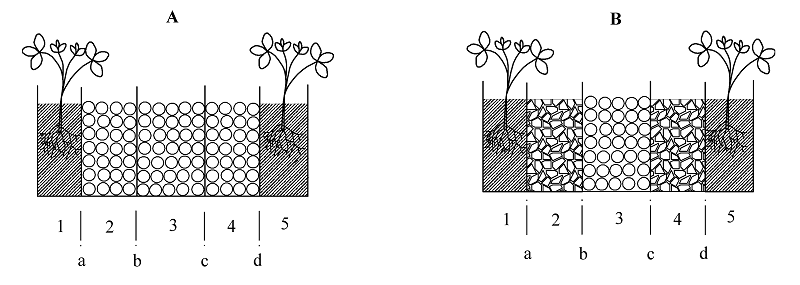
图1 常规(A)和改进(B)的玻璃珠分室培养装置。 a和d为1 mm尼龙网, b和c为30 μm尼龙网; 将装置分隔为5个分室, 其中1和5为植物生长室, 2和4为菌根生长室, 3为AM真菌菌丝生长室。在B装置的2和4菌根生长室中装满粗河砂来代替A装置中的玻 璃珠。
Fig. 1 Traditional (A) and modified (B) glass bead split-compartment culture system. a and d are nylon mesh screens of 1 mm, and b and c are nylon mesh screens of 30 μm; each container was separated into five compartments which 1 and 5 are plant growing compartments, 2 and 4 are mycorrhizal growing compartments, and 3 is the AM fungal hyphae growing compartment. The 2 and 4 compartments in B filled with coarse river sands instead of glass beads in A.
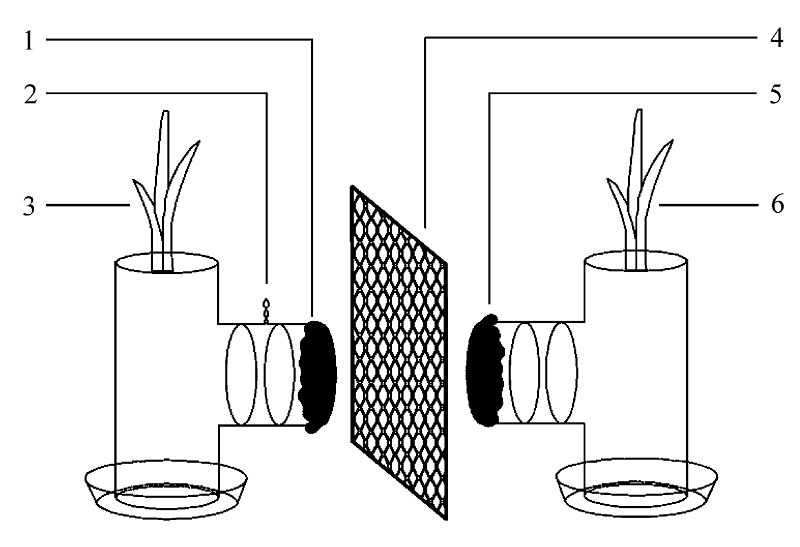
图2 H形装置结构构件图(改绘自Barto et al., 2011)。 1, 30 μm尼龙网; 2, 人工化感物质注入孔; 3, 供体植物; 4, 穿孔的钢板网; 5, 30 μm尼龙网; 6, 受体植物。30 μm尼龙网和穿孔钢板网将装置分隔为两个相同的分室。
Fig. 2 The two-compartment H-bridge cultivation system (Mo- dified from Barto et al., 2011). 1, nylon mesh screens of 30 μm; 2, injection hole for artificial allelochemicals; 3, donor plants; 4, perforated steel plates; 5, nylon mesh screens of 30 μm; 6, receiver plants. The device was separated by the nylon mesh screens of 30 μm and the perforated steel plates into two identical compartments.
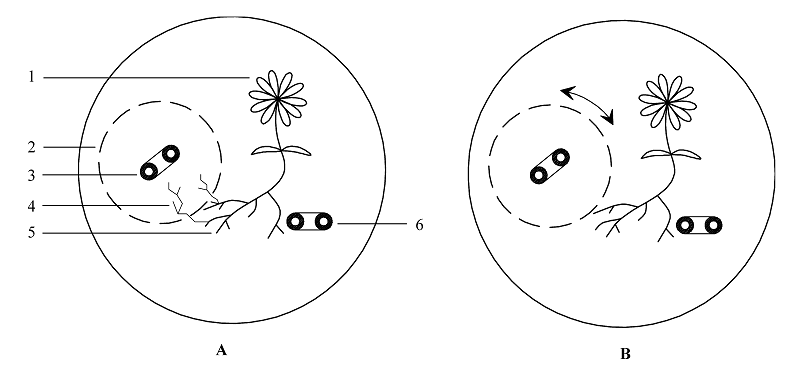
图3 根排斥室(RECs)培养系统示意图(改绘自Barto et al., 2011 和Babikova et al., 2013) 。 A, 根外菌丝进入REC。B, 旋转REC切断了共生菌根网络(CMNs)与RECs的联系。1, 可以产生化感物质的植物; 2, 根排斥室; 3, 根排斥室内PDMS微型管; 4, 根外菌丝; 5, 植物根系; 6, 根排斥室外PDMS微型管, 双向箭头代表旋转根排斥室。
Fig. 3 The root exclusion compartment (RECs) culture system (Modified from Barto et al., 2011 and Babikova et al., 2013). A, Extra-radical mycelium entering into REC. B, Spinning out REC to cut the communication between common mycorrhizal networks (CMNs) and RECs. 1, plants which can produce allelochemicals; 2, RECs; 3, intra-REC PDMS tubing; 4, external hyphae; 5, plant roots; 6, extra-REC PDMS tubing, and the doubled sided arrow stands for rotary RECs.
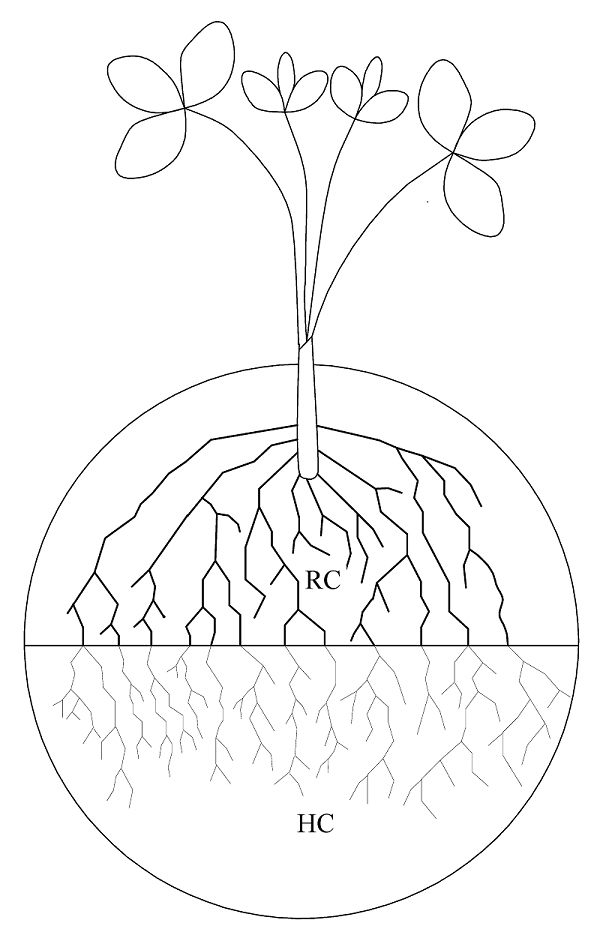
图4 供体自养植物双分室体外培养系统(改绘自Derelle et al., 2012)。 HC, 根外菌丝生长室; RC, 根系生长室。粗线代表供体自养植物的根系, 细线代表AM真菌根外菌丝。
Fig. 4 In vitro mycorrhizal donor plants culture system (Modified from Derelle et al., 2012). HC, external hyphae growing compartment; RC, root growing compartment; The thick line stands for roots of donor autotrophic plants, and the thin line stands for external hyphae.
| 1 |
Abdel Latef AAH, He CX ( 2011). Effect of arbuscular mycorrhizal fungi on growth, mineral nutrition, antioxidant enzymes activity and fruit yield of tomato grown under salinity stress. Scientia Horticulturae, 127, 228-233.
DOI URL |
| 2 |
Amir H, Lagrange A, Hassaïne N, Cavaloc Y ( 2013). Arbuscular mycorrhizal fungi from New Caledonian ultramafic soils improve tolerance to nickel of endemic plant species. Mycorrhiza, 23, 585-595.
DOI URL |
| 3 |
Babikova Z, Gilbert L, Bruce TJA, Birkett M, Caulfield JC, Woodcock C, Johnson D ( 2013). Underground signals carried through common mycelial networks warn neighbouring plants of aphid attack. Ecology Letters, 16, 835-843.
DOI URL |
| 4 |
Babikova Z, Johnson D, Bruce T, Pickett J, Gilbert L ( 2014). Underground allies: How and why do mycelial networks help plants defend themselves? BioEssays, 36, 21-26.
DOI URL |
| 5 |
Bago B, Azcón-Aguilar C, Piché Y ( 1998). Architecture and developmental dynamics of the external mycelium of the arbuscular mycorrhizal fungus Glomus intraradices grown under monoxenic conditions. Mycologia, 90, 52-62.
DOI URL |
| 6 |
Bais HP, Vepachedu R, Gilroy S, Callaway RM, Vivanco JM ( 2003). Allelopathy and exotic plant invasion: from molecules and genes to species interactions. Science, 301, 1377-1380.
DOI URL |
| 7 |
Barto EK, Hilker M, Müller F, Mohney BK, Weidenhamer JD, Rillig MC ( 2011). The fungal fast lane: common mycorrhizal networks extend bioactive zones of allelochemicals in soils. PLoS ONE, 6, e27195.
DOI URL |
| 8 |
Barto EK, Weidenhamer JD, Cipollini D, Rillig MC ( 2012). Fungal superhighways: Do common mycorrhizal networks enhance below ground communication? Trends in Plant Science, 17, 633-637.
DOI URL |
| 9 |
Bécard G, Fortin JA ( 1998). Early events of vesicular-arbuscular mycorrhizal formation on Ri T-DNA transformed roots. New Phytologist, 108, 211-218.
DOI URL |
| 10 |
Behie SW, Bidochka MJ ( 2014). Ubiquity of insect-derived nitrogen transfer to plants by endophytic insect-pathogenic fungi: an additional branch of the soil nitrogen cycle. Applied and Environmental Microbiology, 80, 1553-1560.
DOI URL |
| 11 | Bi YL, Wang HG, Li XL ( 1999). The morphological characteristics of AM symbiosis between arbuscular mycorrhizal fungus and transformed Ri T-DNA carrot roots. Mycosystema, 18, 159-163. (in Chinese with English abstract) |
| 12 | [ 毕银丽, 汪洪钢, 李晓林 ( 1999). 丛枝菌根真菌与转移Ri T-DNA胡萝卜根器官双重培养的形态学研究. 菌物系统, 18, 159-163.] |
| Bi YL, Wang HG, Li XL ( 2000). Establishment of dual culture for arbuscular mycorrhiza and formation of hyphosphere. Mycosystema, 19, 517-521. (in Chinese with English abstract) | |
| 13 | [ 毕银丽, 汪洪钢, 李晓林 ( 2000). 丛枝菌根的双重培养方法及其菌丝际的建立. 菌物系统, 19, 517-521.] |
| Blair AC, Hanson BD, Brunk GR, Marrs RA, Westra P, Nissen SJ, Hufbauer RA ( 2005). New techniques and findings in the study of a candidate allelochemical implicated in invasion success. Ecology Letters, 8, 1039-1047. | |
| 14 |
Callaway RM, Cipollini D, Barto K, Thelen GC, Hallett SG, Prati D, Klironomos J ( 2008). Novel weapons: invasive plant suppresses fungal mutualists in America but not in its native Europe. Ecology, 89, 1043-1055.
DOI URL |
| 15 |
Chabot S, Bel-Rhlid R, Chênevert R, Piché Y ( 1992). Hyphal growth promotion in vitro of the VA mycorrhizal fungus, Gigaspora margarita Becker & Hall, by the activity of structurally specific flavonoid compounds under CO2- enriched conditions. New Phytologist, 122, 461-467.
DOI URL |
| 16 |
Chen BD, Christie P, Li XL ( 2001). A modified glass bead compartment cultivation system for studies on nutrient and trace metal uptake by arbuscular mycorrhiza. Chemosphere, 42, 185-192.
DOI URL |
| 17 |
Chen SC, Jin WJ, Liu AR, Zhang SJ, Liu DL, Wang FH, Lin XM, He CX ( 2013). Arbuscular mycorrhizal fungi (AMF) increase growth and secondary metabolism in cucumber subjected to low temperature stress. Scientia Horticulturae, 160, 222-229.
DOI URL |
| 18 |
Derelle D, Declerck S, Genet P, Dajoz I, van Aarle IM ( 2012). Association of highly and weakly mycorrhizal seedlings can promote the extra-and intraradical development of a common mycorrhizal network. FEMS Microbiology Ecology, 79, 251-259.
DOI URL |
| 19 | Diop TA, Plenchette C, Strulu DG ( 1994a). In vitro culture of sheared mycorrhizal roots. Symbiosis, 17, 217-227. |
| 20 |
Diop TA, Plenchette C, Strullu DG ( 1994b). Dual axenic culture of sheared-root inocula of vesicular-arbuscular mycorrhizal fungi associated with tomato roots. Mycorrhiza, 5, 17-22.
DOI URL |
| 21 |
Douds Jr DD ( 1997). A procedure for the establishment of Glomus mosseae in dual culture with Ri T-DNA transformed carrot roots. Mycorrhiza, 7, 57-61.
DOI URL |
| 22 |
Douds Jr DD ( 2002). Increased spore production by Glomus intraradices in the split-plate monoxenic culture system by repeated harvest, gel replacement, and resupply of glucose to the mycorrhiza. Mycorrhiza, 12, 163-167.
DOI URL |
| 23 |
Egerton-Warburton LM, Querejeta JI, Allen MF ( 2007). Common mycorrhizal networks provide a potential pathway for the transfer of hydraulically lifted water between plants. Journal of Experimental Botany, 58, 1473-1483.
DOI URL |
| 24 |
Gadkar V, Driver JD, Rillig MC ( 2006). A novel in vitro cultivation system to produce and isolate soluble factors released from hyphae of arbuscular mycorrhizal fungi. Biotechnology Letters, 28, 1071-1076.
DOI URL |
| 25 | Göhre V, Paszkowski U ( 2006). Contribution of the arbuscular mycorrhizal symbiosis to heavy metal phytoremediation. Planta, 223, 1115-1122. |
| 26 |
Grunwald U, Guo WB, Fischer K, Isayenkov S, Ludwig-Müler J, Hause B, Yan XL, Küter H, Franken P ( 2009). Overlapping expression patterns and differential transcript levels of phosphate transporter genes in arbuscular mycorrhizal, Pi-fertilised and phytohormone-treated Medicago truncatula roots. Planta, 229, 1023-1034.
DOI URL |
| 27 | Gyuricza V, Thiry Y, Wannijn J, Declerck S, Dupré de Boulois H ( 2010). Radiocesium transfer between Medicago truncatula plants via a common mycorrhizal network. Environmental Microbiology, 12, 2180-2189. |
| 28 |
Hattingh MJ, Gray LE, Gerdemann WJ ( 1973). Uptake and translocation of 32P-labelled phosphate to onion roots by endomycorrhizal fungi . Soil Science, 116, 383-387.
DOI URL |
| 29 |
Karandashov V, Kuzovkina I, Hawkins H J, George E ( 2000). Growth and sporulation of the arbuscular mycorrhizal fungus Glomus caledonium in dual culture with transformed carrot roots. Mycorrhiza, 10, 23-28.
DOI URL |
| 30 |
Kaya C, Ashraf M, Sonmez O, Aydemir S, Tuna AL, Cullu MA ( 2009). The influence of arbuscular mycorrhizal colonisation on key growth parameters and fruit yield of pepper plants grown at high salinity. Scientia Horticulturae, 121, 1-6.
DOI URL |
| 31 |
Kaya C, Higgs D, Kirnak H, Tas I ( 2003). Mycorrhizal colonisation improves fruit yield and water use efficiency in watermelon ( Citrullus lanatus Thunb.) grown under well-watered and water-stressed conditions. Plant and Soil, 253, 287-292.
DOI URL |
| 32 |
Li XL, George E, Marschner H ( 1991). Extension of the phosphorus depletion zone in VA-mycorrhiza whiter clover in a calcareous soil. Plant and Soil, 136, 41-48.
DOI URL |
| 33 |
Liu Q, Parsons AJ, Xue H, Jones CS, Rasmussen S ( 2013). Functional characterisation and transcript analysis of an alkaline phosphatase from the arbuscular mycorrhizal fungus Funneliformis mosseae. Fungal Genetics and Biology, 54, 52-59.
DOI URL |
| 34 |
Maldonado-Mendoza IE, Dewbre GR, Harrison MJ ( 2001). A phosphate transporter gene from the extraradical mycelium of an arbuscular mycorrhizal fungus Glomus intraradices is regulated in response to phosphate in the environment. Molecular Plant-Microbe Interactions, 14, 1140-1148.
DOI URL |
| 35 |
Martínez-Medina A, Pascual JA, Pérez-Alfocea F, Albacete A, Roldán A ( 2010). Trichoderma harzianum and Glomus intraradices modify the hormone disruption induced by Fusarium oxysporum infection in melon plants. Phytopathology, 100, 682-688.
DOI URL |
| 36 |
Meding SM, Zasoski RJ ( 2008). Hyphal-mediated transfer of nitrate, arsenic, cesium, rubidium, and strontium between arbuscular mycorrhizal forbs and grasses from a California oak woodland. Soil Biology & Biochemistry, 40, 126-134.
DOI URL |
| 37 |
Mohney BK, Matz T, LaMoreaux J, Wilcox DS, Gimsing AL, Mayer P, Weidenhamer JD ( 2009). In situ silicone tube microextraction: a new method for undisturbed sampling of root-exuded thiophenes from marigold ( Tagetes erecta L.) in soil. Journal of Chemical Ecology, 35, 1279-1287.
DOI URL |
| 38 |
Mosse B, Hepper C ( 1975). Vesicular-arbuscular mycorrhiza infections in root organ cultures. Physiological Plant Pathology, 5, 215-223.
DOI URL |
| 39 |
Mugnier J, Mosse B ( 1987). Vesicular-arbuscular mycorrhizal infection in transformed Ri T-DNA roots grown axenically. Phytopathology, 77, 1045-1050.
DOI URL |
| 40 |
Nagahashi G, Douds Jr DD ( 2000). Partial separation of root exudate components and their effects upon the growth of germinated spores of AM fungi. Mycological Research, 104, 1453-1464.
DOI URL |
| 41 |
Navarro A, Elia A, Conversa G, Campi P, Mastrorilli M ( 2012). Potted mycorrhizal carnation plants and saline stress: growth, quality and nutritional plant responses. Scientia Horticulturae, 140, 131-139.
DOI URL |
| 42 |
Ooki A, Yokouchi Y ( 2008). Development of a silicone membrane tube equilibrator for measuring partial pressures of volatile organic compounds in natural water. Environmental Science & Technology, 42, 5706-5711.
DOI URL |
| 43 |
Plenchette C, Declerck S, Diop TA, Strullu DG ( 1996). Infectivity of monoaxenic subcultures of the arbuscular mycorrhizal fungus Glomus versiforme associated with Ri-T-DNA-transformed carrot root. Applied Microbiology and Biotechnology, 46, 545-548.
DOI URL |
| 44 | Redecker D, Thierfelder H, Werner D ( 1995). A new cultivation system for arbuscular mycorrhizal fungi on glass beads. Angewandte Botanik, 69, 189-191. |
| 45 |
Ren L, Lou Y, Zhang N, Zhu X, Hao W, Sun S, Xu G ( 2013). Role of arbuscular mycorrhizal network in carbon and phosphorus transfer between plants. Biology and Fertility of Soils, 49, 3-11.
DOI URL |
| 46 | Schüßler A, Walker C (2010). The Glomeromycota: a species list with new families and new genera. http://schuessler.userweb.mwn.de/amphylo/Schuessler&Walker2010_Glomeromycota.pdf . Cited: April 2014. |
| 47 | Smith SE, Read DJ (2008). Mycorrhizal Symbiosis. 3rd edn. Academic Press, New York. |
| 48 |
Soliman AS, Shanan NT, Massoud ON, Swelim DM ( 2014). Improving salinity tolerance of Acacia saligna(Labill.) plant by arbuscular mycorrhizal fungi and Rhizobium inoculation. African Journal of Biotechnology, 11, 1259-1266.
DOI URL |
| 49 |
Song YY, Cao M, Xie LJ, Liang XT, Zeng RS, Su YJ, Huang JH, Wang RL, Luo SM ( 2011). Induction of DIMBOA accumulation and systemic defense responses as mechanism of enhanced resistance of mycorrhizal corn ( Zea mays L.) to sheath blight. Mycorrhiza, 21, 721-731.
DOI URL |
| 50 | Song YY, Ye M, Li C, He X, Zhu-Salzman K, Wang RL, Zeng RS ( 2014). Hijacking common mycorrhizal networks for herbivore-induced defence signal transfer between tomato plants. Scientific Reports, 4, doi: 10.1038/srep03915. |
| 51 |
Song YY, Zeng RS, Xu JF, Li J, Shen X, Yihdego WG ( 2010). Interplant communication of tomato plants through underground commonmycorrhizal networks. PLoS ONE, 5, e13324.
DOI URL |
| 52 | St-Arnaud M, Hamel C, Vimard B, Caron M, Fortin JA ( 1995). Altered growth of Fusarium oxysporum f. sp. Chrysanthemi in an in vitro dual culture system with the vesicular- arbuscular mucorrhizal fungus Glomus intraradices growing on Daucus carota trasformed root. Mycorrhiza, 5, 431-438. |
| 53 |
St-Arnaud M, Hamel C, Vimard B, Caron M, Fortin JA ( 1996). Enhanced hyphal growth and spore production of the arbuscular mycorrhizal fungus Glomus intraradices in an in vitro system in the absence of host roots. Mycological Research, 100, 328-332.
DOI URL |
| 54 |
Tiwari P, Adholeya A ( 2002). In vitro co-culture of two AMF isolates Gigaspora margarita and Glomus intraradices on Ri T-DNA transformed roots. FEMS Microbiology Letters, 206, 39-43.
DOI URL |
| 55 |
Ulrich H, Katharina J, Hermann B ( 2002). Towards growth of arbscular mycorrhizal fungi independent of a plant host. Applied and Environmental Microbiology, 68, 1919-1924.
DOI URL |
| 56 |
Vági P, Knapp D G, Kósa A, Seress D, Horváth ÁN, Kovács GM ( 2014). Simultaneous specific in planta visualization of root-colonizing fungi using fluorescence in situ hybridization (FISH). Mycorrhiza, 24, 259-266.
DOI URL |
| 57 |
Vandenhove H, van Hees M, Vandecasteele C ( 2000). Potential side effects of ammonium-ferric-hexacyano-ferrate application: enhanced radiostrontium transfer and free cyanide release. Journal of Environmental Radioactivity, 47, 149-155.
DOI URL |
| 58 |
Voets L, de la Providencia IE, Fernandez K, IJdo M, Cranenbrouck S, Declerck S ( 2009). Extraradical mycelium network of arbuscular mycorrhizal fungi allows fast colonization of seedlings under in vitro conditions. Mycorrhiza, 19, 347-356.
DOI URL |
| 59 |
Voets L, Goubau I, Olsson PA, Merckx R, Declerck S ( 2008). Absence of carbon transfer between Medicago truncatula plants linked by a mycorrhizal network, demonstrated in an experimental microcosm. FEMS Microbiology Ecology, 65, 350-360.
DOI URL |
| 60 |
Vos C, Claerhout S, Mkandawire R, Panis B, de Waele D, Elsen A ( 2011). Arbuscular mycorrhizal fungi reduce root-knot nematode penetration through altered root exudation of their host. Plant and Soil, 354, 335-345.
DOI URL |
| 61 |
Walder F, Niemann H, Natarajan M, Lehmann MF, Boller T, Wiemken A ( 2012). Mycorrhizal networks: common goods of plants shared under unequal terms of trade. Plant Physiology, 159, 789-797.
DOI URL |
| 62 | Wang HG, Wu GY, Li HQ ( 1990). The penetration of vesicular arbuscular mycorrhizal fungi and rhizobium to the root organ of Phaseolus aureus Roxb. Microbiology, 17(4), 193-195. (in Chinese with English abstract) |
| 63 |
[ 汪洪钢, 吴观以, 李慧荃 ( 1990). VA菌根真菌与根瘤菌对离体绿豆根器官的侵染. 微生物学通报, 17(4), 193-195.]
DOI URL |
| Wu QS, Xia RX, Zou YN ( 2008). Improved soil structure and citrus growth after inoculation with three arbuscular mycorrhizal fungi under drought stress. European Journal of Soil Biology, 44, 122-128. | |
| 64 |
Xiao TJ, Yang QS, Ran W, Xu GH, Shen QR ( 2010). Effect of inoculation with arbuscular mycorrhizal fungus on nitrogen and phosphorus utilization in upland rice-mungbean intercropping system. Agricultural Sciences in China, 9, 528-535.
DOI URL |
| [1] | 魏莉, 王鹏森, 刘珊, 樊锐, 黄楠, 张建国, 其美拉姆, 苟扬, 刘沫含, 黄婷, 周冀琼. 丛枝菌根真菌对豆禾混播植物垂直生态位养分吸收的影响[J]. 植物生态学报, 2026, 50(3): 760-773. |
| [2] | 周春菡, 熊智诚, 杨明新, 史海兰, 周亚星, 唐玉, 张静, 纪宝明, 代心灵. 黄河源园区高寒湿地菌根真菌群落特征及其影响因素[J]. 植物生态学报, 2026, 50(3): 625-638. |
| [3] | 姜庆宏, 丁露, 王哲, 郑春丽, 冯昭绰. 丛枝菌根真菌与不同功能细菌联用对苜蓿的促生作用[J]. 植物生态学报, 2026, 50(3): 774-788. |
| [4] | 马建辉, 童鑫, 张思榕, 毛子昆, 秦俊, 马克平. 菌根真菌生理生态功能研究进展及展望[J]. 植物生态学报, 2026, 50(3): 498-514. |
| [5] | 王海浪, 付伟, 伍松林, 陈保冬. 丛枝菌根真菌生态功能及群落调控[J]. 植物生态学报, 2026, 50(3): 515-535. |
| [6] | 秦斐斐, 唐朝辉, 司彤, 慈敦伟. 盐碱耐受型和敏感型花生生长发育及根际土壤特性对丛枝菌根真菌的响应[J]. 植物生态学报, 2026, 50(3): 742-759. |
| [7] | 邹纪开, 吴佳怡, 谷云懿, 陈宝明. 不同形态氮添加与丛枝菌根真菌对外来入侵植物白花鬼针草竞争力的影响[J]. 植物生态学报, 2026, 50(3): 722-730. |
| [8] | 何正嘉, 曾歆然, 王琳影, 薛昕宇, 苏钦泽, 李宇, 张寅杰, 吴辉煌, 陈成聪, 吴良泉, 魏安妮, 仇云鹏, 郭梨锦. 茶园丛枝菌根真菌群落和土壤有机碳对镁肥的响应[J]. 植物生态学报, 2026, 50(3): 700-709. |
| [9] | 段世龙, 余成瑾, 许心垚, 冯固, 谢贤安, 张林. 植物-丛枝菌根真菌-细菌连续体及其维持机制[J]. 植物生态学报, 2026, 50(3): 600-611. |
| [10] | 江康威, 吕程, 王亚菲, 李宏, 张芷晴, 王雨, 张青青, 吐尔逊娜依•热依木. 放牧干扰下丛枝菌根真菌群落对土壤多功能性的影响[J]. 植物生态学报, 2026, 50(3): 685-699. |
| [11] | 何堂庆, 王变变, 曹鑫鑫, 张康成, 汪晓东, 王浩, 白彤硕, 赵叶新, 张艺, 王益, 仇云鹏, 胡水金. 半干旱草地植物和丛枝菌根真菌群落对长期降水增加的响应[J]. 植物生态学报, 2026, 50(3): 674-684. |
| [12] | 王梦雪, 胡明艳, 储诚进, 陈阳, 罗文启, 马子龙. 亚热带森林不同菌根真菌树种叶片和细根的碳氮磷化学计量特征[J]. 植物生态学报, 2026, 50(2): 334-343. |
| [13] | 张斌, 张浩成, 乔天, 吕治兵, 许亚男, 李雪芹, 原向阳, 冯美臣, 张美俊. 接种丛枝菌根真菌对干旱胁迫燕麦非结构性碳水化合物及碳氮磷化学计量特征的影响[J]. 植物生态学报, 2025, 49(7): 1082-1095. |
| [14] | 胡蝶, 蒋欣琪, 戴志聪, 陈戴一, 张雨, 祁珊珊, 杜道林. 丛枝菌根真菌提高入侵杂草南美蟛蜞菊对除草剂的耐受性[J]. 植物生态学报, 2024, 48(5): 651-659. |
| [15] | 陈科宇, 邢森, 唐玉, 孙佳慧, 任世杰, 张静, 纪宝明. 不同草地类型土壤丛枝菌根真菌群落特征及其驱动因素[J]. 植物生态学报, 2024, 48(5): 660-674. |
| 阅读次数 | ||||||
|
全文 |
|
|||||
|
摘要 |
|
|||||
Copyright © 2026 版权所有 《植物生态学报》编辑部
地址: 北京香山南辛村20号, 邮编: 100093
Tel.: 010-62836134, 62836138; Fax: 010-82599431; E-mail: apes@ibcas.ac.cn, cjpe@ibcas.ac.cn
备案号: 京ICP备16067583号-19

