
植物生态学报 ›› 2024, Vol. 48 ›› Issue (5): 651-659.DOI: 10.17521/cjpe.2023.0383 cstr: 32100.14.cjpe.2023.0383
所属专题: 入侵生态学
胡蝶1, 蒋欣琪1, 戴志聪2, 陈戴一1, 张雨1, 祁珊珊1,*( ), 杜道林3
收稿日期:2023-12-21
接受日期:2024-02-06
出版日期:2024-05-20
发布日期:2024-02-26
通讯作者:
(基金资助:
HU Die1, JIANG Xin-Qi1, DAI Zhi-Cong2, CHEN Dai-Yi1, ZHANG Yu1, QI Shan-Shan1,*(), DU Dao-Lin3
Received:2023-12-21
Accepted:2024-02-06
Online:2024-05-20
Published:2024-02-26
Contact:
(Supported by:摘要:
入侵杂草南美蟛蜞菊(Sphagneticola trilobata)的优势生长严重危害本土植物群落和生态系统的稳定性。近年来, 化学防治依然是最主要的杂草防控手段。丛枝菌根真菌(AMF)作为一种菌根共生体, 在宿主植物的生长和抵抗外界环境胁迫中起到重要的作用。该研究通过温室控制实验设置4种处理方式: 对照组、只接种AMF、只喷施除草剂以及喷施除草剂并接种AMF, 以验证AMF是否在入侵杂草南美蟛蜞菊响应除草剂中起到重要作用。结果显示: 在草甘膦铵盐除草剂的胁迫下, 南美蟛蜞菊的菌根侵染率、泡囊数以及菌根侵染丰度等级占比都显著上升; 相比于只喷施除草剂处理, 接种AMF显著增加南美蟛蜞菊的叶面积、地上生物量和根冠比, 显著减少黄酮醇相对含量以及叶片损害数。首次发现与AMF的共生能缓解除草剂对入侵杂草南美蟛蜞菊的胁迫。因此, 在杂草的化学防治过程中, 与AMF的共生可能极大提高杂草对除草剂的抗性, 可为入侵杂草的有效防控提供新的思考途径。
胡蝶, 蒋欣琪, 戴志聪, 陈戴一, 张雨, 祁珊珊, 杜道林. 丛枝菌根真菌提高入侵杂草南美蟛蜞菊对除草剂的耐受性. 植物生态学报, 2024, 48(5): 651-659. DOI: 10.17521/cjpe.2023.0383
HU Die, JIANG Xin-Qi, DAI Zhi-Cong, CHEN Dai-Yi, ZHANG Yu, QI Shan-Shan, DU Dao-Lin. Arbuscular mycorrhizal fungi enhance the capacity of invasive Sphagneticola trilobata to tolerate herbicides. Chinese Journal of Plant Ecology, 2024, 48(5): 651-659. DOI: 10.17521/cjpe.2023.0383
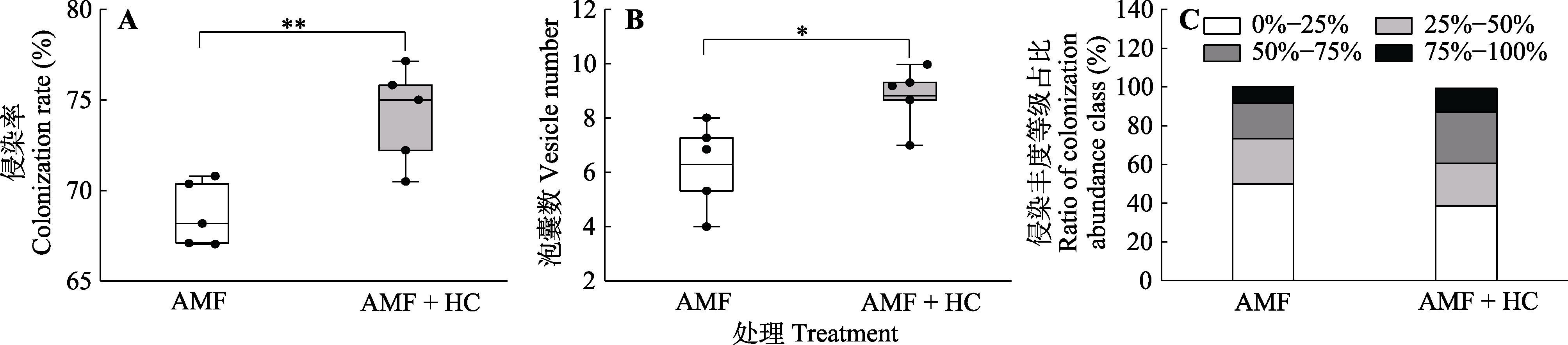
图1 不同处理下南美蟛蜞菊的菌根侵染率(A)、泡囊数(B)和侵染丰度等级占比(C) (平均值±标准差)。AMF, 接种丛枝菌根真菌; HC, 喷施除草剂。*, p < 0.05; **, p < 0.01。
Fig. 1 Arbuscular mycorrhizal fungi colonization rate (A), vesicle number (B), and ratio of colonization abundance class (C) of Sphagneticola trilobata under different treatments (mean ± SD). AMF, inoculating arbuscular mycorrhizal fungi; HC, apply herbicide treatment. *, p < 0.05; **, p < 0.01.
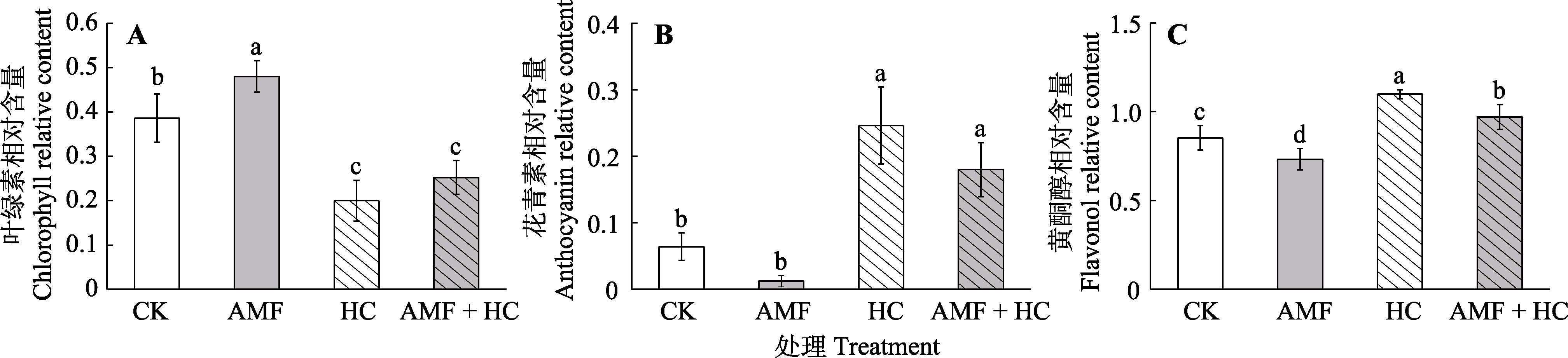
图2 不同处理下南美蟛蜞菊的叶绿素(A)、花青素(B)和黄酮醇(C)相对含量(平均值±标准差)。AMF, 只接种丛枝菌根真菌; CK, 对照; HC, 只喷施除草剂。不同小写字母表示不同处理间差异显著(n = 5, p < 0.05)。
Fig. 2 Chlorophyll (A), anthocyanin (B) and flavonol (C) relative content of Sphagneticola trilobata under different treatments (mean ± SD).AMF, only inoculating arbuscular mycorrhizal fungi; CK, control; HC, only applying herbicide. Different lowercase letters represent significant differences among different treatments (n = 5, p < 0.05).
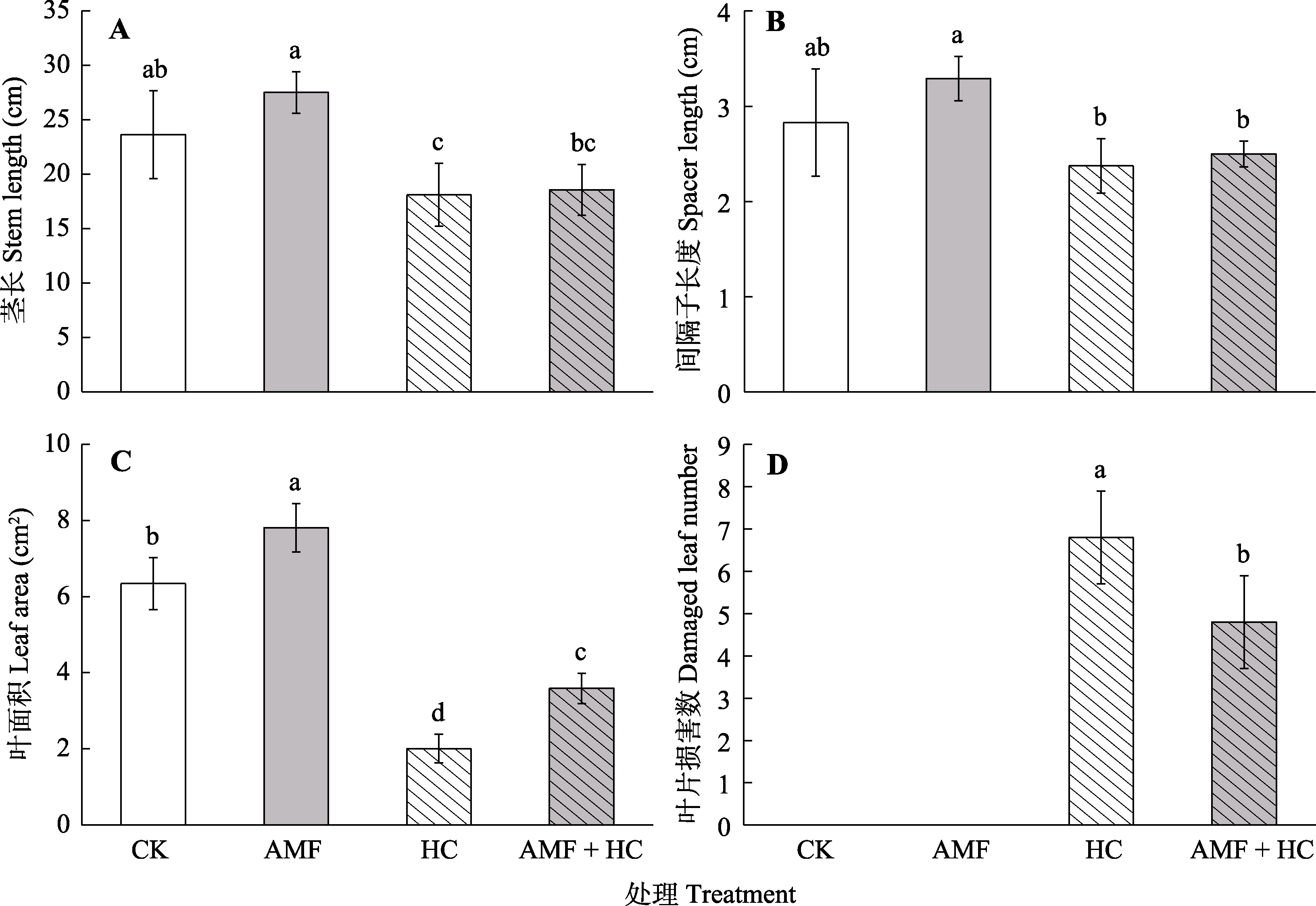
图3 不同处理下南美蟛蜞菊的茎长(A)、间隔子长度(B)、叶面积(C)和叶片损害数(D) (平均值±标准差)。AMF, 只接种丛枝菌根真菌; CK, 对照; HC, 只喷施除草剂。不同小写字母表示不同处理间差异显著(n = 5, p < 0.05)。
Fig. 3 Stem length (A), spacer length (B), leaf area (C), and damaged leaf number (D) of Sphagneticola trilobata under different treatments (mean ± SD). AMF, only inoculating arbuscular mycorrhizal fungi; CK, control; HC, only applying herbicide. Different lowercase letters represent significant differences among different treatments (n = 5, p < 0.05).
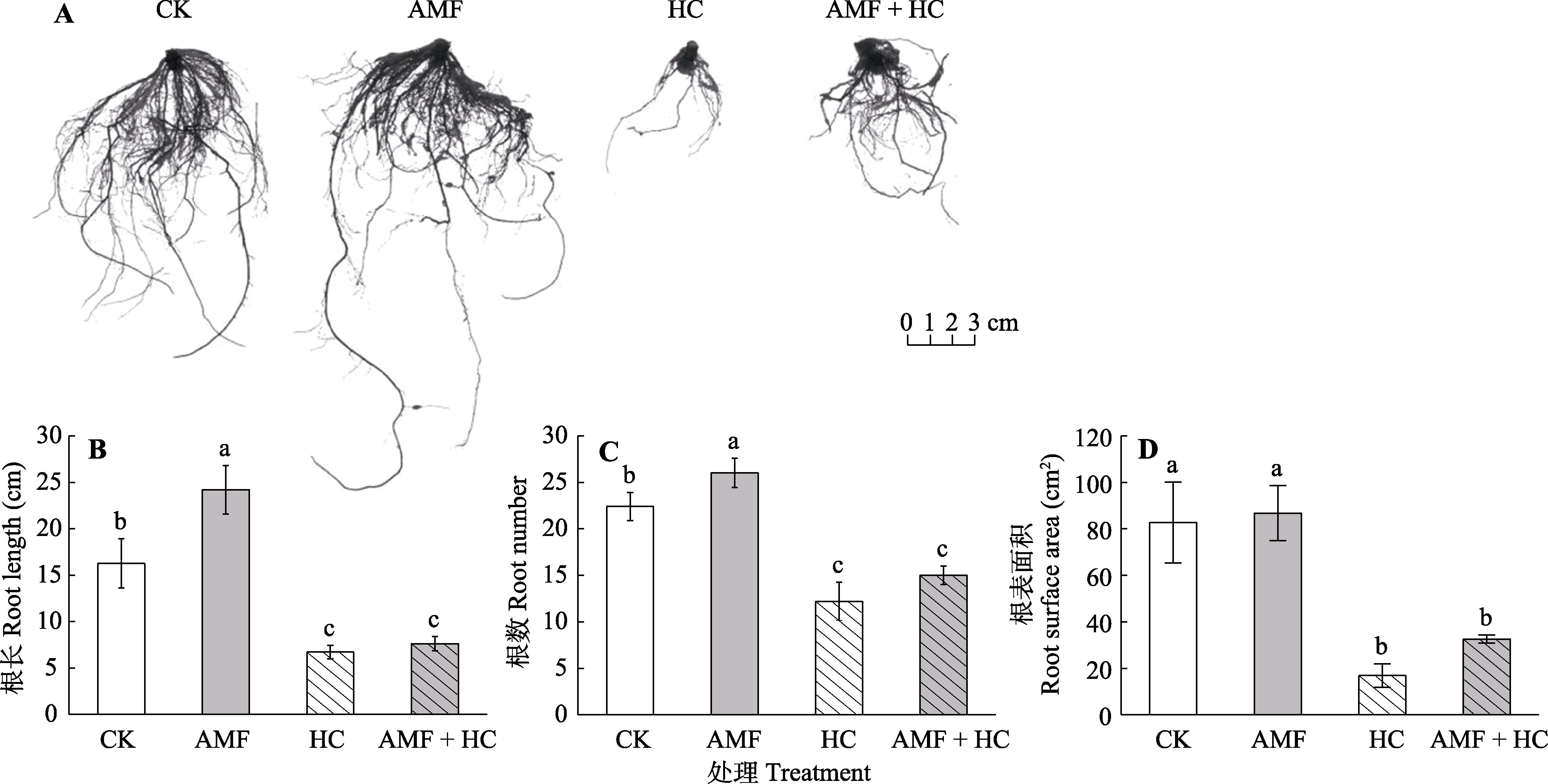
图4 不同处理下南美蟛蜞菊的根系形态(A)、根长(B)、根数(C)和根表面积(D) (平均值±标准差)。AMF, 只接种丛枝菌根真菌; CK, 对照; HC, 只喷施除草剂。不同小写字母表示不同处理间差异显著(n = 5, p < 0.05)。
Fig. 4 Root morphology (A), root length (B), root number (C), and root surface area (D) of Sphagneticola trilobata under different treatments (mean ± SD). AMF, only inoculating arbuscular mycorrhizal fungi; CK, control; HC, only applying herbicide. Different lowercase letters represent significant differences among different treatments (n = 5, p < 0.05).
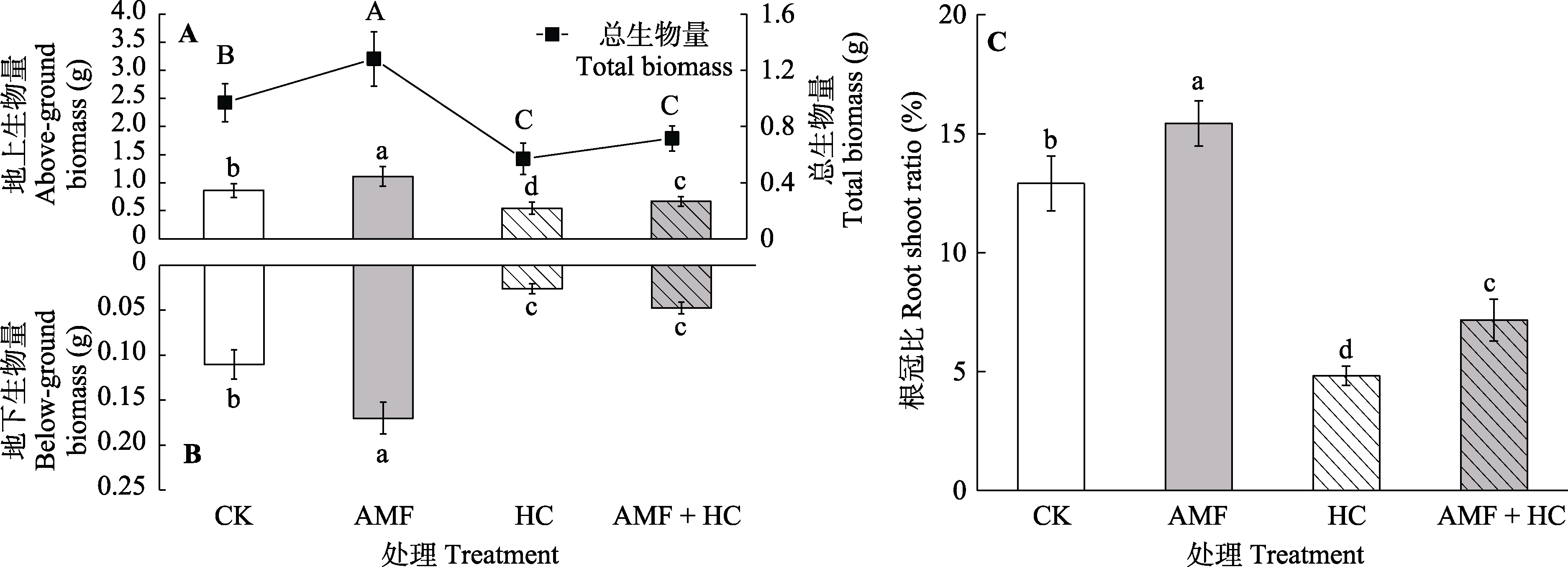
图5 不同处理下南美蟛蜞菊的地上生物量、总生物量(A)、地下生物量(B)和根冠比(C) (平均值±标准差)。AMF, 只接种丛枝菌根真菌; CK, 对照; HC, 只喷施除草剂。不同字母表示不同处理间差异显著(n = 5, p < 0.05)。
Fig. 5 Above-ground biomass, total biomass (A), below-ground biomass (B), and root shoot ratio (C) of Sphagneticola trilobata under different treatments (mean ± SD). AMF, only inoculating arbuscular mycorrhizal fungi; CK, control; HC, only applying herbicide. Different letters represent significant differences among different treatments (n = 5, p < 0.05).
| [1] | Brundrett MC, Tedersoo L (2018). Evolutionary history of mycorrhizal symbioses and global host plant diversity. New Phytologist, 220, 1108-1115. |
| [2] | Chen J, Zhang HQ, Zhang XL, Tang M (2017). Arbuscular mycorrhizal symbiosis alleviates salt stress in black locust through improved photosynthesis, water status, and K+/Na+ homeostasis. Frontiers in Plant Science, 8, 1739. DOI: 10.3389/fpls.2017.01739. |
| [3] | Chen Q, Cheng H, Li Q, He FR, Wu WW, Qi SS, Dai ZC, Du DL (2020). Arbuscular mycorrhizal fungi promote the growth of Wedelia trilobata under low phosphorus environment. Jiangsu Agricultural Sciences, 48, 103-107. |
| [陈琪, 程浩, 李琴, 贺芙蓉, 吴闻文, 祁珊珊, 戴志聪, 杜道林 (2020). 丛枝菌根真菌促进南美蟛蜞菊在低磷环境下的生长. 江苏农业科学, 48, 103-107.] | |
| [4] | Chen Q, Wu W, Qi S, Cheng H, Li Q, Ran Q, Dai Z, Du D, Egan S, Thomas T (2021). Arbuscular mycorrhizal fungi improve the growth and disease resistance of the invasive plant Wedelia trilobata. Journal of Applied Microbiology, 130, 582-591. |
| [5] |
Cornelissen JHC, Song Y, Yu F, Dong M (2014). Plant traits and ecosystem effects of clonality: a new research agenda. Annals of Botany, 114, 369-376.
DOI PMID |
| [6] | Courchamp F, Fournier A, Bellard C, Bertelsmeier C, Bonnaud E, Jeschke JM, Russell JC (2017). Invasion biology: specific problems and possible solutions. Trends in Ecology & Evolution, 32, 13-22. |
| [7] | Davidson BE, Novak SJ, Serpe MD (2016). Consequences of inoculation with native arbuscular mycorrhizal fungi for root colonization and survival of Artemisia tridentata ssp. wyomingensis seedlings after transplanting. Mycorrhiza, 26, 595-608. |
| [8] | Dowarah B, Gill SS, Agarwala N (2022). Arbuscular mycorrhizal fungi in conferring tolerance to biotic stresses in plants. Journal of Plant Growth Regulation, 41, 1429-1444. |
| [9] |
Duke SO, Powles SB (2008). Glyphosate: a once-in-a-century herbicide. Pest Management Science, 64, 319-325.
DOI PMID |
| [10] | Elsheikh EAE, El-Keblawy A, Mosa KA, Okoh AI, Saadoun I (2021). Role of endophytes and rhizosphere microbes in promoting the invasion of exotic plants in arid and semi-arid areas: a review. Sustainability, 13, 13081. DOI: 10.3390/su132313081. |
| [11] | Faria AT, de Seia Gonçalves BF, Saraiva DT, de Freitas Souza M, da Silva AA, Silva DV (2018). Activity of rhizosphere soil microorganisms of sugarcane cultivars after spraying of herbicides: diuron, tebuthiuron, ametryn and diuron + hexazinone. Revista Caatinga, 31, 593-601. |
| [12] | Fomina M, Ritz K, Gadd GM (2003). Nutritional influence on the ability of fungal mycelia to penetrate toxic metal- containing domains. Mycological Research, 107, 861-871. |
| [13] | Gao XP, Guo HH, Zhang Q, Guo HX, Zhang L, Zhang CY, Gou ZY, Liu Y, Wei JM, Chen AY, Chu ZH, Zeng FC (2020). Arbuscular mycorrhizal fungi (AMF) enhanced the growth, yield, fiber quality and phosphorus regulation in upland cotton (Gossypium hirsutum L.). Scientific Reports, 10, 2084. DOI: 10.1038/s41598-020-59180-3. |
| [14] | Gao Y, Liu H, Tao B (2013). Screening for glyphosate resistant wild soybean (Glycine soja) and study on its physiological mechanisms of resistance. Agricultural Science & Technology, 14, 1263-1266. |
| [高越, 刘辉, 陶波 (2013). 抗草甘膦野生大豆筛选及其抗性生理机制研究. 农业科学与技术, 14, 1263-1266.] | |
| [15] | Gharineh MH, Nadian H, Fathi G, Siadat A, Maadi B (2009). Role of arbuscular mycorrhizae in development of salt- tolerance of Trifolium alexandrinum plants under salinity stress. Journal of Food Agriculture and Environment, 7, 432-437. |
| [16] | Guo SL, Jiang HW, Fang F, Chen GQ (2009). Influences of herbicides, uprooting and use as cut flowers on sexual reproduction of Solidago canadensis. Weed Research, 49, 291-299. |
| [17] | Hao ZP, Xie W, Chen BD (2019). Arbuscular mycorrhizal symbiosis affects plant immunity to viral infection and accumulation. Viruses, 11, 534. DOI: 10.3390/v11060534. |
| [18] |
Helander M, Saloniemi I, Saikkonen K (2012). Glyphosate in northern ecosystems. Trends in Plant Science, 17, 569-574.
DOI PMID |
| [19] | Henry WB, Koger CH, Shaner DL (2005). Accumulation of shikimate in corn and soybean exposed to various rates of glyphosate. Crop Management, 4, 1-7. |
| [20] |
Huang X, He J, Yan X, Hong Q, Chen K, He Q, Zhang L, Liu XW, Chuang SC, Li SP, Jiang JD (2017). Microbial catabolism of chemical herbicides: microbial resources, metabolic pathways and catabolic genes. Pesticide Biochemistry and Physiology, 143, 272-297.
DOI PMID |
| [21] | Hulme PE (2012). Weed risk assessment: a way forward or a waste of time. Journal of Applied Ecology, 49, 10-19. |
| [22] |
Jajoo A, Mathur S (2021). Role of arbuscular mycorrhizal fungi as an underground saviuor for protecting plants from abiotic stresses. Physiology and Molecular Biology of Plants, 27, 2589-2603.
DOI PMID |
| [23] | Jakobsen I, Murmann LM, Rosendahl S (2021). Hormetic responses in arbuscular mycorrhizal fungi. Soil Biology & Biochemistry, 159, 108299. DOI: 10.1016/j.soilbio.2021. 108299. |
| [24] | Jeong S, Kim TM, Choi B, Kim Y, Kim E (2021). Invasive Lactuca serriola seeds contain endophytic bacteria that contribute to drought tolerance. Scientific Reports, 11, 13307. DOI: 10.1038/s41598-021-92706-x. |
| [25] |
Jiang YN, Wang WX, Xie QJ, Liu N, Liu LX, Wang DP, Zhang XW, Yang C, Chen XY, Tang DZ, Wang ET (2017). Plants transfer lipids to sustain colonization by mutualistic mycorrhizal and parasitic fungi. Science, 356, 1172-1175.
DOI PMID |
| [26] | Ke ZH, Chen YF, Hui M, Song LY (2014). Comparative study on allelopathic effects of Wedelia trilobata and Wedelia chinensis. Journal of South China Normal Univesity (Natural Science Edition), 46(1), 83-88. |
| [柯展鸿, 陈雁飞, 惠苗, 宋莉英 (2014). 南美蟛蜞菊和蟛蜞菊化感作用的比较研究. 华南师范大学学报(自然科学版), 46(1), 83-88.] | |
| [27] |
Landwehr M, Hildebrandt U, Wilde P, Nawrath K, Tóth T, Biró B, Bothe H (2002). The arbuscular mycorrhizal fungus Glomus geosporum in European saline, sodic and gypsum soils. Mycorrhiza, 12, 199-211.
PMID |
| [28] |
Lenoir I, Fontaine J, Lounès-Hadj Sahraoui A(2016). Arbuscular mycorrhizal fungal responses to abiotic stresses: a review. Phytochemistry, 123, 4-15.
DOI PMID |
| [29] | Li H, Wu ZH, Wang ZC, Xu YX, Chen SX (2013). Studies on the effectiveness of different herbicides mixtures on Wedelia trilobata under young Eucalyptus urophylla × E. grandis. Eucalypt Science and Technology, 30(2), 15-20. |
| [李慧, 吴志华, 王志超, 许宇星, 陈少雄 (2013). 不同除草剂复配对幼龄尾巨桉林下南美蟛蜞菊的防治效果研究. 桉树科技, 30(2), 15-20.] | |
| [30] | Liu J, Dong M, Miao SL, Li ZY, Song MH, Wang RQ (2006). Invasive alien plants in China: role of clonality and geographical origin. Biological Invasions, 8, 1461-1470. |
| [31] | Lowe S, Browne M, Boudjelas S, De Poorter M (2000). 100 of the World’s Worst Invasive Alien Species. Invasive Species Specialist Group, Auckland, New Zealand. |
| [32] | Malty JD, Siqueira JO, Moreira FMD (2006). Effects of glyphosate on soybean symbiotic microorganisms, in culture media and in greenhouse. Pesquisa Agropecuaria Brasileira, 41, 285-291. |
| [33] | Miozzi L, Vaira AM, Catoni M, Fiorilli V, Accotto GP, Lanfranco L (2019). Arbuscular mycorrhizal symbiosis: plant friend or foe in the fight against viruses. Frontiers in Microbiology, 10, 1238. DOI: 10.3389/fmicb.2019.01238. |
| [34] | Morandi D (1989). Effect of xenobiotics on endomycorrhizal infections and isoflavonoid accumulation in soybean roots. Plant Physiology and Biochemistry, 27, 697-701. |
| [35] | Oliveira CM, Auad AM, Mendes SM, Frizzas MR (2014). Crop losses and the economic impact of insect pests on Brazilian agriculture. Crop Protection, 56, 50-54. |
| [36] |
Olszyk D, Pfleeger T, Lee EH, Plocher M (2015). Glyphosate and dicamba herbicide tank mixture effects on native plant and non-genetically engineered soybean seedlings. Ecotoxicology, 24, 1014-1027.
DOI PMID |
| [37] | Pang F, Xia WK, He M, Qi SS, Dai ZC, Du DL (2020). Nitrogen-fixing bacteria alleviates competition between arbuscular mycorrhizal fungi and Solidago canadensis for nutrients under nitrogen limitation. Chinese Journal of Plant Ecology, 44, 782-790. |
| [庞芳, 夏维康, 何敏, 祁珊珊, 戴志聪, 杜道林 (2020). 固氮菌缓解氮限制环境中丛枝菌根真菌对加拿大一枝黄花的营养竞争. 植物生态学报, 44, 782-790.] | |
| [38] | Phillips JM, Hayman DS (1970). Improved procedures for clearing roots and staining parasitic and vesicular-arbuscular mycorrhizal fungi for rapid assessment of infection. Transactions of the British Mycological Society, 55, 158-161. |
| [39] | Ruuskanen S, Fuchs B, Nissinen R, Puigbò P, Rainio M, Saikkonen K, Helander M (2023). Ecosystem consequences of herbicides: the role of microbiome. Trends in Ecology & Evolution, 38, 35-43. |
| [40] | Savin MC, Purcell LC, Daigh A, Manfredini A (2009). Response of mycorrhizal infection to glyphosate applications and P fertilization in glyphosate-tolerant soybean, maize, and cotton. Journal of Plant Nutrition, 32, 1702-1717. |
| [41] | Shen K, Cornelissen JHC, Wang Y, Wu C, He Y, Ou J, Tan Q, Xia T, Kang L, Guo Y, Wu B (2020). AM fungi alleviate phosphorus limitation and enhance nutrient competitiveness of invasive plants via mycorrhizal networks in karst areas. Frontiers in Ecology and Evolution, 8, 125. DOI: 10.3389/fevo.2020.00125. |
| [42] |
Tian B, Pei Y, Huang W, Ding J, Siemann E (2021). Increasing flavonoid concentrations in root exudates enhance associations between arbuscular mycorrhizal fungi and an invasive plant. ISME Journal, 15, 1919-1930.
DOI PMID |
| [43] | Tian XJ, Li X, Shen YM, Shen DR, He C (2018). Effects of glyphosate on physiology and genotoxicity of Wedelia trilobata. Journal of Honghe University, 16(5), 150-152. |
| [田学军, 李珣, 沈云玫, 沈登荣, 何超 (2018). 草甘膦对南美蟛蜞菊的遗传毒性和生理的影响. 红河学院学报, 16(5), 150-152.] | |
| [44] | Tian XJ, Tao HZ, Shen YM, Yuan H, Shen DR, He C (2016). Effects of atrazine on antioxidase activity and genotoxicity of Wedelia trilobata (L.) A. S. Hitche. Agrochemicals, 55, 672-674. |
| [田学军, 陶宏征, 沈云玫, 袁寒, 沈登荣, 何超 (2016). 莠去津对南美蟛蜞菊抗氧化酶活性的影响与细胞毒性. 农药, 55, 672-674.] | |
| [45] | Trouvelot A (1986). Mesure du taux de mycorhization va d’un système radiculaire. Recherche de méthodes d’estimation ayant une signification fonctionnelle//Gianinazzi-Pearson V, Gianinazzi S. Mycorrhizae: Physiology and Genetics. INRA Press, Paris. |
| [46] | van Bruggen AHC, He M, Shin K, Mai V, Jeong KC, Finckh MR, Morris JG (2018). Environmental and health effects of the herbicide glyphosate. Science of the Total Environment, 616-617, 255-268. |
| [47] | Velmourougane K, Blaise D, Manikandan A, Savitha S, Waghmare VN (2021). Environmental impacts of herbicide tolerant crops and glyphosate-based herbicides—A review. Applied Ecology and Environmental Research, 19, 3481-3504. |
| [48] | Wang JH, Hu D, Shi XN, Luo J, Ren GQ, Dai ZC, Qi SS, Du DL (2022). Different responses of invasive weed Alternanthera philoxeroides and Oryza sativa to plant growth regulators. Life-Basel, 12, 1069. DOI: 10.3390/life12071069. |
| [49] | Wang Q, Liu GD (2020). A method for detecting arbuscular mycorrhizal fungi based on amplicon sequencing. Genomics and Applied Biology, 39, 5617-5624. |
| [王启, 刘广达 (2020). 一种基于扩增子测序检测丛枝菌根真菌的方法. 基因组学与应用生物学, 39, 5617-5624.] | |
| [50] |
Winagraski E, Kaschuk G, Monteiro PHR, Auer CG, Higa AR (2019). Diversity of arbuscular mycorrhizal fungi in forest ecosystems of Brazil: a review. Cerne, 25, 25-35.
DOI |
| [51] | Wu YQ, Hu JS (2006). Wedelia trilobata responses to herbicides’ stress and its chemical control. Ecological Science, 25, 325-329. |
| [吴彦琼, 胡劲松 (2006). 南美蟛蜞菊对除莠剂的胁迫反应及其化学防除. 生态科学, 25, 325-329.] | |
| [52] | Wu YQ, Hu YJ, Liao FL (2005). Wedelia trilobata—A species from introduced to potential invasive. Guihaia, 25, 413-418. |
| [吴彦琼, 胡玉佳, 廖富林 (2005). 从引进到潜在入侵的植物——南美蟛蜞菊. 广西植物, 25, 413-418.] | |
| [53] | Yang LQ, Liao FY, Zhao K (2011). Effect of herbicides on the photosynthetic rate and chlorophyll fluorescence of Solidago canadensis L. Advanced Materials Research, 356-360, 2785-2790. |
| [54] | Yang RY, Yu GD, Tang JJ, Chen X (2008). Effects of metal lead on growth and mycorrhizae of an invasive plant species (Solidago canadensis L.). Journal of Environmental Sciences, 20, 739-744. |
| [55] | Zhang F, Li Q, Yerger EH, Chen X, Shi Q, Wan F (2018). AM fungi facilitate the competitive growth of two invasive plant species, Ambrosia artemisiifolia and Bidens pilosa. Mycorrhiza, 28, 703-715. |
| [56] | Zou TT, Jin CZ, Zhu ZJ, Hu YH (2019). Detection of glyphosate resistance in black nightshade Solanum nigrum from Hunan China. Science Asia, 45, 419-424. |
| [1] | 陈科宇, 邢森, 唐玉, 孙佳慧, 任世杰, 张静, 纪宝明. 不同草地类型土壤丛枝菌根真菌群落特征及其驱动因素[J]. 植物生态学报, 2024, 48(5): 660-674. |
| [2] | 陈保冬, 付伟, 伍松林, 朱永官. 菌根真菌在陆地生态系统碳循环中的作用[J]. 植物生态学报, 2024, 48(1): 1-20. |
| [3] | 杨佳绒, 戴冬, 陈俊芳, 吴宪, 刘啸林, 刘宇. 丛枝菌根真菌多样性对植物群落构建和稀有种维持的研究进展[J]. 植物生态学报, 2023, 47(6): 745-755. |
| [4] | 何斐, 李川, Faisal SHAH, 卢谢敏, 王莹, 王梦, 阮佳, 魏梦琳, 马星光, 王卓, 姜浩. 丛枝菌根菌丝桥介导刺槐-魔芋间碳转运和磷吸收[J]. 植物生态学报, 2023, 47(6): 782-791. |
| [5] | 谢伟, 郝志鹏, 张莘, 陈保冬. 丛枝菌根网络介导的植物间信号交流研究进展及展望[J]. 植物生态学报, 2022, 46(5): 493-515. |
| [6] | 马炬峰, 辛敏, 徐陈超, 祝琬莹, 毛传澡, 陈欣, 程磊. 丛枝菌根真菌与氮添加对不同根形态基因型水稻氮吸收的影响[J]. 植物生态学报, 2021, 45(7): 728-737. |
| [7] | 庞芳, 夏维康, 何敏, 祁珊珊, 戴志聪, 杜道林. 固氮菌缓解氮限制环境中丛枝菌根真菌对加拿大一枝黄花的营养竞争[J]. 植物生态学报, 2020, 44(7): 782-790. |
| [8] | 崔利, 郭峰, 张佳蕾, 杨莎, 王建国, 孟静静, 耿耘, 李新国, 万书波. 摩西斗管囊霉改善连作花生根际土壤的微环境[J]. 植物生态学报, 2019, 43(8): 718-728. |
| [9] | 高文童, 张春艳, 董廷发, 胥晓. 丛枝菌根真菌对不同性别组合模式下青杨雌雄植株根系生长的影响[J]. 植物生态学报, 2019, 43(1): 37-45. |
| [10] | 徐丽娇, 郝志鹏, 谢伟, 李芳, 陈保冬. 丛枝菌根真菌根外菌丝跨膜H +和Ca 2+流对干旱胁迫的响应[J]. 植物生态学报, 2018, 42(7): 764-773. |
| [11] | 刘海跃, 李欣玫, 张琳琳, 王姣姣, 贺学礼. 西北荒漠带花棒根际丛枝菌根真菌生态地理分布[J]. 植物生态学报, 2018, 42(2): 252-260. |
| [12] | 陈宝明, 韦慧杰, 陈伟彬, 朱政财, 原亚茹, 张永隆, 蓝志刚. 外来入侵植物对土壤氮转化主要过程及相关微生物的影响[J]. 植物生态学报, 2018, 42(11): 1071-1081. |
| [13] | 杨海水, 王琪, 郭伊, 熊艳琴, 许明敏, 戴亚军. 丛枝菌根真菌群落与植物系统发育的相关性分析[J]. 植物生态学报, 2015, 39(4): 383-387. |
| [14] | 闫姣,贺学礼,张亚娟,许伟,张娟,赵丽莉. 荒漠北沙柳根系丛枝菌根真菌和黑隔内生真菌定殖状况[J]. 植物生态学报, 2014, 38(9): 949-958. |
| [15] | 刘婷,唐明. 丛枝菌根真菌对杨树生长、气孔和木质部微观结构的影响[J]. 植物生态学报, 2014, 38(9): 1001-1007. |
| 阅读次数 | ||||||
|
全文 |
|
|||||
|
摘要 |
|
|||||
Copyright © 2022 版权所有 《植物生态学报》编辑部
地址: 北京香山南辛村20号, 邮编: 100093
Tel.: 010-62836134, 62836138; Fax: 010-82599431; E-mail: apes@ibcas.ac.cn, cjpe@ibcas.ac.cn
备案号: 京ICP备16067583号-19
