
植物生态学报 ›› 2014, Vol. 38 ›› Issue (8): 878-887.DOI: 10.3724/SP.J.1258.2014.00082 cstr: 32100.14.SP.J.1258.2014.00082
乔丽青1,2, 田大栓2, 万宏伟2, 宝音陶格涛1,*( ), 潘庆民2,*()
收稿日期:2014-04-15
接受日期:2014-05-22
出版日期:2014-04-15
发布日期:2014-08-18
作者简介:bytgtnm@126.com基金资助:
QIAO Li-Qing1,2, TIAN Da-Shuan2, WAN Hong-Wei2, BAOYIN Taogetao1,*(), PAN Qing-Min2,*()
Received:2014-04-15
Accepted:2014-05-22
Online:2014-04-15
Published:2014-08-18
摘要:
放牧是内蒙古草原最主要的利用方式, 而草原植物在不同放牧压力下的生长和繁殖策略是它们与有蹄类动物长期协同进化的结果。为了了解瓣蕊唐松草(Thalictrum petaloideum)的生长和繁殖策略如何响应载畜率的变化, 作者依托中国科学院内蒙古草原站的大型放牧实验平台, 从种群、个体和器官三个组织水平上研究了该物种对放牧强度的响应。结果表明: 1)在种群水平上, 随着载畜率的增加, 瓣蕊唐松草减少了生殖株丛数或不进行有性生殖生长。该实验条件下, 载畜率每hm 2 7.5只羊(夏季)是瓣蕊唐松草不再进行生殖生长的阈值; 2)在个体水平上, 随着载畜率的增加, 瓣蕊唐松草降低了株高和个体生物量, 减少了生殖枝、花朵和种子等生殖器官的数量。随着载畜率的增加, 瓣蕊唐松草生殖分配的调节从依赖于植株个体大小向不依赖于植株个体大小转变。3)在器官水平上, 随着载畜率的增加, 瓣蕊唐松草减少了生殖枝的花朵负荷, 提高了单粒质量。籽粒数量和籽粒质量之间的权衡是瓣蕊唐松草应对放牧干扰的重要机制。
乔丽青, 田大栓, 万宏伟, 宝音陶格涛, 潘庆民. 不同载畜率下瓣蕊唐松草的生长和繁殖对策. 植物生态学报, 2014, 38(8): 878-887. DOI: 10.3724/SP.J.1258.2014.00082
QIAO Li-Qing, TIAN Da-Shuan, WAN Hong-Wei, BAOYIN Taogetao, PAN Qing-Min. Growth and reproductive strategies of Thalictrum petaloideum under different stocking rates. Chinese Journal of Plant Ecology, 2014, 38(8): 878-887. DOI: 10.3724/SP.J.1258.2014.00082
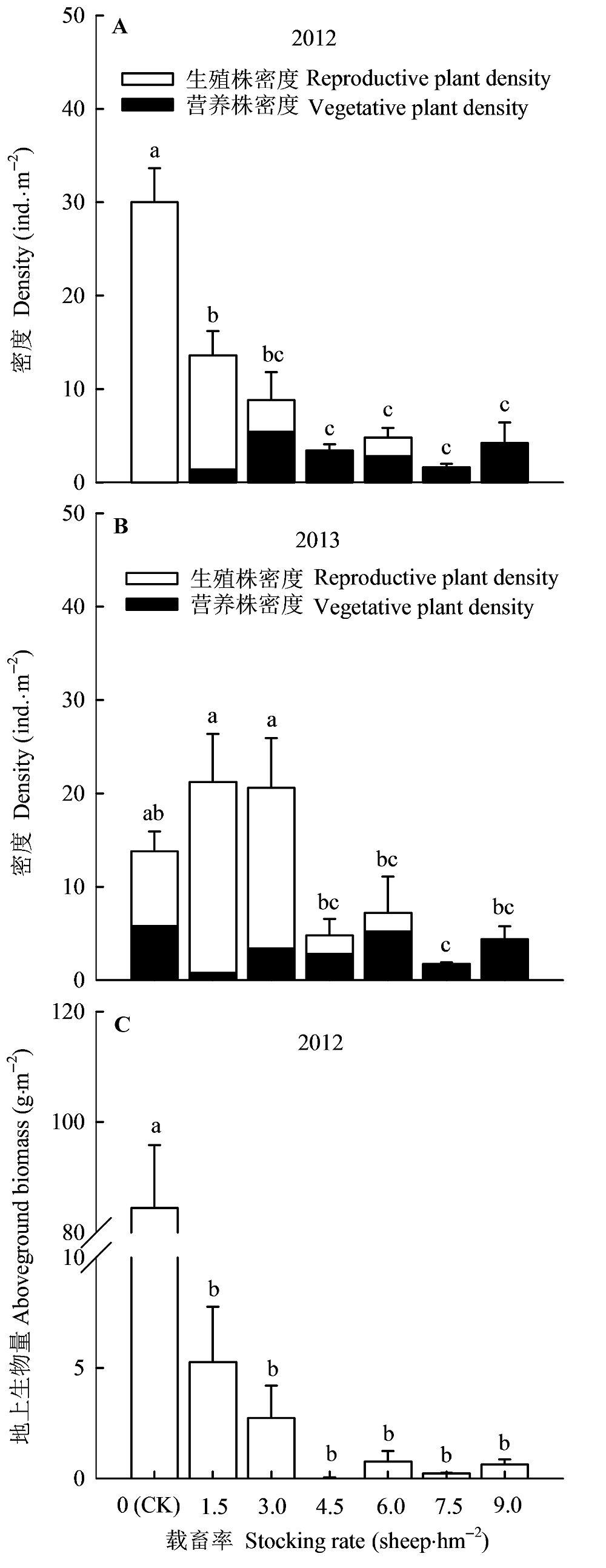
图1 不同载畜率下瓣蕊唐松草的密度和地上生物量(平均值±标准误差, n = 5)。不同的小写字母表示在0.05水平上差异显著。
Fig. 1 Density and aboveground biomass of Thalictrum petaloideum population under different stocking rates (mean ± SE, n = 5). Different lowercase letters indicate significant differences (p < 0.05).
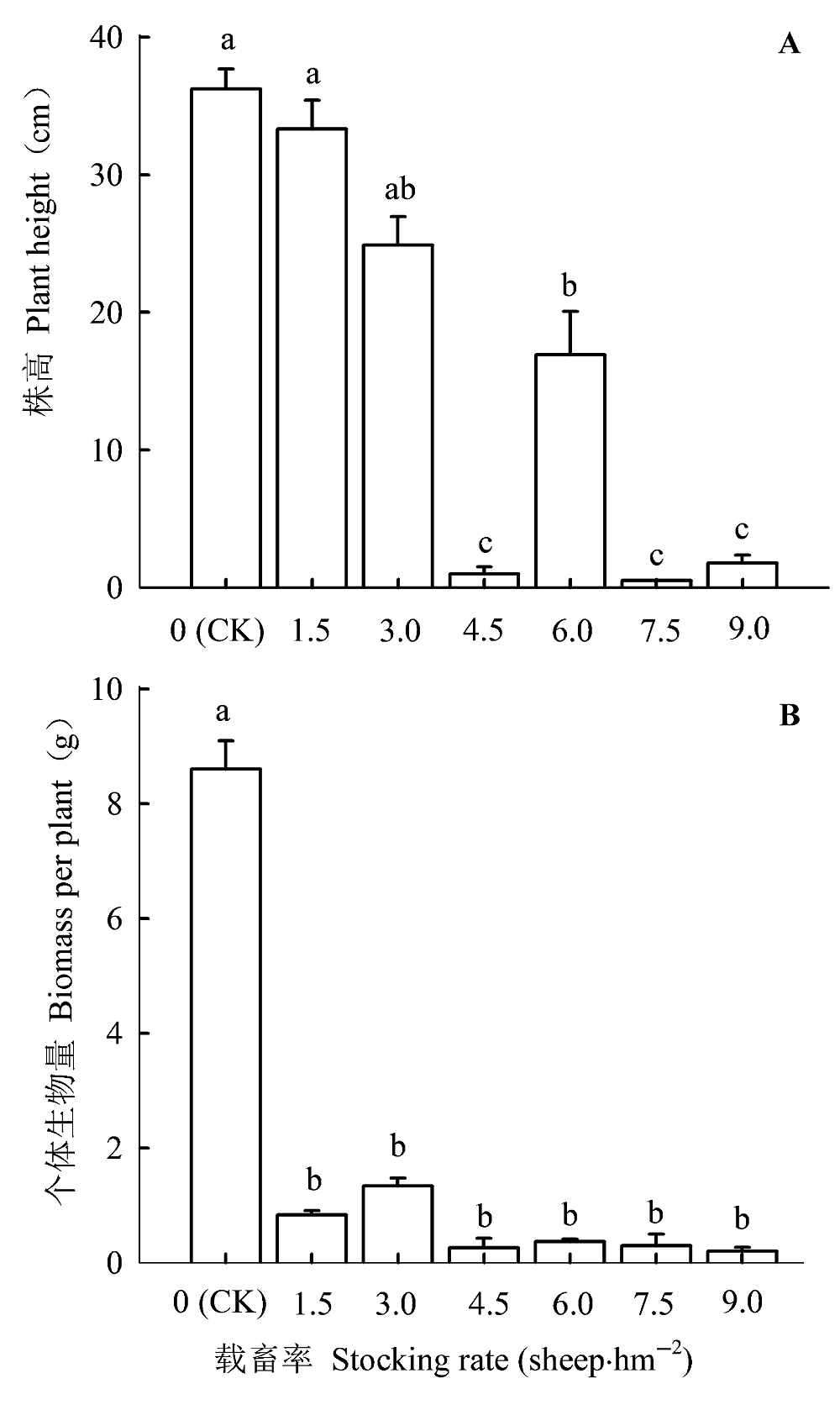
图2 不同载畜率下瓣蕊唐松草的株高(A)与个体生物量(B) (平均值±标准误差, n = 50)。不同的小写字母表示在0.05水平上差异显著。
Fig. 2 Plant height (A) and biomass per plant (B) of Thalictrum petaloideum under different stocking rates (mean ± SE, n = 50). Different lowercase letters indicate significant differences (p < 0.05).
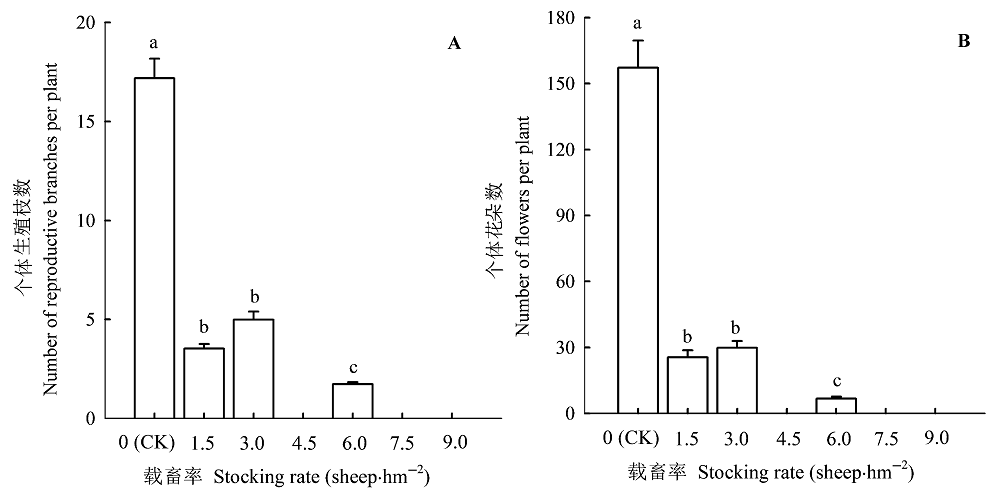
图3 不同载畜率下瓣蕊唐松草个体的生殖枝数(A)与花朵数(B) (平均值±标准误差, n = 50)。不同的小写字母表示在0.05水平上差异显著。
Fig. 3 Numbers of reproductive branches (A) and flowers (B) of Thalictrum petaloideum at individual level under different stocking rates (mean ± SE, n = 50). Different lowercase letters indicate significant differences (p < 0.05).
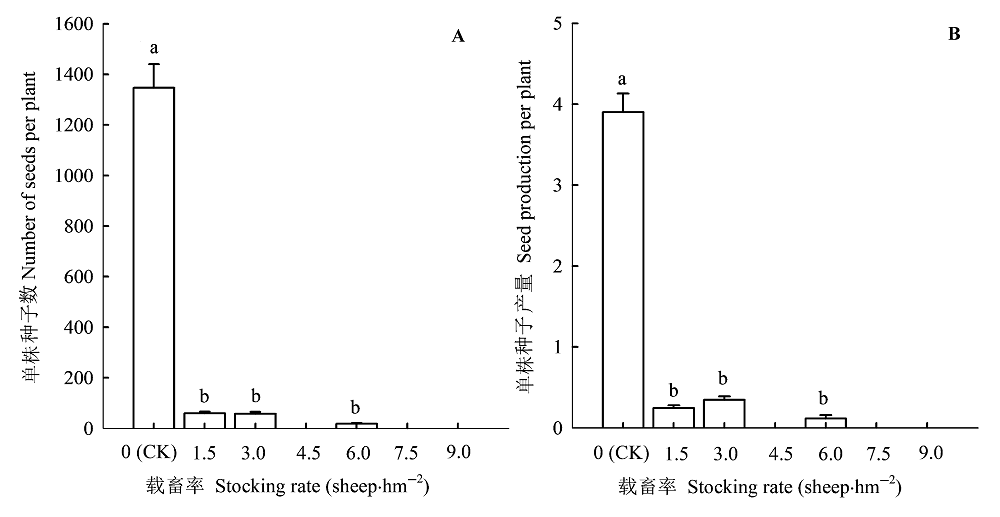
图4 不同载畜率下个体水平种子数(A)和单株种子产量(B) (平均值±标准误差, n = 50)。不同的小写字母表示在0.05水平上差异显著。
Fig. 4 Number of seeds per plant (A) and seed yield per plant (B) of Thalictrum petaloideum under different stocking rates (mean ± SE, n = 50). Different lowercase letters indicate significant differences (p < 0.05).
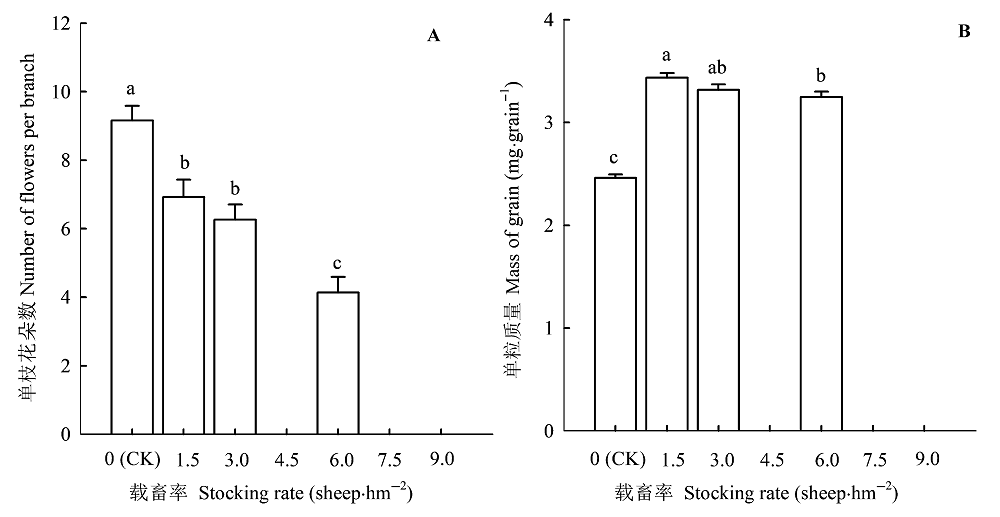
图5 不同载畜率下单枝花朵数(A)与单粒质量(B) (平均值±标准误差, n = 50)。不同的小写字母表示在0.05水平上差异显著。
Fig. 5 Number of flowers per branch (A) and grain mass (B) of Thalictrum petaloideum under different stocking rates (mean ± SE, n = 50). Different lowercase letters indicate significant differences (p < 0.05).
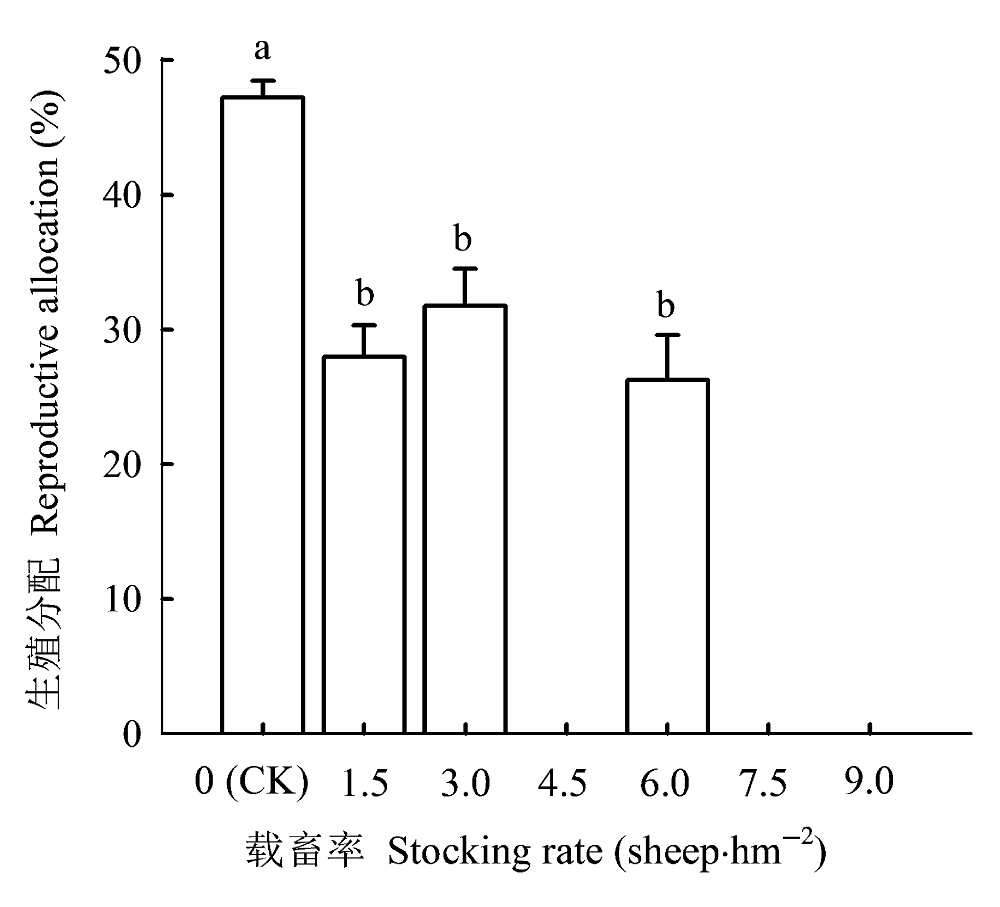
图6 不同载畜率下瓣蕊唐松草的生物量生殖分配(平均值±标准误差, n = 50)。不同的小写字母表示在0.05水平上差异 显著。
Fig. 6 Reproductive biomass allocation of Thalictrum petaloideum under different stocking rates (mean ± SE, n = 50). Different lowercase letters indicate significant differences (p < 0.05).
| 载畜率 Stocking rate (sheep·hm-2) | ||||
|---|---|---|---|---|
| 0 (对照 Control) | 1.5 | 3.0 | 6.0 | |
| 斜率 Slope | 0.863a | 1.200b | - | - |
| R2 | 0.569 | 0.107 | - | - |
| p | < 0.000 1 | 0.022 | 0.688 | 0.108 |
| 截距 Intercept | 0.075 93 | -0.413 96 | - | - |
| 重复数 Number of replications | 50 | 48 | 49 | 36 |
表1 不同载畜率下瓣蕊唐松草在个体水平上种子与非种子部分生殖分配计量关系的变化
Table 1 Changes in reproductive allometric relationships between seeds and non-seed parts at an individual level in Thalictrum petaloideum under different stocking rates
| 载畜率 Stocking rate (sheep·hm-2) | ||||
|---|---|---|---|---|
| 0 (对照 Control) | 1.5 | 3.0 | 6.0 | |
| 斜率 Slope | 0.863a | 1.200b | - | - |
| R2 | 0.569 | 0.107 | - | - |
| p | < 0.000 1 | 0.022 | 0.688 | 0.108 |
| 截距 Intercept | 0.075 93 | -0.413 96 | - | - |
| 重复数 Number of replications | 50 | 48 | 49 | 36 |
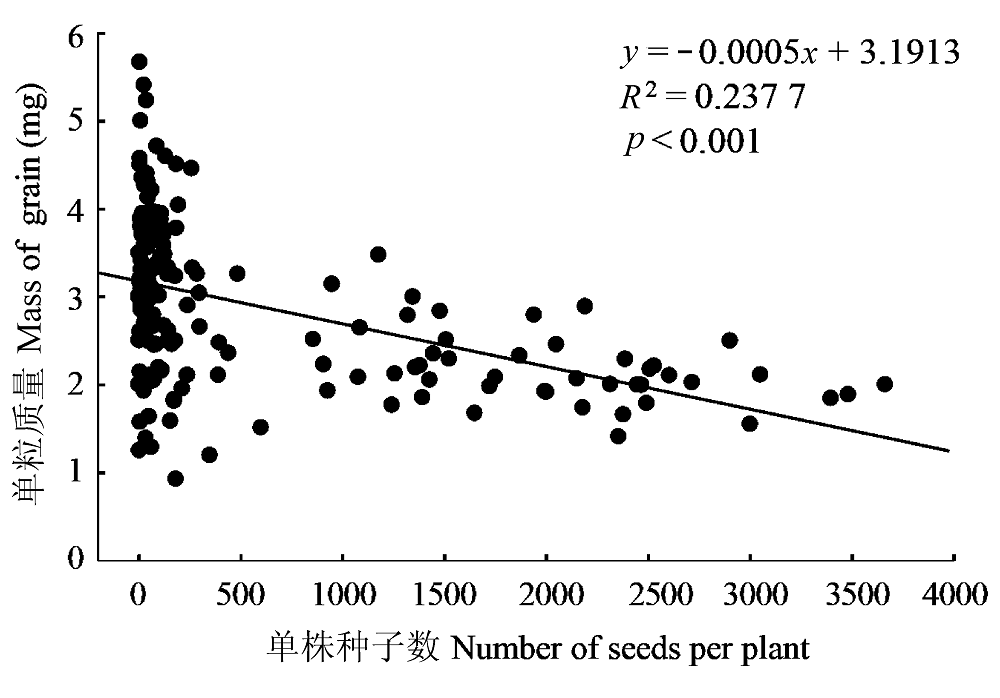
图7 单株种子数与单粒质量之间的关系。
Fig. 7 Relationship between seed numbers per plant and grain mass of Thalictrum Petaloideum.
| [1] | Bao GZ, Kang CL, Li XL (2002). Effects of stocking intensity on grass reproductive allocation and grain weight on the artificial grassland. Acta Ecologica Sinica, 22, 1362-1366. (in Chinese with English abstract) |
| [ 包国章, 康春莉, 李向林 (2002). 不同放牧强度对人工草地牧草生殖分配及种子质量的影响. 生态学报, 22, 1362-1366.] | |
| [2] | Briske DD (1986). Plant response to defoliation: morphological considerations and allocation priorities. In: Joss PJ, Lynch PW, Williams OB eds. Rangelands: a Resource Under Siege. Cambridge University Press, Cambridge, UK. 425-427. |
| [3] | Cheplick GP (2005). The allometry of reproductive allocation. In: Reekie EG, Bazzaz FA eds. Reproductive Allocation in Plants. Academic Press, Burlington, USA. 97-128. |
| [4] | Christiansen S, Svejcar T (1988). Grazing effects on shoot and root dynamics and above- and below-ground non- structural carbohydrate in Caucasian bluestem. Grass and Forage Science, 43, 111-119. |
| [5] | Díaz S, Lavorel S, McIntyre S, Falczuk V, Casanoves F, Milchunas DG, Skarpe C, Rusch G, Sternberg M, Noy-Meir I, Landsberg J, Zhang W, Clark H, Campbell BD (2007). Plant trait responses to grazing—a global synthesis. Global Change Biology, 13, 313-341. |
| [6] |
Díaz S, Noy-Meir I, Cabido M (2001). Can grazing response of herbaceous plants be predicted from simple vegetative traits? Journal of Applied Ecology, 38, 497-508.
DOI URL |
| [7] |
Falster DS, Westoby M (2003). Plant height and evolutionary games. Trends in Ecology & Evolution, 18, 337-343.
DOI URL |
| [8] | Fang XW, Wang XZ, Li H, Chen K, Wang G (2006). Responses of Caragana korshinskii to different aboveground shoot removal: combining defence and tolerance strategies. Annuals of Botany, 98, 203-211. |
| [9] |
Fortunel C, Violle C, Roumet C, Buatois B, Navas ML, Garnier E (2009). Allocation strategies and seed traits are hardly affected by nitrogen supply in 18 species differing in successional status. Perspectives in Plant Ecology, Evolution and Systematics, 11, 267-283.
DOI URL |
| [10] | Grotkopp E, Rejmánek M, Rost TL (2002). Toward a causal explanation of plant invasiveness: seedling growth and life-history strategies of 29 pine (Pinus) species. The American Naturalist, 159, 396-419. |
| [11] |
Huhta AP, Hellström K, Rautio P, Tuomi J (2000). A test of the compensatory continuum: fertilization increases and below-ground competition decreases the grazing tolerance of tall wormseed mustard (Erysimum strictum). Evolutionary Ecology, 14, 353-372.
DOI URL |
| [12] |
Lennartsson T, Tuomi J, Nilsson P (1997). Evidence for an evolutionary history of overcompensation in the grassland biennial Gentianella campestris(Gentianaceae). The American Naturalist, 149, 1147-1155.
DOI URL |
| [13] | Li JH, Li ZQ (2002). Effect of grazing on reproduction in Potentilla acaulis population. Acta Prataculturae Sinica, 11(3), 92-96. (in Chinese with English abstract) |
| [ 李金花, 李镇清 (2002). 放牧对星毛委陵菜(Potentilla acaulis)种群生殖对策的影响. 草业学报, 11(3), 92-96.] | |
| [14] | Liu ZG, Li ZQ (2006). Plant biodiversity of Aretemisia frigida communities on degraded grasslands under different grazing intensities after thirteen-year enclosure. Acta Ecologica Sinica, 26, 475-482. (in Chinese with English abstract) |
| [ 刘振国, 李镇清 (2006). 退化草原冷蒿群落13年不同放牧强度后的植物多样性. 生态学报, 26, 475-482.] | |
| [15] |
McCarthy MC, Enquist BJ (2007). Consistency between an allometric approach and optimal partitioning theory in global patterns of plant biomass allocation. Functional Ecology, 21, 713-720.
DOI URL |
| [16] | Niklas KJ, Enquist B (2002). On the vegetative biomass partitioning of seed plant leaves, stems, and roots. The American Naturalist, 159, 482-497. |
| [17] |
Niu KC, Choler P, Zhao BB, Du GZ (2009). The allometry of reproductive biomass in response to land use in Tibetan alpine grasslands. Functional Ecology, 23, 274-283.
DOI URL |
| [18] | Reekie EG, Bazzaz FA (2005). Reproductive Allocation in Plants. Academic Press, Burlington, USA. |
| [19] |
Ren HY, Zheng SX, Bai YF (2009). Effects of grazing on foliage biomass allocation of grassland communities in Xilin River Basin, Inner Mongolia. Chinese Journal of Plant Ecology, 33, 1065-1074. (in Chinese with English abstract)
DOI URL |
| [ 任海彦, 郑淑霞, 白永飞 (2009). 放牧对内蒙古锡林河流域草地群落植物茎叶生物量资源分配的影响. 植物生态学报, 33, 1065-1074.] | |
| [20] | Smith SE (1998). Variation in response to defoliation between populations of Bouteloua curtipendula var. caespitosa(Poaceae) with different livestock grazing histories. American Journal of Botany, 85, 1266-1272. |
| [21] | Su ZX, Zhang SL, Zhong ZC (1998). Advances in plant reproductive ecology. Chinese Journal of Ecology, 17(1), 39-46. (in Chinese with English abstract) |
| [ 苏智先, 张素兰, 钟章成 (1998). 植物生殖生态学研究进展. 生态学杂志, 17(1), 39-46.] | |
| [22] | Sugiyama S, Bazzaz FA (1998). Size dependence of reproductive allocation: the influence of resource availability, competition and genetic identity. Functional Ecology, 12, 280-288. |
| [23] |
Tian DS, Pan QM, Simmons M, Chaolu H, Du BH, Bai YF, Wang H, Han XG (2012). Hierarchical reproductive allocation and allometry within a perennial bunchgrass after 11 years of nutrient addition. PLoS ONE, 7, e42833.
URL PMID |
| [24] |
Turnbull LA, Coomes D, Hector A, Rees M (2004). Seed mass and the competition/colonization trade-off: competitive interactions and spatial patterns in a guild of annual plants. Journal of Ecology, 92, 97-109.
DOI URL |
| [25] | Wang RZ (2000). Effect of grazing on reproduction in Leymus chinensis population. Chinese Journal of Applied Ecology, 11, 399-402. (in Chinese with English abstract) |
| [ 王仁忠 (2000). 放牧影响下羊草种群生殖生态学的研究. 应用生态学报, 11, 399-402.] | |
| [26] | Wang SP, Wang YF, Chen ZZ (2001). The biological- economical principle on sustainable development of grass- land livestock in Inner Mongolia steppe. Acta Ecologica Sinica, 21, 617-623. (in Chinese with English abstract) |
| [ 汪诗平, 王艳芬, 陈佐忠 (2001). 内蒙古草地畜牧业可持续发展的生物经济原则研究. 生态学报, 21, 617-623.] | |
| [27] | Wang SP, Chen ZZ, Wang YF, Li YH (1999). The study of optimal stocking rate and sustainable development of rangeland-livestock in Inner Mongolia steppe. Grassland of China, (4), 67-75. |
| [28] |
Warton DI, Wright IJ, Falster DS, Westoby M (2006). Bivariate line-fitting methods for allometry. Biological Reviews, 81, 259-291.
DOI URL PMID |
| [29] | Wei H (2010). Effects of grazing on plant diversity and productivity in a Stipa baicalensis grassland community. Inner Mongolia Prataculture, 22(3), 25-30. (in Chinese) |
| [ 魏红 (2010). 放牧对贝加尔针茅草原群落植物多样性和生产力的影响. 内蒙古草业, 22(3), 25-30.] | |
| [30] | Xiu H, Zhao ML, Niu H, Han X, Wang J (2013). Changes in phenotypic characteristics of Agropyron cristatum under grazing stress. Grassland and Prataculture, 25(4), 38-46. (in Chinese) |
| [ 秀花, 赵萌莉, 牛海, 韩雄, 王静 (2013). 放牧胁迫下冰草表型性状的变化. 草原与草业, 25(4), 38-46.] | |
| [31] | Yang YF, Zhu TC (1988). A study on seed production of Aneurolepidium chinense population in different ecological conditions. Acta Ecologica Sinica, 8, 256-262. (in Chinese with English abstract) |
| [ 杨允菲, 祝廷成 (1988). 不同生态条件下羊草种群种子生产的探讨. 生态学报, 8, 256-262.] | |
| [32] | Zhang YF, Zhang DY (2006). Asexual and sexual reproductive strategies in clonal plants. Journal of Plant Ecology (Chinese Version), 30, 174-183. (in Chinese with English abstract) |
| [ 张玉芬, 张大勇 (2006). 克隆植物的无性与有性繁殖对策. 植物生态学报, 30, 174-183.] | |
| [33] | Zhao BB, Niu KC, Du GZ (2009). The effect of grazing on above-ground biomass allocation of 27 plant species in an alpine meadow plant community in Qinghai-Tibetan Plateau. Acta Ecologica Sinica, 29, 1596-1606. (in Chinese with English abstract) |
| [ 赵彬彬, 牛克昌, 杜国祯 (2009). 放牧对青藏高原东缘高寒草甸群落27种植物地上生物量分配的影响. 生态学报, 29, 1596-1606.] | |
| [34] | Zhong ZC (1995). Reproductive strategies of plant populations. Chinese Journal of Ecology, 14, 37-42. (in Chinese with English abstract) |
| [ 钟章成 (1995). 植物种群的繁殖对策. 生态学杂志, 14, 37-42.] | |
| [35] | Zhou C, Zhang Z, Lü YT, Yang YF (2011). Vegetative propagation and reproductive growth Leymus chinensis of two ecotypes in Songnen Plain. Acta Agrestia Sinica, 19, 372-376. (in Chinese with English abstract) |
| [ 周婵, 张卓, 吕勇通, 杨允菲 (2011). 松嫩平原两个生态型羊草营养和生殖生长的研究. 草地学报, 19, 372-376.] |
| [1] | 陈鹏鹏, 武胜利, 张燕, 肖佳奇, 黄露蕊, 史慧杰. 艾比湖流域抛物线沙丘上梭梭的种群结构与动态[J]. , 2026, 50(预发表): 0-. |
| [2] | 江康威, 吕程, 王亚菲, 李宏, 张芷晴, 王雨, 张青青, 吐尔逊娜依•热依木. 放牧干扰下丛枝菌根真菌群落对土壤多功能性的影响[J]. 植物生态学报, 2026, 50(3): 685-699. |
| [3] | 吕卫东, 董全民, 孙彩彩, 刘文亭, 刘玉祯, 张振祥, 李梦棋, 杨晓霞. 牦牛和藏羊放牧对高寒草地植物和微生物碳氮库的影响[J]. 植物生态学报, 2025, 49(9): 1424-1433. |
| [4] | 崔冬晴, 田晨, 宋慧敏, 鲁小名, 萨其日, 徐国庆, 杨培志, 白永飞, 田建卿. 典型草原优势植物根际细菌群落多样性和功能群组成对长期放牧的响应机制[J]. 植物生态学报, 2025, 49(7): 1163-1176. |
| [5] | 马腾飞, 郝杰, 刁华杰, 宁亚楠, $\boxed{\hbox{王常慧}}$, 董宽虎. 晋北农牧交错带草地土壤无机氮含量的季节变化及其对放牧强度的响应[J]. 植物生态学报, 2025, 49(6): 965-974. |
| [6] | 贾妍妍, 柳华清, 解欣然, 王博, 张维, 杨允菲. 珍稀濒危植物天山梣林龄结构及种群动态[J]. 植物生态学报, 2025, 49(5): 760-772. |
| [7] | 张望, 谭思仪, 涂文琴, 娄安如. 新疆吐鲁番和哈密地区梭梭种群遗传多样性和遗传结构[J]. 植物生态学报, 2025, 49(11): 1858-1868. |
| [8] | 张子睿, 周静, 胡艳萍, 梁爽, 马永鹏, 陈伟乐. 极度濒危植物巧家五针松的根内和根际真菌群落特征[J]. 植物生态学报, 2025, 49(10): 1600-1611. |
| [9] | 黄承玲, 黎荣瀚, 覃红玲, 杨胜雄, 田晓玲, 夏国威, 陈正仁, 周玮. 基于SNP分子标记的极小种群植物荔波杜鹃保护遗传学[J]. 植物生态学报, 2025, 49(10): 1677-1684. |
| [10] | 贺艺, 周静, 陈宸, 房庭舟, 苏剑, 高浩杰, 曹嘉浩, 杨飞宇, 范淇博, 朱乐瑶, 陈薏名, 杨飞, 王毅腾, 冯雷, 刘飞, 梁爽, 蒋明凯, 陈军, 赵云鹏, 陈伟乐, 赵颖, 黄建国. 浙江海岛濒危树种的保护与恢复[J]. 植物生态学报, 2025, 49(10): 1583-1599. |
| [11] | 李天琦, 曹继容, 柳小妮, 田思惠, 兰波兰, 邱颖, 薛建国, 张倩, 褚建民, 张淑敏, 黄建辉, 李凌浩, 王其兵. 内蒙古典型草原土壤酶化学计量与限制性养分对放牧的响应[J]. 植物生态学报, 2025, 49(1): 19-29. |
| [12] | 许宏, 苏华, 李永庚, 苏本营, 杨景成, 李玉强, 王正文. 畜禽草耦合模式探索——不同土地利用方式对中国北方草地羊草植物群落的影响[J]. 植物生态学报, 2025, 49(1): 211-220. |
| [13] | 房凯, 王迎新, 黄建辉, 段俊光, 张琦, 张倩, 甘红豪, 褚建民. 内蒙古典型草原不同退化阶段植被恢复的养分限制因子解析[J]. 植物生态学报, 2025, 49(1): 7-18. |
| [14] | 秦嘉晨, 王欢, 朱江, 王扬, 田晨, 白永飞, 杨培志, 郑淑霞. 基于种内与种间性状变异的放牧过滤作用及其尺度效应[J]. 植物生态学报, 2024, 48(7): 858-871. |
| [15] | 江康威, 张青青, 王亚菲, 李宏, 丁雨, 杨永强, 吐尔逊娜依•热依木. 放牧干扰下天山北坡中段植物功能群特征及其与土壤环境因子的关系[J]. 植物生态学报, 2024, 48(6): 701-718. |
| 阅读次数 | ||||||
|
全文 |
|
|||||
|
摘要 |
|
|||||
Copyright © 2026 版权所有 《植物生态学报》编辑部
地址: 北京香山南辛村20号, 邮编: 100093
Tel.: 010-62836134, 62836138; Fax: 010-82599431; E-mail: apes@ibcas.ac.cn, cjpe@ibcas.ac.cn
备案号: 京ICP备16067583号-19

