
植物生态学报 ›› 2022, Vol. 46 ›› Issue (9): 995-1004.DOI: 10.17521/cjpe.2021.0450 cstr: 32100.14.cjpe.2021.0450
所属专题: 全球变化与生态系统; 青藏高原植物生态学:生态系统生态学; 青藏高原植物生态学:种群生态学
魏瑶1,4, 马志远2, 周佳颖3, 张振华1,*( )
)
收稿日期:2021-12-06
接受日期:2022-04-20
出版日期:2022-09-20
发布日期:2022-10-19
作者简介:张振华:ORCID:0000-0002-1862-0473(zhenhua@nwipb.cas.cn)基金资助:
WEI Yao1,4, MA Zhi-Yuan2, ZHOU Jia-Ying3, ZHANG Zhen-Hua1,*()
Received:2021-12-06
Accepted:2022-04-20
Online:2022-09-20
Published:2022-10-19
Supported by:摘要:
气候变化显著影响了高寒植物物候期及生长模式, 从而改变了高寒生态系统功能。而高寒植物物候期和生长状况对气候变化的响应程度, 与其自身资源分配策略有关。为了更好地探究气候变化下高寒植物繁殖物候及生长的规律, 该研究以青藏高原高寒草甸为研究对象, 按生物量从高到低选取15种常见植物, 其生物量之和占样地总生物量80%以上, 采用红外辐射器模拟增温的方法, 利用同质园实验, 观测无种间竞争条件下, 增温2年间植物返青、现蕾、开花以及结实物候, 并监测了植株高度。研究结果表明: (1)在功能群水平上, 增温使豆科类植物的返青、现蕾和开花时间分别显著提前了(8.21 ± 1.81)、(9.14 ± 2.41)和(10.14 ± 2.05) d, 使其开花持续时间显著延长了(6.14 ± 1.52) d, 而增温对其他功能群物候事件无显著影响。增温对高寒植物物候的影响存在种间及年际间差异, 但总体上增温使大多数高寒植物繁殖物候提前并且开花持续时间延长, 将更多的资源更多地分配到繁殖生长上。(2)增温显著降低了杂类草植物的植株高度(平均降低(3.58 ± 0.96) cm), 但对豆科类、禾草类及莎草类功能群植株高度没有显著影响。 增温对高寒植物植株高度的影响存在显著的种间差异以及年际差异。综上所述, 未来气候变暖背景下, 青藏高原高寒植物群落可能更早进入繁殖阶段, 从而降低在营养生长上的资源分配。另外, 由于各物种繁殖能力和营养生长对温度变化响应的差异, 气候变暖将导致高寒植物群落中各物种盖度的变化, 进而改变群落物种组成, 从而影响高寒生态系统的功能。
魏瑶, 马志远, 周佳颖, 张振华. 模拟增温改变青藏高原植物繁殖物候及植株高度. 植物生态学报, 2022, 46(9): 995-1004. DOI: 10.17521/cjpe.2021.0450
WEI Yao, MA Zhi-Yuan, ZHOU Jia-Ying, ZHANG Zhen-Hua. Experimental warming changed reproductive phenology and height of alpine plants on the Qingzang Plateau. Chinese Journal of Plant Ecology, 2022, 46(9): 995-1004. DOI: 10.17521/cjpe.2021.0450
| 功能群 Functional group | 返青时间 Leaf out time (d) | 现蕾时间 Flower bud time (d) | 开花时间 Flower time (d) | 结实时间 Fruit time (d) | 开花持续时间 Flowering time (d) | 高度 Height (cm) |
|---|---|---|---|---|---|---|
| 豆科类 Legumes | -8.21 ± 1.81* | -9.14 ± 2.41* | -10.14 ± 2.05* | -4.72 ± 1.96 | 6.14 ± 1.52* | 0.92 ± 0.66 |
| 禾草类 Grasses | -1.67 ± 1.59 | -6.07 ± 2.18 | -0.30 ± 3.17 | -0.40 ± 0.99 | -0.10 ± 3.71 | -1.95 ± 2.05 |
| 莎草类 Sedges | 1.58 ± 2.25 | -4.99 ± 5.02 | -7.95 ± 5.74 | 0.56 ± 3.50 | 9.72 ± 3.89 | 0.70 ± 1.86 |
| 杂类草 Forbs | -1.08 ± 0.92 | -5.25 ± 3.70 | -3.04 ± 4.22 | -4.64 ± 4.96 | -1.31 ± 1.42 | -3.58 ± 0.96* |
表1 增温后青藏高原不同功能群高寒植物物候期及高度变化(平均值±标准误)
Table 1 Changes of phenological period and height among alpine plants of different functional groups under warming condition on the Qingzang Plateau (mean ± SE)
| 功能群 Functional group | 返青时间 Leaf out time (d) | 现蕾时间 Flower bud time (d) | 开花时间 Flower time (d) | 结实时间 Fruit time (d) | 开花持续时间 Flowering time (d) | 高度 Height (cm) |
|---|---|---|---|---|---|---|
| 豆科类 Legumes | -8.21 ± 1.81* | -9.14 ± 2.41* | -10.14 ± 2.05* | -4.72 ± 1.96 | 6.14 ± 1.52* | 0.92 ± 0.66 |
| 禾草类 Grasses | -1.67 ± 1.59 | -6.07 ± 2.18 | -0.30 ± 3.17 | -0.40 ± 0.99 | -0.10 ± 3.71 | -1.95 ± 2.05 |
| 莎草类 Sedges | 1.58 ± 2.25 | -4.99 ± 5.02 | -7.95 ± 5.74 | 0.56 ± 3.50 | 9.72 ± 3.89 | 0.70 ± 1.86 |
| 杂类草 Forbs | -1.08 ± 0.92 | -5.25 ± 3.70 | -3.04 ± 4.22 | -4.64 ± 4.96 | -1.31 ± 1.42 | -3.58 ± 0.96* |
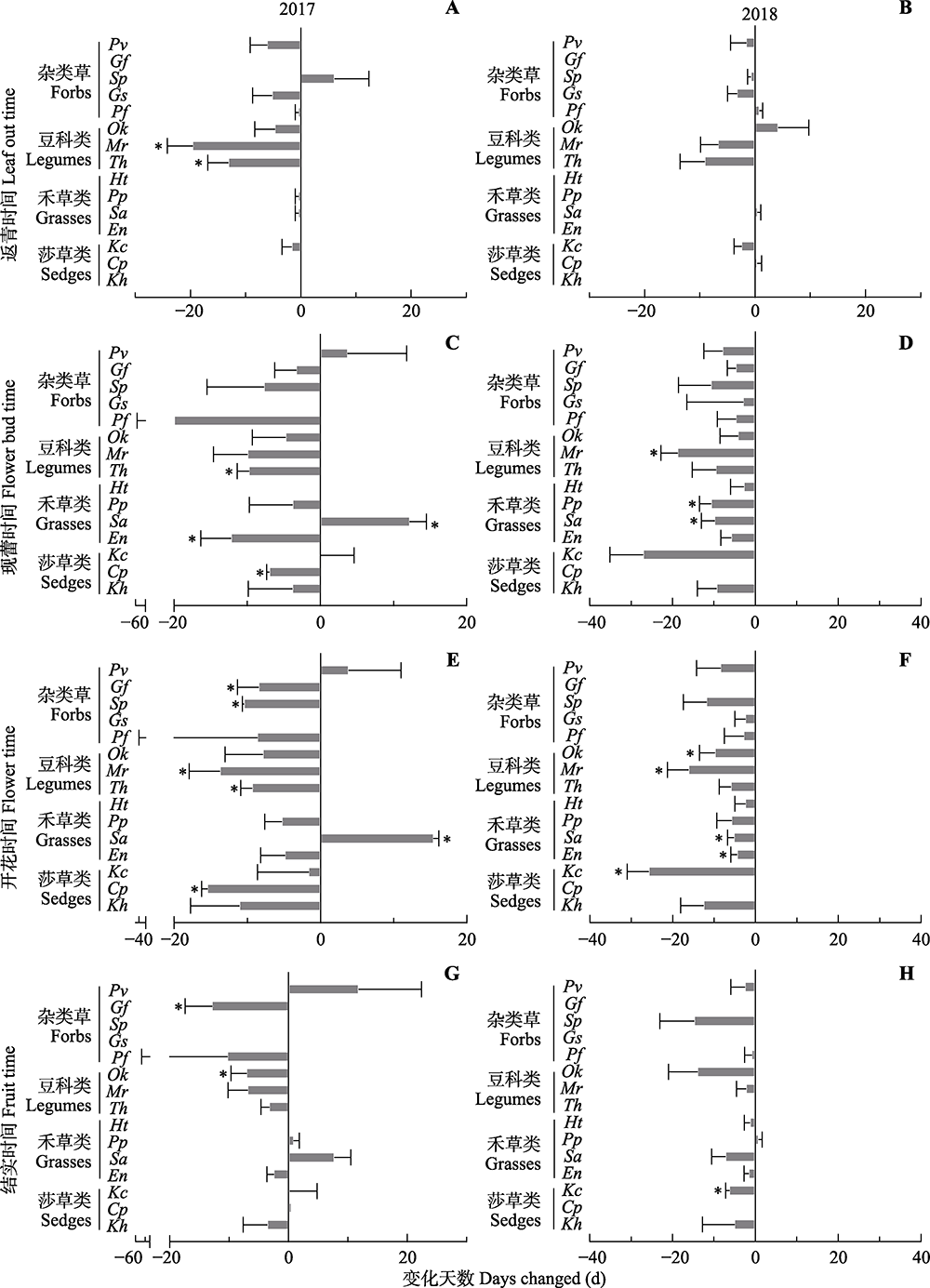
图1 增温下2017和2018年青藏高原高寒植物各物种返青(A、B)、现蕾(C、D)、开花(E、F)、结实(G、H)时间的变化(平均值±标准误)。图中正、负值分别表示与对照相比推迟、提前的天数; *表示增温处理与对照相比差异显著(p < 0.05)。Cp, 红棕薹草; En, 垂穗披碱草; Gf, 线叶龙胆; Gs, 麻花艽; Ht, 藏异燕麦; Kc, 线叶嵩草; Kh, 矮生嵩草; Mr, 花苜蓿; Ok, 甘肃棘豆; Pp, 草地早熟禾; Pf, 金露梅; Pv, 珠芽蓼; Sa, 异针茅; Sp, 美丽风毛菊; Th, 高山豆。
Fig. 1 Changes of leaf out time (A, B), flower bud time (C, D), flower time (E, F) and fruit time (G, H) among each species of alpine plants on the Qingzang Plateau in 2017 and 2018 under warming condition (mean ± SE). A positive value indicates later than the control; a negative value indicates earlier than the control. * indicates significant difference between treatment and the control (p < 0.05). Cp, Carex przewalskii; En, Elymus nutans; Gf, Gentiana lawrencei var. farreri; Gs, Gentiana straminea; Ht, Helictotrichon tibeticum; Kc, Kobresia capillifolia; Kh, Kobresia humilis; Mr, Medicago ruthenica; Ok, Oxytropis kansuensis; Pp, Poa pratensis; Pf, Potentilla fruticosa; Pv, Polygonum viviparum; Sa, Stipa aliena; Sp, Saussurea pulchra; Th, Tibetia himalaica.
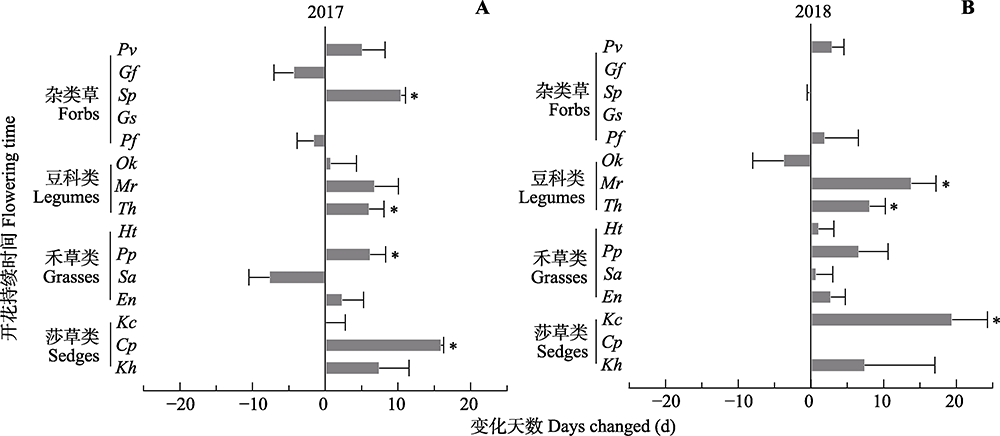
图2 增温下2017 (A)和2018 (B)年青藏高原高寒植物各物种开花持续时间变化(平均值±标准误)。图中正、负值分别表示与对照相比延长、缩短的天数。*表示增温处理与对照相比差异显著(p < 0.05)。Cp, 红棕薹草; En, 垂穗披碱草; Gf, 线叶龙胆; Gs, 麻花艽; Ht, 藏异燕麦; Kc, 线叶嵩草; Kh, 矮生嵩草; Mr, 花苜蓿; Ok, 甘肃棘豆; Pp, 草地早熟禾; Pf, 金露梅; Pv, 珠芽蓼; Sa, 异针茅; Sp, 美丽风毛菊; Th, 高山豆。
Fig. 2 Changes of flowering time among each species of alpine plants on the Qingzang Plateau in 2017 (A) and 2018 (B) under warming condition (mean ± SE). A positive value indicates longer flowering time than the control; a negative value indicates shorter flowering time than the control. * indicates significant difference between treatment and the control (p < 0.05). Cp, Carex przewalskii; En, Elymus nutans; Gf, Gentiana lawrencei var. farreri; Gs, Gentiana straminea; Ht, Helictotrichon tibeticum; Kc, Kobresia capillifolia; Kh, Kobresia humilis; Mr, Medicago ruthenica; Ok, Oxytropis kansuensis; Pp, Poa pratensis; Pf, Potentilla fruticosa; Pv, Polygonum viviparum; Sa, Stipa aliena; Sp, Saussurea pulchra; Th, Tibetia himalaica.
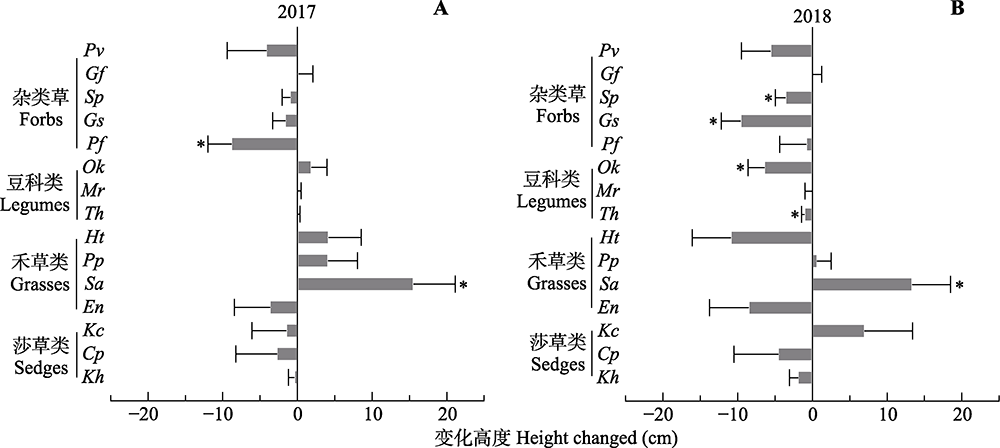
图3 增温下2017 (A)和2018 (B)年青藏高原高寒植物各物种植株高度变化(平均值±标准误)。图中正、负值分别表示与对照相比升高、降低的高度。*表示增温处理与对照相比差异显著(p < 0.05)。Cp, 红棕薹草; En, 垂穗披碱草; Gf, 线叶龙胆; Gs, 麻花艽; Ht, 藏异燕麦; Kc, 线叶嵩草; Kh, 矮生嵩草; Mr, 花苜蓿; Ok, 甘肃棘豆; Pp, 草地早熟禾; Pf, 金露梅; Pv, 珠芽蓼; Sa, 异针茅; Sp, 美丽风毛菊; Th, 高山豆。
Fig. 3 Changes of height among each species of alpine plants on the Qingzang Plateau in 2017 (A) and 2018 (B) under warming condition (mean ± SE). A positive value indicates higher height than the control; a negative value indicates lower height than the control. * indicates significant difference between treatment and the control (p < 0.05). Cp, Carex przewalskii; En, Elymus nutans; Gf, Gentiana lawrencei var. farreri; Gs, Gentiana straminea; Ht, Helictotrichon tibeticum; Kc, Kobresia capillifolia; Kh, Kobresia humilis; Mr, Medicago ruthenica; Ok, Oxytropis kansuensis; Pp, Poa pratensis; Pf, Potentilla fruticosa; Pv, Polygonum viviparum; Sa, Stipa aliena; Sp, Saussurea pulchra; Th, Tibetia himalaica.
| [1] | Álvarez-Cansino L, Zunzunegui M, Díaz Barradas MC, Esquivias MP (2010). Gender-specific costs of reproduction on vegetative growth and physiological performance in the dioecious shrub Corema album. Annals of Botany, 106, 989-998. |
| [2] |
Bjorkman AD, Myers-Smith IH, Elmendorf SC, Normand S, Rüger N, Beck PSA, Blach-Overgaard A, Blok D, Cornelissen JHC, Forbes BC, Georges D, Goetz SJ, Guay KC, Henry GHR, HilleRisLambers J, et al. (2018). Plant functional trait change across a warming tundra biome. Nature, 562, 57-62.
DOI URL |
| [3] |
Cleland EE, Chuine I, Menzel A, Mooney HA, Schwartz MD (2007). Shifting plant phenology in response to global change. Trends in Ecology & Evolution, 22, 357-365.
DOI URL |
| [4] |
Díaz S, Kattge J, Cornelissen JHC, Wright IJ, Lavorel S, Dray S, Reu B, Kleyer M, Wirth C, Prentice IC, Garnier E, Bönisch G, Westoby M, Poorter H, Reich PB, et al. (2016). The global spectrum of plant form and function. Nature, 529, 167-171.
DOI URL |
| [5] |
Dorji T, Hopping KA, Meng FD, Wang SP, Jiang LL, Klein JA (2020). Impacts of climate change on flowering phenology and production in alpine plants: the importance of end of flowering. Agriculture, Ecosystems & Environment, 291, 106795. DOI: 10.1016/j.agee.2019.106795.
DOI |
| [6] |
Dorji T, Totland Ø, Moe SR, Hopping KA, Pan JB, Klein JA (2013). Plant functional traits mediate reproductive phenology and success in response to experimental warming and snow addition in Tibet. Global Change Biology, 19, 459-472.
DOI PMID |
| [7] | Fitchett JM, Grab SW, Thompson DI (2015). Plant phenology and climate change: progress in methodological approaches and application. Progress in Physical Geography, 39, 460-482. |
| [8] | [IPCC (The Intergovernmental Panel on Climate Change)(2021). Climate Change 2021: The Physical Science Basis: Summary for Policymakers. [2021-11-28]. https://www.ipcc.ch/report/ar6/wg1/downloads/report/IPCC_AR6_WGI_SPM_final.pdf. |
| [9] |
Jiang LL, Wang SP, Meng FD, Duan JC, Niu HS, Xu GP, Zhu XX, Zhang ZH, Luo CY, Cui SJ, Li YM, Li XE, Wang Q, Zhou Y, Bao XY, et al. (2016). Relatively stable response of fruiting stage to warming and cooling relative to other phenological events. Ecology, 97, 1961-1969.
DOI PMID |
| [10] |
Klein JA, Harte J, Zhao XQ (2008). Decline in medicinal and forage species with warming is mediated by plant traits on the Tibetan Plateau. Ecosystems, 11, 775-789.
DOI URL |
| [11] |
Körner C (1998). A re-assessment of high elevation treeline positions and their explanation. Oecologia, 115, 445-459.
DOI PMID |
| [12] | Körner C (2003). Alpine Plant Life: Functional Plant Ecology of High Mountain Ecosystems. Springer, Heidelberg, Germany. |
| [13] |
Li P, Liu ZL, Zhou XL, Xie BG, Li ZW, Luo YP, Zhu QA, Peng CH (2021). Combined control of multiple extreme climate stressors on autumn vegetation phenology on the Tibetan Plateau under past and future climate change. Agricultural and Forest Meteorology, 308-309, 108571. DOI: 10.1016/j.agrformet.2021.108571.
DOI |
| [14] |
Li XE, Jiang LL, Meng FD, Wang SP, Niu HS, Iler AM, Duan JC, Zhang ZH, Luo CY, Cui SJ, Zhang LR, Li YM, Wang Q, Zhou Y, Bao XY, et al. (2016). Responses of sequential and hierarchical phenological events to warming and cooling in alpine meadows. Nature Communications, 7, 12489. DOI: 10.1038/ncomms12489.
DOI |
| [15] |
Liu HY, Mi ZR, Lin L, Wang YH, Zhang ZH, Zhang FW, Wang H, Liu LL, Zhu B, Cao GM, Zhao XQ, Sanders NJ, Classen AT, Reich PB, He JS (2018). Shifting plant species composition in response to climate change stabilizes grassland primary production. Proceedings of the National Academy of Sciences of the United States of America, 115, 4051-4056.
DOI PMID |
| [16] | Ma ZY (2020). The Effects of Climate Change on Plant Community Diversity and Ecosystem Function in an Alpine Grassland on the Tibetan Plateau. PhD dissertation, Peking University, Beijing. 102-119. |
| [ 马志远 (2020). 气候变化对高寒草地植物群落多样性和生态系统功能的影响.博士学位论文, 北京大学, 北京. 102-119.] | |
| [17] |
Ma ZY, Liu HY, Mi ZR, Zhang ZH, Wang YH, Xu W, Jiang L, He JS (2017). Climate warming reduces the temporal stability of plant community biomass production. Nature Communications, 8, 15378. DOI: 10.1038/ncomms15378.
DOI |
| [18] |
Meng FD, Jiang LL, Zhang ZH, Cui SJ, Duan JC, Wang SP, Luo CY, Wang Q, Zhou Y, Li XE, Zhang LR, Li BW, Dorji T, Li YN, Du MY (2017). Changes in flowering functional group affect responses of community phenological sequences to temperature change. Ecology, 98, 734-740.
DOI PMID |
| [19] |
Molau U (1993). Relationships between flowering phenology and life history strategies in tundra plants. Arctic and Alpine Research, 25, 391. DOI: 10.2307/1551922.
DOI |
| [20] | Park T, Chen C, Macias-Fauria M, Tømmervik H, Choi S, Winkler A, Bhatt US, Walker DA, Piao SL, Brovkin V, Nemani RR, Myneni RB (2019). Changes in timing of seasonal peak photosynthetic activity in northern ecosystems. Global Change Biology, 25, 2382-2395. |
| [21] |
Pérez-Harguindeguy N, Díaz S, Garnier E, Lavorel S, Poorter H, Jaureguiberry P, Bret-Harte MS, Cornwell WK, Craine JM, Gurvich DE, Urcelay C, Veneklaas EJ, Reich PB, Poorter L, Wright IJ, et al. (2013). New handbook for standardised measurement of plant functional traits worldwide. Australian Journal of Botany, 61, 167-234.
DOI URL |
| [22] |
Reich PB, Sendall KM, Rice KR, Rich RL, Stefanski A, Hobbie SE, Montgomery RA (2015). Geographic range predicts photosynthetic and growth response to warming in co-occurring tree species. Nature Climate Change, 5, 148-152.
DOI URL |
| [23] |
Shen MG, Piao SL, Dorji T, Liu Q, Cong N, Chen XQ, An S, Wang SP, Wang T, Zhang GX (2015). Plant phenological responses to climate change on the Tibetan Plateau: research status and challenges. National Science Review, 2, 454-467.
DOI URL |
| [24] | Shen ZX, Zhou XM, Chen ZZ, Zhou HK (2002). Response of plant groups to simulated rainfall and nitrogen supply in alpine Kobresia humilis meadow. Acta Phytoecologica Sinica, 26, 288-294. |
| [沈振西, 周兴民, 陈佐忠, 周华坤 (2002). 高寒矮嵩草草甸植物类群对模拟降水和施氮的响应. 植物生态学报, 26, 288-294.] | |
| [25] |
Suonan J, Classen AT, Sanders NJ, He JS (2019). Plant phenological sensitivity to climate change on the Tibetan Plateau and relative to other areas of the world. Ecosphere, 10, e02543. DOI: 10.1002/ecs2.2543.
DOI |
| [26] |
Suonan J, Classen AT, Zhang ZH, He JS (2017). Asymmetric winter warming advanced plant phenology to a greater extent than symmetric warming in an alpine meadow. Functional Ecology, 31, 2147-2156.
DOI URL |
| [27] |
Wang CY, Cheng HY, Wei M, Wang S, Wu BD, Du DL (2021). Plant height and leaf size: Which one is more important in affecting the successful invasion of Solidago canadensis and Conyza canadensis in urban ecosystems? Urban Forestry & Urban Greening, 59, 127033. DOI: 10.1016/j.ufug.2021.127033.
DOI |
| [28] |
Wang H, Liu HY, Cao GM, Ma ZY, Li YK, Zhang FW, Zhao X, Zhao XQ, Jiang L, Sanders NJ, Classen AT, He JS (2020). Alpine grassland plants grow earlier and faster but biomass remains unchanged over 35 years of climate change. Ecology Letters, 23, 701-710.
DOI PMID |
| [29] |
Wang SP, Duan JC, Xu GP, Wang YF, Zhang ZH, Rui YC, Luo CY, Xu B, Zhu XX, Chang XF, Cui XY, Niu HS, Zhao XQ, Wang WY (2012). Effects of warming and grazing on soil N availability, species composition, and ANPP in an alpine meadow. Ecology, 93, 2365-2376.
PMID |
| [30] |
Wang SP, Meng FD, Duan JC, Wang YF, Cui XY, Piao SL, Niu HS, Xu GP, Luo CY, Zhang ZH, Zhu XX, Shen MG, Li YN, Du MY, Tang YH, et al. (2014a). Asymmetric sensitivity of first flowering date to warming and cooling in alpine plants. Ecology, 95, 3387-3398.
DOI URL |
| [31] | Wang SP, Wang CS, Duan JC, Zhu XX, Xu GP, Luo CY, Zhang ZH, Meng FD, Li YN, Du MY (2014b). Timing and duration of phenological sequences of alpine plants along an elevation gradient on the Tibetan Plateau. Agricultural and Forest Meteorology, 189- 190, 220-228. |
| [32] |
Wang XH, Piao SL, Ciais P, Li JS, Friedlingstein P, Koven C, Chen AP (2011). Spring temperature change and its implication in the change of vegetation growth in North America from 1982 to 2006. Proceedings of the National Academy of Sciences of the United States of America, 108, 1240-1245.
DOI PMID |
| [33] | Wang ZP, Zhang XZ, He YT, Shi PL, Zu JX, Niu B, Li M (2018). Effects of precipitation changes on the precipitation use efficiency and aboveground productivity of alpine steppe-meadow on northern Tibetan Plateau, China. Chinese Journal of Applied Ecology, 29, 1822-1828. |
|
[王志鹏, 张宪洲, 何永涛, 石培礼, 俎佳星, 牛犇, 李猛 (2018). 降水变化对藏北高寒草原化草甸降水利用效率及地上生产力的影响. 应用生态学报, 29, 1822-1828.]
DOI |
|
| [34] |
Xia JY, Niu SL, Ciais P, Janssens IA, Chen JQ, Ammann C, Arain A, Blanken PD, Cescatti A, Bonal D, Buchmann N, Curtis PS, Chen SP, Dong JW, Flanagan LB, et al. (2015). Joint control of terrestrial gross primary productivity by plant phenology and physiology. Proceedings of the National Academy of Sciences of the United States of America, 112, 2788-2793.
DOI PMID |
| [35] |
Xu W, Zhu MY, Zhang ZH, Ma ZY, Liu HY, Chen LT, Cao GM, Zhao XQ, Schmid B, He JS (2018). Experimentally simulating warmer and wetter climate additively improves rangeland quality on the Tibetan Plateau. Journal of Applied Ecology, 55, 1486-1497.
DOI URL |
| [36] | Yu HY, Xu JC (2009). Effects of climate change on vegetations on Qinghai-Tibet Plateau: a review. Chinese Journal of Ecology, 28, 747-754. |
| [于海英, 许建初 (2009). 气候变化对青藏高原植被影响研究综述. 生态学杂志, 28, 747-754.] | |
| [37] |
Zhang L, Wang GX, Ran F, Peng AH, Xiao Y, Yang Y, Yang Y (2018). Experimental warming changed plants’ phenological sequences of two dominant species in an alpine meadow, western of Sichuan. Chinese Journal of Plant Ecology, 42, 20-27.
DOI |
|
[张莉, 王根绪, 冉飞, 彭阿辉, 肖瑶, 杨阳, 杨燕 (2018). 模拟增温改变川西高山草甸优势植物繁殖物候序列特征. 植物生态学报, 42, 20-27.]
DOI |
|
| [38] | Zhao XQ, Zhou XM (1999). Ecological basis of alpine meadow ecosystem management in Tibet: Haibei alpine meadow ecosystem research station. Ambio, 28, 642-647. |
| [39] |
Zhu JT (2016). Effects of experimental warming on plant reproductive phenology in Xizang alpine meadow. Chinese Journal of Plant Ecology, 40, 1028-1036.
DOI URL |
|
[朱军涛 (2016). 实验增温对藏北高寒草甸植物繁殖物候的影响. 植物生态学报, 40, 1028-1036.]
DOI |
| [1] | 张安宁, 肖亚宁, 赵霞, 张淼, 崔瀚文, 陈书燕, 安黎哲. 青藏高原灌木化与氮添加对土壤线虫及功能性状的交互作用[J]. 植物生态学报, 2026, 50(预发表): 0-. |
| [2] | 张琳, 袁伟影, 宋创业, 吴冬秀. 1998-2010年中国典型生态系统长期监测样地环境要素、物种丰富度和生物量动态数据集[J]. 植物生态学报, 2025, 49(8): 1182-1190. |
| [3] | 范亚冉, 夏少攀, 于冰冰, 朱紫琪, 杨威, 范豫川, 刘晓雨, 张旭辉, 郑聚锋. 大气CO2浓度升高和增温对土壤有机碳库积累、分子组成和结构稳定性的影响[J]. 植物生态学报, 2025, 49(7): 1053-1069. |
| [4] | 陈龙, 郭柯, 勾晓华, 赵秀海, 马泓若. 祁连圆柏林群落组成及特征[J]. 植物生态学报, 2025, 49(6): 852-864. |
| [5] | 王世松, 曲孝云, 董劭琼, 李佳鸿, 杨琦, 侯满福, 赵利清, 郭柯, 刘长成, 胥晓. 西藏札达典型荒漠植被类型及群落特征[J]. 植物生态学报, 2025, 49(5): 801-812. |
| [6] | 王娟, 张登山, 肖元明, 裴全帮, 王博, 樊博, 周国英. 长期围封后高寒草原植物根系分泌物特征与环境因子关系[J]. 植物生态学报, 2025, 49(4): 596-609. |
| [7] | 王堃莹, 邱贵福, 刘子赫, 孟君, 刘宇轩, 贾国栋. 气候变化对不同退化程度小叶杨林分生长和内在水分利用效率的调节[J]. 植物生态学报, 2025, 49(2): 343-355. |
| [8] | 黄美红, 牛梦秋, 杨鹏飞, 林洁, 廖周瑜, 陈建国, 向建英. 不同温度和埋藏深度对高山垫状植物山生福禄草种子出苗及幼苗生长的影响[J]. 植物生态学报, 2025, 49(12): 2092-2104. |
| [9] | 贺艺, 周静, 陈宸, 房庭舟, 苏剑, 高浩杰, 曹嘉浩, 杨飞宇, 范淇博, 朱乐瑶, 陈薏名, 杨飞, 王毅腾, 冯雷, 刘飞, 梁爽, 蒋明凯, 陈军, 赵云鹏, 陈伟乐, 赵颖, 黄建国. 浙江海岛濒危树种的保护与恢复[J]. 植物生态学报, 2025, 49(10): 1583-1599. |
| [10] | 陈诚智, 高钰森, 罗力嘉, 王东. 川西高寒窄叶鲜卑花灌丛凋落枝和凋落叶生产与分解[J]. 植物生态学报, 2025, 49(10): 1733-1743. |
| [11] | 王麟, 李雪, 王愉, 王新, 胡小文, 杨梅, 朱剑霄. 不同配方种衣剂对高寒草地乡土草种种子生长与建植的影响[J]. 植物生态学报, 2025, 49(1): 118-128. |
| [12] | 王雯莹, 肖元明, 王小赟, 徐嘉昕, 马玉花, 李强峰, 周国英. 多功能群物种配置模式下退化高寒草甸植物多样性与生态系统多功能性的关联[J]. 植物生态学报, 2025, 49(1): 103-117. |
| [13] | 张辉, 赵赟鹏, 刘晓琛, 郭增鹏, 胡国瑞, 冯彦皓, 马妙君. 高寒草甸退化过程中土壤种子库的变化及其在植物群落更新中的潜在作用[J]. 植物生态学报, 2025, 49(1): 74-82. |
| [14] | 张鹏, 焦亮, 薛儒鸿, 魏梦圆, 杜达石, 吴璇, 王旭鸽, 李倩. 干旱强度影响祁连山西段不同海拔青海云杉的生长恢复[J]. 植物生态学报, 2024, 48(8): 977-987. |
| [15] | 史倩, 同小娟, 许玲玲, 孟平, 于裴洋, 李俊, 杨铭鑫. 油松早晚材径向生长对气候因子的响应[J]. 植物生态学报, 2024, 48(8): 988-1000. |
| 阅读次数 | ||||||
|
全文 |
|
|||||
|
摘要 |
|
|||||
Copyright © 2026 版权所有 《植物生态学报》编辑部
地址: 北京香山南辛村20号, 邮编: 100093
Tel.: 010-62836134, 62836138; Fax: 010-82599431; E-mail: apes@ibcas.ac.cn, cjpe@ibcas.ac.cn
备案号: 京ICP备16067583号-19

