
植物生态学报 ›› 2023, Vol. 47 ›› Issue (9): 1298-1309.DOI: 10.17521/cjpe.2022.0480 cstr: 32100.14.cjpe.2022.0480
所属专题: 菌根真菌
任悦1, 高广磊1,2,3,*( ), 丁国栋1,2,3, 张英1,2, 赵珮杉1, 柳叶1
收稿日期:2022-11-28
接受日期:2023-04-26
出版日期:2023-09-20
发布日期:2023-09-28
基金资助:
REN Yue1, GAO Guang-Lei1,2,3,*(), DING Guo-Dong1,2,3, ZHANG Ying1,2, ZHAO Pei-Shan1, LIU Ye1
Received:2022-11-28
Accepted:2023-04-26
Online:2023-09-20
Published:2023-09-28
Supported by:摘要:
阐明不同生长期樟子松(Pinus sylvestris var. mongolica)外生菌根真菌群落物种组成、分子生态网络特征及其驱动因子, 可为樟子松人工林可持续经营管理提供理论依据。该研究以毛乌素沙地不同树龄(23、33和44年)樟子松为研究对象, 采用野外调查取样、Illumina MiSeq技术和分子生态网络等生物信息学分析相结合的方法, 比较分析生长季初期(4月)、生长旺盛期(7月)和生长季末期(9月)外生菌根真菌群落物种组成、菌群间相互作用关系及群落变化主要影响因子。主要结果有: 1)生长期对樟子松外生菌根真菌丰富度和Chao1指数影响显著, 生长旺盛期Chao1指数和Simpson多样性指数显著高于其他两个生长期; 树龄对外生菌根真菌多样性没有显著影响。2)毛乌素沙地樟子松根尖共鉴定到外生菌根真菌2门4纲7目18科28属; 生长季初期、旺盛期和末期的优势类群分别为棉革菌属(Tomentella)、丝盖伞属(Inocybe)和地孔菌属(Geopora), 不同树龄优势类群均为地孔菌属; 优势类群棉革菌属和丝盖伞属为生长旺盛期和生长季末期的共有指示菌属。3)生长季末期外生菌根真菌网络节点数、边数最大, 其群落结构更加复杂, 菌种间存在较强的相互作用。4)土壤pH和年平均相对湿度是显著影响樟子松外生菌根真菌群落物种组成差异的环境因子。结论: 生长期和树龄均对樟子松外生菌根真菌多样性与群落物种组成产生影响, 其中生长期的作用强于树龄; 外生菌根真菌季节动态分布主要取决于土壤性质和气候条件。
任悦, 高广磊, 丁国栋, 张英, 赵珮杉, 柳叶. 不同生长期樟子松外生菌根真菌群落物种组成及其驱动因素. 植物生态学报, 2023, 47(9): 1298-1309. DOI: 10.17521/cjpe.2022.0480
REN Yue, GAO Guang-Lei, DING Guo-Dong, ZHANG Ying, ZHAO Pei-Shan, LIU Ye. Species composition and driving factors of the ectomycorrhizal fungal community associated with Pinus sylvestris var. mongolica at different growth periods. Chinese Journal of Plant Ecology, 2023, 47(9): 1298-1309. DOI: 10.17521/cjpe.2022.0480
| 龄组 Age group | 林龄 Stand age (a) | 纬度 Longitude (° N) | 经度 Longitude (° E) | 平均树高 Average tree height (m) | 平均胸径 Average tree DBH (cm) | 郁闭度 Canopy density |
|---|---|---|---|---|---|---|
| 中龄林 MUh | 23 | 38.33 | 109.72 | 9.91 ± 1.02 | 14.15 ± 3.05 | 0.72 |
| 近熟林 MUn | 33 | 38.34 | 109.73 | 13.05 ± 0.94 | 18.63 ± 2.46 | 0.80 |
| 成熟林 MUm | 44 | 38.34 | 109.73 | 14.65 ± 0.81 | 21.98 ± 3.04 | 0.76 |
表1 陕西榆林樟子松人工林研究样地概况(平均值±标准差)
Table 1 Basic characteristics of the sample areas of Pinus sylvestris var. mongolica plantation in Yulin, Shaanxi Province (mean ± SD)
| 龄组 Age group | 林龄 Stand age (a) | 纬度 Longitude (° N) | 经度 Longitude (° E) | 平均树高 Average tree height (m) | 平均胸径 Average tree DBH (cm) | 郁闭度 Canopy density |
|---|---|---|---|---|---|---|
| 中龄林 MUh | 23 | 38.33 | 109.72 | 9.91 ± 1.02 | 14.15 ± 3.05 | 0.72 |
| 近熟林 MUn | 33 | 38.34 | 109.73 | 13.05 ± 0.94 | 18.63 ± 2.46 | 0.80 |
| 成熟林 MUm | 44 | 38.34 | 109.73 | 14.65 ± 0.81 | 21.98 ± 3.04 | 0.76 |
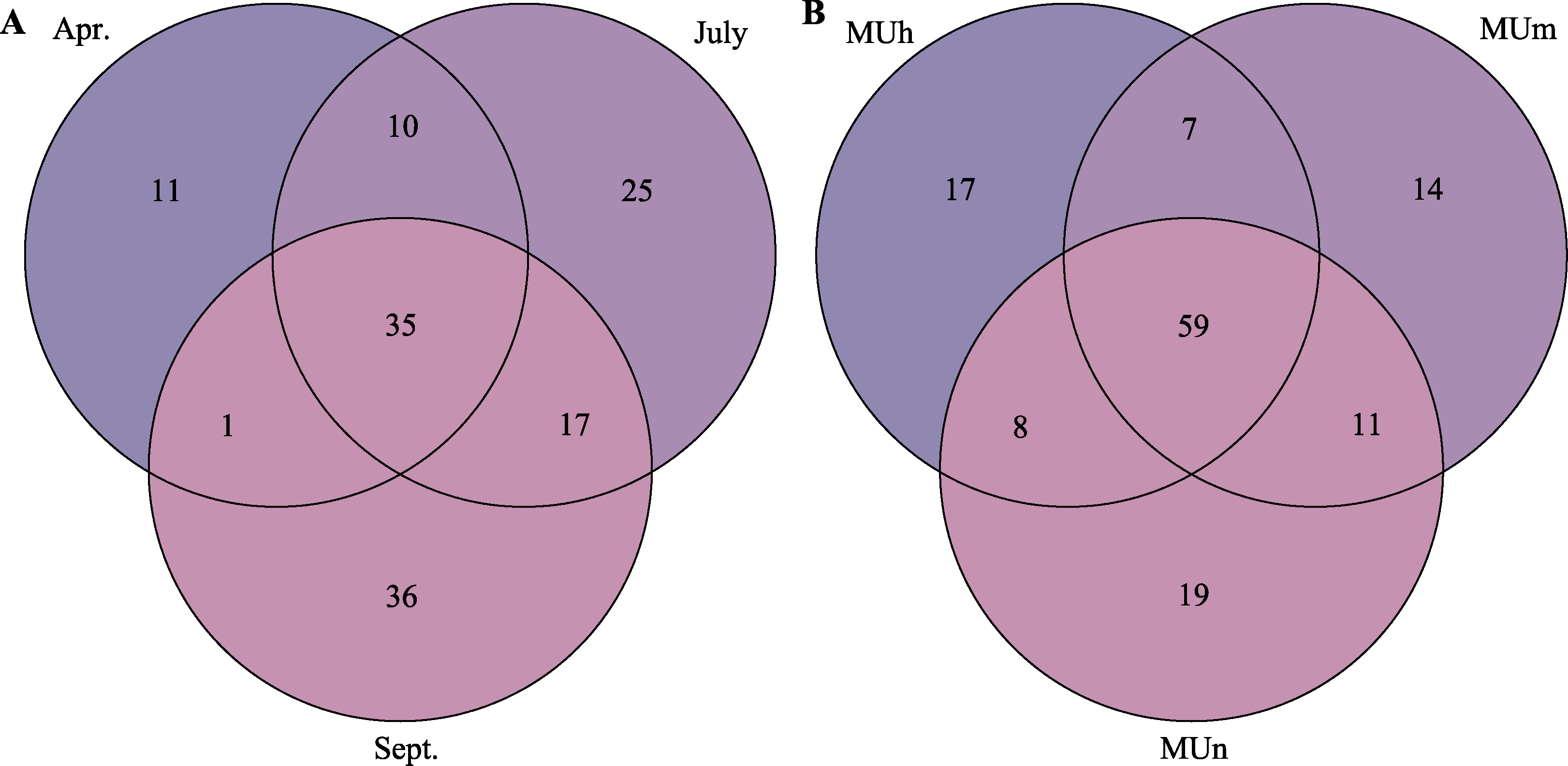
图1 不同生长期(A)和不同树龄(B)樟子松外生菌根真菌可操作分类单元(OTU)韦恩图。Apr., 生长季初期; July, 生长旺盛期; Sept., 生长季末期。MUh, 中龄林; MUm, 成熟林; MUn, 近熟林。
Fig. 1 Venn diagram of ectomycorrhizal fungal operational taxonomic unit (OUT) associated with Pinus sylvestris var. mongolica at different growth period (A) and age group (B). Apr., early growth period; July, vigorous growth period; Sept., late growth period. MUh, middle-aged forest; MUm, mature forest; MUn, nearly mature forest.
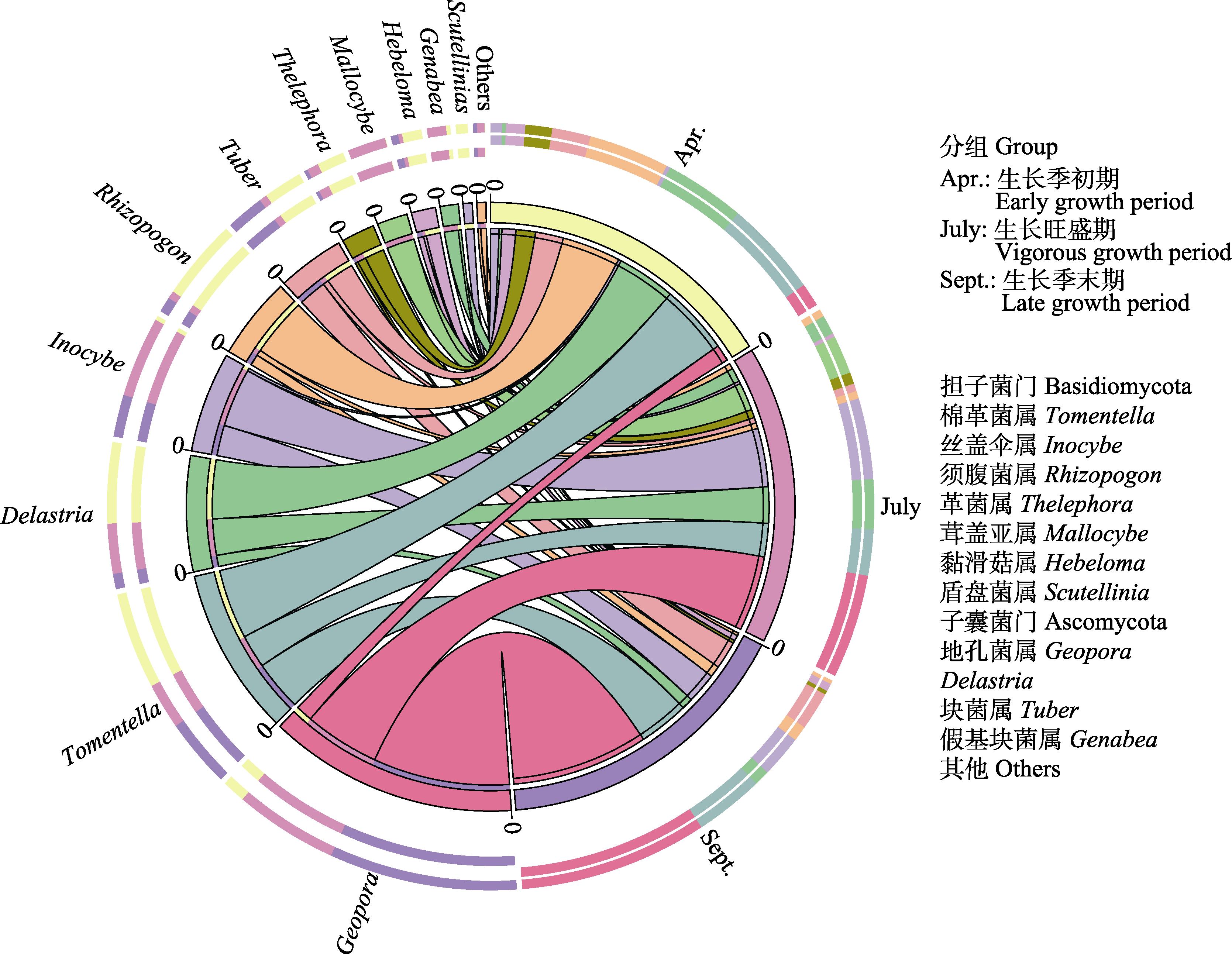
图2 樟子松外生菌根真菌相对丰度堆积图(属水平)。图中左半边表示真菌属在不同样地的相对丰度, 右半边表示样地中不同真菌属在不同生长期的相对丰度。其他, 相对丰度<1%的所有真菌属。
Fig. 2 Relative abundance of ectomycorrhizal fungi associated with Pinus sylvestris var. mongolica at genus level. The left half of figure shows the relative abundance of ectomycorrhizal fungal genera in different plots, and the right half shows the relative abundance of different ectomycorrhizal fungal genera at different growth period. Others, all genera with a relative abundance less than 1%.
| 生长期 Growth period | 龄组 Age group | 丰富度 Richness | Chao1指数 Chao1 index | ACE指数 ACE index | Shannon-Wiener指数 Shannon-Wiener index | Simpson指数 Simpson index | Pielou指数 Pielou index |
|---|---|---|---|---|---|---|---|
| Apr. | MUh | 13 ± 1Ba | 15.78 ± 2.91Ba | 16.44 ± 0.81Aa | 1.64 ± 0.25Aa | 0.75 ± 0.05Aa | 2.64 ± 0.93Aa |
| MUn | 13 ± 1Ba | 14.61 ± 2.96Ba | 20.22 ± 2.17Aa | 1.15 ± 0.45Aa | 0.56 ± 0.17Aa | 1.93 ± 0.49Ba | |
| MUm | 12 ± 1Ba | 17.00 ± 7.86Ba | 24.65 ± 1.43Aa | 1.02 ± 0.32Aa | 0.46 ± 0.19Aa | 2.43 ± 0.48Aa | |
| July | MUh | 24 ± 5Aa | 28.75 ± 8.74Aa | 35.83 ± 2.72Aa | 1.77 ± 0.19Aa | 0.78 ± 0.03Aa | 3.00 ± 0.83Aa |
| MUn | 22 ± 2Aa | 26.67 ± 3.06Aa | 26.62 ± 3.04Aa | 1.38 ± 0.28Aa | 0.64 ± 0.09Aa | 2.60 ± 0.27ABa | |
| MUm | 23 ± 4Aa | 27.17 ± 6.95Aa | 30.44 ± 3.65Aa | 1.56 ± 0.30Aa | 0.70 ± 0.11Aa | 2.83 ± 0.53Aa | |
| Sept. | MUh | 19 ± 3Aa | 19.92 ± 3.02Aa | 20.94 ± 3.42Aa | 1.16 ± 0.46Aa | 0.54 ± 0.19Ba | 2.63 ± 0.50Aa |
| MUn | 23 ± 1Aa | 24.92 ± 1.13Aa | 29.09 ± 3.09Aa | 1.53 ± 0.53Aa | 0.66 ± 0.22Aa | 2.95 ± 0.13Aa | |
| MUm | 19 ± 5Aa | 26.83 ± 11.73Aa | 26.45 ± 2.41Aa | 1.18 ± 0.54Aa | 0.54 ± 0.20Aa | 2.48 ± 0.77Aa | |
| Fgrowth period | 31.705** | 6.606** | 1.804 | 1.676 | 1.955 | 1.424 | |
| Fage group | 0.462 | 0.235 | 0.130 | 1.075 | 1.485 | 0.204 | |
| Fgrowth period × age group | 1.051 | 0.352 | 0.538 | 1.296 | 1.249 | 1.003 | |
表2 不同生长期樟子松外生菌根真菌群落α多样性(平均值±标准差)
Table 2 Α diversity of ectomycorrhizal fungal community associated with Pinus sylvestris var. mongolica at different growth periods (mean ± SD)
| 生长期 Growth period | 龄组 Age group | 丰富度 Richness | Chao1指数 Chao1 index | ACE指数 ACE index | Shannon-Wiener指数 Shannon-Wiener index | Simpson指数 Simpson index | Pielou指数 Pielou index |
|---|---|---|---|---|---|---|---|
| Apr. | MUh | 13 ± 1Ba | 15.78 ± 2.91Ba | 16.44 ± 0.81Aa | 1.64 ± 0.25Aa | 0.75 ± 0.05Aa | 2.64 ± 0.93Aa |
| MUn | 13 ± 1Ba | 14.61 ± 2.96Ba | 20.22 ± 2.17Aa | 1.15 ± 0.45Aa | 0.56 ± 0.17Aa | 1.93 ± 0.49Ba | |
| MUm | 12 ± 1Ba | 17.00 ± 7.86Ba | 24.65 ± 1.43Aa | 1.02 ± 0.32Aa | 0.46 ± 0.19Aa | 2.43 ± 0.48Aa | |
| July | MUh | 24 ± 5Aa | 28.75 ± 8.74Aa | 35.83 ± 2.72Aa | 1.77 ± 0.19Aa | 0.78 ± 0.03Aa | 3.00 ± 0.83Aa |
| MUn | 22 ± 2Aa | 26.67 ± 3.06Aa | 26.62 ± 3.04Aa | 1.38 ± 0.28Aa | 0.64 ± 0.09Aa | 2.60 ± 0.27ABa | |
| MUm | 23 ± 4Aa | 27.17 ± 6.95Aa | 30.44 ± 3.65Aa | 1.56 ± 0.30Aa | 0.70 ± 0.11Aa | 2.83 ± 0.53Aa | |
| Sept. | MUh | 19 ± 3Aa | 19.92 ± 3.02Aa | 20.94 ± 3.42Aa | 1.16 ± 0.46Aa | 0.54 ± 0.19Ba | 2.63 ± 0.50Aa |
| MUn | 23 ± 1Aa | 24.92 ± 1.13Aa | 29.09 ± 3.09Aa | 1.53 ± 0.53Aa | 0.66 ± 0.22Aa | 2.95 ± 0.13Aa | |
| MUm | 19 ± 5Aa | 26.83 ± 11.73Aa | 26.45 ± 2.41Aa | 1.18 ± 0.54Aa | 0.54 ± 0.20Aa | 2.48 ± 0.77Aa | |
| Fgrowth period | 31.705** | 6.606** | 1.804 | 1.676 | 1.955 | 1.424 | |
| Fage group | 0.462 | 0.235 | 0.130 | 1.075 | 1.485 | 0.204 | |
| Fgrowth period × age group | 1.051 | 0.352 | 0.538 | 1.296 | 1.249 | 1.003 | |
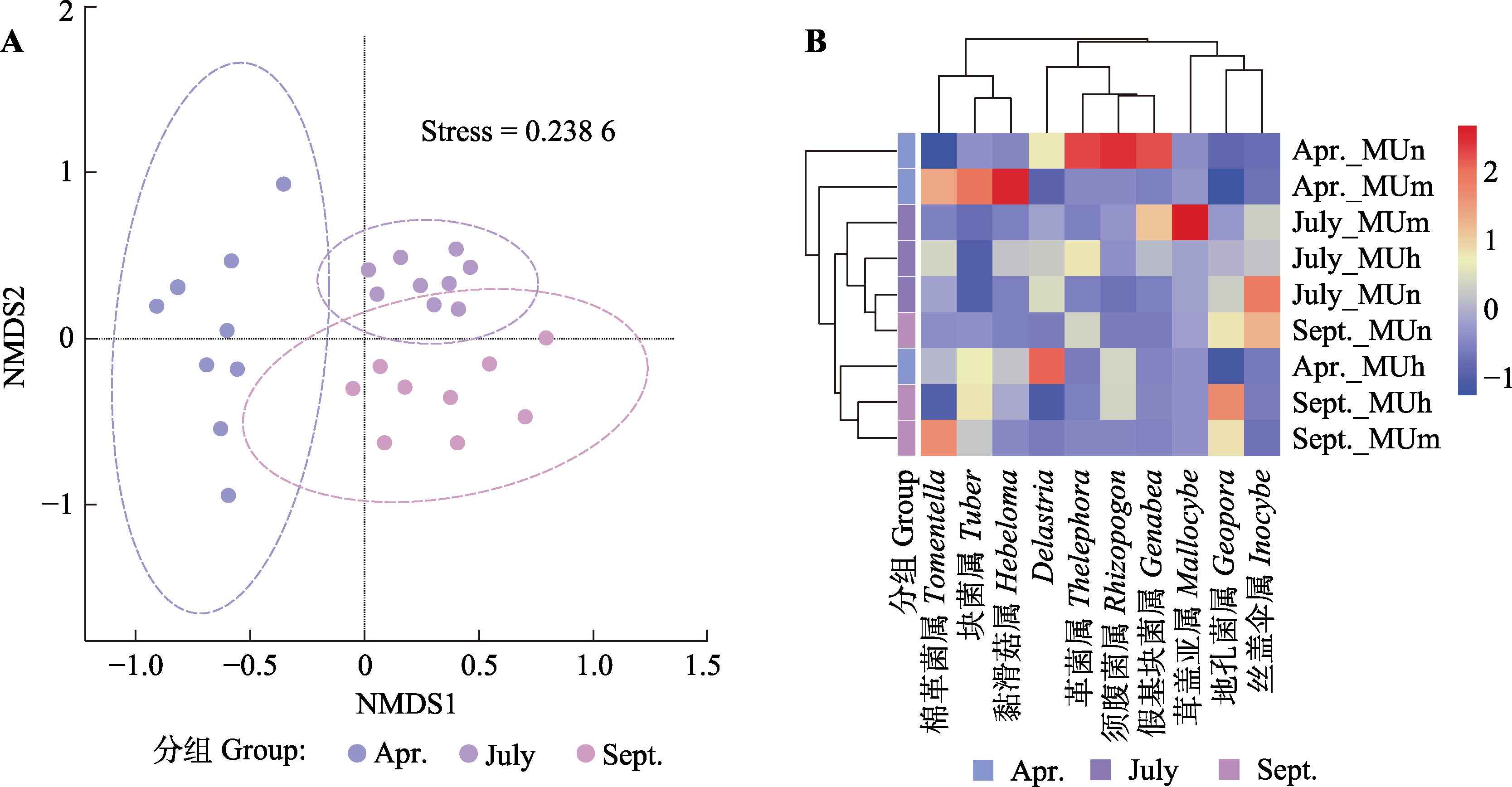
图3 不同生长期樟子松外生菌根真菌群落结构。A, 非度量多维尺度(NMDS)分析。B, 相关性聚类热图(top 10属)。Apr., 生长季初期; July, 生长旺盛期; Sept., 生长季末期。MUh, 中龄林; MUm, 成熟林; MUn, 近熟林。Stress, 应力函数值。
Fig. 3 Community structure of the ectomycorrhizal fungi associated with Pinus sylvestris var. mongolica at different growth periods. A, Non-metric multidimensional scaling (NMDS) analysis. B, Corheatmap (top10 genera). Apr., early growth period; July, vigorous growth period; Sept., late growth period. MUh, middle-aged forest; MUm, mature forest; MUn, nearly mature forest.
| 组别 Group | 指示种 Indicator species | 属 Genus | 指示值 Indicator value | p |
|---|---|---|---|---|
| Apr. | OTU216 | 盾盘菌属 Scutellinia | 0.970 | 0.001 |
| July | OTU27 | 茸盖亚属 Mallocybe | 0.976 | 0.001 |
| OTU104 | 茸盖亚属 Mallocybe | 0.960 | 0.003 | |
| OTU20 | 丝盖伞属 Inocybe | 0.975 | 0.001 | |
| OTU88 | 丝盖伞属 Inocybe | 0.957 | 0.003 | |
| OTU142 | 丝盖伞属 Inocybe | 0.930 | 0.001 | |
| OTU892 | 阿太菌属 Amphinema | 0.879 | 0.001 | |
| OTU368 | 棉革菌属 Tomentella | 0.846 | 0.028 | |
| OTU441 | 棉革菌属 Tomentella | 0.789 | 0.047 | |
| Sept. | OTU207 | 丝盖伞属 Inocybe | 0.922 | 0.006 |
| OTU420 | 棉革菌属 Tomentella | 0.839 | 0.024 | |
| OTU264 | 地孔菌属 Geopora | 0.815 | 0.001 |
表3 不同生长期樟子松外生菌根真菌指示菌种
Table 3 Indicator species of ectomycorrhizal fungal community associated with Pinus sylvestris var. mongolica at different growth periods
| 组别 Group | 指示种 Indicator species | 属 Genus | 指示值 Indicator value | p |
|---|---|---|---|---|
| Apr. | OTU216 | 盾盘菌属 Scutellinia | 0.970 | 0.001 |
| July | OTU27 | 茸盖亚属 Mallocybe | 0.976 | 0.001 |
| OTU104 | 茸盖亚属 Mallocybe | 0.960 | 0.003 | |
| OTU20 | 丝盖伞属 Inocybe | 0.975 | 0.001 | |
| OTU88 | 丝盖伞属 Inocybe | 0.957 | 0.003 | |
| OTU142 | 丝盖伞属 Inocybe | 0.930 | 0.001 | |
| OTU892 | 阿太菌属 Amphinema | 0.879 | 0.001 | |
| OTU368 | 棉革菌属 Tomentella | 0.846 | 0.028 | |
| OTU441 | 棉革菌属 Tomentella | 0.789 | 0.047 | |
| Sept. | OTU207 | 丝盖伞属 Inocybe | 0.922 | 0.006 |
| OTU420 | 棉革菌属 Tomentella | 0.839 | 0.024 | |
| OTU264 | 地孔菌属 Geopora | 0.815 | 0.001 |
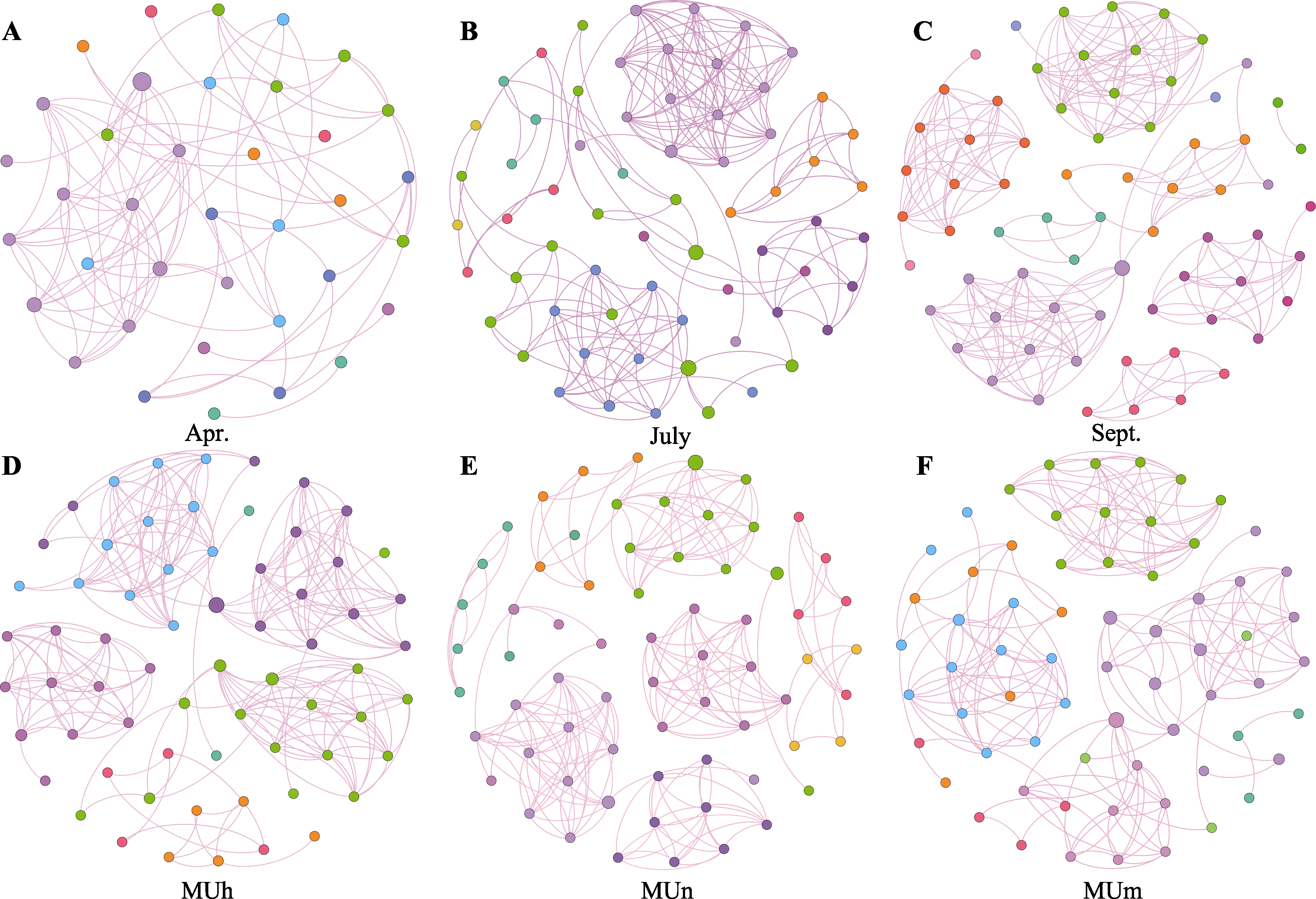
图4 不同生长期樟子松外生菌根真菌相互作用。颜色代表不同模块, 连接线代表节点间为正相互作用。Apr., 生长季初期; July, 生长旺盛期; Sept., 生长季末期。MUh, 中龄林; MUm, 成熟林; MUn, 近熟林。
Fig. 4 Interactions of ectomycorrhizal fungi community associated with Pinus sylvestris var. mongolica at different growth periods. Colors represent different modules. Links represent the positive interaction between nodes. Apr., early growth period; July, vigorous growth period; Sept., late growth period. MUh, middle-aged forest; MUm, mature forest; MUn, nearly mature forest.
| 拓扑特征 Topological feature | 生长期 Growth period | 龄组 Age group | |||||
|---|---|---|---|---|---|---|---|
| Apr. | July | Sept. | MUh | MUn | MUm | ||
| 经验网络 Empirical network | 节点 Node | 37 | 65 | 69 | 65 | 67 | 66 |
| 边 Edge | 87 | 201 | 241 | 243 | 211 | 201 | |
| 模块化 Modularity | 0.663 | 0.730 | 0.798 | 0.772 | 0.819 | 0.776 | |
| 平均度 Average degree | 4.703 | 6.185 | 6.986 | 7.477 | 6.299 | 6.091 | |
| 平均路径长度 Average path length | 1.215 | 1.659 | 1.159 | 1.349 | 1.202 | 2.120 | |
| 平均聚类系数 Average clustering coefficient | 0.901 | 0.911 | 0.952 | 0.923 | 0.941 | 0.820 | |
| 正相关 Positive | 87 (100%) | 201 (100%) | 241 (100%) | 243 (100%) | 211 (100%) | 201 (100%) | |
| 随机网络 Random network | 平均路径长度 Average path length | 1.025 | 1.512 | 1.100 | 1.196 | 1.087 | 1.864 |
| 平均聚类系数 Average clustering coefficient | 0.841 | 0.865 | 0.912 | 0.918 | 0.921 | 0.798 | |
表4 不同生长期樟子松外生菌根真菌网络拓扑性质
Table 4 Topological characteristics of ectomycorrhizal fungal community associated with Pinus sylvestris var. mongolica at different growth periods
| 拓扑特征 Topological feature | 生长期 Growth period | 龄组 Age group | |||||
|---|---|---|---|---|---|---|---|
| Apr. | July | Sept. | MUh | MUn | MUm | ||
| 经验网络 Empirical network | 节点 Node | 37 | 65 | 69 | 65 | 67 | 66 |
| 边 Edge | 87 | 201 | 241 | 243 | 211 | 201 | |
| 模块化 Modularity | 0.663 | 0.730 | 0.798 | 0.772 | 0.819 | 0.776 | |
| 平均度 Average degree | 4.703 | 6.185 | 6.986 | 7.477 | 6.299 | 6.091 | |
| 平均路径长度 Average path length | 1.215 | 1.659 | 1.159 | 1.349 | 1.202 | 2.120 | |
| 平均聚类系数 Average clustering coefficient | 0.901 | 0.911 | 0.952 | 0.923 | 0.941 | 0.820 | |
| 正相关 Positive | 87 (100%) | 201 (100%) | 241 (100%) | 243 (100%) | 211 (100%) | 201 (100%) | |
| 随机网络 Random network | 平均路径长度 Average path length | 1.025 | 1.512 | 1.100 | 1.196 | 1.087 | 1.864 |
| 平均聚类系数 Average clustering coefficient | 0.841 | 0.865 | 0.912 | 0.918 | 0.921 | 0.798 | |
| 因子 Factor | 顺序 Order | RDA1 | RDA2 | R2 | p |
|---|---|---|---|---|---|
| pH | 1 | 0.644 | -0.765 | 0.691 | 0.024 |
| RHa | 2 | -0.094 | -0.996 | 0.641 | 0.028 |
| SDa | 3 | -0.627 | 0.779 | 0.389 | 0.134 |
| Ta | 4 | 0.688 | -0.726 | 0.474 | 0.134 |
| SOC | 5 | 0.974 | -0.228 | 0.365 | 0.250 |
| Pa | 6 | 0.549 | -0.836 | 0.278 | 0.410 |
| TN | 7 | -0.872 | 0.490 | 0.196 | 0.525 |
| SP | 8 | -0.259 | 0.966 | 0.199 | 0.550 |
| AP | 9 | 0.703 | -0.711 | 0.180 | 0.584 |
| SWC | 10 | 0.588 | -0.809 | 0.057 | 0835 |
| AN | 11 | -0.747 | 0.665 | 0.013 | 0.954 |
| TP | 12 | 0.736 | -0.677 | 0.003 | 0.992 |
表5 樟子松外生菌根真菌属相对丰度与环境因子的冗余分析(RDA)中环境因子的排序
Table 5 Constrained ordination of environmental factors in the redundancy analysis (RDA) of relative abundance of ectomycorrhizal fungal genus associated with Pinus sylvestris var. mongolica and environmental factors
| 因子 Factor | 顺序 Order | RDA1 | RDA2 | R2 | p |
|---|---|---|---|---|---|
| pH | 1 | 0.644 | -0.765 | 0.691 | 0.024 |
| RHa | 2 | -0.094 | -0.996 | 0.641 | 0.028 |
| SDa | 3 | -0.627 | 0.779 | 0.389 | 0.134 |
| Ta | 4 | 0.688 | -0.726 | 0.474 | 0.134 |
| SOC | 5 | 0.974 | -0.228 | 0.365 | 0.250 |
| Pa | 6 | 0.549 | -0.836 | 0.278 | 0.410 |
| TN | 7 | -0.872 | 0.490 | 0.196 | 0.525 |
| SP | 8 | -0.259 | 0.966 | 0.199 | 0.550 |
| AP | 9 | 0.703 | -0.711 | 0.180 | 0.584 |
| SWC | 10 | 0.588 | -0.809 | 0.057 | 0835 |
| AN | 11 | -0.747 | 0.665 | 0.013 | 0.954 |
| TP | 12 | 0.736 | -0.677 | 0.003 | 0.992 |
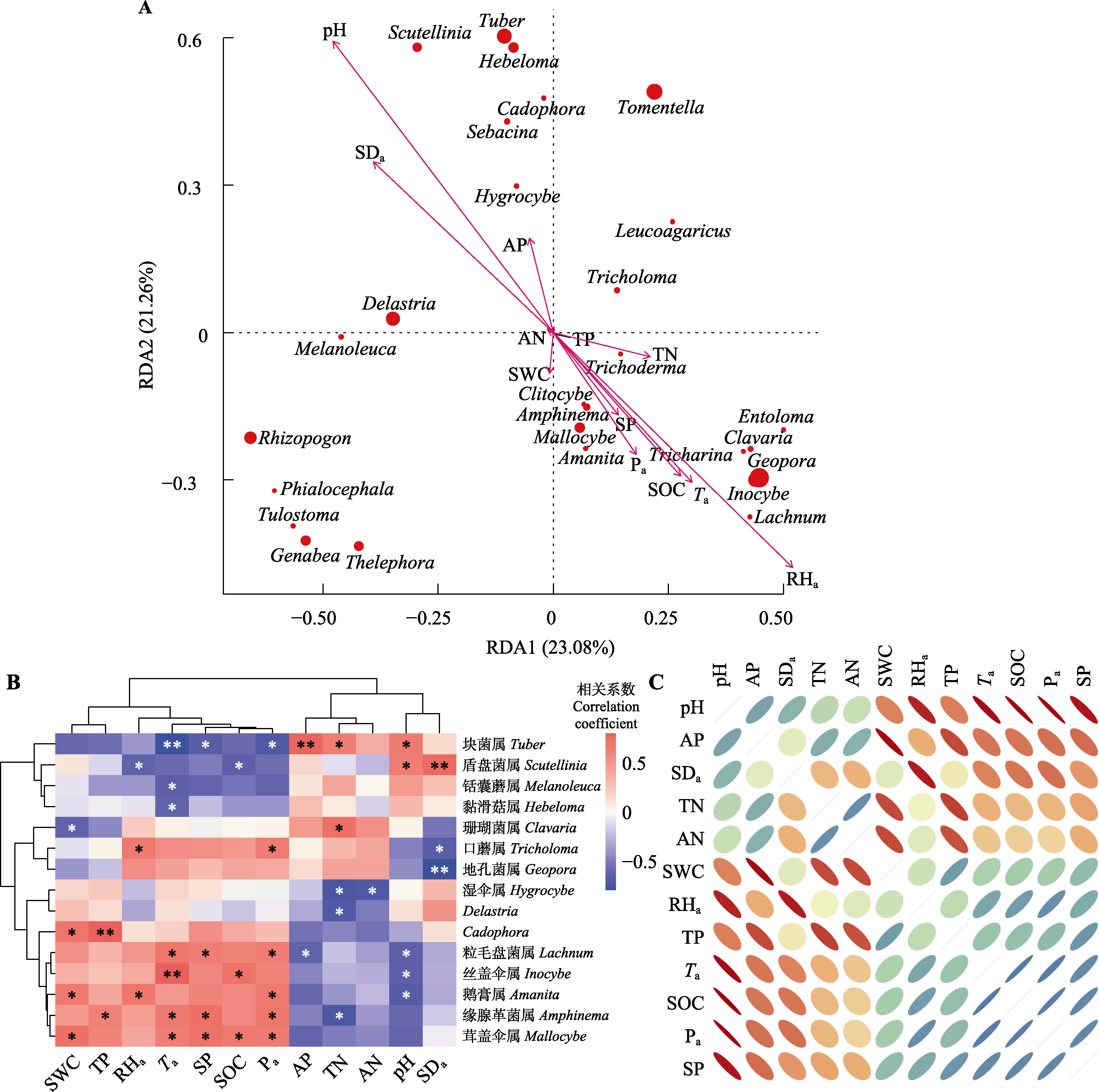
图5 樟子松外生菌根真菌群落与环境因子的相关关系。A, 外生菌根真菌群落与环境因子的冗余分析(RDA)。B, 外生菌根真菌属相对丰度与土壤因子的相关性分析。C, 环境因子间相关性分析。*, p < 0.05; **, p < 0.01。RDA图中点的大小代表属的相对丰度, 点越大相对丰度越高; 环境因子间相关性的椭圆越扁、颜色越深代表相关性越强, 红色代表正相关, 蓝色代表负相关。AN, 土壤铵态氮含量; AP, 土壤速效磷含量; Pa, 年降水量; RHa, 年平均相对湿度; SDa, 年日照时间; SOC, 土壤有机碳含量; SP, 土壤孔隙度; SWC, 土壤含水量; Ta, 年平均气温; TN, 土壤全氮含量; TP, 土壤全磷含量。
Fig. 5 Relationship of ectomycorrhizal fungal communities and soil properties associated with Pinus sylvestris var. mongolica plantation. A, Redundancy analysis (RDA) between ectomycorrhizal fungi and environmental factors. B, Correlation analysis between relative abundance of main ectomycorrhizal fungal genera and environmental factors. C, Correlation analysis between environmental factors. *, p < 0.05; **, p < 0.01. The dots’ size in the RDA analysis represents the relative abundance of ectomycorrhizal fungal genera, the bigger the size, the higher of the relative abundance. The oblate and the darker the color of the ellipse between soil physical and chemical factors represent the stronger correlation, red represents the positive and blue represents the negative. AN, soil ammonia nitrogen content; AP, soil available phosphorus content; Pa, annual precipitation; RHa, annual relative humidity; SDa, annual sunshine duration; SOC, soil organic carbon content; SP, soil porosity; SWC, soil water content; Ta, annual air temperature; TN, soil total nitrogen content; TP, soil total phosphorus content.
| [1] | Adamo I, Castaño C, Bonet JA, Colinas C, Alday JG (2021). Soil physicochemical properties have a greater effect on soil fungi than host species in mediterranean pure and mixed pine forests. Soil Biology & Biochemistry, 160, 108320. DOI: 10.1016/j.soilbio.2021.108320. |
| [2] |
Arraiano-Castilho R, Bidartondo MI, Niskanen T, Clarkson JJ, Brunner I, Zimmermann S, Senn-Irlet B, Frey B, Peintner U, Mrak T, Suz LM (2021). Habitat specialization controls ectomycorrhizal fungi above the treeline in the European Alps. New Phytologist, 229, 2901-2916.
DOI PMID |
| [3] |
Awad A, Majcherczyk A, Schall P, Schröter K, Schöning I, Schrumpf M, Ehbrecht M, Boch S, Kahl T, Bauhus J, Seidel D, Ammer C, Fischer M, Kües U, Pena R (2019). Ectomycorrhizal and saprotrophic soil fungal biomass are driven by different factors and vary among broadleaf and coniferous temperate forests. Soil Biology & Biochemistry, 131, 9-18.
DOI URL |
| [4] |
Barbeta A, Mejía-Chang M, Ogaya R, Voltas J, Dawson TE, Peñuelas J (2015). The combined effects of a long-term experimental drought and an extreme drought on the use of plant-water sources in a Mediterranean forest. Global Change Biology, 21, 1213-1225.
DOI PMID |
| [5] |
Bennett JA, Maherali H, Reinhart KO, Lekberg Y, Hart MM, Klironomos J (2017). Plant-soil feedbacks and mycorrhizal type influence temperate forest population dynamics. Science, 355, 181-184.
DOI PMID |
| [6] |
Boeraeve M, Honnay O, Jacquemyn H (2018). Effects of host species, environmental filtering and forest age on community assembly of ectomycorrhizal fungi in fragmented forests. Fungal Ecology, 36, 89-98.
DOI URL |
| [7] | Chen FL, Zhang K, Xiang D, Wu AP, Li YZ, Zou DS, Zheng H (2019). Impacts of litter decomposition of eucalyptus on soil microbial community: a microcosm study. Acta Pedologica Sinica, 56, 432-442. |
| [陈法霖, 张凯, 向丹, 吴爱平, 李有志, 邹冬生, 郑华 (2019). 桉树凋落物对土壤微生物群落的影响: 基于控制实验研究. 土壤学报, 56, 432-442.] | |
| [8] |
Corrales A, Turner BL, Tedersoo L, Anslan S, Dalling JW (2017). Nitrogen addition alters ectomycorrhizal fungal communities and soil enzyme activities in a tropical montane forest. Fungal Ecology, 27, 14-23.
DOI URL |
| [9] |
Courty PE, Franc A, Pierrat JC, Garbaye J (2008). Temporal changes in the ectomycorrhizal community in two soil horizons of a temperate oak forest. Applied and Environmental Microbiology, 74, 5792-5801.
DOI URL |
| [10] | Craine JM, Elmore AJ, Aidar MPM, Bustamante M, Dawson TE, Hobbie EA, Kahmen A, Mack MC, McLauchlan KK, Michelsen A, Nardoto GB, Pardo LH, Peñuelas J, Reich PB, Schuur EAG, et al. (2009). Global patterns of foliar nitrogen isotopes and their relationships with climate, mycorrhizal fungi, foliar nutrient concentrations, and nitrogen availability. New Phytologist, 183, 980-992. |
| [11] |
Deng Y, Jiang YH, Yang YF, He ZL, Luo F, Zhou JZ (2012). Molecular ecological network analyses. BMC Bioinformatics, 13, 113. DOI: 10.1186/1471-2105-13-113.
PMID |
| [12] | Druebert C, Lang C, Valtanen K, Polle A (2009). Beech carbon productivity as driver of ectomycorrhizal abundance and diversity. Plant, Cell & Environment, 32, 992-1003. |
| [13] |
Edgar RC (2010). Search and clustering orders of magnitude faster than BLAST. Bioinformatics, 26, 2460-2461.
DOI PMID |
| [14] |
Fang XM, Yu DP, Zhou WM, Zhou L, Dai LM (2016). The effects of forest type on soil microbial activity in Changbai Mountain, northeast China. Annals of Forest Science, 73, 473-482.
DOI URL |
| [15] |
Frey-Klett P, Garbaye J, Tarkka M (2007). The mycorrhiza helper bacteria revisited. New Phytologist, 176, 22-36.
DOI PMID |
| [16] |
Goldmann K, Schröter K, Pena R, Schöning I, Schrumpf M, Buscot F, Polle A, Wubet T (2016). Divergent habitat filtering of root and soil fungal communities in temperate beech forests. Scientific Reports, 6, 31439. DOI: 10.1038/srep31439.
PMID |
| [17] | Gong S, Feng B, Jian SP, Wang GS, Ge ZW, Yang ZL (2022). Elevation matters more than season in shaping the heterogeneity of soil and root associated ectomycorrhizal fungal community. Microbiology Spectrum, 10, e01950-21. DOI: 10.1128/spectrum.01950-21. |
| [18] |
Griffiths RP, Baham JE, Caldwell BA (1994). Soil solution chemistry of ectomycorrhizal mats in forest soil. Soil Biology & Biochemistry, 26, 331-337.
DOI URL |
| [19] | Guo MS, Gao GL, Ding GD, Zhang Y (2020). Drivers of ectomycorrhizal fungal community structure associated with Pinus sylvestris var. mongolica differ at regional vs. local spatial scales in Northern China. Forests, 11, 323. DOI: 10.3390/F11030323. |
| [20] |
Han QS, Huang J, Long DF, Wang XB, Liu JJ (2017). Diversity and community structure of ectomycorrhizal fungi associated with Larix chinensis across the alpine treeline ecotone of Taibai Mountain. Mycorrhiza, 27, 487-497.
DOI URL |
| [21] |
Hayward J, Horton TR, Nuñez MA (2015). Ectomycorrhizal fungal communities coinvading with Pinaceae host plants in Argentina: Gringos bajo el bosque. New Phytologist, 208, 497-506.
DOI PMID |
| [22] |
Hupperts SF, Karst J, Pritsch K, Landhäusser SM (2017). Host phenology and potential saprotrophism of ectomycorrhizal fungi in the boreal forest. Functional Ecology, 31, 116-126.
DOI URL |
| [23] |
Koizumi T, Nara K (2020). Ectomycorrhizal fungal communities in ice-age relict forests of Pinus pumila on nine moutains correspond to summer temperature. The ISME Journal, 14, 189-201.
DOI |
| [24] |
Kutszegi G, Siller I, Dima B, Takács K, Merényi Z, Varga T, Turcsányi G, Bidló A, Ódor P (2015). Drivers of macrofungal species composition in temperate forests, West Hungary: functional groups compared. Fungal Ecology, 17, 69-83.
DOI URL |
| [25] | Li M, Gao XH (2021). Community structure and driving factors for rhizosphere ectomycorrhizal fungi of Betula platyphylla in Daqing Mountain. Chinese Journal of Ecology, 40, 1244-1252. |
| [李敏, 高秀宏 (2021). 大青山白桦根围外生菌根真菌群落结构及其驱动因素. 生态学杂志, 40, 1244-1252.] | |
| [26] | Li M, Lü GF, Niu YF, Meng ZY, Yang XJ (2022). Ectomycorrhizal community structure and driving factors of Betula platyphylla in different climate zones in Inner Mongolia. Acta Ecologica Sinica, 12, 4847-4860. |
| [李敏, 吕桂芬, 牛艳芳, 孟兆云, 杨勋爵 (2022). 内蒙古不同气候带白桦外生菌根真菌群落结构及影响因素. 生态学报, 12, 4847-4860.] | |
| [27] | Long DF, Liu JJ, Han QS, Wang XB, Huang J (2016). Ectomycorrhizal fungal communities associated with Populus simonii and Pinus tabuliformis in the hilly-gully region of the Loess Plateau, China. Scientific Reports, 6, 24336. DOI: 10.1038/srep24336. |
| [28] |
Mason PA, Wilson J, Last FT, Walker C (1983). The concept of succession in relation to the spread of sheathing mycorrhizal fungi on inoculated tree seedlings growing in unsterile soils. Plant and Soil, 71, 247-256.
DOI URL |
| [29] |
Miyamoto Y, Terashima Y, Nara K (2018). Temperature niche position and breadth of ectomycorrhizal fungi: reduced diversity under warming predicted by a nested community structure. Global Change Biology, 24, 5724-5737.
DOI PMID |
| [30] |
Mundra S, Bahram M, Tedersoo L, Kauserud H, Halvorsen R, Eidesen P (2015). Temporal variation of Bistorta vivipara-associated ectomycorrhizal fungal communities in the High Arctic. Molecular Ecology, 24, 6289-6302.
DOI PMID |
| [31] | Ren Y, Gao GL, Ding GD, Zhang Y, Guo MS, Cao HY, Su M (2019). Stoichiometric characteristics of nitrogen and phosphorus in leaf-litter-soil system of Pinus sylvestris var. mongolica plantations. Chinese Journal of Applied Ecology, 30, 743-750. |
|
[任悦, 高广磊, 丁国栋, 张英, 郭米山, 曹红雨, 苏敏 (2019). 沙地樟子松人工林叶片-枯落物-土壤氮磷化学计量特征. 应用生态学报, 30, 743-750.]
DOI |
|
| [32] | Ren Y, Guo MS, Ding GD, Wang Y (2022). Ectomycorrhizal fungi associated with Pinus sylvestris var. mongolica were altered by soil environments with aging plantation in a semi-arid desert. Frontiers in Environmental Science, 10, 858452. DOI: 10.3389/fenvs.2022.858452. |
| [33] |
Sebastiana M, da Silva AB, Matos AR, Alcântara A, Silvestre S, Malhó R (2018). Ectomycorrhizal inoculation with Pisolithus tinctorius reduces stress induced by drought in cork oak. Mycorrhiza, 28, 247-258.
DOI PMID |
| [34] |
Siles JA, Margesin R (2017). Seasonal soil microbial responses are limited to changes in functionality at two alpine forest sites differing in altitude and vegetation. Scientific Reports, 7, 2204. DOI: 10.1038/s41598-017-02363-2.
PMID |
| [35] |
Taylor DL, Bruns TD (1999). Community structure of ectomycorrhizal fungi in a Pinus muricata forest: minimal overlap between the mature forest and resistant propagule communities. Molecular Ecology, 8, 1837-1850.
PMID |
| [36] |
Tang YS, Wang L, Jia JW, Fu XH, Le YQ, Chen XZ, Sun Y (2011). Response of soil microbial community in Jiuduansha wetland to different successional stages and its implications for soil microbial respiration and carbon turnover. Soil Biology & Biochemistry, 43, 638-646.
DOI URL |
| [37] |
Tamara C, Gerardo M, Anabela MA, Alejandro S (2015). Seasonal variations of ectomycorrhizal communities in declining Quercus ilex forests: interactions with topography, tree health status and Phytophthora cinnamomi infections. Forestry, 88, 257-266.
DOI URL |
| [38] | Tedersoo L, Bahram M, Zobel M (2020). How mycorrhizal associations drive plant population and community biology. Science, 367, eaba1223. DOI: 10.1126/science.aba1223. |
| [39] |
van der Linde S, Suz LM, Orme CDL, Cox F, Andreae H, Asi E, Atkinson B, Benham S, Carroll C, Cools N, de Vos B, Dietrich HP, Eichhorn J, Gehrmann J, Grebenc T, et al. (2018). Environment and host as large-scale controls of ectomycorrhizal fungi. Nature, 558, 243-248.
DOI |
| [40] | Wang HH, Chu HL, Dou Q, Feng H, Tang M, Zhang SX, Wang CY (2021). Seasonal changes in Pinus tabuliformis root-associated fungal microbiota drive N and P cycling in terrestrial ecosystem. Frontiers in Microbiology, 11, 526898. DOI: 10.3389/fmicb.2020.526898. |
| [41] | Wang JY, Yin XL, Ren Y, Gao GL, Ding GD, Zhang Y, Zhao PS, Guo MS (2020). Diversity characteristics of ectomycorrhizal fungi associated with Pinus sylvestris var. mongolica in the Mu Us sandy land. Microbiology China, 47, 3856-3867. |
| [王家源, 殷小琳, 任悦, 高广磊, 丁国栋, 张英, 赵珮杉, 郭米山 (2020). 毛乌素沙地樟子松外生菌根真菌多样性特征. 微生物学通报, 47, 3856-3867.] | |
| [42] |
Wang XQ, Wang CK, Zhang TD (2017). New perspectives on forest soil carbon and nitrogen cycling processes: roles of arbuscular mycorrhizal versus ectomycorrhizal tree species. Chinese Journal of Plant Ecology, 41, 1113-1125.
DOI URL |
|
[王薪琪, 王传宽, 张泰东 (2017). 森林土壤碳氮循环过程的新视角: 丛枝与外生菌根树种的作用. 植物生态学报, 41, 1113-1125.]
DOI |
|
| [43] |
Watts DJ, Strogatz SH (1998). Collective dynamics of “small-world” networks. Nature, 393, 440-442.
DOI |
| [44] |
Xia TZ, Li LS, Yang HQ (2022). Soil fungal community characteristics at the upper and lower altitudinal range limits of Cephalostachyum pingbianense. Chinese Journal of Plant Ecology, 46, 823-833.
DOI URL |
|
[夏体泽, 李露双, 杨汉奇 (2022). 屏边空竹分布区海拔上下边界的土壤真菌群落特征. 植物生态学报, 46, 823-833.]
DOI |
|
| [45] |
Yao F, Yang S, Wang ZR, Wang X, Ye J, Wang XG, de Bruyn JM, Feng X, Jiang Y, Li H (2017). Microbial taxa distribution is associated with ecological trophic cascades along an elevation gradient. Frontiers in Microbiology, 8, 2071. DOI: 10.3389/fmicb.2017.02071.
PMID |
| [46] | Zhang Y, Cao HY, Zhao PS, Wei XS, Ding GD, Gao GL, Shi MC (2021). Vegetation restoration alters fungal community composition and functional groups in a desert ecosystem. Frontiers in Environmental Science, 9, 589068. DOI: 10.3389/fenvs.2021.589068. |
| [47] |
Zhao PS, Gao GL, Ding GD, Zhang Y, Wand JY (2022a). Biogeography and ecological functions of root-associated and soil fungi of Pinus sylvestris var. mongolica across different afforestation areas in desertified Northern China. Land Degradation & Development, 34, 313-326.
DOI URL |
| [48] | Zhao PS, Gao GL, Ren Y, Ding GD, Zhang Y, Wang JY (2022b). Intra-annual variation of root-associated fungi of Pinus sylvestris var. mongolica: the role of climate and implications for host phenology. Applied Soil Ecology, 176, 104480. DOI: 10.1016/j.apsoil.2022.104480. |
| [1] | 杨梅花, 张子嘉, 乔栋, 冯俊娜, 庞子杰, 钱龙, 刘志晖, 蔡娜娜, 胡中民, 杨国姣. 海南热带森林乔木群落调查和多样性数据集[J]. 植物生态学报, 2026, 50(预发表): 0-. |
| [2] | 何青, 袁旭东, 任博申, 冯治洋, 鲁梦珍, 林巧玲, 姜庆虎, 杨林森, 余辉亮, 姚辉, 杨敬元, 刘峰, 江明喜. 一年蓬(Erigeron annuus)入侵对亚高山泥炭湿地植物群落结构与多样性的影响[J]. 植物生态学报, 2026, 50(预发表): 0-. |
| [3] | 谭秋颜, 张清, 高程, 褚海燕, 杨腾. 外生菌根真菌: 高寒生态系统碳氮循环的关键驱动者[J]. 植物生态学报, 2026, 50(3): 584-599. |
| [4] | 马建辉, 童鑫, 张思榕, 毛子昆, 秦俊, 马克平. 菌根真菌生理生态功能研究进展及展望[J]. 植物生态学报, 2026, 50(3): 498-514. |
| [5] | 李文竹, 栾军伟, 邸雅平, 王一, 聂秀青, 刘世荣. 模拟干旱对暖温带锐齿槲栎林菌根介导下土壤酶活性和土壤有机碳组分的影响[J]. 植物生态学报, 2026, 50(3): 660-673. |
| [6] | 王梦雪, 胡明艳, 储诚进, 陈阳, 罗文启, 马子龙. 亚热带森林不同菌根真菌树种叶片和细根的碳氮磷化学计量特征[J]. 植物生态学报, 2026, 50(2): 334-343. |
| [7] | 田地, 迟小龙, 石亮, 刘宵含, 赵常提, 吴梅, 张玉忠, 高永亮. 塞罕坝地区优势造林树种叶片化学计量特征及其环境驱动[J]. 植物生态学报, 2026, 50(2): 362-373. |
| [8] | 滕安萍, 刘明慧, 高广磊, 丁国栋, 张英, 李启研. 科尔沁沙地不同林龄樟子松人工林土壤真菌-细菌共现模式[J]. 植物生态学报, 2025, 49(9): 1556-1568. |
| [9] | 赵珮杉, 高广磊, 丁国栋, 张英. 林龄和生态位对樟子松人工林地下真菌群落构建的影响[J]. 植物生态学报, 2025, 49(9): 1472-1484. |
| [10] | 蔡榕榕, 沈历都, 刘雅各, 费雯丽, 戴冠华. 2005-2010年长白山阔叶红松林长期监测样地植物物种组成和群落特征数据集[J]. 植物生态学报, 2025, 49(8): 1236-1245. |
| [11] | 白帆, 王杨. 2007-2015年北京东灵山暖温带落叶阔叶林长期监测样地植物物种组成和群落特征数据集[J]. 植物生态学报, 2025, 49(8): 1229-1235. |
| [12] | 赵常明, 熊高明, 申国珍, 葛结林, 徐文婷, 徐凯, 武元帅, 谢宗强. 2010年神农架常绿落叶阔叶混交林和亚高山针叶林长期监测样地植物物种组成和群落特征数据集[J]. 植物生态学报, 2025, 49(8): 1215-1228. |
| [13] | 饶兴权, 蔡锡安, 林永标, 刘素萍. 2005-2015年鹤山马占相思林长期监测样地植物物种组成和群落特征数据集[J]. 植物生态学报, 2025, 49(8): 1246-1254. |
| [14] | 徐志雄, 杞金华, 杨国平, 鲁志云, 杨效东, 范泽鑫. 2005-2010年哀牢山中山湿性常绿阔叶林长期监测样地植物物种组成和群落特征数据集[J]. 植物生态学报, 2025, 49(8): 1191-1204. |
| [15] | 周志琼, 丁建林, 李晓明, 何其华. 2005-2010年西南山地人工林长期监测样地植物物种组成与群落特征数据集[J]. 植物生态学报, 2025, 49(8): 1255-1262. |
| 阅读次数 | ||||||
|
全文 |
|
|||||
|
摘要 |
|
|||||
Copyright © 2026 版权所有 《植物生态学报》编辑部
地址: 北京香山南辛村20号, 邮编: 100093
Tel.: 010-62836134, 62836138; Fax: 010-82599431; E-mail: apes@ibcas.ac.cn, cjpe@ibcas.ac.cn
备案号: 京ICP备16067583号-19

