
植物生态学报 ›› 2025, Vol. 49 ›› Issue (9): 1363-1373.DOI: 10.17521/cjpe.2024.0470 cstr: 32100.14.cjpe.2024.0470
郑子仪1,3, 陈江慧1,3, 刘慧颖1,2,3,4,*( )
)
收稿日期:2024-12-30
接受日期:2025-05-13
出版日期:2025-09-20
发布日期:2025-09-01
通讯作者:
*刘慧颖 (hyliu@des.ecnu.edu.cn)基金资助:
ZHENG Zi-Yi1,3, CHEN Jiang-Hui1,3, LIU Hui-Ying1,2,3,4,*()
Received:2024-12-30
Accepted:2025-05-13
Online:2025-09-20
Published:2025-09-01
Supported by:摘要: 近年来, 植物根系分泌物作为植物-土壤-微生物相互作用的关键环节, 逐渐受到越来越多的关注。然而, 由于草地植物根系交织复杂, 关于气候变暖对草本植物根系分泌速率影响的研究仍然较为有限。该研究以青藏高原高寒草甸10种优势植物为对象, 开展室内气候培养箱实验, 通过原位动态收集根系分泌物, 定量分析增温(+4 ℃)条件下优势物种根系碳分泌速率的变化及其影响因素。结果表明: (1)增温显著提高了大多数优势物种的根系碳分泌速率, 使整体水平提升了(83.48 ± 6.00) μg·g-1·h-1 (81.71%), 但降低了豆科植物的根系分泌速率(11.15%); (2)增温引起的根系分泌速率变化与植物养分性状和形态性状的变化密切相关, 其中根氮含量对增温下植物根系分泌速率的解释力最强。该研究结果表明, 气候变暖将增强高寒草甸植物优势物种的根系分泌速率, 并强调了功能性状在调控根系分泌速率响应气候变暖中的重要作用。该研究有助于理解气候变化背景下高寒草甸根际碳动态, 为进一步预测青藏高原土壤碳库的变化提供科学依据。
郑子仪, 陈江慧, 刘慧颖. 气候变暖提高青藏高原高寒草甸优势物种的根系分泌速率. 植物生态学报, 2025, 49(9): 1363-1373. DOI: 10.17521/cjpe.2024.0470
ZHENG Zi-Yi, CHEN Jiang-Hui, LIU Hui-Ying. Climate warming increases root exudation rates of dominant species in alpine meadow on the Qingzang Plateau. Chinese Journal of Plant Ecology, 2025, 49(9): 1363-1373. DOI: 10.17521/cjpe.2024.0470
| 固定效应 Fixed effect | 模型自由度 NumDF | 残差自由度 DenDF | F | p |
|---|---|---|---|---|
| 处理 Treatment (T) | 1 | 40 | 103.20 | <0.001*** |
| 物种 Species (S) | 9 | 40 | 29.51 | <0.001*** |
| 处理×物种 T × S | 9 | 40 | 7.27 | <0.001*** |
表1 增温对高寒草甸10种优势植物根系碳分泌速率影响的线性混合效应模型结果
Table 1 Linear mixed effects model results of the effect of warming on carbon exudation rates of 10 dominant species in alpine meadows on the Qingzang Plateau
| 固定效应 Fixed effect | 模型自由度 NumDF | 残差自由度 DenDF | F | p |
|---|---|---|---|---|
| 处理 Treatment (T) | 1 | 40 | 103.20 | <0.001*** |
| 物种 Species (S) | 9 | 40 | 29.51 | <0.001*** |
| 处理×物种 T × S | 9 | 40 | 7.27 | <0.001*** |
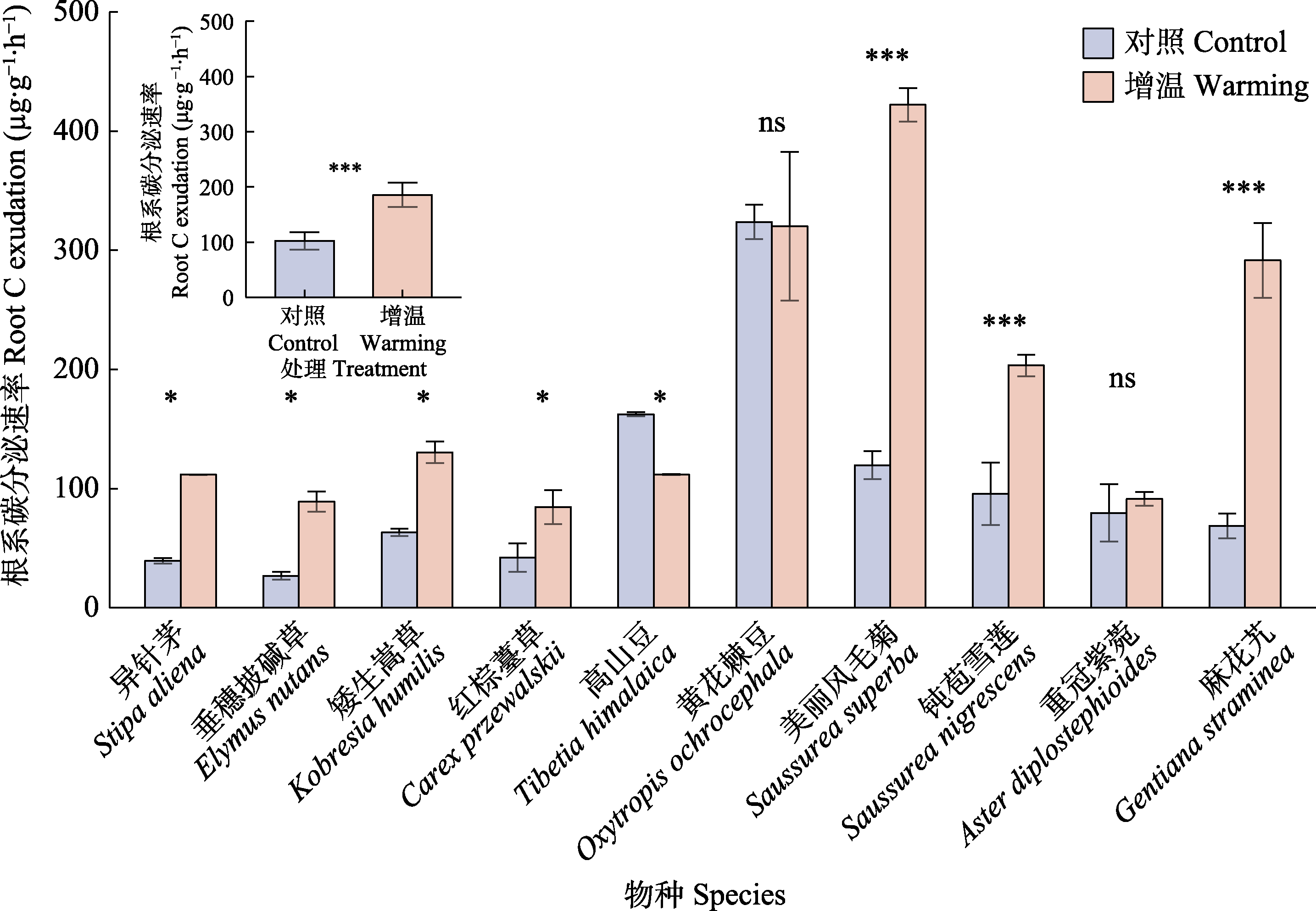
图1 增温对青藏高原高寒草甸10个优势物种根系碳分泌速率的影响(平均值±标准误, n = 3)。左上角插图显示了增温对所有物种根系碳分泌速率的影响(n = 30)。星号表示对照和增温处理之间存在显著差异(*, p < 0.05; ***, p < 0.001), ns表示对照和增温处理之间无显著差异(p > 0.05)。
Fig. 1 Effects of warming on root carbon (C) exudation rates of 10 dominant species in alpine meadows on the Qingzang Plateau (mean ± SE, n = 3). The upper left inset shows the effect of warming on root carbon exudation rates of all species (n = 30). Asterisks indicate significant differences between control and warming (*, p < 0.05; ***, p < 0.001), and ns indicates no significant differences between control and warming (p > 0.05).

图2 增温对青藏高原高寒草甸优势植物经济型谱的影响。红色箭头为增温处理的方向, 棕色箭头为代表根系性状, 绿色箭头代表叶片性状。LC, 根碳含量; LN, 叶氮含量; NPR, 净光合速率; RC, 根碳含量; RN, 根氮含量; Root C exudation, 根系碳分泌速率; RTD, 根组织密度; SLA, 比叶面积; SPAD, 叶绿素相对含量; SRA, 比根面积; SRL, 比根长; Warming, 增温。PC1, 主成分1; PC2, 主成分2。
Fig. 2 Effects of warming on the economic phenotypes of dominant plants in alpine meadows on the Qingzang Plateau. The red arrow indicates the direction of the warming treatment, the brown arrows indicate the root traits, and the green arrows indicate the leaf traits. LC, leaf carbon content; LN, leaf nitrogen content; NPR, net photosynthetic rate; RC, root carbon content; RN, root nitrogen content; Root C exudation, root carbon exudation rate; RTD, root tissue density; SLA, specific leaf area; SPAD, relative chlorophyll content; SRA, specific root area; SRL, specific root length; Warming, warming treatment. PC1, principal component 1; PC2, principal component 2.
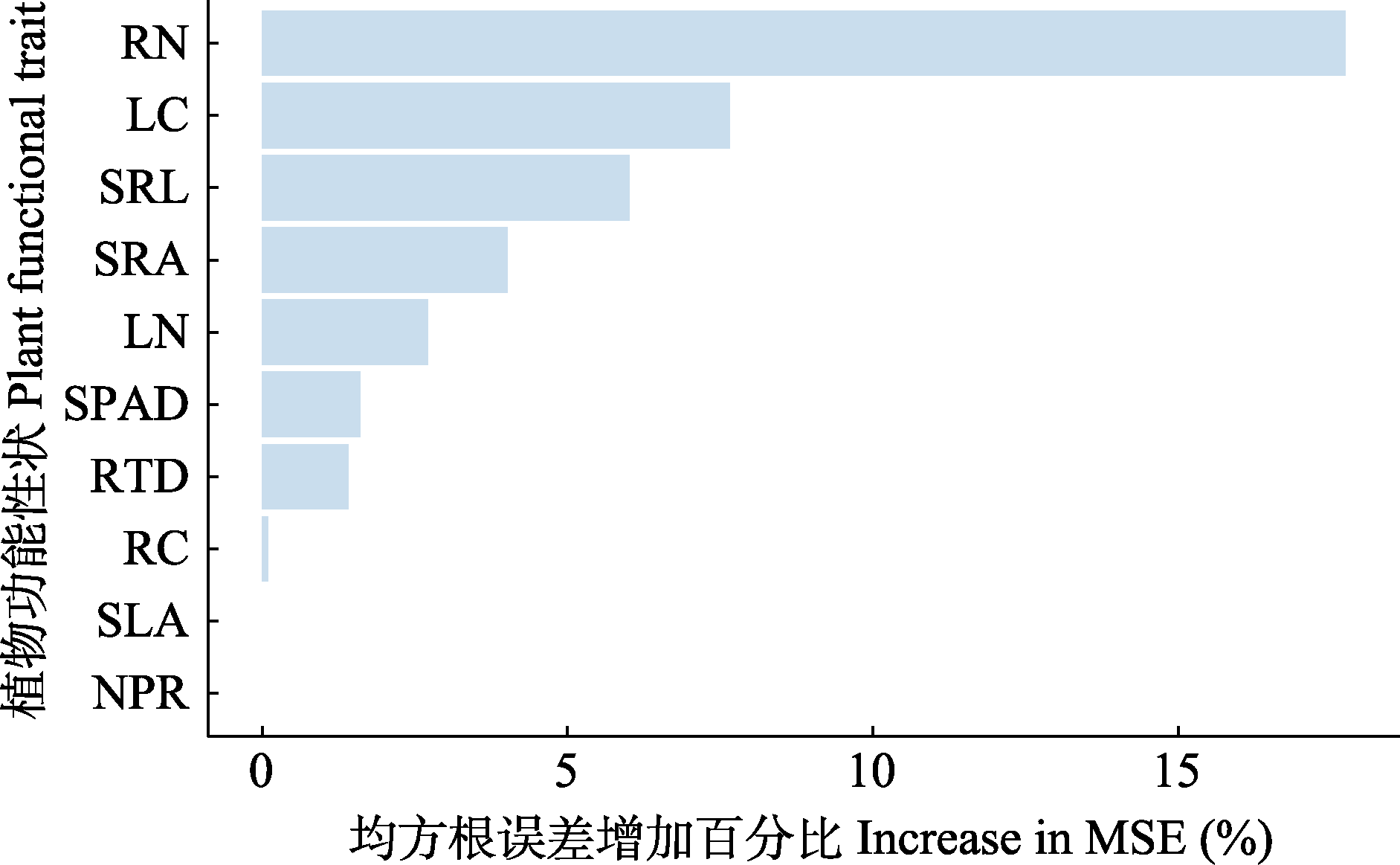
图3 植物功能性状对根系碳分泌速率变化的相对贡献(n = 60)。LC, 根碳含量; LN, 叶氮含量; NPR, 净光合速率; RC, 根碳含量; RN, 根氮含量; RTD, 根组织密度; SLA, 比叶面积; SPAD, 叶绿素相对含量; SRA, 比根面积; SRL, 比根长。
Fig. 3 Contribution of plant functional traits to changes in root carbon exudation rate (n = 60). LC, leaf carbon content; LN, leaf nitrogen content; NPR, net photosynthetic rate; RC, root carbon content; RN, root nitrogen content; RTD, root tissue density; SLA, specific leaf area; SPAD, relative chlorophyll content; SRA, specific root area; SRL, specific root length. MSE, mean squared error.
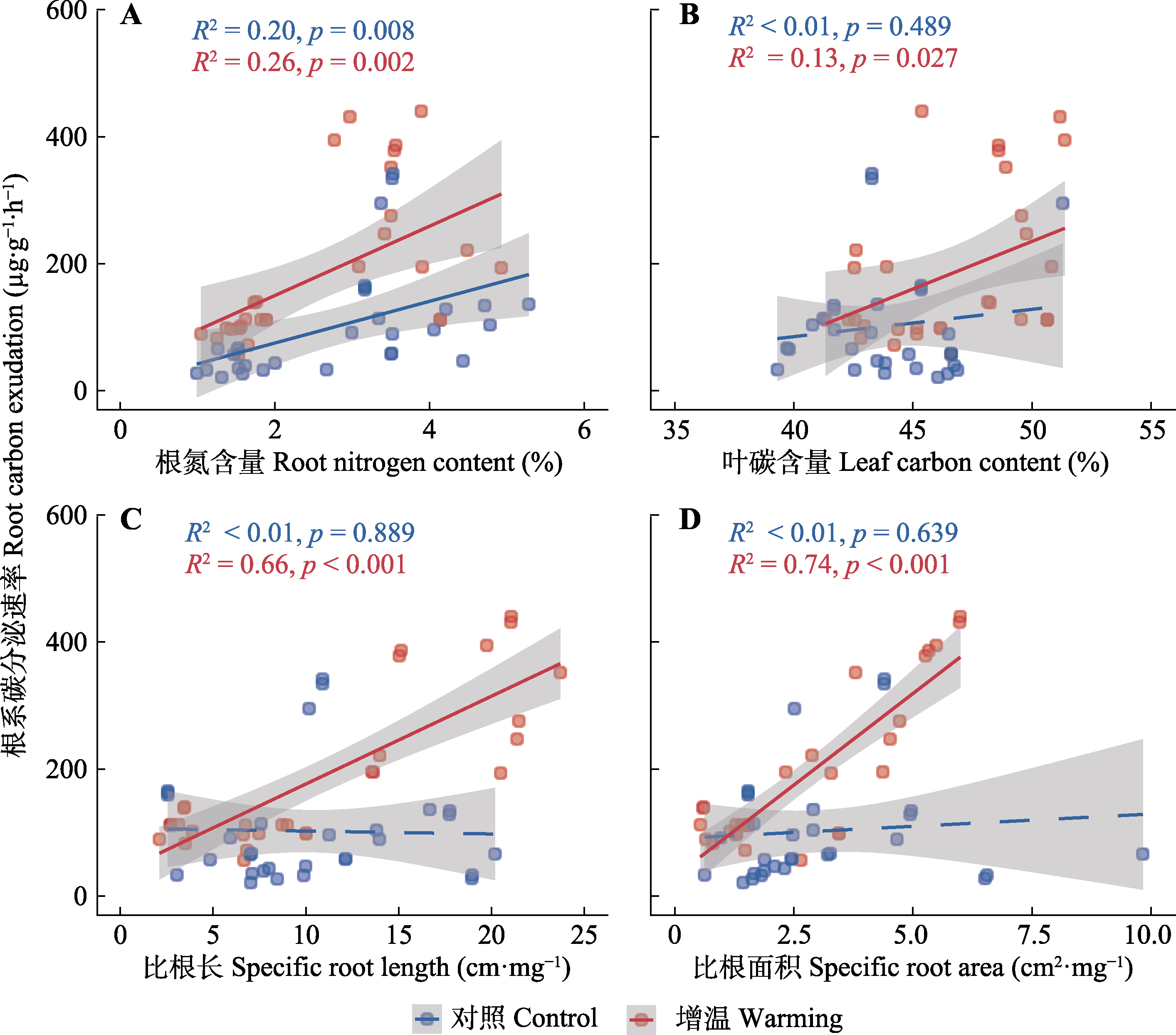
图4 根系碳分泌速率与关键植物性状的线性拟合。灰色阴影表示95%置信区间, 实线表示线性拟合斜率显著(p < 0.05)。
Fig. 4 Linear fit of root carbon exudation rate to key plant traits. Gray shading indicates 95% confidence intervals, and the solid line represents a significant slope of the linear fit (p < 0.05).
| [1] |
Akatsuki M, Makita N (2020). Influence of fine root traits on in situ exudation rates in four conifers from different mycorrhizal associations. Tree Physiology, 40, 1071-1079.
DOI PMID |
| [2] |
Badri DV, Vivanco JM (2009). Regulation and function of root exudates. Plant, Cell & Environment, 32, 666-681.
DOI URL |
| [3] |
Bais HP, Weir TL, Perry LG, Gilroy S, Vivanco JM (2006). The role of root exudates in rhizosphere interactions with plants and other organisms. Annual Review of Plant Biology, 57, 233-266.
PMID |
| [4] | Bates D, Mächler M, Bolker B, Walker S (2015). Fitting linear mixed-effects models using lme4. Journal of Statistical Software, 67(1), 1-48. |
| [5] | Bergmann J, Weigelt A, van der Plas F, Laughlin DC, Kuyper TW, Guerrero-Ramirez N, Valverde-Barrantes OJ, Bruelheide H, Freschet GT, Iversen CM, Kattge J, McCormack ML, Meier IC, Rillig MC, Roumet C, et al. (2020). The fungal collaboration gradient dominates the root economics space in plants. Science Advances, 6, eaba3756. DOI: 10.1126/sciadv.aba3756. |
| [6] | Bhattarai P, Zheng Z, Bhatta KP, Adhikari YP, Zhang Y (2021). Climate-driven plant response and resilience on the Tibetan Plateau in space and time: a review. Plants, 10, 480. DOI: 10.3390/plants10030480. |
| [7] |
Brundrett MC, Tedersoo L (2018). Evolutionary history of mycorrhizal symbioses and global host plant diversity. New Phytologist, 220, 1108-1115.
DOI PMID |
| [8] |
Chai YN, Schachtman DP (2022). Root exudates impact plant performance under abiotic stress. Trends in Plant Science, 27, 80-91.
DOI URL |
| [9] |
Chen H, Zhu QA, Peng CH, Wu N, Wang YF, Fang XQ, Gao YH, Zhu D, Yang G, Tian JQ, Kang XM, Piao SL, Ouyang H, Xiang WH, Luo ZB, et al. (2013). The impacts of climate change and human activities on biogeochemical cycles on the Qinghai-Tibetan Plateau. Global Change Biology, 19, 2940-2955.
DOI PMID |
| [10] | Cheng CJ, He NP, Li MX, Xu L, Cai WX, Li X, Zhao WZ, Li C, Sun OJ (2023). Plant species richness on the Tibetan Plateau: patterns and determinants. Ecography, 1, e06265. DOI: 10.3390/plants14152379. |
| [11] |
Dijkstra FA, Zhu B, Cheng W (2021). Root effects on soil organic carbon: a double-edged sword. New Phytologist, 230, 60-65.
DOI PMID |
| [12] |
Dusenge ME, Duarte AG, Way DA (2019). Plant carbon metabolism and climate change: elevated CO2 and temperature impacts on photosynthesis, photorespiration and respiration. New Phytologist, 221, 32-49.
DOI URL |
| [13] | Eissenstat DM, Yanai RD (1997). The ecology of root lifespan. Advances in Ecological Research, 27, 2-59. |
| [14] | Gao YQ, Wang HM, Yang FT, Dai XQ, Meng SW, Hu MY, Kou L, Fu XL (2024). Relationships between root exudation and root morphological and architectural traits vary with growing season. Tree Physiology, 44. DOI: 10.1093/treephys/tpad118. |
| [15] |
Haichar FZ, Santaella C, Heulin T, Achouak W (2014). Root exudates mediated interactions belowground. Soil Biology & Biochemistry, 77, 69-80.
DOI URL |
| [16] | Han MG, Sun LJ, Gan DY, Fu LC, Zhu B (2020). Root functional traits are key determinants of the rhizosphere effect on soil organic matter decomposition across 14 temperate hardwood species. Soil Biology & Biochemistry, 151, 108019. DOI: 10.1016/j.soilbio.2020.108019. |
| [17] |
Henneron L, Cros C, Picon-Cochard C, Rahimian V, Fontaine S (2020). Plant economic strategies of grassland species control soil carbon dynamics through rhizodeposition. Journal of Ecology, 108, 528-545.
DOI |
| [18] |
Jiang Z, Fu YL, Zhou LY, He YH, Zhou GY, Dietrich P, Long JL, Wang XX, Jia SX, Ji YH, Jia Z, Song BQ, Liu RQ, Zhou XH (2023). Plant growth strategy determines the magnitude and direction of drought-induced changes in root exudates in subtropical forests. Global Change Biology, 29, 3476-3488.
DOI PMID |
| [19] |
Jing JY, Cong WF, Bezemer TM (2022). Legacies at work: plant-soil-microbiome interactions underpinning agricultural sustainability. Trends in Plant Science, 27, 781-792.
DOI PMID |
| [20] |
Keiluweit M, Bougoure JJ, Nico PS, Pett-Ridge J, Weber PK, Kleber M (2015). Mineral protection of soil carbon counteracted by root exudates. Nature Climate Change, 5, 588-595.
DOI |
| [21] |
Lai JS, Zou Y, Zhang S, Zhang XG, Mao LF (2022). glmm.hp: an R package for computing individual effect of predictors in generalized linear mixed models. Journal of Plant Ecology, 15, 1302-1307.
DOI |
| [22] | Lê S, Josse J, Husson F (2008). FactoMineR: an R package for multivariate analysis. Journal of Statistical Software, 25(1), 1-18. |
| [23] |
Liu HY, Mi ZR, Lin L, Wang YH, Zhang ZH, Zhang FW, Wang H, Liu LL, Zhu B, Cao GM, Zhao XQ, Sanders NJ, Classen AT, Reich PB, He JS (2018). Shifting plant species composition in response to climate change stabilizes grassland primary production. Proceedings of the National Academy of Sciences of the United States of America, 115, 4051-4056.
DOI PMID |
| [24] |
Liu M, Wen JH, Chen YM, Xu WJ, Wang Q, Ma ZL (2022). Warming increases soil carbon input in a Sibiraea angustata-dominated alpine shrub ecosystem. Journal of Plant Ecology, 15, 335-346.
DOI URL |
| [25] | Lu JY, Yin LM, Dijkstra FA, Yan SB, Wang P, Cheng WX (2023). Linking plant traits to rhizosphere priming effects across six grassland species with and without nitrogen fertilization. Soil Biology & Biochemistry, 185, 109144. DOI: 10.1016/j.soilbio.2023.109144. |
| [26] | Luo XZ, Zhang LL, Lin YB, Wen DZ, Hou EQ (2023). Nitrogen availability mediates soil organic carbon cycling in response to phosphorus supply: a global meta-analysis. Soil Biology & Biochemistry, 185, 109158. DOI: 10.1016/j.soilbio.2023.109158. |
| [27] | Ma ZL (2020). Responses of root exudative carbon and nitrogen inputs to warming in an alpine scrub ecosystem on the eastern Qinghai-Tibet Plateau. Ecology and Environmental Sciences, 29, 643-649. |
|
[马志良 (2020). 青藏高原东缘高寒灌丛根系分泌物碳氮输入对增温的响应. 生态环境学报, 29, 643-649.]
DOI |
|
| [28] | Ma ZL, Zhao WQ, Zhao CZ, Wang D, Liu M, Li DD, Liu Q (2018). Plants regulate the effects of experimental warming on the soil microbial community in an alpine scrub ecosystem. PLoS ONE, 13, e0195079. DOI: 10.1371/journal.pone.0195079. |
| [29] |
Marenco RA, Antezana-Vera SA, Nascimento HCS (2009). Relationship between specific leaf area, leaf thickness, leaf water content and SPAD-502 readings in six Amazonian tree species. Photosynthetica, 47, 184-190.
DOI URL |
| [30] |
Meier IC, Tückmantel T, Heitkötter J, Müller K, Preusser S, Wrobel TJ, Kandeler E, Marschner B, Leuschner C (2020). Root exudation of mature beech forests across a nutrient availability gradient: the role of root morphology and fungal activity. New Phytologist, 226, 583-594.
DOI PMID |
| [31] |
Oburger E, Jones DL (2018). Sampling root exudates—Mission impossible? Rhizosphere, 6, 116-133.
DOI URL |
| [32] |
Pan SN, Wang X, Yan ZB, Wu J, Guo LL, Peng ZY, Wu YT, Li J, Wang B, Su YJ, Liu LL (2024). Leaf stomatal configuration and photosynthetic traits jointly affect leaf water use efficiency in forests along climate gradients. New Phytologist, 244, 1250-1262.
DOI PMID |
| [33] |
Pérez-Harguindeguy N, Díaz S, Garnier E, Lavorel S, Poorter H, Jaureguiberry P, Bret-Harte MS, Cornwell WK, Craine JM, Gurvich DE, Urcelay C, Veneklaas EJ, Reich PB, Poorter L, Wright IJ, Ray P, Enrico L, et al. (2016). New handbook for standardised measurement of plant functional traits worldwide. Australian Journal of Botany, 64, 715-716.
DOI URL |
| [34] |
Phillips RP, Erlitz Y, Bier R, Bernhardt ES (2008). New approach for capturing soluble root exudates in forest soils. Functional Ecology, 22, 990-999.
DOI URL |
| [35] |
Prescott CE, Grayston SJ, Helmisaari HS, Kaštovská E, Körner C, Lambers H, Meier IC, Millard P, Ostonen I (2020). Surplus carbon drives allocation and plant-soil interactions. Trends in Ecology & Evolution, 35, 1110-1118.
DOI URL |
| [36] |
Sun LJ, Ataka M, Han MG, Han YF, Gan DY, Xu TL, Guo YP, Zhu B (2021). Root exudation as a major competitive fine‐root functional trait of 18 coexisting species in a subtropical forest. New Phytologist, 229, 259-271.
DOI URL |
| [37] |
Tang M, Keck DC, Cheng WX, Zeng H, Zhu B (2019). Linking rhizosphere respiration rate of three grassland species with root nitrogen concentration. Geoderma, 346, 84-90.
DOI |
| [38] |
Walker TS, Bais HP, Grotewold E, Vivanco JM (2003). Root exudation and rhizosphere biology. Plant Physiology, 132, 44-51.
DOI PMID |
| [39] |
Wang C, Morrissey EM, Mau RL, Hayer M, Piñeiro J, Mack MC, Marks JC, Bell SL, Miller SN, Schwartz E, Dijkstra P, Koch BJ, Stone BW, Purcell AM, Blazewicz SJ, et al. (2021a). The temperature sensitivity of soil: microbial biodiversity, growth, and carbon mineralization. The ISME Journal, 15, 2738-2747.
DOI URL |
| [40] | Wang H, Lu JY, Dijkstra FA, Sun LJ, Yin LM, Wang P, Cheng WX (2025). Rhizosphere priming effects and trade-offs among root traits, exudation and mycorrhizal symbioses. Soil Biology & Biochemistry, 202, 109690. DOI: 10.1016/j.soilbio.2024.109690. |
| [41] |
Wang JS, Defrenne C, McCormack ML, Yang L, Tian DS, Luo YQ, Hou EQ, Yan T, Li ZL, Bu WS, Chen Y, Niu SL (2021b). Fine-root functional trait responses to experimental warming: a global meta-analysis. New Phytologist, 230, 1856-1867.
DOI URL |
| [42] |
Weemstra M, Mommer L, Visser EJW, van Ruijven J, Kuyper TW, Mohren GMJ, Sterck FJ (2016). Towards a multidimensional root trait framework: a tree root review. New Phytologist, 211, 1159-1169.
DOI PMID |
| [43] |
Weese DJ, Heath KD, Dentinger BTM, Lau JA (2015). Long-term nitrogen addition causes the evolution of less-cooperative mutualists. Evolution, 69, 631-642.
DOI PMID |
| [44] |
Weigelt A, Mommer L, Andraczek K, Iversen CM, Bergmann J, Bruelheide H, Fan Y, Freschet GT, Guerrero-Ramírez NR, Kattge J, Kuyper TW, Laughlin DC, Meier IC, van der Plas F, Poorter H, et al. (2021). An integrated framework of plant form and function: the belowground perspective. New Phytologist, 232, 42-59.
DOI PMID |
| [45] |
Wen ZH, Li HB, Shen Q, Tang XM, Xiong CY, Li HG, Pang JY, Ryan MH, Lambers H, Shen JB (2019). Tradeoffs among root morphology, exudation and mycorrhizal symbioses for phosphorus-acquisition strategies of 16 crop species. New Phytologist, 223, 882-895.
DOI PMID |
| [46] |
Wen ZH, White PJ, Shen JB, Lambers H (2022). Linking root exudation to belowground economic traits for resource acquisition. New Phytologist, 233, 1620-1635.
DOI URL |
| [47] |
Williams A, Langridge H, Straathof AL, Muhamadali H, Hollywood KA, Goodacre R, de Vries FT (2022). Root functional traits explain root exudation rate and composition across a range of grassland species. Journal of Ecology, 110, 21-33.
DOI URL |
| [48] |
Wright IJ, Reich PB, Westoby M, Ackerly DD, Baruch Z, Bongers F, Cavender-Bares J, Chapin T, Cornelissen JHC, Diemer M, Flexas J, Garnier E, Groom PK, Gulias J, Hikosaka K, et al. (2004). The worldwide leaf economics spectrum. Nature, 428, 821-827.
DOI |
| [49] |
Wu LK, Lin XM, Lin WX (2014). Advances and perspective in research on plant-soil-microbe interactions mediated by root exudates. Chinese Journal of Plant Ecology, 38, 298-310.
DOI |
|
[吴林坤, 林向民, 林文雄 (2014). 根系分泌物介导下植物-土壤-微生物互作关系研究进展与展望. 植物生态学报, 38, 298-310.]
DOI |
|
| [50] |
Xiong DC, Yang ZJ, Chen GS, Liu XF, Lin WS, Huang JX, Bowles FP, Lin CF, Xie JS, Li YQ, Yang YS (2018). Interactive effects of warming and nitrogen addition on fine root dynamics of a young subtropical plantation. Soil Biology & Biochemistry, 123, 180-189.
DOI URL |
| [51] |
Yang L, Li TT, Li XX, Wang YS, Wang XW (2024). Nitrogen addition decreases root exudation of four temperate tree species seedlings, independent of the applied nitrogen form. Plant and Soil, 498, 637-650.
DOI |
| [52] |
Yin HJ, Zhang ZL, Liu Q (2018). Root exudates and their ecological consequences in forest ecosystems: problems and perspective. Chinese Journal of Plant Ecology, 42, 1055-1070.
DOI URL |
|
[尹华军, 张子良, 刘庆 (2018). 森林根系分泌物生态学研究: 问题与展望. 植物生态学报, 42, 1055-1070.]
DOI |
|
| [53] |
Yin R, Qin WK, Wang XD, Xie D, Wang H, Zhao HY, Zhang ZH, He JS, Schädler M, Kardol P, Eisenhauer N, Zhu B (2023). Experimental warming causes mismatches in alpine plant-microbe-fauna phenology. Nature Communications, 14, 2159. DOI: 10.1038/s41467-023-37938-3.
PMID |
| [54] | Yu Y, Zhou Y, Janssens IA, Deng Y, He XJ, Liu LL, Yi Y, Xiao NW, Wang XD, Li C, Xiao CW (2024). Divergent rhizosphere and non-rhizosphere soil microbial structure and function in long-term warmed steppe due to altered root exudation. Global Change Biology, 30, e17111. DOI: 10.1111/gcb.17111. |
| [55] |
Zeng J, Li XY, Xing LH, Chen L, Li Y, Wang X, Zhang Q, Yang G, Ren CJ, Yang GH, Han XH (2024). Soil nitrogen regulates root carbon secretion in the context of global change: a global meta-analysis. Functional Ecology, 38, 2067-2080.
DOI URL |
| [56] | Zhai XF, Zheng Y, Ma FL, Ren LF, Bai WM, Tian QY, Zhang WH (2024). Root exudation is involved in regulation of nitrogen transformation under mowing in a temperate steppe. Soil Biology & Biochemistry, 195, 109481. DOI: 10.1016/j.soilbio.2024.109481. |
| [57] | Zhang CF, Cai YM, Zhao QX, He TB, Mao TX, Zhang T, Zhang LM, Su WC (2024). The quantification of root exudation by an in-situ method based on root morphology over three incubation periods. Frontiers in Plant Science, 15, 1423703. DOI: 10.3389/fpls.2024.1423703. |
| [58] |
Zhang ZL, Qiao MF, Li DD, Yin HJ, Liu Q (2016). Do warming-induced changes in quantity and stoichiometry of root exudation promote soil N transformations via stimulation of soil nitrifiers, denitrifiers and ammonifiers? European Journal of Soil Biology, 74, 60-68.
DOI URL |
| [59] |
Zhu EX, Cao ZJ, Jia J, Liu CZ, Zhang ZH, Wang H, Dai GH, He JS, Feng XJ (2021). Inactive and inefficient: warming and drought effect on microbial carbon processing in alpine grassland at depth. Global Change Biology, 27, 2241-2253.
DOI PMID |
| [60] |
Zong N, Chai X, Shi PL, Yang XC (2018). Effects of warming and nitrogen addition on plant photosynthate partitioning in an alpine meadow on the Tibetan Plateau. Journal of Plant Growth Regulation, 37, 803-812.
DOI |
| [1] | 段建林, 孟晟, 陈仁利, 熊林峰, 卢春洋, 席念勋. 全球变化因子多样性对菌根植物性状的影响[J]. , 2026, 50(预发表): 0-. |
| [2] | 李燚, 黄欢, 赵艳超, 陈立同. 养分添加对不同海拔高寒草甸群落多样性及组成的影响[J]. 植物生态学报, 2026, 50(预发表): 0-. |
| [3] | 梁天豪, 吴帆, 黄锦学, 景陈鸿, 傅贺菁, 杨智杰, 熊德成. 增温对中亚热带格氏栲天然林细根生长量及形态特征的影响[J]. 植物生态学报, 2026, 50(1): 94-106. |
| [4] | 张法伟, 李红琴, 祝景彬, 樊博, 周华坤, 李英年, 梁乃申. 氮添加和降水改变对高寒草甸生态系统地上与地下碳储的影响[J]. 植物生态学报, 2025, 49(9): 1399-1409. |
| [5] | 崔冬晴, 田晨, 宋慧敏, 鲁小名, 萨其日, 徐国庆, 杨培志, 白永飞, 田建卿. 典型草原优势植物根际细菌群落多样性和功能群组成对长期放牧的响应机制[J]. 植物生态学报, 2025, 49(7): 1163-1176. |
| [6] | 杜英杰, 范爱连, 王雪, 闫晓俊, 陈廷廷, 贾林巧, 姜琦, 陈光水. 亚热带天然常绿阔叶林乔木树种与林下灌木树种根-叶功能性状协调性及差异[J]. 植物生态学报, 2025, 49(4): 585-595. |
| [7] | 刘洋, 刘傲, 宋璇紫, 杨云, 安柏衡, 韩梦姣, 班玛才格尔, 米玛旺堆. 高原鼠兔干扰对高寒草甸主要植物生态位及种间联结的影响[J]. 植物生态学报, 2025, 49(12): 2054-2068. |
| [8] | 韩润宇, 陈仕东, 谭艺桦, 陈相标, 熊德成, 刘小飞, 胥超, 杨智杰, 杨玉盛. 亚热带天然林林下优势灌木叶片结构对长期土壤增温的响应[J]. 植物生态学报, 2025, 49(11): 1907-1918. |
| [9] | 张晓婷, 王俊杰. 盐和铜处理下红树植物叶绿素荧光特性变化与叶片结构及生化组分关系[J]. 植物生态学报, 2025, 49(11): 1944-1956. |
| [10] | 童金莲, 张博纳, 汤璐瑶, 叶琳峰, 李姝雯, 谢江波, 李彦, 王忠媛. C4植物狗尾草功能性状网络沿降水梯度带的区域分异规律[J]. 植物生态学报, 2025, 49(11): 1817-1832. |
| [11] | 张辉, 赵赟鹏, 刘晓琛, 郭增鹏, 胡国瑞, 冯彦皓, 马妙君. 高寒草甸退化过程中土壤种子库的变化及其在植物群落更新中的潜在作用[J]. 植物生态学报, 2025, 49(1): 74-82. |
| [12] | 马东峰, 贾存智, 王学朋, 赵鹏鹏, 胡小文. 甘南高寒退化草甸多物种组配的修复效果评估[J]. 植物生态学报, 2025, 49(1): 93-102. |
| [13] | 王雯莹, 肖元明, 王小赟, 徐嘉昕, 马玉花, 李强峰, 周国英. 多功能群物种配置模式下退化高寒草甸植物多样性与生态系统多功能性的关联[J]. 植物生态学报, 2025, 49(1): 103-117. |
| [14] | 徐嘉昕, 肖元明, 王小赟, 王雯莹, 马玉花, 李强峰, 周国英. 微生物菌肥与氮磷肥回补对退化高寒草甸土壤理化性质和酶活性的影响[J]. 植物生态学报, 2025, 49(1): 159-172. |
| [15] | 冉佳鑫, 张宇辉, 王云, 杨智杰, 毛超. 增温和氮磷添加对亚热带森林凋落物溶解有机碳生物可降解性的影响[J]. 植物生态学报, 2024, 48(9): 1232-1242. |
| 阅读次数 | ||||||
|
全文 |
|
|||||
|
摘要 |
|
|||||
Copyright © 2026 版权所有 《植物生态学报》编辑部
地址: 北京香山南辛村20号, 邮编: 100093
Tel.: 010-62836134, 62836138; Fax: 010-82599431; E-mail: apes@ibcas.ac.cn, cjpe@ibcas.ac.cn
备案号: 京ICP备16067583号-19

