
植物生态学报 ›› 2025, Vol. 49 ›› Issue (9): 1344-1362.DOI: 10.17521/cjpe.2025.0070 cstr: 32100.14.cjpe.2025.0070
杨浩林1( ), 赵英1,*(
 ), 胡秋丽1
收稿日期:2025-02-26
接受日期:2025-08-25
出版日期:2025-09-20
发布日期:2025-10-25
通讯作者:
*赵英 (yzhaosoils@gmail.com)基金资助:
YANG Hao-Lin1(), ZHAO Ying1,*(), HU Qiu-Li1, Jeffrey John MCDONNELL1,2
Received:2025-02-26
Accepted:2025-08-25
Online:2025-09-20
Published:2025-10-25
Supported by:摘要:
近年来, 随着稳定同位素技术、原位监测设备以及土壤水提取方法的持续改进, 生态水文学对“生态水文分离”现象的认识显著深化: 植物与径流往往分别取自束缚水与自由水两个功能不同的土壤水库。该文系统回顾了“两水世界”假说的发展脉络, 并结合最新研究成果, 详细综述了该假说在小流域实验、跨尺度分析及跨生态系统比较研究中的最新进展。文章系统归纳了降水入渗后土壤中束缚水与自由水的形成机制、时空动态以及两者之间一定程度的连通性; 同时讨论了植物水源判识、土壤水采样技术标准化和生态水文模型构建中面临的关键问题。基于最新高频观测与提取技术, 该文提出未来研究方向, 包括深入揭示植物吸水机理、改进同位素在线监测方法、建立多尺度耦合模型以及开展不同气候和植被条件下的对比研究。期望更准确评估植被用水与径流形成的耦合关系,为生态恢复与流域管理提供过程可解释的依据。
杨浩林, 赵英, 胡秋丽. “两水世界”假说的研究进展与未来展望. 植物生态学报, 2025, 49(9): 1344-1362. DOI: 10.17521/cjpe.2025.0070
YANG Hao-Lin, ZHAO Ying, HU Qiu-Li, Jeffrey John MCDONNELL. “Two water worlds” hypothesis: advances and future prospects. Chinese Journal of Plant Ecology, 2025, 49(9): 1344-1362. DOI: 10.17521/cjpe.2025.0070
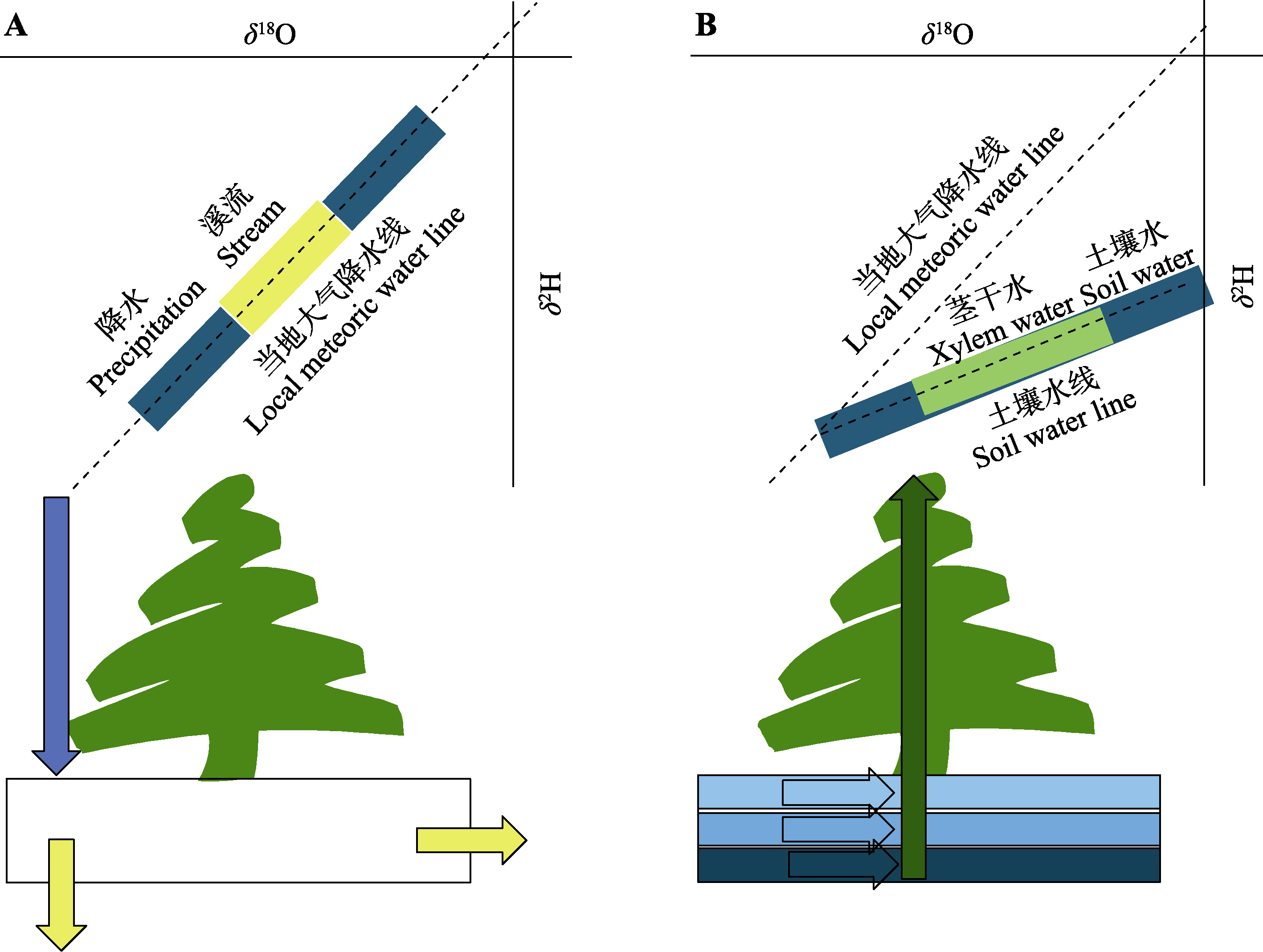
图1 两水世界假说示意图(改编自Goldsmith等(2012)和McDonnell (2014))。A, 高移动性水混合空间。B, 低移动性水混合空间。δ2H和δ18O分别为样品的氢氧同位素比值相对于标准物质同位素比值的千分差。
Fig. 1 Schematic diagram of the two-water world hypothesis with mobile water mixing space (A) and low mobility water mixing space (B) (adapted from Goldsmith et al. (2012) and McDonnell (2014)). δ²H and δ18O represent the stable hydrogen and oxygen isotope ratios corresponding to the international isotope ratio standard V-SMOW.
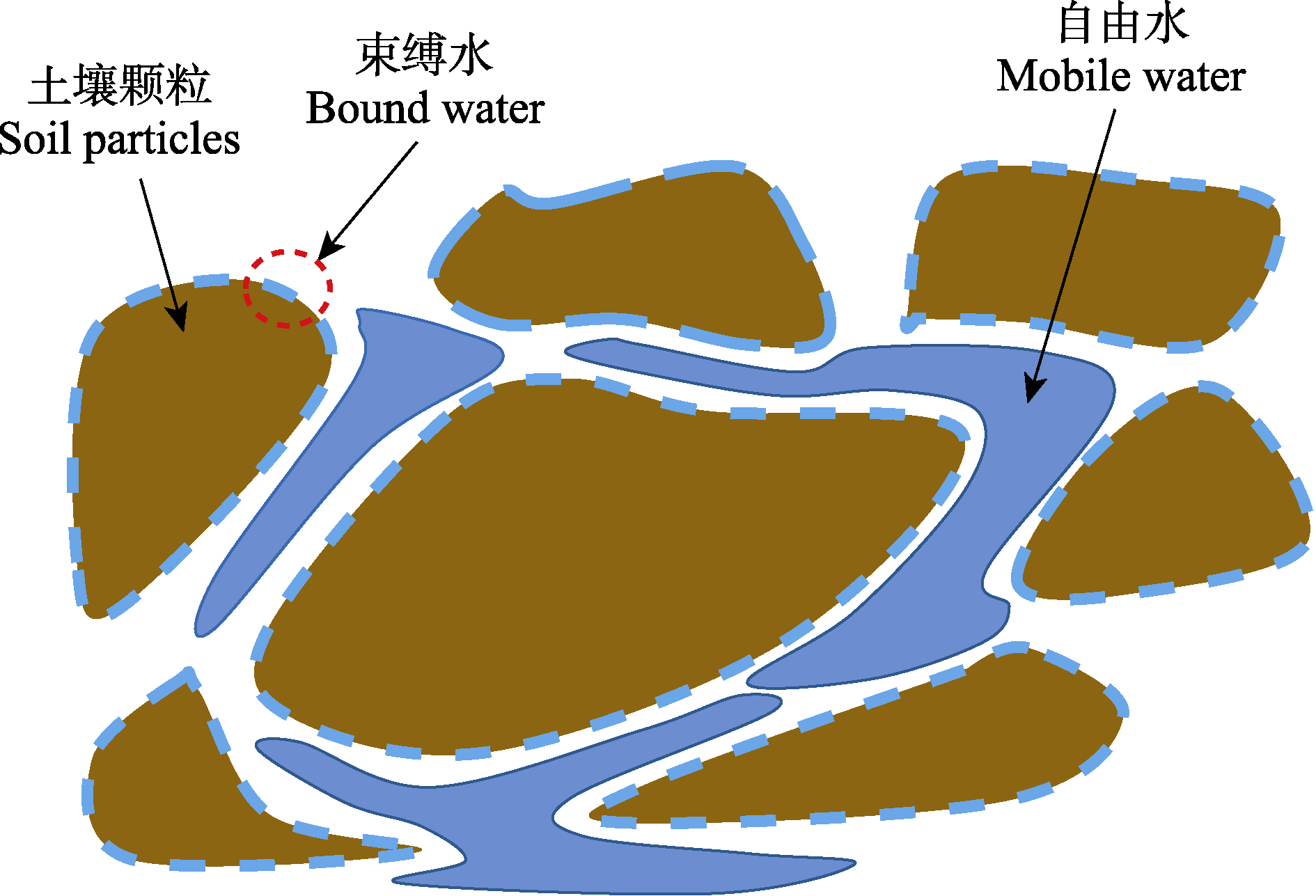
图2 土壤束缚水和自由水分区图。
Fig. 2 Diagram of bound water and mobile water in soil.
| 方法 Method | 水分类型 Types of water | 缺点 Disadvantage |
|---|---|---|
| 低温真空抽提法 Cryogenic vacuum extraction | 土壤中全部水分 All moisture in the soil | 真空、加热条件, 存在分馏 The occurrence of isotopic fractionation under vacuum and heating conditions |
| 离心法 Centrifugation | 特定吸力下的水分 Water content at a specific suction level | 无法提取小孔隙水 Inability to extract water from small soil pores |
| 共沸蒸馏法 Azeotropic distillation | 土壤中全部水分 All moisture in the soil | 步骤复杂, 存在有机质污染 Complexity in experimental procedure and susceptibility to organic contamination |
| 机械压榨法 Mechanical squeezing | 一定压力下的水分 Water content at a given pressure | 土壤类型受限, 效率低 Limitations to specific soil types and low extraction efficiency |
表1 常见土壤水分采集方法
Table 1 Common methods for soil moisture collection
| 方法 Method | 水分类型 Types of water | 缺点 Disadvantage |
|---|---|---|
| 低温真空抽提法 Cryogenic vacuum extraction | 土壤中全部水分 All moisture in the soil | 真空、加热条件, 存在分馏 The occurrence of isotopic fractionation under vacuum and heating conditions |
| 离心法 Centrifugation | 特定吸力下的水分 Water content at a specific suction level | 无法提取小孔隙水 Inability to extract water from small soil pores |
| 共沸蒸馏法 Azeotropic distillation | 土壤中全部水分 All moisture in the soil | 步骤复杂, 存在有机质污染 Complexity in experimental procedure and susceptibility to organic contamination |
| 机械压榨法 Mechanical squeezing | 一定压力下的水分 Water content at a given pressure | 土壤类型受限, 效率低 Limitations to specific soil types and low extraction efficiency |
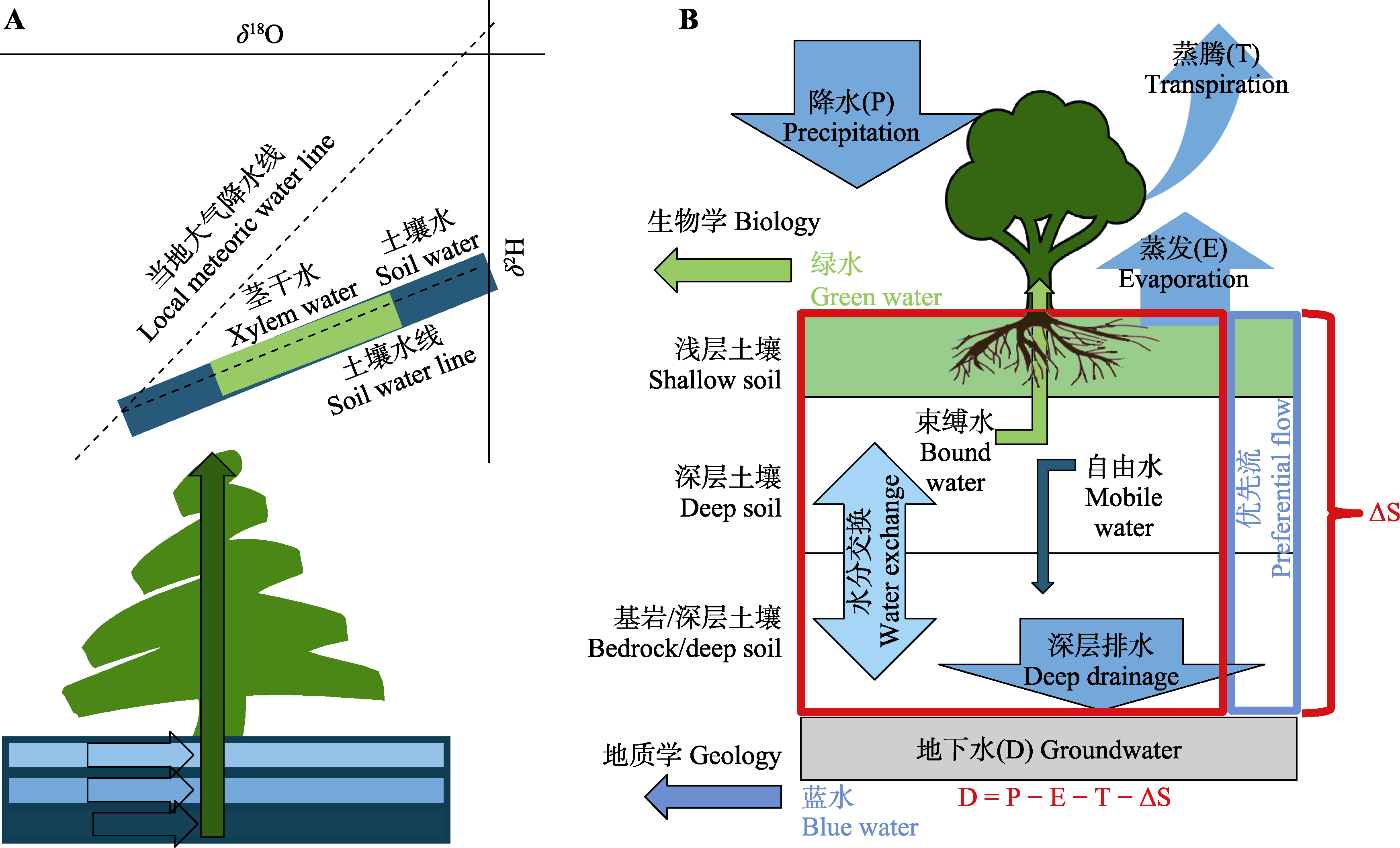
图3 生态水文过程及其分离机制未来研究展望示意图。ΔS, 土壤储水量变化; D, 渗漏; E, 蒸发; P, 降雨; T, 蒸腾。δ2H和δ18O分别为样品的氢氧同位素比值相对于标准物质同位素比值的千分差。
Fig. 3 Schematic diagram of ecohydrological processes. ΔS, change of soil water storage; D, drainage; E, evaporation; P, precipitation; T, transpiration. δ²H and δ18O represent the stable hydrogen and oxygen isotope ratios corresponding to the international isotope ratio standard V-SMOW.
| [1] | Allen ST, Kirchner JW (2022). Potential effects of cryogenic extraction biases on plant water source partitioning inferred from xylem-water isotope ratios. Hydrological Processes, 36, e14483. DOI: 10.1002/hyp.14483. |
| [2] |
Allen ST, Kirchner JW, Braun S, Siegwolf RTW, Goldsmith GR (2019). Seasonal origins of soil water used by trees. Hydrology and Earth System Sciences, 23, 1199-1210.
DOI |
| [3] |
Barbeta A, Gimeno TE, Clavé L, Fréjaville B, Jones SP, Delvigne C, Wingate L, Ogée J (2020). An explanation for the isotopic offset between soil and stem water in a temperate tree species. New Phytologist, 227, 766-779.
DOI PMID |
| [4] |
Barbeta A, Jones SP, Clavé L, Wingate L, Gimeno TE, Fréjaville B, Wohl S, Ogée J (2019). Unexplained hydrogen isotope offsets complicate the identification and quantification of tree water sources in a riparian forest. Hydrology and Earth System Sciences, 23, 2129-2146.
DOI |
| [5] |
Bates CG, Henry AJ (1928). Second phase of streamflow experiment at Wagon Wheel Gap, Colo. Monthly Weather Review, 56, 79-80.
DOI URL |
| [6] |
Benettin P, Volkmann THM, von Freyberg J, Frentress J, Penna D, Dawson TE, Kirchner JW (2018). Effects of climatic seasonality on the isotopic composition of evaporating soil waters. Hydrology and Earth System Sciences, 22, 2881-2890.
DOI URL |
| [7] | Berry ZC, Evaristo J, Moore G, Poca M, Steppe K, Verrot L, Asbjornsen H, Borma LS, Bretfeld M, Hervé-Fernández P, Seyfried M, Schwendenmann L, Sinacore K, de Wispelaere L, McDonnell JJ (2018). The two water worlds hypothesis: addressing multiple working hypotheses and proposing a way forward. Ecohydrology, 11, e1843. DOI: 10.1002/eco.1843. |
| [8] |
Beven K, Germann P (1982). Macropores and water flow in soils. Water Resources Research, 18, 1311-1325.
DOI URL |
| [9] | Bi YL, Wu C, Wang SM, Gao XJ, Xue C, Yang W, Li MC, Xiao L, Christie P (2022). Combined arbuscular mycorrhizal inoculation and loess amendment improve rooting and revegetation post-mining. Rhizosphere, 23, 100560. DOI: 10.1016/j.rhisph.2022.100560. |
| [10] | Bowling DR, Schulze ES, Hall SJ (2017). Revisiting streamside trees that do not use stream water: Can the two water worlds hypothesis and snowpack isotopic effects explain a missing water source? Ecohydrology, 10, e1771. DOI: 10.1002/eco.1771. |
| [11] |
Brunel JP, Walker GR, Kennett-Smith AK (1995). Field validation of isotopic procedures for determining sources of water used by plants in a semi-arid environment. Journal of Hydrology, 167, 351-368.
DOI URL |
| [12] |
Chen Y, Helliker BR, Tang X, Li F, Zhou Y, Song X (2020). Stem water cryogenic extraction biases estimation in deuterium isotope composition of plant source water. Proceedings of the National Academy of Sciences of the United States of America, 117, 33345-33350.
DOI PMID |
| [13] | Chen YN, Li WH, Zhou HH, Chen YP, Hao XM, Fu AH, Ma JX (2014). Analysis of water use strategies of the desert riparian forest plant community in inland rivers of two arid regions in northwestern China. Biogeosciences Discussions, 11, 14819-14856. |
| [14] |
Cui JP, Tian LD, Gerlein-Safdi C, Qu DM (2017). The influence of memory, sample size effects, and filter paper material on online laser-based plant and soil water isotope measurements. Rapid Communications in Mass Spectrometry, 31, 509-522.
DOI PMID |
| [15] |
de la Casa J, Barbeta A, Rodríguez-Uña A, Wingate L, Ogée J, Gimeno TE (2022). Isotopic offsets between bulk plant water and its sources are larger in cool and wet environments. Hydrology and Earth System Sciences, 26, 4125-4146.
DOI URL |
| [16] |
Dollinger J, Dagès C, Bailly JS, Lagacherie P, Voltz M (2015). Managing ditches for agroecological engineering of landscape. A review. Agronomy for Sustainable Development, 35, 999-1020.
DOI URL |
| [17] |
Dubbert M, Caldeira MC, Dubbert D, Werner C (2019). A pool-weighted perspective on the two-water-worlds hypothesis. New Phytologist, 222, 1271-1283.
DOI PMID |
| [18] |
Ehleringer JR, Dawson TE (1992). Water uptake by plants: perspectives from stable isotope composition. Plant, Cell & Environment, 15, 1073-1082.
DOI URL |
| [19] | Evaristo J, Jameel Y, Chun KP (2021). Implication of stem water cryogenic extraction experiment for an earlier study is not supported with robust context-specific statistical assessment. Proceedings of the National Academy of Sciences of the United States of America, 118, e2100365118. DOI: 10.1073/pnas.2100365118. |
| [20] |
Evaristo J, Jasechko S, McDonnell JJ (2015). Global separation of plant transpiration from groundwater and streamflow. Nature, 525, 91-94.
DOI |
| [21] |
Evaristo J, Mcdonnell JJ, Scholl MA, Bruijnzeel LA, Chun KP (2016). Insights into plant water uptake from xylem-water isotope measurements in two tropical catchments with contrasting moisture conditions. Hydrological Processes, 30, 3210-3227.
DOI URL |
| [22] |
Figueroa-Johnson MA, Tindall JA, Friedel MJ (2007). A comparison of δ18O composition of water extracted from suction lysimeters, centrifugation, and azeotropic distillation. Water, Air, and Soil Pollution, 184, 63-75.
DOI URL |
| [23] |
Finkenbiner CE, Good SP, Renée Brooks J, Allen ST, Sasidharan S (2022). The extent to which soil hydraulics can explain ecohydrological separation. Nature Communications, 13, 6492. DOI: 10.1038/s41467-022-34215-7.
PMID |
| [24] |
Goldsmith GR, Muñoz-Villers LE, Holwerda F, McDonnell JJ, Asbjornsen H, Dawson TE (2012). Stable isotopes reveal linkages among ecohydrological processes in a seasonally dry tropical montane cloud forest. Ecohydrology, 5, 779-790.
DOI URL |
| [25] |
Good SP, Noone D, Bowen G (2015). WATER RESOURCES. Hydrologic connectivity constrains partitioning of global terrestrial water fluxes. Science, 349, 175-177.
DOI PMID |
| [26] | Gu HL, Chen GP, Ren H, Liu B, Yang QY, Feng XY, Fan MY, Zhou H (2025). Seasonal dynamics of water-use strategies and response to precipitation in different habitats of Nitraria L. Journal of Hydrology, 648, 132388. DOI: 10.1016/j.jhydrol.2024.132388. |
| [27] | Guo R (2020). Examination of the Ecohydrological Separation Hypothesis in Hillside, Mountain Foot and Flood Plain of the Lanzhou City. Master degree dissertation, Northwest Normal University, Lanzhou. |
| [郭蓉 (2020). 兰州市山坡、山麓、河漫滩生态水文分离假说验证. 硕士学位论文, 西北师范大学, 兰州.] | |
| [28] | He D, Wen MY, Wang YB, Du GY, Zhang CC, He HL, Jin JJ, Li M, Si BC (2023). Xylem water cryogenic vacuum extraction: testing correction methods with CaviTron-based apple twig sampling. Journal of Hydrology, 621, 129572. DOI: 10.1016/j.jhydrol.2023.129572. |
| [29] |
Hervé-Fernández P, Oyarzún C, Brumbt C, Huygens D, Bodé S, Verhoest NEC, Boeckx P (2016). Assessing the ‘two water worlds’ hypothesis and water sources for native and exotic evergreen species in south-central Chile. Hydrological Processes, 30, 4227-4241.
DOI URL |
| [30] | Hewlett JD, Hibbert AR (1967). Factors affecting the response of small watersheds to precipitation in humid areas// Sopper WE, Lull HW. Forest Hydrology. Pergamon Press, New York. 275-290. |
| [31] |
Horton JH, Hawkins RH (1965). Flow path of rain from the soil surface to the water table. Soil Science, 100, 377-383.
DOI URL |
| [32] | Knighton J, Kuppel S, Smith A, Soulsby C, Sprenger M, Tetzlaff D (2020). Using isotopes to incorporate tree water storage and mixing dynamics into a distributed ecohydrologic modelling framework. Ecohydrology, 13, e2201. DOI: 10.1002/eco.2201. |
| [33] |
Landon MK, Delin GN, Komor SC, Regan CP (1999). Comparison of the stable-isotopic composition of soil water collected from suction lysimeters, wick samplers, and cores in a sandy unsaturated zone. Journal of Hydrology, 224, 45-54.
DOI URL |
| [34] |
Lei ZR, Jia GD, Yu XX, Liu ZH (2023). A review of stable hydrogen and oxygen isotopic offset in plant water source research. Chinese Journal of Plant Ecology, 47, 25-40.
DOI URL |
|
[雷自然, 贾国栋, 余新晓, 刘子赫 (2023). 植物水分来源稳定氢氧同位素偏移研究进展. 植物生态学报, 47, 25-40.]
DOI |
|
| [35] | Li YH, Sternberg L, Lin GH (2020). Recent advances and future perspectives on applications of two water worlds hypothesis to isotopic ecohydrological research. Journal of Isotopes, 33, 423-434. |
| [李裕红, Sternberg L, 林光辉 (2020). 同位素生态水文学的“双水世界假说”及其研究进展. 同位素, 33, 423-434.] | |
| [36] | Lin GH, da S L Sternberg L (1993). Hydrogen isotopic fractionation by plant roots during water uptake in coastal wetland plants//Ehleringer JR, Hall AE, Farquhar GD. Stable Isotopes and Plant Carbon-water Relations. Academic Press, New York. 497-510. |
| [37] | Liu YP, Fang YC, Hu HC, Tian FQ, Dong ZQ, Khan MYA (2020). Ecohydrological separation hypothesis: review and prospect. Water, 12, 2077. DOI: 10.3390/w12082077. |
| [38] | Lyu SD, Song XW, Wen XF (2019). Ecohydrologic separation of the mixing process between precipitation and soil water: a review. Chinese Journal of Applied Ecology, 30, 1797-1806. |
|
[吕斯丹, 宋贤威, 温学发 (2019). 降水与土壤水混合过程的生态水文分离现象及其研究进展. 应用生态学报, 30, 1797-1806.]
DOI |
|
| [39] |
McDonnell JJ (2014). The two water worlds hypothesis: ecohydrological separation of water between streams and trees? Wiley Interdisciplinary Reviews: Water, 1, 323-329.
DOI URL |
| [40] |
McMillan H, Gueguen M, Grimon E, Woods R., Clark M, Rupp DE (2014). Spatial variability of hydrological processes and model structure diagnostics in a 50 km2 catchment. Hydrological Processes, 28, 4896-4913.
DOI URL |
| [41] |
Moreno-Gutiérrez C, Dawson TE, Nicolás E, Querejeta JI (2012). Isotopes reveal contrasting water use strategies among coexisting plant species in a Mediterranean ecosystem. New Phytologist, 196, 489-496.
DOI PMID |
| [42] |
Munksgaard NC, Wurster CM, Bass A, Bird MI (2012). Extreme short-term stable isotope variability revealed by continuous rainwater analysis. Hydrological Processes, 26, 3630-3634.
DOI URL |
| [43] | Nehemy MF, Benettin P, Asadollahi M, Pratt D, Rinaldo A, McDonnell JJ (2021). Tree water deficit and dynamic source water partitioning. Hydrological Processes, 35, e14004. DOI: 10.1002/hyp.14004. |
| [44] | Oerter EJ, Bowen G (2017). In situ monitoring of H and O stable isotopes in soil water reveals ecohydrologic dynamics in managed soil systems. Ecohydrology, 10, e1841. DOI: 10.1002/eco.1841. |
| [45] |
Orlowski N, Pratt DL, McDonnell JJ (2016). Intercomparison of soil pore water extraction methods for stable isotope analysis. Hydrological Processes, 30, 3434-3449.
DOI URL |
| [46] | Orlowski N, Winkler A, McDonnell JJ, Breuer L (2018). A simple greenhouse experiment to explore the effect of cryogenic water extraction for tracing plant source water. Ecohydrology, 11, e1967. DOI: 10.1002/eco.1967. |
| [47] | Pang TZ, Zhao Y, Poca M, Wang JJ, Li HC, Liu JZ (2025). Analyzing water uptake of apple trees using isotopic techniques in the Shandong Peninsula, China. Journal of Hydrology: Regional Studies, 57, 102153. DOI: 10.1016/j.ejrh.2024.102153. |
| [48] |
Penna D, Hopp L, Scandellari F, Allen ST, Benettin P, Beyer M, Geris J, Klaus J, Marshall JD, Schwendenmann L, Volkmann THM, von Freyberg J, Amin A, Ceperley N, Engel M, et al. (2018). Ideas and perspectives: tracing terrestrial ecosystem water fluxes using hydrogen and oxygen stable isotopes—Challenges and opportunities from an interdisciplinary perspective. Biogeosciences, 15, 6399-6415.
DOI URL |
| [49] |
Phillips FM (2010). Soil-water bypass. Nature Geoscience, 3, 77-78.
DOI |
| [50] |
Poca M, Coomans O, Urcelay C, Zeballos SR, Bodé S, Boeckx P (2019). Isotope fractionation during root water uptake by Acacia caven is enhanced by arbuscular mycorrhizas. Plant and Soil, 441, 485-497.
DOI |
| [51] | Radolinski J, Pangle L, Klaus J, Stewart RD (2021). Testing the ‘two water worlds’ hypothesis under variable preferential flow conditions. Hydrological Processes, 35, e14252. DOI: 10.1002/hyp.14252. |
| [52] | Radolinski J, Vremec M, Wachter H, Birk S, Brüggemann N, Herndl M, Kahmen A, Nelson DB, Kübert A, Schaumberger A, Stumpp C, Tissink M, Werner C, Bahn M (2025). Drought in a warmer, CO2-rich climate restricts grassland water use and soil water mixing. Science, 387, 290-296. |
| [53] |
Renée Brooks J, Barnard HR, Coulombe R, McDonnell JJ (2010). Ecohydrologic separation of water between trees and streams in a Mediterranean climate. Nature Geoscience, 3, 100-104.
DOI |
| [54] |
Sachsenmaier L, Schnabel F, Dietrich P, Eisenhauer N, Ferlian O, Quosh J, Richter R, Wirth C (2024). Forest growth resistance and resilience to the 2018-2020 drought depend on tree diversity and mycorrhizal type. Journal of Ecology, 112, 1787-1803.
DOI URL |
| [55] |
Schlesinger WH, Jasechko S (2014). Transpiration in the global water cycle. Agricultural and Forest Meteorology, 189-190, 115-117.
DOI URL |
| [56] |
Seeger S, Weiler M (2021). Temporal dynamics of tree xylem water isotopes: in situ monitoring and modeling. Biogeosciences, 18, 4603-4627.
DOI URL |
| [57] |
Soulsby C, Birkel C, Geris J, Dick J, Tunaley C, Tetzlaff D (2015). Stream water age distributions controlled by storage dynamics and nonlinear hydrologic connectivity: modeling with high-resolution isotope data. Water Resources Research, 51, 7759-7776.
PMID |
| [58] |
Sprenger M, Stumpp C, Weiler M, Aeschbach W, Allen ST, Benettin P, Dubbert M, Hartmann A, Hrachowitz M, Kirchner JW, McDonnell JJ, Orlowski N, Penna D, Pfahl S, Rinderer M, et al. (2019). The demographics of water: a review of water ages in the critical zone. Reviews of Geophysics, 57, 800-834.
DOI URL |
| [59] |
Stumpp C, Klaus J, Stichler W (2014). Analysis of long-term stable isotopic composition in German precipitation. Journal of Hydrology, 517, 351-361.
DOI URL |
| [60] |
Surma J, Assonov S, Staubwasser M (2021). Triple oxygen isotope systematics in the hydrologic cycle. Reviews in Mineralogy and Geochemistry, 86, 401-428.
DOI URL |
| [61] |
Vargas AI, Schaffer B, Li YH, da Silveira Lobo Sternberg L(2017). Testing plant use of mobile vs immobile soil water sources using stable isotope experiments. New Phytologist, 215, 582-594.
DOI PMID |
| [62] |
Volkmann THM, Haberer K, Gessler A, Weiler M (2016). High-resolution isotope measurements resolve rapid ecohydrological dynamics at the soil-plant interface. New Phytologist, 210, 839-849.
DOI PMID |
| [63] |
von Freyberg J, Allen ST, Grossiord C, Dawson TE (2020). Plant and root-zone water isotopes are difficult to measure, explain, and predict: some practical recommendations for determining plant water sources. Methods in Ecology and Evolution, 11, 1352-1367.
DOI |
| [64] | Wang JY, Chen JS, Lu BH, Tong HB, Tan ZC, Sun YY, Lin T, Wang YS (2015). Review and prospect of isotope hydrology. Journal of Hohai University (Natural Sciences), 43, 406-413. |
| [汪集旸, 陈建生, 陆宝宏, 童海滨, 谭忠成, 孙营营, 林统, 王永森 (2015). 同位素水文学的若干回顾与展望. 河海大学学报(自然科学版), 43, 406-413.] | |
| [65] |
Wang L, Zhu GF, Qiu DD, Liu YW, Zhao KL, Sang LY, Zhang ZX, Sun ZG, Yong LL, Jiao YY (2023). The use of stable isotopes to determine optimal application of irrigation-water to a maize crop. Plant and Soil, 482, 679-696.
DOI |
| [66] |
Wassenaar LI, Hendry MJ, Chostner VL, Lis GP (2008). High resolution pore water δ2H and δ18O measurements by H2O(liquid)-H2O(vapor) equilibration laser spectroscopy. Environmental Science & Technology, 42, 9262-9267.
DOI URL |
| [67] | Wen MY (2022). Mechanism and Improvement of Isotopic Bias on Cryogenic Vacuum Extracted Soil Water and Plant Water. PhD dissertation, Northwest A&F University, Yangling, Shaanxi. |
| [文明宜 (2022). 真空抽提土壤和植物水同位素偏差机理及改进方法研究. 博士学位论文, 西北农林科技大学, 陕西杨凌.] | |
| [68] | Wen MY, Zhao XN, Si BC, He D, Li M, Gao XD, Cai YH, Lu YW, Wang YB (2023). Inter-comparison of extraction methods for plant water isotope analysis and its indicative significance. Journal of Hydrology, 625, 130015. DOI: 10.1016/j.jhydrol.2023.130015. |
| [69] |
Wu C, Bi YL, Zhu WB (2024). Is the amount of water transported by arbuscular mycorrhizal fungal hyphae negligible? Insights from a compartmentalized experimental study. Plant and Soil, 499, 537-552.
DOI |
| [70] | Xu YQ, Zhao H, Zhou BQ, Dong ZW, Li GY, Li SY (2024). Variations in water use strategies of Tamarix ramosissima at coppice dunes along a precipitation gradient in desert regions of northwest China. Frontiers in Plant Science, 15, 1408943. DOI: 10.3389/fpls.2024.1408943. |
| [71] | Yao LM (2011). Response Mechanism and Simulation of Young Haloxylon ammodendron Root Water Absorption to Soil Water and Salt Stress. PhD dissertation, Northwest A&F University, Yangling, Shaanxi. |
| [姚立民 (2011). 幼龄梭梭根系吸水对土壤水盐胁迫的响应机理及其模拟研究. 博士学位论文, 西北农林科技大学, 陕西杨凌.] | |
| [72] |
Zhao LJ, Wang LX, Cernusak LA, Liu XH, Xiao HL, Zhou MX, Zhang SQ (2016). Significant difference in hydrogen isotope composition between xylem and tissue water in Populus euphratica. Plant, Cell & Environment, 39, 1848-1857.
DOI URL |
| [73] |
Zhao P, Tang XY, Zhao P, Wang C, Tang JL (2013). Identifying the water source for subsurface flow with deuterium and oxygen-18 isotopes of soil water collected from tension lysimeters and cores. Journal of Hydrology, 503, 1-10.
DOI URL |
| [74] |
Zhao X, Li FD, Ai ZP, Li J, Gu CK (2018). Stable isotope evidences for identifying crop water uptake in a typical winter wheat-summer maize rotation field in the North China Plain. Science of the Total Environment, 618, 121-131.
DOI URL |
| [75] | Zhao Y (2021). An incorrect wetness-based correction method for deuterium offset. Proceedings of the National Academy of Sciences of the United States of America, 118, e2026641118. DOI: 10.1073/pnas.2026641118. |
| [76] | Zhao Y (2022). Plant Water Use Strategies and Mechanisms in the Semi-arid Region of the Loess Plateau. PhD dissertation, Research Center of Soil and Water Conservation and Ecological Environment, Chinese Academy of Sciences and Ministry of Education, Yangling, Shaanxi. |
| [赵影 (2022). 黄土高原半干旱区植物水分利用策略及机制. 博士学位论文, 中国科学院教育部水土保持与生态环境研究中心, 陕西杨凌.] | |
| [77] | Zhou TH, Zhao CY, Wu GL, Jiang SW, Yu YX, Wang DD (2017). Application of stable isotopes in analyzing the water sources of Populus euphratica and Tamarix ramosissima in the upstream of Tarim River. Journal of Desert Research, 37, 124-131. |
|
[周天河, 赵成义, 吴桂林, 蒋少伟, 俞永祥, 王丹丹 (2017). 塔里木河上游胡杨(Populus euphratica)、柽柳(Tamarix ramosissima)水分来源的稳定同位素示踪. 中国沙漠, 37, 124-131.]
DOI |
|
| [78] |
Zuecco G, Amin A, Frentress J, Engel M, Marchina C, Anfodillo T, Borga M, Carraro V, Scandellari F, Tagliavini M, Zanotelli D, Comiti F, Penna D (2022). A comparative study of plant water extraction methods for isotopic analyses: scholander-type pressure chamber vs. cryogenic vacuum distillation. Hydrology and Earth System Sciences, 26, 3673-3689.
DOI URL |
| [1] | 李佳泽, 贾德彬, 郝玉胜, 郝帅, 尚紫琴, 纪明宇. 内蒙大兴安岭地区落叶松生态系统氧同位素日变化及蒸散定量区分[J]. , 2026, 50(预发表): 0-. |
| [2] | 陈淼, 陈健, 刘顺, 许格希, 冯秋红, 史作民. 外生菌根真菌对青藏高原东缘岷江冷杉和糙皮桦氮获取的贡献及其影响因素[J]. 植物生态学报, 2026, 50(3): 731-741. |
| [3] | 戴允泽, 姚良锦, 陈淼, 徐小牛. 氮磷添加对常绿阔叶林土壤团聚体稳定性及其碳氮含量的影响[J]. 植物生态学报, 2026, 50(1): 55-69. |
| [4] | 王堃莹, 邱贵福, 刘子赫, 孟君, 刘宇轩, 贾国栋. 气候变化对不同退化程度小叶杨林分生长和内在水分利用效率的调节[J]. 植物生态学报, 2025, 49(2): 343-355. |
| [5] | 赵梦扬, 庄淏然, 许德浩, 马国荣, 马永成, 冯克鹏. 干旱半干旱地区灌区玉米农田土壤植物大气连续体系统氢氧稳定同位素特征及其影响因素[J]. 植物生态学报, 2025, 49(2): 256-267. |
| [6] | 周红娟, 刘子赫, 刘柯言, 张初蕊, 胡旭, 韩璐, 陈立欣. 不同降雨条件下北京土石山区混生乔灌植物的水分吸收和生态位特征[J]. 植物生态学报, 2024, 48(9): 1089-1103. |
| [7] | 吴风燕, 吴永胜, 陈晓涵, 冯骥, 卢丽媛, 查斯娜, 王超宇, 孟元发, 尹强. 鄂尔多斯高原3种固沙灌木水分利用效率的时空变化特征[J]. 植物生态学报, 2024, 48(9): 1180-1191. |
| [8] | 路晨曦, 徐漫, 石学瑾, 赵成, 陶泽, 李敏, 司炳成. 基于贝叶斯模型MixSIAR的不同水同位素输入方法对苹果园吸水特征分析结果的影响[J]. 植物生态学报, 2023, 47(2): 238-248. |
| [9] | 朱林, 王甜甜, 赵学琳, 祁亚淑, 许兴. 紫花苜蓿和斜茎黄耆水力提升作用及其对伴生植物的效应[J]. 植物生态学报, 2020, 44(7): 752-762. |
| [10] | 方运霆, 刘冬伟, 朱飞飞, 图影, 李善龙, 黄韶楠, 全智, 王盎. 氮稳定同位素技术在陆地生态系统氮循环研究中的应用[J]. 植物生态学报, 2020, 44(4): 373-383. |
| [11] | 魏杰, 陈昌华, 王晶苑, 温学发. 箱式通量观测技术和方法的理论假设及其应用进展[J]. 植物生态学报, 2020, 44(4): 318-329. |
| [12] | 庞家平, 温学发. 稳定同位素红外光谱技术测定CO2同位素校正方法的研究进展[J]. 植物生态学报, 2018, 42(2): 143-152. |
| [13] | 李亚飞, 于静洁, 陆凯, 王平, 张一驰, 杜朝阳. 额济纳三角洲胡杨和多枝柽柳水分来源解析[J]. 植物生态学报, 2017, 41(5): 519-528. |
| [14] | 吕婷, 赵西宁, 高晓东, 潘燕辉. 黄土丘陵区典型天然灌丛和人工灌丛优势植物土壤水分利用策略[J]. 植物生态学报, 2017, 41(2): 175-185. |
| [15] | 邹婷婷, 张子良, 李娜, 袁远爽, 郑东辉, 刘庆, 尹华军. 川西亚高山针叶林主要树种对土壤中不同形态氮素的吸收差异[J]. 植物生态学报, 2017, 41(10): 1051-1059. |
| 阅读次数 | ||||||
|
全文 |
|
|||||
|
摘要 |
|
|||||
Copyright © 2026 版权所有 《植物生态学报》编辑部
地址: 北京香山南辛村20号, 邮编: 100093
Tel.: 010-62836134, 62836138; Fax: 010-82599431; E-mail: apes@ibcas.ac.cn, cjpe@ibcas.ac.cn
备案号: 京ICP备16067583号-19

