
植物生态学报 ›› 2026, Vol. 50 ›› Issue (2): 268-278.DOI: 10.17521/cjpe.2025.0229 cstr: 32100.14.cjpe.2025.0229
侯霄帆( ), 马辰涵, 孙语倩, 高钰涵, 李品**()(
 )
)
收稿日期:2025-06-18
接受日期:2025-12-17
出版日期:2026-02-28
发布日期:2026-04-01
通讯作者:
**李品 (lipin@bjfu.edu.cn)作者简介:第一联系人:* 同等贡献
基金资助:
HOU Xiao-Fan(), MA Chen-Han, SUN Yu-Qian, GAO Yu-Han, LI Pin**()()
Received:2025-06-18
Accepted:2025-12-17
Online:2026-02-28
Published:2026-04-01
Contact:
**LI Pin (lipin@bjfu.edu.cn)About author:First author contact:* Contributed equally to this work
Supported by:摘要:
大气臭氧(O3)浓度升高显著影响植物元素分配, 进而调控凋落物分解过程, 但叶片与细根凋落物的生态化学计量特征如何响应O3胁迫仍不清楚。该研究旨在揭示O3升高对叶片与细根凋落物分解过程中碳(C)、氮(N)、磷(P)计量特征的影响及其调控机制。依托北京延庆O3-FACE平台, 以栾树(Koelreuteria paniculata)和茶树(Camellia sinensis)为研究对象, 设置环境空气(NF)和加O3处理(NF60, 环境空气+60 nmol·mol-1 O3), 开展为期12个月的凋落物分解实验, 测定不同分解阶段(0、1、3、12个月)凋落物C、N、P含量及其计量比(C:N、C:P、N:P)的动态变化。O3处理显著改变了凋落物初始化学计量特征及分解残留特征。NF60处理下, 栾树凋落叶初始C:N升高7.6%, N:P下降17.7%, 分解12个月后残留率增加10.3%; 而茶树细根P含量上升11.1%, C:P下降14.5%, 表现出器官—物种特异的计量偏移。凋落物残留率与C:N、C:P、N:P显著相关。分解过程中, 两树种的凋落叶N:P均显著升高(栾树: 43.6%-68.0%, 茶树: 52.9%-59.3%), 提示后期P限制增强; 细根亦出现器官特异的N:P上升, 但幅度与处理效果依赖于树种, 与微生物生长速率假说一致。O3改变了凋落物的化学计量特征, 尤其是C:P平衡, 这可能进一步影响微生物养分获取并减缓碳周转过程; 同时, 凋落叶与细根表现出明显不同的响应模式。栾树凋落叶分解受P限制更明显, 而茶树细根通过P重分配维持较高分解效率。研究揭示了植物器官对O3胁迫的差异化适应策略, 为全球变化背景下凋落物分解的化学计量调控机制提供了新见解。
侯霄帆, 马辰涵, 孙语倩, 高钰涵, 李品. 臭氧胁迫下叶片与细根凋落物分解的生态化学计量特征差异. 植物生态学报, 2026, 50(2): 268-278. DOI: 10.17521/cjpe.2025.0229
HOU Xiao-Fan, MA Chen-Han, SUN Yu-Qian, GAO Yu-Han, LI Pin. Differential ecological stoichiometry of leaf and fine root litter decomposition under ozone stress. Chinese Journal of Plant Ecology, 2026, 50(2): 268-278. DOI: 10.17521/cjpe.2025.0229
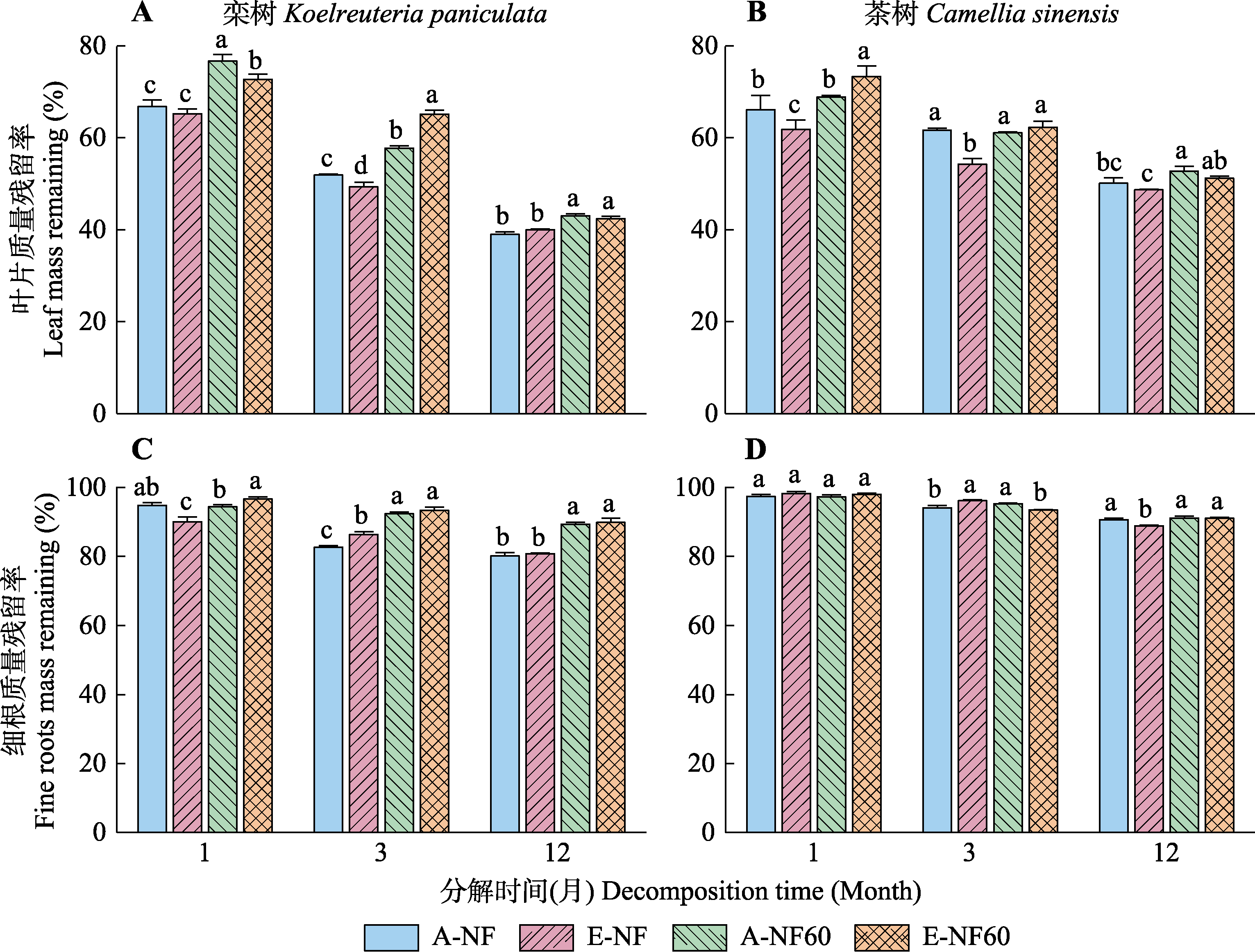
图1 不同O3处理对两个树种叶片和细根凋落物在分解1、3和12个月时的质量残留率影响(平均值±标准误)。A, 自然分解环境; E, O3升高的分解环境; NF, 环境空气下的分解底物; NF60, 经60 nmol·mol-1 O3预处理的分解底物。在同一分解时间内, 不同处理间若标注不同的小写字母, 表示差异显著(p < 0.05)。
Fig. 1 Effects of ozone treatments on the mass remaining (%) of leaf and fine root litter from two tree species after 1, 3, and 12 months of decomposition (mean ± SE). A, the ambient decomposition environment; E, the elevated ozone environment; NF, litter derived from plants grown under ambient air; NF60, litter derived from plants exposed to ambient air + 60 nmol·mol-1 O3. Different lowercase letters indicate significant differences among treatments within the same decomposition stage (p < 0.05).
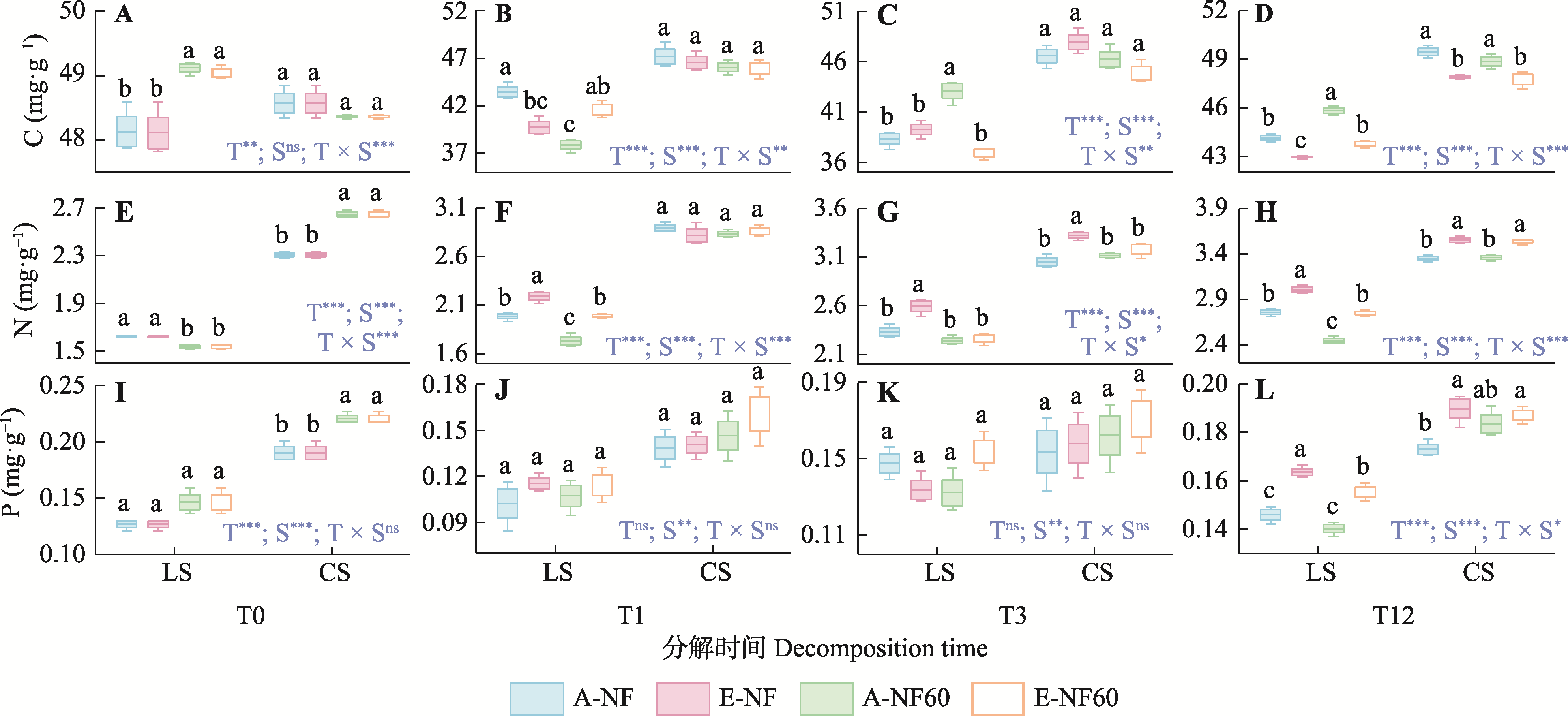
图2 不同分解阶段凋落叶中碳(C) (A-D)、氮(N) (E-H)和磷(P) (I-L)含量的变化(平均值±标准误, n = 3)。T0、T1、T3和T12分别表示分解0、1、3和12个月。CS, 茶树; LS, 栾树。相同分解阶段下, 不同处理间若标注不同小写字母, 表示差异显著(p < 0.05)。采用双因素方差分析检验处理(T)、树种(S)及其交互作用(T × S)对化学组分的影响: *, p < 0.05; **, p < 0.01; ***, p < 0.001; ns, 差异不显著。
Fig. 2 Changes in carbon (C) (A-D), nitrogen (N) (E-H), and phosphorus (P) (I-L) contents in leaf litter across different decomposition stages (mean ± SE, n = 3). T0, T1, T3 and T12 denote decomposition times of 0, 1, 3 and 12 months, respectively. CS, Camellia sinensis; LS, Koelreuteria paniculata. Different lowercase letters indicate significant differences among treatments within the same decomposition stage (p < 0.05). A two-way ANOVA was used to examine the effects of treatment (T), species (S), and their interaction (T × S) on the chemical components: *, p < 0.05; **, p < 0.01; ***, p < 0.001; ns, no significant difference.
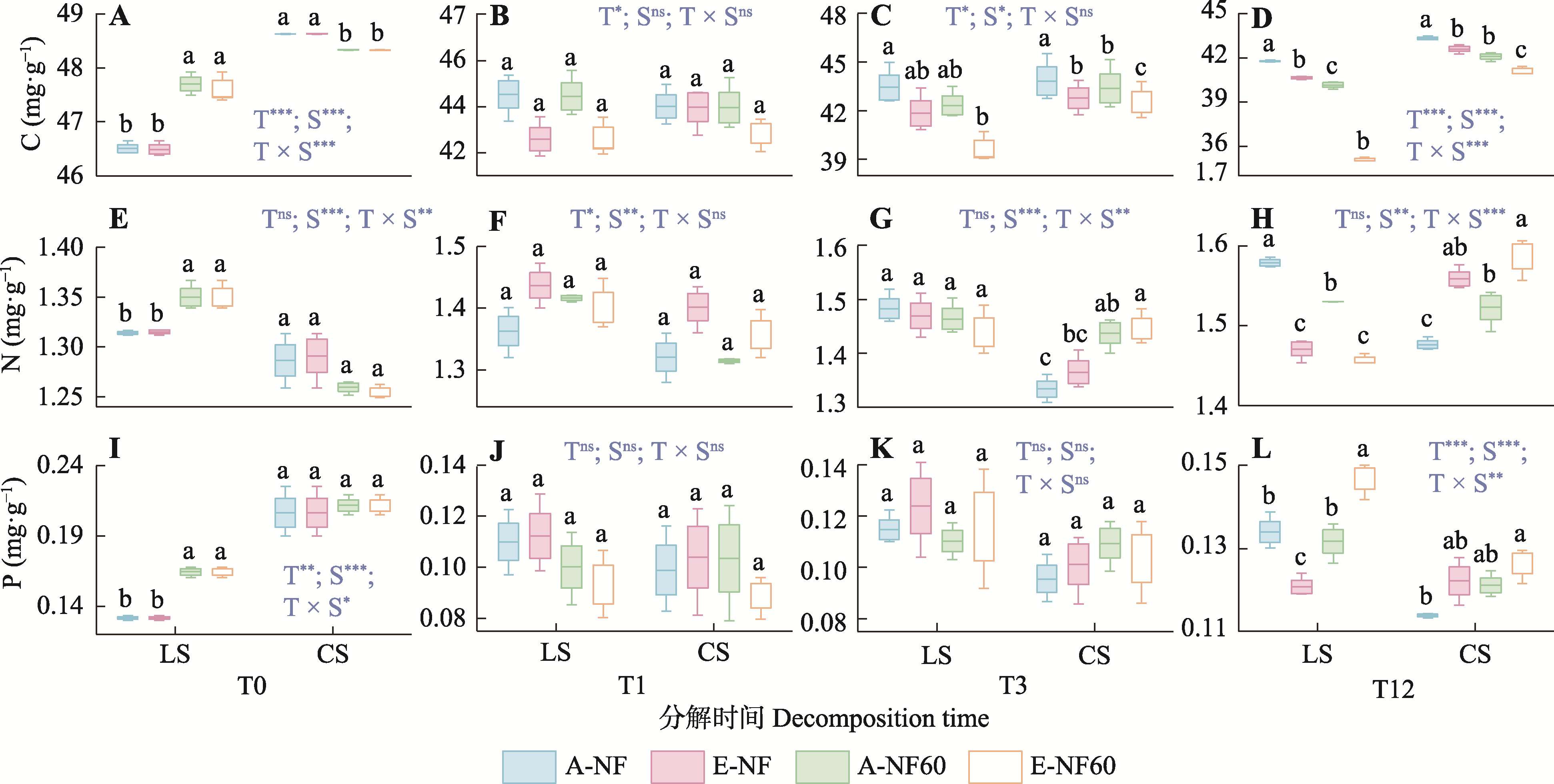
图3 不同分解阶段细根中碳(C) (A-D)、氮(N) (E-H)和磷(P) (I-L)含量的变化。CS, 茶树; LS, 栾树。T0、T1、T3和T12分别表示分解0、1、3和12个月。相同分解阶段下, 不同处理间若标注不同小写字母, 表示差异显著(p < 0.05)。采用双因素方差分析检验处理(T)、树种(S)及其交互作用(T × S)对化学组分的影响: *, p < 0.05; **, p < 0.01; ***, p < 0.001; ns, 差异不显著。
Fig. 3 Changes in carbon (C) (A-D), nitrogen (N) (E-H), and phosphorus (P) (I-L) contents in fine roots across different decomposition stages. T0, T1, T3 and T12 denote decomposition times of 0, 1, 3 and 12 months, respectively. CS, Camellia sinensis; LS, Koelreuteria paniculata. Different lowercase letters indicate significant differences among treatments within the same decomposition stage (p < 0.05). A two-way ANOVA was used to examine the effects of treatment (T), species (S), and their interaction (T × S) on the chemical components: *, p < 0.05; **, p < 0.01; ***, p < 0.001; ns, no significant difference.
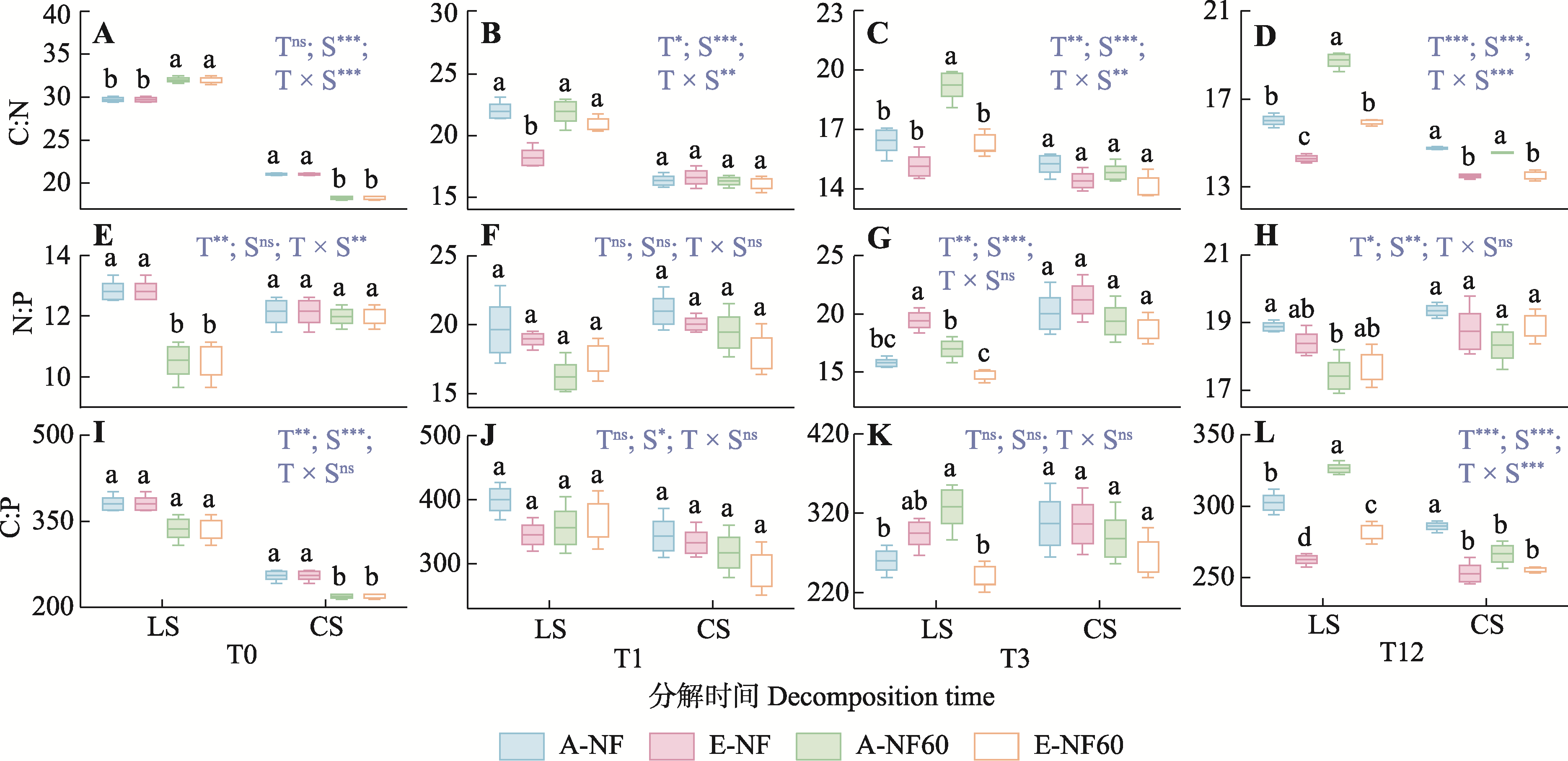
图4 不同分解阶段凋落叶中化学计量比的变化。C, 碳; N, 氮; P, 磷。CS, 茶树; LS, 栾树。T0、T1、T3和T12分别表示分解0、1、3和12个月。相同分解阶段下, 不同处理间若标注不同小写字母, 表示差异显著(p < 0.05)。采用双因素方差分析检验处理(T)、树种(S)及其交互作用(T × S)对化学组分的影响: *, p < 0.05; **, p < 0.01; ***, p < 0.001; ns, 差异不显著。
Fig. 4 Changes in stoichiometric ratios in leaf litter across different decomposition stages. T0, T1, T3 and T12 denote decomposition times of 0, 1, 3 and 12 months, respectively. C, carbon; N, nitrogen; P, phosphorus. CS, Camellia sinensis; LS, Koelreuteria paniculata. Different lowercase letters indicate significant differences among treatments within the same decomposition stage (p < 0.05). A two-way ANOVA was used to examine the effects of treatment (T), species (S), and their interaction (T × S) on the chemical components: *, p < 0.05; **, p < 0.01; ***, p < 0.001; ns, no significant difference.
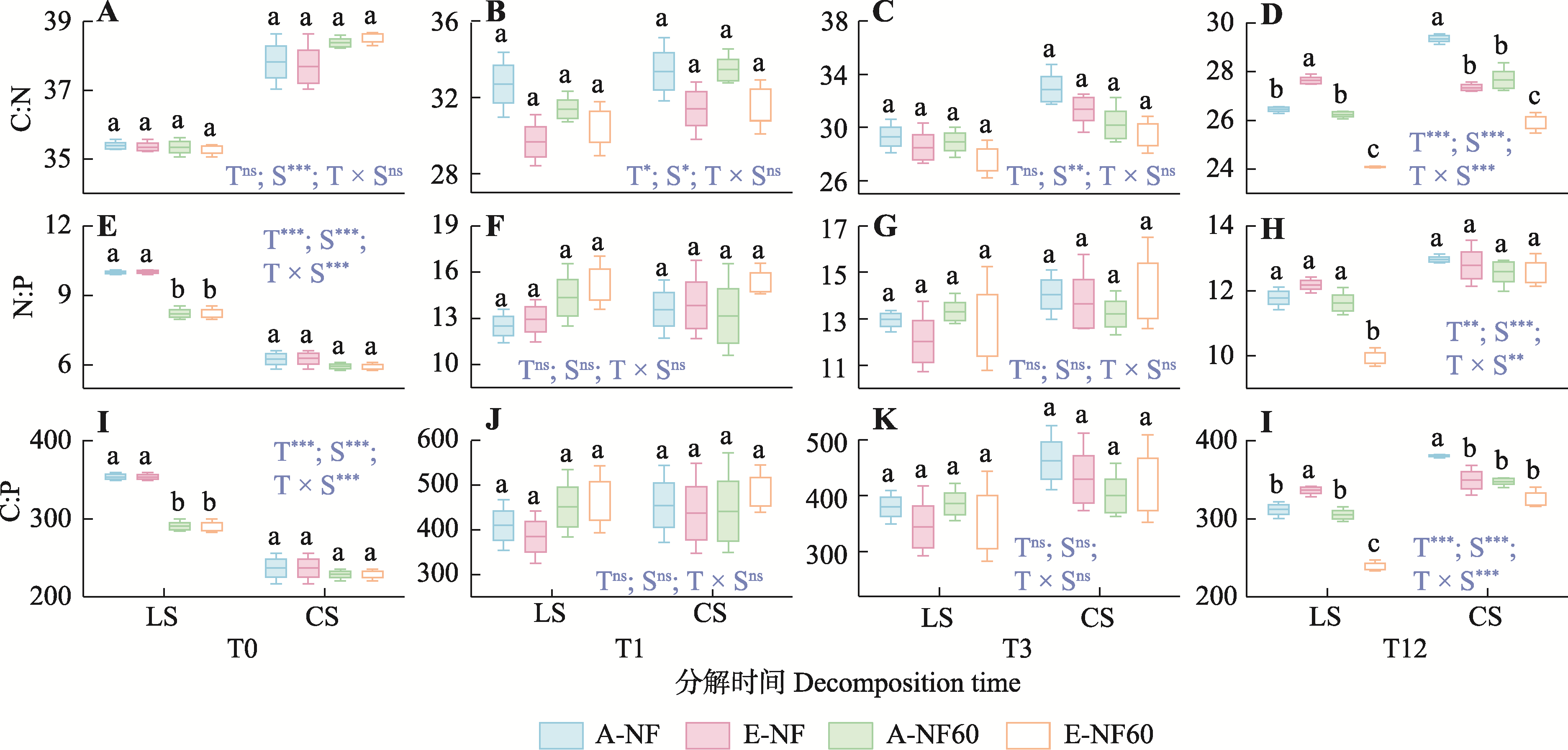
图5 不同分解阶段细根中化学计量比的变化。T0、T1、T3和T12分别表示分解0、1、3和12个月。C, 碳; N, 氮; P, 磷。CS, 茶树; LS, 栾树。相同分解阶段下, 不同处理间若标注不同小写字母, 表示差异显著(p < 0.05)。采用双因素方差分析检验处理(T)、树种(S)及其交互作用(T × S)对化学组分的影响: *, p < 0.05; **, p < 0.01; ***, p < 0.001; ns, 差异不显著。
Fig. 5 Changes in stoichiometric ratios in fine roots across different decomposition stages. T0, T1, T3 and T12 denote decomposition times of 0, 1, 3 and 12 months, respectively. C, carbon; N, nitrogen; P, phosphorus. CS, Camellia sinensis; LS, Koelreuteria paniculata. Different lowercase letters indicate significant differences among treatments within the same decomposition stage (p < 0.05). A two-way ANOVA was used to examine the effects of treatment (T), species (S), and their interaction (T × S) on the chemical components: *, p < 0.05; **, p < 0.01; ***, p < 0.001; ns, no significant difference.
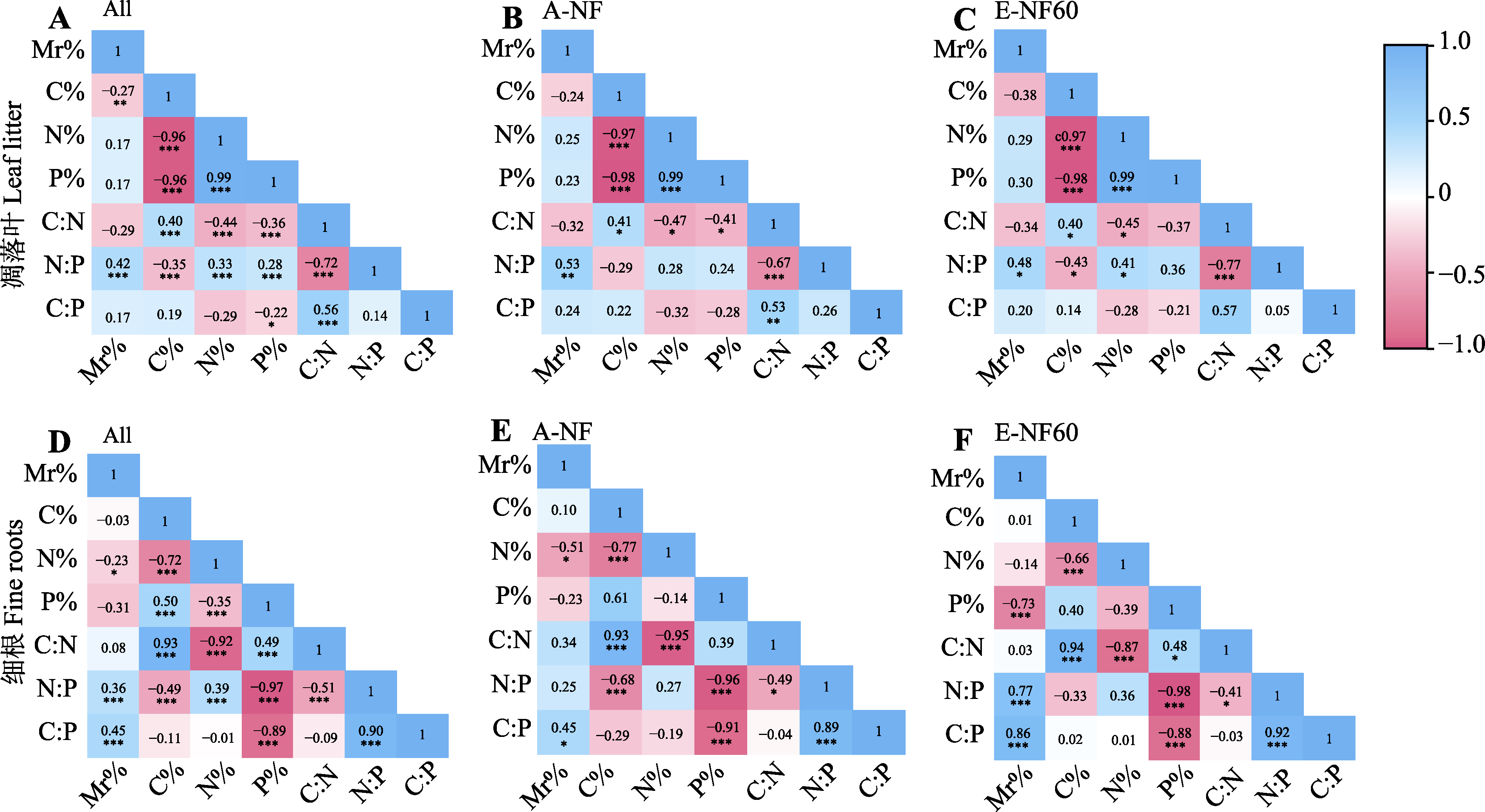
图6 凋落叶(A-C)与细根(D-F)残留率(Mr)与碳(C)、氮(N)、磷(P)化学计量特征之间的相关性分析。A, 自然分解环境; E, O3升高的分解环境; NF, 环境空气下的分解底物; NF60, 经60 nmol·mol-1 O3预处理的分解底物。*, p < 0.05; **, p < 0.01; ***, p < 0.001。
Fig. 6 Correlations among the mass remaining of leaf litter (A-C) and fine roots (D-F) and their stoichiometric characteristics of C, N, and P. A, natural decomposition environment; E, elevated O3 decomposition environment; NF, decomposition substrate under ambient air; NF60, decomposition substrate pretreated with 60 nmol·mol-1 O3. *, p < 0.05; **, p < 0.01; ***, p < 0.001.
| [1] | Agathokleous E, Feng ZZ, Oksanen E, Sicard P, Wang Q, Saitanis CJ, Araminiene V, Blande JD, Hayes F, Calatayud V, Domingos M, Veresoglou SD, Peñuelas J, Wardle DA, de Marco A, et al. (2020). Ozone affects plant, insect, and soil microbial communities: a threat to terrestrial ecosystems and biodiversity. Science Advances, 6, eabc1176. DOI: 10.1126/sciadv.abc1176. |
| [2] | Auwal M, Sun H, Adamu UK, Meng J, van Zwieten L, Pal Singh B, Luo Y, Xu J (2023). The phosphorus limitation in the post-fire forest soils increases soil CO2 emission via declining cellular carbon use efficiency and increasing extracellular phosphatase. Catena, 224, 106968. DOI: 10.1016/j.catena.2023.106968. |
| [3] | Berg B, McClaugherty C (2014). Plant Litter: Decomposition, Humus Formation, Carbon Sequestration. 3rd ed. Springer, Berlin. |
| [4] | Brewster C, Fenner N, Hayes F (2024). Chronic ozone exposure affects nitrogen remobilization in wheat at key growth stages. Science of the Total Environment, 908, 168288. DOI: 10.1016/j.scitotenv.2023.168288. |
| [5] |
Carrillo Y, Bell C, Koyama A, Canarini A, Boot CM, Wallenstein M, Pendall E (2017). Plant traits, stoichiometry and microbes as drivers of decomposition in the rhizosphere in a temperate grassland. Journal of Ecology, 105, 1750-1765.
DOI URL |
| [6] | Chen J, Xu H, Seven J, Zilla T, Dippold MA, Kuzyakov Y (2023). Microbial phosphorus recycling in soil by intra- and extracellular mechanisms. ISME Communications, 3, 135. DOI: 10.1038/s43705-024-00320-4. |
| [7] |
Cotrufo MF, Soong JL, Horton AJ, Campbell EE, Haddix ML, Wall DH, Parton WJ (2015). Formation of soil organic matter via biochemical and physical pathways of litter mass loss. Nature Geoscience, 8, 776-779.
DOI |
| [8] | Elias DMO, Robinson S, Both S, Goodall T, Majalap-Lee N, Ostle NJ, McNamara NP (2020). Soil microbial community and litter quality controls on decomposition across a tropical forest disturbance gradient. Frontiers in Forests and Global Change, 3, 81. DOI: 10.3389/ffgc.2020.00081. |
| [9] |
Elser JJ, Acharya K, Kyle M, Cotner J, Makino W, Markow T, Watts T, Hobbie S, Fagan W, Schade J, Hood J, Sterner RW (2003). Growth rate-stoichiometry couplings in diverse biota. Ecology Letters, 6, 936-943.
DOI URL |
| [10] |
Fioretto A, Papa S, Curcio E, Sorrentino G, Fuggi A (2000). Enzyme dynamics on decomposing leaf litter of Cistus incanus and Myrtus communis in a Mediterranean ecosystem. Soil Biology & Biochemistry, 32, 1847-1855.
DOI URL |
| [11] |
Freschet GT, Cornwell WK, Wardle DA, Elumeeva TG, Liu WD, Jackson BG, Onipchenko VG, Soudzilovskaia NA, Tao JP, Cornelissen JHC (2013). Linking litter decomposition of above- and below-ground organs to plant-soil feedbacks worldwide. Journal of Ecology, 101, 943-952.
DOI URL |
| [12] |
Güsewell S (2004). N:P ratios in terrestrial plants: variation and functional significance. New Phytologist, 164, 243-266.
DOI PMID |
| [13] |
Güsewell S, Verhoeven JTA (2006). Litter N:P ratios indicate whether N or P limits the decomposability of graminoid leaf litter. Plant and Soil, 287, 131-143.
DOI URL |
| [14] |
He PC, Lian JY, Ye Q, Liu H, Zheng Y, Yu KL, Zhu SD, Li RH, Yin DY, Ye WH, Wright IJ (2022). How do functional traits influence tree demographic properties in a subtropical monsoon forest. Functional Ecology, 36, 3200-3210.
DOI URL |
| [15] | Hobbie SE (2015). Plant species effects on nutrient cycling: revisiting litter feedbacks. Trends in Ecology & Evolution 30, 357-363. |
| [16] | Hou XF, Li P, Wu XJ, Xu S, Sun Q (2024). Differences in nutrient release and decay rate of poplar leaf litter and fine roots and their relationship with substrate quality and decomposition environment under ozone pollution. Environmental and Experimental Botany, 226, 105898. DOI: 10.1016/j.envexpbot.2024.105898. |
| [17] | Hou XF, Wu XJ, Ma CH, Tian D, Yan ZB, Li P (2022). Effect of the elevated ozone on greening tree species of urban: Alterations in C-N-P stoichiometry and nutrient stock allocation to leaves and fine roots. Urban Forestry & Urban Greening, 76, 127735. DOI: 10.1016/j.ufug.2022.127735. |
| [18] |
Kasurinen A, Silfver T, Rousi M, Mikola J (2017). Warming and ozone exposure effects on silver birch (Betula pendula Roth) leaf litter quality, microbial growth and decomposition. Plant and Soil, 414, 127-142.
DOI URL |
| [19] |
Koerselman W, Meuleman AFM (1996). The vegetation N/P ratio: a new tool to detect the nature of nutrient limitation. Journal of Applied Ecology, 33, 1441-1450.
DOI URL |
| [20] |
Kontunen-Soppela S, Ossipov V, Ossipova S, Oksanen E (2007). Shift in birch leaf metabolome and carbon allocation during long-term open-field ozone exposure. Global Change Biology, 13, 1053-1067.
DOI URL |
| [21] |
Kraus TEC, Dahlgren RA, Zasoski RJ (2003). Tannins in nutrient dynamics of forest ecosystems—A review. Plant and Soil, 256, 41-66.
DOI |
| [22] |
Li P, Calatayud V, Gao F, Uddling J, Feng ZZ (2016). Differences in ozone sensitivity among woody species are related to leaf morphology and antioxidant levels. Tree Physiology, 36, 1105-1116.
DOI PMID |
| [23] |
Li P, Yang YH, Han WX, Fang JY (2014). Global patterns of soil microbial nitrogen and phosphorus stoichiometry in forest ecosystems. Global Ecology and Biogeography, 23, 979-987.
DOI URL |
| [24] | Li P, Yin RB, Shang B, Agathokleous E, Zhou HM, Feng ZZ (2020). Interactive effects of ozone exposure and nitrogen addition on tree root traits and biomass allocation pattern: an experimental case study and a literature meta-analysis. Science of the Total Environment, 710, 136379. DOI: 10.1016/j.scitotenv.2019.136379. |
| [25] |
Li P, Yin RB, Zhou HM, Xu S, Feng ZZ (2022). Functional traits of poplar leaves and fine roots responses to ozone pollution under soil nitrogen addition. Journal of Environmental Sciences, 113, 118-131.
DOI PMID |
| [26] |
Livesley SJ, McPherson EG, Calfapietra C (2016). The urban forest and ecosystem services: impacts on urban water, heat, and pollution cycles at the tree, street, and city scale. Journal of Environmental Quality, 45, 119-124.
DOI PMID |
| [27] |
Manzoni S, Trofymow JA, Jackson RB, Porporato A (2010). Stoichiometric controls on carbon, nitrogen, and phosphorus dynamics in decomposing litter. Ecological Monographs, 80, 89-106.
DOI URL |
| [28] | Mooshammer M, Wanek W, Hämmerle I, Fuchslueger L, Hofhansl F, Knoltsch A, Schnecker J, Takriti M, Watzka M, Wild B, Keiblinger KM, Zechmeister-Boltenstern S, Richter A (2014). Adjustment of microbial nitrogen use efficiency to carbon:nitrogen imbalances regulates soil nitrogen cycling. Nature Communications, 5, 3694. DOI: 10.1038/ncomms4694. |
| [29] | Qiu YP, Guo LJ, Xu XY, Zhang L, Zhang KC, Chen MF, Zhao YX, Burkey KO, Shew HD, Zobel RW, Zhang Y, Hu SJ (2021). Warming and elevated ozone induce tradeoffs between fine roots and mycorrhizal fungi and stimulate organic carbon decomposition. Science Advances, 7, eabe9256. DOI: 10.1126/sciadv.abe9256. |
| [30] | Shang B, Li ZZ, Yuan XY, Xu YS, Feng ZZ (2022). Effects of elevated ozone on the uptake and allocation of macronutrients in poplar saplings above- and belowground. Science of the Total Environment, 851, 158044. DOI: 10.1016/j.scitotenv.2022.158044. |
| [31] |
Sinsabaugh RL, Hill BH, Follstad Shah JJ (2009). Ecoenzymatic stoichiometry of microbial organic nutrient acquisition in soil and sediment. Nature, 462, 795-798.
DOI |
| [32] | Sterner RW, Elser JJ (2002). Ecological Stoichiometry: the Biology of Elements from Molecules to the Biosphere. Princeton University Press, Princeton. |
| [33] | Wang DN, Freschet GT, McCormack ML, Lambers H, Gu JC (2025). Nutrient resorption of leaves and roots coordinates with root nutrient-acquisition strategies in a temperate forest. New Phytologist, 246, 515-527. |
| [34] | Wang N, Wang YX, Zhang XY, Wu YQ, Zhang L, Liu GH, Fu JY, Li X, Mu D, Li ZZ (2024). Elevated ozone reduces the quality of tea leaves but may improve the resistance of tea plants. Plants, 13, 1108. DOI: 10.3390/plants13081108. |
| [35] |
Wang T, Xue LK, Brimblecombe P, Lam YF, Li L, Zhang L (2017). Ozone pollution in China: a review of concentrations, meteorological influences, chemical precursors, and effects. Science of the Total Environment, 575, 1582-1596.
DOI URL |
| [36] | Wu JJ, Zhang H, Cheng XL, Liu GH (2023). Nitrogen addition stimulates litter decomposition rate: from the perspective of the combined effect of soil environment and litter quality. Soil Biology & Biochemistry, 179, 108992. DOI: 10.1016/j.soilbio.2023.108992. |
| [37] | Yang JJ, Guan PT, Zhang P, Wu YG, Wang DL, Wu DH (2023). Stronger microbial nutrient limitations in subsoil along the precipitation gradient of agroecosystem: insights from soil enzyme activity and stoichiometry. Frontiers in Ecology and Evolution, 11, 1137172. DOI: 10.3389/fevo.2023.1137172. |
| [38] |
Yendrek CR, Erice G, Montes CM, Tomaz T, Sorgini CA, Brown PJ, McIntyre LM, Leakey ADB, Ainsworth EA (2017). Elevated ozone reduces photosynthetic carbon gain by accelerating leaf senescence of inbred and hybrid maize in a genotype-specific manner. Plant, Cell & Environment, 40, 3088-3100.
DOI URL |
| [1] | 饶朝康, 唐亮. 不同潮位红树植物叶际微生物群落特征及其影响因素[J]. 植物生态学报, 2026, 50(预发表): 1-. |
| [2] | 王梦雪, 胡明艳, 储诚进, 陈阳, 罗文启, 马子龙. 亚热带森林不同菌根真菌树种叶片和细根的碳氮磷化学计量特征[J]. 植物生态学报, 2026, 50(2): 334-343. |
| [3] | 张竟文, 李晶, 王汝苗, 王贺年, 崔丽娟. 不同纬度滨海湿地植物根系与土壤生态化学计量特征及内稳性分析[J]. 植物生态学报, 2026, 50(2): 461-473. |
| [4] | 冯哲, 许格希, 刘顺, 陈健, 李非凡, 巩闪闪, 贾磊, 孙镇, 余美霓, 史作民, 周庆宏, 蒋冬梅. 生境因子和系统发育协同驱动云南金沙江干热河谷植物叶片化学计量特征[J]. 植物生态学报, 2026, 50(2): 352-361. |
| [5] | 李沁, 贺鹏程, 叶清. 华南国家植物园24种植物花与叶片功能性状变异[J]. 植物生态学报, 2026, 50(2): 474-488. |
| [6] | 田地, 迟小龙, 石亮, 刘宵含, 赵常提, 吴梅, 张玉忠, 高永亮. 塞罕坝地区优势造林树种叶片化学计量特征及其环境驱动[J]. 植物生态学报, 2026, 50(2): 362-373. |
| [7] | 谭聪, 石亮, 赵常提, 甘沛钦, 陈冰瑞, 谭深, 卜燕华, 田地. 基于叶片功能性状多维特征的北京平原林生态优化策略解析[J]. 植物生态学报, 2026, 50(2): 388-399. |
| [8] | 叶学敏, 高伟, 唐星林, 陈伏生, 孙荣喜, 罗坤水. 氮磷添加对常绿阔叶林幼树叶片植食损伤的影响及调控机制[J]. 植物生态学报, 2026, 50(2): 256-267. |
| [9] | 李月琪, 麻仲花, 刘威帆, 苏明, 万猛虎, 李清云, 张丹, 刘吉利, 吴娜. 垂直深旋耕配施有机肥对盐碱地玉米叶片衰老特性及产量的影响[J]. 植物生态学报, 2026, 50(1): 222-236. |
| [10] | 梁天豪, 吴帆, 黄锦学, 景陈鸿, 傅贺菁, 杨智杰, 熊德成. 增温对中亚热带格氏栲天然林细根生长量及形态特征的影响[J]. 植物生态学报, 2026, 50(1): 94-106. |
| [11] | 皮惠之, 张秋芳, 孙浩, 曾泉鑫, 彭园珍, 元晓春, 徐建国, 陈岳民. 微生物碳氮不平衡影响罗浮栲林土壤微生物氮利用效率对氮富集的响应[J]. 植物生态学报, 2026, 50(1): 34-44. |
| [12] | 陈刚刚, 朱思洁, 郭亮娜, 付芳伟, 刘昱灼, 李江荣. 藏东南色季拉山高山树线乔灌地上-地下养分分配策略[J]. 植物生态学报, 2025, 49(9): 1515-1526. |
| [13] | 沈会涛, 俞筱押, 秦彦杰, 武爱彬. 太行山东麓核桃林生态化学计量及碳储量随林龄变化特征[J]. 植物生态学报, 2025, 49(9): 1543-15555. |
| [14] | 张箫荻, 王晓霞, 章毓文, 侯靖雨, 石骁鹏, 和璐璐, 刘亚栋, 薛柳, 何宝华, 段劼. 北京山区三种林下灌木水力结构、叶片功能性状及其环境适应策略[J]. 植物生态学报, 2025, 49(7): 1128-1143. |
| [15] | 杜英杰, 范爱连, 王雪, 闫晓俊, 陈廷廷, 贾林巧, 姜琦, 陈光水. 亚热带天然常绿阔叶林乔木树种与林下灌木树种根-叶功能性状协调性及差异[J]. 植物生态学报, 2025, 49(4): 585-595. |
| 阅读次数 | ||||||
|
全文 |
|
|||||
|
摘要 |
|
|||||
Copyright © 2026 版权所有 《植物生态学报》编辑部
地址: 北京香山南辛村20号, 邮编: 100093
Tel.: 010-62836134, 62836138; Fax: 010-82599431; E-mail: apes@ibcas.ac.cn, cjpe@ibcas.ac.cn
备案号: 京ICP备16067583号-19

