
植物生态学报 ›› 2026, Vol. 50 ›› Issue (3): 742-759.DOI: 10.17521/cjpe.2025.0260 cstr: 32100.14.cjpe.2025.0260
秦斐斐1, 唐朝辉2, 司彤3, 慈敦伟1,*( )
)
收稿日期:2025-07-11
接受日期:2025-10-17
出版日期:2026-03-20
发布日期:2026-05-19
通讯作者:
*慈敦伟(cdw_2007@126.com)基金资助:
QIN Fei-Fei1, TANG Zhao-Hui2, SI Tong3, CI Dun-Wei1,*()
Received:2025-07-11
Accepted:2025-10-17
Online:2026-03-20
Published:2026-05-19
Contact:
*CI Dun-Wei(cdw_2007@126.com)
Supported by:摘要:
盐碱地是解决中国耕地紧缺的重要现实和潜在农业资源, 高效利用盐碱地资源, 实现盐碱地花生(Arachis hypogaea)绿色高效种植是当前保障花生生产的迫切需求。在盐碱胁迫生境下, 丛枝菌根真菌(AMF)能够有效发挥宿主植物在盐碱土壤中的生产潜力, 提高植物耐盐性。尽管AMF提高盐胁迫下花生耐盐性已得到证实, 但有关盐碱耐受型和敏感型花生的生长发育对AMF的响应机制还不清楚。该研究以耐盐花生品种‘花育25’ (‘HY25’)和盐敏感品种‘花育22’ (‘HY22’)为试验材料, 在非盐碱地和盐碱地2种土壤环境下设置AMF花生种子包衣处理, 分析不同耐盐程度花生生长发育和根际土壤环境对AMF的响应机制, 为AMF在盐碱地花生高效生产中的应用提供理论依据和技术支撑。结果表明: 在2种土壤环境下盐耐受型花生和敏感型花生的生长发育和根际土壤特性对AMF的响应机制不同。2种土壤环境下, AMF改善‘HY25’植株地上部分农艺性状, 优化光合参数, 显著增加荚果产量; AMF虽对非盐碱地上‘HY22’地上部分农艺性状有部分抑制作用, 但能增强叶片光合性能, 提高荚果产量和品质。2个品种根系的生长发育对AMF的响应差异显著: 1)在非盐碱地上, AMF对‘HY25’根系生长的促进作用始于花针期, 且促进效果持续至成熟期; 在盐碱环境下AMF主要增加荚果期‘HY25’的根系总长、总表面积和总体积; 2) ‘HY22’根系对AMF的接种更为敏感, 2种土壤环境下, AMF对花针期和/或荚果期根系均有抑制作用, 且盐碱环境下抑制作用>非盐碱地。AMF对根际土壤特性的影响表现为: 1) 2种土壤环境下, 2个品种的土壤有效磷含量显著增加; 2)盐碱环境下, 显著增加2个品种根际土壤过氧化氢酶、磷酸酶、蔗糖酶活性; 3)在非盐碱地上, 对‘HY22’根际土壤酶活性有显著的抑制作用。结果表明, 相较于盐敏感型花生, 盐耐受型花生可能是AMF更为高效的共生品种, AMF能更好地促进其生长发育, 且在盐碱环境下AMF更能有效地发挥其微生物调控的协同作用。
秦斐斐, 唐朝辉, 司彤, 慈敦伟. 盐碱耐受型和敏感型花生生长发育及根际土壤特性对丛枝菌根真菌的响应. 植物生态学报, 2026, 50(3): 742-759. DOI: 10.17521/cjpe.2025.0260
QIN Fei-Fei, TANG Zhao-Hui, SI Tong, CI Dun-Wei. Response mechanisms of growth and rhizosphere soil properties in salt-tolerant and salt-sensitive peanut (Arachis hypogaea) to arbuscular mycorrhizal fungi. Chinese Journal of Plant Ecology, 2026, 50(3): 742-759. DOI: 10.17521/cjpe.2025.0260
| 有机质含量 Organic matters content (g·kg-1) | 碱解氮含量 Hydrolyzable nitrogen content (mg·kg-1) | 速效磷(P2O5)含量 Available phosphorus content (mg·kg-1) | 速效钾(K2O)含量 Available potassium content (mg·kg-1) | 交换性钙含量 Exchangeable calcium content (g·kg-1) | 盐含量 Soil salt content (g·kg-1) | pH | |
|---|---|---|---|---|---|---|---|
| 莱西非盐碱地 Laixi normal soil | 16.7 | 89.3 | 49.6 | 93.6 | 2.36 | 0.8 | 6.7 |
| 广饶盐碱地 Guangrao saline alkali soil | 6.6 | 39.5 | 24.2 | 123.0 | 7.52 | 2.6 | 8.8 |
表1 莱西和广饶试验基地土壤基本特性
Table 1 Physiochemical properties of soil in Laixi and Guangrao experimental sites
| 有机质含量 Organic matters content (g·kg-1) | 碱解氮含量 Hydrolyzable nitrogen content (mg·kg-1) | 速效磷(P2O5)含量 Available phosphorus content (mg·kg-1) | 速效钾(K2O)含量 Available potassium content (mg·kg-1) | 交换性钙含量 Exchangeable calcium content (g·kg-1) | 盐含量 Soil salt content (g·kg-1) | pH | |
|---|---|---|---|---|---|---|---|
| 莱西非盐碱地 Laixi normal soil | 16.7 | 89.3 | 49.6 | 93.6 | 2.36 | 0.8 | 6.7 |
| 广饶盐碱地 Guangrao saline alkali soil | 6.6 | 39.5 | 24.2 | 123.0 | 7.52 | 2.6 | 8.8 |
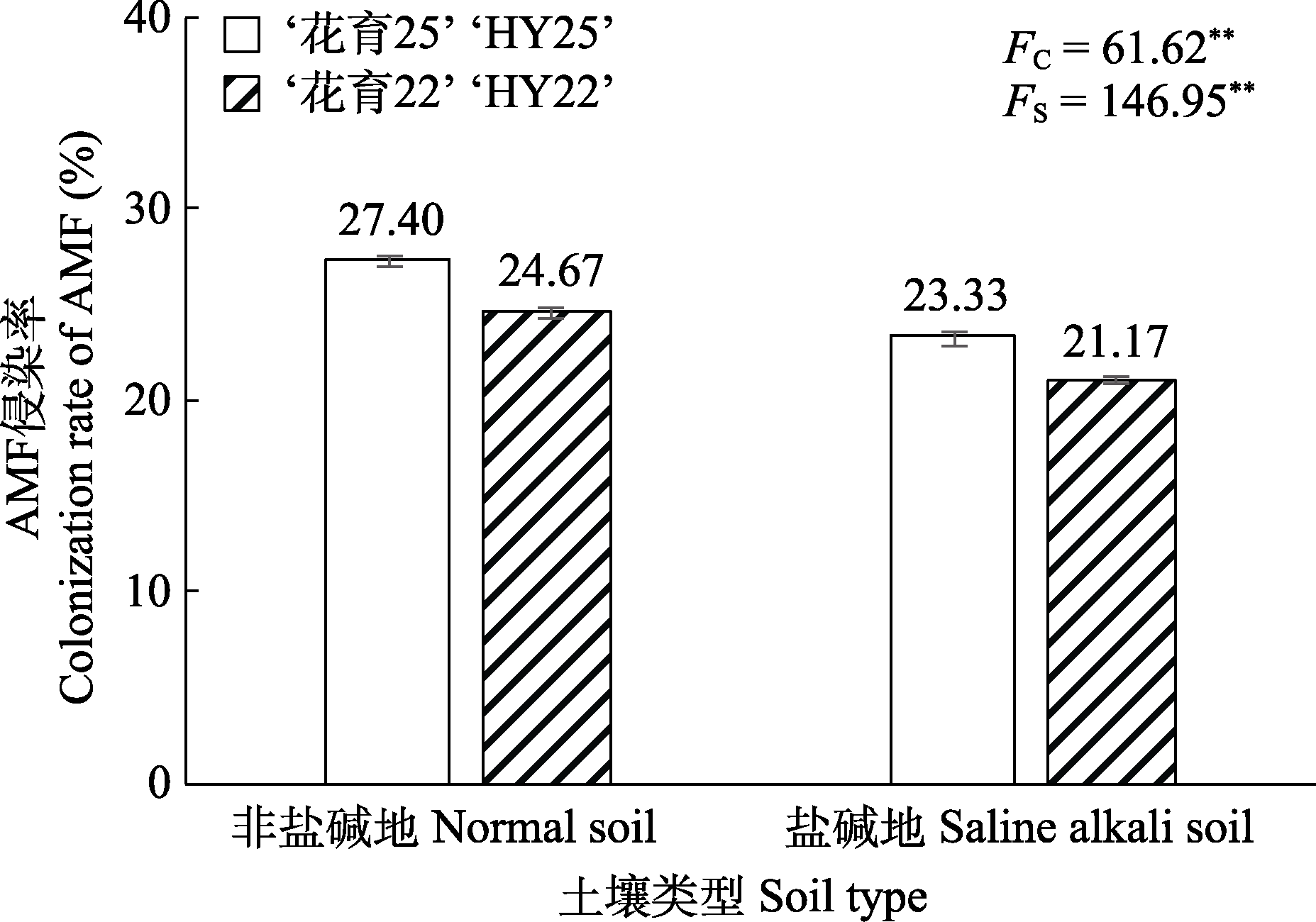
图1 非盐碱地和盐碱地耐盐型和敏感型花生品种接种丛枝菌根真菌(AMF)后菌根侵染率(平均值±标准差)。FC, 品种间的F值; FS, 土壤间F值; **, 处理间差异极显著(p < 0.01)。
Fig. 1 Colonization rates of arbuscular mycorrhizal fungi (AMF) in salt-tolerant and salt-sensitive peanut cultivars under normal and saline alkali soil environments (mean ± SD). FC, F value between cultivar; FS, F value between soils; **, significant differences at p < 0.01 level.
| 土壤 Soil (A) | 品种 Cultivar (B) | 处理 Treatment (C) | 主茎高 Stem height (cm) | 侧枝长 Lateral branch length (cm) | 一次分枝数 Primary branches number | 二次分枝数 Secondary branches number | 主茎叶数 Stem leaf number | 第一侧枝基部10 cm节数 Nodes number of the 10 cm base of lateral branches |
|---|---|---|---|---|---|---|---|---|
| 非盐碱地 Normal soil | ‘HY25’ | CK | 31.5 ± 3.2 | 32.8 ± 2.9 | 5.2 ± 0.5 | 3.7 ± 0.1 | 14.3 ± 0.1 | 4.7 ± 0.1 |
| AMF | 27.7 ± 2.3* | 24.1 ± 2.2** | 5.2 ± 0.3ns | 4.3 ± 0.3* | 14.2 ± 0.1ns | 6.0 ± 0.2** | ||
| ‘HY22’ | CK | 47.9 ± 1.9 | 47.5 ± 2.0 | 4.7 ± 0.1 | 3.5 ± 0.0 | 18.3 ± 1.0 | 6.0 ± 0.1 | |
| AMF | 35.5 ± 1.4** | 39.3 ± 1.7** | 5.2 ± 0.3* | 3.8 ± 0.1ns | 15.8 ± 0.7** | 6.5 ± 0.1* | ||
| 盐碱地 Saline alkali soil | ‘HY25’ | CK | 21.3 ± 2.1 | 24.3 ± 1.1 | 4.5 ± 0.1 | 3.5 ± 0.3 | 12.7 ± 0.3 | 5.7 ± 0.1 |
| AMF | 32.9 ± 3.2** | 39.2 ± 1.5** | 5.2 ± 0.2* | 4.2 ± 0.1* | 14.8 ± 1.0** | 6.3 ± 0.1* | ||
| ‘HY22’ | CK | 34.0 ± 1.8 | 37.6 ± 0.8 | 5.5 ± 0.1 | 4.0 ± 0.1 | 16.0 ± 0.6 | 6.3 ± 0.1 | |
| AMF | 30.7 ± 2.9* | 36.3 ± 1.2ns | 5.5 ± 0.1ns | 4.7 ± 0.0* | 15.2 ± 0.9* | 7.0 ± 0.0* | ||
| A | ** | ns | ns | ns | * | * | ||
| B | ** | ** | ns | ns | ** | ** | ||
| C | ns | ns | ns | ns | ns | ** | ||
| A × B | ** | ** | * | ns | ns | ns | ||
| A × C | ** | ** | ns | ns | * | ns | ||
| B × C | ** | ** | ns | ns | ** | ns | ||
| A × B × C | ns | ** | ns | ns | ns | ns | ||
表2 丛枝菌根真菌(AMF)对非盐碱地和盐碱地盐耐受型和敏感型花生品种农艺性状的影响(平均值±标准差, n = 3)
Table 2 Effects of arbuscular mycorrhizal fungi (AMF) on agronomic characteristics of salt-tolerant and salt-sensitive peanut cultivars in normal and saline alkali soils (mean ± SD, n = 3)
| 土壤 Soil (A) | 品种 Cultivar (B) | 处理 Treatment (C) | 主茎高 Stem height (cm) | 侧枝长 Lateral branch length (cm) | 一次分枝数 Primary branches number | 二次分枝数 Secondary branches number | 主茎叶数 Stem leaf number | 第一侧枝基部10 cm节数 Nodes number of the 10 cm base of lateral branches |
|---|---|---|---|---|---|---|---|---|
| 非盐碱地 Normal soil | ‘HY25’ | CK | 31.5 ± 3.2 | 32.8 ± 2.9 | 5.2 ± 0.5 | 3.7 ± 0.1 | 14.3 ± 0.1 | 4.7 ± 0.1 |
| AMF | 27.7 ± 2.3* | 24.1 ± 2.2** | 5.2 ± 0.3ns | 4.3 ± 0.3* | 14.2 ± 0.1ns | 6.0 ± 0.2** | ||
| ‘HY22’ | CK | 47.9 ± 1.9 | 47.5 ± 2.0 | 4.7 ± 0.1 | 3.5 ± 0.0 | 18.3 ± 1.0 | 6.0 ± 0.1 | |
| AMF | 35.5 ± 1.4** | 39.3 ± 1.7** | 5.2 ± 0.3* | 3.8 ± 0.1ns | 15.8 ± 0.7** | 6.5 ± 0.1* | ||
| 盐碱地 Saline alkali soil | ‘HY25’ | CK | 21.3 ± 2.1 | 24.3 ± 1.1 | 4.5 ± 0.1 | 3.5 ± 0.3 | 12.7 ± 0.3 | 5.7 ± 0.1 |
| AMF | 32.9 ± 3.2** | 39.2 ± 1.5** | 5.2 ± 0.2* | 4.2 ± 0.1* | 14.8 ± 1.0** | 6.3 ± 0.1* | ||
| ‘HY22’ | CK | 34.0 ± 1.8 | 37.6 ± 0.8 | 5.5 ± 0.1 | 4.0 ± 0.1 | 16.0 ± 0.6 | 6.3 ± 0.1 | |
| AMF | 30.7 ± 2.9* | 36.3 ± 1.2ns | 5.5 ± 0.1ns | 4.7 ± 0.0* | 15.2 ± 0.9* | 7.0 ± 0.0* | ||
| A | ** | ns | ns | ns | * | * | ||
| B | ** | ** | ns | ns | ** | ** | ||
| C | ns | ns | ns | ns | ns | ** | ||
| A × B | ** | ** | * | ns | ns | ns | ||
| A × C | ** | ** | ns | ns | * | ns | ||
| B × C | ** | ** | ns | ns | ** | ns | ||
| A × B × C | ns | ** | ns | ns | ns | ns | ||
| 土壤 Soil (A) | 品种 Cultivar (B) | 处理 Treatment (C) | 净光合速率 Net photosynthetic rate (μmol·m-2·s-1) | 气孔导度 Stomatal conductance (mol·m-2·s-1) | 细胞间CO2浓度 Intercellular CO2 concentration (μl·L-1) | 蒸腾速率 Transpiration rate (mmol·m-2·s-1) |
|---|---|---|---|---|---|---|
| 非盐碱地 Normal soil | ‘HY25’ | CK | 19.1 ± 1.6 | 694.3 ± 56.9 | 318.7 ± 5.2 | 2.3 ± 0.1 |
| AMF | 21.5 ± 0.3* | 735.0 ± 34.9* | 298.2 ± 3.2ns | 3.2 ± 0.1** | ||
| ‘HY22’ | CK | 22.5 ± 1.3 | 1 203.2 ± 25.8 | 320.5 ± 4.8 | 3.9 ± 0.0 | |
| AMF | 23.3 ± 1.3ns | 2 001.7 ± 78.4** | 310.2 ± 4.5ns | 5.2 ± 0.0** | ||
| 盐碱地 Saline alkali soil | ‘HY25’ | CK | 16.2 ± 0.7 | 223.8 ± 33.9 | 240.5 ± 21.3 | 1.1 ± 0.1 |
| AMF | 18.8 ± 0.6* | 470.3 ± 30.3** | 292.6 ± 7.6* | 2.4 ± 0.1** | ||
| ‘HY22’ | CK | 20.6 ± 1.9 | 1 179.7 ± 23.5 | 326.5 ± 6.0 | 3.8 ± 0.1 | |
| AMF | 24.5 ± 1.0* | 1 355.3 ± 53.6* | 307.8 ± 6.0ns | 4.8 ± 0.3* | ||
| A | * | ** | ** | ** | ||
| B | ** | ** | ** | ** | ||
| C | ** | ** | ns | ** | ||
| A × B | ns | ns | ** | ** | ||
| A × C | ns | * | * | ns | ||
| B × C | ns | ** | * | ns | ||
| A × B × C | ns | ** | ** | ns | ||
表3 丛枝菌根真菌(AMF)对非盐碱地和盐碱地盐耐受型和敏感型花生品种叶片光合作用的影响(平均值±标准差, n = 6)
Table 3 Effects of arbuscular mycorrhizal fungi (AMF) on leaf photosynthesis of salt-tolerant and salt-sensitive peanut cultivars in normal and saline alkali soils (mean ± SD, n = 6)
| 土壤 Soil (A) | 品种 Cultivar (B) | 处理 Treatment (C) | 净光合速率 Net photosynthetic rate (μmol·m-2·s-1) | 气孔导度 Stomatal conductance (mol·m-2·s-1) | 细胞间CO2浓度 Intercellular CO2 concentration (μl·L-1) | 蒸腾速率 Transpiration rate (mmol·m-2·s-1) |
|---|---|---|---|---|---|---|
| 非盐碱地 Normal soil | ‘HY25’ | CK | 19.1 ± 1.6 | 694.3 ± 56.9 | 318.7 ± 5.2 | 2.3 ± 0.1 |
| AMF | 21.5 ± 0.3* | 735.0 ± 34.9* | 298.2 ± 3.2ns | 3.2 ± 0.1** | ||
| ‘HY22’ | CK | 22.5 ± 1.3 | 1 203.2 ± 25.8 | 320.5 ± 4.8 | 3.9 ± 0.0 | |
| AMF | 23.3 ± 1.3ns | 2 001.7 ± 78.4** | 310.2 ± 4.5ns | 5.2 ± 0.0** | ||
| 盐碱地 Saline alkali soil | ‘HY25’ | CK | 16.2 ± 0.7 | 223.8 ± 33.9 | 240.5 ± 21.3 | 1.1 ± 0.1 |
| AMF | 18.8 ± 0.6* | 470.3 ± 30.3** | 292.6 ± 7.6* | 2.4 ± 0.1** | ||
| ‘HY22’ | CK | 20.6 ± 1.9 | 1 179.7 ± 23.5 | 326.5 ± 6.0 | 3.8 ± 0.1 | |
| AMF | 24.5 ± 1.0* | 1 355.3 ± 53.6* | 307.8 ± 6.0ns | 4.8 ± 0.3* | ||
| A | * | ** | ** | ** | ||
| B | ** | ** | ** | ** | ||
| C | ** | ** | ns | ** | ||
| A × B | ns | ns | ** | ** | ||
| A × C | ns | * | * | ns | ||
| B × C | ns | ** | * | ns | ||
| A × B × C | ns | ** | ** | ns | ||
| 土壤 Soil (A) | 品种 Cultivar (B) | 处理 Treatment (C) | 荚果产量 Yield (kg·hm-2) | 总果数 Total pod number | 饱果数 Full pod number | 双仁果数 Number of double kernels | 百果质量 100-pod mass (g) | 百仁质量 100-kernel mass (g) | 出仁率 Shelling rate (%) |
|---|---|---|---|---|---|---|---|---|---|
| 非盐碱地 Normal soil | ‘HY25’ | CK | 7 502.1 ± 48.6 | 18.7 ± 0.3 | 10.3 ± 0.3 | 14.3 ± 0.5 | 264.0 ± 4.2 | 117.6 ± 1.3 | 71.6 ± 0.3 |
| AMF | 8 743.6 ± 110.7* | 23.7 ± 0.5* | 15.7 ± 0.1* | 18.7 ± 0.1* | 284.0 ± 1.7* | 121.4 ± 0.6* | 72.7 ± 0.4ns | ||
| ‘HY22’ | CK | 7 601.6 ± 88.0 | 19.2 ± 0.2 | 9.7 ± 0.2 | 15.0 ± 0.1 | 269.3 ± 0.7 | 113.2 ± 2.2 | 70.0 ± 0.1 | |
| AMF | 8 473.4 ± 96.8* | 23.7 ± 0.3* | 14.7 ± 0.3* | 17.7 ± 0.3* | 289.3 ± 1.0* | 117.2 ± 1.4* | 71.5 ± 0.0ns | ||
| 盐碱地 Saline alkali soil | ‘HY25’ | CK | 6 456.8 ± 62.2 | 15.0 ± 0.5 | 8.7 ± 0.5 | 12.7 ± 0.3 | 219.3 ± 1.6 | 93.2 ± 0.5 | 68.6 ± 0.4 |
| AMF | 7 870.0 ± 50.2* | 19.7 ± 0.1* | 11.3 ± 0.2* | 15.7 ± 0.2* | 248.7 ± 1.5** | 101.8 ± 0.8* | 72.0 ± 0.0* | ||
| ‘HY22’ | CK | 6 317.3 ± 130.0 | 16.7 ± 0.2 | 8.3 ± 0.3 | 13.3 ± 0.1 | 218.2 ± 2.5 | 85.5 ± 0.9 | 67.4 ± 0.2 | |
| AMF | 7 696.0 ± 37.7* | 20.6 ± 0.1* | 12.3 ± 0.4* | 16.7 ± 0.3* | 231.6 ± 1.1* | 93.1 ± 0.5* | 70.7 ± 0.3* | ||
| A | ** | ** | ** | * | ** | ** | * | ||
| B | ns | ns | ns | ns | ns | * | * | ||
| C | ** | ** | ** | ** | ** | * | ** | ||
| A × B | ns | ns | ns | ns | ns | ns | ns | ||
| A × C | ns | ns | ns | ns | ns | ns | ns | ||
| B × C | ns | ns | ns | ns | ns | ns | ns | ||
| A × B × C | ns | ns | ns | ns | ns | ns | ns | ||
表4 丛枝菌根真菌(AMF)对非盐碱地和盐碱地盐耐受型和敏感型花生品种产量及其构成因素的影响(平均值±标准差, n = 3)
Table 4 Effects of arbuscular mycorrhizal fungi (AMF) on yield and yield components of salt-tolerant and salt-sensitive peanut cultivars in normal and saline alkali soils (mean ± SD, n = 3)
| 土壤 Soil (A) | 品种 Cultivar (B) | 处理 Treatment (C) | 荚果产量 Yield (kg·hm-2) | 总果数 Total pod number | 饱果数 Full pod number | 双仁果数 Number of double kernels | 百果质量 100-pod mass (g) | 百仁质量 100-kernel mass (g) | 出仁率 Shelling rate (%) |
|---|---|---|---|---|---|---|---|---|---|
| 非盐碱地 Normal soil | ‘HY25’ | CK | 7 502.1 ± 48.6 | 18.7 ± 0.3 | 10.3 ± 0.3 | 14.3 ± 0.5 | 264.0 ± 4.2 | 117.6 ± 1.3 | 71.6 ± 0.3 |
| AMF | 8 743.6 ± 110.7* | 23.7 ± 0.5* | 15.7 ± 0.1* | 18.7 ± 0.1* | 284.0 ± 1.7* | 121.4 ± 0.6* | 72.7 ± 0.4ns | ||
| ‘HY22’ | CK | 7 601.6 ± 88.0 | 19.2 ± 0.2 | 9.7 ± 0.2 | 15.0 ± 0.1 | 269.3 ± 0.7 | 113.2 ± 2.2 | 70.0 ± 0.1 | |
| AMF | 8 473.4 ± 96.8* | 23.7 ± 0.3* | 14.7 ± 0.3* | 17.7 ± 0.3* | 289.3 ± 1.0* | 117.2 ± 1.4* | 71.5 ± 0.0ns | ||
| 盐碱地 Saline alkali soil | ‘HY25’ | CK | 6 456.8 ± 62.2 | 15.0 ± 0.5 | 8.7 ± 0.5 | 12.7 ± 0.3 | 219.3 ± 1.6 | 93.2 ± 0.5 | 68.6 ± 0.4 |
| AMF | 7 870.0 ± 50.2* | 19.7 ± 0.1* | 11.3 ± 0.2* | 15.7 ± 0.2* | 248.7 ± 1.5** | 101.8 ± 0.8* | 72.0 ± 0.0* | ||
| ‘HY22’ | CK | 6 317.3 ± 130.0 | 16.7 ± 0.2 | 8.3 ± 0.3 | 13.3 ± 0.1 | 218.2 ± 2.5 | 85.5 ± 0.9 | 67.4 ± 0.2 | |
| AMF | 7 696.0 ± 37.7* | 20.6 ± 0.1* | 12.3 ± 0.4* | 16.7 ± 0.3* | 231.6 ± 1.1* | 93.1 ± 0.5* | 70.7 ± 0.3* | ||
| A | ** | ** | ** | * | ** | ** | * | ||
| B | ns | ns | ns | ns | ns | * | * | ||
| C | ** | ** | ** | ** | ** | * | ** | ||
| A × B | ns | ns | ns | ns | ns | ns | ns | ||
| A × C | ns | ns | ns | ns | ns | ns | ns | ||
| B × C | ns | ns | ns | ns | ns | ns | ns | ||
| A × B × C | ns | ns | ns | ns | ns | ns | ns | ||
| 土壤 Soil (A) | 品种 Cultivar (B) | 处理 Treatment (C) | 蛋白质含量 Protein content (%) | 脂肪含量 Fat content (%) | 油酸含量 Oleic acid content (%) | 亚油酸含量 Linoleic acid content (%) | 油酸/亚油酸 O/L |
|---|---|---|---|---|---|---|---|
| 非盐碱地 Normal soil | ‘HY25’ | CK | 29.1 ± 0.7 | 51.7 ± 0.7 | 45.0 ± 2.4 | 36.4 ± 2.3 | 1.24 ± 0.14 |
| AMF | 29.7 ± 0.4ns | 49.2 ± 0.8ns | 39.5 ± 2.1* | 40.7 ± 2.1* | 0.97 ± 0.10** | ||
| ‘HY22’ | CK | 28.8 ± 0.4 | 51.2 ± 0.5 | 52.7 ± 2.6 | 30.1 ± 1.2 | 1.76 ± 0.16 | |
| AMF | 29.3 ± 0.7ns | 49.7 ± 1.0ns | 54.1 ± 3.0* | 28.9 ± 2.5* | 1.89 ± 0.28* | ||
| 盐碱地 Saline alkali soil | ‘HY25’ | CK | 26.5 ± 1.2 | 49.9 ± 1.1 | 42.6 ± 1.2 | 38.1 ± 1.0 | 1.12 ± 0.06 |
| AMF | 26.9 ± 0.7ns | 50.9 ± 0.6ns | 39.7 ± 4.2* | 40.6 ± 3.6* | 1.00 ± 0.20* | ||
| ‘HY22’ | CK | 25.1 ± 1.4 | 51.8 ± 1.9 | 49.1 ± 2.3 | 33.0 ± 1.9 | 1.49 ± 0.15 | |
| AMF | 27.3 ± 1.3* | 51.5 ± 1.2ns | 49.3 ± 3.4ns | 32.9 ± 2.8ns | 1.52 ± 0.23ns | ||
| A | ** | ns | ** | ** | ** | ||
| B | ns | ns | ** | ** | ** | ||
| C | ns | ns | ns | ** | ** | ||
| A × B | ns | ns | ns | ** | ns | ||
| A × C | ns | * | ns | ns | ** | ||
| B × C | ns | ns | * | ** | ** | ||
| A × B × C | ns | ns | ns | * | ** | ||
表5 丛枝菌根真菌(AMF)对非盐碱地和盐碱地盐耐受型和敏感型花生品种籽仁品质的影响(平均值±标准差, n = 3)
Table 5 Effects of arbuscular mycorrhizal fungi (AMF) on kernel quality of salt-tolerant and salt-sensitive peanut cultivars in normal and saline alkali soils (mean ± SD, n = 3)
| 土壤 Soil (A) | 品种 Cultivar (B) | 处理 Treatment (C) | 蛋白质含量 Protein content (%) | 脂肪含量 Fat content (%) | 油酸含量 Oleic acid content (%) | 亚油酸含量 Linoleic acid content (%) | 油酸/亚油酸 O/L |
|---|---|---|---|---|---|---|---|
| 非盐碱地 Normal soil | ‘HY25’ | CK | 29.1 ± 0.7 | 51.7 ± 0.7 | 45.0 ± 2.4 | 36.4 ± 2.3 | 1.24 ± 0.14 |
| AMF | 29.7 ± 0.4ns | 49.2 ± 0.8ns | 39.5 ± 2.1* | 40.7 ± 2.1* | 0.97 ± 0.10** | ||
| ‘HY22’ | CK | 28.8 ± 0.4 | 51.2 ± 0.5 | 52.7 ± 2.6 | 30.1 ± 1.2 | 1.76 ± 0.16 | |
| AMF | 29.3 ± 0.7ns | 49.7 ± 1.0ns | 54.1 ± 3.0* | 28.9 ± 2.5* | 1.89 ± 0.28* | ||
| 盐碱地 Saline alkali soil | ‘HY25’ | CK | 26.5 ± 1.2 | 49.9 ± 1.1 | 42.6 ± 1.2 | 38.1 ± 1.0 | 1.12 ± 0.06 |
| AMF | 26.9 ± 0.7ns | 50.9 ± 0.6ns | 39.7 ± 4.2* | 40.6 ± 3.6* | 1.00 ± 0.20* | ||
| ‘HY22’ | CK | 25.1 ± 1.4 | 51.8 ± 1.9 | 49.1 ± 2.3 | 33.0 ± 1.9 | 1.49 ± 0.15 | |
| AMF | 27.3 ± 1.3* | 51.5 ± 1.2ns | 49.3 ± 3.4ns | 32.9 ± 2.8ns | 1.52 ± 0.23ns | ||
| A | ** | ns | ** | ** | ** | ||
| B | ns | ns | ** | ** | ** | ||
| C | ns | ns | ns | ** | ** | ||
| A × B | ns | ns | ns | ** | ns | ||
| A × C | ns | * | ns | ns | ** | ||
| B × C | ns | ns | * | ** | ** | ||
| A × B × C | ns | ns | ns | * | ** | ||
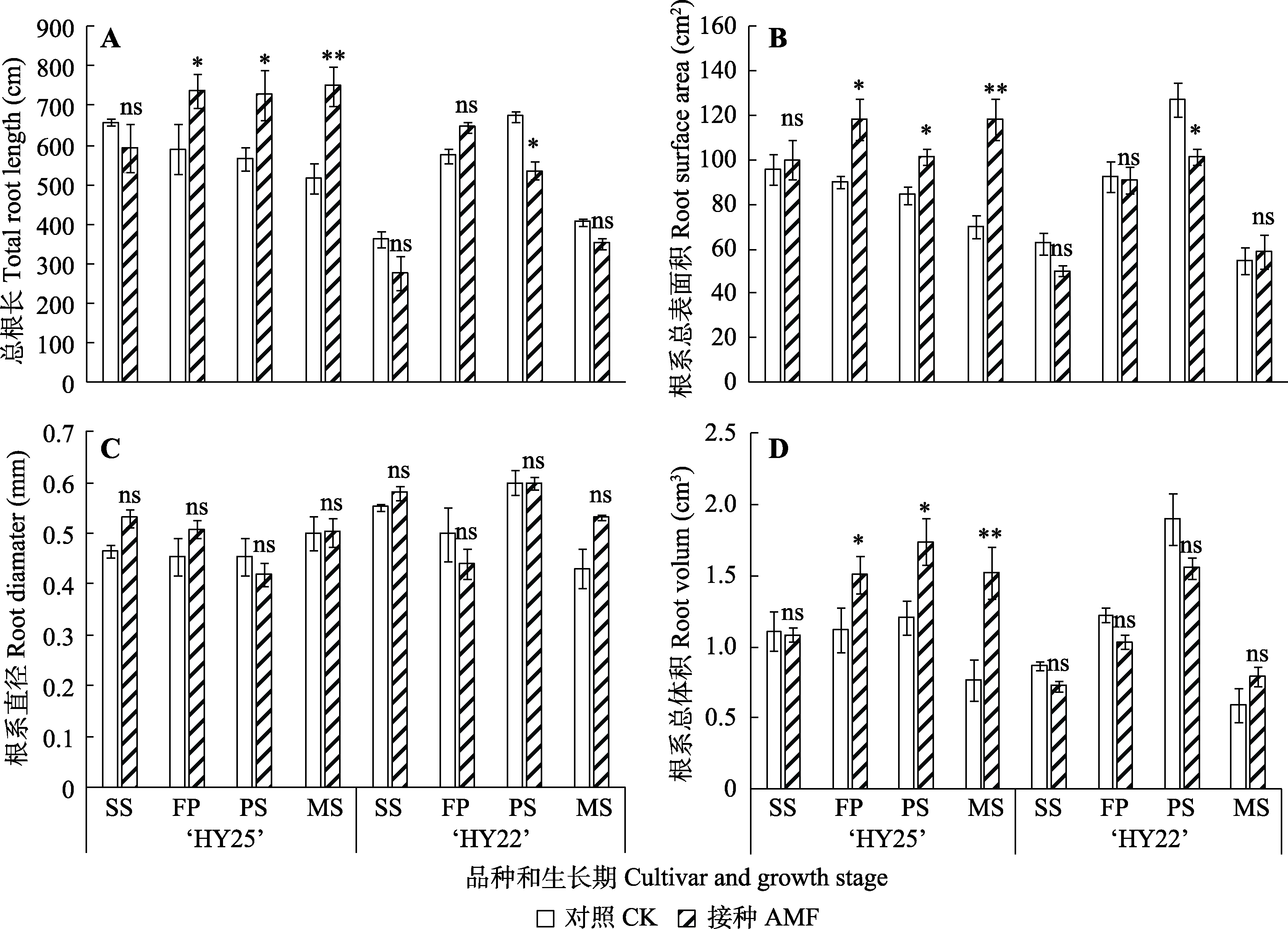
图2 非盐碱环境下丛枝菌根真菌(AMF)对耐盐型‘HY25’和敏感型‘HY22’根系形态的影响(平均值±标准差, n = 3)。SS, 苗期; FP, 花针期; PS, 荚果期; MS, 成熟期。ns, p ≥ 0.05; *, p < 0.05; **, p < 0.01; CK, 对照。
Fig. 2 Influence of arbuscular mycorrhizal fungi (AMF) on root morphology of salt-tolerant cultivar ‘HY25’ and salt-sensitive cultivar ‘HY22’ in normal soil (mean ± SD, n = 3). SS, seedling stage; FP, flowering-pegging stage; PS, pod setting stage; MS, maturation stage. ns, p ≥ 0.05; *, p < 0.05; **, p < 0.01; CK, control.
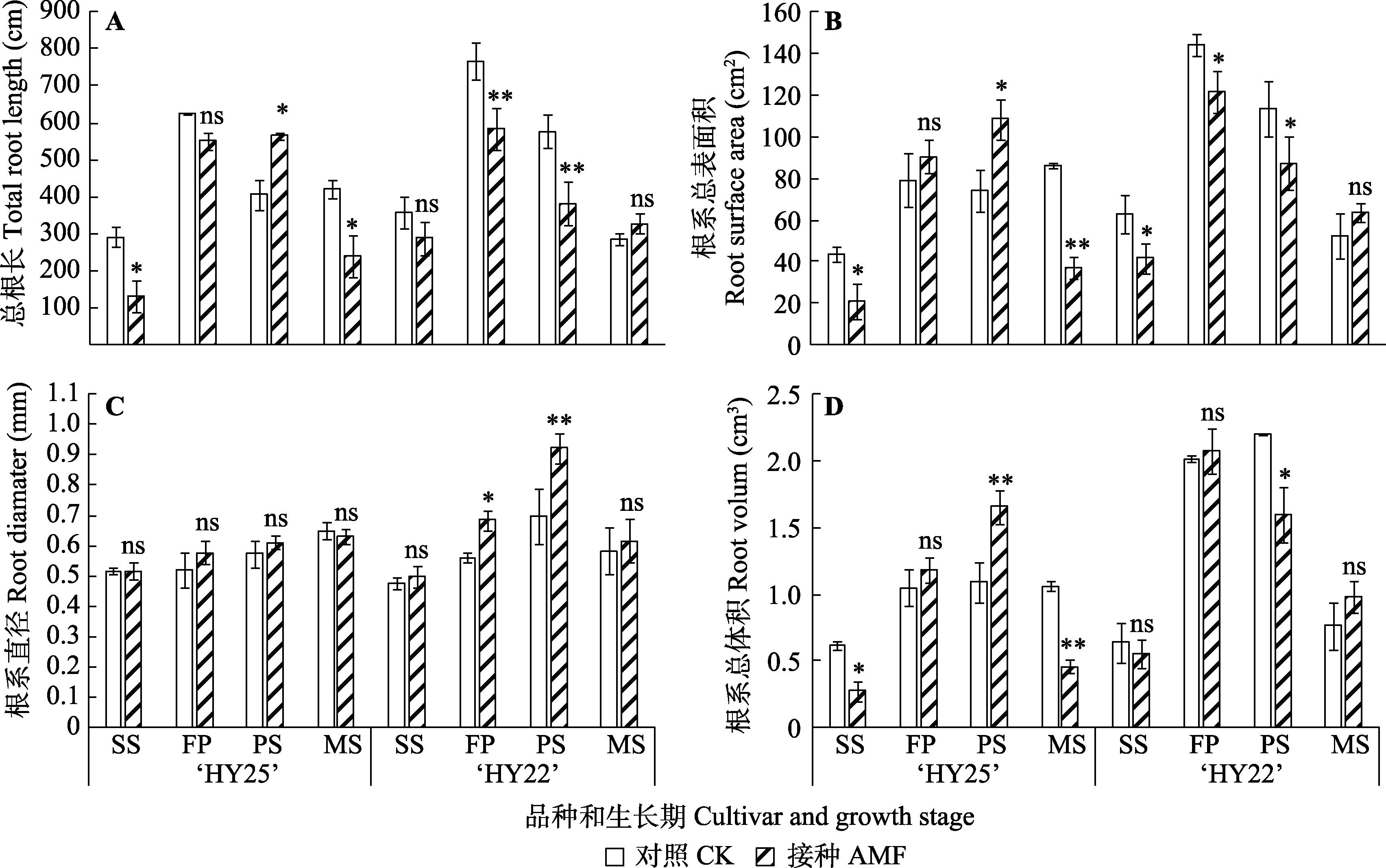
图3 盐碱环境下丛枝菌根真菌(AMF)对耐盐型‘HY25’和敏感型‘HY22’根系形态的影响(平均值±标准差, n = 3)。SS, 苗期; FP, 花针期; PS, 荚果期; MS, 成熟期。ns, p ≥ 0.05; *, p < 0.05; **, p < 0.01; CK, 对照。
Fig. 3 Influence of arbuscular mycorrhizal fungi (AMF) on root morphology of salt-tolerant cultivar ‘HY25’ and salt-sensitive cultivar ‘HY22’ in saline alkali soil (mean ± SD, n = 3). SS, seedling stage; FP, flowering-pegging stage; PS, pod setting stage; MS, maturation stage. ns, p ≥ 0.05; *, p < 0.05; **, p < 0.01; CK, control.
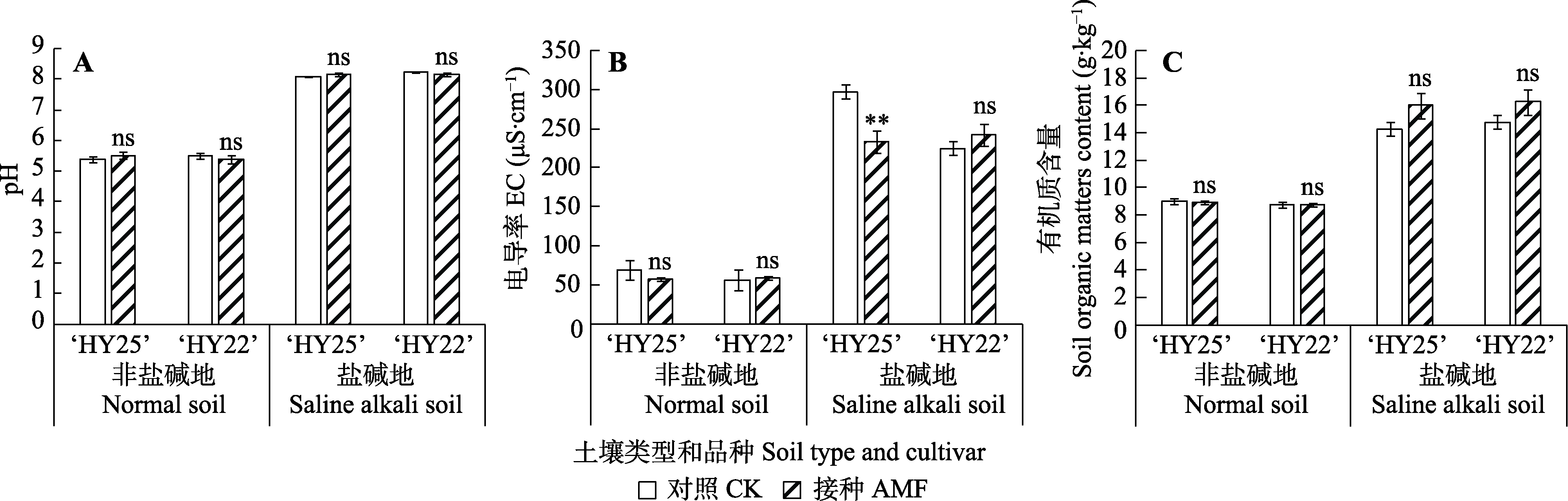
图4 丛枝菌根真菌(AMF)对非盐碱地和盐碱地耐盐型花生‘HY25’和敏感型花生‘HY22’成熟期(MS)根际土壤pH、电导率和有机质的影响(平均值±标准差, n = 3)。ns, p ≥ 0.05; **, p < 0.01; CK, 对照。
Fig. 4 Influence of arbuscular mycorrhizal fungi (AMF) on rhizosphere soil pH, EC and soil organic matters in salt-tolerant cultivar ‘HY25’ and salt-sensitive cultivar ‘HY22’ at mature stage (MS) in normal and saline alkalis soils (mean ± SD, n = 3). ns, p ≥ 0.05; **, p < 0.01; CK, control.
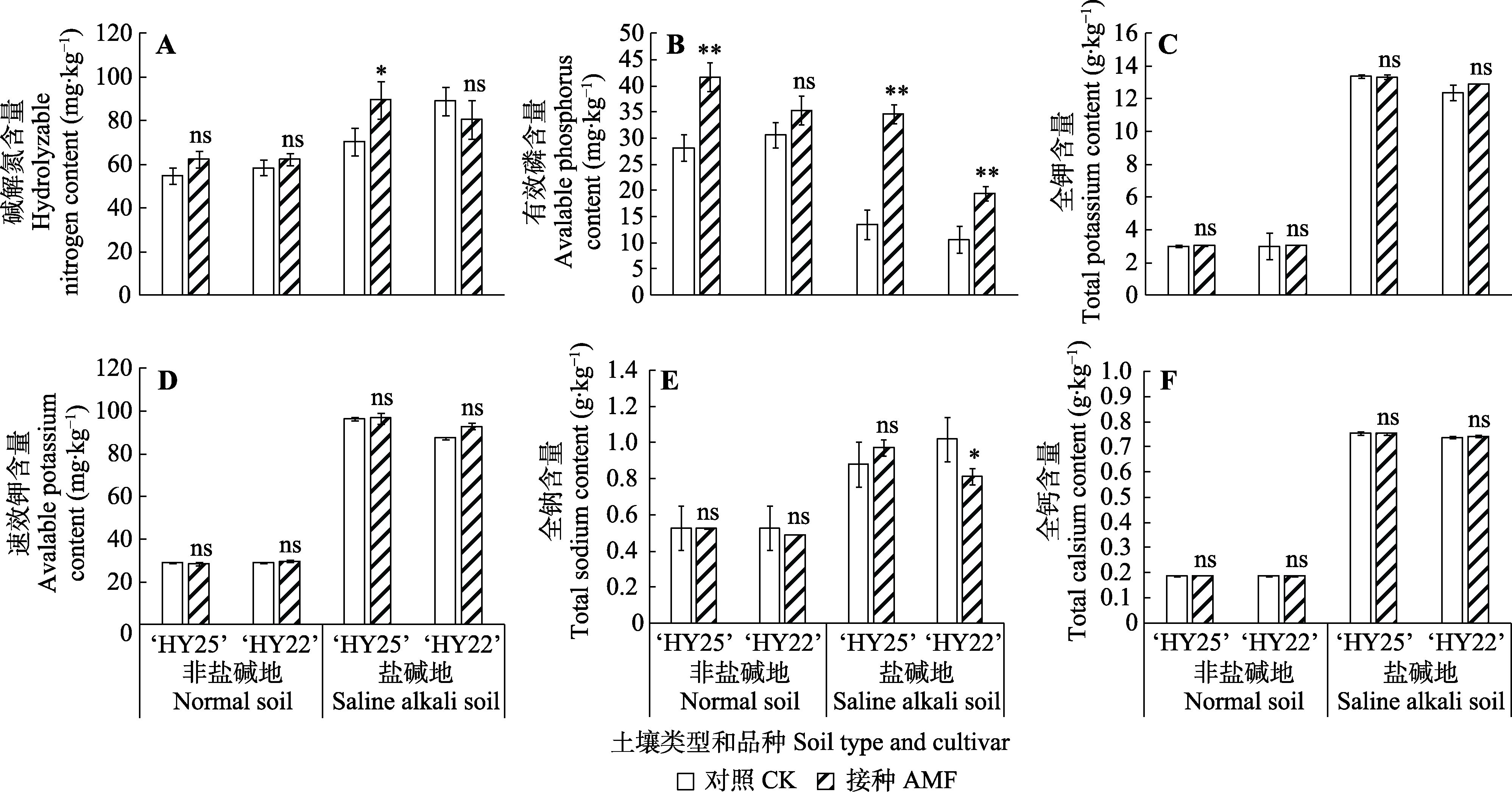
图5 丛枝菌根真菌(AMF)对盐碱地和非盐碱地耐盐型花生‘HY25’和敏感型花生‘HY22’成熟期(MS)根际土壤养分离子的影响(平均值±标准差, n = 3)。ns, p ≥ 0.05; *, p < 0.05; **, p < 0.01; CK, 对照。
Fig. 5 Influence of arbuscular mycorrhizal fungi (AMF) on rhizosphere soil nutrient ions in salt-tolerant cultivar ‘HY25’ and salt-sensitive cultivar ‘HY22’ at mature stage (MS) in saline alkali and normal soils (mean ± SD, n = 3). F, total calcium. ns, p ≥ 0.05; *, p < 0.05; **, p < 0.01; CK, control.
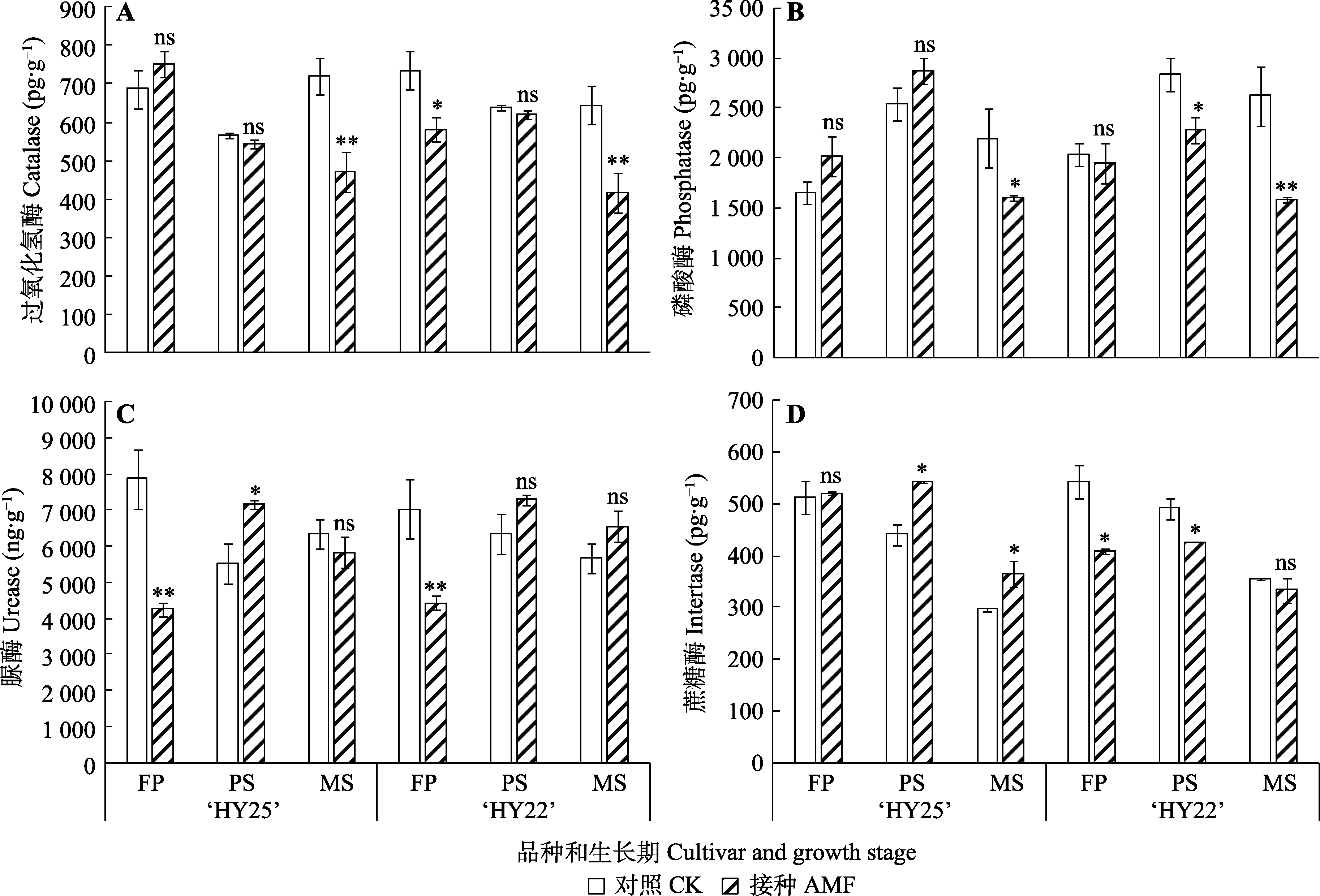
图6 非盐碱地上丛枝菌根真菌(AMF)对耐盐型‘HY25’和敏感型‘HY22’根际土壤酶活性的影响(平均值±标准差, n = 3)。SS, 苗期; FP, 花针期; PS, 荚果期; MS, 成熟期。ns, p ≥ 0.05; *, p < 0.05; **, p < 0.01; CK, 对照。
Fig. 6 Influence of arbuscular mycorrhizal fungi (AMF) on rhizosphere soil enzyme activities in salt-tolerant cultivar ‘HY25’ and salt-sensitive cultivar ‘HY22’ in normal soil (mean ± SD, n = 3). SS, seedling stage; FP, flowering-pegging stage; PS, pod setting stage; MS, maturation stage. ns, p ≥ 0.05; *, p < 0.05; **, p < 0.01; CK, control.
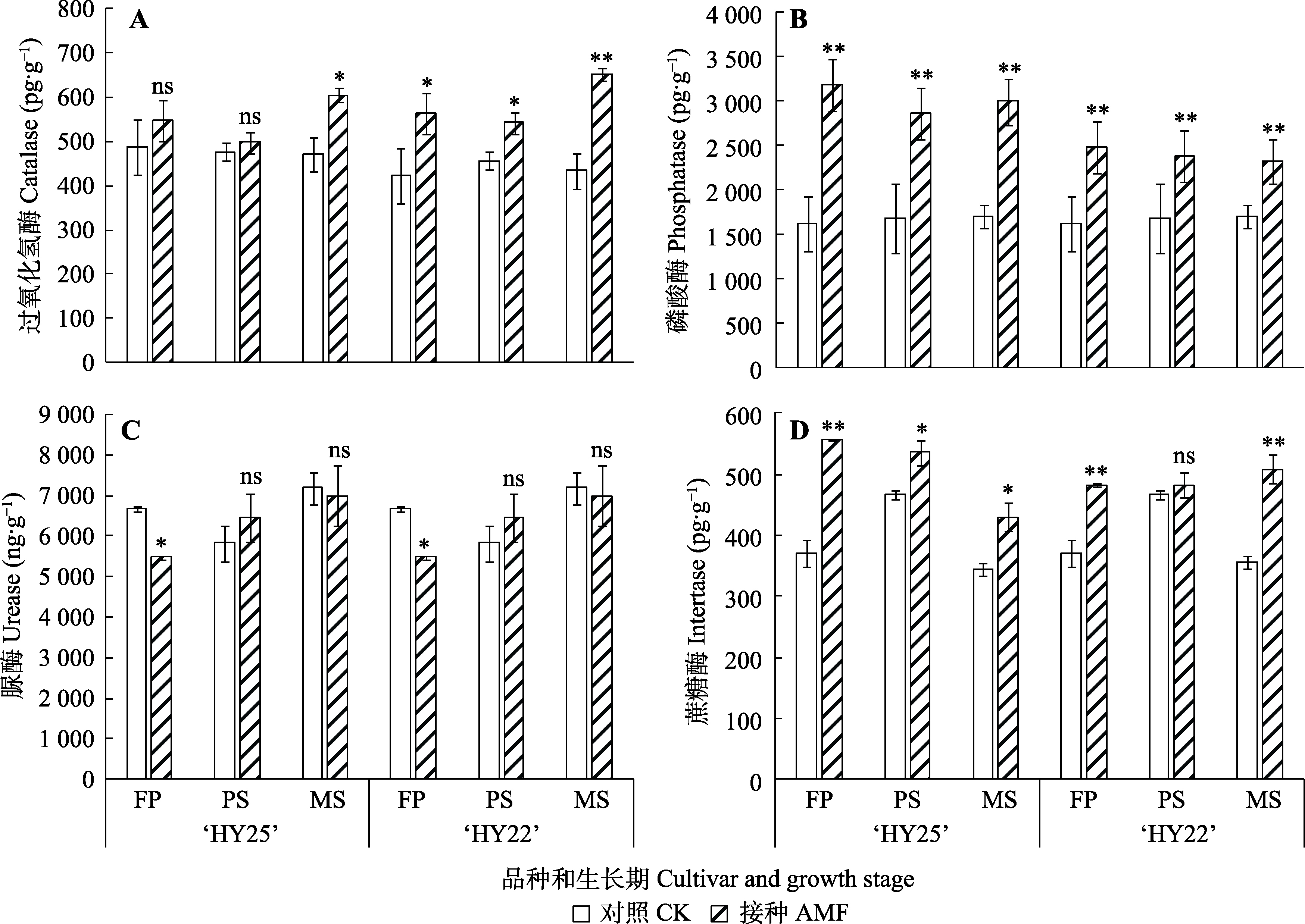
图7 盐碱地上丛枝菌根真菌(AMF)对耐盐型‘HY25’和敏感型‘HY22’根际土壤酶活性的影响(平均值±标准差, n = 3)。SS, 苗期; FP, 花针期; PS, 荚果期; MS, 成熟期。ns, p ≥ 0.05; *, p < 0.05; **, p < 0.01; CK, 对照。
Fig. 7 Influence of arbuscular mycorrhizal fungi (AMF) on rhizosphere soil enzyme activities in salt-tolerant cultivar ‘HY25’ and salt-sensitive cultivar ‘HY22’ in saline alkali soil (mean ± SD, n = 3). SS, seedling stage; FP, flowering-pegging stage; PS, pod setting stage; MS, maturation stage. ns, p ≥ 0.05; *, p < 0.05; **, p < 0.01; CK, control.
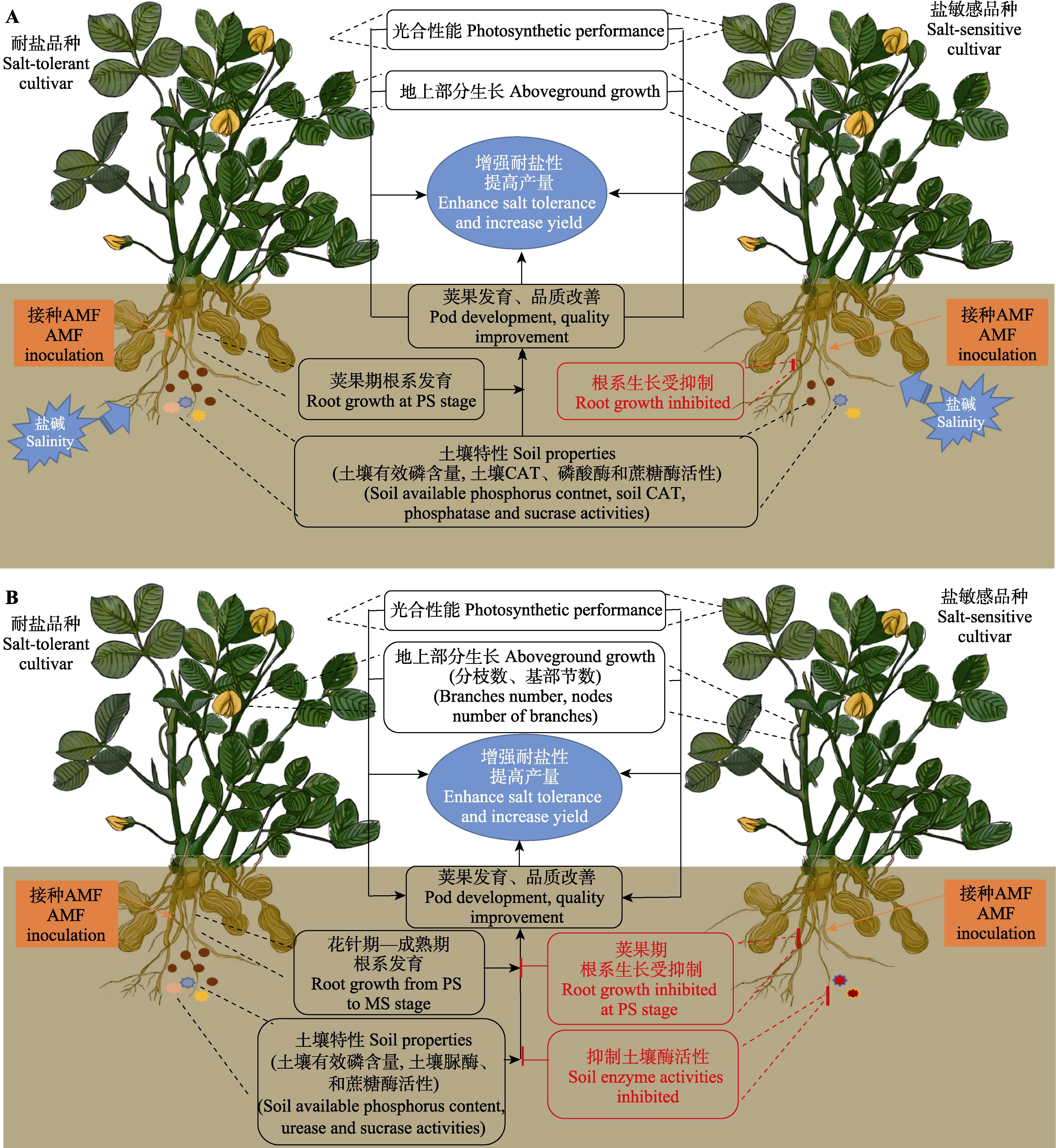
图8 盐耐受型和盐敏感型花生品种在正常土壤(A)和盐碱环境下(B)对丛枝菌根真菌(AMF)的响应机制。MS, 成熟期; PS, 夹果期。
Fig. 8 Working model illustrating the response mechanisms of salt-tolerant and salt-sensitive peanut cultivars to arbuscular mycorrhizal fungi (AMF) in normal soil (A) and in saline alkali soil (B). MS, maturation stage; PS, pod setting stage.
| [1] | Abrol IP, Yadav JSP, Massoud SI (1988). Salt-affected Soils and Their Management. Food and Agriculture Organization of the United Nations, Rome. |
| [2] | Berruti A, Lumini E, Balestrini R, Bianciotto V (2016). Arbuscular mycorrhizal fungi as natural biofertilizers: let’s benefit from past successes. Frontiers in Microbiology, 6, 1559. DOI: 10.3389/fmicb.2015.01559. |
| [3] |
Cabral C, Ravnskov S, Tringovska I, Wollenweber B (2016). Arbuscular mycorrhizal fungi modify nutrient allocation and composition in wheat (Triticum aestivum L.) subjected to heat-stress. Plant and Soil, 408, 385-399.
DOI URL |
| [4] |
Cartmill AD, Valdez-Aguilar LA, Cartmill DL, Volder A, Alarcón A (2013). Arbuscular mycorrhizal colonization does not alleviate sodium chloride-salinity stress in vinca [Catharanthus roseus (L.) G. Don]. Journal of Plant Nutrition, 36, 164-178.
DOI URL |
| [5] |
Carvalho LM, Correia PM, Martins-Loução MA (2004). Arbuscular mycorrhizal fungal propagules in a salt marsh. Mycorrhiza, 14, 165-170.
PMID |
| [6] |
Chen J, Zhang HQ, Zhang XL, Tang M (2017). Arbuscular mycorrhizal symbiosis alleviates salt stress in black locust through improved photosynthesis, water status, and K+/Na+ homeostasis. Frontiers in Plant Science, 8, 1739. DOI: 10.3389/fpls.2017.01739.
PMID |
| [7] | Chen YL, Chen BD, Liu L, Hu YJ, Xu TL, Zhang X (2014). The role of arbuscular mycorrhizal fungi in soil nitrogen cycling. Acta Ecologica Sinica, 34, 4807-4815. |
| [陈永亮, 陈保冬, 刘蕾, 胡亚军, 徐天乐, 张莘 (2014). 丛枝菌根真菌在土壤氮素循环中的作用. 生态学报, 34, 4807-4815.] | |
| [8] |
Ci DW, Dai LX, Song WW, Zhang ZM (2013). Genotypic differences in salt tolerance from germination to seedling stage in peanut. Chinese Journal of Plant Ecology, 37, 1018-1027.
DOI URL |
|
[慈敦伟, 戴良香, 宋文武, 张智猛 (2013). 花生萌发至苗期耐盐胁迫的基因型差异. 植物生态学报, 37, 1018-1027.]
DOI |
|
| [9] | Ci DW, Qin FF, Tang ZH, Zhang GC, Zhang JL, Si T, Yang JS, Xu Y, Yu TY, Xu ML, He K (2023). Aarbuscular mycorrhizal fungi restored the saline-alkali soil and promoted the growth of peanut roots. Plants, 12, 3426. DOI: 10.3390/plants12193426. |
| [10] |
Ci DW, Tang ZH, Ding H, Cui L, Zhang GC, Li SX, Dai LX, Qin FF, Zhang ZM, Yang JS, Xu Y (2021). The synergy effect of arbuscular mycorrhizal fungi symbiosis and exogenous calcium on bacterial community composition and growth performance of peanut (Arachis hypogaea L.) in saline alkali soil. Journal of Microbiology, 59, 51-63.
DOI |
| [11] | Cui LJ, Liu YX, Lin J, Shi KM (2020). Effects of arbuscular mycorrhizal fungi on roots growth and endogenous hormones of phoebe zhennan under salt stress. Journal of Nanjing Forestry University (Natural Sciences Edition), 44, 119-124. |
|
[崔令军, 刘瑜霞, 林健, 石开明 (2020). 盐胁迫下丛枝菌根真菌对桢楠根系生长和激素的影响. 南京林业大学学报(自然科学版), 44, 119-124.]
DOI |
|
| [12] | Deng Y, Shen H, Guo T (2009). Review of researches on nitrogen utilized by arbuscular mycorrhiza. Acta Ecologica Sinica, 29, 5627-5635. |
| [邓胤, 申鸿, 郭涛 (2009). 丛枝菌根利用氮素研究进展. 生态学报, 29, 5627-5635.] | |
| [13] | Duan HX, Luo CL, Li JY, Wang BZ, Naseer M, Xiong YC (2021). Improvement of wheat productivity and soil quality by arbuscular mycorrhizal fungi is density- and moisture-dependent. Agronomy for Sustainable Development, 41, 3. DOI: 10.1007/s13593-020-00659-8. |
| [14] | Duan HX, Luo CL, Shi Q, Kang SP, Zhao L, Xiong YC (2025). Research progress in the effects of arbuscular mycorrhizal fungi on plant-soil systems. Acta Ecologica Sinica, 45, 475-491. |
| [段海霞, 罗崇亮, 师茜, 康生萍, 赵玲, 熊友才 (2025). 丛枝菌根真菌对植物-土壤系统的影响研究进展. 生态学报, 45, 475-491.] | |
| [15] | Duan HX, Shi Q, Kang SP, Gou HQ, Luo CL, Xiong YC (2024). Advances in research on the interactions among arbuscular mycorrhizal fungi, rhizobia, and plants. Acta Prataculturae Sinica, 33, 166-182. |
|
[段海霞, 师茜, 康生萍, 苟海青, 罗崇亮, 熊友才 (2024). 丛枝菌根真菌和根瘤菌与植物共生研究进展. 草业学报, 33, 166-182.]
DOI |
|
| [16] |
Evelin H, Devi TS, Gupta S, Kapoor R (2019). Mitigation of salinity stress in plants by arbuscular mycorrhizal symbiosis: current understanding and new challenges. Frontiers in Plant Science, 10, 470. DOI: 10.3389/fpls.2019.00470.
PMID |
| [17] | Feng G, Li XL, Zhang FS, Li SX (2000). Effect of phosphorus and arbuscular mycorrhizal fungus on response of maize plant to saline environment. Journal of Plant Resources and Environment, 9, 22-26. |
| [冯固, 李晓林, 张福锁, 李生秀 (2000). 施磷和接种AM真菌对玉米耐盐性的影响. 植物资源与环境学报, 9, 22-26.] | |
| [18] | Feng G, Yang MQ, Bai DS (1998). Influence of VAM fungi on mineral elements concentration and composition in Bromus inermis under salinity stress. Acta Prataculturae Sinica, 7, 21-28. |
| [冯固, 杨茂秋, 白灯莎 (1998). 盐胁迫下VA菌根真菌对无芒雀麦体内矿质元素含量及组成的影响. 草业学报, 7, 21-28.] | |
| [19] | Feng G, Yang MQ, Bai DS, Huang QS (1997). Influence of VA mycorrhizal fungi on availability of different phosphates in calcareous soil. Journal of Plant Nutrition and Fertilizers, 3, 43-48. |
| [冯固, 杨茂秋, 白灯莎, 黄全生 (1997). VA菌根真菌对石灰性土壤不同形态磷酸盐有效性的影响. 植物营养与肥料学报, 3, 43-48.] | |
| [20] |
Govindarajulu M, Pfeffer PE, Jin HR, Abubaker J, Douds DD, Allen JW, Bücking H, Lammers PJ, Shachar-Hill Y (2005). Nitrogen transfer in the arbuscular mycorrhizal symbiosis. Nature, 435, 819-823.
DOI |
| [21] |
Gupta R, Krishnamurthy KV (1996). Response of mycorrhizal and nonmycorrhizal Arachis hypogaea to NaCl and acid stress. Mycorrhiza, 6, 145-149.
DOI URL |
| [22] |
Hashem A, Abd_Allah EF, Alqarawi AA, Aldubise A, Egamberdieva D (2015). Arbuscular mycorrhizal fungi enhances salinity tolerance of Panicum turgidum Forssk by altering photosynthetic and antioxidant pathways. Journal of Plant Interactions, 10, 230-242.
DOI URL |
| [23] | Huang YX, Wang Z, Huang SH, Cao J, Wu F, Zhang LP (2025). Differential AMF diversity in the rhizosphere and endosphere of two Camellia oleifera cultivars. Applied Soil Ecology, 212, 106204. DOI: 10.1016/j.apsoil.2025.106204. |
| [24] | Iwuala E, Abiodun I, Odjegba V, Popoola K, Adekunle A, Ayenigba E, Uzochukwu S, Alam A (2025). Salt stress tolerance enhanced by symbiotic mycorrhizal fungi in two mungbean landraces. Journal of Crop Health, 77, 88. DOI: 10.1007/s10343-025-01153-5. |
| [25] |
Jayne B, Quigley M (2014). Influence of arbuscular mycorrhiza on growth and reproductive response of plants under water deficit: a meta-analysis. Mycorrhiza, 24, 109-119.
DOI PMID |
| [26] | Jin L, Chen GL, Zhao Y, Wang XJ (2007). Response of arbuscular mycorrhizal fungi to salt stressed condition and the interrelation between AMF and host plant. Ecology and Environmnet, (1), 228-233. |
| [金樑, 陈国良, 赵银, 王晓娟 (2007). 丛枝菌根对盐胁迫的响应及其与宿主植物的互作. 生态环境, (1), 228-233.] | |
| [27] |
Jin L, Wang Q, Wang Q, Wang XJ, Gange AC (2017). Mycorrhizal-induced growth depression in plants. Symbiosis, 72, 81-88.
DOI URL |
| [28] | Johny L, Cahill DM, Adholeya A (2021). AMF enhance secondary metabolite production in ashwagandha, licorice, and marigold in a fungi-host specific manner. Rhizosphere, 17, 100314. DOI:10.1016/j.rhisph.2021.100314. |
| [29] |
Kaiser C, Kilburn MR, Clode PL, Fuchslueger L, Koranda M, Cliff JB, Solaiman ZM, Murphy DV (2015). Exploring the transfer of recent plant photosynthates to soil microbes: mycorrhizal pathway vs direct root exudation. New Phytologist, 205, 1537-1551.
DOI PMID |
| [30] |
Kapoor R, Sharma D, Bhatnagar AK (2008). Arbuscular mycorrhizae in micropropagation systems and their potential applications. Scientia Horticulturae, 116, 227-239.
DOI URL |
| [31] |
Khalloufi M, Martínez-Andújar C, Lachaâl M, Karray-Bouraoui N, Pérez-Alfocea F, Albacete A (2017). The interaction between foliar GA3 application and arbuscular mycorrhizal fungi inoculation improves growth in salinized tomato (Solanum lycopersicum L.) plants by modifying the hormonal balance. Journal of Plant Physiology, 214, 134-144.
DOI PMID |
| [32] |
Lenoir I, Fontaine J, Lounès-Hadj Sahraoui A (2016). Arbuscular mycorrhizal fungal responses to abiotic stresses: a review. Phytochemistry, 123, 4-15.
DOI PMID |
| [33] | Li SB, Cao L, Qin L, He YM, Zhan FD, Li B, Duan HP (2020). Effects of arbuscular mycorrhizal fungi on root traits, photosynthetic physiology and cadmium accumulation of sand-cultured maize seedlings. Microbiology China, 47, 3822-3832. |
| [李胜宝, 曹力, 秦丽, 何永美, 湛方栋, 李博, 段红平 (2020). 丛枝菌根真菌对砂培玉米幼苗根系特征、光合生理与镉累积的影响. 微生物学通报, 47, 3822-3832.] | |
| [34] |
Liang BB, Wang WJ, Fan XX, Kurakov AV, Liu YF, Song FQ, Chang W (2021). Arbuscular mycorrhizal fungi can ameliorate salt stress in Elaeagnus angustifolia by improving leaf photosynthetic function and ultrastructure. Plant Biology, 23, 232-241.
DOI URL |
| [35] | Liu W, Wu QS, Zhai HF, Zhao LJ, Ye XF (2010). Relation between arbuscular mycorrhizal fungi and soil salinization plant. Northern Horticulture, (2), 226-228. |
| [柳威, 吴强盛, 翟华芬, 赵伦杰, 叶贤锋 (2010). 丛枝菌根真菌与土壤盐碱植物的关系. 北方园艺, (2), 226-228.] | |
| [36] |
Liu YX, Lu JH, Cui L, Tang ZH, Ci DW, Zou XX, Zhang XJ, Yu XN, Wang YF, Si T (2023). The multifaceted roles of arbuscular mycorrhizal fungi in peanut responses to salt, drought, and cold stress. BMC Plant Biology, 23, 36. DOI: 10.1186/s12870-023-04053-w.
PMID |
| [37] | Lu CY, Zhang ZC, Guo PR, Wang R, Liu T, Luo JQ, Hao BH, Wang YC, Guo W (2023). Synergistic mechanisms of bioorganic fertilizer and AMF driving rhizosphere bacterial community to improve phytoremediation efficiency of multiple HMs-contaminated saline soil. Science of the Total Environment, 883, 163708. DOI: 10.1016/j.scitotenv.2023.163708. |
| [38] | Lu RK (2000). Methods of Soil Agro-chemical Analysis. China Agricultural Science and Technology Press, Beijing. 638. |
| [鲁如坤 (2000). 土壤农业化学分析方法. 中国农业科技出版社, 北京. 638.] | |
| [39] |
Marro N, Grilli G, Soteras F, Caccia M, Longo S, Cofré N, Borda V, Burni M, Janoušková M, Urcelay C (2022). The effects of arbuscular mycorrhizal fungal species and taxonomic groups on stressed and unstressed plants: a global meta-analysis. New Phytologist, 235, 320-332.
DOI PMID |
| [40] | McHugh JM, Dighton J (2004). Influence of mycorrhizal inoculation, inundation period, salinity, and phosphorus availability on the growth of two salt marsh grasses, Spartina alterniflora Lois. and Spartina cynosuroides (L.) Roth., in nursery systems. Restoration Ecology, 12, 533-545. |
| [41] | Nacoon S, Ekprasert J, Riddech N, Mongkolthanaruk W, Jogloy S, Vorasoot N, Cooper J, Boonlue S (2021). Growth enhancement of sunchoke by arbuscular mycorrhizal fungi under drought condition. Rhizosphere, 17, 100308. DOI: 10.1016/j.rhisph.2021.100308. |
| [42] |
Nakmee PS, Techapinyawat S, Ngamprasit S (2016). Comparative potentials of native arbuscular mycorrhizal fungi to improve nutrient uptake and biomass of Sorghum bicolor Linn. Agriculture and Natural Resources, 50, 173-178.
DOI URL |
| [43] |
Phillips JM, Hayman DS (1970). Improved procedures for clearing roots and staining parasitic and vesicular-arbuscular mycorrhizal fungi for rapid assessment of infection. Transactions of the British Mycological Society, 55, 158-161.
DOI URL |
| [44] | Qin WJ, Yan HY, Zou BY, Guo RZ, Ci DW, Tang ZH, Zou XX, Zhang XJ, Yu XN, Wang YF, Si T (2021). Arbuscular mycorrhizal fungi alleviate salinity stress in peanut: evidence from pot-grown and field experiments. Food and Energy Security, 10, e314. DOI: 10.1002/fes3.314. |
| [45] |
Sheng M, Tang M, Chen H, Yang BW, Zhang FF, Huang YH (2008). Influence of arbuscular mycorrhizae on photosynthesis and water status of maize plants under salt stress. Mycorrhiza, 18, 287-296.
DOI PMID |
| [46] |
Sheng M, Tang M, Chen H, Yang BW, Zhang FF, Huang YH (2009). Influence of arbuscular mycorrhizae on the root system of maize plants under salt stress. Canadian Journal of Microbiology, 55, 879-886.
DOI PMID |
| [47] | Sheng M, Tang M, Zhang FF, Huang YH (2011). Effect of AM fungi on salt resistance of maize. Acta Botanica Boreali-Occidentalia Sinica, 31, 332-337. |
| [盛敏, 唐明, 张峰峰, 黄艳辉 (2011). 盐胁迫下接种AM真菌对玉米耐盐性的影响. 西北植物学报, 31, 332-337.] | |
| [48] | Si T, Lu JH, Cao YD, Tang ZH, Ci DW, Yu XN, Zhang XJ, Wang YF, Zou XX (2024). Physiological, transcriptional and metabolomic evidence for arbuscular mycorrhizal fungi and Lactobacillus plantarum in peanut resistance to salinity stress. Journal of Agronomy and Crop Science, 210, e12672. DOI: 10.1111/jac.12672. |
| [49] | Singh LP, Gill SS, Tuteja N (2011). Unraveling the role of fungal symbionts in plant abiotic stress tolerance. Plant Signaling & Behavior, 6, 175-191. |
| [50] |
Sui XL, Zhang T, Tian YQ, Xue RJ, Li AR (2019). A neglected alliance in battles against parasitic plants: arbuscular mycorrhizal and rhizobial symbioses alleviate damage to a legume host by root hemiparasitic Pedicularis species. New Phytologist, 221, 470-481.
DOI URL |
| [51] |
Tao J, Wu QF, Shi J, Li SH, Ge JF, Chen JH, Xu QF, Liang CF, Qin H (2020). Impact of intercropping and arbuscular mycorrhizal fungi on soil fertility and corn yield in a newly cultivated mountain land. Acta Agriculturae Zhejiangensis, 32, 115-123.
DOI |
|
[陶晶, 邬奇峰, 石江, 李松昊, 葛江飞, 陈俊辉, 徐秋芳, 梁辰飞, 秦华 (2020). 间作与接种丛枝菌根真菌对新垦山地玉米产量和土壤肥力的影响. 浙江农业学报, 32, 115-123.]
DOI |
|
| [52] | Teng QM, Zhang ZF, Li HY, Xu GP, Zhou LW, Huang YQ (2020). Effects of arbuscular mycorrhizal fungi on growth, photosynthesis characteristics and mineral nutrition of Arundo donax under Cd stress. Soils, 52, 1212-1221. |
| [滕秋梅, 张中峰, 李红艳, 徐广平, 周龙武, 黄玉清 (2020). 丛枝菌根真菌对镉胁迫下芦竹生长、光合特性和矿质营养的影响. 土壤, 52, 1212-1221.] | |
| [53] |
Verbruggen E, Toby Kiers E (2010). Evolutionary ecology of mycorrhizal functional diversity in agricultural systems. Evolutionary Applications, 3, 547-560.
DOI PMID |
| [54] | Wan SB (2003). Zhongguo Huasheng Zaipeixue. Shanghai Scientific & Technical Publisers, Shanghai. 647. |
| [万书波 (2003). 中国花生栽培学. 上海科学技术出版社, 上海. 647.] | |
| [55] | Wang XH, Guo SX (2018). Effect of soil nutrients on distribution of AM fungi in peony garden. Journal of Qingdao Agricultural University (Natural Science), 35, 251-257. |
| [汪晓红, 郭绍霞 (2018). 土壤养分含量对牡丹根区土壤中AM真菌分布的影响. 青岛农业大学学报(自然科学版), 35, 251-257.] | |
| [56] | Wu N, Li Z, Liu HG, Tang M (2015). Influence of arbuscular mycorrhiza on photosynthesis and water status of Populus cathayana Rehder males and females under salt stress. Acta Physiologiae Plantarum, 37, 183. DOI: 10.1007/s11738-015-1932-6. |
| [57] |
Yang JS, Tang ZH, Xu Y, Li SX, Cui L, Si T, Guo F, Ci DW (2020). Effects of arbuscular mycorrhizal fungi and superphosphate on yield and quality of peanut in saline and non-saline soil. Chinese Journal of Oil Crop Sciences, 42, 1019-1025.
DOI |
| [杨吉顺, 唐朝辉, 徐扬, 李尚霞, 崔利, 司彤, 郭峰, 慈敦伟 (2020). 丛枝菌根真菌和过磷酸钙对盐碱、非盐碱土壤花生产量和品质的影响. 中国油料作物学报, 42, 1019-1025.] | |
| [58] |
Ye L, Zhao X, Bao EC, Cao K, Zou ZR (2019). Effects of arbuscular mycorrhizal fungi on watermelon growth, elemental uptake, antioxidant, and photosystem II activities and stress-response gene expressions under salinity-alkalinity stresses. Frontiers in Plant Science, 10, 863. DOI: 10.3389/fpls.2019.00863.
PMID |
| [59] | Zai XM, Hao ZP, Zhao H, Qin P (2014). Rhizospheric niche of beach plum seedlings colonized by arbuscular mycorrhizal fungi. Scientia Silvae Sinicae, 50(1), 41-48. |
| [宰学明, 郝振萍, 赵辉, 钦佩 (2014). 丛枝菌根化滨梅苗的根际微生态环境. 林业科学, 50(1), 41-48.] | |
| [60] | Zhang Y, Gu HH, Ai YJ, Li FP, Wu ZJ (2025). Research progress on effect of arbuscular mycorrhizal fungi on soil carbon balance. Journal of Agricultural Science and Technology, 27, 170-183. |
| [张莹, 谷海红, 艾艳君, 李富平, 吴梓敬 (2025). 丛枝菌根真菌对土壤碳平衡的影响研究进展. 中国农业科技导报(中英文), 27, 170-183.] | |
| [61] | Zhang ZM, Dai LX, Ci DW, Yang JS, Ding H, Qin FF, Mu GJ (2016). Effects of planting density and sowing method on growth, development, yield and quality of peanut in saline alkali land. Chinese Journal of Eco-Agriculture, 24, 1328-1338. |
| [张智猛, 戴良香, 慈敦伟, 杨吉顺, 丁红, 秦斐斐, 穆国俊 (2016). 种植密度和播种方式对盐碱地花生生长发育、产量及品质的影响. 中国生态农业学报, 24, 1328-1338.] | |
| [62] | Zhu FR, Zhou N, Yang M, Ding B, Pan XJ, Qi JS, Guo DQ (2020). Effect of different arbuscular mycorrhizal fungi on soil nutrients in rhizosphere soil of Paris polyphylla var. yunnanensis seedlings. Chinese Journal of Experimental Traditional Medical Formulae, 26, 86-95. |
| [朱芙蓉, 周浓, 杨敏, 丁博, 潘兴娇, 祁俊生, 郭冬琴 (2020). 不同丛枝菌根真菌对滇重楼幼苗根际土壤养分的影响. 中国实验方剂学杂志, 26, 86-95.] |
| [1] | 魏莉, 王鹏森, 刘珊, 樊锐, 黄楠, 张建国, 其美拉姆, 苟扬, 刘沫含, 黄婷, 周冀琼. 丛枝菌根真菌对豆禾混播植物垂直生态位养分吸收的影响[J]. 植物生态学报, 2026, 50(3): 760-773. |
| [2] | 周春菡, 熊智诚, 杨明新, 史海兰, 周亚星, 唐玉, 张静, 纪宝明, 代心灵. 黄河源园区高寒湿地菌根真菌群落特征及其影响因素[J]. 植物生态学报, 2026, 50(3): 625-638. |
| [3] | 姜庆宏, 丁露, 王哲, 郑春丽, 冯昭绰. 丛枝菌根真菌与不同功能细菌联用对苜蓿的促生作用[J]. 植物生态学报, 2026, 50(3): 774-788. |
| [4] | 马建辉, 童鑫, 张思榕, 毛子昆, 秦俊, 马克平. 菌根真菌生理生态功能研究进展及展望[J]. 植物生态学报, 2026, 50(3): 498-514. |
| [5] | 王海浪, 付伟, 伍松林, 陈保冬. 丛枝菌根真菌生态功能及群落调控[J]. 植物生态学报, 2026, 50(3): 515-535. |
| [6] | 邹纪开, 吴佳怡, 谷云懿, 陈宝明. 不同形态氮添加与丛枝菌根真菌对外来入侵植物白花鬼针草竞争力的影响[J]. 植物生态学报, 2026, 50(3): 722-730. |
| [7] | 何正嘉, 曾歆然, 王琳影, 薛昕宇, 苏钦泽, 李宇, 张寅杰, 吴辉煌, 陈成聪, 吴良泉, 魏安妮, 仇云鹏, 郭梨锦. 茶园丛枝菌根真菌群落和土壤有机碳对镁肥的响应[J]. 植物生态学报, 2026, 50(3): 700-709. |
| [8] | 段世龙, 余成瑾, 许心垚, 冯固, 谢贤安, 张林. 植物-丛枝菌根真菌-细菌连续体及其维持机制[J]. 植物生态学报, 2026, 50(3): 600-611. |
| [9] | 江康威, 吕程, 王亚菲, 李宏, 张芷晴, 王雨, 张青青, 吐尔逊娜依•热依木. 放牧干扰下丛枝菌根真菌群落对土壤多功能性的影响[J]. 植物生态学报, 2026, 50(3): 685-699. |
| [10] | 何堂庆, 王变变, 曹鑫鑫, 张康成, 汪晓东, 王浩, 白彤硕, 赵叶新, 张艺, 王益, 仇云鹏, 胡水金. 半干旱草地植物和丛枝菌根真菌群落对长期降水增加的响应[J]. 植物生态学报, 2026, 50(3): 674-684. |
| [11] | 张静, 陈洁, 李艳朋, 盘李军, 许涵, 李意德, 何海生. 南亚热带针阔混交人工林植物生物量比较及其影响因子分析[J]. 植物生态学报, 2026, 50(2): 400-416. |
| [12] | 王梦雪, 胡明艳, 储诚进, 陈阳, 罗文启, 马子龙. 亚热带森林不同菌根真菌树种叶片和细根的碳氮磷化学计量特征[J]. 植物生态学报, 2026, 50(2): 334-343. |
| [13] | 张斌, 张浩成, 乔天, 吕治兵, 许亚男, 李雪芹, 原向阳, 冯美臣, 张美俊. 接种丛枝菌根真菌对干旱胁迫燕麦非结构性碳水化合物及碳氮磷化学计量特征的影响[J]. 植物生态学报, 2025, 49(7): 1082-1095. |
| [14] | 徐源, 谭卓然, 殷缘, 化佳敏, 韩迎新, 蔺吉祥, 王傲, 王竞红. 入侵植物对土壤特性影响的研究进展[J]. 植物生态学报, 2025, 49(11): 1767-1777. |
| [15] | 甄玉琪, 邓晨茜, 鲍梦林, 臧纱纱, 严芳, 吴红艳. 海水升温及紫外辐射对威氏海链藻光合特性的影响[J]. 植物生态学报, 2025, 49(11): 1934-1943. |
| 阅读次数 | ||||||
|
全文 |
|
|||||
|
摘要 |
|
|||||
Copyright © 2026 版权所有 《植物生态学报》编辑部
地址: 北京香山南辛村20号, 邮编: 100093
Tel.: 010-62836134, 62836138; Fax: 010-82599431; E-mail: apes@ibcas.ac.cn, cjpe@ibcas.ac.cn
备案号: 京ICP备16067583号-19

