
植物生态学报 ›› 2025, Vol. 49 ›› Issue (11): 1791-1804.DOI: 10.17521/cjpe.2024.0465 cstr: 32100.14.cjpe.2024.0465
刘强1,2, 马鸿元2,*( ), 彭云峰3, 拉本1, 叶得力2, 张嘉宸2, 赖俊华2
收稿日期:2024-12-20
接受日期:2025-05-01
出版日期:2025-11-20
发布日期:2025-11-20
通讯作者:
*马鸿元(ma_hongyuan@foxmail.com)基金资助:
LIU Qiang1,2, MA Hong-Yuan2,*(), PENG Yun-Feng3, LA Ben1, YE De-Li2, ZHANG Jia-Chen2, LAI Jun-Hua2
Received:2024-12-20
Accepted:2025-05-01
Online:2025-11-20
Published:2025-11-20
Supported by:摘要: 草地生态系统中储存着大量有机碳。近年来, 草地分布区大规模光伏电站建设极大改变了园区内微气候、植被和土壤特征, 进而影响生态系统碳循环。然而, 光伏开发对植被和土壤储量的影响还缺乏系统研究。为探究其对荒漠化草原生态系统碳储量的影响, 该研究采用以空间代替时间的方法, 分析共和县塔拉滩光伏电站内的植被地上生物量碳密度、土壤总碳、有机碳和易氧化有机碳储量等指标随建成年限的变化规律。结果表明: (1)研究区域内土壤总碳在光伏板下、板间和站外的平均储量分别为: 118.83、119.08、108.15 t·hm-2; 有机碳储量分别为61.97、61.29、58.14 t·hm-2; 易氧化有机碳储量分别为23.95、25.21、19.18 t·hm-2; 植被地上生物量碳密度分别为47.58、43.69、26.03 g·m-2; 除有机碳和板下易氧化有机碳储量外, 板下和板间均显著大于站外。(2)随电站建成年限的增加, 植被地上生物量碳密度在板下和板间分别以6.91和10.01 g·m-2·a-1的速率增长。土壤有机碳和易氧化有机碳储量与光伏建成年限间呈显著的正相关关系。(3)植被地上生物量碳密度主要受光伏建设和植被盖度的影响, 易氧化有机碳储量同样受光伏的影响最大。总之, 光伏建设尽管在短期内对土壤总碳储量的影响统计上尚不显著, 但是会显著增加植被地上生物量碳密度、土壤有机碳和易氧化有机碳储量。将来随着光伏建设年限的延长, 该区域土壤将持续发挥碳汇功能。因此, 大规模光伏开发对提升我国高寒荒漠化草地固碳能力、实现碳中和目标有积极作用。
刘强, 马鸿元, 彭云峰, 拉本, 叶得力, 张嘉宸, 赖俊华. 大规模光伏开发对高寒荒漠化草原生态系统碳储量的影响. 植物生态学报, 2025, 49(11): 1791-1804. DOI: 10.17521/cjpe.2024.0465
LIU Qiang, MA Hong-Yuan, PENG Yun-Feng, LA Ben, YE De-Li, ZHANG Jia-Chen, LAI Jun-Hua. Influence of large-scale photovoltaic development on carbon storage in an alpine desert grassland ecosystem. Chinese Journal of Plant Ecology, 2025, 49(11): 1791-1804. DOI: 10.17521/cjpe.2024.0465
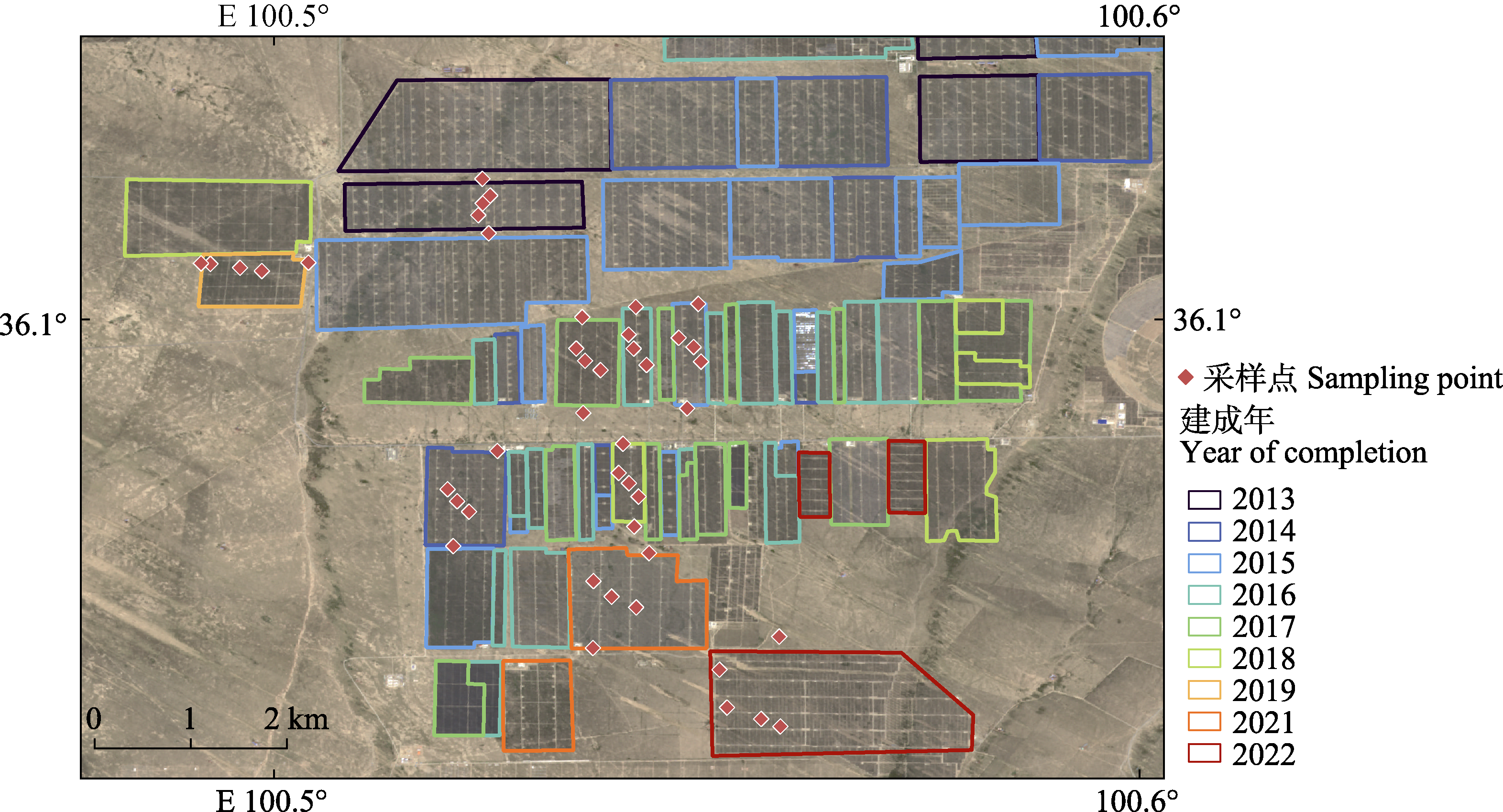
图1 青海塔拉滩不同建成年限光伏电站研究区域概况。
Fig. 1 Overview of the study area for photovoltaic power plants of different construction years in Talatan.
| 模型 Model | 参数数量 Number of parameters | AIC | BIC | 对数似然 Log-likelihood | 偏差 Deviation | χ² | 自由度 df | p |
|---|---|---|---|---|---|---|---|---|
| model_null | 4 | 1 231.62 | 1 243.85 | -611.81 | 1 223.62 | NA | NA | NA |
| model_board | 5 | 1 233.59 | 1 248.87 | -611.79 | 1 223.59 | 0.03 | 1 | 0.860 |
| model_depth | 6 | 1 209.19 | 1 227.53 | -598.59 | 1 197.19 | 26.40 | 1 | <0.001 |
| model_all | 7 | 1 211.16 | 1 232.56 | -598.58 | 1 197.16 | 0.03 | 1 | 0.871 |
表1 不同混合线性模型的似然比检验结果
Table 1 Likelihood ratio test results for different mixed linear models
| 模型 Model | 参数数量 Number of parameters | AIC | BIC | 对数似然 Log-likelihood | 偏差 Deviation | χ² | 自由度 df | p |
|---|---|---|---|---|---|---|---|---|
| model_null | 4 | 1 231.62 | 1 243.85 | -611.81 | 1 223.62 | NA | NA | NA |
| model_board | 5 | 1 233.59 | 1 248.87 | -611.79 | 1 223.59 | 0.03 | 1 | 0.860 |
| model_depth | 6 | 1 209.19 | 1 227.53 | -598.59 | 1 197.19 | 26.40 | 1 | <0.001 |
| model_all | 7 | 1 211.16 | 1 232.56 | -598.58 | 1 197.16 | 0.03 | 1 | 0.871 |
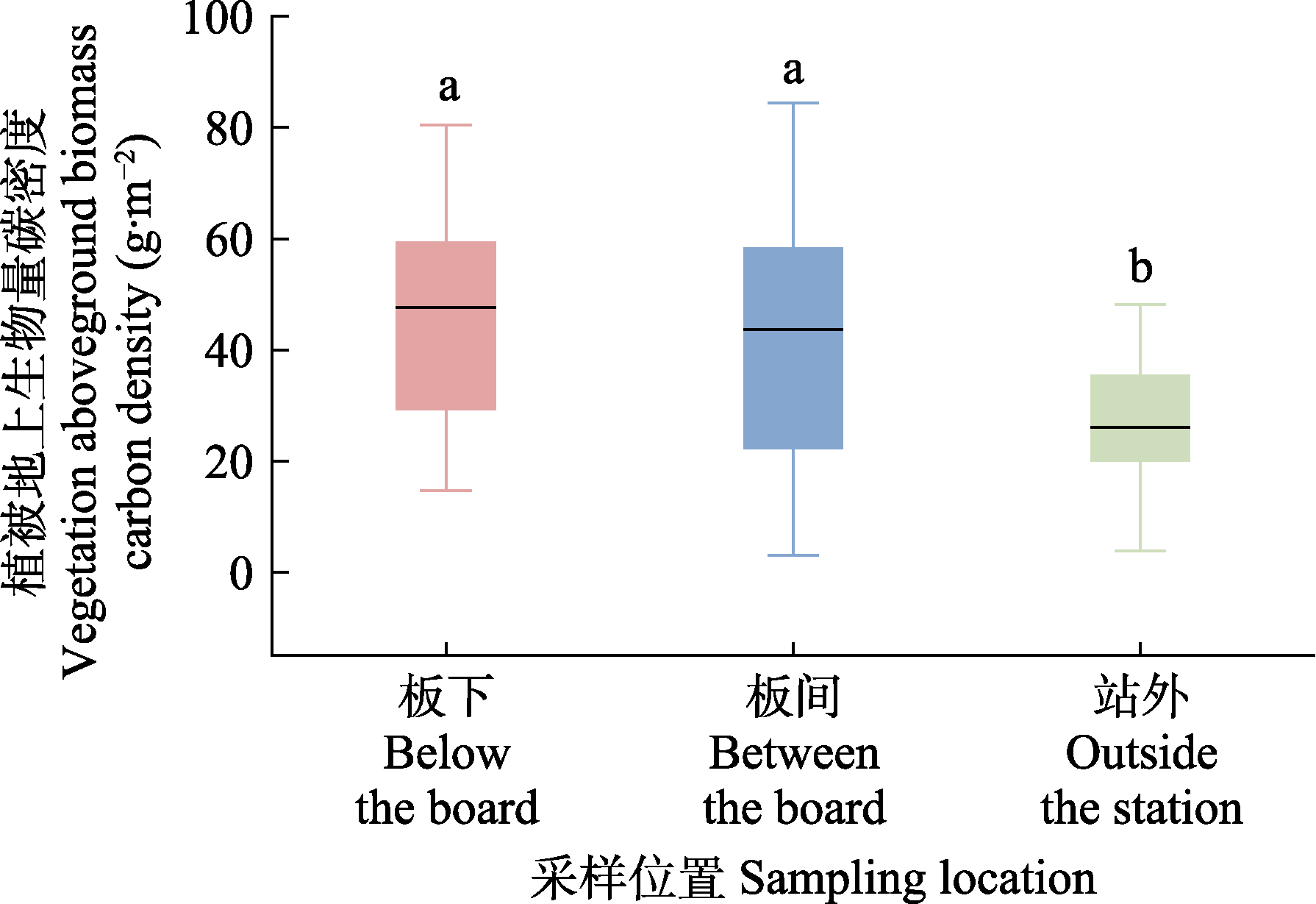
图2 光伏板下、板间和站外植被地上生物量碳密度的单因素方差分析。不同小写字母代表观测指标在不同采样位置之间差异显著(p < 0.05)。
Fig. 2 One-way ANOVA of aboveground biomass carbon density under the photovoltaic panels, between the panels, and outside the station. Different lowercase letters represent significant differences between sampling locations (p < 0.05).
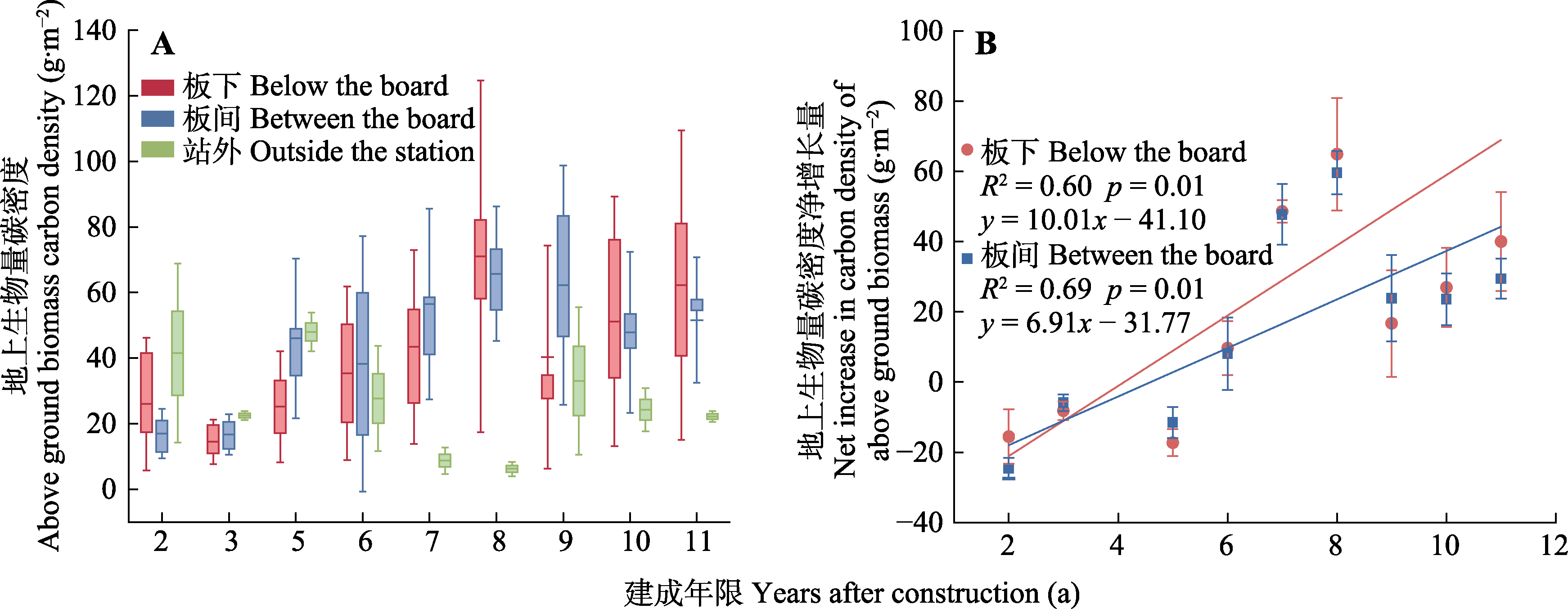
图3 不同光伏电站建成年限板下、板间和站外植被地上生物量碳密度的比较(A), 以及植被地上生物量碳密度净增长量(平均值±标准误)随光伏电站建成年限的变化(B)。
Fig. 3 Difference of aboveground biomass carbon density under the photovoltaic panels, between the panels, and outside the station (A), and changes in the net aboveground biomass carbon density (mean ± SE) under the photovoltaic panels and between the panels after photovoltaic power station construction (B).
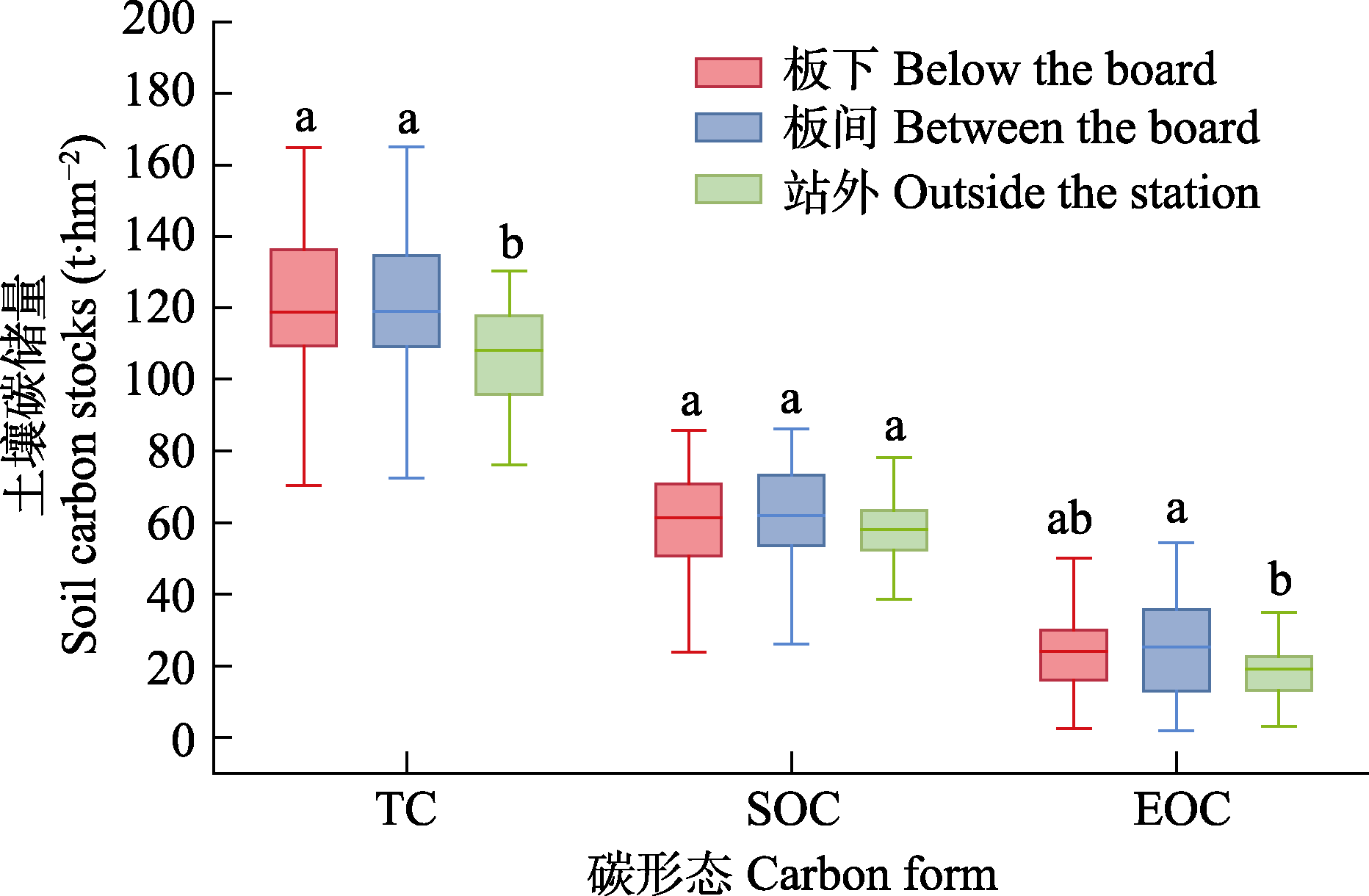
图4 光伏板下、板间和站外土壤碳储量的单因素方差分析。EOC, 易氧化有机碳; SOC, 有机碳; TC, 总碳。不同小写字母代表观测指标在不同采样位置之间差异显著(p < 0.05)。
Fig. 4 One-way ANOVA of soil carbon stocks under the photovoltaic panels, between the panels, and outside the station. EOC, readily oxidizable organic carbon; SOC, organic carbon; TC, total carbon. Different lowercase letters represent significant differences between sampling locations (p < 0.05).
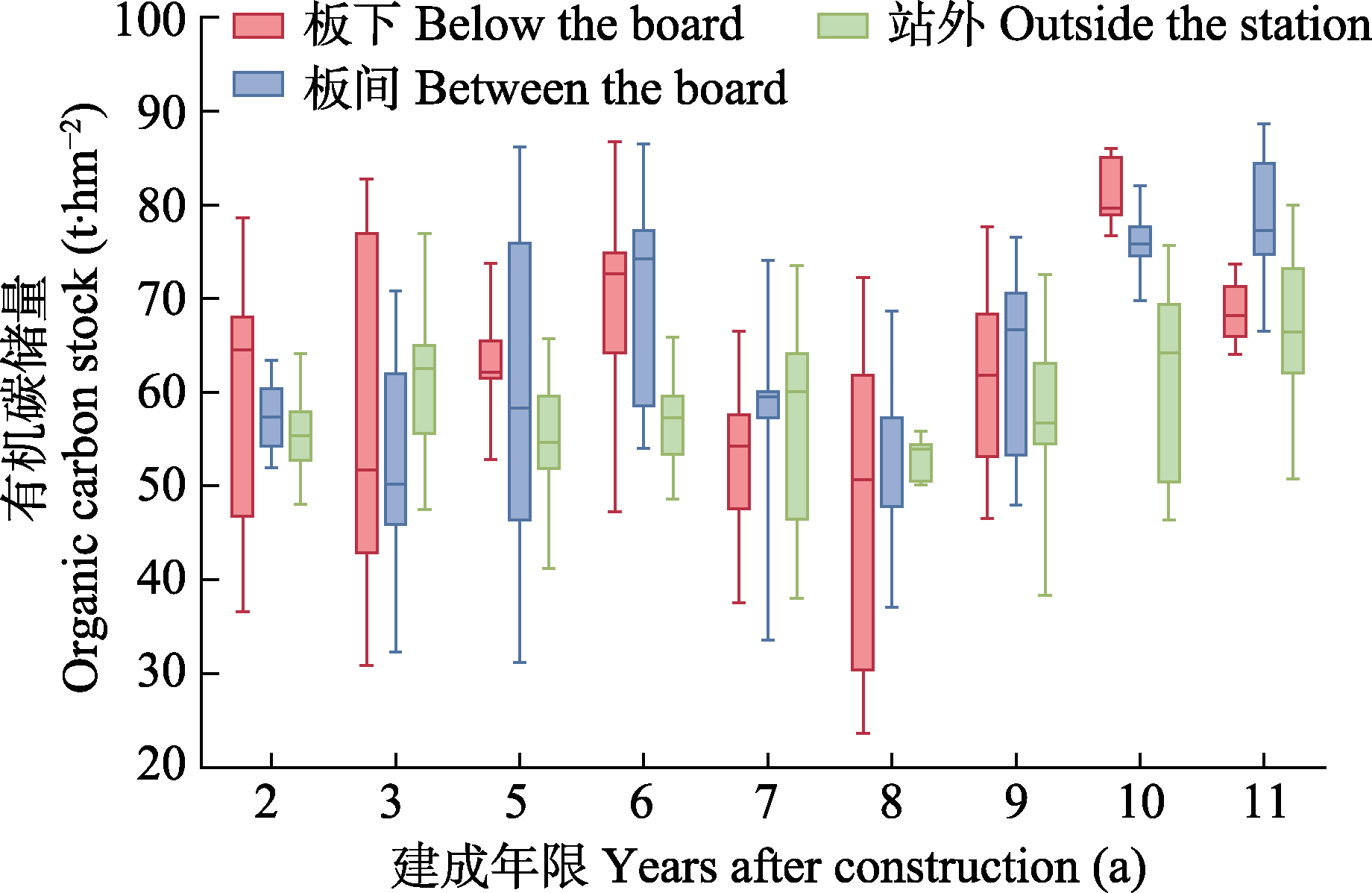
图5 不同建成年限光伏电站板下、板间和站外有机碳储量的比较。
Fig. 5 Comparison of organic carbon stocks under the photovoltaic panels, between the panels, and outside the photovoltaic power station with different years of construction.
| 固定因子 Fixed factor | 系数估计 Coefficient estimation | 标准差 Standard deviation | 自由度 df | t | p |
|---|---|---|---|---|---|
| 截距 Intercept | 0.539 | 3.198 | 49.697 | 0.169 | 0.867 |
| 光伏建成年数 Years after construction (a) | 1.081 | 0.382 | 50.799 | 2.832 | 0.007** |
| 10-20 cm深度 Depth 10-20 cm | 0.466 | 2.674 | 48.612 | 0.174 | 0.862 |
| 20-40 cm深度 Depth 20-40 cm | -12.959 | 2.683 | 49.168 | -4.830 | <0.001*** |
表2 土壤有机碳储量(SOC)的最优混合线性模型参数估计
Table 2 Estimates of optimal mixed linear model parameters for soil organic carbon stock (SOC)
| 固定因子 Fixed factor | 系数估计 Coefficient estimation | 标准差 Standard deviation | 自由度 df | t | p |
|---|---|---|---|---|---|
| 截距 Intercept | 0.539 | 3.198 | 49.697 | 0.169 | 0.867 |
| 光伏建成年数 Years after construction (a) | 1.081 | 0.382 | 50.799 | 2.832 | 0.007** |
| 10-20 cm深度 Depth 10-20 cm | 0.466 | 2.674 | 48.612 | 0.174 | 0.862 |
| 20-40 cm深度 Depth 20-40 cm | -12.959 | 2.683 | 49.168 | -4.830 | <0.001*** |
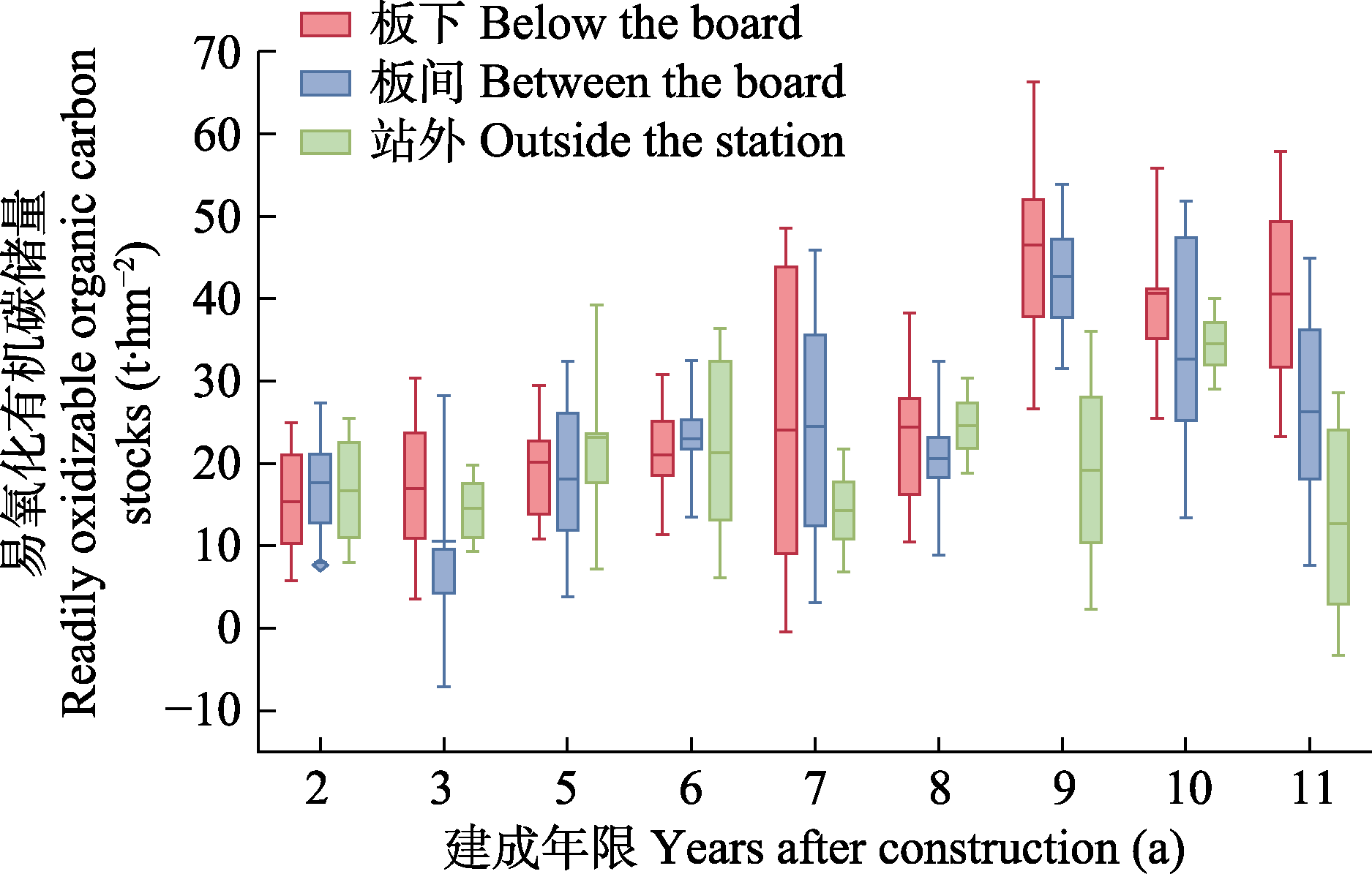
图6 不同建成年限光伏电站板下、板间和站外易氧化有机碳储量的比较。
Fig. 6 Comparison of easily oxidizable organic carbon stocks under the photovoltaic panels, between the panels, and outside the photovoltaic power station with different years of construction.
| 固定因子 Fixed factor | 系数估计 Coefficient estimation | 标准差 Standard deviation | 自由度 df | t | p |
|---|---|---|---|---|---|
| 截距 Intercept | -8.915 | 3.907 | 45.12 | -2.282 | 0.027* |
| 光伏建成年数 Years after construction (a) | 2.384 | 0.476 | 48.88 | 5.011 | <0.001*** |
| 10-20 cm深度 Depth 10-20 cm | 1.582 | 3.357 | 45.13 | 0.471 | 0.640 |
| 20-40 cm深度 Depth 20-40 cm | -4.163 | 3.323 | 45.85 | -1.253 | 0.217 |
表3 易氧化有机碳储量(EOC)的最优混合线性模型参数估计
Table 3 Estimates of optimal mixed linear model parameters for readily oxidizable organic carbon stock (EOC)
| 固定因子 Fixed factor | 系数估计 Coefficient estimation | 标准差 Standard deviation | 自由度 df | t | p |
|---|---|---|---|---|---|
| 截距 Intercept | -8.915 | 3.907 | 45.12 | -2.282 | 0.027* |
| 光伏建成年数 Years after construction (a) | 2.384 | 0.476 | 48.88 | 5.011 | <0.001*** |
| 10-20 cm深度 Depth 10-20 cm | 1.582 | 3.357 | 45.13 | 0.471 | 0.640 |
| 20-40 cm深度 Depth 20-40 cm | -4.163 | 3.323 | 45.85 | -1.253 | 0.217 |
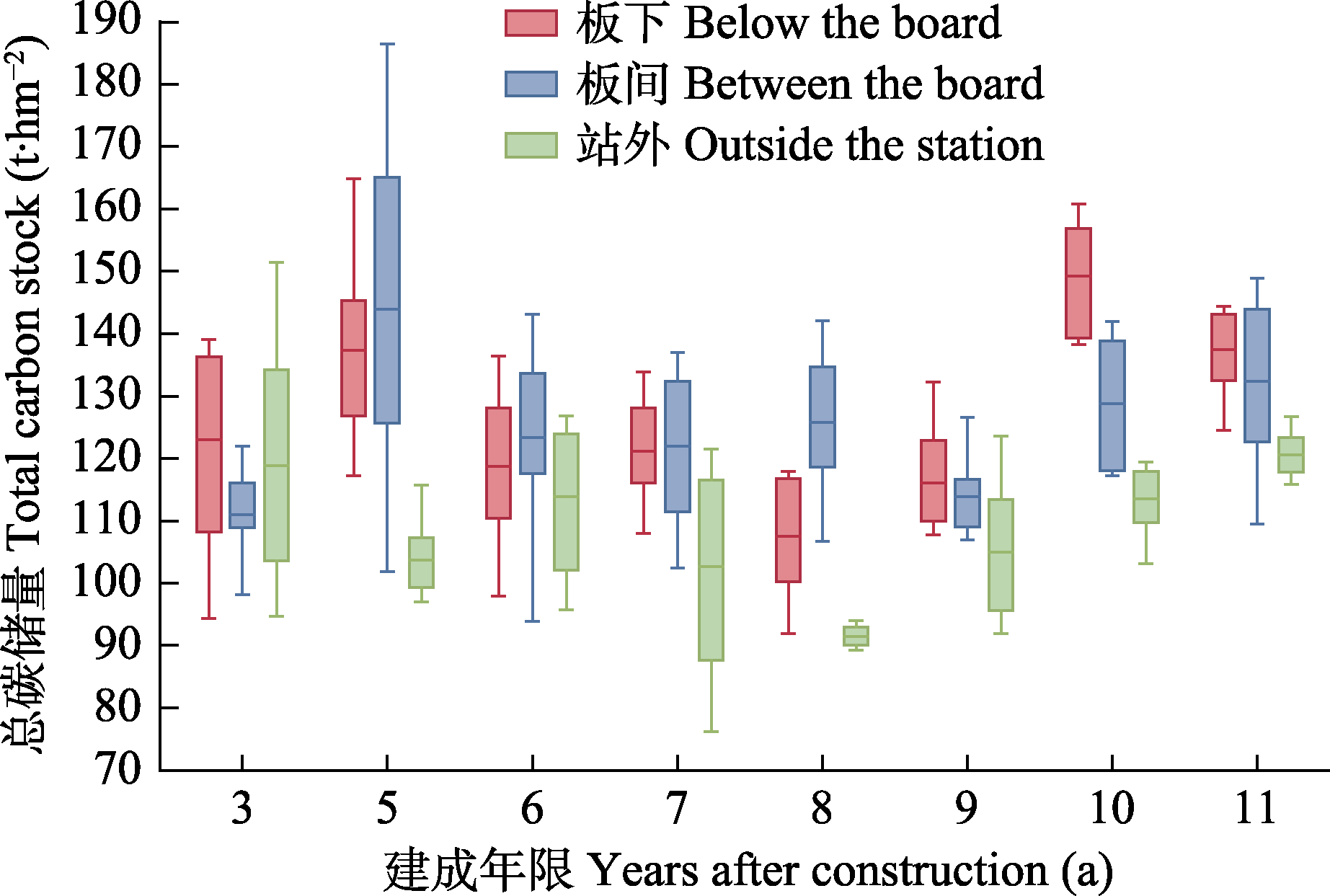
图7 不同建成年限光伏电站板下、板间和站外总碳储量的比较。
Fig. 7 Comparison of total carbon stocks under the photovoltaic panels, between the panels, and outside the photovoltaic power station with different years of construction.
| 固定因子 Fixed factor | 系数估计 Coefficient estimation | 标准差 Standard deviation | 自由度 df | t | p |
|---|---|---|---|---|---|
| 截距 Intercept | 7.904 | 7.964 | 44.781 | 0.992 | 0.326 |
| 光伏建成年数 Years after construction (a) | 0.922 | 0.938 | 45.854 | 0.984 | 0.331 |
| 10-20 cm深度 Depth 10-20 cm | 0.349 | 5.618 | 42.610 | 0.062 | 0.951 |
| 20-40 cm深度 Depth 20-40 cm | 7.747 | 5.697 | 44.849 | 1.360 | 0.181 |
表4 总碳储量(TC)的最优混合线性模型参数估计
Table 4 Estimates of optimal mixed linear model parameters for total carbon stock (TC)
| 固定因子 Fixed factor | 系数估计 Coefficient estimation | 标准差 Standard deviation | 自由度 df | t | p |
|---|---|---|---|---|---|
| 截距 Intercept | 7.904 | 7.964 | 44.781 | 0.992 | 0.326 |
| 光伏建成年数 Years after construction (a) | 0.922 | 0.938 | 45.854 | 0.984 | 0.331 |
| 10-20 cm深度 Depth 10-20 cm | 0.349 | 5.618 | 42.610 | 0.062 | 0.951 |
| 20-40 cm深度 Depth 20-40 cm | 7.747 | 5.697 | 44.849 | 1.360 | 0.181 |
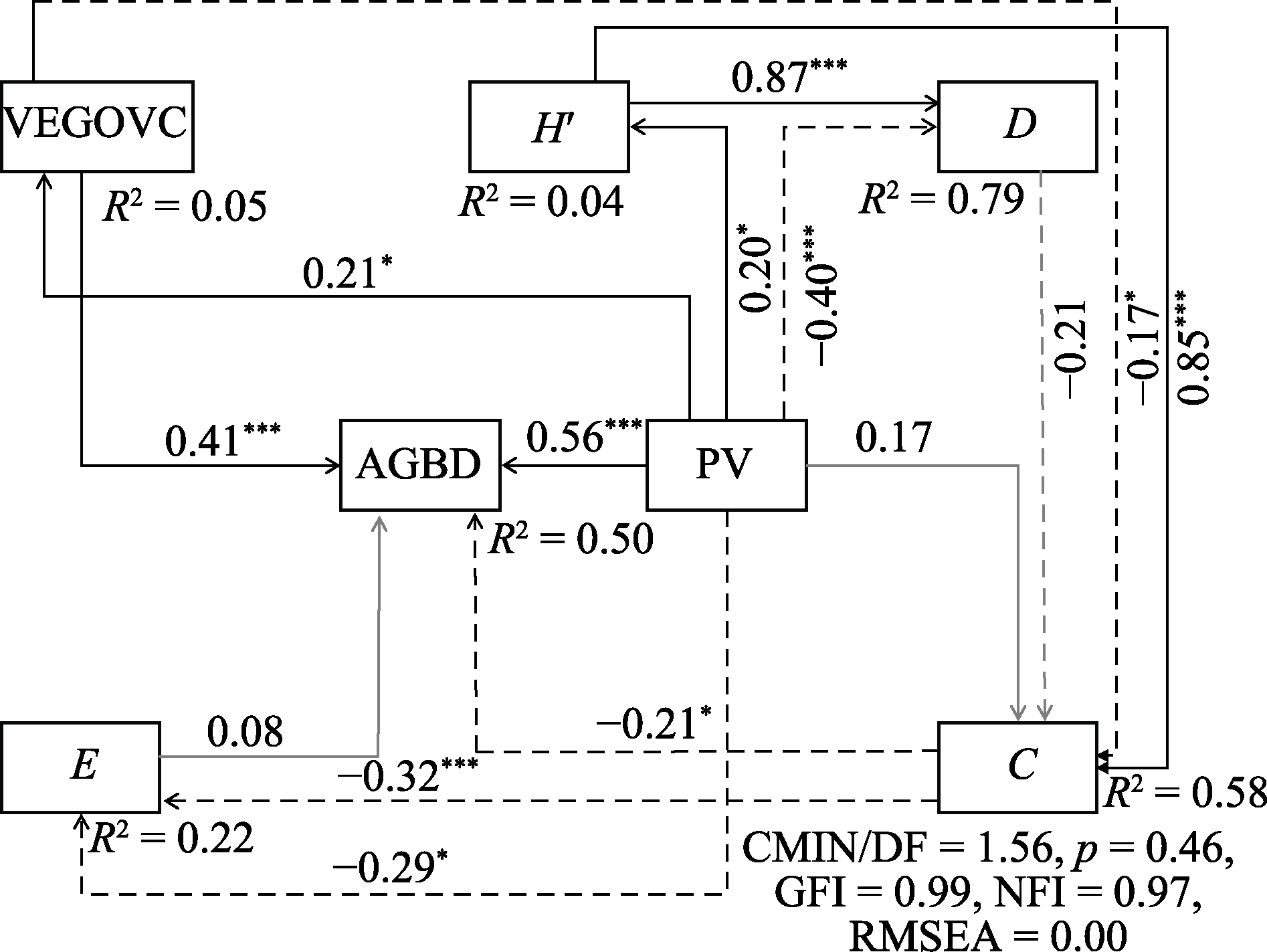
图8 植被地上生物量碳密度驱动因子的结构方程模型。黑色实线代表显著的正向影响; 黑色虚线代表显著的负向影响; 灰色实线代表不显著的正向影响; 灰色虚线代表不显著的负向影响; *, p < 0.05; **, p < 0.01; ***, p < 0.001。AGBD, 地上生物量碳密度; C, Margalef丰富度指数; D, Simpson优势度指数; E, Pielou均匀度指数; H′, Shannon-Wiener多样性指数; PV, 光伏电站建成时间; VEGOVC, 植被盖度。
Fig. 8 Structural equation model of drivers of aboveground biomass carbon density. Solid black lines represent significant positive impacts; dashed black lines represent significant negative impacts; solid gray lines represent non-significant positive impacts; and dashed gray lines represent non-significant negative impacts. *, p < 0.05; **, p < 0.01; ***, p < 0.001. AGBD, above ground biomass carbon density; C, Margalef richness index; D, Simpson dominance index; E, Pielou evenness index; H′, Shannon-Wiener diversity index; PV, photovoltaic power plant construction time; VEGOVC, vegetation coverage.
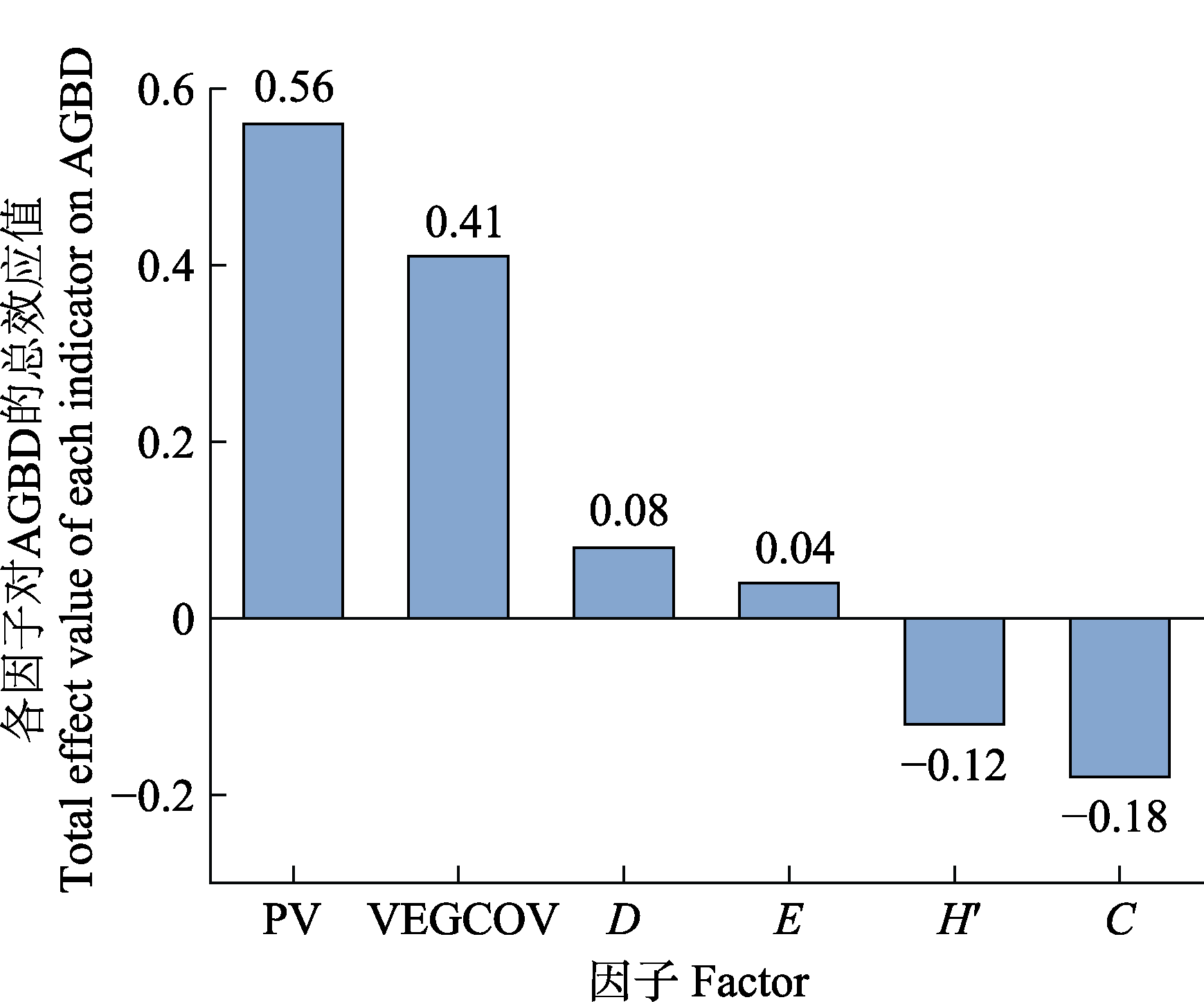
图9 结构模型方程中各因子对植被地上生物量碳密度的总效应值。AGBD, 地上生物量碳密度; C, Margalef丰富度指数; D, Simpson优势度指数; E, Pielou均匀度指数; H′, Shannon-Wiener多样性指数; PV, 光伏电站建成时间; VEGOVC, 植被盖度。
Fig. 9 Total effect values of the factors on the aboveground biomass carbon density in the structural equation model. AGBD, above ground biomass carbon density; C, Margalef richness index; D, Simpson dominance index; E, Pielou evenness index; H′, Shannon-Wiener diversity index; PV, photovoltaic power plant construction time; VEGOVC, vegetation coverage.
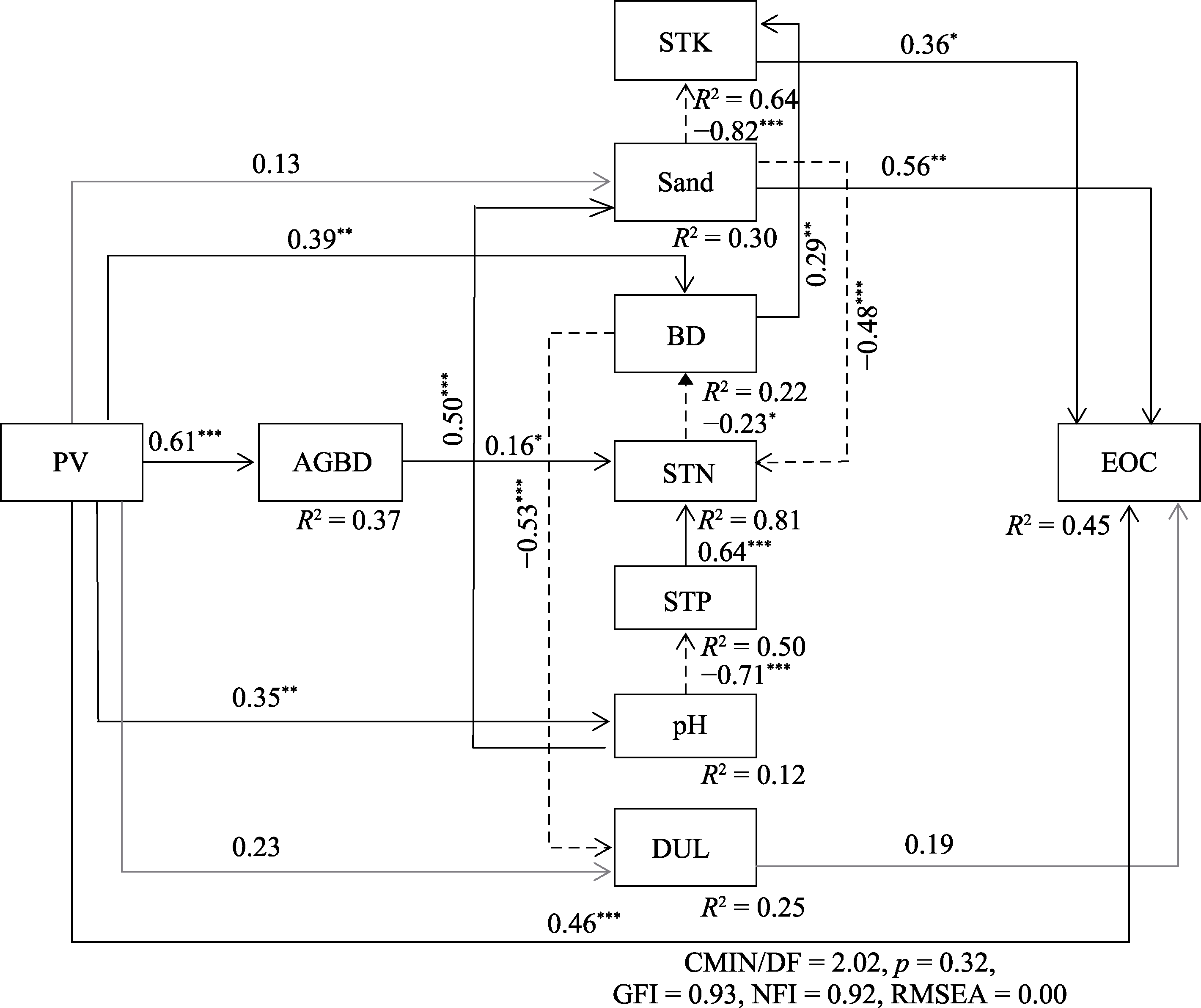
图10 土壤易氧化有机碳储量(EOC)驱动因子的结构方程模型。AGBD, 地上生物量碳密度; BD, 土壤容重; DUL, 田间持水量; PV, 电站建成时间; Sand, 土壤含砂量; STK, 土壤全钾含量; STN, 土壤全氮含量; STP, 土壤全磷含量。黑色实线代表显著的正向影响; 黑色虚线代表显著的负向影响; 灰色实线代表不显著的正向影响; *, p < 0.05; **, p < 0.01; ***, p < 0.001。
Fig. 10 Structural equation model of drivers of easily oxidizable organic carbon stock (EOC) in soils. AGBD, above ground biomass carbon density; BD, soil bulk density; DUL, field capacity; PV, power plant construction year; Sand, soil sand content; STK, soil total potassium content; STN, soil total nitrogen content; STP, soil total phosphorus content. Solid black lines represent significant positive impacts; dashed black lines represent significant negative impacts; solid gray lines represent non-significant positive impacts. *, p < 0.05; **, p < 0.01; ***, p < 0.001.
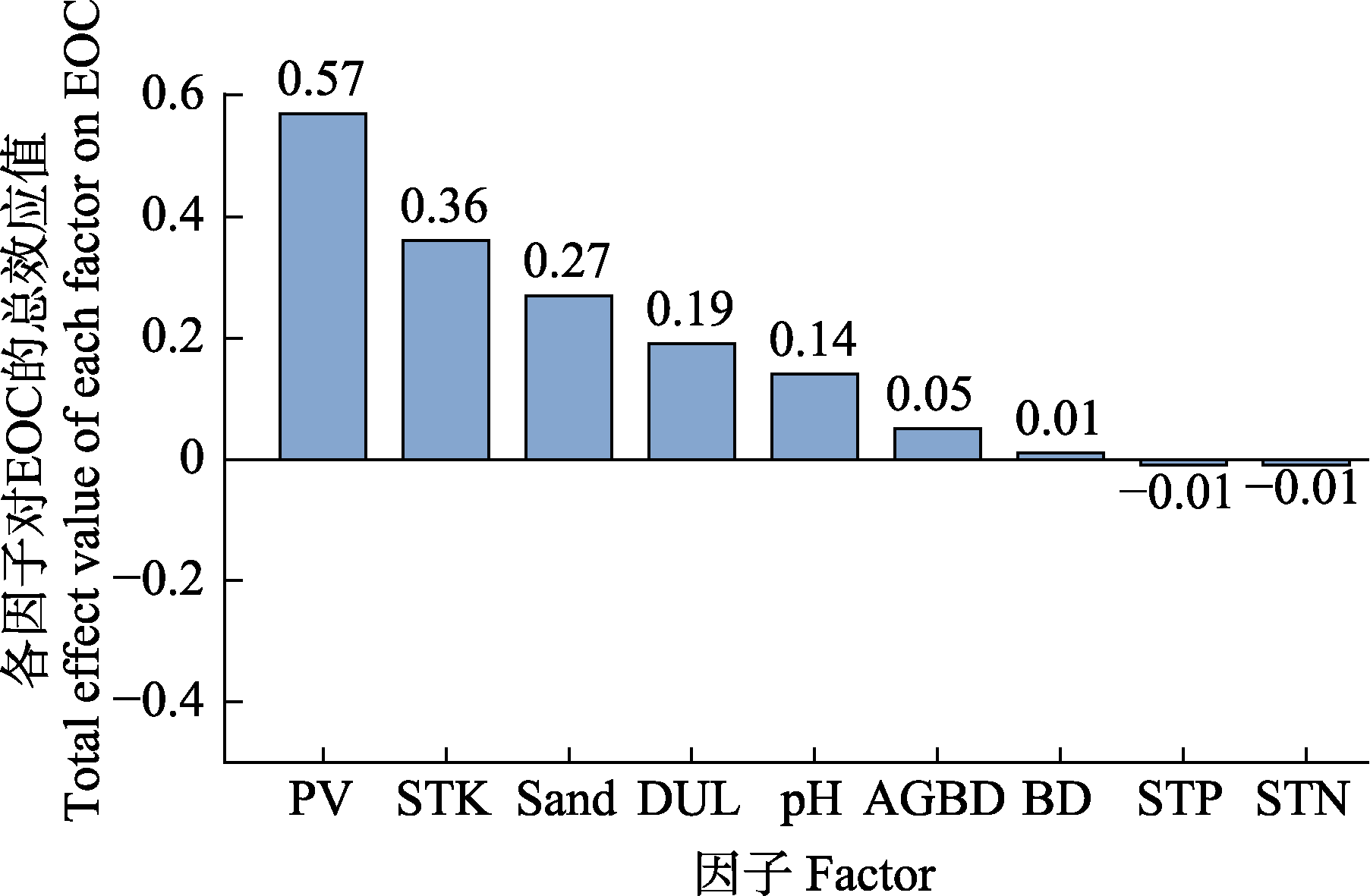
图11 结构模型方程中各因子对土壤易氧化有机碳储量(EOC)造成的总效应值。AGBD, 地上生物量碳密度; BD, 土壤容重; DUL, 田间持水量; PV, 电站建成时间; Sand, 土壤含砂量; STK, 土壤全钾含量; STN, 土壤全氮含量; STP, 土壤全磷含量。
Fig. 11 Total effect values of the factors on readily oxidizable organic carbon stock (EOC) in soils in the structural equation model. AGBD, above ground biomass carbon density; BD, soil bulk density; DUL, field capacity; PV, power plant construction year; Sand, soil sand content; STK, soil total potassium content; STN, soil total nitrogen content; STP, soil total phosphorus content.
| [1] | Aman MM, Solangi KH, Hossain MS, Badarudin A, Jasmon GB, Mokhlis H, Bakar AHA, Kazi SN (2015). A review of Safety, Health and Environmental (SHE) issues of solar energy system. Renewable and Sustainable Energy Reviews, 41, 1190-1204. |
| [2] | Bao XX, Yi J, Lian Y, Liu SR, Ji MS, Wu RQMG, (2009). Study on plant community diversity under different grazing regimes in typical grasslands. Journal of North China Agriculture, 24(5), 229-233. |
|
[包秀霞, 易津, 廉勇, 刘书润, 吉木色, 乌仁其木格 (2009). 典型草原不同放牧方式植物群落多样性研究. 华北农学报, 24(5), 229-233.]
DOI |
|
| [3] | Chen H, Wu W, Li C, Lu G, Ye DL, Ma C, Ren L, Li GD (2025). Ecological and environmental effects of global photovoltaic power plants: a meta-analysis. Journal of Environmental Management, 373, 123785. DOI: 10.1016/j.jenvman.2024.123785. |
| [4] | Chen SS, Wang M, Zhang C, Xin XP, Zhu XY, Guo LF, Yan RR (2023). Effects of different grazing intensities on soil active organic carbon in Leymus Chinensis meadow steppe in Hulunbuir. Soil and Fertilizer Sciences in China, (11), 16-24. |
| [陈思思, 王淼, 张楚, 辛晓平, 朱晓昱, 郭雷风, 闫瑞瑞 (2023). 不同放牧强度对呼伦贝尔羊草草甸草原土壤活性有机碳的影响. 中国土壤与肥料, (11), 16-24.] | |
| [5] |
de Marco A, Petrosillo I, Semeraro T, Pasimeni MR, Aretano R, Zurlini G (2014). The contribution of Utility-Scale Solar Energy to the global climate regulation and its effects on local ecosystem services. Global Ecology and Conservation, 2, 324-337.
DOI URL |
| [6] | Fang JY, Liu GH, Xu SL (1996). Carbon Storage in Chinese Terrestrial Ecosystems. China Environmental Science Press, Beijing. 391-397. |
| [方精云, 刘国华, 徐嵩龄 (1996). 中国陆地生态系统中碳的储存量. 中国环境科学出版社, 北京. 391-397.] | |
| [7] | Gao XQ, Yang LW, Lyu F, Ma LY, Li HL, Hui XY, Hou XH (2016). Observational study on the impact of the large solar farm on air temperature and humidity in desert areas of Golmud. Acta Energiae Solaris Sinica, 37, 2909-2915. |
| [高晓清, 杨丽薇, 吕芳, 马丽云, 李海玲, 惠小英, 侯旭宏 (2016). 光伏电站对格尔木荒漠地区空气温湿度影响的观测研究. 太阳能学报, 37, 2909-2915.] | |
| [8] | Guo LY, Xiong LS, Wang WM (2008). Influence of climatic change on talatan lawn desertification in recent 50 years. Research of Soil and Water Conservation, 15(6), 57-63. |
| [郭连云, 熊联胜, 王万满 (2008). 近50年气候变化对塔拉滩草地荒漠化的影响. 水土保持研究, 15(6), 57-63.] | |
| [9] | Huang ZX, Ke ZJ, Ma YL, Xia CQ, Tang X, He QX, Zhang QQ, Sun FD (2024). Effects of different degrees of disturbance by plateau pika on plant diversity, soil bulk density, and water content. Journal of Sichuan Agricultural University, 42, 1348-1356. |
| [黄趾萱, 柯尊舰, 马彦龙, 夏程乾, 唐鑫, 何秋霞, 张荞荞, 孙飞达 (2024). 高原鼠兔不同干扰程度对植物多样性及土壤容重、含水量的影响. 四川农业大学学报, 42, 1348-1356.] | |
| [10] | Kline RB (2015). Principles and Practice of Structural Equation Modeling. Guilford Publications, New York. |
| [11] | Krasner NZ, Fox J, Armstrong A, Ave K, Carvalho F, Li YD, Walston LJ, Ricketts MP, Jordaan SM, Abou Najm M, Hartmann HM, Lybrand R, Hernandez RR (2025). Impacts of photovoltaic solar energy on soil carbon: a global systematic review and framework. Renewable and Sustainable Energy Reviews, 208, 115032. DOI: 10.1016/j.rser.2024.115032. |
| [12] |
Lal R (2018). Digging deeper: a holistic perspective of factors affecting soil organic carbon sequestration in agroecosystems. Global Change Biology, 24, 3285-3301.
DOI PMID |
| [13] | Li QS (2021). Discussion on the path of China’s energy transformation under the goal of carbon neutrality. China Coal, 47(8), 1-7. |
| [李全生 (2021). 碳中和目标下我国能源转型路径探讨. 中国煤炭, 47(8), 1-7.] | |
| [14] | Li SH, Gao Q, Wang XQ, Lan L, Yang ZW (2016). Characteristics of vegetation and soil property changes by photovoltaic plant interference in alpine desert steppe. Journal of Soil and Water Conservation, 30(6), 325-329. |
| [李少华, 高琪, 王学全, 兰岚, 杨占武 (2016). 光伏电厂干扰下高寒荒漠草原区植被和土壤变化特征. 水土保持学报, 30(6), 325-329.] | |
| [15] | Liu LY (2022). A sea of photovoltaics rises in Qinghai’s Gobi Desert. People’s Daily Overseas Edition, 07-05(005). |
| [刘乐艺 (2022). 青海戈壁荒滩兴起“光伏海”. 人民日报海外版, 07-05(005).] | |
| [16] | Liu Q, Ma HY, Cui YY, Ye DL, Zhang XP, La B (2024). Vegetation community restoration post-photovoltaic installation: a case study of the Qinghai Gonghe solar energy park. Chinese Wild Plant Resources, 43(12), 124-130. |
| [刘强, 马鸿元, 崔颖颖, 叶得力, 张旭萍, 拉本 (2024). 光伏建设后植被群落恢复过程分析——以青海共和光伏园区为例. 中国野生植物资源, 43(12), 124-130.] | |
| [17] | Liu X, Zhang P, Liu JQ (2022). Inorganic fertilizers are limiting factors of vegetation restoration of Qinghai Tala Shoal Photovoltaic Power Station. Biodiversity Science, 30(5), 29-36. |
| [刘向, 张鹏, 刘建全 (2022). 无机肥料是青海塔拉滩光伏电站植被恢复过程中的限制性因子. 生物多样性, 30(5), 29-36.] | |
| [18] |
Moriarty P, Honnery D (2012). What is the global potential for renewable energy? Renewable and Sustainable Energy Reviews, 16(1), 244-252.
DOI URL |
| [19] | Peng YF, Chang JF, Zhao X, Shi Y, Bai YX, Li QL, Yao ST, Ma WH, Fang JY, Yang YH (2023). Grassland carbon sink in China and its promotion strategies. Bulletin of National Natural Science Foundation of China, 37, 587-602. |
| [彭云峰, 常锦峰, 赵霞, 石岳, 白宇轩, 李秦鲁, 姚世庭, 马文红, 方精云, 杨元合 (2023). 中国草地生态系统固碳能力及其提升途径. 中国科学基金, 37, 587-602.] | |
| [20] | Pütz S, Groeneveld J, Henle K, Knogge C, Martensen AC, Metz M, Metzger JP, Ribeiro MC, de Paula MD, Huth A (2014). Long-term carbon loss in fragmented Neotropical forests. Nature Communications, 5, 5037. DOI: 10.1038/ncomms6037. |
| [21] | Qin YF (2021). Research on the Impact of Large-scale Desert Photovoltaic Development on Local Microclimate, Soil and Vegetation. Master degree dissertation, Xi’an University of Science and Technology, Xi’an. |
| [秦一凡 (2021). 大型荒漠光伏开发对局地微气候-土壤-植被的影响研究. 硕士学位论文, 西安理工大学, 西安.] | |
| [22] | Qiu LP, Zhang XC, Cheng JM (2011). Soil organic matter fractions and soil carbon management index in grasslands with different fencing ages. Plant Nutrition and Fertilizer Science, 17, 1166-1171. |
| [邱莉萍, 张兴昌, 程积民 (2011). 不同封育年限草地土壤有机质组分及其碳库管理指数. 植物营养与肥料学报, 17, 1166-1171.] | |
| [23] |
Ren NP, Li YK, Zhu BQ, Wang YF, Liang WC, Liu XP (2024). Effects of photovoltaic panels on plant community characteristics and species diversity in meadow steppe. Chinese Journal of Ecology, 43, 766-772.
DOI |
| [任乃芃, 李一坤, 朱柏全, 王一帆, 梁文超, 刘香萍 (2024). 光伏电板对草甸草原植物群落特征及物种多样性的影响. 生态学杂志, 43, 766-772.] | |
| [24] | Stegen JC, Lin X, Konopka AE, Fredrickson JK (2012). Stochastic and deterministic assembly processes in subsurface microbial communities. The ISME Journal, 6, 1653-1664. |
| [25] | Tang X, Zhao X, Bai Y, Tang Z, Wang W, Zhao Y, Wan H, Xie Z, Shi X, Wu B, Wang G, Yan J, Ma K, Du S, Li S, et al. (2018). Carbon pools in China’s terrestrial ecosystems: new estimates based on an intensive field survey. Proceedings of the National Academy of Sciences of the United States of America, 115, 4021-4026. |
| [26] | Tian N, Wang YX, Weng BQ (2010). Advances in soil carbon stock estimation. Subtropical Agricultural Research, 6, 193-198. |
| [田娜, 王义祥, 翁伯琦 (2010). 土壤碳储量估算研究进展. 亚热带农业研究, 6, 193-198.] | |
| [27] | Walston LJ, Li Y, Hartmann HM, Macknick J, Hanson A, Nootenboom C, Lonsdorf E, Hellmann J (2021). Modeling the ecosystem services of native vegetation management practices at solar energy facilities in the Midwestern United States. Ecosystem Services, 47, 101227. DOI: 10.1016/j.ecoser.2020.101227. |
| [28] | Wang J, Xie HT, Zhu P, Li XY (2003). Cannotation and modern analysis method for active soil organic matter (carbon). Chinese Journal of Ecology, 22(6), 109-112. |
| [王晶, 解宏图, 朱平, 李晓云 (2003). 土壤活性有机质(碳)的内涵和现代分析方法概述. 生态学杂志, 22(6), 109-112.] | |
| [29] | Wang T, Wang DX, Guo TD, Zhang GG, Zhao SX, Niu HC, Lu SY, Lin H (2016). The impact of photovoltaic power construction on soil and vegetation. Research of Soil and Water Conservation, 23(3), 90-94. |
| [王涛, 王得祥, 郭廷栋, 张岗岗, 赵世雄, 牛怀诚, 卢舜瑜, 林虎 (2016). 光伏电站建设对土壤和植被的影响. 水土保持研究, 23(3), 90-94.] | |
| [30] |
Wilberforce T, Baroutaji A, El Hassan Z, Thompson J, Soudan B, Olabi AG (2019). Prospects and challenges of concentrated solar photovoltaics and enhanced geothermal energy technologies. Science of the Total Environment, 659, 851-861.
DOI |
| [31] | Yan L (2024). Study on the Impact of Photovoltaic Deployment in Taratan on Carbon Storage in Desert Grasslands. Master degree dissertation, Qinghai Normal University, Xining. |
| [严莉 (2024). 塔拉滩光伏布设对荒漠草地碳储量影响研究. 硕士学位论文, 青海师范大学, 西宁.] | |
| [32] |
Yan X, Liu RT, An H (2018). Characterization of readily oxidizable carbon and dissolved organic carbon within the soil carbon pool during desertification of grassland in Central China. Acta Prataculturae Sinica, 27(11), 15-25.
DOI |
|
[阎欣, 刘任涛, 安慧 (2018). 土壤易氧化有机碳与溶解性有机碳对荒漠草地沙漠化过程中土壤碳库变异的表征. 草业学报, 27(11), 15-25.]
DOI |
|
| [33] | Yin DY, Ma L, Qu JJ, Zhao SP, Yu Y, Tan LH, Xiao JH (2017). Effect of large photovoltaic power station on microclimate of desert region in Gonghe Basin. Bulletin of Soil and Water Conservation, 37(3), 15-21. |
| [殷代英, 马鹿, 屈建军, 赵素平, 余晔, 谭立海, 肖建华 (2017). 大型光伏电站对共和盆地荒漠区微气候的影响. 水土保持通报, 37(3), 15-21.] | |
| [34] | Yu J, Fang L, Bian ZF, Wang Q, Yu YC (2014). A review of the composition of soil carbon pool. Acta Ecologica Sinica, 34, 4829-4838. |
| [余健, 房莉, 卞正富, 汪青, 俞元春 (2014). 土壤碳库构成研究进展. 生态学报, 34, 4829-4838.] | |
| [35] | Yue SJ (2021). Research on Eco-environmental Effects of Large-scale Photovoltaic Development in Qinghai Desert Area. PhD dissertation, Xi’an University of Science and Technology, Xi’an. |
| [岳生娟 (2021). 青海荒漠区大规模光伏开发生态环境效应研究. 博士学位论文, 西安理工大学, 西安.] | |
| [36] | Zhai B (2019). Characteristics of Leymus chinensis Community in Photovoltaic Power Station and Its Influence Mechanism. Master degree dissertation, Inner Mongolia Agricultural University, Hohhot. |
| [翟波 (2019). 光伏电站内羊草群落特征及其影响机制. 硕士学位论文, 内蒙古农业大学, 呼和浩特.] | |
| [37] | Zhang CC, Zhang WF, Dong ZJ, Zhan XL (2024). Impact of photovoltaic arrays on microclimate in desert areas under the background of carbon neutral. Journal of Gansu Agricultural University, 59(5), 228-236. |
| [张呈春, 张维福, 董智今, 展秀丽 (2024). 碳中和背景下光伏阵列对沙漠地区微气候的影响. 甘肃农业大学学报, 59(5), 228-236.] | |
| [38] |
Zhang J, Wang SL, Wang QK, Liu YX (2009). Content and seasonal change in soil labile organic carbon under different forest covers. Chinese Journal of Eco-Agriculture, 17(1), 41-47.
DOI URL |
| [张剑, 汪思龙, 王清奎, 刘燕新 (2009). 不同森林植被下土壤活性有机碳含量及其季节变化. 中国生态农业学报, 17(1), 41-47.] | |
| [39] | Zhang ZP, Shang W, Wang Q, Fu GQ, Zhang WX, Wan X (2020). Biodiversity of herbaceous species under large photovoltaic (PV) power stations in desert region of Hexi Corridor. Journal of Northwest Forestry University, 35(2), 190-196. |
| [张芝萍, 尚雯, 王祺, 付贵全, 张卫星, 万翔 (2020). 河西走廊荒漠区光伏电站植物群落物种多样性研究. 西北林学院学报, 35(2), 190-196.] | |
| [40] | Zhou YR, Yu ZL, Zhao SD (2000). Carbon storage and budget of major Chinese forest types. Acta Phytoecologica Sinica, 24, 518-522. |
| [周玉荣, 于振良, 赵士洞 (2000). 我国主要森林生态系统碳贮量和碳平衡. 植物生态学报, 24, 518-522.] |
| [1] | 吴闫宁, 郝珉辉, 何怀江, 张春雨, 赵秀海. 长白山森林功能多样性与地上碳汇功能的关系及其随演替的变化[J]. 植物生态学报, 2025, 49(2): 232-243. |
| [2] | 张建华, 周晓阳, 段珊珊, 白佳妮, 徐龙超. 北京东灵山2种典型灌丛碳密度分配特征[J]. 植物生态学报, 2025, 49(10): 1721-1732. |
| [3] | 黄玫, 石岳, 孙文娟, 赵霞, 常锦峰, 方精云. 云南省生态系统碳汇及其对碳中和的贡献[J]. 植物生态学报, 2024, 48(10): 1243-1255. |
| [4] | 任培鑫, 李鹏, 彭长辉, 周晓路, 杨铭霞. 洞庭湖流域植被光合物候的时空变化及其对气候变化的响应[J]. 植物生态学报, 2023, 47(3): 319-330. |
| [5] | 韩广轩, 李隽永, 屈文笛. 氮输入对滨海盐沼湿地碳循环关键过程的影响及机制[J]. 植物生态学报, 2021, 45(4): 321-333. |
| [6] | 方精云. 碳中和的生态学透视[J]. 植物生态学报, 2021, 45(11): 1173-1176. |
| [7] | 张亮, 王志磊, 薛婷婷, 郝笑云, 杨晨露, 高飞飞, 王莹, 韩星, 李华, 王华. 葡萄园生态系统碳源/汇及碳减排策略研究进展[J]. 植物生态学报, 2020, 44(3): 179-191. |
| [8] | 杨开军, 杨万勤, 谭羽, 贺若阳, 庄丽燕, 李志杰, 谭波, 徐振锋. 川西亚高山云杉林冬季土壤呼吸对雪被去除的短期响应[J]. 植物生态学报, 2017, 41(9): 964-971. |
| [9] | 贾彦龙, 李倩茹, 许中旗, 桑卫国. 基于CO2FIX模型的华北落叶松人工林碳循环过程[J]. 植物生态学报, 2016, 40(4): 405-415. |
| [10] | 崔高阳, 陈云明, 曹扬, 安淳淳. 陕西省森林生态系统碳储量分布格局分析[J]. 植物生态学报, 2015, 39(4): 333-342. |
| [11] | 胡海清, 罗碧珍, 魏书精, 魏书威, 孙龙, 罗斯生, 马洪斌. 小兴安岭7种典型林型林分生物量碳密度与固碳能力[J]. 植物生态学报, 2015, 39(2): 140-158. |
| [12] | 李嵘, 常瑞英. 土壤有机碳对外源氮添加的响应及其机制[J]. 植物生态学报, 2015, 39(10): 1012-1020. |
| [13] | 李新宇, 唐海萍. 陆地植被的固碳功能与适用于碳贸易的生物固碳方式[J]. 植物生态学报, 2006, 30(2): 200-209. |
| 阅读次数 | ||||||
|
全文 |
|
|||||
|
摘要 |
|
|||||
Copyright © 2026 版权所有 《植物生态学报》编辑部
地址: 北京香山南辛村20号, 邮编: 100093
Tel.: 010-62836134, 62836138; Fax: 010-82599431; E-mail: apes@ibcas.ac.cn, cjpe@ibcas.ac.cn
备案号: 京ICP备16067583号-19

