
植物生态学报 ›› 2025, Vol. 49 ›› Issue (12): 1973-1990.DOI: 10.17521/cjpe.2024.0466 cstr: 32100.14.cjpe.2024.0466
• 研究论文 • 下一篇
董金龙1,2,3( ), 邓云1,3,*(
 ), 张文富1,3, 袁盛东1,3, 岩光4, 陈典5, 郭贤明4, 刘峰5,6, 林露湘1,3
收稿日期:2024-12-23
接受日期:2025-04-08
出版日期:2025-12-20
发布日期:2025-12-29
通讯作者:
*邓云(dy@xtbg.org.cn)作者简介:董金龙,ORCID:0009-0006-2731-3551
基金资助:
DONG Jin-Long1,2,3(), DENG Yun1,3,*(), ZHANG Wen-Fu1,3, YUAN Sheng-Dong1,3, YAN Guang4, CHEN Dian5, GUO Xian-Ming4, LIU Feng5,6, LIN Lu-Xiang1,3
Received:2024-12-23
Accepted:2025-04-08
Online:2025-12-20
Published:2025-12-29
Supported by:摘要:
木质藤本是热带森林生态系统的重要组成部分, 木质藤本攀附显著制约树木的生长和生物量积累。然而, 目前关于木质藤本对森林树木的攀附程度及其影响因素的研究仍较为匮乏。该研究重点探究了西双版纳热带雨林、热带低山常绿阔叶林和热带季节性湿润林3种主要热带森林类型中环境因子和树木径级梯度对藤本攀附比率的影响。以西双版纳地区的21个1 hm2森林动态样地为研究对象, 通过藤本攀附比率定量描述藤本攀附程度; 分析环境因子对藤本攀附比率的贡献大小, 并探索藤本攀附比率随树木径级的变化趋势。结果表明: 藤本攀附比率表现为热带季节性湿润林(27.8% ± 9.2%) >热带雨林(25.2% ± 10.6%) >热带低山常绿阔叶林(12.5% ± 10.7%); 以最冷月最低气温、最冷季度平均气温和最干季度平均气温等气温因子为正载荷的气候主分量1, 以全碳、全氮和水解性氮含量等养分因子为负载荷的土壤主分量2和以全钾含量为主要负载荷的土壤主分量3是与藤本攀附比率相关的主要环境因子。所有森林类型下的藤本攀附比率均呈现随树木胸径的增加而上升的趋势。部分树种在不同植被类型中有较高的藤本攀附比率, 如印度锥(Castanopsis indica)在热带雨林和热带低山常绿阔叶林中的藤本攀附比率分别为54.3%和40.6%, 西南猫尾木(Markhamia stipulata)在热带低山常绿阔叶林和热带季节性湿润林中的藤本攀附比率分别为38.2%和55.6%, 毛桐(Mallotus barbatus)和粗糠柴(Mallotus philippensis)在热带雨林和热带季节性湿润林中的藤本攀附比率分别为43.9%和75.8%。该研究揭示了西双版纳热带森林中木质藤本攀附比率在不同环境因子和树木径级间的变化规律, 为理解热带森林中藤本攀附程度与植被类型和环境间的相互关系提供了新的科学依据, 将有助于促进全球变化背景下的热带森林可持续管理与保护。
董金龙, 邓云, 张文富, 袁盛东, 岩光, 陈典, 郭贤明, 刘峰, 林露湘. 西双版纳热带森林的藤本攀附比率及其影响因素. 植物生态学报, 2025, 49(12): 1973-1990. DOI: 10.17521/cjpe.2024.0466
DONG Jin-Long, DENG Yun, ZHANG Wen-Fu, YUAN Sheng-Dong, YAN Guang, CHEN Dian, GUO Xian-Ming, LIU Feng, LIN Lu-Xiang. Liana prevalence and its influencing factors in tropical forests of Xishuangbanna, Southwestern China. Chinese Journal of Plant Ecology, 2025, 49(12): 1973-1990. DOI: 10.17521/cjpe.2024.0466
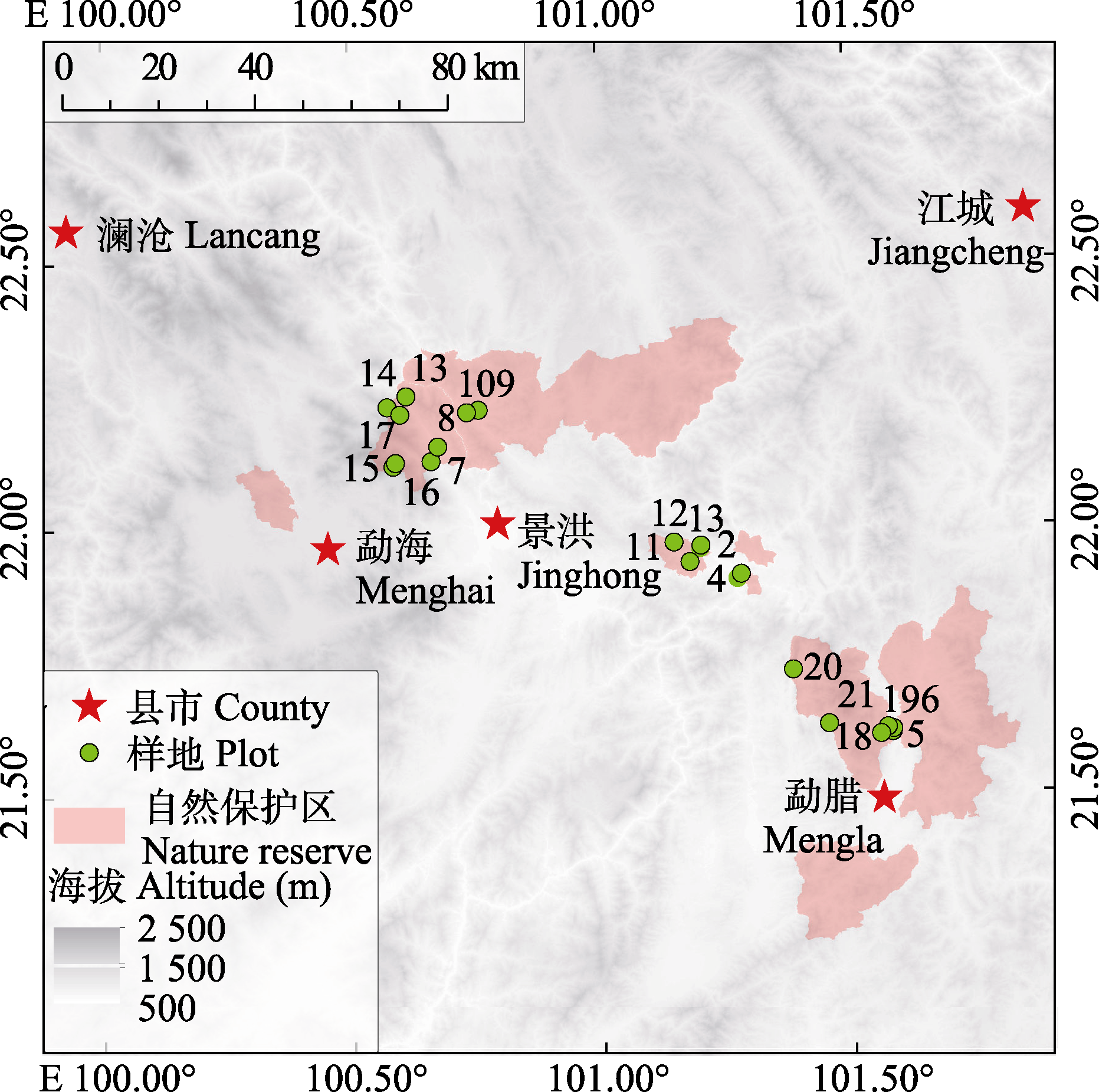
图1 西双版纳21个1 hm2样地分布图。
Fig. 1 Distribution map of the 21 1 hm2 sample plots in Xishuangbanna.
| 样地序号 Plot No. | 地名 Place | 植被类型 Vegetation type | 海拔 Altitude (m) | 胸径≥1 cm乔木数量 Number of trees (DBH ≥ 1 cm) | 树种数 Number of species | 属数 Number of genus | 科数 Number of family | 备注 Note |
|---|---|---|---|---|---|---|---|---|
| 1 | 勐仑55 km 55 km, Menglun | TRF | 742 | 5 362 | 220 | 148 | 57 | |
| 2 | 勐仑绿石林 Lüshilin, Menglun | TSMF | 613 | 7 199 | 93 | 83 | 36 | |
| 3 | 勐仑55 km垭口 Menglun 55 km Yakou | TLEBF | 751 | 5 369 | 166 | 120 | 58 | 次生林 Secondary forest |
| 4 | 勐仑新开地 Xinkaidi, Menglun | TRF | 557 | 4 130 | 122 | 93 | 44 | 次生林 Secondary forest |
| 5 | 补蚌斑马山 Banmashan, Bubeng | TRF | 640 | 2 846 | 198 | 135 | 57 | 次生林 Secondary forest |
| 6 | 补蚌塔吊 Canopy Crane, Bubeng | TRF | 653 | 5 187 | 213 | 142 | 61 | |
| 7 | 曼点瀑布 Waterfall, Mandian | TRF | 723 | 4 748 | 188 | 125 | 50 | |
| 8 | 曼点茶厂 Tea Factory, Mandian | TRF | 700 | 4 555 | 203 | 130 | 56 | |
| 9 | 勐养龙山箐 Longshanqing, Mengyang | TRF | 712 | 2 515 | 143 | 108 | 50 | |
| 10 | 勐养江边站 Jiangbianzhan, Mengyang | TRF | 620 | 3 133 | 124 | 95 | 43 | |
| 11 | 勐仑水库 Menglun Reservoir | TRF | 690 | 4 244 | 192 | 132 | 52 | |
| 12 | 勐仑44 km 44 km, Menglun | TRF | 811 | 3 126 | 189 | 138 | 60 | |
| 13 | 过门山茶地头 Chaditou, Guomenshan | TLEBF | 1 238 | 4 085 | 175 | 121 | 50 | |
| 14 | 过门山大平掌 Dapingzhang, Guomenshan | TLEBF | 1 683 | 981 | 73 | 57 | 34 | |
| 15 | 蚌岗南木噶河 Nanmugahe, Benggang | TLEBF | 1 714 | 3 531 | 117 | 78 | 43 | |
| 16 | 蚌岗瓦厂 Tile Factory, Benggang | TLEBF | 1 628 | 2 957 | 82 | 72 | 43 | 次生林 Secondary forest |
| 17 | 过门山八箭河 Bajianhe, Guomenshan | TLEBF | 1 456 | 3 511 | 99 | 74 | 38 | |
| 18 | 补蚌南沙河 Nanshahe, Bubeng | TRF | 713 | 3 677 | 203 | 132 | 58 | |
| 19 | 补蚌山顶 Bubeng Summit | TRF | 880 | 3 703 | 202 | 140 | 62 | |
| 20 | 勐远仙境 Xianjing, Mengyuan | TSMF | 783 | 3 005 | 72 | 60 | 37 | |
| 21 | 勐远曼班东 Manbandong, Mengyuan | TLEBF | 1 154 | 5 014 | 97 | 69 | 40 | 次生林 Secondary forest |
表1 西双版纳样地基本信息
Table 1 Basic information of the plots in Xishuangbanna
| 样地序号 Plot No. | 地名 Place | 植被类型 Vegetation type | 海拔 Altitude (m) | 胸径≥1 cm乔木数量 Number of trees (DBH ≥ 1 cm) | 树种数 Number of species | 属数 Number of genus | 科数 Number of family | 备注 Note |
|---|---|---|---|---|---|---|---|---|
| 1 | 勐仑55 km 55 km, Menglun | TRF | 742 | 5 362 | 220 | 148 | 57 | |
| 2 | 勐仑绿石林 Lüshilin, Menglun | TSMF | 613 | 7 199 | 93 | 83 | 36 | |
| 3 | 勐仑55 km垭口 Menglun 55 km Yakou | TLEBF | 751 | 5 369 | 166 | 120 | 58 | 次生林 Secondary forest |
| 4 | 勐仑新开地 Xinkaidi, Menglun | TRF | 557 | 4 130 | 122 | 93 | 44 | 次生林 Secondary forest |
| 5 | 补蚌斑马山 Banmashan, Bubeng | TRF | 640 | 2 846 | 198 | 135 | 57 | 次生林 Secondary forest |
| 6 | 补蚌塔吊 Canopy Crane, Bubeng | TRF | 653 | 5 187 | 213 | 142 | 61 | |
| 7 | 曼点瀑布 Waterfall, Mandian | TRF | 723 | 4 748 | 188 | 125 | 50 | |
| 8 | 曼点茶厂 Tea Factory, Mandian | TRF | 700 | 4 555 | 203 | 130 | 56 | |
| 9 | 勐养龙山箐 Longshanqing, Mengyang | TRF | 712 | 2 515 | 143 | 108 | 50 | |
| 10 | 勐养江边站 Jiangbianzhan, Mengyang | TRF | 620 | 3 133 | 124 | 95 | 43 | |
| 11 | 勐仑水库 Menglun Reservoir | TRF | 690 | 4 244 | 192 | 132 | 52 | |
| 12 | 勐仑44 km 44 km, Menglun | TRF | 811 | 3 126 | 189 | 138 | 60 | |
| 13 | 过门山茶地头 Chaditou, Guomenshan | TLEBF | 1 238 | 4 085 | 175 | 121 | 50 | |
| 14 | 过门山大平掌 Dapingzhang, Guomenshan | TLEBF | 1 683 | 981 | 73 | 57 | 34 | |
| 15 | 蚌岗南木噶河 Nanmugahe, Benggang | TLEBF | 1 714 | 3 531 | 117 | 78 | 43 | |
| 16 | 蚌岗瓦厂 Tile Factory, Benggang | TLEBF | 1 628 | 2 957 | 82 | 72 | 43 | 次生林 Secondary forest |
| 17 | 过门山八箭河 Bajianhe, Guomenshan | TLEBF | 1 456 | 3 511 | 99 | 74 | 38 | |
| 18 | 补蚌南沙河 Nanshahe, Bubeng | TRF | 713 | 3 677 | 203 | 132 | 58 | |
| 19 | 补蚌山顶 Bubeng Summit | TRF | 880 | 3 703 | 202 | 140 | 62 | |
| 20 | 勐远仙境 Xianjing, Mengyuan | TSMF | 783 | 3 005 | 72 | 60 | 37 | |
| 21 | 勐远曼班东 Manbandong, Mengyuan | TLEBF | 1 154 | 5 014 | 97 | 69 | 40 | 次生林 Secondary forest |
| 环境因子 Environmental factor | 方差 膨胀 因子 VIF | 胸径 DBH (cm) | 整体 Total | ||||||||||||
|---|---|---|---|---|---|---|---|---|---|---|---|---|---|---|---|
| 1-5 | 5-10 | 10-20 | 20-30 | 30-40 | ≥ 40 | ||||||||||
| 估计 值 Estimate | 总 权重 SW | 估计 值 Estimate | 总 权重 SW | 估计 值 Estimate | 总权 重 SW | 估计 值 Estimate | 总权 重 SW | 估计 值 Estimate | 总 权重 SW | 估计 值 Estimate | 总 权重 SW | 估计 值 Estimate | 总 权重 SW | ||
| 截距 Intercept | 2.284E-16 | 2.264E-16 | -4.820E-17 | 6.828E-17 | 4.182E-17 | 1.367E-16 | 2.428E-16 | ||||||||
| 水平曲率 Plan curvature | 2.199 | -0.007 | 0.11 | -0.027 | 0.17 | -0.025 | 0.16 | -0.060 | 0.26 | -0.029 | 0.18 | -0.004 | 0.09 | -0.030 | 0.12 |
| 地形湿度指数 Topographic wetness index | 2.219 | 0.229 | 0.62 | 0.064 | 0.28 | 0.021 | 0.15 | 0.091 | 0.36 | 0.099 | 0.42 | 0.067 | 0.34 | 0.083 | 0.14 |
| 潜在辐射强度 Potential total insolation | 4.889 | 0.017 | 0.13 | 0.064 | 0.24 | 0.090 | 0.31 | 0.090 | 0.29 | 0.012 | 0.10 | 0.002 | 0.09 | 0.057 | 0.94 |
| 土壤主分量01 Soil_PC01 | 1.928 | 0.087 | 0.32 | 0.199 | 0.62 | 0.126 | 0.47 | 0.042 | 0.22 | 0.026 | 0.17 | -0.011 | 0.12 | 0.067 | 0.88 |
| 土壤主分量02 Soil_PC02 | 4.267 | -0.043 | 0.18 | -0.045 | 0.18 | -0.216 | 0.47 | -0.733* | 0.93 | -1.016*** | 1.00 | -0.937*** | 1.00 | -0.096 | 0.07 |
| 土壤主分量03 Soil_PC03 | 3.610 | -0.011 | 0.12 | -0.055 | 0.22 | -0.166 | 0.42 | -0.565 | 0.9 | -0.586* | 0.96 | -0.633** | 0.99 | -0.054 | 0.07 |
| 土壤主分量04 Soil_PC04 | 2.130 | -0.029 | 0.17 | -0.006 | 0.10 | -0.001 | 0.08 | -0.003 | 0.07 | -0.006 | 0.08 | 0.000 | 0.08 | -0.022 | 0.04 |
| 气候主分量01 Clim_PC01 | 9.769 | 0.636* | 0.98 | 0.747** | 0.99 | 0.919* | 0.99 | 1.450*** | 1.00 | 1.652*** | 1.00 | 1.668*** | 1.00 | 0.709* | 0.98 |
| 气候主分量02 Clim_PC02 | 2.098 | 0.000 | 0.11 | 0.024 | 0.15 | 0.038 | 0.19 | 0.012 | 0.10 | 0.045 | 0.22 | 0.009 | 0.10 | 0.003 | 0.67 |
| 气候主分量03 Clim_PC03 | 2.187 | -0.050 | 0.22 | -0.018 | 0.14 | -0.004 | 0.10 | -0.008 | 0.09 | -0.002 | 0.07 | -0.007 | 0.10 | -0.016 | 0.45 |
| 纹理主分量01 Texture_PC01 | 2.425 | 0.086 | 0.31 | 0.018 | 0.14 | 0.002 | 0.09 | 0.005 | 0.07 | 0.001 | 0.07 | -0.006 | 0.09 | 0.041 | 0.18 |
| 纹理主分量02 Texture_PC02 | 3.440 | 0.006 | 0.11 | -0.002 | 0.12 | -0.011 | 0.14 | -0.044 | 0.21 | -0.031 | 0.17 | -0.008 | 0.10 | 0.010 | 0.41 |
| 纹理主分量03 Texture_PC03 | 4.037 | -0.009 | 0.12 | -0.063 | 0.23 | -0.167 | 0.46 | -0.130 | 0.38 | -0.052 | 0.23 | -0.003 | 0.08 | -0.031 | 0.07 |
表2 环境因子对西双版纳藤本攀附比率影响的一般线性模型拟合参数
Table 2 Results of the general linear model analyzing the impact of environmental factors on the liana prevalence in Xishuangbanna
| 环境因子 Environmental factor | 方差 膨胀 因子 VIF | 胸径 DBH (cm) | 整体 Total | ||||||||||||
|---|---|---|---|---|---|---|---|---|---|---|---|---|---|---|---|
| 1-5 | 5-10 | 10-20 | 20-30 | 30-40 | ≥ 40 | ||||||||||
| 估计 值 Estimate | 总 权重 SW | 估计 值 Estimate | 总 权重 SW | 估计 值 Estimate | 总权 重 SW | 估计 值 Estimate | 总权 重 SW | 估计 值 Estimate | 总 权重 SW | 估计 值 Estimate | 总 权重 SW | 估计 值 Estimate | 总 权重 SW | ||
| 截距 Intercept | 2.284E-16 | 2.264E-16 | -4.820E-17 | 6.828E-17 | 4.182E-17 | 1.367E-16 | 2.428E-16 | ||||||||
| 水平曲率 Plan curvature | 2.199 | -0.007 | 0.11 | -0.027 | 0.17 | -0.025 | 0.16 | -0.060 | 0.26 | -0.029 | 0.18 | -0.004 | 0.09 | -0.030 | 0.12 |
| 地形湿度指数 Topographic wetness index | 2.219 | 0.229 | 0.62 | 0.064 | 0.28 | 0.021 | 0.15 | 0.091 | 0.36 | 0.099 | 0.42 | 0.067 | 0.34 | 0.083 | 0.14 |
| 潜在辐射强度 Potential total insolation | 4.889 | 0.017 | 0.13 | 0.064 | 0.24 | 0.090 | 0.31 | 0.090 | 0.29 | 0.012 | 0.10 | 0.002 | 0.09 | 0.057 | 0.94 |
| 土壤主分量01 Soil_PC01 | 1.928 | 0.087 | 0.32 | 0.199 | 0.62 | 0.126 | 0.47 | 0.042 | 0.22 | 0.026 | 0.17 | -0.011 | 0.12 | 0.067 | 0.88 |
| 土壤主分量02 Soil_PC02 | 4.267 | -0.043 | 0.18 | -0.045 | 0.18 | -0.216 | 0.47 | -0.733* | 0.93 | -1.016*** | 1.00 | -0.937*** | 1.00 | -0.096 | 0.07 |
| 土壤主分量03 Soil_PC03 | 3.610 | -0.011 | 0.12 | -0.055 | 0.22 | -0.166 | 0.42 | -0.565 | 0.9 | -0.586* | 0.96 | -0.633** | 0.99 | -0.054 | 0.07 |
| 土壤主分量04 Soil_PC04 | 2.130 | -0.029 | 0.17 | -0.006 | 0.10 | -0.001 | 0.08 | -0.003 | 0.07 | -0.006 | 0.08 | 0.000 | 0.08 | -0.022 | 0.04 |
| 气候主分量01 Clim_PC01 | 9.769 | 0.636* | 0.98 | 0.747** | 0.99 | 0.919* | 0.99 | 1.450*** | 1.00 | 1.652*** | 1.00 | 1.668*** | 1.00 | 0.709* | 0.98 |
| 气候主分量02 Clim_PC02 | 2.098 | 0.000 | 0.11 | 0.024 | 0.15 | 0.038 | 0.19 | 0.012 | 0.10 | 0.045 | 0.22 | 0.009 | 0.10 | 0.003 | 0.67 |
| 气候主分量03 Clim_PC03 | 2.187 | -0.050 | 0.22 | -0.018 | 0.14 | -0.004 | 0.10 | -0.008 | 0.09 | -0.002 | 0.07 | -0.007 | 0.10 | -0.016 | 0.45 |
| 纹理主分量01 Texture_PC01 | 2.425 | 0.086 | 0.31 | 0.018 | 0.14 | 0.002 | 0.09 | 0.005 | 0.07 | 0.001 | 0.07 | -0.006 | 0.09 | 0.041 | 0.18 |
| 纹理主分量02 Texture_PC02 | 3.440 | 0.006 | 0.11 | -0.002 | 0.12 | -0.011 | 0.14 | -0.044 | 0.21 | -0.031 | 0.17 | -0.008 | 0.10 | 0.010 | 0.41 |
| 纹理主分量03 Texture_PC03 | 4.037 | -0.009 | 0.12 | -0.063 | 0.23 | -0.167 | 0.46 | -0.130 | 0.38 | -0.052 | 0.23 | -0.003 | 0.08 | -0.031 | 0.07 |
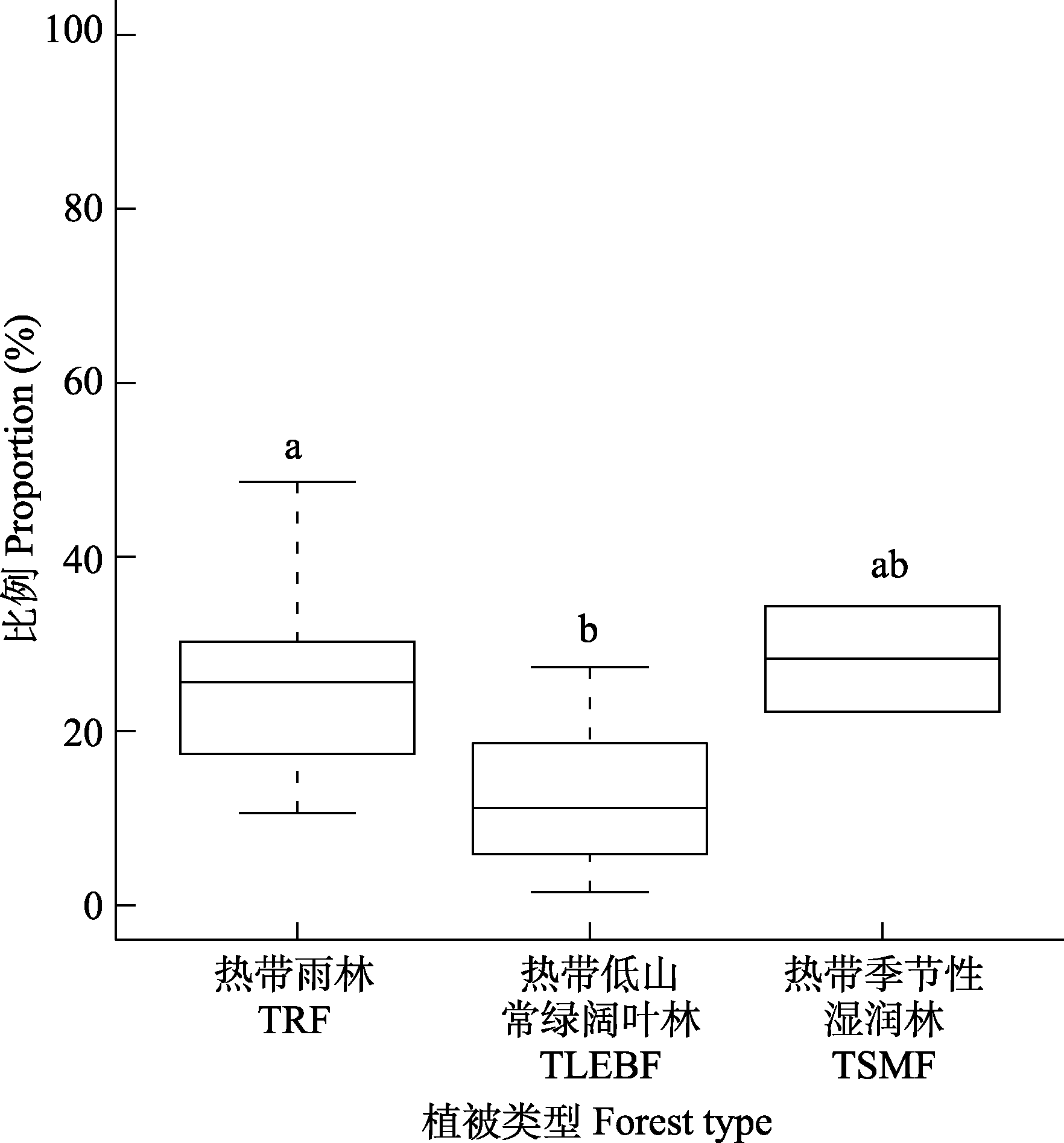
图2 西双版纳不同植被类型间的整体藤本攀附比率。箱式图表示数据的四分位数(IQR)范围(第25百分位数至第75百分位数), 箱中横线为藤本攀附比率中位数, 上下须之间表示99.3%置信区间。不同小写字母代表不同植被类型间的藤本攀附比率差异显著(p < 0.05)。
Fig. 2 Comparison of liana prevalence across the three forest types in Xishuangbanna. The boxes represent the interquartile range (25th percentile to 75th percentile), with horizontal lines within each box indicating the median prevalence rate. Whiskers show the 99.3% confidence interval of the data. Different lowercase letters indicate significant differences in liana prevalence between forest types (p < 0.05). TLEBF, tropical lowland evergreen broadleaf forest; TRF, tropical rainforest; TSMF, tropical seasonal moist forest.
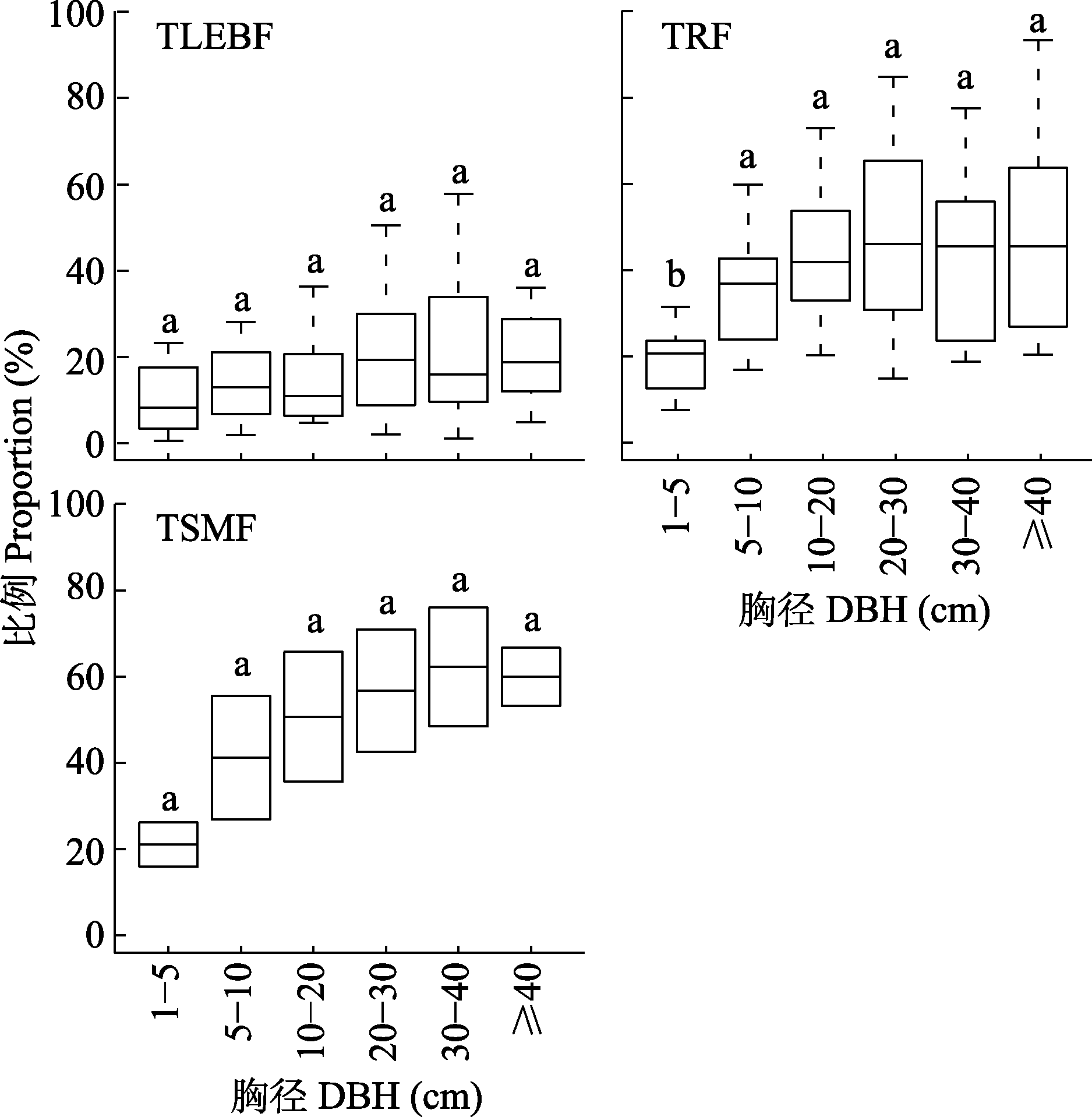
图3 西双版纳热带低山常绿阔叶林(TLEBF)、热带雨林(TRF)和热带季节性湿润林(TSMF)各树木径级的藤本攀附比率。箱式图表示数据的四分位数(IQR)范围(第25百分位数至第75百分位数), 箱中横线为藤本攀附比率中位数, 上下须之间表示99.3%置信区间。不同小写字母代表不同植被类型间的藤本攀附比率差异显著(p < 0.05)。
Fig. 3 Liana prevalence across tree diameter at breast height (DBH) classes in different forest types in Xishuangbanna. Forest types are abbreviated as follows: TLEBF, tropical lowland evergreen broadleaf forest; TRF, tropical rainforest; TSMF, tropical seasonal moist forest. The boxes represent the interquartile range (25th percentile to 75th percentile), with horizontal lines within each box indicating the median prevalence rate. Whiskers show the 99.3% confidence interval of the data. Different lowercase letters indicate significant differences in liana prevalence among vegetation types (p < 0.05).
| 植被类型 Forest type | 序号 Rank | 物种名 Species | 科名 Family | 调查数量 Number of investigated individuals | 最大 调查胸径 Max DBH (cm) | 藤本 攀附比率 LI_prop (%) | 藤本严重 攀附比率 LI_heavy (%) |
|---|---|---|---|---|---|---|---|
| 热带雨林 TRF | 1 | 大果榕 Ficus auriculata | 桑科 Moraceae | 50 | 46.2 | 70.0 | 38.0 |
| 2 | 印度锥 Castanopsis indica | 壳斗科 Fagaceae | 127 | 49.8 | 54.3 | 22.0 | |
| 3 | 广西青梅 Vatica guangxiensis | 龙脑香科 Dipterocarpaceae | 34 | 86.9 | 52.9 | 5.9 | |
| 4 | 胭脂 Artocarpus tonkinensis | 桑科 Moraceae | 39 | 29.5 | 51.3 | 30.8 | |
| 5 | 版纳柿 Diospyros xishuangbannaensis | 柿科 Ebenaceae | 56 | 24.2 | 50.0 | 16.1 | |
| 6 | 假玉桂 Celtis timorensis | 大麻科 Cannabaceae | 31 | 54.4 | 48.4 | 25.8 | |
| 7 | 羽叶白头树 Garuga pinnata | 橄榄科 Burseraceae | 80 | 152.9 | 46.3 | 18.8 | |
| 8 | 毗黎勒 Terminalia bellirica | 使君子科 Combretaceae | 43 | 74.2 | 44.2 | 16.3 | |
| 9 | 毛桐 Mallotus barbatus | 大戟科 Euphorbiaceae | 66 | 6.0 | 43.9 | 9.1 | |
| 10 | 黑毛柿 Diospyros hasseltii | 柿科 Ebenaceae | 64 | 42.5 | 43.8 | 17.2 | |
| 热带低山 常绿阔叶林 TLEBF | 1 | 泰国黄叶树 Xanthophyllum flavescens | 远志科 Polygalaceae | 46 | 30.6 | 54.3 | 19.6 |
| 2 | 印度锥 Castanopsis indica | 壳斗科 Fagaceae | 32 | 54.3 | 40.6 | 15.6 | |
| 3 | 西南猫尾木 Markhamia stipulata | 紫葳科 Bignoniaceae | 55 | 24.3 | 38.2 | 20.0 | |
| 4 | 红光树 Knema tenuinervia | 肉豆蔻科 Myristicaceae | 39 | 44.6 | 35.9 | 17.9 | |
| 5 | 梯脉紫金牛 Ardisia scalarinervis | 报春花科 Primulaceae | 31 | 4.7 | 35.5 | 3.2 | |
| 6 | 高檐蒲桃 Syzygium oblatum | 桃金娘科 Myrtaceae | 433 | 14.3 | 35.3 | 7.9 | |
| 7 | 云南沉香 Aquilaria yunnanensis | 瑞香科 Thymelaeaceae | 38 | 37.6 | 34.2 | 10.5 | |
| 8 | 伞花冬青 Ilex godajam | 冬青科 Aquifoliaceae | 68 | 23.6 | 33.8 | 16.2 | |
| 9 | 香花木姜子 Litsea panamanja | 樟科 Lauraceae | 37 | 84.4 | 29.7 | 5.4 | |
| 10 | 披针叶楠 Phoebe lanceolata | 樟科 Lauraceae | 338 | 28.4 | 29.6 | 6.8 | |
| 热带季节性 湿润林 TSMF | 1 | 绒毛紫薇 Lagerstroemia tomentosa | 千屈菜科 Lythraceae | 59 | 124.8 | 86.4 | 66.1 |
| 2 | 粗糠柴 Mallotus philippensis | 大戟科 Euphorbiaceae | 66 | 23.9 | 75.8 | 56.1 | |
| 3 | 延辉巴豆 Croton yanhuii | 大戟科 Euphorbiaceae | 40 | 32.2 | 72.5 | 42.5 | |
| 4 | 灰毛浆果楝 Cipadessa baccifera | 楝科 Meliaceae | 52 | 27.2 | 71.2 | 32.7 | |
| 5 | 西南猫尾木 Markhamia stipulata | 紫葳科 Bignoniaceae | 54 | 23.6 | 55.6 | 33.3 | |
| 6 | 常绿榆 Ulmus lanceifolia | 榆科 Ulmaceae | 48 | 38.0 | 54.2 | 27.1 | |
| 7 | 火烧花 Mayodendron igneum | 紫葳科 Bignoniaceae | 79 | 27.2 | 51.9 | 32.9 | |
| 8 | 少花琼楠 Beilschmiedia pauciflora | 樟科 Lauraceae | 45 | 56.4 | 51.1 | 24.4 | |
| 9 | 藤春 Alphonsea monogyna | 番荔枝科 Annonaceae | 108 | 36.5 | 47.2 | 11.1 | |
| 10 | 假山椤 Harpullia cupanioides | 无患子科 Sapindaceae | 31 | 42.5 | 41.9 | 12.9 |
表3 西双版纳各植被类型中藤本攀附比率最高的前10个树种
Table 3 The ten tree species with the highest proportion of individuals infested by lianas in each forest types in Xishuangbanna
| 植被类型 Forest type | 序号 Rank | 物种名 Species | 科名 Family | 调查数量 Number of investigated individuals | 最大 调查胸径 Max DBH (cm) | 藤本 攀附比率 LI_prop (%) | 藤本严重 攀附比率 LI_heavy (%) |
|---|---|---|---|---|---|---|---|
| 热带雨林 TRF | 1 | 大果榕 Ficus auriculata | 桑科 Moraceae | 50 | 46.2 | 70.0 | 38.0 |
| 2 | 印度锥 Castanopsis indica | 壳斗科 Fagaceae | 127 | 49.8 | 54.3 | 22.0 | |
| 3 | 广西青梅 Vatica guangxiensis | 龙脑香科 Dipterocarpaceae | 34 | 86.9 | 52.9 | 5.9 | |
| 4 | 胭脂 Artocarpus tonkinensis | 桑科 Moraceae | 39 | 29.5 | 51.3 | 30.8 | |
| 5 | 版纳柿 Diospyros xishuangbannaensis | 柿科 Ebenaceae | 56 | 24.2 | 50.0 | 16.1 | |
| 6 | 假玉桂 Celtis timorensis | 大麻科 Cannabaceae | 31 | 54.4 | 48.4 | 25.8 | |
| 7 | 羽叶白头树 Garuga pinnata | 橄榄科 Burseraceae | 80 | 152.9 | 46.3 | 18.8 | |
| 8 | 毗黎勒 Terminalia bellirica | 使君子科 Combretaceae | 43 | 74.2 | 44.2 | 16.3 | |
| 9 | 毛桐 Mallotus barbatus | 大戟科 Euphorbiaceae | 66 | 6.0 | 43.9 | 9.1 | |
| 10 | 黑毛柿 Diospyros hasseltii | 柿科 Ebenaceae | 64 | 42.5 | 43.8 | 17.2 | |
| 热带低山 常绿阔叶林 TLEBF | 1 | 泰国黄叶树 Xanthophyllum flavescens | 远志科 Polygalaceae | 46 | 30.6 | 54.3 | 19.6 |
| 2 | 印度锥 Castanopsis indica | 壳斗科 Fagaceae | 32 | 54.3 | 40.6 | 15.6 | |
| 3 | 西南猫尾木 Markhamia stipulata | 紫葳科 Bignoniaceae | 55 | 24.3 | 38.2 | 20.0 | |
| 4 | 红光树 Knema tenuinervia | 肉豆蔻科 Myristicaceae | 39 | 44.6 | 35.9 | 17.9 | |
| 5 | 梯脉紫金牛 Ardisia scalarinervis | 报春花科 Primulaceae | 31 | 4.7 | 35.5 | 3.2 | |
| 6 | 高檐蒲桃 Syzygium oblatum | 桃金娘科 Myrtaceae | 433 | 14.3 | 35.3 | 7.9 | |
| 7 | 云南沉香 Aquilaria yunnanensis | 瑞香科 Thymelaeaceae | 38 | 37.6 | 34.2 | 10.5 | |
| 8 | 伞花冬青 Ilex godajam | 冬青科 Aquifoliaceae | 68 | 23.6 | 33.8 | 16.2 | |
| 9 | 香花木姜子 Litsea panamanja | 樟科 Lauraceae | 37 | 84.4 | 29.7 | 5.4 | |
| 10 | 披针叶楠 Phoebe lanceolata | 樟科 Lauraceae | 338 | 28.4 | 29.6 | 6.8 | |
| 热带季节性 湿润林 TSMF | 1 | 绒毛紫薇 Lagerstroemia tomentosa | 千屈菜科 Lythraceae | 59 | 124.8 | 86.4 | 66.1 |
| 2 | 粗糠柴 Mallotus philippensis | 大戟科 Euphorbiaceae | 66 | 23.9 | 75.8 | 56.1 | |
| 3 | 延辉巴豆 Croton yanhuii | 大戟科 Euphorbiaceae | 40 | 32.2 | 72.5 | 42.5 | |
| 4 | 灰毛浆果楝 Cipadessa baccifera | 楝科 Meliaceae | 52 | 27.2 | 71.2 | 32.7 | |
| 5 | 西南猫尾木 Markhamia stipulata | 紫葳科 Bignoniaceae | 54 | 23.6 | 55.6 | 33.3 | |
| 6 | 常绿榆 Ulmus lanceifolia | 榆科 Ulmaceae | 48 | 38.0 | 54.2 | 27.1 | |
| 7 | 火烧花 Mayodendron igneum | 紫葳科 Bignoniaceae | 79 | 27.2 | 51.9 | 32.9 | |
| 8 | 少花琼楠 Beilschmiedia pauciflora | 樟科 Lauraceae | 45 | 56.4 | 51.1 | 24.4 | |
| 9 | 藤春 Alphonsea monogyna | 番荔枝科 Annonaceae | 108 | 36.5 | 47.2 | 11.1 | |
| 10 | 假山椤 Harpullia cupanioides | 无患子科 Sapindaceae | 31 | 42.5 | 41.9 | 12.9 |
| 植被类型 Forest type | 序号 Rank | 物种名 Species | 科名 Family | 调查数量 Number of investigated individuals | 最大 调查胸径 Max DBH (cm) | 藤本 攀附比率 LI_prop (%) | 藤本严重 攀附比率 LI_heavy (%) |
|---|---|---|---|---|---|---|---|
| 热带雨林 TRF | 1 | 罗伞树 Ardisia quinquegona | 报春花科 Primulaceae | 72 | 8.1 | 9.7 | 1.4 |
| 2 | 龙山龙船花 Ixora longshanensis | 茜草科 Rubiaceae | 93 | 8.0 | 9.7 | 1.1 | |
| 3 | 苎麻 Boehmeria nivea | 荨麻科 Urticaceae | 134 | 7.0 | 9.0 | 0.0 | |
| 4 | 棒果榕 Ficus subincisa | 桑科 Moraceae | 51 | 8.2 | 7.8 | 0.0 | |
| 5 | 北酸脚杆 Pseudodissochaeta septentrionalis | 野牡丹科 Melastomataceae | 39 | 6.1 | 7.7 | 2.6 | |
| 6 | 虎克粗叶木 Lasianthus hookeri | 茜草科 Rubiaceae | 122 | 3.6 | 6.6 | 0.0 | |
| 7 | 库兹粗叶木 Lasianthus chrysoneurus | 茜草科 Rubiaceae | 32 | 3.9 | 6.3 | 0.0 | |
| 8 | 南山花 Prismatomeris tetrandra | 茜草科 Rubiaceae | 35 | 4.6 | 5.7 | 2.9 | |
| 9 | 鹅掌柴 Heptapleurum heptaphyllum | 五加科 Araliaceae | 43 | 26.3 | 4.7 | 0.0 | |
| 10 | 火焰花 Phlogacanthus curviflorus | 爵床科 Acanthaceae | 58 | 8.8 | 3.4 | 0.0 | |
| 热带低山 常绿阔叶林 TLEBF | 1 | 大参 Macropanax dispermus | 五加科 Araliaceae | 63 | 27.2 | 1.6 | 0.0 |
| 2 | 瑞丽山龙眼 Helicia shweliensis | 山龙眼科 Proteaceae | 347 | 29.7 | 1.4 | 0.6 | |
| 3 | 无患子 Sapindus saponaria | 无患子科 Sapindaceae | 103 | 49.9 | 1.0 | 0.0 | |
| 4 | 毛叶木姜子 Litsea mollis | 樟科 Lauraceae | 164 | 86.2 | 0.6 | 0.0 | |
| 5 | 贫花厚壳桂 Cryptocarya depauperata | 樟科 Lauraceae | 348 | 65.3 | 0.6 | 0.0 | |
| 6 | 大叶斑鸠菊 Vernonia volkameriifolia | 菊科 Asteraceae | 59 | 7.9 | 0.0 | 0.0 | |
| 7 | 多花山矾 Symplocos ramosissima | 山矾科 Symplocaceae | 33 | 18.8 | 0.0 | 0.0 | |
| 8 | 聚果九节 Psychotria morindoides | 茜草科 Rubiaceae | 66 | 6.6 | 0.0 | 0.0 | |
| 9 | 秃瓣杜英 Elaeocarpus glabripetalus | 杜英科 Elaeocarpaceae | 52 | 41.8 | 0.0 | 0.0 | |
| 10 | 臀果木 Pygeum topengii | 蔷薇科 Rosaceae | 44 | 27.9 | 0.0 | 0.0 | |
| 热带季节性 湿润林 TSMF | 1 | 帚序苎麻 Boehmeria zollingeriana | 荨麻科 Urticaceae | 136 | 7.1 | 35.3 | 16.9 |
| 2 | 闭花木 Cleistanthus sumatranus | 叶下珠科 Phyllanthaceae | 2 443 | 37.8 | 27.1 | 5.5 | |
| 3 | 腺叶单籽暗罗 Monoon simiarum | 番荔枝科 Annonaceae | 67 | 44.2 | 25.4 | 13.4 | |
| 4 | 轮叶戟 Lasiococca comberi var. pseudoverticillata | 大戟科 Euphorbiaceae | 1 425 | 53.6 | 23.8 | 9.4 | |
| 5 | 九里香 Murraya exotica | 芸香科 Rutaceae | 40 | 15.2 | 22.5 | 5.0 | |
| 6 | 勐仑三宝木 Trigonostemon bonianus | 大戟科 Euphorbiaceae | 177 | 16.2 | 19.8 | 3.4 | |
| 7 | 缅桐 Sumbaviopsis albicans | 大戟科 Euphorbiaceae | 374 | 22.8 | 19.0 | 6.7 | |
| 8 | 小绿刺 Capparis urophylla | 山柑科 Capparaceae | 53 | 5.2 | 15.1 | 11.3 | |
| 9 | 猪肚木 Canthium horridum | 茜草科 Rubiaceae | 43 | 3.8 | 14.0 | 2.3 | |
| 10 | 棒柄花 Cleidion brevipetiolatum | 大戟科 Euphorbiaceae | 626 | 14.7 | 13.3 | 3.5 |
表4 西双版纳各植被类型中藤本攀附比率最低的10个树种
Table 4 The ten tree species with the lowest proportion of individuals infested by lianas in each forest types
| 植被类型 Forest type | 序号 Rank | 物种名 Species | 科名 Family | 调查数量 Number of investigated individuals | 最大 调查胸径 Max DBH (cm) | 藤本 攀附比率 LI_prop (%) | 藤本严重 攀附比率 LI_heavy (%) |
|---|---|---|---|---|---|---|---|
| 热带雨林 TRF | 1 | 罗伞树 Ardisia quinquegona | 报春花科 Primulaceae | 72 | 8.1 | 9.7 | 1.4 |
| 2 | 龙山龙船花 Ixora longshanensis | 茜草科 Rubiaceae | 93 | 8.0 | 9.7 | 1.1 | |
| 3 | 苎麻 Boehmeria nivea | 荨麻科 Urticaceae | 134 | 7.0 | 9.0 | 0.0 | |
| 4 | 棒果榕 Ficus subincisa | 桑科 Moraceae | 51 | 8.2 | 7.8 | 0.0 | |
| 5 | 北酸脚杆 Pseudodissochaeta septentrionalis | 野牡丹科 Melastomataceae | 39 | 6.1 | 7.7 | 2.6 | |
| 6 | 虎克粗叶木 Lasianthus hookeri | 茜草科 Rubiaceae | 122 | 3.6 | 6.6 | 0.0 | |
| 7 | 库兹粗叶木 Lasianthus chrysoneurus | 茜草科 Rubiaceae | 32 | 3.9 | 6.3 | 0.0 | |
| 8 | 南山花 Prismatomeris tetrandra | 茜草科 Rubiaceae | 35 | 4.6 | 5.7 | 2.9 | |
| 9 | 鹅掌柴 Heptapleurum heptaphyllum | 五加科 Araliaceae | 43 | 26.3 | 4.7 | 0.0 | |
| 10 | 火焰花 Phlogacanthus curviflorus | 爵床科 Acanthaceae | 58 | 8.8 | 3.4 | 0.0 | |
| 热带低山 常绿阔叶林 TLEBF | 1 | 大参 Macropanax dispermus | 五加科 Araliaceae | 63 | 27.2 | 1.6 | 0.0 |
| 2 | 瑞丽山龙眼 Helicia shweliensis | 山龙眼科 Proteaceae | 347 | 29.7 | 1.4 | 0.6 | |
| 3 | 无患子 Sapindus saponaria | 无患子科 Sapindaceae | 103 | 49.9 | 1.0 | 0.0 | |
| 4 | 毛叶木姜子 Litsea mollis | 樟科 Lauraceae | 164 | 86.2 | 0.6 | 0.0 | |
| 5 | 贫花厚壳桂 Cryptocarya depauperata | 樟科 Lauraceae | 348 | 65.3 | 0.6 | 0.0 | |
| 6 | 大叶斑鸠菊 Vernonia volkameriifolia | 菊科 Asteraceae | 59 | 7.9 | 0.0 | 0.0 | |
| 7 | 多花山矾 Symplocos ramosissima | 山矾科 Symplocaceae | 33 | 18.8 | 0.0 | 0.0 | |
| 8 | 聚果九节 Psychotria morindoides | 茜草科 Rubiaceae | 66 | 6.6 | 0.0 | 0.0 | |
| 9 | 秃瓣杜英 Elaeocarpus glabripetalus | 杜英科 Elaeocarpaceae | 52 | 41.8 | 0.0 | 0.0 | |
| 10 | 臀果木 Pygeum topengii | 蔷薇科 Rosaceae | 44 | 27.9 | 0.0 | 0.0 | |
| 热带季节性 湿润林 TSMF | 1 | 帚序苎麻 Boehmeria zollingeriana | 荨麻科 Urticaceae | 136 | 7.1 | 35.3 | 16.9 |
| 2 | 闭花木 Cleistanthus sumatranus | 叶下珠科 Phyllanthaceae | 2 443 | 37.8 | 27.1 | 5.5 | |
| 3 | 腺叶单籽暗罗 Monoon simiarum | 番荔枝科 Annonaceae | 67 | 44.2 | 25.4 | 13.4 | |
| 4 | 轮叶戟 Lasiococca comberi var. pseudoverticillata | 大戟科 Euphorbiaceae | 1 425 | 53.6 | 23.8 | 9.4 | |
| 5 | 九里香 Murraya exotica | 芸香科 Rutaceae | 40 | 15.2 | 22.5 | 5.0 | |
| 6 | 勐仑三宝木 Trigonostemon bonianus | 大戟科 Euphorbiaceae | 177 | 16.2 | 19.8 | 3.4 | |
| 7 | 缅桐 Sumbaviopsis albicans | 大戟科 Euphorbiaceae | 374 | 22.8 | 19.0 | 6.7 | |
| 8 | 小绿刺 Capparis urophylla | 山柑科 Capparaceae | 53 | 5.2 | 15.1 | 11.3 | |
| 9 | 猪肚木 Canthium horridum | 茜草科 Rubiaceae | 43 | 3.8 | 14.0 | 2.3 | |
| 10 | 棒柄花 Cleidion brevipetiolatum | 大戟科 Euphorbiaceae | 626 | 14.7 | 13.3 | 3.5 |
| [1] | Addo-Fordjour P, Rahmad ZB, Shahrul AMS (2014). Environmental factors influencing liana community diversity, structure and habitat associations in a tropical hill forest, Malaysia. Plant Ecology & Diversity, 7, 485-496. |
| [2] |
Akaike H (1974). A new look at the statistical model identification. IEEE Transactions on Automatic Control, 19, 716-723.
DOI URL |
| [3] | Anderson DR (2008). Model Based Inference in the Life Sciences: a Primer on Evidence. Springer, New York. |
| [4] |
Aussenac R, Bergeron Y, Gravel D, Drobyshev I (2019). Interactions among trees: a key element in the stabilizing effect of species diversity on forest growth. Functional Ecology, 33, 360-367.
DOI |
| [5] | Bai XL, Zhang YB, Liu Q, Wang YSD, Yang D, Zhang JL (2020). Leaf and stem traits are linked to liana growth rate in a subtropical cloud forest. Forests, 11, 1120. DOI: 10.3390/f11101120. |
| [6] | Becknell JM, Vargas GG, Wright LA, Woods NF, Medvigy D, Powers JS (2022). Increasing liana abundance and associated reductions in tree growth in secondary seasonally dry tropical forest. Frontiers in Forests and Global Change, 5, 838357. DOI: 10.3389/ffgc.2022.838357. |
| [7] |
Benlloch-González M, Arquero O, Fournier JM, Barranco D, Benlloch M (2008). K+ starvation inhibits water-stress-induced stomatal closure. Journal of Plant Physiology, 165, 623-630.
PMID |
| [8] | Bruy D, Ibanez T, Munzinger J, Isnard S (2017). Abundance, richness and composition of lianas in forest communities along an elevation gradient in New Caledonia. Plant Ecology & Diversity, 10, 469-481. |
| [9] | Burnham KP, Anderson DR (2002). Model Selection and Multimodel Inference: a Practical Information-Theoretic Approach. 2nd ed. Springer-Verlag, New York. |
| [10] |
Cai ZQ, Schnitzer SA, Bongers F (2009). Seasonal differences in leaf-level physiology give lianas a competitive advantage over trees in a tropical seasonal forest. Oecologia, 161, 25-33.
DOI URL |
| [11] |
Campanello PI, Garibaldi JF, Gatti MG, Goldstein G (2007). Lianas in a subtropical Atlantic forest: host preference and tree growth. Forest Ecology and Management, 242, 250-259.
DOI URL |
| [12] |
Campbell EJF, Newbery DM (1993). Ecological relationships between lianas and trees in lowland rain forest in Sabah, East Malaysia. Journal of Tropical Ecology, 9, 469-490.
DOI URL |
| [13] | Cao M, Zhu H, Wang H, Lan GY, Hu YH, Zhou SS, Deng XB, Cui JY (2008). Xishuangbanna Tropical Seasonal Rainforest Dynamics Plot: Tree Distribution Maps, Diameter Tables and Species Documentation. Yunnan Science and Technology Press, Kunming. |
| [14] | Cavaleri MA, Oberbauer SF, Clark DB, Clark DA, Ryan MG (2010). Height is more important than light in determining leaf morphology in a tropical forest. Ecology, 91, 1730-1739. |
| [15] | Chatterjee S, Price B (1991). Regression Diagnostics. Wiley, New York. |
| [16] | Chen YJ, Chen JW, Cai ZQ (2007). Lianas and their functions in tropical forests. Chinese Bulletin of Botany, 24, 240-249. |
| [陈亚军, 陈军文, 蔡志全 (2007). 木质藤本及其在热带森林中的生态学功能. 植物学通报, 24, 240-249.] | |
| [17] | Condit R (1998). Tropical Forest Census Plots: Methods and Results From Barro Colorado Island, Panama and a Comparison with Other Plots. Springer Science & Business Media, Berlin. |
| [18] |
Davis SD, Sperry JS, Hacke UG (1999). The relationship between xylem conduit diameter and cavitation caused by freezing. American Journal of Botany, 86, 1367-1372.
PMID |
| [19] | Deng XB, Tang JW (2010). China Ecosystem Positioning Observation and Research Data Set—Forest Ecosystem Volume—Xishuangbanna Station in Yunnan Province (1998-2006). China Agriculture Press, Beijing. |
| [邓晓保, 唐建维 (2010). 中国生态系统定位观测与研究数据集—森林生态系统卷—云南西双版纳站(1998-2006). 中国农业出版社, 北京.] | |
| [20] | Deng Y, Zhang WF, Cao M, Dong JL, Chen H, Deng XB, Liu JJ, Song XY, Xia SW, Sha LQ, Yuan SD, Lin LX (2024). Overstory functional groups indicate the legacy of land use in a secondary tropical forest in southwestern China. Journal of Forestry Research, 35, 85. DOI: 10.1007/s11676-024-01729-3. |
| [21] | DeWalt SJ, Schnitzer SA, Alves LF, Bongers F, Burnham RJ, Cai ZQ, Carson WP, Chave J, Chuyong GB, Costa FRC, Ewango CEN, Gallagher RV, Gerwing JJ, Gortaire Amezcua E, Hart T, et al. (2015). Biogeographical patterns of liana abundance and diversity//Schnitzer SA, Bongers F, Burnham RJ, Putz FE. Ecology of Lianas. Wiley, Hoboken, USA. |
| [22] | DeWalt SJ, Schnitzer SA, Chave J, Bongers F, Burnham RJ, Cai ZQ, Chuyong G, Clark DB, Ewango CEN, Gerwing JJ, Gortaire E, Hart T, Ibarra-Manriquez G, Ickes K, Kenfack D, Macia MJ, et al. (2010). Annual rainfall and seasonality predict pan-tropical patterns of liana density and basal area. Biotropica, 42, 309-317. |
| [23] | Estrada-Villegas S, Hall JS, van Breugel M, Schnitzer SA (2020). Lianas reduce biomass accumulation in early successional tropical forests. Ecology, 101, e02989. DOI: 10.1002/ecy.2989. |
| [24] | Estrada-Villegas S, Pedraza Narvaez SS, Sanchez A, Schnitzer SA (2022). Lianas significantly reduce tree performance and biomass accumulation across tropical forests: a global meta-analysis. Frontiers in Forests and Global Change, 4, 812066. DOI: 10.3389/ffgc.2021.812066. |
| [25] |
Fadrique B, Homeier J (2016). Elevation and topography influence community structure, biomass and host tree interactions of lianas in tropical montane forests of southern Ecuador. Journal of Vegetation Science, 27, 958-968.
DOI URL |
| [26] |
Fick SE, Hijmans RJ (2017). WorldClim 2: new 1-km spatial resolution climate surfaces for global land areas. International Journal of Climatology, 37, 4302-4315.
DOI URL |
| [27] |
García León MM, Martínez Izquierdo L, Mello FNA, Powers JS, Schnitzer SA (2018). Lianas reduce community-level canopy tree reproduction in a Panamanian forest. Journal of Ecology, 106, 737-745.
DOI URL |
| [28] |
Gerwing JJ, Schnitzer SA, Burnham RJ, Bongers F, Chave J, DeWalt SJ, Ewango CEN, Foster R, Kenfack D, Martínez-Ramos M, Parren M, Parthasarathy N, Pérez-Salicrup DR, Putz FE, Thomas DW (2006). A standard protocol for liana censuses. Biotropica, 38, 256-261.
DOI URL |
| [29] | Haralick RM, Shanmugam K, Dinstein I (1973). Textural features for image classification. IEEE Transactions on Systems, Man, and Cybernetics, SMC-3, 610-621. |
| [30] | Huang WL, Wang BC, Xie KM (2000). Low temperature and cold damage in Xishuangbanna and its disaster reduction measures. Journal of Yunnan Tropical Crops Science & Technology, 23(1), 16-18. |
| [黄文龙, 王丙春, 谢康美 (2000). 西双版纳的低温寒害及其减灾措施. 云南热作科技, 23(1), 16-18.] | |
| [31] | Ingwell LL, Joseph Wright S, Becklund KK, Hubbell SP, Schnitzer SA (2010). The impact of lianas on 10 years of tree growth and mortality on Barro Colorado Island, Panama. Journal of Ecology, 98, 879-887. |
| [32] | Kaçamak B, Réjou-Méchain M, Rowe N, Rossi V, Barbier N, Bazan S, Forni E, Guibal D, Harris DJ, Loubota Panzou GJ, Loumeto JJ, Marcon E, Pinho BX, Zombo I, Gourlet-Fleury S (2025). Local forest structure and host specificity influence liana community composition in a moist central African forest. Ecology and Evolution, 15, e71075. DOI: 10.1002/ece3.71075. |
| [33] | LaFrankie JV, Ashton PS, Chuyong GB, Co L, Condit R, Davies SJ, Foster R, Hubbell SP, Kenfack D, Lagunzad D, Losos EC, Nor NS, Tan S, Thomas DW, Valencia R, Villa G (2006). Contrasting structure and composition of the understory in species-rich tropical rain forests. Ecology, 87, 2298-2305. |
| [34] |
Li JY, Liu LL, Yang B, Luo Y, Bai LZ, Lu HZ, Song L (2024). Spatial-temporal pattern of soil water content and its response to precipitation in a tropical seasonal rainforest in Xishuangbanna. Chinese Journal of Ecology, 43, 3341-3349.
DOI |
| [李嘉媛, 刘露露, 杨斌, 罗艳, 白林忠, 卢华正, 宋亮 (2024). 西双版纳热带季节雨林土壤含水量的时空格局及其与降水的关联. 生态学杂志, 43, 3341-3349.] | |
| [35] | Li SF, Su JR, Liu WD, Zhang ZJ, Liu QY, Li ZW (2011). Changes of liana species diversity in different restoration stages of monsoonal broad-leaved evergreen forest. Acta Ecologica Sinica, 31, 10-20. |
| [李帅锋, 苏建荣, 刘万德, 张志钧, 刘庆云, 李忠文 (2011). 季风常绿阔叶林不同恢复阶段藤本植物的物种多样性比较. 生态学报, 31, 10-20.] | |
| [36] | Liang J, Zhu H, Wang H, Zhou SS (2007). Changes in species diversity of Parashorea forest in the past 20 years in Xishuangbanna, Yunnan. Chinese Journal of Applied & Environmental Biology, 13, 609-614. |
| [梁娟, 朱华, 王洪, 周仕顺 (2007). 西双版纳补蚌地区望天树林近20a来物种多样性变化研究. 应用与环境生物学报, 13, 609-614.] | |
| [37] | Lin LX, Cao M, Tang Y, Fu XH, Zhang JH (2002). Tree species diversity in abandoned swidden fields of Xishuangbanna, SW China. Acta Phytoecologica Sinica, 26, 216-222. |
| [林露湘, 曹敏, 唐勇, 付先惠, 张建侯 (2002). 西双版纳刀耕火种弃耕地树种多样性比较研究. 植物生态学报, 26, 216-222.] | |
| [38] |
Liu JX, Tao JP, He Z, Wang YP, Guo QX (2012). Liana-host tree associations in the tropical montane primary forest and postharvest forest of Bawangling, Hainan Island, China. Acta Ecologica Sinica, 32, 3834-3840.
DOI URL |
| [刘晋仙, 陶建平, 何泽, 王玉平, 郭庆学 (2012). 海南霸王岭山地原始林与伐后林中木质藤本对支持木的选择. 生态学报, 32, 3834-3840.] | |
| [39] | Liu Q (2016). Lians Diversity and Spatial Distribution in Xishuangbanna Tropical Rainforest. Master degree dissertation, University of Chinese Academy of Sciences, Beijing. |
| [刘奇 (2016). 西双版纳热带雨林木质藤本的多样性与空间分布. 硕士学位论文, 中国科学院大学, 北京.] | |
| [40] | Liu Q, Sterck FJ, Medina-Vega JA, Sha LQ, Cao M, Bongers F, Zhang JL, Poorter L (2021). Soil nutrients, canopy gaps and topography affect liana distribution in a tropical seasonal rain forest in southwestern China. Journal of Vegetation Science, 32, e12951. DOI: 10.1111/jvs.12951. |
| [41] | Liu Q, Wu HD, Tan YH, Zhang JL (2017). Liana diversity and its climbing situation on trees in Xishuangbanna tropical seasonal rainforest. Scientia Silvae Sinicae, 53(8), 1-8. |
| [刘奇, 吴怀栋, 谭运洪, 张教林 (2017). 西双版纳热带季雨林木质藤本多样性及其攀援方式. 林业科学, 53(8), 1-8.] | |
| [42] |
Medina-Vega JA, Bongers F, Schnitzer SA, Sterck FJ (2021). Lianas explore the forest canopy more effectively than trees under drier conditions. Functional Ecology, 35, 318-329.
DOI URL |
| [43] |
Muller-Landau HC, Visser MD (2019). How do lianas and vines influence competitive differences and niche differences among tree species? Concepts and a case study in a tropical forest. Journal of Ecology, 107, 1469-1481.
DOI |
| [44] | Ngute ASK, Schoeman DS, Pfeifer M, van der Heijden GMF, Phillips OL, van Breugel M, Campbell MJ, Chandler CJ, Enquist BJ, Gallagher RV, Gehring C, Hall JS, Laurance S, Laurance WF, Letcher SG, et al. (2024). Global dominance of lianas over trees is driven by forest disturbance, climate and topography. Global Change Biology, 30, e17140. DOI: 10.1111/gcb.17140. |
| [45] | Panzou GJL, Loumeto JJ, Chantrain A, Gourlet-Fleury S, Doucet JL, Forni E, Beeckman H, Ilondea BA, Fayolle A (2022). Intensity, determinants, and impacts of liana load on tropical trees in central Africa. Ecosphere, 13, e4322. DOI: 10.1002/ecs2.4322. |
| [46] |
Pérez-Salicrup DR (2001). Effect of liana cutting on tree regeneration in a liana forest in Amazonian Bolivia. Ecology, 82, 389-396.
DOI URL |
| [47] |
Phillips OL, Vásquez Martínez R, Arroyo L, Baker TR, Killeen T, Lewis SL, Malhi Y, Monteagudo Mendoza A, Neill D, Núñez Vargas P, Alexiades M, Cerón C, Di Fiore A, Erwin T, Jardim A, et al. (2002). Increasing dominance of large lianas in Amazonian forests. Nature, 418, 770-774.
DOI |
| [48] |
Putz FE (1984). The natural-history of lianas on Barro-Colorado Island, Panama. Ecology, 65, 1713-1724.
DOI URL |
| [49] | Richards PW (1996). The Tropical Rain Forest: an Ecological Study. 2nd ed. Cambridge University Press, Cambridge, UK. |
| [50] |
Roeder M, Liu JJ, Pasion B, Yasuda M, Ferry Slik JW, Tomlinson KW (2019). Wood density, growth and mortality relationships of lianas on environmental gradients in fragmented forests of montane landscapes. Journal of Vegetation Science, 30, 1143-1152.
DOI URL |
| [51] | Rosenzweig ML (1995). Species Diversity in Space and Time. Cambridge University Press, Cambridge, UK. |
| [52] | Rueda-Trujillo MA, Veldhuis MP, van Bodegom PM, Visser M (2024). Global increase of lianas in tropical forests. Global Change Biology, 30, e17485. DOI: 10.1111/gcb.17485. |
| [53] |
Rutishauser E, Barthélémy D, Blanc L, Eric-André N (2011). Crown fragmentation assessment in tropical trees: method, insights and perspectives. Forest Ecology and Management, 261, 400-407.
DOI URL |
| [54] |
Schnitzer SA. (2005). A mechanistic explanation for global patterns of liana abundance and distribution. The American Naturalist, 166, 262-276.
DOI PMID |
| [55] | Schnitzer SA (2015). The Ecology of Lianas in Forest Ecosystems//Peh K, Corlett R, Bergeron Y. Handbook of Ecology. Routledge Publishing, New York. |
| [56] |
Schnitzer SA (2018). Testing ecological theory with lianas. New Phytologist, 220, 366-380.
DOI PMID |
| [57] |
Schnitzer SA, Bongers F (2002). The ecology of lianas and their role in forests. Trends in Ecology & Evolution, 17, 223-230.
DOI URL |
| [58] |
Schnitzer SA, Carson WP (2010). Lianas suppress tree regeneration and diversity in treefall gaps. Ecology Letters, 13, 849-857.
DOI PMID |
| [59] | Schnitzer SA, Mangan SA, Dalling JW, Baldeck CA, Hubbell SP, Ledo A, Muller-Landau H, Tobin MF, Aguilar S, Brassfield D, Hernandez A, Lao S, Perez R, Valdes O, Yorke SR (2012). Liana abundance, diversity, and distribution on Barro Colorado Island, Panama. PLoS ONE, 7, e52114. DOI: 10.1371/journal.pone.0052114. |
| [60] | Schnitzer SA, van der Heijden GMF (2019). Lianas have a seasonal growth advantage over co-occurring trees. Ecology, 100, e02655. DOI: 10.1002/ecy.2655. |
| [61] |
Si XF, Pimm SL, Russell GJ, Ding P (2014). Turnover of breeding bird communities on islands in an inundated lake. Journal of Biogeography, 41, 2283-2292.
DOI URL |
| [62] | Song SL, Schnitzer SA, Ding YG, Wang GB, Chen L, Liu J, Wen RQ, Luan FG, Fang X, Yang QP, Song QN (2023). Light-demanding tree species are more susceptible to lianas than shade-tolerant tree species in a subtropical secondary forest. Journal of Ecology, 111, 1656-1669. |
| [63] | Song SL, Yi LL, Zhang LL, Chen L, Yu ZP, Song QN, Luan FG, Fang X, Liu J (2023). Mechanisms and ecological consequences of the over-increase of lianas in forests. Guihaia, 43, 980-990. |
| [宋述灵, 易伶俐, 张李龙, 陈琳, 余泽平, 宋庆妮, 栾丰刚, 方熊, 刘骏 (2023). 森林木质藤本数量过度增长的机制与生态效应. 广西植物, 43, 980-990.] | |
| [64] |
Symonds MRE, Moussalli A (2011). A brief guide to model selection, multimodel inferenceand model averaging in behavioural ecology using Akaike’s information criterion. Behavioral Ecology and Sociobiology, 65(1), 13-21.
DOI URL |
| [65] | Tobin MF, Wright AJ, Mangan SA, Schnitzer SA (2012). Lianas have a greater competitive effect than trees of similar biomass on tropical canopy trees. Ecosphere, 3, 1-11. |
| [66] |
van der Heijden GMF, Feldpausch TR, de la Fuente Herrero A, van der Velden NK, Phillips OL (2010). Calibrating the liana crown occupancy index in Amazonian forests. Forest Ecology and Management, 260, 549-555.
DOI URL |
| [67] |
van der Heijden GMF, Powers JS, Schnitzer SA (2015). Lianas reduce carbon accumulation and storage in tropical forests. Proceedings of the National Academy of Sciences of the United States of America, 112, 13267-13271.
DOI PMID |
| [68] | Vegetation of Yunnan Editorial Group (1987). Vegetation of Yunnan. Science Press, Beijing. |
| [云南植被编写组 (1987). 云南植被. 科学出版社, 北京.] | |
| [69] | Vivek P, Parthasarathy N (2017). Patterns of tree-liana interactions: distribution and host preference of lianas in a tropical dry evergreen forest in India. Tropical Ecology, 58, 591-603. |
| [70] |
Vleut I, Pérez-Salicrup DR (2005). Lianas and their supporting plants in the understorey at Los Tuxtlas, Mexico. Journal of Tropical Ecology, 21, 577-580.
DOI URL |
| [71] |
Wood EM, Pidgeon AM, Radeloff VC, Keuler NS (2012). Image texture as a remotely sensed measure of vegetation structure. Remote Sensing of Environment, 121, 516-526.
DOI URL |
| [72] |
Wright SJ, Calderón O, Hernandéz A, Paton S (2004). Are lianas increasing in importance in tropical forests? A 17-year record from Panama. Ecology, 85, 484-489.
DOI URL |
| [73] |
Wright SJ, Jaramillo MA, Pavon J, Condit R, Hubbell SP, Foster RB (2005). Reproductive size thresholds in tropical trees: variation among individuals, species and forests. Journal of Tropical Ecology, 21, 307-315.
DOI URL |
| [74] |
Wright SJ, Sun IF, Pickering M, Fletcher CD, Chen YY (2015). Long-term changes in liana loads and tree dynamics in a Malaysian forest. Ecology, 96, 2748-2757.
PMID |
| [75] |
Wyka TP, Oleksyn J, Karolewski P, Schnitzer SA (2013). Phenotypic correlates of the lianescent growth form: a review. Annals of Botany, 112, 1667-1681.
DOI PMID |
| [76] | Zhang KY (1963). An analysis on the characteristics and forming factors of climates in the south part of Yunnan. Acta Meteorologica Sinica, 33, 210-230. |
| [张克映 (1963). 滇南气候的特征及其形成因子的初步分析. 气象学报, 33, 218-230.] | |
| [77] | Zhang P, Chen AG, Liu HM (1999). A discussion on swidden agriculture in Xishuangbanna. Resources Science, 21(6), 47-50. |
| [张萍, 陈爱国, 刘宏茂 (1999). 论西双版纳的轮歇农业. 资源科学, 21(6), 47-50.] | |
| [78] |
Zhu H (1997). Ecological and biogeographical studies on the tropical rain forest of south Yunnan, SW China with a special reference to its relation with rain forests of tropical Asia. Journal of Biogeography, 24, 647-662.
DOI URL |
| [79] | Zhu H (2022). Tropical rain forest of Yunnan (southwestern China): characteristics, biogeographical origin and evolution. Journal of Tropical and Subtropical Botany, 30, 575-591. |
| [朱华 (2022). 云南热带雨林: 特征、生物地理起源与演化. 热带亚热带植物学报, 30, 575-591.] | |
| [80] | Zhu H, Ashton P (2021). Ecotones in the tropical-subtropical vegetation transition at the tropical margin of Southern China. Chinese Science Bulletin, 66, 3732-3743. |
| [朱华, Ashton P 2021). 中国热带-亚热带常绿阔叶林群落交错区. 科学通报, 66, 3732-3743.] | |
| [81] | Zhu H, Wang H, Li BG, Zhou SS, Zhang JH (2015). Studies on the forest vegetation of Xishuangbanna. Plant Science Journal, 33, 641-726. |
| [朱华, 王洪, 李保贵, 周仕顺, 张建侯 (2015). 西双版纳森林植被研究. 植物科学学报, 33, 641-726.] | |
| [82] | Zi R, Kong Z, Zhu YQ (2019). Climatological characteristics of air temperature and precipitation in the tropical rainforest heritage of Xishuang Banna from 1959 to 2018. Journal of Agricultural Catastrophology, 9(6), 61-66. |
| [字冉, 孔震, 朱原钦 (2019). 1959-2018年西双版纳热带雨林地区气候特征分析. 农业灾害研究, 9(6), 61-66.] |
| [1] | 封逸凡, 朱时应, 周淑荣, 江乐乐, 陈隆, 王苗, 邓国芳, 刘兰. 热带次生林恢复中土壤微生物对菌根化树苗存活和生长性状的影响[J]. 植物生态学报, 2026, 50(预发表): 1-. |
| [2] | 杨梅花, 张子嘉, 乔栋, 冯俊娜, 庞子杰, 钱龙, 刘志晖, 蔡娜娜, 胡中民, 杨国姣. 海南热带森林乔木群落调查和多样性数据集[J]. 植物生态学报, 2026, 50(预发表): 0-. |
| [3] | 王蓉钧, 吴福忠, 吴秋霞, 朱晶晶, 倪祥银. 不同生活型植物叶片氮重吸收效率的差异[J]. 植物生态学报, 2026, 50(2): 344-351. |
| [4] | 邱丹妮, 彭清清, 张慧玲, 温辉辉, 吴福忠. 中亚热带常绿阔叶林典型乔木树种对蚂蚁群落季节性动态的影响[J]. 植物生态学报, 2025, 49(11): 1805-1816. |
| [5] | 冉佳鑫, 张宇辉, 王云, 杨智杰, 毛超. 增温和氮磷添加对亚热带森林凋落物溶解有机碳生物可降解性的影响[J]. 植物生态学报, 2024, 48(9): 1232-1242. |
| [6] | 陆啸飞, 覃张芬, 王斌, 旷远文. 氮添加对南亚热带常绿阔叶林林下植物-土壤植硅体碳的影响[J]. 植物生态学报, 2024, 48(10): 1302-1311. |
| [7] | 张慧玲, 张耀艺, 彭清清, 杨静, 倪祥银, 吴福忠. 中亚热带同质园不同生活型树种微量元素重吸收效率的差异[J]. 植物生态学报, 2023, 47(7): 978-987. |
| [8] | 万春燕, 余俊瑞, 朱师丹. 喀斯特与非喀斯特森林乔木叶性状及其相关性网络的差异[J]. 植物生态学报, 2023, 47(10): 1386-1397. |
| [9] | 林马震, 黄勇, 李洋, 孙建. 高寒草地植物生存策略地理分布特征及其影响因素[J]. 植物生态学报, 2023, 47(1): 41-50. |
| [10] | 吴秋霞, 吴福忠, 胡仪, 康自佳, 张耀艺, 杨静, 岳楷, 倪祥银, 杨玉盛. 亚热带同质园11个树种新老叶非结构性碳水化合物含量比较[J]. 植物生态学报, 2021, 45(7): 771-779. |
| [11] | 曹嘉瑜, 刘建峰, 袁泉, 徐德宇, 樊海东, 陈海燕, 谭斌, 刘立斌, 叶铎, 倪健. 森林与灌丛的灌木性状揭示不同的生活策略[J]. 植物生态学报, 2020, 44(7): 715-729. |
| [12] | 陈思路, 蔡劲松, 林成芳, 宋豪威, 杨玉盛. 亚热带不同树种凋落叶分解对氮添加的响应[J]. 植物生态学报, 2020, 44(3): 214-227. |
| [13] | 梅孔灿, 程蕾, 张秋芳, 林开淼, 周嘉聪, 曾泉鑫, 吴玥, 徐建国, 周锦容, 陈岳民. 不同植物来源可溶性有机质对亚热带森林土壤酶活性的影响[J]. 植物生态学报, 2020, 44(12): 1273-1284. |
| [14] | 车俭, 郑洁, 蒋娅, 金毅, 乙引. 中国亚热带森林动态监测样地常绿和落叶木本被子植物谱系结构及生态习性差异[J]. 植物生态学报, 2020, 44(10): 1007-1014. |
| [15] | 张振振, 赵平, 张锦秀, 斯瑶. 亚热带常绿阔叶林散孔材和环孔材树种导管及叶片功能性状的比较[J]. 植物生态学报, 2019, 43(2): 131-138. |
| 阅读次数 | ||||||
|
全文 |
|
|||||
|
摘要 |
|
|||||
Copyright © 2026 版权所有 《植物生态学报》编辑部
地址: 北京香山南辛村20号, 邮编: 100093
Tel.: 010-62836134, 62836138; Fax: 010-82599431; E-mail: apes@ibcas.ac.cn, cjpe@ibcas.ac.cn
备案号: 京ICP备16067583号-19

