
植物生态学报 ›› 2025, Vol. 49 ›› Issue (10): 1656-1676.DOI: 10.17521/cjpe.2024.0462 cstr: 32100.14.cjpe.2024.0462
所属专题: 虚拟专辑 | 濒危植物多样性与保护
徐艳琴, 曾文敏, 李梦雪, 李风琴, 胡生福, 龚美尹, 高倞, 单章建*( ), 唐琴*()
收稿日期:2024-12-17
接受日期:2025-04-16
出版日期:2025-10-20
发布日期:2025-11-11
通讯作者:
*(Shan ZJ, shanzhangjian@126.com;基金资助:
XU Yan-Qin, ZENG Wen-Min, LI Meng-Xue, LI Feng-Qin, HU Sheng-Fu, GONG Mei-Yin, GAO Jing, SHAN Zhang-Jian*(), TANG Qin*()
Received:2024-12-17
Accepted:2025-04-16
Online:2025-10-20
Published:2025-11-11
Supported by:摘要:
为掌握中国淫羊藿属(Epimedium)受威胁物种的地理分布, 提供资源保护和利用的依据, 该研究检索国内外各大数字标本平台数据并实地查阅中国医学科学院药用植物研究所标本馆(IMD)标本。同时, 结合实地调查和文献检索, 系统整理中国淫羊藿属26个受威胁物种(含1变种)的标本信息, 核实其标本鉴定和地理分布, 并调整其濒危等级及其评估标准。共查询到标本428号1 017份, 鉴定正确的仅274号(64.02%) 666份。共19个类群(73.08%)新增《Flora of China》记载之外的分布点, 但有6个种仅分布于模式产地。淫羊藿属受威胁物种丰富度较高的3个省依次为四川(12种)、湖北(7种)和贵州(6种1变种)。对22个类群的濒危等级或评估标准建议调整。其中, 恩施淫羊藿(Epimedium enshiense)、革叶淫羊藿(E. reticulatum)、方氏淫羊藿(E. fangii)和小叶淫羊藿(E. parvifolium)的濒危等级建议上调为极危。天全淫羊藿(E. flavum)、腺毛淫羊藿(E. glandulosopilosum)、直距淫羊藿(E. mikinorii)、光叶淫羊藿(E. sagittatum var. glabratum)、偏斜淫羊藿(E. truncatum)和竹山淫羊藿(E. zhushanense)的濒危等级建议上调为濒危。单叶淫羊藿(E. simplicifolium)和川鄂淫羊藿(E. fargesii)分别由极危和濒危建议下调为易危。另有10个种仅调整评估标准。淫羊藿属植物濒危的主要原因为分布狭窄、生境衰退及种群数减少。淫羊藿属受威胁类群的腊叶标本鉴定错误较突出。该属物种多为狭域分布, 受威胁程度高, 物种多样性保护应足够重视。濒危等级评估是动态过程, 需长期监测和不断更新。
徐艳琴, 曾文敏, 李梦雪, 李风琴, 胡生福, 龚美尹, 高倞, 单章建, 唐琴. 中国淫羊藿属受威胁物种的地理分布和濒危等级建议. 植物生态学报, 2025, 49(10): 1656-1676. DOI: 10.17521/cjpe.2024.0462
XU Yan-Qin, ZENG Wen-Min, LI Meng-Xue, LI Feng-Qin, HU Sheng-Fu, GONG Mei-Yin, GAO Jing, SHAN Zhang-Jian, TANG Qin. Geographical distribution and conservation status recommendations of threatened Epimedium species in China. Chinese Journal of Plant Ecology, 2025, 49(10): 1656-1676. DOI: 10.17521/cjpe.2024.0462
| 类群 Taxa | IUCN等级及评估标准1) IUCN status and criteria1) | 地理分布2) Geographical distribution2) |
|---|---|---|
| 单叶淫羊藿sy E. simplicifolium | CR, B1ab (i, ii, iii, v); D | 贵州 Guizhou |
| 宽萼淫羊藿 E. latisepalum | CR, D | 四川宝兴 Baoxing, Sichuan |
| 芦山淫羊藿 E. ogisui | CR, B1ab (i, ii, iii, v); C1 | 四川芦山 Lushan, Sichuan |
| 水城淫羊藿 E. shuichengense | EN, C1 | 贵州六盘水 Liupanshui, Guizhou |
| 钟花淫羊藿 E. campanulatum | EN, A2cd; B1ab (iv, v) | 四川都江堰 Dujiangyan, Sichuan |
| 无距淫羊藿 E. ecalcaratum | EN, C1+2a (ii) | 四川 Sichuan |
| 恩施淫羊藿 E. enshiense | EN, A3c | 湖北恩施 Enshi, Hubei |
| 方氏淫羊藿 E. fangii | EN, C1 | 四川峨眉山 Mount Emei, Sichuan |
| 川鄂淫羊藿 E. fargesii | EN, A3c | 四川, 湖北 Sichuan, Hubei |
| 镇坪淫羊藿 E. ilicifolium | EN, C1 | 陕西镇坪 Zhenping, Shaanxi |
| 小叶淫羊藿 E. parvifolium | EN, D | 贵州松桃 Songtao, Guizhou |
| 少花淫羊藿 E. pauciflorum | EN, C1 | 四川 Sichuan |
| 青城山淫羊藿 E. qingchengshanense | EN, C1 | 四川都江堰青城山 Mount Qingcheng, Dujiangyan, Sichuan |
| 革叶淫羊藿 E. reticulatum | EN, A3c | 四川 Sichuan |
| 黔北淫羊藿sy E. borealiguizhouense | VU, A2c; B1ab(iii) | 贵州沿河 Yanhe, Guizhou |
| 绿药淫羊藿sy E. chlorandrum | VU, A2c+3c+4c; B1ab(iv) | 四川宝兴 Baoxing, Sichuan |
| 德务淫羊藿sy E. dewuense | VU, A3c | 贵州德江 Dejiang, Guizhou |
| 长蕊淫羊藿sy E. dolichostemon | VU, A3c | 重庆石柱 Shizhu, Chongqing |
| 天全淫羊藿 E. flavum | VU, A3c | 四川天全 Tianquan, Sichuan |
| 腺毛淫羊藿 E. glandulosopilosum | VU, C1 | 四川 Sichuan |
| 湖南淫羊藿 E. hunanense | VU, B1ab (iii) | 广西, 湖北, 湖南 Guangxi, Hubei, Hunan |
| 直距淫羊藿 E. mikinorii | VU, C1+2a (ii) | 湖北恩施 Enshi, Hubei |
| 强茎淫羊藿sy E. rhizomatosum | VU, A3c | 四川 Sichuan |
| 光叶淫羊藿 E. sagittatum var. glabratum | VU, A3c | 贵州, 湖北 Guizhou, Hubei |
| 偏斜淫羊藿 E. truncatum | VU, C1 | 湖南, 保靖 Baojing, Hunan |
| 竹山淫羊藿 E. zhushanense | VU, C1 | 湖北 Hubei |
| 多花淫羊藿 E. multiflorum | VU, A3c | 贵州 Guizhou |
| 淫羊藿 E. brevicornu | VU, B1ab(iii) | 甘肃, 河南, 青海, 陕西, 山西, 四川, 湖北 Gansu, Henan, Qinghai, Shaanxi, Shanxi, Sichuan, Hubei |
| 巫山淫羊藿 E. wushanense | VU, A3C | 湖北, 贵州, 四川, 广西, 重庆 Hubei, Guizhou, Sichuan, Guangxi, Chongqing |
表1 中国淫羊藿属受威胁类群名录
Table 1 List of threatened taxa of Epimedium from China
| 类群 Taxa | IUCN等级及评估标准1) IUCN status and criteria1) | 地理分布2) Geographical distribution2) |
|---|---|---|
| 单叶淫羊藿sy E. simplicifolium | CR, B1ab (i, ii, iii, v); D | 贵州 Guizhou |
| 宽萼淫羊藿 E. latisepalum | CR, D | 四川宝兴 Baoxing, Sichuan |
| 芦山淫羊藿 E. ogisui | CR, B1ab (i, ii, iii, v); C1 | 四川芦山 Lushan, Sichuan |
| 水城淫羊藿 E. shuichengense | EN, C1 | 贵州六盘水 Liupanshui, Guizhou |
| 钟花淫羊藿 E. campanulatum | EN, A2cd; B1ab (iv, v) | 四川都江堰 Dujiangyan, Sichuan |
| 无距淫羊藿 E. ecalcaratum | EN, C1+2a (ii) | 四川 Sichuan |
| 恩施淫羊藿 E. enshiense | EN, A3c | 湖北恩施 Enshi, Hubei |
| 方氏淫羊藿 E. fangii | EN, C1 | 四川峨眉山 Mount Emei, Sichuan |
| 川鄂淫羊藿 E. fargesii | EN, A3c | 四川, 湖北 Sichuan, Hubei |
| 镇坪淫羊藿 E. ilicifolium | EN, C1 | 陕西镇坪 Zhenping, Shaanxi |
| 小叶淫羊藿 E. parvifolium | EN, D | 贵州松桃 Songtao, Guizhou |
| 少花淫羊藿 E. pauciflorum | EN, C1 | 四川 Sichuan |
| 青城山淫羊藿 E. qingchengshanense | EN, C1 | 四川都江堰青城山 Mount Qingcheng, Dujiangyan, Sichuan |
| 革叶淫羊藿 E. reticulatum | EN, A3c | 四川 Sichuan |
| 黔北淫羊藿sy E. borealiguizhouense | VU, A2c; B1ab(iii) | 贵州沿河 Yanhe, Guizhou |
| 绿药淫羊藿sy E. chlorandrum | VU, A2c+3c+4c; B1ab(iv) | 四川宝兴 Baoxing, Sichuan |
| 德务淫羊藿sy E. dewuense | VU, A3c | 贵州德江 Dejiang, Guizhou |
| 长蕊淫羊藿sy E. dolichostemon | VU, A3c | 重庆石柱 Shizhu, Chongqing |
| 天全淫羊藿 E. flavum | VU, A3c | 四川天全 Tianquan, Sichuan |
| 腺毛淫羊藿 E. glandulosopilosum | VU, C1 | 四川 Sichuan |
| 湖南淫羊藿 E. hunanense | VU, B1ab (iii) | 广西, 湖北, 湖南 Guangxi, Hubei, Hunan |
| 直距淫羊藿 E. mikinorii | VU, C1+2a (ii) | 湖北恩施 Enshi, Hubei |
| 强茎淫羊藿sy E. rhizomatosum | VU, A3c | 四川 Sichuan |
| 光叶淫羊藿 E. sagittatum var. glabratum | VU, A3c | 贵州, 湖北 Guizhou, Hubei |
| 偏斜淫羊藿 E. truncatum | VU, C1 | 湖南, 保靖 Baojing, Hunan |
| 竹山淫羊藿 E. zhushanense | VU, C1 | 湖北 Hubei |
| 多花淫羊藿 E. multiflorum | VU, A3c | 贵州 Guizhou |
| 淫羊藿 E. brevicornu | VU, B1ab(iii) | 甘肃, 河南, 青海, 陕西, 山西, 四川, 湖北 Gansu, Henan, Qinghai, Shaanxi, Shanxi, Sichuan, Hubei |
| 巫山淫羊藿 E. wushanense | VU, A3C | 湖北, 贵州, 四川, 广西, 重庆 Hubei, Guizhou, Sichuan, Guangxi, Chongqing |
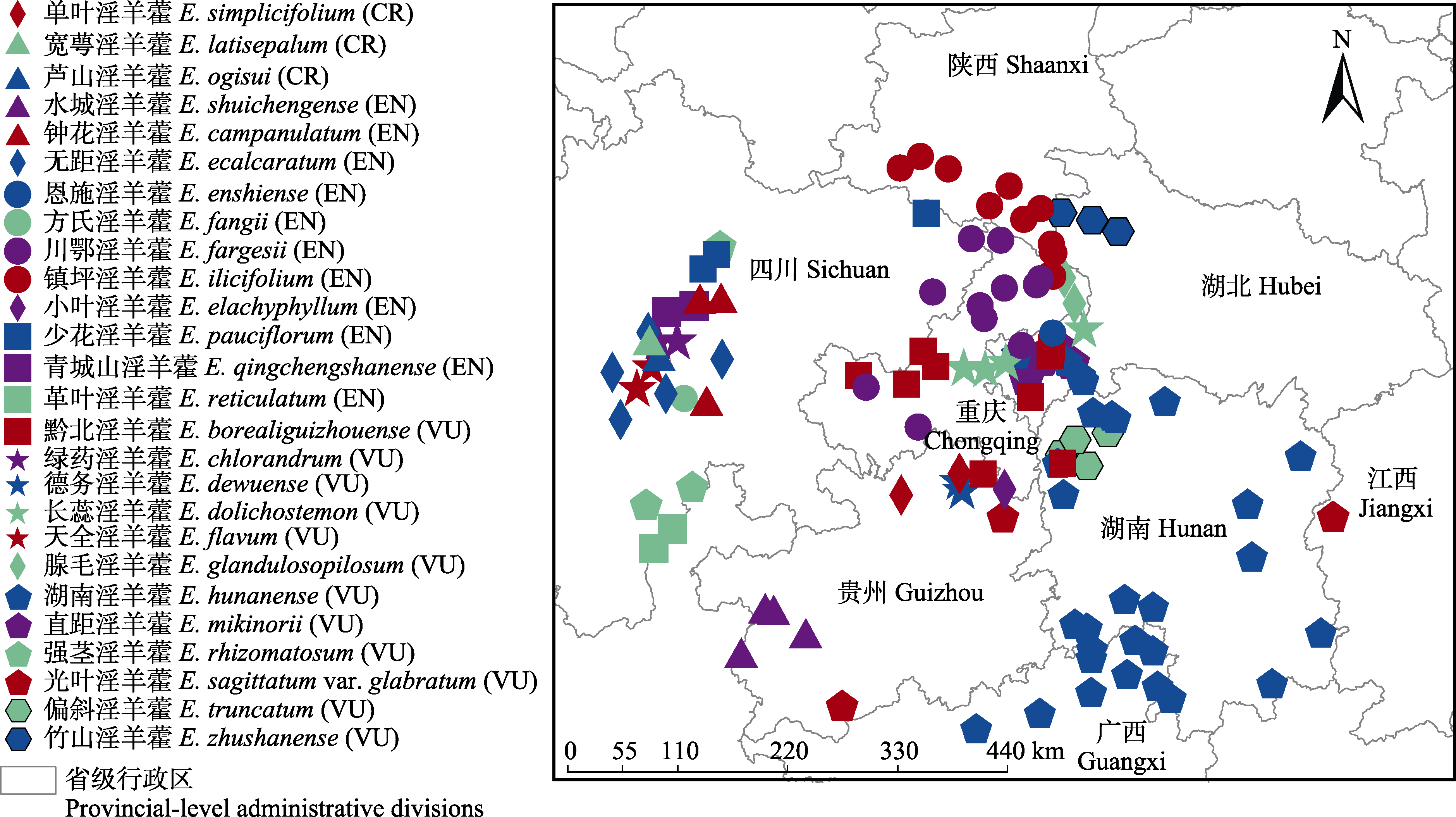
图1 淫羊藿属26个受威胁类群的地理分布。CR, 极危; EN, 濒危; VU, 易危。
Fig. 1 Distribution of 26 threatened taxa of Epimedium. CR, critically endangered; EN, endangered; VU, vulnerable.
| 类群 Taxa | 原濒危等级及评价标准 Original status and criteria | 更新的濒危等级及评估标准 Updated status and criteria | 等级和标准调整 Adjustment of status and criteria |
|---|---|---|---|
| 恩施淫羊藿 E. enshiense | EN, A3c | CR, B1ab (iii, v) |  |
| 方氏淫羊藿 E. fangii | EN, C1 | CR, B1ab (iii, v) |  |
| 小叶淫羊藿 E. parvifolium | EN, D | CR, B1ab (iii, v) |  |
| 革叶淫羊藿 E. reticulatum | EN, A3c | CR, B1ab (iii, v) |  |
| 天全淫羊藿 E. flavum | VU, A3c | EN, B1ab (iii, v) |  |
| 腺毛淫羊藿 E. glandulosopilosum | VU, C1 | EN, A3c; B1ab (iii, v) |  |
| 直距淫羊藿 E. mikinorii | VU, C1+2a (ii) | EN, B1ab (iii, v) |  |
| 光叶淫羊藿 E. sagittatum var. glabratum | VU, A3c | EN, A3c; B1ab (iii, v) |  |
| 偏斜淫羊藿 E. truncatum | VU, C1 | EN, B1ab (iii, v) |  |
| 竹山淫羊藿 E. zhushanense | VU, C1 | EN, B1ab (iii, v) |  |
| 无距淫羊藿 E. ecalcaratum | EN, C1+2a (ii) | EN, B1ab (ii, iii, v) |  |
| 镇坪淫羊藿 E. ilicifolium | EN, C1 | EN, A3c; B1ab (i, ii, iii, v) |  |
| 少花淫羊藿 E. pauciflorum | EN, C1 | EN, B1ab (i, ii, iii, v) |  |
| 青城山淫羊藿 E. qingchengshanense | EN, C1 | EN, B1ab (i, ii, iii, v) |  |
| 川鄂淫羊藿 E. fargesii | EN, A3c | VU, A3c |  |
| 单叶淫羊藿sy E. simplicifolium | CR, B1ab (i, ii, iii, v); D | VU, A3c |  |
| 绿药淫羊藿sy E. chlorandrum | VU, A2c+3c+4c; B1ab (iv) | VU, A3c |  |
| 强茎淫羊藿sy E. rhizomatosum | VU, A3c | VU, A3c C1 |  |
| 德务淫羊藿sy E. dewuense | VU, A3c | VU, B1ab (i, ii, iii, v) |  |
| 长蕊淫羊藿sy E. dolichostemon | VU, A3c | VU, B1ab (i, ii, iii, v) |  |
| 黔北淫羊藿sy E. borealiguizhouense | VU, A2c; B1ab (iii) | VU, A3c |  |
| 湖南淫羊藿 E. hunanense | VU, B1ab (iii) | VU, A3c |  |
表2 中国淫羊藿属22个受威胁类群濒危等级调整
Table 2 Adjustment of the IUCN (International Union for Conservation of Nature) status and criteria of the 22 threatened taxa of Epimedium in China
| 类群 Taxa | 原濒危等级及评价标准 Original status and criteria | 更新的濒危等级及评估标准 Updated status and criteria | 等级和标准调整 Adjustment of status and criteria |
|---|---|---|---|
| 恩施淫羊藿 E. enshiense | EN, A3c | CR, B1ab (iii, v) | |
| 方氏淫羊藿 E. fangii | EN, C1 | CR, B1ab (iii, v) | |
| 小叶淫羊藿 E. parvifolium | EN, D | CR, B1ab (iii, v) | |
| 革叶淫羊藿 E. reticulatum | EN, A3c | CR, B1ab (iii, v) | |
| 天全淫羊藿 E. flavum | VU, A3c | EN, B1ab (iii, v) | |
| 腺毛淫羊藿 E. glandulosopilosum | VU, C1 | EN, A3c; B1ab (iii, v) | |
| 直距淫羊藿 E. mikinorii | VU, C1+2a (ii) | EN, B1ab (iii, v) | |
| 光叶淫羊藿 E. sagittatum var. glabratum | VU, A3c | EN, A3c; B1ab (iii, v) | |
| 偏斜淫羊藿 E. truncatum | VU, C1 | EN, B1ab (iii, v) | |
| 竹山淫羊藿 E. zhushanense | VU, C1 | EN, B1ab (iii, v) | |
| 无距淫羊藿 E. ecalcaratum | EN, C1+2a (ii) | EN, B1ab (ii, iii, v) | |
| 镇坪淫羊藿 E. ilicifolium | EN, C1 | EN, A3c; B1ab (i, ii, iii, v) | |
| 少花淫羊藿 E. pauciflorum | EN, C1 | EN, B1ab (i, ii, iii, v) | |
| 青城山淫羊藿 E. qingchengshanense | EN, C1 | EN, B1ab (i, ii, iii, v) | |
| 川鄂淫羊藿 E. fargesii | EN, A3c | VU, A3c | |
| 单叶淫羊藿sy E. simplicifolium | CR, B1ab (i, ii, iii, v); D | VU, A3c | |
| 绿药淫羊藿sy E. chlorandrum | VU, A2c+3c+4c; B1ab (iv) | VU, A3c | |
| 强茎淫羊藿sy E. rhizomatosum | VU, A3c | VU, A3c C1 | |
| 德务淫羊藿sy E. dewuense | VU, A3c | VU, B1ab (i, ii, iii, v) | |
| 长蕊淫羊藿sy E. dolichostemon | VU, A3c | VU, B1ab (i, ii, iii, v) | |
| 黔北淫羊藿sy E. borealiguizhouense | VU, A2c; B1ab (iii) | VU, A3c | |
| 湖南淫羊藿 E. hunanense | VU, B1ab (iii) | VU, A3c | |
| [1] | Bao SY (1987). New taxa of Berberaceae from S. W. China. Acta Phytotaxonomica Sinica, 25, 150-159. |
| [包士英 (1987). 中国西南部小檗科新植物. 植物分类学报, 25, 150-159.] | |
| [2] | Belyaeva I, Kovtonyuk N (2021). The role of digital herbarium collections in the taxonomic revision of complex plant families: Salicaceae sensu stricto. BIO Web of Conferences, 38, 00014. DOI: 10.1051/bioconf/20213800014. |
| [3] |
Chen G, Sun WB (2018). The role of botanical gardens in scientific research, conservation, and citizen science. Plant Diversity, 40, 181-188.
DOI PMID |
| [4] | Cheng M, Yang G, Li Y, Huang LQ (2020). Brief description of the development report of Chinese traditional medicine resources in China. China Food & Drug Administration Magazine, (1), 4-11. |
| [程蒙, 杨光, 李颖, 黄璐琦 (2020). 《中国中药资源发展报告》简述. 中国食品药品监管 (1), 4-11.] | |
| [5] | China Report Hall (2024). Analysis of the market prospects of Epimedii folium in 2024: the global market size of Epimedii folium is about 5.9 billion US dollars. [2024-10-28]. https://m.chinabgao.com/info/1249413.html. |
| [中国报告大厅 (2024). 2024年淫羊藿市场前景分析: 全球淫羊藿市场规模约为59亿美元. [2024-10-28]. https://m.chinabgao.com/info/1249413.html.] | |
| [6] | Chinese Pharmacopoeia Commission (2020). Pharmacopoeia of the People’s Republic of China: Vol. I. China Medical Science and Technology Press, Beijing. |
| [国家药典委员会 (2020). 中华人民共和国药典: 一部. 中国医药科技出版社, 北京.] | |
| [7] |
Chuang HL, Kumar VB, Day CH, Ho CC, Ho TJ, Chen RJ, Padma VV, Kuo WW, Huang CY (2021). Epimedium promotes steroidogenesis by CREB activation-mediated mitochondrial fusion in endosulfan treated leydig cells. Environmental Toxicology, 36, 1873-1879.
DOI PMID |
| [8] |
Díaz S, Zafra-Calvo N, Purvis A, Verburg PH, Obura D, Leadley P, Chaplin-Kramer R, de Meester L, Dulloo E, Martín-López B, Shaw MR, Visconti P, Broadgate W, Bruford MW, Burgess ND, et al. (2020). Set ambitious goals for biodiversity and sustainability. Science, 370, 411-413.
DOI PMID |
| [9] | Dong HZ, Tang F, Zhao ZL, Huang WX, Wan XY, Hong ZY, Liu Y, Dong X, Chen S (2024). The bioactive compounds of Epimedium and their potential mechanism of action in treating osteoporosis: a network pharmacology and experimental validation study. Pharmaceuticals, 17, 706. DOI: 10.3390/ph17060706. |
| [10] | Dongye ZC, Wu XP, Wen YX, Ding XL, Wang CJ, Zhao TT, Li J, Wu YZ (2022). Icaritin and intratumoral injection of CpG treatment synergistically promote T cell infiltration and antitumor immune response in mice. International Immunopharmacology, 111, 109093. DOI: 10.1016/j.intimp. 2022.109093. |
| [11] | Editorial Committee of Flora of China,Chinese Academy of Sciences (2001). Flora Reipublicae Popularis Sinicae: Volume 29. Science Press, Beijing. |
| [中国科学院中国植物志编辑委员会 (2001). 中国植物志: 第29卷. 科学出版社, 北京.] | |
| [12] |
Guo BL, He SZ, Zhong GY, Xiao PG (2007). Two new species of Epimedium (Berberidaceae) from China. Acta Phytotaxonomica Sinica, 45, 813-821.
DOI URL |
| [郭宝林, 何顺志, 钟国跃, 肖培根 (2007). 中国淫羊藿属(小檗科)二新种. 植物分类学报, 45, 813-821.] | |
| [13] | Guo BL, Xiao PG (1993). The new taxa of the genus Epimedium. Acta Phytotaxonomica Sinica, 31, 194-196. |
| [郭宝林, 肖培根 (1993). 淫羊藿属的新分类群. 植物分类学报, 31, 194-196.] | |
| [14] | Guo MY, Pang XH, Xu YQ, Jiang WJ, Liao BS, Yu JS, Xu J, Song JY, Chen SL (2022). Plastid genome data provide new insights into the phylogeny and evolution of the genus Epimedium. Journal of Advanced Research, 36, 175-185. |
| [15] | Guo MY, Ren L, Xu YQ, Liao BS, Song JY, Li Y, Mantri N, Guo BL, Chen SL, Pang XH (2019). Development of plastid genomic resources for discrimination and classification of Epimedium wushanense (Berberidaceae). International Journal of Molecular Sciences, 20, 4003. DOI: 10.3390/ijms20164003. |
| [16] | Guo MY, Xu YQ, Ren L, He SZ, Pang AX (2018). A systematic study on DNA barcoding of medicinally important genus Epimedium L. (Berberidaceae). Genes, 9, 637. DOI: 10.3390/genes9120637. |
| [17] | Han GY, Song PL, Yu ML, Zhao HT, Chen Y (2013). The endemic and rare species and their protection value of Epimedium Linn. in Guizhou Province. Seed, 32(5), 53-57. |
| [韩国营, 宋培浪, 于美玲, 赵厚涛, 陈勇 (2013). 贵州省淫羊藿属(小檗科)特有和珍稀植物及其保护价值. 种子, 32(5), 53-57.] | |
| [18] |
Harris T, Mulligan M, Brummitt N (2021). Opportunities and challenges for herbaria in studying the spatial variation in plant functional diversity. Systematics and Biodiversity, 19, 322-332.
DOI URL |
| [19] | He SZ (1993). A new species on medicinal plants of Epimedium L. from Guizhou, China. Journal of Plant Resources and Environment, 2(4), 51-53. |
| [何顺志 (1993). 中国淫羊藿属药用植物一新种. 植物资源与环境, 2(4), 51-53.] | |
| [20] | He SZ (2014). The Genus Epimedium of China in Colour. Guizhou Science and Technology Publishing House, Guiyang. |
| [何顺志 (2014). 淫羊藿属中国植物彩色图鉴. 贵州科技出版社, 贵阳.] | |
| [21] | He SZ, Guo BL (1996). A new species of Epimedium (Berberidaceae) from Guizhou. Acta Botanica Yunnanica, 18, 209-210. |
| [何顺志, 郭宝林 (1996). 贵州淫羊藿属(小檗科)一新种. 云南植物研究, 18, 209-210.] | |
| [22] |
He SZ, Wang YY, Guo BL, Xu WF (2010). Epimedium Pudingense (Berberidaceae), a new species from Guizhou, China. Annales Botanici Fennici, 47, 226-228.
DOI URL |
| [23] | He SZ, Wang YY, Xu WF (2008). Studies on the species and geographical distribution of the genus Yangjiaoqi (Epimedium), a yang tonic of the Tujia family in the Wuling Mountains of China. Journal of Medicine & Pharmacy of Chinese Minorities, 14(5), 34-37. |
| [何顺志, 王悦云, 徐文芬 (2008). 中国武陵山区土家补阳药羊角七(淫羊藿)属种类与地理分布的研究. 中国民族医药杂志, 14(5), 34-37.] | |
| [24] | He SZ, Xu WF (2003). A new species of Epimedium (Berberidaceae) from Guizhou, China. Acta Botanica Yunnanica, 25, 281-282. |
| [何顺志, 徐文芬 (2003). 贵州淫羊藿属一新种(英文). 云南植物研究, 25, 281-282.] | |
| [25] | He SZ, Zhang TL (1994). A new species of medicinal plants of Epimedium L. from Guizhou. Guihaia, 14, 25-26. |
| [何顺志, 张天伦 (1994). 贵州淫羊藿属药用植物一新种. 广西植物, 14, 25-26.] | |
| [26] | He YM, Huang H, Jiang Y, Li RQ, Xu YQ (2020). Morphological variation pattern and supplementary description of Epimedium epsteinii. Guihaia, 40, 452-461. |
| [何益明, 黄华, 蒋勇, 李仁清, 徐艳琴 (2020). 紫距淫羊藿的形态变异式样及描述修订. 广西植物, 40, 452-461.] | |
| [27] |
Huang H, Han X, Kang L, Raven P, Jackson PW, Chen Y (2002). Conserving native plants in China. Science, 297, 935-936.
PMID |
| [28] | Huang HW, Raven PH, Wang LS, Liao JP, Zhan QQ (2023). China: The role of botanical gardens in conservation. Innovation, 4, 100433. DOI: 10.1016/j.xinn.2023.100433. |
| [29] |
Huang WC, Zhou XY, Ni ZY, Shao L (2015). An assessment of the extinction risk of Calanthe from China based on specimens and field observations. Biodiversity Science, 23, 493-498.
DOI URL |
|
[黄卫昌, 周翔宇, 倪子轶, 邵丽 (2015). 基于标本和分布信息评估中国虾脊兰属植物的濒危状况. 生物多样性, 23, 493-498.]
DOI |
|
| [30] | IUCN (International Union for Conservation of Nature) (2012a). IUCN Red List Categories and Criteria: Version 3.1. 2nd ed. IUCN, Gland, Switzerland. |
| [31] | IUCN (International Union for Conservation of Nature) (2012b). Guidelines for Application of IUCN Red List Criteria at Regional and National Levels, Version 4.0. Gland, Switzerland. |
| [32] |
Jiang JH, Ji Y, Li JQ, Zhang YJ (2023). Epimedium longnanense (Berberidaceae), a new species from Gansu, China. PhytoKeys, 219, 97-106.
DOI URL |
| [33] | Jiang Y (2020). Selection of Medicinal Germplasm of Epimedium L. Master degree dissertation, Jiangxi Univercity of Chinese Medicine, Nanchang. 44-63. |
| [蒋勇 (2020). 淫羊藿属药用种质筛选. 硕士学位论文, 江西中医药大学, 南昌. 44-63.] | |
| [34] | Liang HR, Yan WM (1990). New taxa of Epimedium L. from China. Acta Phytotaxonomica Sinica, 28, 321-324. |
| [梁海锐, 阎文玫 (1990). 淫羊藿属新植物. 植物分类学报, 28, 321-324.] | |
| [35] |
Liu SX, Liu LJ, Huang XF, Zhu YY, Xu YQ (2017). A taxonomic revision of three Chinese spurless species of genus Epimedium L. (Berberidaceae). PhytoKeys, 78, 23-36.
DOI URL |
| [36] | Liu SX, Shi HJ, Xu YQ (2016). Morphological comparison of the Epimedium franchetii Stearn species complex based on population observation and implications for taxonomy. Plant Science Journal, 34, 325-339. |
| [刘少雄, 石慧君, 徐艳琴 (2016). 基于居群观测的木鱼坪淫羊藿复合种形态比较和分类学启示. 植物科学学报, 34, 325-339.] | |
| [37] | Liu SX, Wang LJ, He PP, Hu SF, Zhang MH, He TT, Xu YQ (2021). Comment on the morphological taxonomic characters of genus Epimedium. Guihaia, 41, 1767-1783. |
| [刘少雄, 王李俊, 何平平, 胡生福, 张梅红, 何甜甜, 徐艳琴 (2021). 淫羊藿属植物形态分类性状评述. 广西植物, 41, 1767-1783.] | |
| [38] |
Mace GM, Lande R (1991). Assessing extinction threats: toward a reevaluation of IUCN threatened species categories. Conservation Biology, 5, 148-157.
DOI URL |
| [39] | Marselle MR, Hartig T, Cox DTC, Bell S, Knapp S, Lindley S, Triguero-Mas M, Böhning-Gaese K, Braubach M, Cook PA, de Vries S, Heintz-Buschart A, Hofmann M, Irvine KN, Kabisch N, et al. (2021). Pathways linking biodiversity to human health: a conceptual framework. Environment International, 150, 106420. DOI: 10.1016/j. envint.2021.106420. |
| [40] | Ministry of Ecology and Environment of the Peoples’s Republic of China (2023). Announcement on the release of the China Biodiversity Red List—Vertebrates Volume (2020) and the China Biodiversity Red List—Higher Plants Volume (2020). [2024-01-05]. https://www.mee.gov.cn/xxgk2018/xxgk/xxgk01/202305/t20230522_1030745.html. |
| [中华人民共和国生态环境部 (2023). 关于发布《中国生物多样性红色名录——脊椎动物卷(2020)》和《中国生物多样性红色名录——高等植物卷(2020)》的公告. [2024-01-05]. https://www.mee.gov.cn/xxgk2018/xxgk/xxgk01/202305/t20230522_1030745.html.] | |
| [41] | National Health Commission of the People’s Republic of China (2002). Circular of the Ministry of Health on further standardizing the management of health food raw materials (No. 51 of 2002)[EB/OL]. [2024-01-26]. http://www.Nhc.Gov.Cn/wjw/gfxwj/201304/e33435ce0d894051b15490aa3219cdc4.shtml. |
| [中华人民共和国国家卫生健康委员会 (2002). 卫生部关于进一步规范保健食品原料管理的通知(2002年第51号)[EB/OL]. [2024-01-26]. http://www.Nhc.Gov.Cn/wjw/gfxwj/201304/e33435ce0d894051b15490aa3219cdc4.shtml.] | |
| [42] | National Medical Products Administration (2022). 2021 Annual Review report. [2024-01-26]. https://www.nmpa.gov.cn/xxgk/fgwj/gzwj/gzwjyp/20220601110541120.html. |
| [国家药品监督管理局 (2022). 2021年度药品审评报告. [2024-01-26]. https://www.nmpa.gov.cn/xxgk/fgwj/gzwj/gzwjyp/20220601110541120.html.] | |
| [43] | Ni JB, Zheng XR, Ou JZ, He CM, Tong YH (2021). Investigation and analysis of medicinal plant resources in Huaiji County, Guangdong Province. Journal of Chinese Medicinal Materials, 44(1), 33-40. |
| [倪静波, 郑锡荣, 欧洁珍, 何春梅, 童毅华 (2021). 广东省怀集县药用植物资源调查分析. 中药材, 44(1), 33-40.] | |
| [44] | Nic Lughadha E, Walker BE, Canteiro C, Chadburn H, Davis AP, Hargreaves S, Lucas EJ, Schuiteman A, Williams E, Bachman SP, Baines D, Barker A, Budden AP, Carretero J, Clarkson JJ, et al. (2018). The use and misuse of herbarium specimens in evaluating plant extinction risks. Philosophical Transactions of the Royal Society B: Biological Sciences, 374, 20170402. DOI: 10.1098/rstb. 2017.0402. |
| [45] | Ogisu M (1996). Epimedium campanulatum (Berberidaceae) a new Chinese spurless species from Sichuan. Kew Bulletin, 51, 401. DOI: 10.2307/4119341. |
| [46] | Ogisu M, Rix M (2011). 713. Epimedium stearnii: Berberidaceae. Curtis’s Botanical Magazine, 28, 190-196. |
| [47] | Pitman NCA, Jørgensen PM (2002). Estimating the size of the world’s threatened flora. Science, 298, 989. DOI: 10.1126/science.298.5595.989. |
| [48] |
Qin HN, Yang Y, Dong SY, He Q, Jia Y, Zhao LN, Yu SX, Liu HY, Liu B, Yan YH, Xiang JY, Xia NH, Peng H, Li ZY, Zhang ZX, et al. (2017a). Threatened species list of China’s higher plant. Biodiversity Science, 25, 696-744.
DOI URL |
| [覃海宁, 杨永, 董仕勇, 何强, 贾渝, 赵莉娜, 于胜祥, 刘慧圆, 刘博, 严岳鸿, 向建英, 夏念和, 彭华, 李振宇, 张志翔, 等 (2017a). 中国高等植物受威胁物种名录. 生物多样性, 25, 696-744.] | |
| [49] |
Qin HN, Zhao LN, Yu SX, Liu HY, Liu B, Xia NH, Peng H, Li ZY, Zhang ZX, He XJ, Yin LK, Lin YL, Liu QR, Hou YT, Liu Y, et al. (2017b). Evaluating the endangerment status of China’s angiosperms through the red list assessment. Biodiversity Science, 25, 745-757.
DOI URL |
| [覃海宁, 赵莉娜, 于胜祥, 刘慧圆, 刘博, 夏念和, 彭华, 李振宇, 张志翔, 何兴金, 尹林克, 林余霖, 刘全儒, 侯元同, 刘演, 等 (2017b). 中国被子植物濒危等级的评估. 生物多样性, 25, 745-757.] | |
| [50] | Salgotra RK, Chauhan BS (2023). Genetic diversity, conservation, and utilization of plant genetic resources. Genes, 14, 174. DOI: 10.3390/genes14010174. |
| [51] |
Scherer-Lorenzen M, Gessner MO, Beisner BE, Messier C, Paquette A, Petermann JS, Soininen J, Nock CA (2022). Pathways for cross-boundary effects of biodiversity on ecosystem functioning. Trends in Ecology & Evolution, 37, 454-467.
DOI URL |
| [52] |
Sheng MY, Tian XJ (2011). A new species of Epimedium (Berberidaceae) with 24 chromosomes from Guizhou, China. Novon, 21, 262-265.
DOI URL |
| [53] | Soltis PS, Nelson G, James SA (2018). Green digitization: Online botanical collections data answering real-world questions. Applications in Plant Sciences, 6, e1028. DOI: 10.1002/aps3.1028. |
| [54] | Stearn WT (1990). Epimedium dolichostemon (Berberidaceae) and other Chinese species of Epimedium. Kew Bulletin, 45, 685-692. |
| [55] | Stearn WT (1993). New large-flowered Chinese species of Epimedium (Berberidaceae). Curtis’s Botanical Magazine, 10, 178-184. |
| [56] | Stearn WT (1995). New Chinese taxa of Epimedium (Berberidaceae) from Sichuan. Curtis’s Botanical Magazine, 12, 15-25. |
| [57] |
Stearn WT (1997). Four new Chinese species of Epimedium (Berberidaceae). Kew Bulletin, 52, 659-671.
DOI URL |
| [58] |
Stearn WT (1998). Four more Chinese species of Epimedium (Berberidaceae). Kew Bulletin, 53, 213-223.
DOI URL |
| [59] | Stearn WT (2002). The genus Epimedium and other herbaceous Berberidaceae. Including the genus Podophyllum. A Botanical Magazine Monograph. 20, 58-63. |
| [60] | Tang L, Yang J, Li Y, Luo L, Ding CB (2009). Species and distribution of genus Epimedium in Sichuan Province. Journal of Sichuan Agricultural University, 27, 284-288. |
| [汤利, 杨界, 李燕, 罗莉, 丁春邦 (2009). 四川淫羊藿属植物的种类及分布. 四川农业大学学报, 27, 284-288.] | |
| [61] | Tang Q, Li MX, Xiao SP, Li FQ, Hu SF, Liu Y, Shan ZJ, Xu YQ, Zhou Y (2025). Geographical distribution and potential distribution area prediction of Epimedium koreanum Nakai. and Epimedium brevicornu Maxim. in China. World Journal of Traditional Chinese Medicine, 20, 1465-1478. |
| [唐琴, 李梦雪, 肖苏萍, 李风琴, 胡生福, 刘勇, 单章建, 徐艳琴, 周银 (2025). 朝鲜淫羊藿和淫羊藿在中国的地理分布及潜在分布区预测研究. 世界中医药, 20, 1465-1478.] | |
| [62] | Tang Q, Peng XH, Tian SY, Wang CY, Zhou ZW, Xu YQ (2023). Study on resource distribution and morphological characteristics of Epimedium wushanense T. S. Ying. Journal of Chinese Medicinal Materials, 46, 1648-1654. |
| [唐琴, 彭昕桁, 田淑云, 王聪颖, 周紫薇, 徐艳琴 (2023). 巫山淫羊藿的资源分布及形态特征研究. 中药材, 46, 1648-1654.] | |
| [63] | Ter Steege H, Pitman NCA, Killeen TJ, Laurance WF, Peres CA, Guevara JE, Salomão RP, Castilho CV, Amaral IL, de Almeida Matos FD, de Souza Coelho L, Magnusson WE, Phillips OL, de Andrade Lima Filho D, de Jesus Veiga Carim M, et al. (2015). Estimating the global conservation status of more than 15,000 Amazonian tree species. Science Advances, 1, e1500936. DOI: 10.1126/sciadv. 1500936. |
| [64] | Theodoridis S, Drakou EG, Hickler T, Thines M, Nogues-Bravo D (2023). Evaluating natural medicinal resources and their exposure to global change. The Lancet Planetary Health, 7, e155-e163. |
| [65] |
Urban MC (2015). Accelerating extinction risk from climate change. Science, 348, 571-573.
DOI PMID |
| [66] | Wang S, Xie Y (2004). China Species Red List, Vol. 1: Red List. Higher Education Press, Beijing. |
| [汪松, 解焱 (2004). 中国物种红色名录, 第一卷: 红色名录. 高等教育出版社, 北京.] | |
| [67] | Wang YY, Xu WF, He SZ (2005). Research status of small-flowered taxa of Epimedium in China. Journal of Guiyang University of Chinese Medicine, 27(4), 6-9. |
| [王悦云, 徐文芬, 何顺志 (2005). 中国淫羊藿小花类群的研究现状. 贵阳中医学院学报, 27(4), 6-9.] | |
| [68] | Wang YY, Xu WF, He SZ (2017). Epimedium muhuangense (Berberidaceae), a new species from China. Phytotaxa, 319, 277-282. |
| [69] | Wei N, Zhang YJ, Xu Z, Kamande EM, Ngumbau VM, Hu GW (2017). Epimedium zhaotongense (Berberidaceae), a new species from Yunnan Province, China. Phytotaxa, 296, 88. DOI: 10.11646/phytotaxa.296.1.7. |
| [70] | Wei QD, Mo YQ, Li XB, Luo M, Zhang H, Zhang LN, Li J, Song ZY, Huo KY (2022). Research progress on distribution characteristics of Epimedium germplasm resources and pharmacological effects in China. Molecular Plant Breeding. http://kns.cnki.net/kcms/detail/46.1068.S.20221206.1838.003.html. |
| [韦启迪, 莫远琪, 黎小冰, 罗鸣, 张浩, 张丽娜, 李娟, 宋朱谕, 霍可以 (2022). 中国淫羊藿种质资源分布特点及其药理作用研究进展. 分子植物育种. http://kns.cnki.net/kcms/detail/46.1068.S.20221206.1838.003.html.] | |
| [71] | Wu GF, Qian SX (1985). A new species of Epimedium L. Acta Phytotaxonomica Sinica, 23, 71-72. |
| [吴国芳, 钱士心 (1985). 淫羊藿属一新种. 植物分类学报, 23, 71-72.] | |
| [72] | Wu H, Lien EJ, Lien LL (2003). Chemical and pharmacological investigations of Epimedium species: a survey. Progress in Drug Research, 60, 1-57. |
| [73] | Xi HC, Zhu H, Yu ZW, Zhang JL, Xiong BS (2014). Investigation of wild plant resources of Epimedium in Guizhou. Guizhou Agricultural Sciences, 42(11), 39-41. |
| [郗厚诚, 朱虹, 于子文, 张久磊, 熊碧声 (2014). 贵州淫羊藿属野生植物资源调查. 贵州农业科学, 42(11), 39-41.] | |
| [74] |
Xia GH, Li GY (2009). Epimedium jingzhouense sp. nov. (Berberidaceae) from Hunan, China. Nordic Journal of Botany, 27, 472-474.
DOI URL |
| [75] | Xiao PG, Zhao RH, Long XC, Guo BL (2009). Macroscopic analysis on production and marketing of medicinal material resources for sustainable development. China Journal of Chinese Materia Medica, 34, 2135-2139. |
| [肖培根, 赵润怀, 龙兴超, 郭宝林 (2009). 中药资源可持续发展产销情况的宏观分析. 中国中药杂志, 34, 2135-2139. | |
| [76] | Xie D, Liu HY, Qin HN (2022). New opportunities and challenges for data integration of plant type specimens. Guihaia, 42(S1), 46-51. |
| [谢丹, 刘慧圆, 覃海宁 (2022). 植物模式标本数据整合新的机遇与挑战. 广西植物, 42(S1), 46-51.] | |
| [77] | Xu WF, He SZ (2005). Species and geographic distribution of large-flowered taxa of Epimedium in China. Journal of Chinese Medicinal Materials, 28, 267-271. |
| [徐文芬, 何顺志 (2005). 中国淫羊藿大花类群的种类与地理分布. 中药材, 28, 267-271.] | |
| [78] |
Xu YQ, Cai WZ, Hu SF, Huang XH, Ge F, Wang Y (2013). Morphological variation of non-glandular hairs in cultivated Epimedium Sagittatum (Berberidaceae) populations and implications for taxonomy. Biodiversity Science, 21, 185-196.
DOI URL |
|
[徐艳琴, 蔡婉珍, 胡生福, 黄小虎, 葛菲, 王瑛 (2013). 箭叶淫羊藿同质园栽培居群非腺毛多样性及其分类学启示. 生物多样性, 21, 185-196.]
DOI |
|
| [79] | Xu YQ, Jiang Y, Huang H, Li RQ, Li FQ, Liu Y, Huang XF (2020a). Taxonomic study of Epimedium L. status, issues and prospect. Guihaia, 40, 601-617. |
| [徐艳琴, 蒋勇, 黄华, 李仁清, 李风琴, 刘勇, 黄小方 (2020a). 淫羊藿属分类学研究: 进展、问题与展望. 广西植物, 40, 601-617.] | |
| [80] | Xu YQ, Li RQ, Zhang HY, Li FQ, Jiang Y, Huang XF (2020b). Distribution of Epimedium sagittatum and its research progress on quality characteristics. Chinese Traditional and Herbal Drugs, 51, 6119-6132. |
| [徐艳琴, 李仁清, 张华雁, 李风琴, 蒋勇, 黄小方 (2020b). 箭叶淫羊藿的资源分布及质量特征研究进展. 中草药, 51, 6119-6132.] | |
| [81] | Xu YQ, Li ZZ, Zhang XJ, Chen JJ, Zhou JF, Wang Y (2008). Geographic distribution and resource status of three important medicinal Epimedium species. Journal of Wuhan Botanical Research, 26(1), 91-98. |
| [徐艳琴, 李作洲, 张学军, 陈建军, 周建峰, 王瑛 (2008). 三种药用淫羊藿的地理分布与资源调查. 武汉植物学研究, 26(1), 91-98.] | |
| [82] |
Xu YQ, Liu LJ, Liu SX, He YM, Li RQ, Ge F (2019). The taxonomic relevance of flower colour for Epimedium (Berberidaceae), with morphological and nomenclatural notes for five species from China. PhytoKeys, 118, 33-64.
DOI URL |
| [83] | Xu YQ, Xu Y, Liu Y, Ge F (2014a). Progress and open problems in classical taxonomic research on Epimedium L. Chinese Traditional and Herbal Drugs, 45, 569-577. |
| [徐艳琴, 许瑛, 刘勇, 葛菲 (2014a). 淫羊藿属经典分类学研究进展及存在的问题. 中草药, 45, 569-577.] | |
| [84] | Xu YQ, Xu Y, Shi HJ, Hu SF, Ge F (2014b). Taxonomic research on Epimedium sagittatum species complex and discussion. Chinese Traditional and Herbal Drugs, 45, 3343-3350. |
| [徐艳琴, 许瑛, 石慧君, 胡生福, 葛菲 (2014b). 箭叶淫羊藿复合体的分类问题及讨论. 中草药, 45, 3343-3350.] | |
| [85] | Yan KJ (1994). A new species of Epimedium from Sichuan. Guihaia, 14, 124-125. |
| [严克俭 (1994). 四川淫羊藿属一新种. 广西植物, 14, 124-125.] | |
| [86] | Ying JS (1975). On the Chinese species of Epimedium L. Acta Phytotaxonomica Sinica, 13, 49-56. |
| [应俊生 (1975). 中国淫羊藿属植物的种类和分布. 植物分类学报, 13, 49-56.] | |
| [87] | Ying JS, Boufford DE, Brach AR (2011). Flora of China (Vol. 19). Science Press, Beijing. |
| [88] | Ying JS (2002). Petal evolution and distribution patterns of Epimedium L. (Berberidaceae). Acta Phytotaxonomica Sinica, 40, 481-489. |
| [应俊生 (2002). 淫羊藿属(小檗科)花瓣的演化和地理分布格局的研究. 植物分类学报, 40, 481-489.] | |
| [89] | Yun SA, Son HD, Im HT, Kim SC (2020). Genetic diversity and population structure of the endangered orchid Pelatantheria scolopendrifolia (Orchidaceae) in Korea. PLoS ONE, 15, e0237546. DOI: 10.1371/journal.pone. 0237546. |
| [90] |
Zang CX, Cai L, Li JQ, Wu XP, Li XG, Li JS (2016). Preparation of the China Biodiversity Red List and its significance for biodiversity conservation within China. Biodiversity Science, 24, 610-614.
DOI URL |
|
[臧春鑫, 蔡蕾, 李佳琦, 吴晓莆, 李晓光, 李俊生 (2016). 《中国生物多样性红色名录》的制定及其对生物多样性保护的意义. 生物多样性, 24, 610-614.]
DOI |
|
| [91] |
Zhang C, Liu X, Nie ZL, Meng Y, Guo BL, Liu QR (2024). Epimedium daiguii (Berberidaceae), a new species from Central China. Phytotaxa, 634, 79-84.
DOI URL |
| [92] |
Zhang DG, Deng T, King C, Zhang JW, Nie ZL, Sun H (2015a). Epimedium tianmenshanensis (Berberidaceae), a new species from Central China. Phytotaxa, 222, 33-43.
DOI URL |
| [93] |
Zhang ML, Uhink CH, Kadereit JW (2007). Phylogeny and biogeography of Epimedium/Vancouveria (Berberidaceae): Western North American-East Asian disjunctions, the origin of European mountain plant taxa, and East Asian species diversity. Systematic Botany, 32, 81-92.
DOI URL |
| [94] |
Zhang YJ, Dang HS, Li JQ, Wang Y (2014). The Epimedium wushanense (Berberidaceae) species complex, with one new species from Sichuan, China. Phytotaxa, 172, 39-45.
DOI URL |
| [95] |
Zhang YJ, Dang HS, Li JQ, Wang Y (2015b). Taxonomic notes on three species of Epimedium (Berberidaceae) endemic to China. Phytotaxa, 204, 147-152.
DOI URL |
| [96] |
Zhang YJ, Dang HS, Li SY, Li JQ, Wang Y (2015c). Five new synonyms in Epimedium (Berberidaceae) from China. PhytoKeys, 49, 1-12.
DOI URL |
| [97] |
Zhang YJ, Dang HS, Wang Y, Li XW, Li JQ (2011). A taxonomic revision of unifoliolate Chinese Epimedium L. (Berberidaceae). Kew Bulletin, 66, 253-262.
DOI URL |
| [98] |
Zhang YJ, Li JQ (2009). A new species of Epimedium (Berberidaceae) from Hubei, China. Novon, 19, 567-569.
DOI URL |
| [99] | Zhang YJ, Zhang SJ, Dang HS, Zheng B, Li JQ, Wang Y (2016). Epimedium xichangense (Berberidaceae), a new species from Sichuan, China. Phytotaxa, 263, 286. DOI: 10.11646/phytotaxa.263.3.9. |
| [100] | Zhang ZX, Shang C (2024). Ex situ conservation: from living plant conservation to seed bank. Biodiversity Science, 32, 16-17. |
| [张志翔, 尚策 (2024). 迁地保护: 从植物活体保存到种子库. 生物多样性, 32, 16-17.] | |
| [101] | Zhong GY (1991). A new species of Epimedium from Sichuan. Acta Phytotaxonomica Sinica, 29, 89-91. |
| [钟国跃 (1991). 四川淫羊藿属一新种. 植物分类学报, 29, 89-91.] | |
| [102] | Zuo YW, Wang SX, Wang X, Deng HP, Lv XY, Xia CY (2023). Epimedium jinfoshanensis (Berberidaceae), a new species from Chongqing, China. Pakistan Journal of Botany, 55, 1521-1525. |
| [1] | 刘碧颖, 陈子豪, 源思浩, 周婷. 植被志书研编中图表绘制的常见问题与技术参考[J]. 植物生态学报, 2025, 49(6): 911-921. |
| [2] | 韦丹丹, 杜燕, 包维楷, 胡斌, 张瀚曰, 王瀚婕, 唐圆圆, 黄龙, 郭昌安, 刘鑫. 冬麻豆群落的地理分布、特征和分类[J]. 植物生态学报, 2025, 49(10): 1698-1709. |
| [3] | 杨玲, 梁思琪, 潘佳明, 韦金鑫, 丁涛, 蒋日红, 邵毅贞, 张宪春, 刘勇波, 向巧萍. 濒危植物百山祖冷杉和资源冷杉的物种划分及其遗传资源的保护[J]. 植物生态学报, 2023, 47(12): 1629-1645. |
| [4] | 胡菀,张志勇,陈陆丹,彭焱松,汪旭. 末次盛冰期以来观光木的潜在地理分布变迁[J]. 植物生态学报, 2020, 44(1): 44-55. |
| [5] | 姜炎彬, 邵小明. 叶附生苔植物物种多样性分布格局及生态成因[J]. 植物生态学报, 2016, 40(5): 523-532. |
| [6] | 郭彦龙, 卫海燕, 路春燕, 张海龙, 顾蔚. 气候变化下桃儿七潜在地理分布的预测[J]. 植物生态学报, 2014, 38(3): 249-261. |
| [7] | 王璐,雷耘,张明理. 基于序列trnL-trnF和ITS的榉属系统发育与地理分布格局的初步分析[J]. 植物生态学报, 2013, 37(5): 407-414. |
| [8] | 吴建国, 周巧富. 中国嵩草属植物地理分布模式和适应的气候特征[J]. 植物生态学报, 2012, 36(3): 199-221. |
| [9] | 李晓笑, 陶翠, 王清春, 崔国发. 中国亚热带地区4种极危冷杉属植物的地理分布特征及其与气候的关系[J]. 植物生态学报, 2012, 36(11): 1154-1164. |
| [10] | 王娟, 倪健. 中国北方温带地区5种锦鸡儿植物的分布模拟[J]. 植物生态学报, 2009, 33(1): 12-24. |
| [11] | 徐晓婷, 杨永, 王利松. 白豆杉的地理分布及潜在分布区估计[J]. 植物生态学报, 2008, 32(5): 1134-1145. |
| [12] | 王铁娟, 杨持, 马静, 乔淑军, 尹俊. 籽蒿的地理分布与遗传分化[J]. 植物生态学报, 2005, 29(1): 122-127. |
| [13] | 蒋霞, 倪健. 西北干旱区10种荒漠植物地理分布与大气候的关系及其可能潜在分布区的估测[J]. 植物生态学报, 2005, 29(1): 98-107. |
| [14] | 王克晶, 李福山, 曹永立, 周涛. 河北省野生大豆种群若干数量性状结构特征[J]. 植物生态学报, 2001, 25(3): 351-358. |
| [15] | 贺善安, 郝日明. 中国鹅掌揪自然种群动态及其致危生境的研究[J]. 植物生态学报, 1999, 23(1): 87-95. |
| 阅读次数 | ||||||
|
全文 |
|
|||||
|
摘要 |
|
|||||
Copyright © 2026 版权所有 《植物生态学报》编辑部
地址: 北京香山南辛村20号, 邮编: 100093
Tel.: 010-62836134, 62836138; Fax: 010-82599431; E-mail: apes@ibcas.ac.cn, cjpe@ibcas.ac.cn
备案号: 京ICP备16067583号-19

