
植物生态学报 ›› 2025, Vol. 49 ›› Issue (9): 1556-1568.DOI: 10.17521/cjpe.2024.0362 cstr: 32100.14.cjpe.2024.0362
• 研究论文 • 上一篇
滕安萍1, 刘明慧1, 高广磊1,2,3,4,5,*( )(
)( ), 丁国栋1,3,4,5, 张英1,4,5, 李启研1
收稿日期:2024-10-20
接受日期:2025-08-25
出版日期:2025-09-20
发布日期:2025-09-23
通讯作者:
*高广磊: ORCID: 0000-0002-0486-1532 (gaoguanglei@bjfu.edu.cn)基金资助:
TENG An-Ping1, LIU Ming-Hui1, GAO Guang-Lei1,2,3,4,5,*()(), DING Guo-Dong1,3,4,5, ZHANG Ying1,4,5, LI Qi-Yan1
Received:2024-10-20
Accepted:2025-08-25
Online:2025-09-20
Published:2025-09-23
Supported by:摘要:
土壤真菌-细菌群落的相互作用对于维持微生境平衡至关重要。然而, 目前对于真菌-细菌群落共现模式的主要调控因素尚不清楚。为揭示科尔沁沙地樟子松(Pinus sylvestris var. mongolica)人工林土壤真菌-细菌群落间相互作用, 以中龄、近熟和成熟樟子松人工林土壤为研究对象, 以沙质草地为对照, 基于16S rRNA高通量测序技术, 采用分子生态网络分析法比较分析樟子松人工林土壤真菌-细菌网络特征及其影响因素。研究结果表明: (1)随林龄增加, 土壤真菌-细菌网络复杂性降低。中龄林真菌-细菌群落交互最密集, 网络抗干扰能力最强, 稳定性最高。与樟子松人工林相比, 沙质草地土壤真菌-细菌网络更复杂。人工林和沙质草地均以细菌群落间的协同关系为主, 表明细菌群落间的相互作用更加密集。(2)关键节点在不同林龄土壤真菌-细菌网络中存在差异且均为细菌运算分类单元(OTU)。中龄林网络关键节点最多, 其中变形菌门的关键节点占比最大。酸杆菌门在中龄林和近熟林共生网络中均为关键节点, 表明变形菌门和酸杆菌门在维持真菌-细菌网络稳定中起关键作用, 而沙质草地未识别到关键节点。(3)人工林土壤真菌-细菌网络复杂性主要受土壤速效磷含量和土壤含水量的影响, 网络稳定性与土壤有机质和速效磷含量显著相关。研究结果有助于深入理解科尔沁沙地樟子松人工林土壤真菌-细菌共现网络特征, 服务樟子松人工林的可持续经营管理。
滕安萍, 刘明慧, 高广磊, 丁国栋, 张英, 李启研. 科尔沁沙地不同林龄樟子松人工林土壤真菌-细菌共现模式. 植物生态学报, 2025, 49(9): 1556-1568. DOI: 10.17521/cjpe.2024.0362
TENG An-Ping, LIU Ming-Hui, GAO Guang-Lei, DING Guo-Dong, ZHANG Ying, LI Qi-Yan. Soil fungal-bacterial co-occurrence network of Pinus sylvestris var. mongolica plantation in Horqin Desert. Chinese Journal of Plant Ecology, 2025, 49(9): 1556-1568. DOI: 10.17521/cjpe.2024.0362
| 样地 Plot | 林龄 Stand age (a) | 平均树高 Average height (m) | 平均胸径 Average DBH (cm) | 林分密度 Stand density (plant·hm-2) | 郁闭度 Canopy density |
|---|---|---|---|---|---|
| HQh | 26 | 10.26 ± 1.47 | 16.93 ± 2.81 | 1 650 | 0.72 |
| HQn | 33 | 10.61 ± 1.03 | 14.06 ± 2.44 | 1 650 | 0.75 |
| HQm | 43 | 11.12 ± 1.74 | 21.07 ± 1.02 | 1 650 | 0.68 |
| HQG | - | - | - | - | 0.75 |
表1 科尔沁沙地樟子松人工林研究样地概况(平均值±标准差)
Table 1 Basic characteristics of the sample areas of Pinus sylvestris var. mongolica plantation in Horqin Desert (mean ± SD)
| 样地 Plot | 林龄 Stand age (a) | 平均树高 Average height (m) | 平均胸径 Average DBH (cm) | 林分密度 Stand density (plant·hm-2) | 郁闭度 Canopy density |
|---|---|---|---|---|---|
| HQh | 26 | 10.26 ± 1.47 | 16.93 ± 2.81 | 1 650 | 0.72 |
| HQn | 33 | 10.61 ± 1.03 | 14.06 ± 2.44 | 1 650 | 0.75 |
| HQm | 43 | 11.12 ± 1.74 | 21.07 ± 1.02 | 1 650 | 0.68 |
| HQG | - | - | - | - | 0.75 |
| 引物 Primer | 引物序列(5′-3′) Primer sequence (5′-3′) | 目标基因 Target genes | 目标区 Target area | |
|---|---|---|---|---|
| 细菌 Bacteria | 338F | CCTACGGGAGGCAGCAG | 16S | V3-V4 |
| 806R | ATTACCGCGGCTGCTGG | |||
| 真菌 Fungi | ITS1F | CTTGGTCATTTAGACGAAGTAA | ITS | ITS1 |
| ITS2 | GCTGCGTTCTTCATCGATGC |
表2 土壤细菌和真菌引物信息
Table 2 Soil bacterial and fungal primer information
| 引物 Primer | 引物序列(5′-3′) Primer sequence (5′-3′) | 目标基因 Target genes | 目标区 Target area | |
|---|---|---|---|---|
| 细菌 Bacteria | 338F | CCTACGGGAGGCAGCAG | 16S | V3-V4 |
| 806R | ATTACCGCGGCTGCTGG | |||
| 真菌 Fungi | ITS1F | CTTGGTCATTTAGACGAAGTAA | ITS | ITS1 |
| ITS2 | GCTGCGTTCTTCATCGATGC |
| 拓扑参数 Topological parameter | HQG | HQh | HQn | HQm | |
|---|---|---|---|---|---|
| 经验网络 Empirical networks | 节点 Node | 757 | 1 369 | 1 200 | 873 |
| 边 Edge | 6 551 | 9 901 | 3 169 | 2 275 | |
| 正相关 Positive (%) | 99.69 | 99.23 | 99.18 | 99.16 | |
| 负相关 Negative (%) | 0.31 | 0.77 | 0.82 | 0.84 | |
| 平均度 Average degree | 17.308 | 14.465 | 5.282 | 5.212 | |
| 图直径 Graph diameter | 44 | 37 | 29 | 18 | |
| 图密度 Graph density | 0.023 | 0.011 | 0.004 | 0.006 | |
| 平均路径长度 Average path distance | 14.746 | 14.512 | 9.020 | 4.574 | |
| 聚类系数 Clustering coefficient | 0.771 | 0.745 | 0.596 | 0.700 | |
| 模块化 Modularity | 0.801 | 0.647 | 0.865 | 0.813 | |
| 随机网络 Random networks | 平均路径长度 Average path distance | 2.640 | 2.967 | 4.452 | 4.275 |
| 平均聚类系数 Average clustering coefficient | 0.022 | 0.011 | 0.004 | 0.007 | |
| 模块化 Modularity | 0.200 | 0.220 | 0.426 | 0.427 | |
表3 科尔沁沙地樟子松人工林土壤真菌-细菌网络和随机网络拓扑参数
Table 3 Soil fungal-bacterial networks and random network topological parameters of Pinus sylvestris var. mongolica plantation in Horqin Desert
| 拓扑参数 Topological parameter | HQG | HQh | HQn | HQm | |
|---|---|---|---|---|---|
| 经验网络 Empirical networks | 节点 Node | 757 | 1 369 | 1 200 | 873 |
| 边 Edge | 6 551 | 9 901 | 3 169 | 2 275 | |
| 正相关 Positive (%) | 99.69 | 99.23 | 99.18 | 99.16 | |
| 负相关 Negative (%) | 0.31 | 0.77 | 0.82 | 0.84 | |
| 平均度 Average degree | 17.308 | 14.465 | 5.282 | 5.212 | |
| 图直径 Graph diameter | 44 | 37 | 29 | 18 | |
| 图密度 Graph density | 0.023 | 0.011 | 0.004 | 0.006 | |
| 平均路径长度 Average path distance | 14.746 | 14.512 | 9.020 | 4.574 | |
| 聚类系数 Clustering coefficient | 0.771 | 0.745 | 0.596 | 0.700 | |
| 模块化 Modularity | 0.801 | 0.647 | 0.865 | 0.813 | |
| 随机网络 Random networks | 平均路径长度 Average path distance | 2.640 | 2.967 | 4.452 | 4.275 |
| 平均聚类系数 Average clustering coefficient | 0.022 | 0.011 | 0.004 | 0.007 | |
| 模块化 Modularity | 0.200 | 0.220 | 0.426 | 0.427 | |
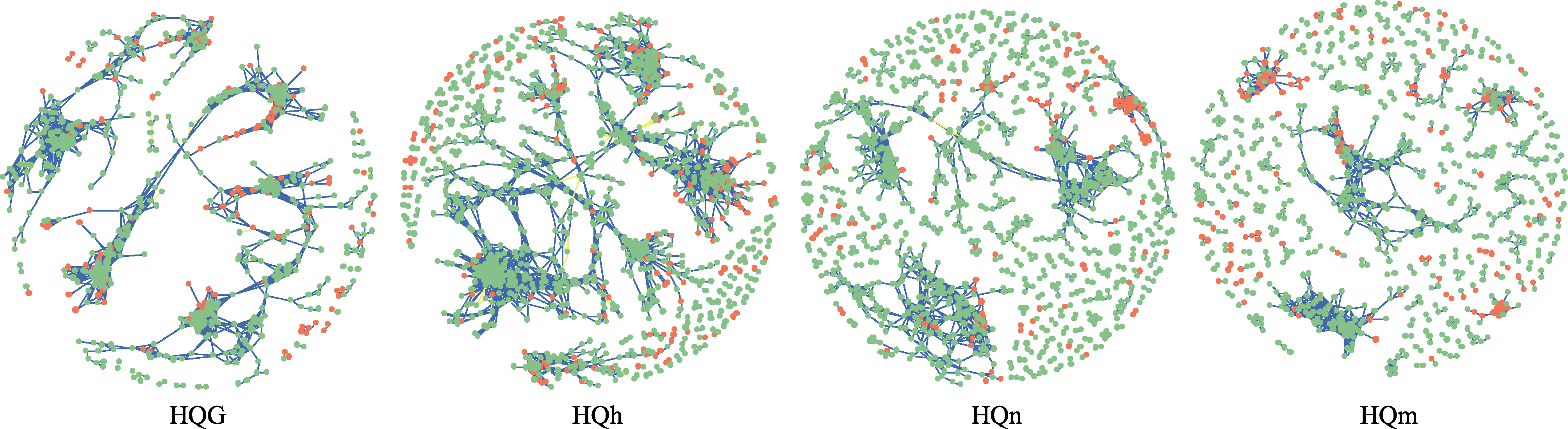
图1 科尔沁沙地樟子松人工林土壤真菌-细菌网络。红点表示真菌, 绿点代表细菌, 蓝线为正相关, 黄线为负相关。HQG, 草地; HQh, 中龄林; HQm, 成熟林; HQn, 近熟林。
Fig. 1 Soil fungal-bacterial network of Pinus sylvestris var. mongolica plantation in Horqin Desert. The red dots represent fungi, the green dots represent bacteria, the blue lines are positively correlated, and the yellow lines are negatively correlated. HQG, grassland; HQh, half-matured forest; HQm, mature forest; HQn, near-mature forest.
| 样地 Plot | 细菌间正相关 Positive correlation between bacteria | 细菌与真菌正相关 Positive correlation between bacteria and fungi | 真菌间正相关 Positive correlation between fungi | 细菌间负相关 Negative correlation between bacteria | 细菌与真菌负相关 Negative correlation between bacteria and fungi | 真菌间负相关 Negative correlation between fungi |
|---|---|---|---|---|---|---|
| HQG | 3 658 | 2 312 | 561 | 15 | 5 | 0 |
| HQh | 6 402 | 2 805 | 618 | 66 | 10 | 0 |
| HQn | 2 465 | 416 | 262 | 25 | 1 | 0 |
| HQm | 1 567 | 486 | 203 | 8 | 9 | 2 |
表4 科尔沁沙地樟子松人工林土壤真菌-细菌网络相互作用特征
Table 4 Interaction characteristics of soil fungal-bacterial network of Pinus sylvestris var. mongolica plantation in Horqin Desert
| 样地 Plot | 细菌间正相关 Positive correlation between bacteria | 细菌与真菌正相关 Positive correlation between bacteria and fungi | 真菌间正相关 Positive correlation between fungi | 细菌间负相关 Negative correlation between bacteria | 细菌与真菌负相关 Negative correlation between bacteria and fungi | 真菌间负相关 Negative correlation between fungi |
|---|---|---|---|---|---|---|
| HQG | 3 658 | 2 312 | 561 | 15 | 5 | 0 |
| HQh | 6 402 | 2 805 | 618 | 66 | 10 | 0 |
| HQn | 2 465 | 416 | 262 | 25 | 1 | 0 |
| HQm | 1 567 | 486 | 203 | 8 | 9 | 2 |
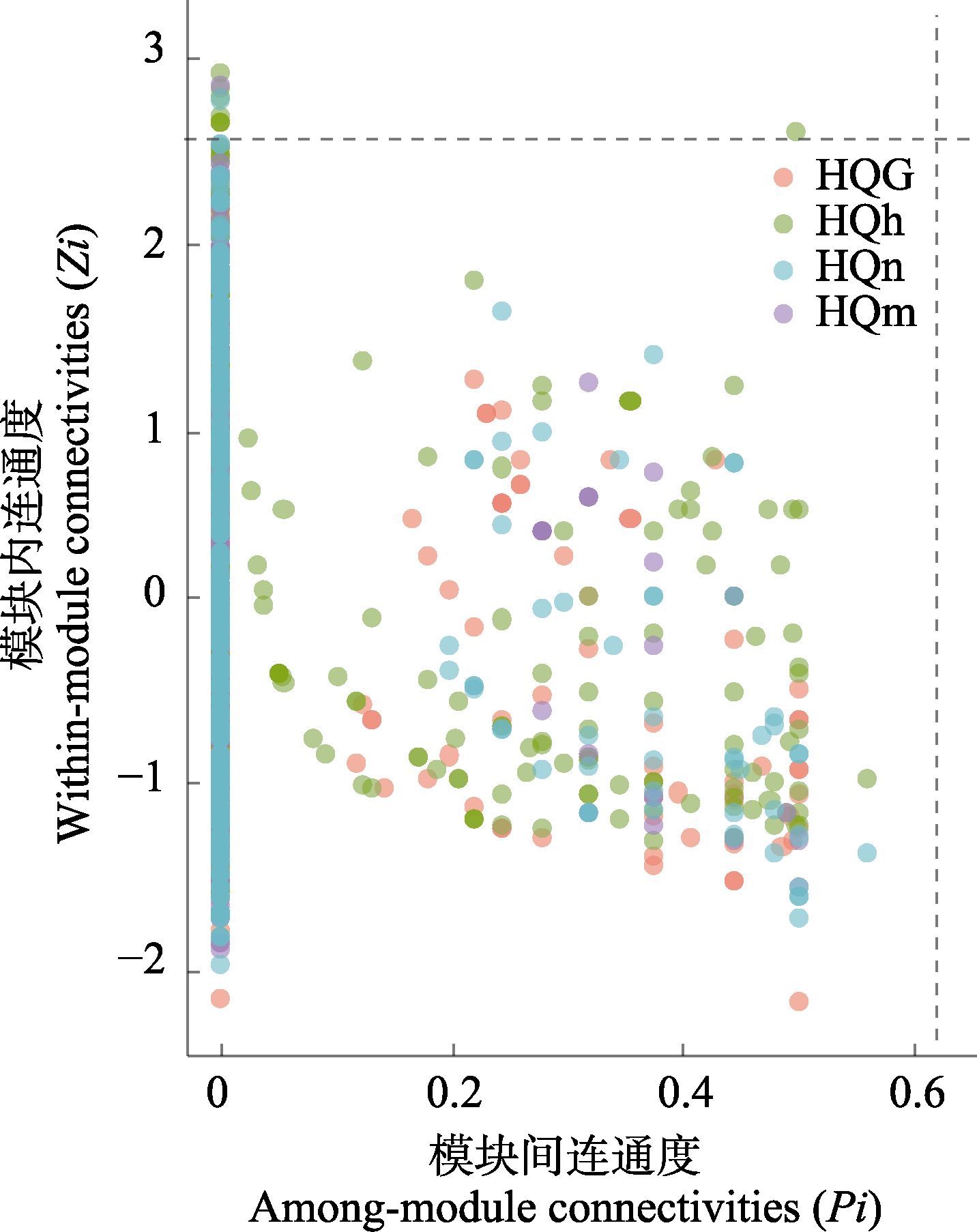
图2 科尔沁沙地樟子松人工林土壤真菌-细菌网络关键节点。HQG, 草地; HQh, 中龄林; HQm, 成熟林; HQn, 近熟林。
Fig. 2 Key nodes of soil fungal-bacterial network of Pinus sylvestris var. mongolica plantation in Horqin Desert. HQG, grassland; HQh, half-matured forest; HQm, mature forest; HQn, near-mature forest.
| 样地 Plot | OTU | 门 Phylum | 纲 Class | 目 Order | 科 Family | 属 Genus | 功能类型 Functional type |
|---|---|---|---|---|---|---|---|
| HQG | - | - | - | - | - | - | - |
| HQh | OTU 1191 | 变形菌门 Proteobacteria | δ变形菌纲 Deltaproteobacteria | SAR324_ cladeMarine_ group_B | - | - | 未知 Unassigned |
| OTU 1432 | 变形菌门 Proteobacteria | δ变形菌纲 Deltaproteobacteria | 硫还原菌目 Desulfurellales | 硫还原菌科 Desulfurellaceae | G55 | 硫呼吸, 硫化物的呼吸 Sulfur respiration, respiration of sulfur compounds | |
| OTU 2119 | 变形菌门 Proteobacteria | δ变形菌纲 Deltaproteobacteria | 黏球菌目 Myxococcales | 海藻科 Haliangiaceae | 黏细菌属 Haliangium | 捕食型或寄生型 Predatory or exoparasitic | |
| OTU 218 | 变形菌门 Proteobacteria | γ变形菌纲 Gammaproteobacteria | 黄单胞菌目 Xanthomonadales | 黄色单胞菌科 Xanthomonadaceae | - | 未知 Unassigned | |
| OTU 232 | 蓝藻门 Cyanobacteria | 黑水仙菌纲 Melainabacteria | 红色杆菌目 Obscuribacterales | - | - | 非光合蓝藻 Non-photosynthetic cyanobacteria | |
| OTU 74 | 变形菌门 Proteobacteria | γ变形菌纲 Gammaproteobacteria | 黄单胞菌目 Xanthomonadales | 黄单胞菌科 Xanthomonadaceae | 砂单胞菌属 Arenimonas | 好氧化能异养, 化能异养 Aerobic chemoheterotrophy, chemoheterotrophy | |
| OTU 895 | 单糖菌门 Saccharibacteria | - | - | - | - | 未知 Unassigned | |
| OTU 903 | 酸杆菌门 Acidobacteria | 索利氏菌纲 Solibacteres | 土菌目 Solibacterales | Solibacteraceae_ Subgroup_3 | - | 未知 Unassigned | |
| HQn | OTU 1623 | 酸杆菌门 Acidobacteria | Subgroup_6 | - | - | - | 未知 Unassigned |
| HQm | OTU 1095 | 匿杆菌门 Latescibacteria | - | - | - | - | 未知 Unassigned |
表5 科尔沁沙地樟子松人工林土壤真菌-细菌网络关键功能类型
Table 5 Functional type of soil fungal-bacterial network of Pinus sylvestris var. mongolica plantation in Horqin Desert
| 样地 Plot | OTU | 门 Phylum | 纲 Class | 目 Order | 科 Family | 属 Genus | 功能类型 Functional type |
|---|---|---|---|---|---|---|---|
| HQG | - | - | - | - | - | - | - |
| HQh | OTU 1191 | 变形菌门 Proteobacteria | δ变形菌纲 Deltaproteobacteria | SAR324_ cladeMarine_ group_B | - | - | 未知 Unassigned |
| OTU 1432 | 变形菌门 Proteobacteria | δ变形菌纲 Deltaproteobacteria | 硫还原菌目 Desulfurellales | 硫还原菌科 Desulfurellaceae | G55 | 硫呼吸, 硫化物的呼吸 Sulfur respiration, respiration of sulfur compounds | |
| OTU 2119 | 变形菌门 Proteobacteria | δ变形菌纲 Deltaproteobacteria | 黏球菌目 Myxococcales | 海藻科 Haliangiaceae | 黏细菌属 Haliangium | 捕食型或寄生型 Predatory or exoparasitic | |
| OTU 218 | 变形菌门 Proteobacteria | γ变形菌纲 Gammaproteobacteria | 黄单胞菌目 Xanthomonadales | 黄色单胞菌科 Xanthomonadaceae | - | 未知 Unassigned | |
| OTU 232 | 蓝藻门 Cyanobacteria | 黑水仙菌纲 Melainabacteria | 红色杆菌目 Obscuribacterales | - | - | 非光合蓝藻 Non-photosynthetic cyanobacteria | |
| OTU 74 | 变形菌门 Proteobacteria | γ变形菌纲 Gammaproteobacteria | 黄单胞菌目 Xanthomonadales | 黄单胞菌科 Xanthomonadaceae | 砂单胞菌属 Arenimonas | 好氧化能异养, 化能异养 Aerobic chemoheterotrophy, chemoheterotrophy | |
| OTU 895 | 单糖菌门 Saccharibacteria | - | - | - | - | 未知 Unassigned | |
| OTU 903 | 酸杆菌门 Acidobacteria | 索利氏菌纲 Solibacteres | 土菌目 Solibacterales | Solibacteraceae_ Subgroup_3 | - | 未知 Unassigned | |
| HQn | OTU 1623 | 酸杆菌门 Acidobacteria | Subgroup_6 | - | - | - | 未知 Unassigned |
| HQm | OTU 1095 | 匿杆菌门 Latescibacteria | - | - | - | - | 未知 Unassigned |
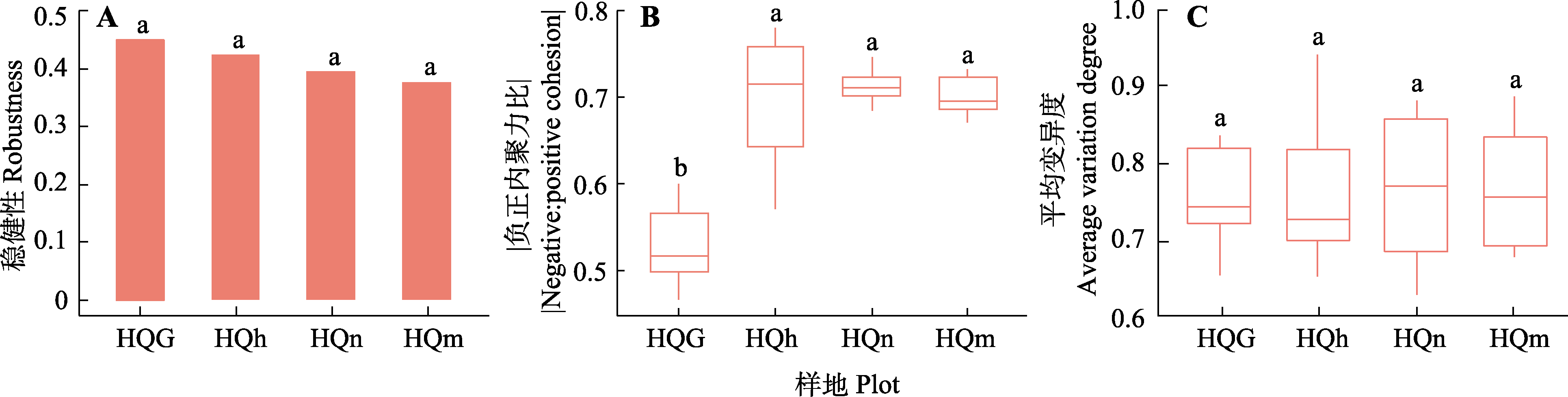
图3 科尔沁沙地樟子松人工林土壤真菌-细菌网络稳定性特征。不同小写字母表示不同林龄土壤真菌-细菌网络稳定性存在显著差异(p < 0.05)。HQG, 草地; HQh, 中龄林; HQm, 成熟林; HQn, 近熟林。
Fig. 3 Stability characteristics of soil fungal-bacterial network of Pinus sylvestris var. mongolica plantation in Horqin Desert. Different lowercase letters indicated that there were significant differences in the stability of soil fungal-bacterial network at different stand ages (p < 0.05). HQG, grassland; HQh, half-matured forest; HQm, mature forest; HQn, near-mature forest.
| 土壤因子 Soil factor | HQG | HQh | HQn | HQm |
|---|---|---|---|---|
| 含水量 Water content (%) | 6.13 ± 1.18b | 7.37 ± 0.99a | 6.75 ± 0.91ab | 5.79 ± 0.35b |
| pH | 6.54 ± 1.11a | 6.46 ± 0.35a | 6.65 ± 0.78a | 6.16 ± 0.47a |
| 全氮含量 Total nitrogen content (g·kg-1) | 0.60 ± 0.11a | 0.61 ± 0.06a | 0.64 ± 0.11a | 0.27 ± 0.17b |
| 全磷含量 Total phosphorus content (g·kg-1) | 0.09 ± 0.02a | 0.08 ± 0.03a | 0.11 ± 0.05a | 0.12 ± 0.03a |
| 有机质含量 Organic matter content (g·kg-1) | 1.69 ± 0.39c | 3.63 ± 1.74bc | 6.00 ± 3.33ab | 7.49 ± 3.45a |
| 铵态氮含量 Ammonia nitrogen content (mg·kg-1) | 4.98 ± 0.74a | 4.72 ± 1.24a | 4.32 ± 0.74a | 4.41 ± 0.58a |
| 硝态氮含量 Nitrate nitrogen content (mg·kg-1) | 3.60 ± 1.72b | 3.77 ± 0.77b | 3.78 ± 0.45b | 6.59 ± 2.89a |
| 速效磷含量 Available phosphorus content (g·kg-1) | 12.49 ± 1.22a | 2.31 ± 0.48b | 2.15 ± 0.60b | 2.73 ± 1.78b |
| 速效钾含量 Available kalium content (mg·kg-1) | 60.96 ± 31.92a | 67.33 ± 7.68a | 30.76 ± 11.89b | 29.23 ± 5.58b |
表6 科尔沁沙地樟子松人工林土壤理化性质
Table 6 Soil physical and chemical properties of Pinus sylvestris var. mongolica plantation in Horqin Desert
| 土壤因子 Soil factor | HQG | HQh | HQn | HQm |
|---|---|---|---|---|
| 含水量 Water content (%) | 6.13 ± 1.18b | 7.37 ± 0.99a | 6.75 ± 0.91ab | 5.79 ± 0.35b |
| pH | 6.54 ± 1.11a | 6.46 ± 0.35a | 6.65 ± 0.78a | 6.16 ± 0.47a |
| 全氮含量 Total nitrogen content (g·kg-1) | 0.60 ± 0.11a | 0.61 ± 0.06a | 0.64 ± 0.11a | 0.27 ± 0.17b |
| 全磷含量 Total phosphorus content (g·kg-1) | 0.09 ± 0.02a | 0.08 ± 0.03a | 0.11 ± 0.05a | 0.12 ± 0.03a |
| 有机质含量 Organic matter content (g·kg-1) | 1.69 ± 0.39c | 3.63 ± 1.74bc | 6.00 ± 3.33ab | 7.49 ± 3.45a |
| 铵态氮含量 Ammonia nitrogen content (mg·kg-1) | 4.98 ± 0.74a | 4.72 ± 1.24a | 4.32 ± 0.74a | 4.41 ± 0.58a |
| 硝态氮含量 Nitrate nitrogen content (mg·kg-1) | 3.60 ± 1.72b | 3.77 ± 0.77b | 3.78 ± 0.45b | 6.59 ± 2.89a |
| 速效磷含量 Available phosphorus content (g·kg-1) | 12.49 ± 1.22a | 2.31 ± 0.48b | 2.15 ± 0.60b | 2.73 ± 1.78b |
| 速效钾含量 Available kalium content (mg·kg-1) | 60.96 ± 31.92a | 67.33 ± 7.68a | 30.76 ± 11.89b | 29.23 ± 5.58b |
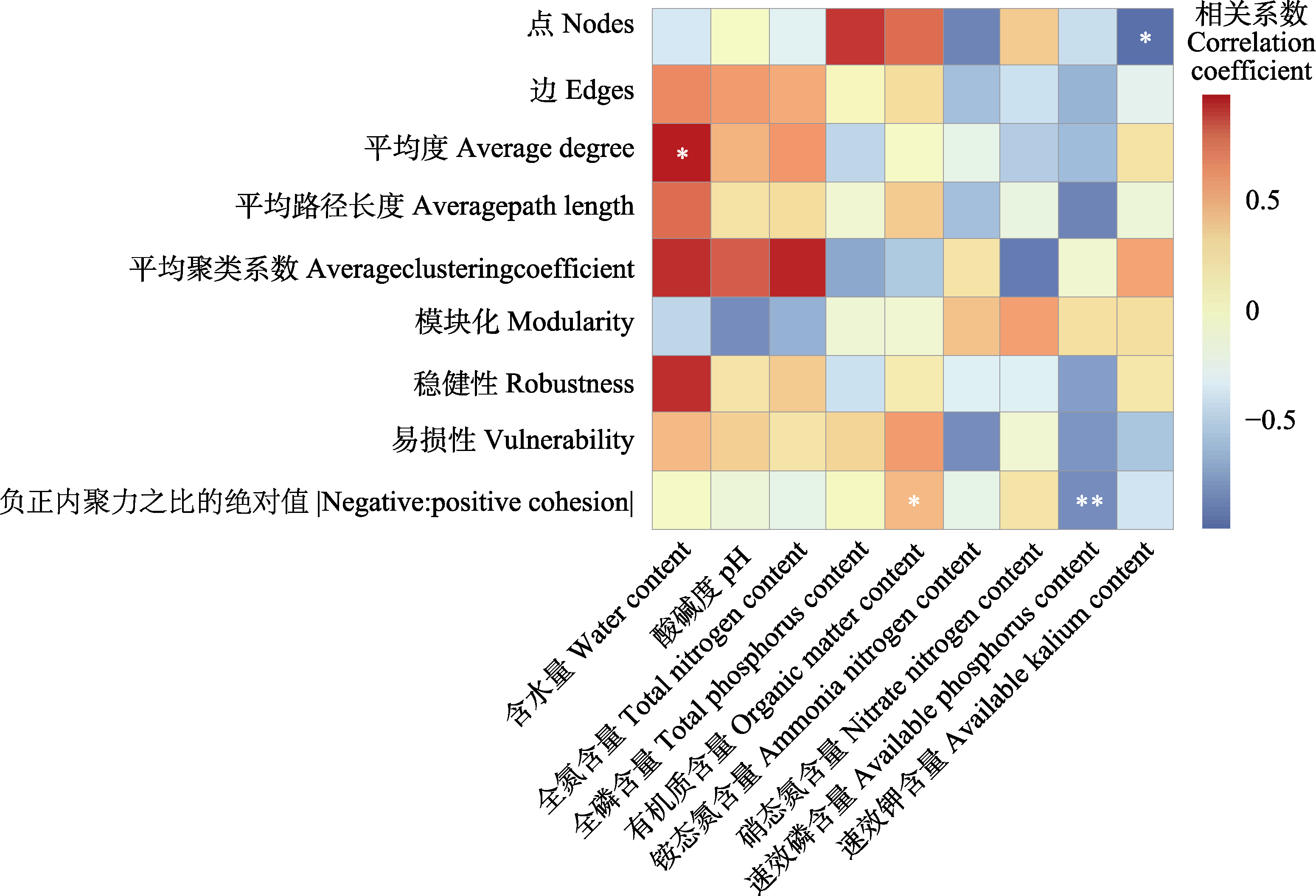
图4 科尔沁沙地樟子松人工林土壤真菌-细菌网络特征与土壤因子相关性。*, p < 0.05, 表示相关性显著; **, p < 0.01, 表示相关性极显著。热图中橙色代表正相关关系, 蓝色代表负相关关系。
Fig. 4 Correlation between soil fungal-bacterial network characteristics and soil characteristics of Pinus sylvestris var. mongolica plantation in Horqin Desert. * indicates significant correlation (p < 0.05); ** indicates extremely significant correlation (p < 0.01). In the heat map, orange represents the positive correlation, and blue represents the negative correlation.
| [1] |
Aizen MA, Sabatino M, Tylianakis JM (2012). Specialization and rarity predict nonrandom loss of interactions from mutualist networks. Science, 335, 1486-1489.
DOI PMID |
| [2] |
Angel R, Soares MIM, Ungar ED, Gillor O (2010). Biogeography of soil archaea and bacteria along a steep precipitation gradient. The ISME Journal, 4, 553-563.
DOI URL |
| [3] | Bai J, Sun XK, Xu CB, Ma XP, Huang Y, Fan ZP, Cao XY (2022). Effects of sewage sludge application on plant growth and soil characteristics at a Pinus sylvestris var. mongolica plantation in Horqin Sandy Land. Forests, 13, 984. DOI: 10.3390/f13070984. |
| [4] |
Banerjee S, Walder F, Büchi L, Meyer M, Held AY, Gattinger A, Keller T, Charles R, van der Heijden MGA(2019). Agricultural intensification reduces microbial network complexity and the abundance of keystone taxa in roots. The ISME Journal, 13, 1722-1736.
DOI URL |
| [5] |
Bao TL, Liu JL, Yuan F, Li YL, Jia ZY, Pan CC (2024). Response of plant community to experimental warming in Horqin Sandy Land. Journal of Desert Research, 44(1), 151-160.
DOI |
|
[包天玲, 刘继亮, 苑峰, 李寅龙, 贾振宇, 潘成臣 (2024). 科尔沁沙质草地植物群落对增温的响应. 中国沙漠, 44(1), 151-160.]
DOI |
|
| [6] |
Barberán A, Bates ST, Casamayor EO, Fierer N (2012). Using network analysis to explore co-occurrence patterns in soil microbial communities. The ISME Journal, 6, 343-351.
DOI URL |
| [7] | Caporaso JG, Lauber CL, Walters WA, Berg-Lyons D, Lozupone CA, Turnbaugh PJ, Fierer N, Knight R (2011). Global patterns of 16S rRNA diversity at a depth of millions of sequences per sample. Proceedings of the National Academy of Sciences of the United States of America, 108, 4516-4522. |
| [8] | Chen YC, Chi JH, Lu XY, Cai YJ, Jiang H, Zhang QF, Zhang KR (2023). Fungal-bacterial composition and network complexity determine soil multifunctionality during ecological restoration. Catena, 230, 107251. DOI: 10.1016/j.catena.2023.107251. |
| [9] |
Chow CT, Kim DY, Sachdeva R, Caron DA, Fuhrman JA (2014). Top-down controls on bacterial community structure: microbial network analysis of bacteria, T4-like viruses and protists. The ISME Journal, 8, 816-829.
DOI URL |
| [10] | Dahlstrom KM, McRose DL, Newman DK (2020). Keystone metabolites of crop rhizosphere microbiomes. Current Biology, 30, R1131-R1137. |
| [11] |
de Vries FT, Griffiths RI, Bailey M, Craig H, Girlanda M, Gweon HS, Hallin S, Kaisermann A, Keith AM, Kretzschmar M, Lemanceau P, Lumini E, Mason KE, Oliver A, Ostle N, et al. (2018). Soil bacterial networks are less stable under drought than fungal networks. Nature Communications, 9, 3033. DOI: 10.1038/s41467-018-05516-7.
PMID |
| [12] |
Delgado-Baquerizo M, Maestre FT, Reich PB, Jeffries TC, Gaitan JJ, Encinar D, Berdugo M, Campbell CD, Singh BK (2016). Microbial diversity drives multifunctionality in terrestrial ecosystems. Nature Communications, 7, 10541. DOI: 10.1038/ncomms10541.
PMID |
| [13] | Deng MF, Hu SJ, Guo LL, Jiang L, Huang YY, Schmid B, Liu C, Chang PF, Li S, Liu XJ, Ma KP, Liu LL (2023). Tree mycorrhizal association types control biodiversity-productivity relationship in a subtropical forest. Science Advances, 9, eadd4468. DOI: 10.1126/sciadv.add4468. |
| [14] |
Deng Y, Jiang YH, Yang YF, He ZL, Luo F, Zhou JZ (2012). Molecular ecological network analyses. BMC Bioinformatics, 13, 113. DOI: 10.1186/1471-2105-13-113.
PMID |
| [15] | Ding YP, Du YJ, Gao GL, Zhang Y, Cao HY, Zhu BB, Yang SY, Zhang JX, Qiu Y, Liu HL (2021). Soil bacterial community structure and functional prediction of Pinus sylvestris var. mongolica plantations in the Hulun Buir Sandy Land. Acta Ecologica Sinica, 41, 4131-4139. |
| [丁钰珮, 杜宇佳, 高广磊, 张英, 曹红雨, 朱宾宾, 杨思远, 张儆醒, 邱业, 刘惠林 (2021). 呼伦贝尔沙地樟子松人工林土壤细菌群落结构与功能预测. 生态学报, 41, 4131-4139.] | |
| [16] | Du Y, Yang Y, Wu SN, Gao XX, He XQ, Dong SK (2025). Core microbes regulate plant-soil resilience by maintaining network resilience during long-term restoration of alpine grasslands. Nature Communications, 16, 3116. DOI: 10.1038/s41467-025-58080-2. |
| [17] | Du YJ, Gao GL, Chen LH, Ding GD, Zhang Y, Cao HY (2019). Soil bacteria community structure and function prediction in the Hulun Buir Sandy Area. China Environmental Science, 39, 4840-4848. |
| [杜宇佳, 高广磊, 陈丽华, 丁国栋, 张英, 曹红雨 (2019). 呼伦贝尔沙区土壤细菌群落结构与功能预测. 中国环境科学, 39, 4840-4848.] | |
| [18] | Fan RY, Ye SM, Wu H, Li ZH, Li LX, Yu CH (2024). Characteristics of changes in soil bacterial community structure and functional diversity in Eucalyptus sp. plantation of different ages. Journal of Beijing Forestry University, 46(12), 41-52. |
| [樊容源, 叶绍明, 吴昊, 李梓华, 李林欣, 余春和 (2024). 不同林龄桉树人工林土壤细菌群落结构与功能多样性变化特征. 北京林业大学学报, 46(12), 41-52.] | |
| [19] |
Fierer N (2017). Embracing the unknown: disentangling the complexities of the soil microbiome. Nature Reviews Microbiology, 15, 579-590.
DOI PMID |
| [20] |
Frey SD, Lee J, Melillo JM, Six J (2013). The temperature response of soil microbial efficiency and its feedback to climate. Nature Climate Change, 3, 395-398.
DOI |
| [21] |
Greenblum S, Turnbaugh PJ, Borenstein E (2012). Metagenomic systems biology of the human gut microbiome reveals topological shifts associated with obesity and inflammatory bowel disease. Proceedings of the National Academy of Sciences of the United States of America, 109, 594-599.
DOI PMID |
| [22] |
Hassani MA, Durán P, Hacquard S (2018). Microbial interactions within the plant holobiont. Microbiome, 6, 58. DOI: 10.1186/s40168-018-0445-0.
PMID |
| [23] | He YH, Huang YH, Lu RM, Yang RS, Wei YN, Liang WH (2024). Responses of avocado rhizosphere soil microbial community and its co-occurrence network to root rot disease. Journal of Central South University of Forestry & Technology, 44(4), 106-115. |
| [何应会, 黄耀恒, 陆荣民, 杨日升, 韦燕妮, 梁文汇 (2024). 油梨根际土壤微生物群落及其共生网络对根腐病的响应. 中南林业科技大学学报, 44(4), 106-115.] | |
| [24] |
Hernandez DJ, David AS, Menges ES, Searcy CA, Afkhami ME (2021). Environmental stress destabilizes microbial networks. The ISME Journal, 15, 1722-1734.
DOI URL |
| [25] |
Herren CM, McMahon KD (2017). Cohesion: a method for quantifying the connectivity of microbial communities. The ISME Journal, 11, 2426-2438.
DOI URL |
| [26] |
Hirano H, Takemoto K (2019). Difficulty in inferring microbial community structure based on co-occurrence network approaches. BMC Bioinformatics, 20, 329. DOI: 10.1186/s12859-019-2915-1.
PMID |
| [27] | Lang MH, Zhang RS, Fan SH, Xiao W, Jiang T, Lu Y, Li SY, Liu SQ (2024). Carbon sequestration function of Pinus sylvestris var. mongolica plantation and its responses to climate factors on the southern edge of Horqin Sandy Land. Journal of Soil and Water Conservation, 38(4), 236-245. |
| [郎明翰, 张日升, 凡胜豪, 肖巍, 姜涛, 卢元, 李书杨, 刘思琪 (2024). 科尔沁沙地南缘樟子松人工林碳汇及对气候因子的响应. 水土保持学报, 38(4), 236-245.] | |
| [28] | Lang MH, Zhang XL, Zhang SH, Fan SH, Zhang RS (2025). Study on the change trend and driving mechanism of groundwater depth in the Horqin Sandy Land. Journal of Soil and Water Conservation, 39(4), 129-138. |
| [郎明翰, 张学利, 张诗行, 凡胜豪, 张日升 (2025). 科尔沁沙地地下水埋深变化趋势及驱动机制. 水土保持学报, 39(4), 129-138.] | |
| [29] | Li BQ, Xu R, Sun XX, Han F, Xiao EZ, Chen L, Qiu L, Sun WM (2021). Microbiome-environment interactions in antimony-contaminated rice paddies and the correlation of core microbiome with arsenic and antimony contamination. Chemosphere, 263, 128227. DOI: 10.1016/j.chemosphere.2020.128227. |
| [30] | Li DD, Li JW, Gao GL, Zhang Y, Ren Y, Liu Y, Zhao PS (2023). Soil fungal community structure and functional characteristics associated with Pinus sylvestris var. mongolica plantations in the Horqin Sandy Land. Journal of Desert Research, 43(4), 241-251. |
|
[李丹丹, 李佳文, 高广磊, 张英, 任悦, 柳叶, 赵珮杉 (2023). 科尔沁沙地樟子松(Pinus sylvestris var. mongolia)人工林土壤真菌群落结构和功能特征. 中国沙漠, 43(4), 241-251.]
DOI |
|
| [31] | Liang XL, Liang XX, Mao XY, Chai BF, Jia T (2024). Distribution pattern and influencing factors of bacterial communities in different soil depths of Caragana jubata shurb in Luya Mountain, China. Chinese Journal of Applied Ecology, 35, 381-389. |
|
[梁雪丽, 梁晓霞, 毛晓雅, 柴宝峰, 贾彤 (2024). 芦芽山鬼箭锦鸡儿灌丛不同深度土壤细菌群落分布格局及其影响因素. 应用生态学报, 35, 381-389.]
DOI |
|
| [32] |
Lin YX, Ye GP, Kuzyakov Y, Liu DY, Fan JB, Ding WX (2019). Long-term manure application increases soil organic matter and aggregation, and alters microbial community structure and keystone taxa. Soil Biology & Biochemistry, 134, 187-196.
DOI URL |
| [33] |
Liu JP, Tang YJ, Bao JS, Wang HK, Peng FR, Chen MY, Tan PP (2022). Pecan plantation age influences the structures, ecological networks, and functions of soil microbial communities. Land Degradation & Development, 33, 3294-3309.
DOI URL |
| [34] | Liu Y, Ren Y, Gao GL, Ding GD, Zhang Y, Zhao PS, Wang JY (2023). Network features of root-associated fungi of Pinus sylvestris var. mongolica plantations and response to climate factors in the Mu Us Desert. Acta Scientiarum Naturalium Universitatis Pekinensis, 59, 467-477. |
| [柳叶, 任悦, 高广磊, 丁国栋, 张英, 赵珮杉, 王家源 (2023). 毛乌素沙地樟子松人工林根内真菌网络动态特征及其对气候因子的响应. 北京大学学报(自然科学版), 59, 467-477.] | |
| [35] | Lu H, Zhao H, Sheng YY, Cong W, Wang XL, Li DQ, Zhang YG (2018). Soil prokaryotic community characteristics in two alpine meadow types based on high-throughput sequencing techniques. Acta Ecologica Sinica, 38, 8080-8087. |
| [卢慧, 赵珩, 盛玉钰, 丛微, 王秀磊, 李迪强, 张于光 (2018). 基于高通量测序的两种高寒草甸土壤原核生物群落特征研究. 生态学报, 38, 8080-8087.] | |
| [36] | Luo ZM, Liu JX, He L, Zhou YY, Li MH, Zheng QR, Chai BF (2023). Revealing the effects of subalpine meadow degradation on soil microbial communities by molecular ecological network analyses. Acta Ecologica Sinica, 43, 7435-7447. |
| [罗正明, 刘晋仙, 赫磊, 周妍英, 李眉红, 郑庆荣, 柴宝峰 (2023). 基于分子生态学网络探究亚高山草甸退化对土壤微生物群落的影响. 生态学报, 43, 7435-7447.] | |
| [37] | Lupatini M, Suleiman AKA, Jacques RJS, Antoniolli ZI, de Siqueira Ferreira A, Kuramae EE, Roesch LFW (2014). Network topology reveals high connectance levels and few key microbial genera within soils. Frontiers in Environmental Science, 2, 10. DOI: 10.3389/fenvs.2014.00010. |
| [38] |
Ma B, Wang HZ, Dsouza M, Lou J, He Y, Dai ZM, Brookes PC, Xu JM, Gilbert JA (2016). Geographic patterns of co-occurrence network topological features for soil microbiota at continental scale in Eastern China. The ISME Journal, 10, 1891-1901.
DOI URL |
| [39] | Ma L, Zhang JB, Li ZQ, Xin XL, Guo ZB, Wang DZ, Li DC, Zhao BZ (2020). Long-term phosphorus deficiency decreased bacterial-fungal network complexity and efficiency across three soil types in China as revealed by network analysis. Applied Soil Ecology, 148, 103506. DOI: 10.1016/j.apsoil.2020.103506. |
| [40] |
Martin KJ, Rygiewicz PT (2005). Fungal-specific PCR primers developed for analysis of the ITS region of environmental DNA extracts. BMC Microbiology, 5, 28. DOI: 10.1186/1471-2180-5-28.
PMID |
| [41] |
Morriën E, Hannula SE, Snoek LB, Helmsing NR, Zweers H, de Hollander M, Soto RL, Bouffaud ML, Buée M, Dimmers W, Duyts H, Geisen S, Girlanda M, Griffiths RI, Jørgensen HB, et al. (2017). Soil networks become more connected and take up more carbon as nature restoration progresses. Nature Communications, 8, 14349. DOI: 10.1038/ncomms14349.
PMID |
| [42] |
Mougi A, Kondoh M (2012). Diversity of interaction types and ecological community stability. Science, 337, 349-351.
DOI PMID |
| [43] |
Newman MEJ (2006). Modularity and community structure in networks. Proceedings of the National Academy of Sciences of the United States of America, 103, 8577-8582.
DOI PMID |
| [44] |
Pepe-Ranney C, Campbell AN, Koechli CN, Berthrong S, Buckley DH (2016). Unearthing the ecology of soil microorganisms using a high resolution DNA-SIP approach to explore cellulose and xylose metabolism in soil. Frontiers in Microbiology, 7, 703. DOI: 10.3389/fmicb.2016.00703.
PMID |
| [45] |
Qiu LP, Zhang Q, Zhu HS, Reich PB, Banerjee S, van der Heijden MGA, Sadowsky MJ, Ishii S, Jia XX, Shao MA, Liu BY, Jiao H, Li HQ, Wei XR (2021). Erosion reduces soil microbial diversity, network complexity and multifunctionality. The ISME Journal, 15, 2474-2489.
DOI URL |
| [46] | Ren Y, Gao GL, Ding GD, Zhang Y, Guo MS, Cao HY, Su M (2019). Stoichiometric characteristics of nitrogen and phosphorus in leaf-litter-soil system of Pinus sylvestris var. mongolica plantations. Chinese Journal of Applied Ecology, 30, 743-750. |
|
[任悦, 高广磊, 丁国栋, 张英, 郭米山, 曹红雨, 苏敏 (2019). 沙地樟子松人工林叶片-枯落物-土壤氮磷化学计量特征. 应用生态学报, 30, 743-750.]
DOI |
|
| [47] | Su BW, Gao C, Ji JC, Zhang H, Zhang YL, Mouazen AM, Shao SS, Jiao H, Yi SW, Li SF (2024). Soil bacterial succession with different land uses along a millennial chronosequence derived from the Yangtze River flood plain. Science of the Total Environment, 908, 168531. DOI: 10.1016/j.scitotenv.2023.168531. |
| [48] | Tan L, Zeng WA, Xiao YS, Li PF, Gu SS, Wu SL, Zhai ZG, Feng K, Deng Y, Hu QL (2021). Fungi-bacteria associations in wilt diseased rhizosphere and endosphere by interdomain ecological network analysis. Frontiers in Microbiology, 12, 722626. DOI: 10.3389/fmicb.2021.722626. |
| [49] |
Ulm F, Gouveia C, Dias T, Cruz C (2017). N fertilization in a Mediterranean ecosystem alters N and P turnover in soil, roots and the ectomycorrhizal community. Soil Biology & Biochemistry, 113, 60-70.
DOI URL |
| [50] | Wang CQ, Kuzyakov Y (2024). Mechanisms and implications of bacterial-fungal competition for soil resources. The ISME Journal, 18, wrae073. DOI: 10.1093/ismejo/wrae073. |
| [51] |
Wang DD, Huang YF, Yang HJ (2023). Differences of bacterial community co-occurrence network and assembly processes between sediment and water in lakes on the Qinghai-Tibet Plateau. Journal of Lake Sciences, 35, 959-971.
DOI URL |
| [王丹丹, 黄跃飞, 杨海娇 (2023). 青藏高原湖泊沉积物与水体细菌群落共发生网络和群落构建过程差异解析. 湖泊科学, 35, 959-971.] | |
| [52] | Wang JY, Yin XL, Ren Y, Gao GL, Ding GD, Zhang Y, Zhao PS, Guo MS (2020). Diversity characteristics of ectomycorrhizal fungi associated with Pinus sylvestris var. mongolica in the Mu Us sandy land. Microbiology China, 47, 3856-3867. |
| [王家源, 殷小琳, 任悦, 高广磊, 丁国栋, 张英, 赵珮杉, 郭米山 (2020). 毛乌素沙地樟子松外生菌根真菌多样性特征. 微生物学通报, 47, 3856-3867.] | |
| [53] | Wang YQ, Chen XB, Dong MZ, Feng SZ, Hu YJ, Su YR, Ge TD, Zhang ZH, Li QY (2017). Characteristics of cellulose-degrading microbial communities in upland and paddy-upland rotation land soils in red soil hilly region. Journal of Agro-Environment Science, 36, 2071-2079. |
| [王雨晴, 陈香碧, 董明哲, 冯书珍, 胡亚军, 苏以荣, 葛体达, 张振华, 李巧云 (2017). 红壤丘陵区旱地和水旱轮作地土壤中纤维素降解功能微生物群落特征. 农业环境科学学报, 36, 2071-2079.] | |
| [54] | Xing LM, Li Q, Gao YQH, Li N (2022). Effect of different phosphorus supply levels on rhizosphere microbial functional diversity of Medicago sativa. Arid Zone Research, 39, 1496-1503. |
|
[邢鏻木, 李强, 高原千惠, 李宁 (2022). 不同供磷水平对紫花苜蓿根际微生物功能多样性的影响. 干旱区研究, 39, 1496-1503.]
DOI |
|
| [55] | Xiong C, Zhu YG, Wang JT, Singh B, Han LL, Shen JP, Li PP, Wang GB, Wu CF, Ge AH, Zhang LM, He JZ (2021). Host selection shapes crop microbiome assembly and network complexity. New Phytologist, 229, 1091-1104. |
| [56] | Xue L, Ren HD, Brodribb TJ, Wang J, Yao XH, Li S (2020). Long term effects of management practice intensification on soil microbial community structure and co-occurrence network in a non-timber plantation. Forest Ecology and Management, 459, 117805. DOI: 10.1016/j.foreco.2019.117805. |
| [57] |
Xun WB, Liu YP, Li W, Ren Y, Xiong W, Xu ZH, Zhang N, Miao YZ, Shen QR, Zhang RF (2021). Specialized metabolic functions of keystone taxa sustain soil microbiome stability. Microbiome, 9, 35. DOI: 10.1186/s40168-020-00985-9.
PMID |
| [58] | Yang CX, Chen SJ, Hong XY, Wang LZ, Wu HM, Tang YY, Gao YY, Hao GF (2025). Plant exudates-driven microbiome recruitment and assembly facilitates plant health management. FEMS Microbiology Reviews, fuaf008. DOI: 10.1093/femsre/fuaf008. |
| [59] | Yang Y, Chai YB, Xie HJ, Zhang L, Zhang ZM, Yang X, Hao SL, Gai JP, Chen YL (2023). Responses of soil microbial diversity, network complexity and multifunctionality to three land-use changes. Science of the Total Environment, 859, 160255. DOI: 10.1016/j.scitotenv.2022.160255. |
| [60] |
Yuan MM, Guo X, Wu LW, Zhang Y, Xiao NJ, Ning DL, Shi Z, Zhou XS, Wu LY, Yang YF, Tiedje JM, Zhou JZ (2021). Climate warming enhances microbial network complexity and stability. Nature Climate Change, 11, 343-348.
DOI |
| [61] |
Zhang L, Zhou JC, George TS, Limpens E, Feng G (2022). Arbuscular mycorrhizal fungi conducting the hyphosphere bacterial orchestra. Trends in Plant Science, 27, 402-411.
DOI URL |
| [62] | Zhang SA, Liu X, Zhao PS, Gao GL, Zhang Y, Ding GD, Liu Y, Ren Y (2023). Soil bacterial networks in Pinus sylvestris var. mongolica plantations of the Hulunbuir Desert. Arid Zone Research, 40, 905-915. |
|
[张颂安, 刘轩, 赵珮杉, 高广磊, 张英, 丁国栋, 柳叶, 任悦 (2023). 呼伦贝尔沙地樟子松人工林土壤细菌网络特征. 干旱区研究, 40, 905-915.]
DOI |
|
| [63] |
Zhao BY, Xing P, Wu QLL (2021). Interactions between bacteria and fungi in macrophyte leaf litter decomposition. Environmental Microbiology, 23, 1130-1144.
DOI PMID |
| [64] | Zhao H, Zhou YC, Ren QF (2020). Evolution of soil microbial community structure and functional diversity in Pinus massoniana plantations with age of stand. Acta Pedologica Sinica, 57, 227-238. |
| [赵辉, 周运超, 任启飞 (2020). 不同林龄马尾松人工林土壤微生物群落结构和功能多样性演变. 土壤学报, 57, 227-238.] | |
| [65] | Zhao JN, Feng XH, Hu J, He M, Wang SY, Yang YH, Chen LY (2024). Mineral and microbial properties drive the formation of mineral-associated organic matter and its response to increased temperature. Global Change Biology, 30, e70004. DOI: 10.1111/gcb.70004. |
| [66] | Zhao PS, Gao GL, Ding GD, Zhang Y (2025). Effects of stand age and niche on community assembly of belowground fungi in Pinus sylvestris var. mongolica plantations. Chinese Journal of Plant Ecology, 49, 1472-1484. |
| [赵珮杉, 高广磊, 丁国栋, 张英 (2025). 林龄和生态位对樟子松人工林地下真菌群落构建的影响. 植物生态学报, 49, 1472-1484.] | |
| [67] | Zhao PS, Gao GL, Ren Y, Ding GD, Zhang Y, Wang JY (2022). Intra-annual variation of root-associated fungi of Pinus sylvestris var. mongolica: the role of climate and implications for host phenology. Applied Soil Ecology, 176, 104480. DOI: 10.1016/j.apsoil.2022.104480. |
| [68] | Zhao PS, Guo MS, Gao GL, Ding GD, Zhang Y (2020). Characteristics of community structure and functional group of fungi in roots of Pinus sylvestris var. mongolica in the Horqin Sandy Land. Scientia Silvae Sinicae, 56(9), 87-96. |
| [赵珮杉, 郭米山, 高广磊, 丁国栋, 张英 (2020). 科尔沁沙地樟子松根内真菌群落结构和功能群特征. 林业科学, 56(9), 87-96.] | |
| [69] | Zhao ZB, He JZ, Quan Z, Wu CF, Sheng R, Zhang LM, Geisen S (2020). Fertilization changes soil microbiome functioning, especially phagotrophic protists. Soil Biology & Biochemistry, 148, 107863. DOI: 10.1016/j.soilbio.2020.107863. |
| [70] |
Zhong YQW, Sorensen PO, Zhu GY, Jia XY, Liu J, Shangguan ZP, Wang RW, Yan WM (2022). Differential microbial assembly processes and co-occurrence networks in the soil-root continuum along an environmental gradient. iMeta, 1, e18. DOI: 10.1002/imt2.18.
PMID |
| [1] | 吴光进, 郭垚鑫, 任成杰, 王俊, 岳明, 赵发珠. 秦岭北麓不同植被类型土壤有机碳含量分布及其影响因素[J]. 植物生态学报, 2026, 50(预发表): 1-. |
| [2] | 赵掷艺, 黄伟权, 胡婧妍, 王义越, 虞梦婕, 吴玉环. 泥炭沼泽湿地植物残体分解及微生物作用机理研究进展[J]. , 2026, 50(预发表): 0-. |
| [3] | 柯嘉雯, 程张浩, 高雪夷, 徐云剑, 王毅. 镉污染下的植物响应:从吸收、转运到应答与缓解机制[J]. 植物生态学报, 2026, 50(预发表): 1-. |
| [4] | 张安宁, 肖亚宁, 赵霞, 张淼, 崔瀚文, 陈书燕, 安黎哲. 青藏高原灌木化与氮添加对土壤线虫及功能性状的交互作用[J]. 植物生态学报, 2026, 50(预发表): 0-. |
| [5] | 饶朝康, 唐亮. 不同潮位红树植物叶际微生物群落特征及其影响因素[J]. 植物生态学报, 2026, 50(预发表): 1-. |
| [6] | 封逸凡, 朱时应, 周淑荣, 江乐乐, 陈隆, 王苗, 邓国芳, 刘兰. 热带次生林恢复中土壤微生物对菌根化树苗存活和生长性状的影响[J]. 植物生态学报, 2026, 50(预发表): 1-. |
| [7] | 姜庆宏, 丁露, 王哲, 郑春丽, 冯昭绰. 丛枝菌根真菌与不同功能细菌联用对苜蓿的促生作用[J]. 植物生态学报, 2026, 50(3): 774-788. |
| [8] | 王发园, 张莘, 陈保冬. 土壤微塑料与丛枝菌根真菌的相互作用[J]. 植物生态学报, 2026, 50(3): 612-624. |
| [9] | 秦斐斐, 唐朝辉, 司彤, 慈敦伟. 盐碱耐受型和敏感型花生生长发育及根际土壤特性对丛枝菌根真菌的响应[J]. 植物生态学报, 2026, 50(3): 742-759. |
| [10] | 何正嘉, 曾歆然, 王琳影, 薛昕宇, 苏钦泽, 李宇, 张寅杰, 吴辉煌, 陈成聪, 吴良泉, 魏安妮, 仇云鹏, 郭梨锦. 茶园丛枝菌根真菌群落和土壤有机碳对镁肥的响应[J]. 植物生态学报, 2026, 50(3): 700-709. |
| [11] | 江康威, 吕程, 王亚菲, 李宏, 张芷晴, 王雨, 张青青, 吐尔逊娜依•热依木. 放牧干扰下丛枝菌根真菌群落对土壤多功能性的影响[J]. 植物生态学报, 2026, 50(3): 685-699. |
| [12] | 刘润洪, 阳柳蓉, 梁慧婷, 申卫军. 丛枝菌根和外生菌根植物磷获取与利用策略研究进展与展望[J]. 植物生态学报, 2026, 50(3): 566-583. |
| [13] | 任曦彤, 李颖, 张雨, 熊胡安赫, 张蕊科, 祁珊珊, 戴志聪, 杜道林. 丛枝菌根真菌与凋落物互作有助于加拿大一枝黄花应对营养胁迫[J]. 植物生态学报, 2026, 50(3): 710-721. |
| [14] | 李文竹, 栾军伟, 邸雅平, 王一, 聂秀青, 刘世荣. 模拟干旱对暖温带锐齿槲栎林菌根介导下土壤酶活性和土壤有机碳组分的影响[J]. 植物生态学报, 2026, 50(3): 660-673. |
| [15] | 杨密, 鲁梦珍, 冯治洋, 袁旭东, 赵小祥, 刘峰, 田秋香. 亚热带森林土壤磷有效性与外生菌根优势度的关联分析[J]. 植物生态学报, 2026, 50(3): 639-648. |
| 阅读次数 | ||||||
|
全文 |
|
|||||
|
摘要 |
|
|||||
Copyright © 2026 版权所有 《植物生态学报》编辑部
地址: 北京香山南辛村20号, 邮编: 100093
Tel.: 010-62836134, 62836138; Fax: 010-82599431; E-mail: apes@ibcas.ac.cn, cjpe@ibcas.ac.cn
备案号: 京ICP备16067583号-19

