
植物生态学报 ›› 2026, Vol. 50 ›› Issue (2): 352-361.DOI: 10.17521/cjpe.2025.0179 cstr: 32100.14.cjpe.2025.0179
冯哲1,3, 许格希1,3, 刘顺1,3, 陈健1,3, 李非凡1,3, 巩闪闪1,3, 贾磊1,3, 孙镇1,3, 余美霓1,3, 史作民1,2,3,*( ), 周庆宏4, 蒋冬梅4
收稿日期:2025-05-16
接受日期:2025-08-25
出版日期:2026-02-28
发布日期:2026-04-01
通讯作者:
*史作民(shizm@caf.ac.cn)基金资助:
FENG Zhe1,3, XU Ge-Xi1,3, LIU Shun1,3, CHEN Jian1,3, LI Fei-Fan1,3, GONG Shan-Shan1,3, JIA Lei1,3, SUN Zhen1,3, YU Mei-Ni1,3, SHI Zuo-Min1,2,3,*(), ZHOU Qing-Hong4, JIANG Dong-Mei4
Received:2025-05-16
Accepted:2025-08-25
Online:2026-02-28
Published:2026-04-01
Contact:
*SHI Zuo-Min (shizm@caf.ac.cn)Supported by:摘要:
植物元素组成及其化学计量特征对于理解植物养分策略与生态系统生物地球化学循环至关重要。尽管“生物地球化学生态位假说”和“化学计量可塑性假说”已在宏观尺度得到验证, 但在极端胁迫环境中, 特别是在考虑系统发育保守性时, 其适用性仍不确定。该研究采集了金沙江干热河谷区5个地点13种共240个灌木和草本植物叶片样本, 测定了其碳(C)、氮(N)、磷(P)化学计量特征及对应土壤理化性质。通过贝叶斯系统发育线性混合模型等方法, 定量评估了生境因子与系统发育对叶片化学计量特征变异的相对贡献, 并探讨了主要生境因子对叶片养分利用策略的调控机制。结果表明, 生境因子对叶片化学计量特征变异的解释度较低, 其中海拔是叶片C、P含量及C:P、N:P的主要驱动因子, 土壤pH则主导叶片N含量和C:N的变化。系统发育分析显示, 叶片N、P含量及C:N、C:P表现出显著的系统发育信号, 贝叶斯模型结果进一步支持系统发育对叶片化学计量特征的主要影响。除系统发育保守性外, 叶片C含量的差异与植物生活型有关, 而N:P则表现出较高的种内可塑性。总之, 该区域叶片化学计量格局主要受系统发育保守性控制, 并由表型可塑性加以补充。该研究有助于深化对环境胁迫条件下植物多样性维持机制的理解, 同时拓展了区域尺度上植物养分利用策略的相关认识。
冯哲, 许格希, 刘顺, 陈健, 李非凡, 巩闪闪, 贾磊, 孙镇, 余美霓, 史作民, 周庆宏, 蒋冬梅. 生境因子和系统发育协同驱动云南金沙江干热河谷植物叶片化学计量特征. 植物生态学报, 2026, 50(2): 352-361. DOI: 10.17521/cjpe.2025.0179
FENG Zhe, XU Ge-Xi, LIU Shun, CHEN Jian, LI Fei-Fan, GONG Shan-Shan, JIA Lei, SUN Zhen, YU Mei-Ni, SHI Zuo-Min, ZHOU Qing-Hong, JIANG Dong-Mei. Habitat factors and phylogeny jointly drive leaf stoichiometry in dry-hot valley region of Jinsha River, Yunnan, China. Chinese Journal of Plant Ecology, 2026, 50(2): 352-361. DOI: 10.17521/cjpe.2025.0179
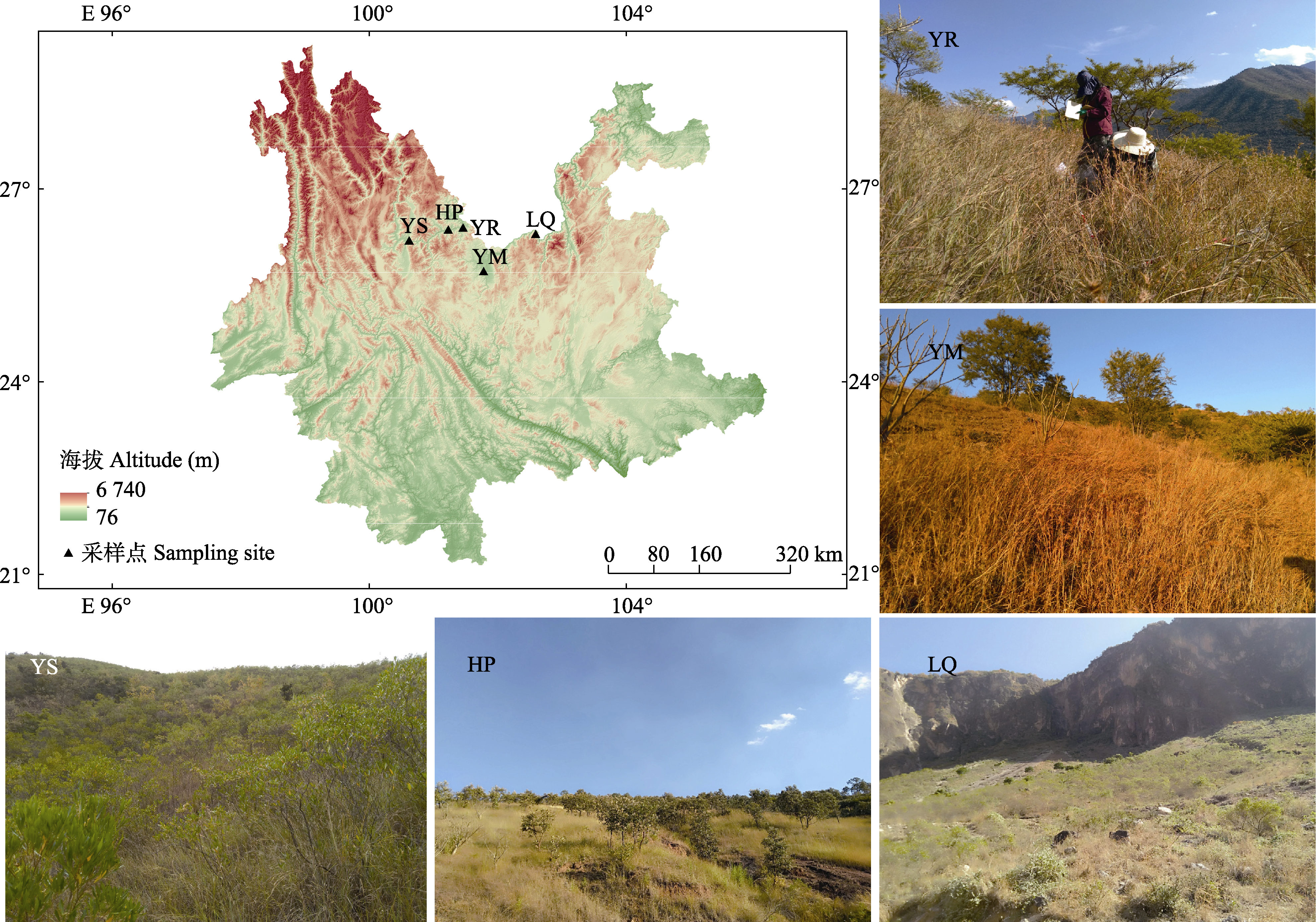
图1 金沙江干热河谷采样点。HP, 华坪; LQ, 禄劝; YM, 元谋; YR, 永仁; YS, 永胜。
Fig. 1 Study sites in dry-hot valley of Jinsha River. HP, Huaping; LQ, Luquan; YM, Yuanmou; YR, Yongren; YS, Yongsheng.
| 采样地点 Study site | 纬度 Latitude (° N) | 经度 Longitude (° E) | 海拔 Altitude (m) | 年平均气温 Mean annual temperature (℃) | 年降水量 Mean annual precipitation (mm) | 胸高断面积 Basal area (cm2·m-2) | 草本盖度 Herb cover (%) |
|---|---|---|---|---|---|---|---|
| 永胜 Yongsheng | 26.20 | 100.62 | 1 297 | 18.3 | 825.0 | 5.85 | 90 |
| 华坪 Huaping | 26.37 | 101.23 | 1 307 | 20.5 | 857.8 | 20.42 | 88 |
| 永仁 Yongren | 26.40 | 101.46 | 1 496 | 18.5 | 925.6 | 34.51 | 93 |
| 元谋 Yuanmou | 25.72 | 101.78 | 1 217 | 20.2 | 827.9 | 2.70 | 92 |
| 禄劝 Luquan | 26.30 | 102.64 | 1 023 | 21.3 | 879.6 | 3.42 | 95 |
表1 金沙江干热河谷采样点基本信息
Table 1 Basic information on the study sites in dry-hot valley of Jinsha River
| 采样地点 Study site | 纬度 Latitude (° N) | 经度 Longitude (° E) | 海拔 Altitude (m) | 年平均气温 Mean annual temperature (℃) | 年降水量 Mean annual precipitation (mm) | 胸高断面积 Basal area (cm2·m-2) | 草本盖度 Herb cover (%) |
|---|---|---|---|---|---|---|---|
| 永胜 Yongsheng | 26.20 | 100.62 | 1 297 | 18.3 | 825.0 | 5.85 | 90 |
| 华坪 Huaping | 26.37 | 101.23 | 1 307 | 20.5 | 857.8 | 20.42 | 88 |
| 永仁 Yongren | 26.40 | 101.46 | 1 496 | 18.5 | 925.6 | 34.51 | 93 |
| 元谋 Yuanmou | 25.72 | 101.78 | 1 217 | 20.2 | 827.9 | 2.70 | 92 |
| 禄劝 Luquan | 26.30 | 102.64 | 1 023 | 21.3 | 879.6 | 3.42 | 95 |
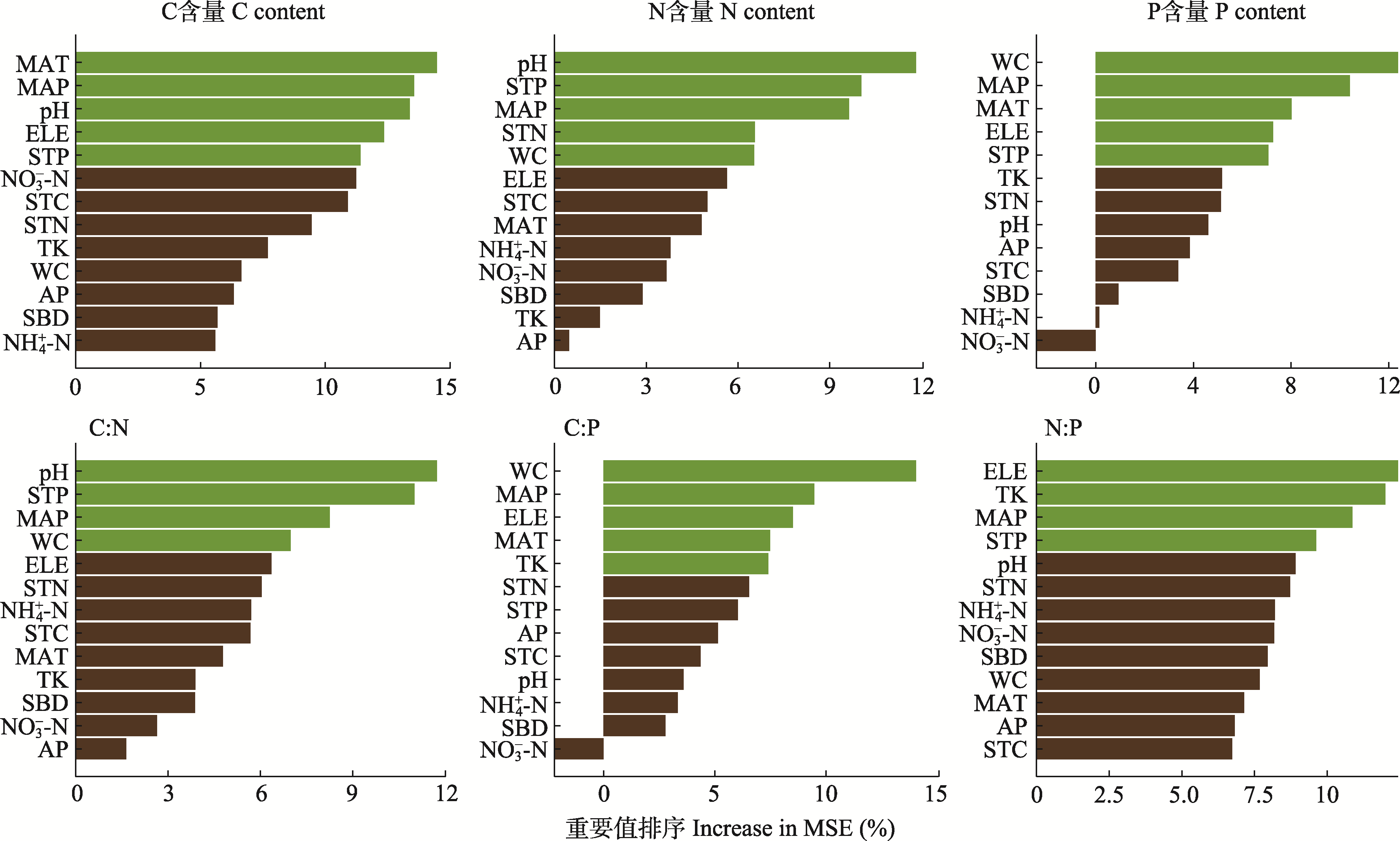
图2 用基于随机森林模型和五折交叉验证的递归特征消除法筛选与植物叶片化学计量特征相关的生境变量。变量的最终选择情况由浅色条目表示。深色条目表示其他次重要的预测变量, 但未用于后续分析。C, 碳; N, 氮; P, 磷。AP, 土壤有效磷含量; ELE, 海拔; MAP, 年降水量; MAT, 年平均气温; NH+ 4-N, 土壤铵态氮含量; NO- 3-N, 土壤硝态氮含量; pH, 土壤pH; SBD, 土壤容重; STC, 土壤总碳含量; STN, 土壤总氮含量; STP, 土壤总磷含量; TK, 土壤总钾含量; WC, 土壤含水量; MSE, 均方误差。
Fig. 2 Recursive Feature Elimination based on random forest and 5-fold cross-validation was used to select habitat variables associated with plant leaf stoichiometry. The final selection of variables is indicated by the light bars. Dark bars indicate additional, next most important predictors, but not used for subsequent analyses. C, carbon; N, nitrogen; P, phosphorus. AP, soil effective phosphorus content; ELE, elevation above sea level; MAP, mean annual precipitation; MAT, mean annual air temperature; NH+ 4-N, soil ammonium nitrogen content; NO- 3-N, soil nitrate nitrogen content; pH, soil pH; SBD, soil bulk density; STC, soil total carbon content; STN, soil total nitrogen content; STP, soil total phosphorus content; TK, soil total potassium content; WC, soil water content; MSE, mean squared error.
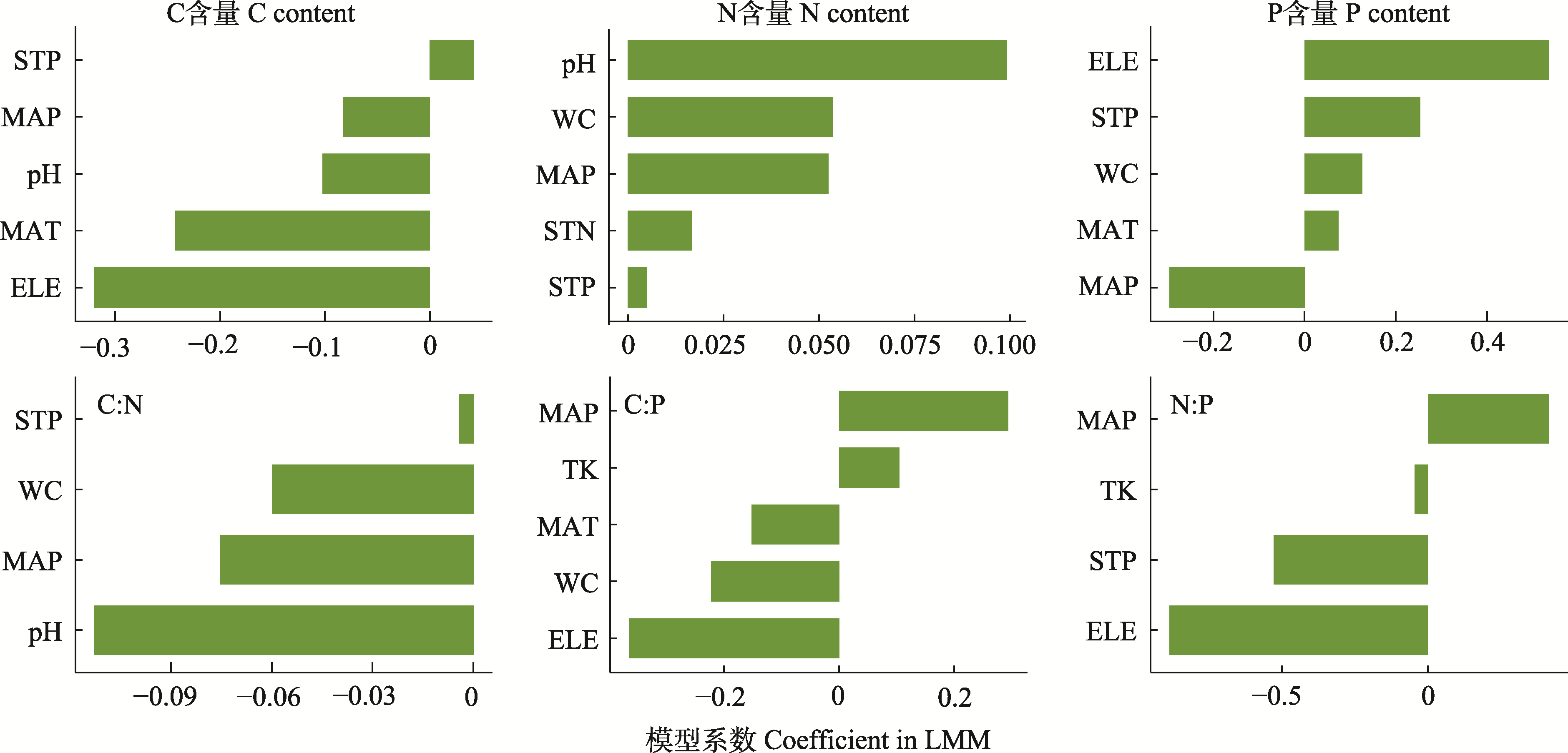
图3 使用线性混合效应模型分析叶片化学计量特征与入选变量的关系。效应强度以标准化固定效应系数表示。C, 碳; N, 氮; P, 磷。ELE, 海拔; MAP, 年降水量; MAT, 年平均气温; pH, 土壤pH; STN, 土壤总氮含量; STP, 土壤总磷含量; TK, 土壤总钾含量; WC, 土壤含水量; LMM, 线性混合效应模型。
Fig. 3 Relationships between leaf stoichiometric and the selected variables were analyzed using linear mixed effect models. Effect magnitudes are expressed as normalized fixed effect coefficients. See Fig. 2 for variable abbreviations. C, carbon; N, nitrogen; P, phosphorus. ELE, elevation above sea level; MAP, mean annual precipitation; MAT, mean annual air temperature; pH, soil pH; STN, soil total nitrogen content; STP, soil total phosphorus content; TK, soil total potassium content; WC, soil water content; LMM, linear mixed-effect model.
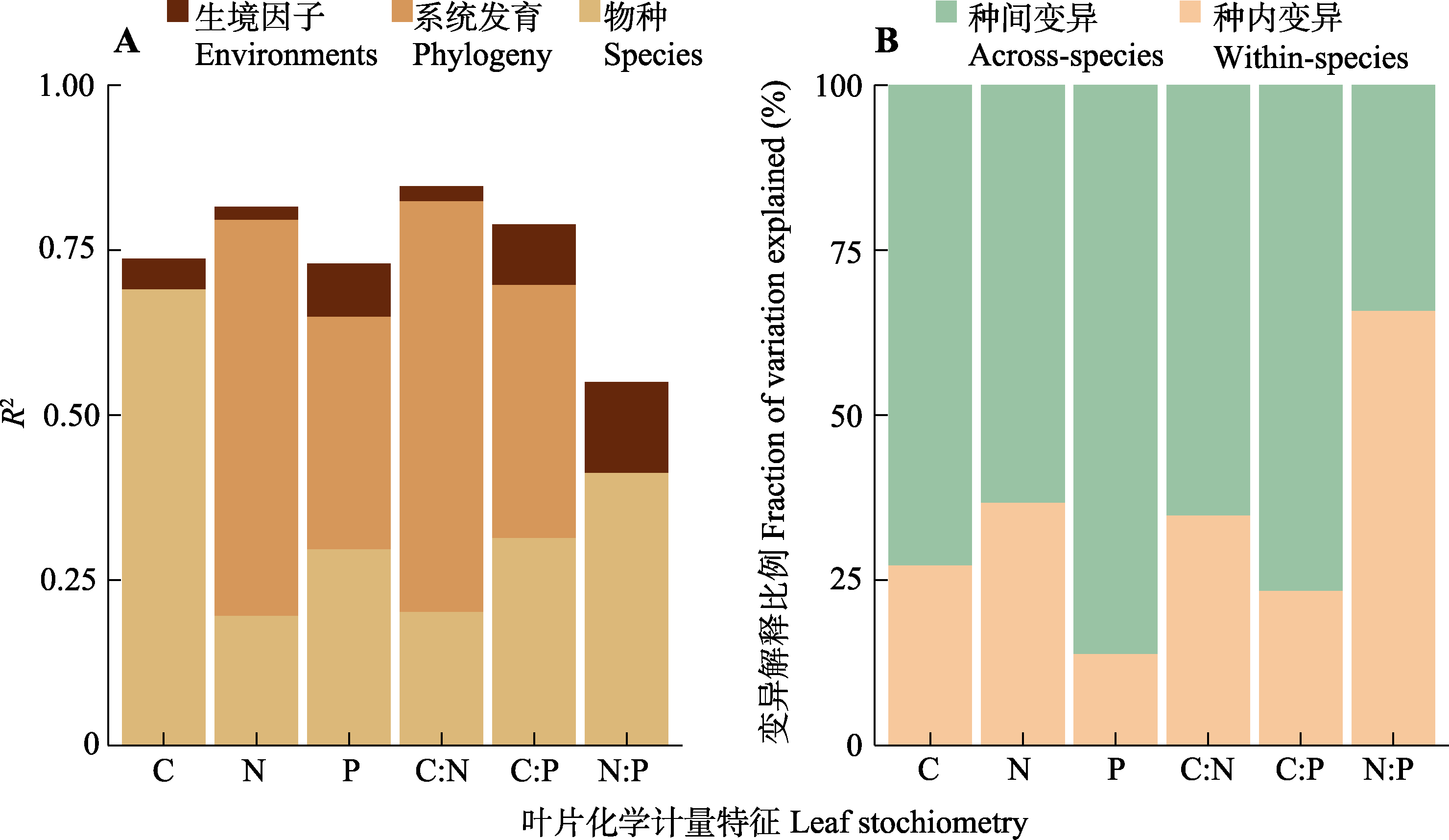
图4 贝叶斯系统发育线性混合模型(A)和物种变异分解结果(B)。A中“生境因子”代表固定效应(通过递归特征消除法从生境因素中选取的一部分子集)。C, 碳; N, 氮; P, 磷。
Fig. 4 Results of the Bayesian phylogenetic mixture model (A) and variance partitioning of species-level variation (B). In panel A, “Environments” represents the fixed effects (a subset of habitat factors selected through recursive feature elimination). C, carbon; N, nitrogen; P, phosphorus.
| Blomberg’s K | p | Pagel’s λ | p | |
|---|---|---|---|---|
| C | 0.155 | 0.135 | 0.507 | 0.297 |
| N | 0.479** | 0.003 | 0.915* | 0.017 |
| P | 0.385* | 0.016 | 0.736* | 0.014 |
| C:N | 0.583** | 0.004 | 0.951* | 0.011 |
| C:P | 0.354* | 0.025 | 0.746* | 0.021 |
| N:P | 0.290 | 0.526 | 0.868 | 0.190 |
表2 植物叶片化学计量特征的系统发育信号
Table 2 Phylogenetic signals of plant leaf stoichiometric traits
| Blomberg’s K | p | Pagel’s λ | p | |
|---|---|---|---|---|
| C | 0.155 | 0.135 | 0.507 | 0.297 |
| N | 0.479** | 0.003 | 0.915* | 0.017 |
| P | 0.385* | 0.016 | 0.736* | 0.014 |
| C:N | 0.583** | 0.004 | 0.951* | 0.011 |
| C:P | 0.354* | 0.025 | 0.746* | 0.021 |
| N:P | 0.290 | 0.526 | 0.868 | 0.190 |
| [1] |
Ågren GI, Weih M (2012). Plant stoichiometry at different scales: element concentration patterns reflect environment more than genotype. New Phytologist, 194, 944-952.
DOI PMID |
| [2] |
Anderegg LDL, Berner LT, Badgley G, Sethi ML, Law BE, HilleRisLambers J (2018). Within-species patterns challenge our understanding of the leaf economics spectrum. Ecology Letters, 21, 734-744.
DOI PMID |
| [3] |
Bai KD, Lv SH, Ning SJ, Zeng DJ, Guo YL, Wang B (2019). Leaf nutrient concentrations associated with phylogeny, leaf habit and soil chemistry in tropical karst seasonal rainforest tree species. Plant and Soil, 434, 305-326.
DOI |
| [4] | Bates D, Mächler M, Bolker B, Walker S (2015). Fitting linear mixed-effects models using lme4. Journal of Statistical Software, 67, 1-48. |
| [5] | Bürkner PC (2017). Brms: an R package for Bayesian multilevel models using Stan. Journal of Statistical Software, 80, 1-28. |
| [6] |
Cai Q, Ding JX, Zhang ZL, Hu J, Wang QT, Yin MZ, Liu Q, Yin HJ (2019). Distribution patterns and driving factors of leaf C, N and P stoichiometry of coniferous species on the eastern Qinghai-Xizang Plateau, China. Chinese Journal of Plant Ecology, 43, 1048-1060.
DOI |
|
[蔡琴, 丁俊祥, 张子良, 胡君, 汪其同, 尹明珍, 刘庆, 尹华军 (2019). 青藏高原东缘主要针叶树种叶片碳氮磷化学计量分布格局及其驱动因素. 植物生态学报, 43, 1048-1060.]
DOI |
|
| [7] |
Chen J, Chen M, Liu S, Xing HS, Li FF, Xu GX, Shi ZM (2024a). Elevational patterns and drivers of leaf carbon, nitrogen, and phosphorus stoichiometry in an Alpine-gorge region on the eastern Qinghai-Tibetan Plateau. Journal of Soil Science and Plant Nutrition, 24, 3953-3968.
DOI |
| [8] | Chen Y, Li YQ, Wang LL, Duan YL, Cao WJ, Wang XY, Li YL (2024b). Heterogeneity of leaf stoichiometry of different life forms along environmental transects in typical ecologically fragile areas of China. Science of the Total Environment, 910, 168495. DOI: 10.1016/j.scitotenv.2023.168495. |
| [9] |
Elser JJ, Sterner RW, Gorokhova E, Fagan WF, Markow TA, Cotner JB, Harrison JF, Hobbie SE, Odell GM, Weider LW (2000). Biological stoichiometry from genes to ecosystems. Ecology Letters, 3, 540-550.
DOI URL |
| [10] |
Finger RA, Turetsky MR, Kielland K, Ruess RW, Mack MC, Euskirchen ES (2016). Effects of permafrost thaw on nitrogen availability and plant-soil interactions in a boreal Alaskan lowland. Journal of Ecology, 104, 1542-1554.
DOI URL |
| [11] |
Finzi AC, Austin AT, Cleland EE, Frey SD, Houlton BZ, Wallenstein MD (2011). Responses and feedbacks of coupled biogeochemical cycles to climate change: examples from terrestrial ecosystems. Frontiers in Ecology and the Environment, 9, 61-67.
DOI URL |
| [12] |
Flexas J, Ribas-Carbó M, Bota J, Galmés J, Henkle M, Martínez-Cañellas S, Medrano H (2006). Decreased Rubisco activity during water stress is not induced by decreased relative water content but related to conditions of low stomatal conductance and chloroplast CO2 concentration. New Phytologist, 172, 73-82.
DOI PMID |
| [13] |
Güsewell S, Koerselman W (2002). Variation in nitrogen and phosphorus concentrations of wetland plants. Perspectives in Plant Ecology, Evolution and Systematics, 5, 37-61.
DOI URL |
| [14] |
He JS, Fang JY, Wang ZH, Guo DL, Flynn DFB, Geng Z (2006). Stoichiometry and large-scale patterns of leaf carbon and nitrogen in the grassland biomes of China. Oecologia, 149, 115-122.
DOI URL |
| [15] |
He NP, Liu CC, Piao SL, Sack L, Xu L, Luo YQ, He JS, Han XG, Zhou GS, Zhou XH, Lin Y, Yu Q, Liu SR, Sun W, Niu SL, et al. (2019). Ecosystem traits linking functional traits to macroecology. Trends in Ecology & Evolution, 34, 200-210.
DOI URL |
| [16] |
Hetherington AM, Woodward FI (2003). The role of stomata in sensing and driving environmental change. Nature, 424, 901-908.
DOI |
| [17] |
Jin Y, Qian H (2022). V. PhyloMaker2: an updated and enlarged R package that can generate very large phylogenies for vascular plants. Plant Diversity, 44, 335-339.
DOI |
| [18] |
Kerkhoff AJ, Enquist BJ, Elser JJ, Fagan WF (2005). Plant allometry, stoichiometry and the temperature-dependence of primary productivity. Global Ecology and Biogeography, 14, 585-598.
DOI URL |
| [19] | Kerkhoff AJ, Fagan WF, Elser JJ, Enquist BJ (2006). Phylogenetic and growth form variation in the scaling of nitrogen and phosphorus in the seed plants. The American Naturalist, 168, E103-E122. |
| [20] | Kuhn M (2008). Building predictive models in R using the caret package. Journal of Statistical Software, 28, 1-26. |
| [21] | Li ZL, Zeng ZQ, Tian DS, Wang JS, Wang BX, Chen HYH, Quan Q, Chen WN, Yang JL, Meng C, Wang Y, Niu SL (2020). Global variations and controlling factors of soil nitrogen turnover rate. Earth-Science Reviews, 207, 103250. DOI: 10.1016/j.earscirev.2020.103250. |
| [22] |
Lin YT, Lai Y, Tang SB, Qin ZF, Liu JF, Kang FF, Kuang YW (2022). Climatic and edaphic variables determine leaf C, N, P stoichiometry of deciduous Quercus species. Plant and Soil, 474, 383-394.
DOI |
| [23] | Liu S, Xu GX, Chen J, Chen M, Shi ZM, Zhou QH, Jiang DM (2024). Soil microbial community structure and influencing factors in dry-hot valley region of Jinsha River, Yunnan Province. Acta Ecologica Sinica, 44, 7172-7182. |
| [刘顺, 许格希, 陈健, 陈淼, 史作民, 周庆宏, 蒋冬梅 (2024). 云南金沙江干热河谷土壤微生物群落结构特征及影响因素. 生态学报, 44, 7172-7182.] | |
| [24] | Lu JN, Zhao XY, Wang SK, Feng S, Ning ZY, Wang RX, Chen XP, Zhao HS, Chen M (2023). Untangling the influence of abiotic and biotic factors on leaf C, N, and P stoichiometry along a desert-grassland transition zone in northern China. Science of the Total Environment, 884, 163902. DOI: 10.1016/j.scitotenv.2023.163902. |
| [25] | Peñuelas J, Fernández-Martínez M, Ciais P, Jou D, Piao S, Obersteiner M, Vicca S, Janssens IA, Sardans J (2019). The bioelements, the elementome, and the biogeochemical niche. Ecology, 100, e02652. DOI: 10.1002/ecy.2652. |
| [26] |
Pérez-Harguindeguy N, Díaz S, Garnier E, Lavorel S, Poorter H, Jaureguiberry P, Bret-Harte MS, Cornwell WK, Craine JM, Gurvich DE, Urcelay C, Veneklaas EJ, Reich PB, Poorter L, Wright IJ, et al. (2016). Corrigendum to, New handbook for standardised measurement of plant functional traits worldwide. Australian Journal of Botany, 64, 715-716.
DOI URL |
| [27] |
Reich PB, Oleksyn J (2004). Global patterns of plant leaf N and P in relation to temperature and latitude. Proceedings of the National Academy of Sciences of the United States of America, 101, 11001-11006.
DOI PMID |
| [28] |
Revell LJ (2012). Phytools: an R package for phylogenetic comparative biology (and other things). Methods in Ecology and Evolution, 3, 217-223.
DOI URL |
| [29] |
Sardans J, Janssens IA, Alonso R, Veresoglou SD, Rillig MC, Sanders TG, Carnicer J, Filella I, Farré-Armengol G, Peñuelas J (2015). Foliar elemental composition of European forest tree species associated with evolutionary traits and present environmental and competitive conditions. Global Ecology and Biogeography, 24, 240-255.
DOI URL |
| [30] | Sardans J, Vallicrosa H, Zuccarini P, Farré-Armengol G, Fernández-Martínez M, Peguero G, Gargallo-Garriga A, Ciais P, Janssens IA, Obersteiner M, Richter A, Peñuelas J (2021). Empirical support for the biogeochemical niche hypothesis in forest trees. Nature Ecology & Evolution, 5, 184-194. |
| [31] |
Saura-Mas S, Lloret F (2007). Leaf and shoot water content and leaf dry matter content of Mediterranean woody species with different post-fire regenerative strategies. Annals of Botany, 99, 545-554.
DOI PMID |
| [32] |
Spicer ME, Radhamoni HVN, Duguid MC, Queenborough SA, Comita LS (2022). Herbaceous plant diversity in forest ecosystems: patterns, mechanisms, and threats. Plant Ecology, 223, 117-129.
DOI |
| [33] |
Stalenberg E, Hutchinson MF, Foley WJ (2018). Using historical normals to improve modern monthly climate normal surfaces for Madagascar. International Journal of Climatology, 38, 5746-5765.
DOI URL |
| [34] | Sun Y, Liao JH, Zou XM, Xu X, Yang JY, Chen HYH, Ruan HH (2020). Coherent responses of terrestrial C, N stoichiometry to drought across plants, soil, and microorganisms in forests and grasslands. Agricultural and Forest Meteorology, 292, 108104. DOI: 10.1016/j.agrformet.2020.108104. |
| [35] |
Tian D, Yan ZB, Fang JY (2021). Review on characteristics and main hypotheses of plant ecological stoichiometry. Chinese Journal of Plant Ecology, 45, 682-713.
DOI |
|
[田地, 严正兵, 方精云 (2021). 植物生态化学计量特征及其主要假说. 植物生态学报, 45, 682-713.]
DOI |
|
| [36] |
Tian D, Yan ZB, Niklas KJ, Han WX, Kattge J, Reich PB, Luo YK, Chen YH, Tang ZY, Hu HF, Wright IJ, Schmid B, Fang JY (2018). Global leaf nitrogen and phosphorus stoichiometry and their scaling exponent. National Science Review, 5, 728-739.
DOI URL |
| [37] | Tian D, Yan ZB, Schmid B, Kattge J, Fang JY, Stocker BD (2024). Environmental versus phylogenetic controls on leaf nitrogen and phosphorous concentrations in vascular plants. Nature Communications, 15, 5346. DOI: 10.1038/s41467-024-49665-4. |
| [38] |
Townsend AR, Cleveland CC, Asner GP, Bustamante MMC (2007). Controls over foliar N:P ratios in tropical rain forests. Ecology, 88, 107-118.
DOI PMID |
| [39] |
Wang C, Yang ZH, He MZ, Hu YK, Lei YB, Hou YH, Ji SN, Wang YH, Yu LF, Peñuelas J, Sardans J, Li XN (2025). Coordinated variations in leaf and root biogeochemical niches. New Phytologist, 246, 947-960.
DOI URL |
| [40] | Wang DC, Wang FC, Huang Y, Duan XW, Liu JY, Hu BX, Sun ZC, Chen JH (2018a). Examining the effects of hydropower station construction on the surface temperature of the Jinsha River Dry-Hot Valley at different seasons. Remote Sensing, 10, 600. DOI: 10.3390/rs10040600. |
| [41] |
Wang S, Wang XB, Han XG, Deng Y (2018b). Higher precipitation strengthens the microbial interactions in semi-arid grassland soils. Global Ecology and Biogeography, 27, 570-580.
DOI URL |
| [42] |
Wang XG, Lü XT, Dijkstra FA, Zhang HY, Wang XB, Wuyunna, Wang ZW, Feng J, Han XG (2019). Changes of plant N:P stoichiometry across a 3000-km aridity transect in grasslands of northern China. Plant and Soil, 443, 107-119.
DOI |
| [43] |
Wright IJ, Reich PB, Westoby M (2003). Least-cost input mixtures of water and nitrogen for photosynthesis. The American Naturalist, 161, 98-111.
DOI URL |
| [44] | Xing H, Wu RH, Yu HB, Shi WJ, Li XJ, Zhang QF (2024). Stoichiometric characteristics and influencing factors of carbon, nitrogen and phosphorus in leaves of steppe plants in Xilingol. Acta Agrestia Sinica, 32, 3774-3787. |
|
[邢浩, 乌日汗, 于红博, 史文杰, 李雪杰, 张巧凤 (2024). 锡林郭勒草原植物叶片碳、氮、磷化学计量特征及其影响因子. 草地学报, 32, 3774-3787.]
DOI |
|
| [45] | Xu XQ, Li WJ, Zhou XW, Lü SH, Bai KD (2024). Leaf ecological stoichiometry in understory plants with different life forms in a subtropical evergreen broad-leaved forest. Journal of Tropical and Subtropical Botany, 32, 725-736. |
| [许雪晴, 李文君, 周雪雯, 吕仕洪, 白坤栋 (2024). 亚热带常绿阔叶林林下不同生活型植物叶片生态化学计量特征. 热带亚热带植物学报, 32, 725-736.] | |
| [46] |
Zhang JH, Zhao N, Liu CC, Yang H, Li ML, Yu GR, Wilcox K, Yu Q, He NP (2018). C:N:P stoichiometry in China’s forests: from organs to ecosystems. Functional Ecology, 32, 50-60.
DOI URL |
| [47] |
Zhang ZZ, Ming QZ, Zhang HC, Li HY, Duan LZ (2013). Progress and issues on geographical environment evolution in dry-hot valley of Jinsha River. Geographical Science Research, 2, 1-7.
DOI URL |
| [48] |
Zhou Y, Yi YJ, Liu HX, Tang CH, Zhu YL, Zhang SH (2022). Effect of geomorphologic features and climate change on vegetation distribution in the arid hot valleys of Jinsha River, Southwest China. Journal of Mountain Science, 19, 2874-2885.
DOI |
| [1] | 田地, 迟小龙, 石亮, 刘宵含, 赵常提, 吴梅, 张玉忠, 高永亮. 塞罕坝地区优势造林树种叶片化学计量特征及其环境驱动[J]. 植物生态学报, 2026, 50(2): 362-373. |
| [2] | 刘子晨, 陈文娜, 黄久香, 李玉玲, 姚纲. 中新世中晚期干旱气候的建立对龙树科物种分化的潜在影响[J]. 植物生态学报, 2026, 50(1): 123-133. |
| [3] | 文佳, 张新娜, 王娟, 赵秀海, 张春雨. 性状调节幼苗存活率对邻体竞争和环境的响应[J]. 植物生态学报, 2024, 48(6): 719-729. |
| [4] | 王振宇, 黄志群. 亚热带27种木本植物叶片性状对植食作用的影响: 验证生长-防御权衡假说[J]. 植物生态学报, 2024, 48(11): 1501-1509. |
| [5] | 马常钦, 黄海龙, 彭政淋, 吴纯泽, 韦庆钰, 贾红涛, 卫星. 水曲柳雌雄株复叶类型及光合功能对不同生境的响应[J]. 植物生态学报, 2023, 47(9): 1287-1297. |
| [6] | 项伟, 黄冬柳, 朱师丹. 热带亚热带26种蕨类植物的吸收根解剖特征[J]. 植物生态学报, 2022, 46(5): 593-601. |
| [7] | 王春成, 张云玲, 马松梅, 黄刚, 张丹, 闫涵. 中国扁桃亚属四种野生扁桃的系统发育与物种分化[J]. 植物生态学报, 2021, 45(9): 987-995. |
| [8] | 杜军, 王文, 何志斌, 陈龙飞, 蔺鹏飞, 朱喜, 田全彦. 祁连山青海云杉物候表型的空间分异及其内在机制[J]. 植物生态学报, 2021, 45(8): 834-843. |
| [9] | 向响, 黄永梅, 杨崇曜, 李泽卿, 陈慧颖, 潘莹萍, 霍佳璇, 任梁. 海拔对青海湖流域群落水平植物功能性状的影响[J]. 植物生态学报, 2021, 45(5): 456-466. |
| [10] | 杨克彤, 常海龙, 陈国鹏, 俞筱押, 鲜骏仁. 兰州市主要绿化植物气孔性状特征[J]. 植物生态学报, 2021, 45(2): 187-196. |
| [11] | 王雪梅, 闫帮国, 史亮涛, 刘刚才. 车桑子幼苗生物量分配与叶性状对氮磷浓度的响应差异[J]. 植物生态学报, 2020, 44(12): 1247-1261. |
| [12] | 柴永福, 许金石, 刘鸿雁, 刘全儒, 郑成洋, 康慕谊, 梁存柱, 王仁卿, 高贤明, 张峰, 福臣, 刘晓, 岳明. 华北地区主要灌丛群落物种组成及系统发育结构特征[J]. 植物生态学报, 2019, 43(9): 793-805. |
| [13] | 闫雅楠, 叶小齐, 吴明, 闫明, 张昕丽. 入侵植物加拿大一枝黄花根际解钾菌多样性及解钾活性[J]. 植物生态学报, 2019, 43(6): 543-556. |
| [14] | 蔡琴, 丁俊祥, 张子良, 胡君, 汪其同, 尹明珍, 刘庆, 尹华军. 青藏高原东缘主要针叶树种叶片碳氮磷化学计量分布格局及其驱动因素[J]. 植物生态学报, 2019, 43(12): 1048-1060. |
| [15] | 王雪, 陈光水, 闫晓俊, 陈廷廷, 姜琦, 陈宇辉, 范爱连, 贾林巧, 熊德成, 黄锦学. 亚热带常绿阔叶林89种木本植物一级根直径的变异[J]. 植物生态学报, 2019, 43(11): 969-978. |
| 阅读次数 | ||||||
|
全文 |
|
|||||
|
摘要 |
|
|||||
Copyright © 2026 版权所有 《植物生态学报》编辑部
地址: 北京香山南辛村20号, 邮编: 100093
Tel.: 010-62836134, 62836138; Fax: 010-82599431; E-mail: apes@ibcas.ac.cn, cjpe@ibcas.ac.cn
备案号: 京ICP备16067583号-19

