
植物生态学报 ›› 2026, Vol. 50 ›› Issue (3): 685-699.DOI: 10.17521/cjpe.2025.0117 cstr: 32100.14.cjpe.2025.0117
江康威1, 吕程2, 王亚菲3, 李宏1, 张芷晴2, 王雨2, 张青青2,*( ), 吐尔逊娜依•热依木2
收稿日期:2025-04-01
接受日期:2025-07-10
出版日期:2026-03-20
发布日期:2026-04-07
通讯作者:
*张青青(greener2010@sina.com)基金资助:
JIANG Kang-Wei1, LÜ Cheng2, WANG Ya-Fei3, LI Hong1, ZHANG Zhi-Qing2, WANG Yu2, ZHANG Qing-Qing2,*(), Tuerxunnayi REYIMU2
Received:2025-04-01
Accepted:2025-07-10
Online:2026-03-20
Published:2026-04-07
Contact:
*ZHANG Qing-Qing(greener2010@sina.com)
Supported by:摘要:
丛枝菌根真菌(AMF)与植物根系的共生合作关系改善了植物群落的养分吸收效率, 对维持草地生态系统关键的功能和过程起到至关重要的作用。然而, 不同放牧强度下AMF群落的变化规律仍存在争议, 特别是在放牧干扰下AMF群落对土壤多功能性(SMF)的驱动作用仍未被明确解析。该研究选取新疆天山北坡的未放牧、轻度放牧和重度放牧的山地草甸草原为研究对象, 采用高通量测序技术分析AMF群落并构建共现网络。采用基于聚类分析的加权平均值法系统评估SMF, 探究不同放牧强度下AMF群落特征及其对SMF的驱动作用。结果表明, 3个放牧强度的AMF优势属均为球囊菌属(Glomus)和多样孢囊霉属(Diversispora)。随着放牧强度增加, AMF群落的多样性和共现网络的稳定性、复杂性、内聚力以及SMF均呈现先增加后降低的单峰曲线趋势。线性回归和结构方程模型的结果表明, 放牧可通过调控AMF群落多样性、网络复杂性和稳定性驱动SMF。AMF群落多样性对SMF的驱动效应主要依靠其网络复杂性和稳定性来实现, 且群落多样性的直接效应低于复杂性和稳定性。该研究强调AMF群落网络复杂性和稳定性放大了群落多样性对SMF的驱动效应, 强化了群落多样性与SMF的联系。研究结果为实现退化草地生态系统的恢复和可持续管理提供理论参考。
江康威, 吕程, 王亚菲, 李宏, 张芷晴, 王雨, 张青青, 吐尔逊娜依•热依木. 放牧干扰下丛枝菌根真菌群落对土壤多功能性的影响. 植物生态学报, 2026, 50(3): 685-699. DOI: 10.17521/cjpe.2025.0117
JIANG Kang-Wei, LÜ Cheng, WANG Ya-Fei, LI Hong, ZHANG Zhi-Qing, WANG Yu, ZHANG Qing-Qing, Tuerxunnayi REYIMU. Effects of soil arbuscular mycorrhizal fungal communities on soil multifunctionality under grazing disturbance. Chinese Journal of Plant Ecology, 2026, 50(3): 685-699. DOI: 10.17521/cjpe.2025.0117
| 放牧强度 Grazing intensity | 植物优势种 Dominant plant species | 高度 Height (cm) | 盖度 Coverage (%) | 地上生物量 Aboveground biomass (g·m-2) |
|---|---|---|---|---|
| 对照 No grazing | 针茅、羊茅、草地早熟禾 Carex stenocarpa, Festuca ovina, Poa pratensis | 26.18 ± 3.63 | 87.50 ± 2.21 | 265.29 ± 60.24 |
| 轻度放牧 Light grazing | 细果薹草、针茅、无芒雀麦 Carex stenocarpa, Stipa capillata, Bromus inermis | 22.68 ± 1.77 | 93.50 ± 2.73 | 175.35 ± 19.29 |
| 重度放牧 Heavy grazing | 醉马草、细果薹草、平车前 Achnatherum inebrians, Carex stenocarpa, Plantago depressa | 13.21 ± 2.49 | 59.16 ± 3.67 | 123.31 ± 33.21 |
表1 天山北坡中段山地草甸不同放牧样地中的植物群落组成(平均值±标准误)
Table 1 Plant community composition in different grazing treatments in the mountain meadow steppes on the northern slope at middle section of the Tianshan Mountains (mean ± SE)
| 放牧强度 Grazing intensity | 植物优势种 Dominant plant species | 高度 Height (cm) | 盖度 Coverage (%) | 地上生物量 Aboveground biomass (g·m-2) |
|---|---|---|---|---|
| 对照 No grazing | 针茅、羊茅、草地早熟禾 Carex stenocarpa, Festuca ovina, Poa pratensis | 26.18 ± 3.63 | 87.50 ± 2.21 | 265.29 ± 60.24 |
| 轻度放牧 Light grazing | 细果薹草、针茅、无芒雀麦 Carex stenocarpa, Stipa capillata, Bromus inermis | 22.68 ± 1.77 | 93.50 ± 2.73 | 175.35 ± 19.29 |
| 重度放牧 Heavy grazing | 醉马草、细果薹草、平车前 Achnatherum inebrians, Carex stenocarpa, Plantago depressa | 13.21 ± 2.49 | 59.16 ± 3.67 | 123.31 ± 33.21 |
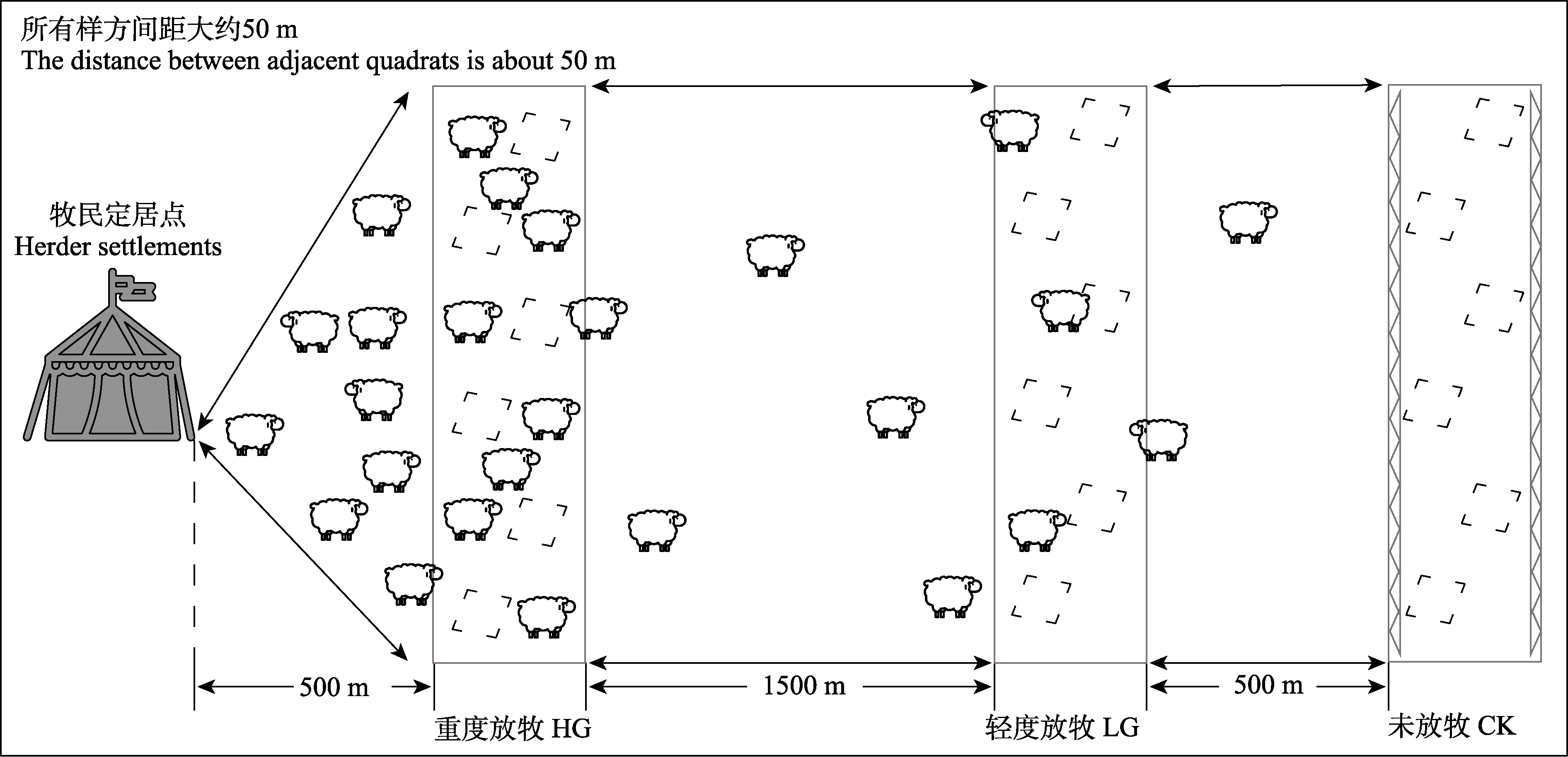
图1 天山北坡中段山地草甸未放牧、轻度放牧和重度放牧样地的位置。
Fig. 1 Location of ungrazed, lightly grazed and heavily grazed plots in the mountain meadow steppes on the northern slope at middle section of the Tianshan Mountains. CK, no grazing; HG, heavy grazing; LG, light grazing.
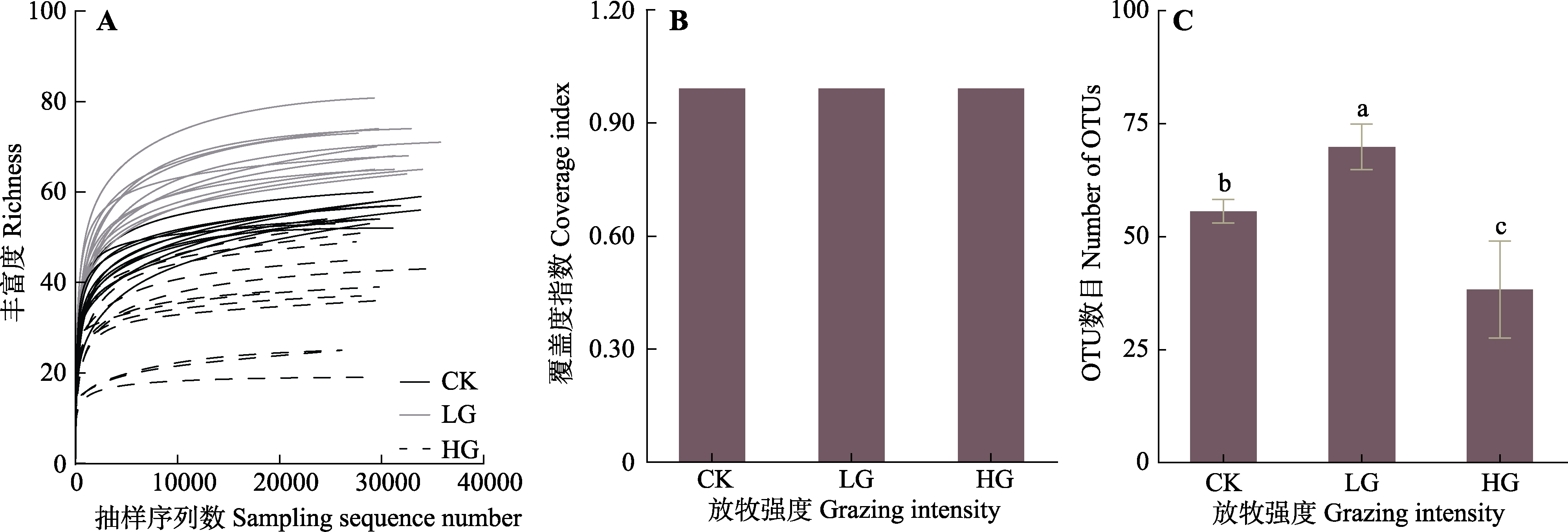
图2 天山北坡中段山地草甸不同放牧样地中运算分类单元(OTU)稀释曲线(A)、覆盖度指数(B)和数目(C) (平均值±标准误)的变化。CK, 未放牧; HG, 重度放牧; LG, 轻度放牧。不同小写字母代表不同放牧样地间差异显著(p < 0.05)。
Fig. 2 Changes in operational taxonomic unit (OTU) rarefaction curve (A), coverage index (B) and number (C) (mean ± SE) in different grazing treatments in the mountain meadow steppes on the northern slope at middle section of the Tianshan Mountains. CK, no grazing; HG, heavy grazing; LG, light grazing. Different lowercase letters indicate significant differences among different grazing treatments (p < 0.05).
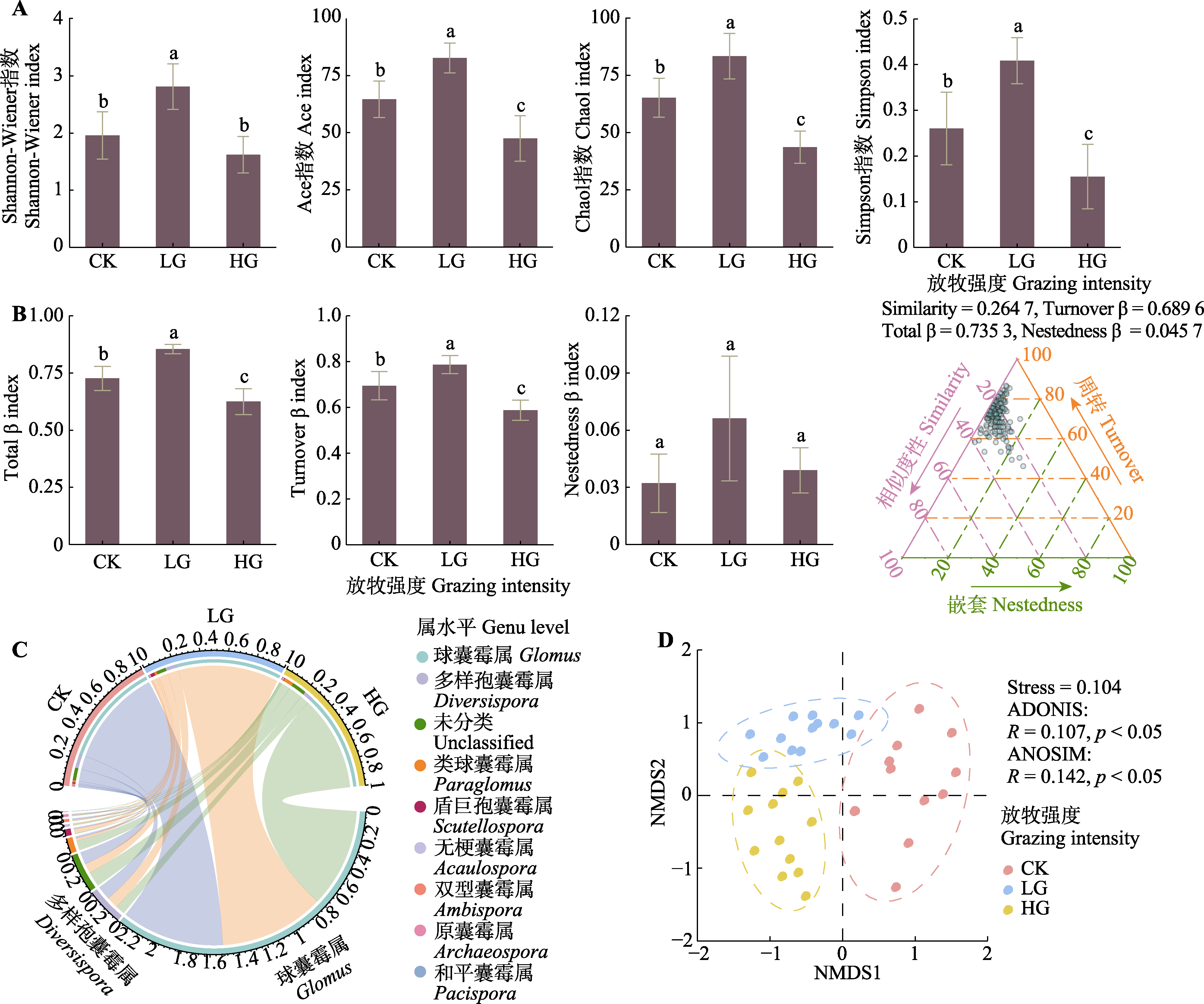
图3 不同放牧样地中丛枝菌根真菌群落α多样性(A)、β多样性(B)、组成(C)和结构(D)的变化。CK, 未放牧; HG, 重度放牧; LG, 轻度放牧。Similarity, 相似性(1 - Total β); Total β, 总β多样性; Turnover β, 周转β多样性(物种替代过程); Nestedness β, 嵌套β多样性(丰富度差异过程)。ADONIS, 置换多元方差分析; ANOSIM, 相似性分析; NMDS1/NMDS2, 非度量多维尺度分析轴1/轴2; Stress, 胁迫系数。不同小写字母代表不同放牧样地间差异显著(p < 0.05)。
Fig. 3 Changes in alpha diversity (A), beta diversity (B), composition (C), and structure (D) of arbuscular mycorrhizal fungal communities in different grazing treatments. CK, no grazing; HG, heavy grazing; LG, light grazing. Similarity, 1 - Total β; Total β, total β diversity; Turnover β, turnover β diversity (replacement); Nestedness β, nestedness β diversity (richness difference). ADONIS, permutational multivariate analysis of variance; ANOSIM, similarity analysis; NMDS1/NMDS2, non-metric multidimensional scaling analysis axis 1/axis 2; Stress, stress coefficient. Different lowercase letters indicate significant differences among different grazing treatments (p < 0.05).
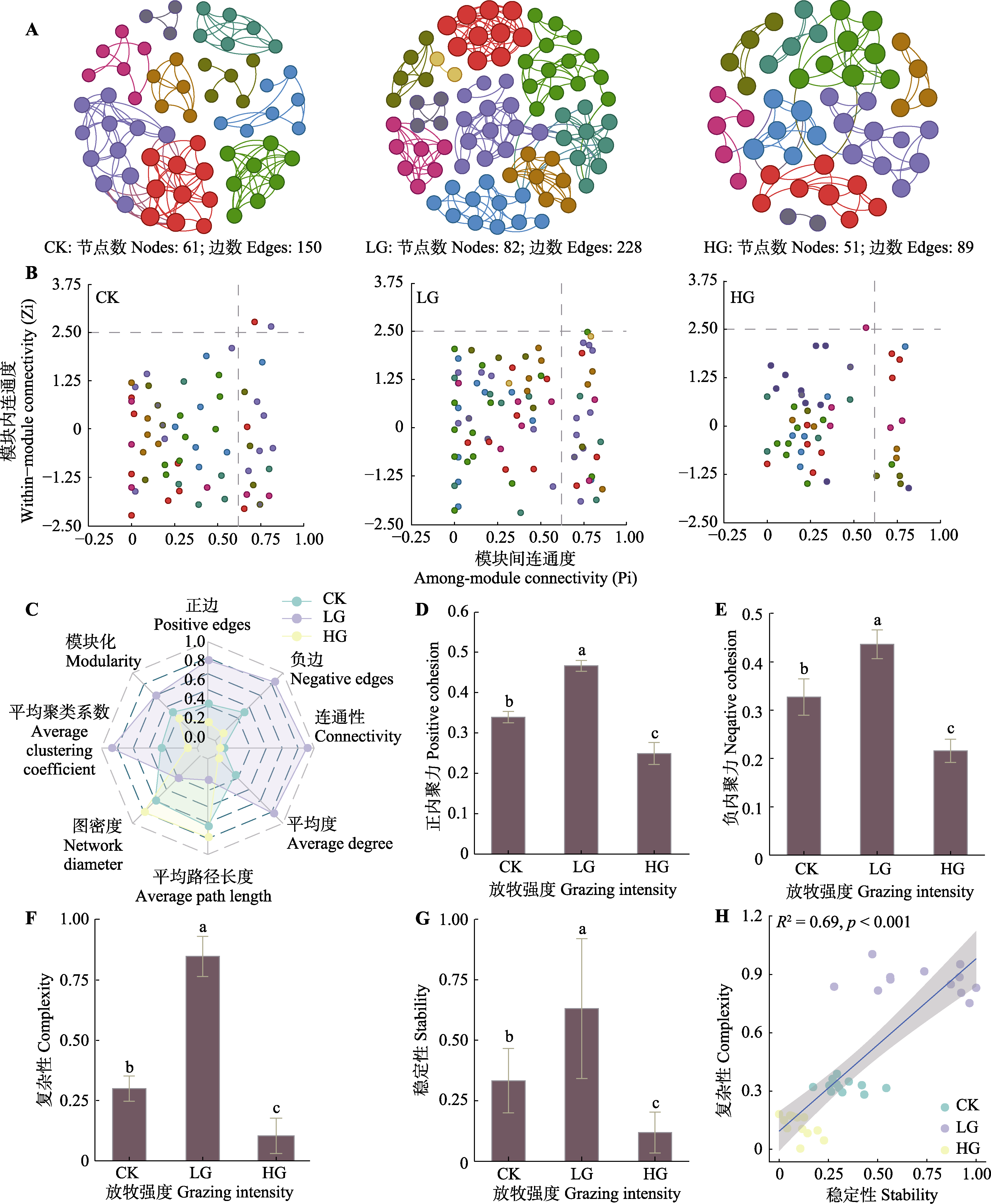
图4 不同放牧样地中丛枝菌根真菌群落共现网络特征的变化。A, 共现网络特征。B, 基于共现网络的关键种。图中虚线表示Zi ≥ 2.5或Pi ≥ 0.62的节点为关键种。C, 共现网络拓扑属性。D, 正内聚力。E, 负内聚力。F, 共现网络复杂性。G, 稳定性。H, 网络复杂性与稳定性的关系。CK, 未放牧; HG, 重度放牧; LG, 轻度放牧。不同小写字母代表不同放牧样地间差异显著(p < 0.05)。
Fig. 4 Changes in the co-occurrence network of arbuscular mycorrhizal fungal communities in different grazing treatments. A, Co-occurrence network characteristics. B, Key species based on co-occurrence network. Dashed lines indicate that nodes with Zi ≥ 2.5 or Pi ≥ 0.62 are identified as key species. C, Co-occurrence network topological properties. D, Positive cohesion. E, Negative cohesion. F, Co-occurrence network complexity. G, Stability. H, Relationship between network complexity and stability. CK, no grazing; HG, heavy grazing; LG, light grazing. Different lowercase letters indicate significant differences among different grazing treatments (p < 0.05).
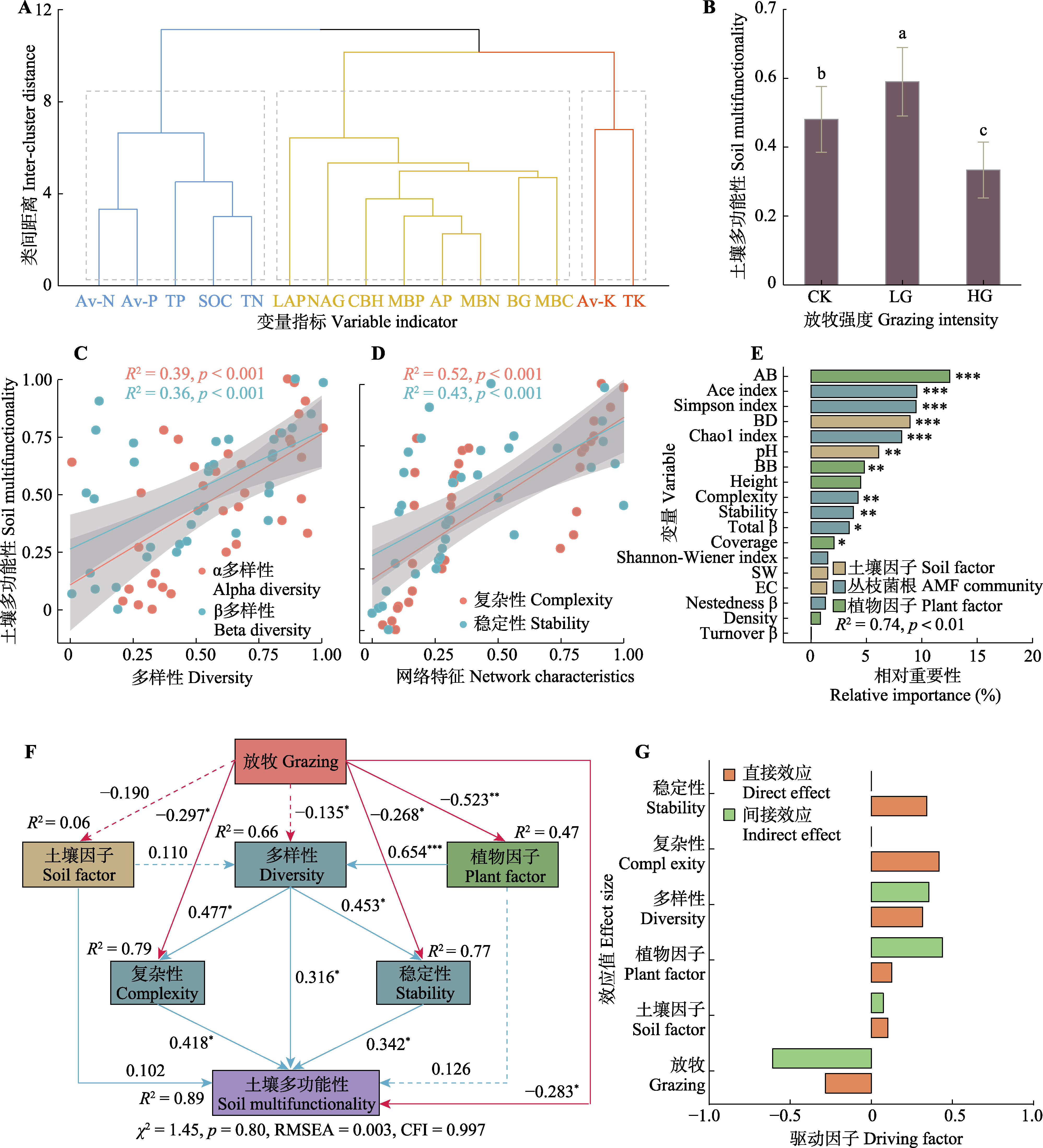
图5 不同放牧样地中丛枝菌根真菌群落对土壤多功能性的驱动。A, 土壤多功能性。B, 基于随机森林的土壤多功能性的驱动因素。C, 土壤多功能性与丛枝菌根真菌群落多样性的关系。D, 土壤多功能性与丛枝菌根真菌群落共现网络复杂性和稳定性的关系。E, 基于随机森林土壤多功能性的影响因子。F, 基于结构方程模型的土壤多功能性驱动过程。G, 基于结构方程模型驱动因子对土壤多功能性的效应值。AB, 地上生物量; Ace index, Ace指数; AP, 碱性磷酸酶活性; Av-K, 速效钾含量; Av-N, 速效氮含量; Av-P, 速效磷含量; BB, 地下生物量; BD, 土壤密度; BG, β-1,4-葡萄糖苷酶活性; CBH, β-α-纤维二糖水解酶活性; Chao1 index, Chao1指数; Complexity, 网络复杂性; Coverage, 植物群落盖度; Density, 植物密度; EC, 电导率; Height, 植物群落高度; LAP, 亮氨酸氨基肽酶活性; MBC, 微生物生物量碳含量; MBN, 微生物生物量氮含量; MBP, 微生物生物量磷含量; NAG, β-1,4-N-乙酰氨基葡萄糖苷酶活性; Nestedness β, 嵌套β多样性; pH, 土壤pH; Shannon-Wiener index, Shannon-Wiener指数; Simpson index, Simpson指数; SOC, 土壤有机碳含量; Stability, 稳定性; SW, 土壤含水量; TK, 全钾含量; TN, 全氮含量; Total β, 总β多样性; TP, 全磷含量; Turnover β, 周转β多样性。CK, 未放牧; HG, 重度放牧; LG, 轻度放牧。不同小写字母代表不同放牧样地间差异显著(p < 0.05)。
Fig. 5 Arbuscular mycorrhizal fungal communities drive soil multifunctionality in different grazing treatments. A, Soil multifunctionality. B, Driving factors of soil multifunctionality based on random forest. C, Relationship between soil multifunctionality and the diversity of arbuscular mycorrhizal fungal communities. D, Relationship between soil multifunctionality and the complexity and stability of the co-occurrence network of arbuscular mycorrhizal fungal communities. E, Influencing factors based on the multifunctionality of soils in random forests. F, Driving process of soil multifunctionality based on structural equation model. G, Effect value of driving factors on soil multifunctionality based on structural equation model. AB, aboveground biomass; AP, alkaline phosphatase activity; Av-K, available potassium content; Av-N, available nitrogen content; Av-P, available phosphorus content; BB, belowground biomass; BD, soil density; BG, β-1,4-glucosidase activity; CBH, β-α-cellobiohydrolase activity; Coverage, coverage of plant community; Density, plant density; EC, electrical conductivity; Height, height of plant community; LAP, leucine aminopeptidase activity; MBC, microbial biomass carbon content; MBN, microbial biomass nitrogen content; MBP, microbial biomass phosphorus content; NAG, β-1,4-N-acetylglucosaminidase activity; Nestedness β, nested β diversity; pH, soil pH; SOC, soil organic carbon content; SW, soil water content; TK, total potassium content; TN, total nitrogen; Total β, total β diversity; TP, total phosphorus content; Turnover β, turnover β diversity. CK, no grazing; HG, heavy grazing; LG, light grazing. Different lowercase letters indicate significant differences among different grazing treatments (p < 0.05).
| [1] |
Aavik T, Träger S, Zobel M, Honnay O, van Geel M, Bueno CG, Koorem K (2021). The joint effect of host plant genetic diversity and arbuscular mycorrhizal fungal communities on restoration success. Functional Ecology, 35, 2621-2634.
DOI URL |
| [2] |
Ba L, Ning JX, Wang DL, Facelli E, Facelli JM, Yang YN, Zhang LC (2012). The relationship between the diversity of arbuscular mycorrhizal fungi and grazing in a meadow steppe. Plant and Soil, 352, 143-156.
DOI URL |
| [3] | Bao SD (2000). Soil and Agricultural Chemistry Analysis. 3rd ed. China Agricultural Press, Beijing. 72-75. |
| [鲍士旦 (2000). 土壤农化分析. 3版. 中国农业出版社, 北京. 72-75.] | |
| [4] |
Chagnon PL, Bradley RL, Maherali H, Klironomos JN (2013). A trait-based framework to understand life history of mycorrhizal fungi. Trends in Plant Science, 18, 484-491.
DOI URL |
| [5] |
Connell JH (1978). Diversity in tropical rain forests and coral reefs. Science, 199, 1302-1310.
DOI PMID |
| [6] |
Dai LC, Guo XW, Ke X, Zhang FW, Li YK, Peng CJ, Shu K, Li Q, Lin L, Cao GM, Du YG (2019). Moderate grazing promotes the root biomass in Kobresia meadow on the northern Qinghai-Tibet Plateau. Ecology and Evolution, 9, 9395-9406.
DOI URL |
| [7] | Dastgheyb Shirazi SS, Ahmadi A, Abdi N, Toranj Zar H, Khaleghi MR (2021). Moderate grazing is the best measure to achieve the optimal conservation and soil resource utilization (case study: Bozdaghin rangelands, North Khorasan, Iran). Environmental Monitoring and Assessment, 193, 549. DOI: 10.1007/s10661-021-09334-1. |
| [8] | DeForest JL, Moorhead DL (2020). Effects of elevated pH and phosphorus fertilizer on soil C, N and P enzyme stoichiometry in an acidic mixed mesophytic deciduous forest. Soil Biology & Biochemistry, 150, 107996. DOI: 10.1016/j.soilbio.2020.107996. |
| [9] | Dong SK, Shang ZH, Gao JX, Boone RB (2020). Enhancing sustainability of grassland ecosystems through ecological restoration and grazing management in an era of climate change on Qinghai-Tibetan Plateau. Agriculture, Ecosystems & Environment, 287, 106684. DOI: 10.1016/j.agee.2019.106684. |
| [10] | Du L, Liu SZ, Wang SQ, Yang J, Tang B, Li K, Zhou JC, Xu Y, Ye YF, Yang YQ, Tang H (2025). Arbuscular mycorrhizal fungi-mediated formation of different carbon fractions in various wetland types enhances carbon sequestration post-restoration on the Tibetan Plateau. Catena, 252, 108847. DOI: 10.1016/j.catena.2025.108847. |
| [11] | Duan L, Li JL, Yin LZ, Luo XQ, Ahmad M, Fang BZ, Li SH, Deng QQ, Wang PD, Li WJ (2022). Habitat-dependent prokaryotic microbial community, potential keystone species, and network complexity in a subtropical estuary. Environmental Research, 212, 113376. DOI: 10.1016/j.envres.2022.113376. |
| [12] |
Duan SL, Feng G, Limpens E, Bonfante P, Xie XN, Zhang L (2024). Cross-kingdom nutrient exchange in the plant-arbuscular mycorrhizal fungus-bacterium continuum. Nature Reviews Microbiology, 22, 773-790.
DOI |
| [13] |
Dudinszky N, Cabello MN, Grimoldi AA, Schalamuk S, Golluscio RA (2019). Role of grazing intensity on shaping arbuscular mycorrhizal fungi communities in Patagonian semiarid steppes. Rangeland Ecology & Management, 72, 692-699.
DOI URL |
| [14] | Fan DD, Ji MK, Wu JS, Chen H, Jia HZ, Zhang XZ, Zhuang XL, Kong WD (2023). Grazing does not influence soil arbuscular mycorrhizal fungal diversity, but increases their interaction complexity with plants in dry grasslands on the Tibetan Plateau. Ecological Indicators, 148, 110065. DOI: 10.1016/j.ecolind.2023.110065. |
| [15] |
Farrell HL, Barberán A, Danielson RE, Fehmi JS, Gornish ES (2020). Disturbance is more important than seeding or grazing in determining soil microbial communities in a semiarid grassland. Restoration Ecology, 28, S335-S343.
DOI |
| [16] |
Fei SL, Kivlin SN, Domke GM, Jo I, LaRue EA, Phillips RP (2022). Coupling of plant and mycorrhizal fungal diversity: its occurrence, relevance, and possible implications under global change. New Phytologist, 234, 1960-1966.
DOI PMID |
| [17] | Feng B, Liu YZ, Liu WT, Lv WD, Sun CC, Yang ZZ, Li CD, Zhou QY, Wang FC, Yang XX, Dong QM (2024). Soil physicochemical properties and plant functional traits regulate ecosystem multifunctionality of alpine grassland under different livestock grazing assemblies. Agriculture, Ecosystems & Environment, 366, 108947. DOI: 10.1016/j.agee.2024.108947. |
| [18] | Fu KX, Chen LX, Yu XX, Jia GD (2024). How has carbon storage changed in the Yili-Tianshan region over the past three decades and into the future? What has driven it to change? Science of the Total Environment, 945, 174005. DOI: 10.1016/j.scitotenv.2024.174005. |
| [19] |
Hammarlund SP, Harcombe WR (2019). Refining the stress gradient hypothesis in a microbial community. Proceedings of the National Academy of Sciences of the United States of America, 116, 15760-15762.
DOI PMID |
| [20] |
Hernandez DJ, David AS, Menges ES, Searcy CA, Afkhami ME (2021). Environmental stress destabilizes microbial networks. The ISME Journal, 15, 1722-1734.
DOI URL |
| [21] |
Herren CM, McMahon KD (2017). Cohesion: a method for quantifying the connectivity of microbial communities. The ISME Journal, 11, 2426-2438.
DOI URL |
| [22] | Jiang KW, Zhang QQ, Wang YF, Li H, Yang YQ, Reyimu T (2024). Effects of grazing on the grassland ecosystem multifunctionality of montane meadow on the northern slope of the Tianshan Mountains, China. Environmental Earth Sciences, 83, 70. DOI: 10.1007/s12665-023-11292-5. |
| [23] |
Kaur S, Campbell BJ, Suseela V (2022). Root metabolome of plant-arbuscular mycorrhizal symbiosis mirrors the mutualistic or parasitic mycorrhizal phenotype. New Phytologist, 234, 672-687.
DOI PMID |
| [24] | Lange M, Eisenhauer N, Sierra CA, Bessler H, Engels C, Griffiths RI, Mellado-Vázquez PG, Malik AA, Roy J, Scheu S, Steinbeiss S, Thomson BC, Trumbore SE, Gleixner G (2015). Plant diversity increases soil microbial activity and soil carbon storage. Nature Communications, 6, 6707. DOI: 10.1038/ncomms7707. |
| [25] |
Lee J, Lee SS, Young JPW (2008). Improved PCR primers for the detection and identification of arbuscular mycorrhizal fungi. FEMS Microbiology Ecology, 65, 339-349.
DOI PMID |
| [26] | Li J, Wang X, Yuan MH, Duan WH, Xia JY, Zhang XS, Zhao YF, Wang JW (2025). Effect of soil microbial community on ecosystem multifunctionality in an alpine grassland. Catena, 249, 108714. DOI: 10.1016/j.catena.2025.108714. |
| [27] |
Li Q, Xiang XJ, Du YG, Li YK, Lin L, Zhang FW, Guo XW, Cao GM (2021). Arbuscular mycorrhizal fungal community structure following different grazing intensities in an alpine grassland. Soil Science Society of America Journal, 85, 1620-1633.
DOI URL |
| [28] | Li Y, Gong JR, Zhang ZH, Shi JY, Zhang WY, Song LY (2022). Grazing directly or indirectly affect shoot and root litter decomposition in different decomposition stage by changing soil properties. Catena, 209, 105803. DOI: 10.1016/j.catena.2021.105803. |
| [29] |
Liu X, Yang H, Li X, Maimaitituersun A (2024). Impacts of land-use change on past and future carbon stocks in the Tianshan north slope economic belt. Land Degradation & Development, 35, 5860-5873.
DOI URL |
| [30] | Long XW, Li JN, Liao XH, Wang JC, Zhang W, Wang KL, Zhao J (2025). Stable soil biota network enhances soil multifunctionality in agroecosystems. Global Change Biology, 31, e70041. DOI: 10.1111/gcb.70041. |
| [31] |
Lumini E, Orgiazzi A, Borriello R, Bonfante P, Bianciotto V (2010). Disclosing arbuscular mycorrhizal fungal biodiversity in soil through a land-use gradient using a pyrosequencing approach. Environmental Microbiology, 12, 2165-2179.
DOI PMID |
| [32] | Luo S, Png GK, Ostle NJ, Zhou HK, Hou XY, Luo CL, Quinton JN, Schaffner U, Sweeney C, Wang DJ, Wu JH, Wu YW, Bardgett RD (2023). Grassland degradation-induced declines in soil fungal complexity reduce fungal community stability and ecosystem multifunctionality. Soil Biology & Biochemistry, 176, 108865. DOI: 10.1016/j.soilbio.2022.108865. |
| [33] | Ma JG, Yu JF, Wang XB, Hou FJ (2025). Plant and microbial communities follow fast-to-slow strategies in response to grazing in an arid rangeland. Agriculture, Ecosystems & Environment, 384, 109550. DOI: 10.1016/j.agee.2025.109550. |
| [34] | Ma LS, Zheng JH, Pen J, Xiao XH, Liu YJ, Liu L, Han WQ, Li GY, Zhang JL (2024). Monitoring and influencing factors of grassland livestock overload in Xinjiang from 1982 to 2020. Frontiers in Plant Science, 15, 1340566. DOI: 10.3389/fpls.2024.1340566. |
| [35] |
MacArthur R (1955). Fluctuations of animal populations and a measure of community stability. Ecology, 36, 533-536.
DOI URL |
| [36] | Mahmoudi N, Caeiro MF, Mahdhi M, Tenreiro R, Ulm F, Mars M, Cruz C, Dias T (2021). Arbuscular mycorrhizal traits are good indicators of soil multifunctionality in drylands. Geoderma, 397, 115099. DOI: 10.1016/j.geoderma.2021.115099. |
| [37] | Manning P, van der Plas F, Soliveres S, Allan E, Maestre FT, Mace G, Whittingham MJ, Fischer M (2018). Redefining ecosystem multifunctionality. Nature Ecology & Evolution, 2, 427-436. |
| [38] |
May RM (1973). Qualitative stability in model ecosystems. Ecology, 54, 638-641.
DOI URL |
| [39] |
McNaughton SJ (1979). Grazing as an optimization process: grass-ungulate relationships in the serengeti. The American Naturalist, 113, 691-703.
DOI URL |
| [40] |
Saiya-Cork KR, Sinsabaugh RL, Zak DR (2002). The effects of long term nitrogen deposition on extracellular enzyme activity in an Acer saccharum forest soil. Soil Biology & Biochemistry, 34, 1309-1315.
DOI URL |
| [41] |
Sanderson MA, Skinner RH, Barker DJ, Edwards GR, Tracy BF, Wedin DA (2004). Plant species diversity and management of temperate forage and grazing land ecosystems. Crop Science, 44, 1132-1144.
DOI URL |
| [42] |
Soka GE, Ritchie ME (2018). Arbuscular mycorrhizal spore composition and diversity associated with different land uses in a tropical savanna landscape, Tanzania. Applied Soil Ecology, 125, 222-232.
DOI URL |
| [43] |
Tang Y, Zhou CH, Chen KY, Xing S, Shi HL, Li CC, Wang YF, Cui XY, Niu HS, Ji BM, Zhang J (2025). Grazing exclusion enriches arbuscular mycorrhizal fungal communities and improves soil organic carbon sequestration in the alpine steppe of northern Xizang. Journal of Integrative Agriculture, 24, 913-924.
DOI |
| [44] |
Toledo S, Peri PL, Fontenla SB (2022). Environmental conditions and grazing exerted effects on arbuscular mycorrhizal in plants at southern Patagonia rangelands. Rangeland Ecology & Management, 81, 44-54.
DOI URL |
| [45] |
van der Heyde M, Bennett JA, Pither J, Hart M (2017). Longterm effects of grazing on arbuscular mycorrhizal fungi. Agriculture, Ecosystems & Environment, 243, 27-33.
DOI URL |
| [46] |
Vance ED, Brookes PC, Jenkinson DS (1987). An extraction method for measuring soil microbial biomass C. Soil Biology & Biochemistry, 19, 703-707.
DOI URL |
| [47] |
Veresoglou SD, Caruso T, Rillig MC (2013). Modelling the environmental and soil factors that shape the niches of two common arbuscular mycorrhizal fungal families. Plant and Soil, 368, 507-518.
DOI URL |
| [48] | Vidaller C, Malik C, Dutoit T (2022). Grazing intensity gradient inherited from traditional herding still explains Mediterranean grassland characteristics despite current land-use changes. Agriculture, Ecosystems & Environment, 338, 108085. DOI: 10.1016/j.agee.2022.108085. |
| [49] | Wang BY, Yan HM, Liu H, Pan LH, Feng ZM (2023). Keep sustainable livestock production without Grassland degradation: Future cultivated pasture development simulation based on agent-based model. Journal of Cleaner Production, 417, 138072. DOI: 10.1016/j.jclepro.2023.138072. |
| [50] |
Wang L, Delgado-Baquerizo M, Wang DL, Isbell F, Liu J, Feng C, Liu JS, Zhong ZW, Zhu H, Yuan X, Chang Q, Liu C (2019). Diversifying livestock promotes multidiversity and multifunctionality in managed grasslands. Proceedings of the National Academy of Sciences of the United States of America, 116, 6187-6192.
DOI PMID |
| [51] | Wang YG, Luo GP, Li CF, Zhang Y, Zhang CL, Yu XT, Fan BB, Zhang WQ, Xie MJ, Liu YJ (2025a). Grazing weakens the carbon sequestration capacity of dry temperate grassland ecosystems in Central Asia. Catena, 248, 108608. DOI: 10.1016/j.catena.2024.108608. |
| [52] | Wang YZ, Jiang P, Liao CL, Fei JC, Zhang YP, Rong XM, Peng JW, Luo GW (2025b). Understanding the increased maize productivity of intercropping systems from interactive scenarios of plant roots and arbuscular mycorrhizal fungi. Agriculture, Ecosystems & Environment, 381, 109450. DOI: 10.1016/j.agee.2024.109450. |
| [53] | Willing CE, Wan J, Yeam JJ, Cessna AM, Peay KG (2024). Arbuscular mycorrhizal fungi equalize differences in plant fitness and facilitate plant species coexistence through niche differentiation. Nature Ecology & Evolution, 8, 2058-2071. |
| [54] | Wu BB, Ding MJ, Zhang H, Devlin AT, Wang P, Chen L, Zhang YJ, Xia Y, Wen JW, Liu LS, Zhang YL, Wang MH (2023). Reduced soil multifunctionality and microbial network complexity in degraded and revegetated alpine meadows. Journal of Environmental Management, 343, 118182. DOI: 10.1016/j.jenvman.2023.118182. |
| [55] |
Xie R, Wu XQ (2016). Effects of grazing intensity on soil organic carbon of rangelands in Xilin Gol League, Inner Mongolia, China. Journal of Geographical Sciences, 26, 1550-1560.
DOI URL |
| [56] | Xie XY, Liu SL, Chen YX, Chen XP, Lang M (2023). Short-term effects of application of reduced phosphorus fertilizer combined with manure on the community complexity and stability of arbuscular mycorrhizal fungi. Acta Microbiologica Sinica, 63, 3793-3810. |
| [谢小雨, 刘顺莉, 陈远学, 陈新平, 郎明 (2023). 减磷配施有机肥对丛枝菌根真菌群落的复杂度和稳定性的短期效应. 微生物学报, 63, 3793-3810.] | |
| [57] | Xun WB, Liu YP, Li W, Ren Y, Xiong W, Xu ZH, Zhang N, Miao YZ, Shen QR, Zhang RF (2021). Specialized metabolic functions of keystone taxa sustain soil microbiome stability. Microbiome, 9, 35. DOI: 10.1186/s40168-020-00985-9. |
| [58] |
Yachi S, Loreau M (1999). Biodiversity and ecosystem productivity in a fluctuating environment: the insurance hypothesis. Proceedings of the National Academy of Sciences of the United States of America, 96, 1463-1468.
DOI PMID |
| [59] | Yan K, Wang CX, Zhang L, Zhao ZX, Yuan ZW, Zhang FS (2025). The life strategy and community complexity of arbuscular mycorrhizal fungi are intricately associated with erosion-induced phosphorus loss risk in a phosphorus-rich mountain. Catena, 250, 108732. DOI: 10.1016/j.catena.2025.108732. |
| [60] |
Yang W, Zheng ZM, Zheng C, Lu K, Ding D, Zhu J (2018). Temporal variations in a phytoplankton community in a subtropical reservoir: an interplay of extrinsic and intrinsic community effects. Science of the Total Environment, 612, 720-727.
DOI URL |
| [61] | Yuan JH Li, HY, Yang YF (2020). The compensatory tillering in the forage grass Hordeum brevisubulatum after simulated grazing of different severity. Frontiers in Plant Science, 11, 792. DOI: 10.3389/fpls.2020.00792. |
| [62] |
Yuan MM, Guo X, Wu LW, Zhang Y, Xiao NJ, Ning DL, Shi Z, Zhou XS, Wu LY, Yang YF, Tiedje JM, Zhou JZ (2021). Climate warming enhances microbial network complexity and stability. Nature Climate Change, 11, 343-348.
DOI |
| [63] | Zhang CZ, Xiang XJ, Yang T, Liu X, Ma YY, Zhang KP, Liu XJ, Chu HY (2024). Nitrogen fertilization reduces plant diversity by changing the diversity and stability of arbuscular mycorrhizal fungal community in a temperate steppe. Science of the Total Environment, 918, 170775. DOI: 10.1016/j.scitotenv.2024.170775. |
| [64] | Zhao L, Wang SP, Shen RH, Gong Y, Wang C, Hong PB, Reuman DC (2022a). Biodiversity stabilizes plant communities through statistical-averaging effects rather than compensatory dynamics. Nature Communications, 13, 7804. DOI: 10.1038/s41467-022-35514-9. |
| [65] | Zhao Y, Tian YQ, Gao Q, Li XB, Zhang Y, Ding Y, Ouyang SN, Yurtaev A, Kuzyakov Y (2022b). Moderate grazing increases newly assimilated carbon allocation belowground. Rhizosphere, 22, 100547. DOI: 10.1016/j.rhisph.2022.100547. |
| [66] |
Zhou GY, Zhou XH, He YH, Shao JJ, Hu ZH, Liu RQ, Zhou HM, Hosseinibai S (2017). Grazing intensity significantly affects belowground carbon and nitrogen cycling in grassland ecosystems: a meta-analysis. Global Change Biology, 23, 1167-1179.
DOI PMID |
| [67] | Zhou JQ, Wang PS, Wei L, Zhang JG, Li XX, Huang N, Liu G, Zou K, Fan R, Liu L, Ma X, Huang T, Sun FD (2025). Grazing increases the complexity of networks and ecological stochastic processes of mycorrhizal fungi. Journal of Environmental Management, 373, 123933. DOI: 10.1016/j.jenvman.2024.123933. |
| [1] | 魏莉, 王鹏森, 刘珊, 樊锐, 黄楠, 张建国, 其美拉姆, 苟扬, 刘沫含, 黄婷, 周冀琼. 丛枝菌根真菌对豆禾混播植物垂直生态位养分吸收的影响[J]. 植物生态学报, 2026, 50(3): 760-773. |
| [2] | 周春菡, 熊智诚, 杨明新, 史海兰, 周亚星, 唐玉, 张静, 纪宝明, 代心灵. 黄河源园区高寒湿地菌根真菌群落特征及其影响因素[J]. 植物生态学报, 2026, 50(3): 625-638. |
| [3] | 姜庆宏, 丁露, 王哲, 郑春丽, 冯昭绰. 丛枝菌根真菌与不同功能细菌联用对苜蓿的促生作用[J]. 植物生态学报, 2026, 50(3): 774-788. |
| [4] | 马建辉, 童鑫, 张思榕, 毛子昆, 秦俊, 马克平. 菌根真菌生理生态功能研究进展及展望[J]. 植物生态学报, 2026, 50(3): 498-514. |
| [5] | 王海浪, 付伟, 伍松林, 陈保冬. 丛枝菌根真菌生态功能及群落调控[J]. 植物生态学报, 2026, 50(3): 515-535. |
| [6] | 秦斐斐, 唐朝辉, 司彤, 慈敦伟. 盐碱耐受型和敏感型花生生长发育及根际土壤特性对丛枝菌根真菌的响应[J]. 植物生态学报, 2026, 50(3): 742-759. |
| [7] | 邹纪开, 吴佳怡, 谷云懿, 陈宝明. 不同形态氮添加与丛枝菌根真菌对外来入侵植物白花鬼针草竞争力的影响[J]. 植物生态学报, 2026, 50(3): 722-730. |
| [8] | 何正嘉, 曾歆然, 王琳影, 薛昕宇, 苏钦泽, 李宇, 张寅杰, 吴辉煌, 陈成聪, 吴良泉, 魏安妮, 仇云鹏, 郭梨锦. 茶园丛枝菌根真菌群落和土壤有机碳对镁肥的响应[J]. 植物生态学报, 2026, 50(3): 700-709. |
| [9] | 段世龙, 余成瑾, 许心垚, 冯固, 谢贤安, 张林. 植物-丛枝菌根真菌-细菌连续体及其维持机制[J]. 植物生态学报, 2026, 50(3): 600-611. |
| [10] | 何堂庆, 王变变, 曹鑫鑫, 张康成, 汪晓东, 王浩, 白彤硕, 赵叶新, 张艺, 王益, 仇云鹏, 胡水金. 半干旱草地植物和丛枝菌根真菌群落对长期降水增加的响应[J]. 植物生态学报, 2026, 50(3): 674-684. |
| [11] | 王梦雪, 胡明艳, 储诚进, 陈阳, 罗文启, 马子龙. 亚热带森林不同菌根真菌树种叶片和细根的碳氮磷化学计量特征[J]. 植物生态学报, 2026, 50(2): 334-343. |
| [12] | 吕卫东, 董全民, 孙彩彩, 刘文亭, 刘玉祯, 张振祥, 李梦棋, 杨晓霞. 牦牛和藏羊放牧对高寒草地植物和微生物碳氮库的影响[J]. 植物生态学报, 2025, 49(9): 1424-1433. |
| [13] | 范亚冉, 夏少攀, 于冰冰, 朱紫琪, 杨威, 范豫川, 刘晓雨, 张旭辉, 郑聚锋. 大气CO2浓度升高和增温对土壤有机碳库积累、分子组成和结构稳定性的影响[J]. 植物生态学报, 2025, 49(7): 1053-1069. |
| [14] | 崔冬晴, 田晨, 宋慧敏, 鲁小名, 萨其日, 徐国庆, 杨培志, 白永飞, 田建卿. 典型草原优势植物根际细菌群落多样性和功能群组成对长期放牧的响应机制[J]. 植物生态学报, 2025, 49(7): 1163-1176. |
| [15] | 张斌, 张浩成, 乔天, 吕治兵, 许亚男, 李雪芹, 原向阳, 冯美臣, 张美俊. 接种丛枝菌根真菌对干旱胁迫燕麦非结构性碳水化合物及碳氮磷化学计量特征的影响[J]. 植物生态学报, 2025, 49(7): 1082-1095. |
| 阅读次数 | ||||||
|
全文 |
|
|||||
|
摘要 |
|
|||||
Copyright © 2026 版权所有 《植物生态学报》编辑部
地址: 北京香山南辛村20号, 邮编: 100093
Tel.: 010-62836134, 62836138; Fax: 010-82599431; E-mail: apes@ibcas.ac.cn, cjpe@ibcas.ac.cn
备案号: 京ICP备16067583号-19

