
植物生态学报 ›› 2026, Vol. 50 ›› Issue (3): 700-709.DOI: 10.17521/cjpe.2025.0321 cstr: 32100.14.cjpe.2025.0321
何正嘉1, 曾歆然2, 王琳影1, 薛昕宇1, 苏钦泽3, 李宇1, 张寅杰1, 吴辉煌4, 陈成聪4, 吴良泉1, 魏安妮5, 仇云鹏6, 郭梨锦1,*( )
)
收稿日期:2025-08-30
接受日期:2025-10-17
出版日期:2026-03-20
发布日期:2026-04-22
通讯作者:
*郭梨锦(guolijin2022@fafu.edu.cn)基金资助:
HE Zheng-Jia1, ZENG Xin-Ran2, WANG Lin-Ying1, XUE Xin-Yu1, SU Qin-Ze3, LI Yu1, ZHANG Yin-Jie1, WU Hui-Huang4, CHEN Cheng-Cong4, WU Liang-Quan1, WEI An-Ni5, QIU Yun-Peng6, GUO Li-Jin1,*()
Received:2025-08-30
Accepted:2025-10-17
Online:2026-03-20
Published:2026-04-22
Contact:
*GUO Li-Jin(guolijin2022@fafu.edu.cn)
Supported by:摘要:
镁肥施用对茶(Camellia sinensis)产量和品质形成具有重要作用, 其作用与丛枝菌根真菌(AMF)和土壤有机碳(SOC)密切相关。然而, 目前对于茶园AMF群落组成及SOC积累对镁肥的响应机制尚不清晰。该研究依托福建省安溪县铁观音茶园长期定位试验基地连续7年镁肥施用实验, 设置4组七水合硫酸镁施用梯度处理: Mg0 (0 kg·hm-2, 对照)、Mg50 (17.5 kg·hm-2)、Mg100 (35 kg·hm-2)和Mg200 (70 kg·hm-2), 旨在揭示茶园AMF群落和SOC含量对镁肥的响应。结果显示: 与Mg0相比, Mg50、Mg100和Mg200显著提高SOC含量(7.8%、11.7%和14.8%)、交换性Mg2+含量(1 370%、2 351%和2 746%)、土壤pH(2.3%、2.8%和4.2%)、土壤可溶性有机碳含量(3.5%、3.3%和4.0%)、修剪凋落物量(6.1%、13.9%和20.2%)和球囊霉属(Glomus)相对丰度(59.5%、75.4%和37.3%)。结构方程模型表明, 镁肥主要通过两条路径协同促进SOC固存: 一是通过改善土壤理化性质, 促进作物生长增加碳源输入, 该路径占比约54%; 二是通过优化AMF群落结构并增强球囊霉属的生态功能, 该路径占比约33%。该研究阐明了镁肥通过调控土壤理化性质和优化AMF群落结构提升茶园碳固存的双路径机制, 为茶园生态系统实现“碳中和”提供了理论依据和技术途径。
何正嘉, 曾歆然, 王琳影, 薛昕宇, 苏钦泽, 李宇, 张寅杰, 吴辉煌, 陈成聪, 吴良泉, 魏安妮, 仇云鹏, 郭梨锦. 茶园丛枝菌根真菌群落和土壤有机碳对镁肥的响应. 植物生态学报, 2026, 50(3): 700-709. DOI: 10.17521/cjpe.2025.0321
HE Zheng-Jia, ZENG Xin-Ran, WANG Lin-Ying, XUE Xin-Yu, SU Qin-Ze, LI Yu, ZHANG Yin-Jie, WU Hui-Huang, CHEN Cheng-Cong, WU Liang-Quan, WEI An-Ni, QIU Yun-Peng, GUO Li-Jin. Response of arbuscular mycorrhizal fungal communities and soil organic carbon to magnesium fertilization in tea plantations. Chinese Journal of Plant Ecology, 2026, 50(3): 700-709. DOI: 10.17521/cjpe.2025.0321
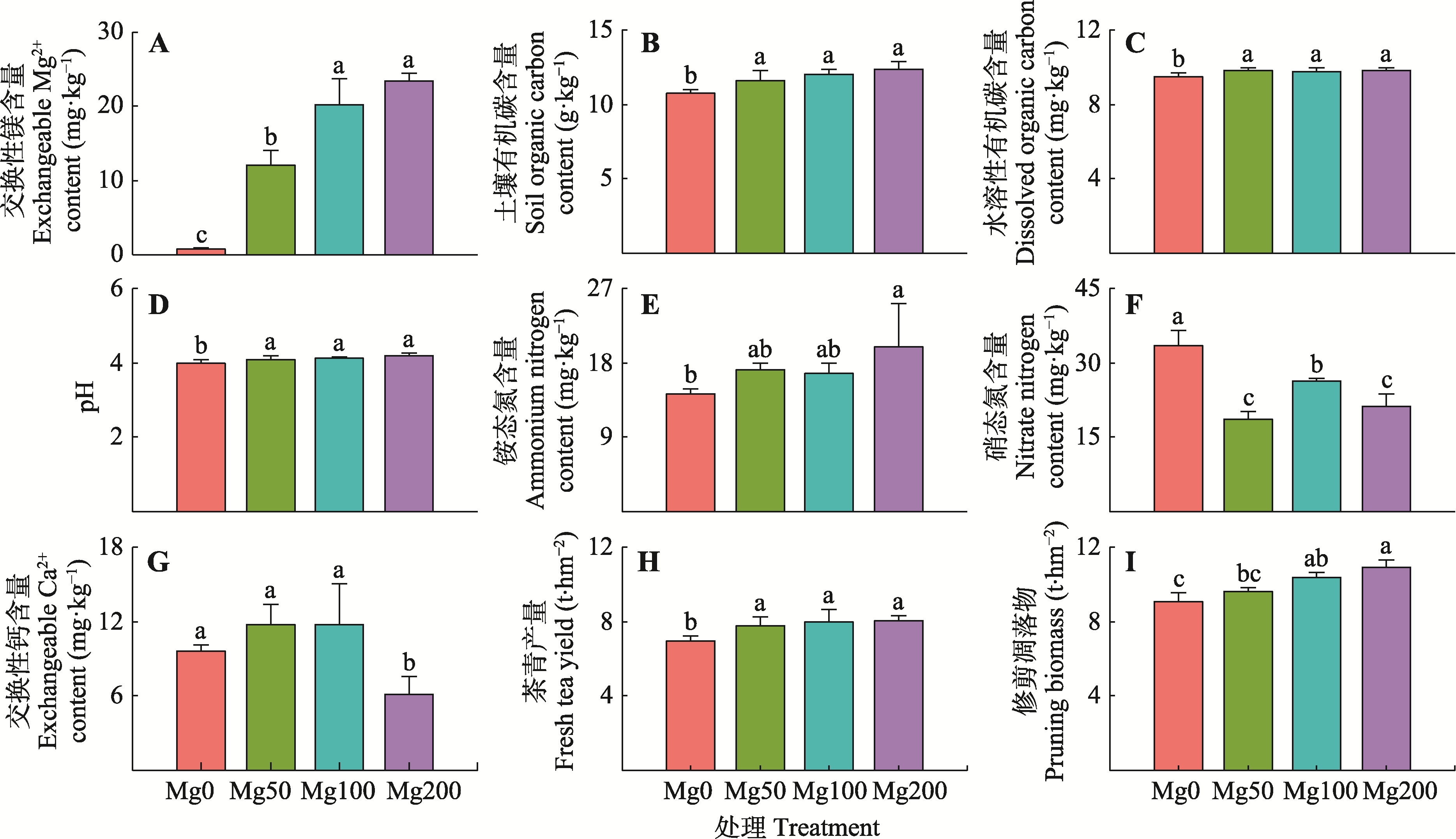
图1 不同镁肥施用量下土壤理化性质和茶叶产量以及修剪量(平均值±标准差)。Mg0、Mg50、Mg100和Mg200表示镁肥施用量分别为0、17.5、35和70 kg·hm-2。不同小写字母代表不同镁肥施用量下差异显著(p < 0.05)。
Fig. 1 Effects of magnesium fertilizer application rates on soil physicochemical properties, tea yield, and pruning biomass (mean ± SD). Mg0, Mg50, Mg100, and Mg200 represent magnesium sulfate heptahydrate application rates of 0, 17.5, 35 and 70 kg·hm-2, respectively. Different lowercase letters indicate significant difference under different magnesium fertilizer application rates (p < 0.05).
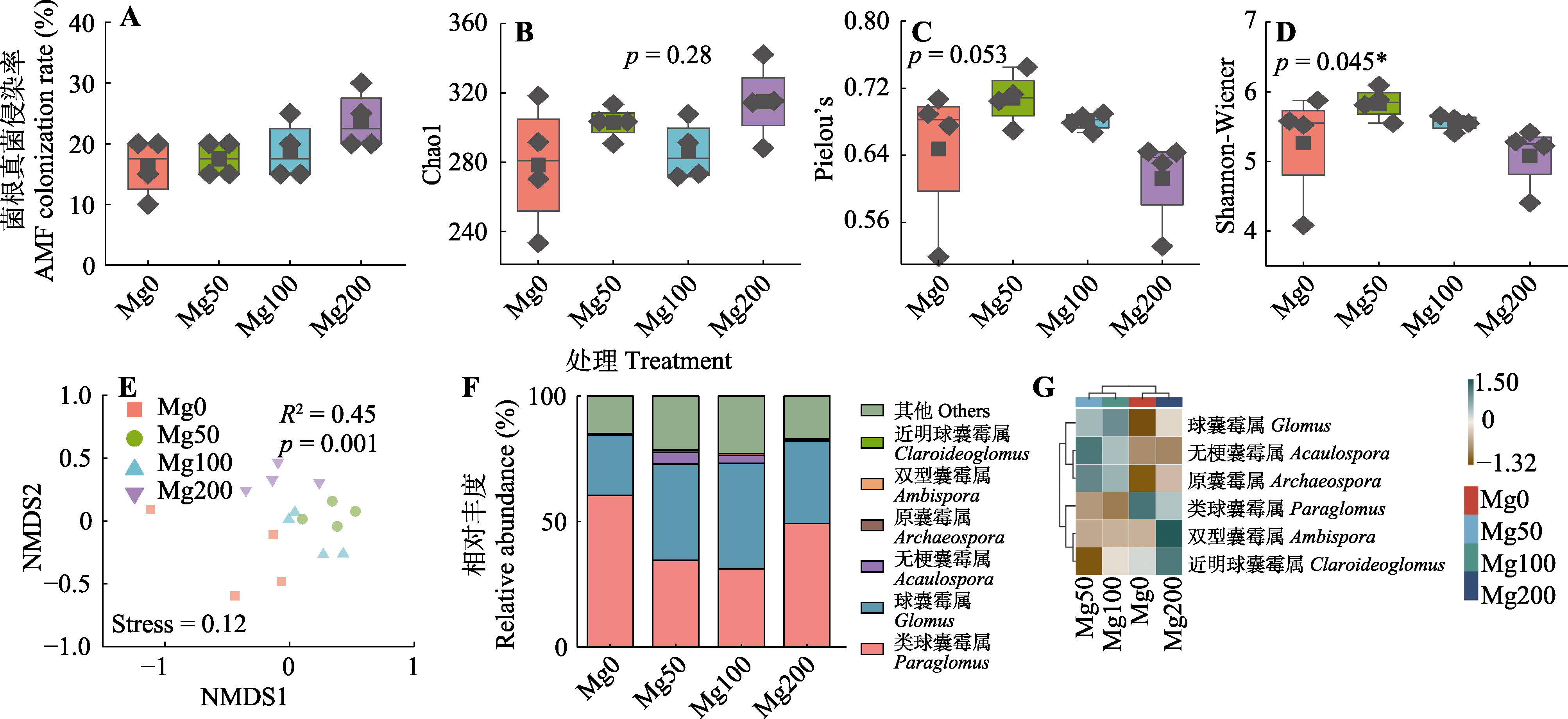
图2 不同镁肥施用量下丛枝菌根真菌群落特征。Mg0、Mg50、Mg100和Mg200表示镁肥施用量分别为0、17.5、35和70 kg·hm-2。NMDS, 基于Brsy-Curtis距离的非度量多维尺度分析。
Fig. 2 Effects of magnesium fertilizer application on arbuscular mycorrhizal fungi (AMF) community. Mg0, Mg50, Mg100, and Mg200 represent magnesium sulfate heptahydrate application rates of 0, 17.5, 35 and 70 kg·hm-2, respectively. NMDS, non-metric multidimensional scaling analysis based on Brsy-Curtis distance.
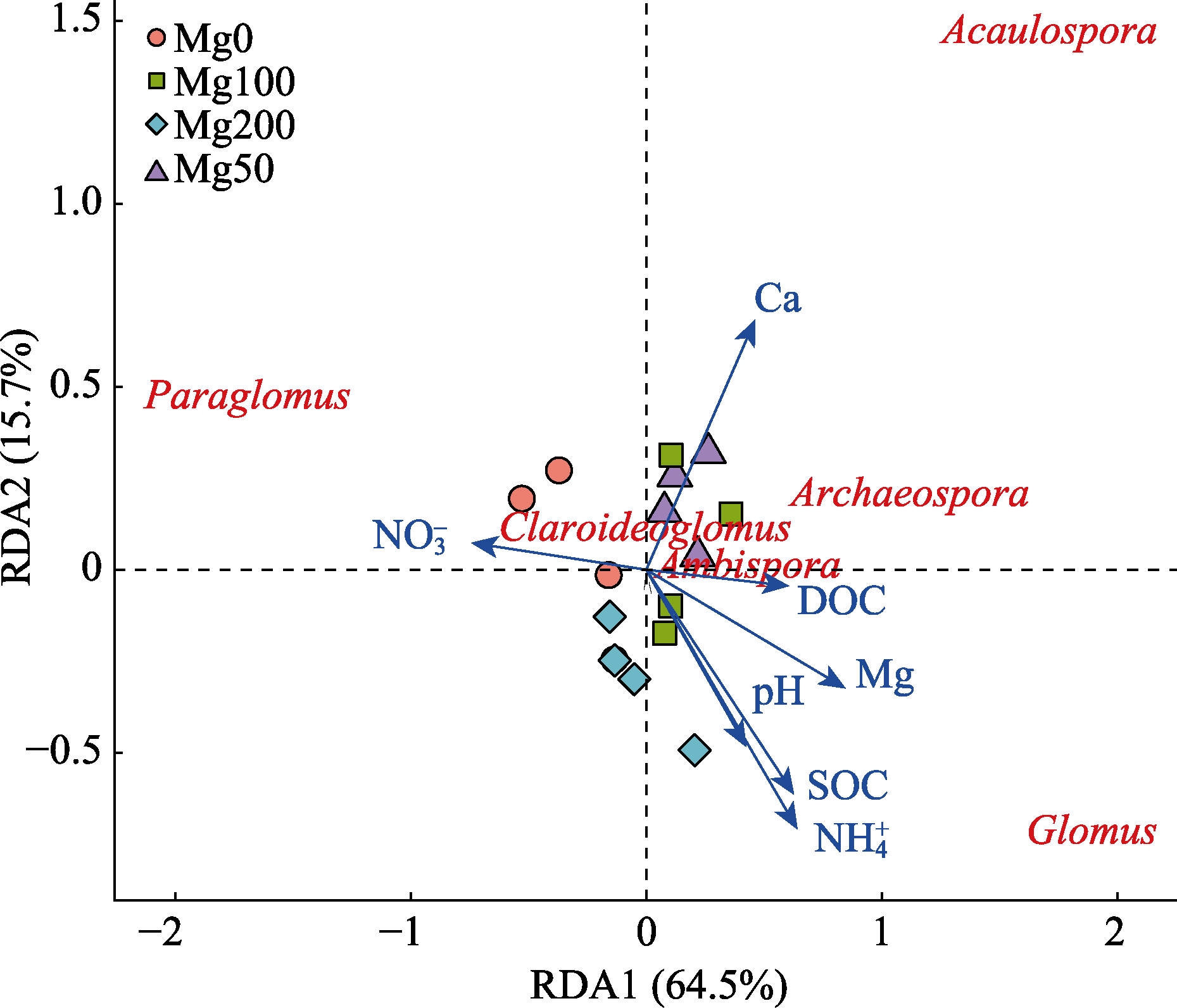
图3 丛枝菌根真菌群落与土壤因子之间的冗余分析(RDA)。Ca, 土壤Ca2+含量; DOC, 土壤水溶性有机碳含量; Mg, 土壤Mg2+含量; NH4+, 土壤铵态氮含量; NO3-, 土壤硝态氮含量; SOC, 土壤有机碳含量。Mg0、Mg50、Mg100和Mg200表示镁肥施肥量分别为0、17.5、35和70 kg·hm-2。Acaulospora, 无梗囊霉属; Ambispora, 双型囊霉属; Archaeospora, 原囊霉属; Claroideoglomus, 近明球囊霉属; Glomus, 球囊霉属; Paraglomus, 类球囊霉属。
Fig. 3 Redundancy analysis (RDA) based on arbuscular mycorrhizal fungi communities. Ca, exchangeable Ca2+ content; DOC, dissolved organic carbon content; Mg, exchangeable Mg2+ content; NH4+, ammonium nitrogen content; NO3-, nitrate nitrogen content; SOC, soil organic carbon content. Mg0, Mg50, Mg100, and Mg200 represent magnesium sulfate heptahydrate application rates of 0, 17.5, 35 and 70 kg·hm-2, respectively.
| 土壤有机碳含量 Soil organic carbon content | pH | 交换性镁含量 Mg content | 交换性钙含量 Ca content | 铵态氮含量 NH4+-N content | 硝态氮含量 NO3--N content | 水溶性有机碳含量 Dissolved organic carbon content | |
|---|---|---|---|---|---|---|---|
| p | 0.005 | 0.388 | 0.004 | 0.028 | 0.001 | 0.048 | 0.171 |
| R2 | 0.547 | 0.129 | 0.566 | 0.437 | 0.691 | 0.363 | 0.234 |
表1 冗余分析(RDA)中环境因子的决定系数(R²)和统计显著性(p)
Table 1 Coefficient of determination (R²) and statistical significance (p) of environmental factors in redundancy analysis (RDA)
| 土壤有机碳含量 Soil organic carbon content | pH | 交换性镁含量 Mg content | 交换性钙含量 Ca content | 铵态氮含量 NH4+-N content | 硝态氮含量 NO3--N content | 水溶性有机碳含量 Dissolved organic carbon content | |
|---|---|---|---|---|---|---|---|
| p | 0.005 | 0.388 | 0.004 | 0.028 | 0.001 | 0.048 | 0.171 |
| R2 | 0.547 | 0.129 | 0.566 | 0.437 | 0.691 | 0.363 | 0.234 |
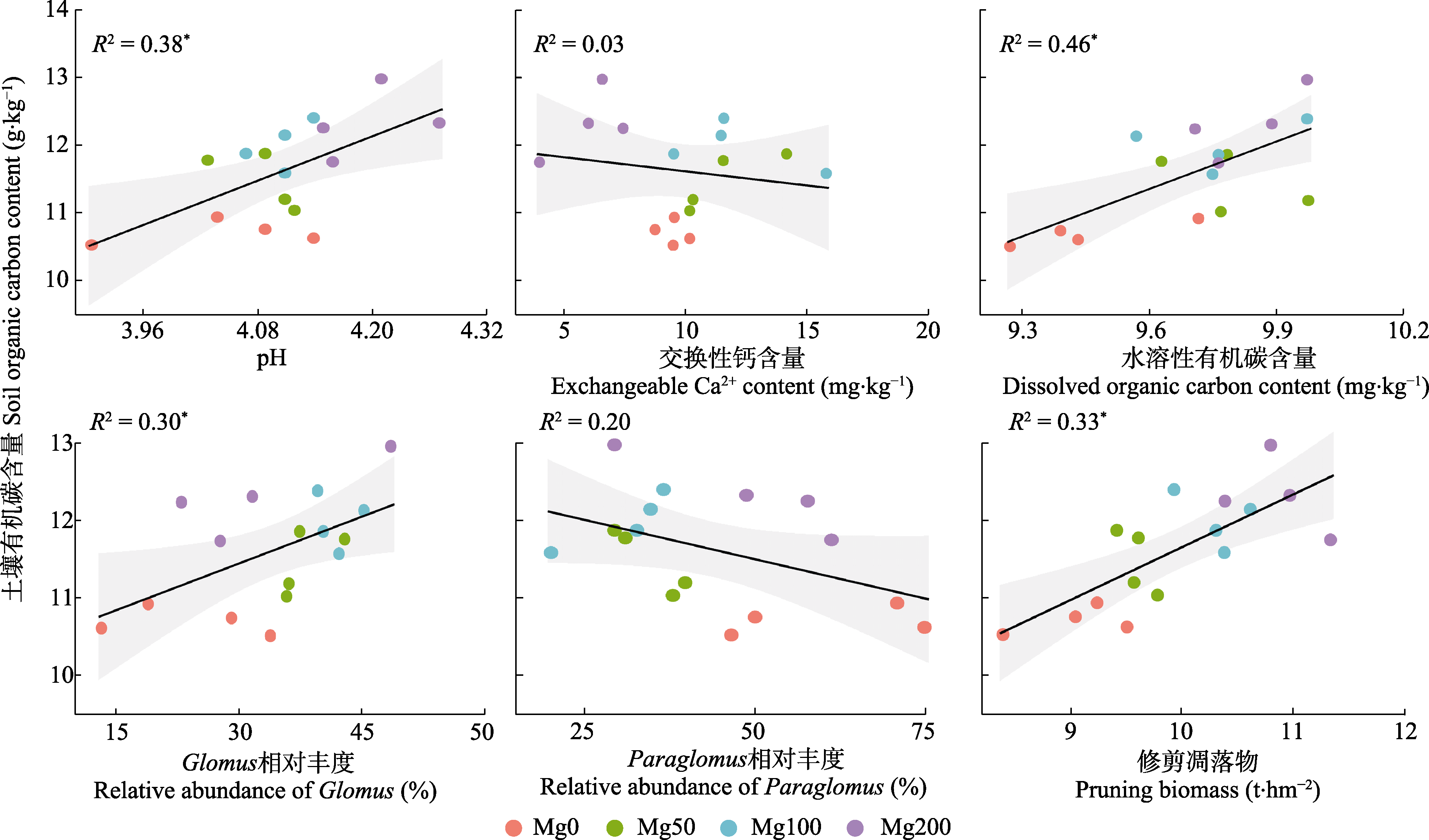
图4 不同土壤理化性质指标、茶青产量和修剪量与土壤有机碳(SOC)含量的线性相关分析。*, p < 0.05。阴影部分表示95%置信区间。Mg0、Mg50、Mg100和Mg200表示镁肥施肥量分别为0、17.5、35和70 kg·hm-2。
Fig. 4 Linear relationships of soil physicochemical indices, tea leaf yield, and pruning biomass with soil organic carbon (SOC) content. *, p < 0.05. Shaded areas represent 95% confidence intervals. Mg0, Mg50, Mg100, and Mg200 represent magnesium sulfate heptahydrate application rates of 0, 17.5, 35 and 70 kg·hm-2, respectively.
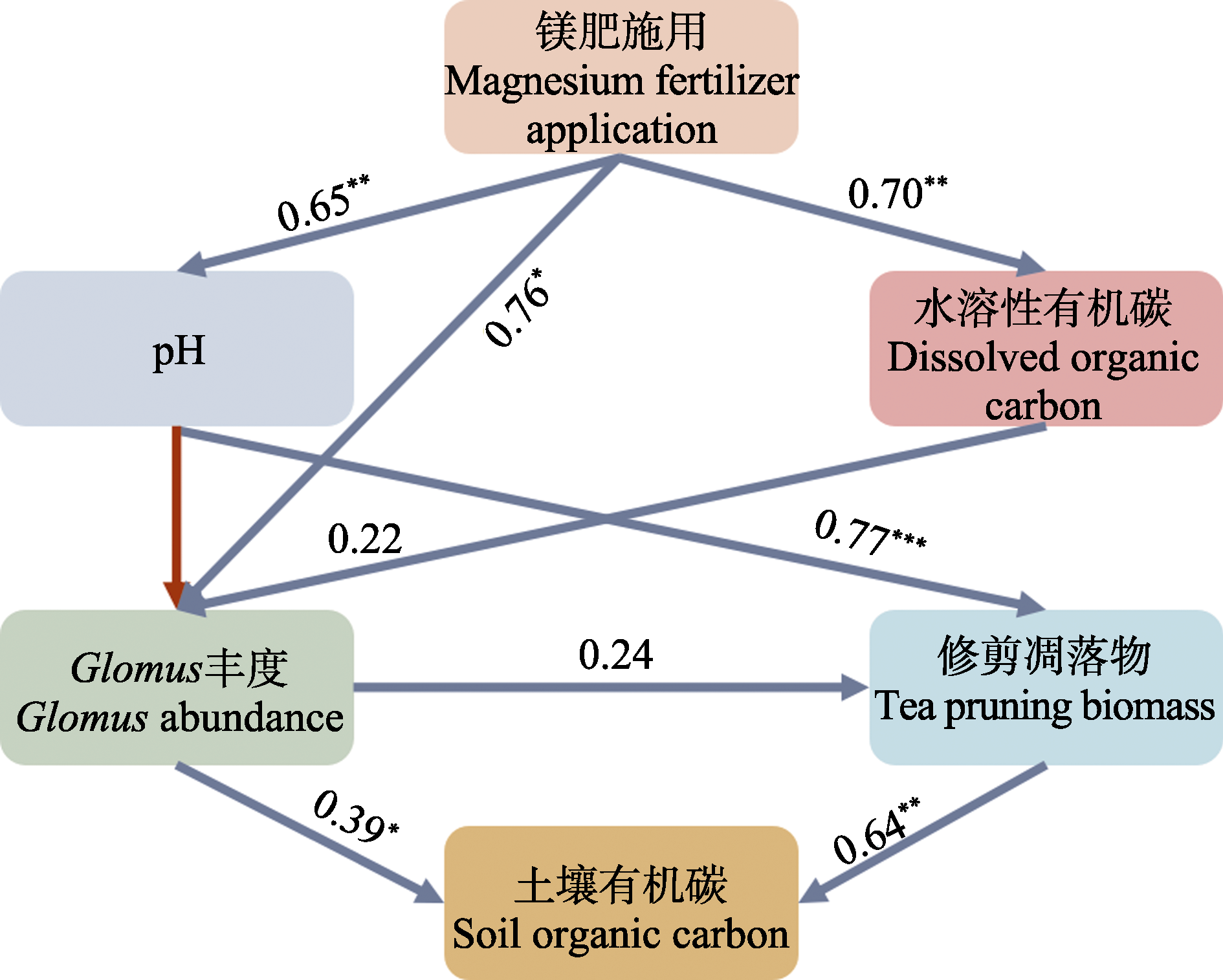
图5 镁肥施用对土壤有机碳(SOC)固存影响的偏最小二乘结构方程模型。灰色线条表示正效应, 红色线条表示负效应。n = 16, 拟合优度为0.739。*, p < 0.05; **, p< 0.01; ***, p < 0.001。
Fig. 5 Partial least squares structural equation modeling (PLS-SEM) of the effects of magnesium fertilizer application on soil organic carbon (SOC) sequestration. Gray lines indicate positive effects, while red lines indicate negative effects. n = 16, goodness-of-fit (GoF) = 0.739. *, p < 0.05; **, p< 0.01; ***, p < 0.001.
| 土壤有机碳含量 Soil organic carbon content | pH | 水溶性有机碳含量 Dissolved organic carbon content | 修剪凋落物 Tea pruning biomass | Glomus丰度 | |
|---|---|---|---|---|---|
| 效应值 | 0.600 | 0.653 | 0.702 | 0.627 | 0.503 |
表2 偏最小二乘结构方程模型中镁肥施用的总效应
Table 2 Total effects of magnesium application on partial least squares structural equation modeling
| 土壤有机碳含量 Soil organic carbon content | pH | 水溶性有机碳含量 Dissolved organic carbon content | 修剪凋落物 Tea pruning biomass | Glomus丰度 | |
|---|---|---|---|---|---|
| 效应值 | 0.600 | 0.653 | 0.702 | 0.627 | 0.503 |
| [1] | Bao SD (2000). Soil and Agricultural Chemistry Analysis. 3rd ed. China Agriculture Press, Beijing. 45-50. |
| [鲍士旦(2000). 土壤农化分析. 3版. 中国农业出版社, 北京. 45-50.] | |
| [2] |
Bose J, Babourina O, Rengel Z (2011). Role of magnesium in alleviation of aluminium toxicity in plants. Journal of Experimental Botany, 62, 2251-2264.
DOI PMID |
| [3] |
Bowman WD, Cleveland CC, Halada Ĺ, Hreško J, Baron JS (2008). Negative impact of nitrogen deposition on soil buffering capacity. Nature Geoscience, 1, 767-770.
DOI |
| [4] |
Callahan BJ, McMurdie PJ, Rosen MJ, Han AW, Johnson AJA, Holmes SP (2016). DADA2: High-resolution sample inference from Illumina amplicon data. Nature Methods, 13, 581-583.
DOI PMID |
| [5] |
Cavagnaro TR, Langley AJ, Jackson LE, Smukler SM, Koch GW (2008). Growth, nutrition, and soil respiration of a mycorrhiza-defective tomato mutant and its mycorrhizal wild-type progenitor. Functional Plant Biology, 35, 228-235.
DOI PMID |
| [6] |
Chari NR, Taylor BN (2022). Soil organic matter formation and loss are mediated by root exudates in a temperate forest. Nature Geoscience, 15, 1011-1016.
DOI |
| [7] |
Chen BD, Fu W, Wu SL, Zhu YG (2024). Involvements of mycorrhizal fungi in terrestrial ecosystem carbon cycling. Chinese Journal of Plant Ecology, 48, 1-20.
DOI URL |
|
[陈保冬, 付伟, 伍松林, 朱永官 (2024). 菌根真菌在陆地生态系统碳循环中的作用. 植物生态学报, 48, 1-20.]
DOI |
|
| [8] |
Chen DM, Wang Y, Lan ZC, Li JJ, Xing W, Hu SJ, Bai YF (2015). Biotic community shifts explain the contrasting responses of microbial and root respiration to experimental soil acidification. Soil Biology & Biochemistry, 90, 139-147.
DOI URL |
| [9] | Chen ZC, Peng WT, Li J, Liao H (2018). Functional dissection and transport mechanism of magnesium in plants. Seminars in Cell & Developmental Biology, 74, 142-152. |
| [10] | Cruz-Paredes C, Diera T, Davey M, Rieckmann MM, Christensen P, Dela Cruz M, Laursen KH, Joner EJ, Christensen JH, Nybroe O, Jakobsen I (2021). Disentangling the abiotic and biotic components of AMF suppressive soils. Soil Biology & Biochemistry, 159, 108305. DOI: 10.1016/j.soilbio.2021.108305. |
| [11] | Domeignoz-Horta LA, Shinfuku M, Junier P, Poirier S, Verrecchia E, Sebag D, DeAngelis KM (2021). Direct evidence for the role of microbial community composition in the formation of soil organic matter composition and persistence. ISME Communications, 1, 64. DOI: 10.1038/s43705-021-00071-7. |
| [12] | Duan YL, Zhang JB, Petropoulos E, Zhao JH, Jia RL, Wu FS, Chen Y, Wang LL, Wang XY, Li YL, Li YQ (2025). Soil acidification destabilizes terrestrial ecosystems via decoupling soil microbiome. Global Change Biology, 31, e70174. DOI: 10.1111/gcb.70174. |
| [13] |
Frey SD (2019). Mycorrhizal fungi as mediators of soil organic matter dynamics. Annual Review of Ecology, Evolution and Systematics, 50, 237-259.
DOI |
| [14] |
Guo WL, Nazim H, Liang ZS, Yang DF (2016). Magnesium deficiency in plants: an urgent problem. The Crop Journal, 4(2), 83-91.
DOI URL |
| [15] |
Herman DJ, Firestone MK, Nuccio E, Hodge A (2012). Interactions between an arbuscular mycorrhizal fungus and a soil microbial community mediating litter decomposition. FEMS Microbiology Ecology, 80, 236-247.
DOI PMID |
| [16] |
Horsch CCA, Antunes PM, Fahey C, Grandy AS, Kallenbach CM (2023). Trait-based assembly of arbuscular mycorrhizal fungal communities determines soil carbon formation and retention. New Phytologist, 239, 311-324.
DOI URL |
| [17] | Hu LN, Huang R, Zhou LM, Qin R, He XY, Deng H, Li K (2023). Effects of magnesium-modified biochar on soil organic carbon mineralization in citrus orchard. Frontiers in Microbiology, 14, 1109272. DOI: 10.3389/fmicb.2023.1109272. |
| [18] | Huang JS, Liu WX, Yang S, Yang L, Peng ZY, Deng MF, Xu S, Zhang BB, Ahirwal J, Liu LL (2021). Plant carbon inputs through shoot, root, and mycorrhizal pathways affect soil organic carbon turnover differently. Soil Biology & Biochemistry, 160, 108322. DOI: 10.1016/j.soilbio.2021.108322. |
| [19] |
Jandl R, Rodeghiero M, Martinez C, Cotrufo MF, Bampa F, van Wesemael B, Harrison RB, Guerrini IA, Richter DD, Rustad L, Lorenz K, Chabbi A, Miglietta F (2014). Current status, uncertainty and future needs in soil organic carbon monitoring. Science of the Total Environment, 468-469, 376-383.
DOI URL |
| [20] |
Jayaganesh S, Venkatesan S (2010). Impact of magnesium sulphate on biochemical and quality constituents of black tea. American Journal of Food Technology, 5, 31-39.
DOI URL |
| [21] |
Jiang SJ, Liu YJ, Luo JJ, Qin MS, Johnson NC, Öpik M, Vasar M, Chai YX, Zhou XL, Mao L, Du GZ, An LZ, Feng HY (2018). Dynamics of arbuscular mycorrhizal fungal community structure and functioning along a nitrogen enrichment gradient in an alpine meadow ecosystem. New Phytologist, 220, 1222-1235.
DOI PMID |
| [22] | Jones DL, Cooledge EC, Hoyle FC, Griffiths RI, Murphy DV (2019). pH and exchangeable aluminum are major regulators of microbial energy flow and carbon use efficiency in soil microbial communities. Soil Biology & Biochemistry, 138, 107584. DOI: 10.1016/j.soilbio.2019.107584. |
| [23] | Klugh KR, Cumming JR (2007). Variations in organic acid exudation and aluminum resistance among arbuscular mycorrhizal species colonizing Liriodendron tulipifera. Tree Physiology, 27, 1103-1112. |
| [24] |
Köchy M, Hiederer R, Freibauer A (2015). Global distribution of soil organic carbon—Part 1: Masses and frequency distributions of SOC stocks for the tropics, permafrost regions, wetlands, and the world. Soil, 1, 351-365.
DOI URL |
| [25] |
Lal R (2004). Soil carbon sequestration to mitigate climate change. Geoderma, 123, 1-22.
DOI URL |
| [26] |
Li SY, Wu X, Xue H, Gu B, Cheng H, Zeng JM, Peng CH, Ge Y, Chang J (2011). Quantifying carbon storage for tea plantations in China. Agriculture, Ecosystems & Environment, 141, 390-398.
DOI URL |
| [27] | Li YD, Xu XK, Lei BF, Zhuang JL, Zhang XJ, Hu CF, Cui JH, Liu YL (2021). Magnesium-nitrogen Co-doped carbon dots enhance plant growth through multifunctional regulation in photosynthesis. Chemical Engineering Journal, 422, 130114. DOI: 10.1016/j.cej.2021.130114. |
| [28] |
Liang C, Amelung W, Lehmann J, Kästner M (2019). Quantitative assessment of microbial necromass contribution to soil organic matter. Global Change Biology, 25, 3578-3590.
DOI PMID |
| [29] | Liao HZ, Lin XK, Yang CK, Du JJ, Peng JJ, Zhou KB (2022). Effects of spraying foliar calcium and magnesium fertilizer on transmembrane transport of organic acids in ‘Feizixiao’ litchi. Southwest China Journal of Agricultural Sciences, 35, 1378-1385. |
| [廖海枝, 林晓凯, 杨成坤, 杜婧加, 彭俊杰, 周开兵 (2022). 叶面喷施钙、镁肥对‘妃子笑’荔枝果肉有机酸跨膜运输的影响. 西南农业学报, 35, 1378-1385.] | |
| [30] | McClelland SC, Paustian K, Schipanski ME (2021). Management of cover crops in temperate climates influences soil organic carbon stocks: a meta-analysis. Ecological Applications, 31, e02278. DOI: 10.1002/eap.2278. |
| [31] |
Paterson E, Sim A, Davidson J, Daniell TJ (2016). Arbuscular mycorrhizal hyphae promote priming of native soil organic matter mineralisation. Plant and Soil, 408, 243-254.
DOI URL |
| [32] |
Phillips JM, Hayman DS (1970). Improved procedures for clearing roots and staining parasitic and vesicular- arbuscular mycorrhizal fungi for rapid assessment of infection. Transactions of the British Mycological Society, 55, 158-160.
DOI URL |
| [33] | Ricklefs RE, Relyea R, Richter C (2014). Ecology: the Economy of Nature. 6th ed. W. H. Freeman, New York. |
| [34] |
Rodríguez Martín JA, Álvaro-Fuentes J, Gonzalo J, Gil C, Ramos-Miras JJ, Grau Corbí JM, Boluda R (2016). Assessment of the soil organic carbon stock in Spain. Geoderma, 264, 117-125.
DOI URL |
| [35] |
Ruan JY, Gerendás J (2015). Absorption of foliar-applied urea-15N and the impact of low nitrogen, potassium, magnesium and sulfur nutritional status in tea (Camellia sinensis L.) plants. Soil Science and Plant Nutrition, 61, 653-663.
DOI URL |
| [36] | Ruan JY, Guan YL, Wu X (2002). Status of Mg availability and the effects of Mg application in tea fields of red soil area in China. Scientia Agricultura Sinica, 35, 815-820. |
| [阮建云, 管彦良, 吴洵 (2002). 茶园土壤镁供应状况及镁肥施用效果研究. 中国农业科学, 35, 815-820.] | |
| [37] |
See CR, Keller AB, Hobbie SE, Kennedy PG, Weber PK, Pett-Ridge J (2022). Hyphae move matter and microbes to mineral microsites: integrating the hyphosphere into conceptual models of soil organic matter stabilization. Global Change Biology, 28, 2527-2540.
DOI URL |
| [38] |
Tisdall JM, Oades JM (1982). Organic matter and water-stable aggregates in soils. Journal of Soil Science, 33, 141-163.
DOI URL |
| [39] | Trouvelot A, Kough JL, Gianinazzi-Pearson V (1986). Mesure du taux de mycorhization VA d’un système radiculaire. Recherche de méthodes d’éstimation ayant une signification fonctionelle//Gianinazzi S, Gianinazzi- Pearsun V. Physiological and Genetical Aspects of Mycorrhizae: Proceedings of the 1st European Symposium on Mycorrhizae. INRA, Paris. 217-222. |
| [40] |
Verlinden MS, Ven A, Verbruggen E, Janssens IA, Wallander H, Vicca S (2018). Favorable effect of mycorrhizae on biomass production efficiency exceeds their carbon cost in a fertilization experiment. Ecology, 99, 2525-2534.
DOI PMID |
| [41] |
Xie W, Hao ZP, Zhang X, Chen BD (2022). Research progress and prospect of signal transfer among plants mediated by arbuscular mycorrhizal networks. Chinese Journal of Plant Ecology, 46, 493-515.
DOI |
|
[谢伟, 郝志鹏, 张莘, 陈保冬 (2022). 丛枝菌根网络介导的植物间信号交流研究进展及展望. 植物生态学报, 46, 493-515.]
DOI |
|
| [42] |
Xu LJ, Hao ZP, Xie W, Li F, Chen BD (2018). Transmembrane H+ and Ca2+ fluxes through extraradical hyphae of arbuscular mycorrhizal fungi in response to drought stress. Chinese Journal of Plant Ecology, 42, 764-773.
DOI |
|
[徐丽娇, 郝志鹏, 谢伟, 李芳, 陈保冬 (2018). 丛枝菌根真菌根外菌丝跨膜H+和Ca2+流对干旱胁迫的响应. 植物生态学报, 42, 764-773.]
DOI |
|
| [43] | Yan P, Wu LQ, Wang DH, Fu JY, Shen C, Li X, Zhang LP, Zhang L, Fan LC, Han WY (2020). Soil acidification in Chinese tea plantations. Science of the Total Environment, 715, 136963. DOI: 10.1016/j.scitotenv.2020.136963. |
| [44] | Zhang QF, Ni K, Yi XY, Liu MY, Ruan JY (2021). Advances of magnesium nutrition in tea plant. Journal of Tea Science, 41(1), 19-27. |
| [张群峰, 倪康, 伊晓云, 刘美雅, 阮建云 (2021). 中国茶树镁营养研究进展与展望. 茶叶科学, 41(1), 19-27.] |
| [1] | 马云瀚, 鲁显楷, 贾永霞, 朱晓敏. 长期氮沉降改变热带森林土壤木质素酚积累的调控路径[J]. 植物生态学报, 2026, 50(预发表): 0-. |
| [2] | 吴光进, 郭垚鑫, 任成杰, 王俊, 岳明, 赵发珠. 秦岭北麓不同植被类型土壤有机碳含量分布及其影响因素[J]. 植物生态学报, 2026, 50(4): 1003-1015. |
| [3] | 李文竹, 栾军伟, 邸雅平, 王一, 聂秀青, 刘世荣. 模拟干旱对暖温带锐齿槲栎林菌根介导下土壤酶活性和土壤有机碳组分的影响[J]. 植物生态学报, 2026, 50(3): 660-673. |
| [4] | 魏莉, 王鹏森, 刘珊, 樊锐, 黄楠, 张建国, 其美拉姆, 苟扬, 刘沫含, 黄婷, 周冀琼. 丛枝菌根真菌对豆禾混播植物垂直生态位养分吸收的影响[J]. 植物生态学报, 2026, 50(3): 760-773. |
| [5] | 周春菡, 熊智诚, 杨明新, 史海兰, 周亚星, 唐玉, 张静, 纪宝明, 代心灵. 黄河源园区高寒湿地菌根真菌群落特征及其影响因素[J]. 植物生态学报, 2026, 50(3): 625-638. |
| [6] | 姜庆宏, 丁露, 王哲, 郑春丽, 冯昭绰. 丛枝菌根真菌与不同功能细菌联用对苜蓿的促生作用[J]. 植物生态学报, 2026, 50(3): 774-788. |
| [7] | 马建辉, 童鑫, 张思榕, 毛子昆, 秦俊, 马克平. 菌根真菌生理生态功能研究进展及展望[J]. 植物生态学报, 2026, 50(3): 498-514. |
| [8] | 王海浪, 付伟, 伍松林, 陈保冬. 丛枝菌根真菌生态功能及群落调控[J]. 植物生态学报, 2026, 50(3): 515-535. |
| [9] | 秦斐斐, 唐朝辉, 司彤, 慈敦伟. 盐碱耐受型和敏感型花生生长发育及根际土壤特性对丛枝菌根真菌的响应[J]. 植物生态学报, 2026, 50(3): 742-759. |
| [10] | 邹纪开, 吴佳怡, 谷云懿, 陈宝明. 不同形态氮添加与丛枝菌根真菌对外来入侵植物白花鬼针草竞争力的影响[J]. 植物生态学报, 2026, 50(3): 722-730. |
| [11] | 段世龙, 余成瑾, 许心垚, 冯固, 谢贤安, 张林. 植物-丛枝菌根真菌-细菌连续体及其维持机制[J]. 植物生态学报, 2026, 50(3): 600-611. |
| [12] | 江康威, 吕程, 王亚菲, 李宏, 张芷晴, 王雨, 张青青, 吐尔逊娜依•热依木. 放牧干扰下丛枝菌根真菌群落对土壤多功能性的影响[J]. 植物生态学报, 2026, 50(3): 685-699. |
| [13] | 何堂庆, 王变变, 曹鑫鑫, 张康成, 汪晓东, 王浩, 白彤硕, 赵叶新, 张艺, 王益, 仇云鹏, 胡水金. 半干旱草地植物和丛枝菌根真菌群落对长期降水增加的响应[J]. 植物生态学报, 2026, 50(3): 674-684. |
| [14] | 王梦雪, 胡明艳, 储诚进, 陈阳, 罗文启, 马子龙. 亚热带森林不同菌根真菌树种叶片和细根的碳氮磷化学计量特征[J]. 植物生态学报, 2026, 50(2): 334-343. |
| [15] | 张法伟, 李红琴, 祝景彬, 樊博, 周华坤, 李英年, 梁乃申. 氮添加和降水改变对高寒草甸生态系统地上与地下碳储的影响[J]. 植物生态学报, 2025, 49(9): 1399-1409. |
| 阅读次数 | ||||||
|
全文 |
|
|||||
|
摘要 |
|
|||||
Copyright © 2026 版权所有 《植物生态学报》编辑部
地址: 北京香山南辛村20号, 邮编: 100093
Tel.: 010-62836134, 62836138; Fax: 010-82599431; E-mail: apes@ibcas.ac.cn, cjpe@ibcas.ac.cn
备案号: 京ICP备16067583号-19

