
植物生态学报 ›› 2026, Vol. 50 ›› Issue (3): 710-721.DOI: 10.17521/cjpe.2025.0173 cstr: 32100.14.cjpe.2025.0173
任曦彤1,2, 李颖1, 张雨3, 熊胡安赫1, 张蕊科1, 祁珊珊3, 戴志聪1,2,4,*( )(
)( ), 杜道林5
收稿日期:2025-05-15
接受日期:2025-07-21
出版日期:2026-03-20
发布日期:2026-04-22
通讯作者:
*戴志聪(daizhicong@163.com)基金资助:
REN Xi-Tong1,2, LI Ying1, ZHANG Yu3, XIONG Hu-An-He1, ZHANG Rui-Ke1, QI Shan-Shan3, DAI Zhi-Cong1,2,4,*()(), DU Dao-Lin5
Received:2025-05-15
Accepted:2025-07-21
Online:2026-03-20
Published:2026-04-22
Contact:
*DAI Zhi-Cong(daizhicong@163.com)
Supported by:摘要:
植物入侵往往引起本地物种多样性的丧失, 造成巨大的经济损失。用于解释外来植物成功入侵的“共生促进假说”提出: 入侵植物往往可以与具有促进作用的共生微生物形成良好的共生关系。为探究不同营养条件下丛枝菌根真菌(AMF)与凋落物互作对入侵植物生长策略的贡献, 该研究以恶性入侵植物加拿大一枝黄花(Solidago canadensis)为研究对象, 通过接种AMF菌剂幼套球囊霉(Claroideoglomus etunicatum)并添加其叶片凋落物, 探讨AMF和凋落物的互作在加拿大一枝黄花响应不同营养条件中的作用。结果显示: 添加凋落物显著提高加拿大一枝黄花的菌根侵染率及侵染丰度; 在低营养情况下, AMF及凋落物都能显著促进植株的茎长、叶面积及地上生物量, 但植株的根冠比显著降低, 且AMF与凋落物互作的效果最为显著; 在正常营养情况下, 仅AMF与凋落物互作对植物的部分指标有显著影响——抑制了根的发育但提高了地上生物量。相对作用强度(RII)分析表明, AMF和凋落物的添加都对加拿大一枝黄花地上部分的生长有显著促进作用, 且在低营养条件下的促进作用显著强于正常营养条件。研究结果表明, 加拿大一枝黄花可以通过AMF与凋落物的互作调整地上地下资源分配策略以应对低营养胁迫。研究结果有助于从共生微生物AMF与凋落物互作的视角解释外来入侵植物如何通过地上地下部分的资源分配策略响应不同营养胁迫, 加深对入侵植物成功入侵机制的理解。
任曦彤, 李颖, 张雨, 熊胡安赫, 张蕊科, 祁珊珊, 戴志聪, 杜道林. 丛枝菌根真菌与凋落物互作有助于加拿大一枝黄花应对营养胁迫. 植物生态学报, 2026, 50(3): 710-721. DOI: 10.17521/cjpe.2025.0173
REN Xi-Tong, LI Ying, ZHANG Yu, XIONG Hu-An-He, ZHANG Rui-Ke, QI Shan-Shan, DAI Zhi-Cong, DU Dao-Lin. Interaction between arbuscular mycorrhizal fungi and litter contributes to responses of Solidago canadensis to nutrient stress. Chinese Journal of Plant Ecology, 2026, 50(3): 710-721. DOI: 10.17521/cjpe.2025.0173
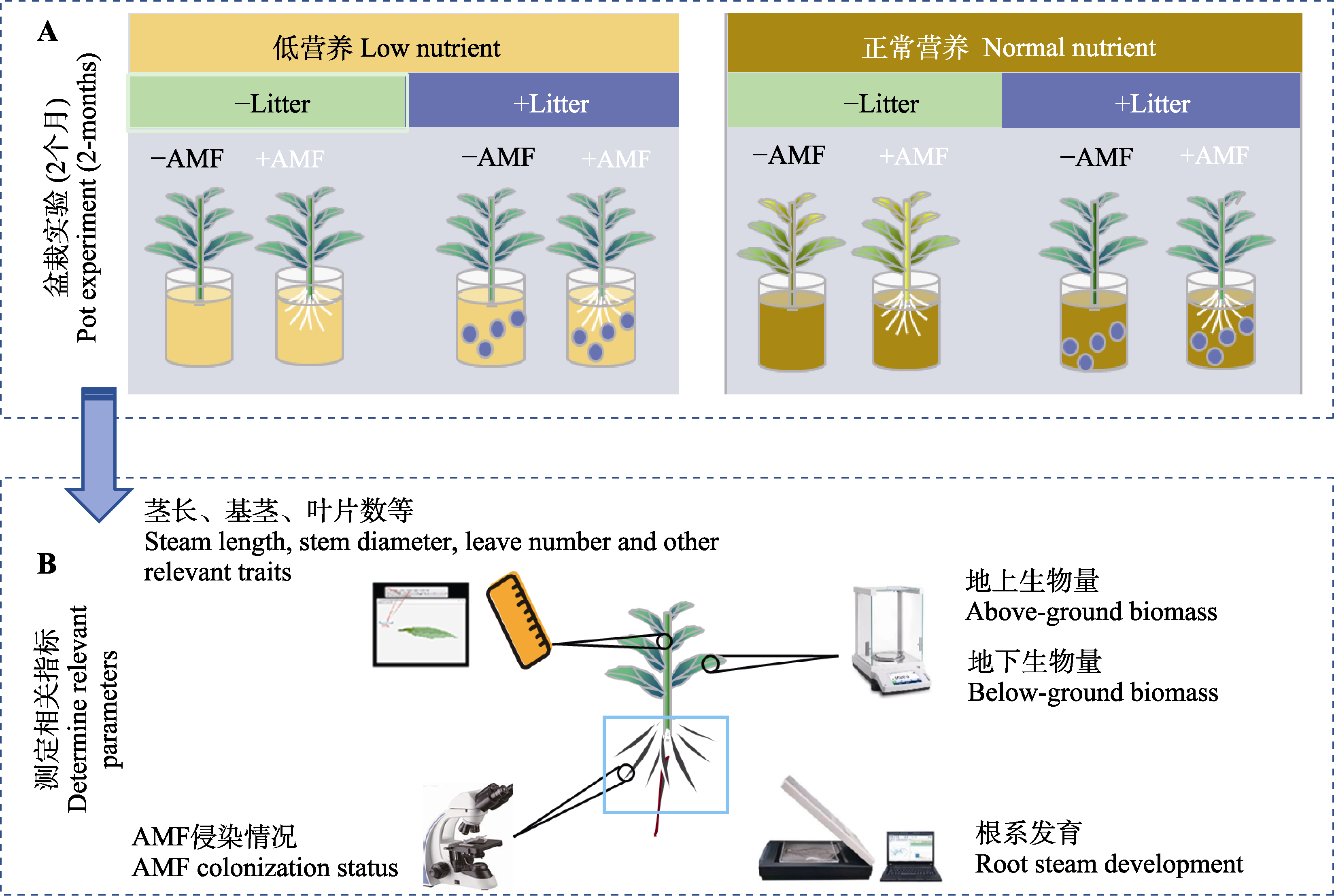
图1 实验设计示意图。-AMF, 不接种丛枝菌根真菌菌剂; +AMF, 接种丛枝菌根真菌菌剂; -Litter, 不添加凋落物; +Litter, 添加凋落物。
Fig. 1 Procedure schematic of experimental design. AMF, arbuscular mycorrhizal fungi. -AMF, without AMF addition; +AMF, with AMF addition; -Litter, without litter addition ; +Litter, with litter addition.
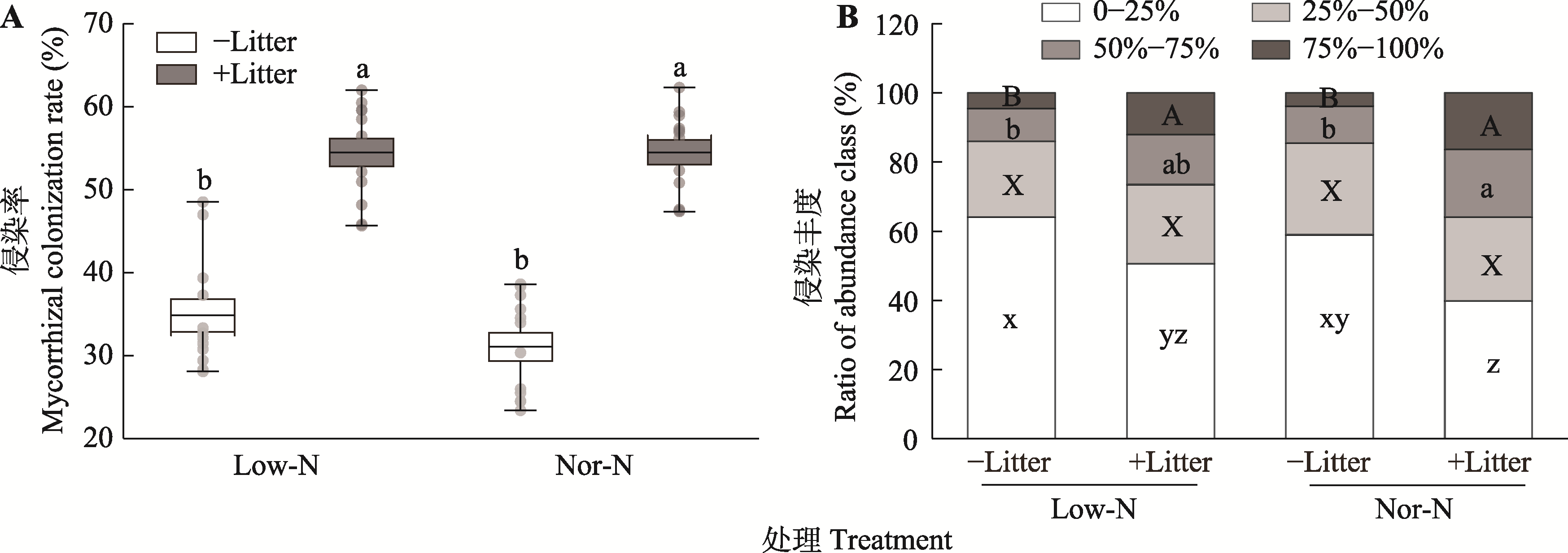
图2 不同处理下丛枝菌根真菌(AMF)的侵染率(A)及侵染丰度(B)。-Litter/+Litter, 未添加/添加凋落物; Low-N/Nor-N, 低/正常营养条件。不同字母表示处理间差异显著(n = 11, p < 0.05)。
Fig. 2 Mycorrhizal colonization rate (A) and Ratio of abundance class (B) of arbuscular mycorrhizal fungi (AMF) under different conditions. -Litter/+Litter, without/with litter addition; Low-N/Nor-N, low/normal nutrient conditions. Different letters indicate significant differences between treatments (n = 11, p < 0.05).
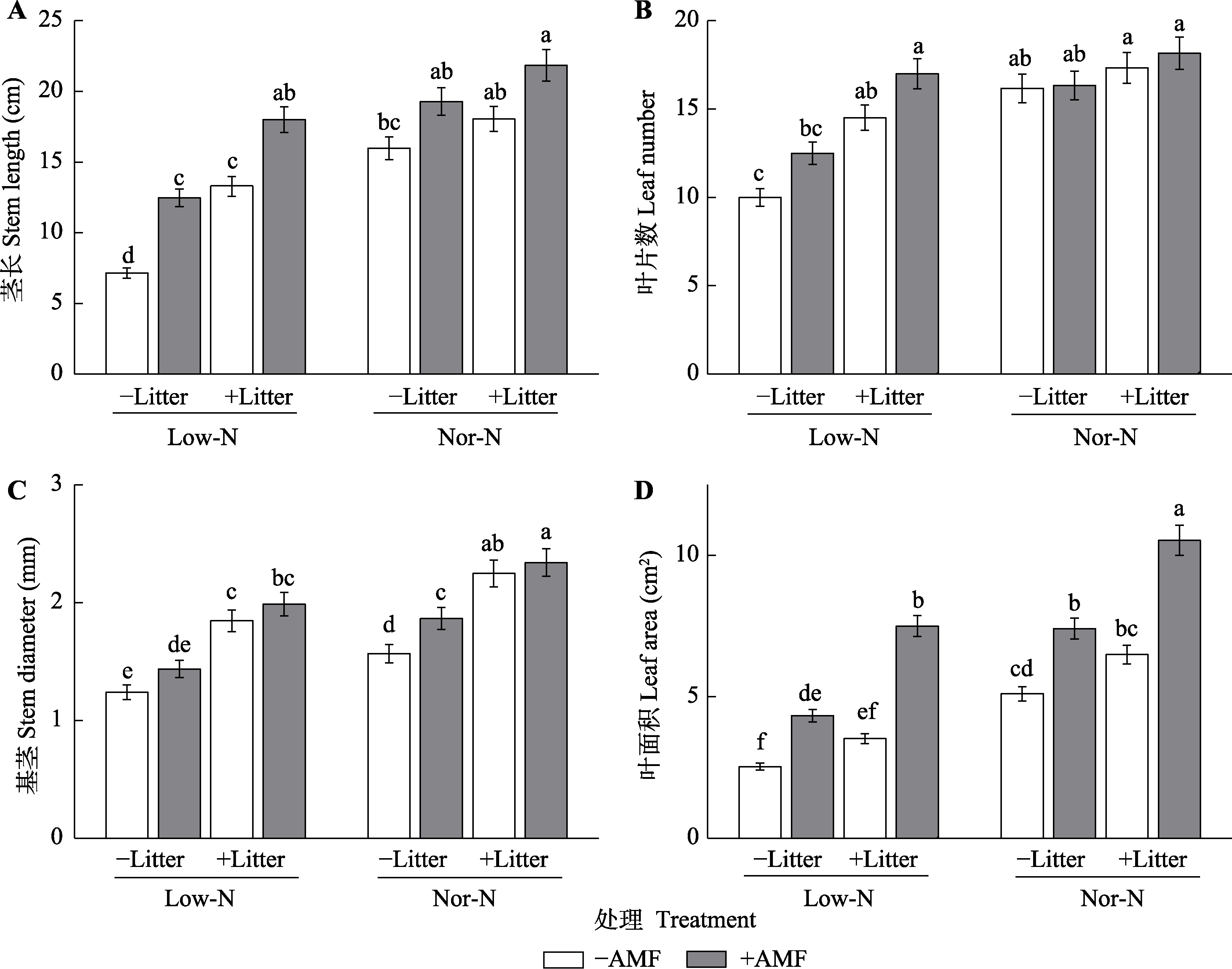
图3 不同处理条件下加拿大一枝黄花地上部分的生长表型(平均值±标准差)。AMF, 丛枝菌根真菌; -AMF/+AMF, 未添加/添加丛枝菌根真菌; -Litter/+Litter, 未添加/添加凋落物; Low-N/Nor-N, 低/正常营养条件。不同小写字母表示处理间差异显著(n = 11, p < 0.05)。
Fig. 3 Growth phenotype of above-ground parts of Solidago canadensis under different conditions (mean ± SD). AMF, arbuscular mycorrhizal fungi; -AMF/+AMF, without/with AMF addition; -Litter/+Litter, without/with litter addition; Low-N/Nor-N, low/normal nutrient conditions. Different lowercase letters indicate significant differences between treatments (n = 11, p < 0.05).
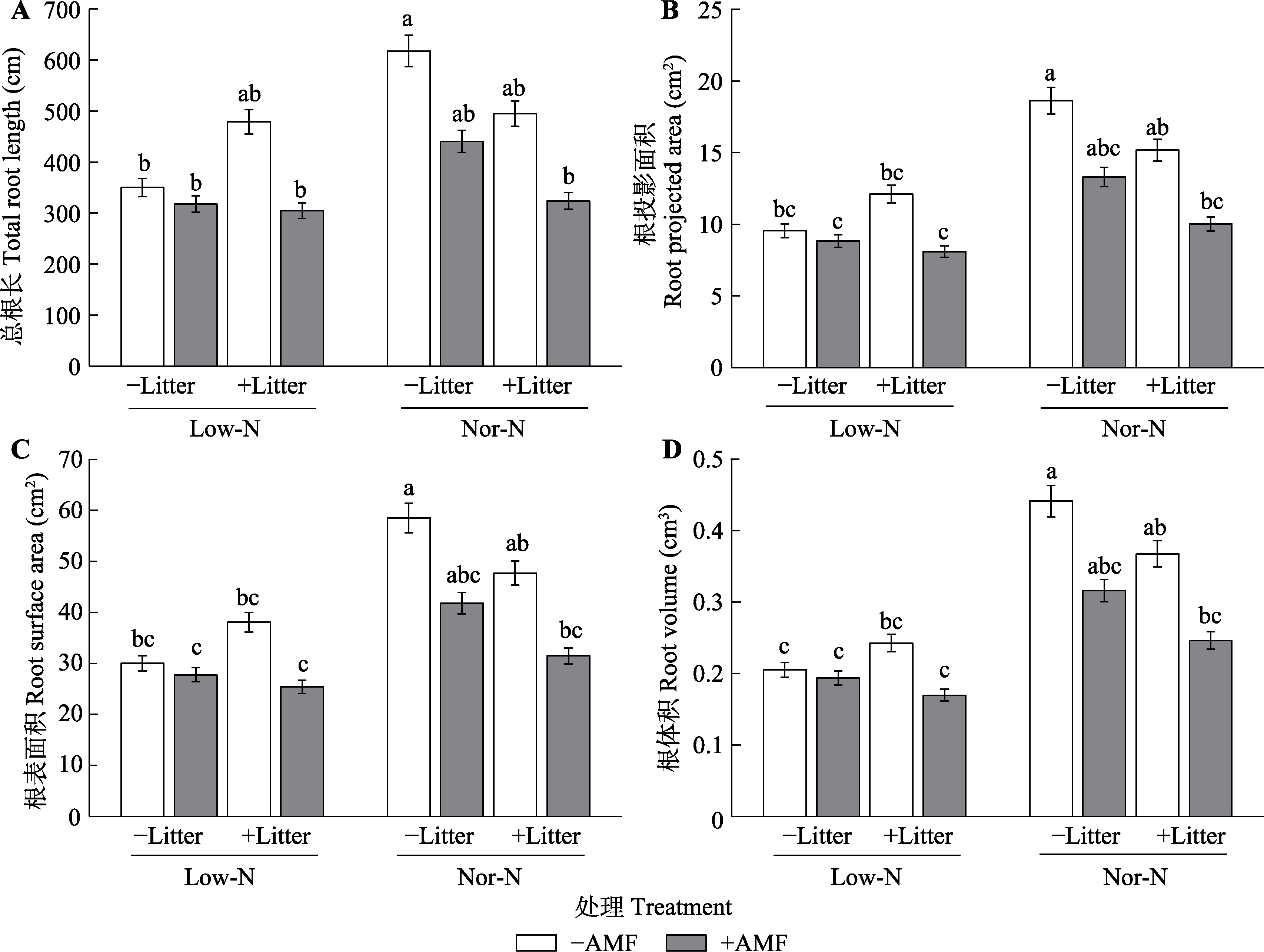
图4 不同条件下加拿大一枝黄花地下部分的生长情况(平均值±标准差)。AMF, 丛枝菌根真菌; -AMF/+AMF, 未添加/添加丛枝菌根真菌; -Litter/+Litter, 未添加/添加凋落物; Low-N/Nor-N, 低/正常营养条件。不同小写字母表示处理间差异显著(n = 11, p < 0.05)。
Fig. 4 Growth phenotype of belowground parts of Solidago canadensis under different conditions (mean ± SD). AMF, arbuscular mycorrhizal fungi; -AMF/+AMF, without/with AMF addition; -Litter/+Litter, without/with litter addition; Low-N/Nor-N, low/normal nutrient conditions. Different lowercase letters indicate significant differences between treatments (n = 11, p < 0.05).
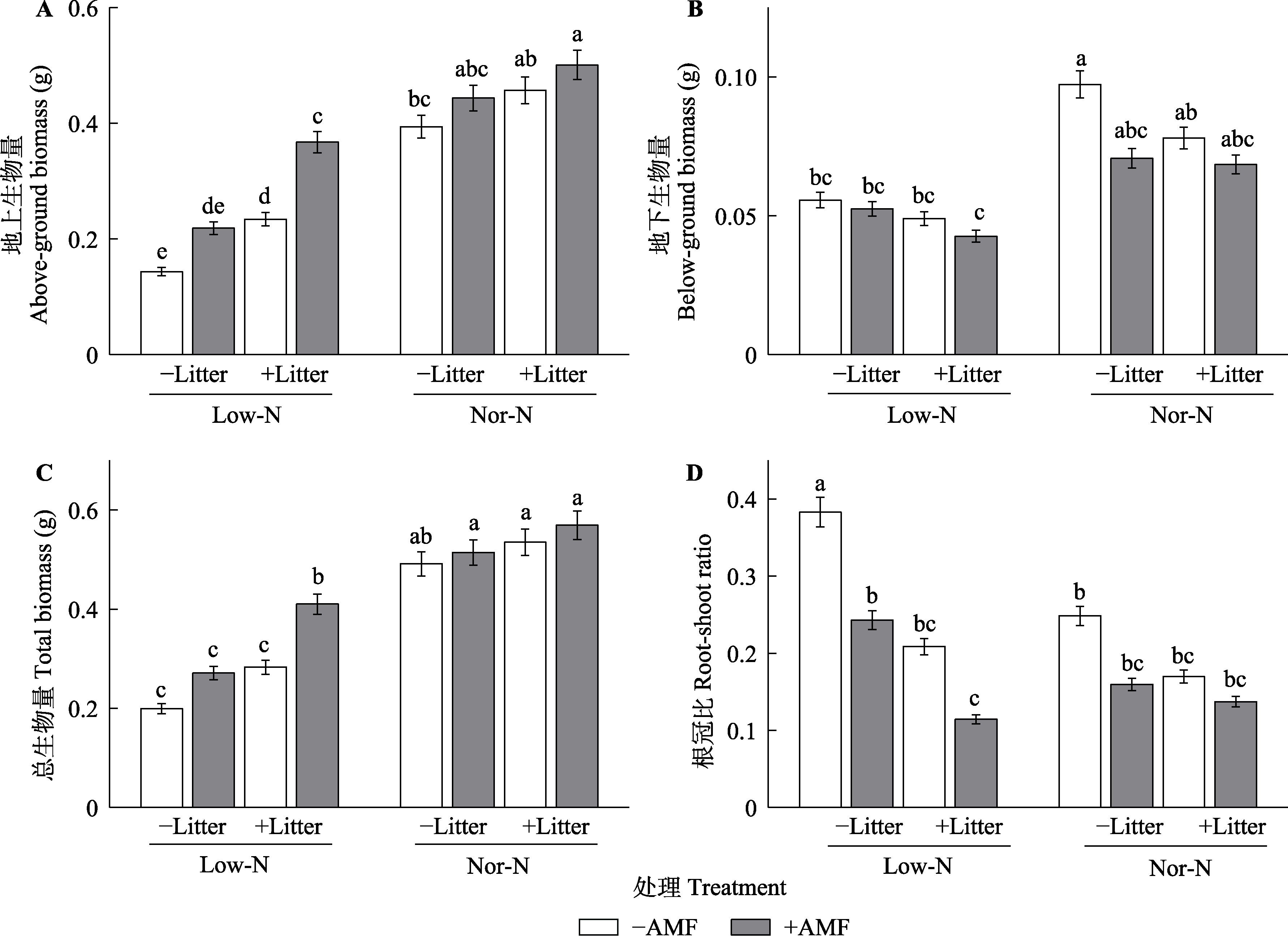
图5 不同条件下加拿大一枝黄花的生物量及其分配情况(平均值±标准差)。AMF, 丛枝菌根真菌; -AMF/+AMF, 未添加/添加丛枝菌根真菌; -Litter/+Litter, 未添加/添加凋落物; Low-N/Nor-N, 低/正常营养条件。不同小写字母表示处理间差异显著(n = 11, p < 0.05)。
Fig. 5 Biomass and its allocation of Solidago canadensis under different conditions (mean ± SD). AMF, arbuscular mycorrhizal fungi; -AMF/+AMF, without/with AMF addition; -Litter/+Litter, without/with litter addition; Low-N/Nor-N, low/normal nutrient conditions. Different lowercase letters indicate significant differences between treatments (n = 11, p < 0.05).
| 变异来源 Source of variation | 自由度 df | 地上生物量 Above-ground biomass | 地下生物量 Below-ground biomass | 总生物量 Total biomass | ||||||
|---|---|---|---|---|---|---|---|---|---|---|
| F | p | Partial η2 | F | p | Partial η2 | F | p | Partial η2 | ||
| 丛枝菌根真菌 AMF | 1 | 37.78 | <0.001 | 0.486 | 4.98 | 0.031 | 0.111 | 17.78 | <0.001 | 0.308 |
| 凋落物 Litter | 1 | 53.49 | <0.001 | 0.572 | 3.45 | 0.071 | 0.079 | 27.95 | <0.001 | 0.411 |
| 营养条件 Nutrient | 1 | 286.70 | <0.001 | 0.878 | 31.40 | <0.001 | 0.440 | 242.54 | <0.001 | 0.858 |
| AMF ×凋落物 AMF × litter | 1 | 1.14 | 0.291 | 0.028 | 0.47 | 0.498 | 0.012 | 1.20 | 0.280 | 0.029 |
| AMF ×营养条件 AMF × nutrient | 1 | 5.50 | 0.024 | 0.121 | 1.70 | 0.200 | 0.041 | 5.45 | 0.025 | 0.120 |
| 凋落物×营养条件 litter × nutrient | 1 | 5.89 | 0.020 | 0.128 | 0.06 | 0.808 | 0.001 | 4.18 | 0.048 | 0.095 |
| AMF ×凋落物×营养条件 AMF × litter × nutrient | 1 | 1.69 | 0.201 | 0.041 | 0.99 | 0.326 | 0.024 | 0.51 | 0.478 | 0.013 |
表1 三因素方差分析及简单效应分析(Partial η2)不同营养条件下丛枝菌根真菌(AMF)及凋落物对加拿大一枝黄花生物量的影响
Table 1 Three-way ANOVA and simple effect analysis (Partial η2) on the effects of arbuscular mycorrhizal fungi (AMF) and litter on the biomass of Solidago canadensis under different nutrient conditions
| 变异来源 Source of variation | 自由度 df | 地上生物量 Above-ground biomass | 地下生物量 Below-ground biomass | 总生物量 Total biomass | ||||||
|---|---|---|---|---|---|---|---|---|---|---|
| F | p | Partial η2 | F | p | Partial η2 | F | p | Partial η2 | ||
| 丛枝菌根真菌 AMF | 1 | 37.78 | <0.001 | 0.486 | 4.98 | 0.031 | 0.111 | 17.78 | <0.001 | 0.308 |
| 凋落物 Litter | 1 | 53.49 | <0.001 | 0.572 | 3.45 | 0.071 | 0.079 | 27.95 | <0.001 | 0.411 |
| 营养条件 Nutrient | 1 | 286.70 | <0.001 | 0.878 | 31.40 | <0.001 | 0.440 | 242.54 | <0.001 | 0.858 |
| AMF ×凋落物 AMF × litter | 1 | 1.14 | 0.291 | 0.028 | 0.47 | 0.498 | 0.012 | 1.20 | 0.280 | 0.029 |
| AMF ×营养条件 AMF × nutrient | 1 | 5.50 | 0.024 | 0.121 | 1.70 | 0.200 | 0.041 | 5.45 | 0.025 | 0.120 |
| 凋落物×营养条件 litter × nutrient | 1 | 5.89 | 0.020 | 0.128 | 0.06 | 0.808 | 0.001 | 4.18 | 0.048 | 0.095 |
| AMF ×凋落物×营养条件 AMF × litter × nutrient | 1 | 1.69 | 0.201 | 0.041 | 0.99 | 0.326 | 0.024 | 0.51 | 0.478 | 0.013 |
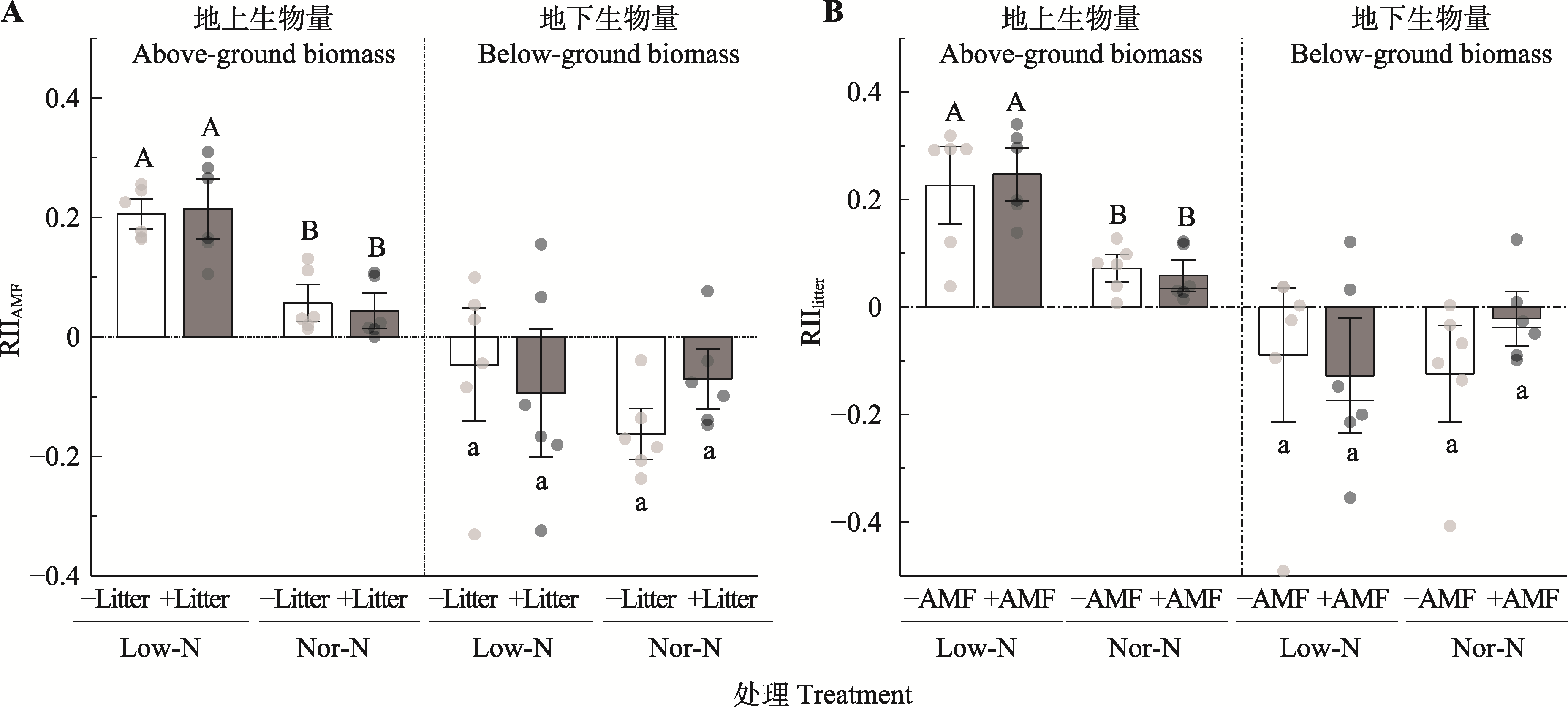
图6 不同条件下丛枝菌根真菌(AMF) (A)及凋落物(B)对加拿大一枝黄花生物量的相对作用强度(RII) (平均值±标准差)。-AMF/+AMF, 未添加/添加丛枝菌根真菌; -Litter/+Litter, 未添加/添加凋落物; Low-N/Nor-N, 低/正常营养条件。不同字母表示处理间差异显著(n = 11, p < 0.05)。
Fig. 6 Relative Interaction Intensity (RII) of arbuscular mycorrhizal fungi (AMF) (A) and Litter (B) on the biomass of Solidago canadensis under different conditions (mean ± SD). -AMF/+AMF, without/with AMF addition; -Litter/+Litter, without/with litter addition; Low-N/Nor-N, low/normal nutrient conditions. Different letters indicate significant differences between treatments (n = 11, p < 0.05).
| [1] |
Allison SD, Vitousek PM (2004). Rapid nutrient cycling in leaf litter from invasive plants in Hawai’i. Oecologia, 141, 612-619.
DOI PMID |
| [2] | Begum N, Qin C, Ahanger MA, Raza S, Khan MI, Ashraf M, Ahmed N, Zhang LX (2019). Role of arbuscular mycorrhizal fungi in plant growth regulation: implications in abiotic stress tolerance. Frontiers in Plant Science, 10, 01068. DOI: 10.3389/fpls.2019.01068. |
| [3] | Benitez L, Kendig AE, Adhikari A, Clay K, Harmon PF, Holt RD, Goss EM, Flory SL (2022). Invasive grass litter suppresses a native grass species and promotes disease. Ecosphere, 13, e3907. DOI: 10.1002/ecs2.3907. |
| [4] | Cao TT, Fang Y, Chen YR, Kong XS, Yang JB, Alharbi H, Kuzyakov Y, Tian XJ (2022). Synergy of saprotrophs with mycorrhiza for litter decomposition and hotspot formation depends on nutrient availability in the rhizosphere. Geoderma, 410, 115662. DOI: 10.1016/j.geoderma.2021.115662. |
| [5] |
Chen Q, Wu WW, Qi SS, Cheng H, Li Q, Ran Q, Dai ZC, Du DL, Egan S, Thomas T (2021). Arbuscular mycorrhizal fungi improve the growth and disease resistance of the invasive plant Wedelia trilobata. Journal of Applied Microbiology, 130, 582-591.
DOI |
| [6] | Cuthbert RN, Pattison Z, Taylor NG, Verbrugge L, Diagne C, Ahmed DA, Leroy B, Angulo E, Briski E, Capinha C, Catford JA, Dalu T, Essl F, Gozlan RE, Haubrock PJ, et al. (2021). Global economic costs of aquatic invasive alien species. Science of the Total Environment, 775, 145238. DOI: 10.1016/j.scitotenv.2021.145238. |
| [7] | Dai ZC, Du DL, Si CC, Lin Y, Hao JL, Sun F (2009). A method to exactly measure the morphological quantity of leaf using scanner and Image J software. Guihaia, 29, 342-347. |
| [戴志聪, 杜道林, 司春灿, 林英, 郝建良, 孙凤 (2009). 用扫描仪及Image J软件精确测量叶片形态数量特征的方法. 广西植物, 29, 342-347.] | |
| [8] |
Diagne C, Leroy B, Gozlan RE, Vaissière AC, Assailly C, Nuninger L, Roiz D, Jourdain F, Jarić I, Courchamp F (2020). InvaCost, a public database of the economic costs of biological invasions worldwide. Scientific Data, 7, 277. DOI: 10.1038/s41597-020-00586-z.
PMID |
| [9] |
Du LS, Liu HY, Guan WB, Li JM, Li JS (2019). Drought affects the coordination of belowground and aboveground resource-related traits in Solidago canadensis in China. Ecology and Evolution, 9, 9948-9960.
DOI URL |
| [10] |
Fu W, Wang N, Pang F, Huang YL, Wu J, Qi SS, Dai ZC, Du DL (2017). Soil microbiota and plant invasions: current and future. Biodiversity Science, 25, 1295-1302.
DOI |
|
[付伟, 王宁, 庞芳, 黄玉龙, 吴俊, 祁珊珊, 戴志聪, 杜道林 (2017). 土壤微生物与植物入侵: 研究现状与展望. 生物多样性, 25, 1295-1302.]
DOI |
|
| [11] | Gui H, Hyde K, Xu JC, Mortimer P (2017). Arbuscular mycorrhiza enhance the rate of litter decomposition while inhibiting soil microbial community development. Scientific Reports, 7, 42184. DOI: 10.1038/srep42184. |
| [12] |
Herman DJ, Firestone MK, Nuccio E, Hodge A (2012). Interactions between an arbuscular mycorrhizal fungus and a soil microbial community mediating litter decomposition. FEMS Microbiology Ecology, 80, 236-247.
DOI PMID |
| [13] | Jacott CN, Murray JD, Ridout CJ (2017). Trade-offs in arbuscular mycorrhizal symbiosis: disease resistance, growth responses and perspectives for crop breeding. Agronomy, 7, 75. DOI: 10.3390/agronomy7040075. |
| [14] |
Kakouridis A, Yuan MT, Nuccio EE, Hagen JA, Fossum CA, Moore ML, Estera-Molina KY, Nico PS, Weber PK, Pett-Ridge J, Firestone MK (2024). Arbuscular mycorrhiza convey significant plant carbon to a diverse hyphosphere microbial food web and mineral-associated organic matter. New Phytologist, 242, 1661-1675.
DOI PMID |
| [15] | Kaźmierczak M, Błońska E, Lasota J (2024). Effect of litter decomposition and nutrient release from shrub litter on enzymatic activity and C/N/P stoichiometry of soils in a temperate pine forest. Acta Oecologica, 124, 104020. DOI: 10.1016/j.actao.2024.104020. |
| [16] | Khan Y, Shah S, Hui T (2022). The roles of arbuscular mycorrhizal fungi in influencing plant nutrients, photosynthesis, and metabolites of cereal crops—A review. Agronomy, 12, 2191. DOI: 10.3390/agronomy12092191. |
| [17] |
Lakens D (2013). Calculating and reporting effect sizes to facilitate cumulative science: a practical primer for t-tests and ANOVAs. Frontiers in Psychology, 4, 863. DOI: 10.3389/fpsyg.2013.00863.
PMID |
| [18] |
Leifheit EF, Verbruggen E, Rillig MC (2015). Arbuscular mycorrhizal fungi reduce decomposition of woody plant litter while increasing soil aggregation. Soil Biology & Biochemistry, 81, 323-328.
DOI URL |
| [19] | Li HN, Liu YY, Gong YM, Zhang XH, Li WJ (2023). Effects of Pedicularis kansuensis invasion on litter decomposition in Bayanbulak alpine steppe. Grassland and Turf, 43(1), 1-11. |
| [李海宁, 柳妍妍, 公延明, 张鲜花, 李文军 (2023). 甘肃马先蒿入侵对巴音布鲁克高寒草原凋落物分解的影响. 草原与草坪, 43(1), 1-11.] | |
| [20] | Lin HY, Chen LX, Li JM (2023). Multiple introductions and distinct genetic groups of Canada goldenrod (Solidago canadensis) in China revealed by genomic single-nucleotide polymorphisms. Plants, 12, 1734. DOI: 10.3390/plants12091734. |
| [21] |
Lind EM, Borer E, Seabloom E, Adler P, Bakker JD, Blumenthal DM, Crawley M, Davies K, Firn J, Gruner DS, Stanley Harpole W, Hautier Y, Hillebrand H, Knops J, Melbourne B, et al. (2013). Life-history constraints in grassland plant species: a growth-defence trade-off is the norm. Ecology Letters, 16, 513-521.
DOI PMID |
| [22] | Liu YJ, Huang W, Yang Q, Zheng YL, Li SP, Wu H, Ju RT, Sun Y, Ding JQ (2022). Research advances of plant invasion ecology over the past 10 years. Biodiversity Science, 30, 22438. DOI: 10.17520/biods.2022438. |
| [刘艳杰, 黄伟, 杨强, 郑玉龙, 黎绍鹏, 吴昊, 鞠瑞亭, 孙燕, 丁建清 (2022). 近十年植物入侵生态学重要研究进展. 生物多样性, 30, 22438. DOI: 10.17520/biods.2022438.] | |
| [23] | Men XX, Bao Y, Zhai DP, Liao C, Wang YY, Wang C, Cheng XL (2024). Different regulatory mechanisms on carbon-degrading enzyme activities under short-term litter input manipulations in subalpine coniferous and broad-leaved forest soils. Soil Biology & Biochemistry, 196, 109512. DOI: 10.1016/j.soilbio.2024.109512. |
| [24] |
Perreault R, Laforest-Lapointe I (2022). Plant-microbe interactions in the phyllosphere: facing challenges of the anthropocene. The ISME Journal, 16, 339-345.
DOI URL |
| [25] | Qi SS, Wang JH, Wan LY, Dai ZC, da Silva Matos DM, Du DL, Egan S, Bonser SP, Thomas T, Moles AT (2022). Arbuscular mycorrhizal fungi contribute to phosphorous uptake and allocation strategies of Solidago canadensis in a phosphorous-deficient environment. Frontiers in Plant Science, 13, 831654. DOI: 10.3389/fpls.2022.831654. |
| [26] | Ran Q, Zhang SL, Arif M, Yin XT, Chen SS, Ren GQ (2024). Effects of arbuscular mycorrhizal fungi on carbon assimilation and ecological stoichiometry of maize under combined abiotic stresses. Journal of Plant Ecology, 17, rtae010. DOI: 10.1093/jpe/rtae010. |
| [27] |
Reinhart KO, Callaway RM (2006). Soil biota and invasive plants. New Phytologist, 170, 445-457.
DOI PMID |
| [28] | Salmeron-Santiago IA, Martínez-Trujillo M, Valdez-Alarcón JJ, Pedraza-Santos ME, Santoyo G, Pozo MJ, Chávez-Bárcenas AT (2021). An updated review on the modulation of carbon partitioning and allocation in arbuscular mycorrhizal plants. Microorganisms, 10, 75. DOI: 10.3390/microorganisms10010075. |
| [29] |
Smith SE, Smith FA (2011). Roles of arbuscular mycorrhizas in plant nutrition and growth: new paradigms from cellular to ecosystem scales. Annual Review of Plant Biology, 62, 227-250.
DOI PMID |
| [30] |
Sun JF, Rutherford S, Saif Ullah M, Ullah I, Javed Q, Rasool G, Ajmal M, Azeem A, Nazir MJ, Du DL (2022). Plant-soil feedback during biological invasions: effect of litter decomposition from an invasive plant (Sphagneticola trilobata) on its native congener (S. calendulacea). Journal of Plant Ecology, 15, 610-624.
DOI URL |
| [31] |
Ullah MS, Farooque AA, Javed Q, Ullah I, Bo YW, Jabran K, Sun JF (2024). Under biological invasion: impacts of litter decomposition mediated by invasive plant species on soil nutrients and functional growth traits of both invasive and native plant species. Russian Journal of Ecology, 55, 89-100.
DOI |
| [32] | Wang L, Chen X, Du YQ, Zhang D, Tang ZH (2022). Nutrients regulate the effects of arbuscular mycorrhizal fungi on the growth and reproduction of cherry tomato. Frontiers in Microbiology, 13, 843010. DOI: 10.3389/fmicb.2022.843010. |
| [33] | Wu SQ, Cheng JL, Xu XY, Zhang Y, Zhao YX, Li HX, Qiang S (2019). Polyploidy in invasive Solidago canadensis increased plant nitrogen uptake, and abundance and activity of microbes and nematodes in soil. Soil Biology & Biochemistry, 138, 107594. DOI: 10.1016/j.soilbio.2019.107594. |
| [34] | Yu L, Zhang H, Zhang WT, Liu KS, Liu M, Shao XQ (2022). Cooperation between arbuscular mycorrhizal fungi and plant growth-promoting bacteria and their effects on plant growth and soil quality. PeerJ, 10, e13080. DOI: 10.7717/peerj.13080. |
| [35] | Yu ZC, Yan MJ, Bu CL, Shen Q, Liu G, Dong TF, Xu X (2024). Effects of different AMF fertilizers on the growth and leaf quality of mulberry “Jialing 30”. Journal of China West Normal University (Natural Sciences), 45, 246-253. |
| [余泽岑, 晏梅静, 补春兰, 沈谦, 刘刚, 董廷发, 胥晓 (2024). 不同AMF菌肥对桑树“嘉陵30”生长和叶品质的影响. 西华师范大学学报(自然科学版), 45, 246-253.] | |
| [36] |
Yuan YG, Wang B, Zhang SS, Tang JJ, Tu C, Hu SJ, Yong JWH, Chen X (2013). Enhanced allelopathy and competitive ability of invasive plant Solidago canadensis in its introduced range. Journal of Plant Ecology, 6, 253-263.
DOI URL |
| [37] | Zhang HY, Goncalves P, Copeland E, Qi SS, Dai ZC, Li GL, Wang CY, Du DL, Thomas T (2020). Invasion by the weed Conyza canadensis alters soil nutrient supply and shifts microbiota structure. Soil Biology & Biochemistry, 143, 107739. DOI: 10.1016/j.soilbio.2020.107739. |
| [38] | Zhang JY, Lin X, Zhang XY, Huang H, Qi YL, Zhang Z, Chen BD, Morriën E, Zhu YG (2024). Bacterial and fungal keystone taxa play different roles in maintaining community resistance and driving soil organic carbon dynamics in response to Solidago canadensis invasion. Science of the Total Environment, 954, 176664. DOI: 10.1016/j.scitotenv.2024.176664. |
| [39] |
Zhang L, Ma XC, Wang H, Liu SW, Siemann E, Zou JW (2016). Soil respiration and litter decomposition increased following perennial forb invasion into an annual grassland. Pedosphere, 26,567-576.
DOI URL |
| [40] |
Zhang SS, Zhu WJ, Wang B, Tang JJ, Chen X (2011). Secondary metabolites from the invasive Solidago canadensis L. accumulation in soil and contribution to inhibition of soil pathogen Pythium ultimum. Applied Soil Ecology, 48, 280-286.
DOI URL |
| [41] |
Zhou XG, Zhang JY, Khashi u Rahman M, Gao DM, Wei Z, Wu FZ, Dini-Andreote F (2023). Interspecific plant interaction via root exudates structures the disease suppressiveness of rhizosphere microbiomes. Molecular Plant, 16, 849-864.
DOI URL |
| [42] |
Zhou Y, Li X, Gao Y, Liu H, Gao YB, van der Heijden MGA, Ren AZ (2018). Plant endophytes and arbuscular mycorrhizal fungi alter plant competition. Functional Ecology, 32, 1168-1179.
DOI URL |
| [1] | 何青, 袁旭东, 任博申, 冯治洋, 鲁梦珍, 林巧玲, 姜庆虎, 杨林森, 余辉亮, 姚辉, 杨敬元, 刘峰, 江明喜. 一年蓬入侵对亚高山泥炭湿地植物群落结构与多样性的影响[J]. 植物生态学报, 2026, 50(4): 895-906. |
| [2] | 邹纪开, 吴佳怡, 谷云懿, 陈宝明. 不同形态氮添加与丛枝菌根真菌对外来入侵植物白花鬼针草竞争力的影响[J]. 植物生态学报, 2026, 50(3): 722-730. |
| [3] | 李新貌, 金光泽, 刘志理. 毛榛“小枝系统”生长与防御策略的季节动态和器官差异[J]. 植物生态学报, 2026, 50(2): 293-305. |
| [4] | 赵珮杉, 高广磊, 丁国栋, 张英. 林龄和生态位对樟子松人工林地下真菌群落构建的影响[J]. 植物生态学报, 2025, 49(9): 1472-1484. |
| [5] | 白皓然, 侯盟, 刘艳杰. 少花蒺藜草入侵与干旱对羊草群落生产力的影响机制[J]. 植物生态学报, 2024, 48(5): 577-589. |
| [6] | 杨佳婷, 潘应骥, 常春玲, 刘艳杰. 本地植物与土壤微生物互作对植物入侵影响的研究进展[J]. 植物生态学报, 2024, 48(12): 1547-1560. |
| [7] | 罗来聪, 赖晓琴, 白健, 李爱新, 方海富, Nasir SHAD, 唐明, 胡冬南, 张令. 氮添加背景下土壤真菌和细菌对不同种源入侵植物乌桕生长特征的影响[J]. 植物生态学报, 2023, 47(2): 206-215. |
| [8] | 汪晶晶, 王嘉浩, 黄致云, Vanessa Chiamaka OKECHUKW, 胡蝶, 祁珊珊, 戴志聪, 杜道林. 不同氮水平下内生固氮菌对入侵植物南美蟛蜞菊生长策略的影响[J]. 植物生态学报, 2023, 47(2): 195-205. |
| [9] | 柳牧青, 杨小凤, 石钰铭, 刘雨薇, 李小蒙, 廖万金. 模拟酸雨对入侵植物豚草与伴生种鬼针草竞争关系的影响[J]. 植物生态学报, 2022, 46(8): 932-940. |
| [10] | 祁鲁玉, 陈浩楠, 库丽洪·赛热别力, 籍天宇, 孟高德, 秦慧颖, 王宁, 宋逸欣, 刘春雨, 杜宁, 郭卫华. 基于植物功能性状的暖温带5种灌木幼苗生长策略[J]. 植物生态学报, 2022, 46(11): 1388-1399. |
| [11] | 邓邦良, 刘倩, 刘喜帅, 郑利亚, 江亮波, 郭晓敏, 刘苑秋, 张令. UV-B辐射增强和氮沉降对入侵植物乌桕生长的影响[J]. 植物生态学报, 2017, 41(4): 471-479. |
| [12] | 胡朝臣, 刘学炎, 类延宝, 谭运洪, 张鹏, 董玉平, 刘丛强. 西双版纳外来入侵植物及其共存种叶片氮、磷化学计量特征[J]. 植物生态学报, 2016, 40(11): 1145-1153. |
| [13] | 李单凤, 于顺利, 王国勋, 方伟伟. 黄土高原优势灌丛营养器官化学计量特征的环境分异和机制[J]. 植物生态学报, 2015, 39(5): 453-465. |
| [14] | 杨清培, 杨光耀, 宋庆妮, 施建敏, 欧阳明, 祁红艳, 方向民. 竹子扩张生态学研究: 过程、后效与机制[J]. 植物生态学报, 2015, 39(1): 110-124. |
| [15] | 王纳纳, 陈颖, 应娇妍, 高勇生, 白永飞. 内蒙古草原典型植物对土壤微生物群落的影响[J]. 植物生态学报, 2014, 38(2): 201-208. |
| 阅读次数 | ||||||
|
全文 |
|
|||||
|
摘要 |
|
|||||
Copyright © 2026 版权所有 《植物生态学报》编辑部
地址: 北京香山南辛村20号, 邮编: 100093
Tel.: 010-62836134, 62836138; Fax: 010-82599431; E-mail: apes@ibcas.ac.cn, cjpe@ibcas.ac.cn
备案号: 京ICP备16067583号-19

