
植物生态学报 ›› 2026, Vol. 50 ›› Issue (4): 971-986.DOI: 10.17521/cjpe.2025.0042 cstr: 32100.14.cjpe.2025.0042
陈欣蕊1,2, 宋维峰1, 王燚1,2, 王浩6, 孙诗瑶1,2, 王彩江3, 蔡世鹏3, 任红3, 何玉陶3, 潘珉4, 曹光秀4, 严毅5, 谢志勇5, 王行1,*( )
)
收稿日期:2025-02-05
接受日期:2025-07-21
出版日期:2026-04-20
发布日期:2026-06-29
通讯作者:
*王行(hwang17@163.com)基金资助:
CHEN Xin-Rui1,2, SONG Wei-Feng1, WANG Yi1,2, WANG Hao6, SUN Shi-Yao1,2, WANG Cai-Jiang3, CAI Shi-Peng3, REN Hong3, HE Yu-Tao3, PAN Min4, CAO Guang-Xiu4, YAN Yi5, XIE Zhi-Yong5, WANG Hang1,*()
Received:2025-02-05
Accepted:2025-07-21
Online:2026-04-20
Published:2026-06-29
Contact:
*WANG Hang(hwang17@163.com)Supported by:摘要: 叶片养分重吸收是植物适应养分限制或极端环境的重要机制。然而, 湿地挺水植物在适应特定环境下的养分重吸收特征及其生态策略尚不明确。该研究以滇池湖滨带12种典型挺水植物为研究对象, 分别于成熟期和衰老期采集了471个株丛的成熟和衰老叶片, 并集中调查了70个样方中的植物地上生物量。在测定叶片氮(N)、磷(P)含量的基础上, 研究不同挺水植物叶片养分重吸收效率和化学计量比的变化特征及内在规律。结果表明: (1)所有植物对N、P的重吸收效率差异显著, 其中, 菰(Zizania latifolia)和黄菖蒲(Iris pseudacorus)对N、P的重吸收效率最高(66.17%和56.22%), 而香蒲(Typha orientalis)和风车草(Cyperus involucratus)的最低(46.13%和42.78%)。(2)典型挺水植物叶片N:P平均值为11.42 (<14), 重吸收效率比(NRE:PRE)平均值为1.25 (显著大于1), 表明滇池湖滨带挺水植物整体上受N限制。在该条件下, 挺水植物的N重吸收效率(56.43%)高于P重吸收效率(49.62%), 进一步体现植物在N限制背景下优先吸收限制性更强的N。(3)相对于其他植物, 花叶芦竹(Arundo donax var. versicolor)表现出最强的N、P积累能力(399.67和49.32 g·m-2)和移除潜力(61.19和8.63 g·m-2)。另外, 植物的地上生物量和N、P含量以及养分重吸收程度共同决定了收割管理策略, 从而影响其对N、P的去除效果。(4)在典型挺水植物的养分重吸收过程中, 同时存在养分浓度控制、养分限制控制和化学计量控制3种策略, 其中化学计量控制占主导地位。研究结果揭示了滇池湖滨带典型挺水植物在养分重吸收、养分积累和生物量移除方面的特征以及相应的生态策略, 为基于养分阻断技术的湖滨带挺水植物收割管理提供重要参考。
陈欣蕊, 宋维峰, 王燚, 王浩, 孙诗瑶, 王彩江, 蔡世鹏, 任红, 何玉陶, 潘珉, 曹光秀, 严毅, 谢志勇, 王行. 滇池湖滨带典型挺水植物氮磷重吸收特征及其适应策略. 植物生态学报, 2026, 50(4): 971-986. DOI: 10.17521/cjpe.2025.0042
CHEN Xin-Rui, SONG Wei-Feng, WANG Yi, WANG Hao, SUN Shi-Yao, WANG Cai-Jiang, CAI Shi-Peng, REN Hong, HE Yu-Tao, PAN Min, CAO Guang-Xiu, YAN Yi, XIE Zhi-Yong, WANG Hang. Nitrogen and phosphorus resorption characteristics and adaptive strategies of typical emergent plants in lakeshore zone of Dianchi Lake, China. Chinese Journal of Plant Ecology, 2026, 50(4): 971-986. DOI: 10.17521/cjpe.2025.0042
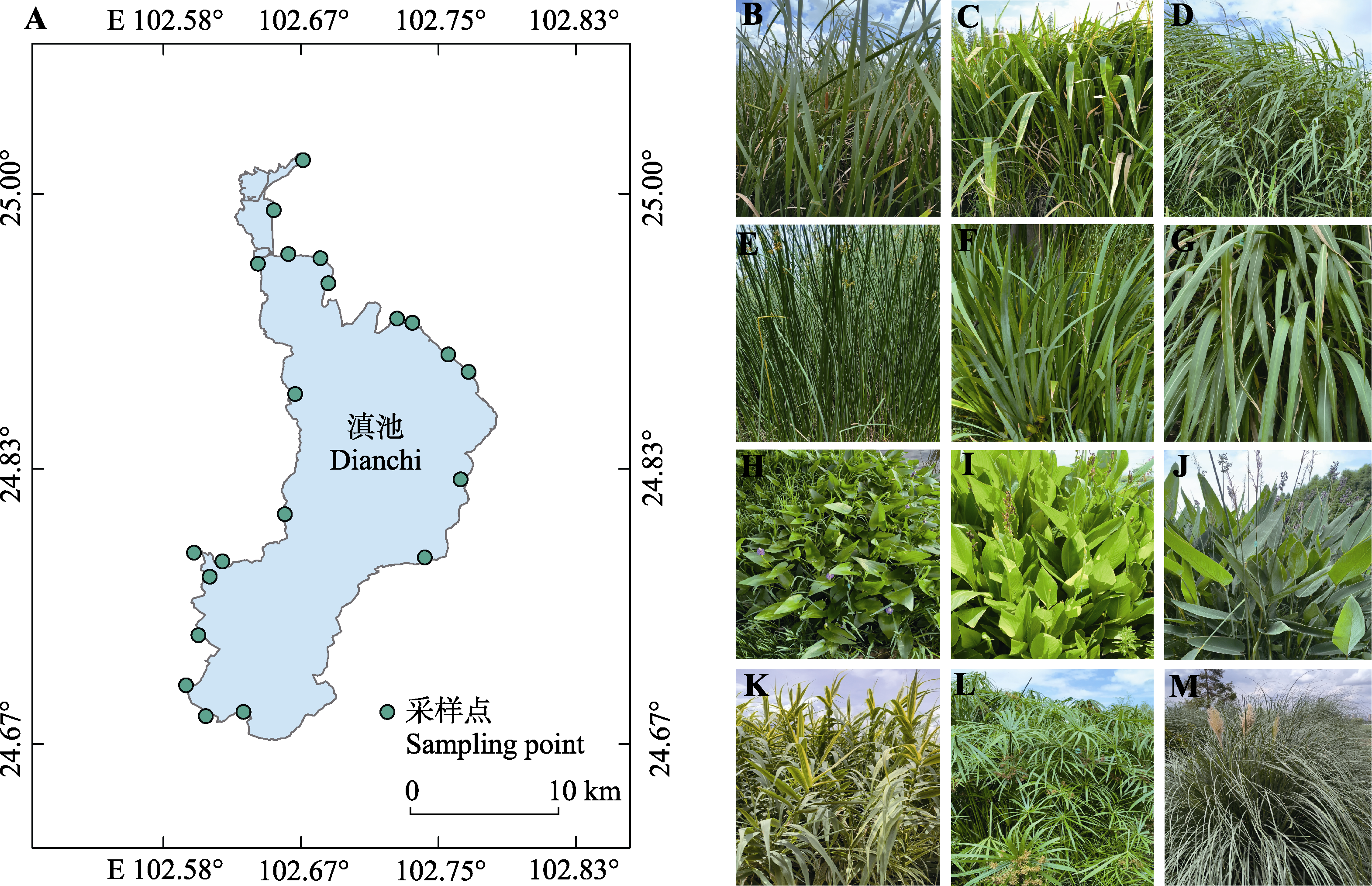
图1 滇池湖滨带研究区地理位置及典型挺水植物单优群落。A, 滇池湖滨带采样点分布图。B, 香蒲群落。C, 菰群落。D, 芦苇群落。E, 水葱群落。F, 黄菖蒲群落。G, 芒群落。H, 梭鱼草群落。I, 美人蕉群落。J, 再力花群落。K, 花叶芦竹群落。L, 风车草群落。M, 蒲苇群落。
Fig. 1 Geographical location of the research area in the lakeshore zone of Dianchi Lake and the typical monodominant emergent plant communities. A, Distribution map of sampling points in the lakeshore zone of Dianchi Lake. B, Typha orientalis community. C, Zizania latifolia community. D, Phragmites australis community. E, Schoenoplectus tabernaemontani community. F, Iris pseudacorus community. G, Miscanthus sinensis community. H, Pontederia cordata community. I, Canna indica community. J, Thalia dealbata community. K, Arundo donax var. versicolor community. L, Cyperus involucratus community. M, Cortaderia selloana community.
| 植物 Plant species | 科名 Family | 株高 Plant height (cm) | 基径 Basal diameter (mm) | 地上生物量 Aboveground biomass (g∙m-2) |
|---|---|---|---|---|
| 香蒲 Typha orientalis | 香蒲科 Typhaceae | 254.62-375.21 | 25.68-61.92 | 2 828.30-9 980.83 |
| 菰 Zizania latifolia | 禾本科 Gramineae | 155.57-262.02 | 3.97-20.73 | 1 663.23-2 818.16 |
| 芦苇 Phragmites australis | 禾本科 Gramineae | 134.16-399.54 | 6.13-13.87 | 2 232.89-3 783.13 |
| 水葱 Schoenoplectus tabernaemontani | 莎草科 Cyperaceae | 95.96-186.03 | 4.42-11.63 | 1 099.35-2 679.47 |
| 黄菖蒲 Iris pseudacorus | 鸢尾科 Iridaceae | 55.03-197.62 | 15.58-41.49 | 934.42-1 811.25 |
| 芒 Miscanthus sinensis | 禾本科 Gramineae | 137.41-338.04 | 5.63-18.26 | 1 507.20-4 716.29 |
| 梭鱼草 Pontederia cordata | 雨久花科 Pontederiaceae | 106.01-154.50 | 20.41-69.34 | 2 211.82-5 946.43 |
| 美人蕉 Canna indica | 美人蕉科 Cannaceae | 173.83-221.48 | 21.05-35.09 | 1 804.08-4 335.44 |
| 再力花 Thalia dealbata | 竹芋科 Marantaceae | 219.02-321.50 | 26.38-51.86 | 2 441.09-5 973.84 |
| 花叶芦竹 Arundo donax var. versicolor | 禾本科 Gramineae | 155.24-524.43 | 11.18-30.29 | 8 585.94-28 480.73 |
| 风车草 Cyperus involucratus | 莎草科 Cyperaceae | 91.02-209.04 | 4.92-11.28 | 2 853.63-5 641.96 |
| 蒲苇 Cortaderia selloana | 禾本科 Gramineae | 112.03-194.52 | 10.77-17.73 | 4 340.37-11 965.44 |
表1 滇池湖滨带12种挺水植物的基本信息
Table 1 Basic information of 12 emergent plants in the lakeshore zone of Dianchi lake
| 植物 Plant species | 科名 Family | 株高 Plant height (cm) | 基径 Basal diameter (mm) | 地上生物量 Aboveground biomass (g∙m-2) |
|---|---|---|---|---|
| 香蒲 Typha orientalis | 香蒲科 Typhaceae | 254.62-375.21 | 25.68-61.92 | 2 828.30-9 980.83 |
| 菰 Zizania latifolia | 禾本科 Gramineae | 155.57-262.02 | 3.97-20.73 | 1 663.23-2 818.16 |
| 芦苇 Phragmites australis | 禾本科 Gramineae | 134.16-399.54 | 6.13-13.87 | 2 232.89-3 783.13 |
| 水葱 Schoenoplectus tabernaemontani | 莎草科 Cyperaceae | 95.96-186.03 | 4.42-11.63 | 1 099.35-2 679.47 |
| 黄菖蒲 Iris pseudacorus | 鸢尾科 Iridaceae | 55.03-197.62 | 15.58-41.49 | 934.42-1 811.25 |
| 芒 Miscanthus sinensis | 禾本科 Gramineae | 137.41-338.04 | 5.63-18.26 | 1 507.20-4 716.29 |
| 梭鱼草 Pontederia cordata | 雨久花科 Pontederiaceae | 106.01-154.50 | 20.41-69.34 | 2 211.82-5 946.43 |
| 美人蕉 Canna indica | 美人蕉科 Cannaceae | 173.83-221.48 | 21.05-35.09 | 1 804.08-4 335.44 |
| 再力花 Thalia dealbata | 竹芋科 Marantaceae | 219.02-321.50 | 26.38-51.86 | 2 441.09-5 973.84 |
| 花叶芦竹 Arundo donax var. versicolor | 禾本科 Gramineae | 155.24-524.43 | 11.18-30.29 | 8 585.94-28 480.73 |
| 风车草 Cyperus involucratus | 莎草科 Cyperaceae | 91.02-209.04 | 4.92-11.28 | 2 853.63-5 641.96 |
| 蒲苇 Cortaderia selloana | 禾本科 Gramineae | 112.03-194.52 | 10.77-17.73 | 4 340.37-11 965.44 |
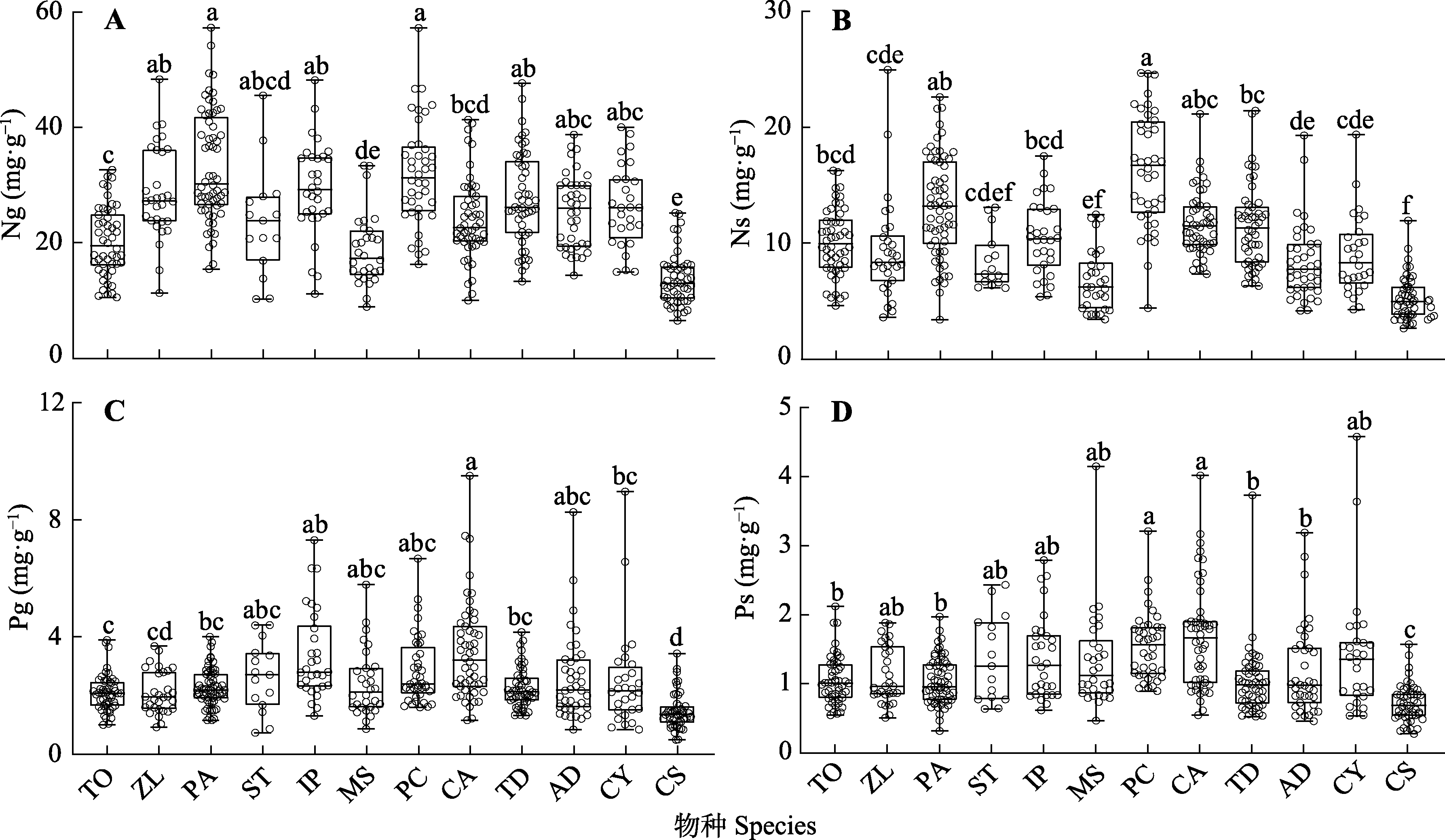
图2 成熟叶片与衰老叶片氮、磷含量。Ng, 成熟叶片氮含量; Ns, 衰老叶片氮含量; Pg, 成熟叶片磷含量; Ps衰老叶片磷含量。AD, 花叶芦竹; CA, 美人蕉; CS, 蒲苇; CY, 风车草; IP, 黄菖蒲; MS, 芒; PA, 芦苇; PC, 梭鱼草; ST, 水葱; TD, 再力花; TO, 香蒲; ZL, 菰。不同小写字母表示差异显著(p < 0.05)。
Fig. 2 Nitrogen and phosphorus contents in mature and senescent leaves. Ng, nitrogen content in mature leaves; Ns, nitrogen content in senescent leaves; Pg, phosphorus content in mature leaves; Ps, phosphorus content in senescent leaves. AD, Arundo donax var. versicolor; CA, Canna indica; CS, Cortaderia selloana; CY, Cyperus involucratus; IP, Iris pseudacorus; MS, Miscanthus sinensis; PA, Phragmites australis; PC, Pontederia cordata; ST, Schoenoplectus tabernaemontani; TD, Thalia dealbata; TO, Typha orientalis; ZL, Zizania latifolia. Different lowercase letters indicate significant differences (p < 0.05).
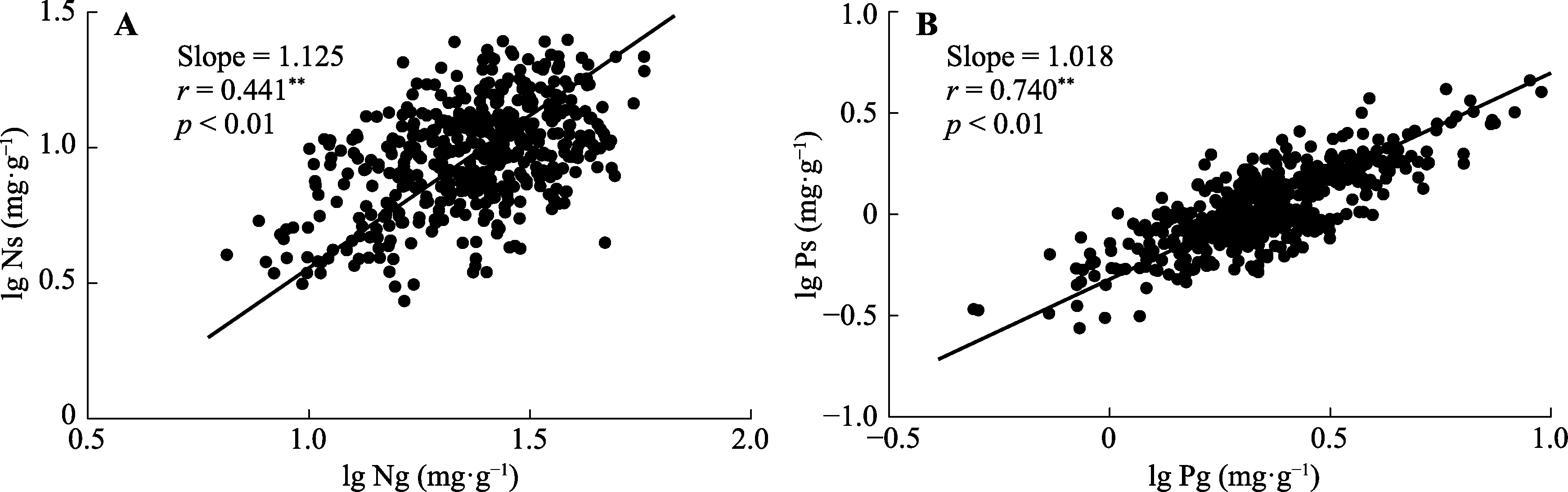
图3 叶片氮、磷含量之间的关系。Ng, 成熟叶片氮含量; Ns, 衰老叶片氮含量; Pg, 成熟叶片磷含量; Ps, 衰老叶片磷含量。r, 相关系数; Slope, 回归斜率。
Fig. 3 Relationship between leaf nitrogen and phosphorus contents. Ng, nitrogen content in mature leaves; Ns, nitrogen content in senescent leaves; Pg, phosphorus content in mature leaves; Ps, phosphorus content in senescent leaves. r, correlation coefficient; Slope, regression slope.
| 植物 Plant species | NRE (%) | PRE (%) | 植物种 Plant species | NRE (%) | PRE (%) |
|---|---|---|---|---|---|
| 香蒲 Typha orientalis | 46.13 ± 2.87c | 48.03 ± 2.51abc | 梭鱼草 Pontederia cordata | 46.63 ± 3.48bc | 52.92 ± 1.96abc |
| 菰 Zizania latifolia | 66.17 ± 2.70a | 46.22 ± 1.73abc | 美人蕉 Canna indica | 47.78 ± 2.57c | 50.94 ± 1.66abc |
| 芦苇 Phragmites australis | 57.71 ± 2.18abc | 52.92 ± 1.96ab | 再力花 Thalia dealbata | 55.46 ± 2.45abc | 53.21 ± 2.75ab |
| 水葱 Schoenoplectus tabernaemontani | 58.23 ± 5.15abc | 45.78 ± 4.16abc | 花叶芦竹 Arundo donax var. versicolor | 64.34 ± 2.93a | 53.59 ± 1.76abc |
| 黄菖蒲 Iris pseudacorus | 61.75 ± 2.94ab | 56.22 ± 3.12a | 风车草 Cyperus involucratus | 64.56 ± 2.39a | 42.78 ± 1.37c |
| 芒 Miscanthus sinensis | 61.95 ± 2.60ab | 44.74 ± 1.77bc | 蒲苇 Cortaderia selloana | 58.82 ± 2.15abc | 49.02 ± 1.96abc |
表2 挺水植物氮(N)、磷(P)重吸收效率(平均值±标准误)
Table 2 Nitrogen (N) and phosphorus (P) resorption efficiencies of emergent plants (mean ± SE)
| 植物 Plant species | NRE (%) | PRE (%) | 植物种 Plant species | NRE (%) | PRE (%) |
|---|---|---|---|---|---|
| 香蒲 Typha orientalis | 46.13 ± 2.87c | 48.03 ± 2.51abc | 梭鱼草 Pontederia cordata | 46.63 ± 3.48bc | 52.92 ± 1.96abc |
| 菰 Zizania latifolia | 66.17 ± 2.70a | 46.22 ± 1.73abc | 美人蕉 Canna indica | 47.78 ± 2.57c | 50.94 ± 1.66abc |
| 芦苇 Phragmites australis | 57.71 ± 2.18abc | 52.92 ± 1.96ab | 再力花 Thalia dealbata | 55.46 ± 2.45abc | 53.21 ± 2.75ab |
| 水葱 Schoenoplectus tabernaemontani | 58.23 ± 5.15abc | 45.78 ± 4.16abc | 花叶芦竹 Arundo donax var. versicolor | 64.34 ± 2.93a | 53.59 ± 1.76abc |
| 黄菖蒲 Iris pseudacorus | 61.75 ± 2.94ab | 56.22 ± 3.12a | 风车草 Cyperus involucratus | 64.56 ± 2.39a | 42.78 ± 1.37c |
| 芒 Miscanthus sinensis | 61.95 ± 2.60ab | 44.74 ± 1.77bc | 蒲苇 Cortaderia selloana | 58.82 ± 2.15abc | 49.02 ± 1.96abc |
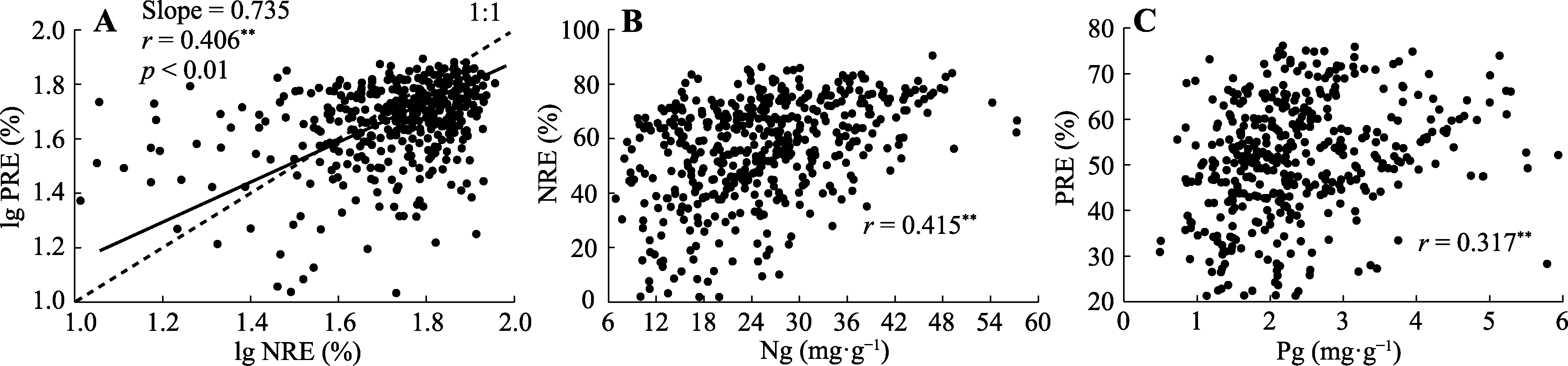
图4 叶片氮重吸收效率与磷重吸收效率、氮磷重吸收效率与成熟叶片氮磷含量的关系。Ng, 成熟叶片氮含量; NRE, 氮重吸收效率; Pg, 成熟叶片磷含量; PRE, 磷重吸收效率。r, 相关系数; Slope, 回归斜率。
Fig. 4 Relationships between nitrogen and phosphorus resorption efficiencies, and between nitrogen and phosphorus resorption efficiencies and mature leaf nitrogen and phosphorus contents. Ng, nitrogen content in mature leaves; NRE, nitrogen resorption efficiency; Pg, phosphorus content in mature leaves; PRE, phosphorus resorption efficiency. r, correlation coefficient; Slope, regression slope.
| 植物 Plant species | Ng:Pg | Ns:Ps | NRE:PRE | Resorbed N:P |
|---|---|---|---|---|
| 香蒲 Typha orientalis | 10.00 ± 0.37cde | 10.31 ± 0.46bcd | 1.11 ± 0.10d | 11.36 ± 1.04cd |
| 菰 Zizania latifolia | 14.53 ± 0.81ab | 8.58 ± 0.515cde | 1.54 ± 0.13a | 23.79 ± 2.95a |
| 芦苇 Phragmites australis | 14.81 ± 0.33a | 13.06 ± 0.41a | 1.13 ± 0.04cd | 17.06 ± 0.80ab |
| 水葱 Schoenoplectus tabernaemontani | 10.98 ± 1.41bcde | 7.20 ± 0.74de | 1.55 ± 0.28abcd | 20.85 ± 6.27abcd |
| 黄菖蒲 Iris pseudacorus | 9.79 ± 0.64cde | 8.84 ± 0.71cde | 1.43 ± 0.30cd | 14.17 ± 2.94bcd |
| 芒 Miscanthus sinensis | 8.59 ± 0.50de | 5.96 ± 0.57e | 1.47 ± 0.10abc | 13.03 ± 1.48bcd |
| 梭鱼草 Pontederia cordata | 11.78 ± 0.41bc | 11.12 ± 0.47abc | 1.04 ± 0.06d | 13.29 ± 1.06bc |
| 美人蕉 Canna indica | 7.86 ± 0.44e | 8.35 ± 0.55de | 1.00 ± 0.07d | 8.26 ± 0.83d |
| 再力花 Thalia dealbata | 12.64 ± 0.49abc | 12.08 ± 0.49ab | 1.20 ± 0.10d | 15.17 ± 1.10abc |
| 花叶芦竹 Arundo donax var. versicolor | 11.56 ± 0.65bcd | 8.62 ± 0.66de | 1.22 ± 0.07abcd | 14.50 ± 1.26abc |
| 风车草 Cyperus involucratus | 13.14 ± 1.05abc | 8.74 ± 1.29de | 1.58 ± 0.10ab | 20.45 ± 1.90ab |
| 蒲苇 Cortaderia selloana | 10.68 ± 0.67cd | 8.15 ± 0.46de | 1.30 ± 0.07abcd | 14.85 ± 1.43abc |
表3 挺水植物叶片氮、磷化学计量特征(平均值±标准误)
Table 3 Stoichiometric characteristics of nitrogen and phosphorus of emergent plants (mean ± SE)
| 植物 Plant species | Ng:Pg | Ns:Ps | NRE:PRE | Resorbed N:P |
|---|---|---|---|---|
| 香蒲 Typha orientalis | 10.00 ± 0.37cde | 10.31 ± 0.46bcd | 1.11 ± 0.10d | 11.36 ± 1.04cd |
| 菰 Zizania latifolia | 14.53 ± 0.81ab | 8.58 ± 0.515cde | 1.54 ± 0.13a | 23.79 ± 2.95a |
| 芦苇 Phragmites australis | 14.81 ± 0.33a | 13.06 ± 0.41a | 1.13 ± 0.04cd | 17.06 ± 0.80ab |
| 水葱 Schoenoplectus tabernaemontani | 10.98 ± 1.41bcde | 7.20 ± 0.74de | 1.55 ± 0.28abcd | 20.85 ± 6.27abcd |
| 黄菖蒲 Iris pseudacorus | 9.79 ± 0.64cde | 8.84 ± 0.71cde | 1.43 ± 0.30cd | 14.17 ± 2.94bcd |
| 芒 Miscanthus sinensis | 8.59 ± 0.50de | 5.96 ± 0.57e | 1.47 ± 0.10abc | 13.03 ± 1.48bcd |
| 梭鱼草 Pontederia cordata | 11.78 ± 0.41bc | 11.12 ± 0.47abc | 1.04 ± 0.06d | 13.29 ± 1.06bc |
| 美人蕉 Canna indica | 7.86 ± 0.44e | 8.35 ± 0.55de | 1.00 ± 0.07d | 8.26 ± 0.83d |
| 再力花 Thalia dealbata | 12.64 ± 0.49abc | 12.08 ± 0.49ab | 1.20 ± 0.10d | 15.17 ± 1.10abc |
| 花叶芦竹 Arundo donax var. versicolor | 11.56 ± 0.65bcd | 8.62 ± 0.66de | 1.22 ± 0.07abcd | 14.50 ± 1.26abc |
| 风车草 Cyperus involucratus | 13.14 ± 1.05abc | 8.74 ± 1.29de | 1.58 ± 0.10ab | 20.45 ± 1.90ab |
| 蒲苇 Cortaderia selloana | 10.68 ± 0.67cd | 8.15 ± 0.46de | 1.30 ± 0.07abcd | 14.85 ± 1.43abc |
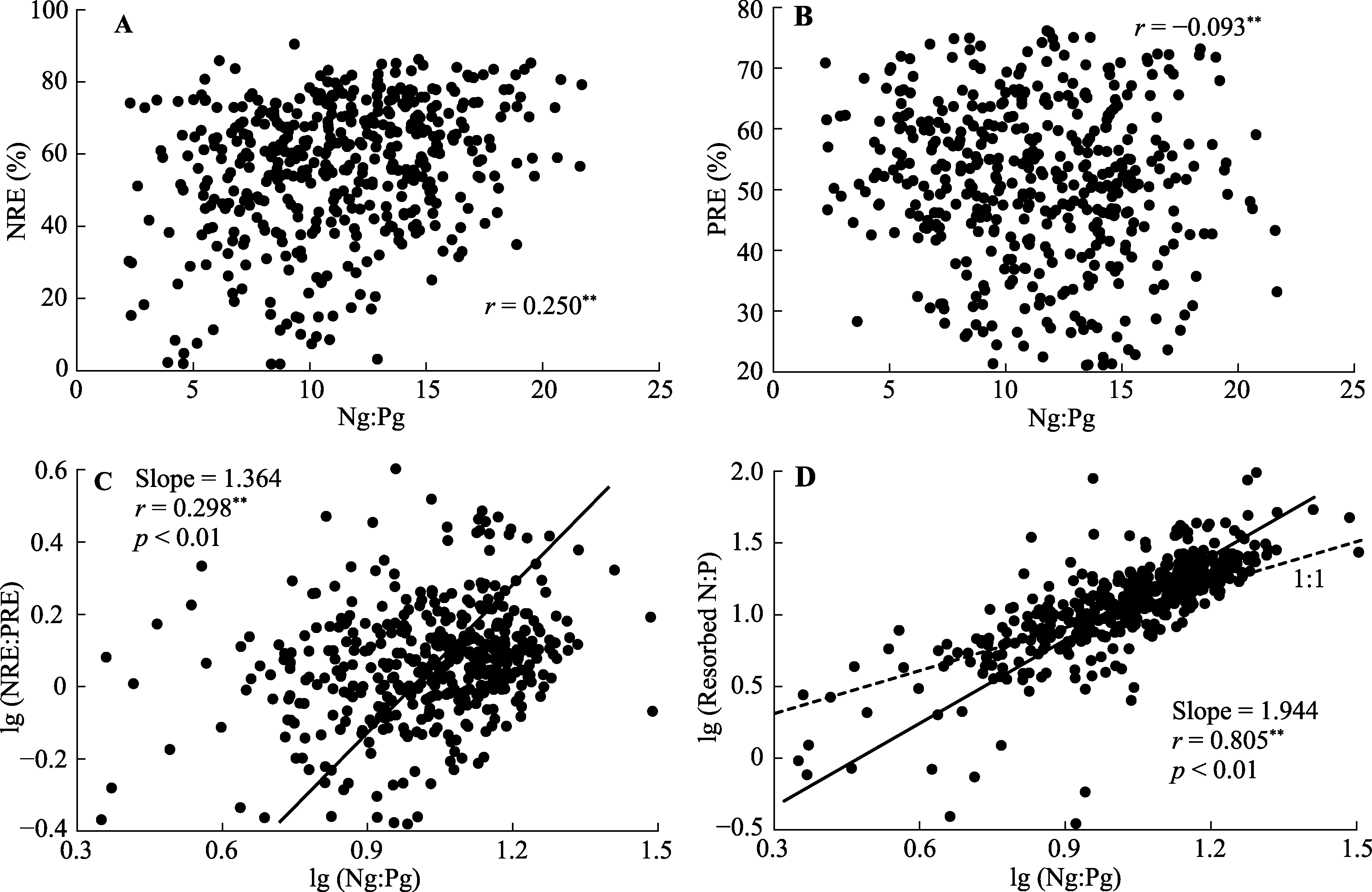
图5 叶片氮磷重吸收效率与叶片氮磷比、氮磷重吸收效率比与叶片氮磷比、叶片重吸收氮磷比与叶片氮磷比的关系。Ng:Pg, 成熟叶片氮磷比; NRE, 氮重吸收效率; NRE:PRE, 氮磷重吸收效率比; PRE, 磷重吸收效率; Resorbed N:P, 叶片重吸收氮磷比。r, 相关系数; Slope, 回归斜率。
Fig. 5 Relationships between leaf nitrogen(N) and phosphorus(P) resorption efficiencies and leaf N:P ratio, between the ratio of N to P resorption efficiencies and leaf N:P ratio, and between resorbed N:P ratio and leaf N:P ratio. Ng:Pg, nitrogen to phosphorus ratio in mature leaves; NRE, N resorption efficiency; NRE:PRE, nitrogen to phosphorus resorption efficiency ratio; PRE, P resorption efficiency; Resorbed N:P, resorbed nitrogen to phosphorus ratio in leaves. r, correlation coefficient; Slope, regression slope.
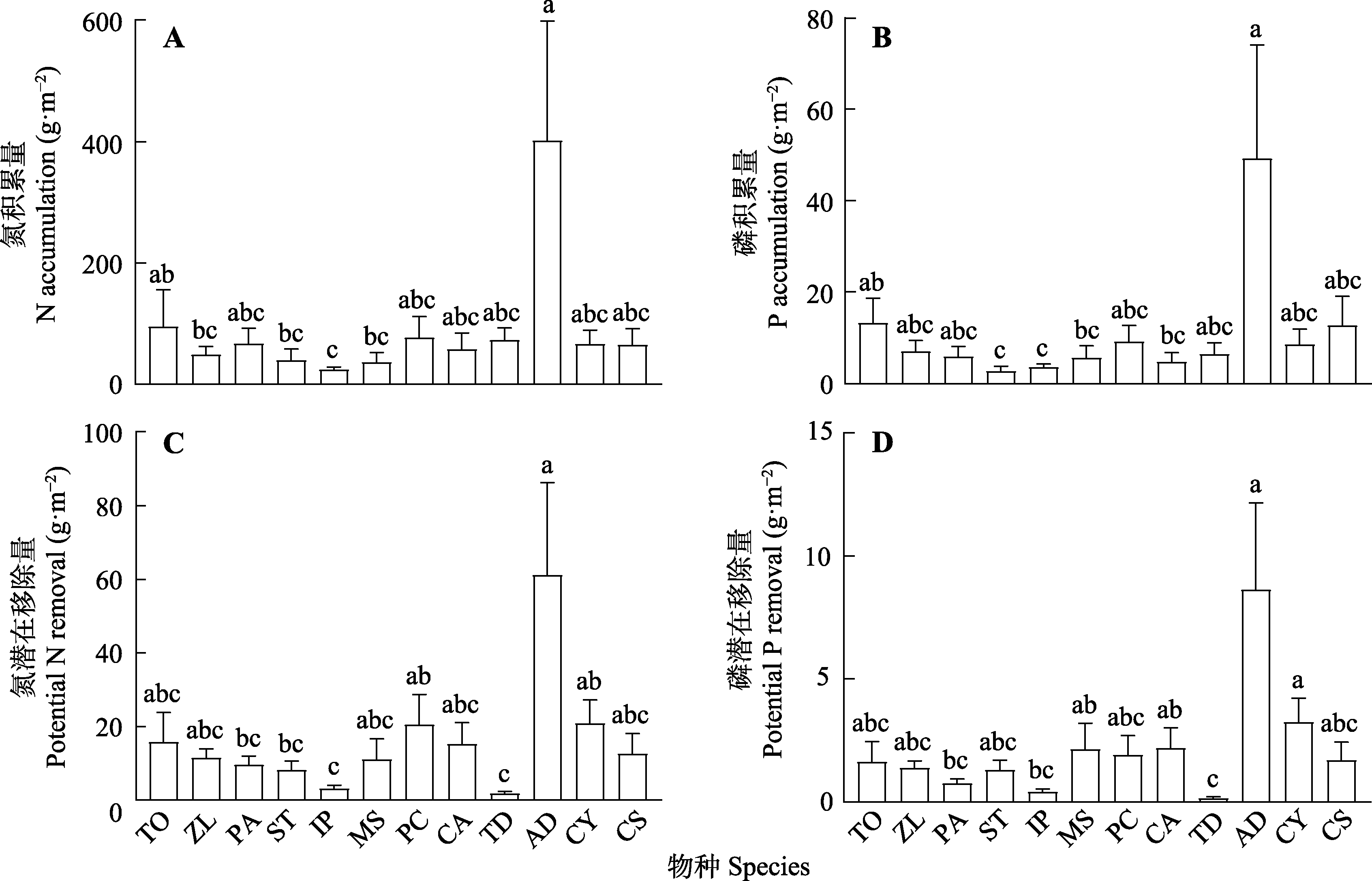
图6 植物地上生物量与氮磷积累量及潜在移除量(平均值±标准误)。AD, 花叶芦竹; CA, 美人蕉; CS, 蒲苇; CY, 风车草; IP, 黄菖蒲; MS, 芒; PA, 芦苇; PC, 梭鱼草; ST, 水葱; TD, 再力花; TO, 香蒲; ZL, 菰。不同小写字母表示差异显著(p < 0.05)。
Fig. 6 Aboveground biomass, nitrogen(N) and phosphorus(P) accumulation, and potential removal of plant (mean ± SE). AD, Arundo donax var. versicolor; CA, Canna indica; CS, Cortaderia selloana; CY, Cyperus involucratus; IP, Iris pseudacorus; MS, Miscanthus sinensis; PA, Phragmites australis; PC, Pontederia cordata; ST, Schoenoplectus tabernaemontani; TD, Thalia dealbata; TO, Typha orientalis; ZL, Zizania latifolia. Different lowercase letters indicate significant differences (p < 0.05).
| [1] |
Achat DL, Pousse N, Nicolas M, Augusto L (2018). Nutrient remobilization in tree foliage as affected by soil nutrients and leaf life span. Ecological Monographs, 88, 408-428.
DOI URL |
| [2] |
Adler PB, Salguero-Gómez R, Compagnoni A, Hsu JS, Ray-Mukherjee J, Mbeau-Ache C, Franco M (2014). Functional traits explain variation in plant life history strategies. Proceedings of the National Academy of Sciences of the United States of America, 111, 740-745.
DOI PMID |
| [3] | Bonham CD (2013). Measurements for Terrestrial Vegetation. 2nd ed. John Wiley & Sons, Hoboken, USA. 87-95. |
| [4] |
Brant AN, Chen HYH (2015). Patterns and mechanisms of nutrient resorption in plants. Critical Reviews in Plant Sciences, 34, 471-486.
DOI URL |
| [5] | Chen H, Reed SC, Lü XT, Xiao KC, Wang KL, Li DJ (2021a). Coexistence of multiple leaf nutrient resorption strategies in a single ecosystem. Science of the Total Environment, 772, 144951. DOI: 10.1016/j.scitotenv.2021.144951. |
| [6] |
Chen H, Reed SC, Lü XT, Xiao KC, Wang KL, Li DJ (2021b). Global resorption efficiencies of trace elements in leaves of terrestrial plants. Functional Ecology, 35, 1596-1602.
DOI URL |
| [7] | Chen TS, Hu ZY, Shen JY, Zhao L, Liu HQ, Xiong YH, Sun RQ, Dong LQ, Zhang K (2024). Effect of warming on nitrogen and phosphorus resorption of Carex muliensis in an alpine marsh on Zoigê Plateau. Chinese Journal of Ecology, 43, 25-32. |
| [陈天松, 胡昭佚, 申金阳, 赵丽, 刘宏强, 熊银洪, 孙荣卿, 董李勤, 张昆 (2024). 增温对若尔盖高寒草本沼泽木里薹草氮磷重吸收的影响. 生态学杂志, 43, 25-32.] | |
| [8] | Cheng LT, Guo W, Wang YZ, Wu XS, Yan Q, Hu YL, Liu X (2024). Nutrient limitation and resorption characteristics of different aged Schima superba plantations in central subtropical China. Chinese Journal of Ecology, 43, 407-414. |
| [程刘涛, 郭文, 王玉哲, 吴晓生, 严强, 胡亚林, 刘先 (2024). 中亚热带不同林龄木荷养分限制及重吸收特征. 生态学杂志, 43, 407-414.] | |
| [9] |
Cui LJ, Li W, Zhang MY, Zhao YH, Wang YF, Zhao XS, Shang XJ (2011). Different wetland plant roles of removing nitrogen and phosphorus on sewage water. Journal of Lake Sciences, 23, 203-208.
DOI URL |
| [崔丽娟, 李伟, 张曼胤, 赵玉辉, 王义飞, 赵欣胜, 商晓静 (2011). 不同湿地植物对污水中氮磷去除的贡献. 湖泊科学, 23, 203-208.] | |
| [10] |
Drenovsky RE, Pietrasiak N, Short TH (2019). Global temporal patterns in plant nutrient resorption plasticity. Global Ecology and Biogeography, 28, 728-743.
DOI |
| [11] |
Du EZ, Terrer C, Pellegrini AFA, Ahlström A, van Lissa CJ, Zhao X, Xia N, Wu XH, Jackson RB (2020). Global patterns of terrestrial nitrogen and phosphorus limitation. Nature Geoscience, 13, 221-226.
DOI |
| [12] | Feng CR, Jiang ML, Niu HL, Xu LG (2024). Analysis of water environment change trend and influencing factors in Dianchi Lake in recent 20 years. The Administration and Technique of Environmental Monitoring, 36(2), 12-18. |
| [冯昶瑞, 蒋名亮, 牛海林, 徐力刚 (2024). 滇池近20年水环境变化趋势与影响因素分析. 环境监测管理与技术, 36(2), 12-18.] | |
| [13] | Guo C, Cai JY, Jin Q, Zhou HY, Li M, Hu QW (2016). Nitrogen and phosphorus resorption of six dominant plant species in Poyang Lake wetlands. Chinese Journal of Ecology, 35, 692-697. |
| [郭超, 蔡家艳, 金奇, 周红艳, 李敏, 胡启武 (2016). 鄱阳湖湿地优势植物氮磷再吸收. 生态学杂志, 35, 692-697.] | |
| [14] |
Güsewell S (2005a). High nitrogen: phosphorus ratios reduce nutrient retention and second-year growth of wetland sedges. New Phytologist, 166, 537-550.
DOI URL |
| [15] |
Güsewell S (2005b). Nutrient resorption of wetland graminoids is related to the type of nutrient limitation. Functional Ecology, 19, 344-354.
DOI URL |
| [16] |
Han WX, Fang JY, Guo DL, Zhang Y (2005). Leaf nitrogen and phosphorus stoichiometry across 753 terrestrial plant species in China. New Phytologist, 168, 377-385.
DOI PMID |
| [17] | Han WX, Tang LY, Chen YH, Fang JY (2013). Relationship between the relative limitation and resorption efficiency of nitrogen vs phosphorus in woody plants. PLoS ONE, 8, e83366. DOI: 10.1371/journal.pone.0083366. |
| [18] |
Hayes P, Turner BL, Lambers H, Laliberté E (2014). Foliar nutrient concentrations and resorption efficiency in plants of contrasting nutrient-acquisition strategies along a 2-million-year dune chronosequence. Journal of Ecology, 102, 396-410.
DOI URL |
| [19] |
Jabłońska E, Winkowska M, Wiśniewska M, Geurts J, Zak D, Kotowski W (2021). Impact of vegetation harvesting on nutrient removal and plant biomass quality in wetland buffer zones. Hydrobiologia, 848, 3273-3289.
DOI |
| [20] | Jiang DL, Xu X, Ruan HH (2017). Review of nutrient resorption and its regulating in plants. Journal of Nanjing Forestry University (Natural Sciences Edition), 41, 183-188. |
|
[江大龙, 徐侠, 阮宏华 (2017). 植物养分重吸收及其影响因素. 南京林业大学学报(自然科学版), 41, 183-188.]
DOI |
|
| [21] | Killingbeck KT (2004). Nutrient resorption//Noodén LD. Plant Cell Death Processes. Academic Press, New York. 215-226. |
| [22] |
Kobe RK, Lepczyk CA, Iyer M (2005). Resorption efficiency decreases with increasing green leaf nutrients in a global data set. Ecology, 86, 2780-2792.
DOI URL |
| [23] |
Koerselman W, Meuleman AFM (1996). The vegetation N:P ratio: a new tool to detect the nature of nutrient limitation. Journal of Applied Ecology, 33, 1441-1450.
DOI URL |
| [24] |
Kull O, Kruijt B (1999). Acclimation of photosynthesis to light: a mechanistic approach. Functional Ecology, 13, 24-36.
DOI URL |
| [25] | Li S (2023). Effects of Environmental Factors and Phylogeny on Nutrient Resorption in Plant Leaves. Master degree dissertation, Dali University, Dali, Yunnan. |
| [李顺 (2023). 环境因子和系统发育对植物叶片养分重吸收的影响. 硕士学位论文, 大理大学, 云南大理.] | |
| [26] | Li SN, Cui LJ, Song HT, Zhang Y, Gao CJ, Guo J, Wei W, Zhao XS, Zhang MY, Wang YF, Li W (2012). Comparison on purification capacity of soil nitrogen and phosphorus in different wetland plants. Ecology and Environmental Sciences, 21, 1870-1874. |
|
[李胜男, 崔丽娟, 宋洪涛, 张岩, 高常军, 郭嘉, 韦玮, 赵欣胜, 张曼胤, 王义飞, 李伟 (2012). 不同湿地植物土壤氮、磷去除能力比较. 生态环境学报, 21, 1870-1874.]
DOI |
|
| [27] |
Li YL, Chen J, Cui JY, Zhao XY, Zhang TH (2013). Nutrient resorption in Caragana microphylla along a chronosequence of plantations: Implications for desertified land restoration in North China. Ecological Engineering, 53, 299-305.
DOI URL |
| [28] |
Liang DF, Zhang JJ, Zhang ST (2015). Patterns of nitrogen resorption in functional groups in a Tibetan alpine meadow. Folia Geobotanica, 50, 267-274.
DOI URL |
| [29] | Liu D, Zhang J, Bao YL, Zhao HY, Qi XX, Xie HJ, Zhang JB (2020). Nutrient resorption patterns of Phragmites australis leaves and its response to soil moisture in Yangguan wetland, Dunhuang, Northwest China. Chinese Journal of Applied Ecology, 31, 807-813. |
|
[刘冬, 张剑, 包雅兰, 赵海燕, 齐璇璇, 谢欢杰, 张静白 (2020). 敦煌阳关湿地芦苇叶片养分重吸收模式及其对土壤水分的响应. 应用生态学报, 31, 807-813.]
DOI |
|
| [30] | Liu Q, Cheng Y, Fan CN, Bai BY (2024). Stoichiometric and accumulation characteristics of nitrogen and phosphorus in artificial and natural herbaceous plants along lakeshore buffer zone. Sustainability, 16, 8772. DOI: 10.3390/su16208772. |
| [31] | Liu SX, An H, Zhang XW, Du ZY, Liu XP (2022). Effects of nitrogen and phosphorus addition on the ecological stoichiometry of plant-litter-soil in desert grassland. Acta Ecologica Sinica, 42, 8773-8783. |
| [刘姝萱, 安慧, 张馨文, 杜忠毓, 刘小平 (2022). 氮磷添加对荒漠草原植物-凋落物-土壤生态化学计量特征的影响. 生态学报, 42, 8773-8783.] | |
| [32] | Liu XL, Wang GM, Zhang HB, Han GX, Li KX, Wang AD (2023a). Inconsistent stoichiometry and growth responses of two coexisting dominant species to various N and P supplies in a supratidal wetland of the Yellow River Delta. Frontiers in Marine Science, 10, 1113629. DOI: 10.3389/fmars.2023.1113629. |
| [33] |
Liu XW, Wang YQ, Fu WH, Yuan ZY, Yu Q, Peng CH, Koerner SE, Guo L (2023b). Growing season temperature and precipitation affect nutrient resorption in herbaceous species througha foliar stoichiometric control strategy. Plant and Soil, 493, 45-60.
DOI |
| [34] | Lu JY, Duan BH, Yang M, Yang H, Yang HM (2018). Research progress in nitrogen and phosphorus resorption from senesced leaves and the influence of ontogenetic and environmental factors. Acta Prataculturae Sinica, 27(4), 178-188. |
|
[陆姣云, 段兵红, 杨梅, 杨晗, 杨惠敏 (2018). 植物叶片氮磷养分重吸收规律及其调控机制研究进展. 草业学报, 27(4), 178-188.]
DOI |
|
| [35] |
Lü XT, Reed S, Yu Q, He NP, Wang ZW, Han XG (2013). Convergent responses of nitrogen and phosphorus resorption to nitrogen inputs in a semiarid grassland. Global Change Biology, 19, 2775-2784.
DOI URL |
| [36] |
Lü XT, Reed SC, Yu Q, Han XG (2016). Nutrient resorption helps drive intra-specific coupling of foliar nitrogen and phosphorus under nutrient-enriched conditions. Plant and Soil, 398, 111-120.
DOI URL |
| [37] |
Peng HY, Yan ZB, Chen YH, Zhao XJ, Han WX (2019). Effects of body size and root to shoot ratio on foliar nutrient resorption efficiency in Amaranthus mangostanus. American Journal of Botany, 106, 363-370.
DOI PMID |
| [38] |
Rejmánková E (2005). Nutrient resorption in wetland macrophytes: comparison across several regions of different nutrient status. New Phytologist, 167, 471-482.
PMID |
| [39] |
Shi B, Ling X, Cui H, Song W, Gao Y, Sun W (2020). Response of nutrient resorption of Leymus chinensis to nitrogen and phosphorus addition in a meadow steppe of Northeast China. Plant Biology, 22, 1123-1132.
DOI URL |
| [40] | Shi XF, Zhang L, Liu C, Zhang YM, Wang M, Wang WQ (2024). Variable leaf nitrogen-phosphorus ratios and stable resorption strategies of Kandelia obovata along the southeastern coast of China. Forest Ecology and Management, 560, 121822. DOI: 10.1016/j.foreco.2024.121822. |
| [41] |
Sohrt J, Herschbach C, Weiler M (2018). Foliar P-but not N resorption efficiency depends on the P-concentration and the N:P ratio in trees of temperate forests. Trees, 32, 1443-1455.
DOI |
| [42] | Song R, Tong R, Zhang H, Wang GG, Wu TG, Yang XQ (2022). Effects of long-term fertilization and stand age on root nutrient acquisition and leaf nutrient resorption of Metasequoia glyptostroboides. Frontiers in Plant Science, 13, 905358. DOI: 10.3389/fpls.2022.905358. |
| [43] |
Sorrell BK, Chagué-Goff C, Basher LM, Partridge TR (2011). N:P ratios, δ15N fractionation and nutrient resorption along a nitrogen to phosphorus limitation gradient in an oligotrophic wetland complex. Aquatic Botany, 94, 93-101.
DOI URL |
| [44] | Streit H, Menezes LS, Pillar VD, Overbeck GE (2022). Intraspecific trait variation of grassland species in response to grazing depends on resource acquisition strategy. Journal of Vegetation Science, 33, e13129. DOI: 10.1111/jvs.13129. |
| [45] |
Sun XB, Li DJ, Lü XT, Fang YT, Ma ZL, Wang ZC, Chu CJ, Li MM, Chen H (2023). Widespread controls of leaf nutrient resorption by nutrient limitation and stoichiometry. Functional Ecology, 37, 1653-1662.
DOI URL |
| [46] | Tan L, Liu CX, Xu S, Wang PY, Zeng Y (2015). Influence analysis of the aquatic plant to the environment and economic benefit in Dianchi Lake wetland. Journal of Anhui Agricultural Sciences, 43, 240-242. |
| [谭喨, 刘春学, 徐杉, 王鹏云, 曾艳 (2015). 滇池湖滨湿地植物对环境影响及经济效益分析. 安徽农业科学, 43, 240-242.] | |
| [47] | Tang Y (2020). Study on Nitrogen and Phosphorus Purification in Water by Typical Aquatic Plants. Master degree dissertation, East China Normal University, Shanghai. |
| [唐玥 (2020). 典型水生植物对水体氮磷的净化功能研究. 硕士学位论文, 华东师范大学, 上海.] | |
| [48] |
Tian D, Yan ZB, Niklas KJ, Han WX, Kattge J, Reich PB, Luo YK, Chen YH, Tang ZY, Hu HF, Wright IJ, Schmid B, Fang JY (2018). Global leaf nitrogen and phosphorus stoichiometry and their scaling exponent. National Science Review, 5, 728-739.
DOI URL |
| [49] |
Tian HQ, Chen GS, Zhang C, Melillo JM, Hall CAS (2010). Pattern and variation of C:N:P ratios in China’s soils: a synthesis of observational data. Biogeochemistry, 98, 139-151.
DOI URL |
| [50] |
Tully KL, Wood TE, Schwantes AM, Lawrence D (2013). Soil nutrient availability and reproductive effort drive patterns in nutrient resorption in Pentaclethra macroloba. Ecology, 94, 930-940.
DOI URL |
| [51] |
Vergutz L, Manzoni S, Porporato A, Novais RF, Jackson RB (2012). Global resorption efficiencies and concentrations of carbon and nutrients in leaves of terrestrial plants. Ecological Monographs, 82, 205-220.
DOI URL |
| [52] |
Vitousek PM, Porder S, Houlton BZ, Chadwick OA (2010). Terrestrial phosphorus limitation: mechanisms, implications, and nitrogen-phosphorus interactions. Ecological Applications, 20, 5-15.
PMID |
| [53] | Wang Z, Lu CX, Wei CX, Xu JT (2024). Effect of plant harvesting on constructed wetland system. Water Technology, 18(2), 1-7. |
| [王朝, 逯崇霄, 魏传旭, 徐景涛 (2024). 植物收割对人工湿地系统的影响. 供水技术, 18(2), 1-7.] | |
| [54] |
Wang ZN, Lu JY, Yang HM, Zhang X, Luo CL, Zhao YX (2014). Resorption of nitrogen, phosphorus and potassium from leaves of lucerne stands of different ages. Plant and Soil, 383, 301-312.
DOI URL |
| [55] | Wang ZN, You FF, Yang M, Duan BH, Lu JY, Yang HM (2016). Temporal dynamics of leaf functional traits and biomass allocation in alfalfa. Chinese Journal of Grassland, 38(2), 41-46. |
| [王振南, 尤菲菲, 杨梅, 段兵红, 陆姣云, 杨惠敏 (2016). 陇东苜蓿叶功能性状和生物量分配的时间动态. 中国草地学报, 38(2), 41-46.] | |
| [56] |
Wang ZQ, Fan ZX, Zhao Q, Wang MC, Ran JZ, Huang H, Niklas KJ (2018). Global data analysis shows that soil nutrient levels dominate foliar nutrient resorption efficiency in herbaceous species. Frontiers in Plant Science, 9, 1431. DOI: 10.3389/fpls.2018.01431.
PMID |
| [57] | Wu HL, Xiang WH, Ouyang S, Xiao WF, Li SG, Chen L, Lei PF, Deng XW, Zeng YL, Zeng LX, Peng CH (2020). Tree growth rate and soil nutrient status determine the shift in nutrient-use strategy of Chinese fir plantations along a chronosequence. Forest Ecology and Management, 460, 117896. DOI: 10.1016/j.foreco.2020.117896. |
| [58] | Xu DF, Pan QC, Li YX, Chen XY, Wang JJ, Zhou L (2018). Effect of biochar on root morphological characteristics of wetland plants and purification capacity of constructed wetland. Environmental Science, 39, 3187-3193. |
| [徐德福, 潘潜澄, 李映雪, 陈晓艺, 王佳俊, 周磊 (2018). 生物炭对人工湿地植物根系形态特征及净化能力的影响. 环境科学, 39, 3187-3193.] | |
| [59] |
Yan T, Lü XT, Zhu JJ, Yang K, Yu LZ, Gao T (2018). Changes in nitrogen and phosphorus cycling suggest a transition to phosphorus limitation with the stand development of larch plantations. Plant and Soil, 422, 385-396.
DOI URL |
| [60] |
Yan T, Zhu JJ, Yang K (2018). Leaf nitrogen and phosphorus resorption of woody species in response to climatic conditions and soil nutrients: a meta-analysis. Journal of Forestry Research, 29, 905-913.
DOI URL |
| [61] |
Yan ZB, Tian D, Han WX, Tang ZY, Fang JY (2017). An assessment on the uncertainty of the nitrogen to phosphorus ratio as a threshold for nutrient limitation in plants. Annals of Botany, 120, 937-942.
DOI PMID |
| [62] | Yang JL, Wen WW, Hu XR, Huang LP, Chen L, Lu HB, Chen GJ (2025). Spatiotemporal variations and driving mechanisms of water quality in nine plateau lakes of Yunnan from 2013 to 2022. Research of Environmental Sciences, 38, 1300-1311. |
| [杨进腊, 温雯雯, 胡潇芮, 黄林培, 陈丽, 卢慧斌, 陈光杰 (2025). 云南九大高原湖泊2013-2022年水质变化趋势及其成因分析. 环境科学研究, 38, 1300-1311.] | |
| [63] | Yang ZX, Zhao YQ (2024). Study on comprehensive evaluation and influencing factors of agricultural green development level in Dianchi Lake Basin. Journal of Yunnan Agricultural University (Social Science), 18(2), 49-57. |
| [杨志鑫, 赵鸭桥 (2024). 滇池流域农业绿色发展水平综合评价及影响因素研究. 云南农业大学学报(社会科学), 18(2), 49-57.] | |
| [64] |
Yuan ZY, Chen HYH (2015). Negative effects of fertilization on plant nutrient resorption. Ecology, 96, 373-380.
PMID |
| [65] |
Zhang J, Sun HM, Wang WG, Hu Z, Yin XL, Ngo HH, Guo WS, Fan JL (2017). Enhancement of surface flow constructed wetlands performance at low temperature through seasonal plant collocation. Bioresource Technology, 224, 222-228.
DOI PMID |
| [66] |
Zhang MX, Luo Y, Yan ZB, Chen J, Eziz A, Li KH, Han WX (2019). Resorptions of 10 mineral elements in leaves of desert shrubs and their contrasting responses to aridity. Journal of Plant Ecology, 12, 358-366.
DOI |
| [67] | Zhang ZS, Lü XG, Xue ZS, Liu XH (2016). Is there a redfi eld-type C:N:P ratio in Chinese wetland soils? Acta Pedologica Sinica, 53, 1160-1169. |
| [张仲胜, 吕宪国, 薛振山, 刘晓辉 (2016). 中国湿地土壤碳氮磷生态化学计量学特征研究. 土壤学报, 53, 1160-1169.] | |
| [68] | Zhao MY, Xiong JQ, Zheng YC, Ren SH, Wang XC (2019). Long-term effect of plant harvesting on pollutants removal in constructed wetlands. Technology of Water Treatment, 45(11), 112-116. |
| [赵梦云, 熊家晴, 郑于聪, 任斯慧, 王晓昌 (2019). 植物收割对人工湿地中污染物去除的长期影响. 水处理技术, 45(11), 112-116.] | |
| [69] |
Zheng LL, Yu LL, Dai P, Xue YG, Long P (2024). Nutrient characteristics and adaptability of plant leaves in Tiankeng Complex of Dashiwei, Guangxi, China. Chinese Journal of Plant Ecology, 48, 872-887.
DOI |
|
[郑莉莉, 余林兰, 戴萍, 薛跃规, 龙萍 (2024). 广西大石围天坑群植物叶片养分特征及其适应性. 植物生态学报, 48, 872-887.]
DOI |
|
| [70] | Zhou XD, Sun XG, Zhao CL, Wang W, Yang HL (2015). Research on enzymatic activities in the rhizosphere of constructed wetland plants and purification of wastewater in seasonal. Ecology and Environmental Sciences, 24, 1043-1049. |
|
[周旭丹, 孙晓刚, 赵春莉, 王薇, 杨红立 (2015). 人工湿地植被根区土壤性质及其净化水质季节效应分析. 生态环境学报, 24, 1043-1049.]
DOI |
|
| [71] | Zhu DH, Peng SH, Liu WZ, Yu SJ, Hui DF (2023). Nutrient resorption and stoichiometric characteristics of Wuyi rock tea cultivars. Forests, 14, 675. DOI: 10.3390/f14040675. |
| [1] | 于江珊, 许浩, 刘秉儒, 王瑞霞, 侯继华. 宁夏白芨滩荒漠植物叶-枝-根化学计量特征及其适应性[J]. 植物生态学报, 2026, 50(预发表): 0-. |
| [2] | 芦海佳, 李冰, 王晓悦, 余海龙, 黄菊莹. 降水降尘混合沉降下盐碱荒漠煤矿区土壤酶生态化学计量特征[J]. 植物生态学报, 2026, 50(5): 1240-1253. |
| [3] | 田地, 迟小龙, 石亮, 刘宵含, 赵常提, 吴梅, 张玉忠, 高永亮. 塞罕坝地区优势造林树种叶片化学计量特征及其环境驱动[J]. 植物生态学报, 2026, 50(2): 362-373. |
| [4] | 冯哲, 许格希, 刘顺, 陈健, 李非凡, 巩闪闪, 贾磊, 孙镇, 余美霓, 史作民, 周庆宏, 蒋冬梅. 生境因子和系统发育协同驱动云南金沙江干热河谷植物叶片化学计量特征[J]. 植物生态学报, 2026, 50(2): 352-361. |
| [5] | 于江珊, 许浩, 郭永忠, 侯继华. 器官年龄在油松叶、枝、根化学计量特征变异以及协调中的重要作用[J]. 植物生态学报, 2026, 50(2): 306-317. |
| [6] | 张竟文, 李晶, 王汝苗, 王贺年, 崔丽娟. 不同纬度滨海湿地植物根系与土壤生态化学计量特征及内稳性分析[J]. 植物生态学报, 2026, 50(2): 461-473. |
| [7] | 李新貌, 金光泽, 刘志理. 毛榛“小枝系统”生长与防御策略的季节动态和器官差异[J]. 植物生态学报, 2026, 50(2): 293-305. |
| [8] | 王蓉钧, 吴福忠, 吴秋霞, 朱晶晶, 倪祥银. 不同生活型植物叶片氮重吸收效率的差异[J]. 植物生态学报, 2026, 50(2): 344-351. |
| [9] | 王梦雪, 胡明艳, 储诚进, 陈阳, 罗文启, 马子龙. 亚热带森林不同菌根真菌树种叶片和细根的碳氮磷化学计量特征[J]. 植物生态学报, 2026, 50(2): 334-343. |
| [10] | 侯霄帆, 马辰涵, 孙语倩, 高钰涵, 李品. 臭氧胁迫下叶片与细根凋落物分解的生态化学计量特征差异[J]. 植物生态学报, 2026, 50(2): 268-278. |
| [11] | 皮惠之, 张秋芳, 孙浩, 曾泉鑫, 彭园珍, 元晓春, 徐建国, 陈岳民. 微生物碳氮不平衡影响罗浮栲林土壤微生物氮利用效率对氮富集的响应[J]. 植物生态学报, 2026, 50(1): 34-44. |
| [12] | 沈会涛, 俞筱押, 秦彦杰, 武爱彬. 太行山东麓核桃林生态化学计量及碳储量随林龄变化特征[J]. 植物生态学报, 2025, 49(9): 1543-15555. |
| [13] | 陈刚刚, 朱思洁, 郭亮娜, 付芳伟, 刘昱灼, 李江荣. 藏东南色季拉山高山树线乔灌地上-地下养分分配策略[J]. 植物生态学报, 2025, 49(9): 1515-1526. |
| [14] | 王娟, 张登山, 肖元明, 裴全帮, 王博, 樊博, 周国英. 长期围封后高寒草原植物根系分泌物特征与环境因子关系[J]. 植物生态学报, 2025, 49(4): 596-609. |
| [15] | 郭李琦, 闫晓蕾, 曹磊, 高景, 刘瑞强, 周旭辉. 树种菌根类型与根系性状对根际微生物网络复杂性的影响[J]. 植物生态学报, 2025, 49(4): 573-584. |
| 阅读次数 | ||||||
|
全文 |
|
|||||
|
摘要 |
|
|||||
Copyright © 2026 版权所有 《植物生态学报》编辑部
地址: 北京香山南辛村20号, 邮编: 100093
Tel.: 010-62836134, 62836138; Fax: 010-82599431; E-mail: apes@ibcas.ac.cn, cjpe@ibcas.ac.cn
备案号: 京ICP备16067583号-19

