
植物生态学报 ›› 2013, Vol. 37 ›› Issue (5): 384-396.DOI: 10.3724/SP.J.1258.2013.00040 cstr: 32100.14.SP.J.1258.2013.00040
所属专题: 青藏高原植物生态学:生态系统生态学; 植物功能性状
李燕,朱志红( )
)
发布日期:2013-05-16
基金资助:
LI Yan,ZHU Zhi-Hong()
Published:2013-05-16
摘要:
基于植物性状和功能型的特征变化对于研究植被动态和生态系统功能变化具有重要意义。通过在高寒矮嵩草(Kobresia humilis)草甸为期5年(2007-2011年)的刈割(不刈割、留茬3 cm、留茬1 cm)、施肥(施肥、不施肥)和浇水(浇水、不浇水)控制实验, 采用递归算法(recursive algorithm)和多元回归分析筛选对模拟放牧发生响应的最优植物性状集和响应功能型, 以及影响群落生产力变化的作用功能型。研究结果显示: (1)在不施肥不浇水、仅施肥、仅浇水和既施肥又浇水4种条件下的最优植物性状集不同, 它们分别是叶缘形状-株高-叶干质量-比叶面积、生活周期-株高-叶干质量-比叶面积、生活周期-叶片叶绿素含量-叶表面结构-株高-叶干质量-比叶面积和繁殖结构-叶缘-株高。其中, 株高、叶干质量和比叶面积是对刈割和土壤资源变化更为敏感的植物性状。(2)在这4种处理条件下, 共获得14个最优响应功能型和4个作用功能型。作用功能型对群落生产力变异的解释能力在50.3%-86.4%之间。(3)最优响应功能型和作用功能型分别占功能型总数的70%和20%。作用功能型占最优响应功能型的28.5%, 两者间仅存在部分重叠。上述结果说明, 植物功能性状和功能型变化能够准确地反映植被的放牧响应和生态系统功能变化, 但是不同资源条件下群落的最优响应性状集和功能型不同。作用功能型是同时反映植被放牧响应和生态系统功能变化的最优功能型。
李燕,朱志红. 高寒草甸对刈割、施肥和浇水发生响应的最优植物性状集和功能型. 植物生态学报, 2013, 37(5): 384-396. DOI: 10.3724/SP.J.1258.2013.00040
LI Yan,ZHU Zhi-Hong. Optimal plant traits and plant functional types responsible to clipping, fertilizing and watering in alpine meadow. Chinese Journal of Plant Ecology, 2013, 37(5): 384-396. DOI: 10.3724/SP.J.1258.2013.00040
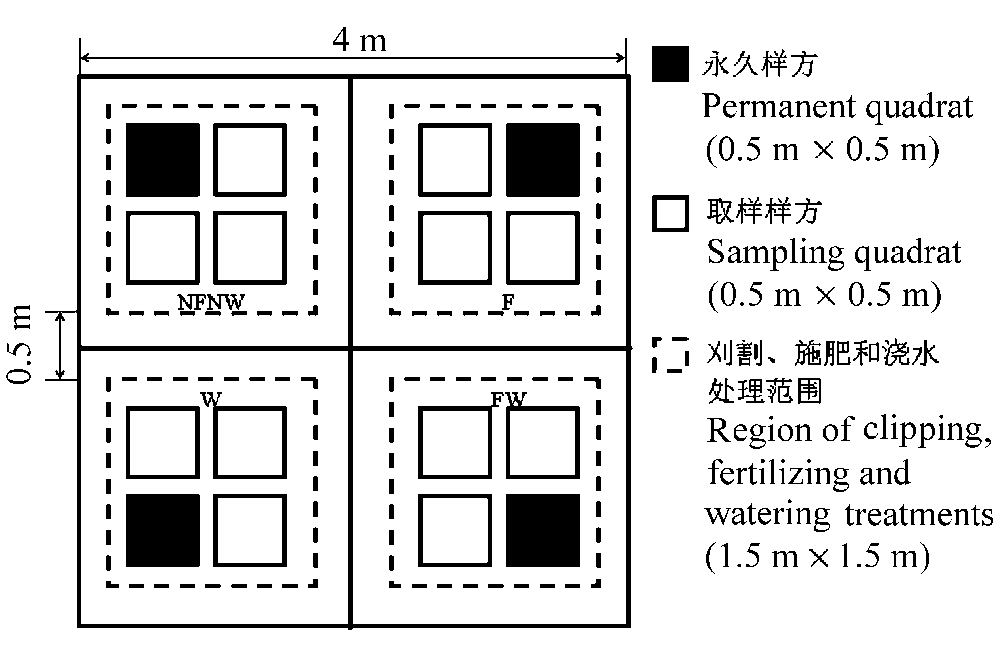
图1 副区处理样方设置图(引自李晓刚等, 2011)。F, 仅施肥; FW, 既施肥, 又浇水; NFNW, 不施肥, 不浇水; W, 仅浇水。
Fig. 1 Quadrats design layout of subplot (from Li et al., 2011). F, fertilized only; FW, fertilized and watered; NFNW, unfertilized and unwatered; W, watered only.
| 性状 Trait | 性状符号 Trait label | 性状类型 Trait type | 赋值分类状态 Evaluated classification state |
|---|---|---|---|
| 生长型 Growth form | gf | 定性性状 Qualitative trait | 1, 直立疏丛生; 2, 莲座; 3, 密丛生; 4, 匍匐状; 5, 垫状; 6, 单株 1, erect caespitose; 2, rosette; 3, close caespitose; 4, stoloniferous; 5, mat forming; 6, solitary |
| 生活周期 Life cycle | lc | 定性性状 Qualitative trait | 0, 非多年生; 1, 多年生 0, not perennial; 1, perennial |
| 营养繁殖器官 Organ of vegetative propagation | ovp | 定性性状 Qualitative trait | 1, 根茎; 2, 无; 3, 匍匐茎; 4, 块茎; 5, 直立茎 1, rhizome; 2, absent; 3, creeping stem; 4, tuber; 5, straight stem |
| 经济类群 Economic group | eg | 定性性状 Qualitative trait | 1, 禾草; 2, 莎草; 3, 豆科植物; 4, 杂类草 1, Gramineae; 2, Cyperaceae; 3, Leguminosae; 4, forbs |
| 叶表面特征 Leaf surface characteristic | lsc | 定性性状 Qualitative trait | 1, 光滑; 2, 具毛; 3, 具刺 1, glabrous; 2, hairy; 3, needle |
| 叶缘 Leaf margin | lm | 定性性状 Qualitative trait | 1, 全缘; 2, 锯齿; 3, 深裂; 4, 全裂 1, entire margin; 2, sawtooth; 3, deep lobed; 4, entire lobed |
| 叶形 Leaf shape | ls | 定性性状 Qualitative trait | 1, 线形; 2, 卵形; 3, 长椭圆形; 4, 披针形; 5, 倒披针形; 6, 倒卵形; 7, 剑形; 8, 阔椭圆形 1, linear; 2, ovate; 3, oblong; 4, lanceolate; 5, oblanceolate; 6, obovate; 7, swordlike; 8, broad oblong |
| 株高 Plant height (cm) | ph | 定量性状Quantitative trait | 1, <7.5; 2, ≥7.5-<16; 3, ≥16-<24; 4, ≥24-<32; 5, ≥32-<40; 6, ≥40 |
| 叶片叶绿素含量 Leaf chlorophyll content (%) | lch | 定量性状Quantitative trait | 1, <15; 2, ≥15-<20; 3, ≥20-<30; 4, ≥30-<40; 5, ≥40-<50; 6, ≥50 |
| 单株叶面积 Leaf area per plant (cm2) | la | 定量性状Quantitative trait | 1, <15; 2, ≥15-<30; 3, ≥30-<45; 4, ≥45-<60; 5, ≥60-<75; 6, ≥75 |
| 单株叶干质量 Leaf dry weight per plant (mg) | lw | 定量性状Quantitative trait | 1, <50; 2, ≥50-<100; 3, ≥100-<200; 4, ≥200-<400; 5, ≥400-<600; 6, ≥600 |
| 比叶面积 Specific leaf area (m2·kg-1) | sla | 定量性状Quantitative trait | 1, <0.2; 2, ≥0.2-<0.4; 3, ≥0.4-<0.6; 4, ≥0.6-<0.8; 5, ≥0.8 |
表1 定义功能型的预选性状及其分类状态
Table 1 Preselective traits and classification states used for definition of plant functional type
| 性状 Trait | 性状符号 Trait label | 性状类型 Trait type | 赋值分类状态 Evaluated classification state |
|---|---|---|---|
| 生长型 Growth form | gf | 定性性状 Qualitative trait | 1, 直立疏丛生; 2, 莲座; 3, 密丛生; 4, 匍匐状; 5, 垫状; 6, 单株 1, erect caespitose; 2, rosette; 3, close caespitose; 4, stoloniferous; 5, mat forming; 6, solitary |
| 生活周期 Life cycle | lc | 定性性状 Qualitative trait | 0, 非多年生; 1, 多年生 0, not perennial; 1, perennial |
| 营养繁殖器官 Organ of vegetative propagation | ovp | 定性性状 Qualitative trait | 1, 根茎; 2, 无; 3, 匍匐茎; 4, 块茎; 5, 直立茎 1, rhizome; 2, absent; 3, creeping stem; 4, tuber; 5, straight stem |
| 经济类群 Economic group | eg | 定性性状 Qualitative trait | 1, 禾草; 2, 莎草; 3, 豆科植物; 4, 杂类草 1, Gramineae; 2, Cyperaceae; 3, Leguminosae; 4, forbs |
| 叶表面特征 Leaf surface characteristic | lsc | 定性性状 Qualitative trait | 1, 光滑; 2, 具毛; 3, 具刺 1, glabrous; 2, hairy; 3, needle |
| 叶缘 Leaf margin | lm | 定性性状 Qualitative trait | 1, 全缘; 2, 锯齿; 3, 深裂; 4, 全裂 1, entire margin; 2, sawtooth; 3, deep lobed; 4, entire lobed |
| 叶形 Leaf shape | ls | 定性性状 Qualitative trait | 1, 线形; 2, 卵形; 3, 长椭圆形; 4, 披针形; 5, 倒披针形; 6, 倒卵形; 7, 剑形; 8, 阔椭圆形 1, linear; 2, ovate; 3, oblong; 4, lanceolate; 5, oblanceolate; 6, obovate; 7, swordlike; 8, broad oblong |
| 株高 Plant height (cm) | ph | 定量性状Quantitative trait | 1, <7.5; 2, ≥7.5-<16; 3, ≥16-<24; 4, ≥24-<32; 5, ≥32-<40; 6, ≥40 |
| 叶片叶绿素含量 Leaf chlorophyll content (%) | lch | 定量性状Quantitative trait | 1, <15; 2, ≥15-<20; 3, ≥20-<30; 4, ≥30-<40; 5, ≥40-<50; 6, ≥50 |
| 单株叶面积 Leaf area per plant (cm2) | la | 定量性状Quantitative trait | 1, <15; 2, ≥15-<30; 3, ≥30-<45; 4, ≥45-<60; 5, ≥60-<75; 6, ≥75 |
| 单株叶干质量 Leaf dry weight per plant (mg) | lw | 定量性状Quantitative trait | 1, <50; 2, ≥50-<100; 3, ≥100-<200; 4, ≥200-<400; 5, ≥400-<600; 6, ≥600 |
| 比叶面积 Specific leaf area (m2·kg-1) | sla | 定量性状Quantitative trait | 1, <0.2; 2, ≥0.2-<0.4; 3, ≥0.4-<0.6; 4, ≥0.6-<0.8; 5, ≥0.8 |
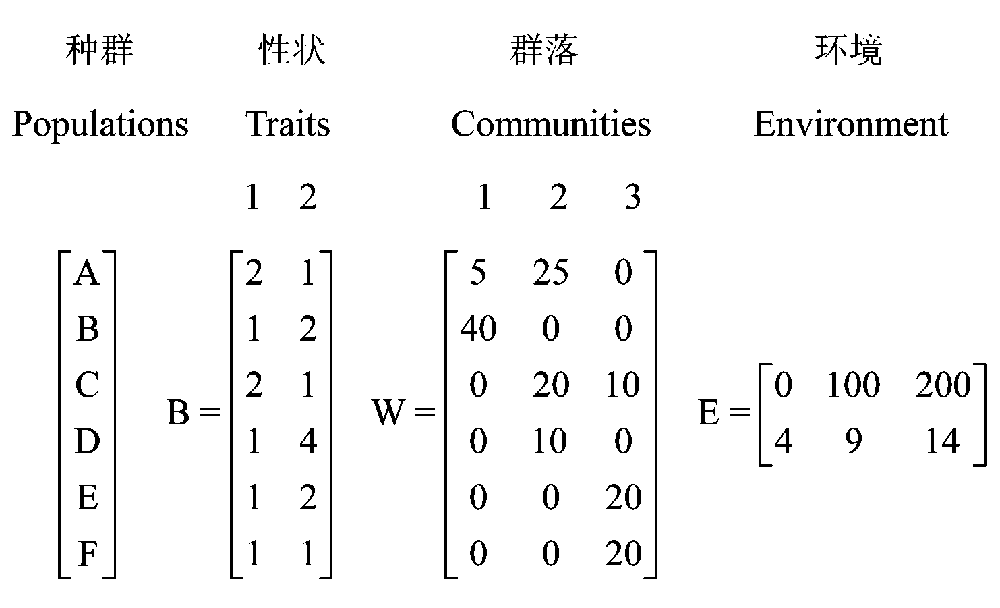
图2 递归算法中的3类矩阵(引自Pillar & Sosinski Jr, 2003)。B, 以性状值表示的种群; E, 以环境变量表示的群落; W, 以物种多度表示的群落。
Fig. 2 Three matrices involved in recursive algorithm (from Pillar & Sosinski Jr, 2003). B, described populations by traits; E, communities described by environmental variables; W, communities described by species abundance.
| 处理 | 性状集编号 | 叠合性MD;A) | 性状符号与性状集 | |||||||||||
|---|---|---|---|---|---|---|---|---|---|---|---|---|---|---|
| Treatment | No. of trait subset | Congruence /?(D;A) | Trait label and trait subset | |||||||||||
| NFNW | 1 | 0.537 | sla | |||||||||||
| 2 | 0.572 | lw | sla | |||||||||||
| 3 | 0.579 | lm | ph | sla | ||||||||||
| 4 | 0.585 | lm | ph | lw | sla | |||||||||
| 5 | 0.583 | lc | lm | lch | Ph | sla | ||||||||
| 6 | 0.576 | lc | lm | lch | Ph | lw | sla | |||||||
| 7 | 0.561 | lc | lsc | lm | lch | ph | lw | sla | ||||||
| 8 | 0.544 | lc | lsc | Is | lm | lch | ph | la | sla | |||||
| 9 | 0.518 | lc | lsc | Is | lm | lch | ph | la | lw | sla | ||||
| 10 | 0.479 | lc | eg | lsc | Is | lm | lch | ph | la | lw | sla | |||
| 11 | 0.427 | gf | lc | eg | lsc | Is | lm | lch | Ph | la | lw | sla | ||
| 12 | 0.35 | gf | lc | ovp | eg | lsc | Is | lm | lch | ph | la | lw | sla | |
| F | 1 | 0.566 | Ph | |||||||||||
| 2 | 0.66 | lw | sla | |||||||||||
| 3 | 0.713 | ph | lw | sla | ||||||||||
| 4 | 0.715 | lc | ph | lw | sla | |||||||||
| 5 | 0.712 | lc | lch | Ph | lw | sla | ||||||||
| 6 | 0.71 | lc | ovp | lch | ph | lw | sla | |||||||
| 7 | 0.691 | lc | ovp | lm | lch | Ph | lw | sla | ||||||
| 8 | 0.673 | lc | ovp | eg | lm | lch | Ph | lw | sla | |||||
| 9 | 0.652 | lc | ovp | eg | Is | lm | lch | ph | lw | sla | ||||
| 10 | 0.629 | gf | lc | ovp | eg | lsc | lm | lch | Ph | lw | sla | |||
| 11 | 0.596 | gf | lc | ovp | eg | lsc | Is | lm | lch | Ph | lw | sla | ||
| 12 | 0.516 | gf | lc | ovp | eg | lsc | Is | lm | lch | ph | la | lw | sla | |
| W | 1 | 0.557 | ph | |||||||||||
| 2 | 0.672 | lsc | Ph | |||||||||||
| 3 | 0.751 | lsc | ph | lw | ||||||||||
| 4 | 0.769 | lsc | lch | Ph | lw | |||||||||
| 5 | 0.797 | lsc | lch | Ph | lw | sla | ||||||||
| 6 | 0.8 | lc | lsc | lch | ph | lw | sla | |||||||
| 7 | 0.778 | lc | lsc | Is | lch | Ph | lw | sla | ||||||
| 8 | 0.75 | lc | eg | lsc | Is | lch | Ph | lw | sla | |||||
| 9 | 0.691 | gf | lc | eg | lsc | Is | lch | Ph | lw | sla | ||||
| 10 | 0.64 | gf | lc | eg | lsc | Is | lm | lch | Ph | lw | sla | |||
| 11 | 0.573 | gf | lc | ovp | eg | lsc | Is | lch | Ph | la | lw | sla | ||
| 12 | 0.514 | gf | lc | ovp | eg | lsc | Is | lm | lch | Ph | la | lw | sla | |
| FW | 1 | 0.602 | lm | |||||||||||
| 2 | 0.698 | ovp | ph | |||||||||||
| 3 | 0.744 | ovp | lm | ph | ||||||||||
| 4 | 0.738 | lc | ovp | lm | ph | |||||||||
| 5 | 0.717 | lc | ovp | lch | ph | sla | ||||||||
| 6 | 0.72 | lc | ovp | lch | ph | la | sla | |||||||
| 7 | 0.72 | lc | ovp | lm | lch | Ph | la | sla | ||||||
| 8 | 0.711 | lc | ovp | Is | lm | lch | Ph | la | sla | |||||
| 9 | 0.688 | gf | lc | ovp | lm | lch | Ph | la | lw | sla | ||||
| 10 | 0.667 | gf | lc | ovp | Is | lm | lch | ph | la | lw | sla | |||
| 11 | 0.644 | gf | lc | ovp | eg | Is | lm | lch | ph | la | lw | sla | ||
| 12 | 0.592 | gf | lc | ovp | eg | lsc | Is | lm | lch | ph | la | lw | sla | |
表2 不同施肥和浇水处理下不同性状组合的最优性状集
Table 2 Optimal trait subsets of different trait combination under different treatments of fertilizing and watering
| 处理 | 性状集编号 | 叠合性MD;A) | 性状符号与性状集 | |||||||||||
|---|---|---|---|---|---|---|---|---|---|---|---|---|---|---|
| Treatment | No. of trait subset | Congruence /?(D;A) | Trait label and trait subset | |||||||||||
| NFNW | 1 | 0.537 | sla | |||||||||||
| 2 | 0.572 | lw | sla | |||||||||||
| 3 | 0.579 | lm | ph | sla | ||||||||||
| 4 | 0.585 | lm | ph | lw | sla | |||||||||
| 5 | 0.583 | lc | lm | lch | Ph | sla | ||||||||
| 6 | 0.576 | lc | lm | lch | Ph | lw | sla | |||||||
| 7 | 0.561 | lc | lsc | lm | lch | ph | lw | sla | ||||||
| 8 | 0.544 | lc | lsc | Is | lm | lch | ph | la | sla | |||||
| 9 | 0.518 | lc | lsc | Is | lm | lch | ph | la | lw | sla | ||||
| 10 | 0.479 | lc | eg | lsc | Is | lm | lch | ph | la | lw | sla | |||
| 11 | 0.427 | gf | lc | eg | lsc | Is | lm | lch | Ph | la | lw | sla | ||
| 12 | 0.35 | gf | lc | ovp | eg | lsc | Is | lm | lch | ph | la | lw | sla | |
| F | 1 | 0.566 | Ph | |||||||||||
| 2 | 0.66 | lw | sla | |||||||||||
| 3 | 0.713 | ph | lw | sla | ||||||||||
| 4 | 0.715 | lc | ph | lw | sla | |||||||||
| 5 | 0.712 | lc | lch | Ph | lw | sla | ||||||||
| 6 | 0.71 | lc | ovp | lch | ph | lw | sla | |||||||
| 7 | 0.691 | lc | ovp | lm | lch | Ph | lw | sla | ||||||
| 8 | 0.673 | lc | ovp | eg | lm | lch | Ph | lw | sla | |||||
| 9 | 0.652 | lc | ovp | eg | Is | lm | lch | ph | lw | sla | ||||
| 10 | 0.629 | gf | lc | ovp | eg | lsc | lm | lch | Ph | lw | sla | |||
| 11 | 0.596 | gf | lc | ovp | eg | lsc | Is | lm | lch | Ph | lw | sla | ||
| 12 | 0.516 | gf | lc | ovp | eg | lsc | Is | lm | lch | ph | la | lw | sla | |
| W | 1 | 0.557 | ph | |||||||||||
| 2 | 0.672 | lsc | Ph | |||||||||||
| 3 | 0.751 | lsc | ph | lw | ||||||||||
| 4 | 0.769 | lsc | lch | Ph | lw | |||||||||
| 5 | 0.797 | lsc | lch | Ph | lw | sla | ||||||||
| 6 | 0.8 | lc | lsc | lch | ph | lw | sla | |||||||
| 7 | 0.778 | lc | lsc | Is | lch | Ph | lw | sla | ||||||
| 8 | 0.75 | lc | eg | lsc | Is | lch | Ph | lw | sla | |||||
| 9 | 0.691 | gf | lc | eg | lsc | Is | lch | Ph | lw | sla | ||||
| 10 | 0.64 | gf | lc | eg | lsc | Is | lm | lch | Ph | lw | sla | |||
| 11 | 0.573 | gf | lc | ovp | eg | lsc | Is | lch | Ph | la | lw | sla | ||
| 12 | 0.514 | gf | lc | ovp | eg | lsc | Is | lm | lch | Ph | la | lw | sla | |
| FW | 1 | 0.602 | lm | |||||||||||
| 2 | 0.698 | ovp | ph | |||||||||||
| 3 | 0.744 | ovp | lm | ph | ||||||||||
| 4 | 0.738 | lc | ovp | lm | ph | |||||||||
| 5 | 0.717 | lc | ovp | lch | ph | sla | ||||||||
| 6 | 0.72 | lc | ovp | lch | ph | la | sla | |||||||
| 7 | 0.72 | lc | ovp | lm | lch | Ph | la | sla | ||||||
| 8 | 0.711 | lc | ovp | Is | lm | lch | Ph | la | sla | |||||
| 9 | 0.688 | gf | lc | ovp | lm | lch | Ph | la | lw | sla | ||||
| 10 | 0.667 | gf | lc | ovp | Is | lm | lch | ph | la | lw | sla | |||
| 11 | 0.644 | gf | lc | ovp | eg | Is | lm | lch | ph | la | lw | sla | ||
| 12 | 0.592 | gf | lc | ovp | eg | lsc | Is | lm | lch | ph | la | lw | sla | |
| 处理 Treatment | 最优性状集 Optimal traits subset | TCAP ρ(TE) | TCAP and TDAP ρ(XE) | TDAP ρ(XE.T) | 所有性状 All traits ρ(D;?) | 性状冗余 Trait redundancy ρ(XE)-ρ(D;?) |
|---|---|---|---|---|---|---|
| NFNW | lm-ph-lw-sla | 0.587 (p = 0.002) | 0.585 (p = 0.001) | 0.131 (p = 0.192) | 0.350 | 0.235 |
| F | lc-ph-lw-sla | 0.721 (p = 0.001) | 0.715 (p = 0.001) | 0.125 (p = 0.169) | 0.516 | 0.199 |
| W | lc-lsc-lch-ph-lw-sla | 0.663 (p = 0.001) | 0.800 (p = 0.001) | 0.601 (p = 0.001) | 0.514 | 0.286 |
| FW | ovp-lm-ph | 0.642 (p = 0.001) | 0.744 (p = 0.001) | 0.528 (p = 0.005) | 0.592 | 0.152 |
表3 不同施肥与浇水处理下与刈割梯度具有最大相关性的最优性状集及其性状的趋同与趋异构建模式
Table 3 Optimal trait subsets that has maximal correlation with clipping gradient and the traits-convergence/divergence assembly patterns under different treatments of fertilizing and watering
| 处理 Treatment | 最优性状集 Optimal traits subset | TCAP ρ(TE) | TCAP and TDAP ρ(XE) | TDAP ρ(XE.T) | 所有性状 All traits ρ(D;?) | 性状冗余 Trait redundancy ρ(XE)-ρ(D;?) |
|---|---|---|---|---|---|---|
| NFNW | lm-ph-lw-sla | 0.587 (p = 0.002) | 0.585 (p = 0.001) | 0.131 (p = 0.192) | 0.350 | 0.235 |
| F | lc-ph-lw-sla | 0.721 (p = 0.001) | 0.715 (p = 0.001) | 0.125 (p = 0.169) | 0.516 | 0.199 |
| W | lc-lsc-lch-ph-lw-sla | 0.663 (p = 0.001) | 0.800 (p = 0.001) | 0.601 (p = 0.001) | 0.514 | 0.286 |
| FW | ovp-lm-ph | 0.642 (p = 0.001) | 0.744 (p = 0.001) | 0.528 (p = 0.005) | 0.592 | 0.152 |
| 处理 Treatment | 植物响应功 能型 PRT | 种群数 No. of populations | 物种数 No. of species | 最优性状集及其性状状态变化(变化范围) Optimal trait subsets and changes of trait states (range of values) | 种群分布 Population distribution (%) | 显著性 Sig. | |||||||
|---|---|---|---|---|---|---|---|---|---|---|---|---|---|
| NFNW | 197 | lm★ | ph (1.2-29.2 cm) | lw (5.35-87.8 mg) | sla (0.04-0.79 cm2·mg-1) | NH | H3 | H1 | |||||
| PRT-(1) PRT-(2) PRT-(3) PRT-(4) PRT-(5) | 40 32 31 68 26 | 17 8 11 14 4 | 全缘-锯齿-深裂-全裂 Entire margin-sawtooth-deep lobed-entire lobed 全缘-锯齿-深裂-全裂 Entire margin-sawtooth-deep lobed-entire lobed 全缘 Entire margin 全缘-锯齿 Entire margin-sawtooth 深裂-全裂 Deep lobed-entire lobed | <7.5 <16 <32 <7.5 <7.5 | <100 >200 <100 >50; <200 <400 | >0.4 <0.4 <0.4 <0.6 <0.8 | 5 53 39 40 23 | 20 34 51 31 42 | 75 13 10 29 35 | ** *** * NS NS | |||
| F | 179 | lc | ph (1.0-43.1 cm) | lw (6.68-99.6 mg) | sla (0.03-0.66 cm2·mg-1) | ||||||||
| PRT-(1) PRT-(2) PRT-(3) PRT-(4) PRT-(5) | 32 54 6 68 19 | 19 21 3 21 5 | 多年生 Perennial 多年生 Perennial 多年生 Perennial 多年生 Perennial 多年生 Perennial | <7.5 <24 >24 <16 <7.5 | <200 >50;<400 <400 <100 >200 | >0.6 <0.6 <0.2 <0.6 <0.4 | 3 54 100 15 37 | 22 35 0 41 42 | 75 11 0 44 21 | ** ** ** * NS | |||
| W | 198 | lsc | lc | lw (5.26-38.8 mg) | sla (0.03-0.76 cm2·mg-1) | ph (1.1-33.2 cm) | lch (27.39-62.29) | ||||||
| PRT-(1) PRT-(2) PRT-(3) PRT-(4) PRT-(5) | 19 41 55 69 14 | 13 16 16 21 7 | 光滑-具毛 Glabrous-hairy 光滑-具毛 Glabrous-hairy 光滑-具毛-具刺 Glabrous-hairy-needle 光滑-具毛 Glabrous-hairy 光滑-具毛-具刺 Glabrous-hairy-needle | 多年生 Perennial 多年生 Perennial 多年生 Perennial 多年生 Perennial 多年生 Perennial | <100 <100 >50;<400 <100 >400 | >0.8 <0.4 <0.4 >0.2; <0.8 <0.2 | <7.5 <32 <16 <7.5 <24 | >20 >30 >40 >30 >40 | 5 66 38 7 86 | 16 29 42 33 14 | 79 5 20 59 0 | ** *** ** *** ** | |
| F×W | 188 | ovp | lm | ph (1.2-46.7 cm) | |||||||||
| PRT-(1) PRT-(2) PRT-(3) PRT-(4) PRT-(5) | 77 11 67 9 24 | 11 5 9 1 3 | 根茎-匍匐茎 Rhizome-creeping stem 根茎 Rhizome 直立茎 Straight stem 根茎 Rhizome 直立茎 Straight stem | 全缘-锯齿 Entire margin-sawtooth 全缘 Entire margin 全缘-锯齿 Entire margin-sawtooth 全裂 Entire lobed 深裂-全裂 Deep lobed-entire lobed | <16 >16;<32 <16 <7.5 <16 | 23 91 31 33 29 | 38 9 34 33 33 | 39 0 34 33 38 | ** *** NS NS NS | ||||
表4 不同施肥与浇水处理下植物响应功能型(PRT)所包含的种群数、物种数及其性状状态与种群分布变化
Table 4 Number of populations, number of species, and changes in both trait states and population distribution involved in each of plant functional response types (PRTs) under different treatments of fertilizing and watering
| 处理 Treatment | 植物响应功 能型 PRT | 种群数 No. of populations | 物种数 No. of species | 最优性状集及其性状状态变化(变化范围) Optimal trait subsets and changes of trait states (range of values) | 种群分布 Population distribution (%) | 显著性 Sig. | |||||||
|---|---|---|---|---|---|---|---|---|---|---|---|---|---|
| NFNW | 197 | lm★ | ph (1.2-29.2 cm) | lw (5.35-87.8 mg) | sla (0.04-0.79 cm2·mg-1) | NH | H3 | H1 | |||||
| PRT-(1) PRT-(2) PRT-(3) PRT-(4) PRT-(5) | 40 32 31 68 26 | 17 8 11 14 4 | 全缘-锯齿-深裂-全裂 Entire margin-sawtooth-deep lobed-entire lobed 全缘-锯齿-深裂-全裂 Entire margin-sawtooth-deep lobed-entire lobed 全缘 Entire margin 全缘-锯齿 Entire margin-sawtooth 深裂-全裂 Deep lobed-entire lobed | <7.5 <16 <32 <7.5 <7.5 | <100 >200 <100 >50; <200 <400 | >0.4 <0.4 <0.4 <0.6 <0.8 | 5 53 39 40 23 | 20 34 51 31 42 | 75 13 10 29 35 | ** *** * NS NS | |||
| F | 179 | lc | ph (1.0-43.1 cm) | lw (6.68-99.6 mg) | sla (0.03-0.66 cm2·mg-1) | ||||||||
| PRT-(1) PRT-(2) PRT-(3) PRT-(4) PRT-(5) | 32 54 6 68 19 | 19 21 3 21 5 | 多年生 Perennial 多年生 Perennial 多年生 Perennial 多年生 Perennial 多年生 Perennial | <7.5 <24 >24 <16 <7.5 | <200 >50;<400 <400 <100 >200 | >0.6 <0.6 <0.2 <0.6 <0.4 | 3 54 100 15 37 | 22 35 0 41 42 | 75 11 0 44 21 | ** ** ** * NS | |||
| W | 198 | lsc | lc | lw (5.26-38.8 mg) | sla (0.03-0.76 cm2·mg-1) | ph (1.1-33.2 cm) | lch (27.39-62.29) | ||||||
| PRT-(1) PRT-(2) PRT-(3) PRT-(4) PRT-(5) | 19 41 55 69 14 | 13 16 16 21 7 | 光滑-具毛 Glabrous-hairy 光滑-具毛 Glabrous-hairy 光滑-具毛-具刺 Glabrous-hairy-needle 光滑-具毛 Glabrous-hairy 光滑-具毛-具刺 Glabrous-hairy-needle | 多年生 Perennial 多年生 Perennial 多年生 Perennial 多年生 Perennial 多年生 Perennial | <100 <100 >50;<400 <100 >400 | >0.8 <0.4 <0.4 >0.2; <0.8 <0.2 | <7.5 <32 <16 <7.5 <24 | >20 >30 >40 >30 >40 | 5 66 38 7 86 | 16 29 42 33 14 | 79 5 20 59 0 | ** *** ** *** ** | |
| F×W | 188 | ovp | lm | ph (1.2-46.7 cm) | |||||||||
| PRT-(1) PRT-(2) PRT-(3) PRT-(4) PRT-(5) | 77 11 67 9 24 | 11 5 9 1 3 | 根茎-匍匐茎 Rhizome-creeping stem 根茎 Rhizome 直立茎 Straight stem 根茎 Rhizome 直立茎 Straight stem | 全缘-锯齿 Entire margin-sawtooth 全缘 Entire margin 全缘-锯齿 Entire margin-sawtooth 全裂 Entire lobed 深裂-全裂 Deep lobed-entire lobed | <16 >16;<32 <16 <7.5 <16 | 23 91 31 33 29 | 38 9 34 33 33 | 39 0 34 33 38 | ** *** NS NS NS | ||||
| 处理 Treatment | 植物响应功能型PRT | 响应类型 Response type | 典型物种 Typical species |
|---|---|---|---|
| NFNW | PRT-(1) PRT-(2) PRT-(3) PRT-(4) PRT-(5) | 增加型 Increaser type 减小型 Decreaser type 单峰型 Unimodal type 中立型 Neutral type 中立型 Neutral type | 矮火绒草 Leontopodium nanum, 棉毛茛 Ranunculus membranaceus, 淡黄香青Anaphalis flavescens, 柔软紫菀 Aster flaccidus 麻花艽 Gentiana straminea, 甘肃棘豆 Oxytropis kansuensis, 美丽凤毛菊 Saus- surea superba, 圆萼摩苓草 Morina chinensis 垂穗披碱草 Elymus nutans, 矮嵩草 Kobresia humilis, 淡黄香青 Anaphalis flavescens, 柔软紫菀 Aster flaccidus, 异叶米口袋 Gueldens- taedtia diversifolia, 二裂委陵菜 Potentilla bifurca 疏齿银莲花 Anemone obtusiloba, 圆萼摩苓草 Morina chinensis, 雪白委陵菜 Pote- ntilla nivea, 亚洲蒲公英 Taraxacum leucanthum |
| F | PRT-(1) PRT-(2) PRT-(3) PRT-(4) PRT-(5) | 增加型 Increaser type 减小型 Decreaser type 减小型 Decreaser type 增加型 Increaser type 中立型 Neutral type | 柔软紫菀 Aster flaccidus, 粗喙薹草 Carex scabrirostris, 麻花艽 Gentiana straminea, 鹅绒委陵菜 Potentilla anserina 垂穗披碱草 Elymus nutans, 疏齿银莲花 Anemone obtusiloba, 蒲公英 Taraxacum mongolicum, 兰石草 Lancea tibetica, 青海苜蓿 Medicago archiducisnicolai 麻花艽 Gentiana straminea, 圆萼摩苓草 Morina chinensis, 美丽凤毛菊 Saussurea superba, 鹅绒委陵菜 Potentilla anserina |
| W | PRT-(1) PRT-(2) PRT-(3) PRT-(4) PRT-(5) | 增加型 Increaser type 减小型 Decreaser type 单峰型 Unimodal type 增加型 Increaser type 减小型 Decreaser type | 垂穗披碱草 Elymus nutans, 矮火绒草 Leontopodium nanum, 棉毛茛 Ranunculus membranaceus, 粗喙薹草 Carex scabrirostris 疏齿银莲花 Anemone obtusiloba, 粗喙薹草 Carex scabrirostris, 垂穗披碱草Elymus nutans, 矮嵩草 Kobresia humilis 麻花艽 Gentiana straminea, 圆萼摩苓草 Morina chinensis, 甘肃棘豆 Oxytropis kansuensis, 黄花棘豆 Oxytropis ochrocephala 淡黄香青 Anaphalis flavescens, 疏齿银莲花 Anemone obtusiloba, 兰石草 Lancea tibetica, 雪白委陵菜 Potentilla nivea 麻花艽 Gentiana straminea, 圆萼摩苓草 Morina chinensis, 美丽凤毛菊 Saussurea superba, 甘肃棘豆 Oxytropis kansuensis |
| FW | PRT-(1) PRT-(2) PRT-(3) PRT-(4) PRT-(5) | 增加型 Increaser type 减小型 Decreaser type 中立型 Neutral type 中立型 Neutral type 中立型 Neutral type | 淡黄香青 Anaphalis flavescens, 粗喙薹草 Carex scabrirostris, 垂穗披碱草 Elymus nutans, 矮嵩草 Kobresia humilis 粗喙薹草 Carex scabrirostris, 垂穗披碱草 Elymus nutans, 柔软紫菀 Aster flaccidus, 麻花艽 Gentiana straminea, 青海苜蓿 Medicago archid- ucisnicolai, 二裂委陵菜 Potentilla bifurca 疏齿银莲花 Anemone obtusiloba 圆萼摩苓草 Morina chinensis, 雪白委陵菜 Potentilla nivea, 亚洲蒲公英 Taraxa- cum leucanthum |
表5 不同施肥与浇水处理下植物响应功能型(PRT)的响应类型、典型物种及作用功能型
Table 5 Response types of plant functional response types (PRTs), typical species and plant functional effect types under different treatments of fertilizing and watering
| 处理 Treatment | 植物响应功能型PRT | 响应类型 Response type | 典型物种 Typical species |
|---|---|---|---|
| NFNW | PRT-(1) PRT-(2) PRT-(3) PRT-(4) PRT-(5) | 增加型 Increaser type 减小型 Decreaser type 单峰型 Unimodal type 中立型 Neutral type 中立型 Neutral type | 矮火绒草 Leontopodium nanum, 棉毛茛 Ranunculus membranaceus, 淡黄香青Anaphalis flavescens, 柔软紫菀 Aster flaccidus 麻花艽 Gentiana straminea, 甘肃棘豆 Oxytropis kansuensis, 美丽凤毛菊 Saus- surea superba, 圆萼摩苓草 Morina chinensis 垂穗披碱草 Elymus nutans, 矮嵩草 Kobresia humilis, 淡黄香青 Anaphalis flavescens, 柔软紫菀 Aster flaccidus, 异叶米口袋 Gueldens- taedtia diversifolia, 二裂委陵菜 Potentilla bifurca 疏齿银莲花 Anemone obtusiloba, 圆萼摩苓草 Morina chinensis, 雪白委陵菜 Pote- ntilla nivea, 亚洲蒲公英 Taraxacum leucanthum |
| F | PRT-(1) PRT-(2) PRT-(3) PRT-(4) PRT-(5) | 增加型 Increaser type 减小型 Decreaser type 减小型 Decreaser type 增加型 Increaser type 中立型 Neutral type | 柔软紫菀 Aster flaccidus, 粗喙薹草 Carex scabrirostris, 麻花艽 Gentiana straminea, 鹅绒委陵菜 Potentilla anserina 垂穗披碱草 Elymus nutans, 疏齿银莲花 Anemone obtusiloba, 蒲公英 Taraxacum mongolicum, 兰石草 Lancea tibetica, 青海苜蓿 Medicago archiducisnicolai 麻花艽 Gentiana straminea, 圆萼摩苓草 Morina chinensis, 美丽凤毛菊 Saussurea superba, 鹅绒委陵菜 Potentilla anserina |
| W | PRT-(1) PRT-(2) PRT-(3) PRT-(4) PRT-(5) | 增加型 Increaser type 减小型 Decreaser type 单峰型 Unimodal type 增加型 Increaser type 减小型 Decreaser type | 垂穗披碱草 Elymus nutans, 矮火绒草 Leontopodium nanum, 棉毛茛 Ranunculus membranaceus, 粗喙薹草 Carex scabrirostris 疏齿银莲花 Anemone obtusiloba, 粗喙薹草 Carex scabrirostris, 垂穗披碱草Elymus nutans, 矮嵩草 Kobresia humilis 麻花艽 Gentiana straminea, 圆萼摩苓草 Morina chinensis, 甘肃棘豆 Oxytropis kansuensis, 黄花棘豆 Oxytropis ochrocephala 淡黄香青 Anaphalis flavescens, 疏齿银莲花 Anemone obtusiloba, 兰石草 Lancea tibetica, 雪白委陵菜 Potentilla nivea 麻花艽 Gentiana straminea, 圆萼摩苓草 Morina chinensis, 美丽凤毛菊 Saussurea superba, 甘肃棘豆 Oxytropis kansuensis |
| FW | PRT-(1) PRT-(2) PRT-(3) PRT-(4) PRT-(5) | 增加型 Increaser type 减小型 Decreaser type 中立型 Neutral type 中立型 Neutral type 中立型 Neutral type | 淡黄香青 Anaphalis flavescens, 粗喙薹草 Carex scabrirostris, 垂穗披碱草 Elymus nutans, 矮嵩草 Kobresia humilis 粗喙薹草 Carex scabrirostris, 垂穗披碱草 Elymus nutans, 柔软紫菀 Aster flaccidus, 麻花艽 Gentiana straminea, 青海苜蓿 Medicago archid- ucisnicolai, 二裂委陵菜 Potentilla bifurca 疏齿银莲花 Anemone obtusiloba 圆萼摩苓草 Morina chinensis, 雪白委陵菜 Potentilla nivea, 亚洲蒲公英 Taraxa- cum leucanthum |
| [1] |
Cadotte MW, Cavender-Bares J, Tilman D, Oakley TH ( 2009). Using phylogenetic, functional and trait diversity to understand patterns of plant community productivity. PLoS ONE, 4, e5695.
DOI URL PMID |
| [2] | Canadell JG, Pataki D, Pitelka L ( 2007). Terrestrial Ecosystems in a Changing World. Springer-Verlag, New York. |
| [3] | Cornelissen JHC, Lavorel S, Garnier E, Díaz S, Buchmann N, Gurvich DE, Reich PB, ter Steege H, Morgan HD, van der Heijden MGA, Pausas JG, Poorter H ( 2003). A handbook of protocols for standardized and easy measurement of plant functional traits worldwide. Australian Journal of Botany, 51, 335-380. |
| [4] | Connell JH ( 1980). Diversity and the coevolution of competitors, or the ghost of competition past. Oikos, 35, 131-138. |
| [5] | Díaz S, Cabido M ( 1997). Plant functional types and ecosystem function in relation to global change. Journal of Vegetation Science, 8, 463-474. |
| [6] | Díaz S, Cabido M ( 2001). Vive la difference: plant functional diversity matters to ecosystem processes. Trends in Ecology & Evolution, 16, 646-655. |
| [7] | Díaz S, Hodgson JG, Thompson K, Cabido M, Cornelissen JHC, Jalili A, Montserrat-Martí G, Grime JP, Zarrinkamar F, Asri Y, Band SR, Basconcelo S, Castro-Díez P, Funes G, Hamzehee B, Khoshnevi M, Pérez-Harguindeguy N, Pérez-Rontomé MC, Shirvany FA, Vendramini F, Yazdani S, Abbas-Azimi R, Bogaard A, Boustani S, Charles M, Dehghan M, de Torres-Espuny L, Falczuk V, Guerrero- Campo J, Hynd A, Jones G, Kowsary E, Kazemi-Saeed F, Maestro-Martínez M, Romo-Díez A, Shaw S, Siavash B, Villar-Salvador P, Zak MR ( 2004). The plant traits that drive ecosystems: evidence from three continents. Journal of Vegetation Science, 15, 295-304. |
| [8] | Díaz S, Noy-Meir I, Cabido M ( 2001). Can grazing response of herbaceous plants be predicted from simple vegetative traits? Journal of Applied Ecology, 38, 497-508. |
| [9] | Diamond, JM (1975). Assembly of species communities. In: Cody ML, Diamond JM eds. Ecology and Evolution of Communities. Harvard University Press, Cambridge, USA. 342-444. |
| [10] | Garnier E, Cortez J, Billès G, Navas ML, Roumet C, Debussche M, Laurent G, Blanchard A, Aubry D, Bellmann A, Neill C, Toussaint JP ( 2004). Plant functional markers capture ecosystem properties during secondary succession. Ecology, 85, 2630-2637. |
| [11] | Gao Y, Wang DL, Ba L, Bai YG, Liu B ( 2008). Interactions between herbivory and resource availability on grazing tolerance of Leymus chinensis. Environmental and Experimental Botany, 63, 113-122. |
| [12] | Grime JP ( 2006). Trait convergence and trait divergence in herbaceous plant communities: mechanisms and consequences. Journal of Vegetation Science, 17, 255-260. |
| [13] | Grime JP, Thompson K, Hunt R, Hodgson JG, Cornelissen JHC, Rorison IH, Hendry GAF, Ashenden TW, Askew AP, Band SR, Booth RE, Bossard CC, Campbell BD, Cooper JEL, Davison AW, Gupta PL, Hall W, Hand DW, Hannah MA, Hillier SH, Hodkinson DJ, Jalili A, Liu Z, Mackey JML, Matthews N, Mowforth MA, Neal AM, Reader RJ, Reiling K, Ross-Fraser W, Spencer RE, Sutton F, Tasker DE, Thorpe PC, Whitehouse J ( 1997). Integrated screening validates primary axes of specialisation in plants. Oikos, 79, 259-281. |
| [14] |
Hillebrand H, Matthiessen B ( 2009). Biodiversity in a complex world: consolidation and progress in functional biodiversity research. Ecology Letters, 12, 1405-1419.
URL PMID |
| [15] | Hooper DU, Chapin FS III, Ewel JJ, Hector A, Inchausti P, Lavorel S, Lawton JH, Lodge DM, Loreau M, Naeem S, Schmid B, Setala H, Symstad AJ, Vandermeer J, Wardle DA ( 2005). Effects of biodiversity on ecosystem functioning: a consensus of current knowledge. Ecological Monographs, 75, 3-35. |
| [16] | Li XG, Zhu ZH, Zhou XS, Yuan FR, Fan RJ, Xu ML ( 2011). Effects of clipping, fertilizing and watering on the relationship between species diversity, functional diversity and primary productivity in alpine meadow of China. Chinese Journal of Plant Ecology, 35, 1136-1147. (in Chinese with English abstract) |
| [ 李晓刚, 朱志红, 周晓松, 袁芙蓉, 樊瑞俭, 许曼丽 ( 2011). 刈割、施肥和浇水对高寒草甸物种多样性、功能多样性与初级生产力关系的影响. 植物生态学报, 35, 1136-1147.] | |
| [17] | Li YN, Wang QX, Gu S, Fu YL, Du MY, Zhao L, Zhao XQ, Yu GR ( 2004). Integrated monitoring of alpine vegetation types and its primary production. Acta Geographica Sinica, 59, 40-48. (in Chinese with English abstract) |
| [ 李英年, 王勤学, 古松, 伏玉玲, 杜明远, 赵亮, 赵新全, 于贵瑞 ( 2004). 高寒植被类型及其植物生产力的监测. 地理学报, 59, 40-48.] | |
| [18] | Louault F, Pillar VD, Aufrére J, Garnier E, Soussana JF ( 2005). Plant traits and functional types in response to reduced disturbance in a semi-natural grassland. Journal of Vegetation Science, 16, 151-160. |
| [19] | Mokany K, Ash J, Roxburgh S ( 2008). Functional identity is more important than diversity in influencing ecosystem processes in a temperate native grassland. Journal of Ecology, 96, 884-893. |
| [20] | Pacala SW, Tilman D ( 1994). Limiting similarity in mechanistic and spatial models of plant competition in heterogeneous environments. The American Naturalist, 143, 222-257. |
| [21] | Parsons RF ( 1968). The significance of growth-rate comparisons for plant ecology. The American Naturalist, 102, 595-597. |
| [22] | Pausas JG, Lavorel S ( 2003). A hierarchical deductive approach for functional types in disturbed ecosystems. Journal of Vegetation Science, 14, 409-416. |
| [23] | Pillar VD ( 1999). On the identification of optimal plant functional types. Journal of Vegetation Science, 10, 631-640. |
| [24] | Pillar VD, Duarte LS, Sosinski EE, Joner F ( 2009). Discriminating trait-convergence and trait-divergence assembly patterns in ecological community gradients. Journal of Vegetation Science, 20, 334-348. |
| [25] | Pillar VD, Orlóci L ( 1993). Taxonomy and perception in vegetation analysis. Coenoses, 8, 53-66. |
| [26] | Pillar VD, Sosinski Jr EE ( 2003). An improved method for searching plant functional types by numerical analysis. Journal of Vegetation Science, 14, 323-332. |
| [27] | Suding KN, Lavorel S, Chapin III FS, Cornelissen JHC, Díaz S, Garnier E, Goldberg D, Hooper DU, Jackson ST, Navas ML ( 2008). Scaling environmental change through the community-level: a trait-based response-and-effect frame- work for plants. Global Change Biology, 14, 1125-1140. |
| [28] | Wacker L, Baudois O, Eichenberger-Glinz S, Schmid B ( 2009). Diversity effects in early- and mid-successional species pools along a nitrogen gradient. Ecology, 90, 637-648. |
| [29] | Weiher E, Keddy PA ( 1995). Assembly rules, null models, and trait dispersion: new questions from old patterns. Oikos, 74, 159-164. |
| [30] | Wilson JB ( 2007). Trait-divergence assembly rules have been demonstrated: limiting similarity lives! A reply to grime. Journal of Vegetation Science, 18, 451-452. |
| [31] | Wright JP, Jones CG ( 2004). Predicting effects of ecosystem engineers on patch-scale species richness from primary productivity. Ecology, 85, 2071-2081. |
| [32] | Zang YM, Zhu ZH, Li YN, Wang WJ, Xi B ( 2009). Effects of species diversity and functional diversity on primary productivity of alpine meadow. Chinese Journal of Ecology, 28, 999-1005. (in Chinese with English abstract) |
| [ 臧岳铭, 朱志红, 李英年, 王文娟, 席博 ( 2009). 高寒矮嵩草草甸物种多样性与功能多样性对初级生产力的影响. 生态学杂志, 28, 999-1005.] | |
| [33] | Zhao XQ (2009). Global Change and Ecological System in Alpine Meadow. Science Press, Beijing. (in Chinese) 78. |
| [ 赵新全 (2009). 高寒草甸生态系统与全球变化. 科学出版社, 北京. 78.] | |
| [34] | Zhou XS, Zhu ZH, Li YN, Yuan FR, Fan RJ ( 2011). Community compensatory mechanism under clipping, fertilizing and watering treatment in alpine meadow. Journal of Lanzhou University (Natural Sciences), 47, 50-57. (in Chinese with English abstract) |
| [ 周晓松, 朱志红, 李英年, 袁芙蓉, 樊瑞俭 ( 2011). 刈割、施肥和浇水处理下高寒矮嵩草草甸补偿机制. 兰州大学学报(自然科学版), 47, 50-57.] | |
| [35] | Zhu ZH, Wang XA, Li YN, Wang G, Guo H ( 2012). Predicting plant traits and functional types response to grazing in an alpine shrub meadow on the Qinghai-Tibet Plateau. Sciences China-Earth Sciences, 55, 837-851. |
| [1] | 段建林, 孟晟, 陈仁利, 熊林峰, 卢春洋, 席念勋. 全球变化因子多样性对菌根植物性状的影响[J]. , 2026, 50(预发表): 0-. |
| [2] | 郑子仪, 陈江慧, 刘慧颖. 气候变暖提高青藏高原高寒草甸优势物种的根系分泌速率[J]. 植物生态学报, 2025, 49(9): 1363-1373. |
| [3] | 崔冬晴, 田晨, 宋慧敏, 鲁小名, 萨其日, 徐国庆, 杨培志, 白永飞, 田建卿. 典型草原优势植物根际细菌群落多样性和功能群组成对长期放牧的响应机制[J]. 植物生态学报, 2025, 49(7): 1163-1176. |
| [4] | 郝杰, 刁华杰, 苏原, 武帅楷, 高阳阳, 梁雯君, 牛慧敏, 杨倩雯, 常婕, 王袼, 许雯丽, 马腾飞, 董宽虎, $\boxed{\hbox{王常慧}}$. 降水调控农牧交错带盐渍化草地净初级生产力对氮添加及刈割的响应[J]. 植物生态学报, 2025, 49(5): 710-719. |
| [5] | 杜英杰, 范爱连, 王雪, 闫晓俊, 陈廷廷, 贾林巧, 姜琦, 陈光水. 亚热带天然常绿阔叶林乔木树种与林下灌木树种根-叶功能性状协调性及差异[J]. 植物生态学报, 2025, 49(4): 585-595. |
| [6] | 张晓婷, 王俊杰. 盐和铜处理下红树植物叶绿素荧光特性变化与叶片结构及生化组分关系[J]. 植物生态学报, 2025, 49(11): 1944-1956. |
| [7] | 童金莲, 张博纳, 汤璐瑶, 叶琳峰, 李姝雯, 谢江波, 李彦, 王忠媛. C4植物狗尾草功能性状网络沿降水梯度带的区域分异规律[J]. 植物生态学报, 2025, 49(11): 1817-1832. |
| [8] | 刘伟, 郝毅晴, 孙佳美, 王璟, 范冰, 郝建玺, 金那申, 潘庆民. 呼伦贝尔退化草原土壤养分调控的原理与技术[J]. 植物生态学报, 2025, 49(1): 138-147. |
| [9] | 秦嘉晨, 王欢, 朱江, 王扬, 田晨, 白永飞, 杨培志, 郑淑霞. 基于种内与种间性状变异的放牧过滤作用及其尺度效应[J]. 植物生态学报, 2024, 48(7): 858-871. |
| [10] | 付粱晨, 丁宗巨, 唐茂, 曾辉, 朱彪. 北京东灵山白桦和蒙古栎的根际效应及其季节动态[J]. 植物生态学报, 2024, 48(4): 508-522. |
| [11] | 王思琦, 金光泽. 五角槭不同生活史阶段叶枝根性状的变异与权衡[J]. 植物生态学报, 2024, 48(11): 1510-1523. |
| [12] | 胡楚婷, 杨柳依依, 石绍林, 周琰, 陈婷婷, 郑博瀚, 杨暘, 卢小玲, 王陈玲, 倪健. 浙江金华典型人工植被的植物功能性状[J]. 植物生态学报, 2024, 48(10): 1336-1350. |
| [13] | 代景忠, 白玉婷, 卫智军, 张楚, 辛晓平, 闫玉春, 闫瑞瑞. 羊草功能性状对施肥的动态响应[J]. 植物生态学报, 2023, 47(7): 943-953. |
| [14] | 葛萍, 李昂, 王银柳, 姜良超, 牛国祥, 哈斯木其尔, 王彦兵, 薛建国, 赵威, 黄建辉. 草甸草原温室气体排放对氮添加量的非线性响应[J]. 植物生态学报, 2023, 47(11): 1483-1492. |
| [15] | 汤璐瑶, 方菁, 钱海蓉, 张博纳, 上官方京, 叶琳峰, 李姝雯, 童金莲, 谢江波. 落羽杉和池杉功能性状随高度的变异与协同[J]. 植物生态学报, 2023, 47(11): 1561-1575. |
| 阅读次数 | ||||||
|
全文 |
|
|||||
|
摘要 |
|
|||||
Copyright © 2026 版权所有 《植物生态学报》编辑部
地址: 北京香山南辛村20号, 邮编: 100093
Tel.: 010-62836134, 62836138; Fax: 010-82599431; E-mail: apes@ibcas.ac.cn, cjpe@ibcas.ac.cn
备案号: 京ICP备16067583号-19

