
Chin J Plant Ecol ›› 2025, Vol. 49 ›› Issue (12): 2043-2053.DOI: 10.17521/cjpe.2024.0453 cstr: 32100.14.cjpe.2024.0453
• Research Articles • Previous Articles Next Articles
BIAN Jia-Chen1, WANG Rui1,2,3, GAO Yang-Yang1,2,3, LIANG Wen-Jun1,2,3, JIN Hong1, ZHANG Wen-Xuan1, ZHANG Xiao-Rong1, HAO Jie1,2,3, $\boxed{\hbox{WANG Chang-Hui}}$1,2,3, DONG Kuan-Hu1,2,3,*( ), DIAO Hua-Jie1,2,3,*()
Received:2024-12-12
Accepted:2025-03-04
Online:2025-12-20
Published:2026-01-19
Contact:
DONG Kuan-Hu, DIAO Hua-Jie
Supported by:BIAN Jia-Chen, WANG Rui, GAO Yang-Yang, LIANG Wen-Jun, JIN Hong, ZHANG Wen-Xuan, ZHANG Xiao-Rong, HAO Jie, $\boxed{\hbox{WANG Chang-Hui}}$, DONG Kuan-Hu, DIAO Hua-Jie. Effect of different levels of nitrogen addition on aboveground and belowground net primary productivity in Leymus secalinus grassland in Northern Shanxi, China[J]. Chin J Plant Ecol, 2025, 49(12): 2043-2053.
Add to citation manager EndNote|Ris|BibTeX
URL: https://www.plant-ecology.com/EN/10.17521/cjpe.2024.0453
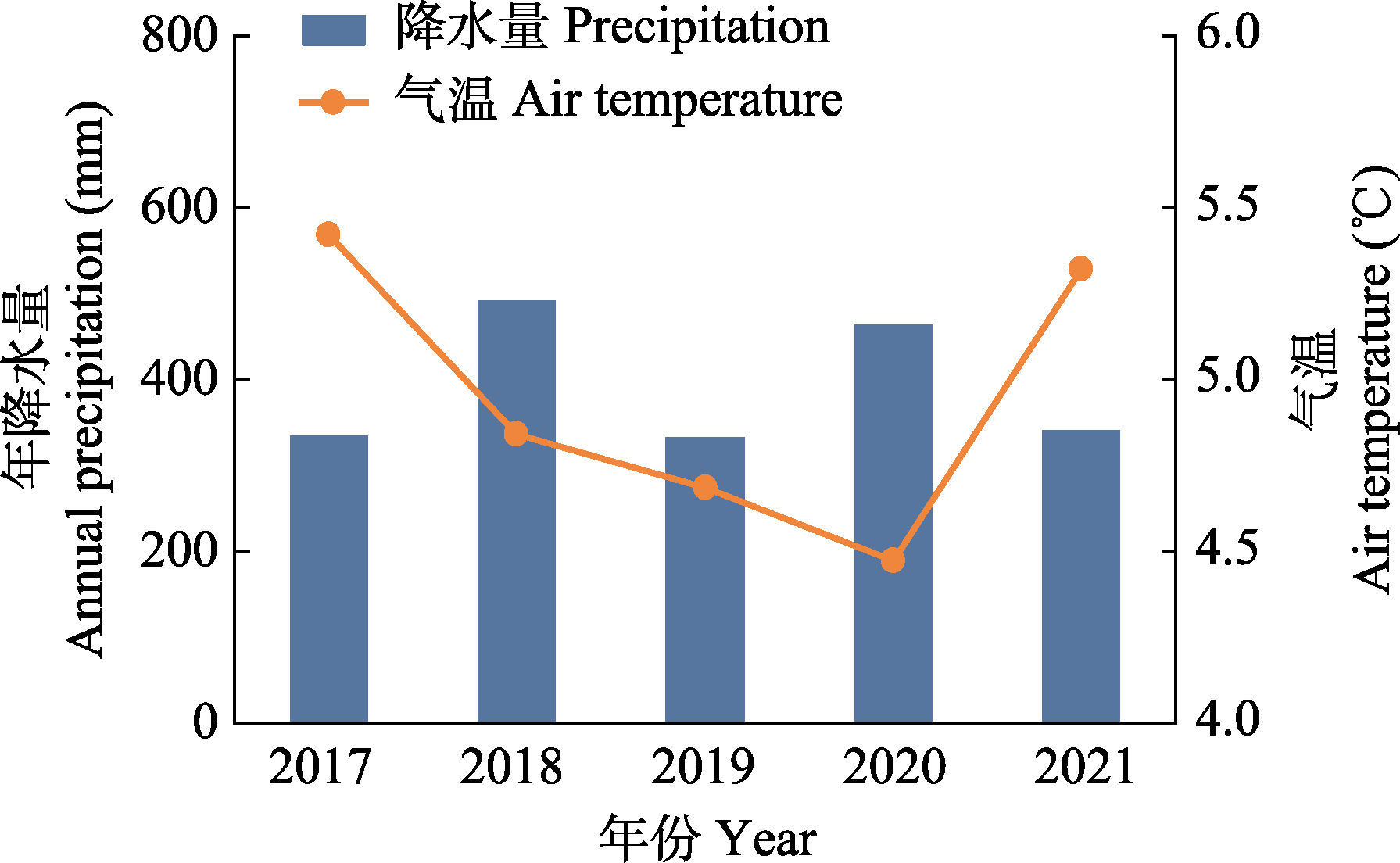
Fig. 1 Annual precipitation and air temperature during 2017-2021 at the study site in Leymus secalinus grassland in Northern Shanxi.
| 因子 Factor | ANPP | BNPP | NPP | NH4+-N | NO-3-N | ST | SWC | pH |
|---|---|---|---|---|---|---|---|---|
| 年 Year (Y) | 12.732*** | 60.957*** | 42.353*** | 1164.145*** | 336.475*** | 648.398*** | 86.091*** | 45.046*** |
| 氮添加 Nitrogen addition (N) | 12.502*** | 3.222** | 10.075*** | 22.508*** | 75.519*** | 3.824** | 0.522 | 4.051** |
| 年×氮添加 Y × N | 0.832 | 0.931 | 0.776 | 22.805*** | 7.085*** | 0.413 | 0.535 | 0.456 |
Table 1 Results (F value) of two factors analysis of variance of the effects of year, nitrogen addition, and their interactions on plant productivity and soil physicochemical properties of Leymus secalinus grassland in Northern Shanxi
| 因子 Factor | ANPP | BNPP | NPP | NH4+-N | NO-3-N | ST | SWC | pH |
|---|---|---|---|---|---|---|---|---|
| 年 Year (Y) | 12.732*** | 60.957*** | 42.353*** | 1164.145*** | 336.475*** | 648.398*** | 86.091*** | 45.046*** |
| 氮添加 Nitrogen addition (N) | 12.502*** | 3.222** | 10.075*** | 22.508*** | 75.519*** | 3.824** | 0.522 | 4.051** |
| 年×氮添加 Y × N | 0.832 | 0.931 | 0.776 | 22.805*** | 7.085*** | 0.413 | 0.535 | 0.456 |
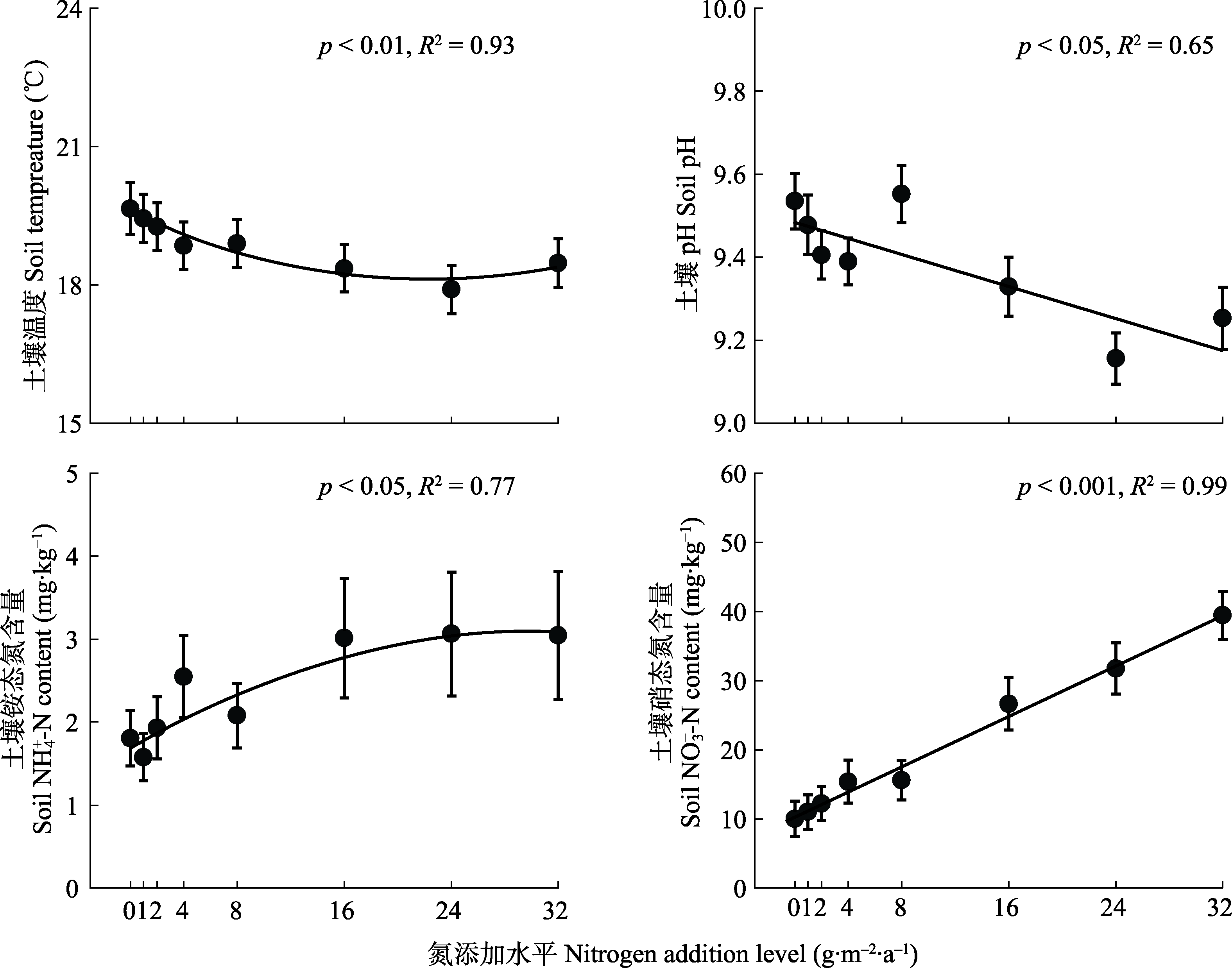
Fig. 2 Effect of nitrogen addition on soil temperature (A), pH (B), NH4+-N content (C), and NO-3-N content (D) in Leymus secalinus grassland in Northern Shanxi (mean ± SE).
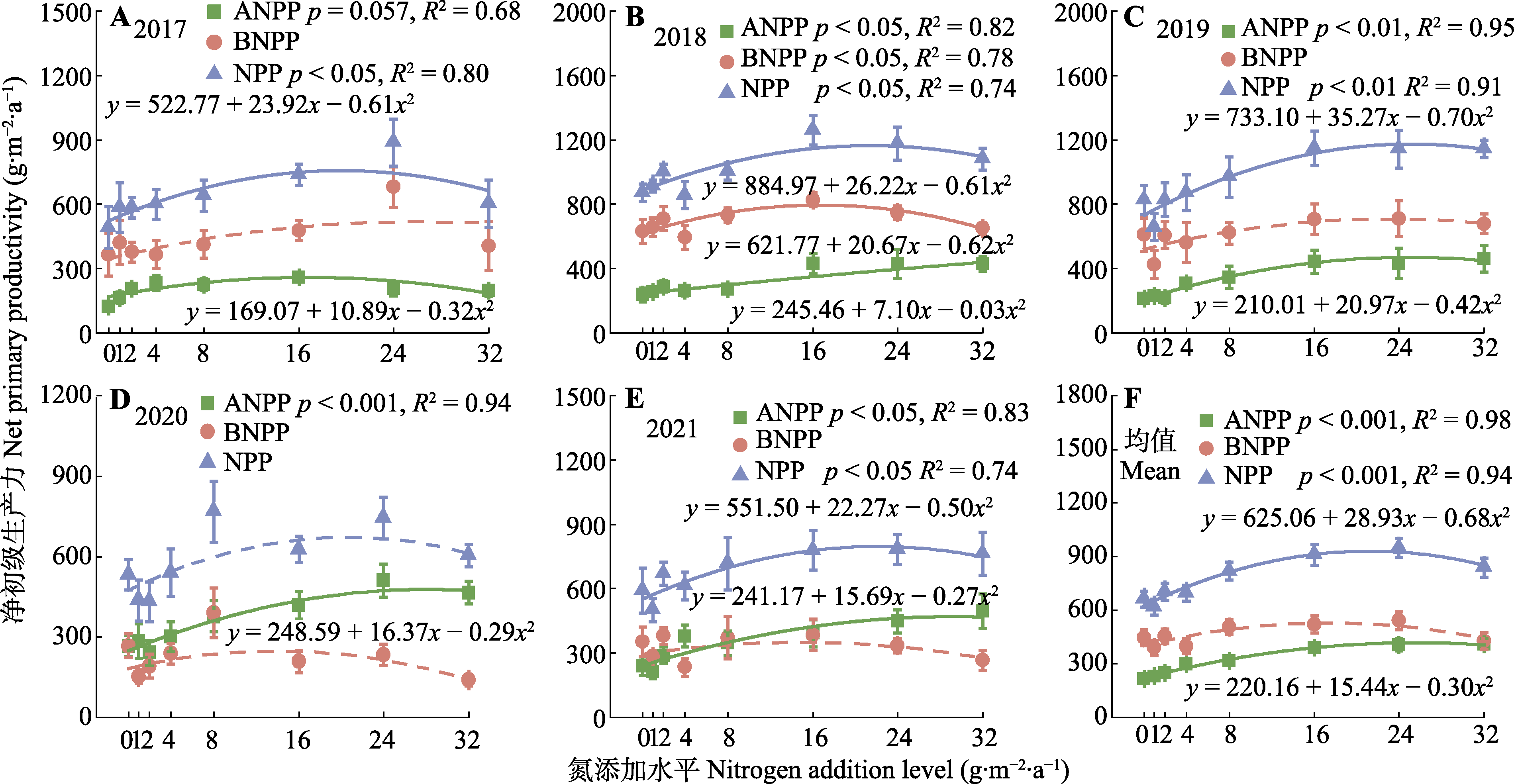
Fig. 3 Threshold of net primary productivity with the increase of nitrogen addition levels in Leymus secalinus grassland in Northern Shanxi of 2017-2021 (mean ± SE). ANPP, aboveground net primary productivity; BNPP, belowground net primary productivity; NPP, net primary productivity. Solid line represents a significant fitted equation (p < 0.05), and dashed line represents an insignificant fitted equation (p > 0.05).
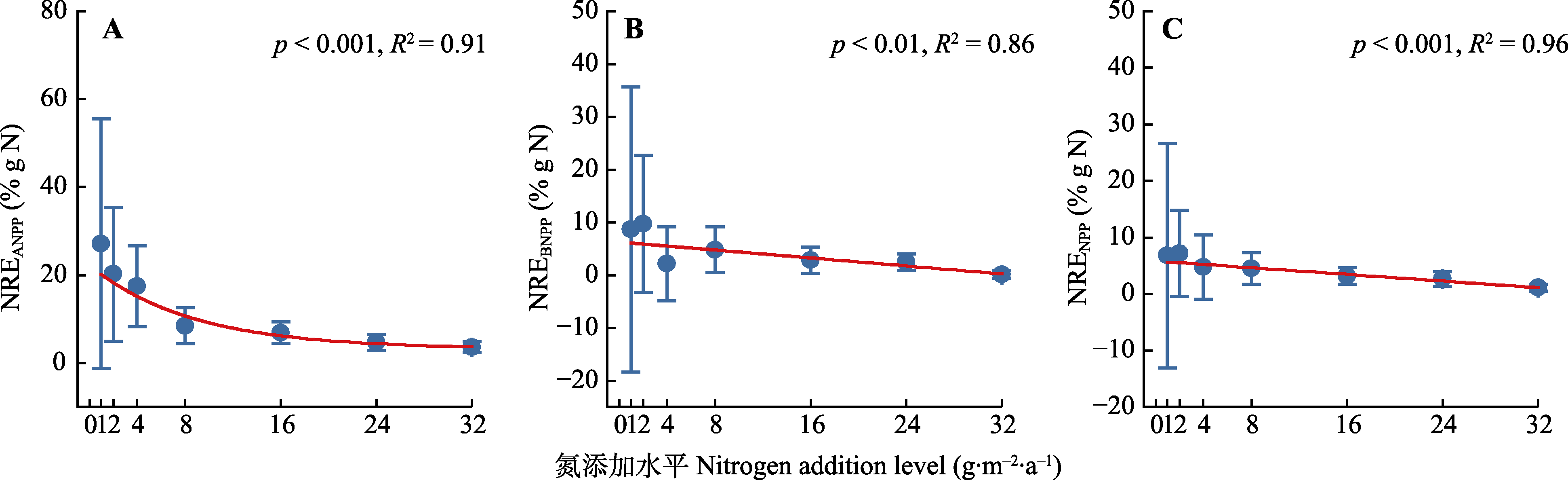
Fig. 4 Response efficiency of aboveground net primary productivity (NREANPP, A), underground net primary productivity (NREBNPP, B), and net primary productivity (NRENPP, C) under different nitrogen addition levels in Leymus secalinus grassland in Northern Shanxi (mean ± SE).
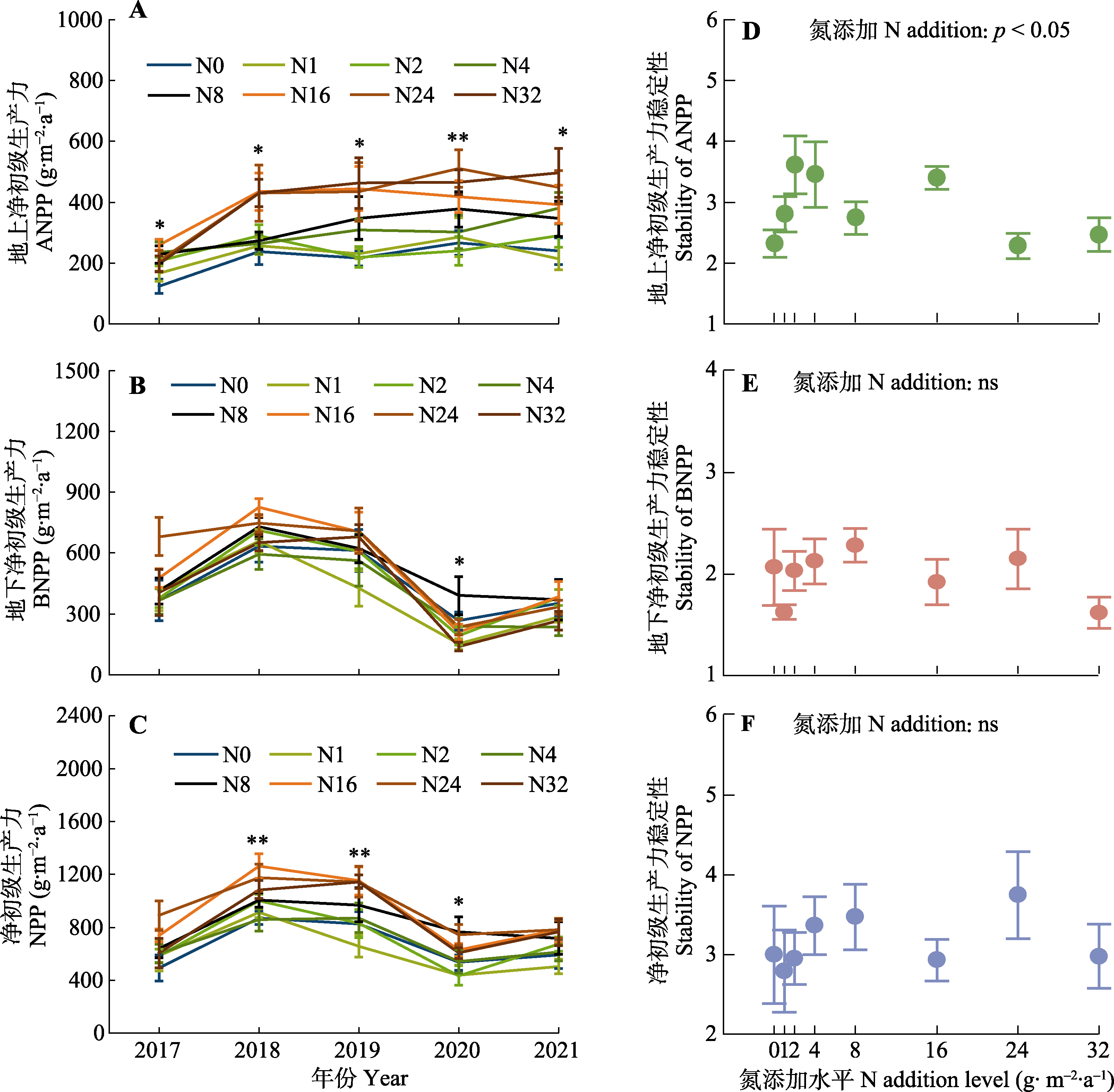
Fig. 5 Annual variation (A-C) and temporal stability (D-F) of plant productivity in Leymus secalinus grassland under different nitrogen (N) addition levels in Northern Shanxi (mean ± SE). ANPP, aboveground net primary productivity; BNPP, belowground net primary productivity; NPP, net primary productivity; N0, N1, N2, N4, N8, N16, N24, N32 represent N addition levels are 0, 1, 2, 4, 8, 16, 24, 32 g∙m-2∙a-1, respectively. *, p < 0.05; **, p < 0.01; ns, p > 0.05.
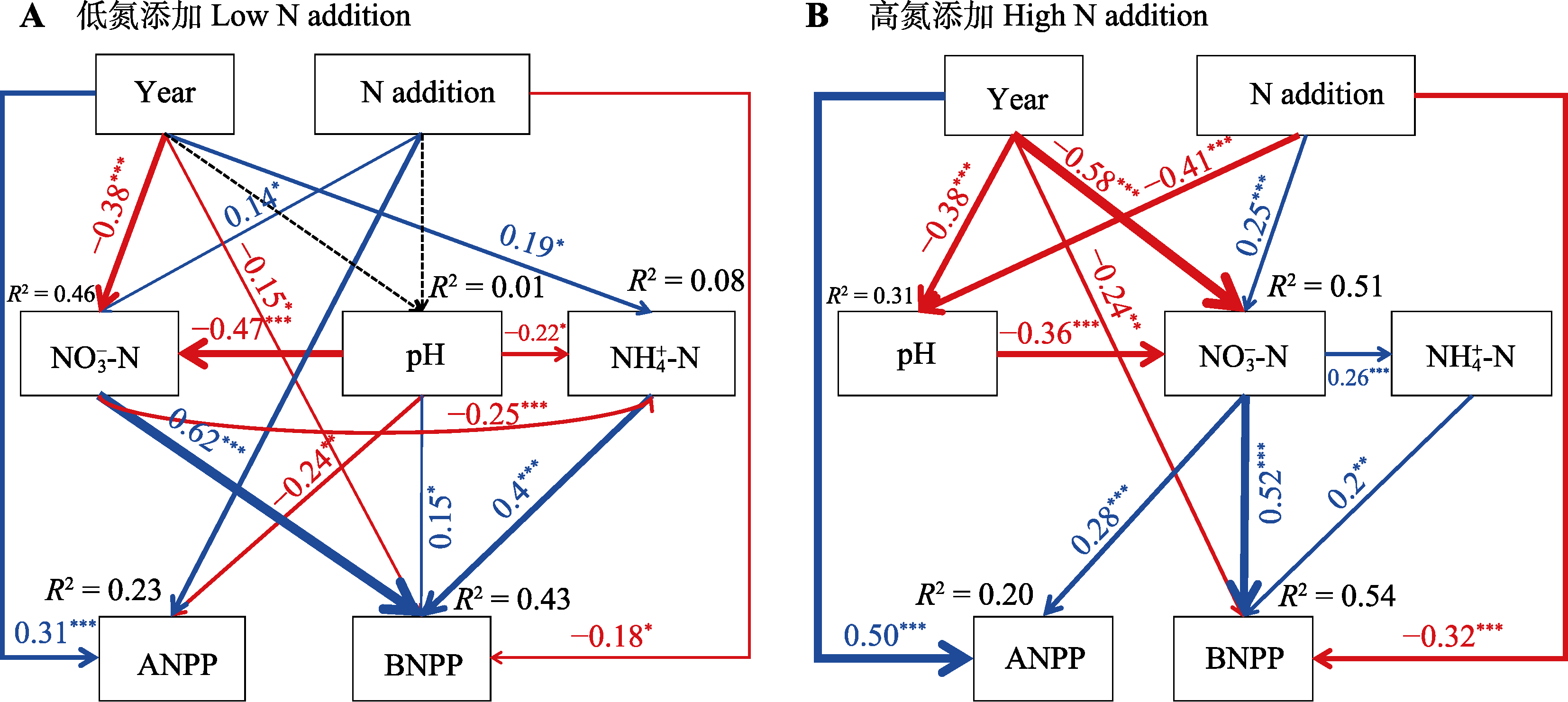
Fig. 6 Structural equation model of the directly and indirectly effects of low nitrogen addition (A) and high nitrogen (N) addition (B) on aboveground net primary productivity (ANPP) and belowground net primary productivity (BNPP). Blue and red lines represent significant positive and negative correlation, respectively, and black dashed line represents no significant correlation. Line width is proportional to the strength of the correlation. Low N addition: significance p = 0.373, Akaike Information Criterion (AIC) = 51.36, Chi-square = 5.36, df = 5; high N addition: p = 0.614, AIC = 45.22, Chi-square = 7.22, df = 9. NH4+-N, soil NH4+-N content; NO-3-N, soil NO-3-N content; pH, soil pH; ST, soil temperature; SM, soil water content. *, p < 0.05; **, p < 0.01; ***, p < 0.001.
| [1] |
Bai YF, Han XG, Wu JG, Chen ZZ, Li LH (2004). Ecosystem stability and compensatory effects in the Inner Mongolia grassland. Nature, 431, 181-184.
DOI |
| [2] |
Cai JP, Luo WT, Liu HY, Feng X, Zhang YY, Wang RZ, Xu ZW, Zhang YG, Jiang Y (2017). Precipitation-mediated responses of soil acid buffering capacity to long-term nitrogen addition in a semi-arid grassland. Atmospheric Environment, 170, 312-318.
DOI URL |
| [3] |
de Graaf MCC, Bobbink R, Roelofs JGM, Verbeek PJM (1998). Differential effects of ammonium and nitrate on three heathland species. Plant Ecology, 135, 185-196.
DOI |
| [4] | Deng TT, Zhou GY, Xiao YM, Jin YT, Li CB (2024). Effects of long-term precipitation changes and nitrogen addition on species diversity and productivity of alpine grasslands in the Qinghai Tibet Plateau. Acta Agrestia Sinica, 32, 1448-1458. |
|
[邓彤彤, 周国英, 肖元明, 靳玉婷, 李长斌 (2024). 长期降水变化和氮添加对青藏高原高寒草原物种多样性和生产力的影响. 草地学报, 32, 1448-1458.]
DOI |
|
| [5] |
Dijkstra FA, Zhu B, Cheng WX (2021). Root effects on soil organic carbon: a double-edged sword. New Phytologist, 230, 60-65.
DOI PMID |
| [6] | Fan W, Meng R, Chen QS (2010). Effects of nitrogen additions on ground/underground biomass allocation of Stipa krylovii community. Animal Husbandry and Feed Science, 31(2), 74-75. |
| [樊维, 蒙荣, 陈全胜 (2010). 不同施氮水平对克氏针茅草原地上地下生物量分配的影响. 畜牧与饲料科学, 31(2), 74-75.] | |
| [7] | Fan YM, Li W, Wen ZM, Guo Q, Liu J, Yang X, Zheng C, Yang YT, Jiang YM, Zhang B (2021). Responses of grassland community biomass and root-shoot ratio to nitrogen addition in different restoration years on the Loess Plateau. Acta Ecologica Sinica, 41, 9824-9835. |
| [樊勇明, 李伟, 温仲明, 郭倩, 刘晶, 杨雪, 郑诚, 杨玉婷, 姜艳敏, 张博 (2021). 黄土区不同恢复年限草地群落生物量及根冠比对氮添加的响应. 生态学报, 41, 9824-9835.] | |
| [8] |
Galloway JN, Dentener FJ, Capone DG, Boyer EW, Howarth RW, Seitzinger SP, Asner GP, Cleveland CC, Green PA, Holland EA, Karl DM, Michaels AF, Porter JH, Townsend AR, Vöosmarty CJ (2004). Nitrogen cycles: past, present, and future. Biogeochemistry, 70, 153-226.
DOI URL |
| [9] |
Geng XQ, Tang YK, Wang LN, Deng X, Zhang ZL, Zhou Y (2024). Nitrogen addition increases biomass but reduces nitrogen use efficiency of terrestrial plants in China. Chinese Journal of Plant Ecology, 48, 147-157.
DOI URL |
|
[耿雪琪, 唐亚坤, 王丽娜, 邓旭, 张泽凌, 周莹 (2024). 氮添加增加中国陆生植物生物量并降低其氮利用效率. 植物生态学报, 48, 147-157.]
DOI |
|
| [10] |
Jing MH, Jia XT, Zhang YL, Cao J, Zhou W, Wang J, Yu Q (2020). Effects of long-term nitrogen addition on community aboveground and belowground biomass and their ratio in a typical steppe of Inner Mongolia. Chinese Journal of Ecology, 39, 3185-3193.
DOI |
| [景明慧, 贾晓彤, 张运龙, 曹娟, 周伟, 王杰, 庾强 (2020). 长期氮添加对内蒙古典型草原植物地上、地下生物量及根冠比的影响. 生态学杂志, 39, 3185-3193.] | |
| [11] |
Knapp AK, Ciais P, Smith MD (2017). Reconciling inconsistencies in precipitation-productivity relationships: implications for climate change. New Phytologist, 214, 41-47.
DOI PMID |
| [12] | Kuai XY, Xing PF, Zhang XL, Wang CH, Dong KH (2019). Effects of short-term nitrogen addition on plant community diversity and productivity of grassland in agro-pastoral ecotone. Chinese Journal of Grassland, 41(5), 104-110. |
| [蒯晓妍, 邢鹏飞, 张晓琳, 王常慧, 董宽虎 (2019). 短期不同水平氮添加对农牧交错带草地植物群落多样性和生产力的影响. 中国草地学报, 41(5), 104-110.] | |
| [13] |
Li BH, Li GJ, Kronzucker HJ, Baluška F, Shi WM (2014). Ammonium stress in Arabidopsis: signaling, genetic loci, and physiological targets. Trends in Plant Science, 19, 107-114.
DOI URL |
| [14] |
Li JZ, Lin S, Taube F, Pan QM, Dittert K (2011). Above and belowground net primary productivity of grassland influenced by supplemental water and nitrogen in Inner Mongolia. Plant and Soil, 340, 253-264.
DOI URL |
| [15] |
Liang XY, Zhang T, Lu XK, Ellsworth DS, BassiriRad H, You CM, Wang D, He PC, Deng Q, Liu H, Mo JM, Ye Q (2020). Global response patterns of plant photosynthesis to nitrogen addition: a meta-analysis. Global Change Biology, 26, 3585-3600.
DOI PMID |
| [16] |
Liu L, Wen Z, Liu S, Zhang XY, Liu XJ (2024). Decline in atmospheric nitrogen deposition in China between 2010 and 2020. Nature Geoscience, 17, 733-736.
DOI |
| [17] |
Lu M, Yang YH, Luo YQ, Fang CM, Zhou XH, Chen JK, Yang X, Li B (2011). Responses of ecosystem nitrogen cycle to nitrogen addition: a meta-analysis. New Phytologist, 189, 1040-1050.
DOI PMID |
| [18] | Luo WT, Griffin-Nolan RJ, Ma W, Liu B, Zuo XA, Xu C, Yu Q, Luo YH, Mariotte P, Smith MD, Collins SL, Knapp AK, Wang ZW, Han XG (2021). Plant traits and soil fertility mediate productivity losses under extreme drought in C3 grasslands. Ecology, 102, e03465. DOI: 10.1002/ecy.3465. |
| [19] |
Muraina TO, Xu C, Yu Q, Yang YD, Jing MH, Jia XT, Jaman MS, Dam Q, Knapp AK, Collins SL, Luo YQ, Luo WT, Zuo XA, Xin XP, Han XG, Smith MD (2021). Species asynchrony stabilises productivity under extreme drought across Northern China grasslands. Journal of Ecology, 109, 1665-1675.
DOI URL |
| [20] |
Namuhan, Wang J, Yang GJ, Song YT, Yu YG, Wang JD, Wang XG, Shi YP, Shen Y, Han XG, Wuyunna, Zhang HY (2024). Mechanisms of biodiversity loss under nitrogen enrichment: unveiling a shift from light competition to cation toxicity. New Phytologist, 243, 1966-1979.
DOI PMID |
| [21] |
Peng YF, Chen HYH, Yang YH (2020). Global pattern and drivers of nitrogen saturation threshold of grassland productivity. Functional Ecology, 34, 1979-1990.
DOI URL |
| [22] |
Shcherbak I, Millar N, Robertson GP (2014). Global metaanalysis of the nonlinear response of soil nitrous oxide (N2O) emissions to fertilizer nitrogen. Proceedings of the National Academy of Sciences of the United States of America, 111, 9199-9204.
DOI PMID |
| [23] | Song QH (2016). The Environmental Adaptability of Biomass Allocation and Root Functional Traits of Stipa krylovii in Degraded Alpine Grassland. Master degree dissertation, Northwest Normal University, Lanzhou. |
| [宋清华 (2016). 高寒退化草地西北针茅生物量分配和根系功能性状的环境适应性. 硕士毕业论文, 西北师范大学, 兰州.] | |
| [24] |
Sun JM, Zhang B, Pan QM, Liu W, Wang XL, Huang JH, Chen DM, Wang CH, Han XG (2023). Non-linear response of productivity to precipitation extremes in the Inner Mongolia grassland. Functional Ecology, 37, 1663-1673.
DOI URL |
| [25] | Tian DS, Wang H, Sun J, Niu SL (2016a). Global evidence on nitrogen saturation of terrestrial ecosystem net primary productivity. Environmental Research Letters, 11, 024012. DOI: 10.1088/1748-9326/11/2/024012. |
| [26] |
Tian QY, Liu NN, Bai WM, Li LH, Chen JQ, Reich PB, Yu Q, Guo DL, Smith MD, Knapp AK, Cheng WX, Lu P, Gao Y, Yang A, Wang TZ, et al. (2016b). A novel soil manganese mechanism drives plant species loss with increased nitrogen deposition in a temperate steppe. Ecology, 97, 65-74.
DOI URL |
| [27] |
Wang J, Gao YZ, Zhang YH, Yang JJ, Smith MD, Knapp AK, Eissenstat DM, Han XG (2019). Asymmetry in above- and belowground productivity responses to N addition in a semi-arid temperate steppe. Global Change Biology, 25, 2958-2969.
DOI PMID |
| [28] | Wang XW, Niu MN, Zhang LW, Bai WM, Li GY, Chen AQ (2021). Effects of multi-level nitrogen addition on plant above- and below-ground biomass allocation in a typical temperate steppe. Journal of Henan Normal University (Natural Science Edition), 49(6), 39-46. |
| [王晓薇, 牛萌楠, 张丽薇, 白文明, 李国勇, 陈安群 (2021). 不同施氮水平对温带典型草原植物地上-地下生物量分配模式的影响. 河南师范大学学报(自然科学版), 49(6), 39-46.] | |
| [29] | Wang XY, Chen JG, Zhang YH, Bi HX (2024). Effects of different frequencies of nitrogen addition on chlorophyll in typical grassland in Inner Mongolia. Acta Ecologica Sinica, 44, 4854-4864. |
| [王晓燕, 陈俊刚, 张云海, 毕华兴 (2024). 不同频率氮添加对内蒙古典型草原植物叶绿素的影响. 生态学报, 44, 4854-4864.] | |
| [30] |
Wilcox KR, von Fischer JC, Muscha JM, Petersen MK, Knapp AK (2015). Contrasting above- and belowground sensitivity of three Great Plains grasslands to altered rainfall regimes. Global Change Biology, 21, 335-344.
DOI PMID |
| [31] |
Xiao LJ, Wang GC, Chang JF, Chen YY, Guo XW, Mao XL, Wang MM, Zhang S, Shi Z, Luo YQ, Cheng L, Yu KL, Mo F, Luo ZK (2023). Global depth distribution of belowground net primary productivity and its drivers. Global Ecology and Biogeography, 32, 1435-1451.
DOI URL |
| [32] | Xie DN, Yang DX, Duan L (2023). Response of forest ecosystems to decreasing atmospheric nitrogen deposition. Environmental Science, 44, 2681-2693. |
| [谢丹妮, 仰东星, 段雷 (2023). 森林生态系统对大气氮沉降降低的响应. 环境科学, 44, 2681-2693.] | |
| [33] | Xu ZW, Jiang L, Ren HY, Han XG (2024). Opposing responses of temporal stability of aboveground and belowground net primary productivity to water and nitrogen enrichment in a temperate grassland. Global Change Biology, 30, e17071. DOI: 10.1111/gcb.17071. |
| [34] |
Yahdjian L, Gherardi L, Sala OE (2011). Nitrogen limitation in arid-subhumid ecosystems: a meta-analysis of fertilization studies. Journal of Arid Environments, 75, 675-680.
DOI URL |
| [35] | Yuan XB (2020). Effects of N Deposition on Plant Community Stability and Soil Microbial Nutrient Utilization Processes in Typical Grassland on Loess Plateau. PhD dissertation, Lanzhou University, Lanzhou. |
| [袁晓波 (2020). 氮沉降对黄土高原典型草原植物群落稳定性及土壤微生物养分利用过程的影响. 博士学位论文, 兰州大学, 兰州.] | |
| [36] |
Yang GJ, Hautier Y, Zhang ZJ, Lü XT, Han XG (2022). Decoupled responses of above- and below-ground stability of productivity to nitrogen addition at the local and larger spatial scale. Global Change Biology, 28, 2711-2720.
DOI URL |
| [37] |
Yang GJ, Stevens C, Zhang ZJ, Lü XT, Han XG (2023). Different nitrogen saturation thresholds for above-, below-, and total net primary productivity in a temperate steppe. Global Change Biology, 29, 4586-4594.
DOI URL |
| [38] | Yang JM (2022). Response Mechanisms of Soil Organic Carbon Fractions to Nitrogen Addition Gradient in an Alpine Meadow. Master degree dissertation, Southwest Minzu University, Chengdu. |
| [杨家明 (2022). 高寒草甸土壤有机碳组分对氮添加梯度的响应机制. 硕士学位论文, 西南民族大学, 成都.] | |
| [39] |
Yang SQ, Bao YJ, Ye JQ, Wu S, Zhang M, Xu MR, Zhao Y, Lyu XT, Han XG (2023). Comparison of photosynthetic-CO2 response process and models of Leymus chinensis under differing nitrogen addition and mowing conditions. Acta Prataculturae Sinica, 32, 160-172.
DOI |
|
[杨斯琪, 鲍雅静, 叶佳琦, 吴帅, 张萌, 徐梦冉, 赵钰, 吕晓涛, 韩兴国 (2023). 氮添加和刈割条件下羊草光合-CO2响应过程及模型比较研究. 草业学报, 32, 160-172.]
DOI |
|
| [40] |
Yang YH, Zhang DY, Wei B, Liu Y, Feng XH, Mao C, Xu WJ, He M, Wang L, Zheng ZH, Wang YY, Chen LY, Peng YF (2023). Nonlinear responses of community diversity, carbon and nitrogen cycles of grassland ecosystems to external nitrogen input. Chinese Journal of Plant Ecology, 47, 1-24.
DOI URL |
|
[杨元合, 张典业, 魏斌, 刘洋, 冯雪徽, 毛超, 徐玮婕, 贺美, 王璐, 郑志虎, 王媛媛, 陈蕾伊, 彭云峰 (2023). 草地群落多样性和生态系统碳氮循环对氮输入的非线性响应及其机制. 植物生态学报, 47, 1-24.]
DOI |
|
| [41] |
Zhang YH, Loreau M, Lü XT, He NP, Zhang GM, Han XG (2016). Nitrogen enrichment weakens ecosystem stability through decreased species asynchrony and population stability in a temperate grassland. Global Change Biology, 22, 1445-1455.
DOI PMID |
| Viewed | ||||||
|
Full text |
|
|||||
|
Abstract |
|
|||||
Copyright © 2026 Chinese Journal of Plant Ecology
Tel: 010-62836134, 62836138, E-mail: apes@ibcas.ac.cn, cjpe@ibcas.ac.cn

